04
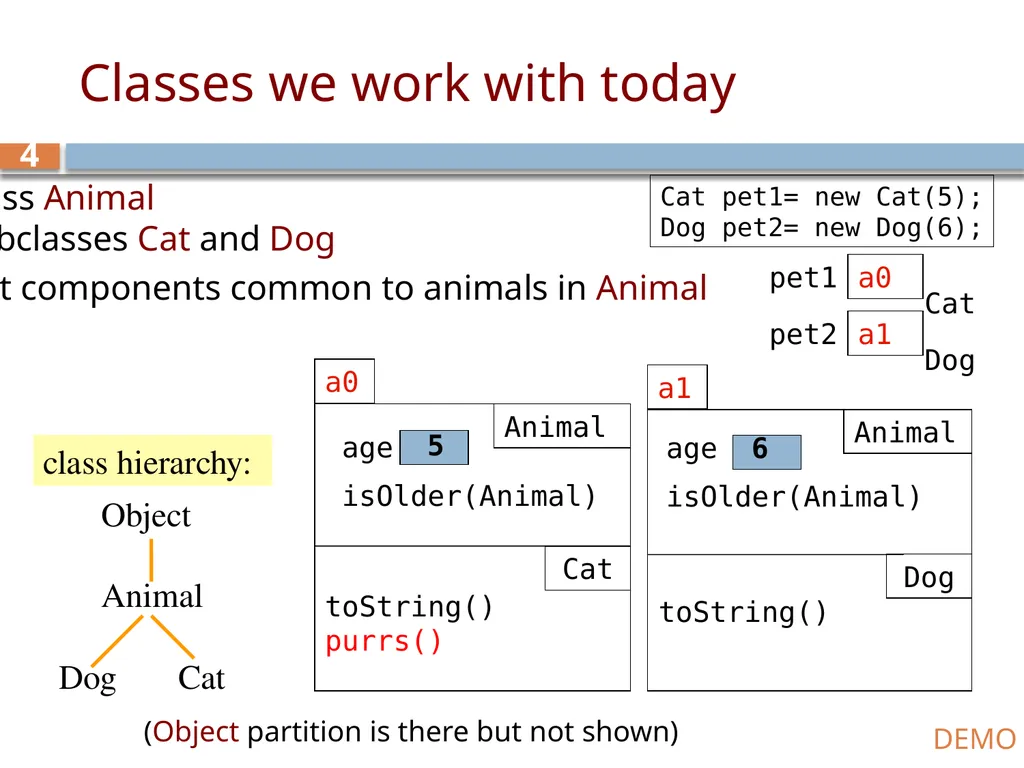
Classes we work with today 4 class Animal
subclasses Cat and Dog
Put components common to animals in Animal (Object partition is there but not shown) Cat pet1= new Cat(5);
Dog pet2= new Dog(6); DEMO<br>
06
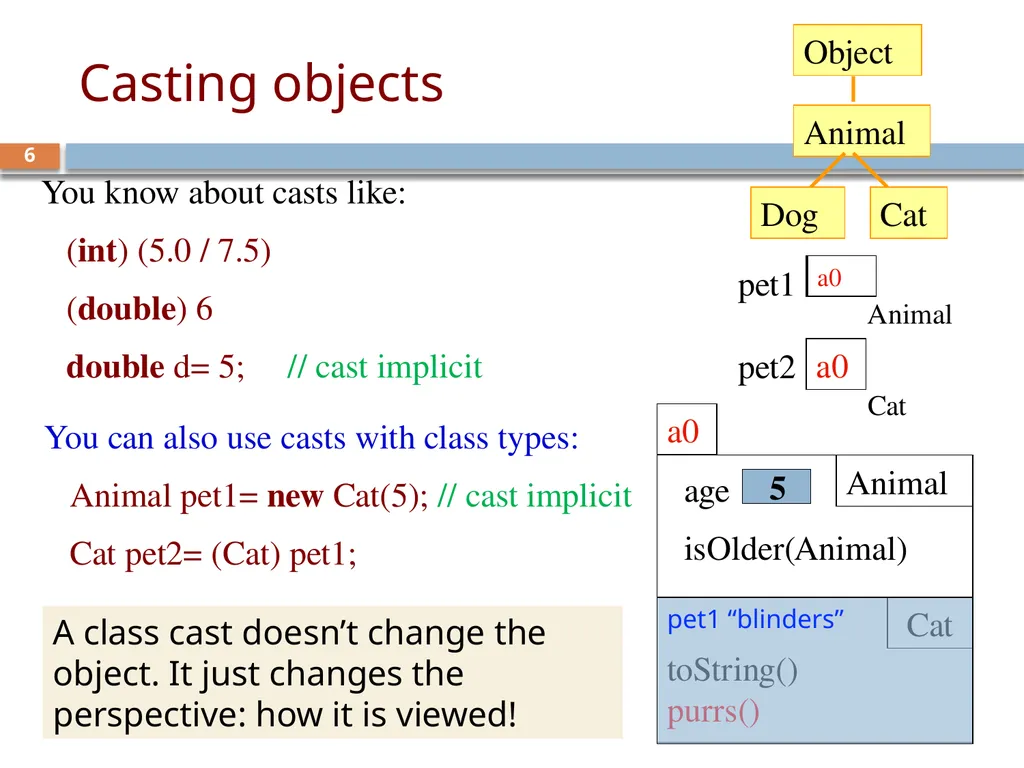
Casting objects 6 You know about casts like:
(int) (5.0 / 7.5)
(double) 6
double d= 5; // cast implicit You can also use casts with class types:
Animal pet1= new Cat(5); // cast implicit
Cat pet2= (Cat) pet1; A class cast doesn’t change the object. It just changes the perspective: how it is viewed! a0 pet1 “blinders”<br>
07
age
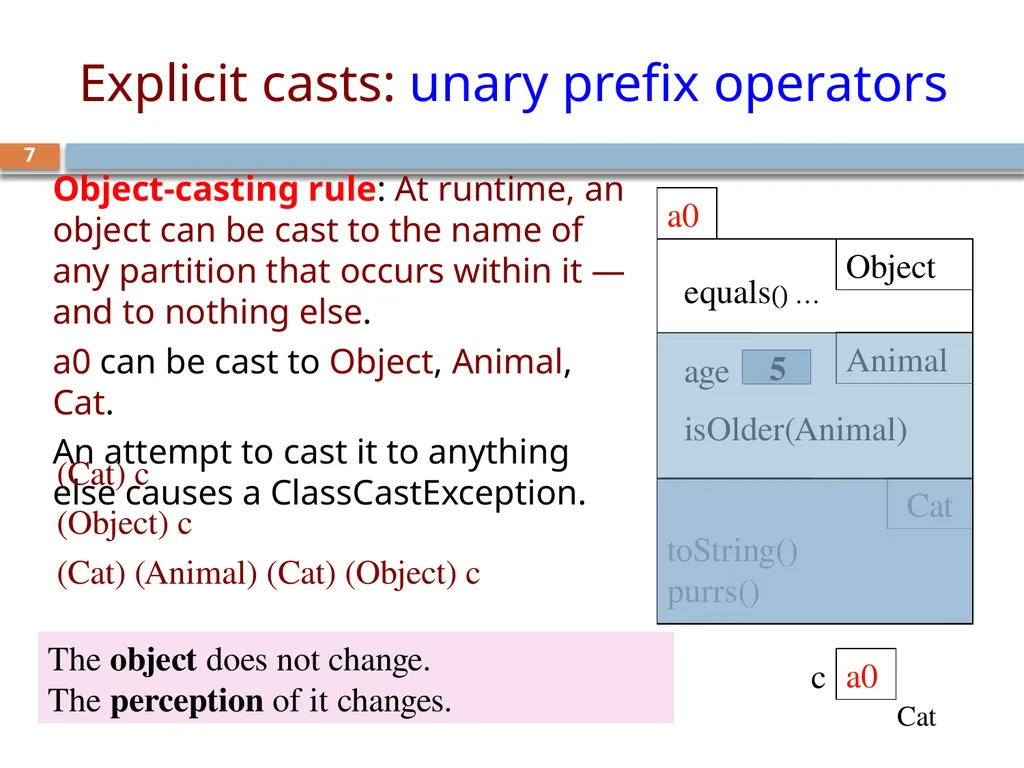
isOlder(Animal) Explicit casts: unary prefix operators 7 a0 Animal Cat toString()�purrs() 5 Object equals() … Object-casting rule: At runtime, an object can be cast to the name of any partition that occurs within it —and to nothing else.
a0 can be cast to Object, Animal, Cat.
An attempt to cast it to anything else causes a ClassCastException. (Cat) c
(Object) c
(Cat) (Animal) (Cat) (Object) c The object does not change.
The perception of it changes.<br>
08
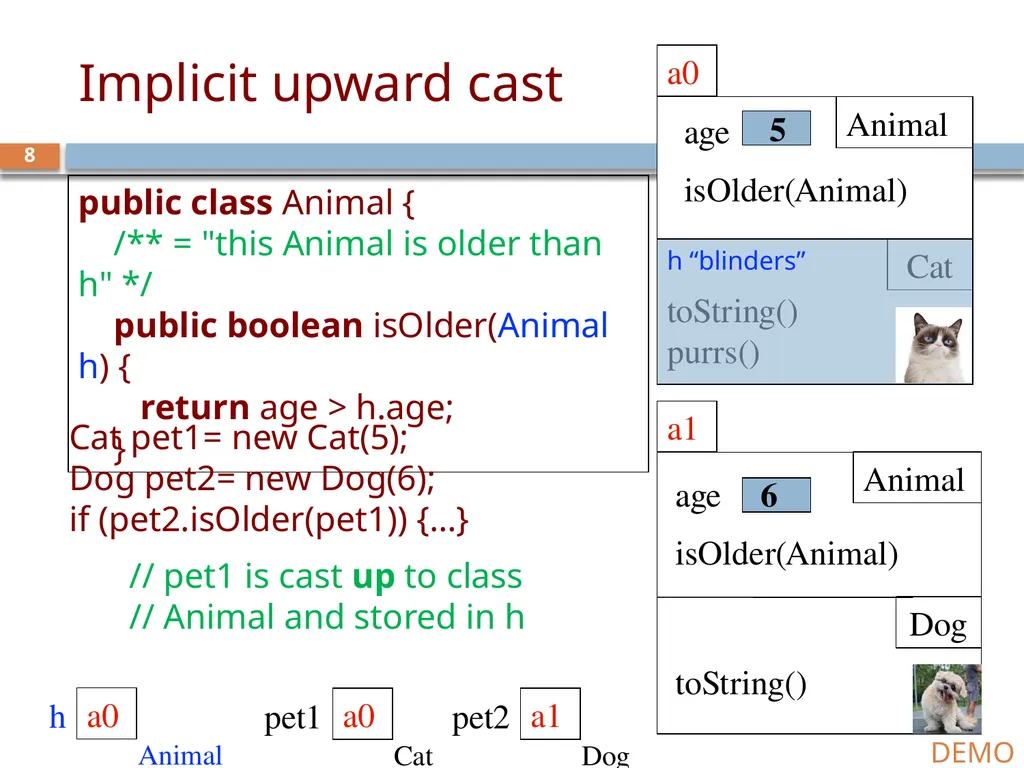
Implicit upward cast 8 public class Animal {
/** = "this Animal is older than h" */
public boolean isOlder(Animal h) {
return age > h.age; � } // pet1 is cast up to class �// Animal and stored in h Cat pet1= new Cat(5);
Dog pet2= new Dog(6);
if (pet2.isOlder(pet1)) {…} h “blinders” DEMO<br>
09
Compile-time reference rule 9<br>
10
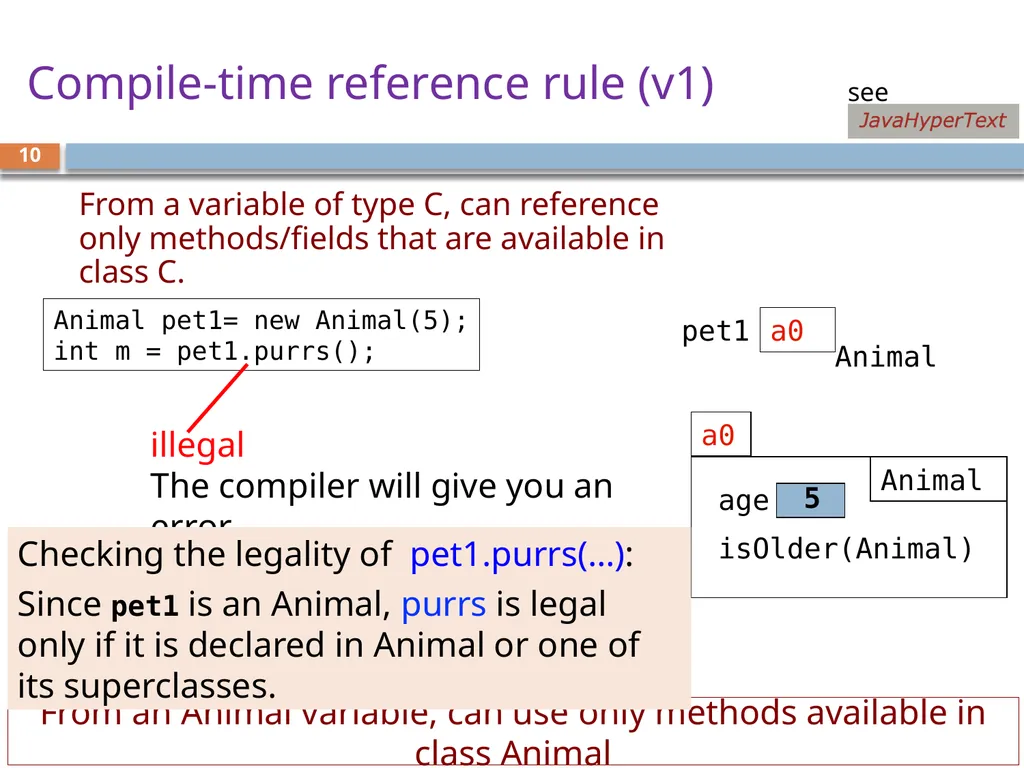
Compile-time reference rule (v1) 10 From a variable of type C, can reference only methods/fields that are available in class C. Animal pet1= new Animal(5);
int m = pet1.purrs(); illegal
The compiler will give you an error. From an Animal variable, can use only methods available in class Animal see Checking the legality of pet1.purrs(…):
Since pet1 is an Animal, purrs is legal only if it is declared in Animal or one of its superclasses.<br>
11
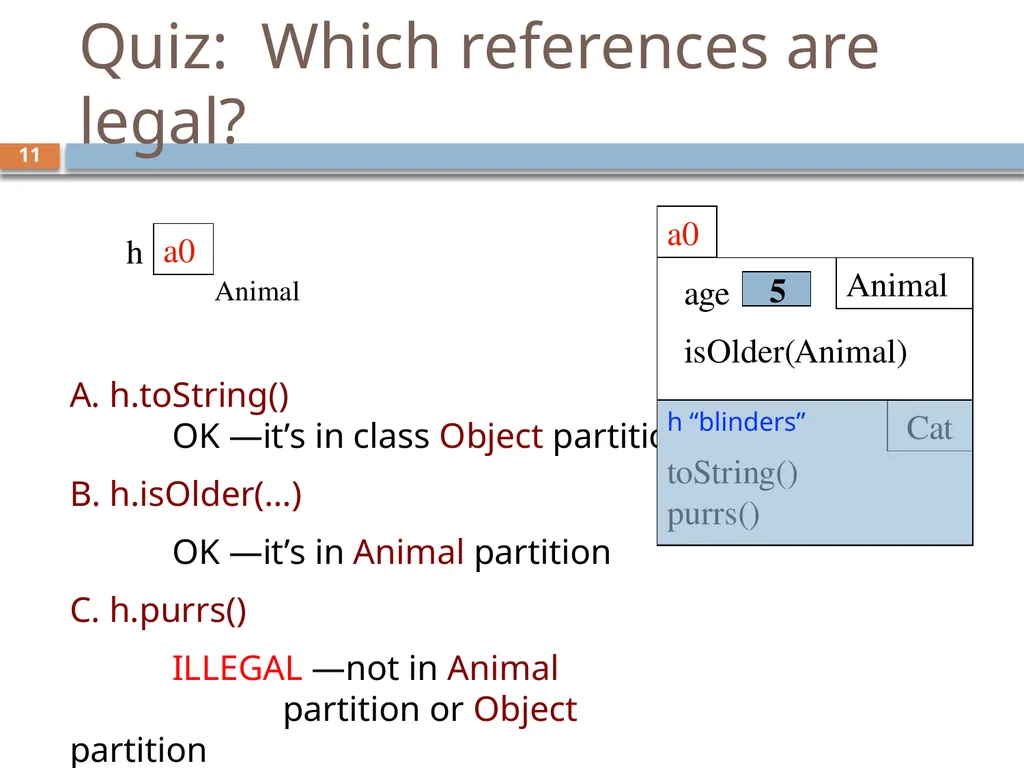
Quiz: Which references are legal? 11 A. h.toString()
OK —it’s in class Object partition
B. h.isOlder(…)
OK —it’s in Animal partition
C. h.purrs()
ILLEGAL —not in Animal
partition or Object partition h “blinders”<br>
13
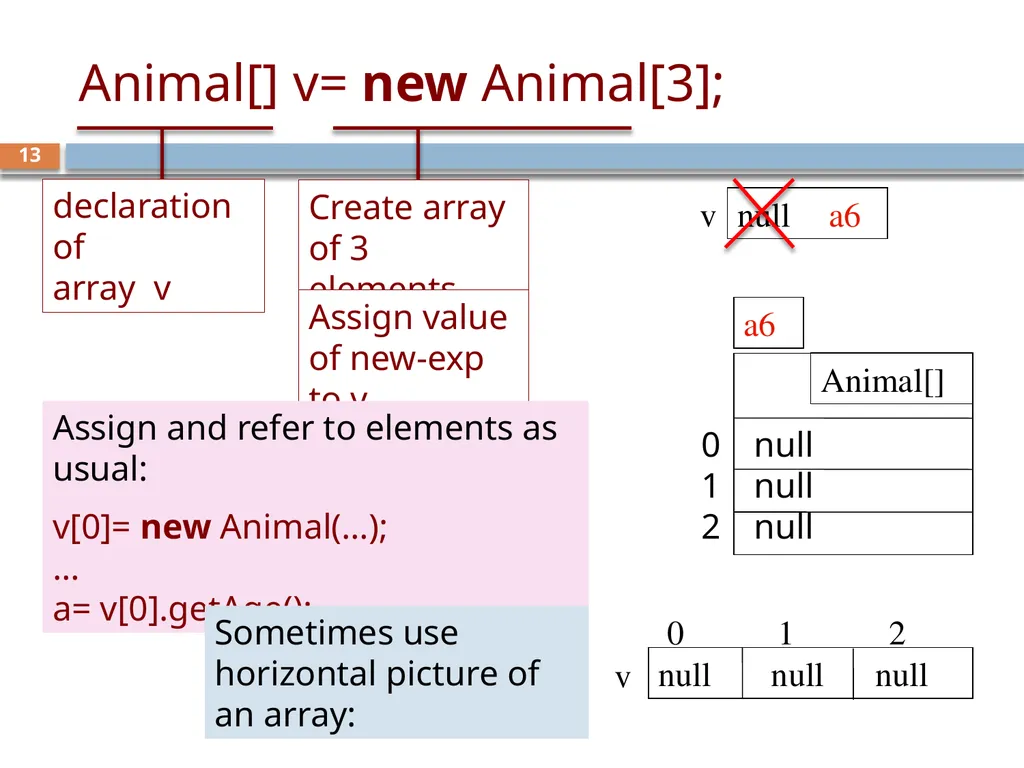
Animal[] v= new Animal[3]; 13 Assign value of new-exp to v Assign and refer to elements as usual:
v[0]= new Animal(…);
…
a= v[0].getAge();<br>
14
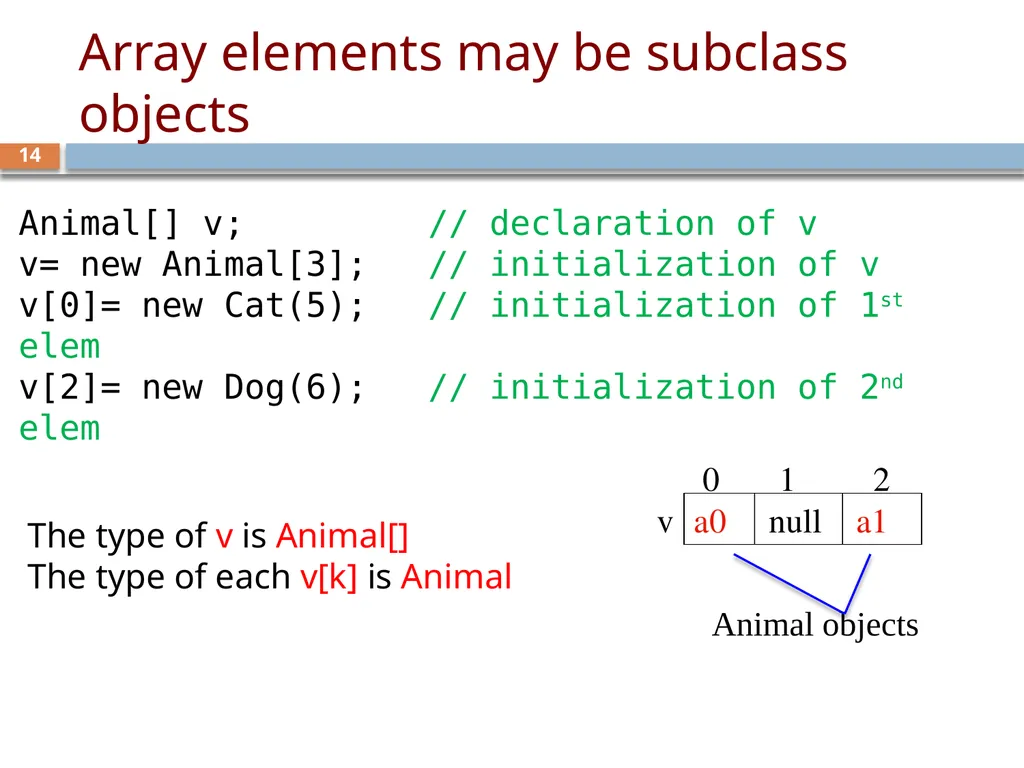
The type of v is Animal[]
The type of each v[k] is Animal Array elements may be subclass objects 14 Animal[] v; // declaration of v
v= new Animal[3]; // initialization of v
v[0]= new Cat(5); // initialization of 1st elem
v[2]= new Dog(6); // initialization of 2nd elem Animal objects<br>
15
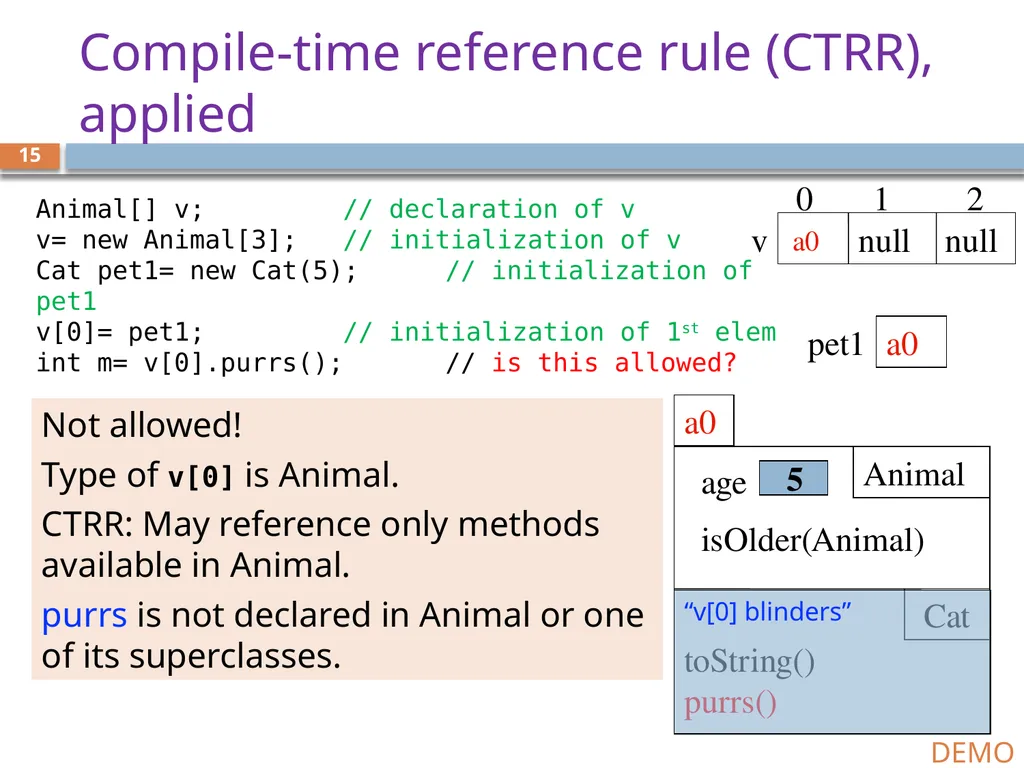
Compile-time reference rule (CTRR), applied 15 Animal[] v; // declaration of v
v= new Animal[3]; // initialization of v
Cat pet1= new Cat(5); // initialization of pet1
v[0]= pet1; // initialization of 1st elem
int m= v[0].purrs(); // is this allowed? a0 “v[0] blinders” Not allowed!
Type of v[0] is Animal.
CTRR: May reference only methods available in Animal.
purrs is not declared in Animal or one of its superclasses. DEMO<br>
16
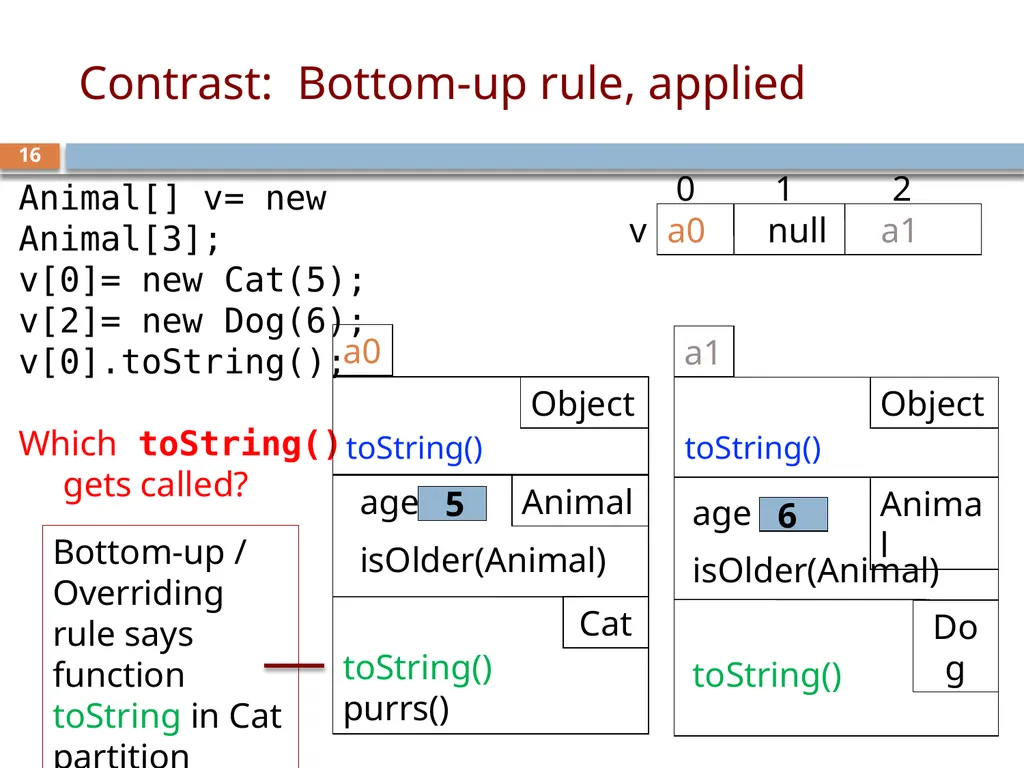
Animal[] v= new Animal[3];
v[0]= new Cat(5);
v[2]= new Dog(6);
v[0].toString();
Which toString()
gets called? Contrast: Bottom-up rule, applied 16 Object Object toString() toString()<br>
18
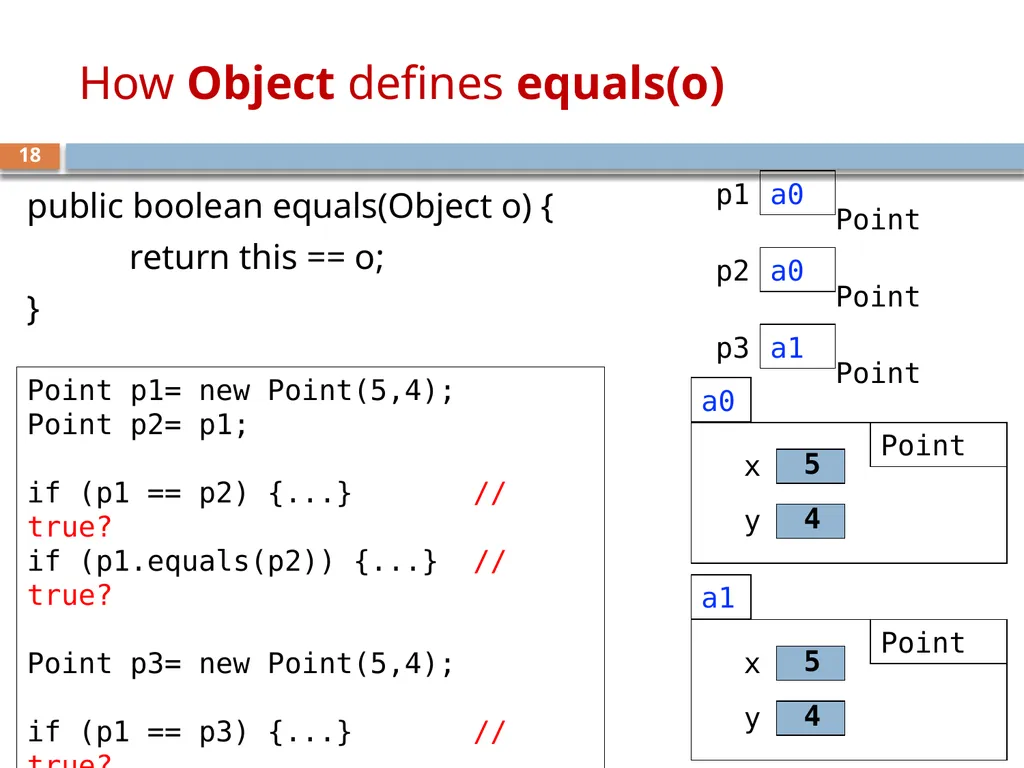
How Object defines equals(o) 18 public boolean equals(Object o) {
return this == o;
} Point p1= new Point(5,4);
Point p2= p1;
if (p1 == p2) {...} // true?
if (p1.equals(p2)) {...} // true?
Point p3= new Point(5,4);
if (p1 == p3) {...} // true?
if (p1.equals(p3)) {...} // true?<br>
19
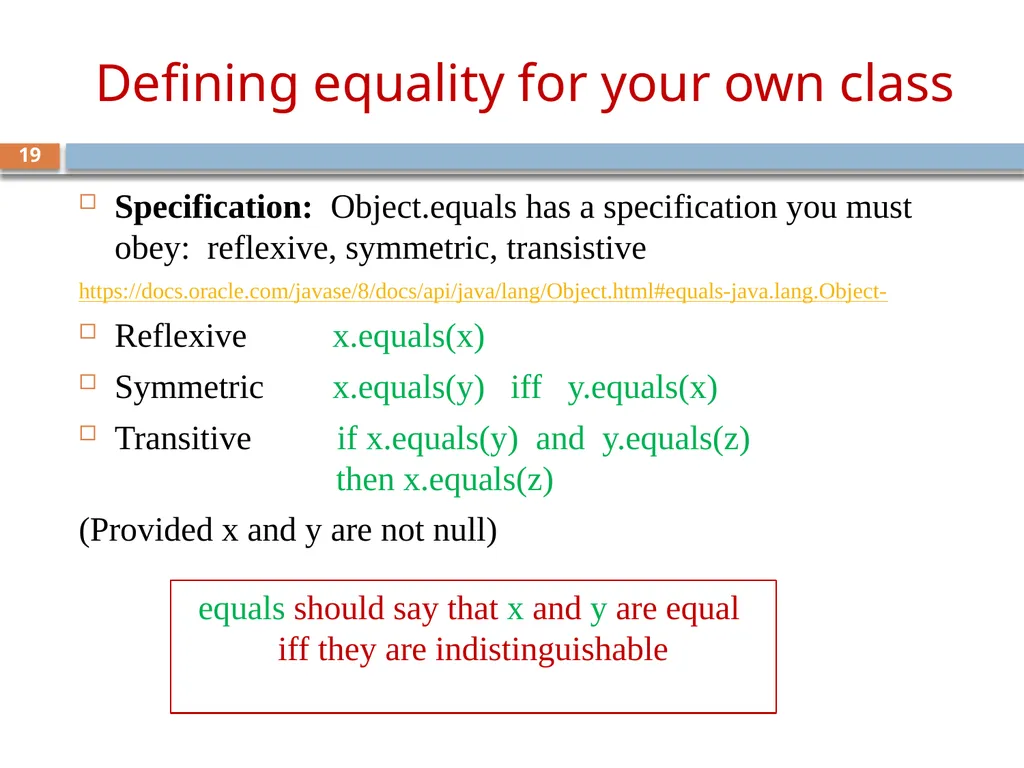
Defining equality for your own class 19 Specification: Object.equals has a specification you must obey: reflexive, symmetric, transistive
https://docs.oracle.com/javase/8/docs/api/java/lang/Object.html#equals-java.lang.Object-
Reflexive x.equals(x)
Symmetric x.equals(y) iff y.equals(x)
Transitive if x.equals(y) and y.equals(z)� then x.equals(z)
(Provided x and y are not null) equals should say that x and y are equal �iff they are indistinguishable<br>
20
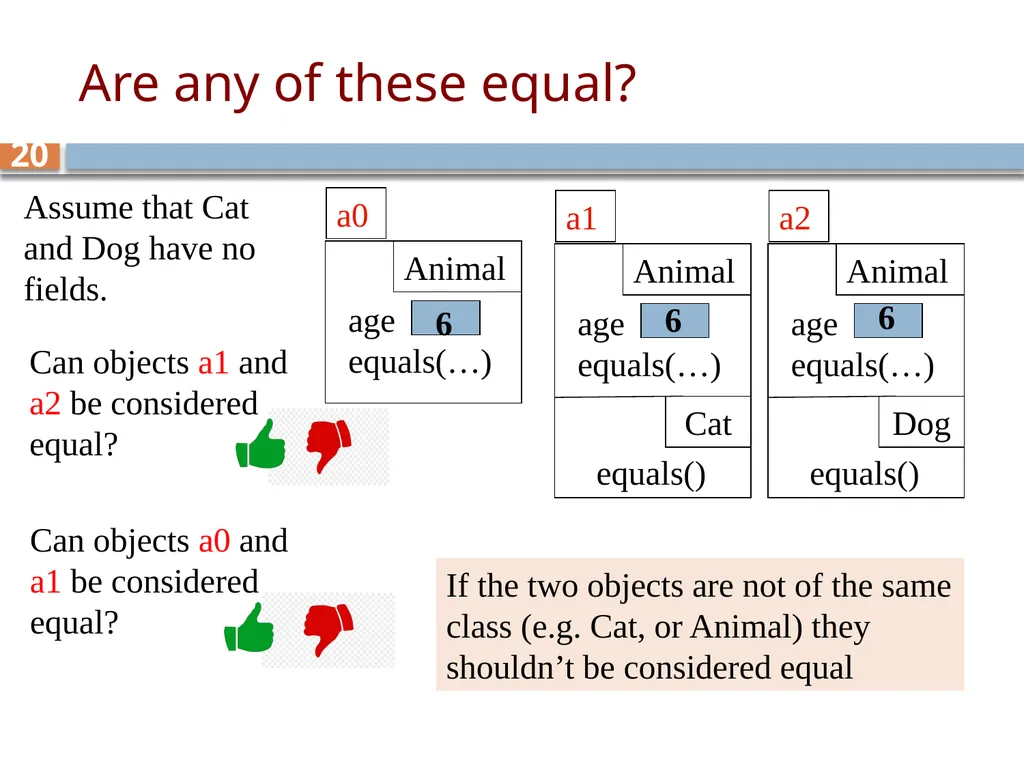
Are any of these equal? 20 Assume that Cat and Dog have no fields. Can objects a1 and a2 be considered equal? Can objects a0 and a1 be considered equal? If the two objects are not of the same class (e.g. Cat, or Animal) they shouldn’t be considered equal<br>
21
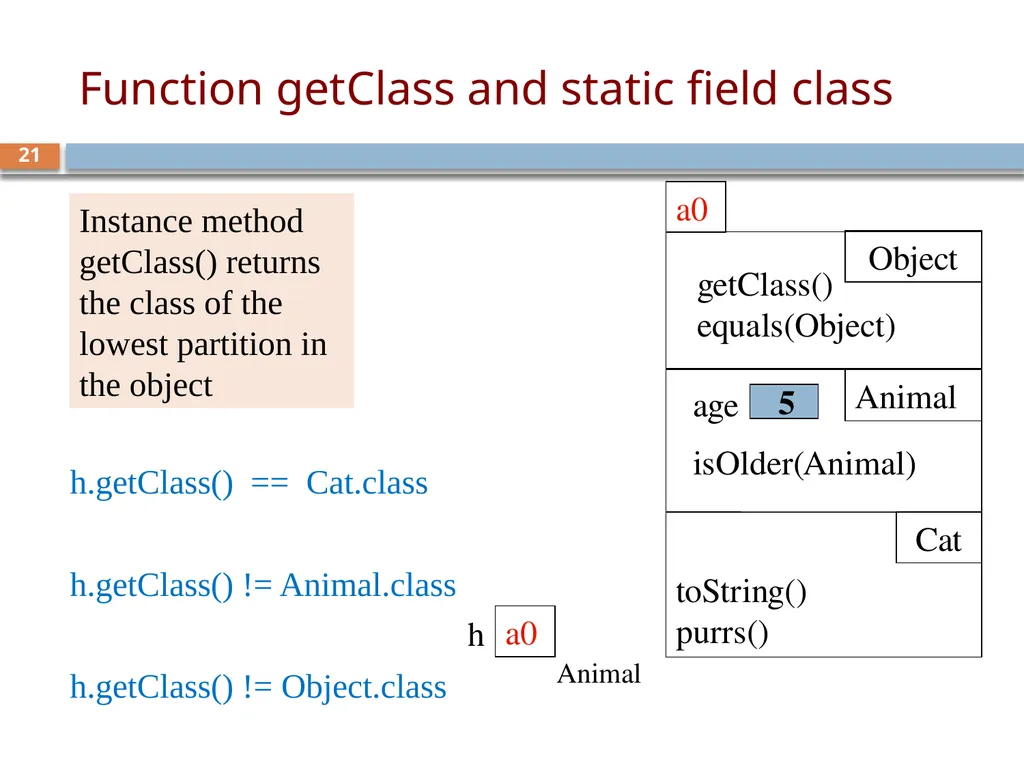
21 h.getClass() == Cat.class
h.getClass() != Animal.class
h.getClass() != Object.class Object getClass()
equals(Object) Function getClass and static field class Instance method getClass() returns the class of the lowest partition in the object<br>
22
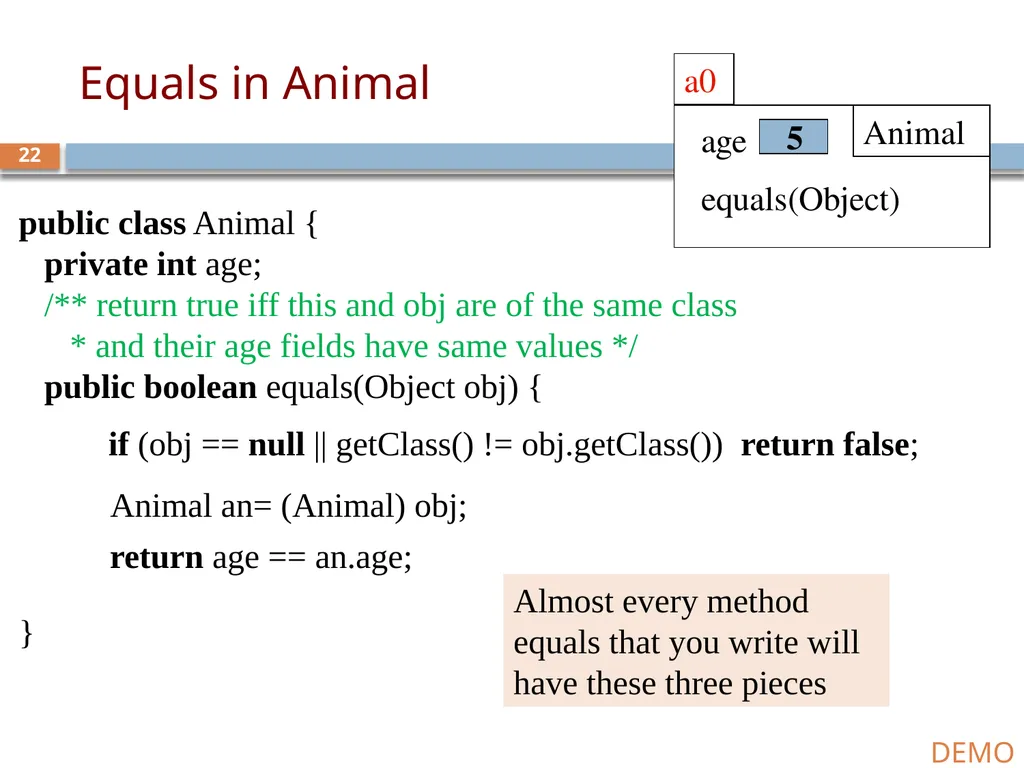
Equals in Animal 22 public class Animal {� private int age;
/** return true iff this and obj are of the same class
* and their age fields have same values */
public boolean equals(Object obj) {
�} if (obj == null || getClass() != obj.getClass()) return false; Animal an= (Animal) obj; return age == an.age; DEMO Almost every method equals that you write will have these three pieces<br>
23
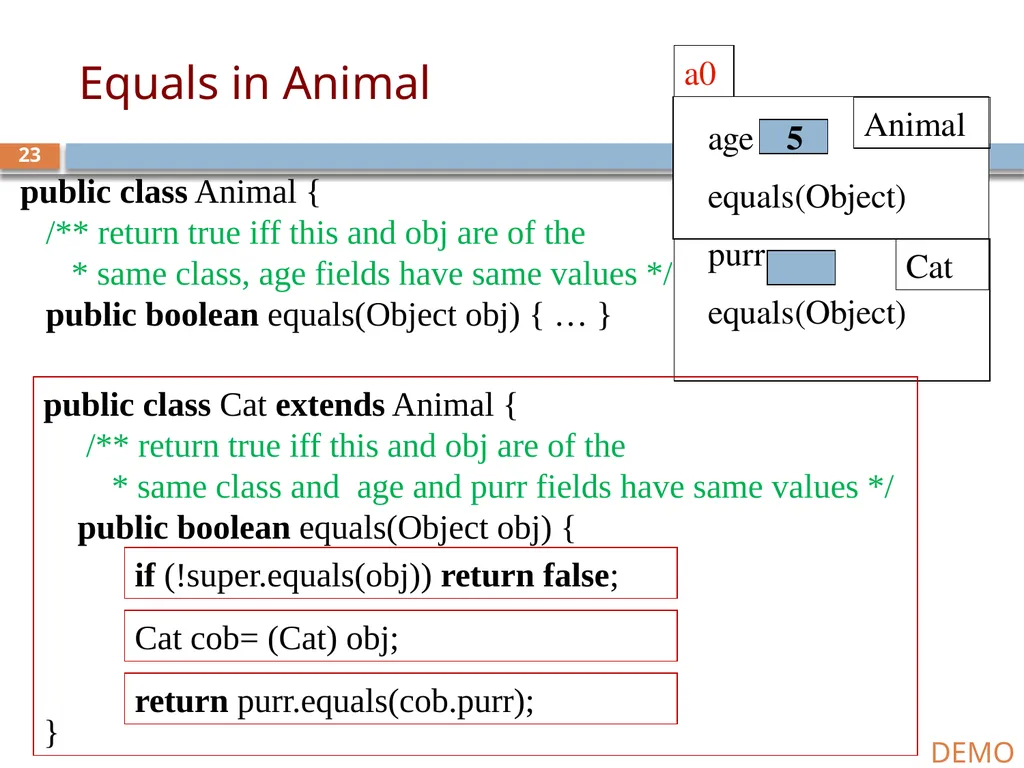
equals(Object) Equals in Animal 23 public class Animal {
/** return true iff this and obj are of the
* same class, age fields have same values */
public boolean equals(Object obj) { … } 5 DEMO Cat age
equals(Object)
purr
equals(Object) public class Cat extends Animal {� /** return true iff this and obj are of the
* same class and age and purr fields have same values */
public boolean equals(Object obj) {
} if (!super.equals(obj)) return false; Cat cob= (Cat) obj; return purr.equals(cob.purr);<br>
24
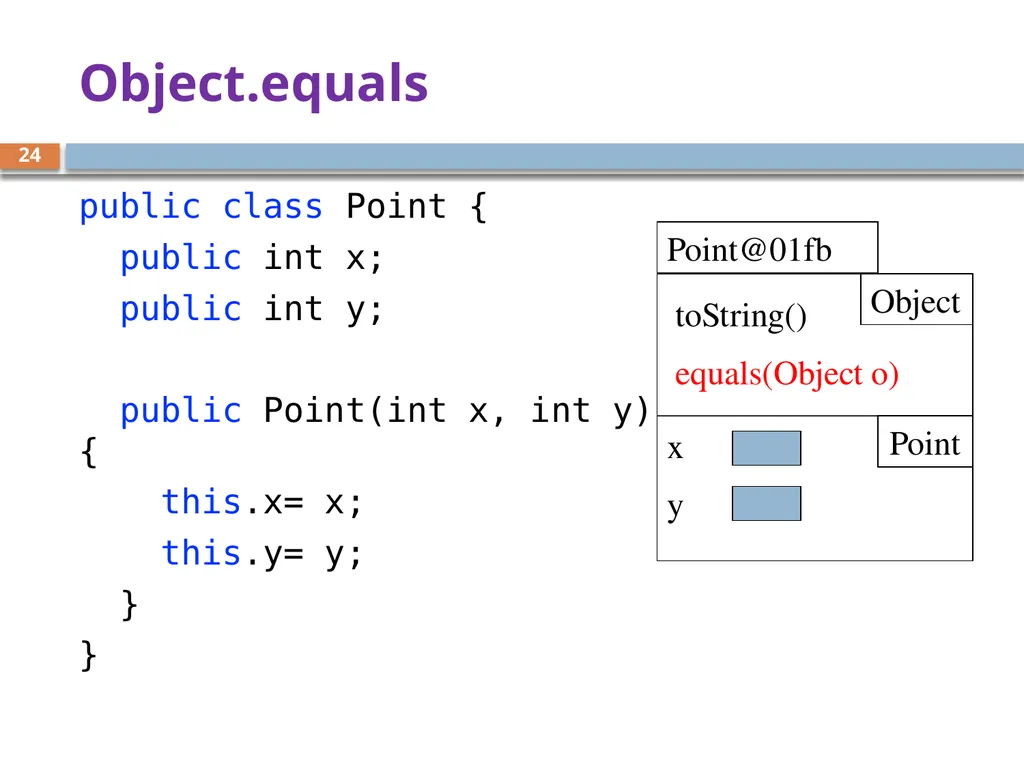
Object.equals 24 public class Point {
public int x;
public int y;
public Point(int x, int y) {
this.x= x;
this.y= y;
}
}<br>
25
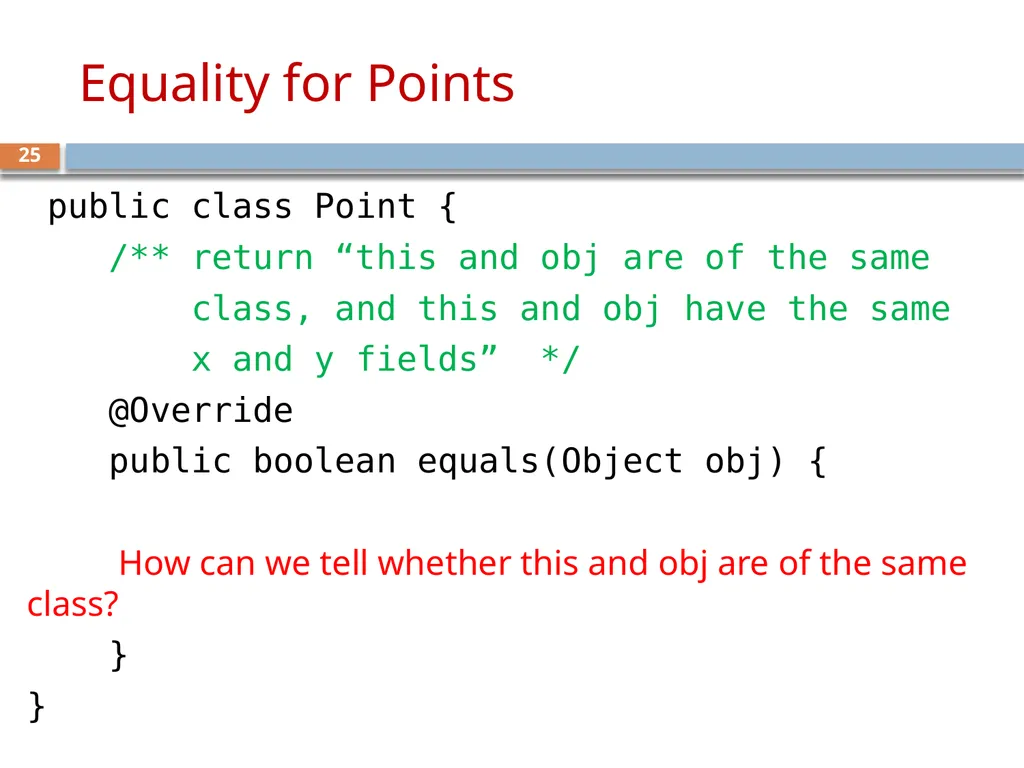
Equality for Points 25 public class Point {
/** return “this and obj are of the same
class, and this and obj have the same
x and y fields” */
@Override
public boolean equals(Object obj) {
How can we tell whether this and obj are of the same class?
}
}<br>
26
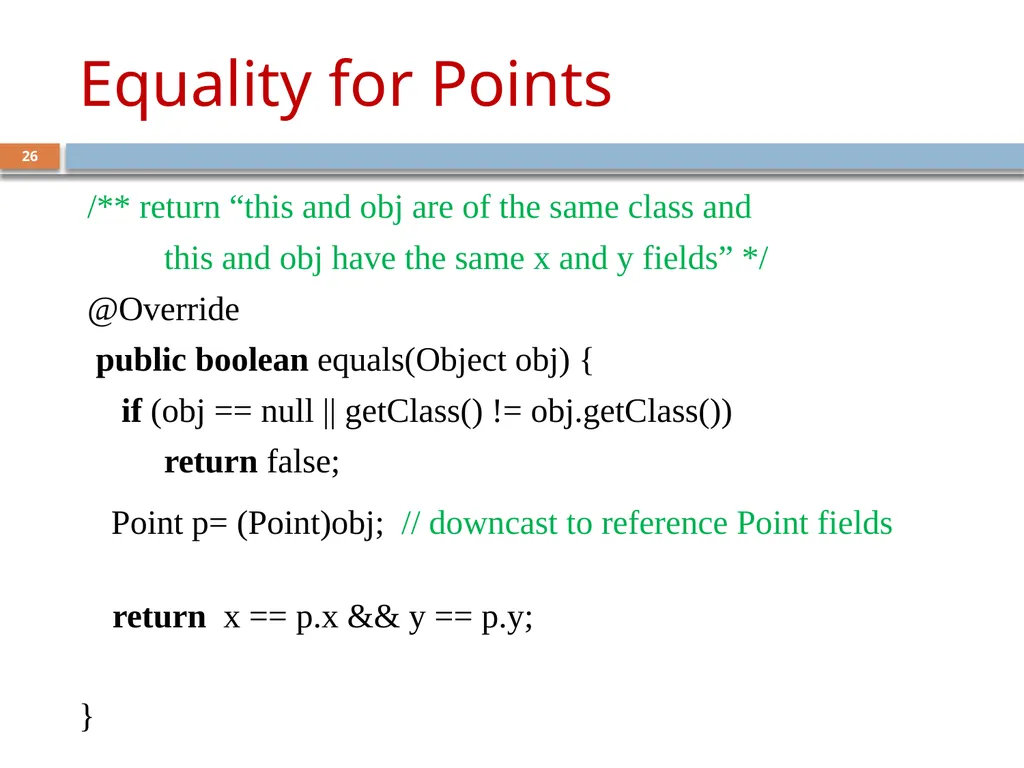
Equality for Points 26 /** return “this and obj are of the same class and
this and obj have the same x and y fields” */
@Override
public boolean equals(Object obj) {
if (obj == null || getClass() != obj.getClass())
return false;
} Point p= (Point)obj; // downcast to reference Point fields return x == p.x && y == p.y;<br>
27
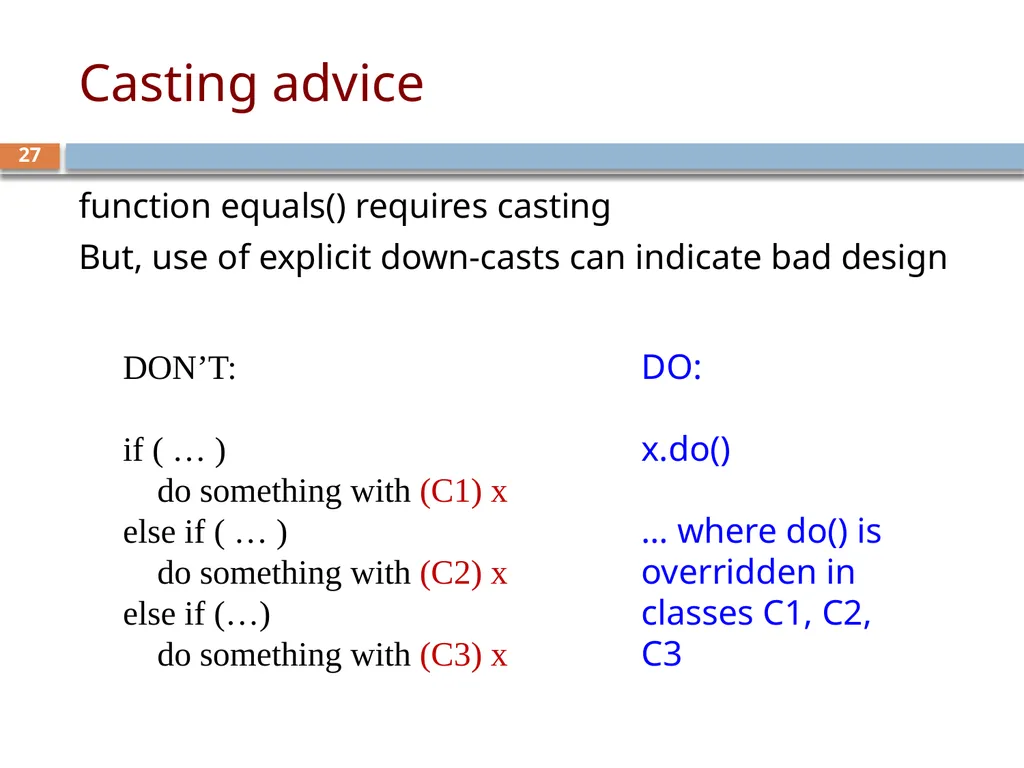
Casting advice 27 function equals() requires casting
But, use of explicit down-casts can indicate bad design DON’T:
if ( … )
do something with (C1) x
else if ( … )
do something with (C2) x
else if (…)
do something with (C3) x DO:
x.do()
… where do() is overridden in classes C1, C2, C3<br>
28
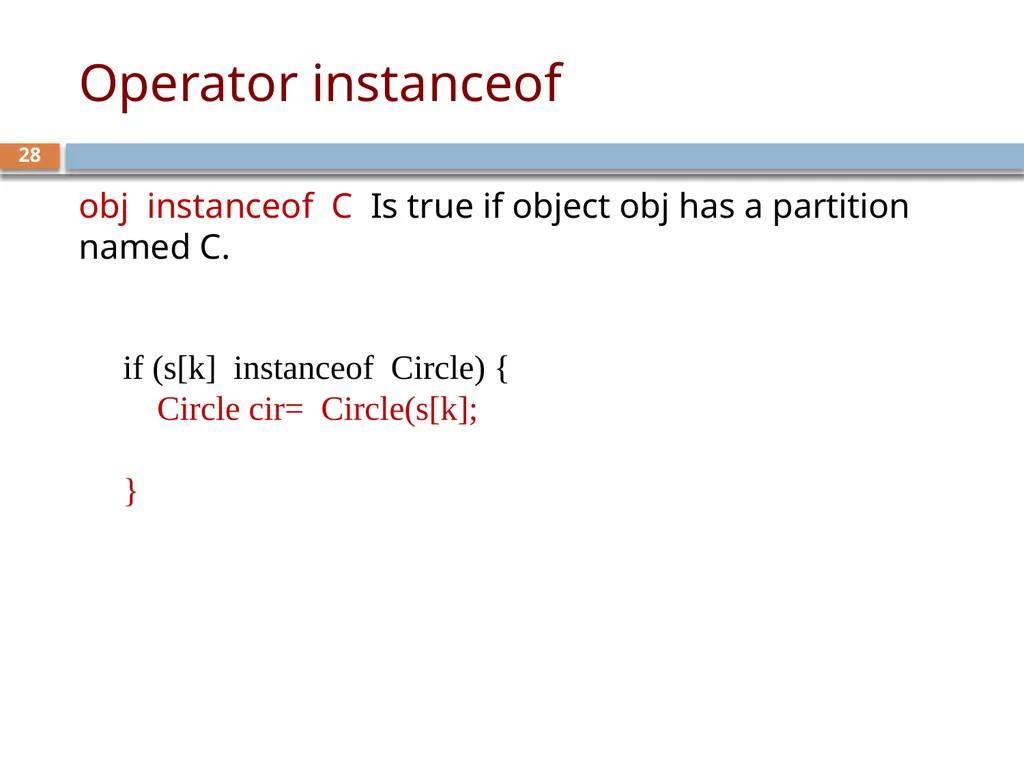
Operator instanceof 28 obj instanceof C Is true if object obj has a partition named C. if (s[k] instanceof Circle) {
Circle cir= Circle(s[k];
}<br>