
CS639: Data Management for Data Science Lecture
SB
Published · 44 slides · 0 views
1 / 1
Description
CS639: Data Management for Data Science Lecture 23: Data Cleaning based on slides by John Canny Theodoros Rekatsinas 1 Dirty Data The Statistics View: There is a process that produces data We want to model ideal samples of that process,
Related Topics
Share
Embed code
Download this presentation From Below
"CS639: Data Management for Data Science Lecture" is the property of its rightful owner. Permission is granted to download and print the materials on this website for personal, non-commercial use only, and to display it on your personal computer provided you do not modify the materials and that you retain all copyright notices contained in the materials. By downloading content from our website, you accept the terms of this agreement.
Presentation Transcript
01
CS639:
Data Management for
Data Science Lecture 23: Data Cleaning
[based on slides by John Canny]
Theodoros Rekatsinas 1<br>
[based on slides by John Canny]
Theodoros Rekatsinas 1<br>
02
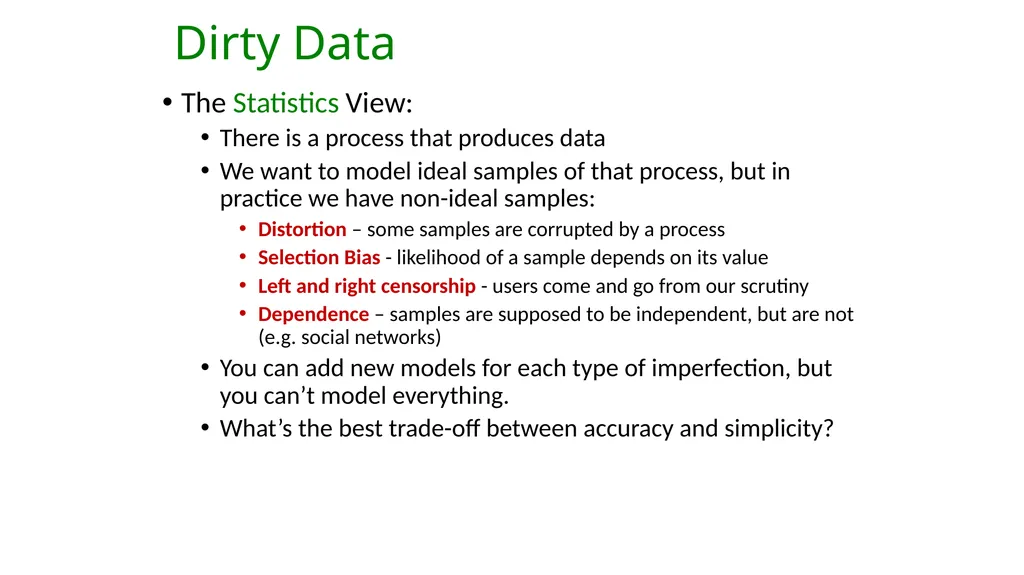
Dirty Data The Statistics View:
There is a process that produces data
We want to model ideal samples of that process, but in practice we have non-ideal samples:
Distortion – some samples are corrupted by a process
Selection Bias - likelihood of a sample depends on its value
Left and right censorship - users come and go from our scrutiny
Dependence – samples are supposed to be independent, but are not (e.g. social networks)
You can add new models for each type of imperfection, but you can’t model everything.
What’s the best trade-off between accuracy and simplicity?<br>
There is a process that produces data
We want to model ideal samples of that process, but in practice we have non-ideal samples:
Distortion – some samples are corrupted by a process
Selection Bias - likelihood of a sample depends on its value
Left and right censorship - users come and go from our scrutiny
Dependence – samples are supposed to be independent, but are not (e.g. social networks)
You can add new models for each type of imperfection, but you can’t model everything.
What’s the best trade-off between accuracy and simplicity?<br>
03
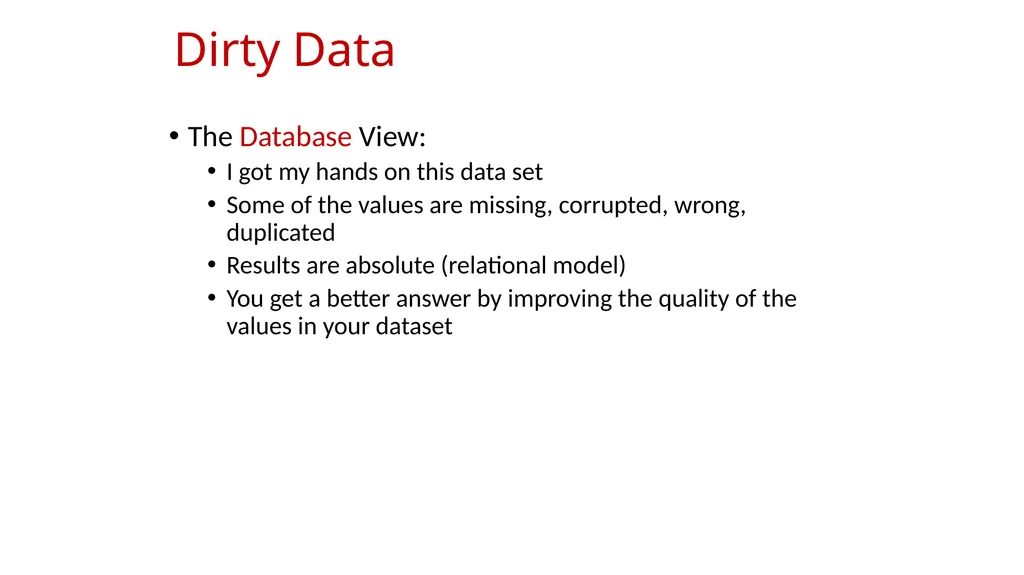
Dirty Data The Database View:
I got my hands on this data set
Some of the values are missing, corrupted, wrong, duplicated
Results are absolute (relational model)
You get a better answer by improving the quality of the values in your dataset<br>
I got my hands on this data set
Some of the values are missing, corrupted, wrong, duplicated
Results are absolute (relational model)
You get a better answer by improving the quality of the values in your dataset<br>
04
Dirty Data The Domain Expert’s View:
This Data Doesn’t look right
This Answer Doesn’t look right
What happened?
Domain experts have an implicit model of the data that they can test against…<br>
This Data Doesn’t look right
This Answer Doesn’t look right
What happened?
Domain experts have an implicit model of the data that they can test against…<br>
05
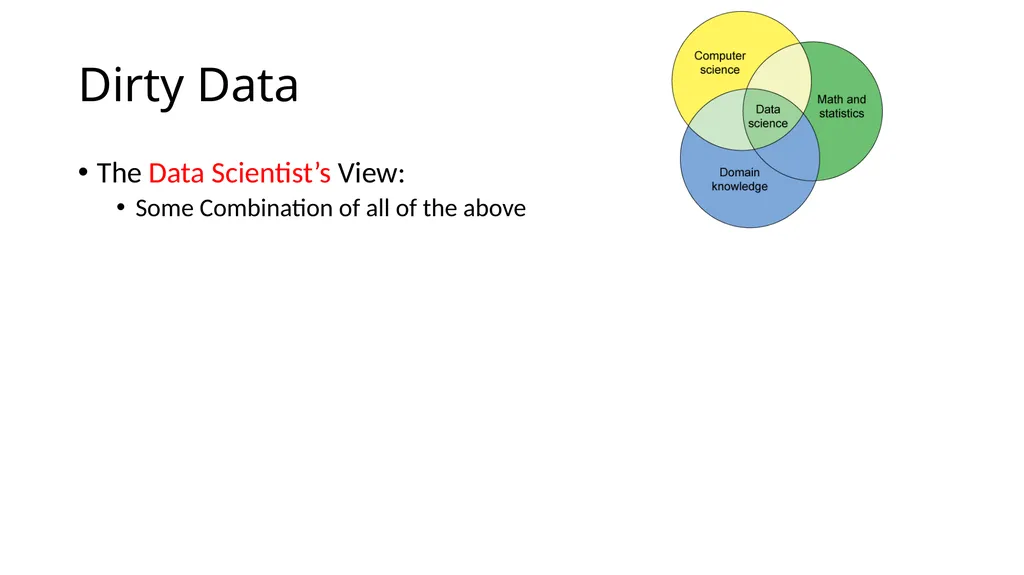
Dirty Data The Data Scientist’s View:
Some Combination of all of the above<br>
Some Combination of all of the above<br>
06
Data Quality Problems (Source) Data is dirty on its own.
Transformations corrupt the data (complexity of software pipelines).
Data sets are clean but integration (i.e., combining them) screws them up.
“Rare” errors can become frequent after transformation or integration.
Data sets are clean but suffer “bit rot”
Old data loses its value/accuracy over time
Any combination of the above<br>
Transformations corrupt the data (complexity of software pipelines).
Data sets are clean but integration (i.e., combining them) screws them up.
“Rare” errors can become frequent after transformation or integration.
Data sets are clean but suffer “bit rot”
Old data loses its value/accuracy over time
Any combination of the above<br>
07
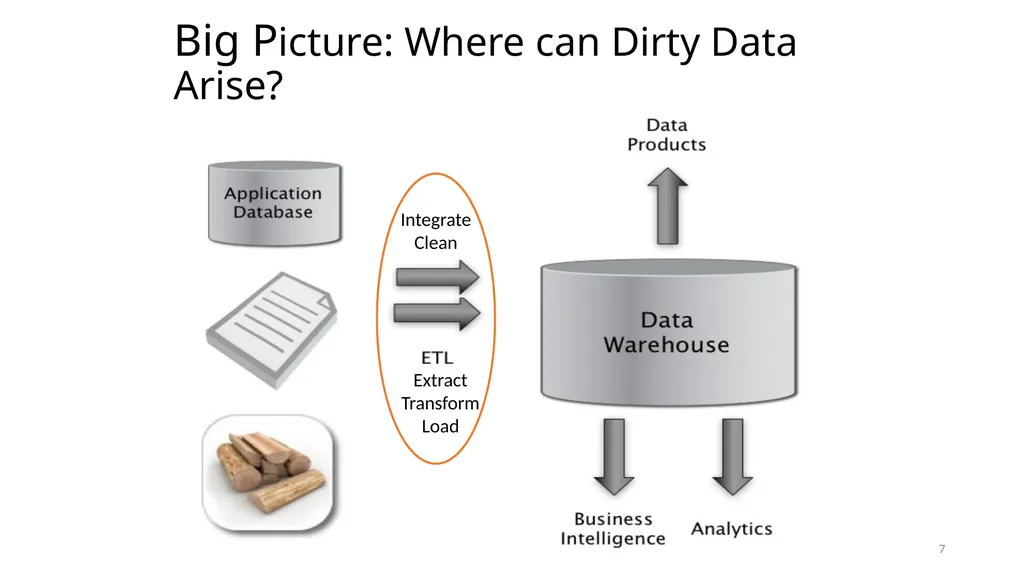
Big Picture: Where can Dirty Data Arise? 7 Integrate
Clean<br>
Clean<br>
08
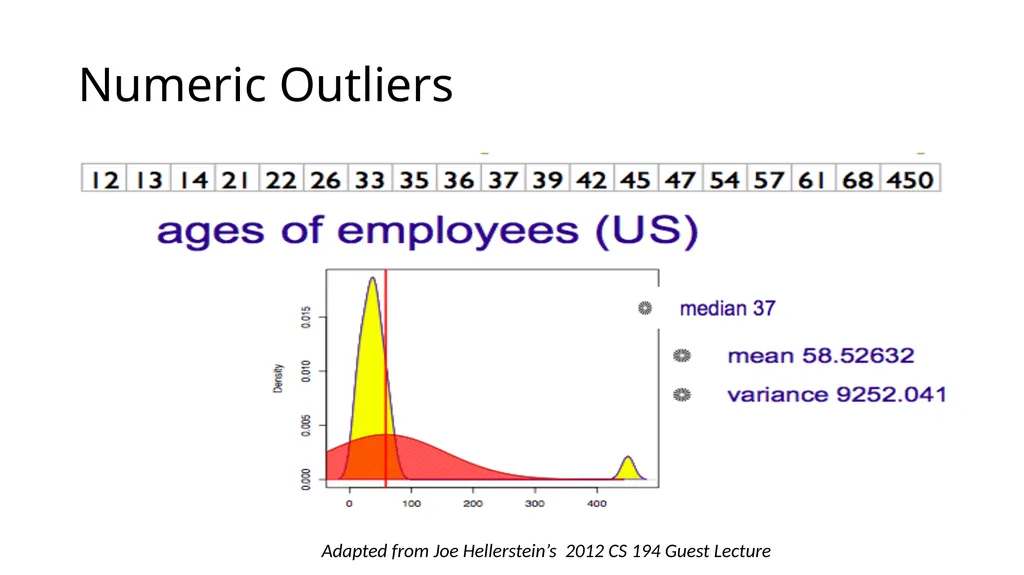
Numeric Outliers Adapted from Joe Hellerstein’s 2012 CS 194 Guest Lecture<br>
09
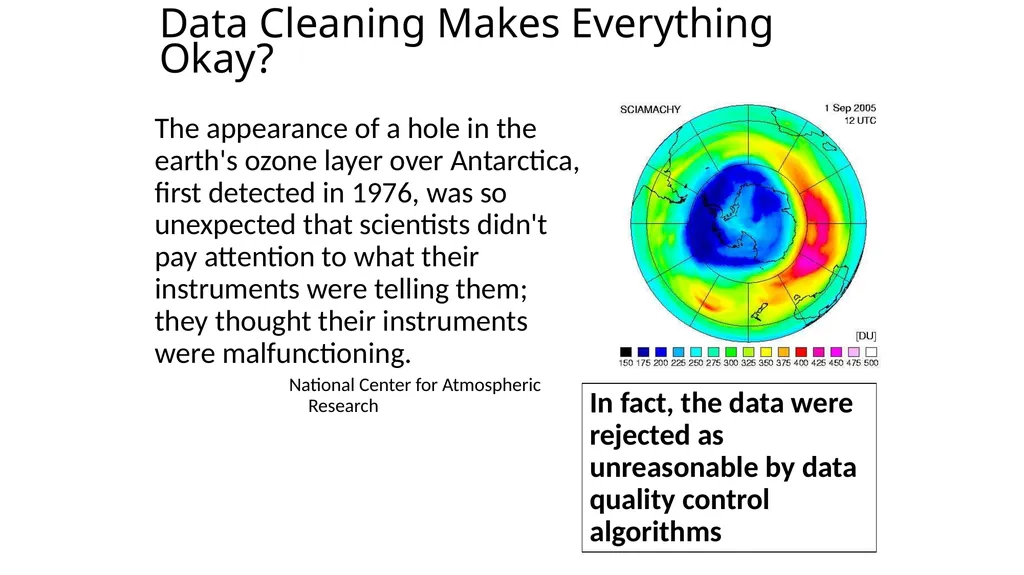
Data Cleaning Makes Everything Okay? The appearance of a hole in the earth's ozone layer over Antarctica, first detected in 1976, was so unexpected that scientists didn't pay attention to what their instruments were telling them; they thought their instruments were malfunctioning.
National Center for Atmospheric Research In fact, the data were rejected as unreasonable by data quality control algorithms<br>
National Center for Atmospheric Research In fact, the data were rejected as unreasonable by data quality control algorithms<br>
10
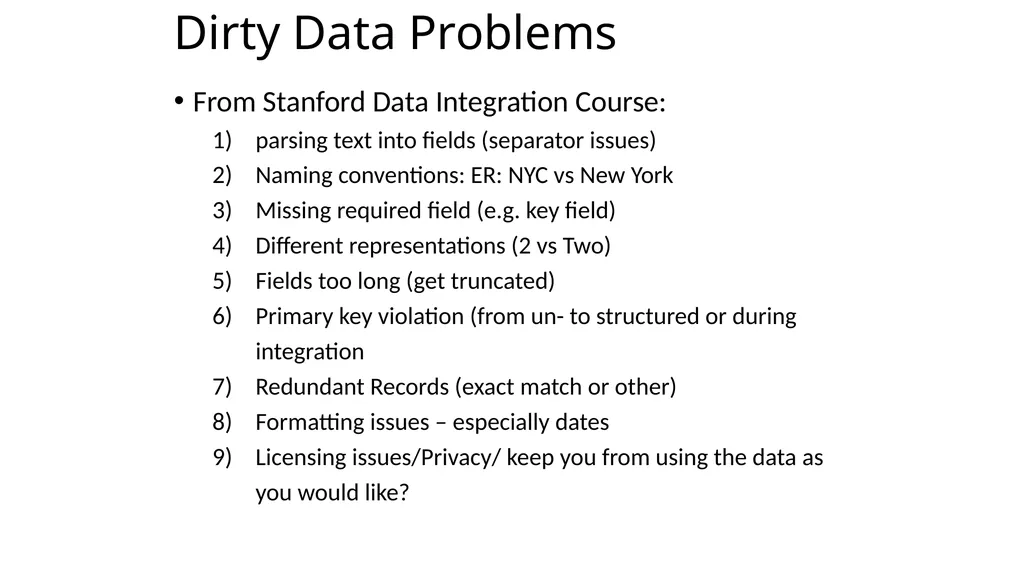
Dirty Data Problems From Stanford Data Integration Course:
parsing text into fields (separator issues)
Naming conventions: ER: NYC vs New York
Missing required field (e.g. key field)
Different representations (2 vs Two)
Fields too long (get truncated)
Primary key violation (from un- to structured or during integration
Redundant Records (exact match or other)
Formatting issues – especially dates
Licensing issues/Privacy/ keep you from using the data as you would like?<br>
parsing text into fields (separator issues)
Naming conventions: ER: NYC vs New York
Missing required field (e.g. key field)
Different representations (2 vs Two)
Fields too long (get truncated)
Primary key violation (from un- to structured or during integration
Redundant Records (exact match or other)
Formatting issues – especially dates
Licensing issues/Privacy/ keep you from using the data as you would like?<br>
11
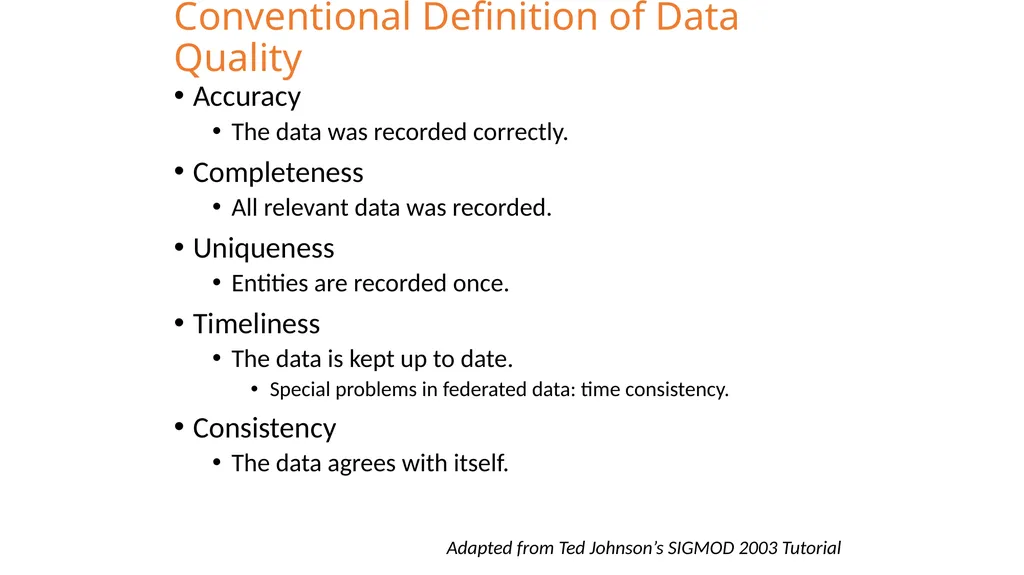
Conventional Definition of Data Quality Accuracy
The data was recorded correctly.
Completeness
All relevant data was recorded.
Uniqueness
Entities are recorded once.
Timeliness
The data is kept up to date.
Special problems in federated data: time consistency.
Consistency
The data agrees with itself. Adapted from Ted Johnson’s SIGMOD 2003 Tutorial<br>
The data was recorded correctly.
Completeness
All relevant data was recorded.
Uniqueness
Entities are recorded once.
Timeliness
The data is kept up to date.
Special problems in federated data: time consistency.
Consistency
The data agrees with itself. Adapted from Ted Johnson’s SIGMOD 2003 Tutorial<br>
12
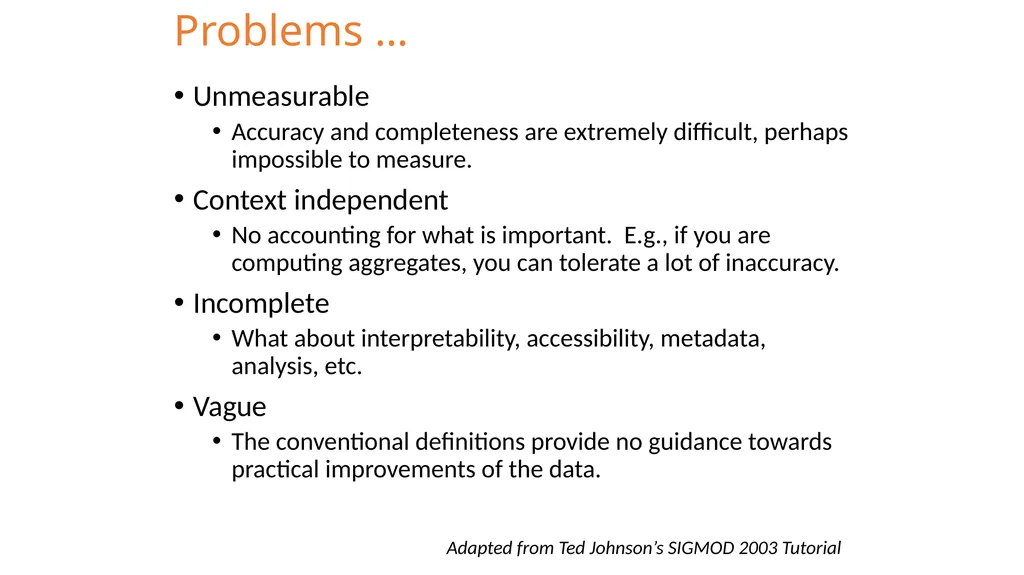
Problems … Unmeasurable
Accuracy and completeness are extremely difficult, perhaps impossible to measure.
Context independent
No accounting for what is important. E.g., if you are computing aggregates, you can tolerate a lot of inaccuracy.
Incomplete
What about interpretability, accessibility, metadata, analysis, etc.
Vague
The conventional definitions provide no guidance towards practical improvements of the data. Adapted from Ted Johnson’s SIGMOD 2003 Tutorial<br>
Accuracy and completeness are extremely difficult, perhaps impossible to measure.
Context independent
No accounting for what is important. E.g., if you are computing aggregates, you can tolerate a lot of inaccuracy.
Incomplete
What about interpretability, accessibility, metadata, analysis, etc.
Vague
The conventional definitions provide no guidance towards practical improvements of the data. Adapted from Ted Johnson’s SIGMOD 2003 Tutorial<br>
13
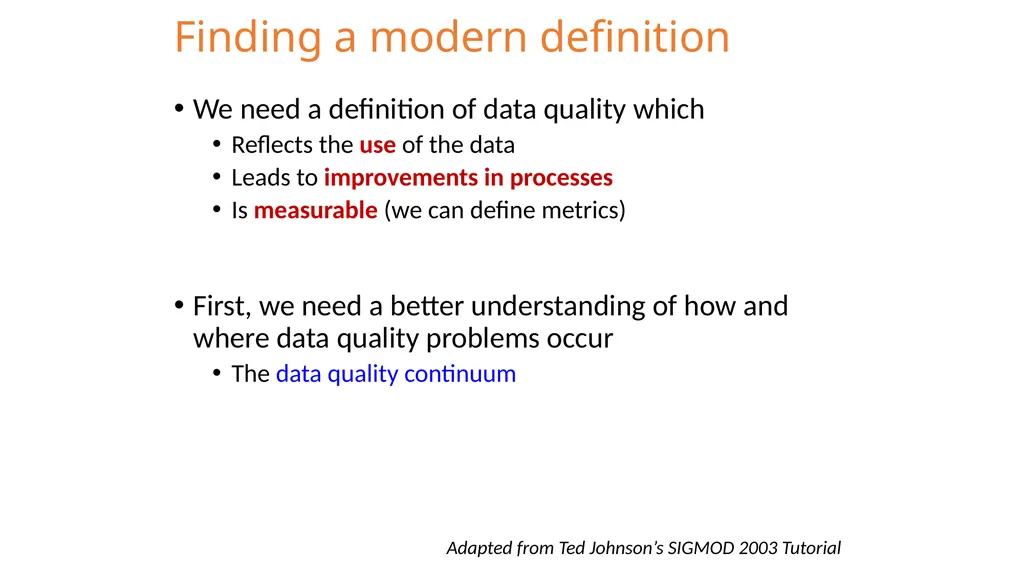
Finding a modern definition We need a definition of data quality which
Reflects the use of the data
Leads to improvements in processes
Is measurable (we can define metrics)
First, we need a better understanding of how and where data quality problems occur
The data quality continuum Adapted from Ted Johnson’s SIGMOD 2003 Tutorial<br>
Reflects the use of the data
Leads to improvements in processes
Is measurable (we can define metrics)
First, we need a better understanding of how and where data quality problems occur
The data quality continuum Adapted from Ted Johnson’s SIGMOD 2003 Tutorial<br>
14
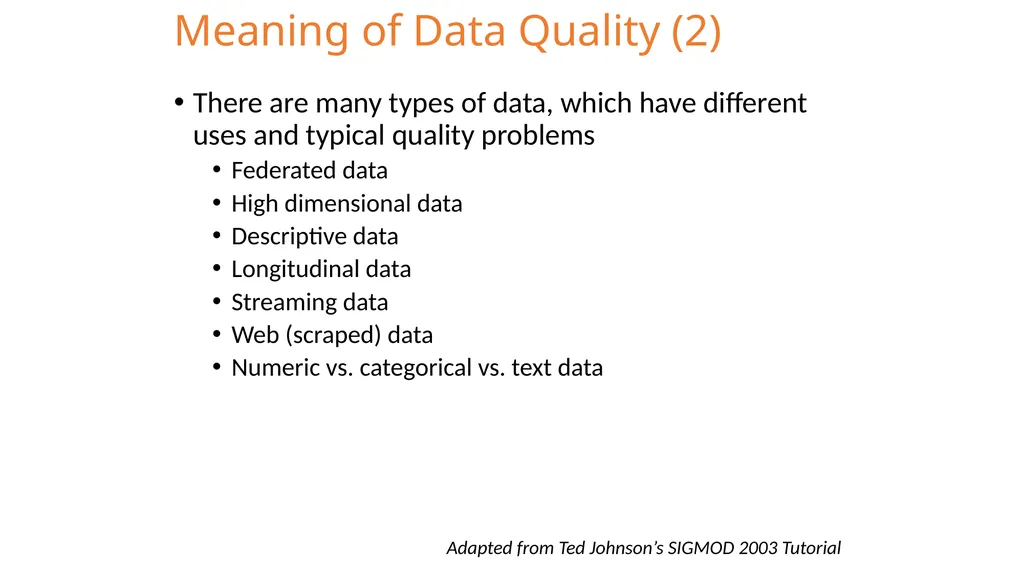
Meaning of Data Quality (2) There are many types of data, which have different uses and typical quality problems
Federated data
High dimensional data
Descriptive data
Longitudinal data
Streaming data
Web (scraped) data
Numeric vs. categorical vs. text data Adapted from Ted Johnson’s SIGMOD 2003 Tutorial<br>
Federated data
High dimensional data
Descriptive data
Longitudinal data
Streaming data
Web (scraped) data
Numeric vs. categorical vs. text data Adapted from Ted Johnson’s SIGMOD 2003 Tutorial<br>
15
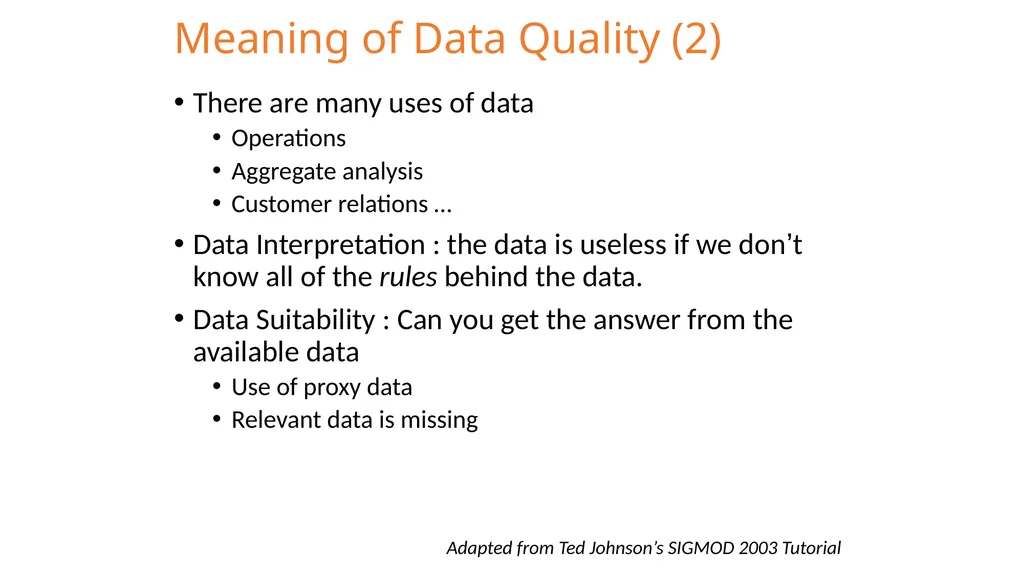
Meaning of Data Quality (2) There are many uses of data
Operations
Aggregate analysis
Customer relations …
Data Interpretation : the data is useless if we don’t know all of the rules behind the data.
Data Suitability : Can you get the answer from the available data
Use of proxy data
Relevant data is missing Adapted from Ted Johnson’s SIGMOD 2003 Tutorial<br>
Operations
Aggregate analysis
Customer relations …
Data Interpretation : the data is useless if we don’t know all of the rules behind the data.
Data Suitability : Can you get the answer from the available data
Use of proxy data
Relevant data is missing Adapted from Ted Johnson’s SIGMOD 2003 Tutorial<br>
16
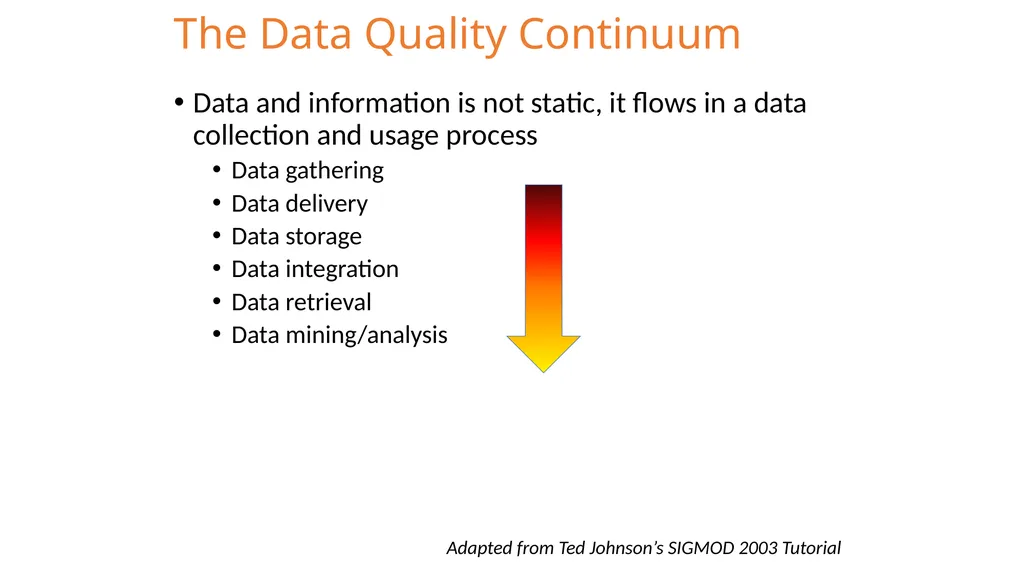
The Data Quality Continuum Data and information is not static, it flows in a data collection and usage process
Data gathering
Data delivery
Data storage
Data integration
Data retrieval
Data mining/analysis Adapted from Ted Johnson’s SIGMOD 2003 Tutorial<br>
Data gathering
Data delivery
Data storage
Data integration
Data retrieval
Data mining/analysis Adapted from Ted Johnson’s SIGMOD 2003 Tutorial<br>
17
Data Gathering How does the data enter the system?
Sources of problems:
Manual entry
No uniform standards for content and formats
Parallel data entry (duplicates)
Approximations, surrogates – SW/HW constraints
Measurement or sensor errors. Adapted from Ted Johnson’s SIGMOD 2003 Tutorial<br>
Sources of problems:
Manual entry
No uniform standards for content and formats
Parallel data entry (duplicates)
Approximations, surrogates – SW/HW constraints
Measurement or sensor errors. Adapted from Ted Johnson’s SIGMOD 2003 Tutorial<br>
18
Data Gathering - Solutions Potential Solutions:
Preemptive:
Process architecture (build in integrity checks)
Process management (reward accurate data entry, data sharing, data stewards)
Retrospective:
Cleaning focus (duplicate removal, merge/purge, name & address matching, field value standardization)
Diagnostic focus (automated detection of glitches). Adapted from Ted Johnson’s SIGMOD 2003 Tutorial<br>
Preemptive:
Process architecture (build in integrity checks)
Process management (reward accurate data entry, data sharing, data stewards)
Retrospective:
Cleaning focus (duplicate removal, merge/purge, name & address matching, field value standardization)
Diagnostic focus (automated detection of glitches). Adapted from Ted Johnson’s SIGMOD 2003 Tutorial<br>
19
Data Delivery Destroying or mutilating information by inappropriate pre-processing
Inappropriate aggregation
Nulls converted to default values
Loss of data:
Buffer overflows
Transmission problems
No checks Adapted from Ted Johnson’s SIGMOD 2003 Tutorial<br>
Inappropriate aggregation
Nulls converted to default values
Loss of data:
Buffer overflows
Transmission problems
No checks Adapted from Ted Johnson’s SIGMOD 2003 Tutorial<br>
20
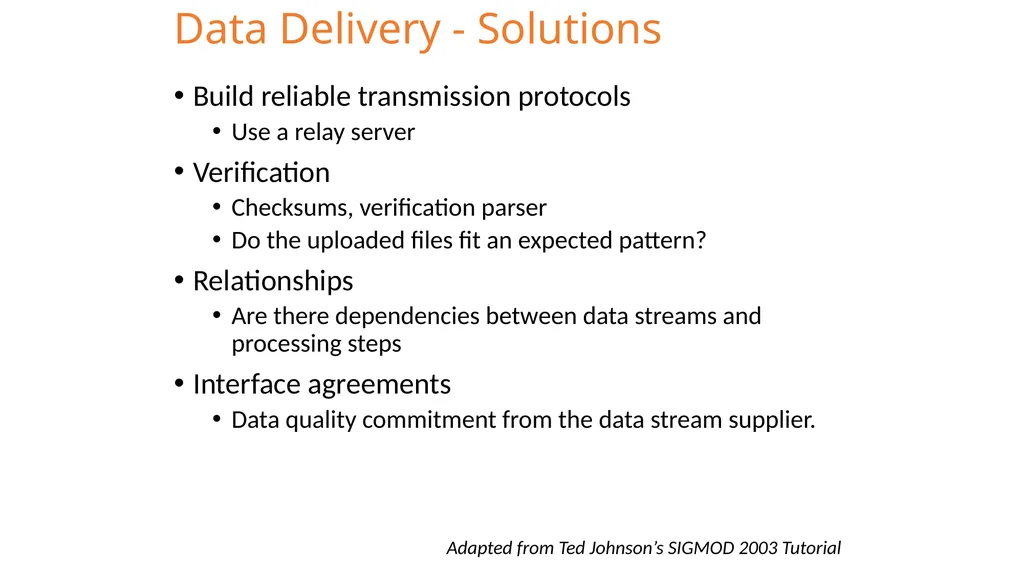
Data Delivery - Solutions Build reliable transmission protocols
Use a relay server
Verification
Checksums, verification parser
Do the uploaded files fit an expected pattern?
Relationships
Are there dependencies between data streams and processing steps
Interface agreements
Data quality commitment from the data stream supplier. Adapted from Ted Johnson’s SIGMOD 2003 Tutorial<br>
Use a relay server
Verification
Checksums, verification parser
Do the uploaded files fit an expected pattern?
Relationships
Are there dependencies between data streams and processing steps
Interface agreements
Data quality commitment from the data stream supplier. Adapted from Ted Johnson’s SIGMOD 2003 Tutorial<br>
21
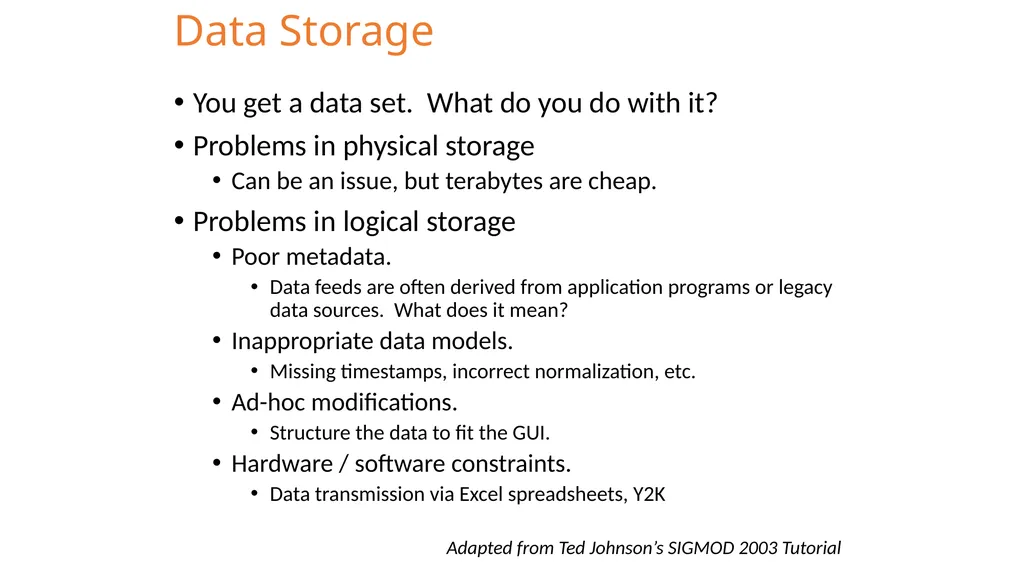
Data Storage You get a data set. What do you do with it?
Problems in physical storage
Can be an issue, but terabytes are cheap.
Problems in logical storage
Poor metadata.
Data feeds are often derived from application programs or legacy data sources. What does it mean?
Inappropriate data models.
Missing timestamps, incorrect normalization, etc.
Ad-hoc modifications.
Structure the data to fit the GUI.
Hardware / software constraints.
Data transmission via Excel spreadsheets, Y2K Adapted from Ted Johnson’s SIGMOD 2003 Tutorial<br>
Problems in physical storage
Can be an issue, but terabytes are cheap.
Problems in logical storage
Poor metadata.
Data feeds are often derived from application programs or legacy data sources. What does it mean?
Inappropriate data models.
Missing timestamps, incorrect normalization, etc.
Ad-hoc modifications.
Structure the data to fit the GUI.
Hardware / software constraints.
Data transmission via Excel spreadsheets, Y2K Adapted from Ted Johnson’s SIGMOD 2003 Tutorial<br>
22
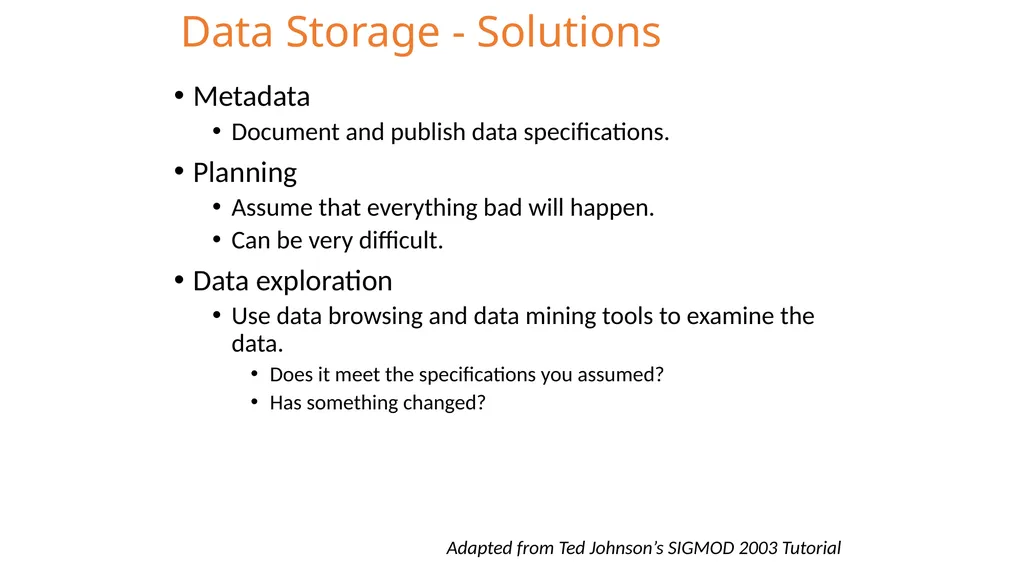
Data Storage - Solutions Metadata
Document and publish data specifications.
Planning
Assume that everything bad will happen.
Can be very difficult.
Data exploration
Use data browsing and data mining tools to examine the data.
Does it meet the specifications you assumed?
Has something changed? Adapted from Ted Johnson’s SIGMOD 2003 Tutorial<br>
Document and publish data specifications.
Planning
Assume that everything bad will happen.
Can be very difficult.
Data exploration
Use data browsing and data mining tools to examine the data.
Does it meet the specifications you assumed?
Has something changed? Adapted from Ted Johnson’s SIGMOD 2003 Tutorial<br>
23
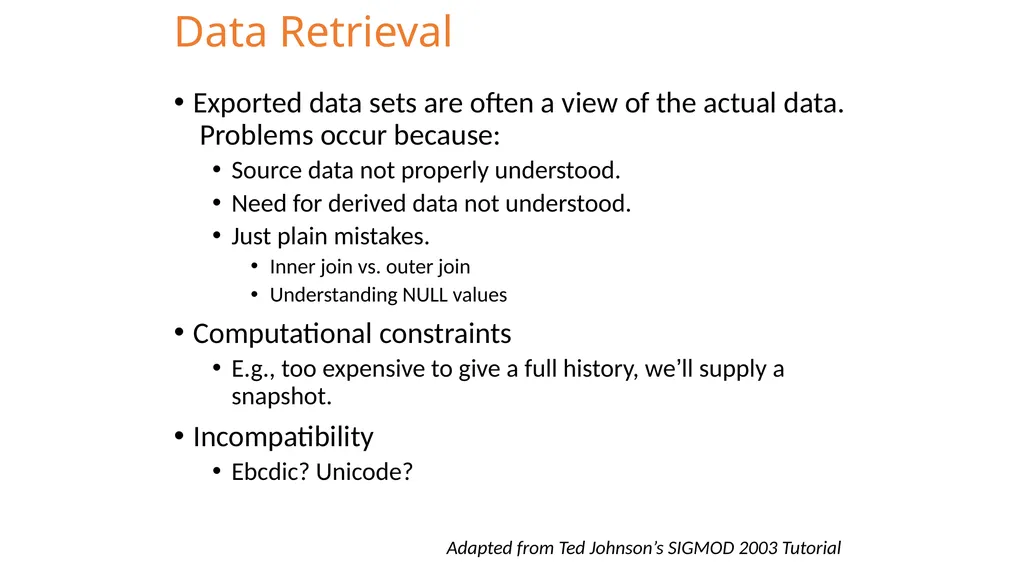
Data Retrieval Exported data sets are often a view of the actual data. Problems occur because:
Source data not properly understood.
Need for derived data not understood.
Just plain mistakes.
Inner join vs. outer join
Understanding NULL values
Computational constraints
E.g., too expensive to give a full history, we’ll supply a snapshot.
Incompatibility
Ebcdic? Unicode? Adapted from Ted Johnson’s SIGMOD 2003 Tutorial<br>
Source data not properly understood.
Need for derived data not understood.
Just plain mistakes.
Inner join vs. outer join
Understanding NULL values
Computational constraints
E.g., too expensive to give a full history, we’ll supply a snapshot.
Incompatibility
Ebcdic? Unicode? Adapted from Ted Johnson’s SIGMOD 2003 Tutorial<br>
24
Data Mining and Analysis What are you doing with all this data anyway?
Problems in the analysis.
Scale and performance
Confidence bounds?
Black boxes and dart boards
Attachment to models
Insufficient domain expertise
Casual empiricism Adapted from Ted Johnson’s SIGMOD 2003 Tutorial<br>
Problems in the analysis.
Scale and performance
Confidence bounds?
Black boxes and dart boards
Attachment to models
Insufficient domain expertise
Casual empiricism Adapted from Ted Johnson’s SIGMOD 2003 Tutorial<br>
25
Retrieval and Mining - Solutions Data exploration
Determine which models and techniques are appropriate, find data bugs, develop domain expertise.
Continuous analysis
Are the results stable? How do they change?
Accountability
Make the analysis part of the feedback loop. Adapted from Ted Johnson’s SIGMOD 2003 Tutorial<br>
Determine which models and techniques are appropriate, find data bugs, develop domain expertise.
Continuous analysis
Are the results stable? How do they change?
Accountability
Make the analysis part of the feedback loop. Adapted from Ted Johnson’s SIGMOD 2003 Tutorial<br>
26
Data Quality Constraints Many data quality problems can be captured by static constraints based on the schema.
Nulls not allowed, field domains, foreign key constraints, etc.
Many others are due to problems in workflow, and can be captured by dynamic constraints
E.g., orders above $200 are processed by Biller 2
The constraints follow an 80-20 rule
A few constraints capture most cases, thousands of constraints to capture the last few cases.
Constraints are measurable. Data Quality Metrics? Adapted from Ted Johnson’s SIGMOD 2003 Tutorial<br>
Nulls not allowed, field domains, foreign key constraints, etc.
Many others are due to problems in workflow, and can be captured by dynamic constraints
E.g., orders above $200 are processed by Biller 2
The constraints follow an 80-20 rule
A few constraints capture most cases, thousands of constraints to capture the last few cases.
Constraints are measurable. Data Quality Metrics? Adapted from Ted Johnson’s SIGMOD 2003 Tutorial<br>
27
Data Quality Metrics We want a measurable quantity
Indicates what is wrong and how to improve
Realize that DQ is a messy problem, no set of numbers will be perfect
Types of metrics
Static vs. dynamic constraints
Operational vs. diagnostic
Metrics should be directionally correct with an improvement in use of the data.
A very large number metrics are possible
Choose the most important ones. Adapted from Ted Johnson’s SIGMOD 2003 Tutorial<br>
Indicates what is wrong and how to improve
Realize that DQ is a messy problem, no set of numbers will be perfect
Types of metrics
Static vs. dynamic constraints
Operational vs. diagnostic
Metrics should be directionally correct with an improvement in use of the data.
A very large number metrics are possible
Choose the most important ones. Adapted from Ted Johnson’s SIGMOD 2003 Tutorial<br>
28
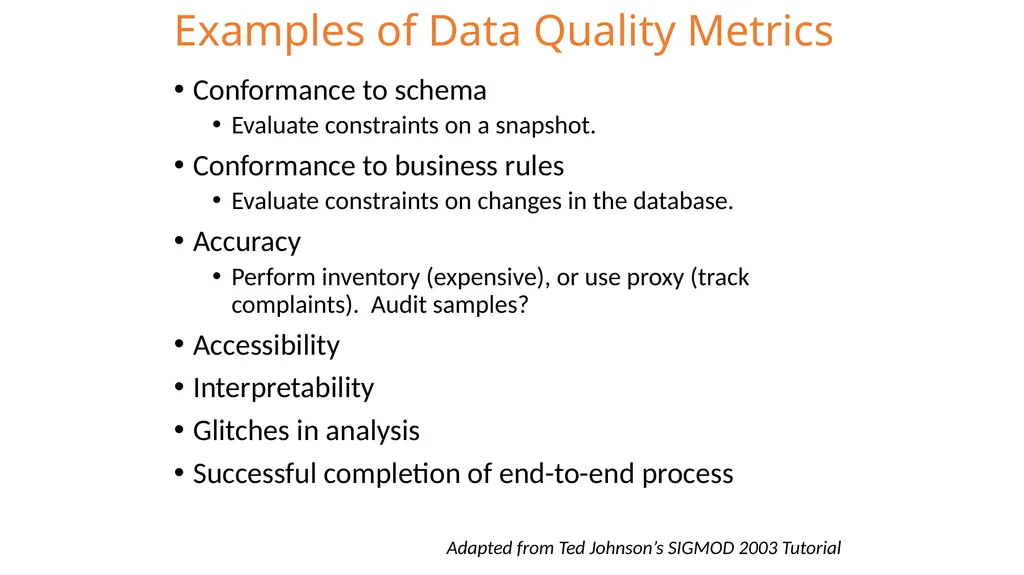
Examples of Data Quality Metrics Conformance to schema
Evaluate constraints on a snapshot.
Conformance to business rules
Evaluate constraints on changes in the database.
Accuracy
Perform inventory (expensive), or use proxy (track complaints). Audit samples?
Accessibility
Interpretability
Glitches in analysis
Successful completion of end-to-end process Adapted from Ted Johnson’s SIGMOD 2003 Tutorial<br>
Evaluate constraints on a snapshot.
Conformance to business rules
Evaluate constraints on changes in the database.
Accuracy
Perform inventory (expensive), or use proxy (track complaints). Audit samples?
Accessibility
Interpretability
Glitches in analysis
Successful completion of end-to-end process Adapted from Ted Johnson’s SIGMOD 2003 Tutorial<br>
29
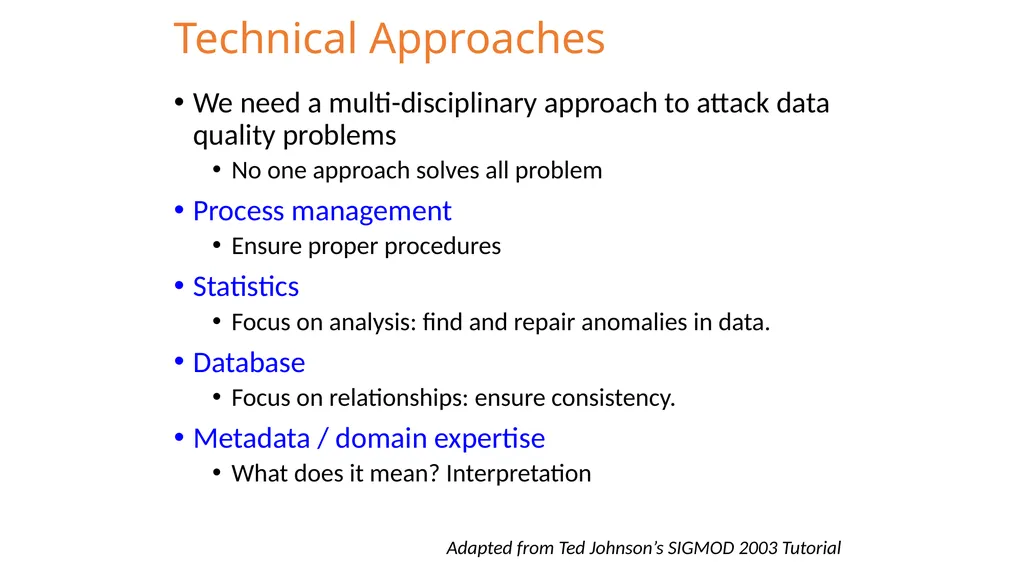
Technical Approaches We need a multi-disciplinary approach to attack data quality problems
No one approach solves all problem
Process management
Ensure proper procedures
Statistics
Focus on analysis: find and repair anomalies in data.
Database
Focus on relationships: ensure consistency.
Metadata / domain expertise
What does it mean? Interpretation Adapted from Ted Johnson’s SIGMOD 2003 Tutorial<br>
No one approach solves all problem
Process management
Ensure proper procedures
Statistics
Focus on analysis: find and repair anomalies in data.
Database
Focus on relationships: ensure consistency.
Metadata / domain expertise
What does it mean? Interpretation Adapted from Ted Johnson’s SIGMOD 2003 Tutorial<br>
30
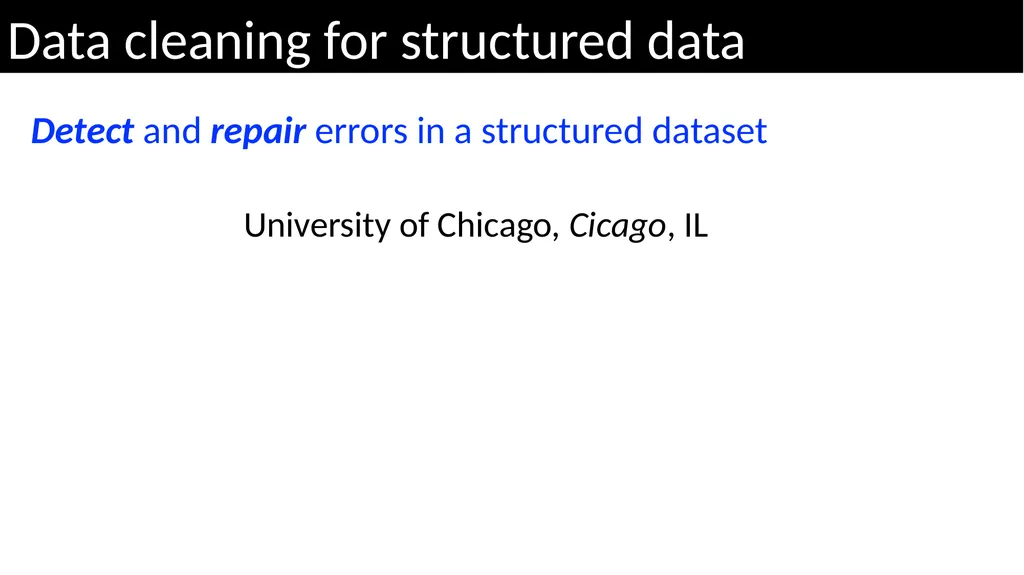
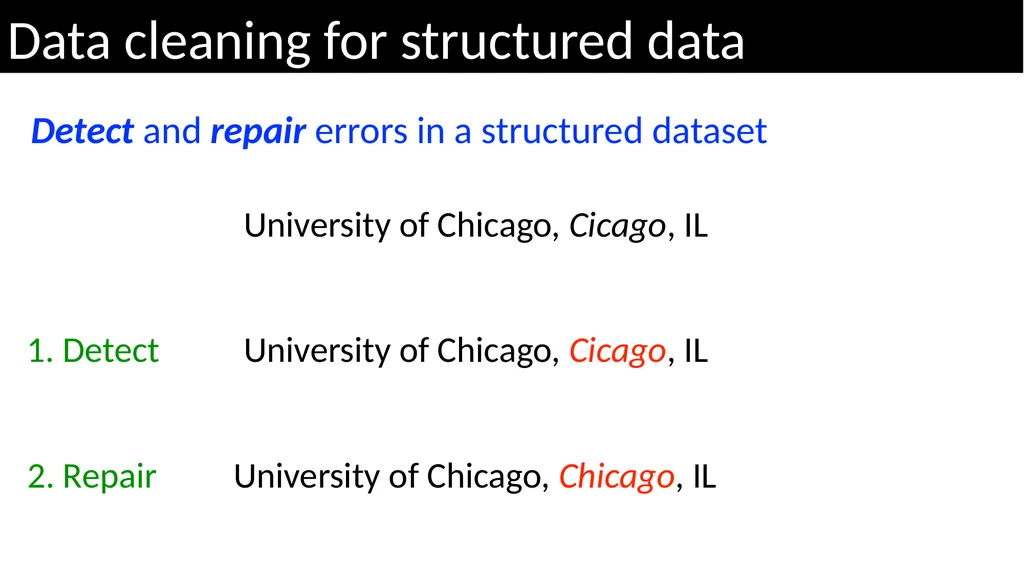
Data cleaning for structured data Detect and repair errors in a structured dataset University of Chicago, Cicago, IL<br>
31
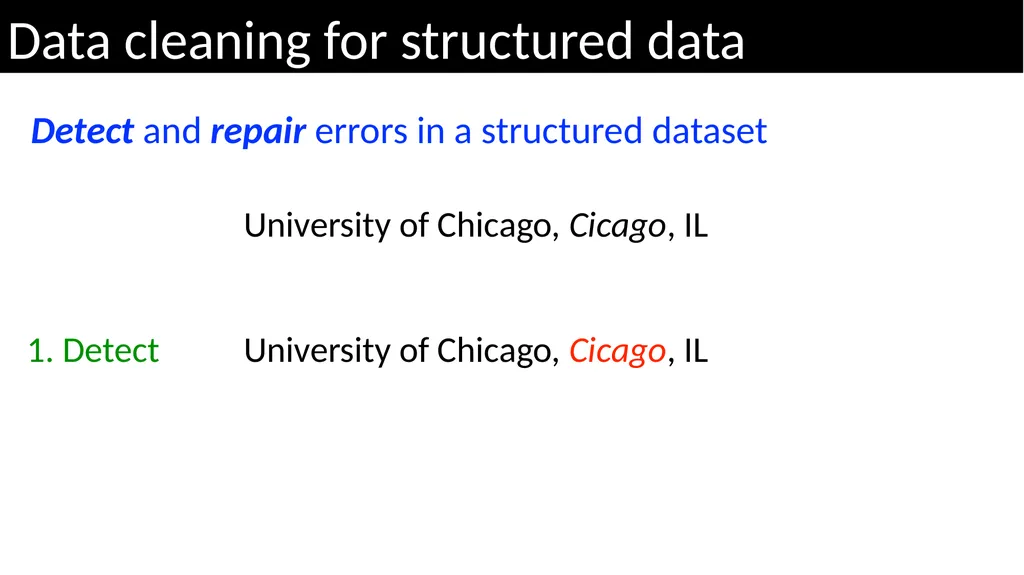
Data cleaning for structured data Detect and repair errors in a structured dataset University of Chicago, Cicago, IL 1. Detect University of Chicago, Cicago, IL<br>
32
Data cleaning for structured data Detect and repair errors in a structured dataset University of Chicago, Cicago, IL 1. Detect University of Chicago, Cicago, IL University of Chicago, Chicago, IL 2. Repair<br>
33
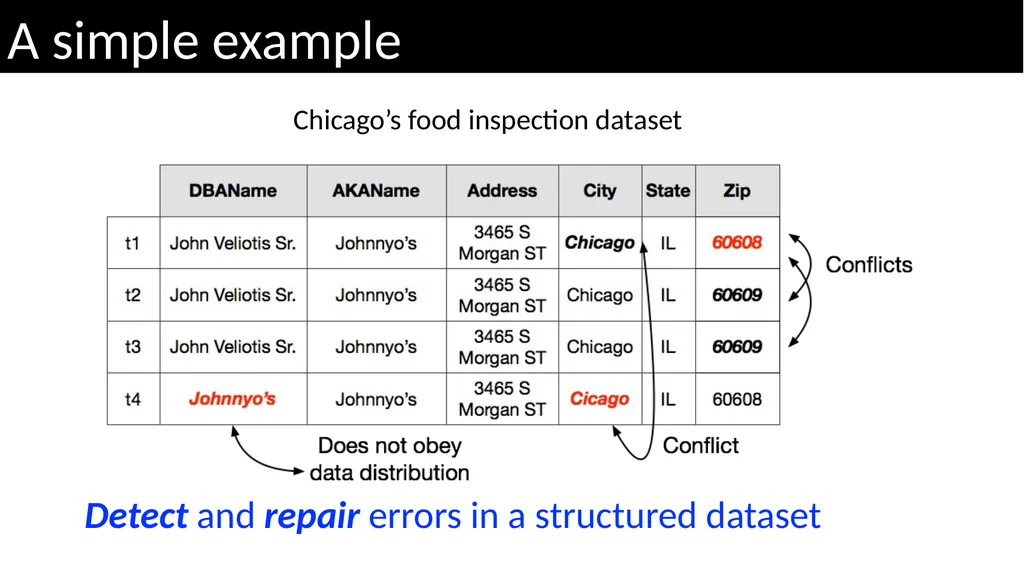
A simple example Chicago’s food inspection dataset Detect and repair errors in a structured dataset<br>
34
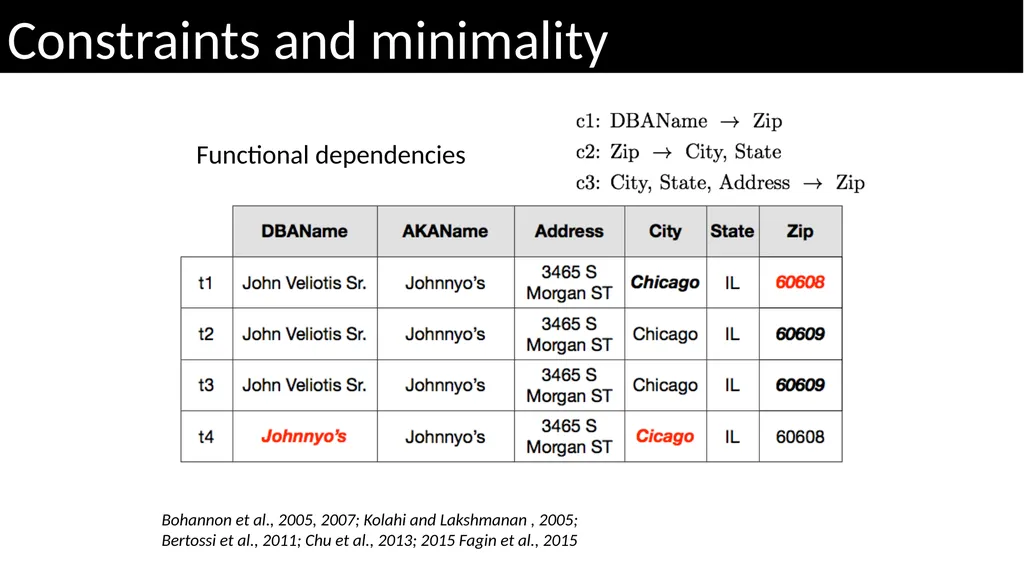
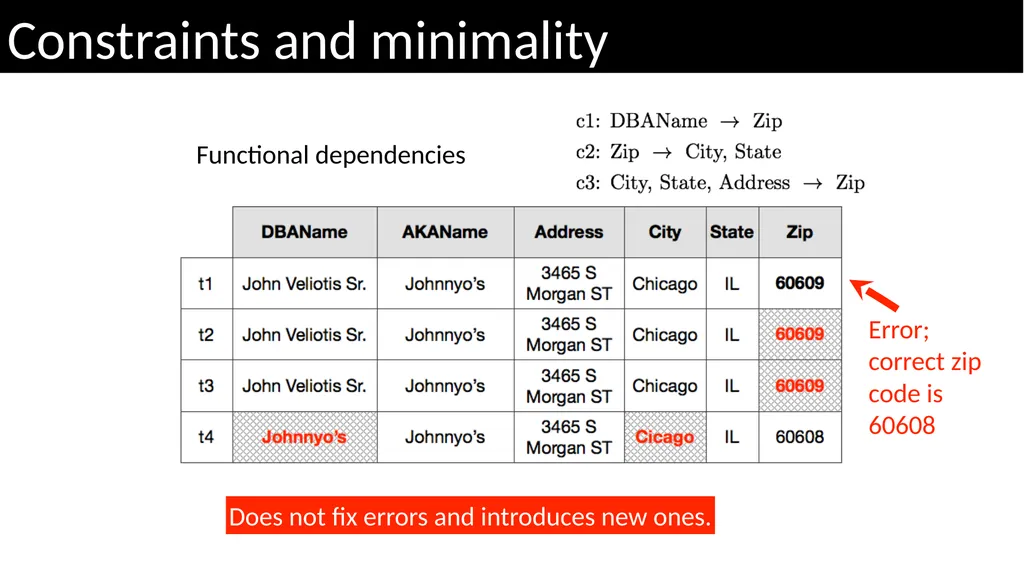
Constraints and minimality Functional dependencies Bohannon et al., 2005, 2007; Kolahi and Lakshmanan , 2005;
Bertossi et al., 2011; Chu et al., 2013; 2015 Fagin et al., 2015<br>
Bertossi et al., 2011; Chu et al., 2013; 2015 Fagin et al., 2015<br>
35
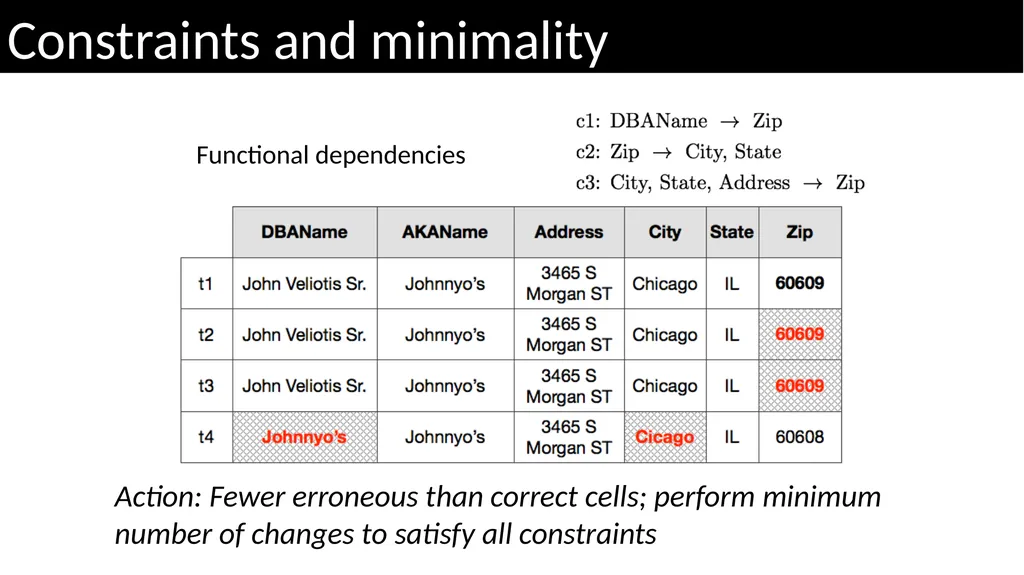
Constraints and minimality Functional dependencies Action: Fewer erroneous than correct cells; perform minimum number of changes to satisfy all constraints<br>
36
Constraints and minimality Functional dependencies Error; correct zip code is 60608 Does not fix errors and introduces new ones.<br>
37
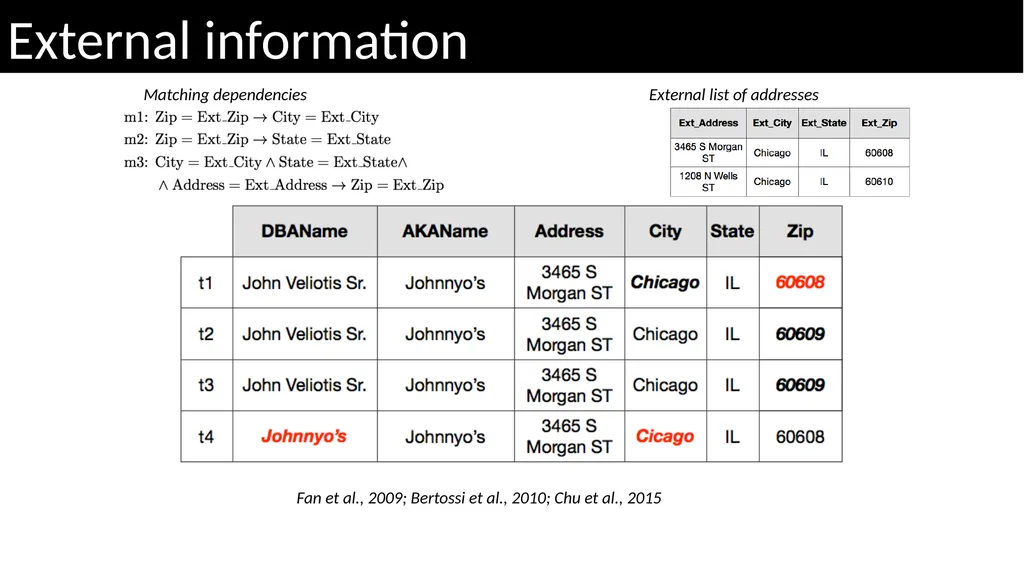
External information External list of addresses Matching dependencies Fan et al., 2009; Bertossi et al., 2010; Chu et al., 2015<br>
38
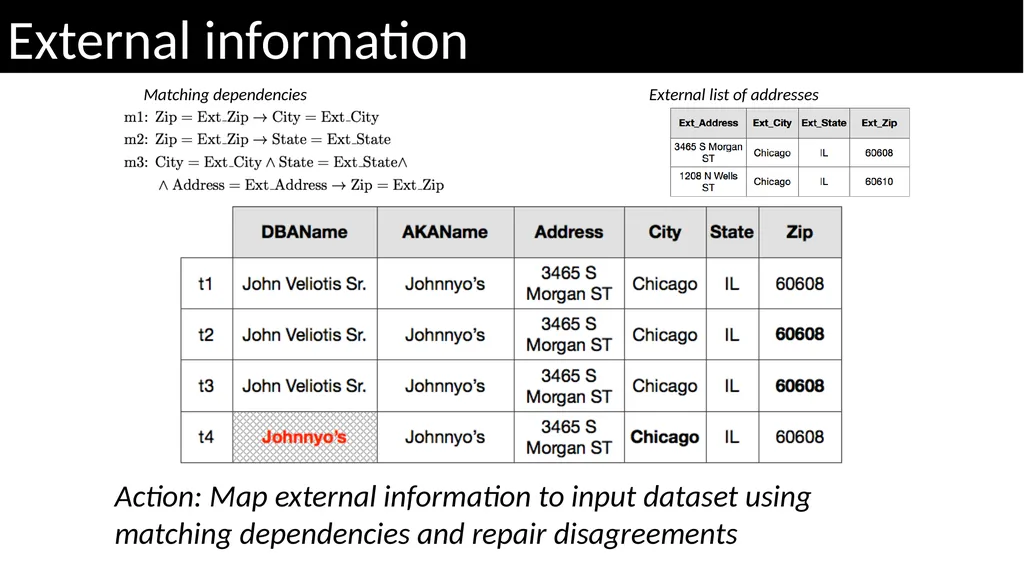
External information External list of addresses Matching dependencies Action: Map external information to input dataset using matching dependencies and repair disagreements<br>
39
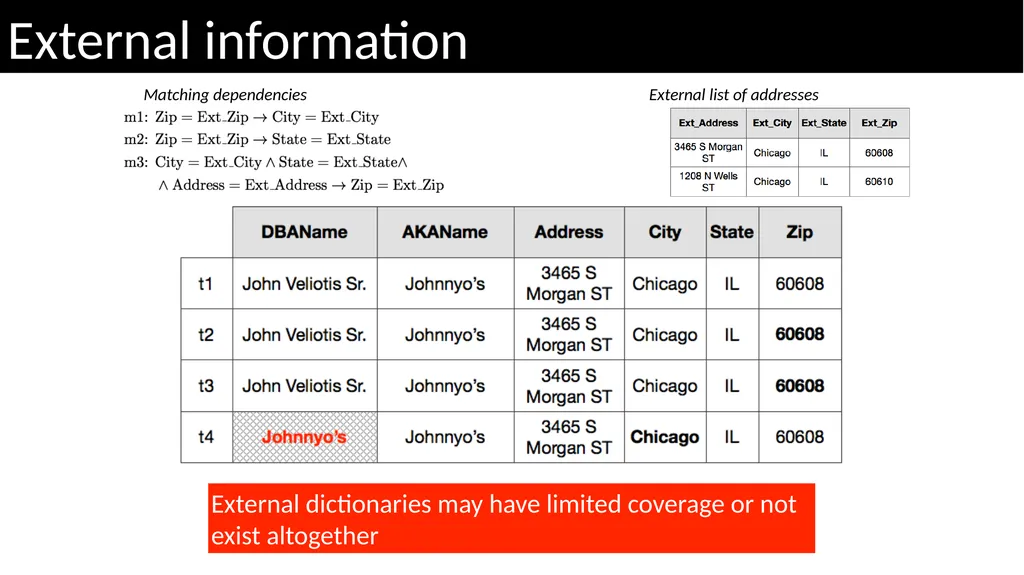
External information External list of addresses Matching dependencies External dictionaries may have limited coverage or not exist altogether<br>
40
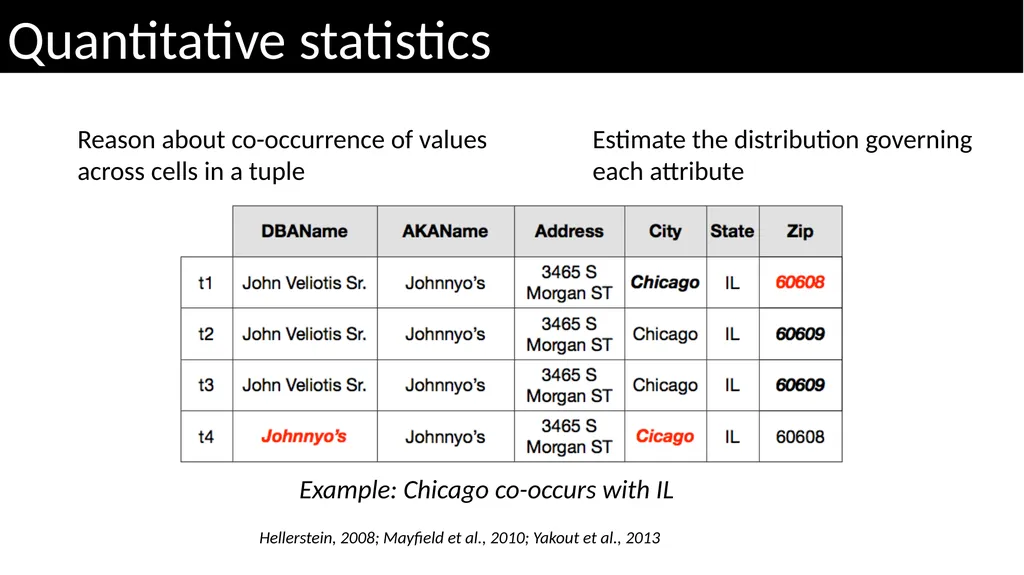
Quantitative statistics Reason about co-occurrence of values across cells in a tuple Estimate the distribution governing each attribute Hellerstein, 2008; Mayfield et al., 2010; Yakout et al., 2013 Example: Chicago co-occurs with IL<br>
41
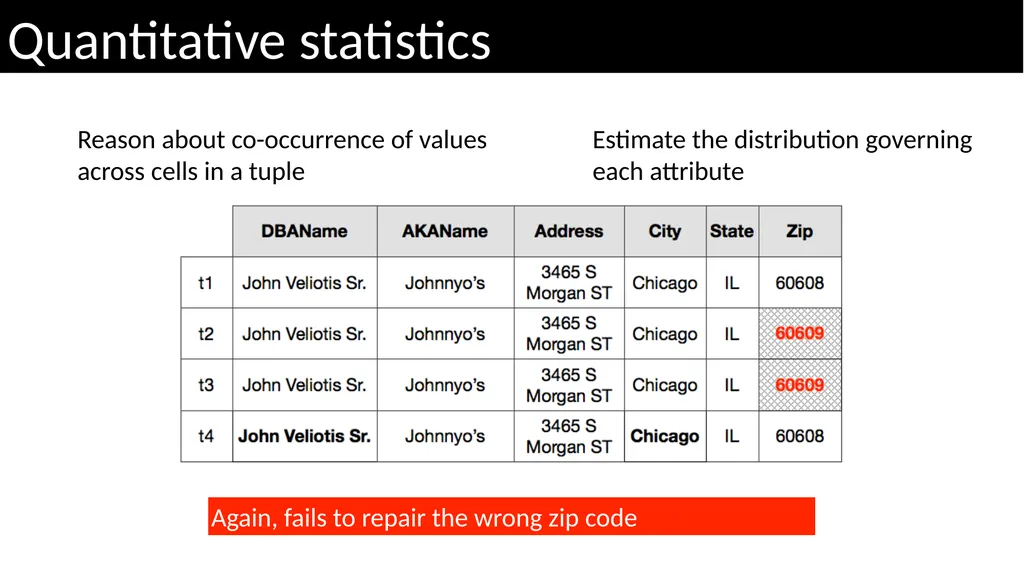
Quantitative statistics Reason about co-occurrence of values across cells in a tuple Estimate the distribution governing each attribute Again, fails to repair the wrong zip code<br>
42
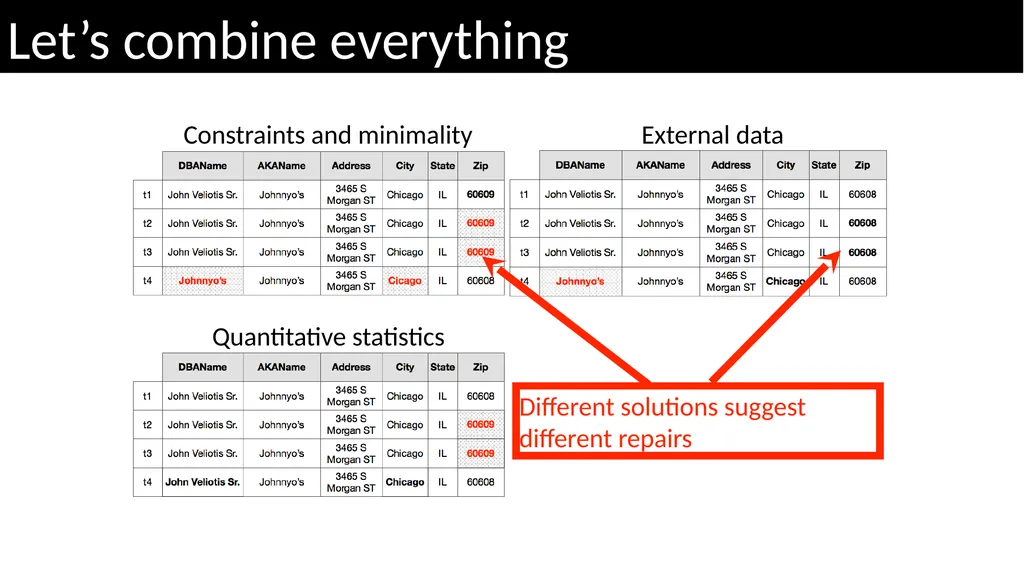
Let’s combine everything Quantitative statistics Constraints and minimality External data<br>
43
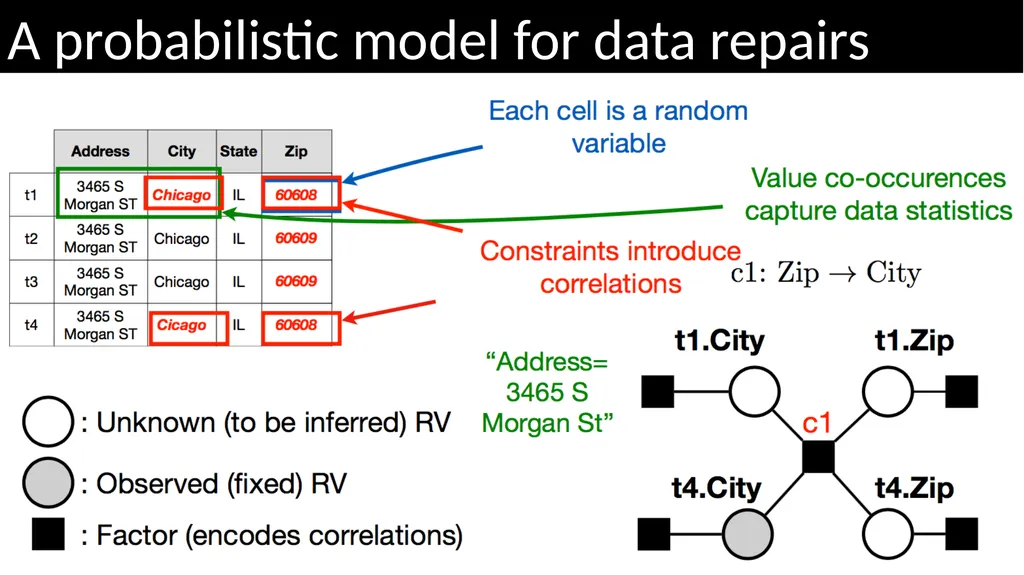
A probabilistic model for data repairs<br>
44
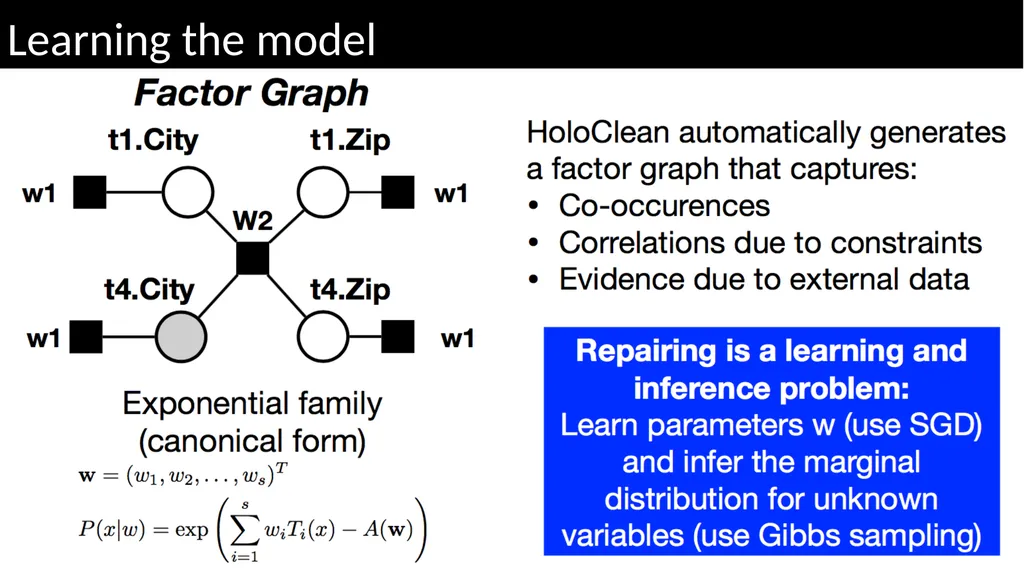
Learning the model<br>