04
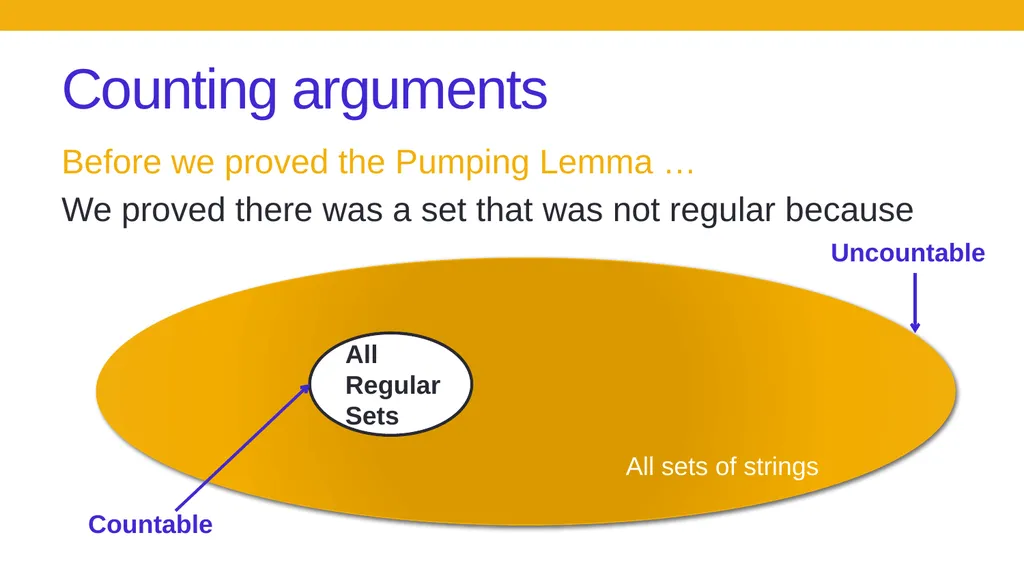
Before we proved the Pumping Lemma …
We proved there was a set that was not regular because All sets of strings Counting arguments All Regular
Sets Countable Uncountable<br>
05
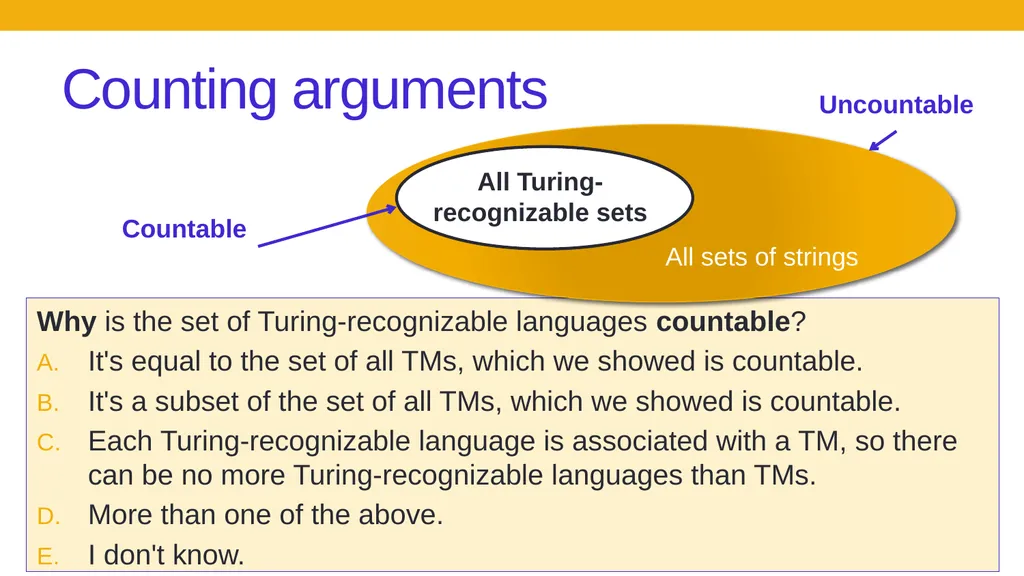
Why is the set of Turing-recognizable languages countable?
It's equal to the set of all TMs, which we showed is countable.
It's a subset of the set of all TMs, which we showed is countable.
Each Turing-recognizable language is associated with a TM, so there can be no more Turing-recognizable languages than TMs.
More than one of the above.
I don't know. All sets of strings Counting arguments All Turing-recognizable sets Countable Uncountable<br>
06
Satisfied? Maybe not …
What's a specific example of a language that is not Turing-recognizable? or not Turing-decidable?
Idea: consider a set that, were it to be Turing-decidable, would have to "talk" about itself, and contradict itself!<br>
07
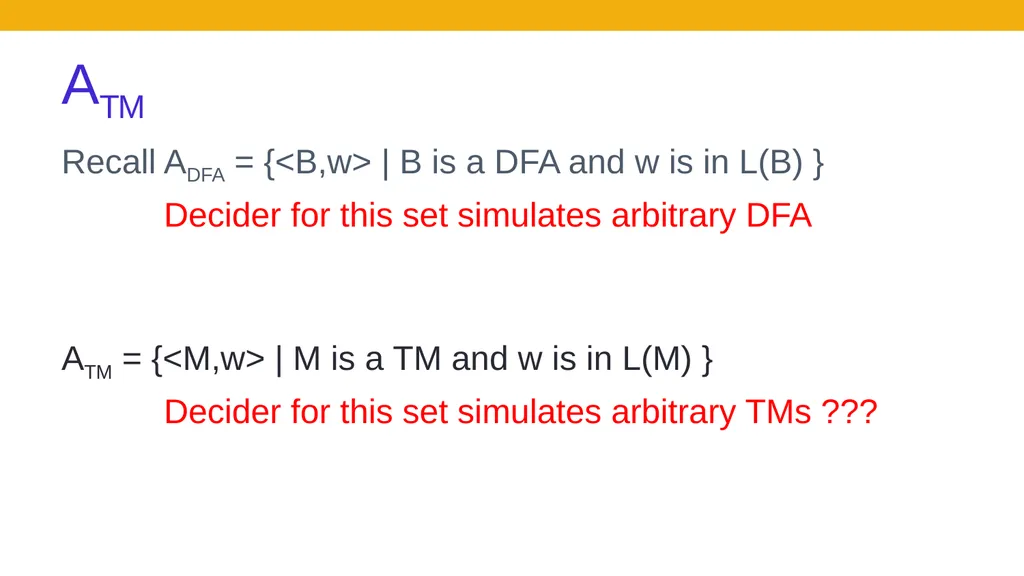
ATM Recall ADFA = {<B,w> | B is a DFA and w is in L(B) }
Decider for this set simulates arbitrary DFA
ATM = {<M,w> | M is a TM and w is in L(M) }
Decider for this set simulates arbitrary TMs ???<br>
08
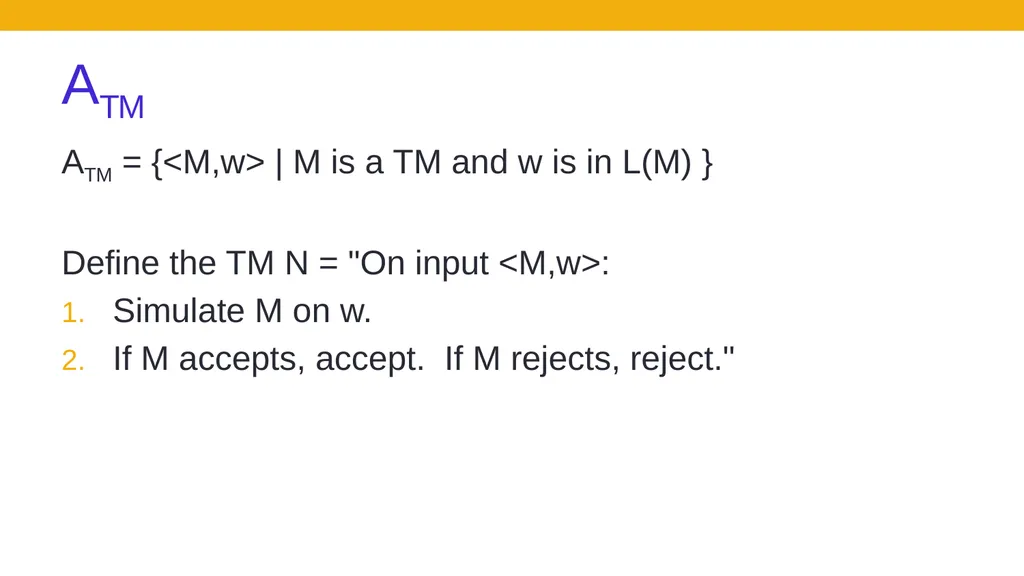
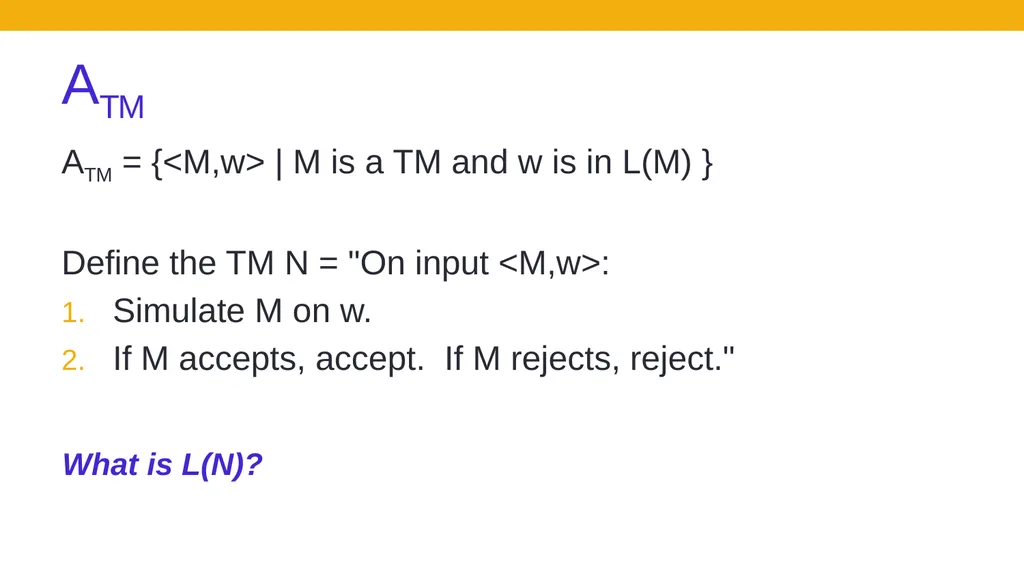
ATM ATM = {<M,w> | M is a TM and w is in L(M) }
Define the TM N = "On input <M,w>:
Simulate M on w.
If M accepts, accept. If M rejects, reject."<br>
09
ATM ATM = {<M,w> | M is a TM and w is in L(M) }
Define the TM N = "On input <M,w>:
Simulate M on w.
If M accepts, accept. If M rejects, reject." What is L(N)?<br>
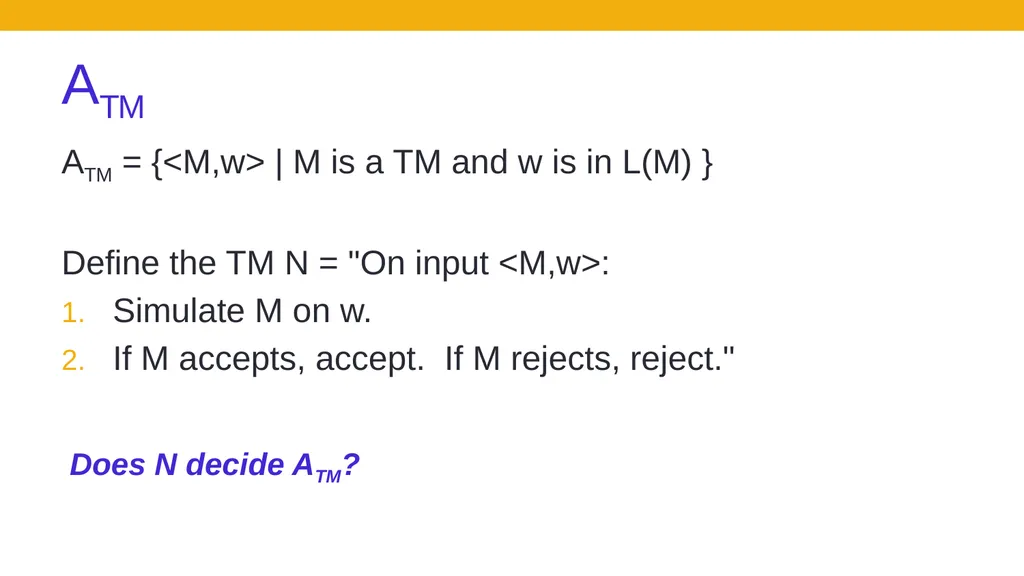
10
ATM ATM = {<M,w> | M is a TM and w is in L(M) }
Define the TM N = "On input <M,w>:
Simulate M on w.
If M accepts, accept. If M rejects, reject." Does N decide ATM?<br>
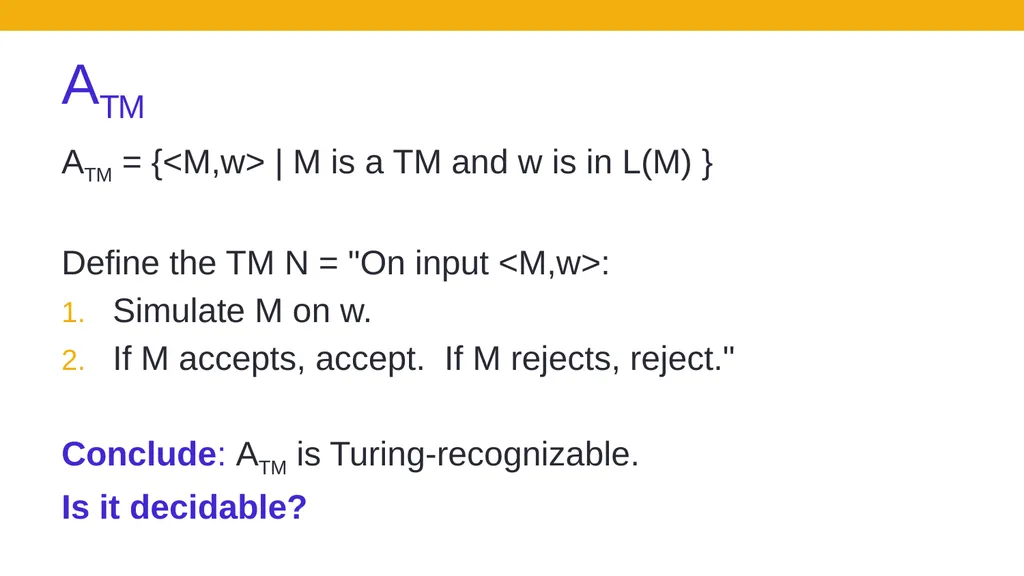
11
ATM ATM = {<M,w> | M is a TM and w is in L(M) }
Define the TM N = "On input <M,w>:
Simulate M on w.
If M accepts, accept. If M rejects, reject."
Conclude: ATM is Turing-recognizable.
Is it decidable?<br>
12
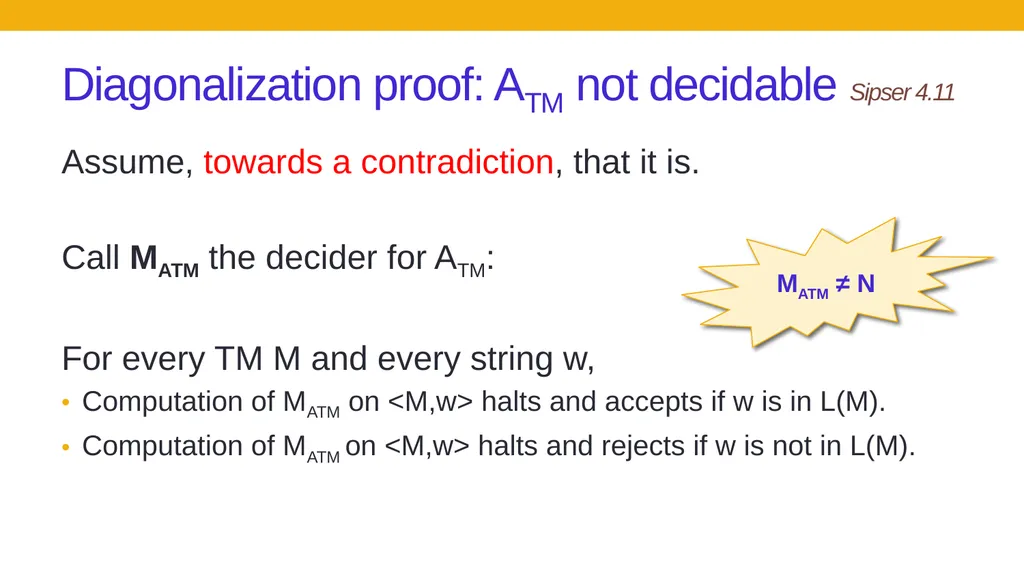
Diagonalization proof: ATM not decidable Sipser 4.11 Assume, towards a contradiction, that it is.
Call MATM the decider for ATM:
For every TM M and every string w,
Computation of MATM on <M,w> halts and accepts if w is in L(M).
Computation of MATM on <M,w> halts and rejects if w is not in L(M). MATM ≠ N<br>
13
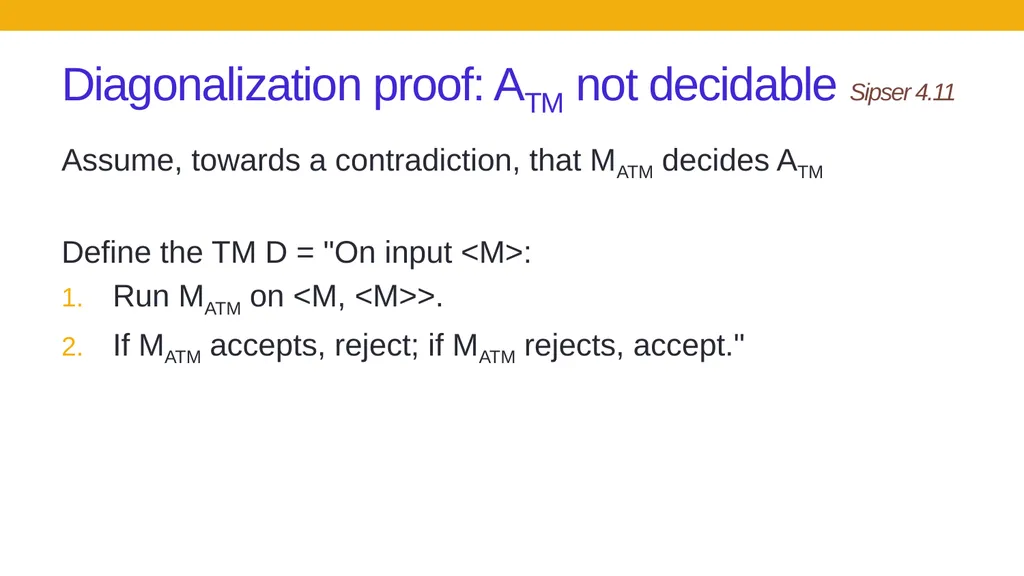
Diagonalization proof: ATM not decidable Sipser 4.11 Assume, towards a contradiction, that MATM decides ATM
Define the TM D = "On input <M>:
Run MATM on <M, <M>>.
If MATM accepts, reject; if MATM rejects, accept."<br>
14
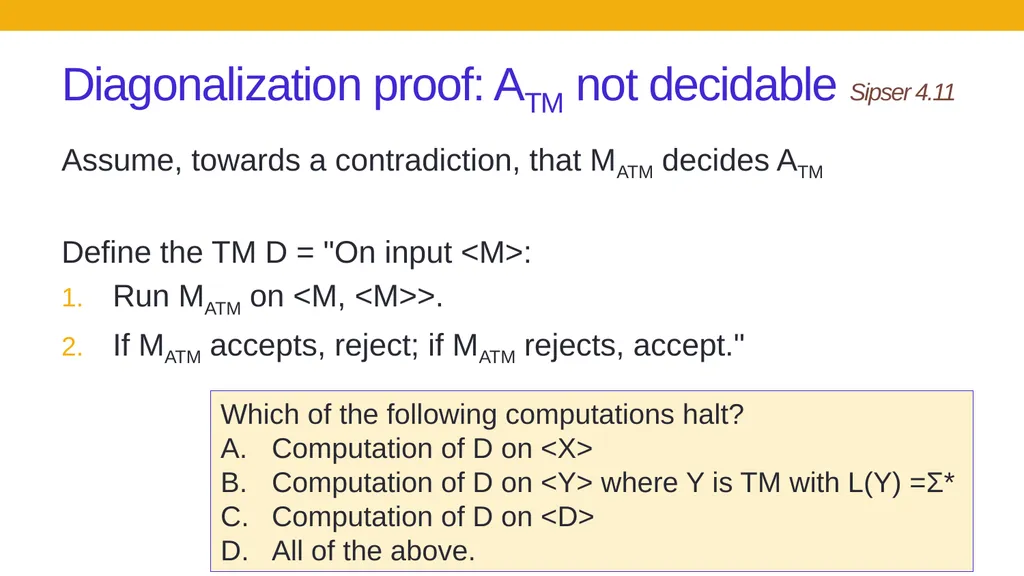
Diagonalization proof: ATM not decidable Sipser 4.11 Assume, towards a contradiction, that MATM decides ATM
Define the TM D = "On input <M>:
Run MATM on <M, <M>>.
If MATM accepts, reject; if MATM rejects, accept." Which of the following computations halt?
Computation of D on <X>
Computation of D on <Y> where Y is TM with L(Y) =Σ*
Computation of D on <D>
All of the above.<br>
15
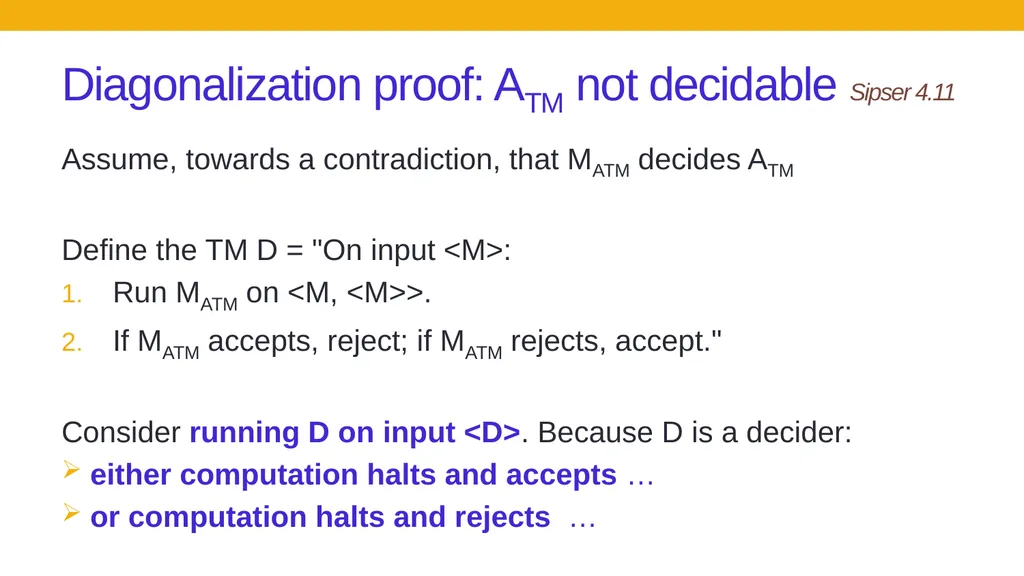
Diagonalization proof: ATM not decidable Sipser 4.11 Assume, towards a contradiction, that MATM decides ATM
Define the TM D = "On input <M>:
Run MATM on <M, <M>>.
If MATM accepts, reject; if MATM rejects, accept."
Consider running D on input <D>. Because D is a decider:
either computation halts and accepts …
or computation halts and rejects …<br>
16
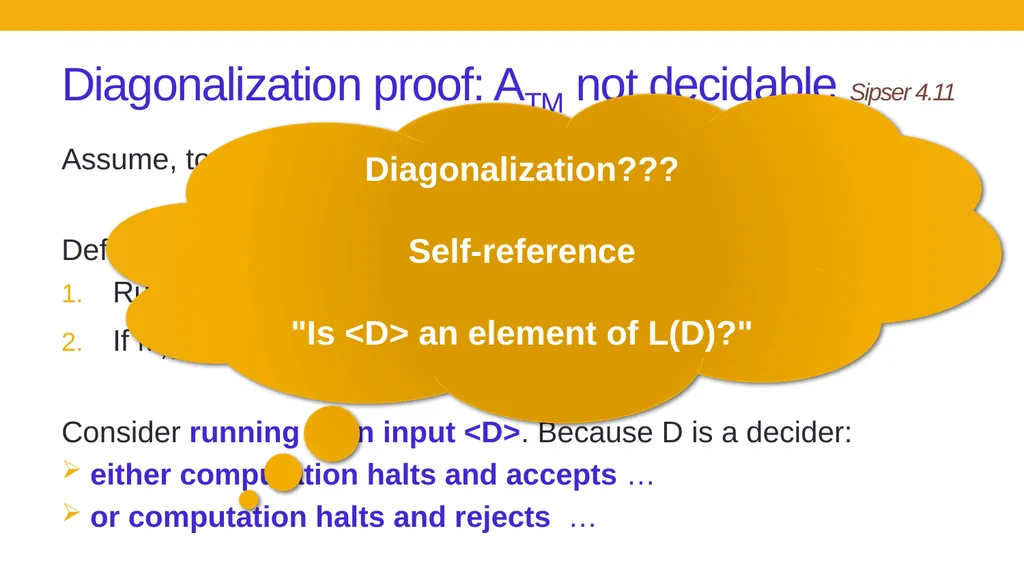
Diagonalization proof: ATM not decidable Sipser 4.11 Assume, towards a contradiction, that MATM decides ATM
Define the TM D = "On input <M>:
Run MATM on <M, <M>>.
If MATM accepts, reject; if MATM rejects, accept."
Consider running D on input <D>. Because D is a decider:
either computation halts and accepts …
or computation halts and rejects … Diagonalization???
Self-reference
"Is <D> an element of L(D)?"<br>
17
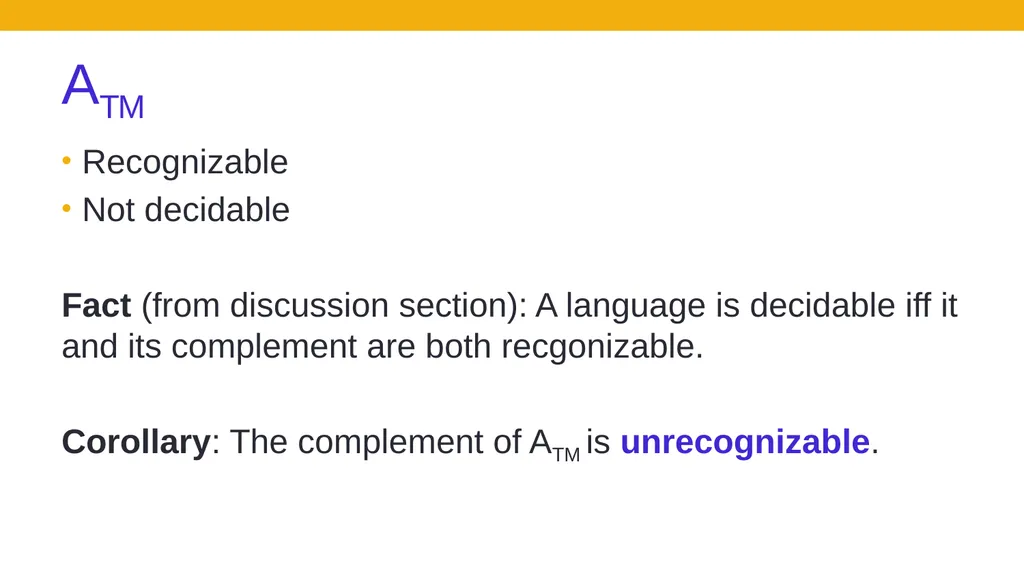
ATM Recognizable
Not decidable
Fact (from discussion section): A language is decidable iff it and its complement are both recgonizable.
Corollary: The complement of ATM is unrecognizable.<br>
18
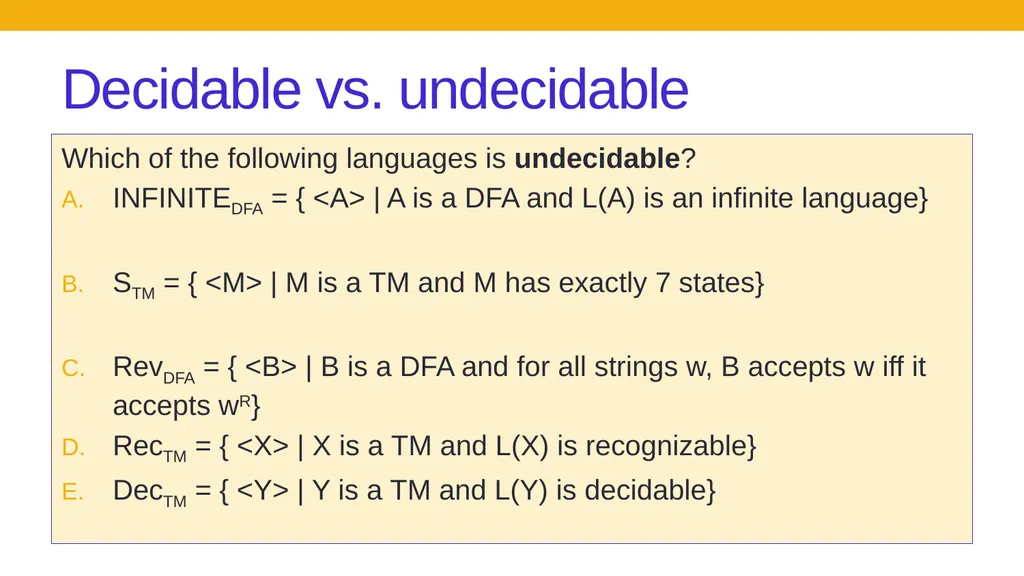
Decidable vs. undecidable Which of the following languages is undecidable?
INFINITEDFA = { <A> | A is a DFA and L(A) is an infinite language}
STM = { <M> | M is a TM and M has exactly 7 states}
RevDFA = { <B> | B is a DFA and for all strings w, B accepts w iff it accepts wR}
RecTM = { <X> | X is a TM and L(X) is recognizable}
DecTM = { <Y> | Y is a TM and L(Y) is decidable}<br>
20
Do we have to diagonalize? Next time: comparing difficulty of problems.<br>