CSE 20 Discrete math Fall 2020 http:cseweb.ucsd.educlassesfa20cse20-a Todays learning goals Translate sentences from English to propositional logic using appropriate propositional variables and boolean operators Evaluate the truth
"CSE 20 Discrete math Fall 2020" is the property of its rightful owner. Permission is granted to
download and print the materials on this website for personal, non-commercial use only, and to display it
on your personal computer provided you do not modify the materials and that you retain all copyright
notices contained in the materials. By downloading content from our website, you accept the terms of this
agreement.
Presentation Transcript
01
CSE 20 Discrete math Fall 2020
http://cseweb.ucsd.edu/classes/fa20/cse20-a/<br>
02
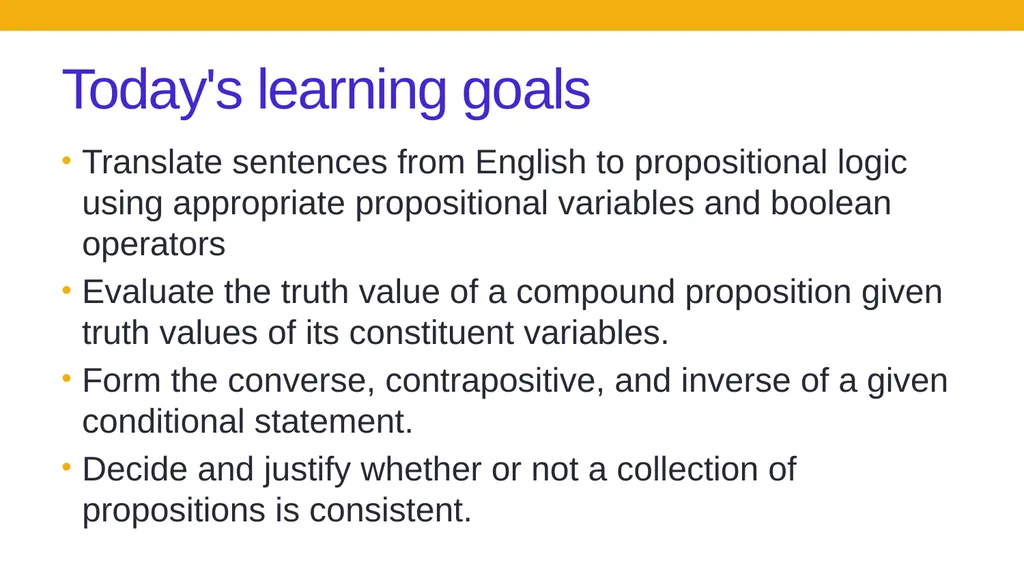
Today's learning goals Translate sentences from English to propositional logic using appropriate propositional variables and boolean operators
Evaluate the truth value of a compound proposition given truth values of its constituent variables.
Form the converse, contrapositive, and inverse of a given conditional statement.
Decide and justify whether or not a collection of propositions is consistent.<br>
03
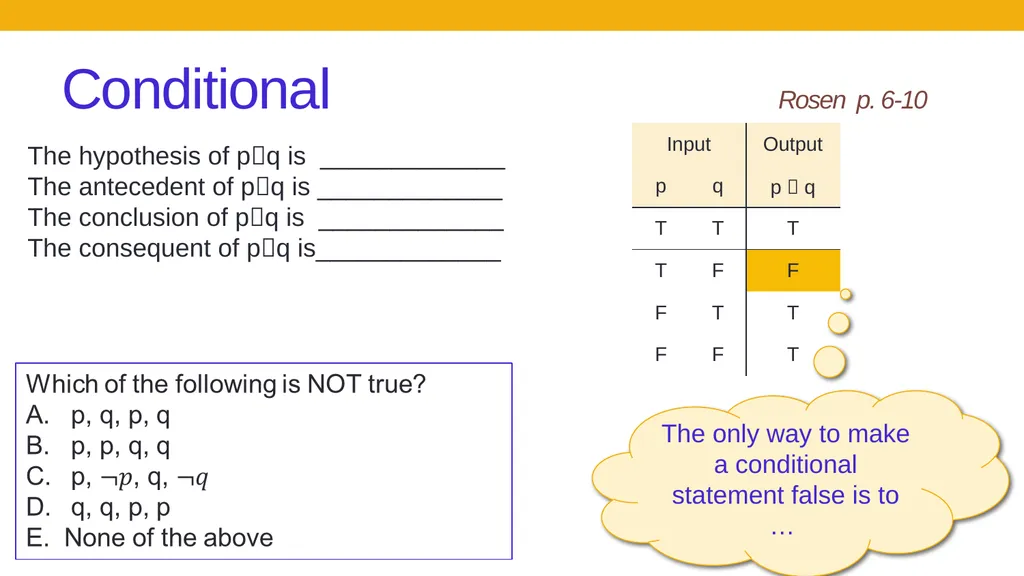
Conditional Rosen p. 6-10 The only way to make a conditional statement false is to … The hypothesis of pq is _____________
The antecedent of pq is _____________
The conclusion of pq is _____________
The consequent of pq is_____________<br>
04
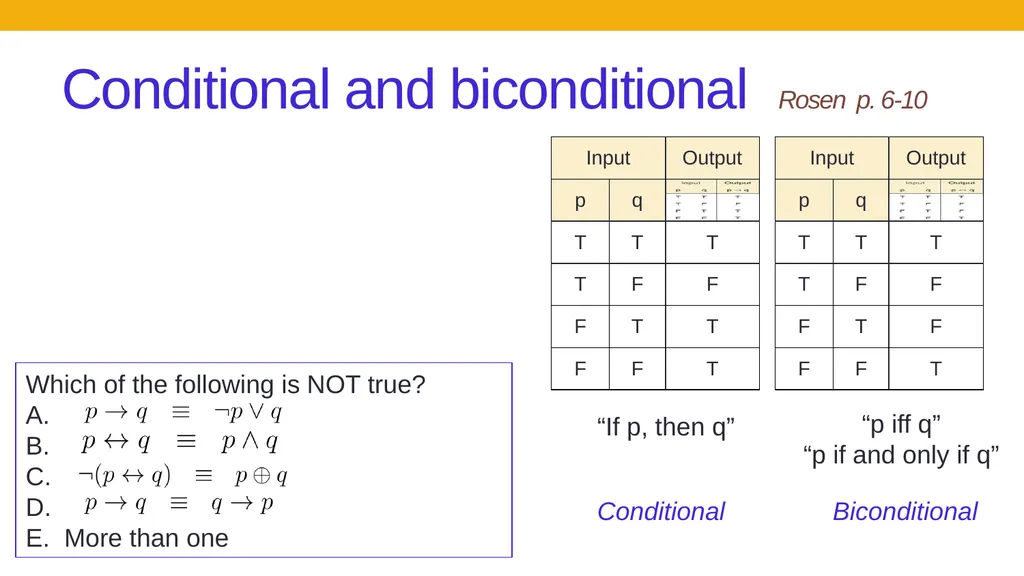
Conditional and biconditional Rosen p. 6-10 “If p, then q” Conditional “p iff q”
“p if and only if q” Biconditional Which of the following is NOT true?
More than one<br>
05
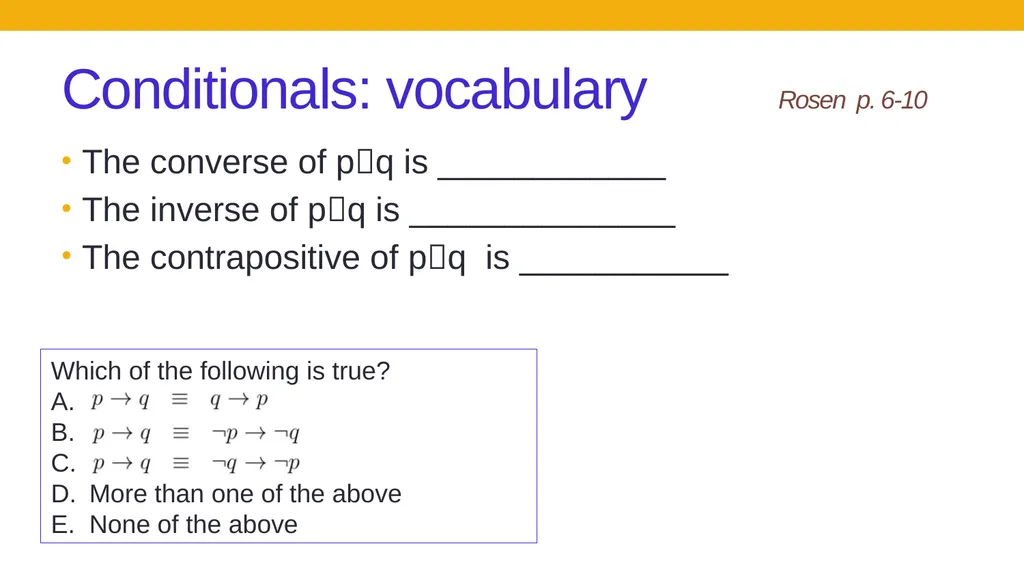
Conditionals: vocabulary Rosen p. 6-10 The converse of pq is ____________
The inverse of pq is ______________
The contrapositive of pq is ___________ Which of the following is true?
More than one of the above
None of the above<br>
06
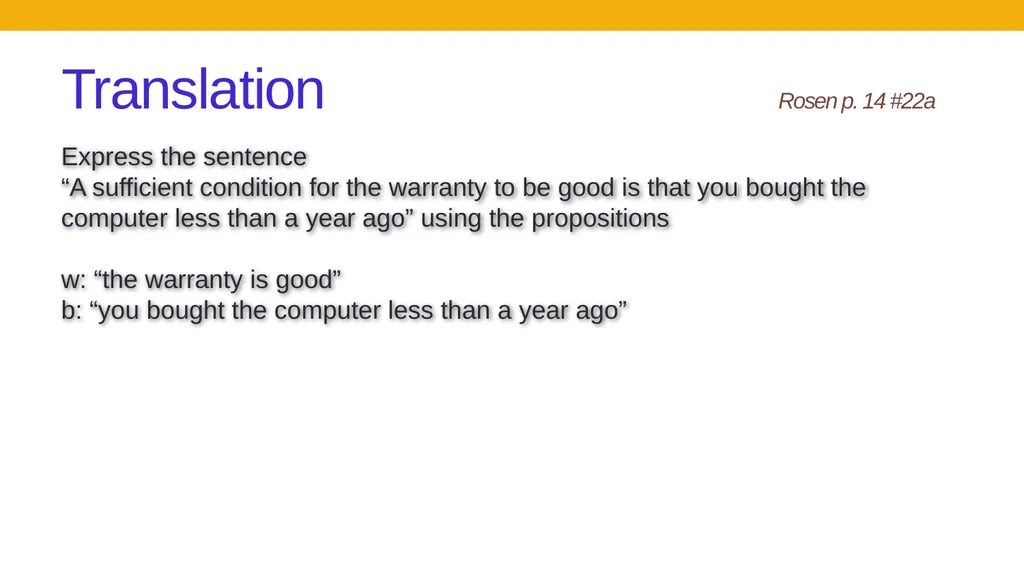
Translation Rosen p. 14 #22a Express the sentence
“A sufficient condition for the warranty to be good is that you bought the computer less than a year ago” using the propositions
w: “the warranty is good”
b: “you bought the computer less than a year ago”<br>
07
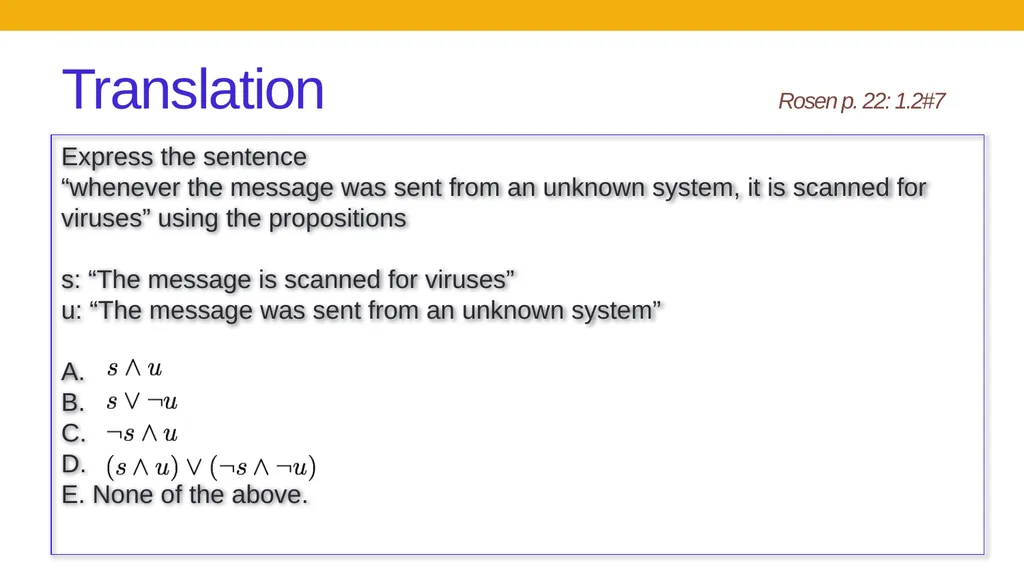
Translation Rosen p. 22: 1.2#7 Express the sentence
“whenever the message was sent from an unknown system, it is scanned for viruses” using the propositions
s: “The message is scanned for viruses”
u: “The message was sent from an unknown system”
A.
B.
C.
D.
E. None of the above.<br>
08
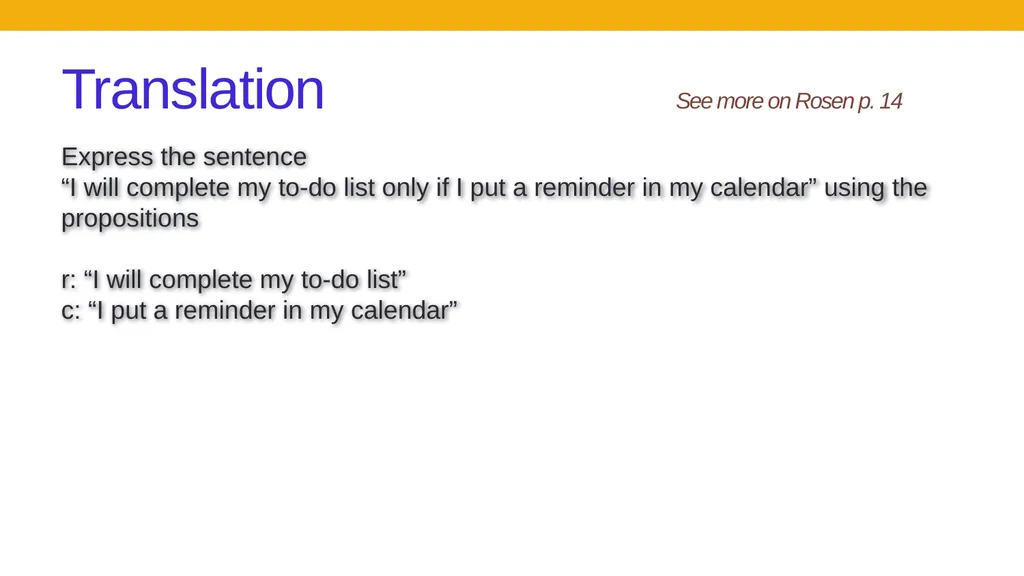
Translation See more on Rosen p. 14 Express the sentence
“I will complete my to-do list only if I put a reminder in my calendar” using the propositions
r: “I will complete my to-do list”
c: “I put a reminder in my calendar”<br>
09
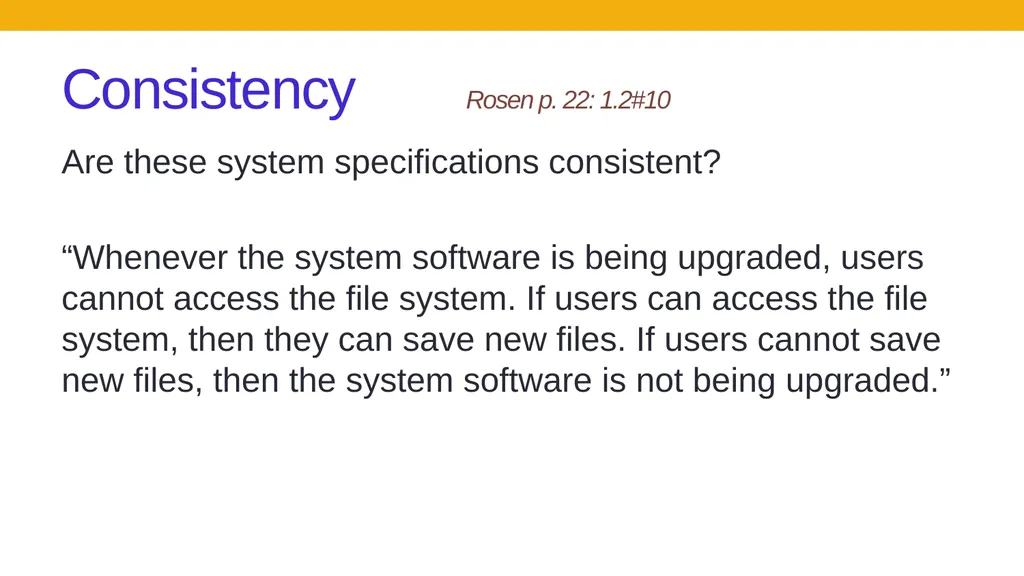
Consistency Rosen p. 22: 1.2#10 Are these system specifications consistent?
“Whenever the system software is being upgraded, users cannot access the file system. If users can access the file system, then they can save new files. If users cannot save new files, then the system software is not being upgraded.”<br>
10
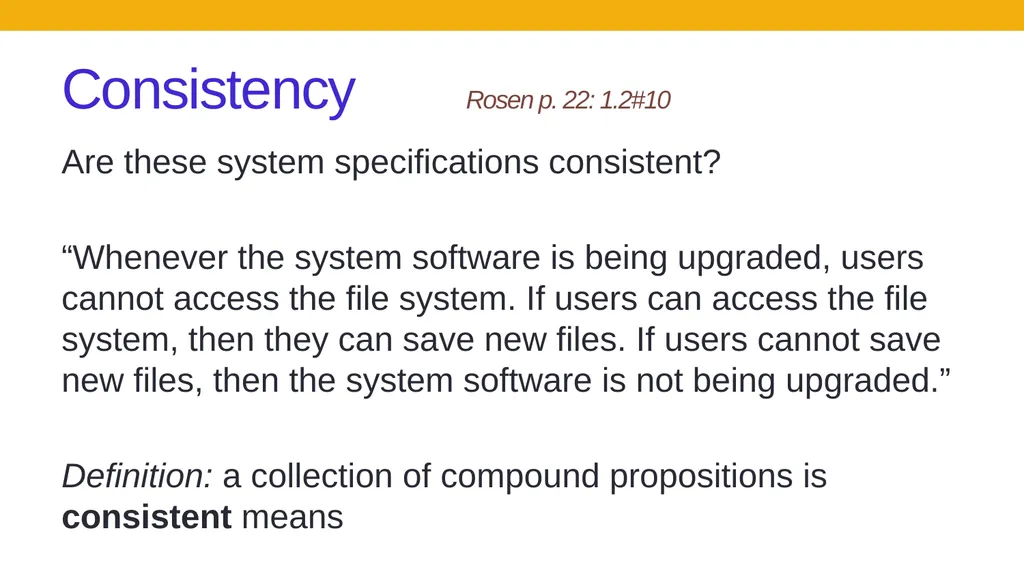
Consistency Rosen p. 22: 1.2#10 Are these system specifications consistent?
“Whenever the system software is being upgraded, users cannot access the file system. If users can access the file system, then they can save new files. If users cannot save new files, then the system software is not being upgraded.”
Definition: a collection of compound propositions is consistent means<br>
11
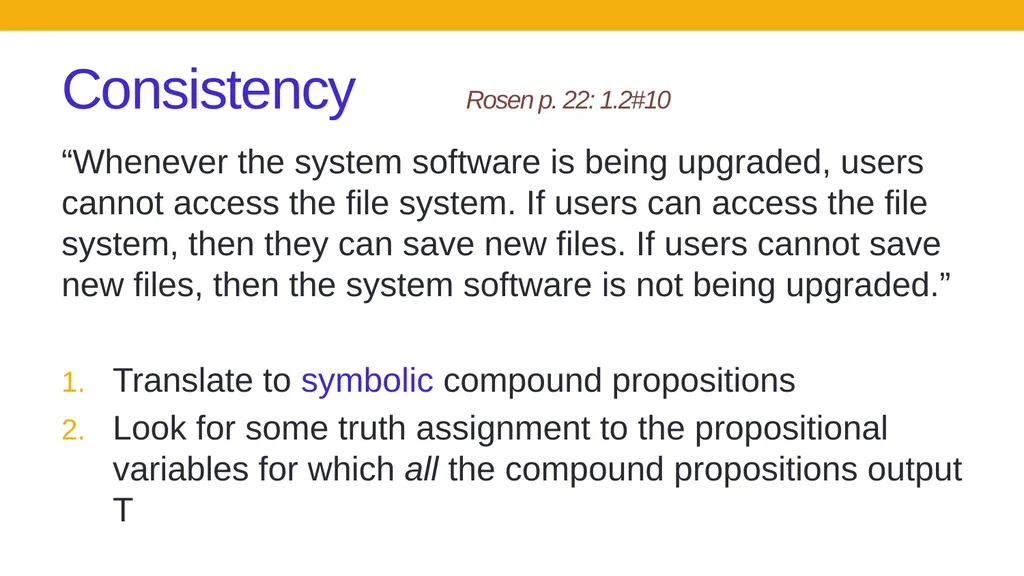
Consistency Rosen p. 22: 1.2#10 “Whenever the system software is being upgraded, users cannot access the file system. If users can access the file system, then they can save new files. If users cannot save new files, then the system software is not being upgraded.”
Translate to symbolic compound propositions
Look for some truth assignment to the propositional variables for which all the compound propositions output T<br>
12
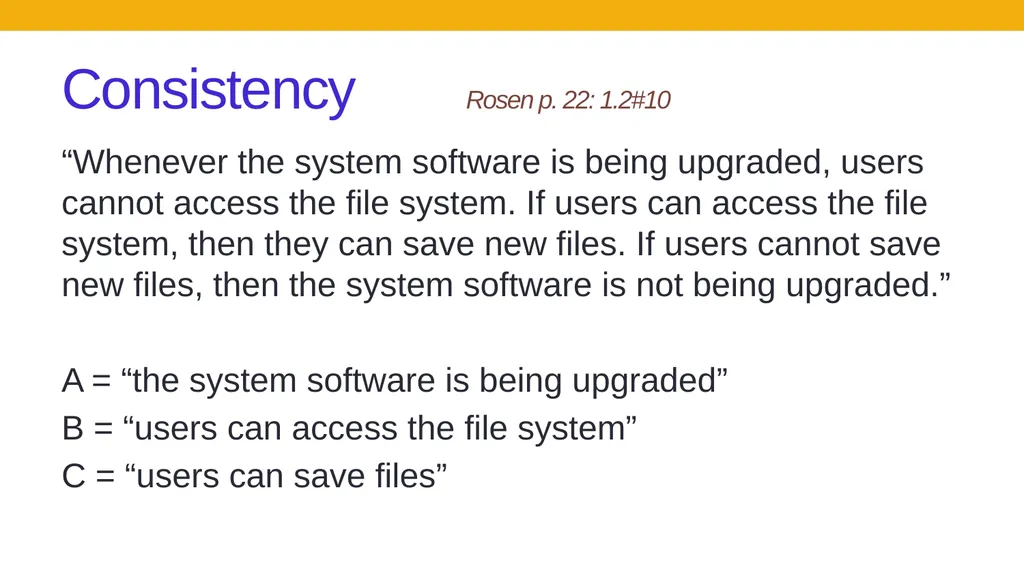
Consistency Rosen p. 22: 1.2#10 “Whenever the system software is being upgraded, users cannot access the file system. If users can access the file system, then they can save new files. If users cannot save new files, then the system software is not being upgraded.”
A = “the system software is being upgraded”
B = “users can access the file system”
C = “users can save files”<br>
13
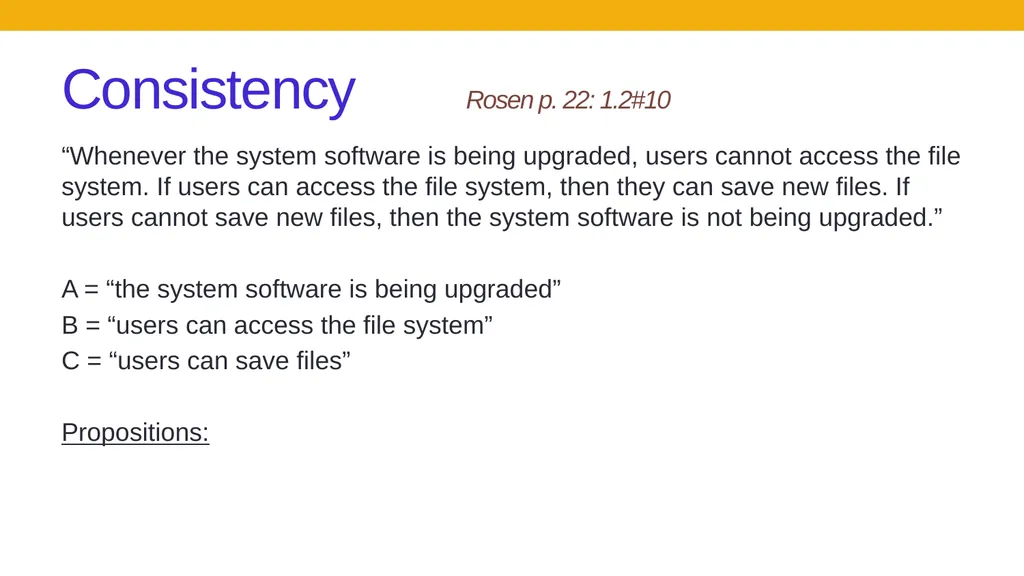
Consistency Rosen p. 22: 1.2#10 “Whenever the system software is being upgraded, users cannot access the file system. If users can access the file system, then they can save new files. If users cannot save new files, then the system software is not being upgraded.”
A = “the system software is being upgraded”
B = “users can access the file system”
C = “users can save files”
Propositions:<br>
14
For next time Read website carefully
http://cseweb.ucsd.edu/classes/fa20/cse20-a/