
CSE 502: Computer Architecture Branch Prediction
YM
Published · 58 slides · 0 views
1 / 1
Description
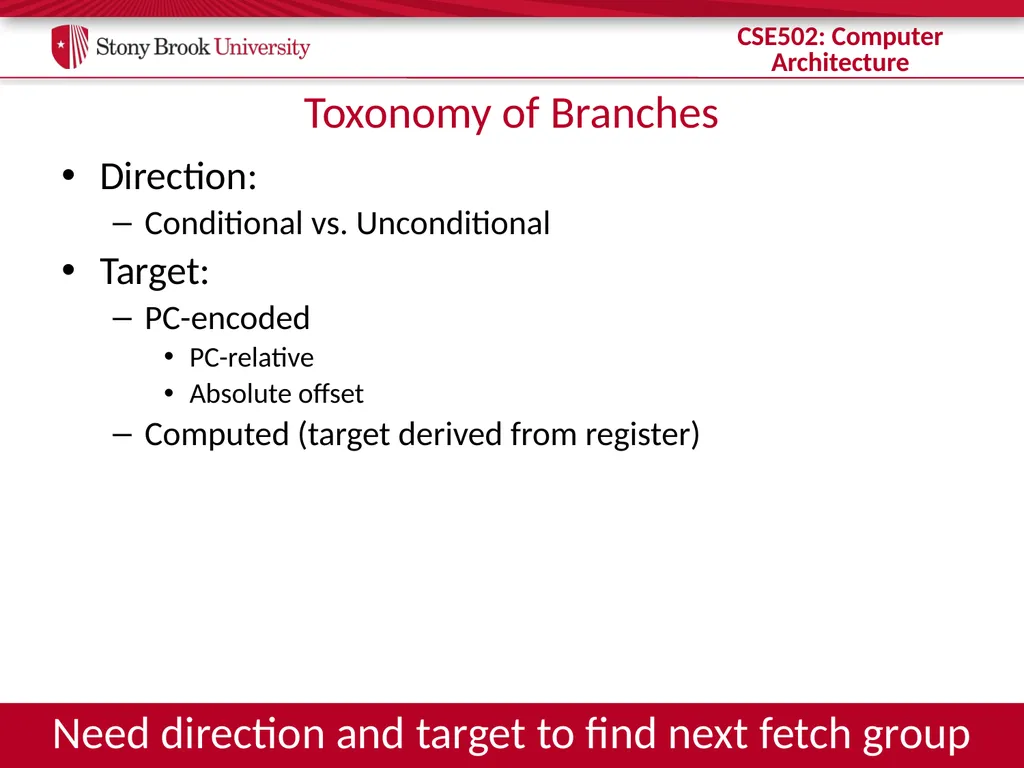
CSE 502: Computer Architecture Branch Prediction Toxonomy of Branches Direction: Conditional vs. Unconditional Target: PC-encoded PC-relative Absolute offset Computed (target derived from register) Need direction and target to find next
Related Topics
Share
Embed code
Download this presentation From Below
"CSE 502: Computer Architecture Branch Prediction" is the property of its rightful owner. Permission is granted to download and print the materials on this website for personal, non-commercial use only, and to display it on your personal computer provided you do not modify the materials and that you retain all copyright notices contained in the materials. By downloading content from our website, you accept the terms of this agreement.
Presentation Transcript
01
CSE 502:
Computer Architecture Branch Prediction<br>
02
Toxonomy of Branches Direction:
Conditional vs. Unconditional
Target:
PC-encoded
PC-relative
Absolute offset
Computed (target derived from register) Need direction and target to find next fetch group<br>
Conditional vs. Unconditional
Target:
PC-encoded
PC-relative
Absolute offset
Computed (target derived from register) Need direction and target to find next fetch group<br>
03
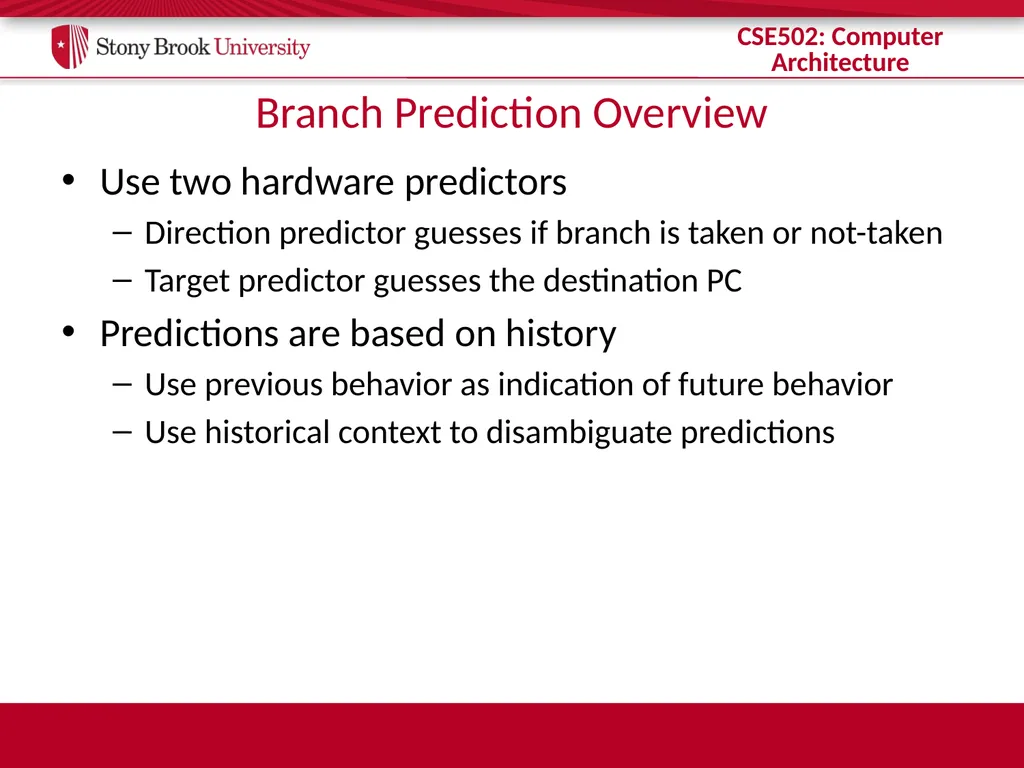
Branch Prediction Overview Use two hardware predictors
Direction predictor guesses if branch is taken or not-taken
Target predictor guesses the destination PC
Predictions are based on history
Use previous behavior as indication of future behavior
Use historical context to disambiguate predictions<br>
Direction predictor guesses if branch is taken or not-taken
Target predictor guesses the destination PC
Predictions are based on history
Use previous behavior as indication of future behavior
Use historical context to disambiguate predictions<br>
04
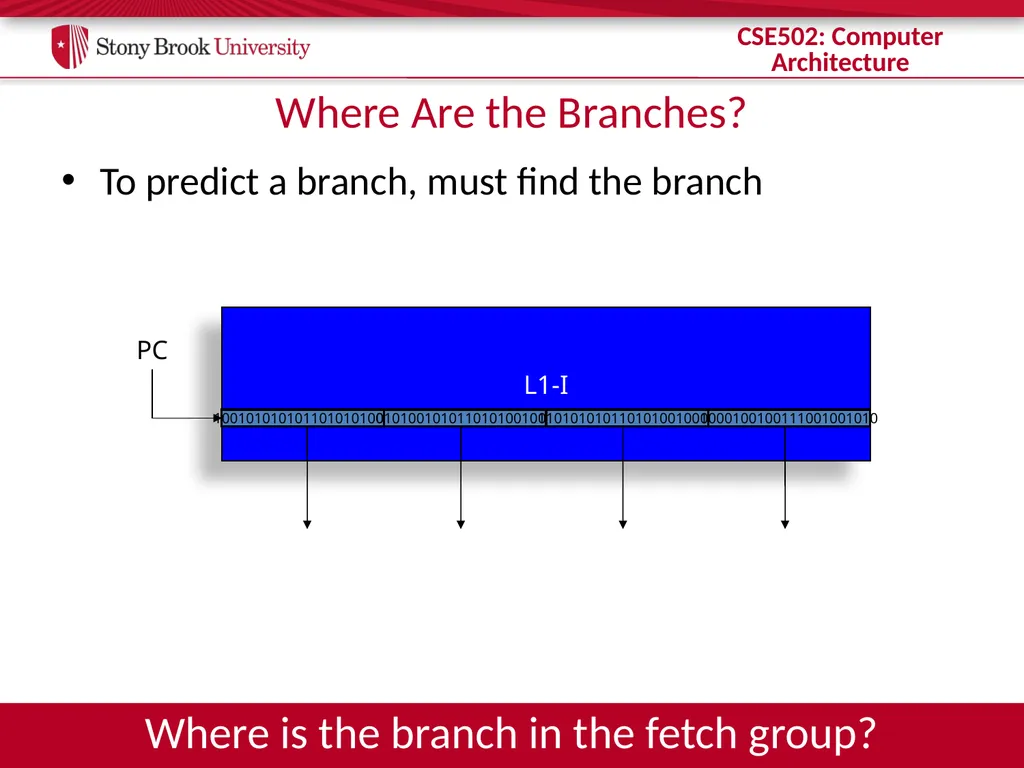
Where Are the Branches? To predict a branch, must find the branch L1-I PC 1001010101011010101001 0101001010110101001010 0101010101101010010010 0000100100111001001010 Where is the branch in the fetch group?<br>
05
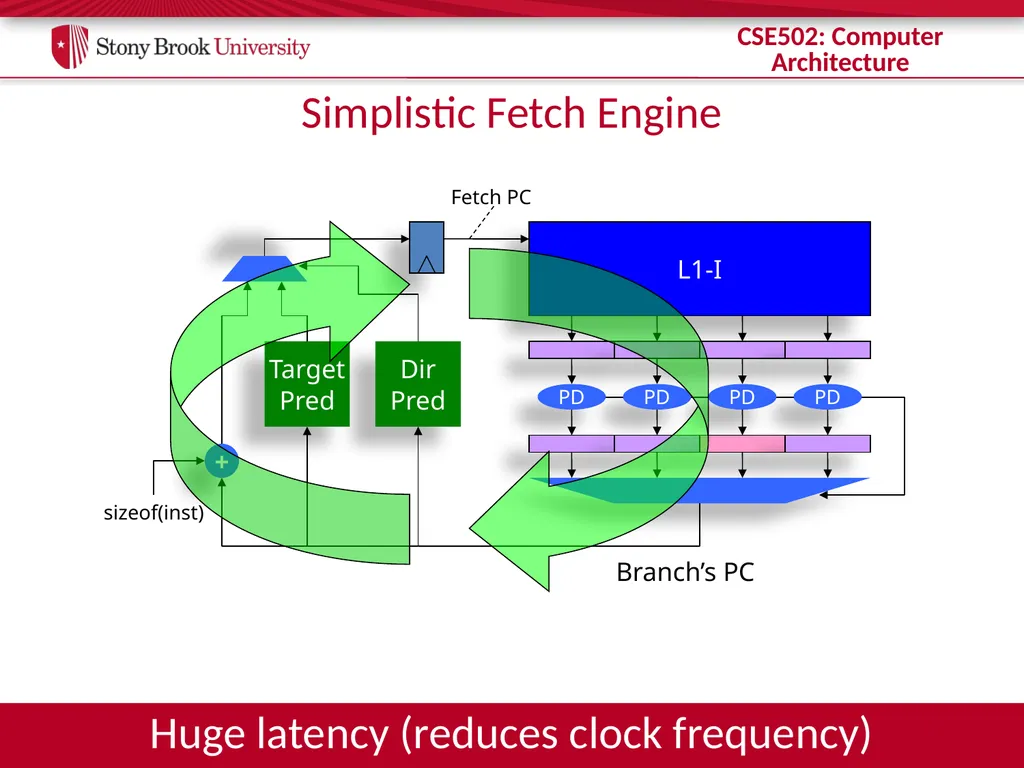
Simplistic Fetch Engine L1-I PD PD PD PD Dir
Pred Target
Pred Branch’s PC + sizeof(inst) Fetch PC Huge latency (reduces clock frequency)<br>
Pred Target
Pred Branch’s PC + sizeof(inst) Fetch PC Huge latency (reduces clock frequency)<br>
06
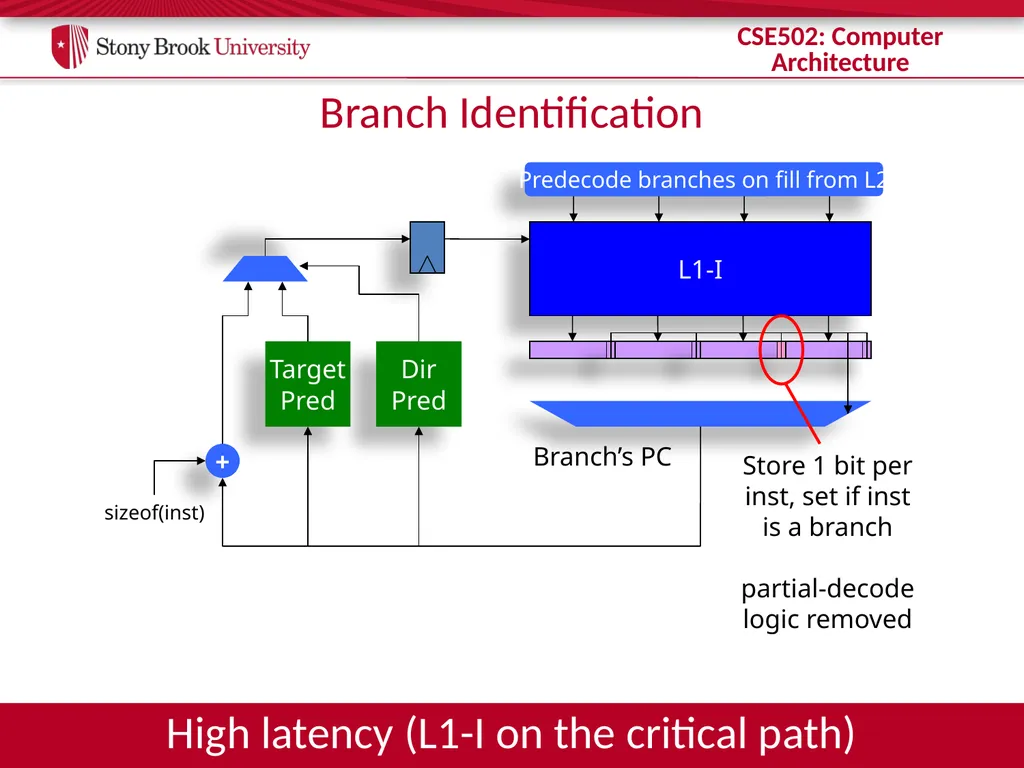
Branch Identification L1-I Dir
Pred Target
Pred Branch’s PC + sizeof(inst) Predecode branches on fill from L2 High latency (L1-I on the critical path)<br>
Pred Target
Pred Branch’s PC + sizeof(inst) Predecode branches on fill from L2 High latency (L1-I on the critical path)<br>
07
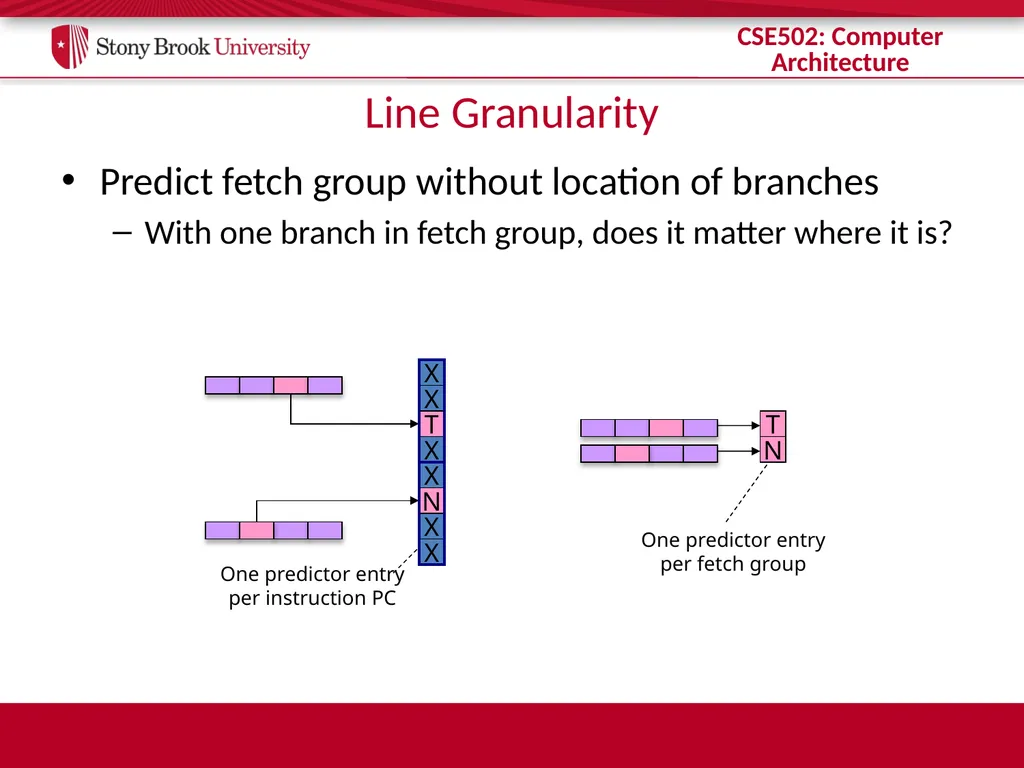
Line Granularity Predict fetch group without location of branches
With one branch in fetch group, does it matter where it is? X X T X X N X X T N One predictor entry
per instruction PC One predictor entry
per fetch group<br>
With one branch in fetch group, does it matter where it is? X X T X X N X X T N One predictor entry
per instruction PC One predictor entry
per fetch group<br>
08
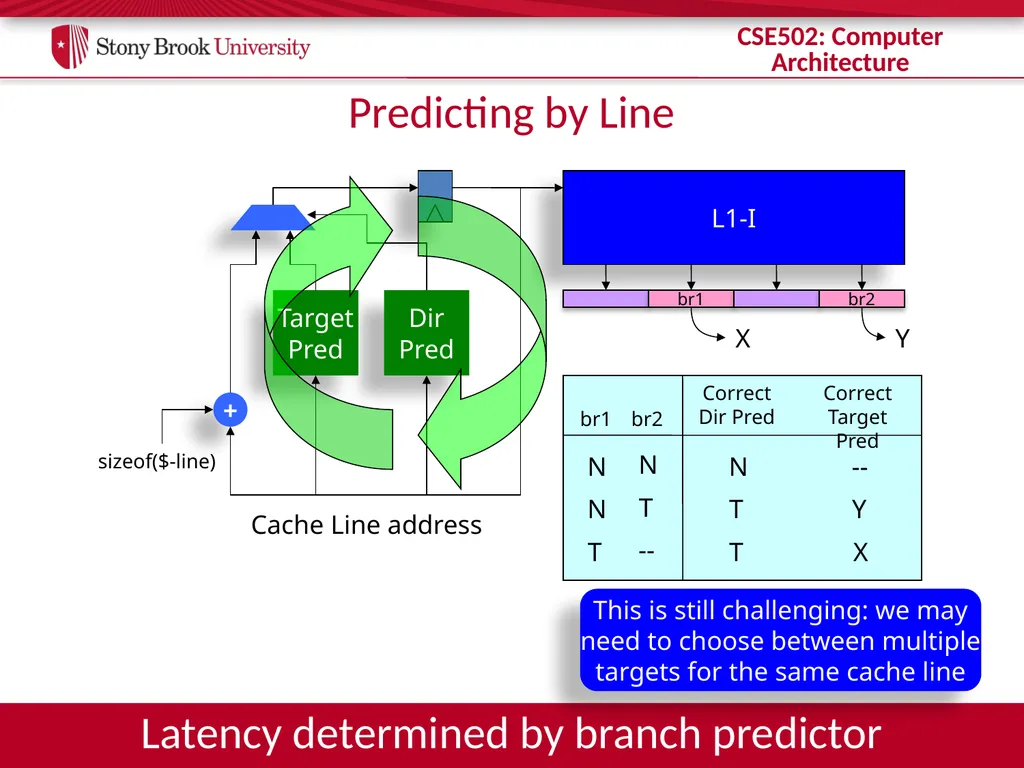
Predicting by Line L1-I br1 br2 Dir
Pred Target
Pred + sizeof($-line) Correct
Dir Pred Correct
Target Pred br1 br2 Cache Line address N N N -- X Y N T T Y T -- T X Latency determined by branch predictor<br>
Pred Target
Pred + sizeof($-line) Correct
Dir Pred Correct
Target Pred br1 br2 Cache Line address N N N -- X Y N T T Y T -- T X Latency determined by branch predictor<br>
09
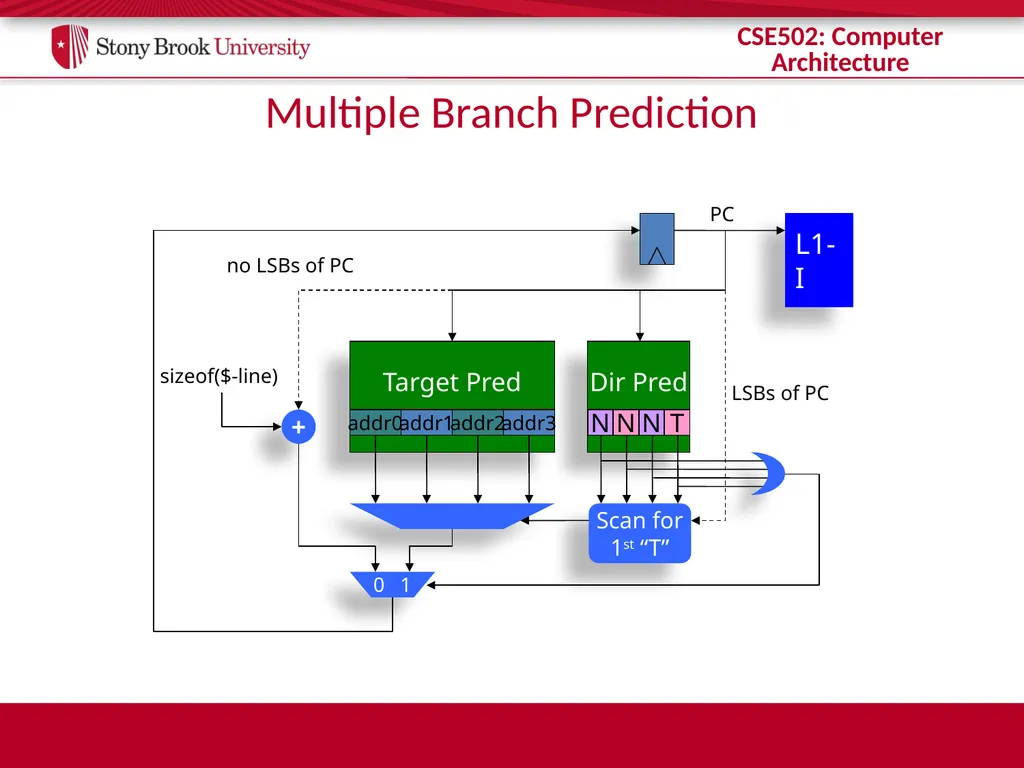
Multiple Branch Prediction Dir Pred Target Pred L1-I N N N T addr0 addr1 addr2 addr3 Scan for
1st “T” 0 1 + LSBs of PC sizeof($-line) no LSBs of PC PC<br>
1st “T” 0 1 + LSBs of PC sizeof($-line) no LSBs of PC PC<br>
10
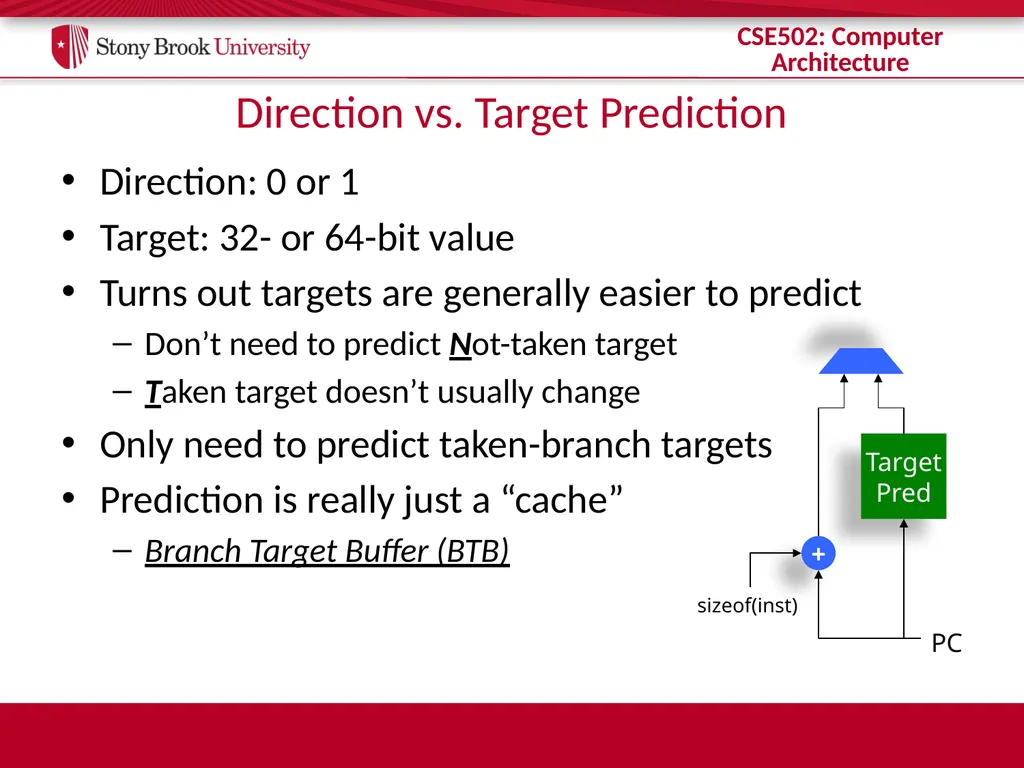
Direction vs. Target Prediction Direction: 0 or 1
Target: 32- or 64-bit value
Turns out targets are generally easier to predict
Don’t need to predict Not-taken target
Taken target doesn’t usually change
Only need to predict taken-branch targets
Prediction is really just a “cache”
Branch Target Buffer (BTB) Target
Pred + sizeof(inst) PC<br>
Target: 32- or 64-bit value
Turns out targets are generally easier to predict
Don’t need to predict Not-taken target
Taken target doesn’t usually change
Only need to predict taken-branch targets
Prediction is really just a “cache”
Branch Target Buffer (BTB) Target
Pred + sizeof(inst) PC<br>
11
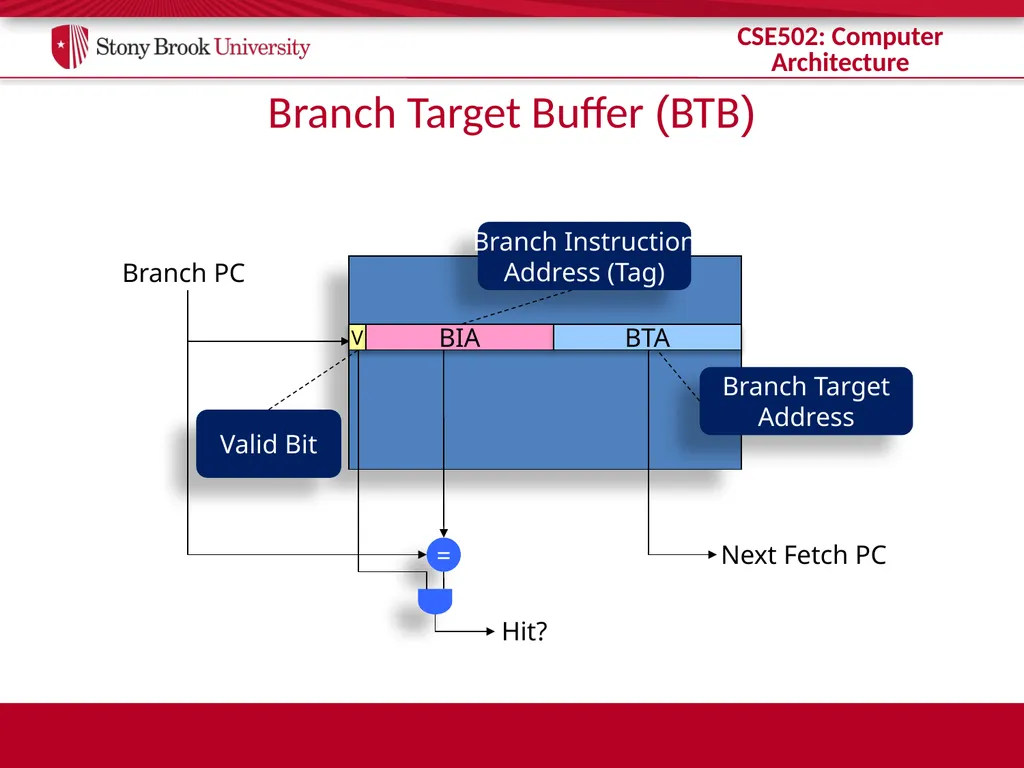
Branch Target Buffer (BTB) V BIA BTA Branch PC = Hit? Next Fetch PC<br>
12
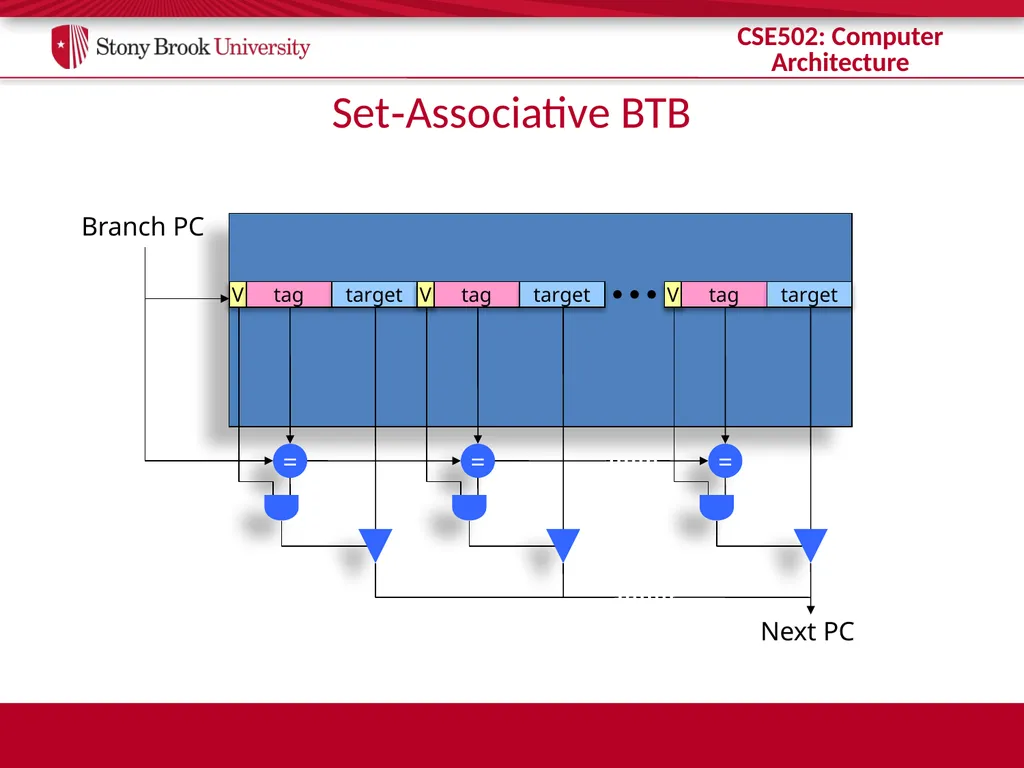
Set-Associative BTB V tag target Branch PC = V tag target V tag target = = Next PC<br>
13
Making BTBs Cheaper Branch prediction is permitted to be wrong
Processor must have ways to detect mispredictions
Correctness of execution is always preserved
Performance may be affected Can tune BTB accuracy based on cost<br>
Processor must have ways to detect mispredictions
Correctness of execution is always preserved
Performance may be affected Can tune BTB accuracy based on cost<br>
14
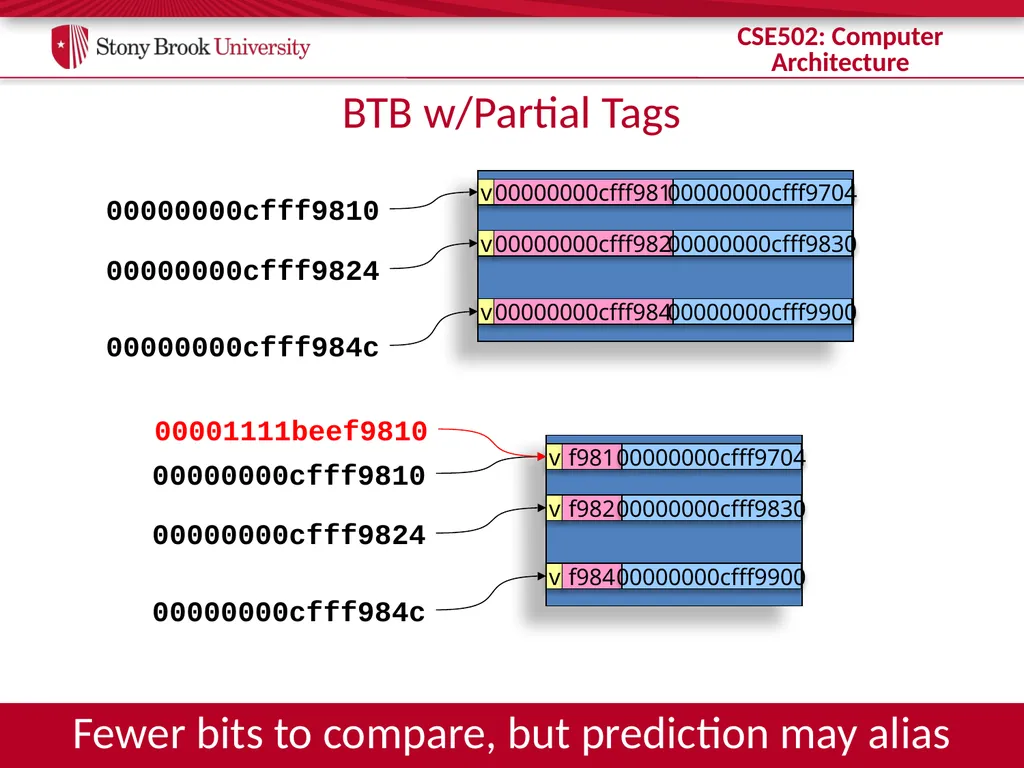
BTB w/Partial Tags 00000000cfff9810 00000000cfff9824 00000000cfff984c v 00000000cfff981 00000000cfff9704 v 00000000cfff982 00000000cfff9830 v 00000000cfff984 00000000cfff9900 Fewer bits to compare, but prediction may alias<br>
15
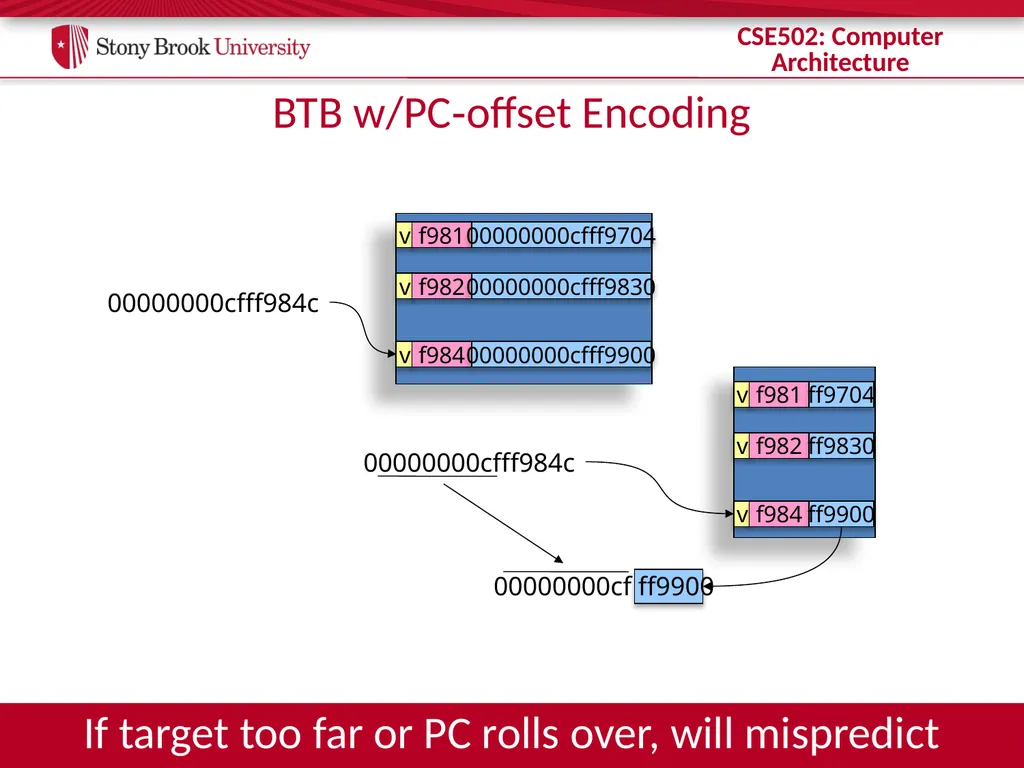
BTB w/PC-offset Encoding 00000000cfff984c v f981 00000000cfff9704 v f982 00000000cfff9830 v f984 00000000cfff9900 00000000cfff984c v f981 ff9704 v f982 ff9830 v f984 ff9900 00000000cf ff9900 If target too far or PC rolls over, will mispredict<br>
16
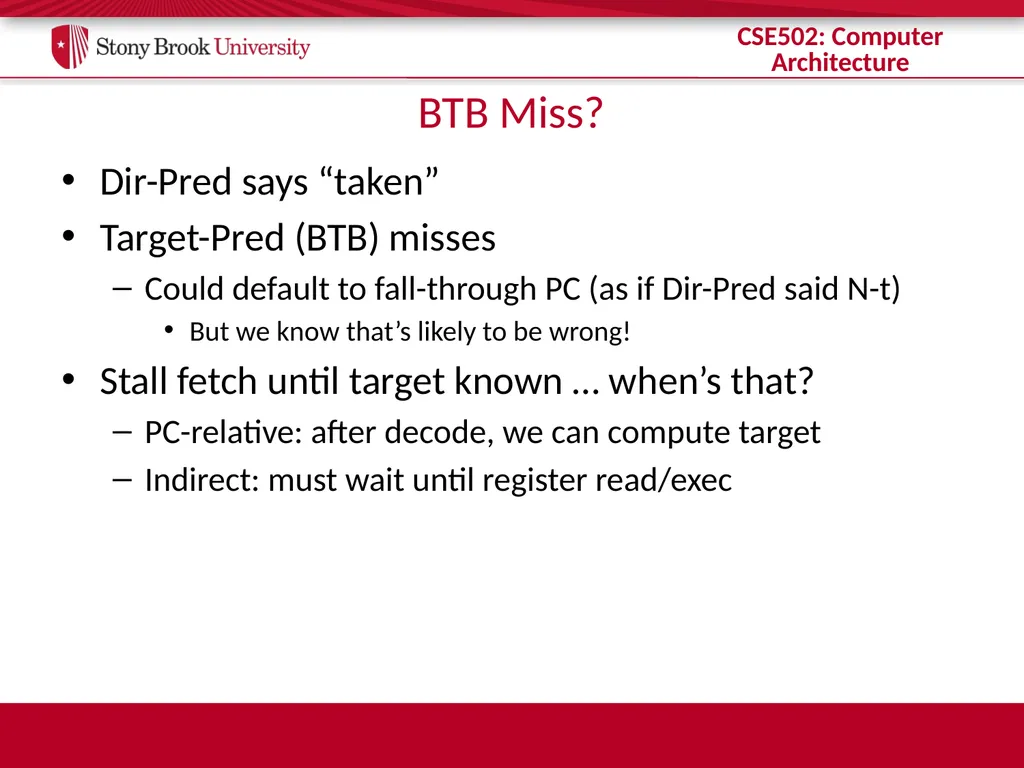
BTB Miss? Dir-Pred says “taken”
Target-Pred (BTB) misses
Could default to fall-through PC (as if Dir-Pred said N-t)
But we know that’s likely to be wrong!
Stall fetch until target known … when’s that?
PC-relative: after decode, we can compute target
Indirect: must wait until register read/exec<br>
Target-Pred (BTB) misses
Could default to fall-through PC (as if Dir-Pred said N-t)
But we know that’s likely to be wrong!
Stall fetch until target known … when’s that?
PC-relative: after decode, we can compute target
Indirect: must wait until register read/exec<br>
17
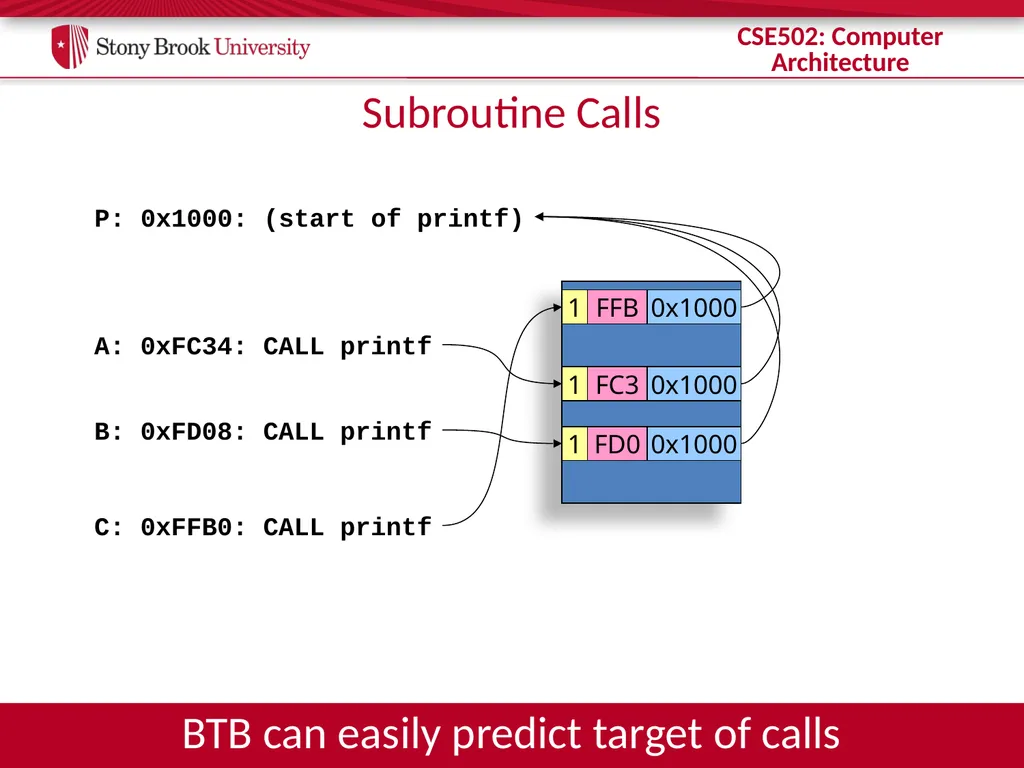
Subroutine Calls A: 0xFC34: CALL printf B: 0xFD08: CALL printf C: 0xFFB0: CALL printf P: 0x1000: (start of printf) 0x1000 FC3 1 0x1000 FD0 1 0x1000 FFB 1 BTB can easily predict target of calls<br>
18
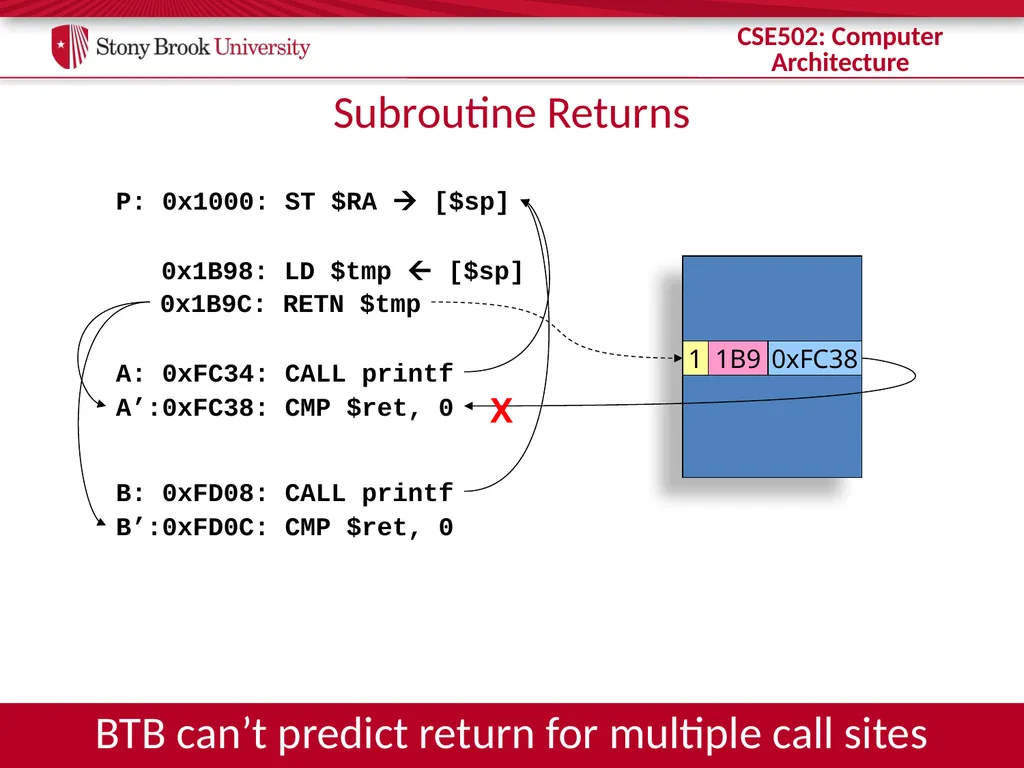
Subroutine Returns P: 0x1000: ST $RA [$sp] 0x1B98: LD $tmp [$sp] A: 0xFC34: CALL printf B: 0xFD08: CALL printf A’:0xFC38: CMP $ret, 0 B’:0xFD0C: CMP $ret, 0 0x1B9C: RETN $tmp 0xFC38 1B9 0 1 X BTB can’t predict return for multiple call sites<br>
19
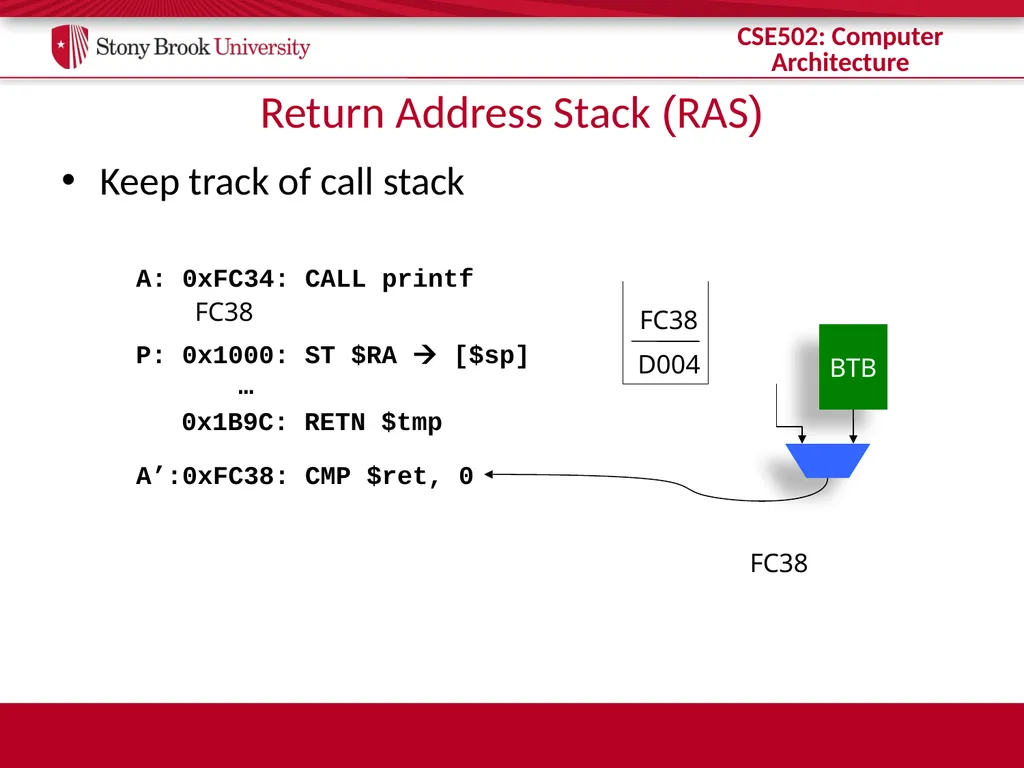
Return Address Stack (RAS) Keep track of call stack A: 0xFC34: CALL printf FC38 D004 P: 0x1000: ST $RA [$sp]
… 0x1B9C: RETN $tmp FC38 BTB A’:0xFC38: CMP $ret, 0 FC38<br>
… 0x1B9C: RETN $tmp FC38 BTB A’:0xFC38: CMP $ret, 0 FC38<br>
20
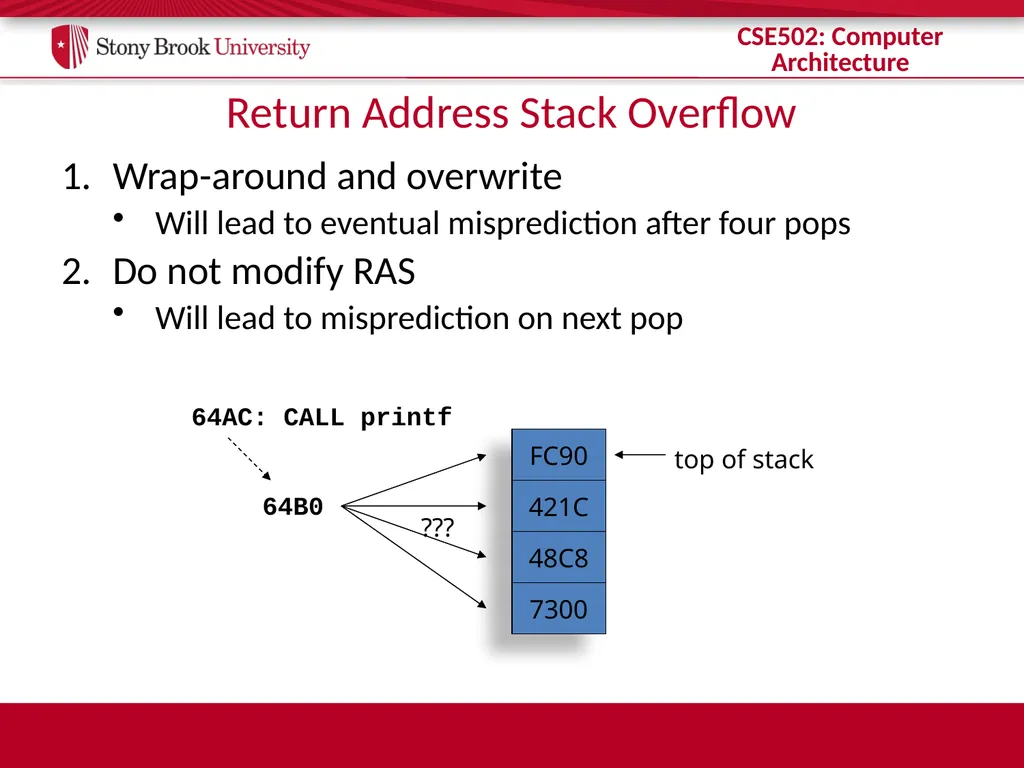
Return Address Stack Overflow Wrap-around and overwrite
Will lead to eventual misprediction after four pops
Do not modify RAS
Will lead to misprediction on next pop FC90 top of stack 64AC: CALL printf 64B0 ??? 421C 48C8 7300<br>
Will lead to eventual misprediction after four pops
Do not modify RAS
Will lead to misprediction on next pop FC90 top of stack 64AC: CALL printf 64B0 ??? 421C 48C8 7300<br>
21
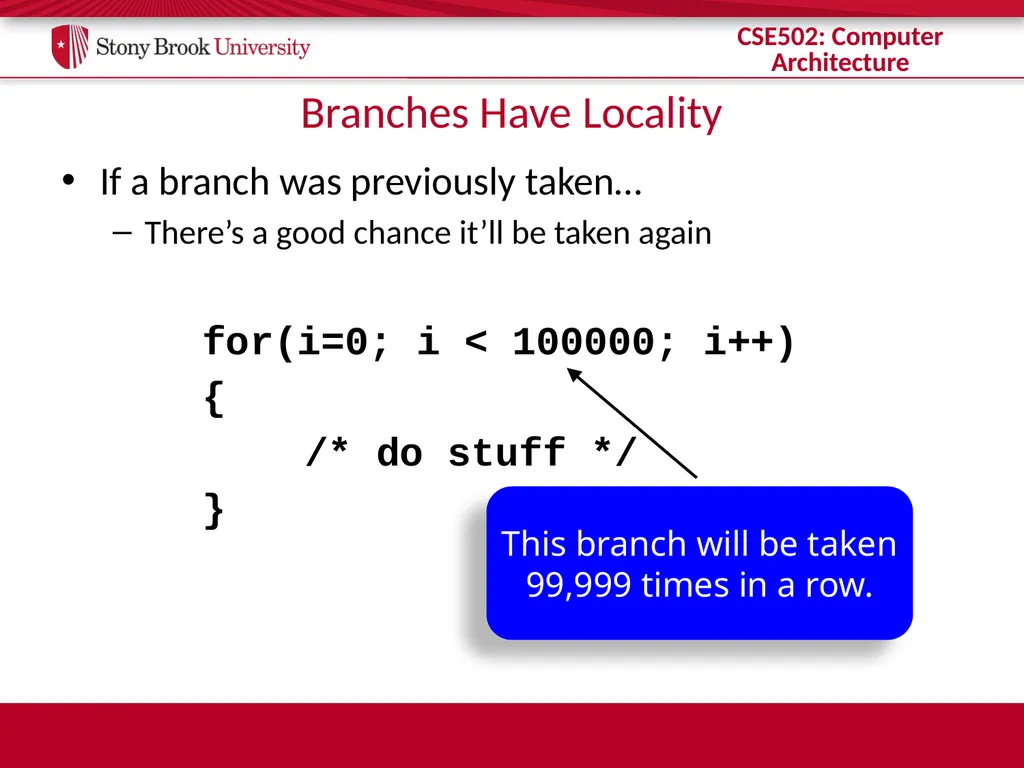
Branches Have Locality If a branch was previously taken…
There’s a good chance it’ll be taken again
for(i=0; i < 100000; i++)
{
/* do stuff */
} This branch will be taken
99,999 times in a row.<br>
There’s a good chance it’ll be taken again
for(i=0; i < 100000; i++)
{
/* do stuff */
} This branch will be taken
99,999 times in a row.<br>
22
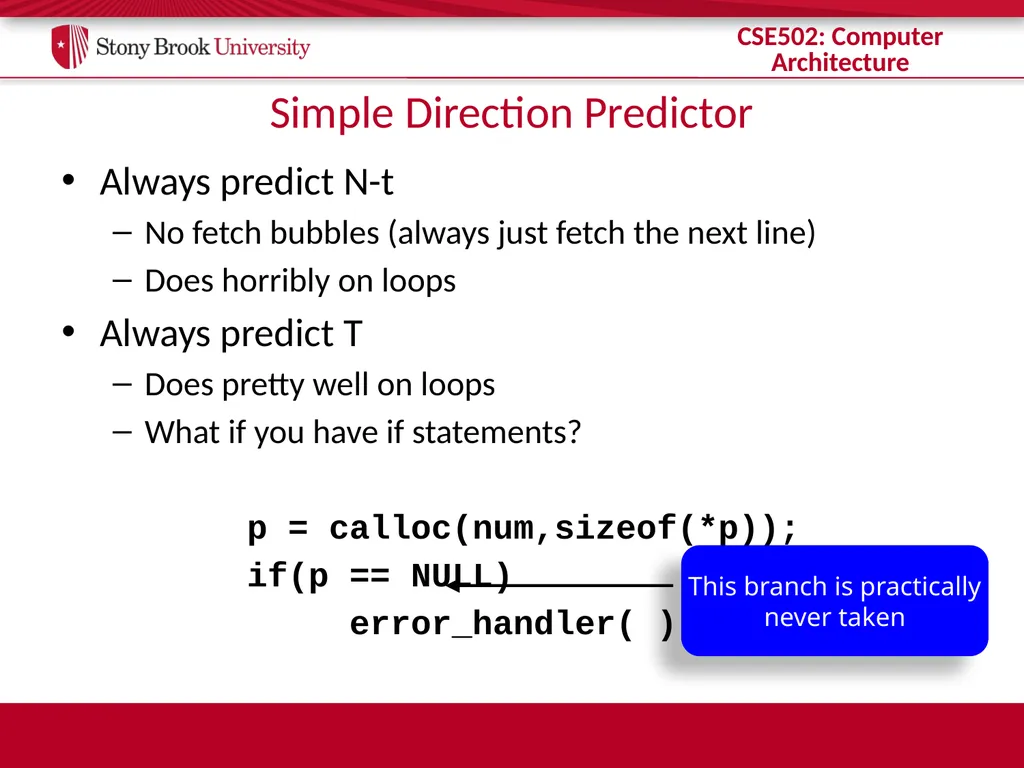
Simple Direction Predictor Always predict N-t
No fetch bubbles (always just fetch the next line)
Does horribly on loops
Always predict T
Does pretty well on loops
What if you have if statements?
p = calloc(num,sizeof(*p));
if(p == NULL)
error_handler( ); This branch is practically
never taken<br>
No fetch bubbles (always just fetch the next line)
Does horribly on loops
Always predict T
Does pretty well on loops
What if you have if statements?
p = calloc(num,sizeof(*p));
if(p == NULL)
error_handler( ); This branch is practically
never taken<br>
23
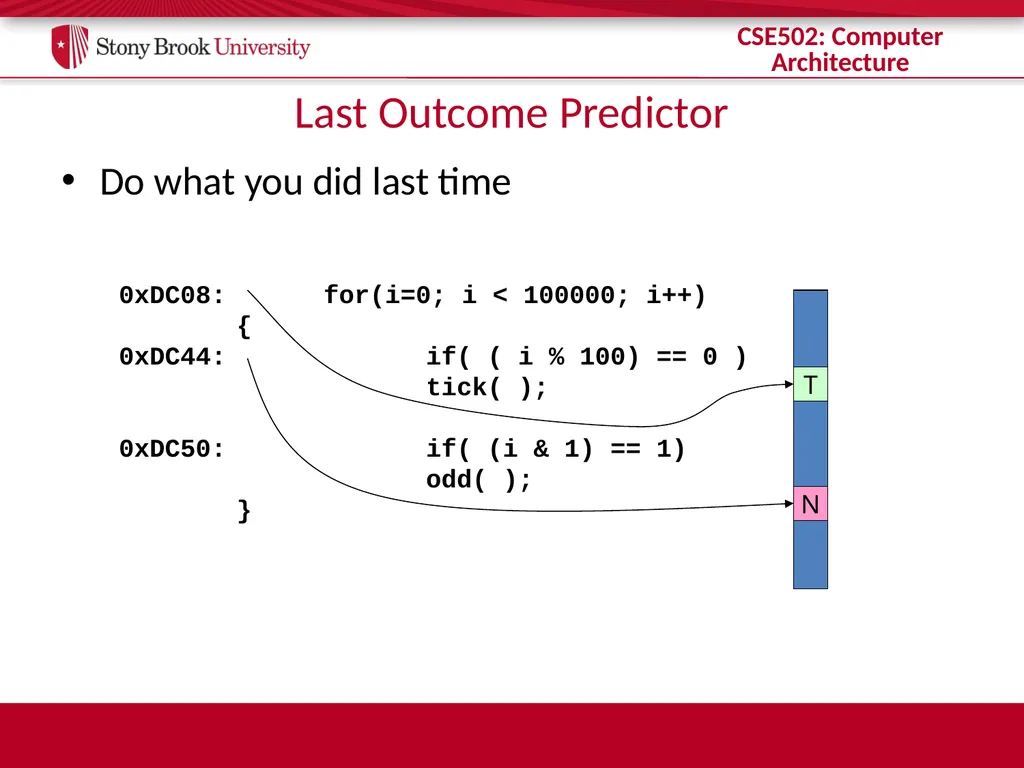
Last Outcome Predictor Do what you did last time 0xDC08: for(i=0; i < 100000; i++)
{
0xDC44: if( ( i % 100) == 0 )
tick( );
0xDC50: if( (i & 1) == 1)
odd( );
} T N<br>
{
0xDC44: if( ( i % 100) == 0 )
tick( );
0xDC50: if( (i & 1) == 1)
odd( );
} T N<br>
24
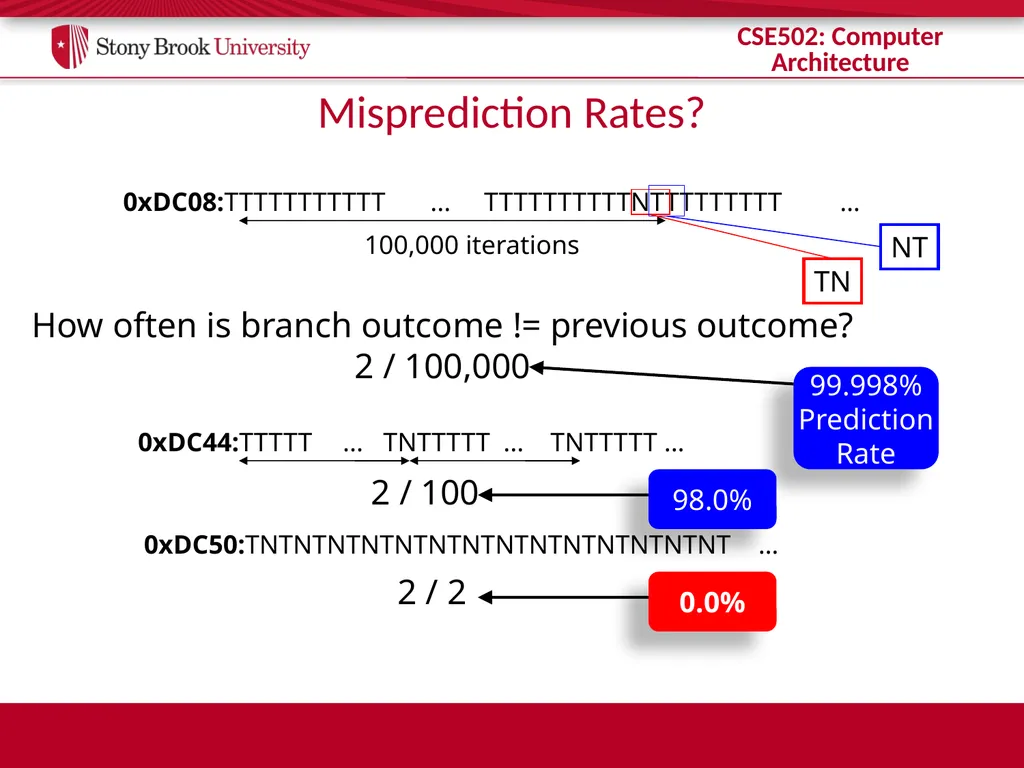
Misprediction Rates? 0xDC08:TTTTTTTTTTT ... TTTTTTTTTTNTTTTTTTTT … 100,000 iterations How often is branch outcome != previous outcome?
2 / 100,000 TN NT<br>
2 / 100,000 TN NT<br>
25
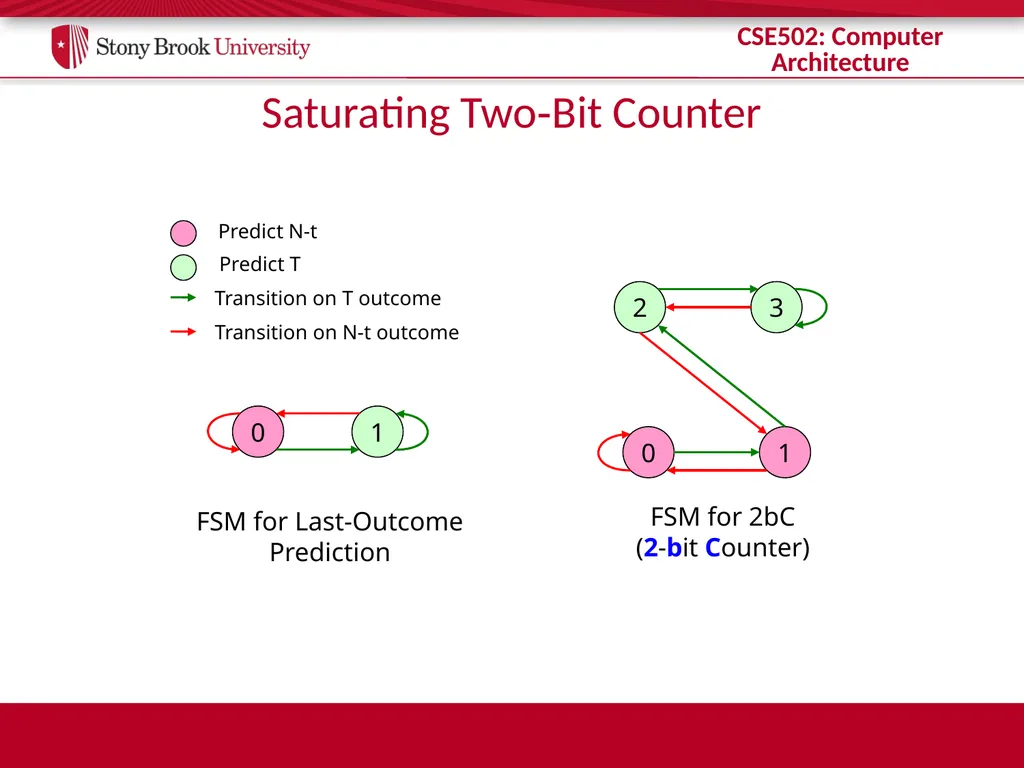
Saturating Two-Bit Counter 0 1 FSM for Last-Outcome
Prediction Predict N-t Predict T Transition on T outcome Transition on N-t outcome<br>
Prediction Predict N-t Predict T Transition on T outcome Transition on N-t outcome<br>
26
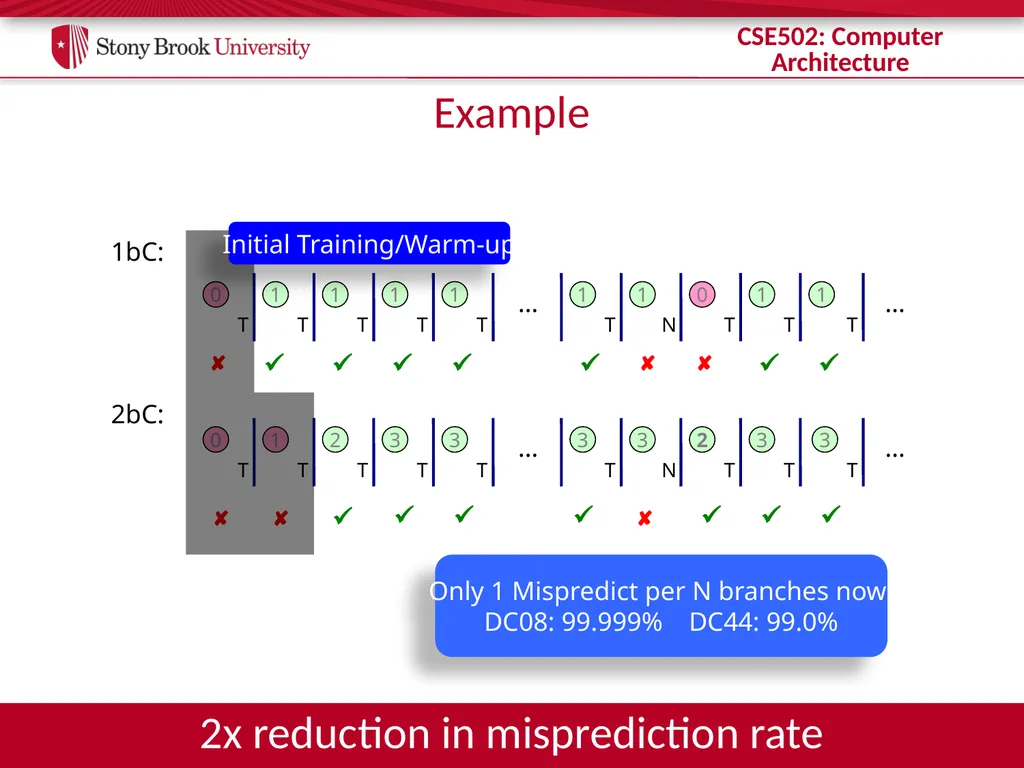
Example 1bC: 2bC: Only 1 Mispredict per N branches now!
DC08: 99.999% DC44: 99.0% 2x reduction in misprediction rate<br>
DC08: 99.999% DC44: 99.0% 2x reduction in misprediction rate<br>
27
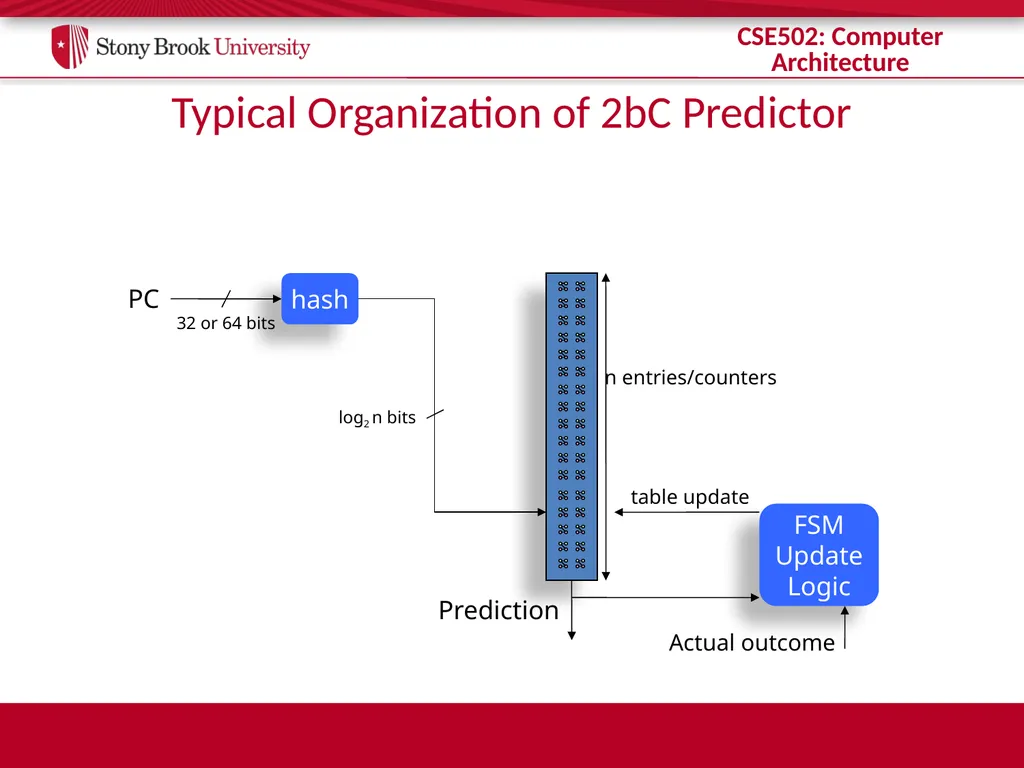
Typical Organization of 2bC Predictor PC hash 32 or 64 bits log2 n bits n entries/counters Prediction<br>
28
Typical Branch Predictor Hash Take the log2n least significant bits of PC
May need to ignore some bits
In RISC, insns. are typically 4 bytes wide
Low-order bits zero
In CISC (ex. x86), insns. can start anywhere
Probably don’t want to shift<br>
May need to ignore some bits
In RISC, insns. are typically 4 bytes wide
Low-order bits zero
In CISC (ex. x86), insns. can start anywhere
Probably don’t want to shift<br>
29
Dealing with Toggling Branches Branch at 0xDC50 changes on every iteration
1bc and 2bc don’t do too well (50% at best)
But it’s still obviously predictable
Why?
It has a repeating pattern: (NT)*
How about other patterns? (TTNTN)*
Use branch correlation
Branch outcome is often related to previous outcome(s)<br>
1bc and 2bc don’t do too well (50% at best)
But it’s still obviously predictable
Why?
It has a repeating pattern: (NT)*
How about other patterns? (TTNTN)*
Use branch correlation
Branch outcome is often related to previous outcome(s)<br>
30
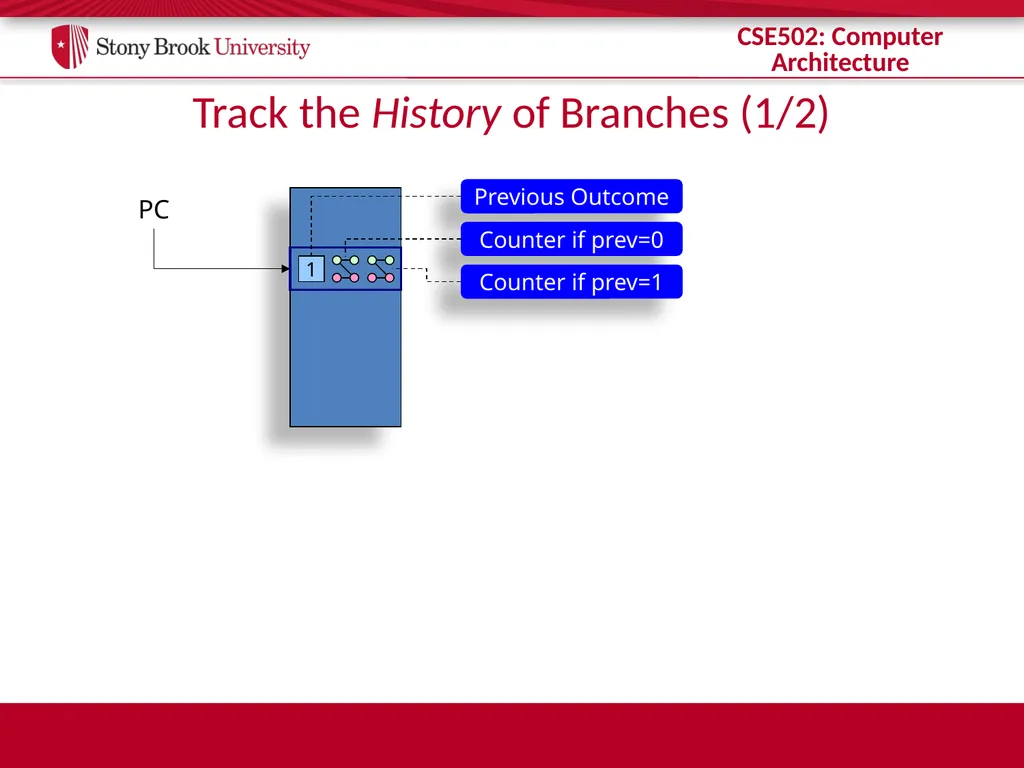
Track the History of Branches (1/2) PC Previous Outcome 1 Counter if prev=0 Counter if prev=1<br>
31
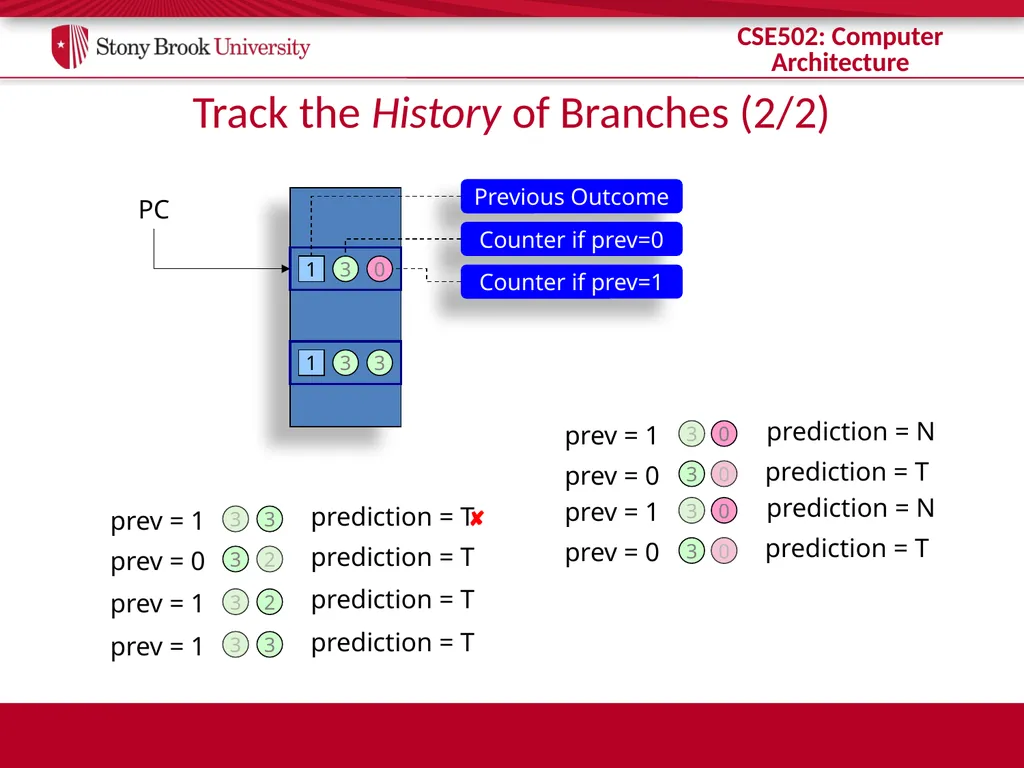
Track the History of Branches (2/2) PC Previous Outcome 1 Counter if prev=0 3 0 Counter if prev=1 <br>
32
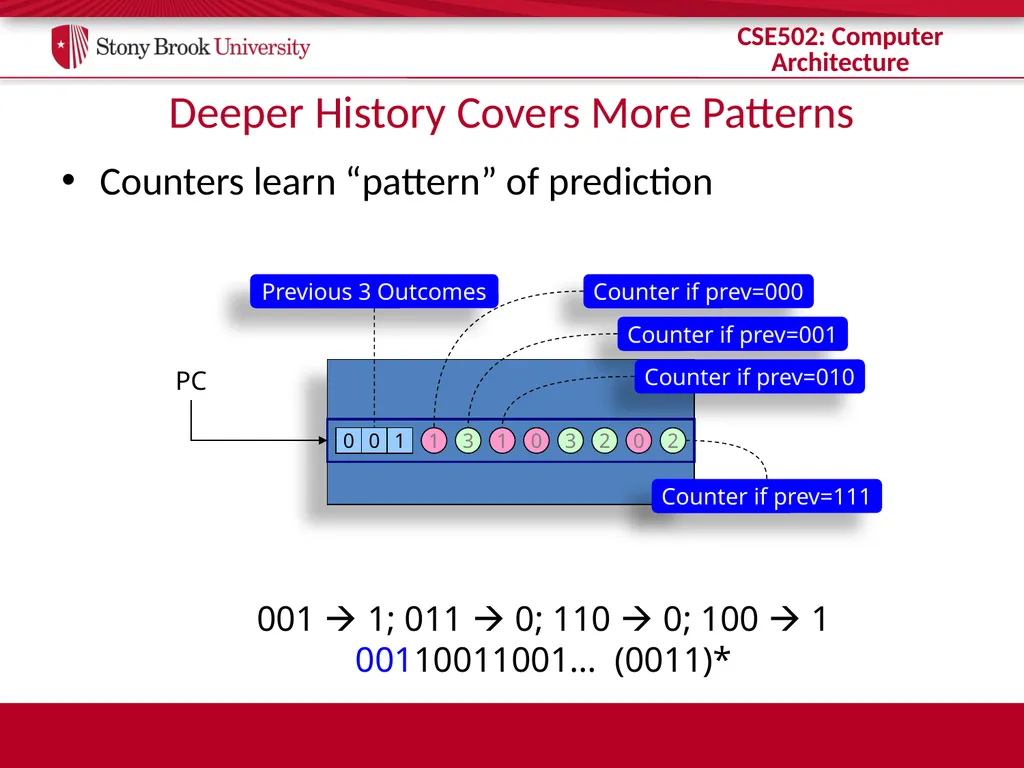
Deeper History Covers More Patterns Counters learn “pattern” of prediction PC 0 3 1 0 1 3 1 0 0 2 2 Previous 3 Outcomes Counter if prev=000 Counter if prev=001 Counter if prev=010 Counter if prev=111 001 1; 011 0; 110 0; 100 1
00110011001… (0011)*<br>
00110011001… (0011)*<br>
33
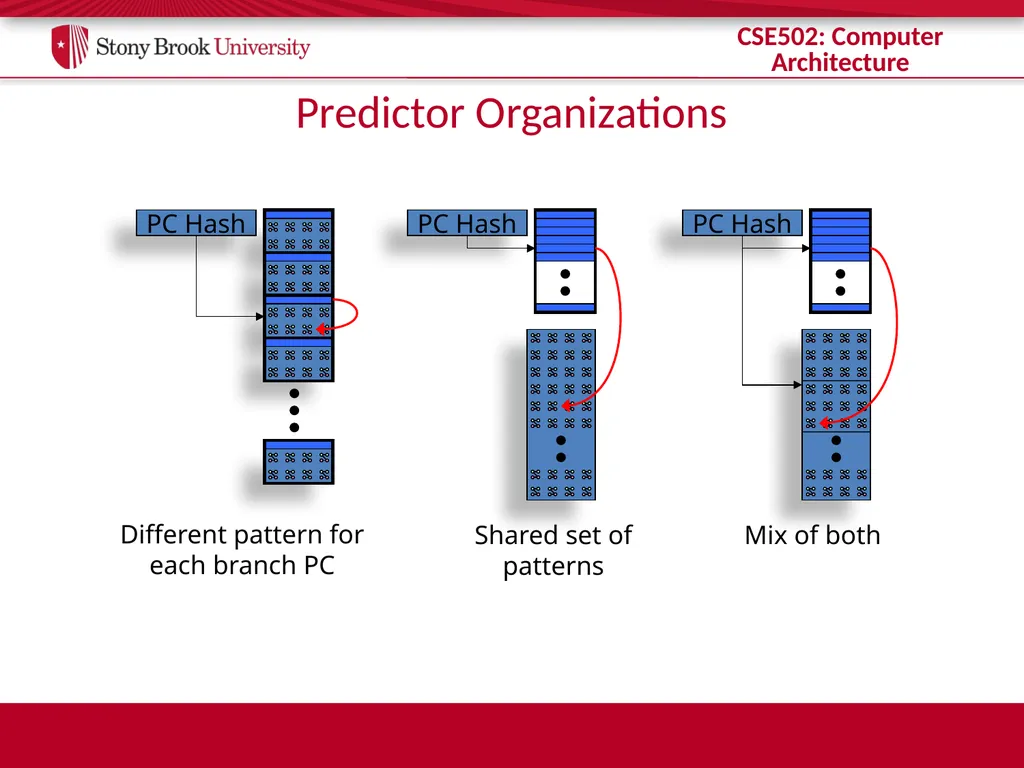
Predictor Organizations PC Hash Different pattern for
each branch PC PC Hash Shared set of
patterns PC Hash Mix of both<br>
each branch PC PC Hash Shared set of
patterns PC Hash Mix of both<br>
34
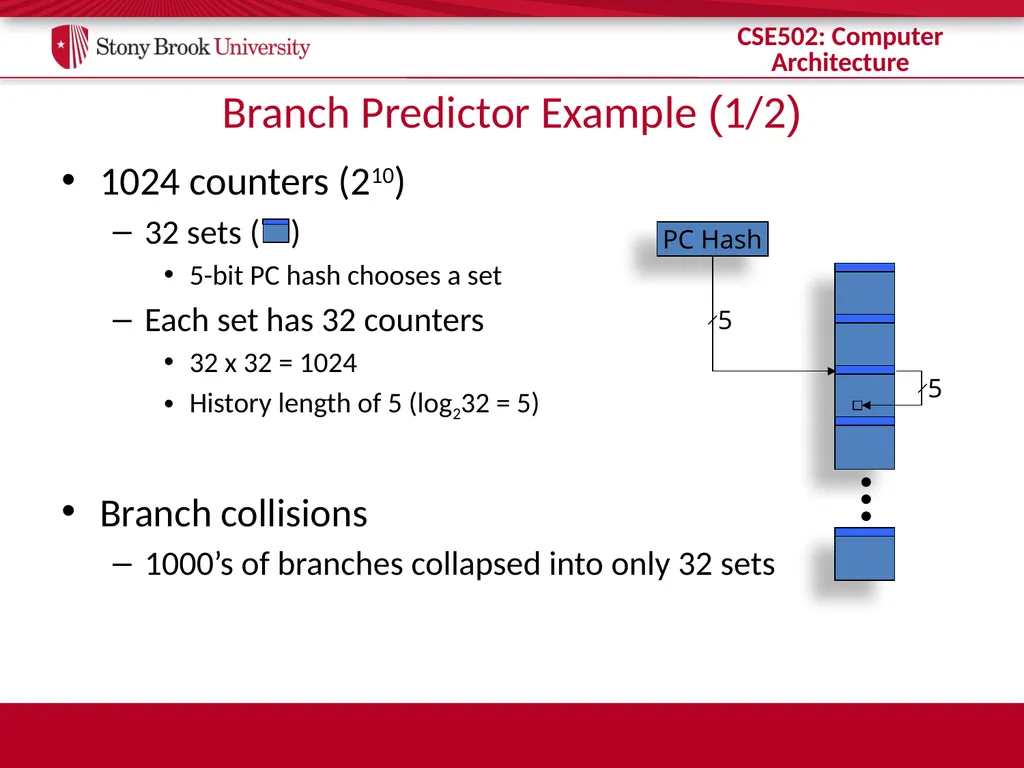
Branch Predictor Example (1/2) 1024 counters (210)
32 sets ( )
5-bit PC hash chooses a set
Each set has 32 counters
32 x 32 = 1024
History length of 5 (log232 = 5)
Branch collisions
1000’s of branches collapsed into only 32 sets PC Hash 5 5<br>
32 sets ( )
5-bit PC hash chooses a set
Each set has 32 counters
32 x 32 = 1024
History length of 5 (log232 = 5)
Branch collisions
1000’s of branches collapsed into only 32 sets PC Hash 5 5<br>
35
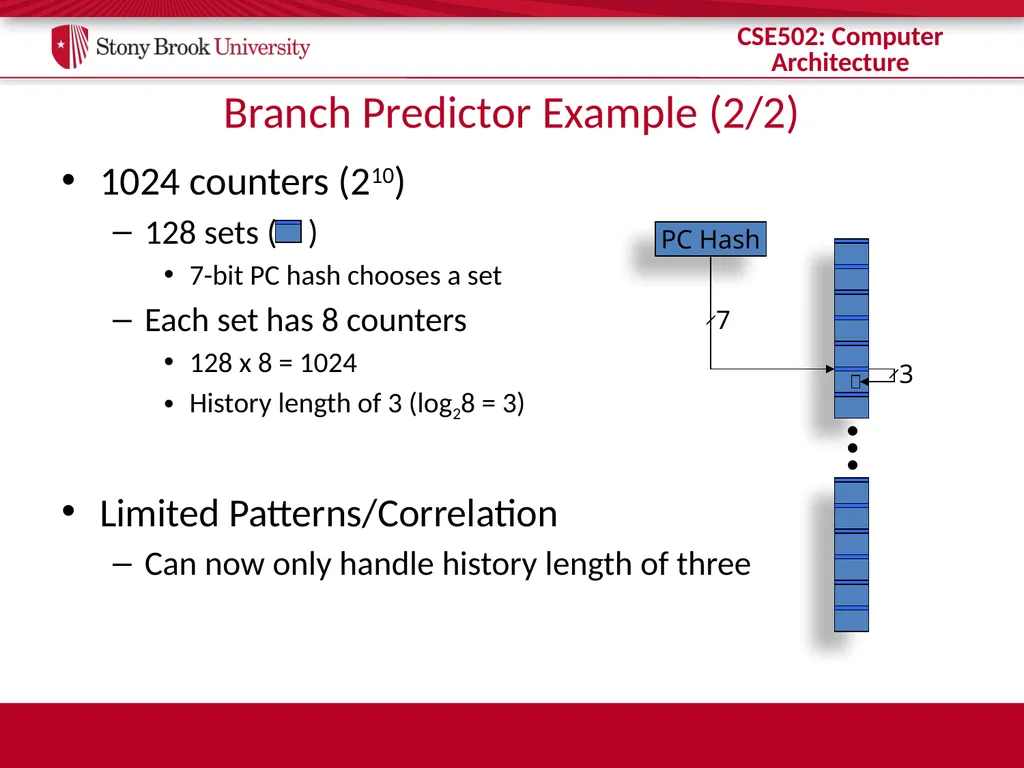
Branch Predictor Example (2/2) 1024 counters (210)
128 sets ( )
7-bit PC hash chooses a set
Each set has 8 counters
128 x 8 = 1024
History length of 3 (log28 = 3)
Limited Patterns/Correlation
Can now only handle history length of three PC Hash 7 3<br>
128 sets ( )
7-bit PC hash chooses a set
Each set has 8 counters
128 x 8 = 1024
History length of 3 (log28 = 3)
Limited Patterns/Correlation
Can now only handle history length of three PC Hash 7 3<br>
36
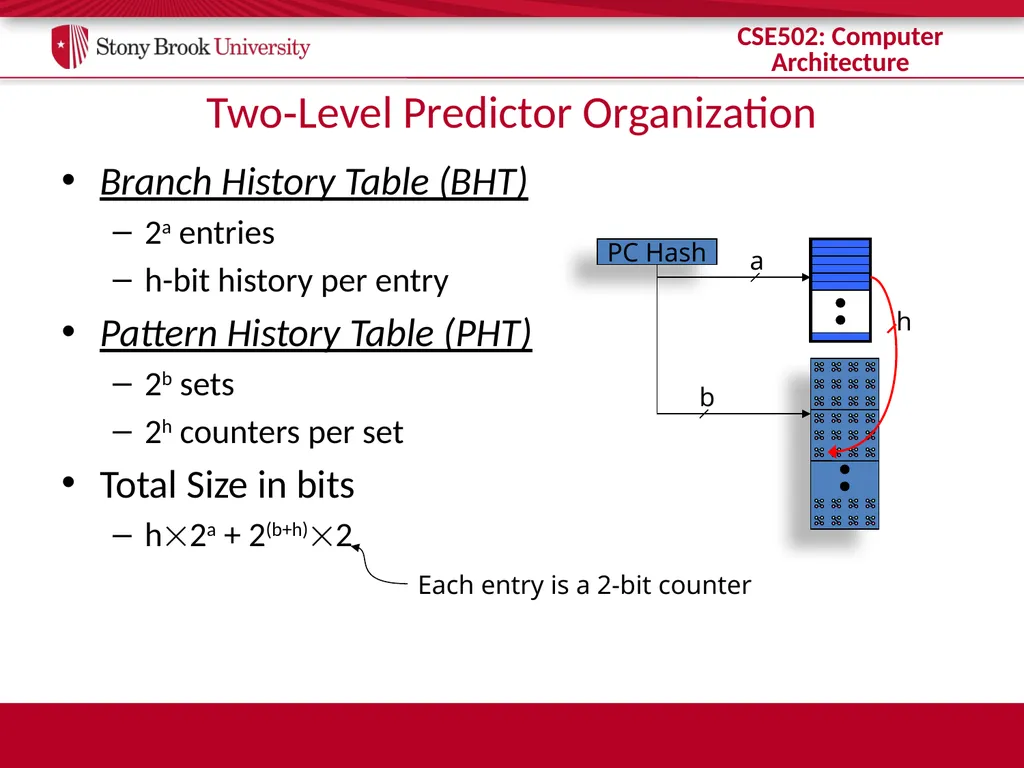
Two-Level Predictor Organization Branch History Table (BHT)
2a entries
h-bit history per entry
Pattern History Table (PHT)
2b sets
2h counters per set
Total Size in bits
h2a + 2(b+h)2 PC Hash a b h Each entry is a 2-bit counter<br>
2a entries
h-bit history per entry
Pattern History Table (PHT)
2b sets
2h counters per set
Total Size in bits
h2a + 2(b+h)2 PC Hash a b h Each entry is a 2-bit counter<br>
37
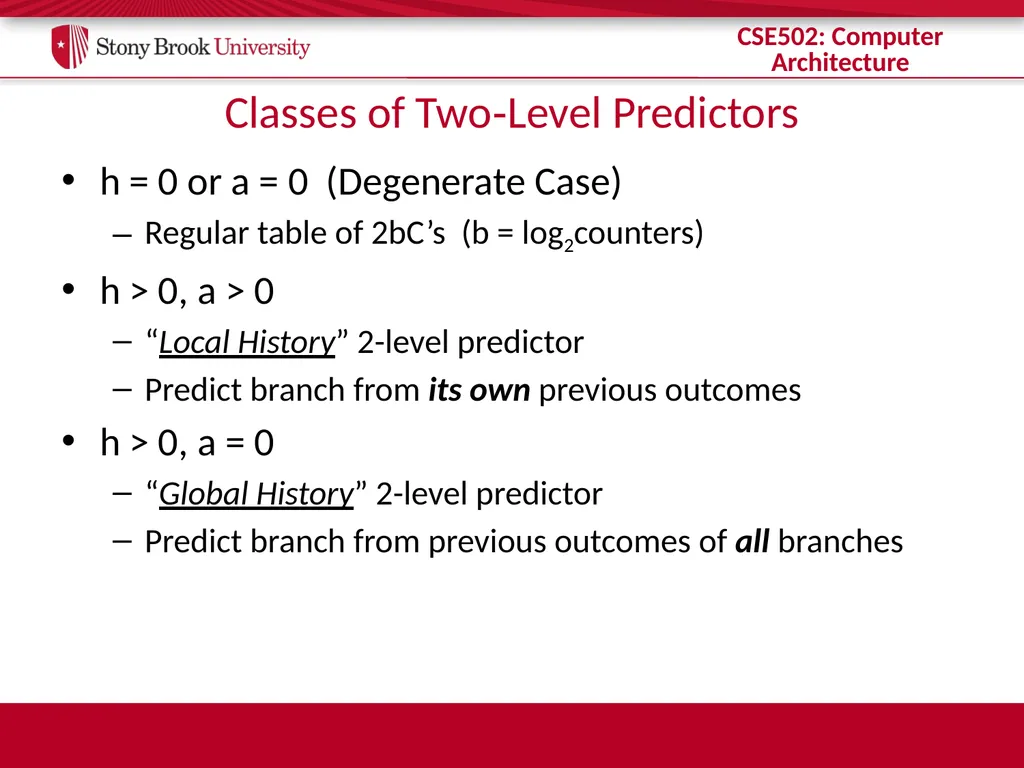
Classes of Two-Level Predictors h = 0 or a = 0 (Degenerate Case)
Regular table of 2bC’s (b = log2counters)
h > 0, a > 0
“Local History” 2-level predictor
Predict branch from its own previous outcomes
h > 0, a = 0
“Global History” 2-level predictor
Predict branch from previous outcomes of all branches<br>
Regular table of 2bC’s (b = log2counters)
h > 0, a > 0
“Local History” 2-level predictor
Predict branch from its own previous outcomes
h > 0, a = 0
“Global History” 2-level predictor
Predict branch from previous outcomes of all branches<br>
38
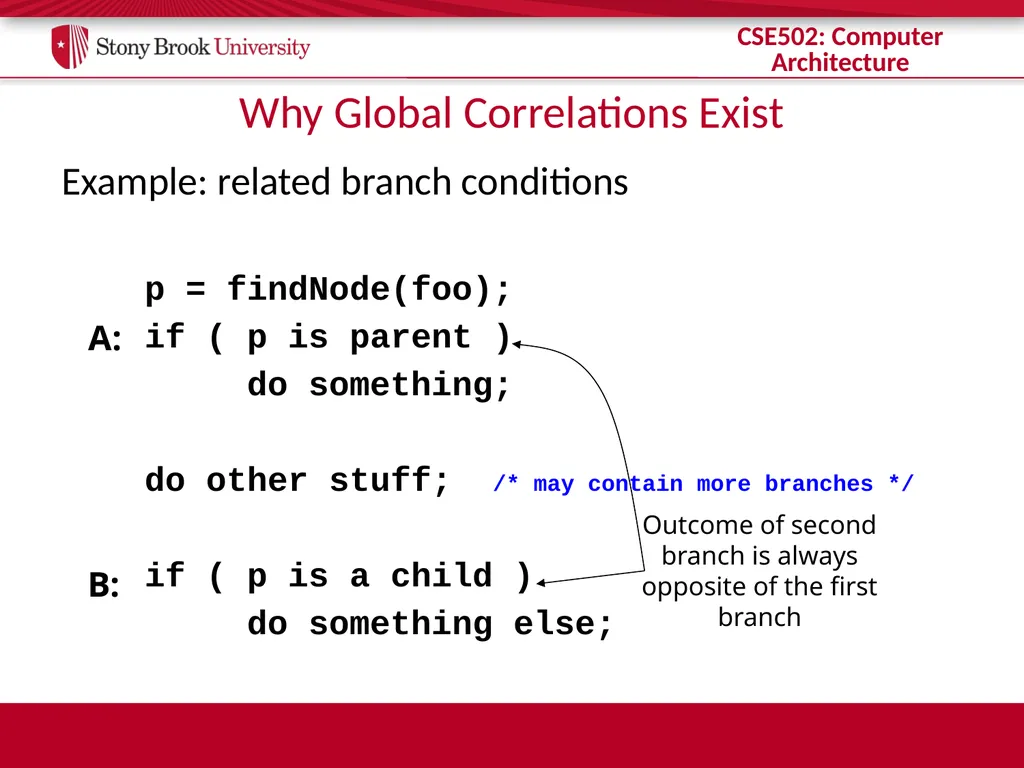
Why Global Correlations Exist Example: related branch conditions
p = findNode(foo);
if ( p is parent )
do something;
do other stuff; /* may contain more branches */
if ( p is a child )
do something else; Outcome of second
branch is always
opposite of the first
branch A: B:<br>
p = findNode(foo);
if ( p is parent )
do something;
do other stuff; /* may contain more branches */
if ( p is a child )
do something else; Outcome of second
branch is always
opposite of the first
branch A: B:<br>
39
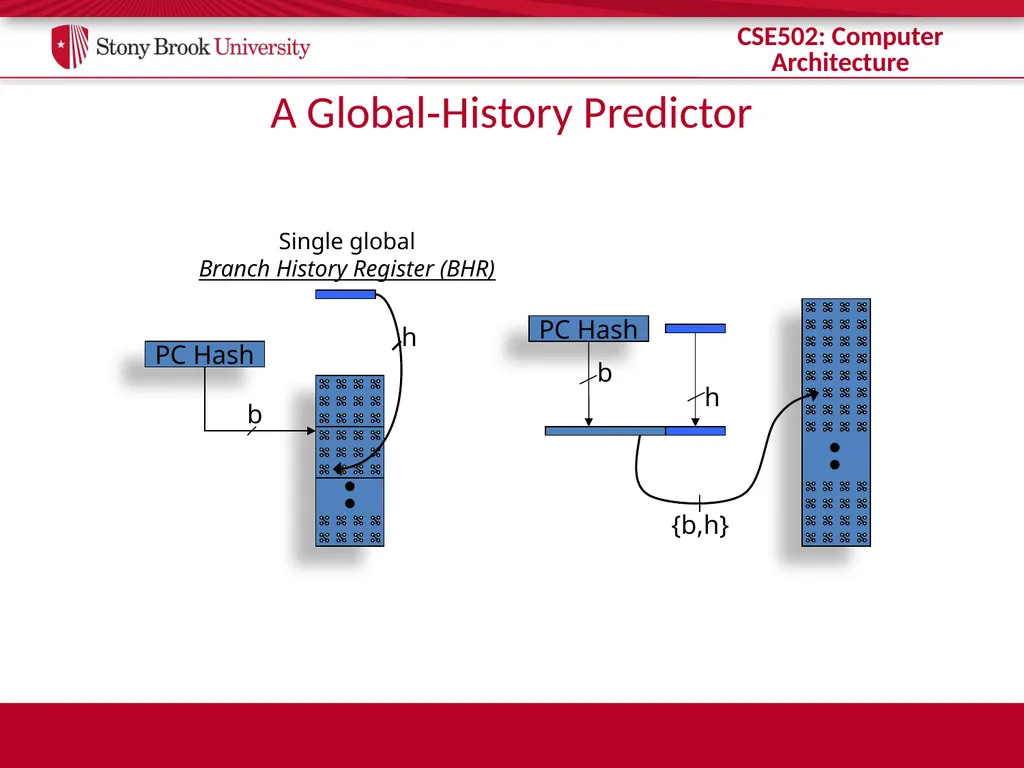
A Global-History Predictor PC Hash b h Single global
Branch History Register (BHR)<br>
Branch History Register (BHR)<br>
40
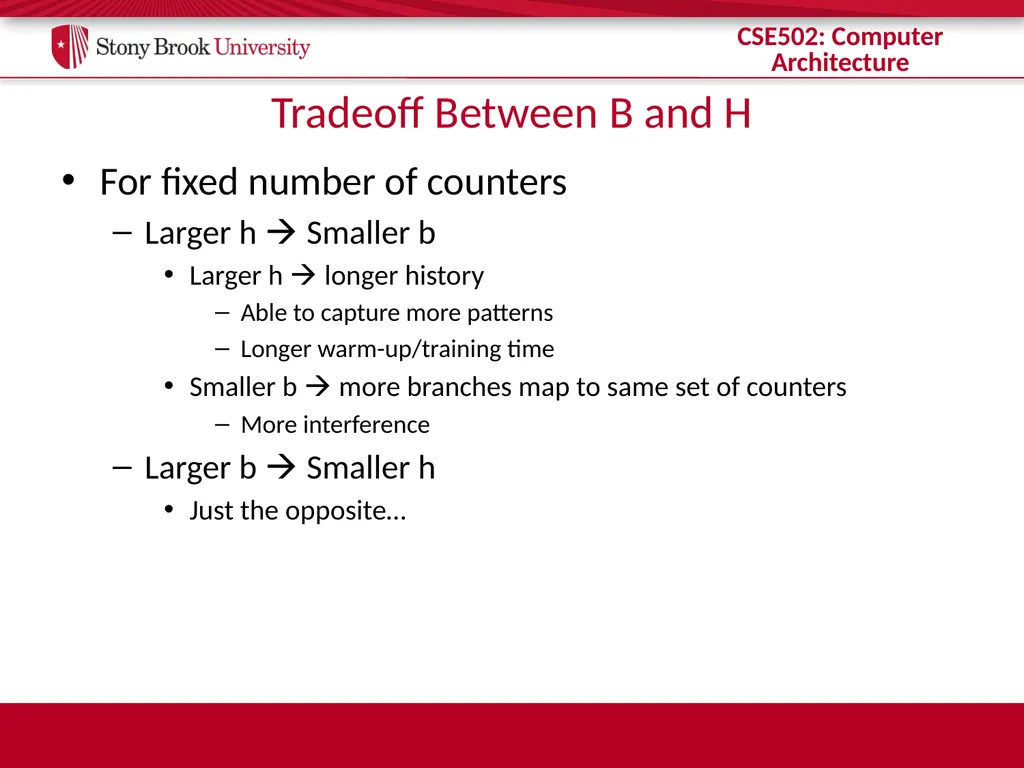
Tradeoff Between B and H For fixed number of counters
Larger h Smaller b
Larger h longer history
Able to capture more patterns
Longer warm-up/training time
Smaller b more branches map to same set of counters
More interference
Larger b Smaller h
Just the opposite…<br>
Larger h Smaller b
Larger h longer history
Able to capture more patterns
Longer warm-up/training time
Smaller b more branches map to same set of counters
More interference
Larger b Smaller h
Just the opposite…<br>
41
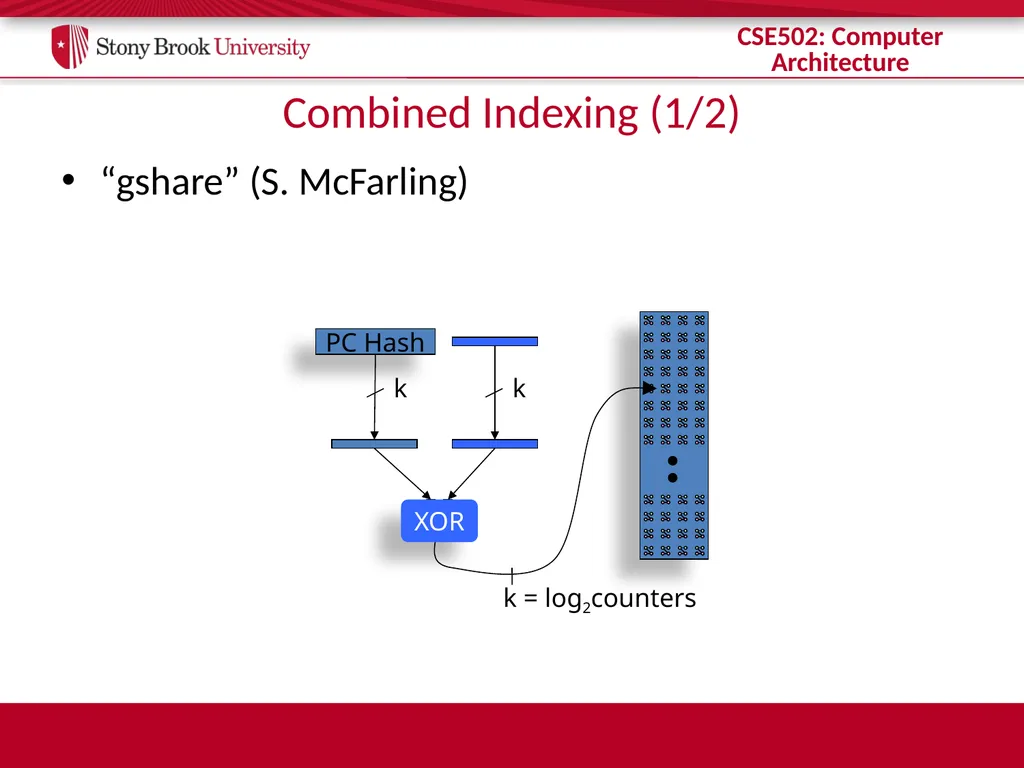
Combined Indexing (1/2) “gshare” (S. McFarling) PC Hash k XOR k = log2counters k<br>
42
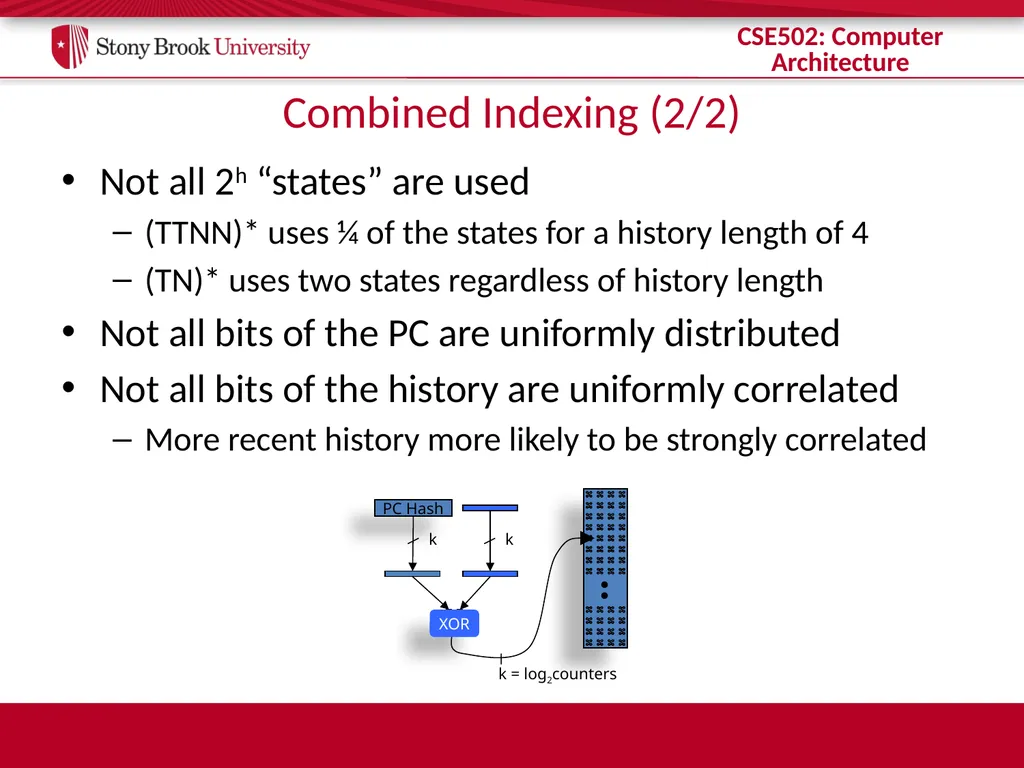
Combined Indexing (2/2) Not all 2h “states” are used
(TTNN)* uses ¼ of the states for a history length of 4
(TN)* uses two states regardless of history length
Not all bits of the PC are uniformly distributed
Not all bits of the history are uniformly correlated
More recent history more likely to be strongly correlated<br>
(TTNN)* uses ¼ of the states for a history length of 4
(TN)* uses two states regardless of history length
Not all bits of the PC are uniformly distributed
Not all bits of the history are uniformly correlated
More recent history more likely to be strongly correlated<br>
43
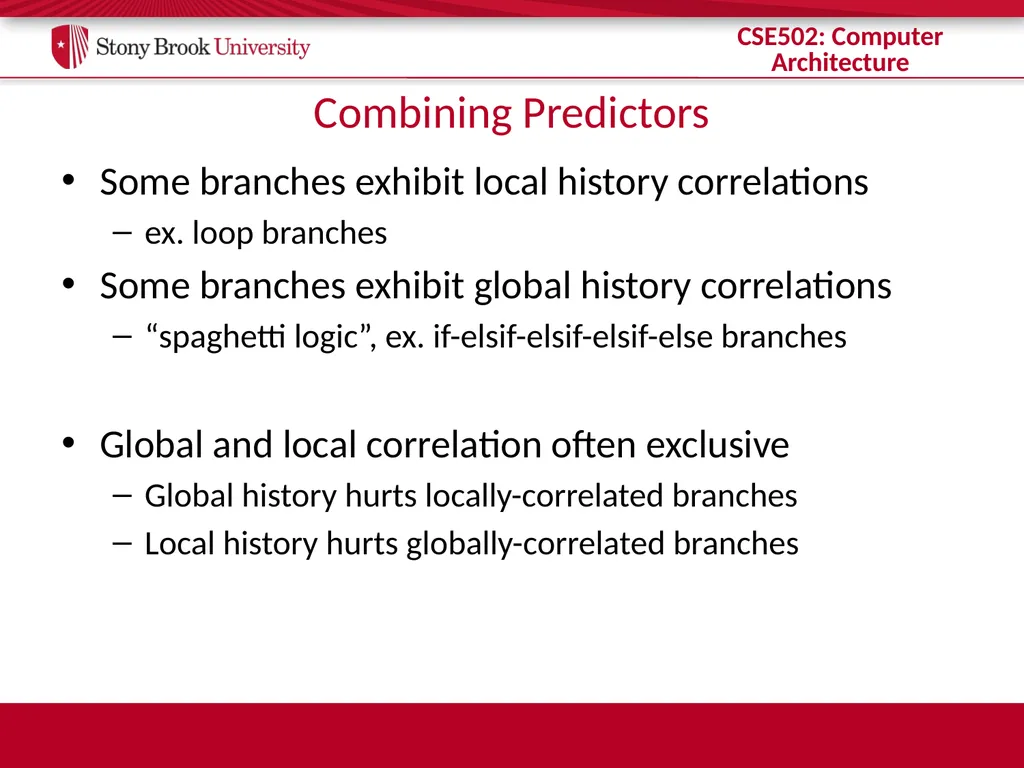
Combining Predictors Some branches exhibit local history correlations
ex. loop branches
Some branches exhibit global history correlations
“spaghetti logic”, ex. if-elsif-elsif-elsif-else branches
Global and local correlation often exclusive
Global history hurts locally-correlated branches
Local history hurts globally-correlated branches<br>
ex. loop branches
Some branches exhibit global history correlations
“spaghetti logic”, ex. if-elsif-elsif-elsif-else branches
Global and local correlation often exclusive
Global history hurts locally-correlated branches
Local history hurts globally-correlated branches<br>
44
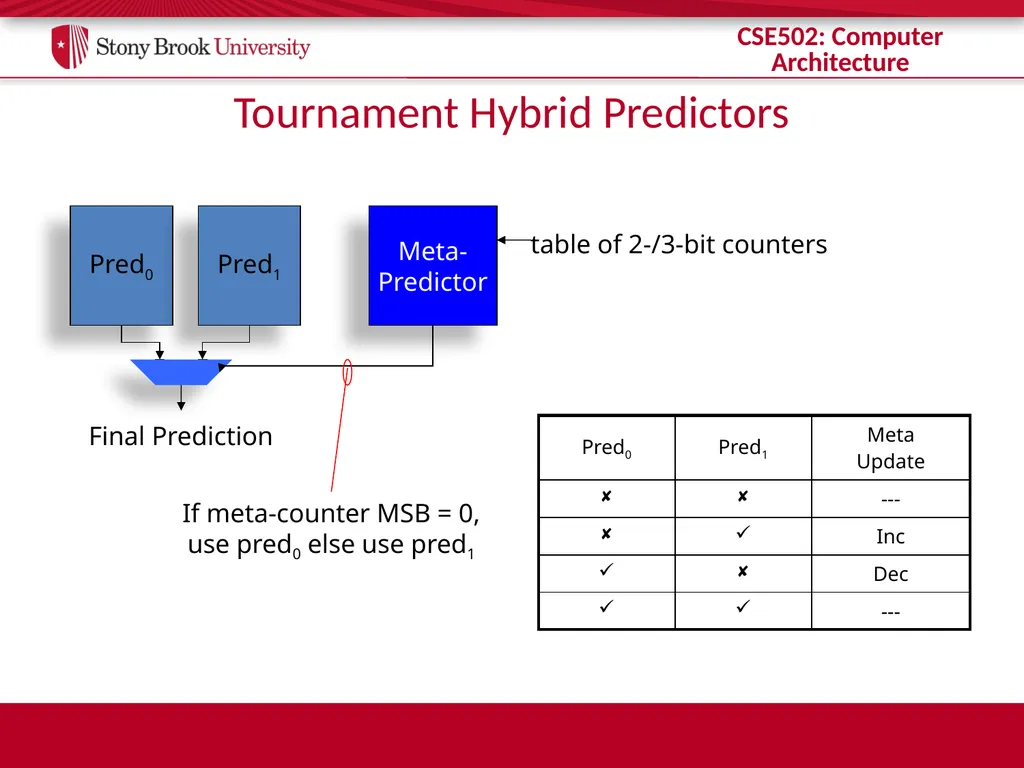
Tournament Hybrid Predictors Pred0 Pred1 Meta-
Predictor Final Prediction table of 2-/3-bit counters If meta-counter MSB = 0,
use pred0 else use pred1<br>
Predictor Final Prediction table of 2-/3-bit counters If meta-counter MSB = 0,
use pred0 else use pred1<br>
45
Pros and Cons of Long Branch Histories Long global history provides context
More potential sources of correlation
Long history incurs costs
PHT cost increases exponentially: O(2h) counters
Training time increases, possibly decreasing accuracy<br>
More potential sources of correlation
Long history incurs costs
PHT cost increases exponentially: O(2h) counters
Training time increases, possibly decreasing accuracy<br>
46
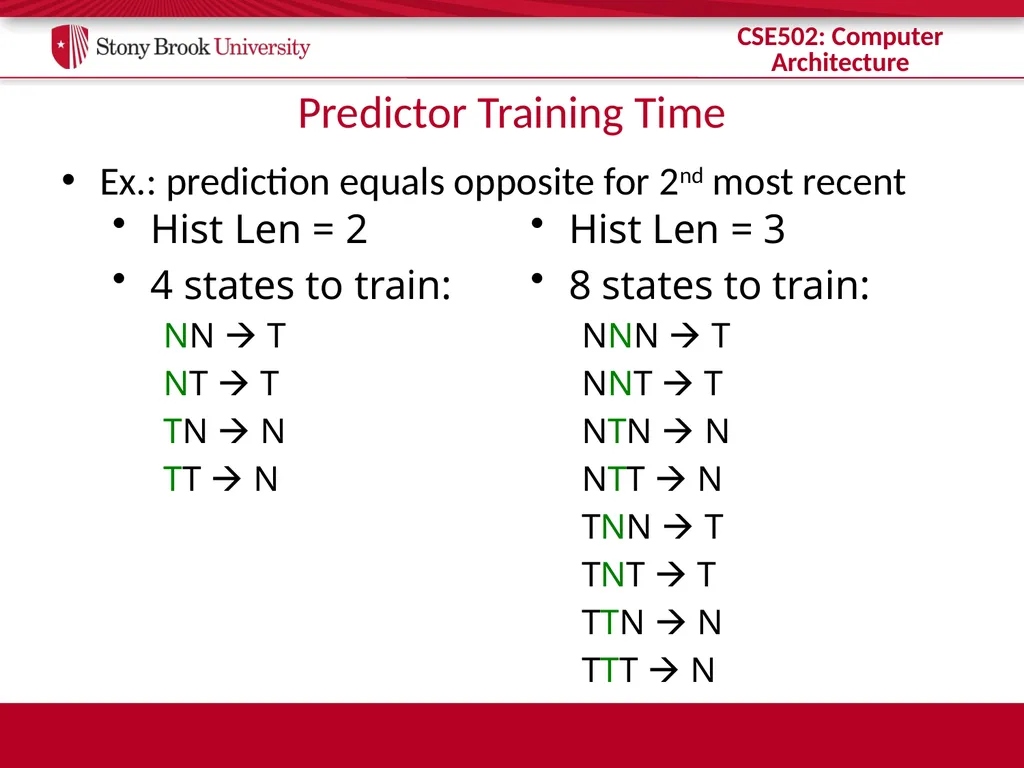
Predictor Training Time Ex.: prediction equals opposite for 2nd most recent Hist Len = 2
4 states to train:
NN T
NT T
TN N
TT N Hist Len = 3
8 states to train:
NNN T
NNT T
NTN N
NTT N
TNN T
TNT T
TTN N
TTT N<br>
4 states to train:
NN T
NT T
TN N
TT N Hist Len = 3
8 states to train:
NNN T
NNT T
NTN N
NTT N
TNN T
TNT T
TTN N
TTT N<br>
47
Branch Predictions Can Be Wrong How/when do we detect a misprediction?
What do we do about it?
Re-steer fetch to correct address
Hunt down and squash instructions from the wrong path<br>
What do we do about it?
Re-steer fetch to correct address
Hunt down and squash instructions from the wrong path<br>
48
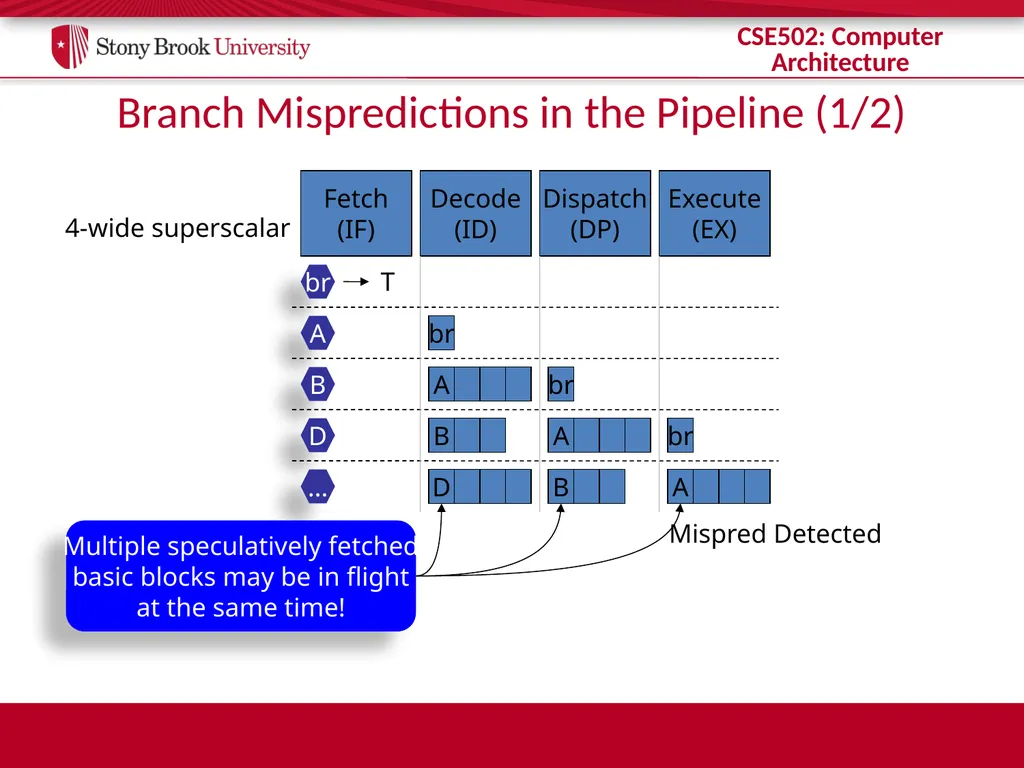
Branch Mispredictions in the Pipeline (1/2) Fetch
(IF) Decode
(ID) Dispatch
(DP) Execute
(EX) T br A B D br br br … A A A Mispred Detected B B D 4-wide superscalar<br>
(IF) Decode
(ID) Dispatch
(DP) Execute
(EX) T br A B D br br br … A A A Mispred Detected B B D 4-wide superscalar<br>
49
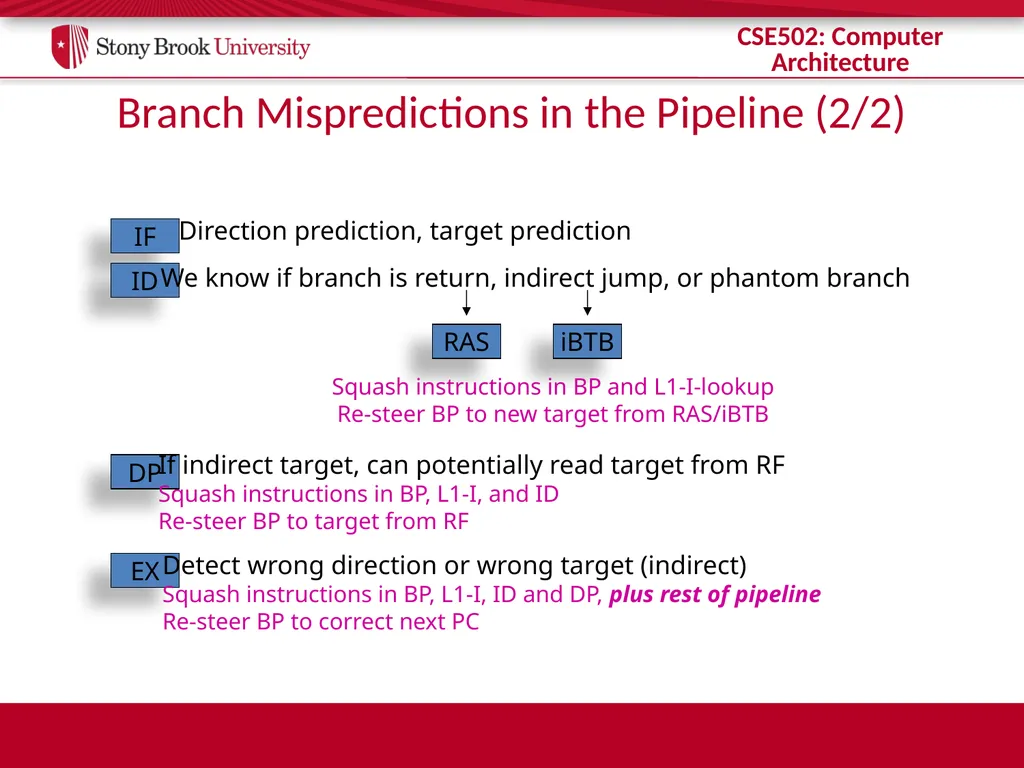
Branch Mispredictions in the Pipeline (2/2) IF ID DP EX Direction prediction, target prediction We know if branch is return, indirect jump, or phantom branch RAS iBTB If indirect target, can potentially read target from RF
Squash instructions in BP, L1-I, and ID
Re-steer BP to target from RF Detect wrong direction or wrong target (indirect)
Squash instructions in BP, L1-I, ID and DP, plus rest of pipeline
Re-steer BP to correct next PC Squash instructions in BP and L1-I-lookup
Re-steer BP to new target from RAS/iBTB<br>
Squash instructions in BP, L1-I, and ID
Re-steer BP to target from RF Detect wrong direction or wrong target (indirect)
Squash instructions in BP, L1-I, ID and DP, plus rest of pipeline
Re-steer BP to correct next PC Squash instructions in BP and L1-I-lookup
Re-steer BP to new target from RAS/iBTB<br>
50
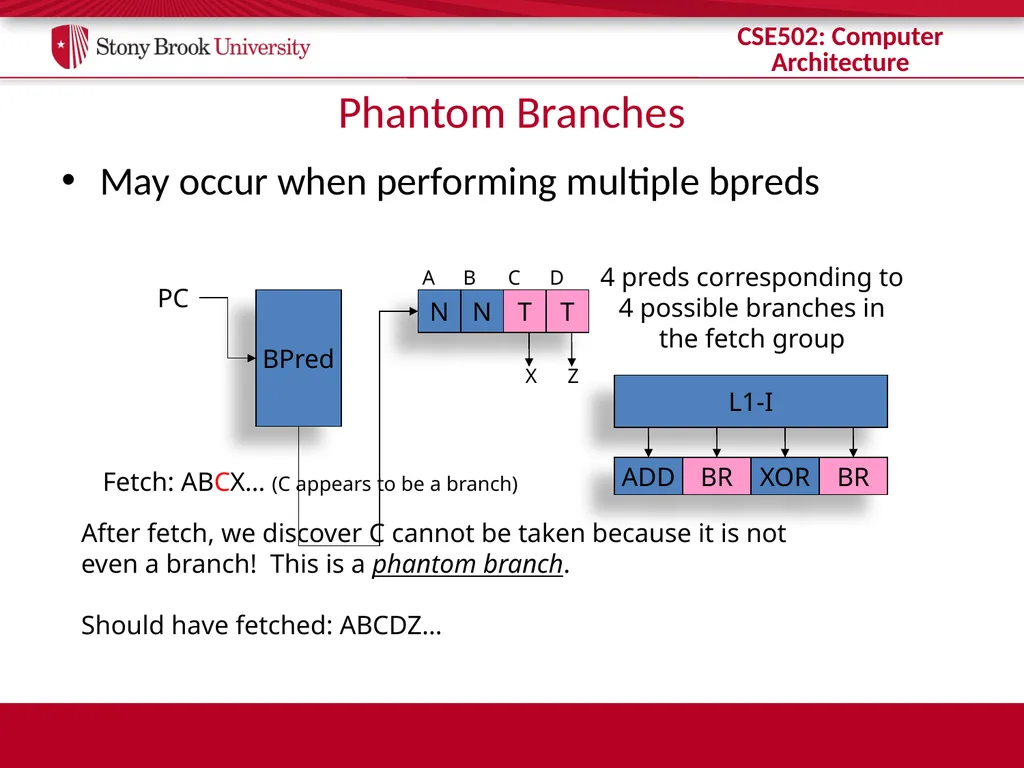
Phantom Branches May occur when performing multiple bpreds PC BPred T 4 preds corresponding to
4 possible branches in
the fetch group A B C D X Z Fetch: ABCX… (C appears to be a branch) After fetch, we discover C cannot be taken because it is not
even a branch! This is a phantom branch.
Should have fetched: ABCDZ… T N N<br>
4 possible branches in
the fetch group A B C D X Z Fetch: ABCX… (C appears to be a branch) After fetch, we discover C cannot be taken because it is not
even a branch! This is a phantom branch.
Should have fetched: ABCDZ… T N N<br>
51
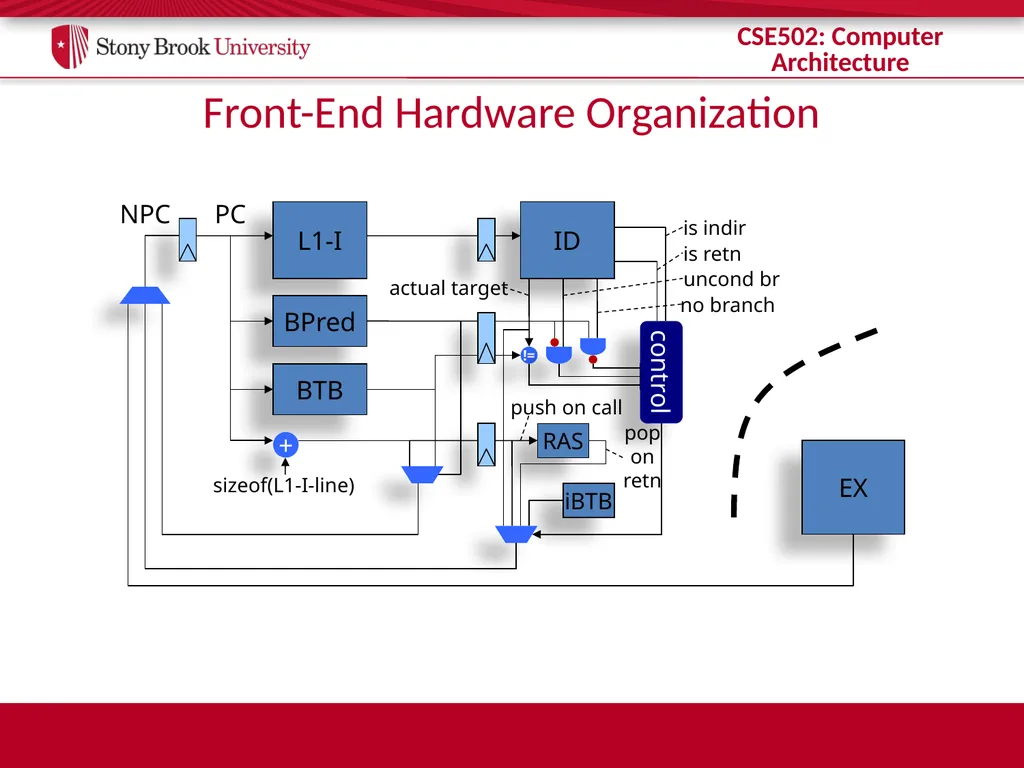
Front-End Hardware Organization L1-I BPred BTB + sizeof(L1-I-line) ID RAS iBTB uncond br != actual target push on call pop
on
retn no branch is retn is indir control NPC PC EX<br>
on
retn no branch is retn is indir control NPC PC EX<br>
52
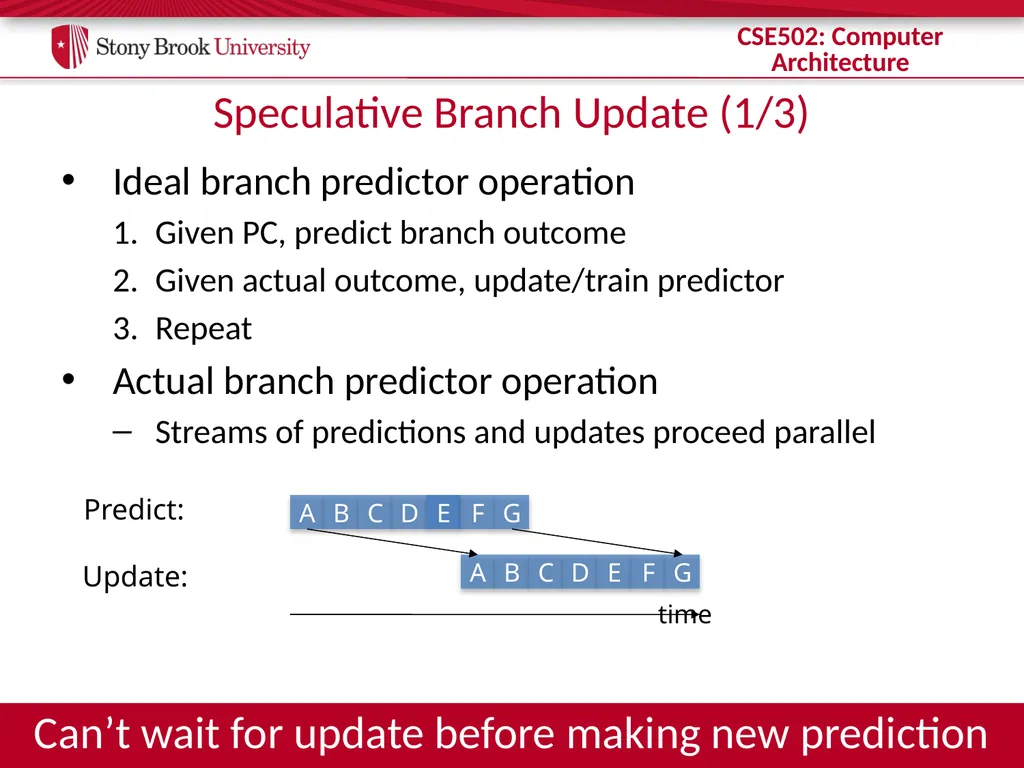
Speculative Branch Update (1/3) Ideal branch predictor operation
Given PC, predict branch outcome
Given actual outcome, update/train predictor
Repeat
Actual branch predictor operation
Streams of predictions and updates proceed parallel Can’t wait for update before making new prediction<br>
Given PC, predict branch outcome
Given actual outcome, update/train predictor
Repeat
Actual branch predictor operation
Streams of predictions and updates proceed parallel Can’t wait for update before making new prediction<br>
53
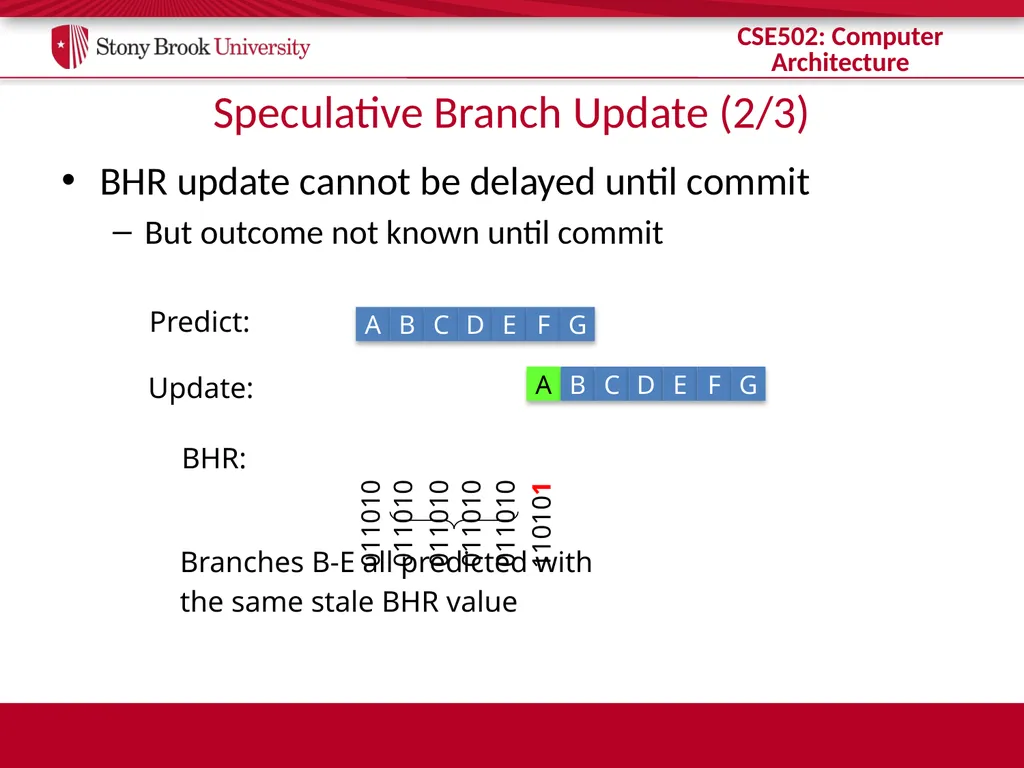
Speculative Branch Update (2/3) BHR update cannot be delayed until commit
But outcome not known until commit A Predict: B C D E F G Update: A B C D E F G 011010 011010 011010 011010 011010 110101 BHR: Branches B-E all predicted with
the same stale BHR value<br>
But outcome not known until commit A Predict: B C D E F G Update: A B C D E F G 011010 011010 011010 011010 011010 110101 BHR: Branches B-E all predicted with
the same stale BHR value<br>
54
Speculative Branch Update (3/3) Update branch history using predictions
Speculative update
If predictions are correct, then BHR is correct
What happens on a misprediction?
Commit-time BHR recovery
Execution-time BHR recovery<br>
Speculative update
If predictions are correct, then BHR is correct
What happens on a misprediction?
Commit-time BHR recovery
Execution-time BHR recovery<br>
55
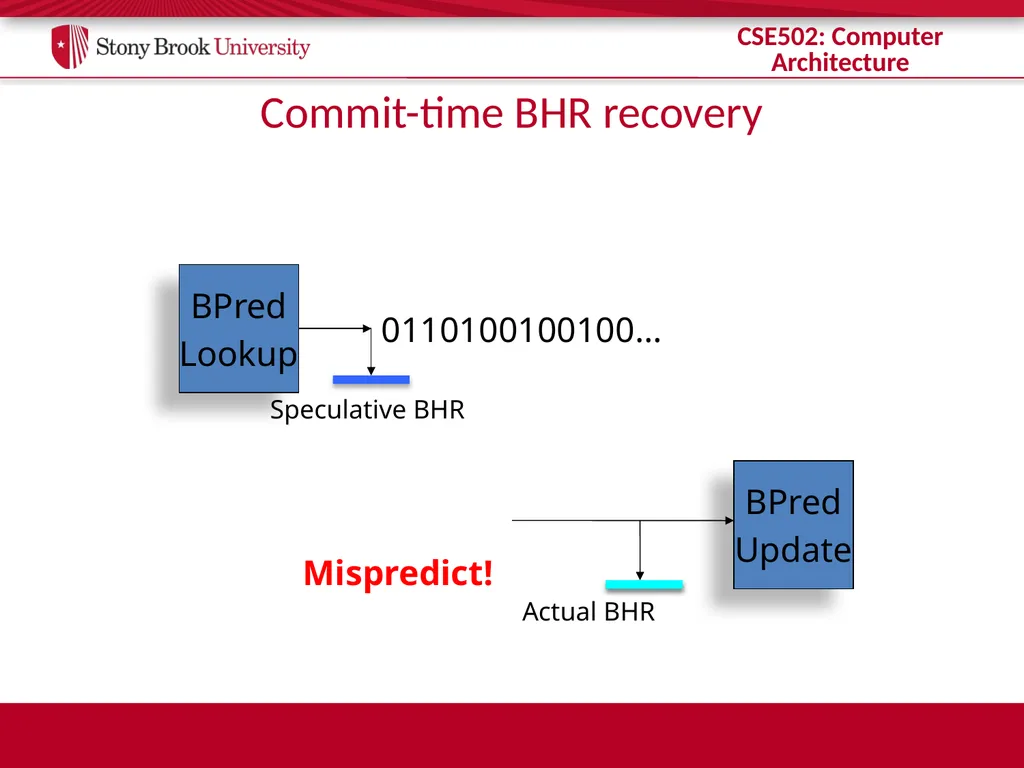
Commit-time BHR recovery BPred
Lookup 0110100100100… Speculative BHR BPred
Update Actual BHR Mispredict!<br>
Lookup 0110100100100… Speculative BHR BPred
Update Actual BHR Mispredict!<br>
56
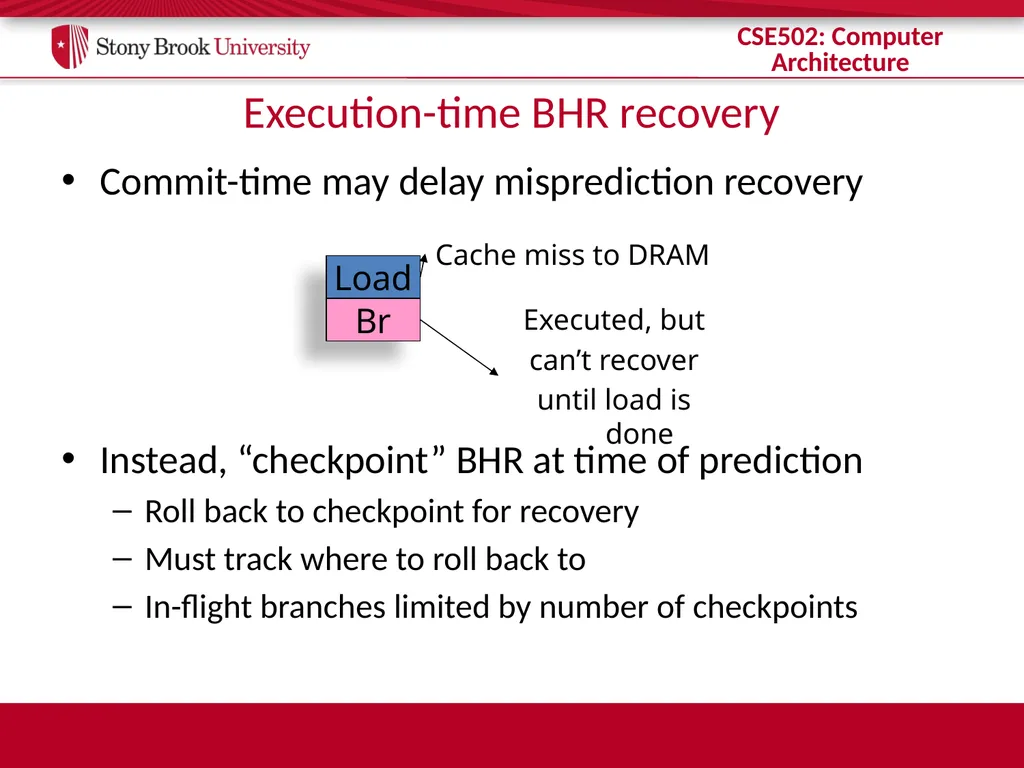
Execution-time BHR recovery Commit-time may delay misprediction recovery
Instead, “checkpoint” BHR at time of prediction
Roll back to checkpoint for recovery
Must track where to roll back to
In-flight branches limited by number of checkpoints Load Br Cache miss to DRAM Executed, but
can’t recover
until load is done<br>
Instead, “checkpoint” BHR at time of prediction
Roll back to checkpoint for recovery
Must track where to roll back to
In-flight branches limited by number of checkpoints Load Br Cache miss to DRAM Executed, but
can’t recover
until load is done<br>
57
Overriding Branch Predictors (1/2) Use two branch predictors
1st one has single-cycle latency (fast, medium accuracy)
2nd one has multi-cycle latency, but more accurate
Second predictor can override the 1st prediction Get speed without full penalty of low accuracy<br>
1st one has single-cycle latency (fast, medium accuracy)
2nd one has multi-cycle latency, but more accurate
Second predictor can override the 1st prediction Get speed without full penalty of low accuracy<br>
58
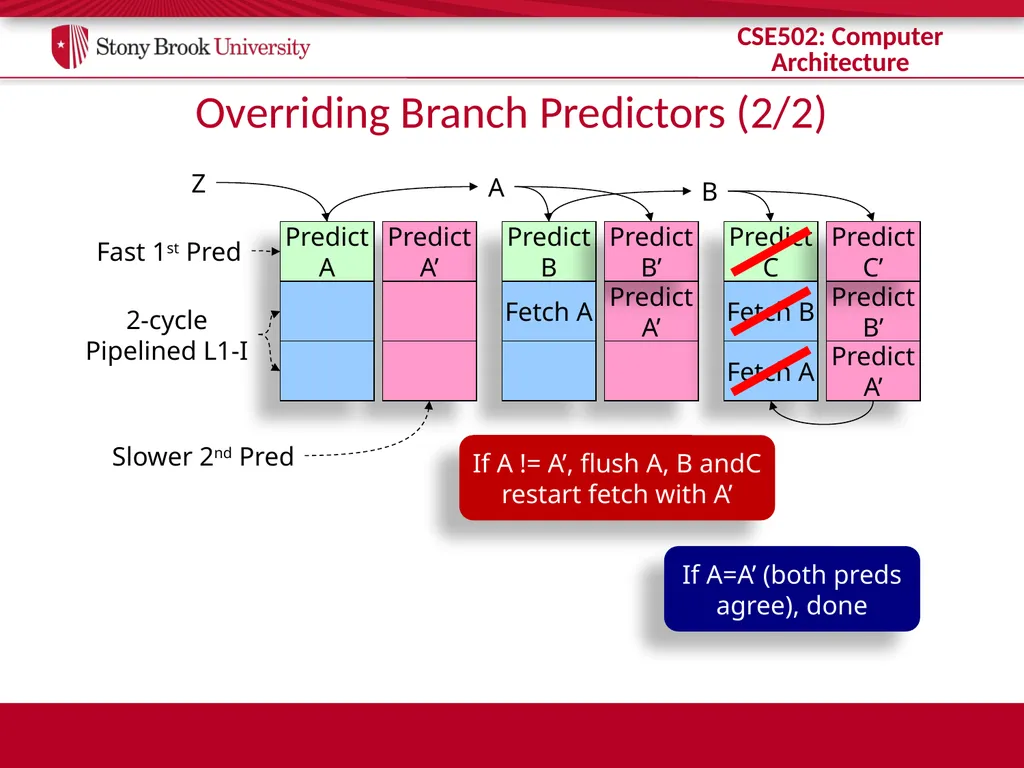
Overriding Branch Predictors (2/2) Predict
A’ Fast 1st Pred 2-cycle
Pipelined L1-I Slower 2nd Pred A If A != A’, flush A, B andC
restart fetch with A’ Z Predict
A<br>
A’ Fast 1st Pred 2-cycle
Pipelined L1-I Slower 2nd Pred A If A != A’, flush A, B andC
restart fetch with A’ Z Predict
A<br>