
CSE 502: Computer Architecture Instruction Commit
DJ
Published · 26 slides · 0 views
1 / 1
Description
CSE 502: Computer Architecture Instruction Commit The End of the Road (um Pipe) Commit is typically the last stage of the pipeline Anything an insn. does at this point is irrevocable Only actions following sequential execution allowed
Related Topics
Share
Embed code
Download this presentation From Below
"CSE 502: Computer Architecture Instruction Commit" is the property of its rightful owner. Permission is granted to download and print the materials on this website for personal, non-commercial use only, and to display it on your personal computer provided you do not modify the materials and that you retain all copyright notices contained in the materials. By downloading content from our website, you accept the terms of this agreement.
Presentation Transcript
01
CSE 502:
Computer Architecture Instruction Commit<br>
02
The End of the Road (um… Pipe) Commit is typically the last stage of the pipeline
Anything an insn. does at this point is irrevocable
Only actions following sequential execution allowed
E.g., wrong path instructions may not commit
They do not exist in the sequential execution<br>
Anything an insn. does at this point is irrevocable
Only actions following sequential execution allowed
E.g., wrong path instructions may not commit
They do not exist in the sequential execution<br>
03
Everything Should Appear In-Order ISA defines program execution in sequential order
To the outside, CPU must appear to execute in order When is someone looking?<br>
To the outside, CPU must appear to execute in order When is someone looking?<br>
04
“Looking” at CPU State When OS swaps contexts
OS saves the current program state (requires “looking”)
Allows restoring the state later
When program has a fault (e.g., page fault)
OS steps in and “looks” at the “current” CPU state<br>
OS saves the current program state (requires “looking”)
Allows restoring the state later
When program has a fault (e.g., page fault)
OS steps in and “looks” at the “current” CPU state<br>
05
Implementation in the CPU ARF keeps state corresponding to committed insns.
Commit from ROB happens in order
ARF always contains some RF state of sequential execution
Whoever wants to “look” should look in ARF
What about insns. that executed out of order?<br>
Commit from ROB happens in order
ARF always contains some RF state of sequential execution
Whoever wants to “look” should look in ARF
What about insns. that executed out of order?<br>
06
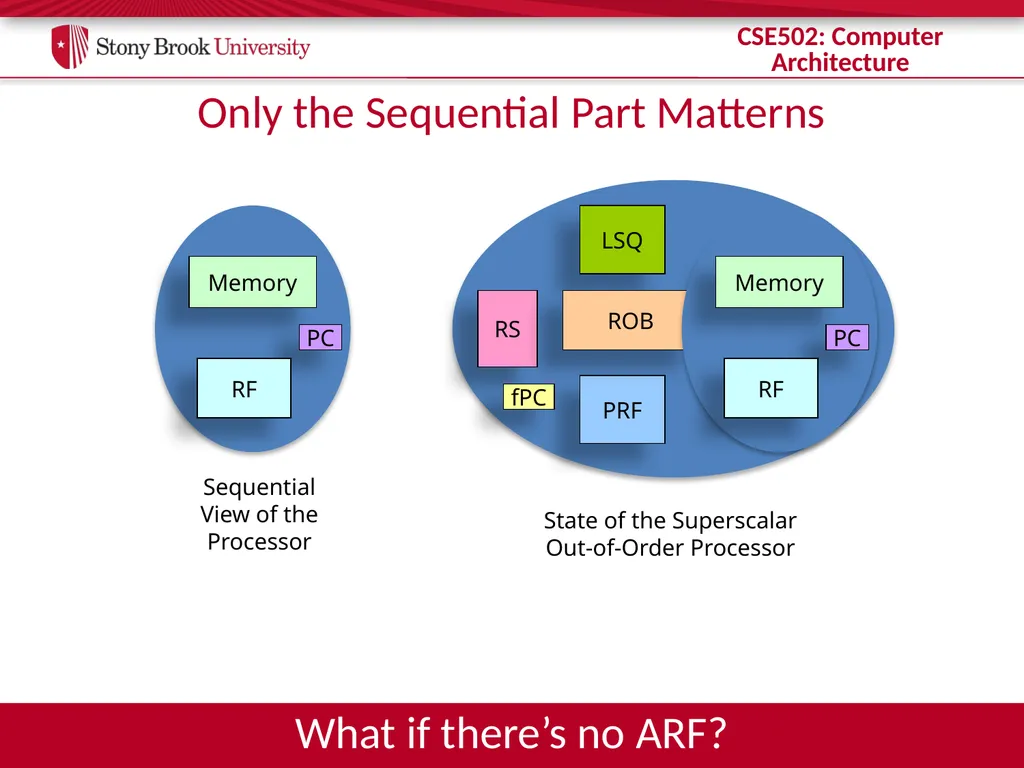
Only the Sequential Part Matterns PC Memory Sequential
View of the
Processor State of the Superscalar
Out-of-Order Processor RF What if there’s no ARF?<br>
View of the
Processor State of the Superscalar
Out-of-Order Processor RF What if there’s no ARF?<br>
07
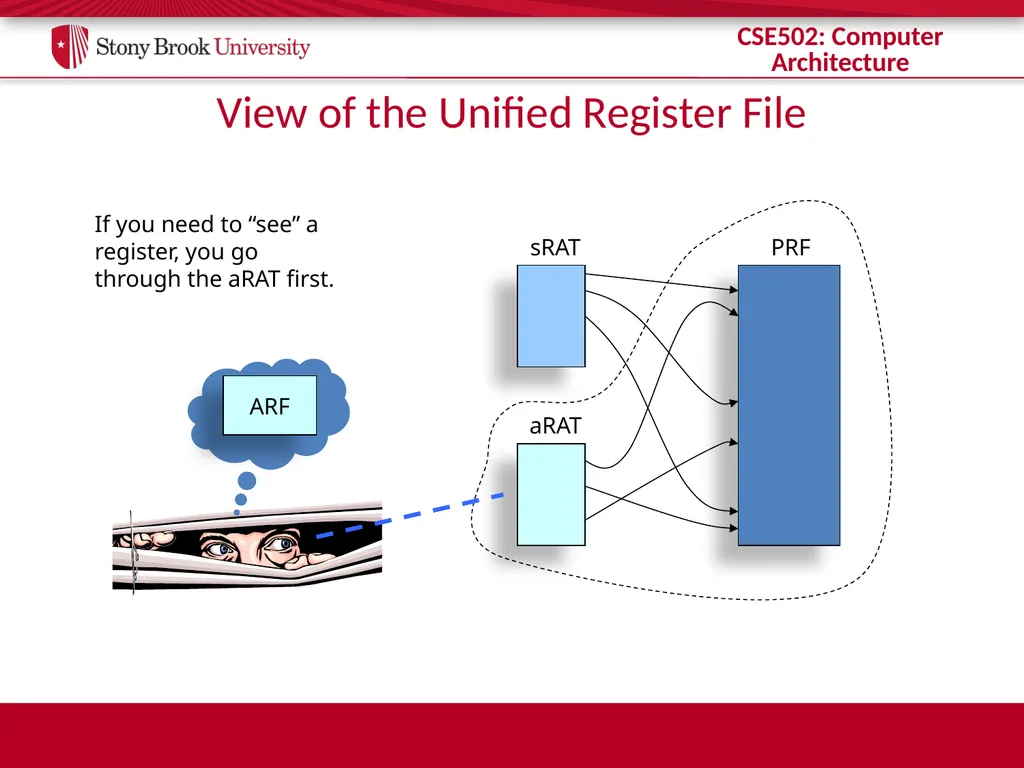
View of the Unified Register File PRF sRAT aRAT If you need to “see” a register, you go through the aRAT first.<br>
08
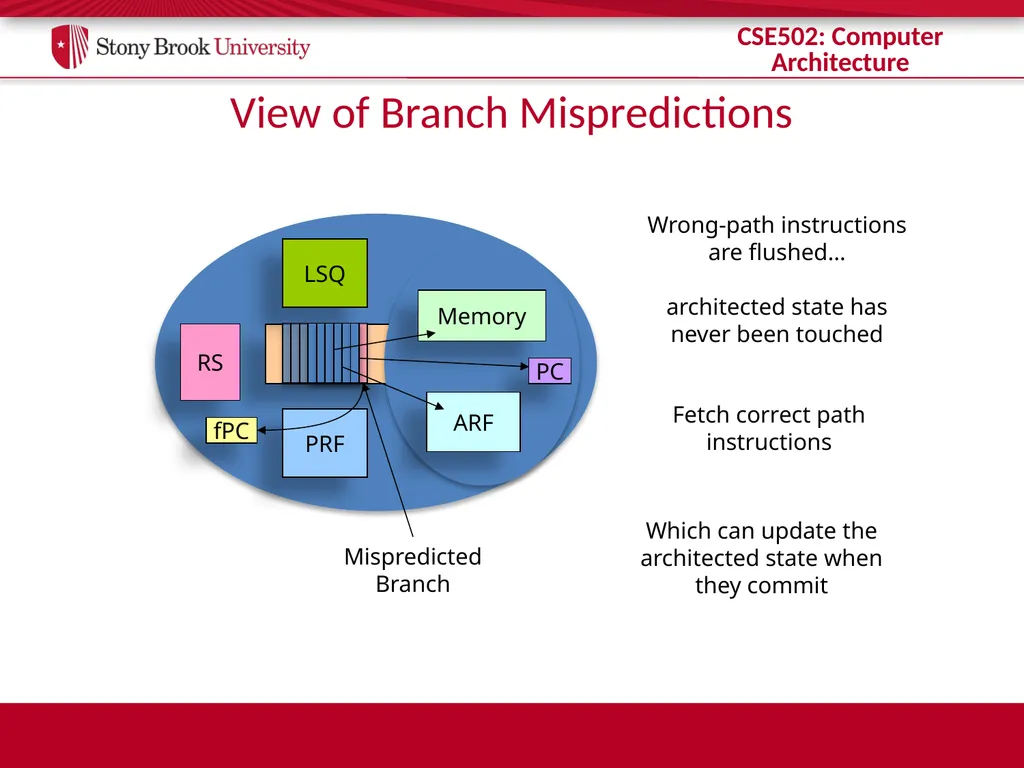
View of Branch Mispredictions Wrong-path instructions
are flushed…
architected state has
never been touched Fetch correct path
instructions Which can update the
architected state when
they commit<br>
are flushed…
architected state has
never been touched Fetch correct path
instructions Which can update the
architected state when
they commit<br>
09
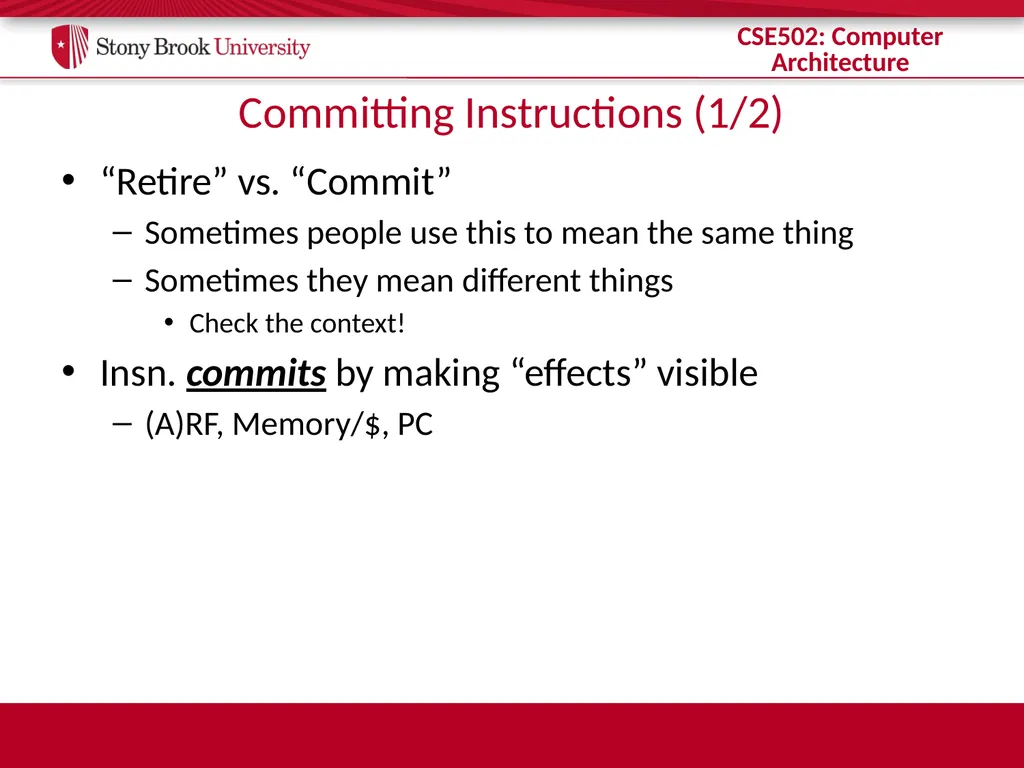
Committing Instructions (1/2) “Retire” vs. “Commit”
Sometimes people use this to mean the same thing
Sometimes they mean different things
Check the context!
Insn. commits by making “effects” visible
(A)RF, Memory/$, PC<br>
Sometimes people use this to mean the same thing
Sometimes they mean different things
Check the context!
Insn. commits by making “effects” visible
(A)RF, Memory/$, PC<br>
10
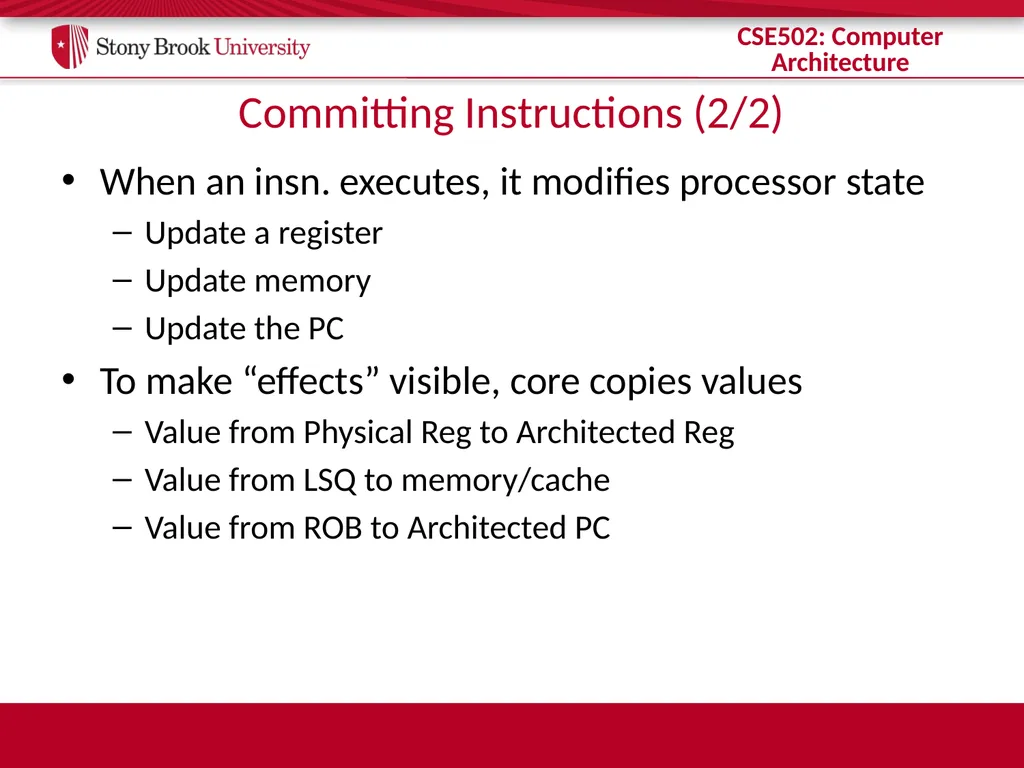
Committing Instructions (2/2) When an insn. executes, it modifies processor state
Update a register
Update memory
Update the PC
To make “effects” visible, core copies values
Value from Physical Reg to Architected Reg
Value from LSQ to memory/cache
Value from ROB to Architected PC<br>
Update a register
Update memory
Update the PC
To make “effects” visible, core copies values
Value from Physical Reg to Architected Reg
Value from LSQ to memory/cache
Value from ROB to Architected PC<br>
11
x86 Commit (1/2) ROB contains uops, outside world knows insns. ROB uop 1 (ADD) uop 1 (SUB) ???? If we take an interrupt right now, we’ll see a half-executed instruction! uop 1 (LD) uop 2 (ADD) uop 7 (POP) uop 8 (POP)<br>
12
x86 Commit (2/2) Works when uop-flow length ≤ commit width
What to do with long flows?
In all cases: can’t commit until all uops in a flow completed
Just commit N uops per cycle ... but make commit uninterruptable ROB Timer interrupt! Defer: Can’t act on this yet... Now do something about the interrupt.<br>
What to do with long flows?
In all cases: can’t commit until all uops in a flow completed
Just commit N uops per cycle ... but make commit uninterruptable ROB Timer interrupt! Defer: Can’t act on this yet... Now do something about the interrupt.<br>
13
Handling REP-prefixed Instructions (1/2) Ex. REP STOSB (memset EAX value ECX times)
Entire sequence is one x86 instruction
What if REPs for 1,000,000,000 iterations?
Can’t “lock up” for a billion cycles while uops commit
Can’t wait to commit until all uops are done
Can’t even fetch the entire instruction – not enough space in ROB
At the ISA level, REP iterations are interruptible...
Treat each iteration as a separate “macro-op”<br>
Entire sequence is one x86 instruction
What if REPs for 1,000,000,000 iterations?
Can’t “lock up” for a billion cycles while uops commit
Can’t wait to commit until all uops are done
Can’t even fetch the entire instruction – not enough space in ROB
At the ISA level, REP iterations are interruptible...
Treat each iteration as a separate “macro-op”<br>
14
Handling REP-prefixed Instructions (2/2) MOV EDI, <pointer> ; the array we want to memset
SUB EAX, EAX ; zero
CLD ; clear direction flag (REP fwd)
MOV ECX, 4 ; do for 100 iterations
REP STOSB ; memset!
ADD EBX, EDX ; unrelated instruction MOV EDI, xxx SUB EAX, EAX CLD MOV ECX, 4 uCMP ECX, 0 uJCZ STA tmp, EDI STD EAX, tmp SUB ECX, 1 ADD EDI, 1 uCMP ECX, 0 uJCZ STA tmp, EDI STD EAX, tmp SUB ECX, 1 ADD EDI, 1 uCMP ECX, 0 uJCZ STA tmp, EDI STD EAX, tmp SUB ECX, 1 ADD EDI, 1 uCMP ECX, 0 uJCZ STA tmp, EDI STD EAX, tmp SUB ECX, 1 ADD EDI, 1 uCMP ECX, 0 uJCZ ADD EBX, EDX Check for zero iterations
(could happen with MOV ECX, 0 ) MOVS flow REP overhead for
1st iteration MOVS flow REP overhead
for 2nd iter. MOVS flow REP overhead
for 3rd iter MOVS flow REP
4th iter A: B: C: D: All of these are interruptible points (commit can stop and effects be seen by outside world), since they all have well-defined ISA-level states:
A: ECX=3, EDI = ptr+1
B: ECX=2, EDI = ptr+2
C: ECX=1, EDI = ptr+3
D: ECX=0, EDI = ptr+4<br>
SUB EAX, EAX ; zero
CLD ; clear direction flag (REP fwd)
MOV ECX, 4 ; do for 100 iterations
REP STOSB ; memset!
ADD EBX, EDX ; unrelated instruction MOV EDI, xxx SUB EAX, EAX CLD MOV ECX, 4 uCMP ECX, 0 uJCZ STA tmp, EDI STD EAX, tmp SUB ECX, 1 ADD EDI, 1 uCMP ECX, 0 uJCZ STA tmp, EDI STD EAX, tmp SUB ECX, 1 ADD EDI, 1 uCMP ECX, 0 uJCZ STA tmp, EDI STD EAX, tmp SUB ECX, 1 ADD EDI, 1 uCMP ECX, 0 uJCZ STA tmp, EDI STD EAX, tmp SUB ECX, 1 ADD EDI, 1 uCMP ECX, 0 uJCZ ADD EBX, EDX Check for zero iterations
(could happen with MOV ECX, 0 ) MOVS flow REP overhead for
1st iteration MOVS flow REP overhead
for 2nd iter. MOVS flow REP overhead
for 3rd iter MOVS flow REP
4th iter A: B: C: D: All of these are interruptible points (commit can stop and effects be seen by outside world), since they all have well-defined ISA-level states:
A: ECX=3, EDI = ptr+1
B: ECX=2, EDI = ptr+2
C: ECX=1, EDI = ptr+3
D: ECX=0, EDI = ptr+4<br>
15
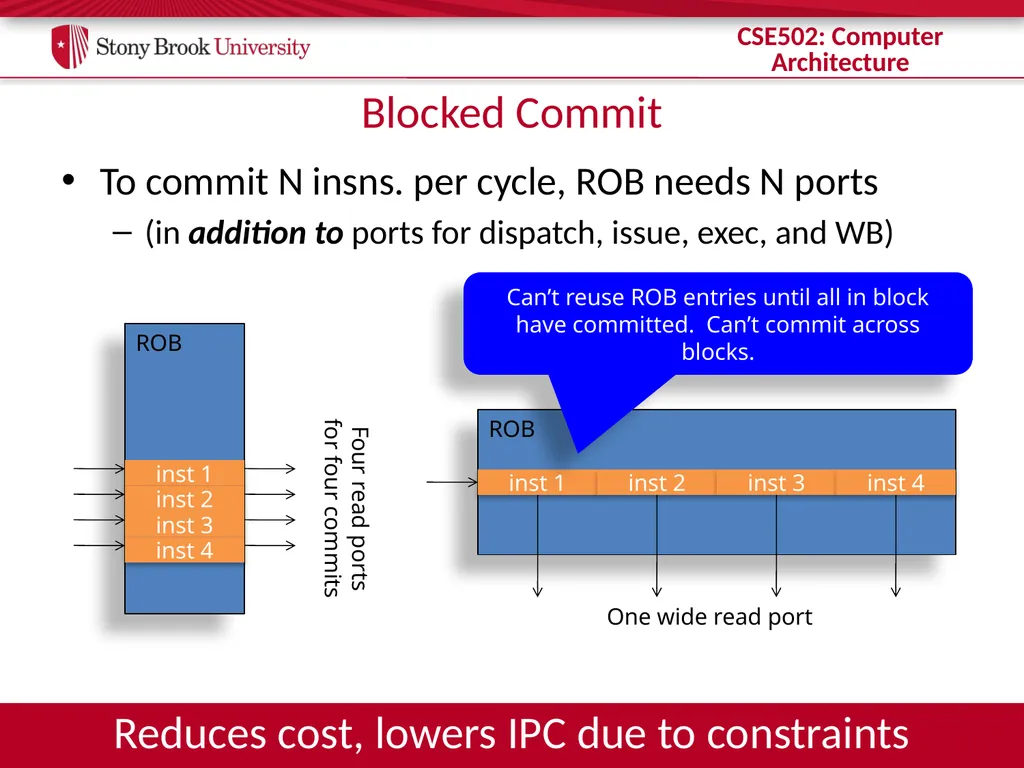
Blocked Commit To commit N insns. per cycle, ROB needs N ports
(in addition to ports for dispatch, issue, exec, and WB) inst 1 inst 2 inst 3 inst 4 Four read ports
for four commits ROB Can’t reuse ROB entries until all in block have committed. Can’t commit across blocks. Reduces cost, lowers IPC due to constraints<br>
(in addition to ports for dispatch, issue, exec, and WB) inst 1 inst 2 inst 3 inst 4 Four read ports
for four commits ROB Can’t reuse ROB entries until all in block have committed. Can’t commit across blocks. Reduces cost, lowers IPC due to constraints<br>
16
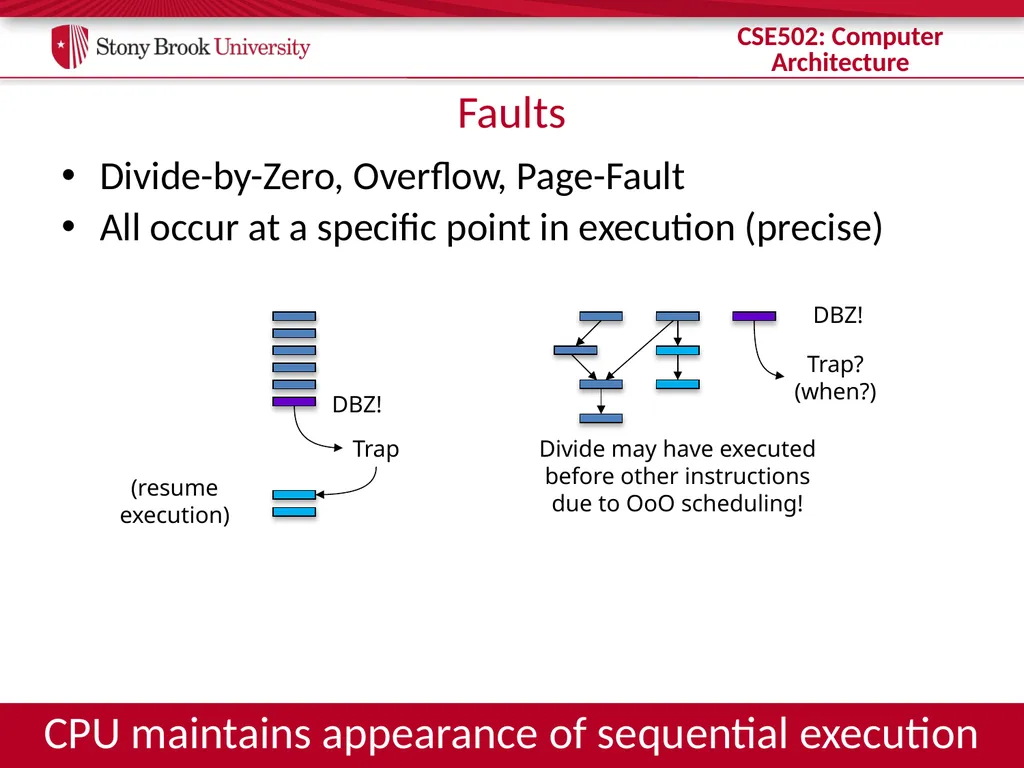
Faults Divide-by-Zero, Overflow, Page-Fault
All occur at a specific point in execution (precise) DBZ! CPU maintains appearance of sequential execution<br>
All occur at a specific point in execution (precise) DBZ! CPU maintains appearance of sequential execution<br>
17
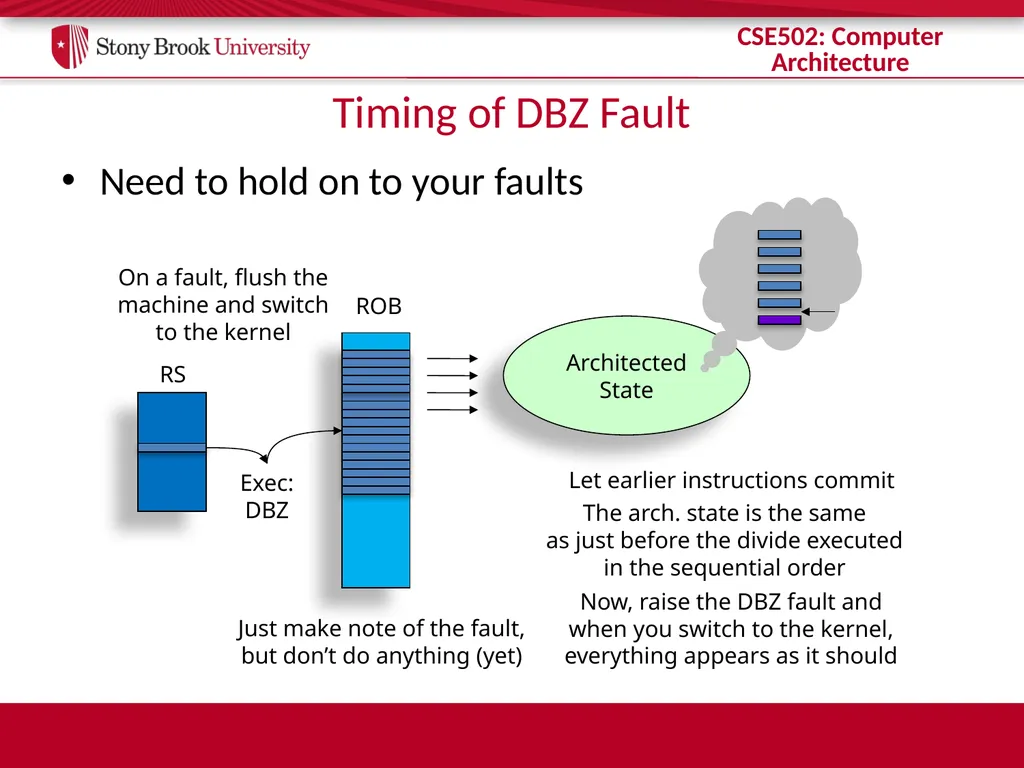
Timing of DBZ Fault Need to hold on to your faults RS ROB Exec:
DBZ Architected
State The arch. state is the same
as just before the divide executed
in the sequential order Now, raise the DBZ fault and
when you switch to the kernel,
everything appears as it should On a fault, flush the
machine and switch
to the kernel Just make note of the fault,
but don’t do anything (yet)<br>
DBZ Architected
State The arch. state is the same
as just before the divide executed
in the sequential order Now, raise the DBZ fault and
when you switch to the kernel,
everything appears as it should On a fault, flush the
machine and switch
to the kernel Just make note of the fault,
but don’t do anything (yet)<br>
18
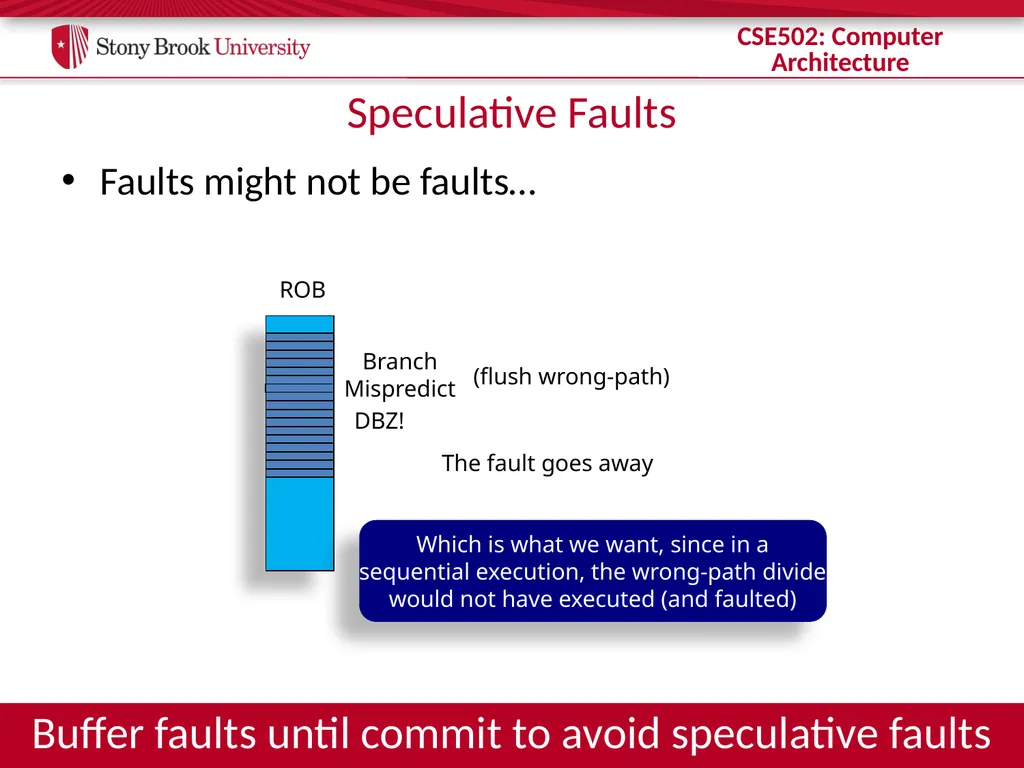
Speculative Faults Faults might not be faults… ROB DBZ! Branch
Mispredict The fault goes away Which is what we want, since in a
sequential execution, the wrong-path divide
would not have executed (and faulted) (flush wrong-path) Buffer faults until commit to avoid speculative faults<br>
Mispredict The fault goes away Which is what we want, since in a
sequential execution, the wrong-path divide
would not have executed (and faulted) (flush wrong-path) Buffer faults until commit to avoid speculative faults<br>
19
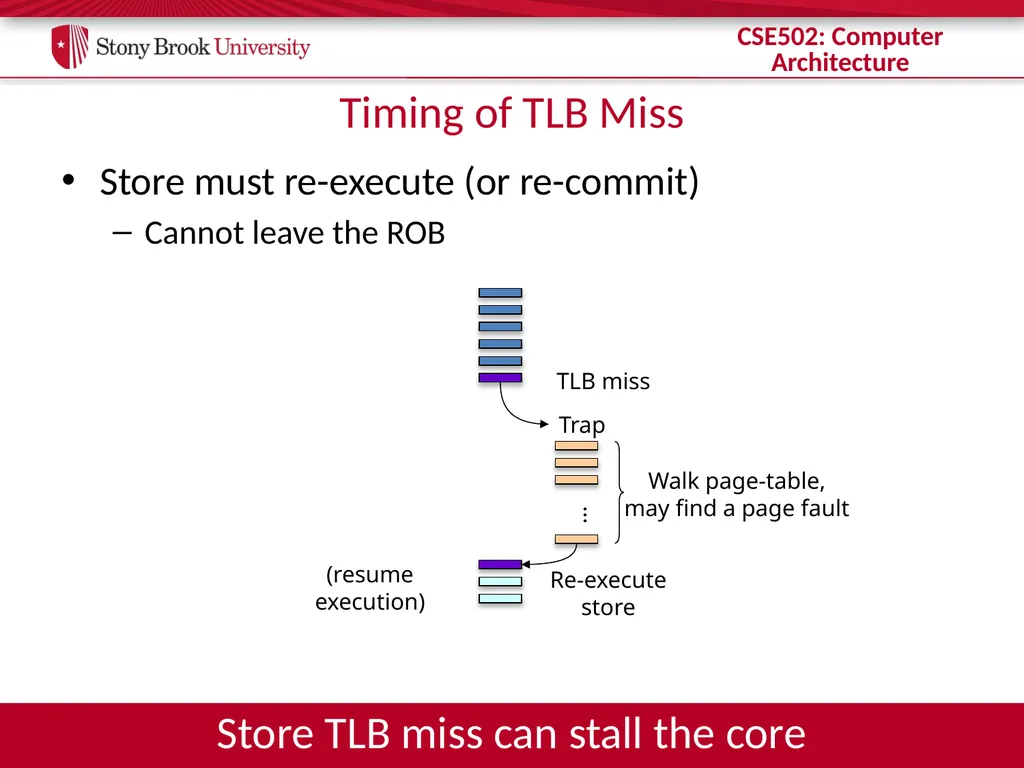
Timing of TLB Miss Store must re-execute (or re-commit)
Cannot leave the ROB TLB miss Store TLB miss can stall the core<br>
Cannot leave the ROB TLB miss Store TLB miss can stall the core<br>
20
Load Faults are Similar Load issues, misses in TLB
When load is oldest, switch to kernel for page-table walk …could be painful; there are lots of loads
Modern processors use hardware page-table walkers
OS loads a few registers with PT information (pointers)
Simple logic fetches mapping info from memory
Page-table format is specified by the ISA<br>
When load is oldest, switch to kernel for page-table walk …could be painful; there are lots of loads
Modern processors use hardware page-table walkers
OS loads a few registers with PT information (pointers)
Simple logic fetches mapping info from memory
Page-table format is specified by the ISA<br>
21
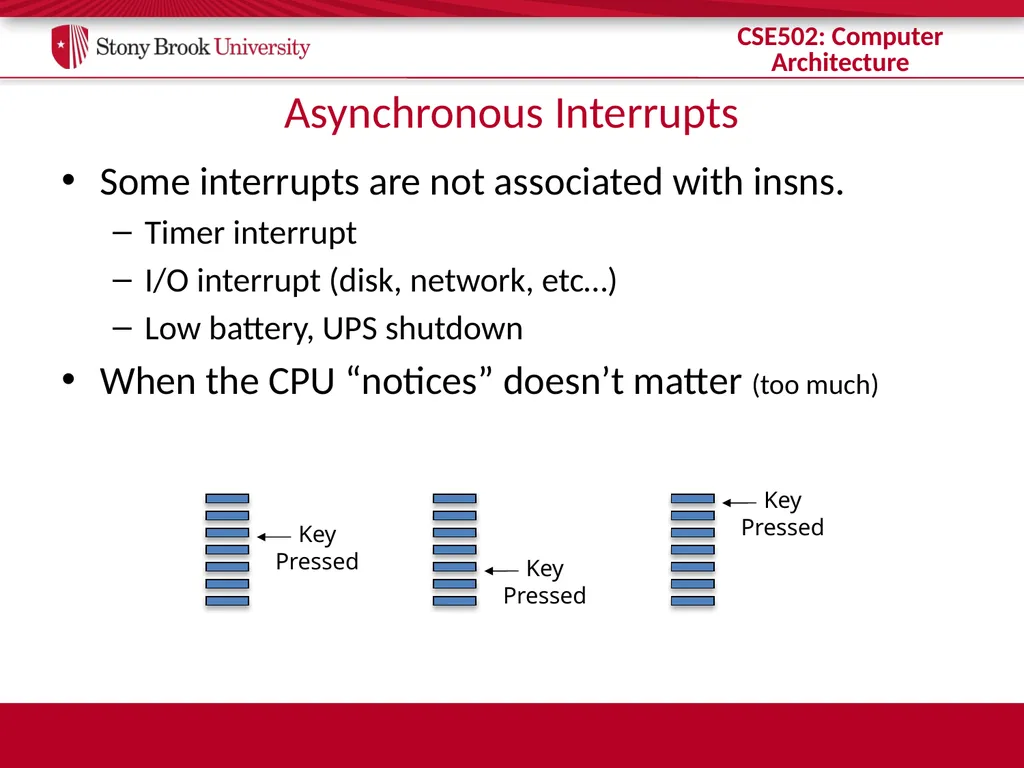
Asynchronous Interrupts Some interrupts are not associated with insns.
Timer interrupt
I/O interrupt (disk, network, etc…)
Low battery, UPS shutdown
When the CPU “notices” doesn’t matter (too much)<br>
Timer interrupt
I/O interrupt (disk, network, etc…)
Low battery, UPS shutdown
When the CPU “notices” doesn’t matter (too much)<br>
22
Two Options for Handling Async Interrupts Handle immediately
Use current architected state and flush the pipeline
Deferred
Stop fetching, let processor drain, then switch to handler
What if CPU takes a fault in the mean time?
Which came “first”, the async. interrupt or the fault?<br>
Use current architected state and flush the pipeline
Deferred
Stop fetching, let processor drain, then switch to handler
What if CPU takes a fault in the mean time?
Which came “first”, the async. interrupt or the fault?<br>
23
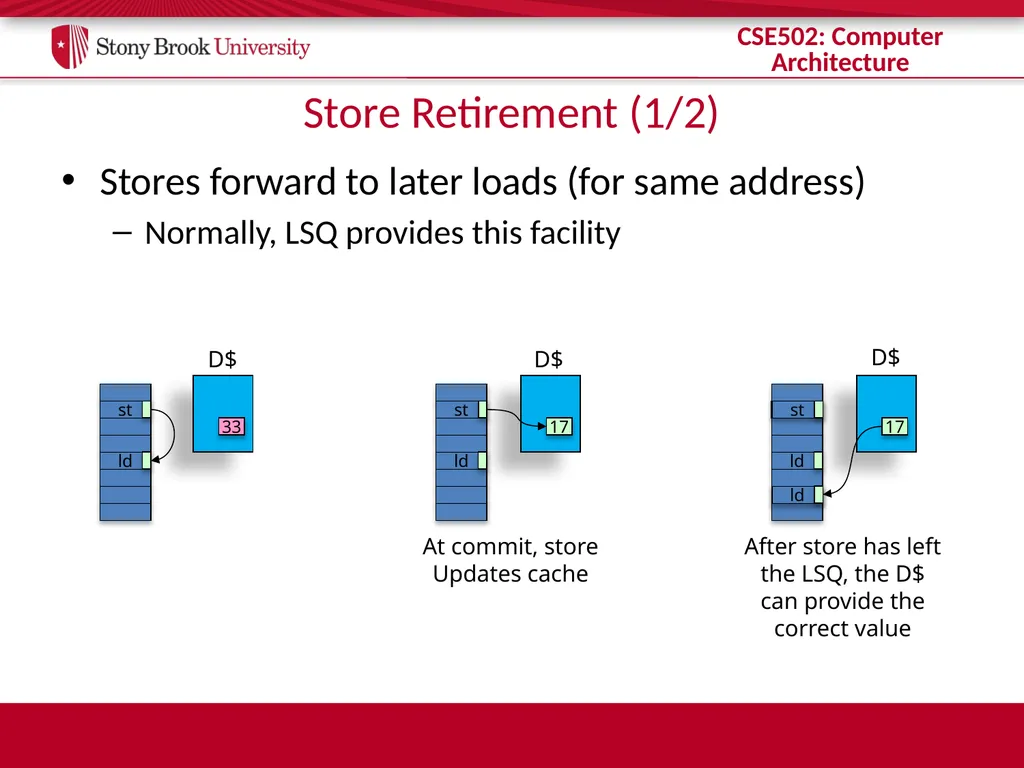
Store Retirement (1/2) Stores forward to later loads (for same address)
Normally, LSQ provides this facility st ld 33 After store has left
the LSQ, the D$
can provide the
correct value D$ D$<br>
Normally, LSQ provides this facility st ld 33 After store has left
the LSQ, the D$
can provide the
correct value D$ D$<br>
24
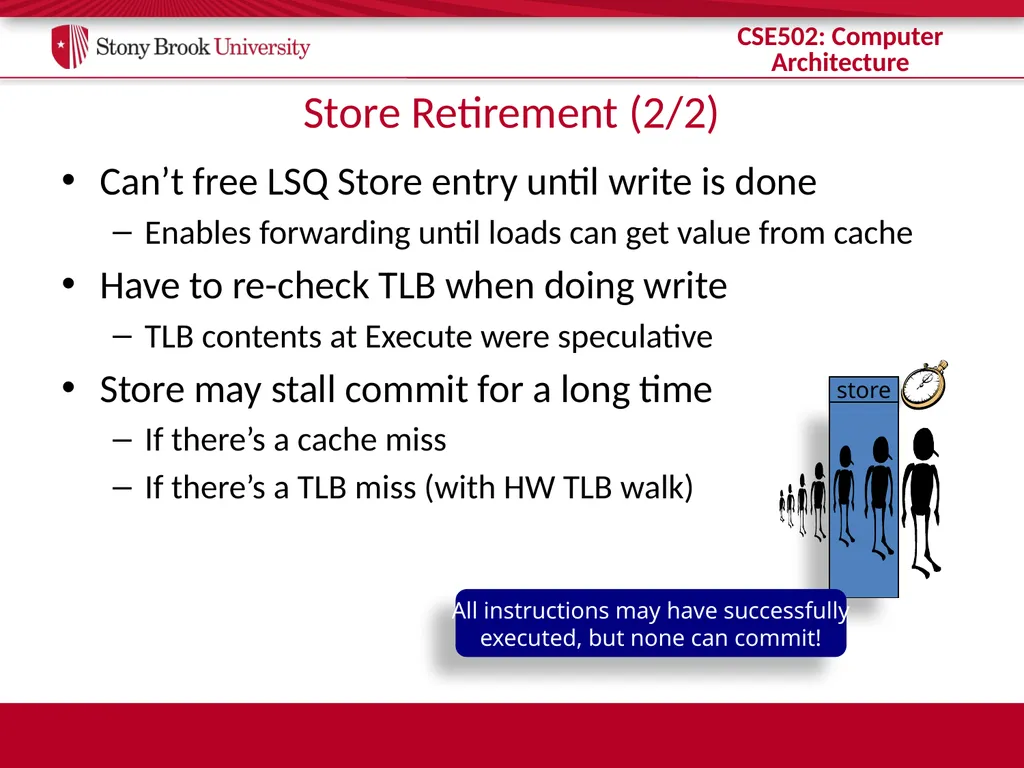
Store Retirement (2/2) Can’t free LSQ Store entry until write is done
Enables forwarding until loads can get value from cache
Have to re-check TLB when doing write
TLB contents at Execute were speculative
Store may stall commit for a long time
If there’s a cache miss
If there’s a TLB miss (with HW TLB walk)<br>
Enables forwarding until loads can get value from cache
Have to re-check TLB when doing write
TLB contents at Execute were speculative
Store may stall commit for a long time
If there’s a cache miss
If there’s a TLB miss (with HW TLB walk)<br>
25
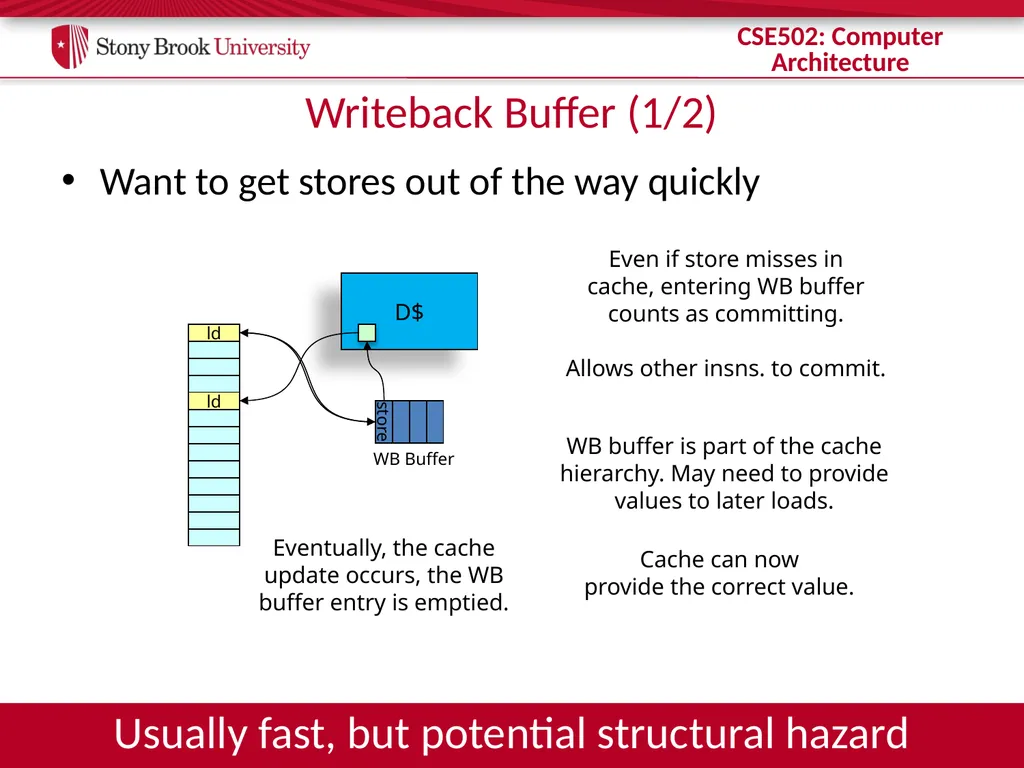
Writeback Buffer (1/2) Want to get stores out of the way quickly store D$ store WB Buffer ld Even if store misses in
cache, entering WB buffer
counts as committing.
Allows other insns. to commit. WB buffer is part of the cache
hierarchy. May need to provide
values to later loads. Eventually, the cache
update occurs, the WB
buffer entry is emptied. ld Cache can now
provide the correct value. Usually fast, but potential structural hazard<br>
cache, entering WB buffer
counts as committing.
Allows other insns. to commit. WB buffer is part of the cache
hierarchy. May need to provide
values to later loads. Eventually, the cache
update occurs, the WB
buffer entry is emptied. ld Cache can now
provide the correct value. Usually fast, but potential structural hazard<br>
26
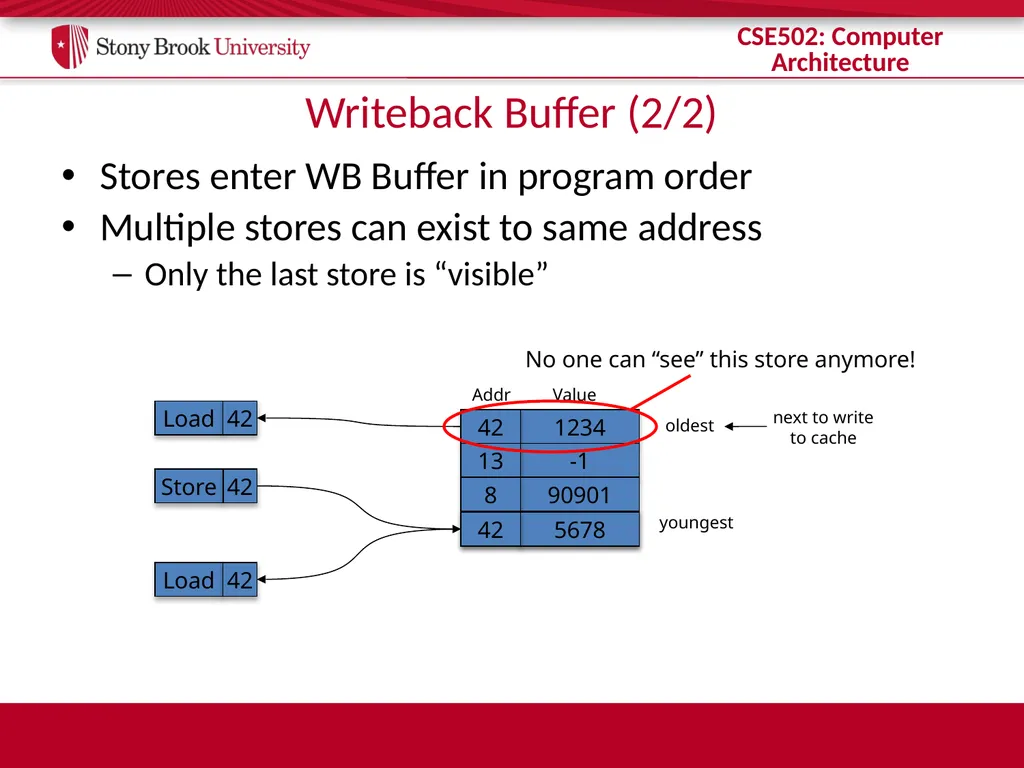
Writeback Buffer (2/2) Stores enter WB Buffer in program order
Multiple stores can exist to same address
Only the last store is “visible” 1234 42 Addr Value -1 13 90901 8 oldest youngest next to write
to cache Load 42 Store 42 Load 42<br>
Multiple stores can exist to same address
Only the last store is “visible” 1234 42 Addr Value -1 13 90901 8 oldest youngest next to write
to cache Load 42 Store 42 Load 42<br>
27
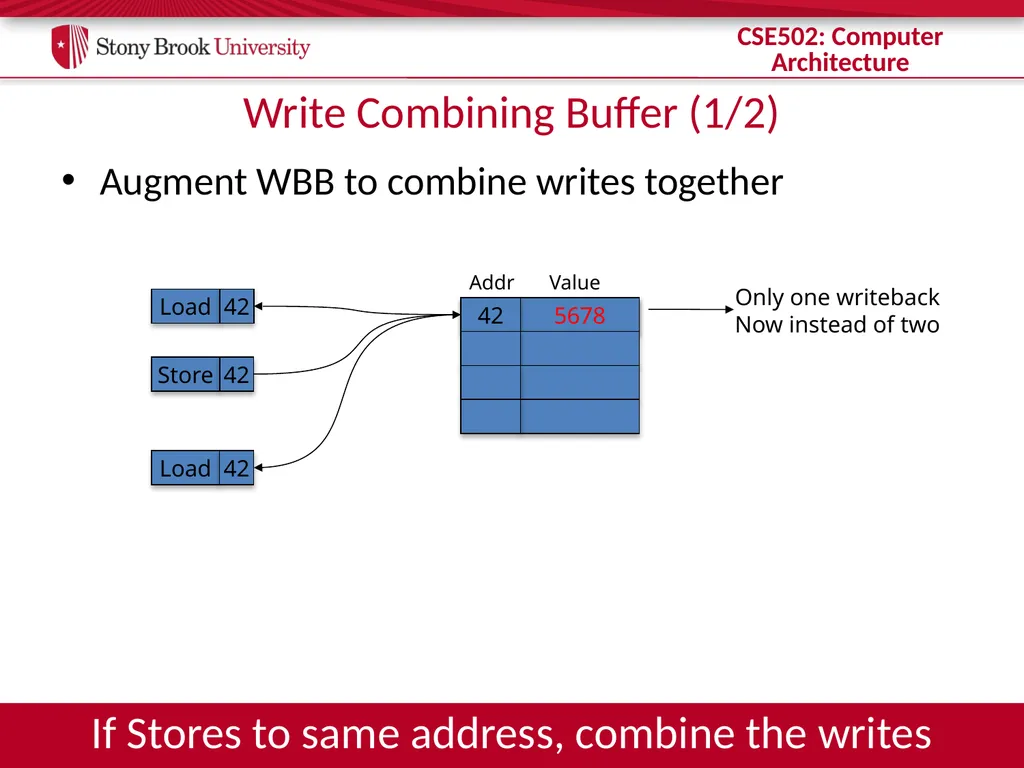
Write Combining Buffer (1/2) Augment WBB to combine writes together 1234 42 Addr Value Load 42 Store 42 Load 42 Only one writeback
Now instead of two If Stores to same address, combine the writes<br>
Now instead of two If Stores to same address, combine the writes<br>
28
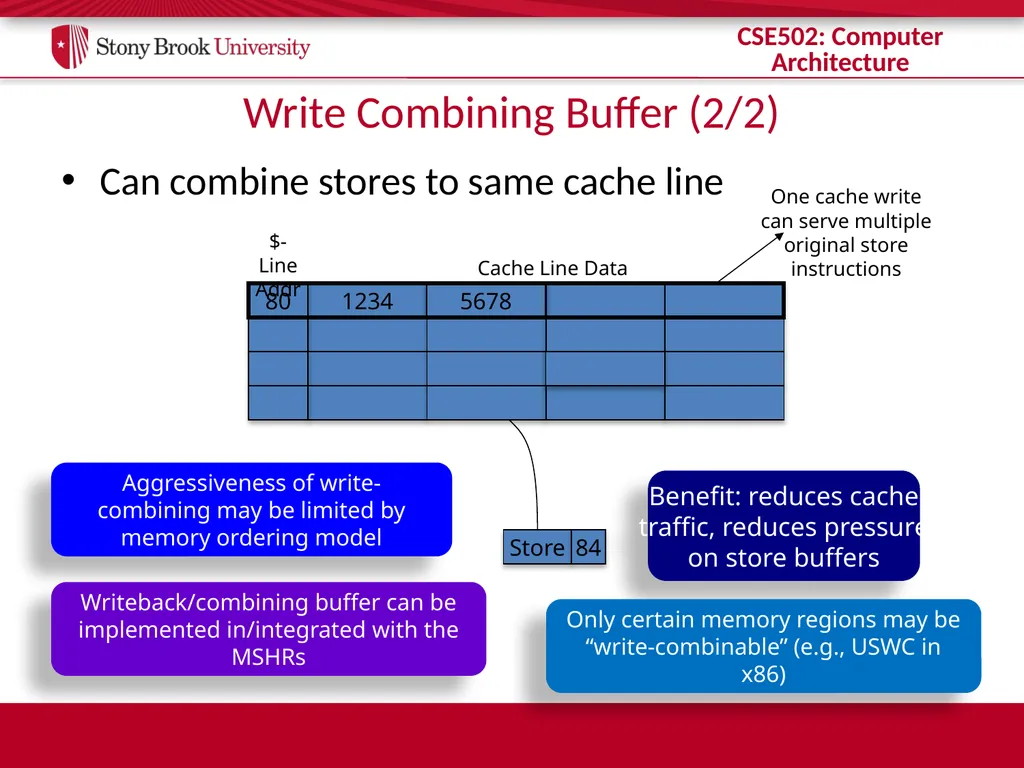
Write Combining Buffer (2/2) Can combine stores to same cache line 1234 80 $-Line
Addr Cache Line Data Benefit: reduces cache
traffic, reduces pressure
on store buffers 5678 Aggressiveness of write-combining may be limited by memory ordering model Writeback/combining buffer can be implemented in/integrated with the MSHRs Only certain memory regions may be “write-combinable” (e.g., USWC in x86)<br>
Addr Cache Line Data Benefit: reduces cache
traffic, reduces pressure
on store buffers 5678 Aggressiveness of write-combining may be limited by memory ordering model Writeback/combining buffer can be implemented in/integrated with the MSHRs Only certain memory regions may be “write-combinable” (e.g., USWC in x86)<br>
29
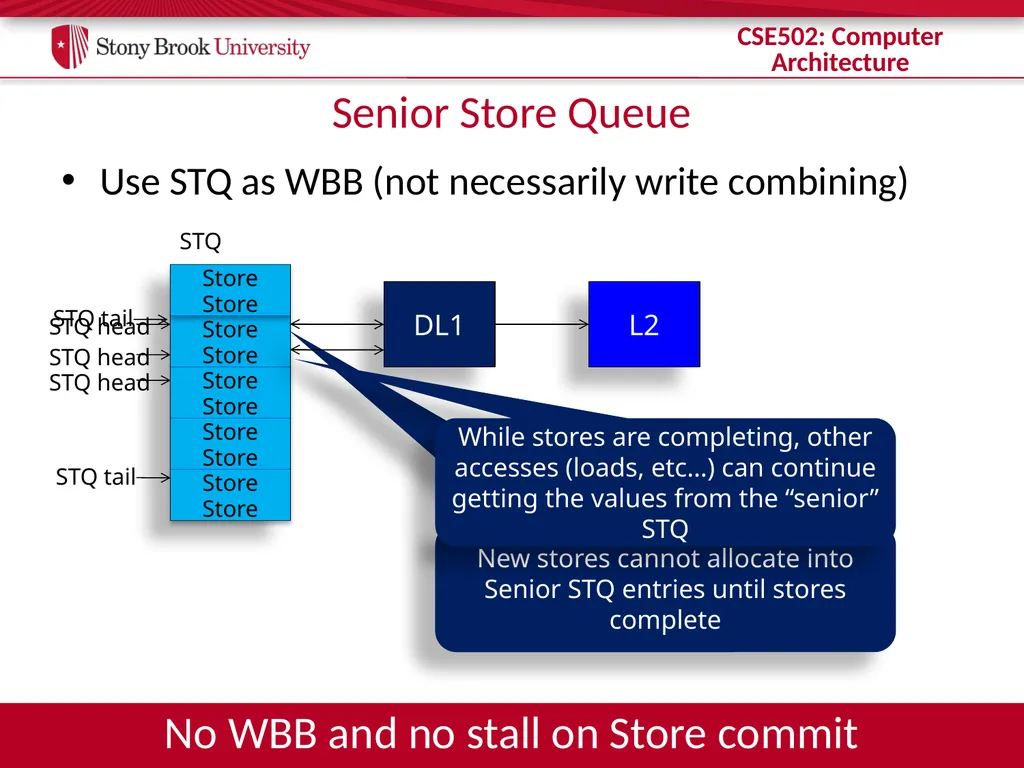
Senior Store Queue Use STQ as WBB (not necessarily write combining) STQ Store Store Store Store Store Store DL1 Store Store Store Store New stores cannot allocate into Senior STQ entries until stores complete No WBB and no stall on Store commit While stores are completing, other accesses (loads, etc…) can continue getting the values from the “senior” STQ<br>
30
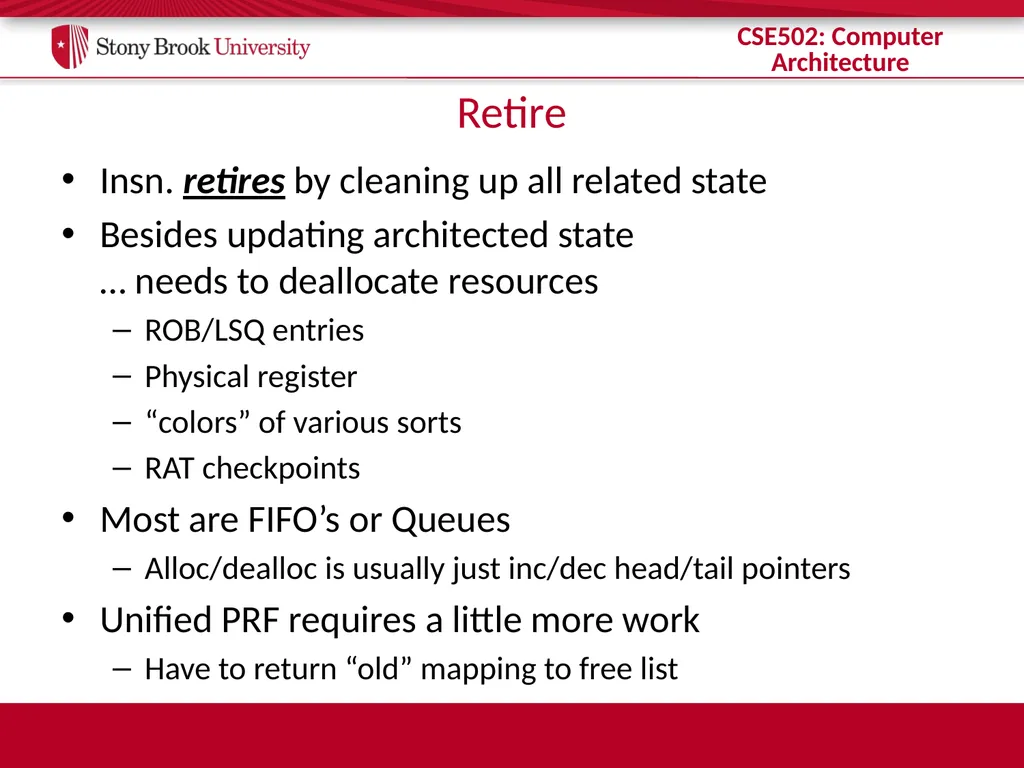
Retire Insn. retires by cleaning up all related state
Besides updating architected state … needs to deallocate resources
ROB/LSQ entries
Physical register
“colors” of various sorts
RAT checkpoints
Most are FIFO’s or Queues
Alloc/dealloc is usually just inc/dec head/tail pointers
Unified PRF requires a little more work
Have to return “old” mapping to free list<br>
Besides updating architected state … needs to deallocate resources
ROB/LSQ entries
Physical register
“colors” of various sorts
RAT checkpoints
Most are FIFO’s or Queues
Alloc/dealloc is usually just inc/dec head/tail pointers
Unified PRF requires a little more work
Have to return “old” mapping to free list<br>