
CUDA C/C++ BASICS NVIDIA Corporation © NVIDIA 2013
TF
Published · 67 slides · 0 views
1 / 1

Description
CUDA CC BASICS NVIDIA Corporation NVIDIA 2013 What is CUDA? CUDA Architecture Expose GPU parallelism for general-purpose computing Retain performance CUDA CC Based on industry-standard CC Small set of extensions to enable
Related Topics
Share
Embed code
Download this presentation From Below
"CUDA C/C++ BASICS NVIDIA Corporation © NVIDIA 2013" is the property of its rightful owner. Permission is granted to download and print the materials on this website for personal, non-commercial use only, and to display it on your personal computer provided you do not modify the materials and that you retain all copyright notices contained in the materials. By downloading content from our website, you accept the terms of this agreement.
Presentation Transcript
01
CUDA C/C++ BASICS NVIDIA Corporation © NVIDIA 2013<br>
02
What is CUDA? CUDA Architecture
Expose GPU parallelism for general-purpose computing
Retain performance
CUDA C/C++
Based on industry-standard C/C++
Small set of extensions to enable heterogeneous programming
Straightforward APIs to manage devices, memory etc.
This session introduces CUDA C/C++ © NVIDIA 2013<br>
Expose GPU parallelism for general-purpose computing
Retain performance
CUDA C/C++
Based on industry-standard C/C++
Small set of extensions to enable heterogeneous programming
Straightforward APIs to manage devices, memory etc.
This session introduces CUDA C/C++ © NVIDIA 2013<br>
03
Introduction to CUDA C/C++ What will you learn in this session?
Start from “Hello World!”
Write and launch CUDA C/C++ kernels
Manage GPU memory
Manage communication and synchronization © NVIDIA 2013<br>
Start from “Hello World!”
Write and launch CUDA C/C++ kernels
Manage GPU memory
Manage communication and synchronization © NVIDIA 2013<br>
04
Prerequisites You (probably) need experience with C or C++
You don’t need GPU experience
You don’t need parallel programming experience
You don’t need graphics experience © NVIDIA 2013<br>
You don’t need GPU experience
You don’t need parallel programming experience
You don’t need graphics experience © NVIDIA 2013<br>
05
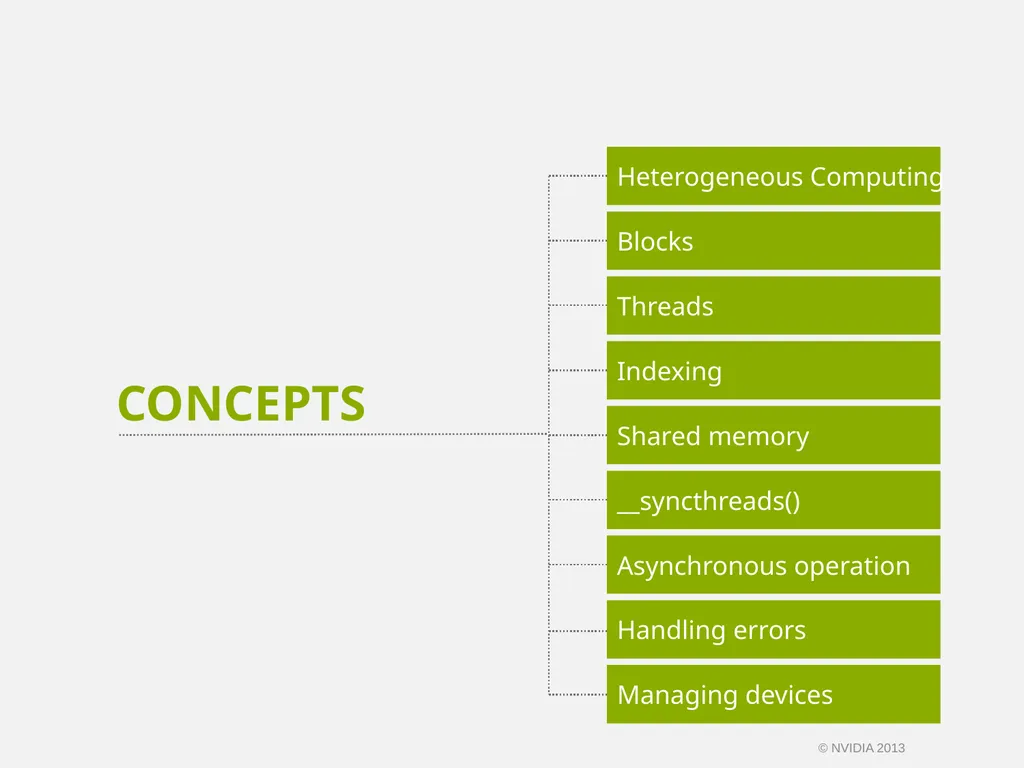
Heterogeneous Computing Blocks Threads Indexing Shared memory __syncthreads() Asynchronous operation Handling errors Managing devices CONCEPTS © NVIDIA 2013<br>
06
Hello World! Heterogeneous Computing Blocks Threads Indexing Shared memory __syncthreads() Asynchronous operation Handling errors Managing devices CONCEPTS<br>
07
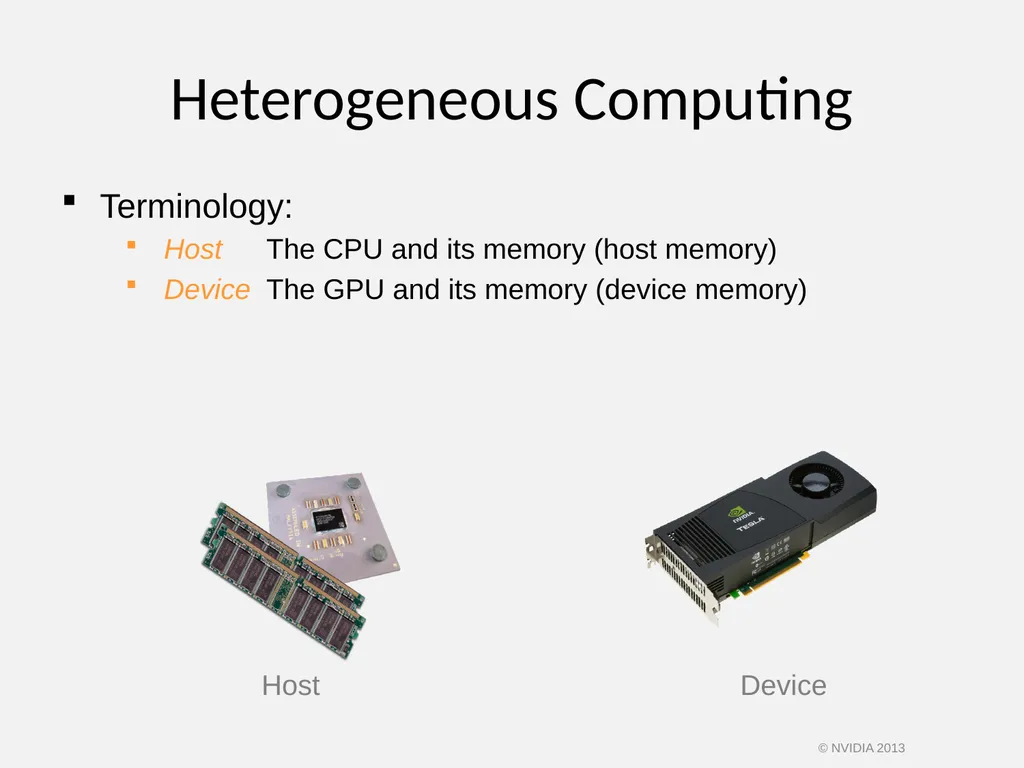
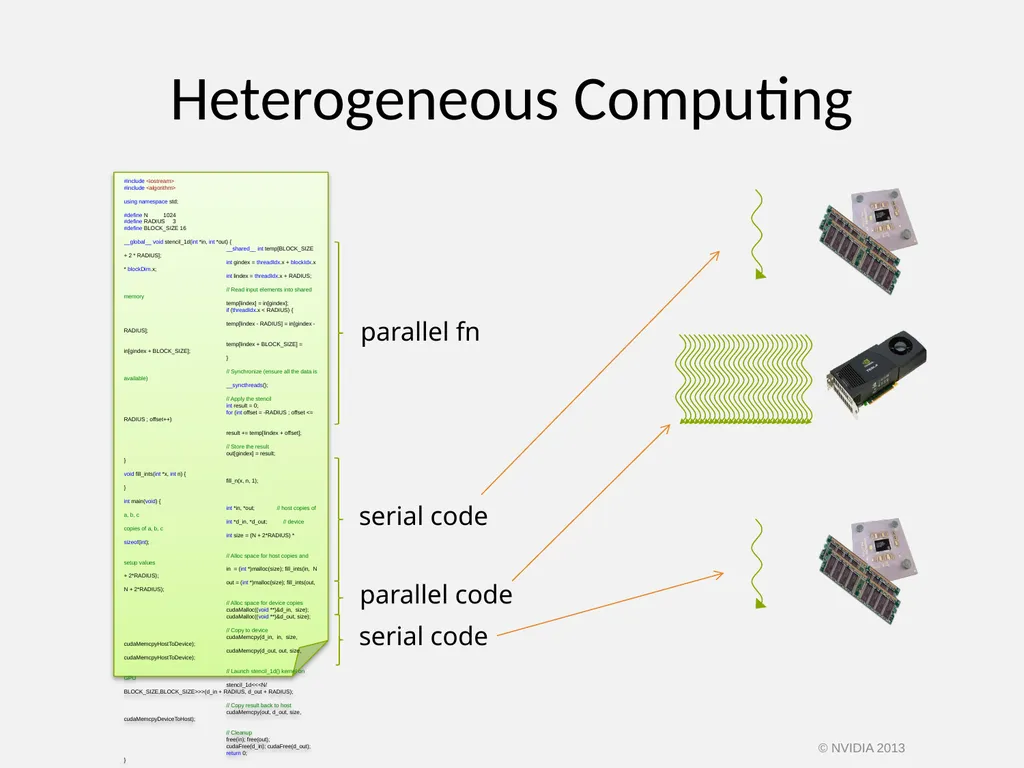
Heterogeneous Computing Terminology:
Host The CPU and its memory (host memory)
Device The GPU and its memory (device memory) Host Device © NVIDIA 2013<br>
Host The CPU and its memory (host memory)
Device The GPU and its memory (device memory) Host Device © NVIDIA 2013<br>
08
Heterogeneous Computing #include <iostream>
#include <algorithm>
using namespace std;
#define N 1024
#define RADIUS 3
#define BLOCK_SIZE 16
__global__ void stencil_1d(int *in, int *out) {
__shared__ int temp[BLOCK_SIZE + 2 * RADIUS];
int gindex = threadIdx.x + blockIdx.x * blockDim.x;
int lindex = threadIdx.x + RADIUS;
// Read input elements into shared memory
temp[lindex] = in[gindex];
if (threadIdx.x < RADIUS) {
temp[lindex - RADIUS] = in[gindex - RADIUS];
temp[lindex + BLOCK_SIZE] = in[gindex + BLOCK_SIZE];
}
// Synchronize (ensure all the data is available)
__syncthreads();
// Apply the stencil
int result = 0;
for (int offset = -RADIUS ; offset <= RADIUS ; offset++)
result += temp[lindex + offset];
// Store the result
out[gindex] = result;
}
void fill_ints(int *x, int n) {
fill_n(x, n, 1);
}
int main(void) {
int *in, *out; // host copies of a, b, c
int *d_in, *d_out; // device copies of a, b, c
int size = (N + 2*RADIUS) * sizeof(int);
// Alloc space for host copies and setup values
in = (int *)malloc(size); fill_ints(in, N + 2*RADIUS);
out = (int *)malloc(size); fill_ints(out, N + 2*RADIUS);
// Alloc space for device copies
cudaMalloc((void **)&d_in, size);
cudaMalloc((void **)&d_out, size);
// Copy to device
cudaMemcpy(d_in, in, size, cudaMemcpyHostToDevice);
cudaMemcpy(d_out, out, size, cudaMemcpyHostToDevice);
// Launch stencil_1d() kernel on GPU
stencil_1d<<<N/BLOCK_SIZE,BLOCK_SIZE>>>(d_in + RADIUS, d_out + RADIUS);
// Copy result back to host
cudaMemcpy(out, d_out, size, cudaMemcpyDeviceToHost);
// Cleanup
free(in); free(out);
cudaFree(d_in); cudaFree(d_out);
return 0;
} serial code parallel code serial code parallel fn © NVIDIA 2013<br>
#include <algorithm>
using namespace std;
#define N 1024
#define RADIUS 3
#define BLOCK_SIZE 16
__global__ void stencil_1d(int *in, int *out) {
__shared__ int temp[BLOCK_SIZE + 2 * RADIUS];
int gindex = threadIdx.x + blockIdx.x * blockDim.x;
int lindex = threadIdx.x + RADIUS;
// Read input elements into shared memory
temp[lindex] = in[gindex];
if (threadIdx.x < RADIUS) {
temp[lindex - RADIUS] = in[gindex - RADIUS];
temp[lindex + BLOCK_SIZE] = in[gindex + BLOCK_SIZE];
}
// Synchronize (ensure all the data is available)
__syncthreads();
// Apply the stencil
int result = 0;
for (int offset = -RADIUS ; offset <= RADIUS ; offset++)
result += temp[lindex + offset];
// Store the result
out[gindex] = result;
}
void fill_ints(int *x, int n) {
fill_n(x, n, 1);
}
int main(void) {
int *in, *out; // host copies of a, b, c
int *d_in, *d_out; // device copies of a, b, c
int size = (N + 2*RADIUS) * sizeof(int);
// Alloc space for host copies and setup values
in = (int *)malloc(size); fill_ints(in, N + 2*RADIUS);
out = (int *)malloc(size); fill_ints(out, N + 2*RADIUS);
// Alloc space for device copies
cudaMalloc((void **)&d_in, size);
cudaMalloc((void **)&d_out, size);
// Copy to device
cudaMemcpy(d_in, in, size, cudaMemcpyHostToDevice);
cudaMemcpy(d_out, out, size, cudaMemcpyHostToDevice);
// Launch stencil_1d() kernel on GPU
stencil_1d<<<N/BLOCK_SIZE,BLOCK_SIZE>>>(d_in + RADIUS, d_out + RADIUS);
// Copy result back to host
cudaMemcpy(out, d_out, size, cudaMemcpyDeviceToHost);
// Cleanup
free(in); free(out);
cudaFree(d_in); cudaFree(d_out);
return 0;
} serial code parallel code serial code parallel fn © NVIDIA 2013<br>
09
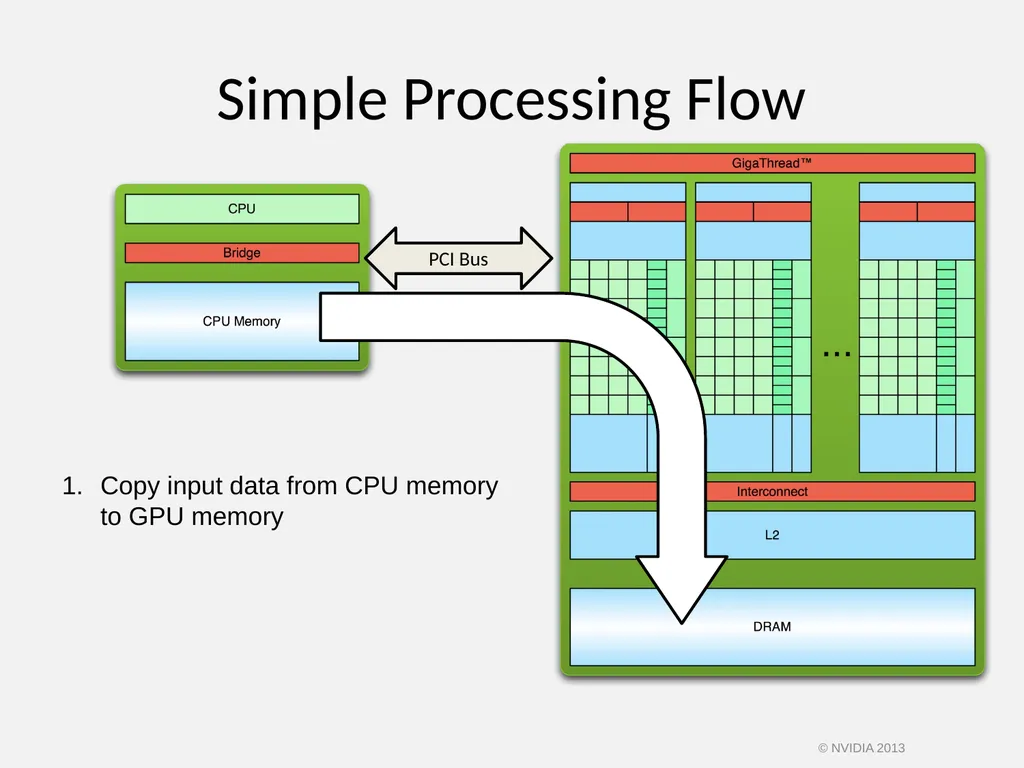
Simple Processing Flow Copy input data from CPU memory to GPU memory PCI Bus © NVIDIA 2013<br>
10
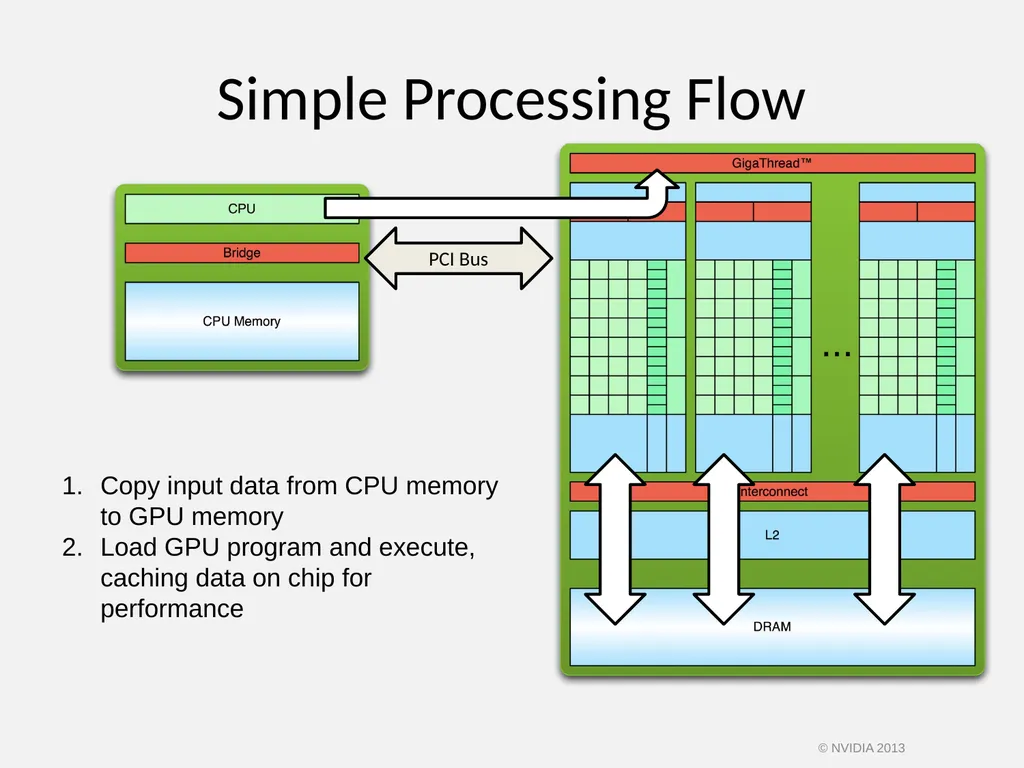
Simple Processing Flow Copy input data from CPU memory to GPU memory
Load GPU program and execute, caching data on chip for performance © NVIDIA 2013 PCI Bus<br>
Load GPU program and execute, caching data on chip for performance © NVIDIA 2013 PCI Bus<br>
11
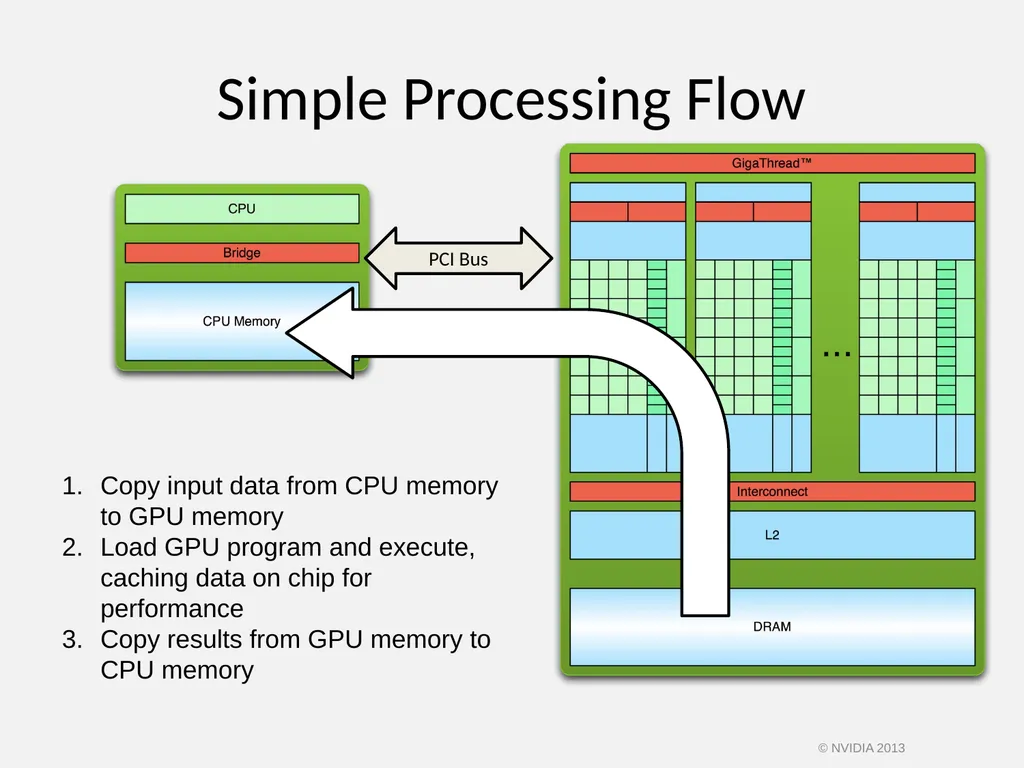
Simple Processing Flow Copy input data from CPU memory to GPU memory
Load GPU program and execute, caching data on chip for performance
Copy results from GPU memory to CPU memory © NVIDIA 2013 PCI Bus<br>
Load GPU program and execute, caching data on chip for performance
Copy results from GPU memory to CPU memory © NVIDIA 2013 PCI Bus<br>
12
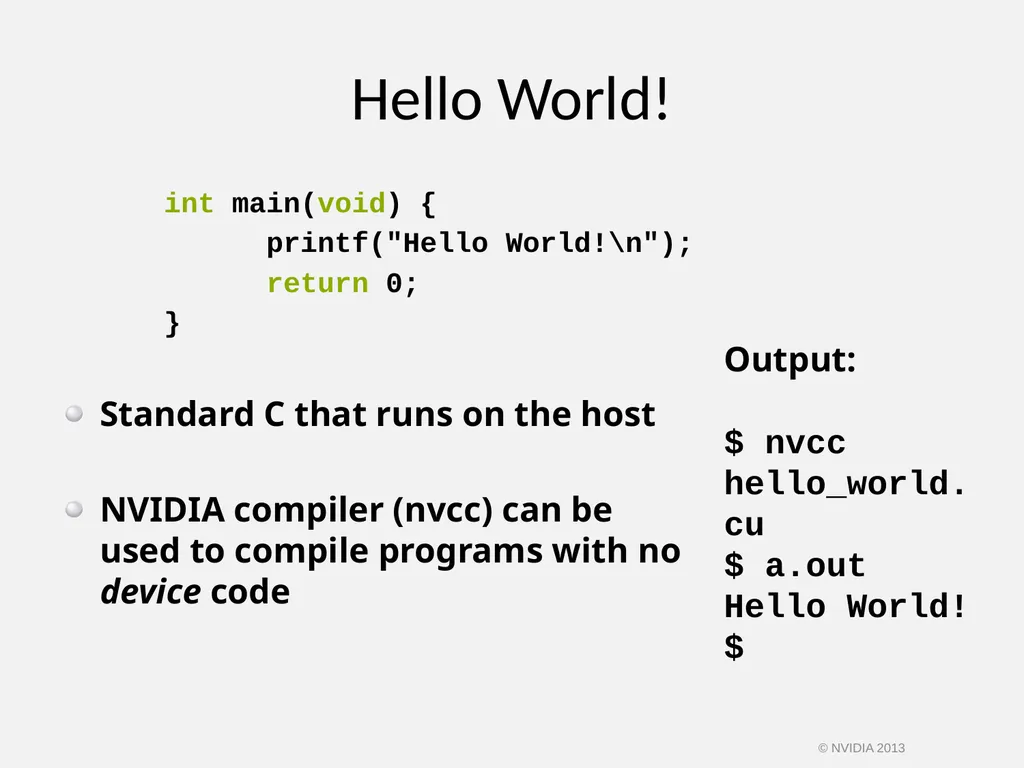
Hello World! int main(void) {
printf("Hello World!\n");
return 0;
}
Standard C that runs on the host
NVIDIA compiler (nvcc) can be used to compile programs with no device code Output:
$ nvcc hello_world.cu
$ a.out
Hello World!
$ © NVIDIA 2013<br>
printf("Hello World!\n");
return 0;
}
Standard C that runs on the host
NVIDIA compiler (nvcc) can be used to compile programs with no device code Output:
$ nvcc hello_world.cu
$ a.out
Hello World!
$ © NVIDIA 2013<br>
13
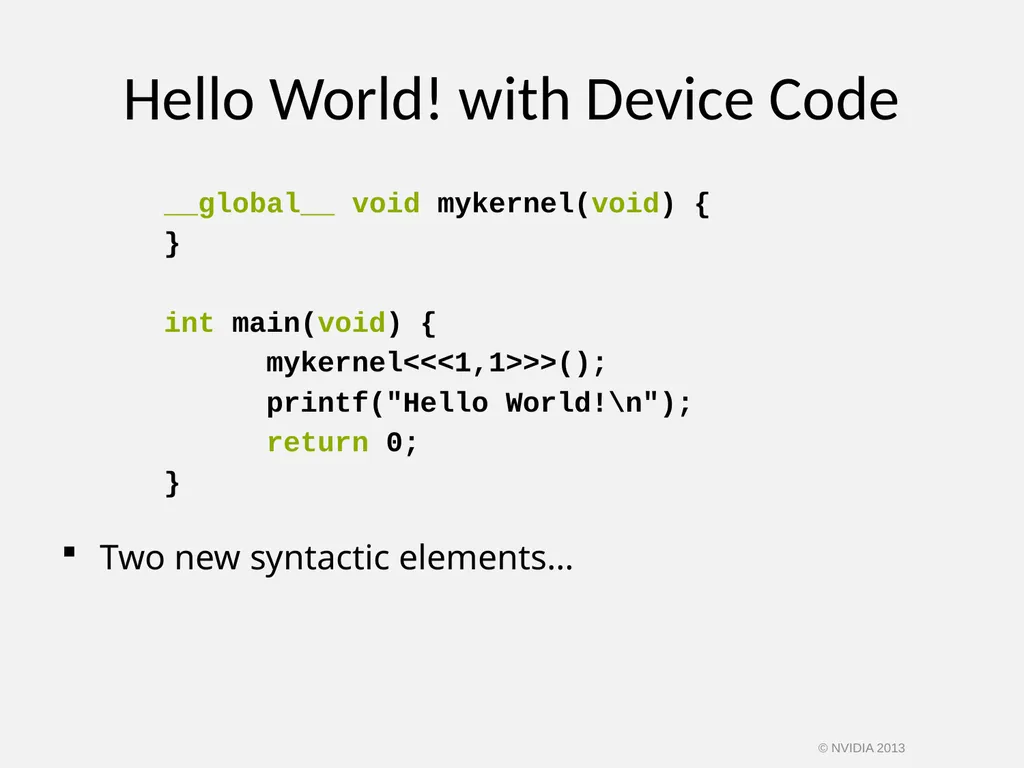
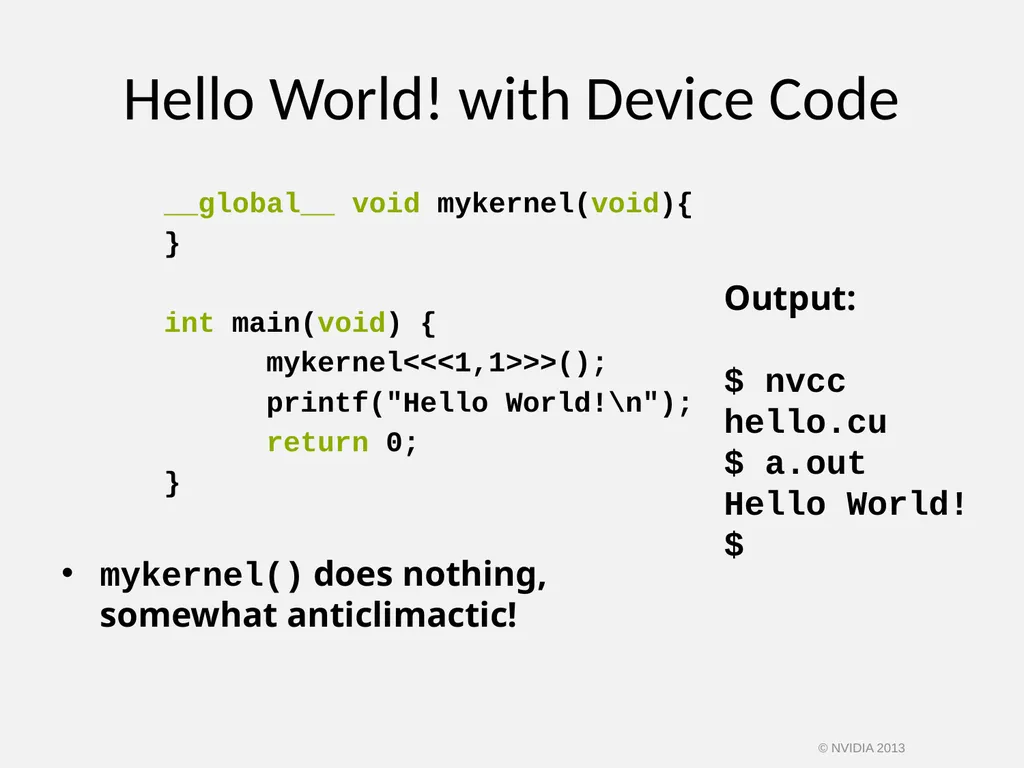
Hello World! with Device Code __global__ void mykernel(void) {
}
int main(void) {
mykernel<<<1,1>>>();
printf("Hello World!\n");
return 0;
}
Two new syntactic elements… © NVIDIA 2013<br>
}
int main(void) {
mykernel<<<1,1>>>();
printf("Hello World!\n");
return 0;
}
Two new syntactic elements… © NVIDIA 2013<br>
14
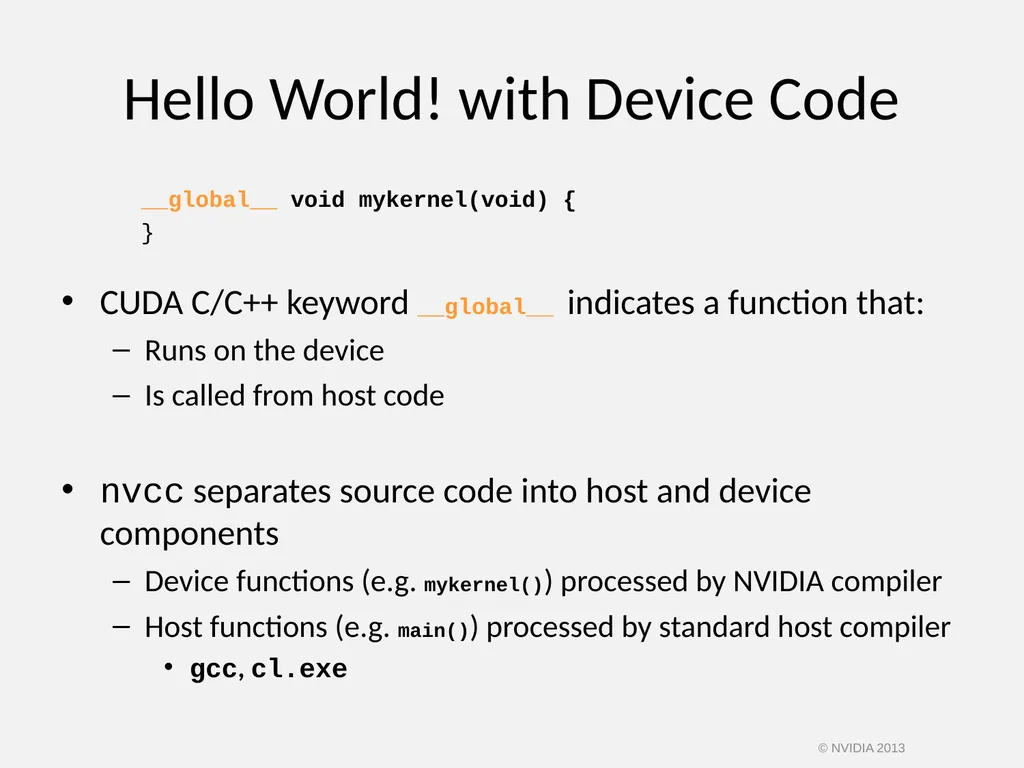
Hello World! with Device Code __global__ void mykernel(void) {
}
CUDA C/C++ keyword __global__ indicates a function that:
Runs on the device
Is called from host code
nvcc separates source code into host and device components
Device functions (e.g. mykernel()) processed by NVIDIA compiler
Host functions (e.g. main()) processed by standard host compiler
gcc, cl.exe © NVIDIA 2013<br>
}
CUDA C/C++ keyword __global__ indicates a function that:
Runs on the device
Is called from host code
nvcc separates source code into host and device components
Device functions (e.g. mykernel()) processed by NVIDIA compiler
Host functions (e.g. main()) processed by standard host compiler
gcc, cl.exe © NVIDIA 2013<br>
15
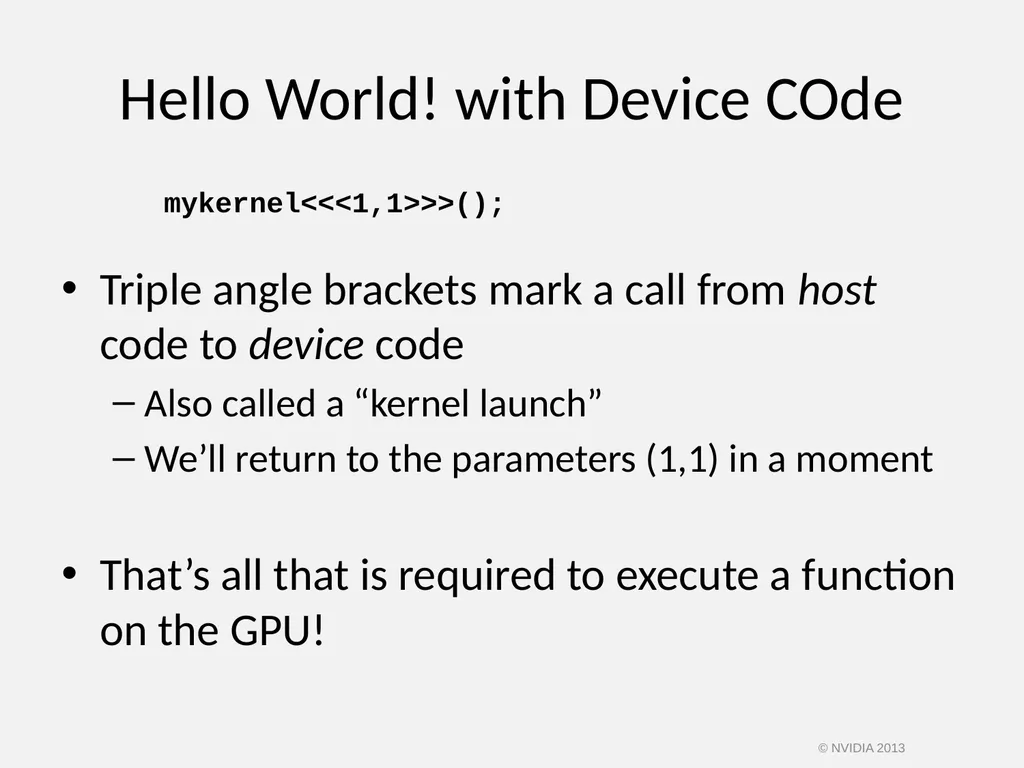
Hello World! with Device COde mykernel<<<1,1>>>();
Triple angle brackets mark a call from host code to device code
Also called a “kernel launch”
We’ll return to the parameters (1,1) in a moment
That’s all that is required to execute a function on the GPU! © NVIDIA 2013<br>
Triple angle brackets mark a call from host code to device code
Also called a “kernel launch”
We’ll return to the parameters (1,1) in a moment
That’s all that is required to execute a function on the GPU! © NVIDIA 2013<br>
16
Hello World! with Device Code __global__ void mykernel(void){
}
int main(void) {
mykernel<<<1,1>>>();
printf("Hello World!\n");
return 0;
}
mykernel() does nothing, somewhat anticlimactic! Output:
$ nvcc hello.cu
$ a.out
Hello World!
$ © NVIDIA 2013<br>
}
int main(void) {
mykernel<<<1,1>>>();
printf("Hello World!\n");
return 0;
}
mykernel() does nothing, somewhat anticlimactic! Output:
$ nvcc hello.cu
$ a.out
Hello World!
$ © NVIDIA 2013<br>
17
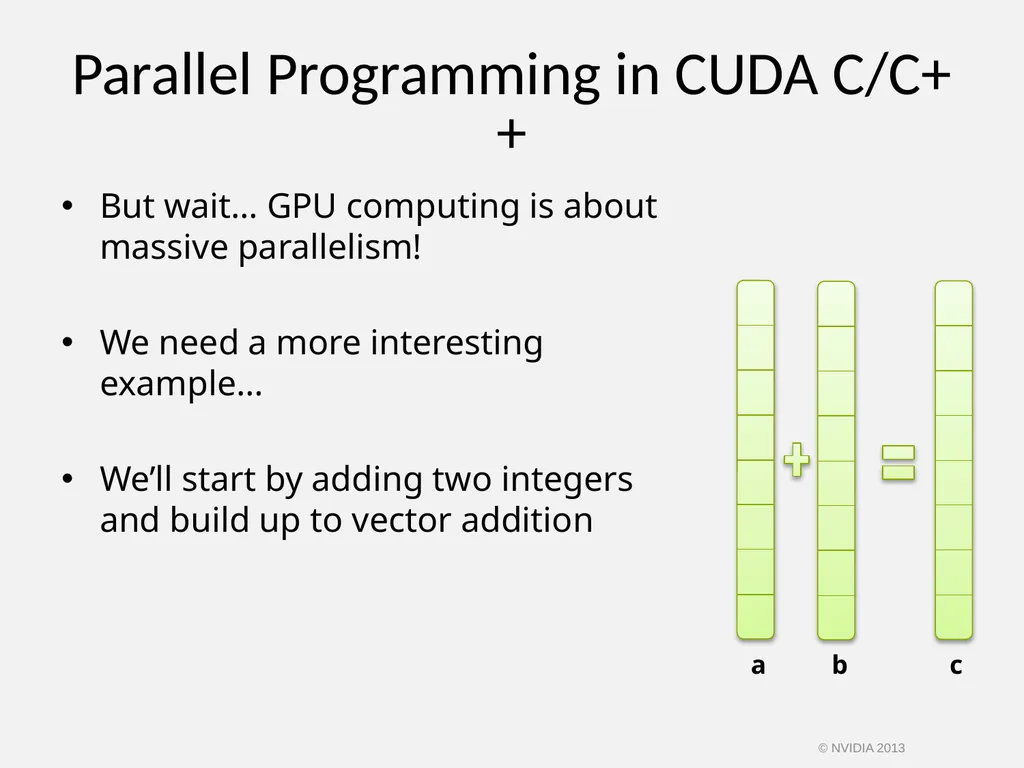
Parallel Programming in CUDA C/C++ But wait… GPU computing is about massive parallelism!
We need a more interesting example…
We’ll start by adding two integers and build up to vector addition a b c © NVIDIA 2013<br>
We need a more interesting example…
We’ll start by adding two integers and build up to vector addition a b c © NVIDIA 2013<br>
18
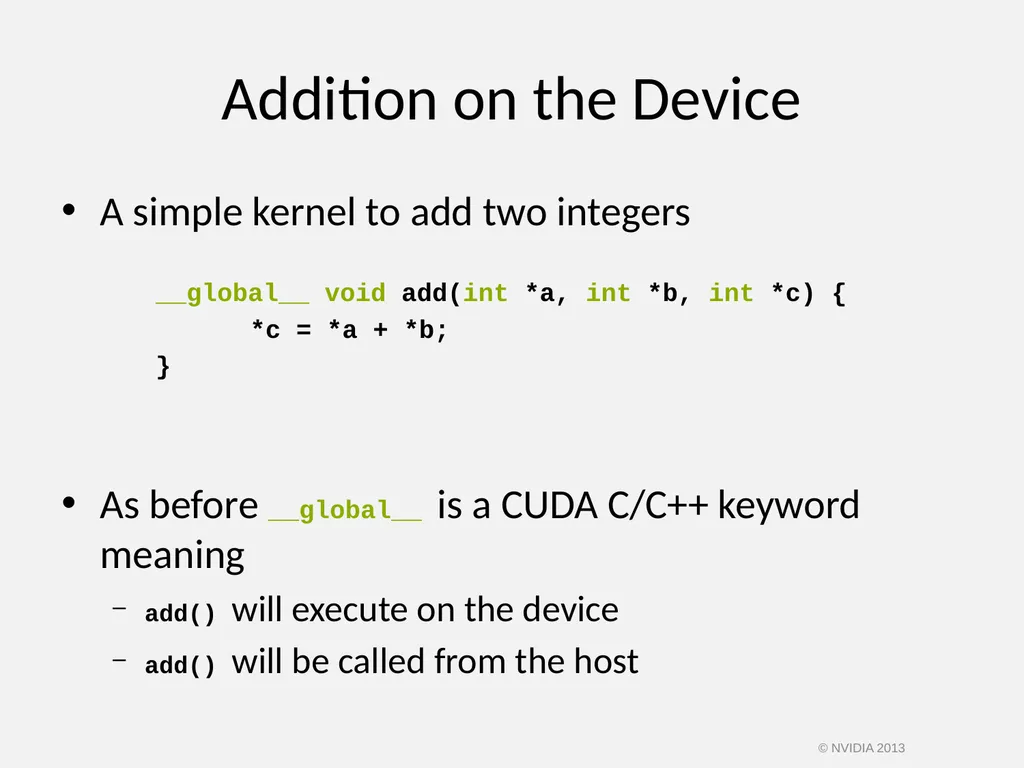
Addition on the Device A simple kernel to add two integers
__global__ void add(int *a, int *b, int *c) {
*c = *a + *b;
}
As before __global__ is a CUDA C/C++ keyword meaning
add() will execute on the device
add() will be called from the host © NVIDIA 2013<br>
__global__ void add(int *a, int *b, int *c) {
*c = *a + *b;
}
As before __global__ is a CUDA C/C++ keyword meaning
add() will execute on the device
add() will be called from the host © NVIDIA 2013<br>
19
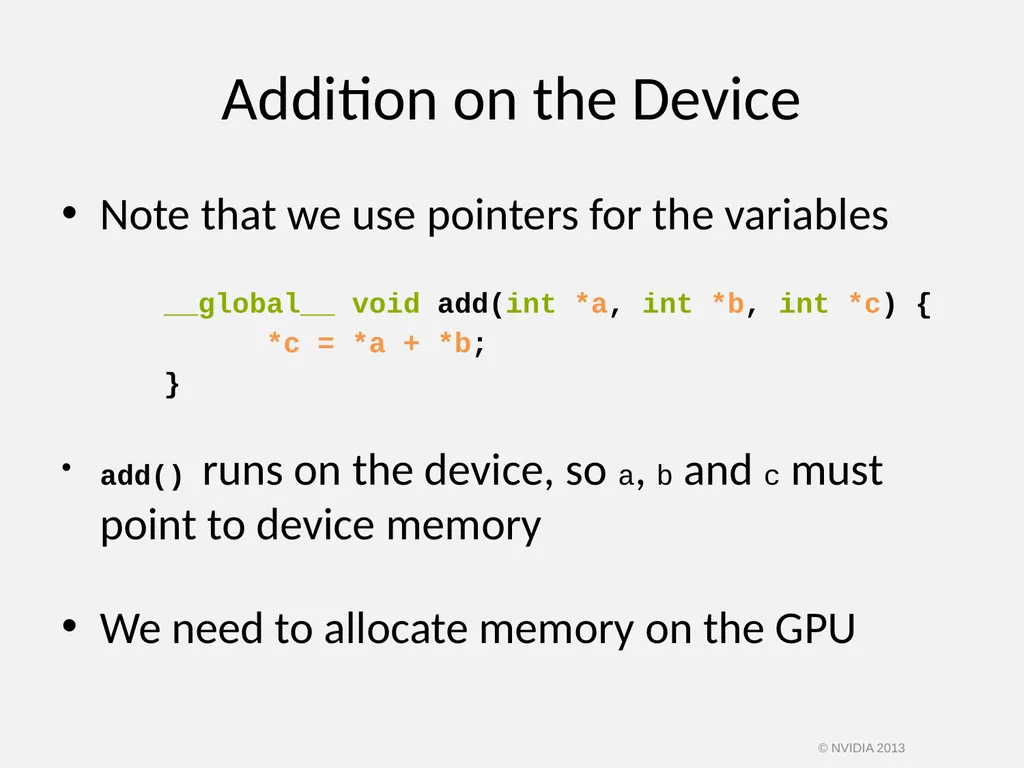
Addition on the Device Note that we use pointers for the variables
__global__ void add(int *a, int *b, int *c) {
*c = *a + *b;
}
add() runs on the device, so a, b and c must point to device memory
We need to allocate memory on the GPU © NVIDIA 2013<br>
__global__ void add(int *a, int *b, int *c) {
*c = *a + *b;
}
add() runs on the device, so a, b and c must point to device memory
We need to allocate memory on the GPU © NVIDIA 2013<br>
20
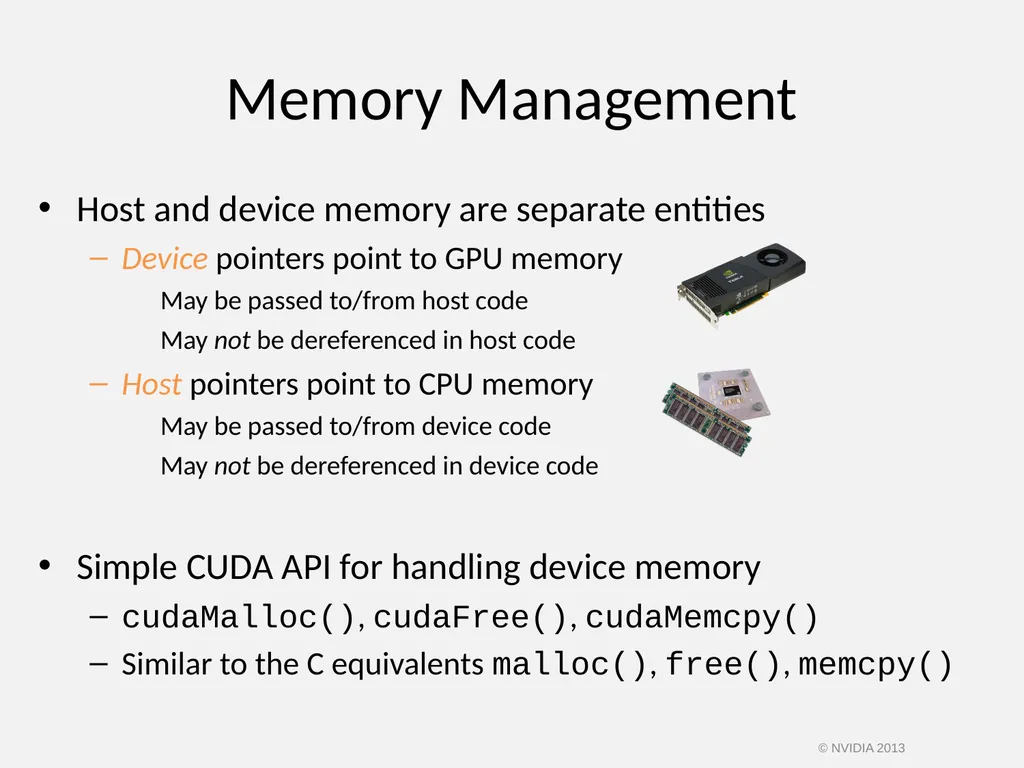
Memory Management Host and device memory are separate entities
Device pointers point to GPU memory
May be passed to/from host code
May not be dereferenced in host code
Host pointers point to CPU memory
May be passed to/from device code
May not be dereferenced in device code
Simple CUDA API for handling device memory
cudaMalloc(), cudaFree(), cudaMemcpy()
Similar to the C equivalents malloc(), free(), memcpy() © NVIDIA 2013<br>
Device pointers point to GPU memory
May be passed to/from host code
May not be dereferenced in host code
Host pointers point to CPU memory
May be passed to/from device code
May not be dereferenced in device code
Simple CUDA API for handling device memory
cudaMalloc(), cudaFree(), cudaMemcpy()
Similar to the C equivalents malloc(), free(), memcpy() © NVIDIA 2013<br>
21
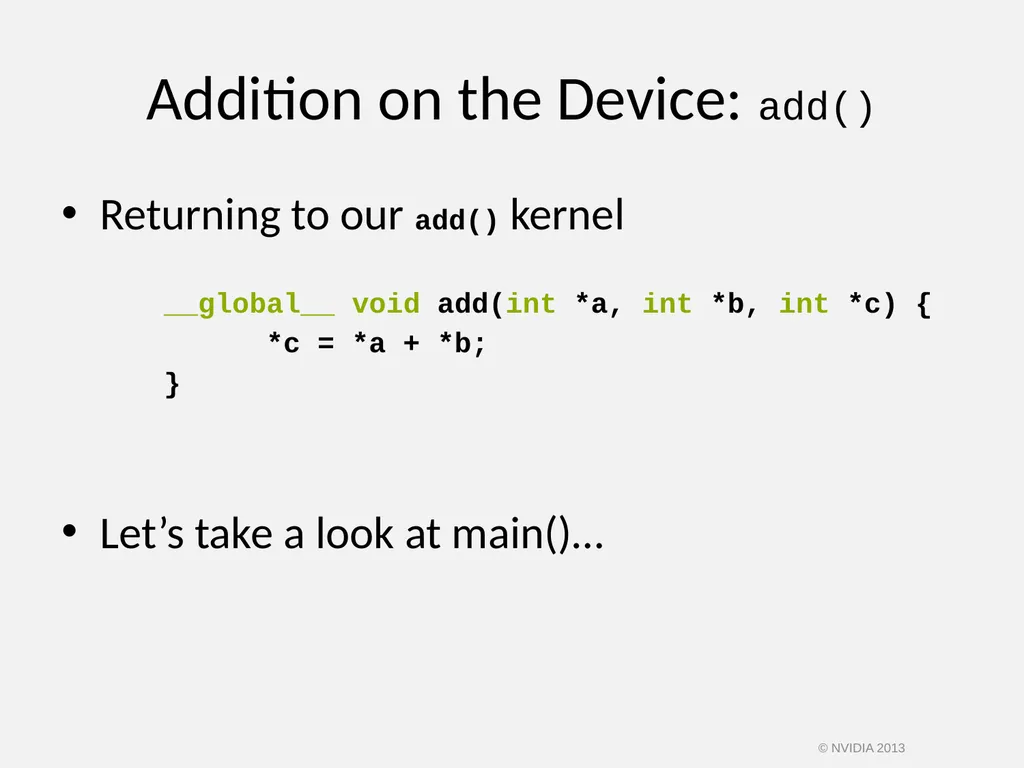
Addition on the Device: add() Returning to our add() kernel
__global__ void add(int *a, int *b, int *c) {
*c = *a + *b;
}
Let’s take a look at main()… © NVIDIA 2013<br>
__global__ void add(int *a, int *b, int *c) {
*c = *a + *b;
}
Let’s take a look at main()… © NVIDIA 2013<br>
22
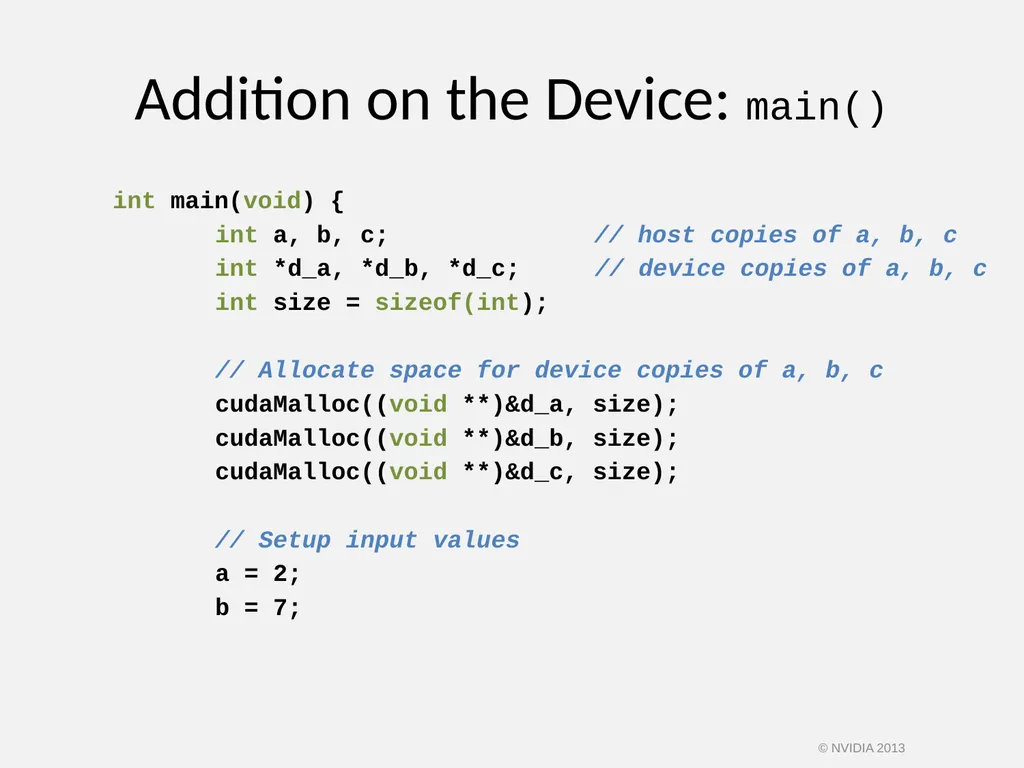
Addition on the Device: main() int main(void) {
int a, b, c; // host copies of a, b, c
int *d_a, *d_b, *d_c; // device copies of a, b, c
int size = sizeof(int);
// Allocate space for device copies of a, b, c
cudaMalloc((void **)&d_a, size);
cudaMalloc((void **)&d_b, size);
cudaMalloc((void **)&d_c, size);
// Setup input values
a = 2;
b = 7; © NVIDIA 2013<br>
int a, b, c; // host copies of a, b, c
int *d_a, *d_b, *d_c; // device copies of a, b, c
int size = sizeof(int);
// Allocate space for device copies of a, b, c
cudaMalloc((void **)&d_a, size);
cudaMalloc((void **)&d_b, size);
cudaMalloc((void **)&d_c, size);
// Setup input values
a = 2;
b = 7; © NVIDIA 2013<br>
23
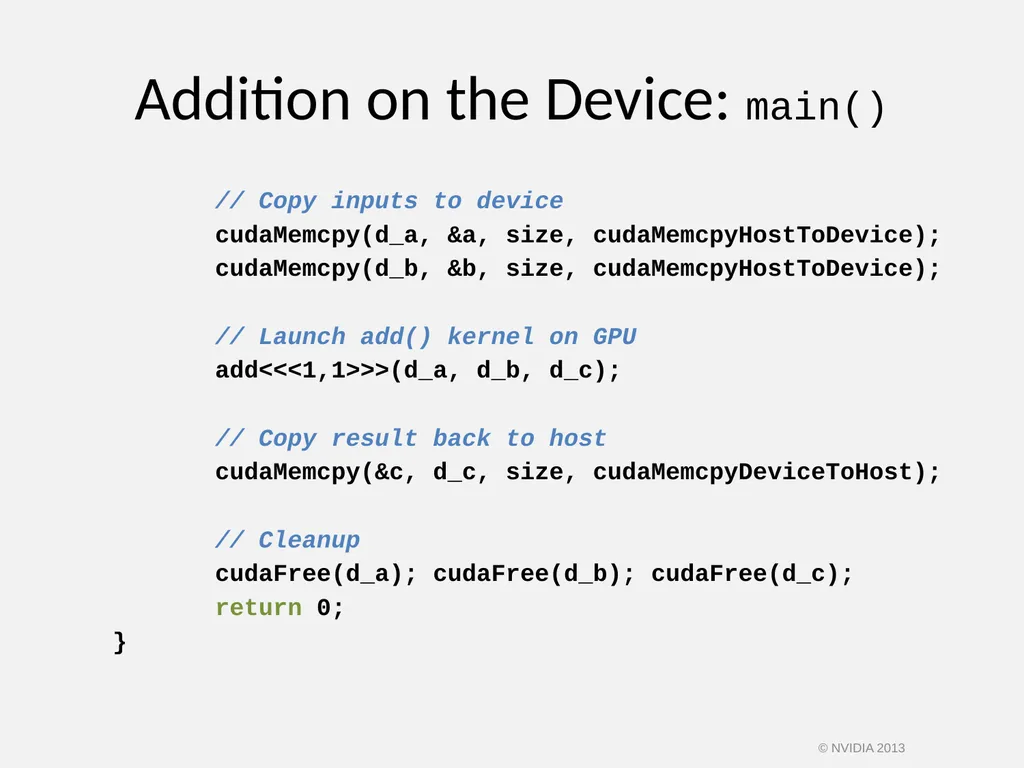
Addition on the Device: main() // Copy inputs to device
cudaMemcpy(d_a, &a, size, cudaMemcpyHostToDevice);
cudaMemcpy(d_b, &b, size, cudaMemcpyHostToDevice);
// Launch add() kernel on GPU
add<<<1,1>>>(d_a, d_b, d_c);
// Copy result back to host
cudaMemcpy(&c, d_c, size, cudaMemcpyDeviceToHost);
// Cleanup
cudaFree(d_a); cudaFree(d_b); cudaFree(d_c);
return 0;
} © NVIDIA 2013<br>
cudaMemcpy(d_a, &a, size, cudaMemcpyHostToDevice);
cudaMemcpy(d_b, &b, size, cudaMemcpyHostToDevice);
// Launch add() kernel on GPU
add<<<1,1>>>(d_a, d_b, d_c);
// Copy result back to host
cudaMemcpy(&c, d_c, size, cudaMemcpyDeviceToHost);
// Cleanup
cudaFree(d_a); cudaFree(d_b); cudaFree(d_c);
return 0;
} © NVIDIA 2013<br>
24
Running in Parallel Heterogeneous Computing Blocks Threads Indexing Shared memory __syncthreads() Asynchronous operation Handling errors Managing devices CONCEPTS © NVIDIA 2013<br>
25
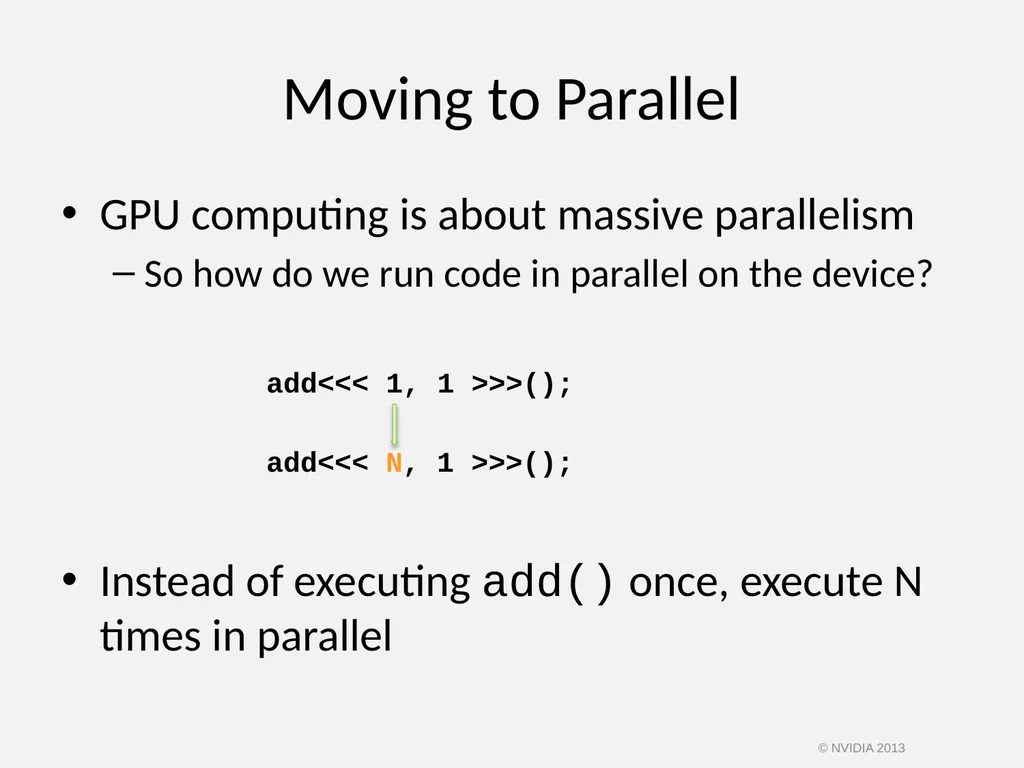
Moving to Parallel GPU computing is about massive parallelism
So how do we run code in parallel on the device?
add<<< 1, 1 >>>();
add<<< N, 1 >>>();
Instead of executing add() once, execute N times in parallel © NVIDIA 2013<br>
So how do we run code in parallel on the device?
add<<< 1, 1 >>>();
add<<< N, 1 >>>();
Instead of executing add() once, execute N times in parallel © NVIDIA 2013<br>
26
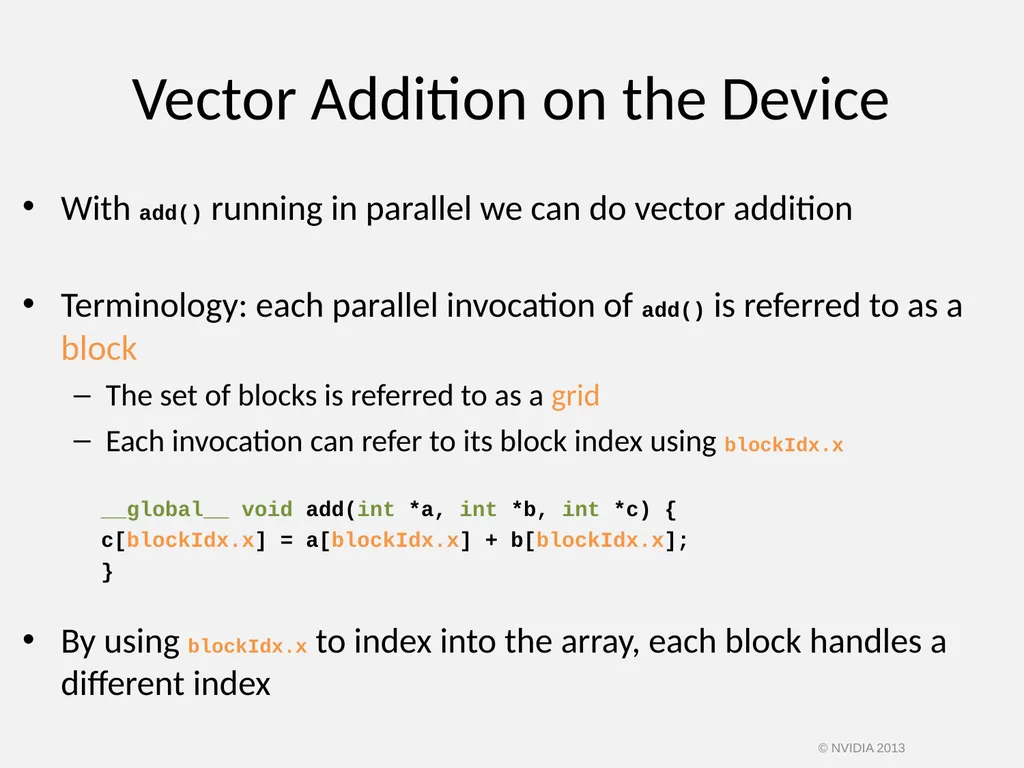
Vector Addition on the Device With add() running in parallel we can do vector addition
Terminology: each parallel invocation of add() is referred to as a block
The set of blocks is referred to as a grid
Each invocation can refer to its block index using blockIdx.x
__global__ void add(int *a, int *b, int *c) {
c[blockIdx.x] = a[blockIdx.x] + b[blockIdx.x];
}
By using blockIdx.x to index into the array, each block handles a different index © NVIDIA 2013<br>
Terminology: each parallel invocation of add() is referred to as a block
The set of blocks is referred to as a grid
Each invocation can refer to its block index using blockIdx.x
__global__ void add(int *a, int *b, int *c) {
c[blockIdx.x] = a[blockIdx.x] + b[blockIdx.x];
}
By using blockIdx.x to index into the array, each block handles a different index © NVIDIA 2013<br>
27
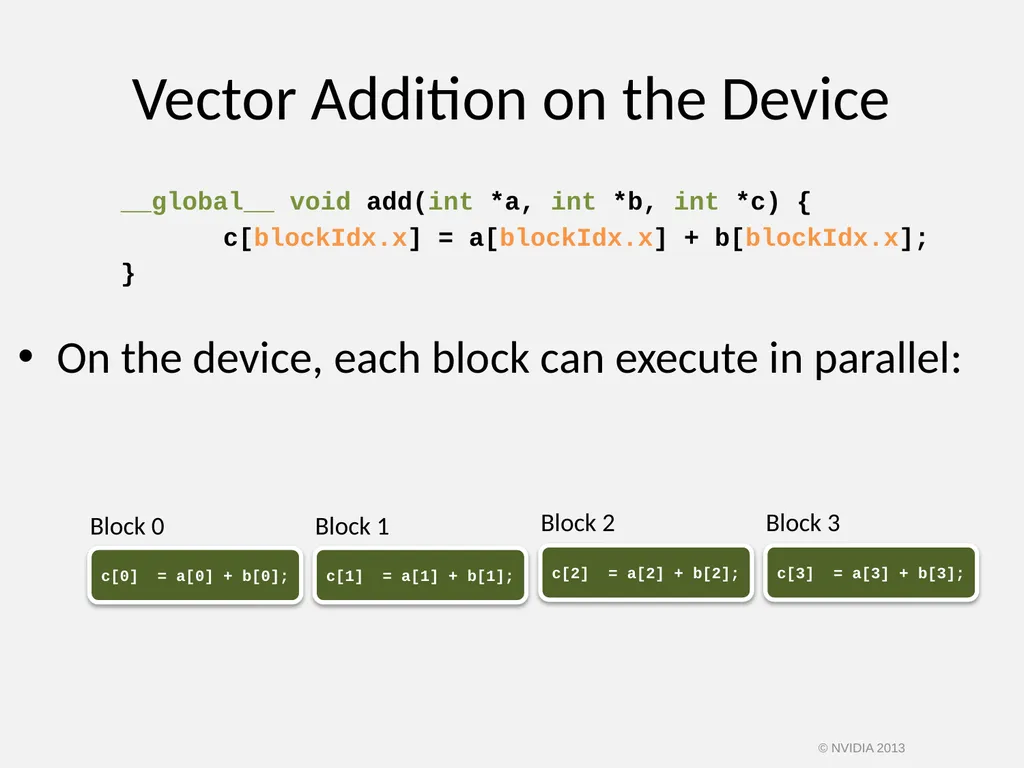
Vector Addition on the Device __global__ void add(int *a, int *b, int *c) {
c[blockIdx.x] = a[blockIdx.x] + b[blockIdx.x];
}
On the device, each block can execute in parallel: c[0] = a[0] + b[0]; c[1] = a[1] + b[1]; c[2] = a[2] + b[2]; c[3] = a[3] + b[3]; Block 0 Block 1 Block 2 Block 3 © NVIDIA 2013<br>
c[blockIdx.x] = a[blockIdx.x] + b[blockIdx.x];
}
On the device, each block can execute in parallel: c[0] = a[0] + b[0]; c[1] = a[1] + b[1]; c[2] = a[2] + b[2]; c[3] = a[3] + b[3]; Block 0 Block 1 Block 2 Block 3 © NVIDIA 2013<br>
28
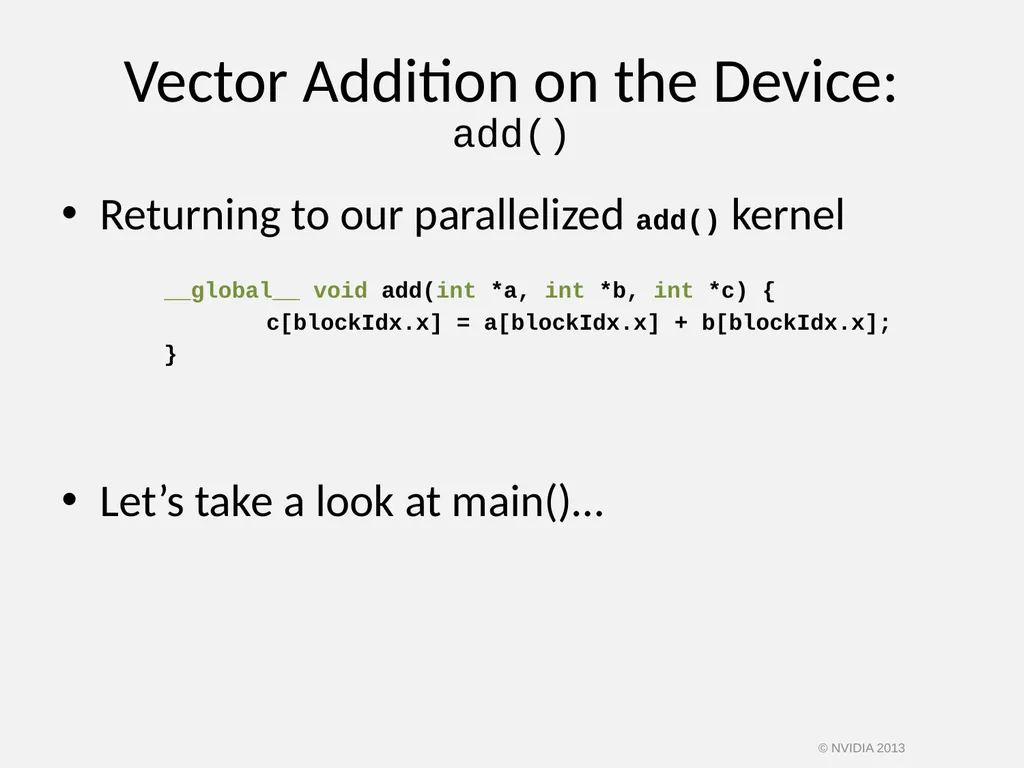
Vector Addition on the Device: add() Returning to our parallelized add() kernel
__global__ void add(int *a, int *b, int *c) {
c[blockIdx.x] = a[blockIdx.x] + b[blockIdx.x];
}
Let’s take a look at main()… © NVIDIA 2013<br>
__global__ void add(int *a, int *b, int *c) {
c[blockIdx.x] = a[blockIdx.x] + b[blockIdx.x];
}
Let’s take a look at main()… © NVIDIA 2013<br>
29
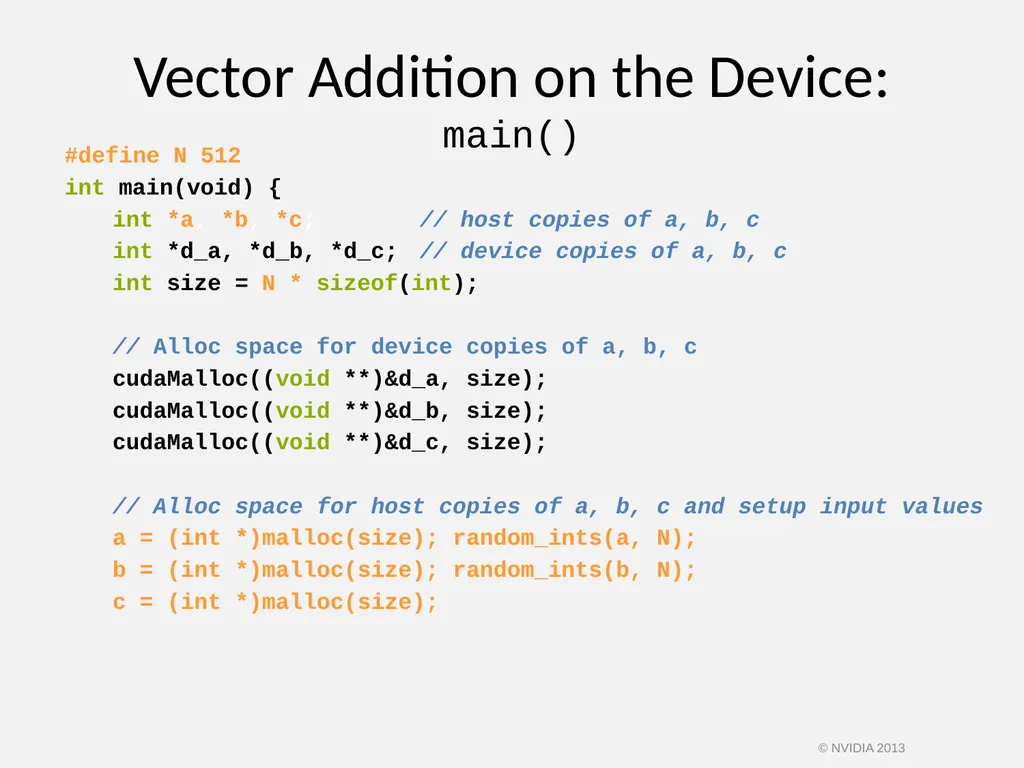
Vector Addition on the Device: main() #define N 512
int main(void) {
int *a, *b, *c; // host copies of a, b, c
int *d_a, *d_b, *d_c; // device copies of a, b, c
int size = N * sizeof(int);
// Alloc space for device copies of a, b, c
cudaMalloc((void **)&d_a, size);
cudaMalloc((void **)&d_b, size);
cudaMalloc((void **)&d_c, size);
// Alloc space for host copies of a, b, c and setup input values
a = (int *)malloc(size); random_ints(a, N);
b = (int *)malloc(size); random_ints(b, N);
c = (int *)malloc(size); © NVIDIA 2013<br>
int main(void) {
int *a, *b, *c; // host copies of a, b, c
int *d_a, *d_b, *d_c; // device copies of a, b, c
int size = N * sizeof(int);
// Alloc space for device copies of a, b, c
cudaMalloc((void **)&d_a, size);
cudaMalloc((void **)&d_b, size);
cudaMalloc((void **)&d_c, size);
// Alloc space for host copies of a, b, c and setup input values
a = (int *)malloc(size); random_ints(a, N);
b = (int *)malloc(size); random_ints(b, N);
c = (int *)malloc(size); © NVIDIA 2013<br>
30
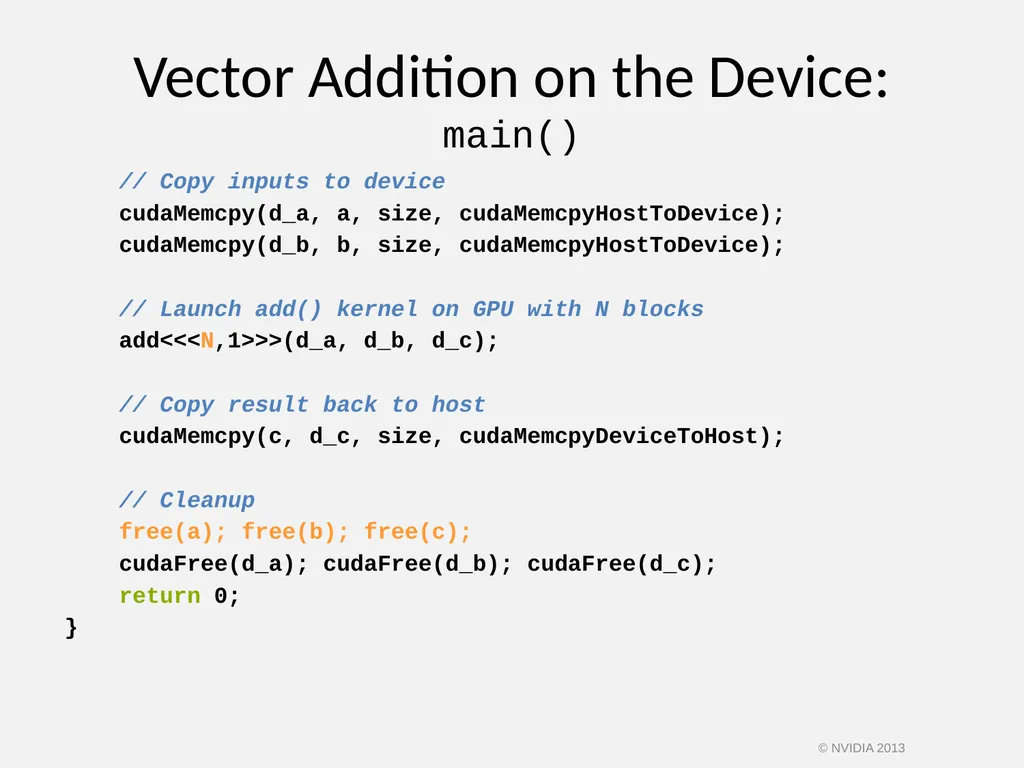
Vector Addition on the Device: main() // Copy inputs to device
cudaMemcpy(d_a, a, size, cudaMemcpyHostToDevice);
cudaMemcpy(d_b, b, size, cudaMemcpyHostToDevice);
// Launch add() kernel on GPU with N blocks
add<<<N,1>>>(d_a, d_b, d_c);
// Copy result back to host
cudaMemcpy(c, d_c, size, cudaMemcpyDeviceToHost);
// Cleanup
free(a); free(b); free(c);
cudaFree(d_a); cudaFree(d_b); cudaFree(d_c);
return 0;
} © NVIDIA 2013<br>
cudaMemcpy(d_a, a, size, cudaMemcpyHostToDevice);
cudaMemcpy(d_b, b, size, cudaMemcpyHostToDevice);
// Launch add() kernel on GPU with N blocks
add<<<N,1>>>(d_a, d_b, d_c);
// Copy result back to host
cudaMemcpy(c, d_c, size, cudaMemcpyDeviceToHost);
// Cleanup
free(a); free(b); free(c);
cudaFree(d_a); cudaFree(d_b); cudaFree(d_c);
return 0;
} © NVIDIA 2013<br>
31
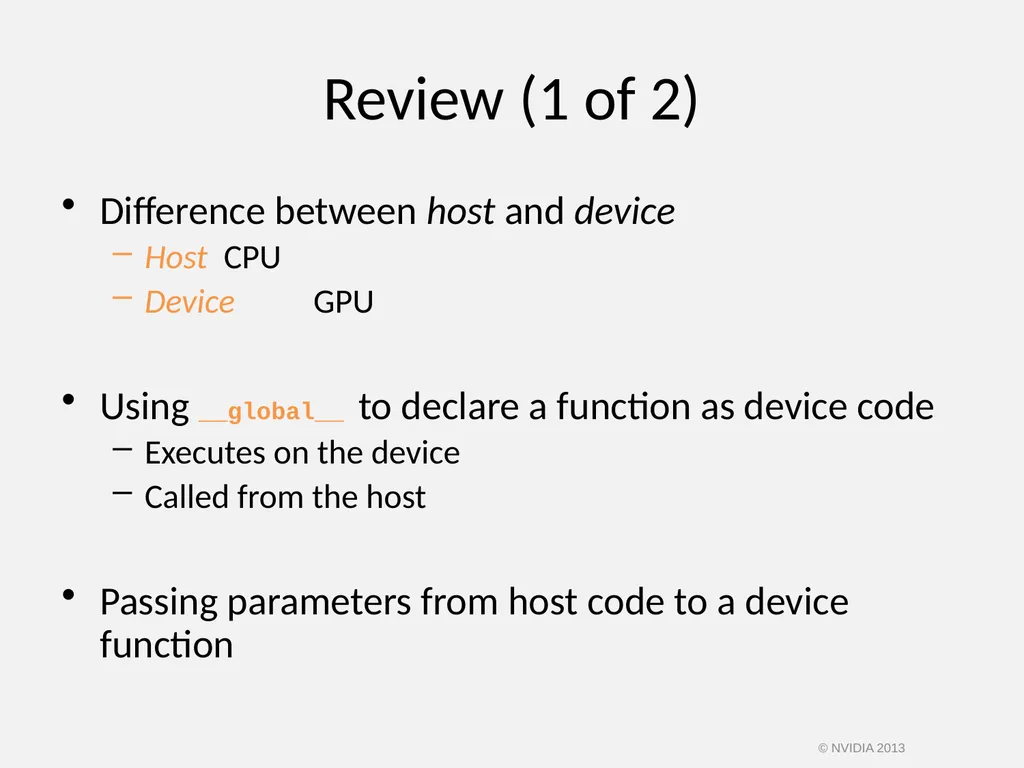
Review (1 of 2) Difference between host and device
Host CPU
Device GPU
Using __global__ to declare a function as device code
Executes on the device
Called from the host
Passing parameters from host code to a device function © NVIDIA 2013<br>
Host CPU
Device GPU
Using __global__ to declare a function as device code
Executes on the device
Called from the host
Passing parameters from host code to a device function © NVIDIA 2013<br>
32
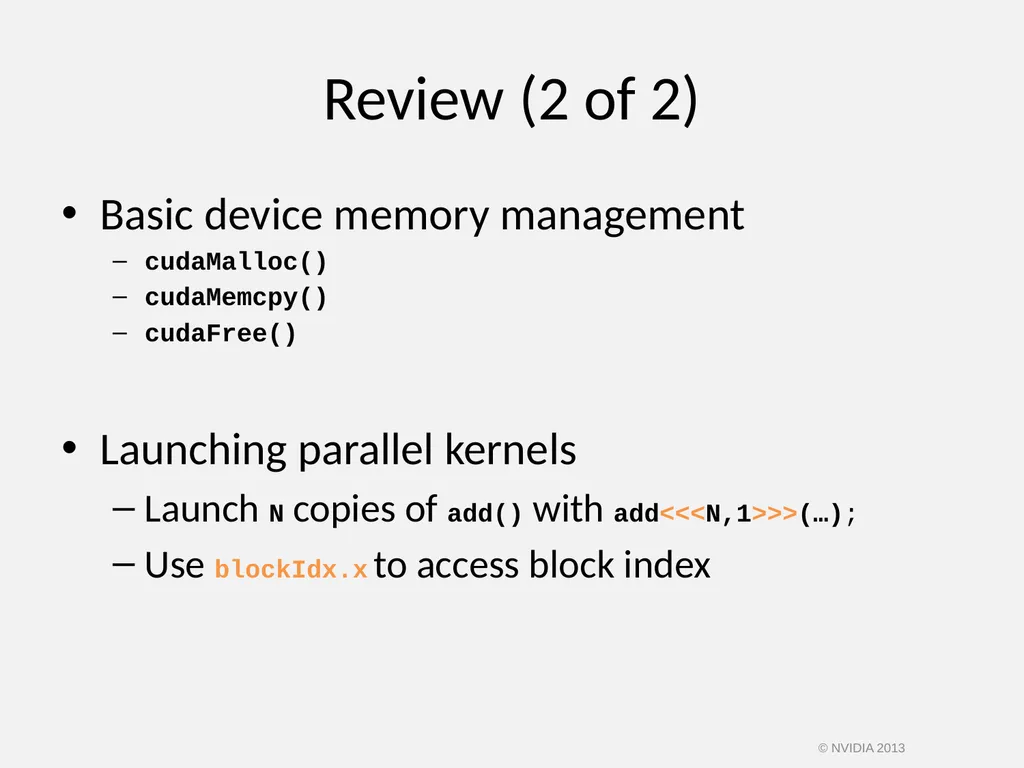
Review (2 of 2) Basic device memory management
cudaMalloc()
cudaMemcpy()
cudaFree()
Launching parallel kernels
Launch N copies of add() with add<<<N,1>>>(…);
Use blockIdx.x to access block index © NVIDIA 2013<br>
cudaMalloc()
cudaMemcpy()
cudaFree()
Launching parallel kernels
Launch N copies of add() with add<<<N,1>>>(…);
Use blockIdx.x to access block index © NVIDIA 2013<br>
33
Introducing Threads Heterogeneous Computing Blocks Threads Indexing Shared memory __syncthreads() Asynchronous operation Handling errors Managing devices CONCEPTS © NVIDIA 2013<br>
34
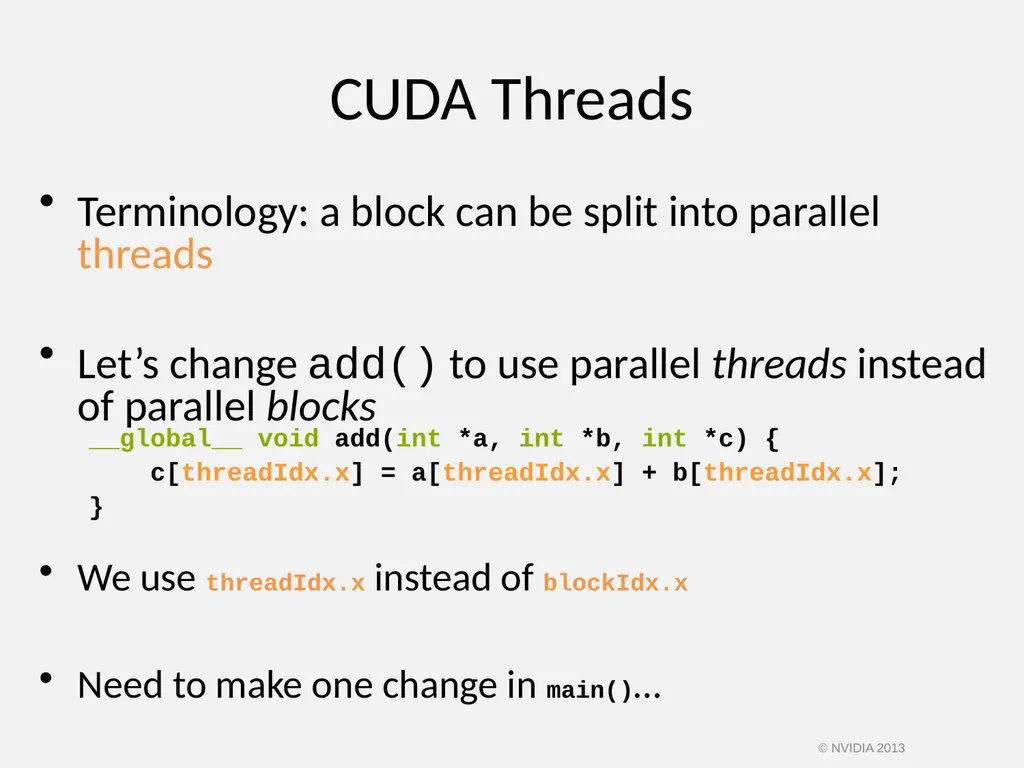
CUDA Threads Terminology: a block can be split into parallel threads
Let’s change add() to use parallel threads instead of parallel blocks We use threadIdx.x instead of blockIdx.x
Need to make one change in main()… __global__ void add(int *a, int *b, int *c) {
c[threadIdx.x] = a[threadIdx.x] + b[threadIdx.x];
} © NVIDIA 2013<br>
Let’s change add() to use parallel threads instead of parallel blocks We use threadIdx.x instead of blockIdx.x
Need to make one change in main()… __global__ void add(int *a, int *b, int *c) {
c[threadIdx.x] = a[threadIdx.x] + b[threadIdx.x];
} © NVIDIA 2013<br>
35
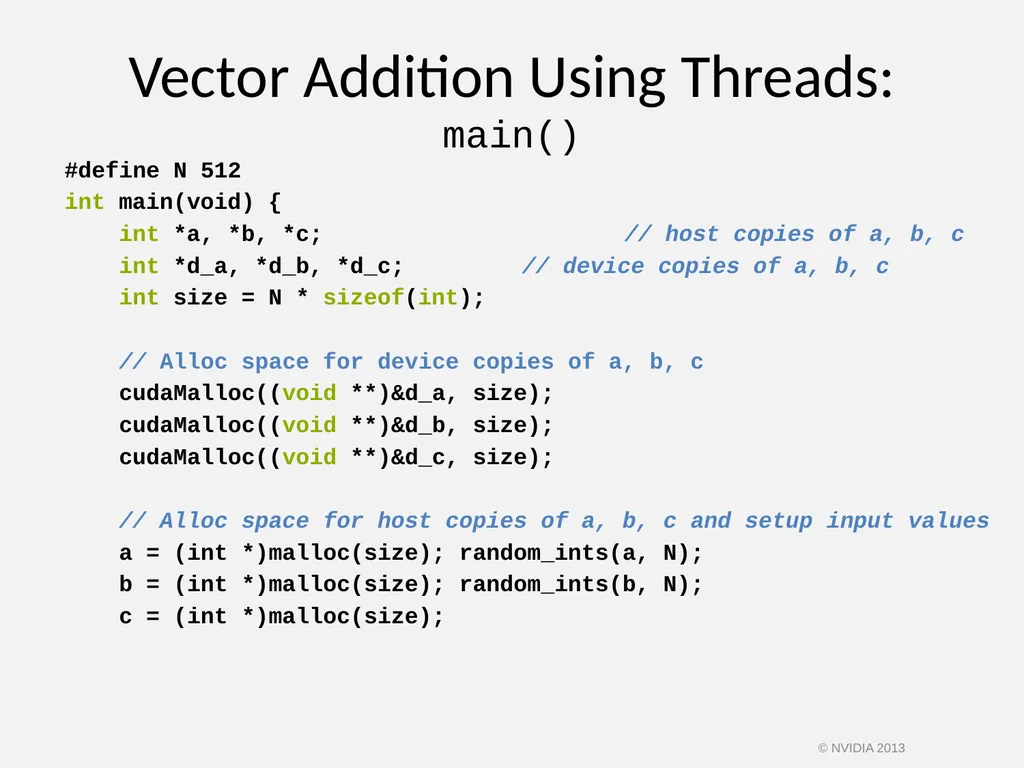
Vector Addition Using Threads: main() #define N 512
int main(void) {
int *a, *b, *c; // host copies of a, b, c
int *d_a, *d_b, *d_c; // device copies of a, b, c
int size = N * sizeof(int);
// Alloc space for device copies of a, b, c
cudaMalloc((void **)&d_a, size);
cudaMalloc((void **)&d_b, size);
cudaMalloc((void **)&d_c, size);
// Alloc space for host copies of a, b, c and setup input values
a = (int *)malloc(size); random_ints(a, N);
b = (int *)malloc(size); random_ints(b, N);
c = (int *)malloc(size); © NVIDIA 2013<br>
int main(void) {
int *a, *b, *c; // host copies of a, b, c
int *d_a, *d_b, *d_c; // device copies of a, b, c
int size = N * sizeof(int);
// Alloc space for device copies of a, b, c
cudaMalloc((void **)&d_a, size);
cudaMalloc((void **)&d_b, size);
cudaMalloc((void **)&d_c, size);
// Alloc space for host copies of a, b, c and setup input values
a = (int *)malloc(size); random_ints(a, N);
b = (int *)malloc(size); random_ints(b, N);
c = (int *)malloc(size); © NVIDIA 2013<br>
36
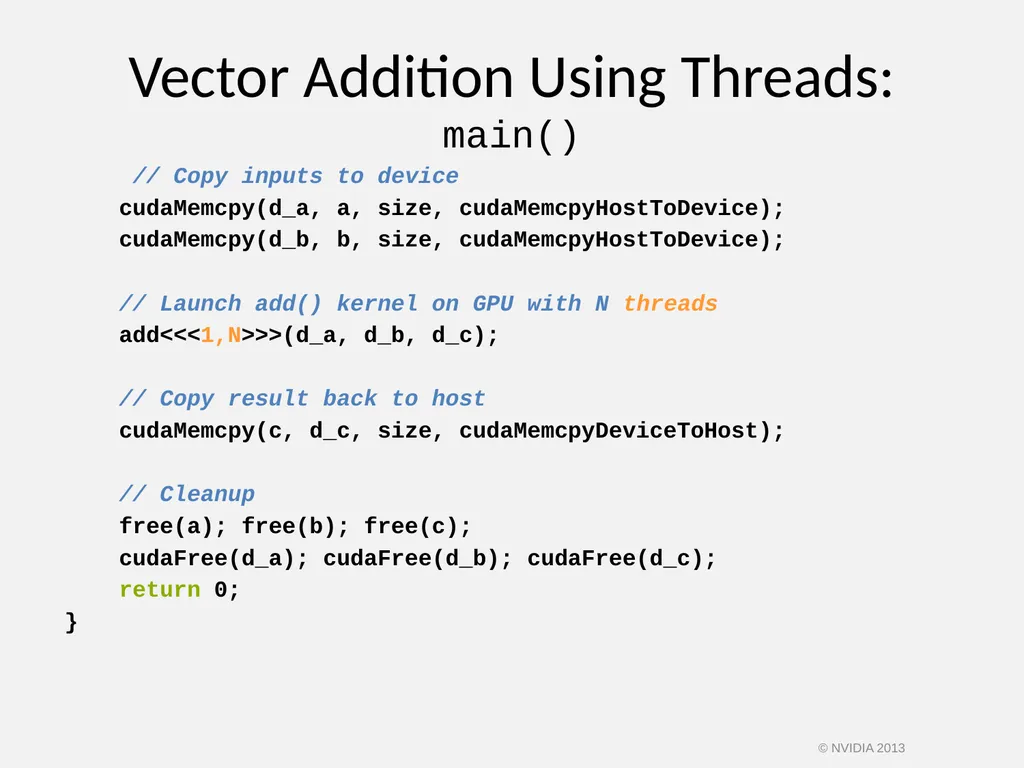
Vector Addition Using Threads: main() // Copy inputs to device
cudaMemcpy(d_a, a, size, cudaMemcpyHostToDevice);
cudaMemcpy(d_b, b, size, cudaMemcpyHostToDevice);
// Launch add() kernel on GPU with N threads
add<<<1,N>>>(d_a, d_b, d_c);
// Copy result back to host
cudaMemcpy(c, d_c, size, cudaMemcpyDeviceToHost);
// Cleanup
free(a); free(b); free(c);
cudaFree(d_a); cudaFree(d_b); cudaFree(d_c);
return 0;
} © NVIDIA 2013<br>
cudaMemcpy(d_a, a, size, cudaMemcpyHostToDevice);
cudaMemcpy(d_b, b, size, cudaMemcpyHostToDevice);
// Launch add() kernel on GPU with N threads
add<<<1,N>>>(d_a, d_b, d_c);
// Copy result back to host
cudaMemcpy(c, d_c, size, cudaMemcpyDeviceToHost);
// Cleanup
free(a); free(b); free(c);
cudaFree(d_a); cudaFree(d_b); cudaFree(d_c);
return 0;
} © NVIDIA 2013<br>
37
Combining Threads
And Blocks Heterogeneous Computing Blocks Threads Indexing Shared memory __syncthreads() Asynchronous operation Handling errors Managing devices CONCEPTS © NVIDIA 2013<br>
38
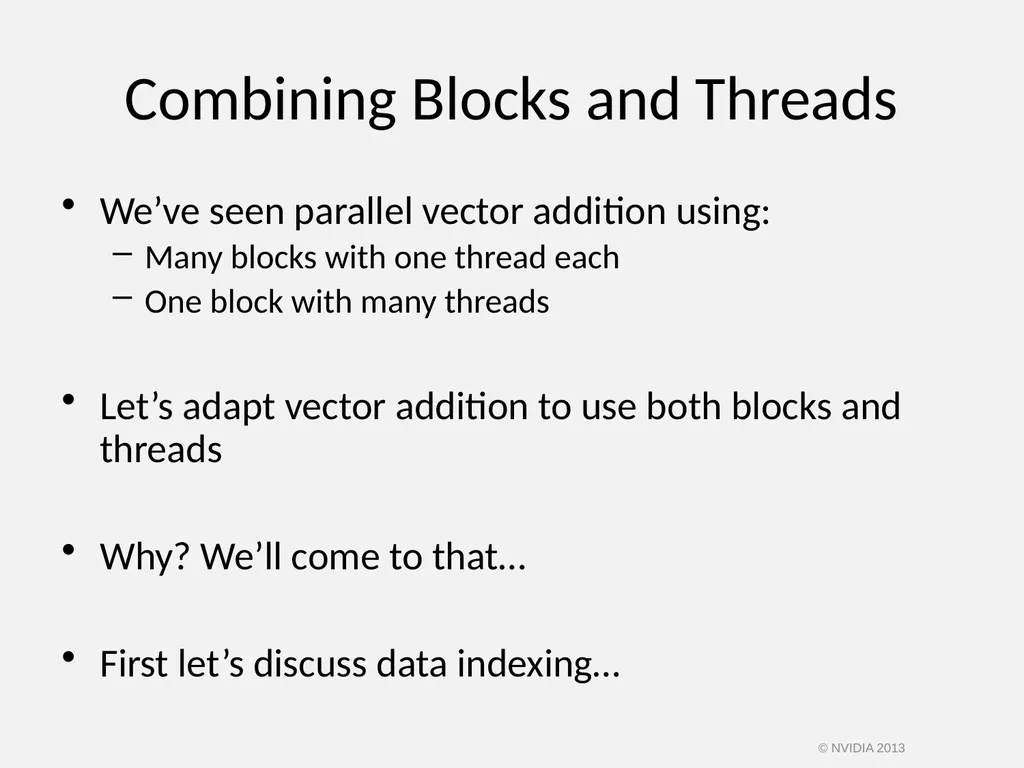
Combining Blocks and Threads We’ve seen parallel vector addition using:
Many blocks with one thread each
One block with many threads
Let’s adapt vector addition to use both blocks and threads
Why? We’ll come to that…
First let’s discuss data indexing… © NVIDIA 2013<br>
Many blocks with one thread each
One block with many threads
Let’s adapt vector addition to use both blocks and threads
Why? We’ll come to that…
First let’s discuss data indexing… © NVIDIA 2013<br>
39
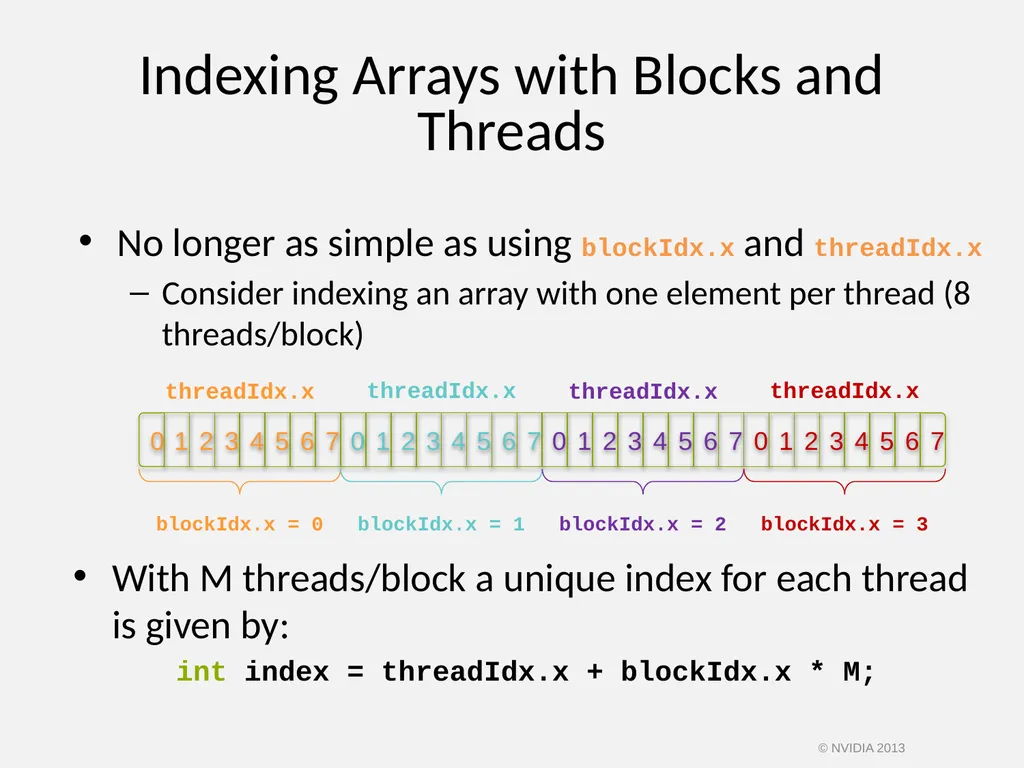
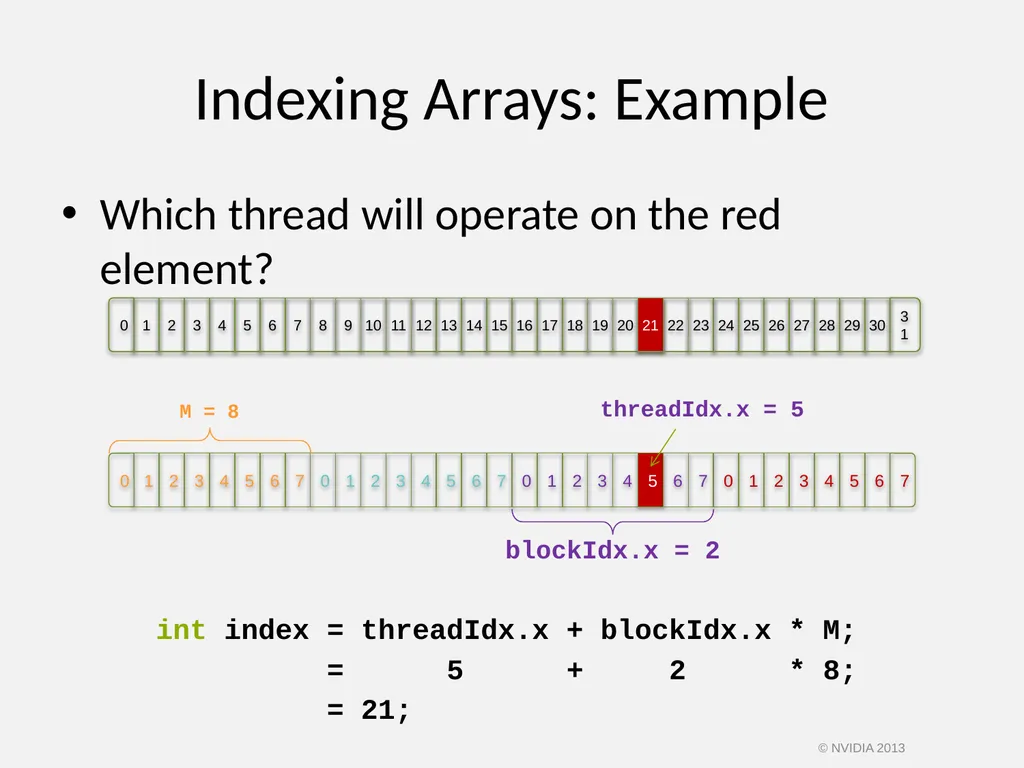
Indexing Arrays with Blocks and Threads With M threads/block a unique index for each thread is given by:
int index = threadIdx.x + blockIdx.x * M; No longer as simple as using blockIdx.x and threadIdx.x
Consider indexing an array with one element per thread (8 threads/block) © NVIDIA 2013<br>
int index = threadIdx.x + blockIdx.x * M; No longer as simple as using blockIdx.x and threadIdx.x
Consider indexing an array with one element per thread (8 threads/block) © NVIDIA 2013<br>
40
Indexing Arrays: Example Which thread will operate on the red element? int index = threadIdx.x + blockIdx.x * M;
= 5 + 2 * 8;
= 21; threadIdx.x = 5 blockIdx.x = 2 M = 8 © NVIDIA 2013<br>
= 5 + 2 * 8;
= 21; threadIdx.x = 5 blockIdx.x = 2 M = 8 © NVIDIA 2013<br>
41
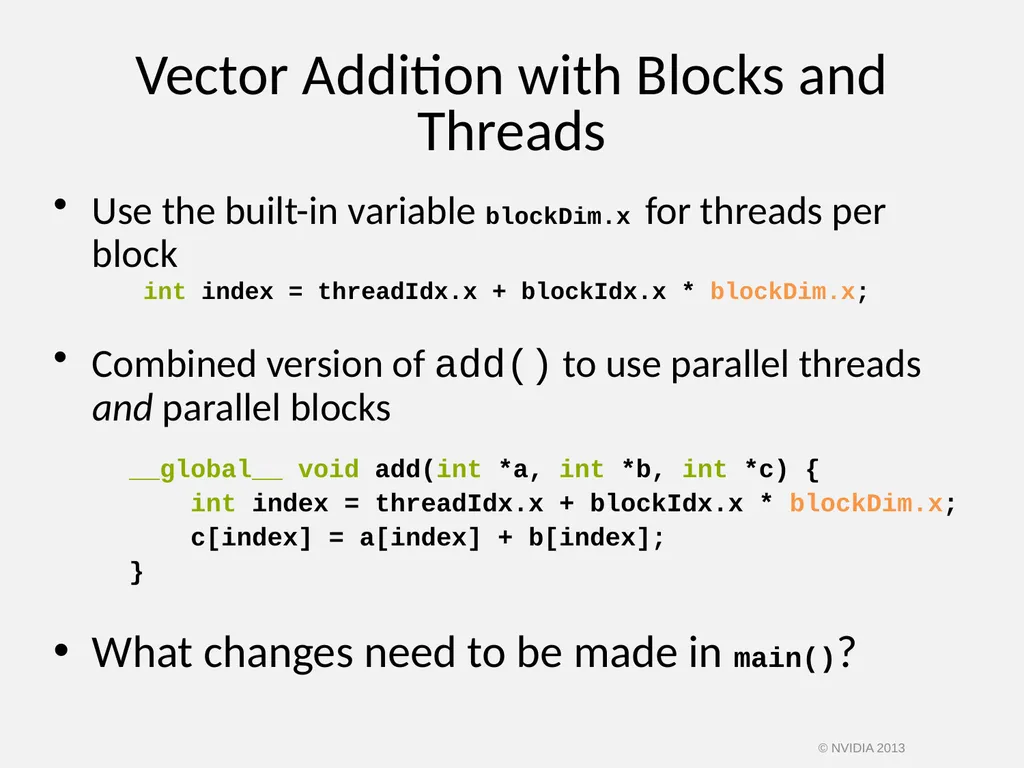
Vector Addition with Blocks and Threads What changes need to be made in main()? Use the built-in variable blockDim.x for threads per block
int index = threadIdx.x + blockIdx.x * blockDim.x;
Combined version of add() to use parallel threads and parallel blocks __global__ void add(int *a, int *b, int *c) {
int index = threadIdx.x + blockIdx.x * blockDim.x;
c[index] = a[index] + b[index];
} © NVIDIA 2013<br>
int index = threadIdx.x + blockIdx.x * blockDim.x;
Combined version of add() to use parallel threads and parallel blocks __global__ void add(int *a, int *b, int *c) {
int index = threadIdx.x + blockIdx.x * blockDim.x;
c[index] = a[index] + b[index];
} © NVIDIA 2013<br>
42
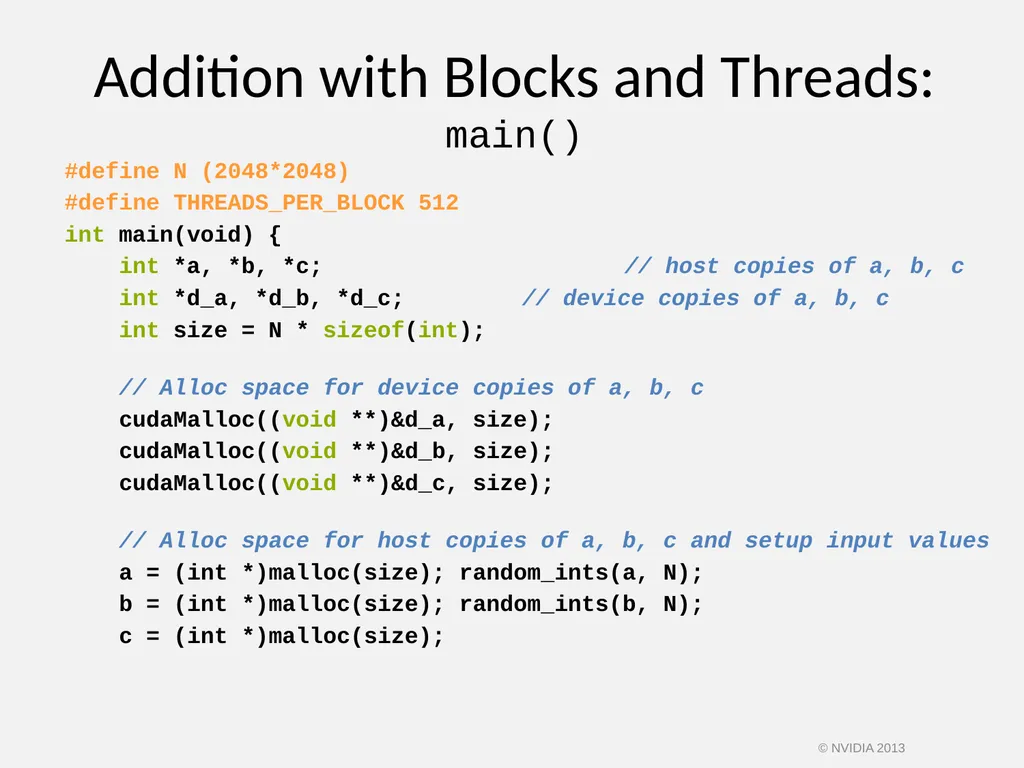
Addition with Blocks and Threads: main() #define N (2048*2048)
#define THREADS_PER_BLOCK 512
int main(void) {
int *a, *b, *c; // host copies of a, b, c
int *d_a, *d_b, *d_c; // device copies of a, b, c
int size = N * sizeof(int);
// Alloc space for device copies of a, b, c
cudaMalloc((void **)&d_a, size);
cudaMalloc((void **)&d_b, size);
cudaMalloc((void **)&d_c, size);
// Alloc space for host copies of a, b, c and setup input values
a = (int *)malloc(size); random_ints(a, N);
b = (int *)malloc(size); random_ints(b, N);
c = (int *)malloc(size); © NVIDIA 2013<br>
#define THREADS_PER_BLOCK 512
int main(void) {
int *a, *b, *c; // host copies of a, b, c
int *d_a, *d_b, *d_c; // device copies of a, b, c
int size = N * sizeof(int);
// Alloc space for device copies of a, b, c
cudaMalloc((void **)&d_a, size);
cudaMalloc((void **)&d_b, size);
cudaMalloc((void **)&d_c, size);
// Alloc space for host copies of a, b, c and setup input values
a = (int *)malloc(size); random_ints(a, N);
b = (int *)malloc(size); random_ints(b, N);
c = (int *)malloc(size); © NVIDIA 2013<br>
43
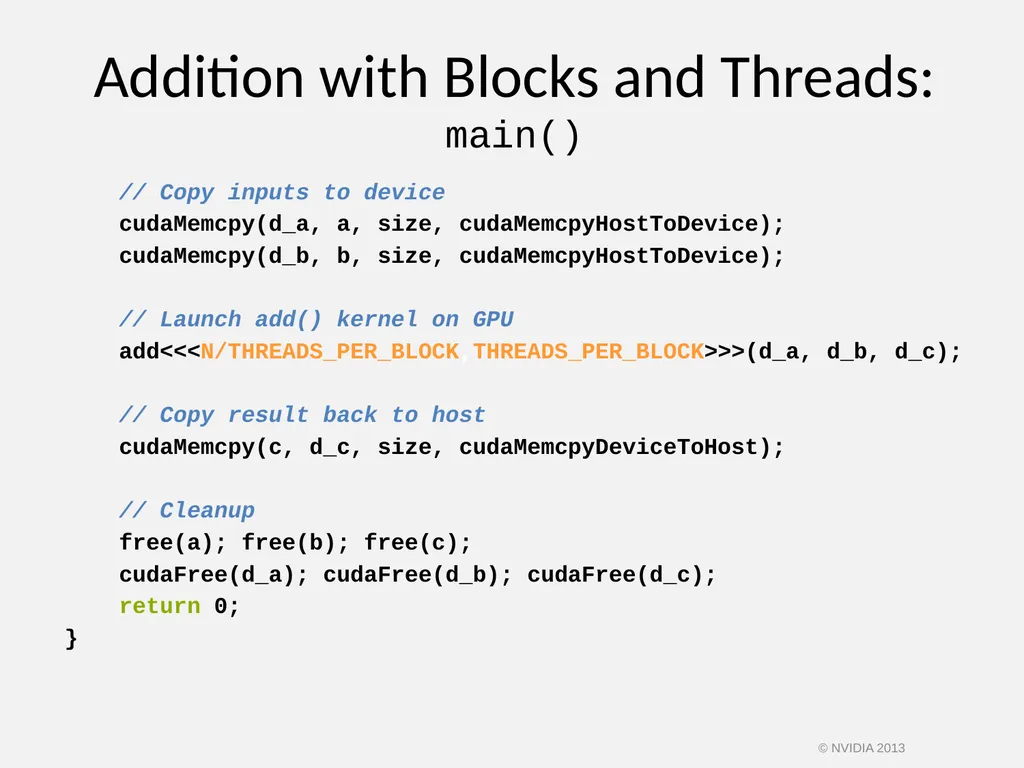
Addition with Blocks and Threads: main() // Copy inputs to device
cudaMemcpy(d_a, a, size, cudaMemcpyHostToDevice);
cudaMemcpy(d_b, b, size, cudaMemcpyHostToDevice);
// Launch add() kernel on GPU
add<<<N/THREADS_PER_BLOCK,THREADS_PER_BLOCK>>>(d_a, d_b, d_c);
// Copy result back to host
cudaMemcpy(c, d_c, size, cudaMemcpyDeviceToHost);
// Cleanup
free(a); free(b); free(c);
cudaFree(d_a); cudaFree(d_b); cudaFree(d_c);
return 0;
} © NVIDIA 2013<br>
cudaMemcpy(d_a, a, size, cudaMemcpyHostToDevice);
cudaMemcpy(d_b, b, size, cudaMemcpyHostToDevice);
// Launch add() kernel on GPU
add<<<N/THREADS_PER_BLOCK,THREADS_PER_BLOCK>>>(d_a, d_b, d_c);
// Copy result back to host
cudaMemcpy(c, d_c, size, cudaMemcpyDeviceToHost);
// Cleanup
free(a); free(b); free(c);
cudaFree(d_a); cudaFree(d_b); cudaFree(d_c);
return 0;
} © NVIDIA 2013<br>
44
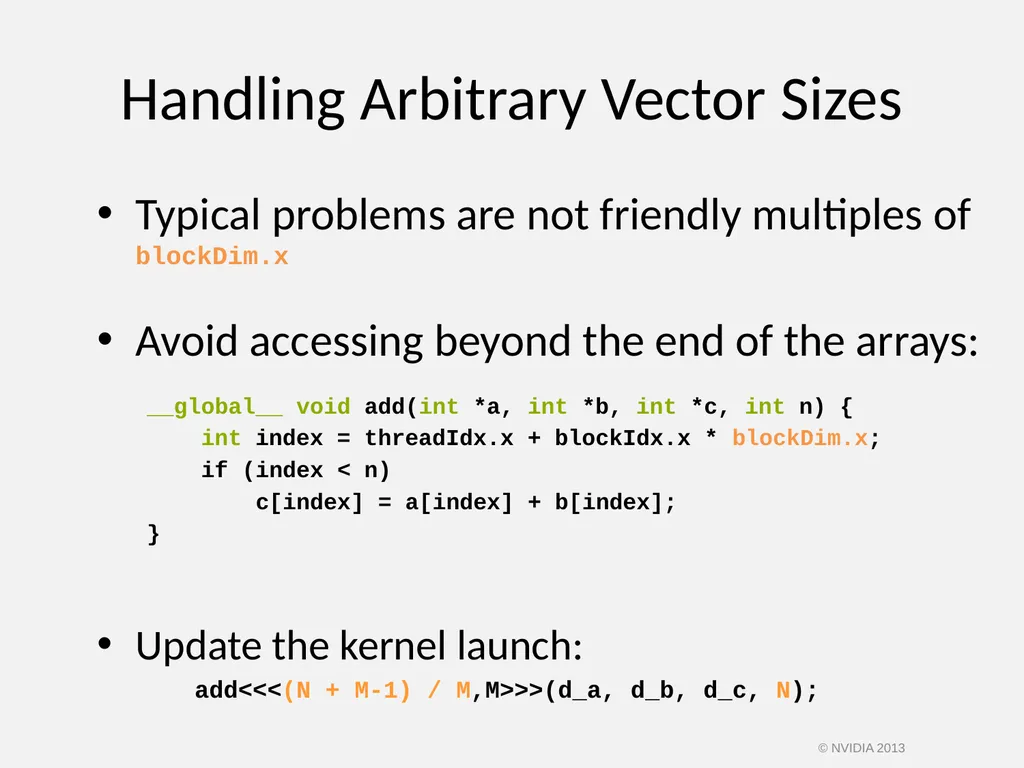
Handling Arbitrary Vector Sizes Update the kernel launch:
add<<<(N + M-1) / M,M>>>(d_a, d_b, d_c, N); Typical problems are not friendly multiples of blockDim.x
Avoid accessing beyond the end of the arrays: __global__ void add(int *a, int *b, int *c, int n) {
int index = threadIdx.x + blockIdx.x * blockDim.x;
if (index < n)
c[index] = a[index] + b[index];
} © NVIDIA 2013<br>
add<<<(N + M-1) / M,M>>>(d_a, d_b, d_c, N); Typical problems are not friendly multiples of blockDim.x
Avoid accessing beyond the end of the arrays: __global__ void add(int *a, int *b, int *c, int n) {
int index = threadIdx.x + blockIdx.x * blockDim.x;
if (index < n)
c[index] = a[index] + b[index];
} © NVIDIA 2013<br>
45
Why Bother with Threads? Threads seem unnecessary
They add a level of complexity
What do we gain?
Unlike parallel blocks, threads have mechanisms to:
Communicate
Synchronize
To look closer, we need a new example… © NVIDIA 2013<br>
They add a level of complexity
What do we gain?
Unlike parallel blocks, threads have mechanisms to:
Communicate
Synchronize
To look closer, we need a new example… © NVIDIA 2013<br>
46
Review Launching parallel kernels
Launch N copies of add() with add<<<N/M,M>>>(…);
Use blockIdx.x to access block index
Use threadIdx.x to access thread index within block
Allocate elements to threads:
int index = threadIdx.x + blockIdx.x * blockDim.x; © NVIDIA 2013<br>
Launch N copies of add() with add<<<N/M,M>>>(…);
Use blockIdx.x to access block index
Use threadIdx.x to access thread index within block
Allocate elements to threads:
int index = threadIdx.x + blockIdx.x * blockDim.x; © NVIDIA 2013<br>
47
Cooperating Threads Heterogeneous Computing Blocks Threads Indexing Shared memory __syncthreads() Asynchronous operation Handling errors Managing devices CONCEPTS © NVIDIA 2013<br>
48
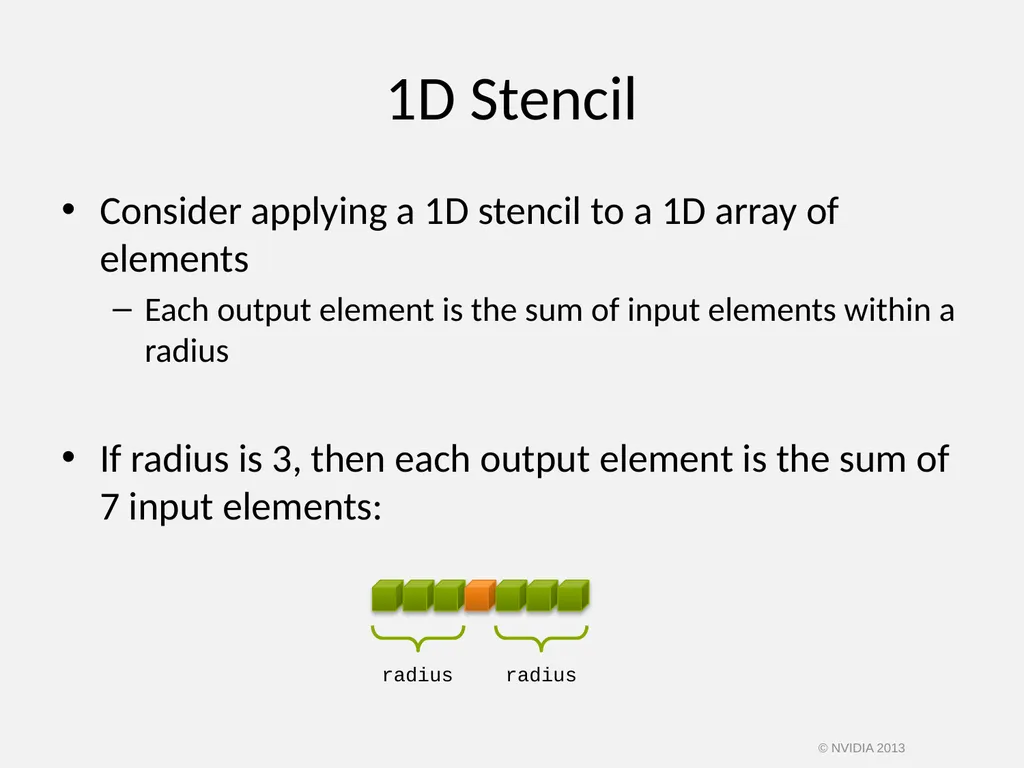
1D Stencil Consider applying a 1D stencil to a 1D array of elements
Each output element is the sum of input elements within a radius
If radius is 3, then each output element is the sum of 7 input elements: © NVIDIA 2013 radius radius<br>
Each output element is the sum of input elements within a radius
If radius is 3, then each output element is the sum of 7 input elements: © NVIDIA 2013 radius radius<br>
49
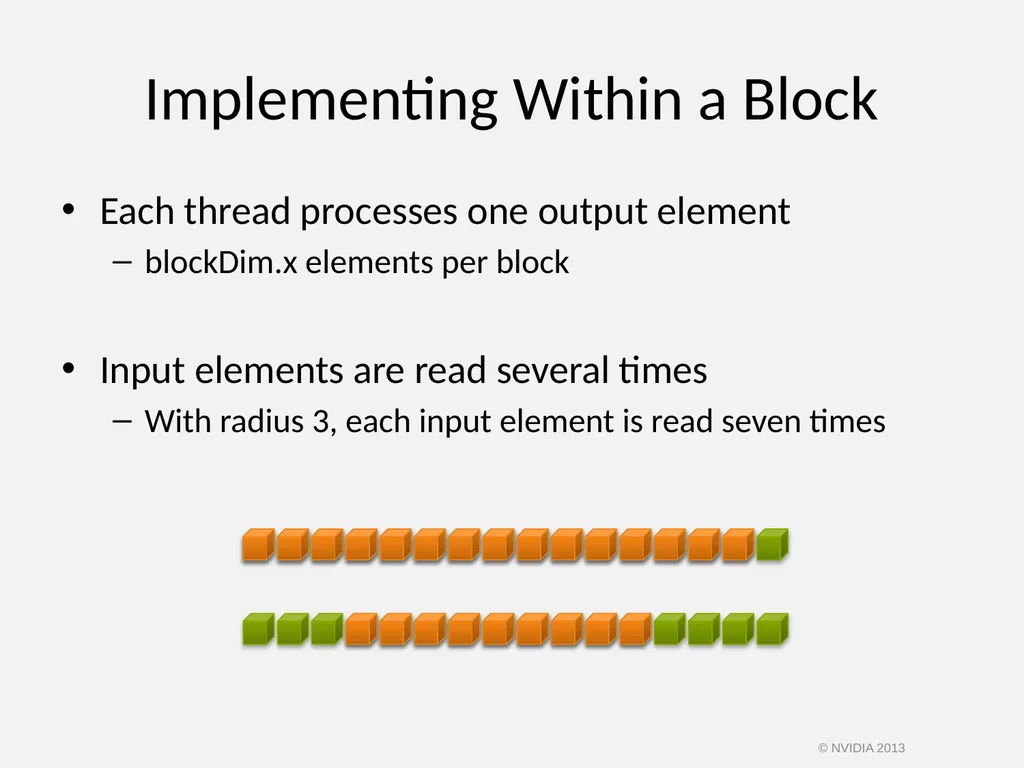
Implementing Within a Block Each thread processes one output element
blockDim.x elements per block
Input elements are read several times
With radius 3, each input element is read seven times © NVIDIA 2013<br>
blockDim.x elements per block
Input elements are read several times
With radius 3, each input element is read seven times © NVIDIA 2013<br>
50
Sharing Data Between Threads Terminology: within a block, threads share data via shared memory
Extremely fast on-chip memory, user-managed
Declare using __shared__, allocated per block
Data is not visible to threads in other blocks © NVIDIA 2013<br>
Extremely fast on-chip memory, user-managed
Declare using __shared__, allocated per block
Data is not visible to threads in other blocks © NVIDIA 2013<br>
51
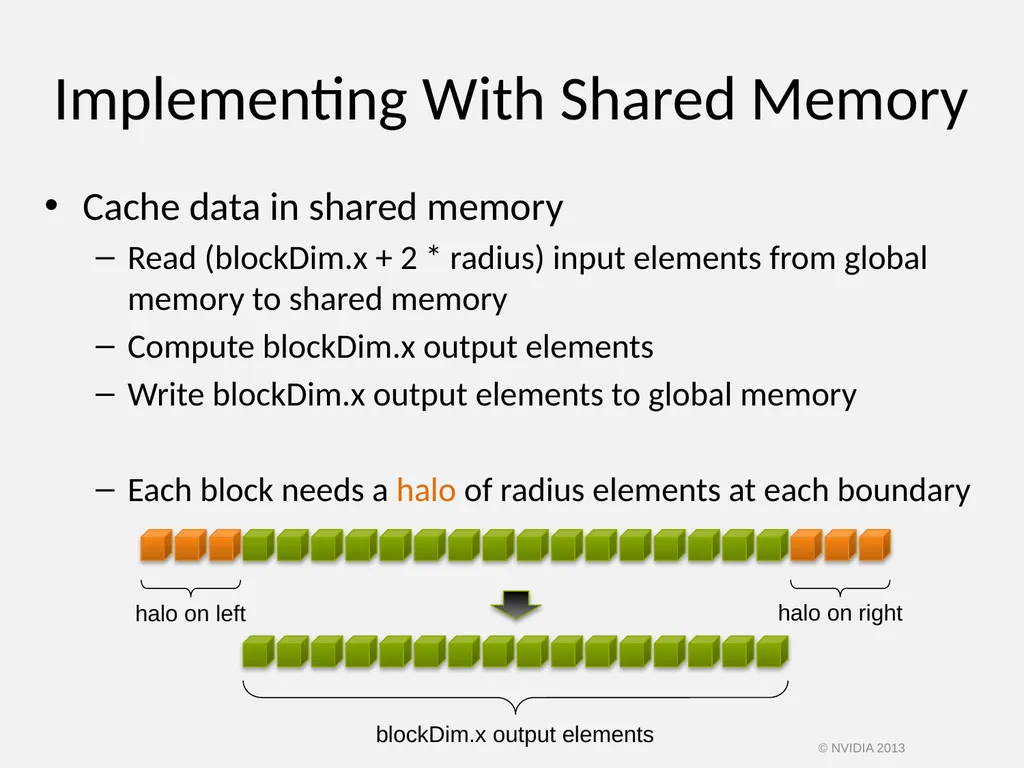
Implementing With Shared Memory Cache data in shared memory
Read (blockDim.x + 2 * radius) input elements from global memory to shared memory
Compute blockDim.x output elements
Write blockDim.x output elements to global memory
Each block needs a halo of radius elements at each boundary blockDim.x output elements halo on left halo on right © NVIDIA 2013<br>
Read (blockDim.x + 2 * radius) input elements from global memory to shared memory
Compute blockDim.x output elements
Write blockDim.x output elements to global memory
Each block needs a halo of radius elements at each boundary blockDim.x output elements halo on left halo on right © NVIDIA 2013<br>
52
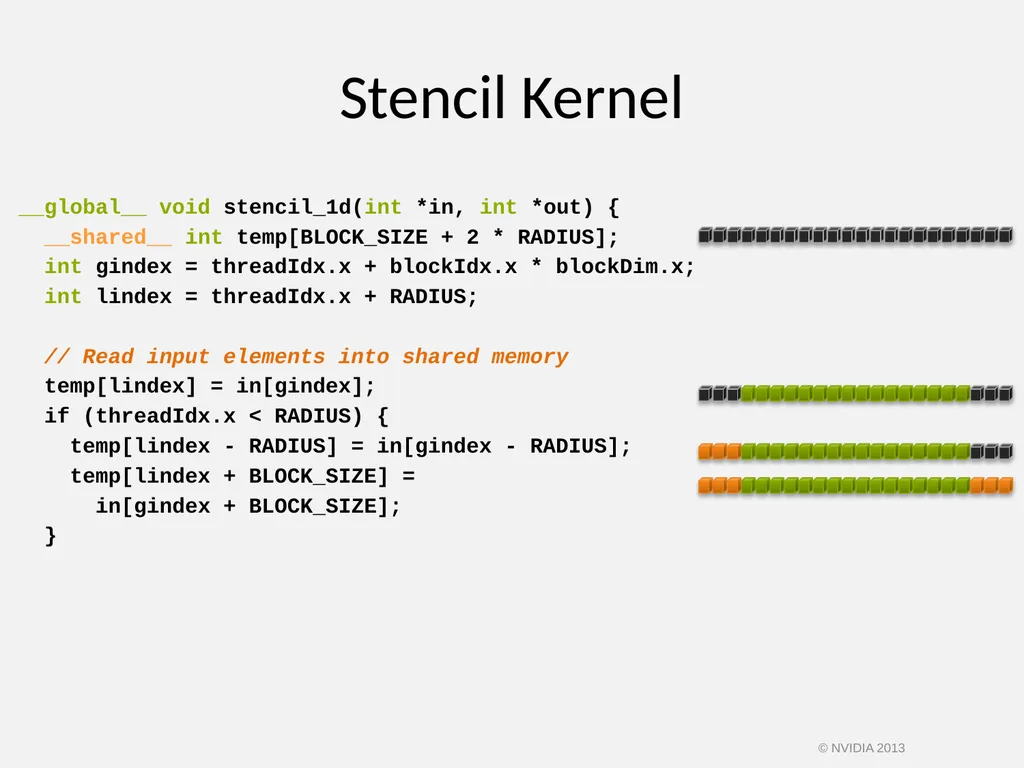
__global__ void stencil_1d(int *in, int *out) {
__shared__ int temp[BLOCK_SIZE + 2 * RADIUS];
int gindex = threadIdx.x + blockIdx.x * blockDim.x;
int lindex = threadIdx.x + RADIUS;
// Read input elements into shared memory
temp[lindex] = in[gindex];
if (threadIdx.x < RADIUS) {
temp[lindex - RADIUS] = in[gindex - RADIUS];
temp[lindex + BLOCK_SIZE] =
in[gindex + BLOCK_SIZE];
} © NVIDIA 2013 Stencil Kernel<br>
__shared__ int temp[BLOCK_SIZE + 2 * RADIUS];
int gindex = threadIdx.x + blockIdx.x * blockDim.x;
int lindex = threadIdx.x + RADIUS;
// Read input elements into shared memory
temp[lindex] = in[gindex];
if (threadIdx.x < RADIUS) {
temp[lindex - RADIUS] = in[gindex - RADIUS];
temp[lindex + BLOCK_SIZE] =
in[gindex + BLOCK_SIZE];
} © NVIDIA 2013 Stencil Kernel<br>
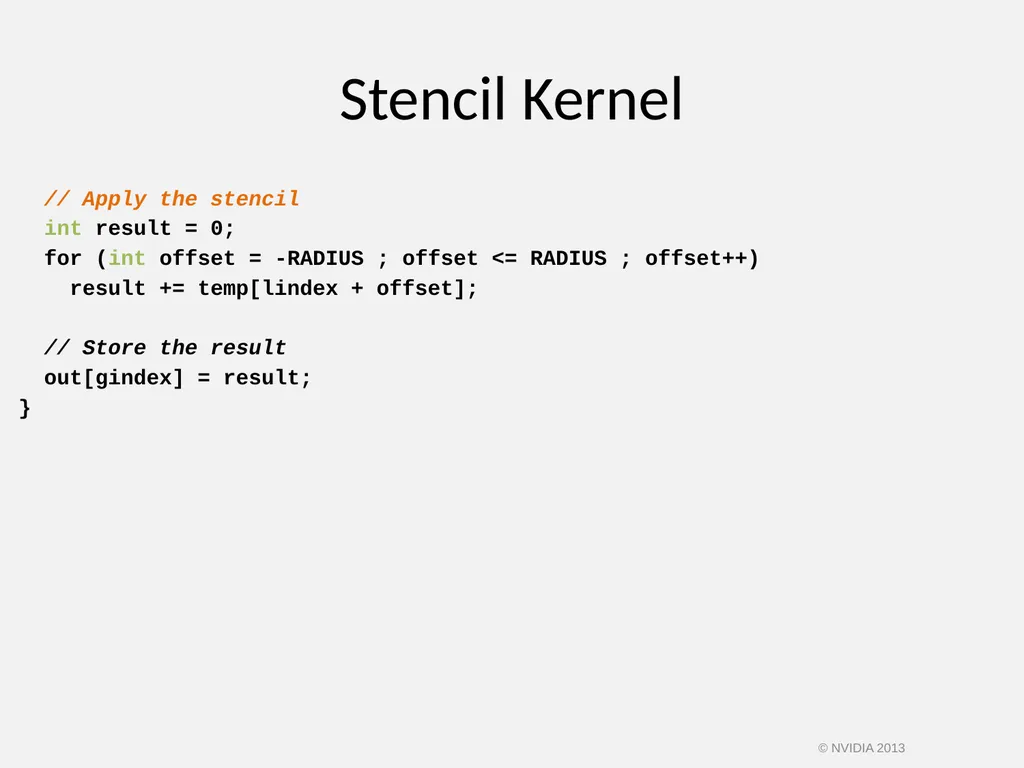
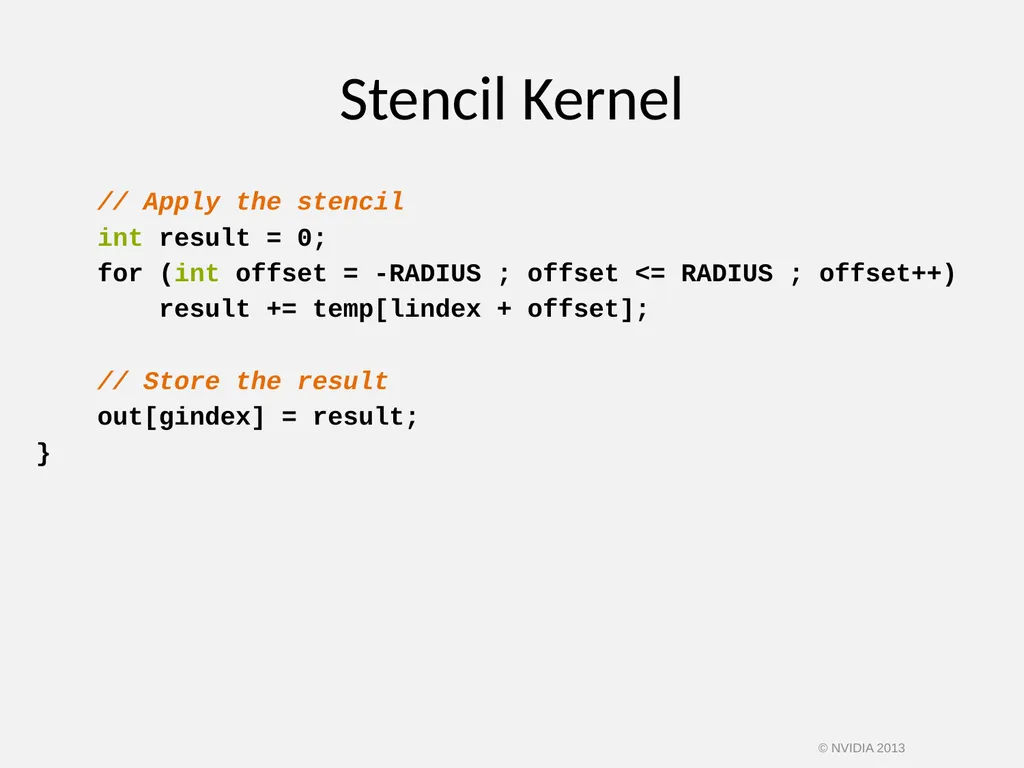
53
// Apply the stencil
int result = 0;
for (int offset = -RADIUS ; offset <= RADIUS ; offset++)
result += temp[lindex + offset];
// Store the result
out[gindex] = result;
} Stencil Kernel © NVIDIA 2013<br>
int result = 0;
for (int offset = -RADIUS ; offset <= RADIUS ; offset++)
result += temp[lindex + offset];
// Store the result
out[gindex] = result;
} Stencil Kernel © NVIDIA 2013<br>
54
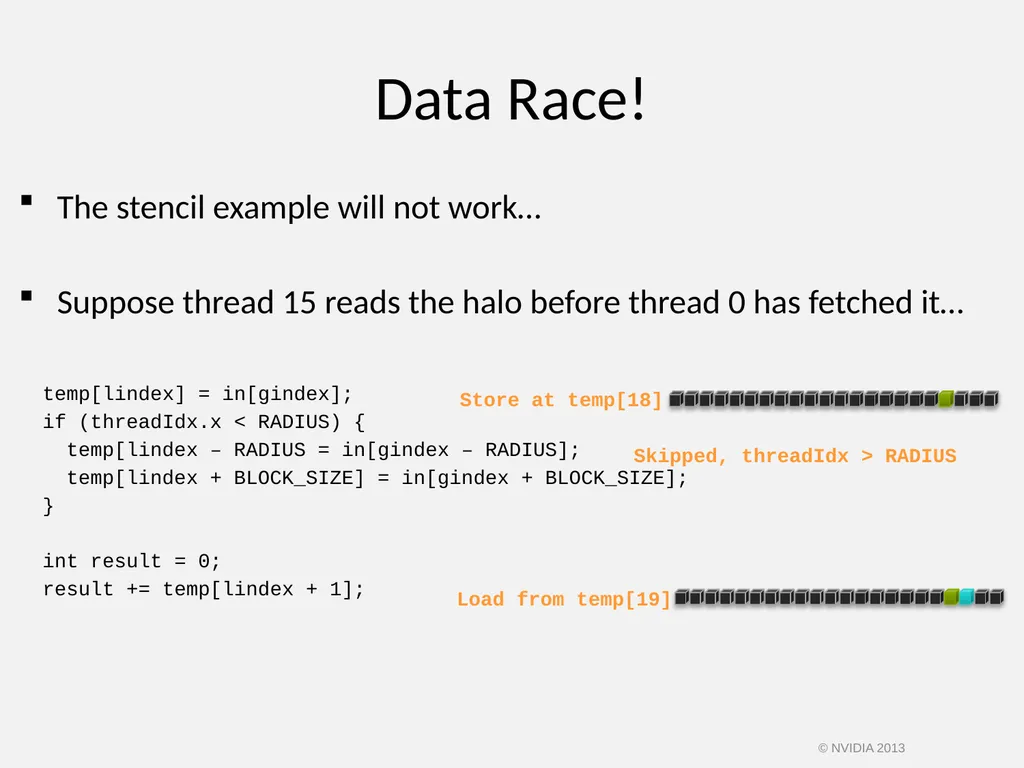
Data Race! © NVIDIA 2013 The stencil example will not work…
Suppose thread 15 reads the halo before thread 0 has fetched it…
temp[lindex] = in[gindex];
if (threadIdx.x < RADIUS) {
temp[lindex – RADIUS = in[gindex – RADIUS];
temp[lindex + BLOCK_SIZE] = in[gindex + BLOCK_SIZE];
}
int result = 0;
result += temp[lindex + 1]; Store at temp[18] Load from temp[19] Skipped, threadIdx > RADIUS<br>
Suppose thread 15 reads the halo before thread 0 has fetched it…
temp[lindex] = in[gindex];
if (threadIdx.x < RADIUS) {
temp[lindex – RADIUS = in[gindex – RADIUS];
temp[lindex + BLOCK_SIZE] = in[gindex + BLOCK_SIZE];
}
int result = 0;
result += temp[lindex + 1]; Store at temp[18] Load from temp[19] Skipped, threadIdx > RADIUS<br>
55
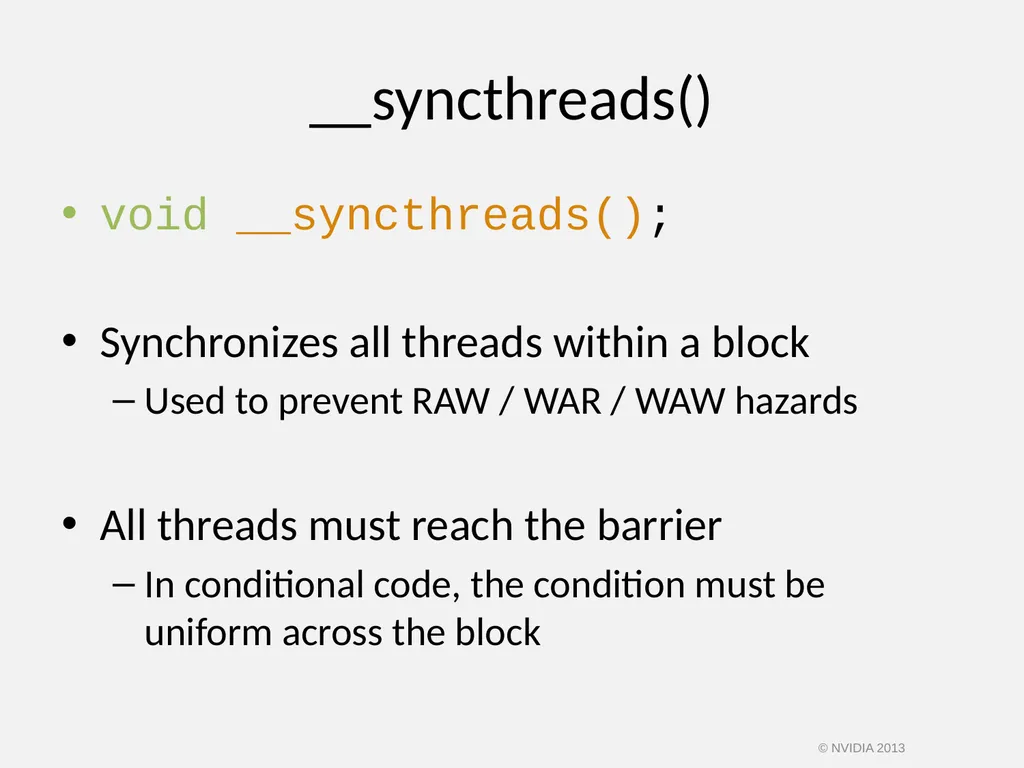
__syncthreads() void __syncthreads();
Synchronizes all threads within a block
Used to prevent RAW / WAR / WAW hazards
All threads must reach the barrier
In conditional code, the condition must be uniform across the block © NVIDIA 2013<br>
Synchronizes all threads within a block
Used to prevent RAW / WAR / WAW hazards
All threads must reach the barrier
In conditional code, the condition must be uniform across the block © NVIDIA 2013<br>
56
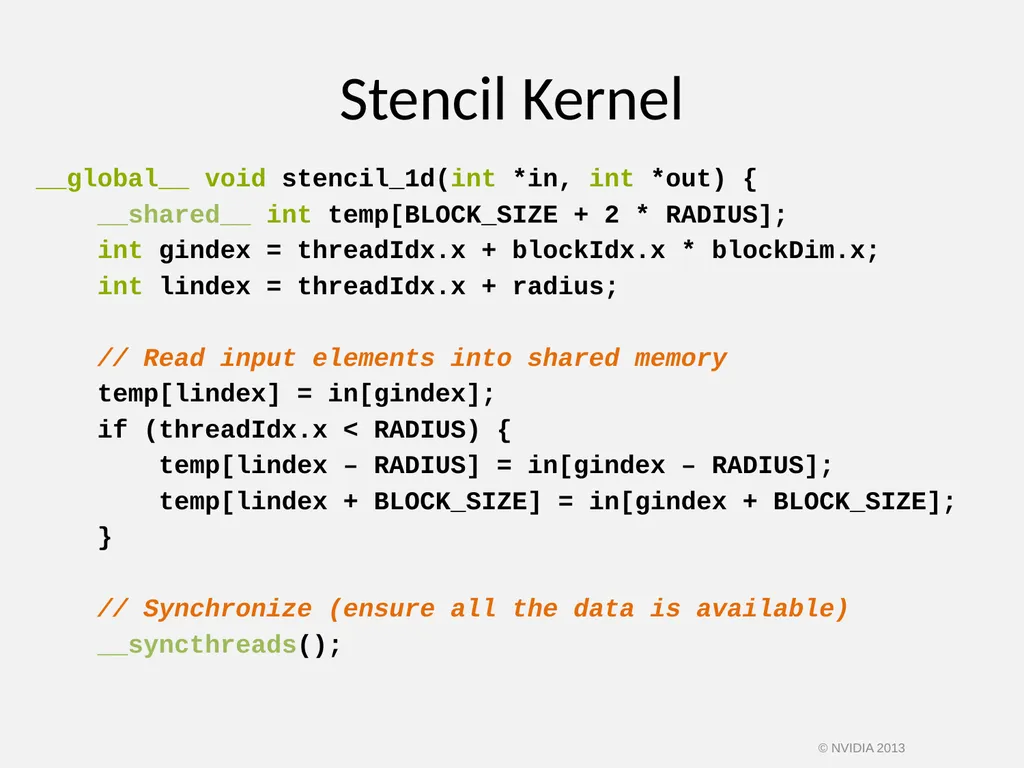
Stencil Kernel __global__ void stencil_1d(int *in, int *out) {
__shared__ int temp[BLOCK_SIZE + 2 * RADIUS];
int gindex = threadIdx.x + blockIdx.x * blockDim.x;
int lindex = threadIdx.x + radius;
// Read input elements into shared memory
temp[lindex] = in[gindex];
if (threadIdx.x < RADIUS) {
temp[lindex – RADIUS] = in[gindex – RADIUS];
temp[lindex + BLOCK_SIZE] = in[gindex + BLOCK_SIZE];
}
// Synchronize (ensure all the data is available)
__syncthreads(); © NVIDIA 2013<br>
__shared__ int temp[BLOCK_SIZE + 2 * RADIUS];
int gindex = threadIdx.x + blockIdx.x * blockDim.x;
int lindex = threadIdx.x + radius;
// Read input elements into shared memory
temp[lindex] = in[gindex];
if (threadIdx.x < RADIUS) {
temp[lindex – RADIUS] = in[gindex – RADIUS];
temp[lindex + BLOCK_SIZE] = in[gindex + BLOCK_SIZE];
}
// Synchronize (ensure all the data is available)
__syncthreads(); © NVIDIA 2013<br>
57
Stencil Kernel // Apply the stencil
int result = 0;
for (int offset = -RADIUS ; offset <= RADIUS ; offset++)
result += temp[lindex + offset];
// Store the result
out[gindex] = result;
} © NVIDIA 2013<br>
int result = 0;
for (int offset = -RADIUS ; offset <= RADIUS ; offset++)
result += temp[lindex + offset];
// Store the result
out[gindex] = result;
} © NVIDIA 2013<br>
58
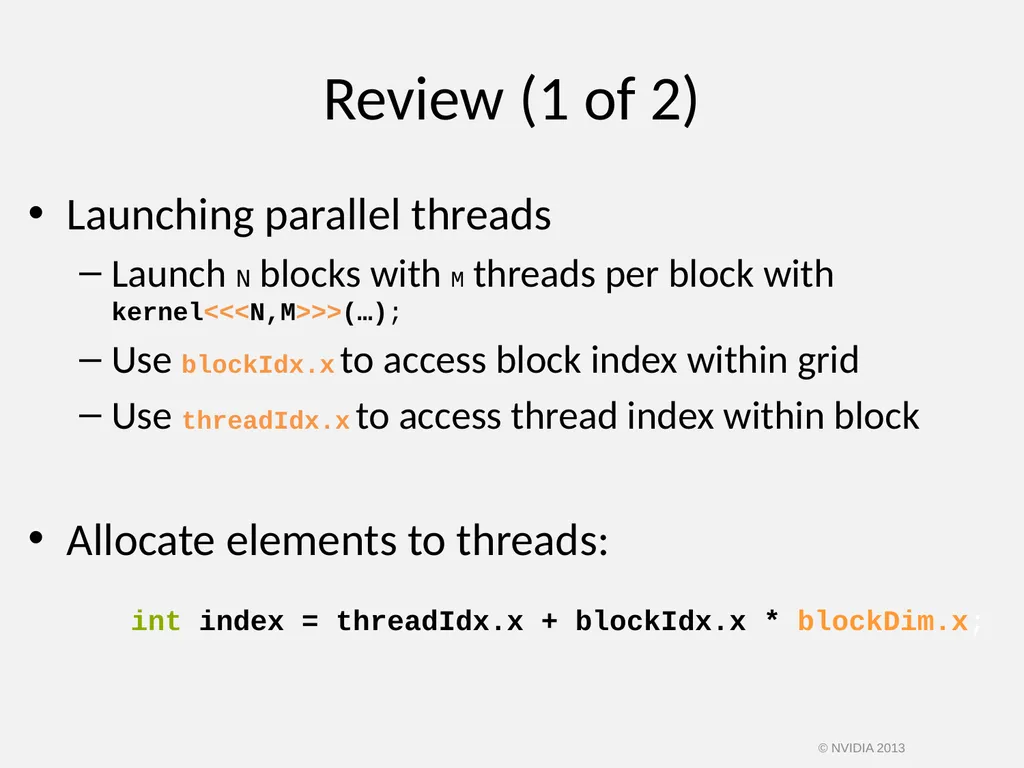
Review (1 of 2) Launching parallel threads
Launch N blocks with M threads per block with kernel<<<N,M>>>(…);
Use blockIdx.x to access block index within grid
Use threadIdx.x to access thread index within block
Allocate elements to threads:
int index = threadIdx.x + blockIdx.x * blockDim.x; © NVIDIA 2013<br>
Launch N blocks with M threads per block with kernel<<<N,M>>>(…);
Use blockIdx.x to access block index within grid
Use threadIdx.x to access thread index within block
Allocate elements to threads:
int index = threadIdx.x + blockIdx.x * blockDim.x; © NVIDIA 2013<br>
59
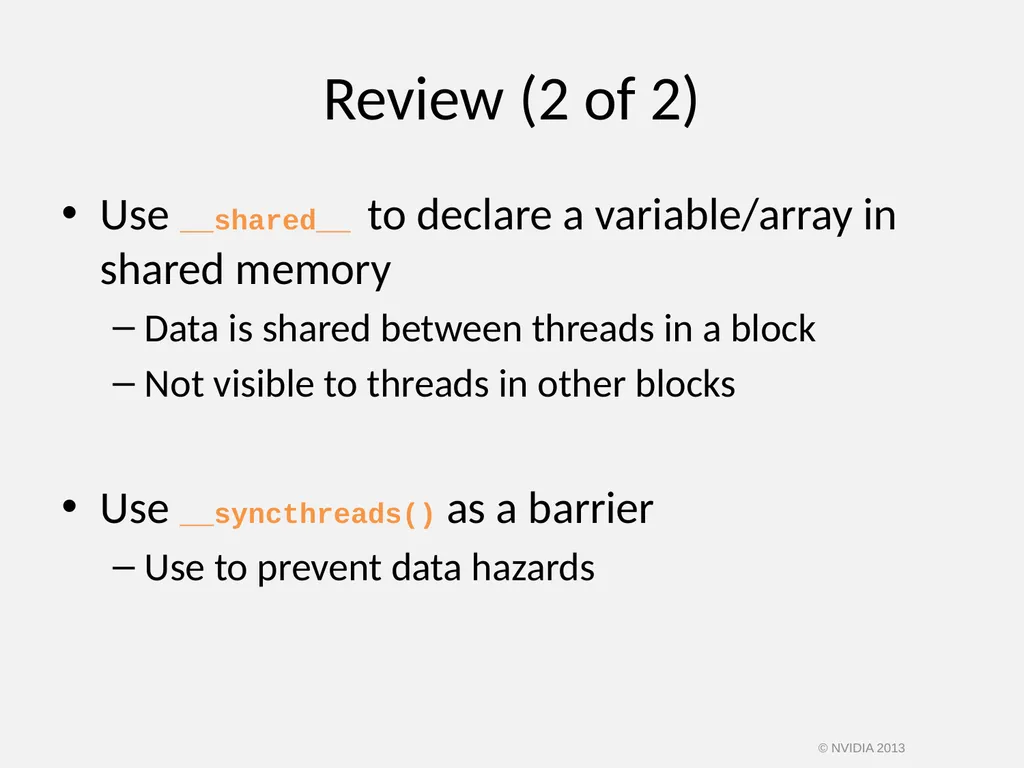
Review (2 of 2) Use __shared__ to declare a variable/array in shared memory
Data is shared between threads in a block
Not visible to threads in other blocks
Use __syncthreads() as a barrier
Use to prevent data hazards © NVIDIA 2013<br>
Data is shared between threads in a block
Not visible to threads in other blocks
Use __syncthreads() as a barrier
Use to prevent data hazards © NVIDIA 2013<br>
60
Managing the Device Heterogeneous Computing Blocks Threads Indexing Shared memory __syncthreads() Asynchronous operation Handling errors Managing devices CONCEPTS © NVIDIA 2013<br>
61
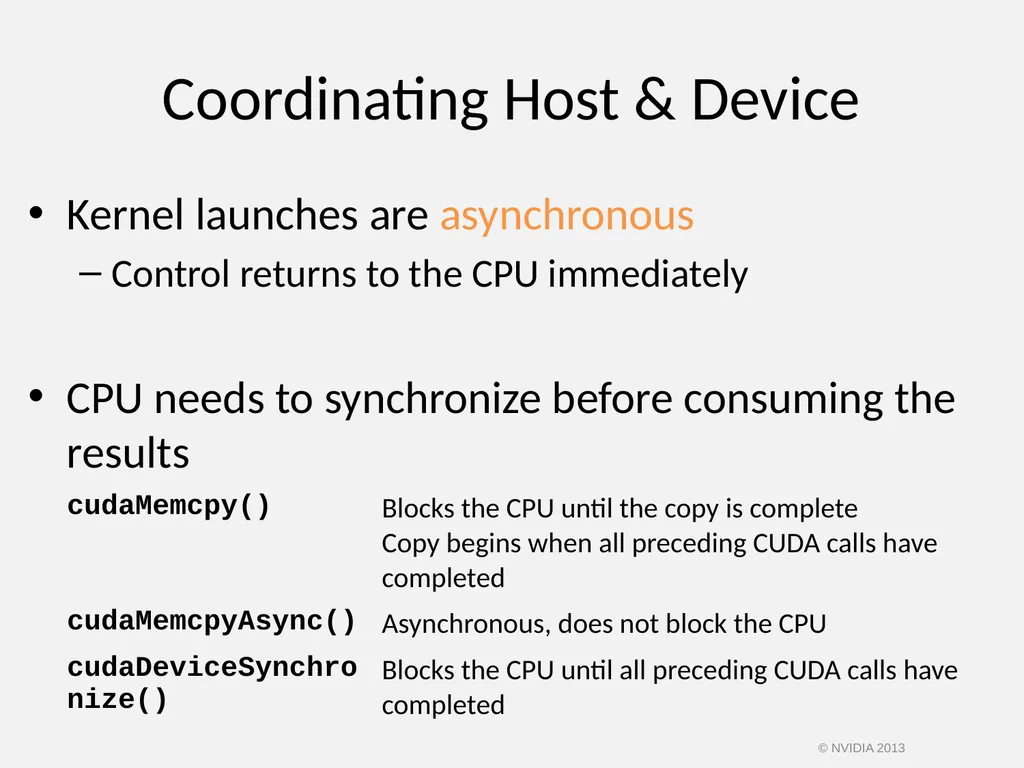
Coordinating Host & Device Kernel launches are asynchronous
Control returns to the CPU immediately
CPU needs to synchronize before consuming the results © NVIDIA 2013<br>
Control returns to the CPU immediately
CPU needs to synchronize before consuming the results © NVIDIA 2013<br>
62
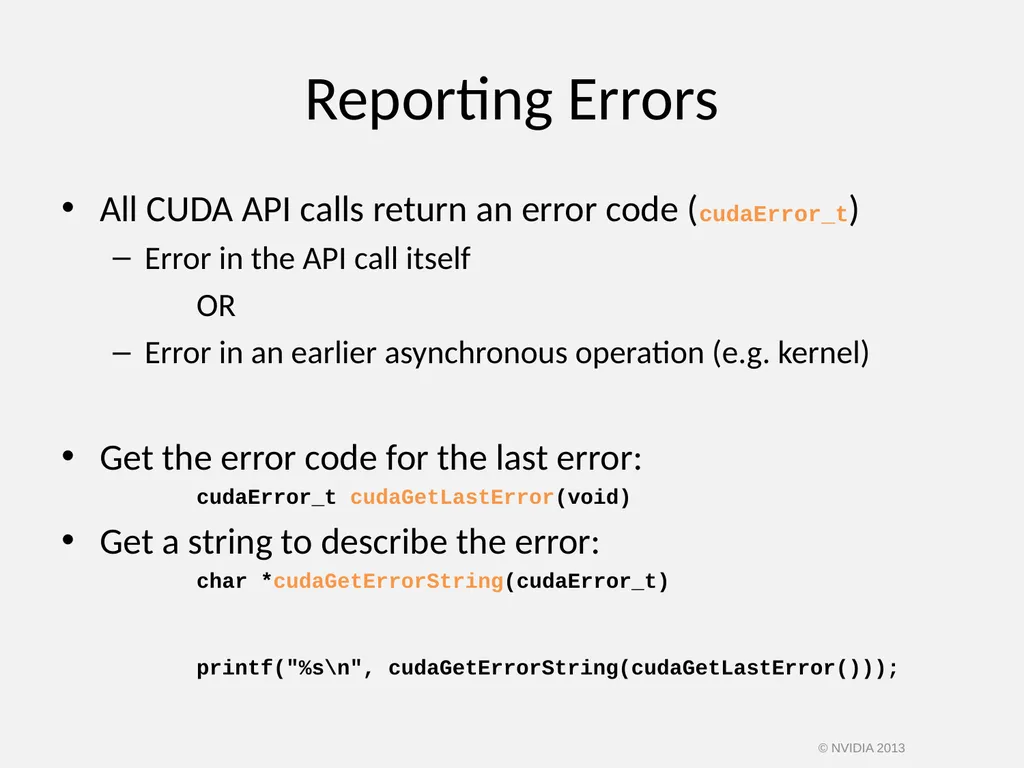
Reporting Errors All CUDA API calls return an error code (cudaError_t)
Error in the API call itself
OR
Error in an earlier asynchronous operation (e.g. kernel)
Get the error code for the last error:
cudaError_t cudaGetLastError(void)
Get a string to describe the error:
char *cudaGetErrorString(cudaError_t)
printf("%s\n", cudaGetErrorString(cudaGetLastError())); © NVIDIA 2013<br>
Error in the API call itself
OR
Error in an earlier asynchronous operation (e.g. kernel)
Get the error code for the last error:
cudaError_t cudaGetLastError(void)
Get a string to describe the error:
char *cudaGetErrorString(cudaError_t)
printf("%s\n", cudaGetErrorString(cudaGetLastError())); © NVIDIA 2013<br>
63
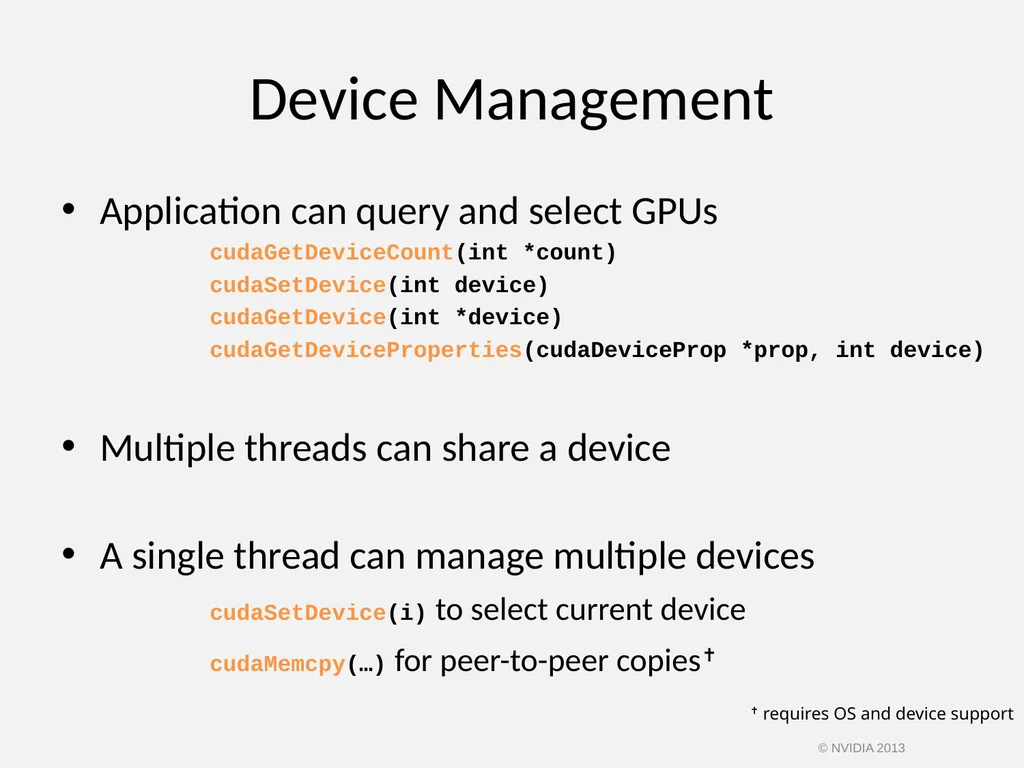
Device Management Application can query and select GPUs
cudaGetDeviceCount(int *count)
cudaSetDevice(int device)
cudaGetDevice(int *device)
cudaGetDeviceProperties(cudaDeviceProp *prop, int device)
Multiple threads can share a device
A single thread can manage multiple devices
cudaSetDevice(i) to select current device
cudaMemcpy(…) for peer-to-peer copies✝ ✝ requires OS and device support © NVIDIA 2013<br>
cudaGetDeviceCount(int *count)
cudaSetDevice(int device)
cudaGetDevice(int *device)
cudaGetDeviceProperties(cudaDeviceProp *prop, int device)
Multiple threads can share a device
A single thread can manage multiple devices
cudaSetDevice(i) to select current device
cudaMemcpy(…) for peer-to-peer copies✝ ✝ requires OS and device support © NVIDIA 2013<br>
64
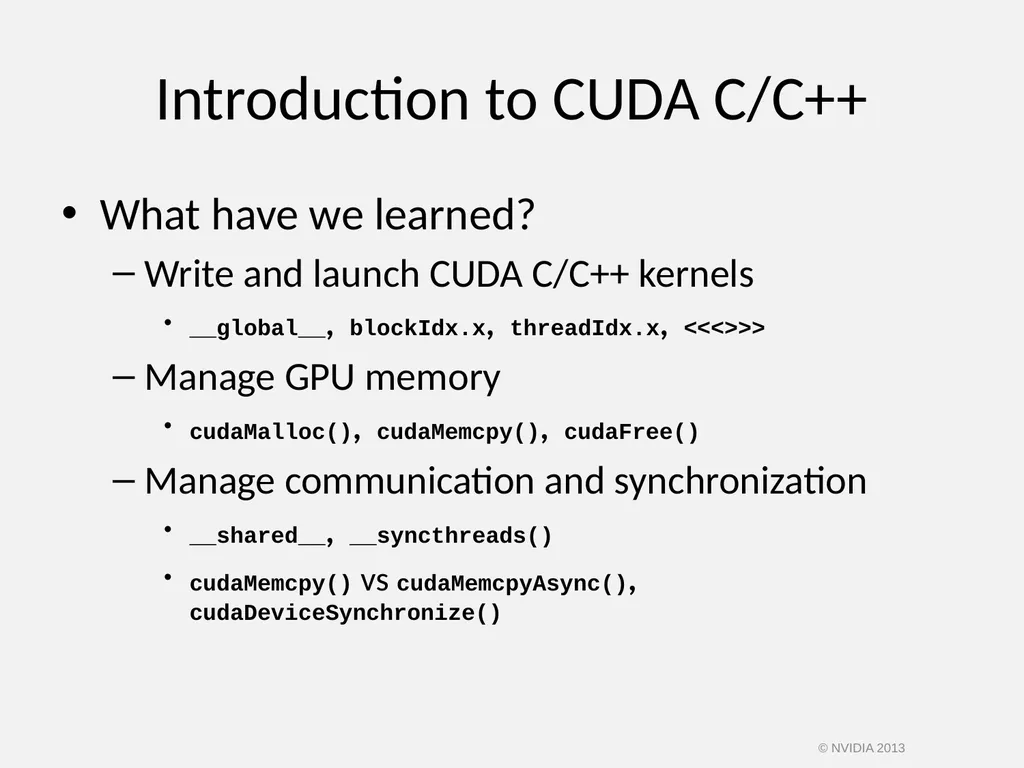
Introduction to CUDA C/C++ What have we learned?
Write and launch CUDA C/C++ kernels
__global__, blockIdx.x, threadIdx.x, <<<>>>
Manage GPU memory
cudaMalloc(), cudaMemcpy(), cudaFree()
Manage communication and synchronization
__shared__, __syncthreads()
cudaMemcpy() vs cudaMemcpyAsync(), cudaDeviceSynchronize() © NVIDIA 2013<br>
Write and launch CUDA C/C++ kernels
__global__, blockIdx.x, threadIdx.x, <<<>>>
Manage GPU memory
cudaMalloc(), cudaMemcpy(), cudaFree()
Manage communication and synchronization
__shared__, __syncthreads()
cudaMemcpy() vs cudaMemcpyAsync(), cudaDeviceSynchronize() © NVIDIA 2013<br>
65
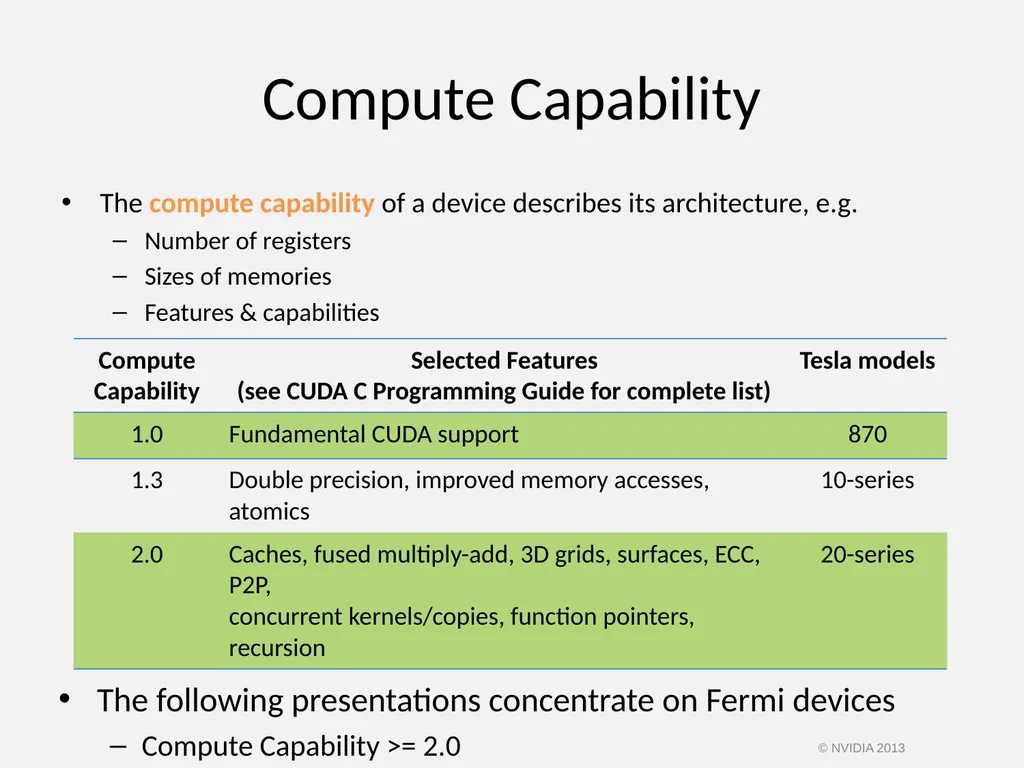
Compute Capability The compute capability of a device describes its architecture, e.g.
Number of registers
Sizes of memories
Features & capabilities The following presentations concentrate on Fermi devices
Compute Capability >= 2.0 © NVIDIA 2013<br>
Number of registers
Sizes of memories
Features & capabilities The following presentations concentrate on Fermi devices
Compute Capability >= 2.0 © NVIDIA 2013<br>
66
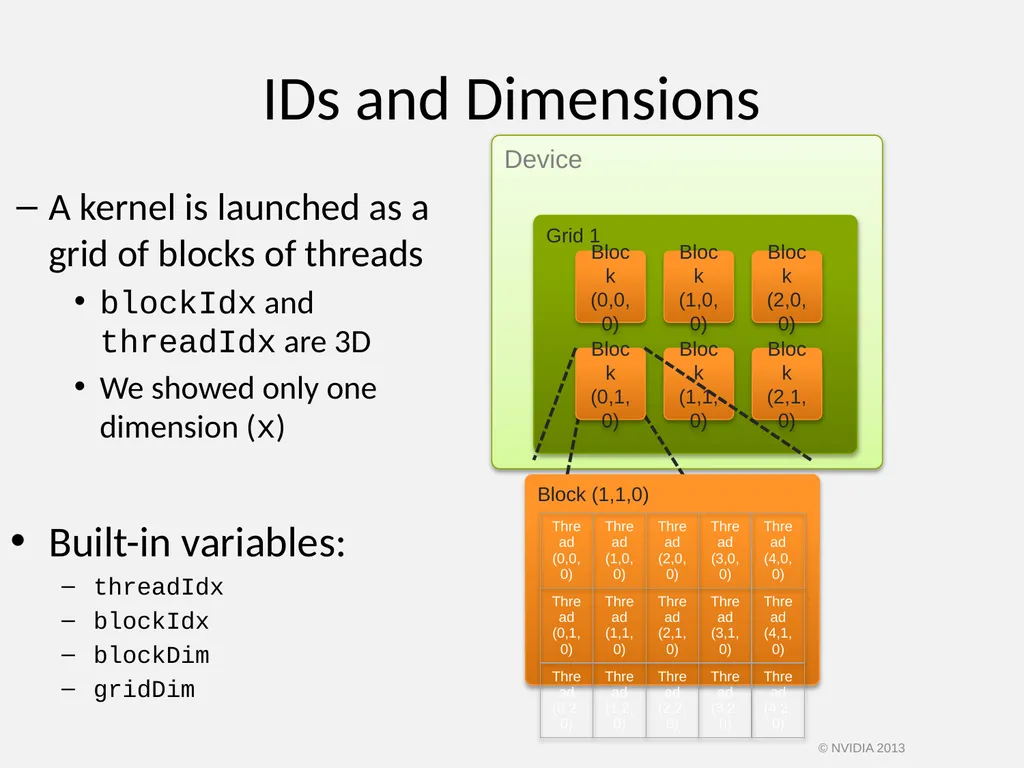
IDs and Dimensions A kernel is launched as a grid of blocks of threads
blockIdx and threadIdx are 3D
We showed only one dimension (x)
Built-in variables:
threadIdx
blockIdx
blockDim
gridDim Device Grid 1 Block (0,0,0) Block (1,0,0) Block (2,0,0) Block (1,1,0) Block (2,1,0) Block (0,1,0) Block (1,1,0) © NVIDIA 2013<br>
blockIdx and threadIdx are 3D
We showed only one dimension (x)
Built-in variables:
threadIdx
blockIdx
blockDim
gridDim Device Grid 1 Block (0,0,0) Block (1,0,0) Block (2,0,0) Block (1,1,0) Block (2,1,0) Block (0,1,0) Block (1,1,0) © NVIDIA 2013<br>
67
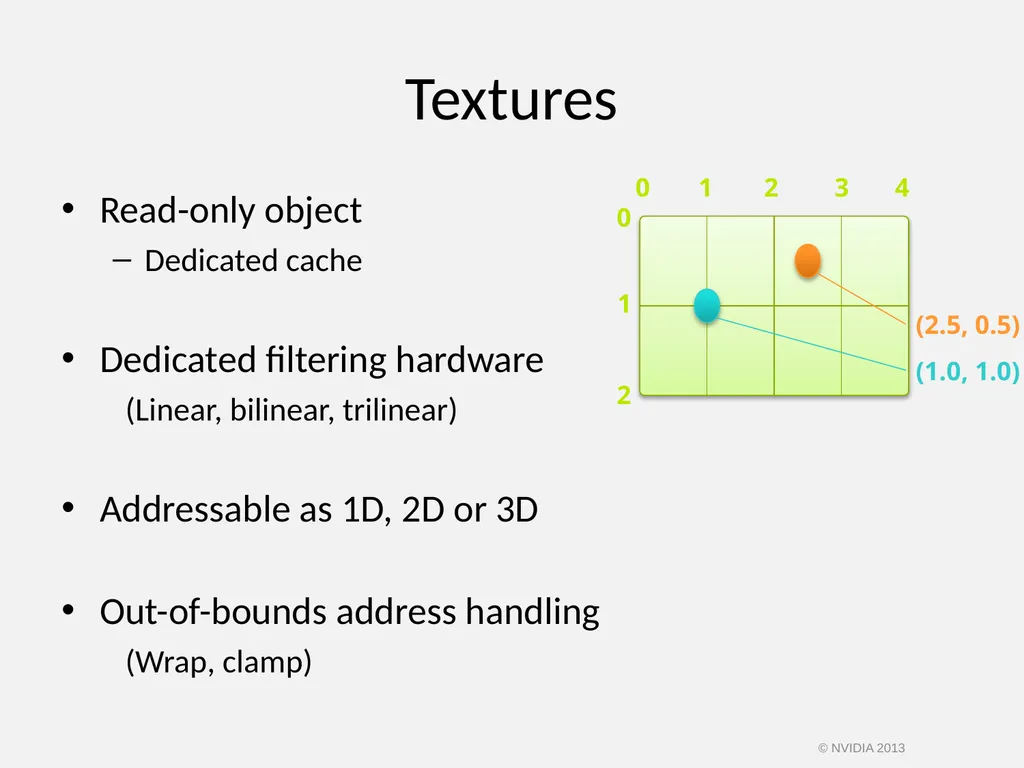
Textures Read-only object
Dedicated cache
Dedicated filtering hardware
(Linear, bilinear, trilinear)
Addressable as 1D, 2D or 3D
Out-of-bounds address handling
(Wrap, clamp) 0 1 2 3 0 1 2 4 (2.5, 0.5) (1.0, 1.0) © NVIDIA 2013<br>
Dedicated cache
Dedicated filtering hardware
(Linear, bilinear, trilinear)
Addressable as 1D, 2D or 3D
Out-of-bounds address handling
(Wrap, clamp) 0 1 2 3 0 1 2 4 (2.5, 0.5) (1.0, 1.0) © NVIDIA 2013<br>
68
Topics we skipped We skipped some details, you can learn more:
CUDA Programming Guide
CUDA Zone – tools, training, webinars and more
developer.nvidia.com/cuda
Need a quick primer for later:
Multi-dimensional indexing
Textures © NVIDIA 2013<br>
CUDA Programming Guide
CUDA Zone – tools, training, webinars and more
developer.nvidia.com/cuda
Need a quick primer for later:
Multi-dimensional indexing
Textures © NVIDIA 2013<br>