Curricular goals An effective curricular goal should: Ask the children to do something, e.g. describe, compare, explain, etc. to demonstrate their understanding of the knowledge gained (often using their disciplinary knowledge for this,
"Curricular goals An effective curricular goal" is the property of its rightful owner. Permission is granted to
download and print the materials on this website for personal, non-commercial use only, and to display it
on your personal computer provided you do not modify the materials and that you retain all copyright
notices contained in the materials. By downloading content from our website, you accept the terms of this
agreement.
Presentation Transcript
01
Curricular goals An effective curricular goal should:
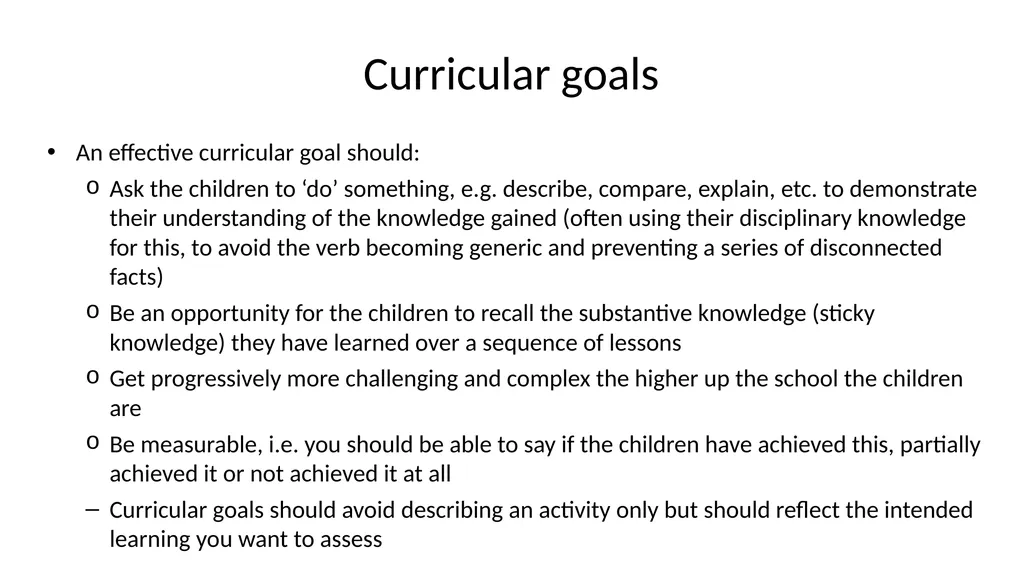
Ask the children to ‘do’ something, e.g. describe, compare, explain, etc. to demonstrate their understanding of the knowledge gained (often using their disciplinary knowledge for this, to avoid the verb becoming generic and preventing a series of disconnected facts)
Be an opportunity for the children to recall the substantive knowledge (sticky knowledge) they have learned over a sequence of lessons
Get progressively more challenging and complex the higher up the school the children are
Be measurable, i.e. you should be able to say if the children have achieved this, partially achieved it or not achieved it at all
Curricular goals should avoid describing an activity only but should reflect the intended learning you want to assess<br>
02
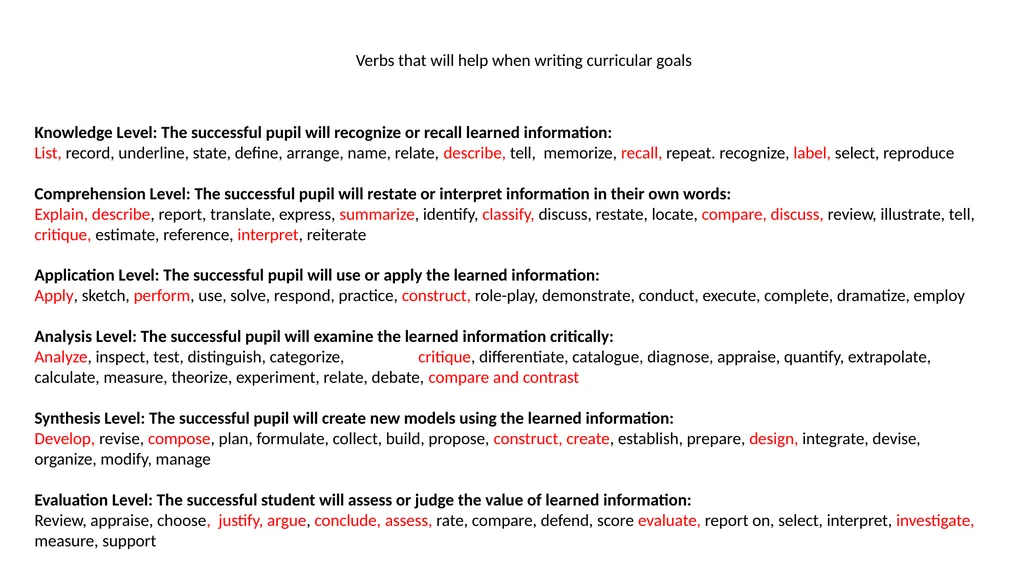
Verbs that will help when writing curricular goals Knowledge Level: The successful pupil will recognize or recall learned information:
List, record, underline, state, define, arrange, name, relate, describe, tell, memorize, recall, repeat. recognize, label, select, reproduce
Comprehension Level: The successful pupil will restate or interpret information in their own words:
Explain, describe, report, translate, express, summarize, identify, classify, discuss, restate, locate, compare, discuss, review, illustrate, tell, critique, estimate, reference, interpret, reiterate
Application Level: The successful pupil will use or apply the learned information:
Apply, sketch, perform, use, solve, respond, practice, construct, role-play, demonstrate, conduct, execute, complete, dramatize, employ
Analysis Level: The successful pupil will examine the learned information critically:
Analyze, inspect, test, distinguish, categorize, critique, differentiate, catalogue, diagnose, appraise, quantify, extrapolate, calculate, measure, theorize, experiment, relate, debate, compare and contrast
Synthesis Level: The successful pupil will create new models using the learned information:
Develop, revise, compose, plan, formulate, collect, build, propose, construct, create, establish, prepare, design, integrate, devise, organize, modify, manage
Evaluation Level: The successful student will assess or judge the value of learned information:
Review, appraise, choose, justify, argue, conclude, assess, rate, compare, defend, score evaluate, report on, select, interpret, investigate, measure, support<br>
03
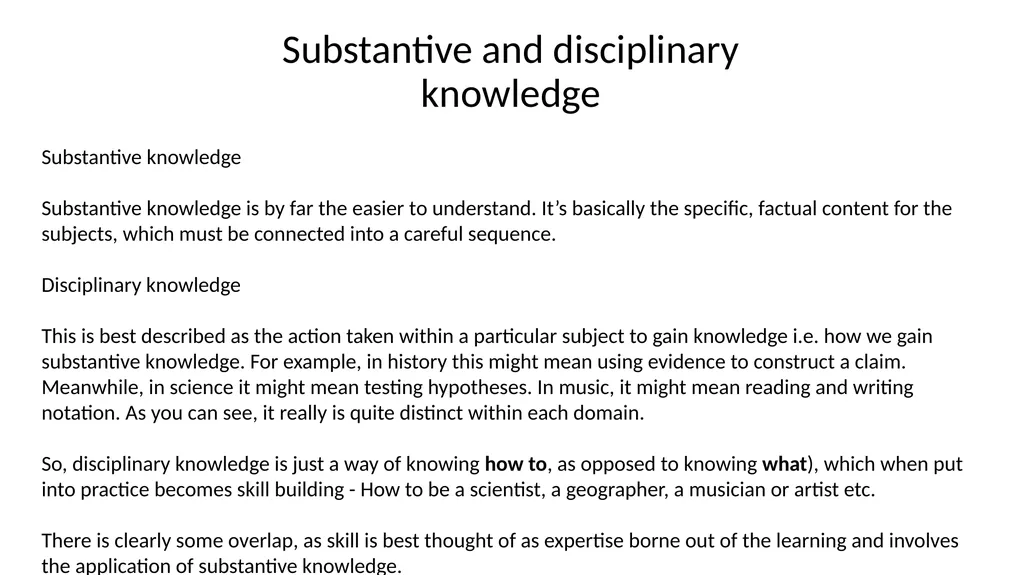
Substantive and disciplinary knowledge Substantive knowledge
Substantive knowledge is by far the easier to understand. It’s basically the specific, factual content for the subjects, which must be connected into a careful sequence.
Disciplinary knowledge
This is best described as the action taken within a particular subject to gain knowledge i.e. how we gain substantive knowledge. For example, in history this might mean using evidence to construct a claim. Meanwhile, in science it might mean testing hypotheses. In music, it might mean reading and writing notation. As you can see, it really is quite distinct within each domain.
So, disciplinary knowledge is just a way of knowing how to, as opposed to knowing what), which when put into practice becomes skill building - How to be a scientist, a geographer, a musician or artist etc.
There is clearly some overlap, as skill is best thought of as expertise borne out of the learning and involves the application of substantive knowledge.
Expertise in a given domain is essentially what disciplinary knowledge is all about.<br>
04
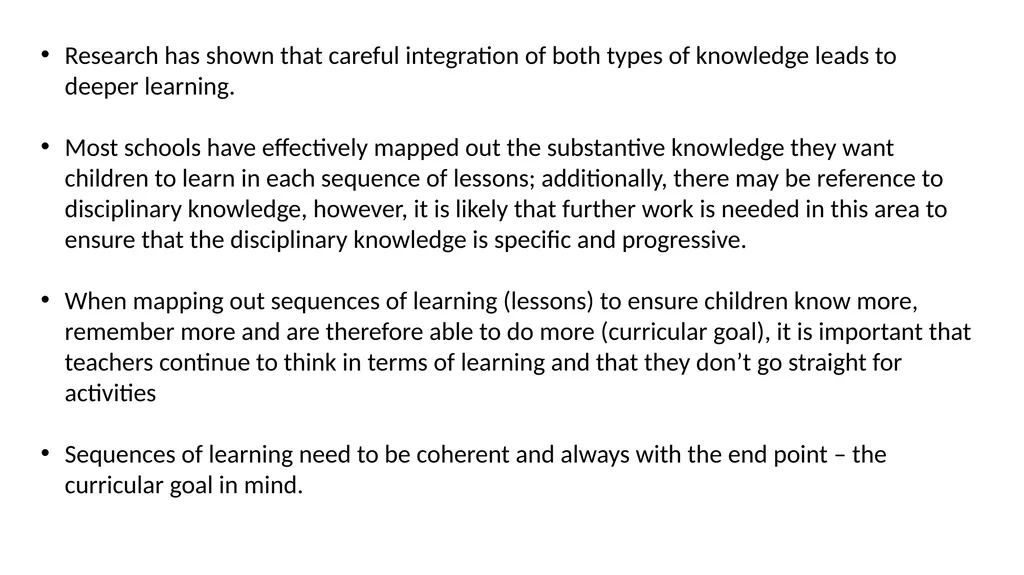
Research has shown that careful integration of both types of knowledge leads to deeper learning.
Most schools have effectively mapped out the substantive knowledge they want children to learn in each sequence of lessons; additionally, there may be reference to disciplinary knowledge, however, it is likely that further work is needed in this area to ensure that the disciplinary knowledge is specific and progressive.
When mapping out sequences of learning (lessons) to ensure children know more, remember more and are therefore able to do more (curricular goal), it is important that teachers continue to think in terms of learning and that they don’t go straight for activities
Sequences of learning need to be coherent and always with the end point – the curricular goal in mind.<br>