
Day Case Surgery Dr. Adel Al-Najjar Consultant

Description: Day Case Surgery Dr. Adel Al-Najjar Consultant Urology Introduction Day case surgery is the admission of select patients to hospital for a planned surgical procedure, returning home on the same day. In the UK, this represents about 70 of
Related Topics
Download Presentation
"Day Case Surgery Dr. Adel Al-Najjar Consultant" is the property of its rightful owner. Permission is granted to download and print the materials on this website for personal, non-commercial use only, and to display it on your personal computer provided you do not modify the materials and that you retain all copyright notices contained in the materials. By downloading content from our website, you accept the terms of this agreement.
Presentation Transcript
slide1. Day Case Surgery Dr. Adel Al-Najjar
Consultant Urology<br>
slide3. Introduction • Day case surgery is the admission of select patients to
hospital for a planned surgical procedure, returning home on
the same day. In the UK, this represents about 70% of all
surgery performed.
• Surgical day cases are often viewed as the highest impact
change in healthcare to improve productivity; healthcare
guidelines have previously advised for a target of “treating day
surgery [rather than inpatient surgery] as the norm for elective surgery”.<br>
slide4. The advantages of day case surgery are: • Shorter inpatient stays
• Reduced risk of hospital acquired infection
• Reduced waiting lists
• Reduced hospital costs
• Reduced demand for inpatient beds<br>
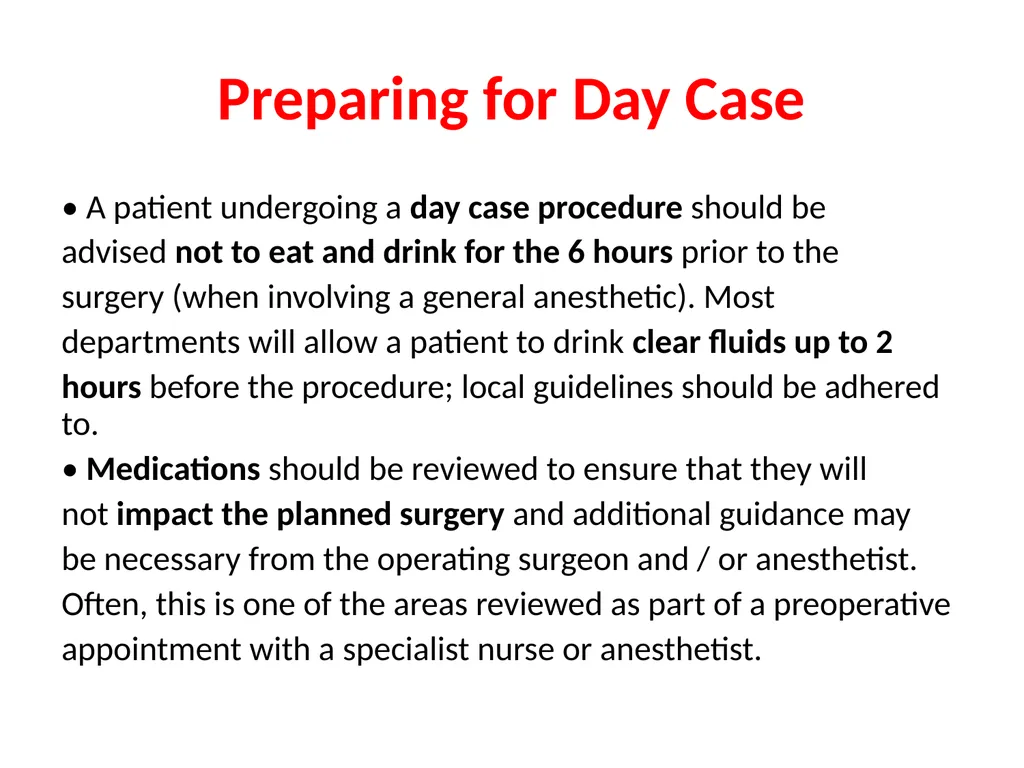
slide5. Preparing for Day Case • A patient undergoing a day case procedure should be
advised not to eat and drink for the 6 hours prior to the
surgery (when involving a general anesthetic). Most
departments will allow a patient to drink clear fluids up to 2
hours before the procedure; local guidelines should be adhered to.
• Medications should be reviewed to ensure that they will
not impact the planned surgery and additional guidance may
be necessary from the operating surgeon and / or anesthetist.
Often, this is one of the areas reviewed as part of a preoperative
appointment with a specialist nurse or anesthetist.<br>
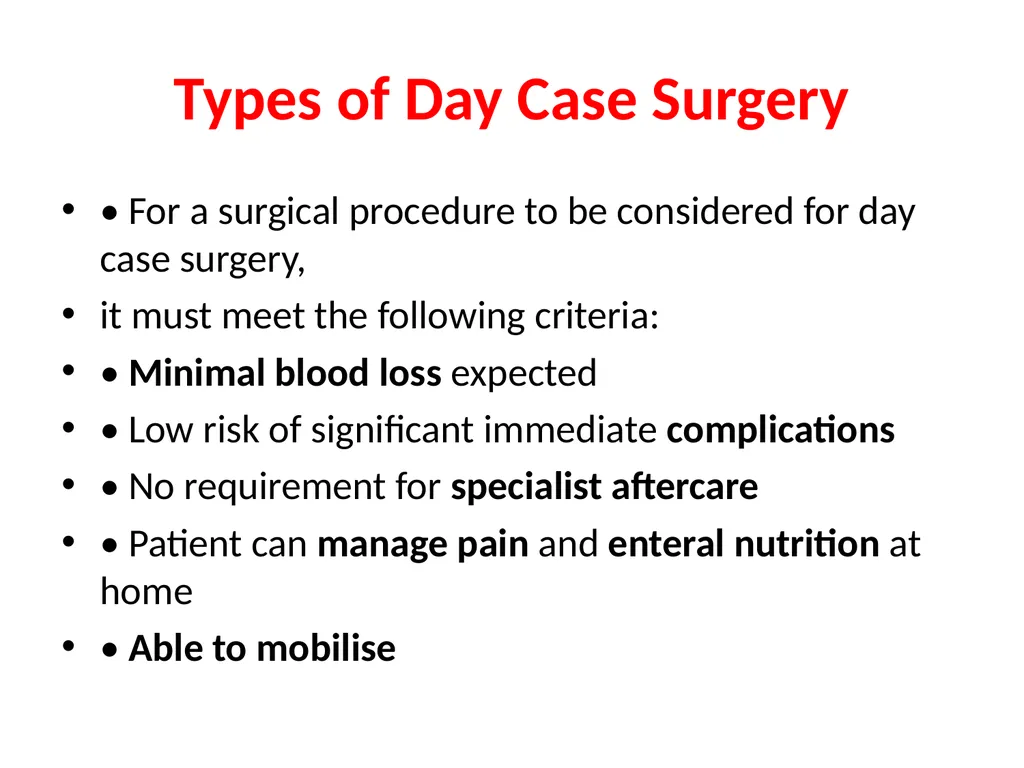
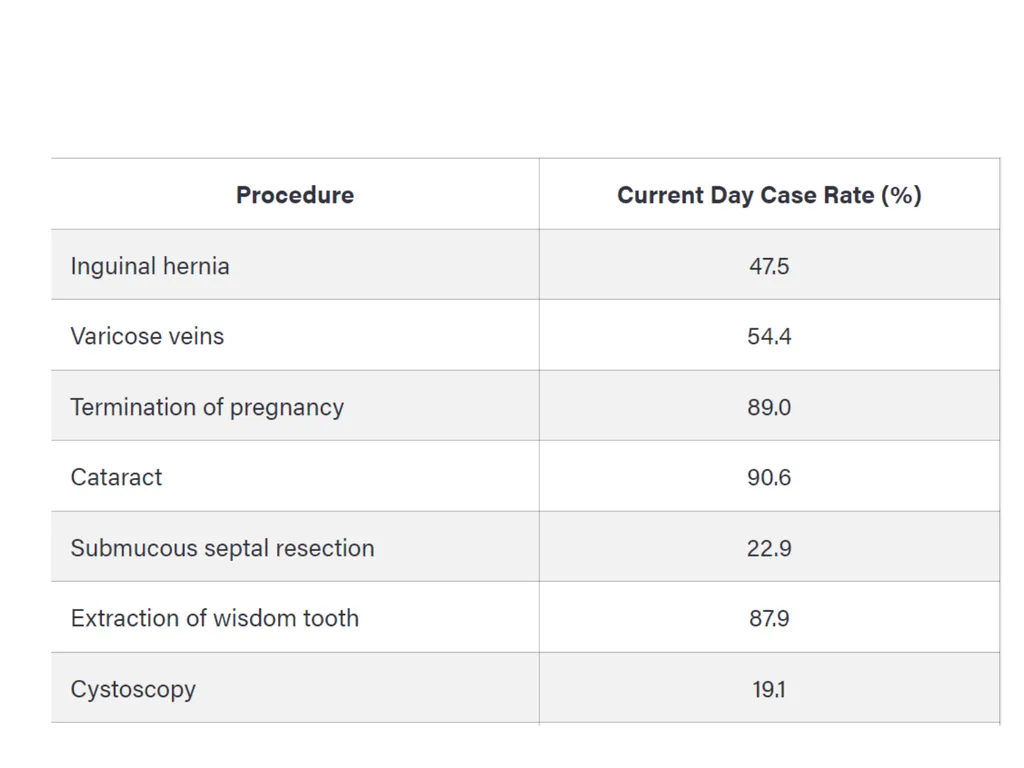
slide6. Types of Day Case Surgery • For a surgical procedure to be considered for day case surgery,
it must meet the following criteria:
• Minimal blood loss expected
• Low risk of significant immediate complications
• No requirement for specialist aftercare
• Patient can manage pain and enteral nutrition at home
• Able to mobilise<br>
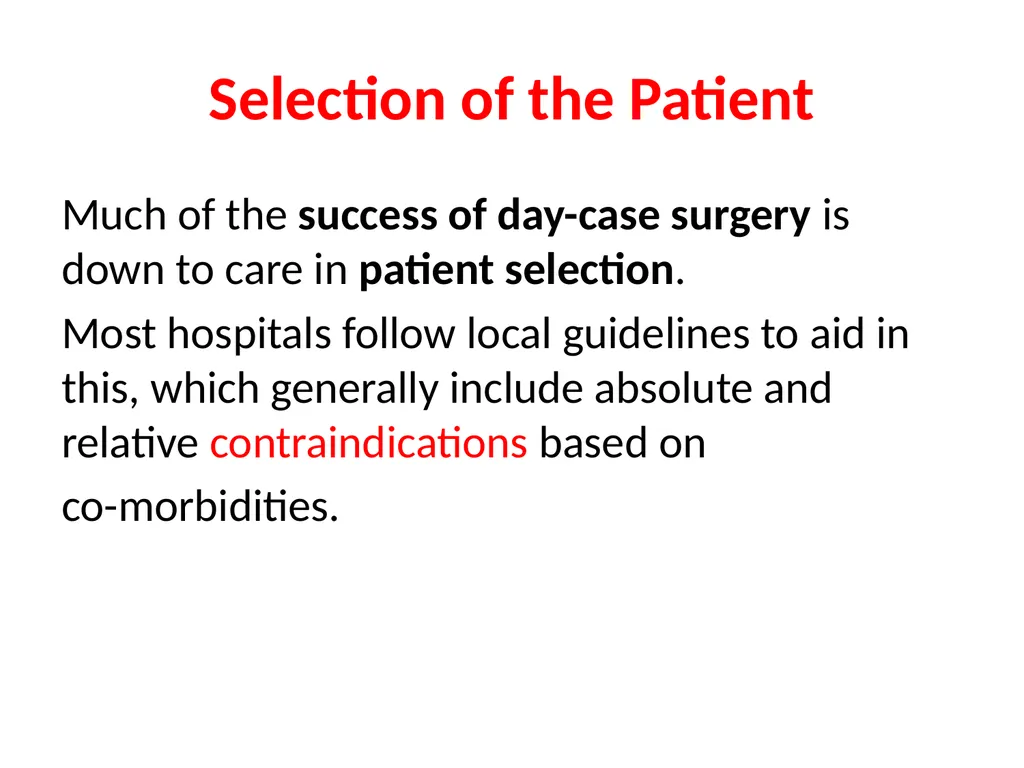
slide8. Selection of the Patient Much of the success of day-case surgery is down to care in patient selection.
Most hospitals follow local guidelines to aid in this, which generally include absolute and relative contraindications based on
co-morbidities.<br>
slide9. The selection of a patient for day surgery should be based upon social and medical factors: • Social factors: – a patient must understand the planned procedure,
consent appropriately, and understand the following post-operative
care
• The patient should also have sufficient provisions to have a responsible adult escort them home and provide support for the first 24 hours of post-operative care
• Medical factors: – a patient’s health must be suitable for a day case
procedure, remembering that some stable chronic diseases (e.g.
diabetes mellitus) can often be better managed as a day procedure
to minimize any disruption to their daily routine
• Those with poorly-controlled or severe co-morbidities may not be suitable for a day case pathway<br>
Consultant Urology<br>
slide3. Introduction • Day case surgery is the admission of select patients to
hospital for a planned surgical procedure, returning home on
the same day. In the UK, this represents about 70% of all
surgery performed.
• Surgical day cases are often viewed as the highest impact
change in healthcare to improve productivity; healthcare
guidelines have previously advised for a target of “treating day
surgery [rather than inpatient surgery] as the norm for elective surgery”.<br>
slide4. The advantages of day case surgery are: • Shorter inpatient stays
• Reduced risk of hospital acquired infection
• Reduced waiting lists
• Reduced hospital costs
• Reduced demand for inpatient beds<br>
slide5. Preparing for Day Case • A patient undergoing a day case procedure should be
advised not to eat and drink for the 6 hours prior to the
surgery (when involving a general anesthetic). Most
departments will allow a patient to drink clear fluids up to 2
hours before the procedure; local guidelines should be adhered to.
• Medications should be reviewed to ensure that they will
not impact the planned surgery and additional guidance may
be necessary from the operating surgeon and / or anesthetist.
Often, this is one of the areas reviewed as part of a preoperative
appointment with a specialist nurse or anesthetist.<br>
slide6. Types of Day Case Surgery • For a surgical procedure to be considered for day case surgery,
it must meet the following criteria:
• Minimal blood loss expected
• Low risk of significant immediate complications
• No requirement for specialist aftercare
• Patient can manage pain and enteral nutrition at home
• Able to mobilise<br>
slide8. Selection of the Patient Much of the success of day-case surgery is down to care in patient selection.
Most hospitals follow local guidelines to aid in this, which generally include absolute and relative contraindications based on
co-morbidities.<br>
slide9. The selection of a patient for day surgery should be based upon social and medical factors: • Social factors: – a patient must understand the planned procedure,
consent appropriately, and understand the following post-operative
care
• The patient should also have sufficient provisions to have a responsible adult escort them home and provide support for the first 24 hours of post-operative care
• Medical factors: – a patient’s health must be suitable for a day case
procedure, remembering that some stable chronic diseases (e.g.
diabetes mellitus) can often be better managed as a day procedure
to minimize any disruption to their daily routine
• Those with poorly-controlled or severe co-morbidities may not be suitable for a day case pathway<br>