
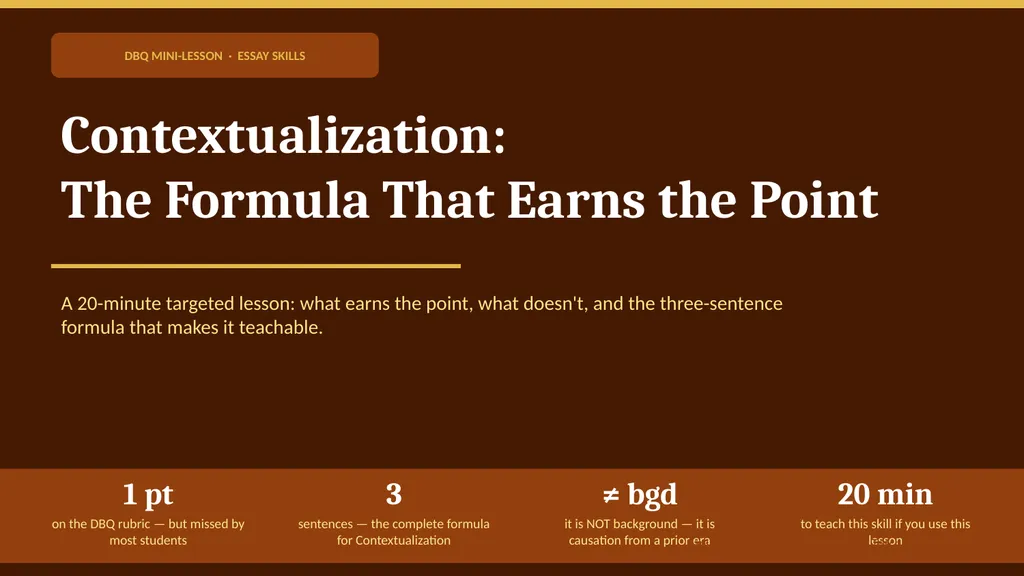
DBQ MINI-LESSON · ESSAY SKILLS Contextualization:
TF
Published · 12 slides · 0 views
1 / 1
Description
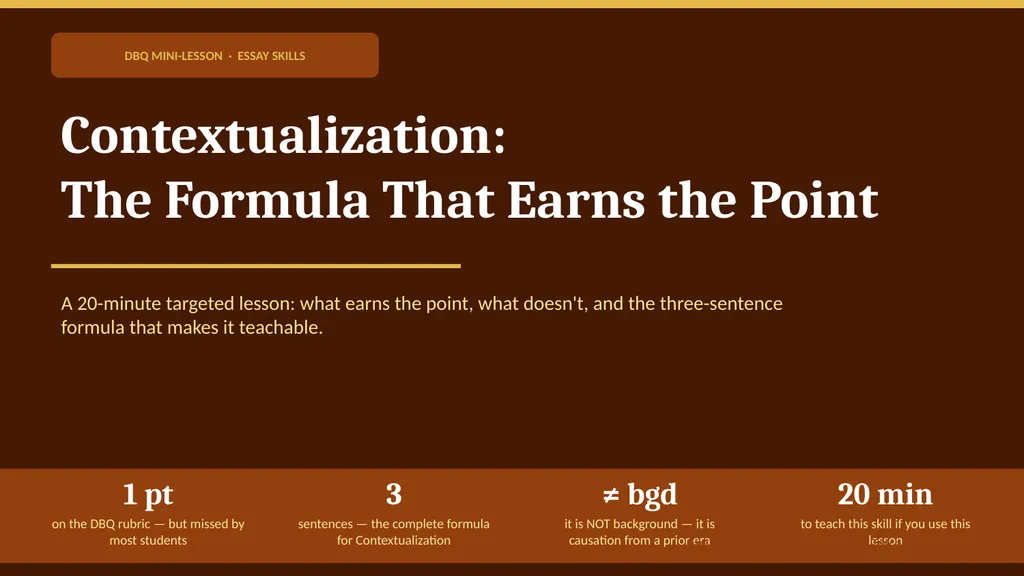
DBQ MINI-LESSON ESSAY SKILLS Contextualization: The Formula That Earns the Point A 20-minute targeted lesson: what earns the point, what doesnt, and the three-sentence formula that makes it teachable. 1 pt on the DBQ rubric but missed
Related Topics
Share
Embed code
Download this presentation From Below
"DBQ MINI-LESSON · ESSAY SKILLS Contextualization:" is the property of its rightful owner. Permission is granted to download and print the materials on this website for personal, non-commercial use only, and to display it on your personal computer provided you do not modify the materials and that you retain all copyright notices contained in the materials. By downloading content from our website, you accept the terms of this agreement.
Presentation Transcript
01
DBQ MINI-LESSON · ESSAY SKILLS Contextualization:
The Formula That Earns the Point A 20-minute targeted lesson: what earns the point, what doesn't, and the three-sentence formula that makes it teachable. 1 pt on the DBQ rubric — but missed by most students 3 sentences — the complete formula for Contextualization ≠ bgd it is NOT background — it is causation from a prior era 20 min to teach this skill if you use this lesson apushistoryexamprep.com · Free Teacher Resource<br>
The Formula That Earns the Point A 20-minute targeted lesson: what earns the point, what doesn't, and the three-sentence formula that makes it teachable. 1 pt on the DBQ rubric — but missed by most students 3 sentences — the complete formula for Contextualization ≠ bgd it is NOT background — it is causation from a prior era 20 min to teach this skill if you use this lesson apushistoryexamprep.com · Free Teacher Resource<br>
02
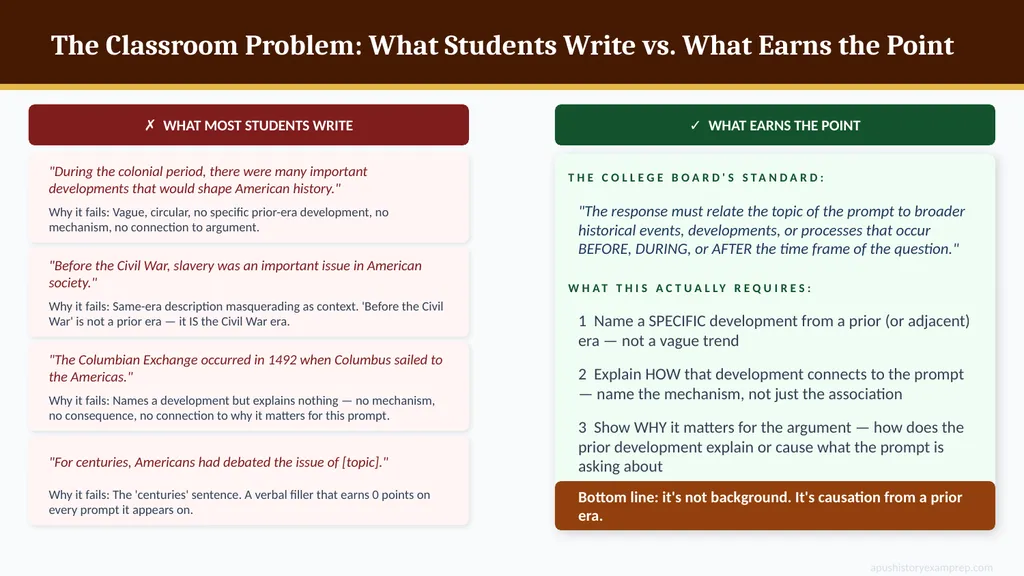
The Classroom Problem: What Students Write vs. What Earns the Point ✗ WHAT MOST STUDENTS WRITE "During the colonial period, there were many important developments that would shape American history." Why it fails: Vague, circular, no specific prior-era development, no mechanism, no connection to argument. "Before the Civil War, slavery was an important issue in American society." Why it fails: Same-era description masquerading as context. 'Before the Civil War' is not a prior era — it IS the Civil War era. "The Columbian Exchange occurred in 1492 when Columbus sailed to the Americas." Why it fails: Names a development but explains nothing — no mechanism, no consequence, no connection to why it matters for this prompt. "For centuries, Americans had debated the issue of [topic]." Why it fails: The 'centuries' sentence. A verbal filler that earns 0 points on every prompt it appears on. ✓ WHAT EARNS THE POINT THE COLLEGE BOARD'S STANDARD: "The response must relate the topic of the prompt to broader historical events, developments, or processes that occur BEFORE, DURING, or AFTER the time frame of the question." WHAT THIS ACTUALLY REQUIRES: 1 Name a SPECIFIC development from a prior (or adjacent) era — not a vague trend 2 Explain HOW that development connects to the prompt — name the mechanism, not just the association 3 Show WHY it matters for the argument — how does the prior development explain or cause what the prompt is asking about Bottom line: it's not background. It's causation from a prior era. apushistoryexamprep.com<br>
03
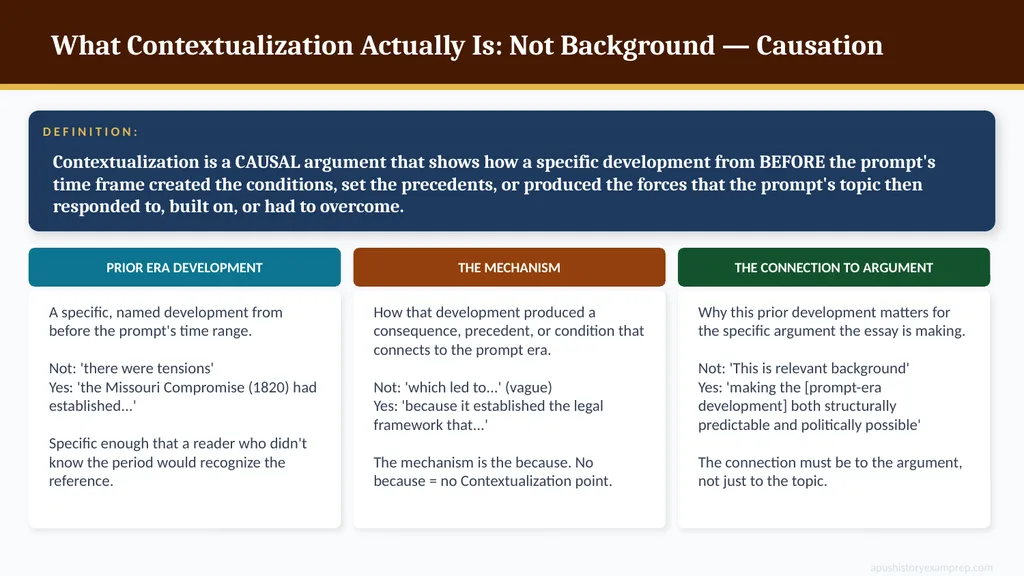
What Contextualization Actually Is: Not Background — Causation DEFINITION: Contextualization is a CAUSAL argument that shows how a specific development from BEFORE the prompt's time frame created the conditions, set the precedents, or produced the forces that the prompt's topic then responded to, built on, or had to overcome. PRIOR ERA DEVELOPMENT A specific, named development from before the prompt's time range.
Not: 'there were tensions'
Yes: 'the Missouri Compromise (1820) had established...'
Specific enough that a reader who didn't know the period would recognize the reference. THE MECHANISM How that development produced a consequence, precedent, or condition that connects to the prompt era.
Not: 'which led to...' (vague)
Yes: 'because it established the legal framework that...'
The mechanism is the because. No because = no Contextualization point. THE CONNECTION TO ARGUMENT Why this prior development matters for the specific argument the essay is making.
Not: 'This is relevant background'
Yes: 'making the [prompt-era development] both structurally predictable and politically possible'
The connection must be to the argument, not just to the topic. apushistoryexamprep.com<br>
Not: 'there were tensions'
Yes: 'the Missouri Compromise (1820) had established...'
Specific enough that a reader who didn't know the period would recognize the reference. THE MECHANISM How that development produced a consequence, precedent, or condition that connects to the prompt era.
Not: 'which led to...' (vague)
Yes: 'because it established the legal framework that...'
The mechanism is the because. No because = no Contextualization point. THE CONNECTION TO ARGUMENT Why this prior development matters for the specific argument the essay is making.
Not: 'This is relevant background'
Yes: 'making the [prompt-era development] both structurally predictable and politically possible'
The connection must be to the argument, not just to the topic. apushistoryexamprep.com<br>
04
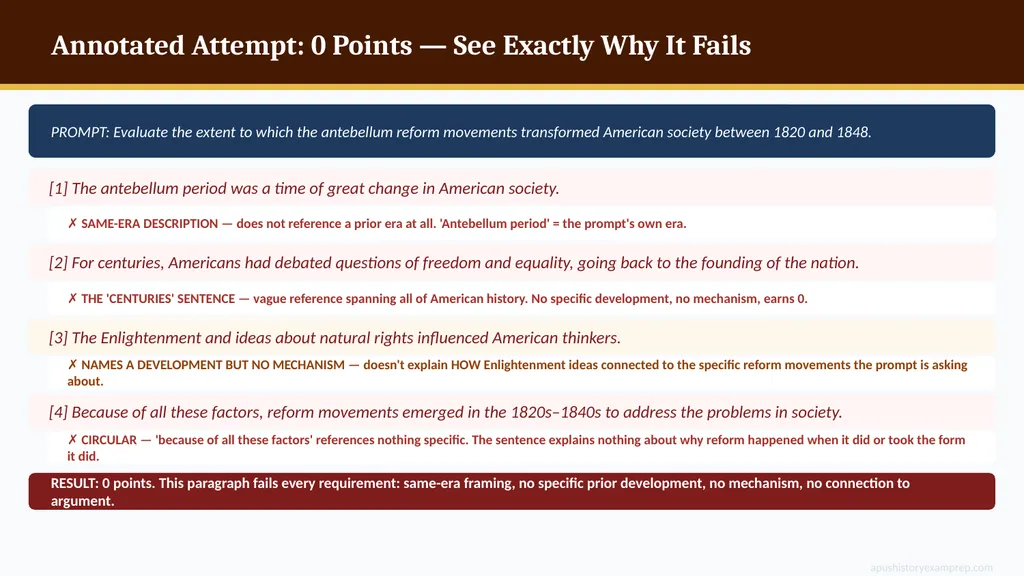
Annotated Attempt: 0 Points — See Exactly Why It Fails PROMPT: Evaluate the extent to which the antebellum reform movements transformed American society between 1820 and 1848. [1] The antebellum period was a time of great change in American society. ✗ SAME-ERA DESCRIPTION — does not reference a prior era at all. 'Antebellum period' = the prompt's own era. [2] For centuries, Americans had debated questions of freedom and equality, going back to the founding of the nation. ✗ THE 'CENTURIES' SENTENCE — vague reference spanning all of American history. No specific development, no mechanism, earns 0. [3] The Enlightenment and ideas about natural rights influenced American thinkers. ✗ NAMES A DEVELOPMENT BUT NO MECHANISM — doesn't explain HOW Enlightenment ideas connected to the specific reform movements the prompt is asking about. [4] Because of all these factors, reform movements emerged in the 1820s–1840s to address the problems in society. ✗ CIRCULAR — 'because of all these factors' references nothing specific. The sentence explains nothing about why reform happened when it did or took the form it did. RESULT: 0 points. This paragraph fails every requirement: same-era framing, no specific prior development, no mechanism, no connection to argument. apushistoryexamprep.com<br>
05
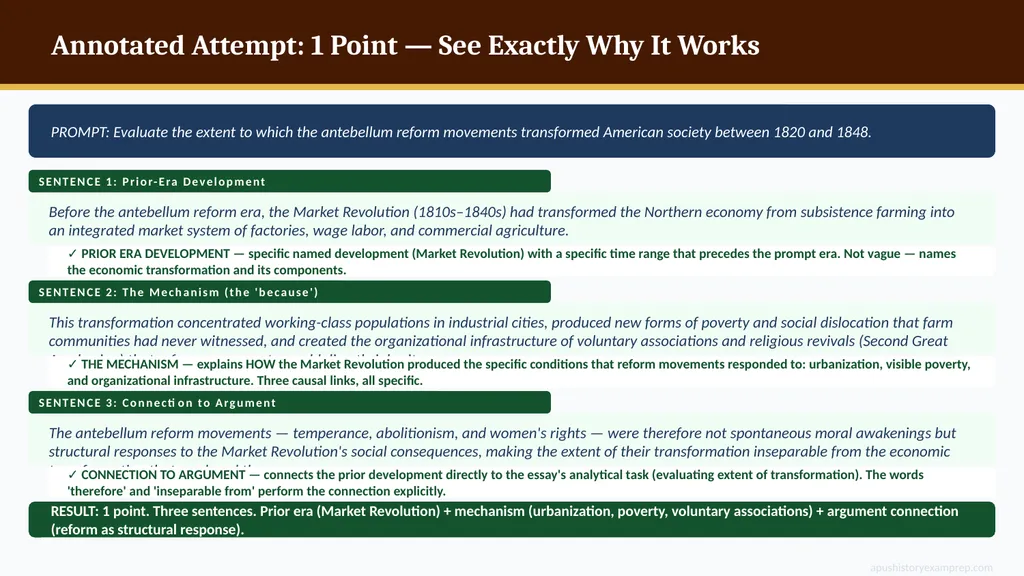
Annotated Attempt: 1 Point — See Exactly Why It Works PROMPT: Evaluate the extent to which the antebellum reform movements transformed American society between 1820 and 1848. SENTENCE 1: Prior-Era Development Before the antebellum reform era, the Market Revolution (1810s–1840s) had transformed the Northern economy from subsistence farming into an integrated market system of factories, wage labor, and commercial agriculture. ✓ PRIOR ERA DEVELOPMENT — specific named development (Market Revolution) with a specific time range that precedes the prompt era. Not vague — names the economic transformation and its components. SENTENCE 2: The Mechanism (the 'because') This transformation concentrated working-class populations in industrial cities, produced new forms of poverty and social dislocation that farm communities had never witnessed, and created the organizational infrastructure of voluntary associations and religious revivals (Second Great Awakening) that reform movements would directly inherit. ✓ THE MECHANISM — explains HOW the Market Revolution produced the specific conditions that reform movements responded to: urbanization, visible poverty, and organizational infrastructure. Three causal links, all specific. SENTENCE 3: Connection to Argument The antebellum reform movements — temperance, abolitionism, and women's rights — were therefore not spontaneous moral awakenings but structural responses to the Market Revolution's social consequences, making the extent of their transformation inseparable from the economic transformation that produced them. ✓ CONNECTION TO ARGUMENT — connects the prior development directly to the essay's analytical task (evaluating extent of transformation). The words 'therefore' and 'inseparable from' perform the connection explicitly. RESULT: 1 point. Three sentences. Prior era (Market Revolution) + mechanism (urbanization, poverty, voluntary associations) + argument connection (reform as structural response). apushistoryexamprep.com<br>
06
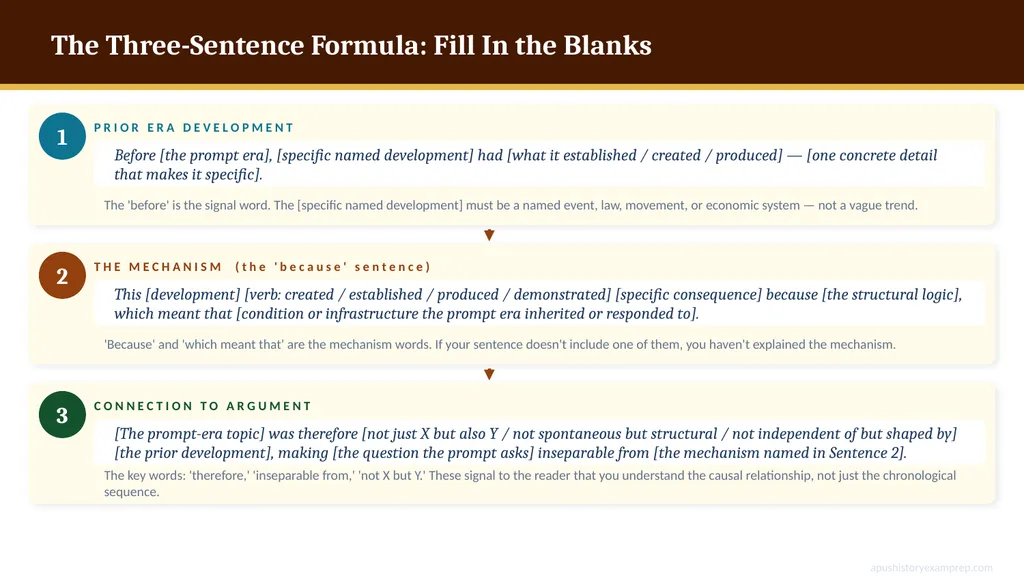
The Three-Sentence Formula: Fill In the Blanks 1 PRIOR ERA DEVELOPMENT Before [the prompt era], [specific named development] had [what it established / created / produced] — [one concrete detail that makes it specific]. The 'before' is the signal word. The [specific named development] must be a named event, law, movement, or economic system — not a vague trend. ▼ 2 THE MECHANISM (the 'because' sentence) This [development] [verb: created / established / produced / demonstrated] [specific consequence] because [the structural logic], which meant that [condition or infrastructure the prompt era inherited or responded to]. 'Because' and 'which meant that' are the mechanism words. If your sentence doesn't include one of them, you haven't explained the mechanism. ▼ 3 CONNECTION TO ARGUMENT [The prompt-era topic] was therefore [not just X but also Y / not spontaneous but structural / not independent of but shaped by] [the prior development], making [the question the prompt asks] inseparable from [the mechanism named in Sentence 2]. The key words: 'therefore,' 'inseparable from,' 'not X but Y.' These signal to the reader that you understand the causal relationship, not just the chronological sequence. apushistoryexamprep.com<br>
07
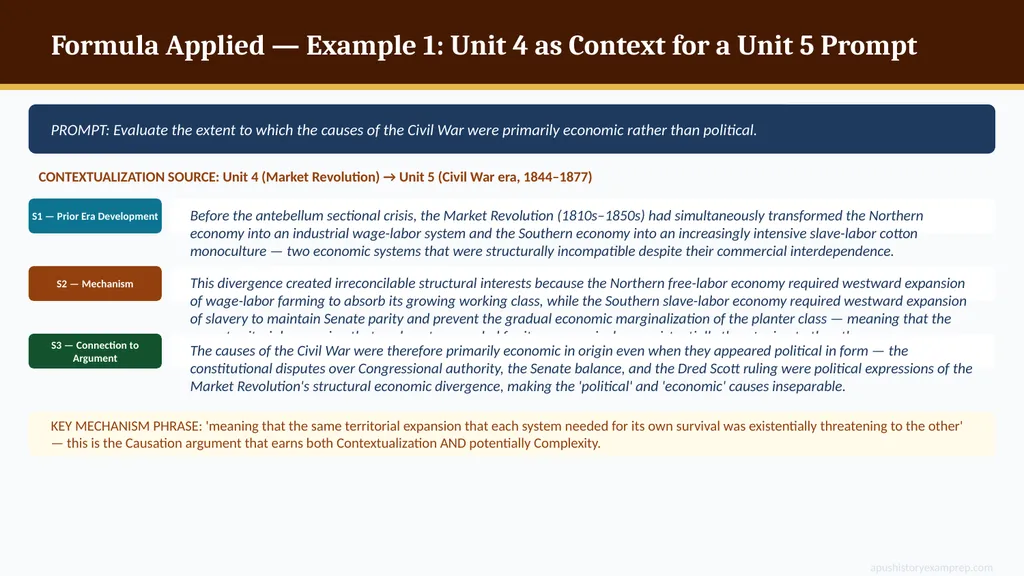
Formula Applied — Example 1: Unit 4 as Context for a Unit 5 Prompt PROMPT: Evaluate the extent to which the causes of the Civil War were primarily economic rather than political. CONTEXTUALIZATION SOURCE: Unit 4 (Market Revolution) → Unit 5 (Civil War era, 1844–1877) S1 — Prior Era Development Before the antebellum sectional crisis, the Market Revolution (1810s–1850s) had simultaneously transformed the Northern economy into an industrial wage-labor system and the Southern economy into an increasingly intensive slave-labor cotton monoculture — two economic systems that were structurally incompatible despite their commercial interdependence. S2 — Mechanism This divergence created irreconcilable structural interests because the Northern free-labor economy required westward expansion of wage-labor farming to absorb its growing working class, while the Southern slave-labor economy required westward expansion of slavery to maintain Senate parity and prevent the gradual economic marginalization of the planter class — meaning that the same territorial expansion that each system needed for its own survival was existentially threatening to the other. S3 — Connection to Argument The causes of the Civil War were therefore primarily economic in origin even when they appeared political in form — the constitutional disputes over Congressional authority, the Senate balance, and the Dred Scott ruling were political expressions of the Market Revolution's structural economic divergence, making the 'political' and 'economic' causes inseparable. KEY MECHANISM PHRASE: 'meaning that the same territorial expansion that each system needed for its own survival was existentially threatening to the other' — this is the Causation argument that earns both Contextualization AND potentially Complexity. apushistoryexamprep.com<br>
08
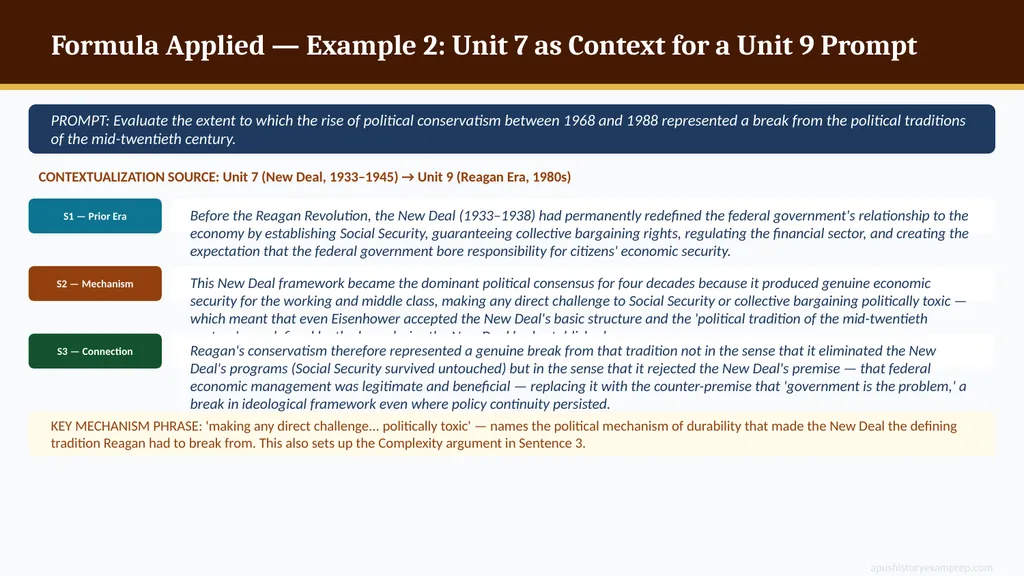
Formula Applied — Example 2: Unit 7 as Context for a Unit 9 Prompt PROMPT: Evaluate the extent to which the rise of political conservatism between 1968 and 1988 represented a break from the political traditions of the mid-twentieth century. CONTEXTUALIZATION SOURCE: Unit 7 (New Deal, 1933–1945) → Unit 9 (Reagan Era, 1980s) S1 — Prior Era Before the Reagan Revolution, the New Deal (1933–1938) had permanently redefined the federal government's relationship to the economy by establishing Social Security, guaranteeing collective bargaining rights, regulating the financial sector, and creating the expectation that the federal government bore responsibility for citizens' economic security. S2 — Mechanism This New Deal framework became the dominant political consensus for four decades because it produced genuine economic security for the working and middle class, making any direct challenge to Social Security or collective bargaining politically toxic — which meant that even Eisenhower accepted the New Deal's basic structure and the 'political tradition of the mid-twentieth century' was defined by the boundaries the New Deal had established. S3 — Connection Reagan's conservatism therefore represented a genuine break from that tradition not in the sense that it eliminated the New Deal's programs (Social Security survived untouched) but in the sense that it rejected the New Deal's premise — that federal economic management was legitimate and beneficial — replacing it with the counter-premise that 'government is the problem,' a break in ideological framework even where policy continuity persisted. KEY MECHANISM PHRASE: 'making any direct challenge... politically toxic' — names the political mechanism of durability that made the New Deal the defining tradition Reagan had to break from. This also sets up the Complexity argument in Sentence 3. apushistoryexamprep.com<br>
09
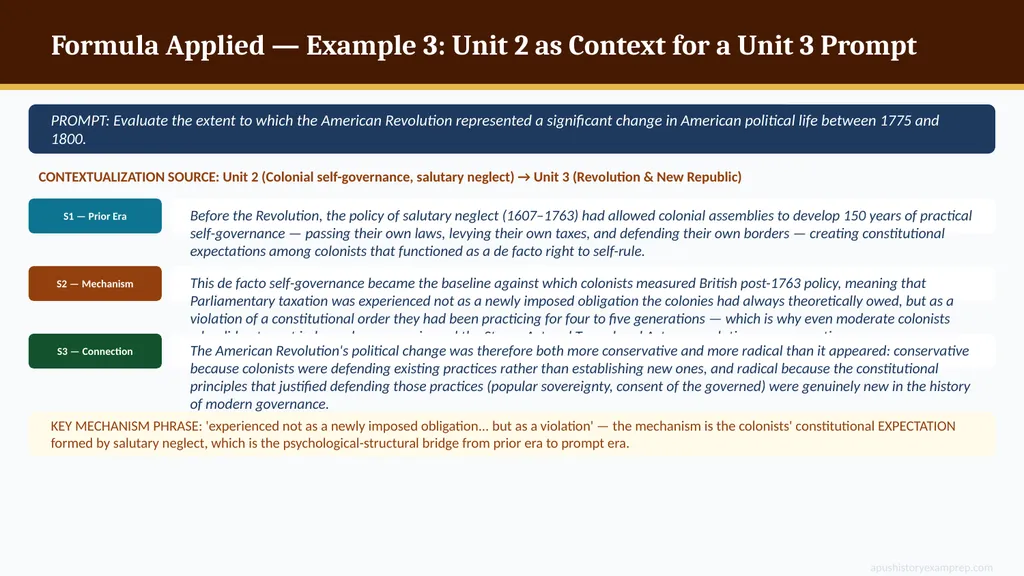
Formula Applied — Example 3: Unit 2 as Context for a Unit 3 Prompt PROMPT: Evaluate the extent to which the American Revolution represented a significant change in American political life between 1775 and 1800. CONTEXTUALIZATION SOURCE: Unit 2 (Colonial self-governance, salutary neglect) → Unit 3 (Revolution & New Republic) S1 — Prior Era Before the Revolution, the policy of salutary neglect (1607–1763) had allowed colonial assemblies to develop 150 years of practical self-governance — passing their own laws, levying their own taxes, and defending their own borders — creating constitutional expectations among colonists that functioned as a de facto right to self-rule. S2 — Mechanism This de facto self-governance became the baseline against which colonists measured British post-1763 policy, meaning that Parliamentary taxation was experienced not as a newly imposed obligation the colonies had always theoretically owed, but as a violation of a constitutional order they had been practicing for four to five generations — which is why even moderate colonists who did not want independence experienced the Stamp Act and Townshend Acts as revolutionary provocations. S3 — Connection The American Revolution's political change was therefore both more conservative and more radical than it appeared: conservative because colonists were defending existing practices rather than establishing new ones, and radical because the constitutional principles that justified defending those practices (popular sovereignty, consent of the governed) were genuinely new in the history of modern governance. KEY MECHANISM PHRASE: 'experienced not as a newly imposed obligation... but as a violation' — the mechanism is the colonists' constitutional EXPECTATION formed by salutary neglect, which is the psychological-structural bridge from prior era to prompt era. apushistoryexamprep.com<br>
10
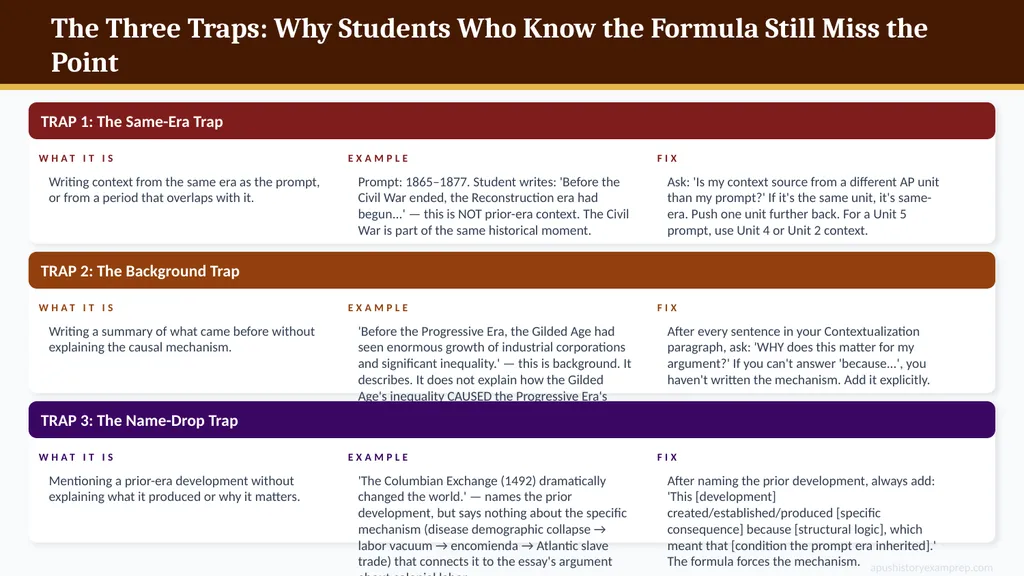
The Three Traps: Why Students Who Know the Formula Still Miss the Point TRAP 1: The Same-Era Trap WHAT IT IS Writing context from the same era as the prompt, or from a period that overlaps with it. EXAMPLE Prompt: 1865–1877. Student writes: 'Before the Civil War ended, the Reconstruction era had begun...' — this is NOT prior-era context. The Civil War is part of the same historical moment. FIX Ask: 'Is my context source from a different AP unit than my prompt?' If it's the same unit, it's same-era. Push one unit further back. For a Unit 5 prompt, use Unit 4 or Unit 2 context. TRAP 2: The Background Trap WHAT IT IS Writing a summary of what came before without explaining the causal mechanism. EXAMPLE 'Before the Progressive Era, the Gilded Age had seen enormous growth of industrial corporations and significant inequality.' — this is background. It describes. It does not explain how the Gilded Age's inequality CAUSED the Progressive Era's specific reform agenda. FIX After every sentence in your Contextualization paragraph, ask: 'WHY does this matter for my argument?' If you can't answer 'because...', you haven't written the mechanism. Add it explicitly. TRAP 3: The Name-Drop Trap WHAT IT IS Mentioning a prior-era development without explaining what it produced or why it matters. EXAMPLE 'The Columbian Exchange (1492) dramatically changed the world.' — names the prior development, but says nothing about the specific mechanism (disease demographic collapse → labor vacuum → encomienda → Atlantic slave trade) that connects it to the essay's argument about colonial labor. FIX After naming the prior development, always add: 'This [development] created/established/produced [specific consequence] because [structural logic], which meant that [condition the prompt era inherited].' The formula forces the mechanism. apushistoryexamprep.com<br>
11
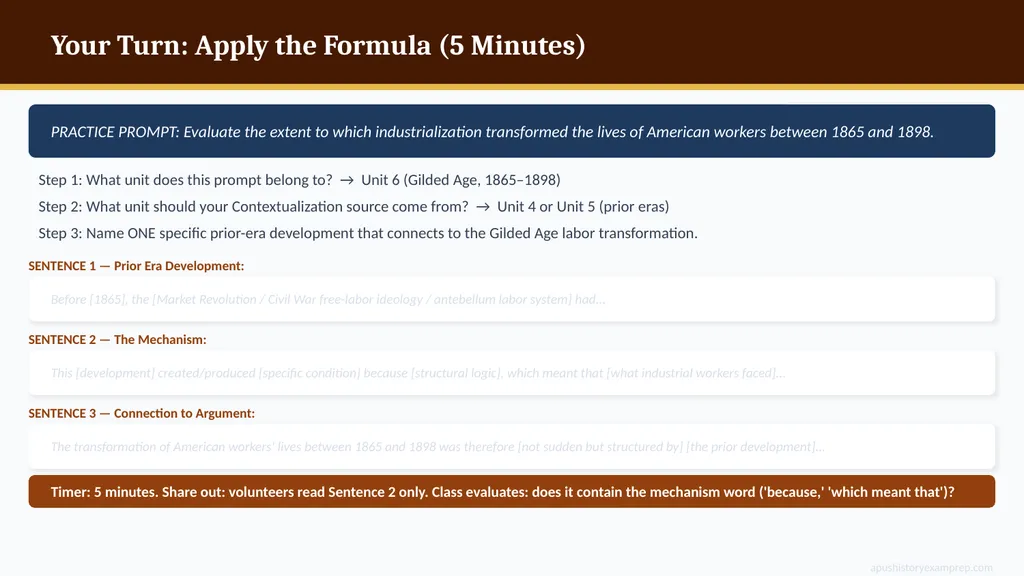
Your Turn: Apply the Formula (5 Minutes) PRACTICE PROMPT: Evaluate the extent to which industrialization transformed the lives of American workers between 1865 and 1898. Step 1: What unit does this prompt belong to? → Unit 6 (Gilded Age, 1865–1898) Step 2: What unit should your Contextualization source come from? → Unit 4 or Unit 5 (prior eras) Step 3: Name ONE specific prior-era development that connects to the Gilded Age labor transformation. SENTENCE 1 — Prior Era Development: Before [1865], the [Market Revolution / Civil War free-labor ideology / antebellum labor system] had... SENTENCE 2 — The Mechanism: This [development] created/produced [specific condition] because [structural logic], which meant that [what industrial workers faced]... SENTENCE 3 — Connection to Argument: The transformation of American workers' lives between 1865 and 1898 was therefore [not sudden but structured by] [the prior development]... Timer: 5 minutes. Share out: volunteers read Sentence 2 only. Class evaluates: does it contain the mechanism word ('because,' 'which meant that')? apushistoryexamprep.com<br>
12
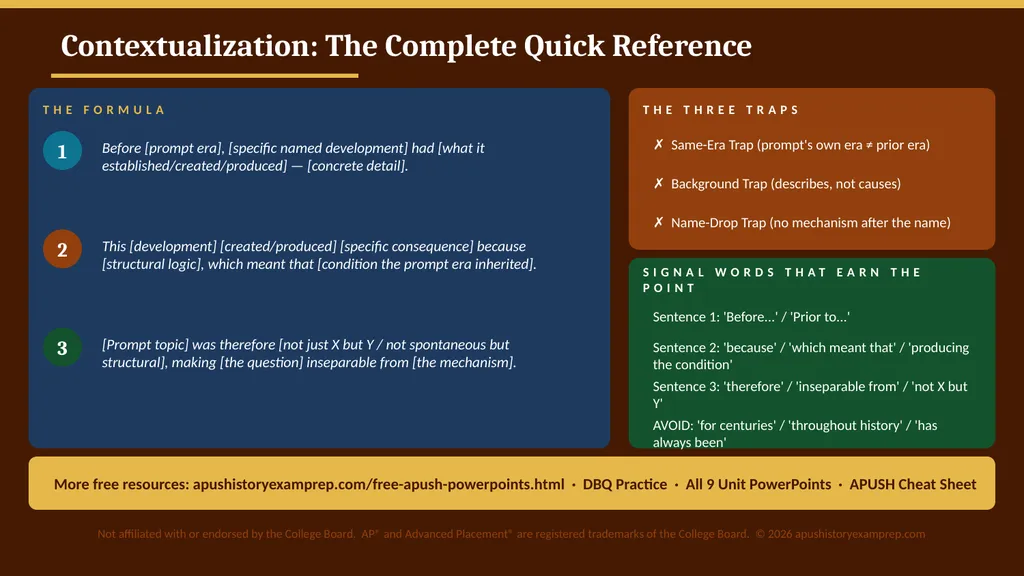
Contextualization: The Complete Quick Reference THE FORMULA 1 Before [prompt era], [specific named development] had [what it established/created/produced] — [concrete detail]. 2 This [development] [created/produced] [specific consequence] because [structural logic], which meant that [condition the prompt era inherited]. 3 [Prompt topic] was therefore [not just X but Y / not spontaneous but structural], making [the question] inseparable from [the mechanism]. THE THREE TRAPS ✗ Same-Era Trap (prompt's own era ≠ prior era) ✗ Background Trap (describes, not causes) ✗ Name-Drop Trap (no mechanism after the name) SIGNAL WORDS THAT EARN THE POINT Sentence 1: 'Before...' / 'Prior to...' Sentence 2: 'because' / 'which meant that' / 'producing the condition' Sentence 3: 'therefore' / 'inseparable from' / 'not X but Y' AVOID: 'for centuries' / 'throughout history' / 'has always been' More free resources: apushistoryexamprep.com/free-apush-powerpoints.html · DBQ Practice · All 9 Unit PowerPoints · APUSH Cheat Sheet Not affiliated with or endorsed by the College Board. AP® and Advanced Placement® are registered trademarks of the College Board. © 2026 apushistoryexamprep.com<br>