
Deadly Justice, Ch 15-16 Deterrence, then
JO
Published · 27 slides · 0 views
1 / 1
Description
Deadly Justice, Ch 15-16 Deterrence, then Declining Use March 9, 2022 Baumgartner, POLI 203, Spring 2022 1 Some announcements first Kristine Bunchs email: kristinejustis4justus.org All the addresses for the individuals who have called in
Related Topics
Share
Embed code
Download this presentation From Below
"Deadly Justice, Ch 15-16 Deterrence, then" is the property of its rightful owner. Permission is granted to download and print the materials on this website for personal, non-commercial use only, and to display it on your personal computer provided you do not modify the materials and that you retain all copyright notices contained in the materials. By downloading content from our website, you accept the terms of this agreement.
Presentation Transcript
01
Deadly Justice, Ch 15-16
Deterrence, then Declining Use March 9, 2022 Baumgartner, POLI 203, Spring 2022 1<br>
02
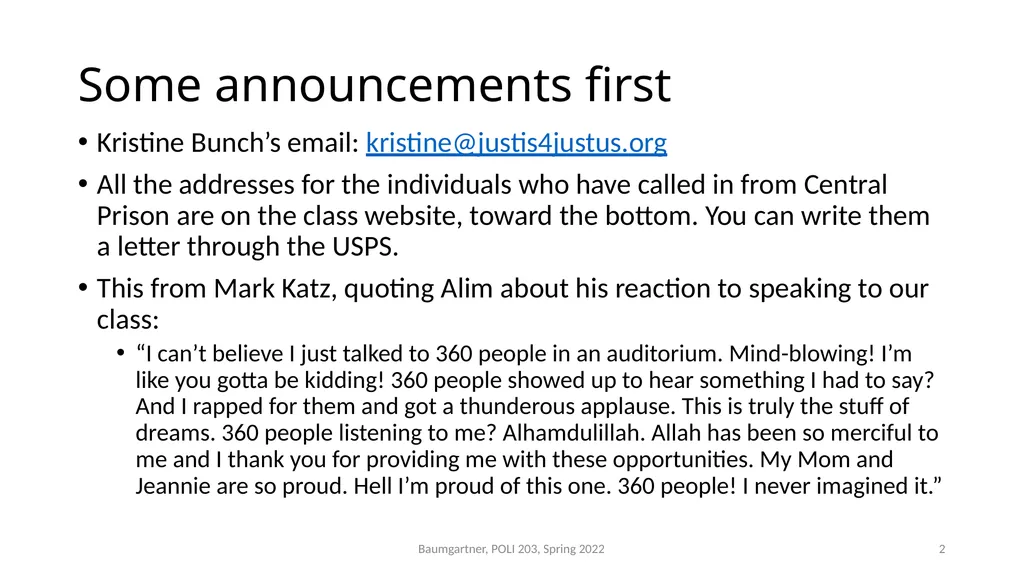
Some announcements first Kristine Bunch’s email: kristine@justis4justus.org
All the addresses for the individuals who have called in from Central Prison are on the class website, toward the bottom. You can write them a letter through the USPS.
This from Mark Katz, quoting Alim about his reaction to speaking to our class:
“I can’t believe I just talked to 360 people in an auditorium. Mind-blowing! I’m like you gotta be kidding! 360 people showed up to hear something I had to say? And I rapped for them and got a thunderous applause. This is truly the stuff of dreams. 360 people listening to me? Alhamdulillah. Allah has been so merciful to me and I thank you for providing me with these opportunities. My Mom and Jeannie are so proud. Hell I’m proud of this one. 360 people! I never imagined it.” Baumgartner, POLI 203, Spring 2022 2<br>
All the addresses for the individuals who have called in from Central Prison are on the class website, toward the bottom. You can write them a letter through the USPS.
This from Mark Katz, quoting Alim about his reaction to speaking to our class:
“I can’t believe I just talked to 360 people in an auditorium. Mind-blowing! I’m like you gotta be kidding! 360 people showed up to hear something I had to say? And I rapped for them and got a thunderous applause. This is truly the stuff of dreams. 360 people listening to me? Alhamdulillah. Allah has been so merciful to me and I thank you for providing me with these opportunities. My Mom and Jeannie are so proud. Hell I’m proud of this one. 360 people! I never imagined it.” Baumgartner, POLI 203, Spring 2022 2<br>
03
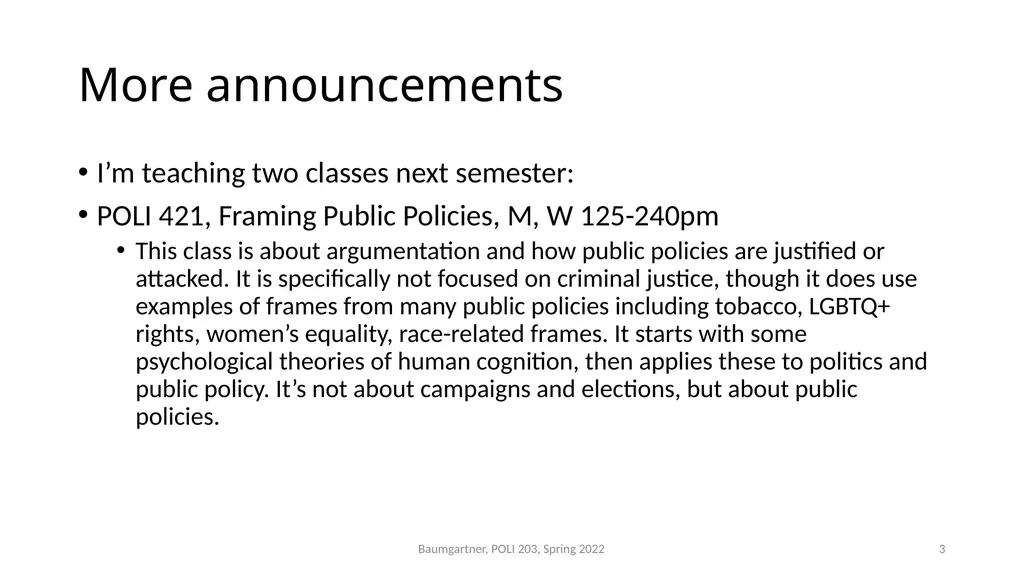
More announcements I’m teaching two classes next semester:
POLI 421, Framing Public Policies, M, W 125-240pm
This class is about argumentation and how public policies are justified or attacked. It is specifically not focused on criminal justice, though it does use examples of frames from many public policies including tobacco, LGBTQ+ rights, women’s equality, race-related frames. It starts with some psychological theories of human cognition, then applies these to politics and public policy. It’s not about campaigns and elections, but about public policies. Baumgartner, POLI 203, Spring 2022 3<br>
POLI 421, Framing Public Policies, M, W 125-240pm
This class is about argumentation and how public policies are justified or attacked. It is specifically not focused on criminal justice, though it does use examples of frames from many public policies including tobacco, LGBTQ+ rights, women’s equality, race-related frames. It starts with some psychological theories of human cognition, then applies these to politics and public policy. It’s not about campaigns and elections, but about public policies. Baumgartner, POLI 203, Spring 2022 3<br>
04
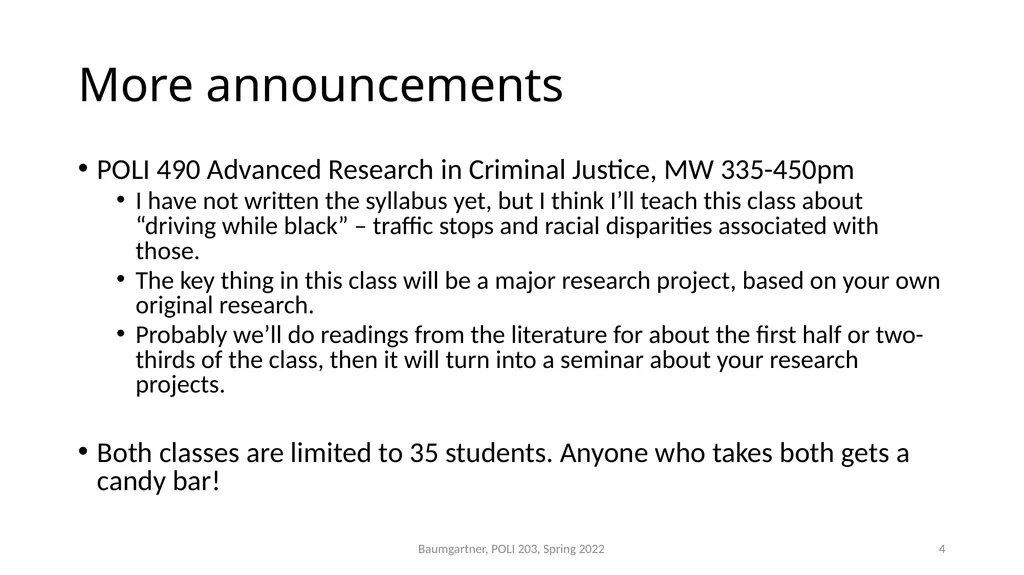
More announcements POLI 490 Advanced Research in Criminal Justice, MW 335-450pm
I have not written the syllabus yet, but I think I’ll teach this class about “driving while black” – traffic stops and racial disparities associated with those.
The key thing in this class will be a major research project, based on your own original research.
Probably we’ll do readings from the literature for about the first half or two-thirds of the class, then it will turn into a seminar about your research projects.
Both classes are limited to 35 students. Anyone who takes both gets a candy bar! Baumgartner, POLI 203, Spring 2022 4<br>
I have not written the syllabus yet, but I think I’ll teach this class about “driving while black” – traffic stops and racial disparities associated with those.
The key thing in this class will be a major research project, based on your own original research.
Probably we’ll do readings from the literature for about the first half or two-thirds of the class, then it will turn into a seminar about your research projects.
Both classes are limited to 35 students. Anyone who takes both gets a candy bar! Baumgartner, POLI 203, Spring 2022 4<br>
05
Deterrence How it was used in Furman and Gregg
Evidence and studies
Where we stand today on deterrence
Public opinion on deterrence Baumgartner, POLI 203, Spring 2022 5<br>
Evidence and studies
Where we stand today on deterrence
Public opinion on deterrence Baumgartner, POLI 203, Spring 2022 5<br>
06
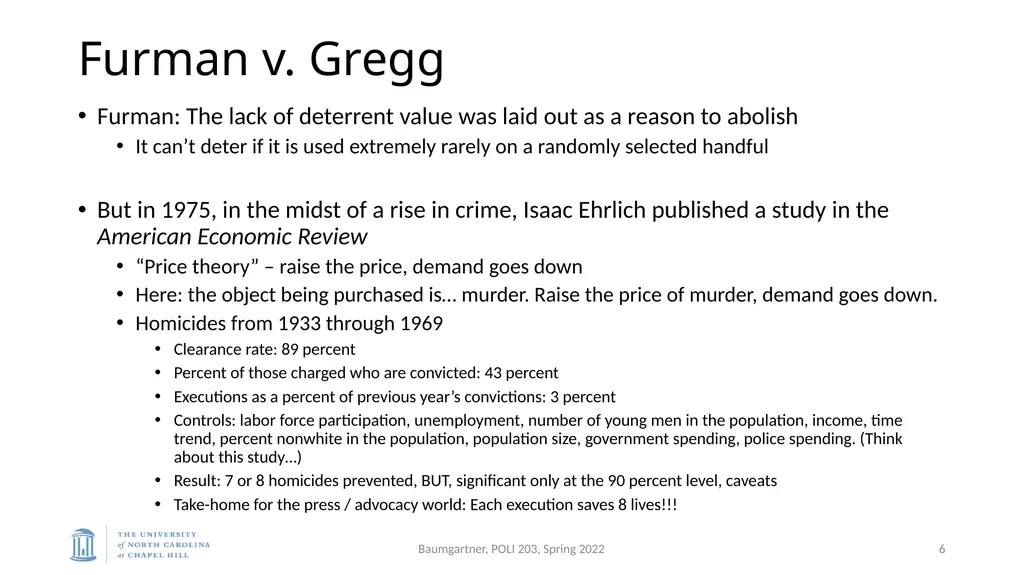
Furman v. Gregg Furman: The lack of deterrent value was laid out as a reason to abolish
It can’t deter if it is used extremely rarely on a randomly selected handful
But in 1975, in the midst of a rise in crime, Isaac Ehrlich published a study in the American Economic Review
“Price theory” – raise the price, demand goes down
Here: the object being purchased is… murder. Raise the price of murder, demand goes down.
Homicides from 1933 through 1969
Clearance rate: 89 percent
Percent of those charged who are convicted: 43 percent
Executions as a percent of previous year’s convictions: 3 percent
Controls: labor force participation, unemployment, number of young men in the population, income, time trend, percent nonwhite in the population, population size, government spending, police spending. (Think about this study…)
Result: 7 or 8 homicides prevented, BUT, significant only at the 90 percent level, caveats
Take-home for the press / advocacy world: Each execution saves 8 lives!!! Baumgartner, POLI 203, Spring 2022 6<br>
It can’t deter if it is used extremely rarely on a randomly selected handful
But in 1975, in the midst of a rise in crime, Isaac Ehrlich published a study in the American Economic Review
“Price theory” – raise the price, demand goes down
Here: the object being purchased is… murder. Raise the price of murder, demand goes down.
Homicides from 1933 through 1969
Clearance rate: 89 percent
Percent of those charged who are convicted: 43 percent
Executions as a percent of previous year’s convictions: 3 percent
Controls: labor force participation, unemployment, number of young men in the population, income, time trend, percent nonwhite in the population, population size, government spending, police spending. (Think about this study…)
Result: 7 or 8 homicides prevented, BUT, significant only at the 90 percent level, caveats
Take-home for the press / advocacy world: Each execution saves 8 lives!!! Baumgartner, POLI 203, Spring 2022 6<br>
07
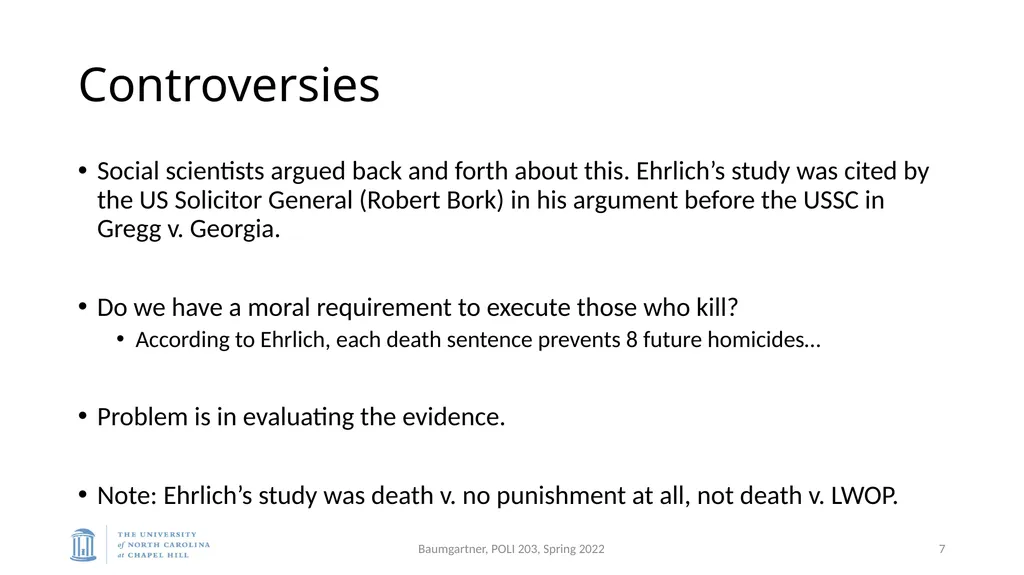
Controversies Social scientists argued back and forth about this. Ehrlich’s study was cited by the US Solicitor General (Robert Bork) in his argument before the USSC in Gregg v. Georgia.
Do we have a moral requirement to execute those who kill?
According to Ehrlich, each death sentence prevents 8 future homicides…
Problem is in evaluating the evidence.
Note: Ehrlich’s study was death v. no punishment at all, not death v. LWOP. Baumgartner, POLI 203, Spring 2022 7<br>
Do we have a moral requirement to execute those who kill?
According to Ehrlich, each death sentence prevents 8 future homicides…
Problem is in evaluating the evidence.
Note: Ehrlich’s study was death v. no punishment at all, not death v. LWOP. Baumgartner, POLI 203, Spring 2022 7<br>
08
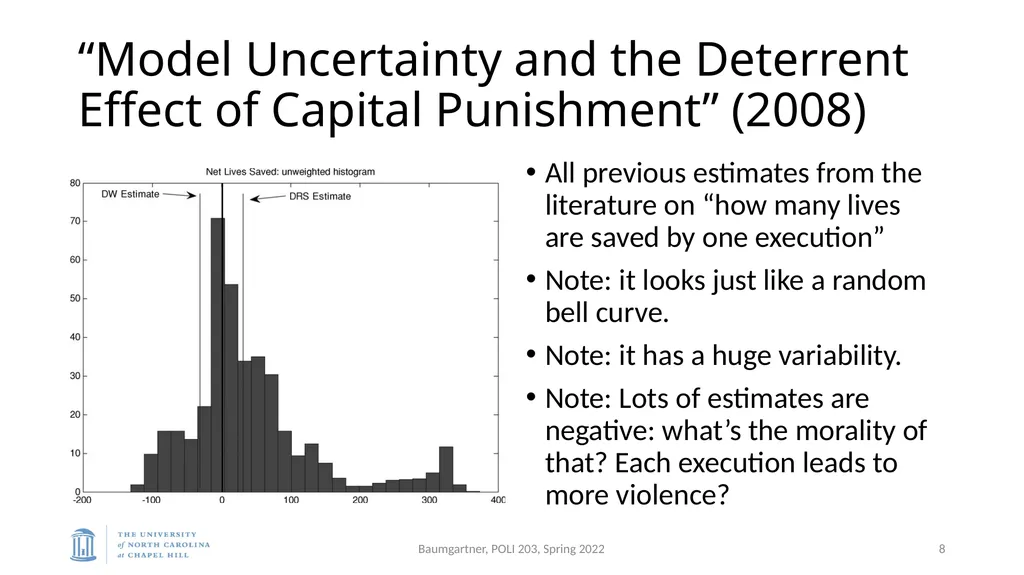
“Model Uncertainty and the Deterrent Effect of Capital Punishment” (2008) All previous estimates from the literature on “how many lives are saved by one execution”
Note: it looks just like a random bell curve.
Note: it has a huge variability.
Note: Lots of estimates are negative: what’s the morality of that? Each execution leads to more violence? Baumgartner, POLI 203, Spring 2022 8<br>
Note: it looks just like a random bell curve.
Note: it has a huge variability.
Note: Lots of estimates are negative: what’s the morality of that? Each execution leads to more violence? Baumgartner, POLI 203, Spring 2022 8<br>
09
National Academy of Sciences review NAS brought together a committee to review the issue
2002 report, then updated in 2014
Conclusion: studies on this topic are “not informative”
The science on this question is clear: we don’t know.
But note that virtually none of the studies have been psychologically reasonable: from the perspective of the potential killer, do we really think they are considering this? Baumgartner, POLI 203, Spring 2022 9<br>
2002 report, then updated in 2014
Conclusion: studies on this topic are “not informative”
The science on this question is clear: we don’t know.
But note that virtually none of the studies have been psychologically reasonable: from the perspective of the potential killer, do we really think they are considering this? Baumgartner, POLI 203, Spring 2022 9<br>
10
Public Opinion on Deterrence People tend to believe in deterrence, or used to.
Trend is sharply downward over time; see Gallup poll results: 1985, 62-32 yes. 2011, 32-64 no.
People do cite deterrence as a reason to support or oppose.
Retribution, deterrence often the most common pro-DP arguments
Decline in belief in the deterrence value is part of the explanation for the decline in DP opinion generally
LWOP, another form of the death penalty, has undercut the deterrence argument: which would deter more? 50 years in a cage, until you die of old age, or a rapid execution? Baumgartner, POLI 203, Spring 2022 10<br>
Trend is sharply downward over time; see Gallup poll results: 1985, 62-32 yes. 2011, 32-64 no.
People do cite deterrence as a reason to support or oppose.
Retribution, deterrence often the most common pro-DP arguments
Decline in belief in the deterrence value is part of the explanation for the decline in DP opinion generally
LWOP, another form of the death penalty, has undercut the deterrence argument: which would deter more? 50 years in a cage, until you die of old age, or a rapid execution? Baumgartner, POLI 203, Spring 2022 10<br>
11
The strange argument about deterrence The “rational murderer”
Calculate the benefit of the crime
Calculate the odds of being captured by the police x the odds of being sentenced to death x the odds of that sentence being carried out, assign values to these outcomes
Compare the cost and the benefit, then act accordingly.
Note most models relate to the odds of being caught at all, not being caught then subject to this v. that punishment, so they are not even good approximations of the “murderer’s calculation”.
More typical murderers
Mentally deranged, either permanently or at the time of the crime
Strung out on drugs or alcohol or both
Completely unaware, as you were before this class started, about the odds of various punishments, given a homicide. Baumgartner, POLI 203, Spring 2022 11<br>
Calculate the benefit of the crime
Calculate the odds of being captured by the police x the odds of being sentenced to death x the odds of that sentence being carried out, assign values to these outcomes
Compare the cost and the benefit, then act accordingly.
Note most models relate to the odds of being caught at all, not being caught then subject to this v. that punishment, so they are not even good approximations of the “murderer’s calculation”.
More typical murderers
Mentally deranged, either permanently or at the time of the crime
Strung out on drugs or alcohol or both
Completely unaware, as you were before this class started, about the odds of various punishments, given a homicide. Baumgartner, POLI 203, Spring 2022 11<br>
12
Let’s say deterrence was indeed a thing… Police clearance rates are more important: What’s the odds of getting caught in the first place
Comparison should be to the next available punishment: LWOP
It’s not even clear that most individuals, if they thought about it, would find a death sentence worse than LWOP…
Also note no one ever paid attention to the issue of most death sentences being overturned, and only a few carried out.
So this literature is a Big Mess, really based on some ideological wishful thinking, or just assuming that there must be deterrence, and the harsher the punishment, the more the deterrence. But it’s more complicated than that. Baumgartner, POLI 203, Spring 2022 12<br>
Comparison should be to the next available punishment: LWOP
It’s not even clear that most individuals, if they thought about it, would find a death sentence worse than LWOP…
Also note no one ever paid attention to the issue of most death sentences being overturned, and only a few carried out.
So this literature is a Big Mess, really based on some ideological wishful thinking, or just assuming that there must be deterrence, and the harsher the punishment, the more the deterrence. But it’s more complicated than that. Baumgartner, POLI 203, Spring 2022 12<br>
13
Declining Use (BTW, at this time in the class 2 years ago, we went remote, ugh…)
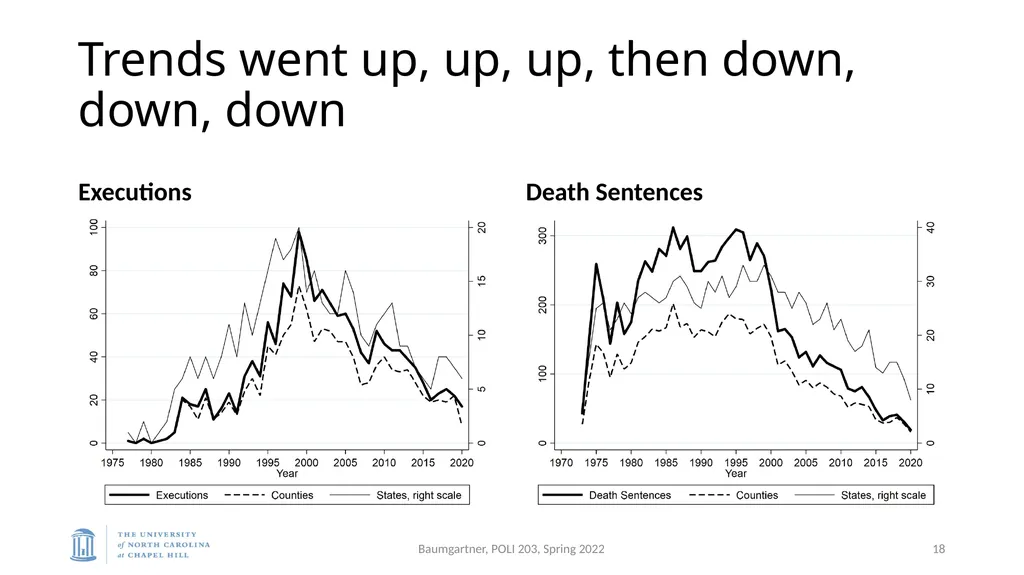
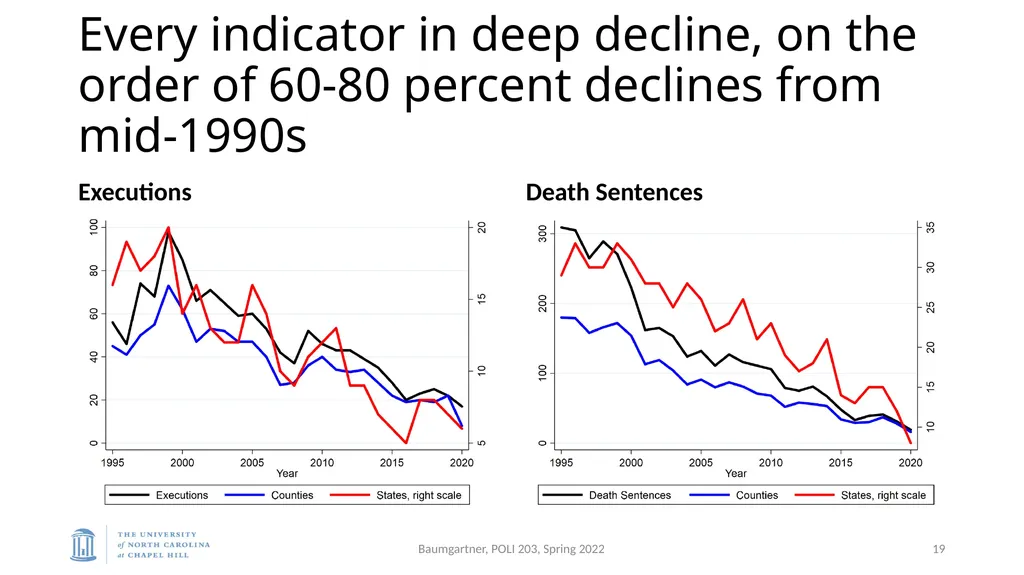
Numbers in sharp decline since peak in mid-1990s
Death sentences, executions, states abolishing, number of states no longer using, number of counties sentencing is lower and lower
What are / could be the constitutional issues associated with that?
Evolving standards of decency: we don’t do this any more…
Equal protection of the law: it can’t be just the county that determines your punishment… Baumgartner, POLI 203, Spring 2022 13<br>
Numbers in sharp decline since peak in mid-1990s
Death sentences, executions, states abolishing, number of states no longer using, number of counties sentencing is lower and lower
What are / could be the constitutional issues associated with that?
Evolving standards of decency: we don’t do this any more…
Equal protection of the law: it can’t be just the county that determines your punishment… Baumgartner, POLI 203, Spring 2022 13<br>
14
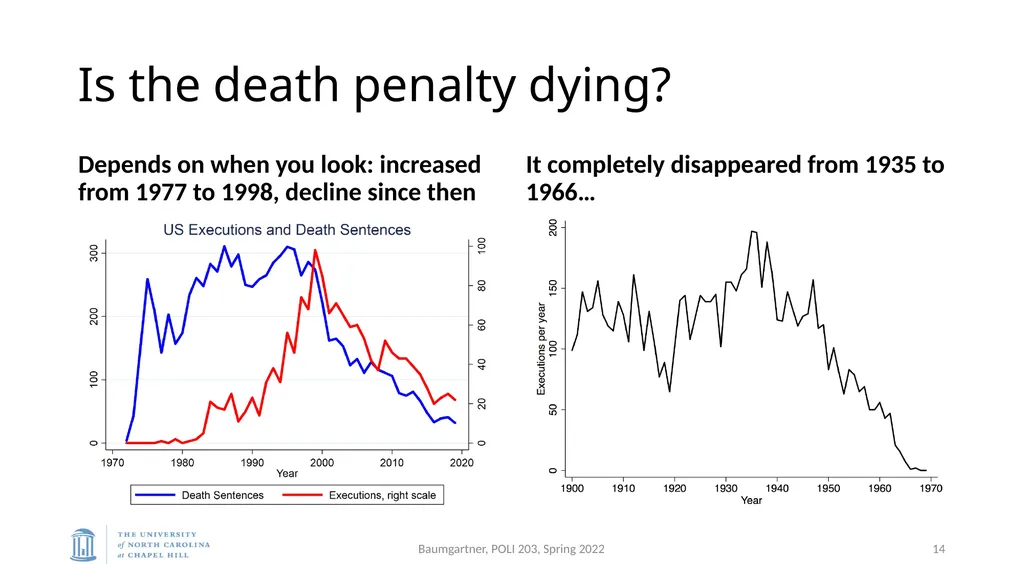
Is the death penalty dying? Depends on when you look: increased from 1977 to 1998, decline since then It completely disappeared from 1935 to 1966… Baumgartner, POLI 203, Spring 2022 14<br>
15
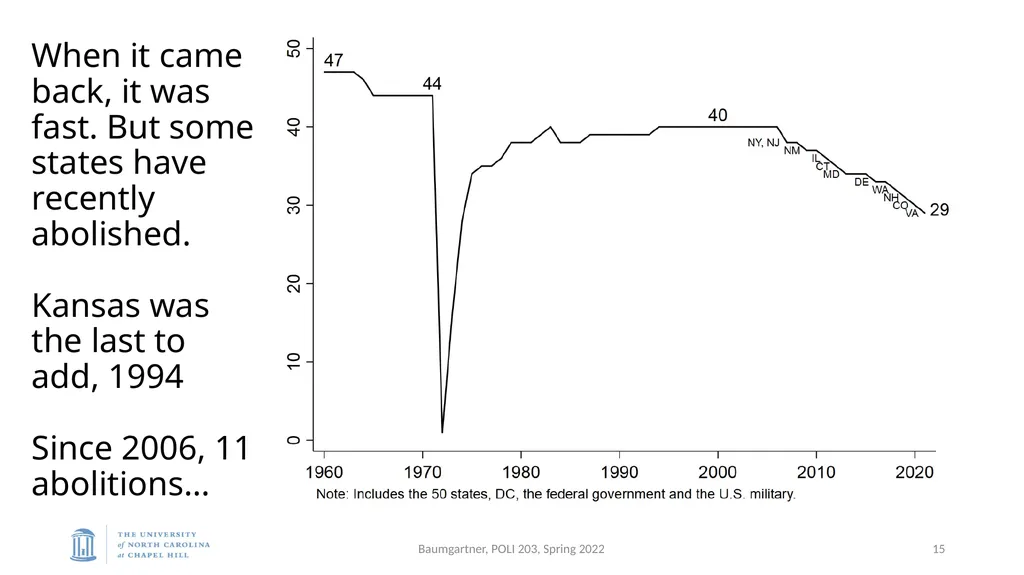
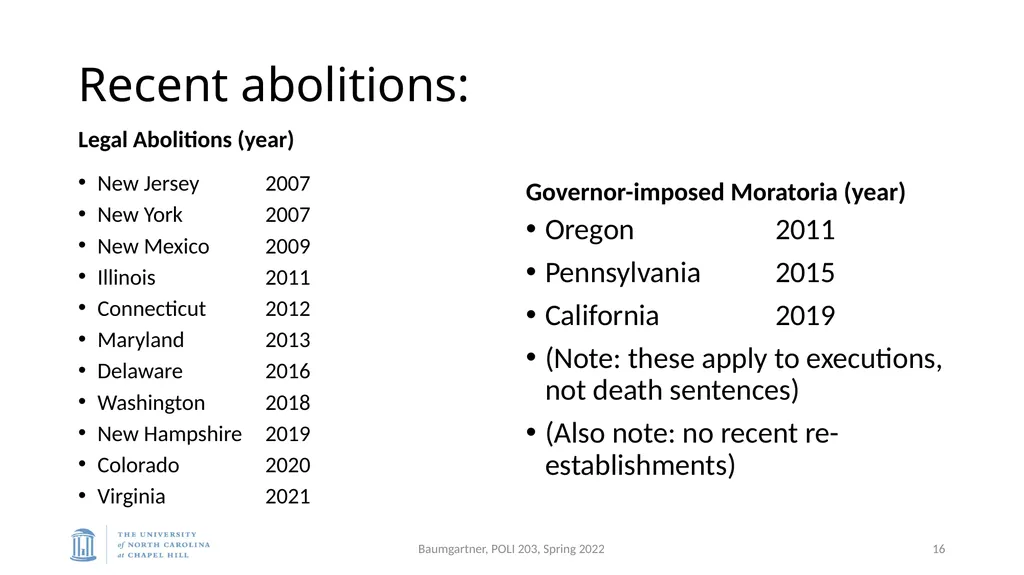
When it came back, it was fast. But some states have recently abolished.
Kansas was the last to add, 1994
Since 2006, 11 abolitions… Baumgartner, POLI 203, Spring 2022 15<br>
16
Recent abolitions: Legal Abolitions (year) New Jersey 2007
New York 2007
New Mexico 2009
Illinois 2011
Connecticut 2012
Maryland 2013
Delaware 2016
Washington 2018
New Hampshire 2019
Colorado 2020
Virginia 2021 Governor-imposed Moratoria (year) Oregon 2011
Pennsylvania 2015
California 2019
(Note: these apply to executions, not death sentences)
(Also note: no recent re-establishments) Baumgartner, POLI 203, Spring 2022 16<br>
New York 2007
New Mexico 2009
Illinois 2011
Connecticut 2012
Maryland 2013
Delaware 2016
Washington 2018
New Hampshire 2019
Colorado 2020
Virginia 2021 Governor-imposed Moratoria (year) Oregon 2011
Pennsylvania 2015
California 2019
(Note: these apply to executions, not death sentences)
(Also note: no recent re-establishments) Baumgartner, POLI 203, Spring 2022 16<br>
17
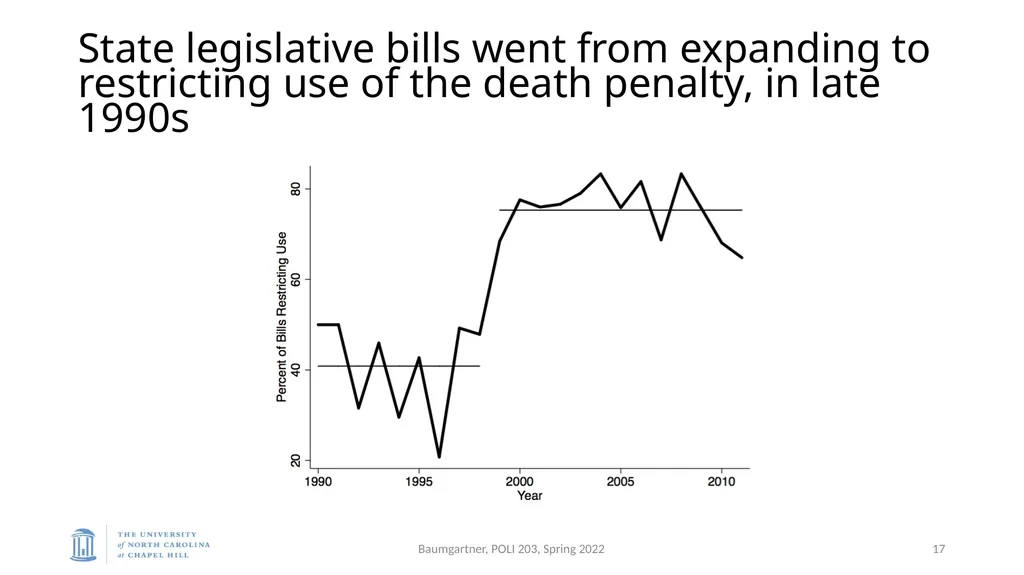
State legislative bills went from expanding to restricting use of the death penalty, in late 1990s Baumgartner, POLI 203, Spring 2022 17<br>
18
Trends went up, up, up, then down, down, down Executions Death Sentences Baumgartner, POLI 203, Spring 2022 18<br>
19
Every indicator in deep decline, on the order of 60-80 percent declines from mid-1990s Executions Death Sentences Baumgartner, POLI 203, Spring 2022 19<br>
20
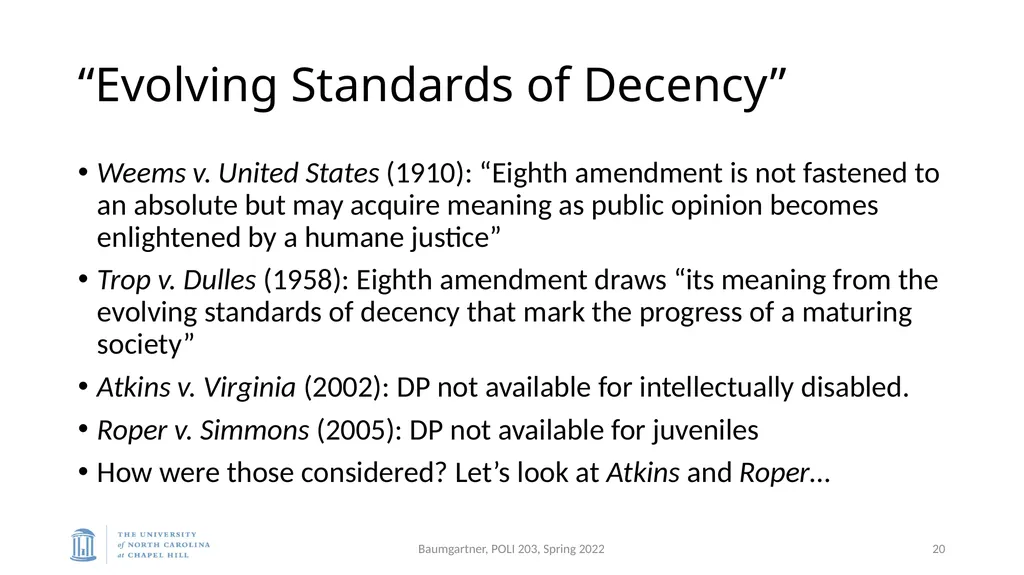
“Evolving Standards of Decency” Weems v. United States (1910): “Eighth amendment is not fastened to an absolute but may acquire meaning as public opinion becomes enlightened by a humane justice”
Trop v. Dulles (1958): Eighth amendment draws “its meaning from the evolving standards of decency that mark the progress of a maturing society”
Atkins v. Virginia (2002): DP not available for intellectually disabled.
Roper v. Simmons (2005): DP not available for juveniles
How were those considered? Let’s look at Atkins and Roper… Baumgartner, POLI 203, Spring 2022 20<br>
Trop v. Dulles (1958): Eighth amendment draws “its meaning from the evolving standards of decency that mark the progress of a maturing society”
Atkins v. Virginia (2002): DP not available for intellectually disabled.
Roper v. Simmons (2005): DP not available for juveniles
How were those considered? Let’s look at Atkins and Roper… Baumgartner, POLI 203, Spring 2022 20<br>
21
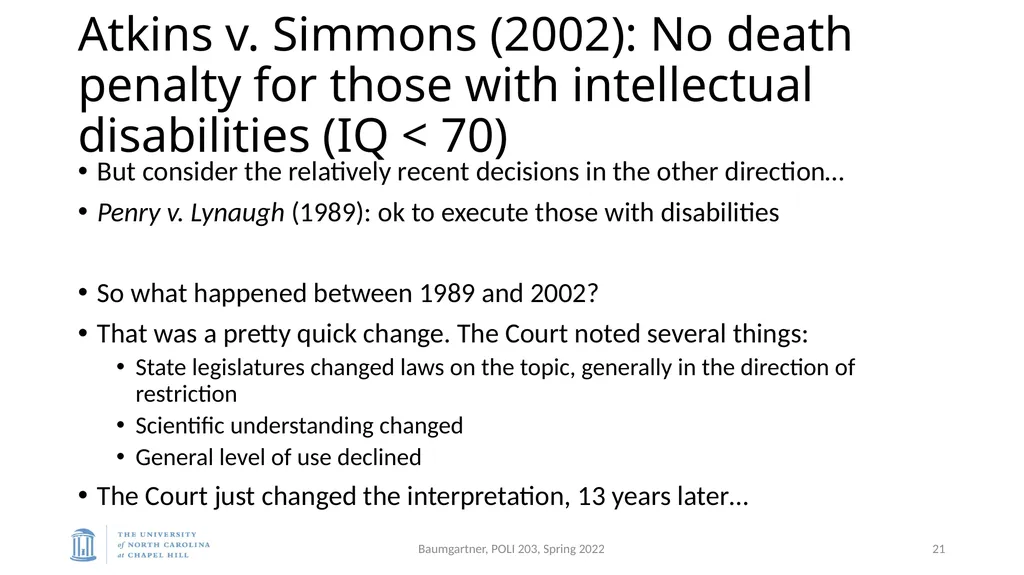
Atkins v. Simmons (2002): No death penalty for those with intellectual disabilities (IQ < 70) But consider the relatively recent decisions in the other direction…
Penry v. Lynaugh (1989): ok to execute those with disabilities
So what happened between 1989 and 2002?
That was a pretty quick change. The Court noted several things:
State legislatures changed laws on the topic, generally in the direction of restriction
Scientific understanding changed
General level of use declined
The Court just changed the interpretation, 13 years later… Baumgartner, POLI 203, Spring 2022 21<br>
Penry v. Lynaugh (1989): ok to execute those with disabilities
So what happened between 1989 and 2002?
That was a pretty quick change. The Court noted several things:
State legislatures changed laws on the topic, generally in the direction of restriction
Scientific understanding changed
General level of use declined
The Court just changed the interpretation, 13 years later… Baumgartner, POLI 203, Spring 2022 21<br>
22
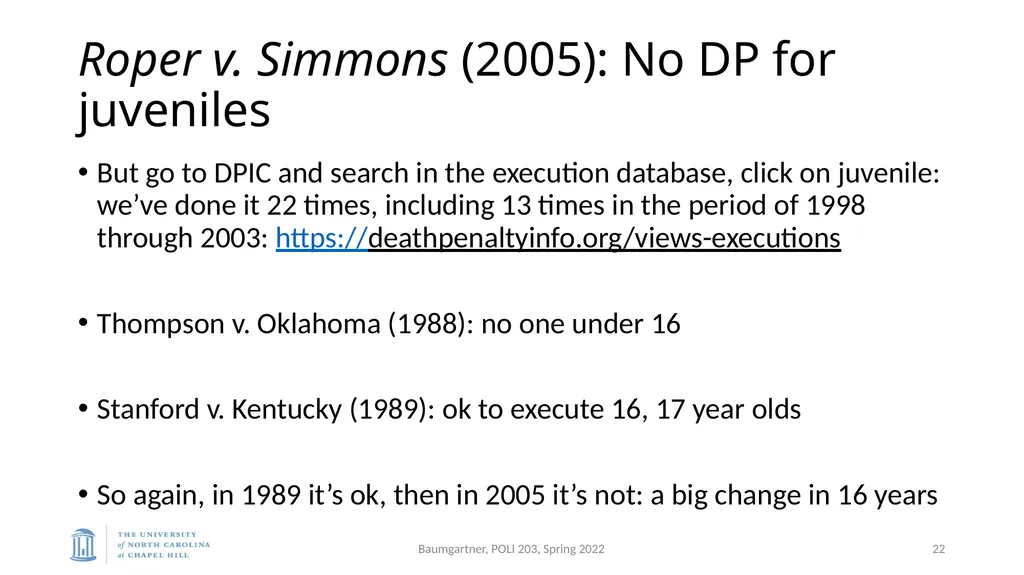
Roper v. Simmons (2005): No DP for juveniles But go to DPIC and search in the execution database, click on juvenile: we’ve done it 22 times, including 13 times in the period of 1998 through 2003: https://deathpenaltyinfo.org/views-executions
Thompson v. Oklahoma (1988): no one under 16
Stanford v. Kentucky (1989): ok to execute 16, 17 year olds
So again, in 1989 it’s ok, then in 2005 it’s not: a big change in 16 years Baumgartner, POLI 203, Spring 2022 22<br>
Thompson v. Oklahoma (1988): no one under 16
Stanford v. Kentucky (1989): ok to execute 16, 17 year olds
So again, in 1989 it’s ok, then in 2005 it’s not: a big change in 16 years Baumgartner, POLI 203, Spring 2022 22<br>
23
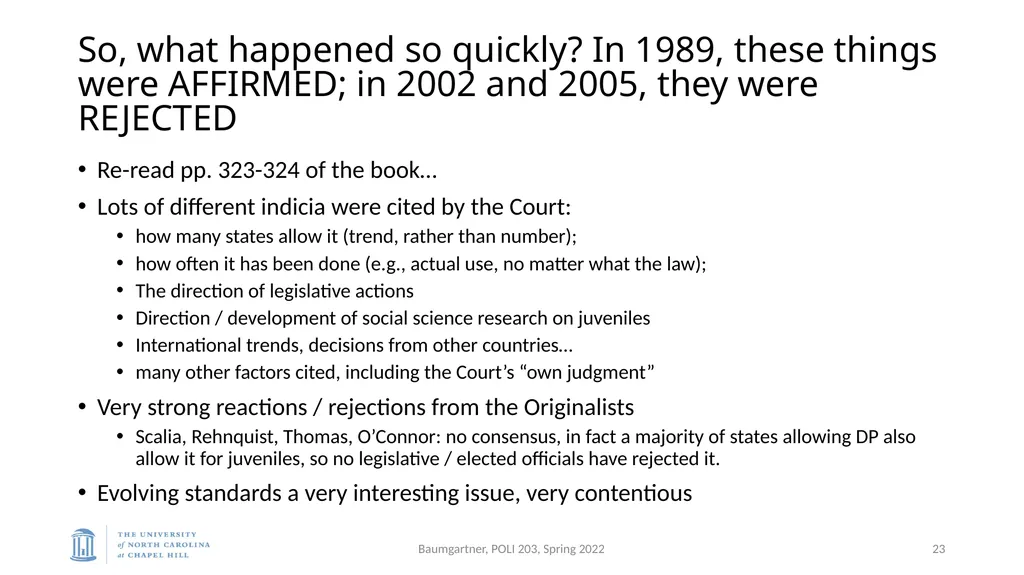
So, what happened so quickly? In 1989, these things were AFFIRMED; in 2002 and 2005, they were REJECTED Re-read pp. 323-324 of the book…
Lots of different indicia were cited by the Court:
how many states allow it (trend, rather than number);
how often it has been done (e.g., actual use, no matter what the law);
The direction of legislative actions
Direction / development of social science research on juveniles
International trends, decisions from other countries…
many other factors cited, including the Court’s “own judgment”
Very strong reactions / rejections from the Originalists
Scalia, Rehnquist, Thomas, O’Connor: no consensus, in fact a majority of states allowing DP also allow it for juveniles, so no legislative / elected officials have rejected it.
Evolving standards a very interesting issue, very contentious Baumgartner, POLI 203, Spring 2022 23<br>
Lots of different indicia were cited by the Court:
how many states allow it (trend, rather than number);
how often it has been done (e.g., actual use, no matter what the law);
The direction of legislative actions
Direction / development of social science research on juveniles
International trends, decisions from other countries…
many other factors cited, including the Court’s “own judgment”
Very strong reactions / rejections from the Originalists
Scalia, Rehnquist, Thomas, O’Connor: no consensus, in fact a majority of states allowing DP also allow it for juveniles, so no legislative / elected officials have rejected it.
Evolving standards a very interesting issue, very contentious Baumgartner, POLI 203, Spring 2022 23<br>
24
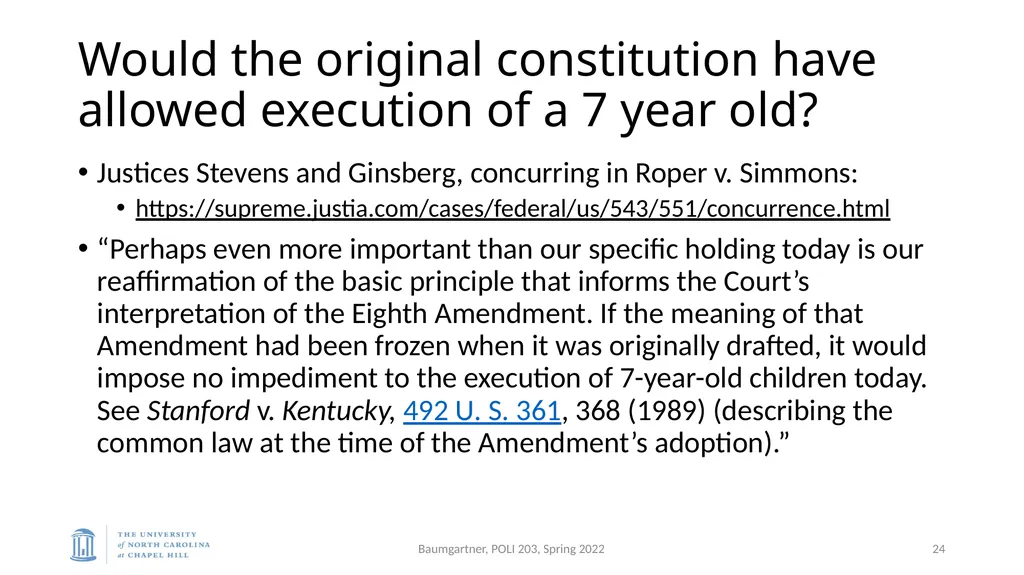
Would the original constitution have allowed execution of a 7 year old? Justices Stevens and Ginsberg, concurring in Roper v. Simmons:
https://supreme.justia.com/cases/federal/us/543/551/concurrence.html
“Perhaps even more important than our specific holding today is our reaffirmation of the basic principle that informs the Court’s interpretation of the Eighth Amendment. If the meaning of that Amendment had been frozen when it was originally drafted, it would impose no impediment to the execution of 7-year-old children today. See Stanford v. Kentucky, 492 U. S. 361, 368 (1989) (describing the common law at the time of the Amendment’s adoption).” Baumgartner, POLI 203, Spring 2022 24<br>
https://supreme.justia.com/cases/federal/us/543/551/concurrence.html
“Perhaps even more important than our specific holding today is our reaffirmation of the basic principle that informs the Court’s interpretation of the Eighth Amendment. If the meaning of that Amendment had been frozen when it was originally drafted, it would impose no impediment to the execution of 7-year-old children today. See Stanford v. Kentucky, 492 U. S. 361, 368 (1989) (describing the common law at the time of the Amendment’s adoption).” Baumgartner, POLI 203, Spring 2022 24<br>
25
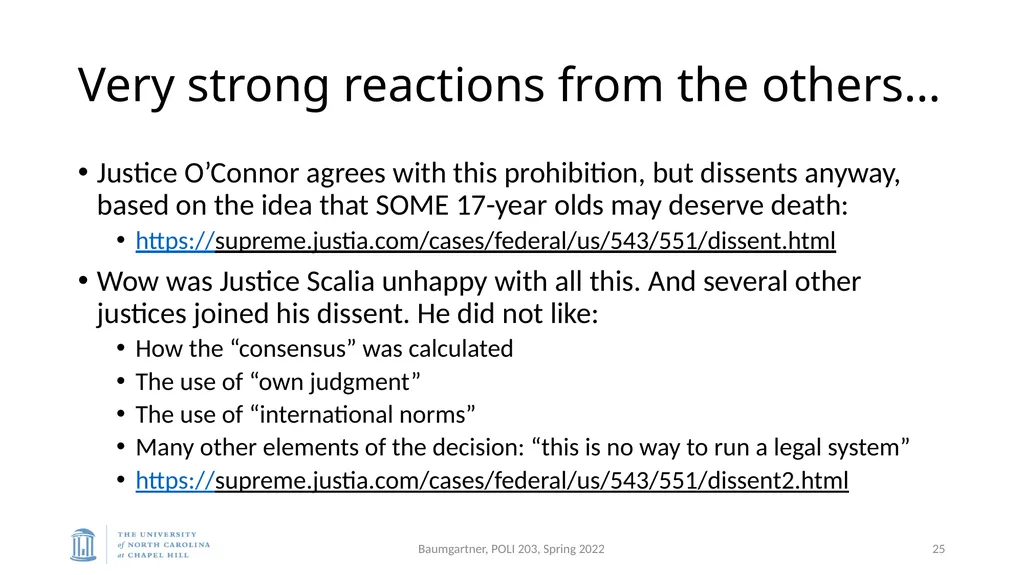
Very strong reactions from the others… Justice O’Connor agrees with this prohibition, but dissents anyway, based on the idea that SOME 17-year olds may deserve death:
https://supreme.justia.com/cases/federal/us/543/551/dissent.html
Wow was Justice Scalia unhappy with all this. And several other justices joined his dissent. He did not like:
How the “consensus” was calculated
The use of “own judgment”
The use of “international norms”
Many other elements of the decision: “this is no way to run a legal system”
https://supreme.justia.com/cases/federal/us/543/551/dissent2.html Baumgartner, POLI 203, Spring 2022 25<br>
https://supreme.justia.com/cases/federal/us/543/551/dissent.html
Wow was Justice Scalia unhappy with all this. And several other justices joined his dissent. He did not like:
How the “consensus” was calculated
The use of “own judgment”
The use of “international norms”
Many other elements of the decision: “this is no way to run a legal system”
https://supreme.justia.com/cases/federal/us/543/551/dissent2.html Baumgartner, POLI 203, Spring 2022 25<br>
26
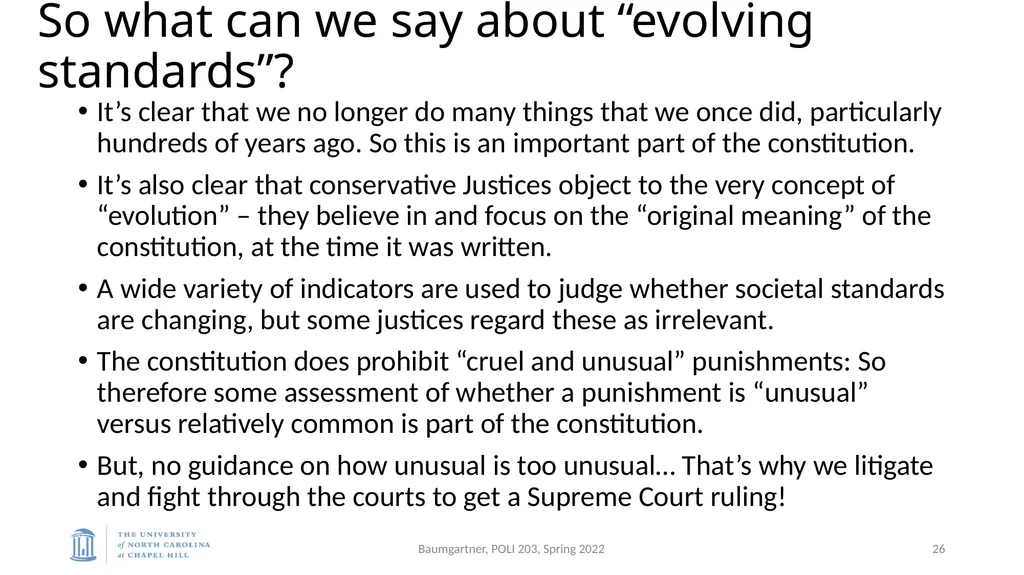
So what can we say about “evolving standards”? It’s clear that we no longer do many things that we once did, particularly hundreds of years ago. So this is an important part of the constitution.
It’s also clear that conservative Justices object to the very concept of “evolution” – they believe in and focus on the “original meaning” of the constitution, at the time it was written.
A wide variety of indicators are used to judge whether societal standards are changing, but some justices regard these as irrelevant.
The constitution does prohibit “cruel and unusual” punishments: So therefore some assessment of whether a punishment is “unusual” versus relatively common is part of the constitution.
But, no guidance on how unusual is too unusual… That’s why we litigate and fight through the courts to get a Supreme Court ruling! Baumgartner, POLI 203, Spring 2022 26<br>
It’s also clear that conservative Justices object to the very concept of “evolution” – they believe in and focus on the “original meaning” of the constitution, at the time it was written.
A wide variety of indicators are used to judge whether societal standards are changing, but some justices regard these as irrelevant.
The constitution does prohibit “cruel and unusual” punishments: So therefore some assessment of whether a punishment is “unusual” versus relatively common is part of the constitution.
But, no guidance on how unusual is too unusual… That’s why we litigate and fight through the courts to get a Supreme Court ruling! Baumgartner, POLI 203, Spring 2022 26<br>
27
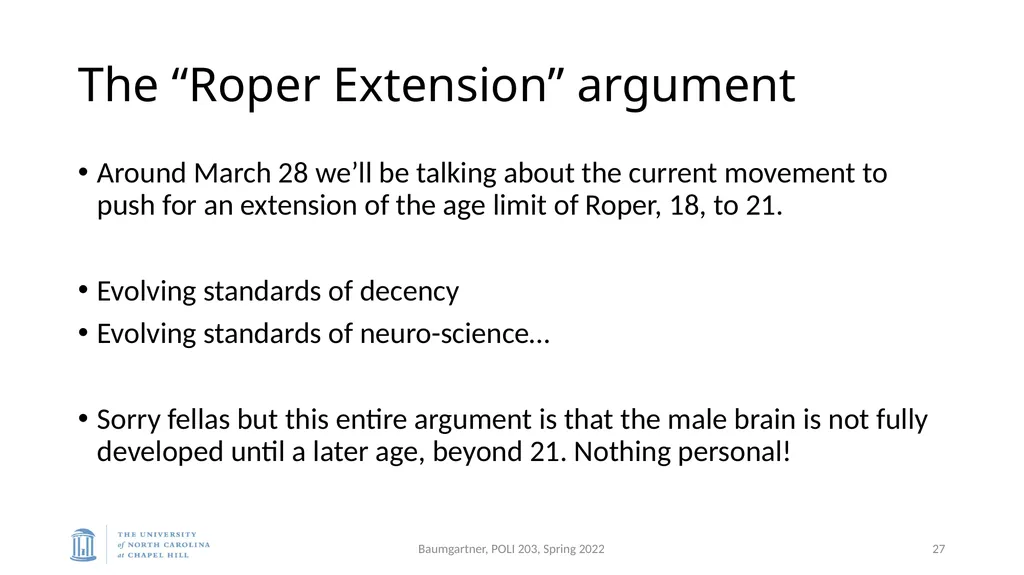
The “Roper Extension” argument Around March 28 we’ll be talking about the current movement to push for an extension of the age limit of Roper, 18, to 21.
Evolving standards of decency
Evolving standards of neuro-science…
Sorry fellas but this entire argument is that the male brain is not fully developed until a later age, beyond 21. Nothing personal! Baumgartner, POLI 203, Spring 2022 27<br>
Evolving standards of decency
Evolving standards of neuro-science…
Sorry fellas but this entire argument is that the male brain is not fully developed until a later age, beyond 21. Nothing personal! Baumgartner, POLI 203, Spring 2022 27<br>