
DEAFNESS,,,,,HEARING LOSS Asst.prof dr.FALIH
TG
Published · 48 slides · 0 views

1 / 1









Description
DEAFNESS,,,,,HEARING LOSS Asst.prof dr.FALIH AL-ANBAKY Hearing impairment, deafness, or hearing loss refers to the inability to hear or understand things, either totally or partially. Symptoms may be mild, moderate, severe or profound. A
Related Topics
Share
Embed code
Download this presentation From Below
"DEAFNESS,,,,,HEARING LOSS Asst.prof dr.FALIH" is the property of its rightful owner. Permission is granted to download and print the materials on this website for personal, non-commercial use only, and to display it on your personal computer provided you do not modify the materials and that you retain all copyright notices contained in the materials. By downloading content from our website, you accept the terms of this agreement.
Presentation Transcript
01
DEAFNESS,,,,,HEARING LOSS
Asst.prof dr.FALIH AL-ANBAKY<br>
02
Hearing impairment, deafness, or hearing loss refers to the inability to hear or understand things, either totally or partially. Symptoms may be mild, moderate, severe or profound. A patient with mild hearing impairment may have problems understanding speech, especially if there is a lot of noise around, while those with moderate deafness may need a hearing aid. Some people are severely deaf and depend on lip-reading when communicating with others.
People who are profoundly deaf can hear nothing at all. In order to communicate spontaneously and rapidly with people, they are totally reliant on lip-reading and/or sign language.<br>
People who are profoundly deaf can hear nothing at all. In order to communicate spontaneously and rapidly with people, they are totally reliant on lip-reading and/or sign language.<br>
03
What is the difference between hearing loss and deafness?
Hearing loss refers to a diminished ability to hear sounds like other people do, while
Deafness refers to the inability to understand speech through hearing even when sound is amplified.
Profound deafness =totally deaf means the person cannot hear anything at all; they are unable to detect sound, even at the highest volume possible.<br>
Hearing loss refers to a diminished ability to hear sounds like other people do, while
Deafness refers to the inability to understand speech through hearing even when sound is amplified.
Profound deafness =totally deaf means the person cannot hear anything at all; they are unable to detect sound, even at the highest volume possible.<br>
04
A few facts and figures about deafness in UK
10 million people (approx.) in the UK are affected by hearing loss (1 in 6).
6.5 million of these are aged 60 and over.
3.7 million are of working age.
Around 2 million people use hearing aids.
About 800,000 are severely or profoundly deaf.
Many people with hearing loss also have tinnitus. They may also have balance difficulties.
Hearing loss increases sharply with age - about a third of people aged 70+ have a hearing loss. But 10 million people make deafness the second largest disability in the UK.<br>
10 million people (approx.) in the UK are affected by hearing loss (1 in 6).
6.5 million of these are aged 60 and over.
3.7 million are of working age.
Around 2 million people use hearing aids.
About 800,000 are severely or profoundly deaf.
Many people with hearing loss also have tinnitus. They may also have balance difficulties.
Hearing loss increases sharply with age - about a third of people aged 70+ have a hearing loss. But 10 million people make deafness the second largest disability in the UK.<br>
05
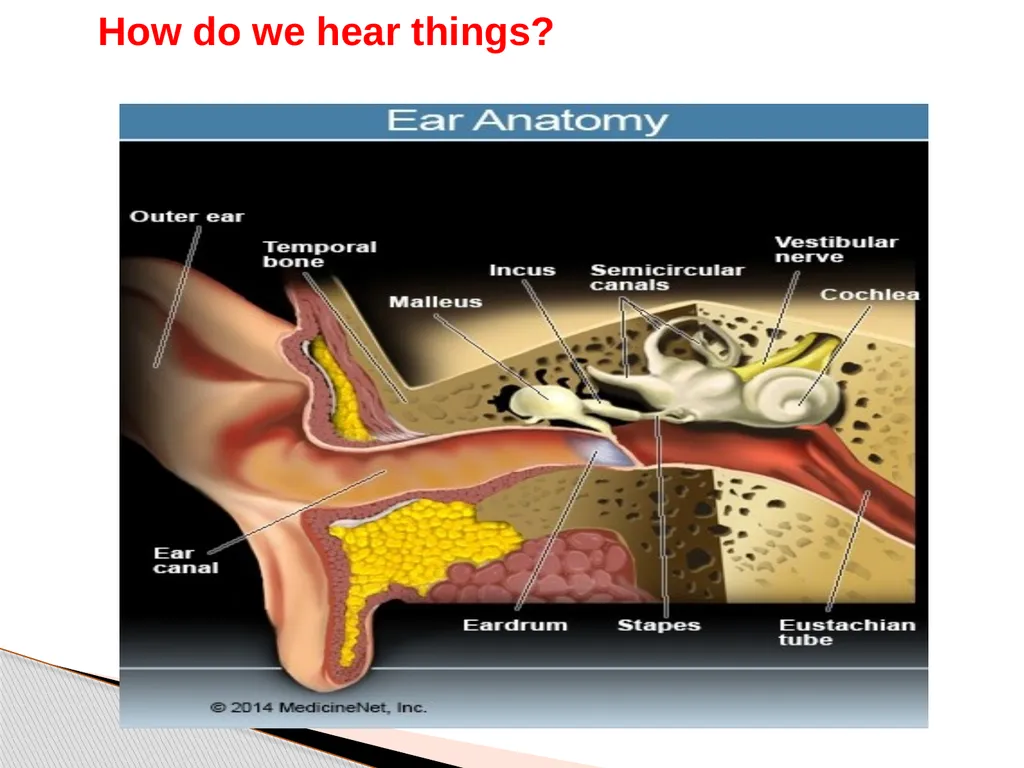
How do we hear things?<br>
06
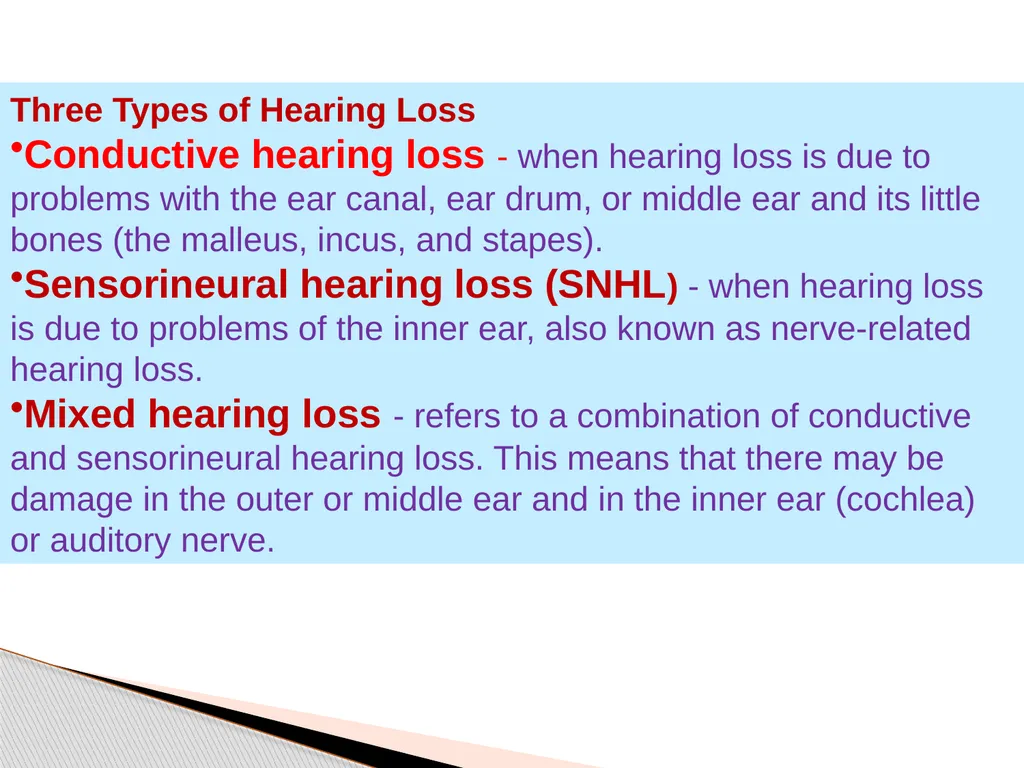
Three Types of Hearing Loss
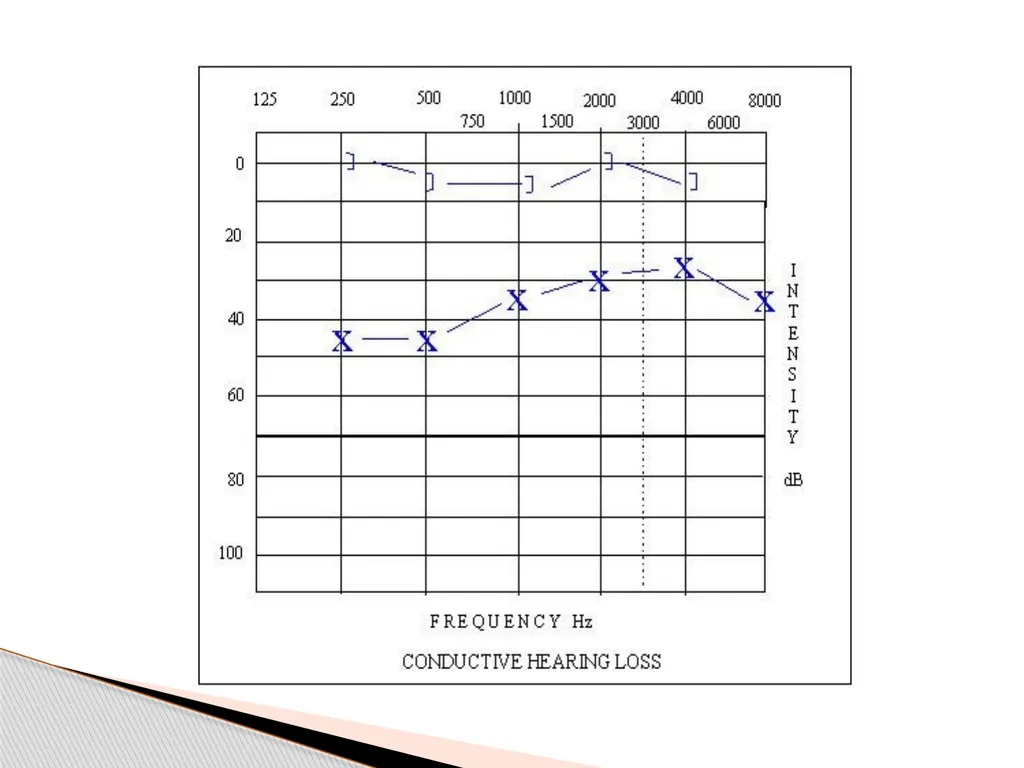
Conductive hearing loss - when hearing loss is due to problems with the ear canal, ear drum, or middle ear and its little bones (the malleus, incus, and stapes).
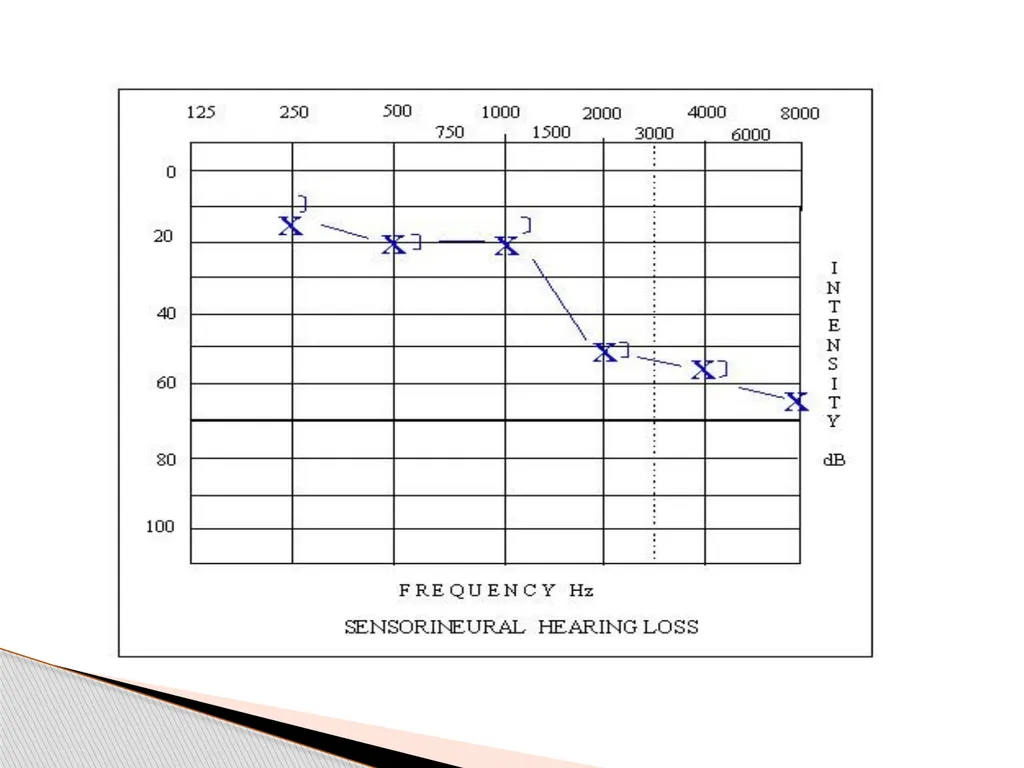
Sensorineural hearing loss (SNHL) - when hearing loss is due to problems of the inner ear, also known as nerve-related hearing loss.
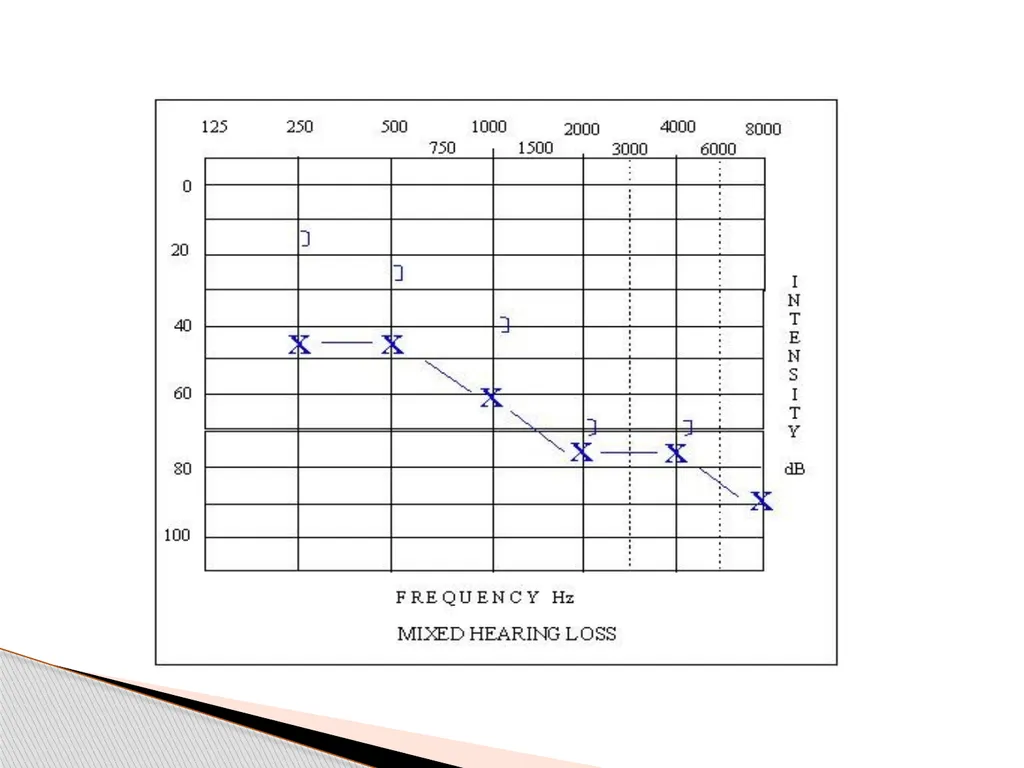
Mixed hearing loss - refers to a combination of conductive and sensorineural hearing loss. This means that there may be damage in the outer or middle ear and in the inner ear (cochlea) or auditory nerve.<br>
Conductive hearing loss - when hearing loss is due to problems with the ear canal, ear drum, or middle ear and its little bones (the malleus, incus, and stapes).
Sensorineural hearing loss (SNHL) - when hearing loss is due to problems of the inner ear, also known as nerve-related hearing loss.
Mixed hearing loss - refers to a combination of conductive and sensorineural hearing loss. This means that there may be damage in the outer or middle ear and in the inner ear (cochlea) or auditory nerve.<br>
07
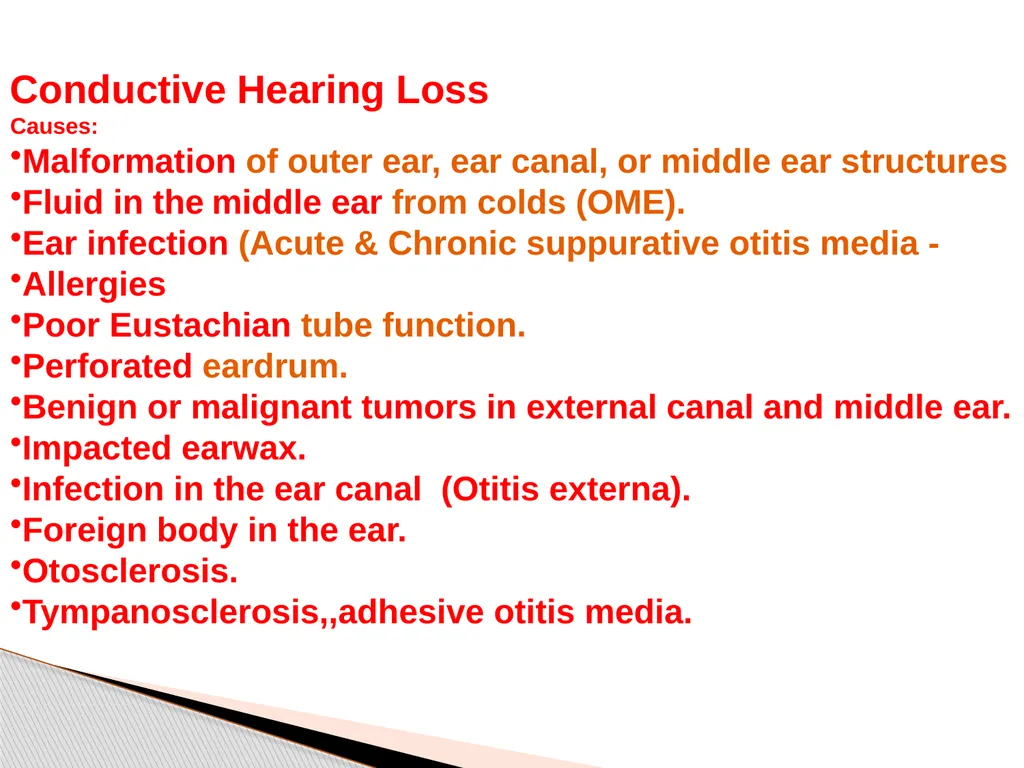
Conductive Hearing Loss
Causes:
Malformation of outer ear, ear canal, or middle ear structures
Fluid in the middle ear from colds (OME).
Ear infection (Acute & Chronic suppurative otitis media -
Allergies
Poor Eustachian tube function.
Perforated eardrum.
Benign or malignant tumors in external canal and middle ear.
Impacted earwax.
Infection in the ear canal (Otitis externa).
Foreign body in the ear.
Otosclerosis.
Tympanosclerosis,,adhesive otitis media.<br>
Causes:
Malformation of outer ear, ear canal, or middle ear structures
Fluid in the middle ear from colds (OME).
Ear infection (Acute & Chronic suppurative otitis media -
Allergies
Poor Eustachian tube function.
Perforated eardrum.
Benign or malignant tumors in external canal and middle ear.
Impacted earwax.
Infection in the ear canal (Otitis externa).
Foreign body in the ear.
Otosclerosis.
Tympanosclerosis,,adhesive otitis media.<br>
08
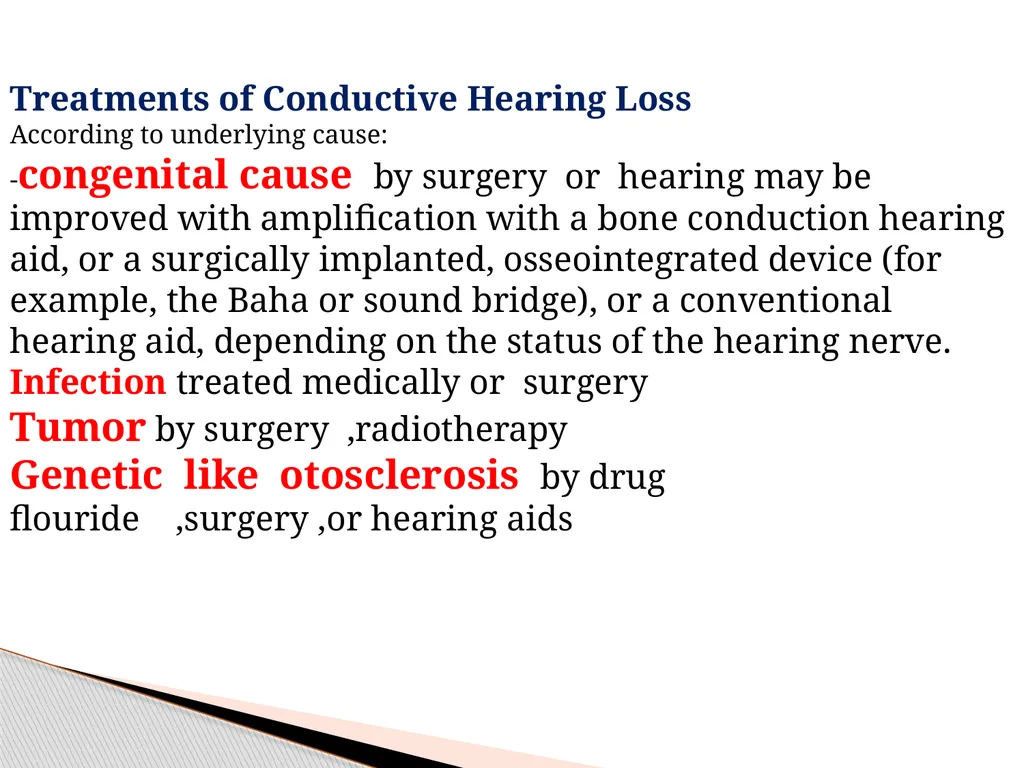
Treatments of Conductive Hearing Loss
According to underlying cause:
-congenital cause by surgery or hearing may be improved with amplification with a bone conduction hearing aid, or a surgically implanted, osseointegrated device (for example, the Baha or sound bridge), or a conventional hearing aid, depending on the status of the hearing nerve.
Infection treated medically or surgery
Tumor by surgery ,radiotherapy
Genetic like otosclerosis by drug flouride ,surgery ,or hearing aids<br>
According to underlying cause:
-congenital cause by surgery or hearing may be improved with amplification with a bone conduction hearing aid, or a surgically implanted, osseointegrated device (for example, the Baha or sound bridge), or a conventional hearing aid, depending on the status of the hearing nerve.
Infection treated medically or surgery
Tumor by surgery ,radiotherapy
Genetic like otosclerosis by drug flouride ,surgery ,or hearing aids<br>
09
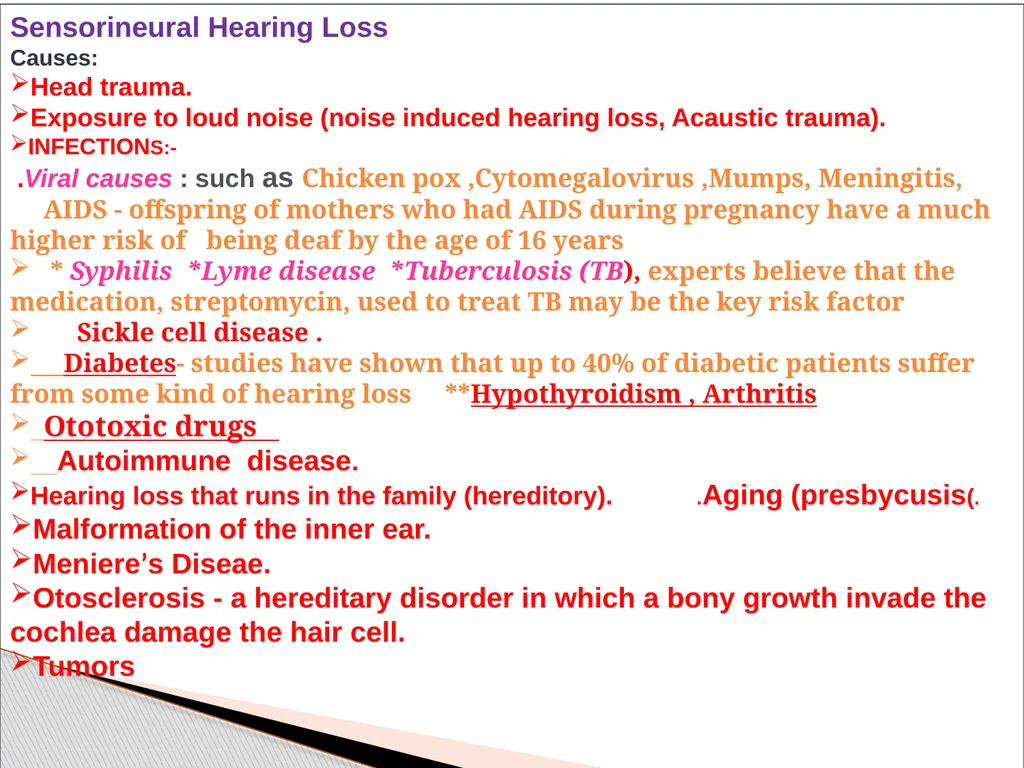
Sensorineural Hearing Loss
Causes:
Head trauma.
Exposure to loud noise (noise induced hearing loss, Acaustic trauma).
INFECTIONS:-
.Viral causes : such as Chicken pox ,Cytomegalovirus ,Mumps, Meningitis,
AIDS - offspring of mothers who had AIDS during pregnancy have a much higher risk of being deaf by the age of 16 years
* Syphilis *Lyme disease *Tuberculosis (TB), experts believe that the medication, streptomycin, used to treat TB may be the key risk factor
Sickle cell disease .
Diabetes- studies have shown that up to 40% of diabetic patients suffer from some kind of hearing loss **Hypothyroidism , Arthritis
Ototoxic drugs
Autoimmune disease.
Hearing loss that runs in the family (hereditory). .Aging (presbycusis(.
Malformation of the inner ear.
Meniere’s Diseae.
Otosclerosis - a hereditary disorder in which a bony growth invade the cochlea damage the hair cell.
Tumors<br>
Causes:
Head trauma.
Exposure to loud noise (noise induced hearing loss, Acaustic trauma).
INFECTIONS:-
.Viral causes : such as Chicken pox ,Cytomegalovirus ,Mumps, Meningitis,
AIDS - offspring of mothers who had AIDS during pregnancy have a much higher risk of being deaf by the age of 16 years
* Syphilis *Lyme disease *Tuberculosis (TB), experts believe that the medication, streptomycin, used to treat TB may be the key risk factor
Sickle cell disease .
Diabetes- studies have shown that up to 40% of diabetic patients suffer from some kind of hearing loss **Hypothyroidism , Arthritis
Ototoxic drugs
Autoimmune disease.
Hearing loss that runs in the family (hereditory). .Aging (presbycusis(.
Malformation of the inner ear.
Meniere’s Diseae.
Otosclerosis - a hereditary disorder in which a bony growth invade the cochlea damage the hair cell.
Tumors<br>
10
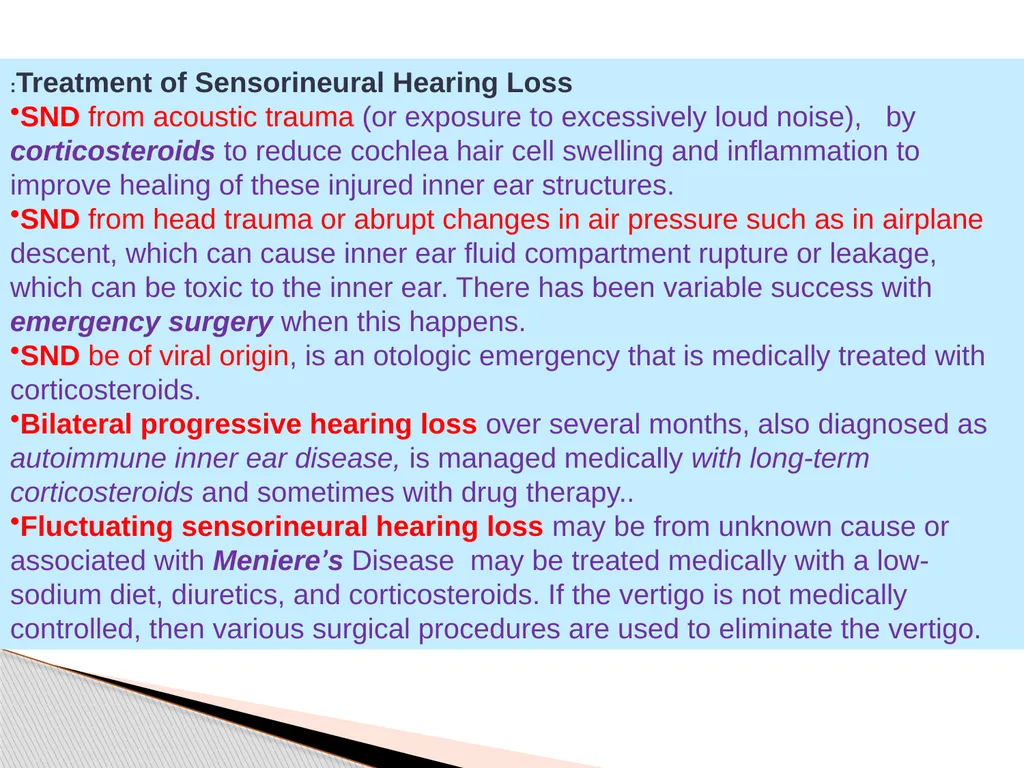
Treatment of Sensorineural Hearing Loss:
SND from acoustic trauma (or exposure to excessively loud noise), by corticosteroids to reduce cochlea hair cell swelling and inflammation to improve healing of these injured inner ear structures.
SND from head trauma or abrupt changes in air pressure such as in airplane descent, which can cause inner ear fluid compartment rupture or leakage, which can be toxic to the inner ear. There has been variable success with emergency surgery when this happens.
SND be of viral origin, is an otologic emergency that is medically treated with corticosteroids.
Bilateral progressive hearing loss over several months, also diagnosed as autoimmune inner ear disease, is managed medically with long-term corticosteroids and sometimes with drug therapy..
Fluctuating sensorineural hearing loss may be from unknown cause or associated with Meniere’s Disease may be treated medically with a low-sodium diet, diuretics, and corticosteroids. If the vertigo is not medically controlled, then various surgical procedures are used to eliminate the vertigo.<br>
SND from acoustic trauma (or exposure to excessively loud noise), by corticosteroids to reduce cochlea hair cell swelling and inflammation to improve healing of these injured inner ear structures.
SND from head trauma or abrupt changes in air pressure such as in airplane descent, which can cause inner ear fluid compartment rupture or leakage, which can be toxic to the inner ear. There has been variable success with emergency surgery when this happens.
SND be of viral origin, is an otologic emergency that is medically treated with corticosteroids.
Bilateral progressive hearing loss over several months, also diagnosed as autoimmune inner ear disease, is managed medically with long-term corticosteroids and sometimes with drug therapy..
Fluctuating sensorineural hearing loss may be from unknown cause or associated with Meniere’s Disease may be treated medically with a low-sodium diet, diuretics, and corticosteroids. If the vertigo is not medically controlled, then various surgical procedures are used to eliminate the vertigo.<br>
11
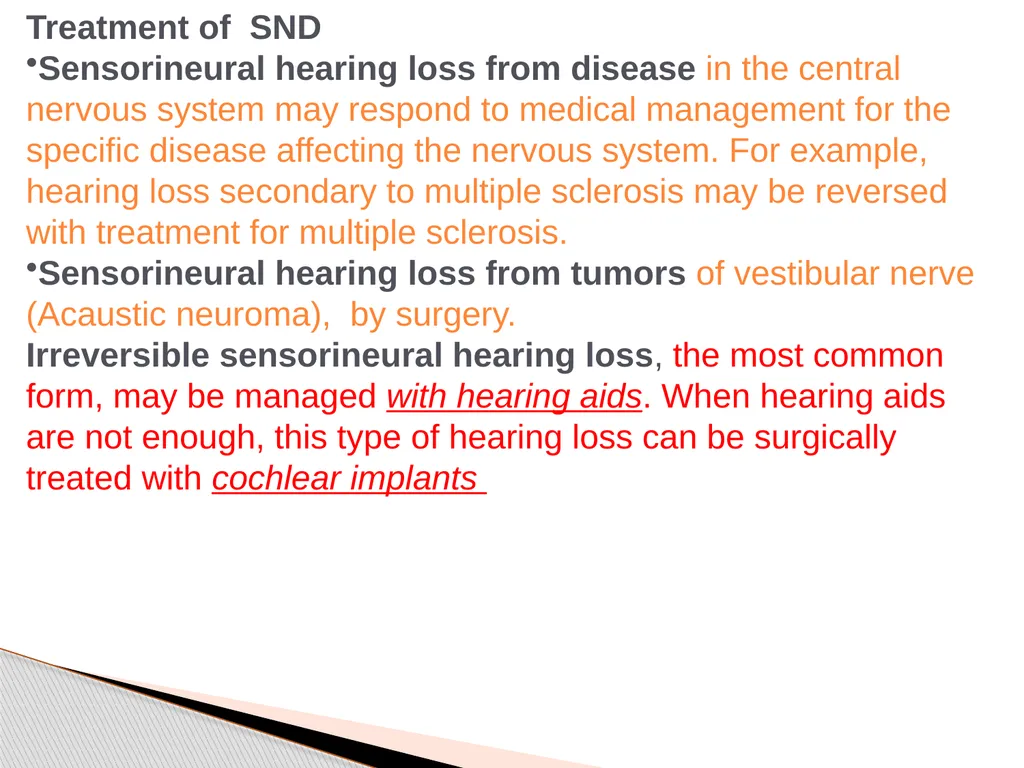
Treatment of SND
Sensorineural hearing loss from disease in the central nervous system may respond to medical management for the specific disease affecting the nervous system. For example, hearing loss secondary to multiple sclerosis may be reversed with treatment for multiple sclerosis.
Sensorineural hearing loss from tumors of vestibular nerve (Acaustic neuroma), by surgery.
Irreversible sensorineural hearing loss, the most common form, may be managed with hearing aids. When hearing aids are not enough, this type of hearing loss can be surgically treated with cochlear implants<br>
Sensorineural hearing loss from disease in the central nervous system may respond to medical management for the specific disease affecting the nervous system. For example, hearing loss secondary to multiple sclerosis may be reversed with treatment for multiple sclerosis.
Sensorineural hearing loss from tumors of vestibular nerve (Acaustic neuroma), by surgery.
Irreversible sensorineural hearing loss, the most common form, may be managed with hearing aids. When hearing aids are not enough, this type of hearing loss can be surgically treated with cochlear implants<br>
12
Mixed Hearing Loss
Treatments for Mixed Hearing Loss
Recommends taking care of the conductive component first.(medically or surgical( .
To make the person a better hearing aid candidate, .<br>
Treatments for Mixed Hearing Loss
Recommends taking care of the conductive component first.(medically or surgical( .
To make the person a better hearing aid candidate, .<br>
13
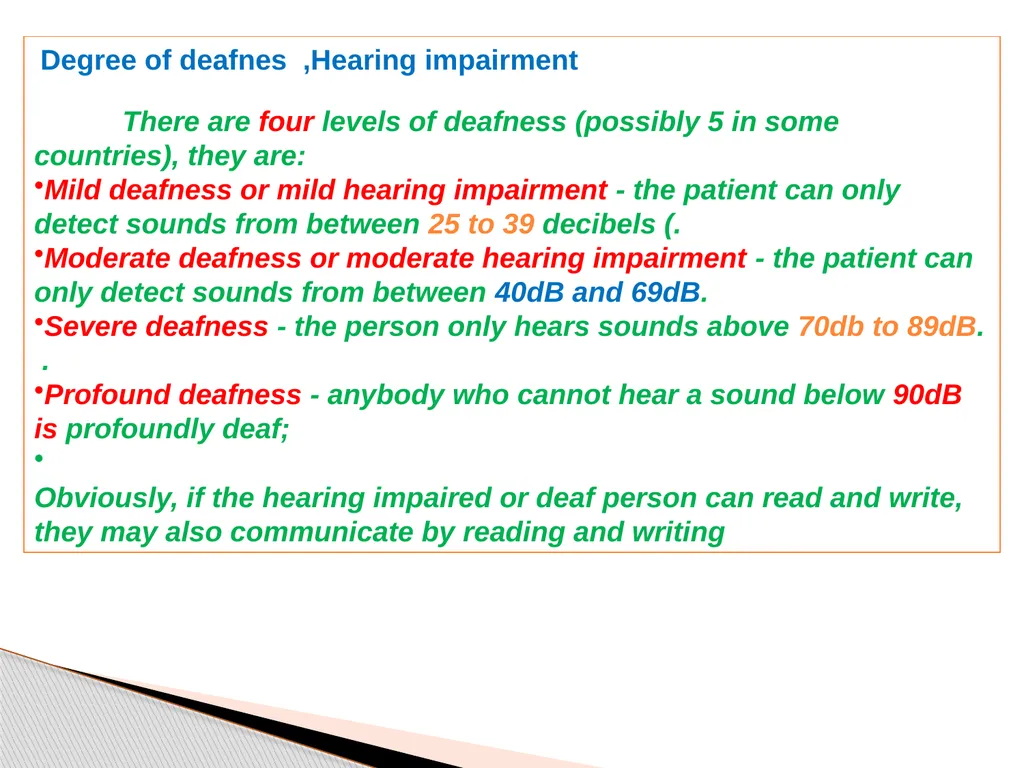
Degree of deafnes ,Hearing impairment There are four levels of deafness (possibly 5 in some countries), they are:
Mild deafness or mild hearing impairment - the patient can only detect sounds from between 25 to 39 decibels (.
Moderate deafness or moderate hearing impairment - the patient can only detect sounds from between 40dB and 69dB.
Severe deafness - the person only hears sounds above 70db to 89dB. .
Profound deafness - anybody who cannot hear a sound below 90dB is profoundly deaf;
Obviously, if the hearing impaired or deaf person can read and write, they may also communicate by reading and writing<br>
Mild deafness or mild hearing impairment - the patient can only detect sounds from between 25 to 39 decibels (.
Moderate deafness or moderate hearing impairment - the patient can only detect sounds from between 40dB and 69dB.
Severe deafness - the person only hears sounds above 70db to 89dB. .
Profound deafness - anybody who cannot hear a sound below 90dB is profoundly deaf;
Obviously, if the hearing impaired or deaf person can read and write, they may also communicate by reading and writing<br>
14
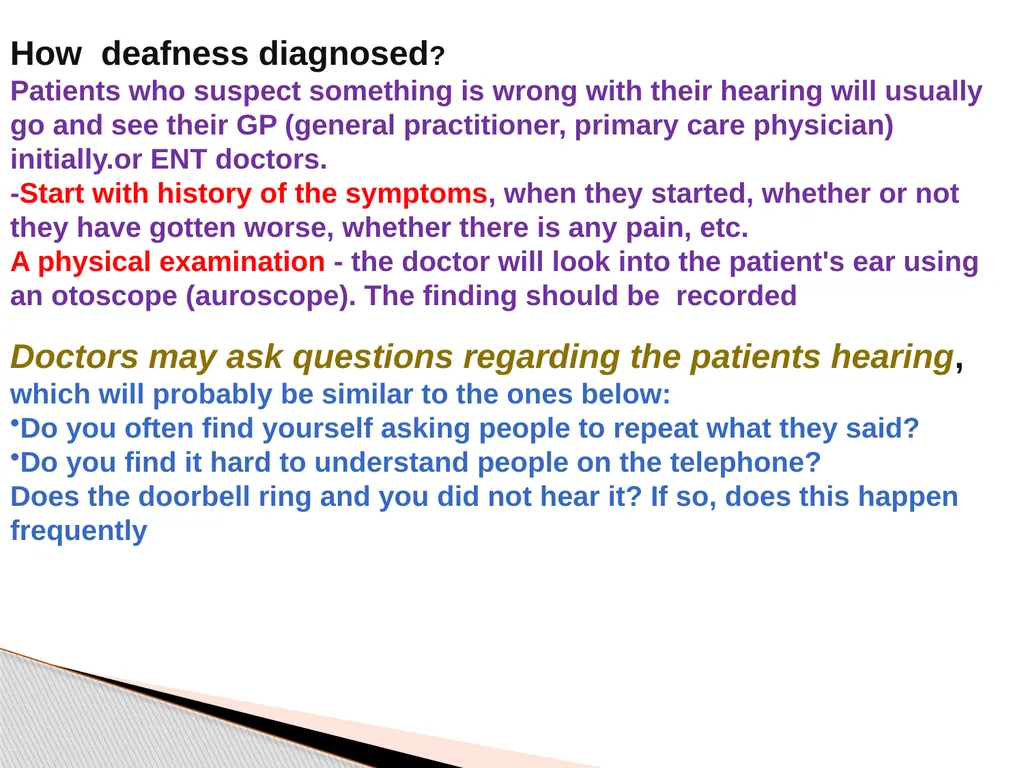
How deafness diagnosed?
Patients who suspect something is wrong with their hearing will usually go and see their GP (general practitioner, primary care physician) initially.or ENT doctors.
-Start with history of the symptoms, when they started, whether or not they have gotten worse, whether there is any pain, etc. A physical examination - the doctor will look into the patient's ear using an otoscope (auroscope). The finding should be recorded Doctors may ask questions regarding the patients hearing, which will probably be similar to the ones below:
Do you often find yourself asking people to repeat what they said?
Do you find it hard to understand people on the telephone?
Does the doorbell ring and you did not hear it? If so, does this happen frequently<br>
Patients who suspect something is wrong with their hearing will usually go and see their GP (general practitioner, primary care physician) initially.or ENT doctors.
-Start with history of the symptoms, when they started, whether or not they have gotten worse, whether there is any pain, etc. A physical examination - the doctor will look into the patient's ear using an otoscope (auroscope). The finding should be recorded Doctors may ask questions regarding the patients hearing, which will probably be similar to the ones below:
Do you often find yourself asking people to repeat what they said?
Do you find it hard to understand people on the telephone?
Does the doorbell ring and you did not hear it? If so, does this happen frequently<br>
15
When you chat to people face-to-face, do you have to focus carefully?
Has anybody ever mentioned to you that you might have a problem with your hearing?
When you hear a sound, do you often find it hard to determine where it is coming from
When several people are talking, do you find it hard to understand what one of them is telling you?
Are you often told that the TV, radio or any sound-producing device is too loud?
Do you find the speech of men easier to understand than women's or children's?
Have you often found yourself misunderstanding what other people say to you
Have you hear ringigng,rushing ,hissing sounds in ears(Tinitus).
? Anybody who answers "yes" to most of the above questions should see their doctor and have their hearing checked.<br>
Has anybody ever mentioned to you that you might have a problem with your hearing?
When you hear a sound, do you often find it hard to determine where it is coming from
When several people are talking, do you find it hard to understand what one of them is telling you?
Are you often told that the TV, radio or any sound-producing device is too loud?
Do you find the speech of men easier to understand than women's or children's?
Have you often found yourself misunderstanding what other people say to you
Have you hear ringigng,rushing ,hissing sounds in ears(Tinitus).
? Anybody who answers "yes" to most of the above questions should see their doctor and have their hearing checked.<br>
16
The diagnosis of deafnes depend on folowing tests:.
Whispered speech test. The doctor will whisper a combination of numbers and letters from behind the patient and ask him to repeat the combination to check if he can hear anything. Each ear should be tested separately.
Tuning fork test.
Pure tone audiometry. .
Otoacoustic emissions. This test is used to measure your cochlear function by recording signals produced by the hair cells.
Auditory brainstem response. This test measures the activity of cochlea, auditory nerve and brain when a sound is heard<br>
Whispered speech test. The doctor will whisper a combination of numbers and letters from behind the patient and ask him to repeat the combination to check if he can hear anything. Each ear should be tested separately.
Tuning fork test.
Pure tone audiometry. .
Otoacoustic emissions. This test is used to measure your cochlear function by recording signals produced by the hair cells.
Auditory brainstem response. This test measures the activity of cochlea, auditory nerve and brain when a sound is heard<br>
17
If your hearing loss has a sensorineural cause, a number of other tests can be done to pinpoint where the problem lies.
**In cases of unilateral sensorineural deafness , and may be associated with vertigo tinitus,need to do CTscan and MRI scan. This is to rule out rare causes of hearing loss such as an acoustic neuroma or cholesteatoma or other intracranial (cerebellopontine angle) tumour<br>
**In cases of unilateral sensorineural deafness , and may be associated with vertigo tinitus,need to do CTscan and MRI scan. This is to rule out rare causes of hearing loss such as an acoustic neuroma or cholesteatoma or other intracranial (cerebellopontine angle) tumour<br>
18
Otosclerosis
Definition: a localized disease of the otic capsule in which new spongy bone causes ankylosis of the footplate of stapes or invades the cochlea.
.<br>
Definition: a localized disease of the otic capsule in which new spongy bone causes ankylosis of the footplate of stapes or invades the cochlea.
.<br>
19
Aetiology:
exact causes unknown, many theories.
-Measles virus RNA is found in otosclerotic foci in footplates removed during surgery. Measles virus infection may activate the gene responsible for otosclerosis. -
- Hereditary (50% +ve family history) inhereted as autosomal dominant pattern with incomplete penetrance
- Incidence: more in white races, female two time more male
- Age of onset 20-30 years of age.
- Effect of pregnancy accelerate the condition but never cause it (pill have the same effects)<br>
exact causes unknown, many theories.
-Measles virus RNA is found in otosclerotic foci in footplates removed during surgery. Measles virus infection may activate the gene responsible for otosclerosis. -
- Hereditary (50% +ve family history) inhereted as autosomal dominant pattern with incomplete penetrance
- Incidence: more in white races, female two time more male
- Age of onset 20-30 years of age.
- Effect of pregnancy accelerate the condition but never cause it (pill have the same effects)<br>
20
Pathology: normal bone absorbed and replaced by new spongy osteoid bone. The commonest site 80-90% is on the anterior margin of the footplate of the stapes at its attachment to the oval window called (fissula ante fenestram) and spread via vascular channels leads to ankylosis (fixation) of the stapes footplate. It may involve the cochlea and labyrinth in8% so called labyrinthine otosclerosis, 2% both stapes and cochlea .<br>
21
Clinical features:
-Deafness is the predominant symptom, usually gradual bilateral (80%) and it's conductive in type.
Patients exhibit low volume-speech.(hear their voice louder).
Usually takes many years to becom obvious . Sensorineural deafness if the cochlea involved.
*Paracusis welleci(the patient hears better in a background noise).
-Tinnitus
--Vertigo
symptom appear at any age from 15-45yrs mostly at twenties.<br>
-Deafness is the predominant symptom, usually gradual bilateral (80%) and it's conductive in type.
Patients exhibit low volume-speech.(hear their voice louder).
Usually takes many years to becom obvious . Sensorineural deafness if the cochlea involved.
*Paracusis welleci(the patient hears better in a background noise).
-Tinnitus
--Vertigo
symptom appear at any age from 15-45yrs mostly at twenties.<br>
22
On Examination:
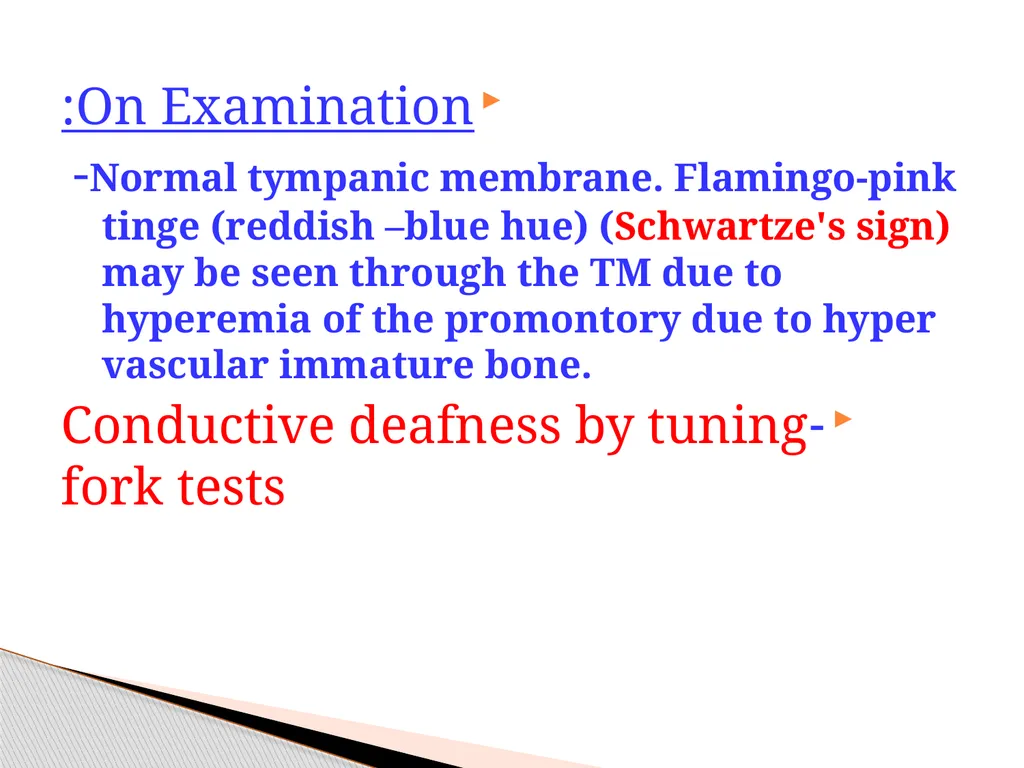
-Normal tympanic membrane. Flamingo-pink tinge (reddish –blue hue) (Schwartze's sign) may be seen through the TM due to hyperemia of the promontory due to hyper vascular immature bone.
-Conductive deafness by tuning fork tests<br>
-Normal tympanic membrane. Flamingo-pink tinge (reddish –blue hue) (Schwartze's sign) may be seen through the TM due to hyperemia of the promontory due to hyper vascular immature bone.
-Conductive deafness by tuning fork tests<br>
23
Investigation:
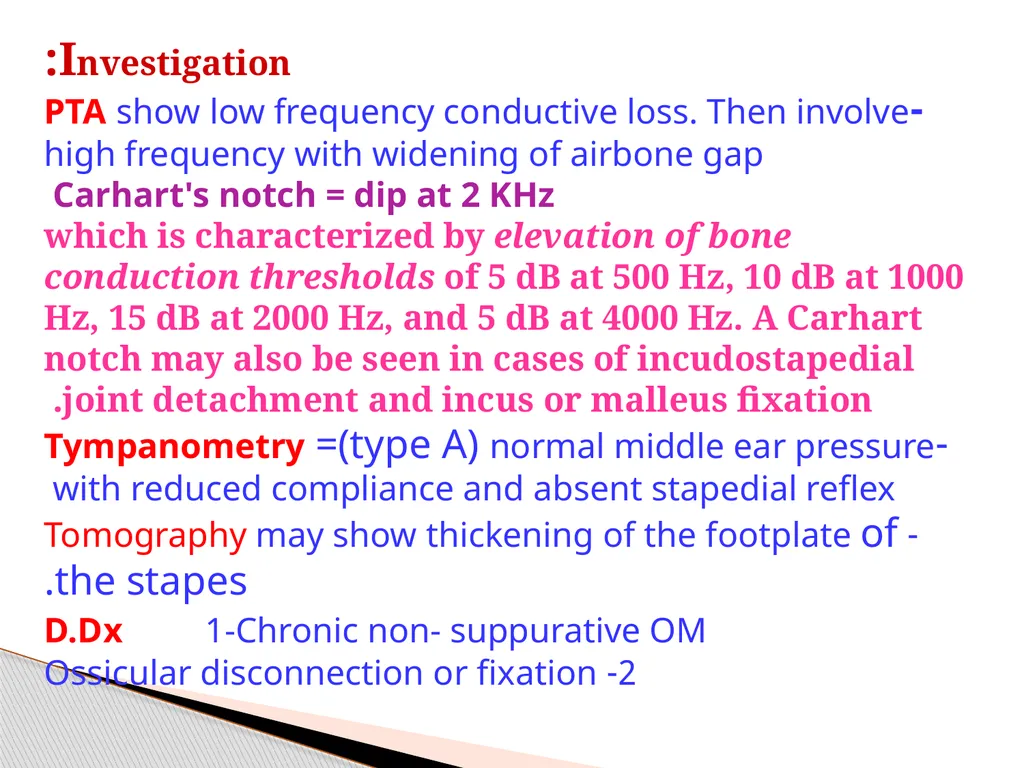
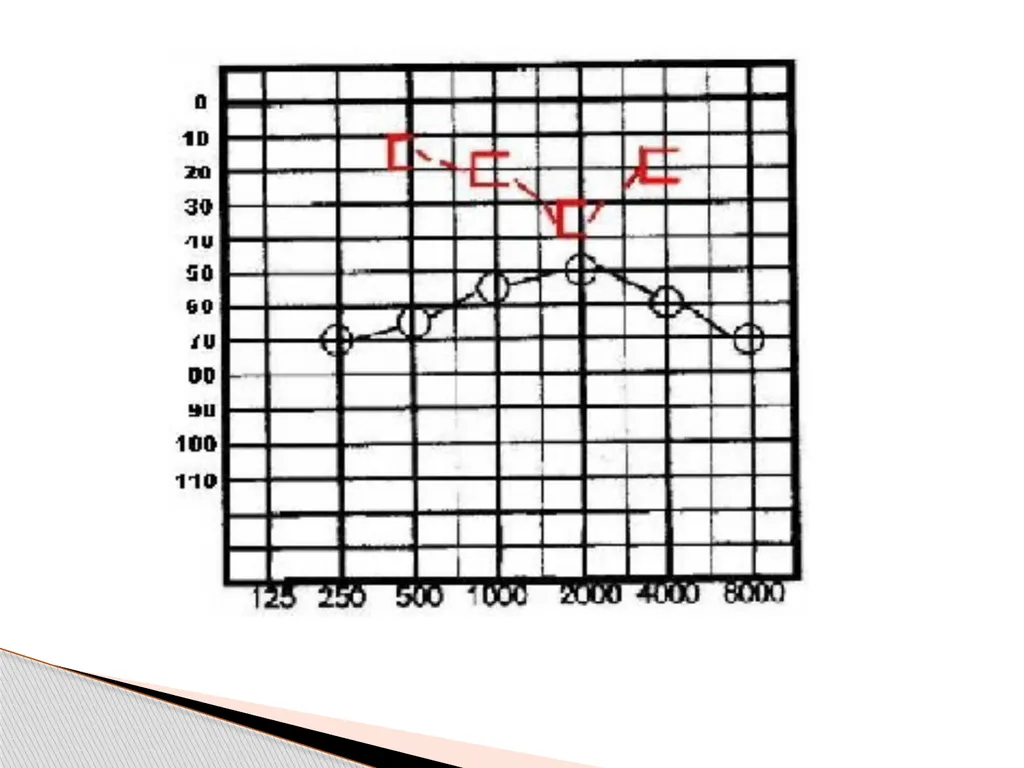
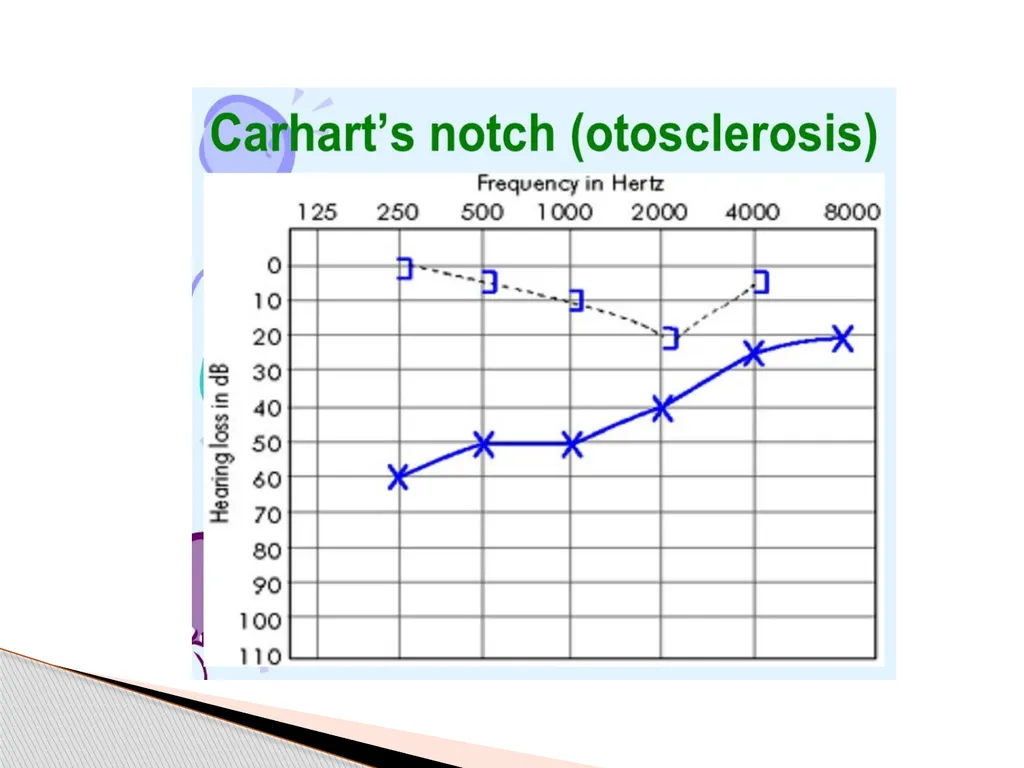
-PTA show low frequency conductive loss. Then involve high frequency with widening of airbone gap
Carhart's notch = dip at 2 KHz
which is characterized by elevation of bone conduction thresholds of 5 dB at 500 Hz, 10 dB at 1000 Hz, 15 dB at 2000 Hz, and 5 dB at 4000 Hz. A Carhart notch may also be seen in cases of incudostapedial joint detachment and incus or malleus fixation.
-Tympanometry =(type A) normal middle ear pressure with reduced compliance and absent stapedial reflex
- Tomography may show thickening of the footplate of the stapes.
D.Dx 1-Chronic non- suppurative OM
2- Ossicular disconnection or fixation<br>
-PTA show low frequency conductive loss. Then involve high frequency with widening of airbone gap
Carhart's notch = dip at 2 KHz
which is characterized by elevation of bone conduction thresholds of 5 dB at 500 Hz, 10 dB at 1000 Hz, 15 dB at 2000 Hz, and 5 dB at 4000 Hz. A Carhart notch may also be seen in cases of incudostapedial joint detachment and incus or malleus fixation.
-Tympanometry =(type A) normal middle ear pressure with reduced compliance and absent stapedial reflex
- Tomography may show thickening of the footplate of the stapes.
D.Dx 1-Chronic non- suppurative OM
2- Ossicular disconnection or fixation<br>
24
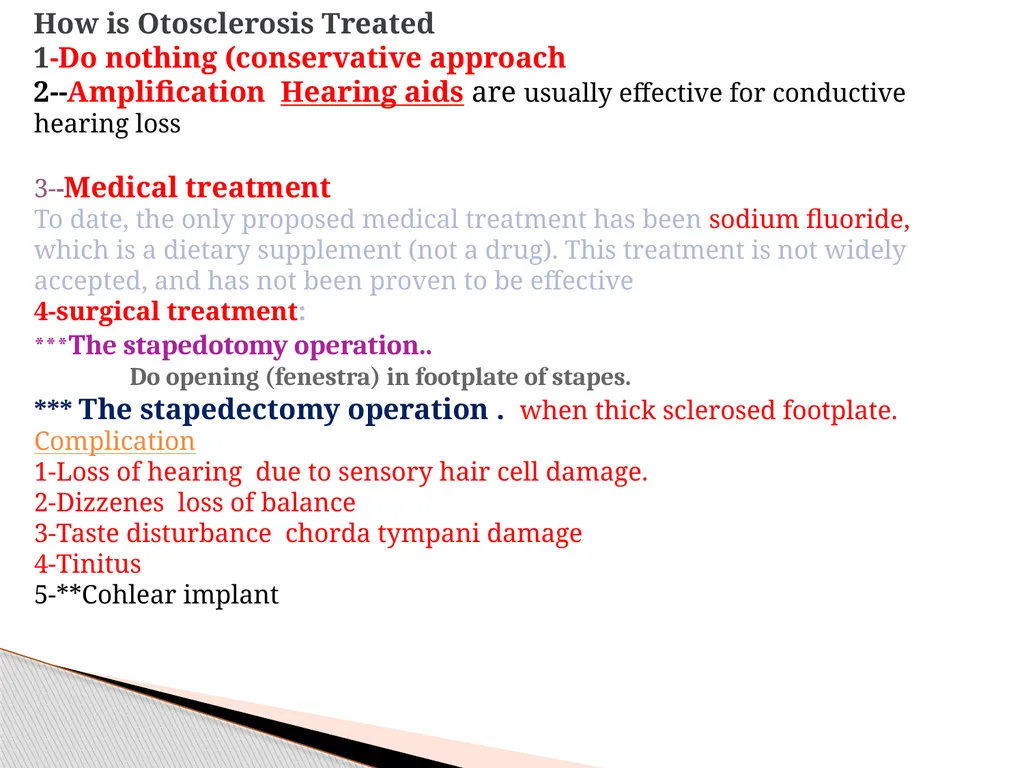
How is Otosclerosis Treated
1-Do nothing (conservative approach
2--Amplification Hearing aids are usually effective for conductive hearing loss
3--Medical treatment
To date, the only proposed medical treatment has been sodium fluoride, which is a dietary supplement (not a drug). This treatment is not widely accepted, and has not been proven to be effective
4-surgical treatment:
***The stapedotomy operation..
Do opening (fenestra) in footplate of stapes.
*** The stapedectomy operation . when thick sclerosed footplate.
Complication
1-Loss of hearing due to sensory hair cell damage.
2-Dizzenes loss of balance
3-Taste disturbance chorda tympani damage
4-Tinitus
5-**Cohlear implant<br>
1-Do nothing (conservative approach
2--Amplification Hearing aids are usually effective for conductive hearing loss
3--Medical treatment
To date, the only proposed medical treatment has been sodium fluoride, which is a dietary supplement (not a drug). This treatment is not widely accepted, and has not been proven to be effective
4-surgical treatment:
***The stapedotomy operation..
Do opening (fenestra) in footplate of stapes.
*** The stapedectomy operation . when thick sclerosed footplate.
Complication
1-Loss of hearing due to sensory hair cell damage.
2-Dizzenes loss of balance
3-Taste disturbance chorda tympani damage
4-Tinitus
5-**Cohlear implant<br>
25
Meniere's Disease
WHAT IS MÉNIÈRE`S DISEASE?
Ménière`s disease describes a set of episodic symptoms including vertigo , intermittent hearing loss, tinnitus .
Episodes of vertigo (spinning sensation) typically last from 20 minutes up to 4 hours.
Hearing loss is often intermittent, , lattr on becomes permanent.
Tinnitus:- A roaring, buzzing, or ringing sound in the ear), and a sensation of fullness in the affected ear. may come and go with changes in hearing, occur during or just before attacks, or be constant.
Ménières disease is also called idiopathic endolymphatic hydrops and is one of the most common causes of dizziness. The disease mostly unilateral, only 15% both ears
.<br>
WHAT IS MÉNIÈRE`S DISEASE?
Ménière`s disease describes a set of episodic symptoms including vertigo , intermittent hearing loss, tinnitus .
Episodes of vertigo (spinning sensation) typically last from 20 minutes up to 4 hours.
Hearing loss is often intermittent, , lattr on becomes permanent.
Tinnitus:- A roaring, buzzing, or ringing sound in the ear), and a sensation of fullness in the affected ear. may come and go with changes in hearing, occur during or just before attacks, or be constant.
Ménières disease is also called idiopathic endolymphatic hydrops and is one of the most common causes of dizziness. The disease mostly unilateral, only 15% both ears
.<br>
26
Cause of Meniere's disease isn't well understood
Due to abnormal volume or composition of fluid in the inner ear.
Inner ear consist of bony labyrinth and inside it membranous labyrinth contain endolymph, there is sensory cell response for fluid movement ,pressure ,composition.
In order to function properly, the fluid needs to retain a certain volume, pressure and chemical composition. Too much fluid may accumulate either due to excess production or inadequate absorption.. Alteration of the properties of inner ear fluid may help cause Meniere's disease.<br>
Due to abnormal volume or composition of fluid in the inner ear.
Inner ear consist of bony labyrinth and inside it membranous labyrinth contain endolymph, there is sensory cell response for fluid movement ,pressure ,composition.
In order to function properly, the fluid needs to retain a certain volume, pressure and chemical composition. Too much fluid may accumulate either due to excess production or inadequate absorption.. Alteration of the properties of inner ear fluid may help cause Meniere's disease.<br>
27
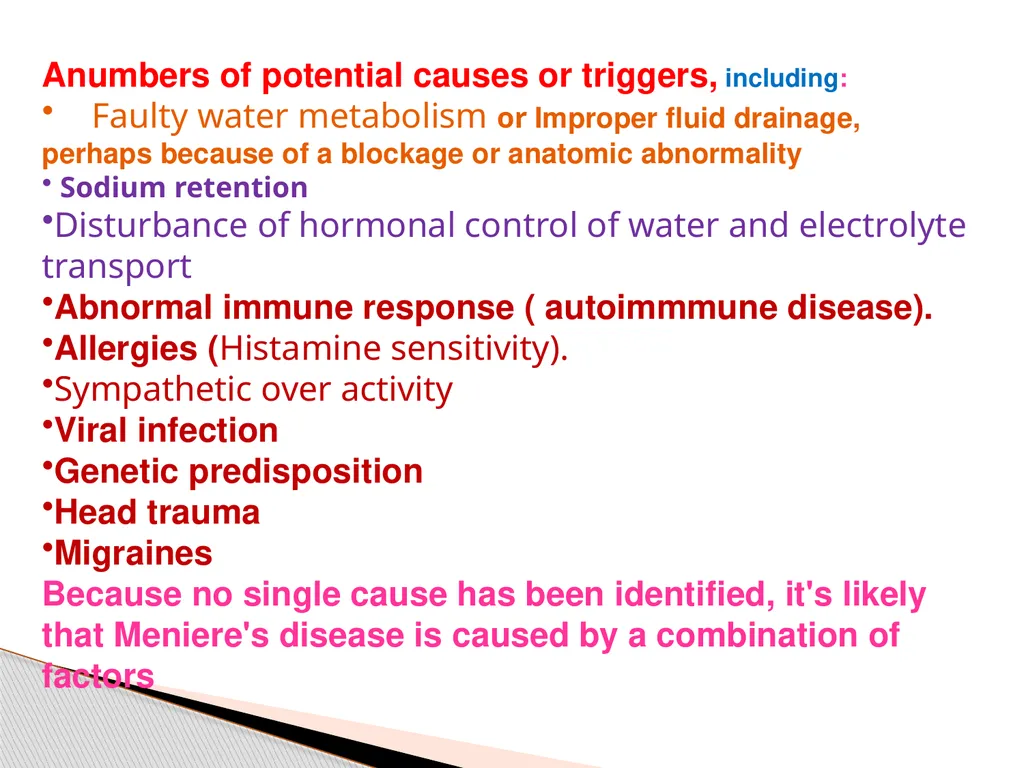
Anumbers of potential causes or triggers, including:
Faulty water metabolism or Improper fluid drainage, perhaps because of a blockage or anatomic abnormality
Sodium retention
Disturbance of hormonal control of water and electrolyte transport
Abnormal immune response ( autoimmmune disease).
Allergies (Histamine sensitivity).
Sympathetic over activity
Viral infection
Genetic predisposition
Head trauma
Migraines
Because no single cause has been identified, it's likely that Meniere's disease is caused by a combination of factors<br>
Faulty water metabolism or Improper fluid drainage, perhaps because of a blockage or anatomic abnormality
Sodium retention
Disturbance of hormonal control of water and electrolyte transport
Abnormal immune response ( autoimmmune disease).
Allergies (Histamine sensitivity).
Sympathetic over activity
Viral infection
Genetic predisposition
Head trauma
Migraines
Because no single cause has been identified, it's likely that Meniere's disease is caused by a combination of factors<br>
28
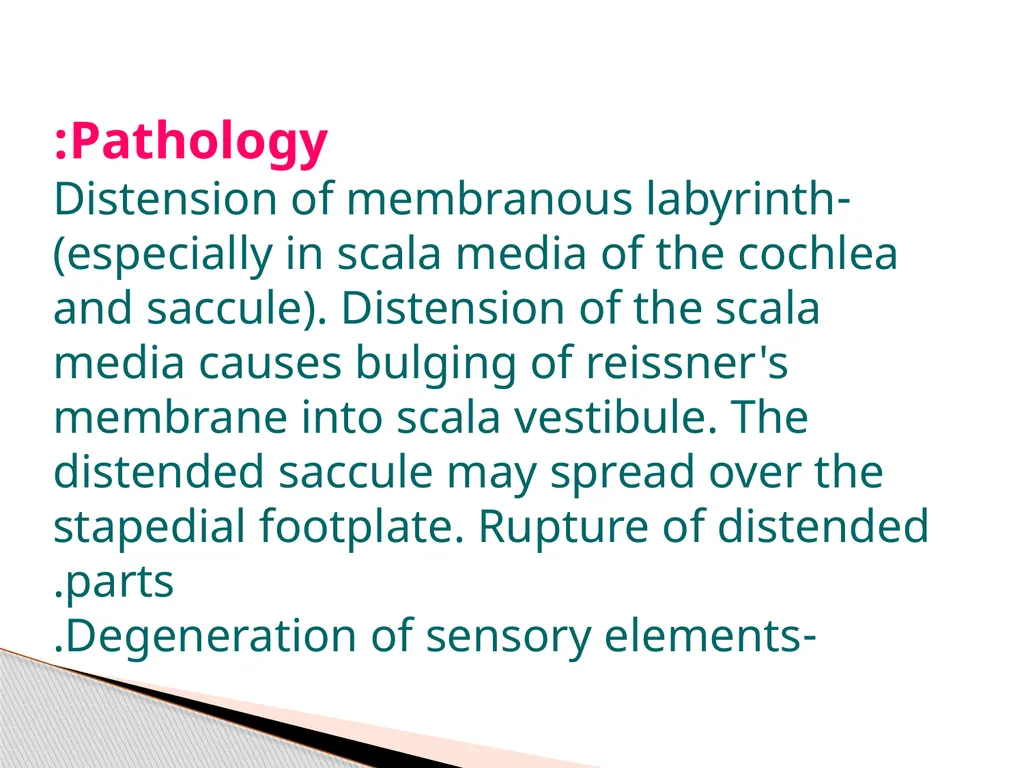
Pathology:
-Distension of membranous labyrinth (especially in scala media of the cochlea and saccule). Distension of the scala media causes bulging of reissner's membrane into scala vestibule. The distended saccule may spread over the stapedial footplate. Rupture of distended parts.
-Degeneration of sensory elements.<br>
-Distension of membranous labyrinth (especially in scala media of the cochlea and saccule). Distension of the scala media causes bulging of reissner's membrane into scala vestibule. The distended saccule may spread over the stapedial footplate. Rupture of distended parts.
-Degeneration of sensory elements.<br>
29
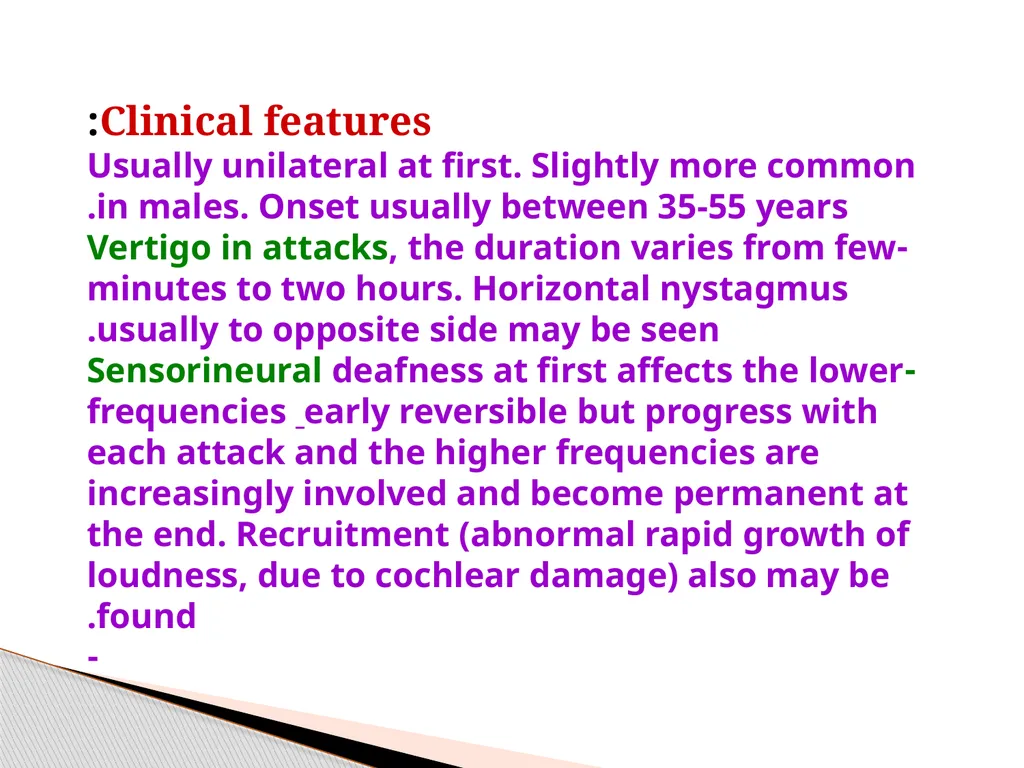
Clinical features:
Usually unilateral at first. Slightly more common in males. Onset usually between 35-55 years.
-Vertigo in attacks, the duration varies from few minutes to two hours. Horizontal nystagmus usually to opposite side may be seen.
-Sensorineural deafness at first affects the lower frequencies early reversible but progress with each attack and the higher frequencies are increasingly involved and become permanent at the end. Recruitment (abnormal rapid growth of loudness, due to cochlear damage) also may be found.
-<br>
Usually unilateral at first. Slightly more common in males. Onset usually between 35-55 years.
-Vertigo in attacks, the duration varies from few minutes to two hours. Horizontal nystagmus usually to opposite side may be seen.
-Sensorineural deafness at first affects the lower frequencies early reversible but progress with each attack and the higher frequencies are increasingly involved and become permanent at the end. Recruitment (abnormal rapid growth of loudness, due to cochlear damage) also may be found.
-<br>
30
--Tinnitus.
-Vagal disturbances: nausea, vomiting even diarrhea, pallor, cold sweat and lowered blood pressure.
-Headache (Associated migraine in 7-20%)
-Anxiety.<br>
-Vagal disturbances: nausea, vomiting even diarrhea, pallor, cold sweat and lowered blood pressure.
-Headache (Associated migraine in 7-20%)
-Anxiety.<br>
31
Diagnosis
1-History
2-An audiometric examination (hearing test PTA) indicates a sensory type of hearing loss in the affected ear. Speech discrimination is often diminished in the affected ear.
3-Caloric test:between the attacks show canal paresis. 4-For balance
An ENG (electronystagmogram) with caloric test. In about 50 percent of patients, the balance function is reduced in the affected ear.
5-Other tests
Electrocochleography (ECoG) may indicate increased inner ear fluid pressure in some cases of Ménières disease.
The auditory brain stem response (ABR), , computed tomography (CT), or magnetic resonance imaging (MRI) may be needed to rule out a tumor occurring on the hearing and balance nerve. Such tumors are rare, but they can cause symptoms similar to Ménières disease.<br>
1-History
2-An audiometric examination (hearing test PTA) indicates a sensory type of hearing loss in the affected ear. Speech discrimination is often diminished in the affected ear.
3-Caloric test:between the attacks show canal paresis. 4-For balance
An ENG (electronystagmogram) with caloric test. In about 50 percent of patients, the balance function is reduced in the affected ear.
5-Other tests
Electrocochleography (ECoG) may indicate increased inner ear fluid pressure in some cases of Ménières disease.
The auditory brain stem response (ABR), , computed tomography (CT), or magnetic resonance imaging (MRI) may be needed to rule out a tumor occurring on the hearing and balance nerve. Such tumors are rare, but they can cause symptoms similar to Ménières disease.<br>
32
Differential diagnosis:
1-Labyrinthitis
2-Cogan's disease
3-Vestibular neuronitis
4-BPPV
5-Acoustic neuroma
6-Disseminated sclerosis
7-Epilepsy<br>
1-Labyrinthitis
2-Cogan's disease
3-Vestibular neuronitis
4-BPPV
5-Acoustic neuroma
6-Disseminated sclerosis
7-Epilepsy<br>
33
Treatment:
Conservative: - Reassurance
- - To reduce the frequency of episodes by
Avoid stress and excess fluid& salt ingestion, caffeine, smoking, and alcohol. Get regular sleep and eat properly. Remain physically active, but avoid excessive fatigue.
Attacks of vertigo can controlled by
- Sedation (diazepam)
- Labyrinthine sedatives (Cinnarizine, promethazine)
- Vasodilators (Betahistine hydrochloride)
- Removal of toxic foci
- Diuretics (if the attacks are related to menstrual cycle)
- Restriction of salts and fluid intake
- Intratympanic injection with either gentamicin) vestibulotoxic)through temporary opening or placing a tube in the eardrum. But gentamycin cause SND
-An air pressure pulse generator a mechanical pump that is applied to ear canal for 5 minutes 3 times a day
-<br>
Conservative: - Reassurance
- - To reduce the frequency of episodes by
Avoid stress and excess fluid& salt ingestion, caffeine, smoking, and alcohol. Get regular sleep and eat properly. Remain physically active, but avoid excessive fatigue.
Attacks of vertigo can controlled by
- Sedation (diazepam)
- Labyrinthine sedatives (Cinnarizine, promethazine)
- Vasodilators (Betahistine hydrochloride)
- Removal of toxic foci
- Diuretics (if the attacks are related to menstrual cycle)
- Restriction of salts and fluid intake
- Intratympanic injection with either gentamicin) vestibulotoxic)through temporary opening or placing a tube in the eardrum. But gentamycin cause SND
-An air pressure pulse generator a mechanical pump that is applied to ear canal for 5 minutes 3 times a day
-<br>
34
WHEN IS SURGERY RECOMMENDED?
Surgery is needed in only a small minority of patients with Menieres disease. If vertigo attacks are not controlled by conservative measures and are disabling, one of the following surgical procedures might be recommended:
Endolymphatic sac shunt or decompression relieves attacks of vertigo in one-half to two-thirds of cases
Selective vestibular neurectomy :-. While vertigo attacks are permanently cured in a high percentage of cases, patients may continue to experience imbalance, hearing function is usually preserved.
Labryrinthectomy and eighth nerve section :. This is considered when the patient with Ménière-s disease has poor hearing in the affected ear. This procedure will result in the highest rates for control of vertigo attacks.<br>
Surgery is needed in only a small minority of patients with Menieres disease. If vertigo attacks are not controlled by conservative measures and are disabling, one of the following surgical procedures might be recommended:
Endolymphatic sac shunt or decompression relieves attacks of vertigo in one-half to two-thirds of cases
Selective vestibular neurectomy :-. While vertigo attacks are permanently cured in a high percentage of cases, patients may continue to experience imbalance, hearing function is usually preserved.
Labryrinthectomy and eighth nerve section :. This is considered when the patient with Ménière-s disease has poor hearing in the affected ear. This procedure will result in the highest rates for control of vertigo attacks.<br>
35
Presbycusis
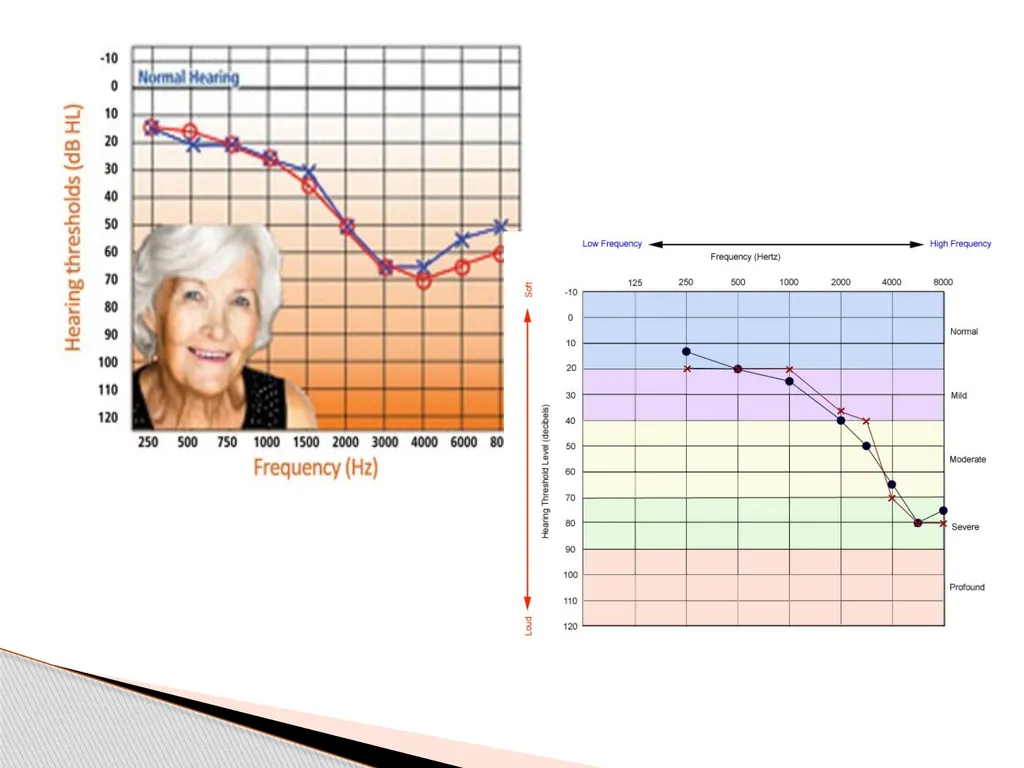
Presbycusis (also spelled presbyacusis, from Greek presbys “elder” + akousis “hearing”[1]), or age-related hearing loss, is the cumulative effect of aging on hearing. It is a progressive bilateral symmetrical age-related sensorineural hearing loss. The hearing loss is most marked at higher frequencies.
There are four pathological types of presbycusis:
Sensory: characterised by degeneration of organ of corti.
Neural: characterised by degeneration of cells of spiral ganglion.
Strial/metabolic: characterised by atrophy of stria vascularis in all turns of cochlea.
Cochlear conductive: due to stiffening of basilar membrane thus affecting its movement<br>
Presbycusis (also spelled presbyacusis, from Greek presbys “elder” + akousis “hearing”[1]), or age-related hearing loss, is the cumulative effect of aging on hearing. It is a progressive bilateral symmetrical age-related sensorineural hearing loss. The hearing loss is most marked at higher frequencies.
There are four pathological types of presbycusis:
Sensory: characterised by degeneration of organ of corti.
Neural: characterised by degeneration of cells of spiral ganglion.
Strial/metabolic: characterised by atrophy of stria vascularis in all turns of cochlea.
Cochlear conductive: due to stiffening of basilar membrane thus affecting its movement<br>
36
Presentation
Bilateral high frequency sensorineural deafness, poor speech discrimination.
Deterioration in hearing has been found to start early, Age affects high frequencies more than low, and men more frequently than women. The effects of aging can be exacerbated by exposure to environmental noise, This is noise-induced hearing loss (NIHL) and is distinct from presbycusis.
Over time, the detection of high-pitched sounds becomes more difficult, and speech perception is affected, particularly of sibilants and fricatives. Both ears tend to be affected .<br>
Bilateral high frequency sensorineural deafness, poor speech discrimination.
Deterioration in hearing has been found to start early, Age affects high frequencies more than low, and men more frequently than women. The effects of aging can be exacerbated by exposure to environmental noise, This is noise-induced hearing loss (NIHL) and is distinct from presbycusis.
Over time, the detection of high-pitched sounds becomes more difficult, and speech perception is affected, particularly of sibilants and fricatives. Both ears tend to be affected .<br>
37
Pathophysiology
Degeneration due to vascular insufficiency: Atrophy of epithelial, neural tissues and stria vascularis in the cochlea.<br>
Degeneration due to vascular insufficiency: Atrophy of epithelial, neural tissues and stria vascularis in the cochlea.<br>
38
CAUSES
Factors that can cause hearing loss
Heredity: Factors like early aging of the cochlea and susceptibility of the cochlea for drug insults are genetically determined.
Atherosclerosis: May diminish vascularity of the cochlea, thereby reducing its oxygen supply.
Dietary habits: Increased intake of saturated fat may accelerate atherosclerotic changes in old age.
Diabetes: May cause vasculitis and endothelial proliferation in the blood vessels of the cochlea, thereby reducing its blood supply.
Noise trauma: Exposure to loud noise/music on a continuing basis stresses the already hypoxic cochlea, hastening the presbycusis.
Smoking: Is postulated to accentuate atherosclerotic changes in blood vessels aggravating presbycusis.
Hypertension: Causes potent vascular changes, like reduction in blood supply to the cochlea, thereby aggravating presbycusis.
Ototoxic drugs: Ingestion of ototoxic drugs like aspirin may hasten the process of presbycusis<br>
Factors that can cause hearing loss
Heredity: Factors like early aging of the cochlea and susceptibility of the cochlea for drug insults are genetically determined.
Atherosclerosis: May diminish vascularity of the cochlea, thereby reducing its oxygen supply.
Dietary habits: Increased intake of saturated fat may accelerate atherosclerotic changes in old age.
Diabetes: May cause vasculitis and endothelial proliferation in the blood vessels of the cochlea, thereby reducing its blood supply.
Noise trauma: Exposure to loud noise/music on a continuing basis stresses the already hypoxic cochlea, hastening the presbycusis.
Smoking: Is postulated to accentuate atherosclerotic changes in blood vessels aggravating presbycusis.
Hypertension: Causes potent vascular changes, like reduction in blood supply to the cochlea, thereby aggravating presbycusis.
Ototoxic drugs: Ingestion of ototoxic drugs like aspirin may hasten the process of presbycusis<br>
39
Treatments]
Devices like hearing aids and cochlear implants already help improve hearing of many elderly. Though still in their early stages, several treatments for presbycusis are in development. Included in these are the water-soluble coenzyme Q10 formulation, .
In a study performed in 2010, it was found that the water-soluble formulation of coenzyme Q10 (CoQ10) caused a significant improvement in liminar tonal audiometry of the air and bone thresholds at 1000 Hz, 2000 Hz, 4000 Hz, and 8000 Hz.[6] It is likely that a larger clinical trial will be performed<br>
Devices like hearing aids and cochlear implants already help improve hearing of many elderly. Though still in their early stages, several treatments for presbycusis are in development. Included in these are the water-soluble coenzyme Q10 formulation, .
In a study performed in 2010, it was found that the water-soluble formulation of coenzyme Q10 (CoQ10) caused a significant improvement in liminar tonal audiometry of the air and bone thresholds at 1000 Hz, 2000 Hz, 4000 Hz, and 8000 Hz.[6] It is likely that a larger clinical trial will be performed<br>
40
Ototoxicity
..
The extent of ototoxicity varies with the drug, the dose, and other conditions. In some cases, there is full recovery after the drug has been discontinued. In other cases, the extent of damage is limited, and may even be too small to be noticed. This may occur in highfrequency hearing loss,, there may be permanent and complete deafness. .[9] Symptoms of ototoxicity include mild ,moderat,sever or profound hearing loss .
vertigo, and tinnitus.[9] Definition: damage of the cochlear and or the vestibular part of the inner ear and or the vestibulocochlear nerve by drugs and chemical agent<br>
..
The extent of ototoxicity varies with the drug, the dose, and other conditions. In some cases, there is full recovery after the drug has been discontinued. In other cases, the extent of damage is limited, and may even be too small to be noticed. This may occur in highfrequency hearing loss,, there may be permanent and complete deafness. .[9] Symptoms of ototoxicity include mild ,moderat,sever or profound hearing loss .
vertigo, and tinnitus.[9] Definition: damage of the cochlear and or the vestibular part of the inner ear and or the vestibulocochlear nerve by drugs and chemical agent<br>
41
Causes and symptoms
Many drugs can cause ototoxicity.
Antibiotics
amikacin (Amikin)
streptomycin
neomycin
gentamicin (Garamycin(
erythromycin .
kanamycin (
tobramycin (
netilmycin (Netromycin)
vancomycin (Vancocin)
Anti-cancer drugs
cisplatin (Platinol AQ)
bleomycin (Blenoxane)
vincristine (Oncovin)
Diuretics
acetazolamide (Diamox)
furosemide (Lasix)
bumetanide (Bumex)
ethacrynic acid (Edecrine)
. Aspirin overdose causes ringing in the ears. The antimalarial drugs quinine and chloroquine may also cause ear damage. environmental chemicals that can cause ear damage are tin, lead, mercury, carbon monoxide, and carbon disulfide.<br>
Many drugs can cause ototoxicity.
Antibiotics
amikacin (Amikin)
streptomycin
neomycin
gentamicin (Garamycin(
erythromycin .
kanamycin (
tobramycin (
netilmycin (Netromycin)
vancomycin (Vancocin)
Anti-cancer drugs
cisplatin (Platinol AQ)
bleomycin (Blenoxane)
vincristine (Oncovin)
Diuretics
acetazolamide (Diamox)
furosemide (Lasix)
bumetanide (Bumex)
ethacrynic acid (Edecrine)
. Aspirin overdose causes ringing in the ears. The antimalarial drugs quinine and chloroquine may also cause ear damage. environmental chemicals that can cause ear damage are tin, lead, mercury, carbon monoxide, and carbon disulfide.<br>
42
Treatment
There are no current treatments to reverse the effects of
ototoxicity.
Preventive: Avoid or discontinue ototoxic drugs
Monitor treatment.
Monitor hearing (How?)
Therapeutic: no medical or surgical treatment is effective.
People who suffer permanent hearing loss may elect to use hearing aids, or, when appropriate, receive a cochlear implant. For those who have balance problems, physical therapy may often be helpful. Physical therapists can help people with balance problems learn to rely more on vision and the sensations from muscles to achieve balance.<br>
There are no current treatments to reverse the effects of
ototoxicity.
Preventive: Avoid or discontinue ototoxic drugs
Monitor treatment.
Monitor hearing (How?)
Therapeutic: no medical or surgical treatment is effective.
People who suffer permanent hearing loss may elect to use hearing aids, or, when appropriate, receive a cochlear implant. For those who have balance problems, physical therapy may often be helpful. Physical therapists can help people with balance problems learn to rely more on vision and the sensations from muscles to achieve balance.<br>