
Dealing with challenging patients Communication
Description: Dealing with challenging patients Communication Skills Demanding and unreasonable patients (or patients with a high IQ) Challenges: Lack of experience Emotional patients Intimidating patients Lack of background to patients demands Money
Related Topics
Download Presentation
"Dealing with challenging patients Communication" is the property of its rightful owner. Permission is granted to download and print the materials on this website for personal, non-commercial use only, and to display it on your personal computer provided you do not modify the materials and that you retain all copyright notices contained in the materials. By downloading content from our website, you accept the terms of this agreement.
Presentation Transcript
slide1. Dealing with challenging patients Communication Skills<br>
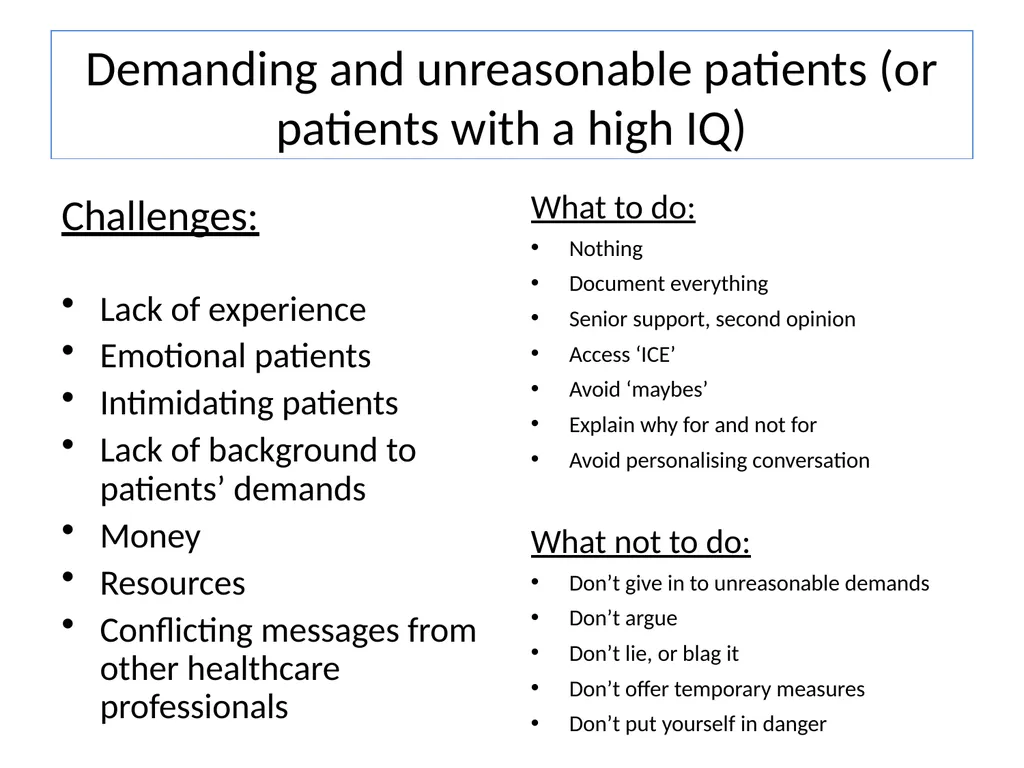
slide2. Demanding and unreasonable patients (or patients with a high IQ) Challenges:
Lack of experience
Emotional patients
Intimidating patients
Lack of background to patients’ demands
Money
Resources
Conflicting messages from other healthcare professionals What to do:
Nothing
Document everything
Senior support, second opinion
Access ‘ICE’
Avoid ‘maybes’
Explain why for and not for
Avoid personalising conversation
What not to do:
Don’t give in to unreasonable demands
Don’t argue
Don’t lie, or blag it
Don’t offer temporary measures
Don’t put yourself in danger<br>
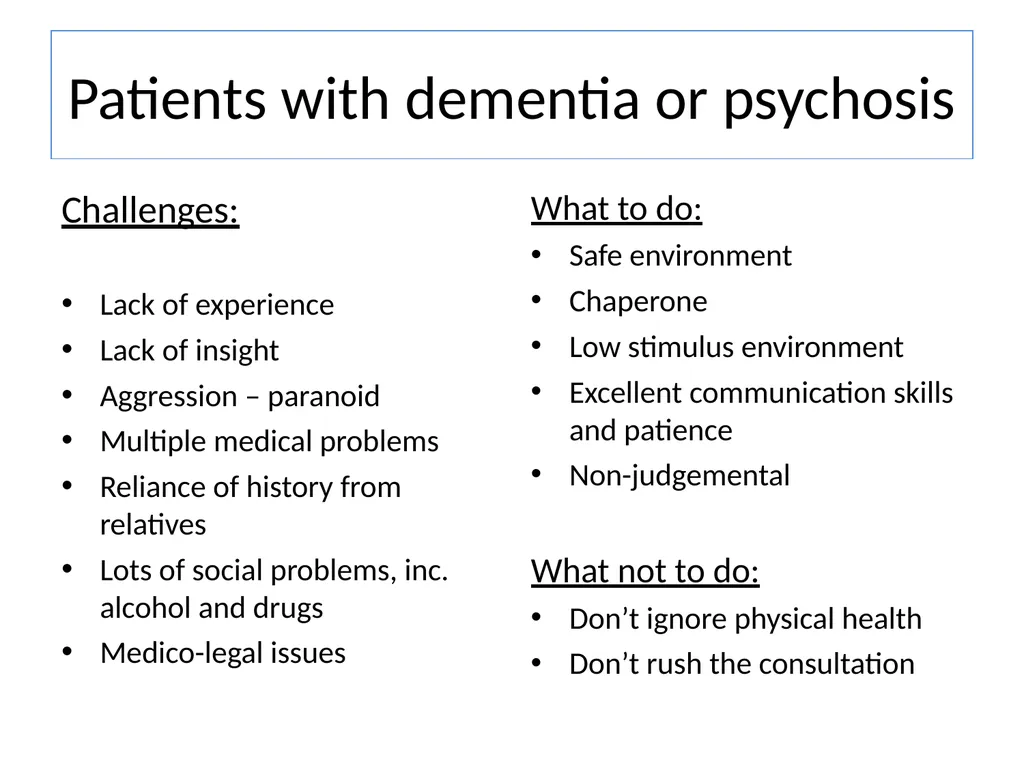
slide3. Patients with dementia or psychosis Challenges:
Lack of experience
Lack of insight
Aggression – paranoid
Multiple medical problems
Reliance of history from relatives
Lots of social problems, inc. alcohol and drugs
Medico-legal issues What to do:
Safe environment
Chaperone
Low stimulus environment
Excellent communication skills and patience
Non-judgemental
What not to do:
Don’t ignore physical health
Don’t rush the consultation<br>
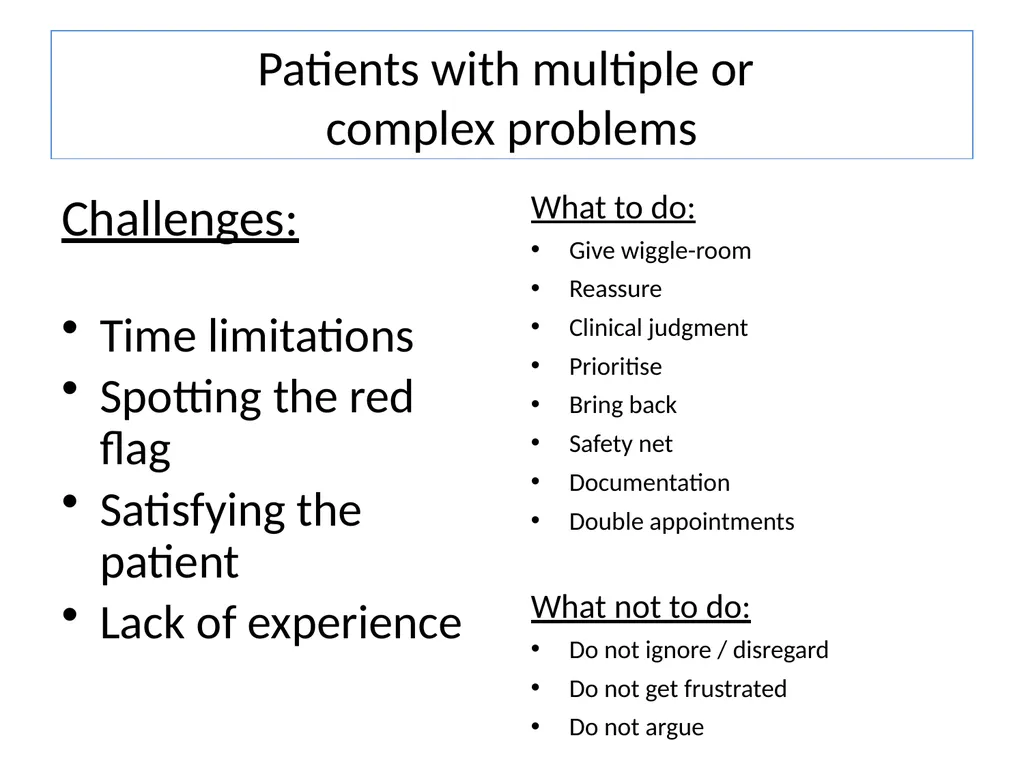
slide4. Patients with multiple or complex problems Challenges:
Time limitations
Spotting the red flag
Satisfying the patient
Lack of experience What to do:
Give wiggle-room
Reassure
Clinical judgment
Prioritise
Bring back
Safety net
Documentation
Double appointments
What not to do:
Do not ignore / disregard
Do not get frustrated
Do not argue<br>
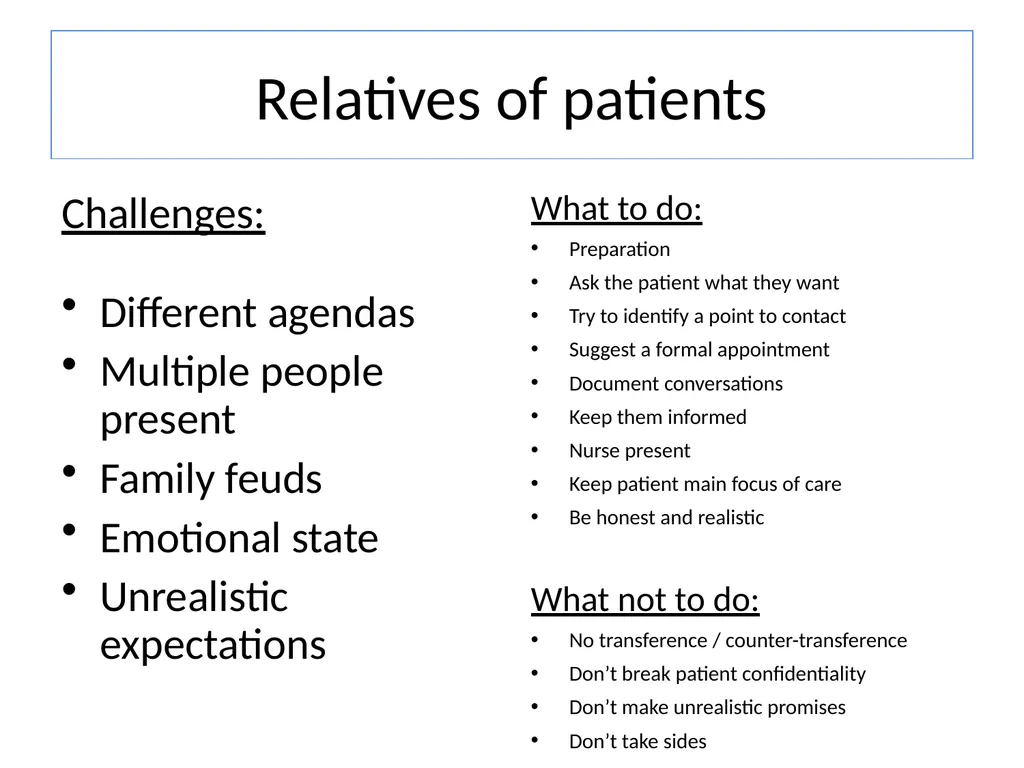
slide5. Relatives of patients Challenges:
Different agendas
Multiple people present
Family feuds
Emotional state
Unrealistic expectations What to do:
Preparation
Ask the patient what they want
Try to identify a point to contact
Suggest a formal appointment
Document conversations
Keep them informed
Nurse present
Keep patient main focus of care
Be honest and realistic
What not to do:
No transference / counter-transference
Don’t break patient confidentiality
Don’t make unrealistic promises
Don’t take sides<br>
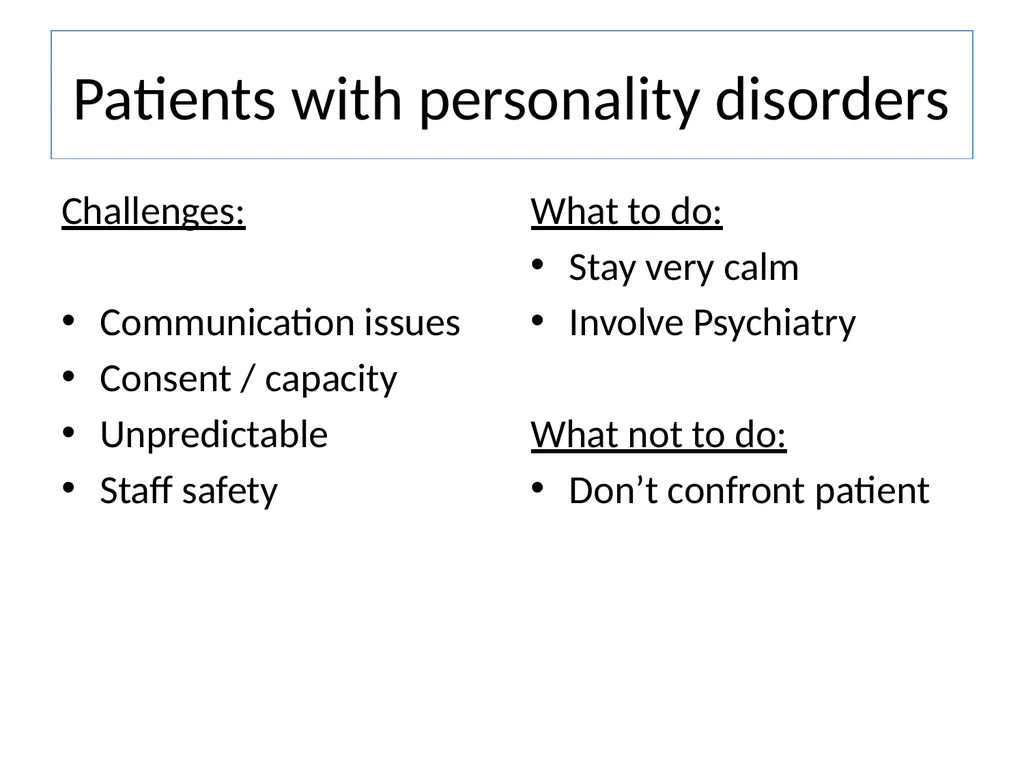
slide6. Patients with personality disorders Challenges:
Communication issues
Consent / capacity
Unpredictable
Staff safety What to do:
Stay very calm
Involve Psychiatry
What not to do:
Don’t confront patient<br>
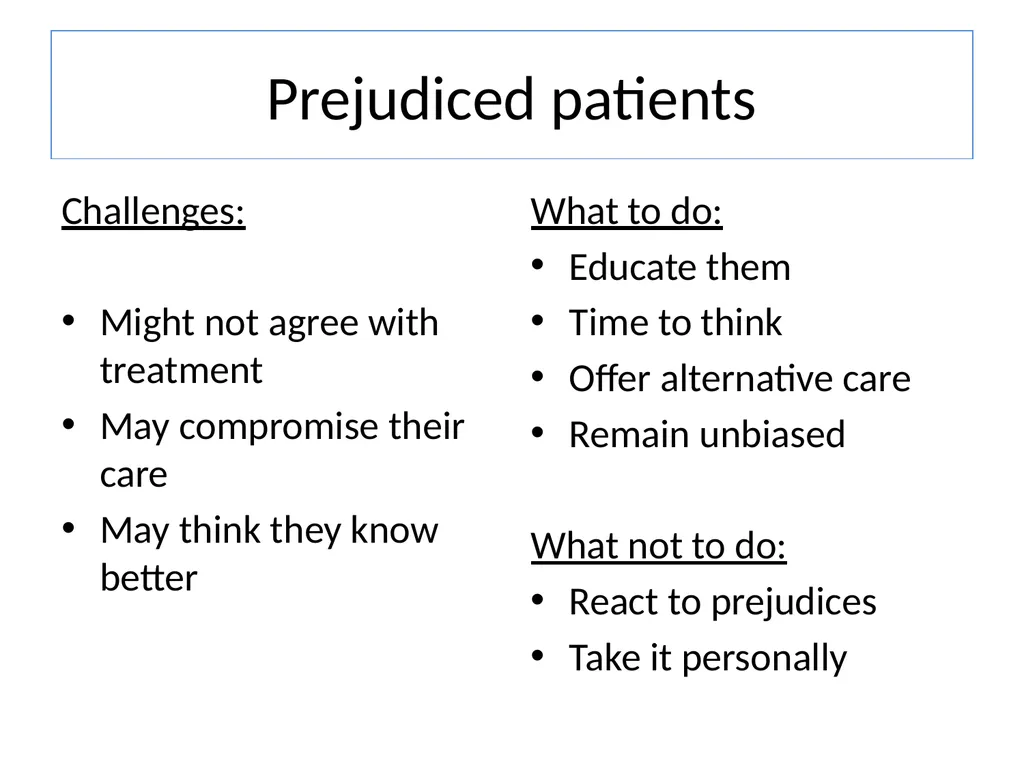
slide7. Prejudiced patients Challenges:
Might not agree with treatment
May compromise their care
May think they know better What to do:
Educate them
Time to think
Offer alternative care
Remain unbiased
What not to do:
React to prejudices
Take it personally<br>
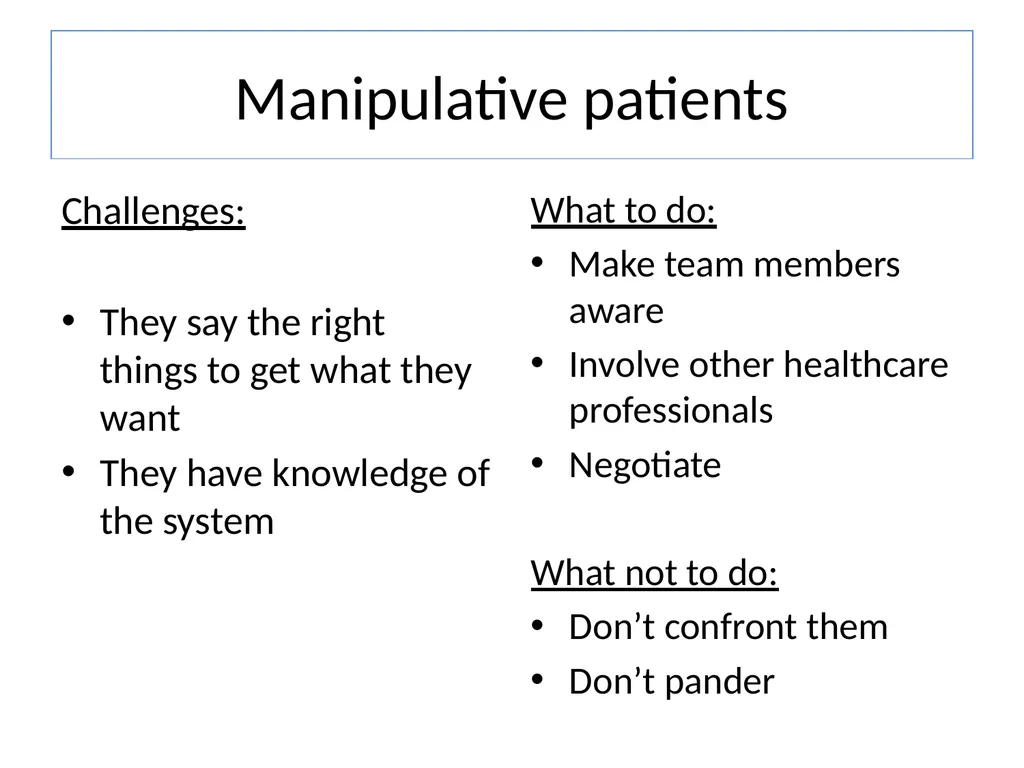
slide8. Manipulative patients Challenges:
They say the right things to get what they want
They have knowledge of the system What to do:
Make team members aware
Involve other healthcare professionals
Negotiate
What not to do:
Don’t confront them
Don’t pander<br>
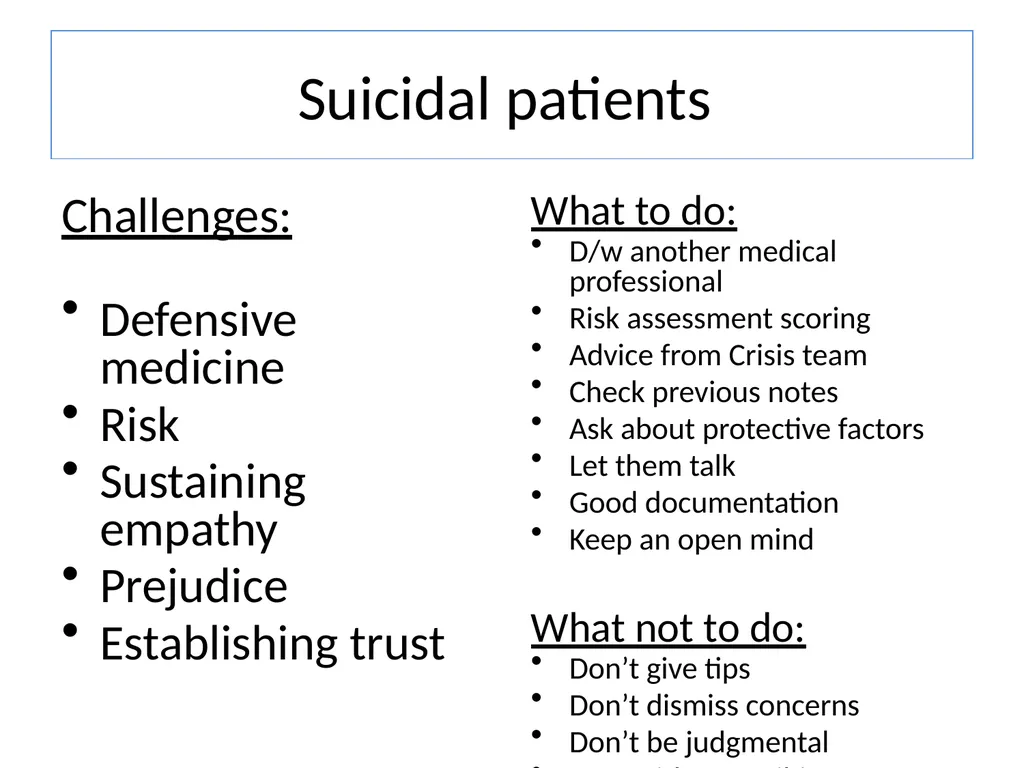
slide9. Suicidal patients Challenges:
Defensive medicine
Risk
Sustaining empathy
Prejudice
Establishing trust What to do:
D/w another medical professional
Risk assessment scoring
Advice from Crisis team
Check previous notes
Ask about protective factors
Let them talk
Good documentation
Keep an open mind
What not to do:
Don’t give tips
Don’t dismiss concerns
Don’t be judgmental
Care with prescribing<br>
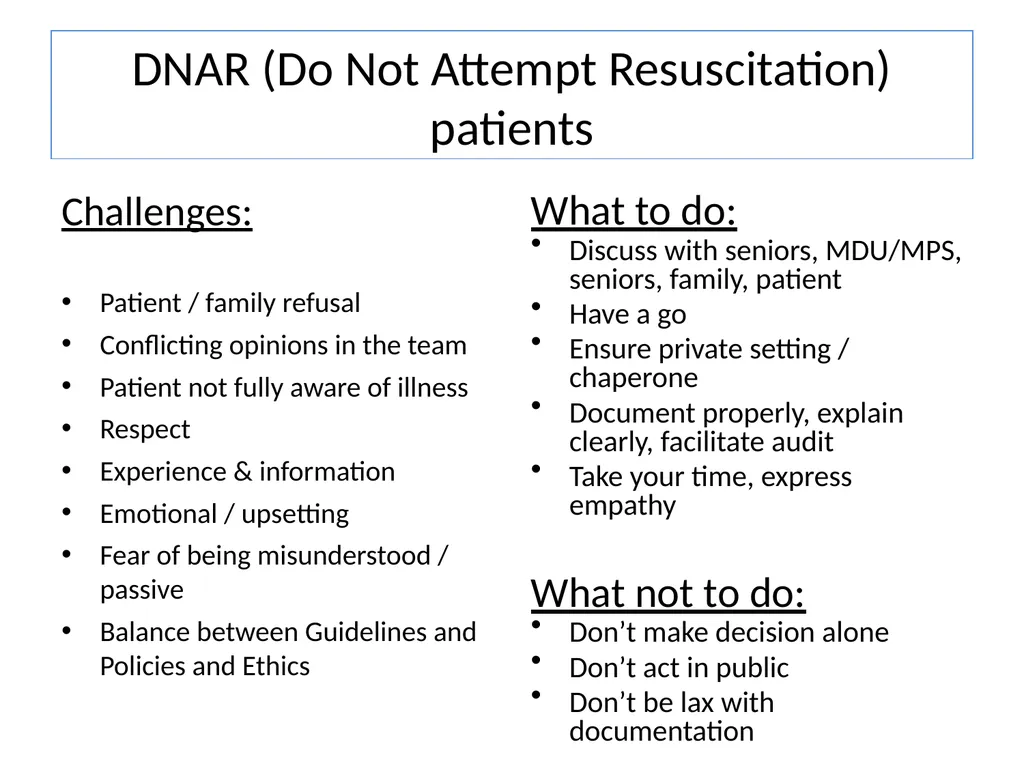
slide10. DNAR (Do Not Attempt Resuscitation) patients Challenges:
Patient / family refusal
Conflicting opinions in the team
Patient not fully aware of illness
Respect
Experience & information
Emotional / upsetting
Fear of being misunderstood / passive
Balance between Guidelines and Policies and Ethics What to do:
Discuss with seniors, MDU/MPS, seniors, family, patient
Have a go
Ensure private setting / chaperone
Document properly, explain clearly, facilitate audit
Take your time, express empathy
What not to do:
Don’t make decision alone
Don’t act in public
Don’t be lax with documentation<br>
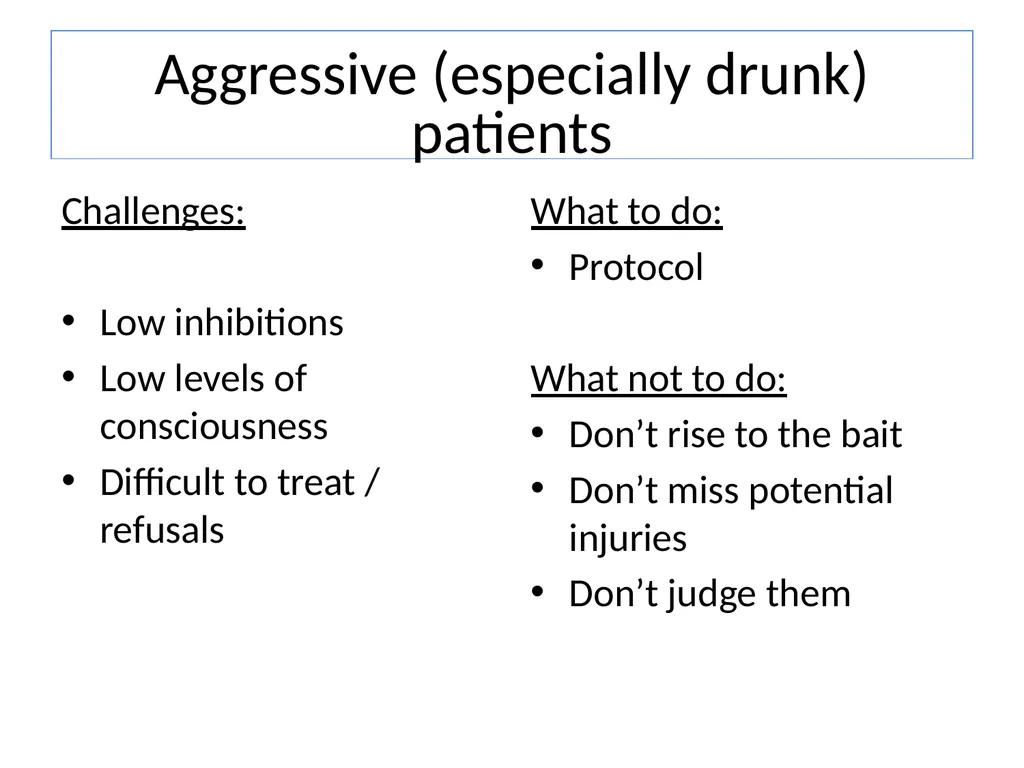
slide11. Aggressive (especially drunk) patients Challenges:
Low inhibitions
Low levels of consciousness
Difficult to treat / refusals What to do:
Protocol
What not to do:
Don’t rise to the bait
Don’t miss potential injuries
Don’t judge them<br>
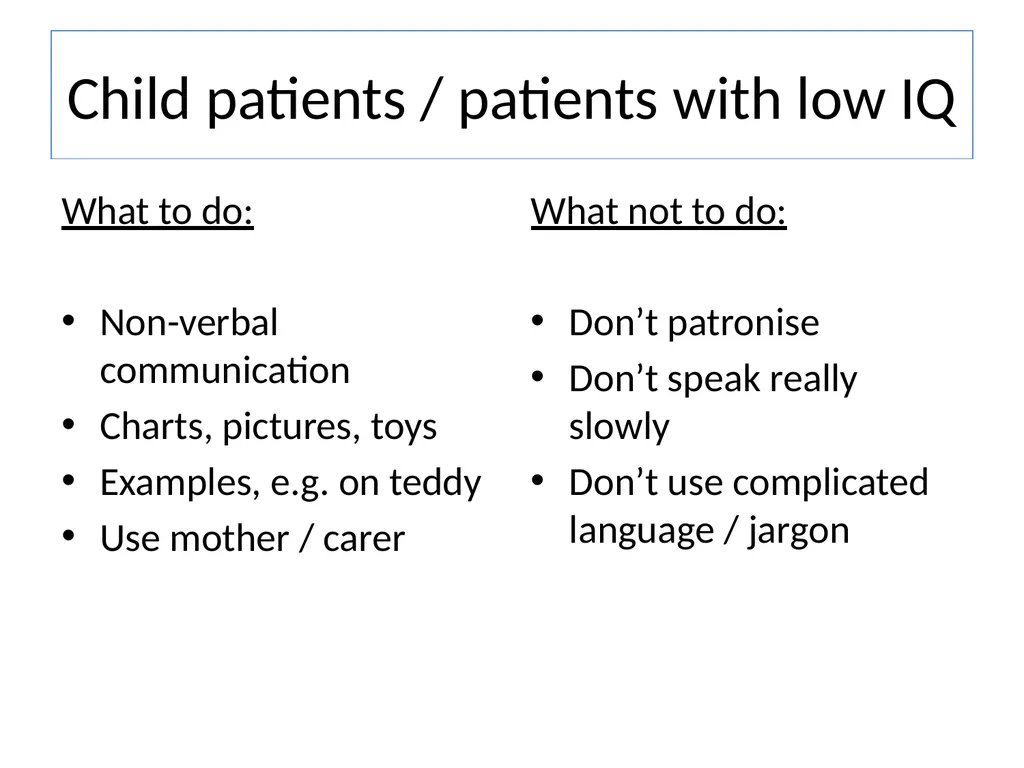
slide12. Child patients / patients with low IQ What to do:
Non-verbal communication
Charts, pictures, toys
Examples, e.g. on teddy
Use mother / carer What not to do:
Don’t patronise
Don’t speak really slowly
Don’t use complicated language / jargon<br>
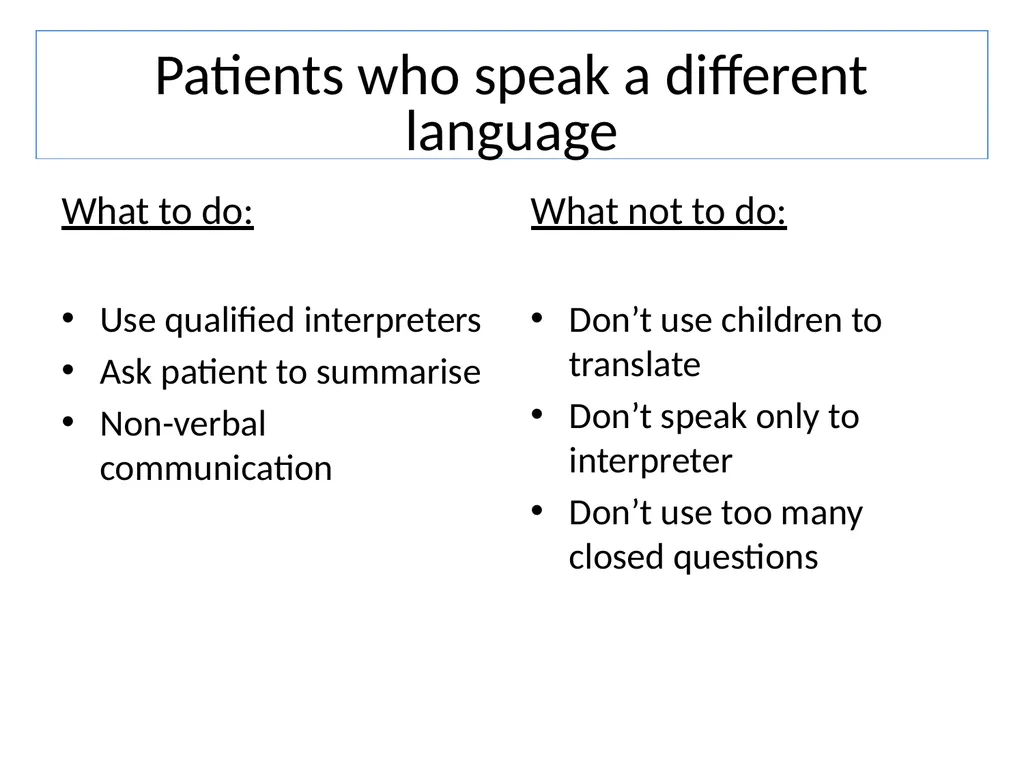
slide13. Patients who speak a different language What to do:
Use qualified interpreters
Ask patient to summarise
Non-verbal communication What not to do:
Don’t use children to translate
Don’t speak only to interpreter
Don’t use too many closed questions<br>
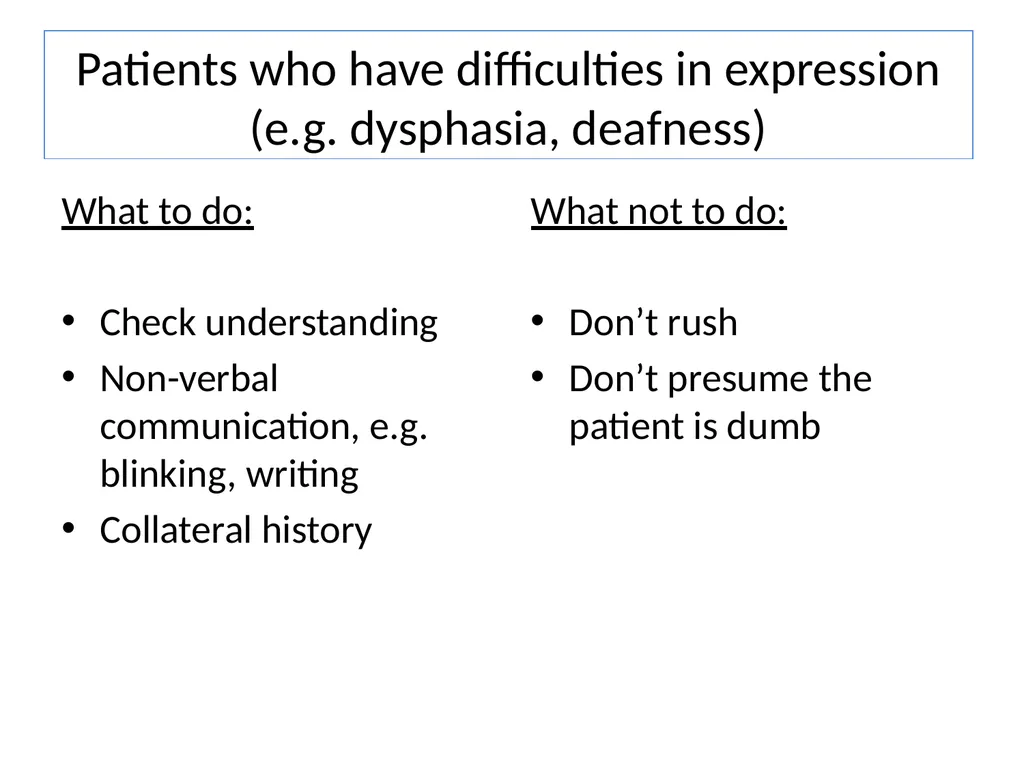
slide14. Patients who have difficulties in expression (e.g. dysphasia, deafness) What to do:
Check understanding
Non-verbal communication, e.g. blinking, writing
Collateral history What not to do:
Don’t rush
Don’t presume the patient is dumb<br>
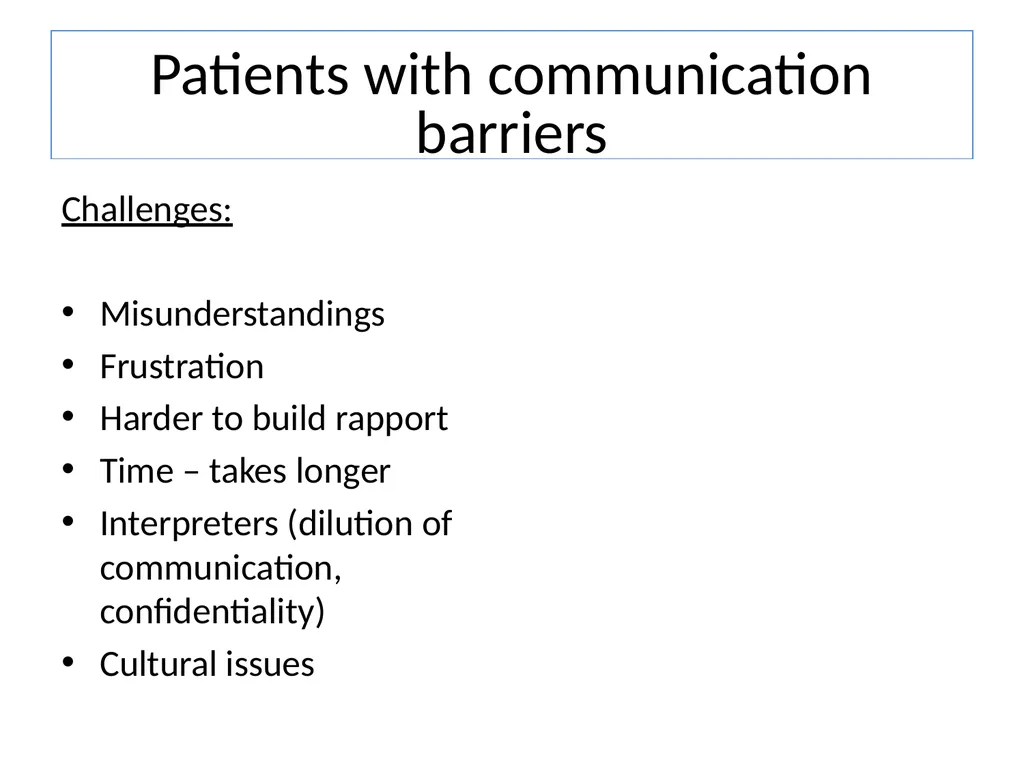
slide15. Patients with communication barriers Challenges:
Misunderstandings
Frustration
Harder to build rapport
Time – takes longer
Interpreters (dilution of communication, confidentiality)
Cultural issues<br>
slide16. FY2 communication: Useful tools from the field of Psychology Dr Julie Highfield
Clinical Psychologist
Cardiac Rehab and Renal Services- UHCW<br>
slide17. Areas covered The following are some ideas from the field of clinical psychology which may help you when considering why some interactions with clients can be difficult. It is not intended as an exhaustive list.
The kinds of things covered are:
Some thoughts on why patients may struggle to adhere to your advice. This includes thinking about how patient represent illness (from Leventhal), and from psychodynamic ideas, and motivation for change (with ideas from motivational interviewing).
Some thoughts on the way in which a patient may act and how this shapes our behaviour and then their behaviour in turn- drawing from Transactional analysis, reciprocal roles (CAT), and transference.<br>
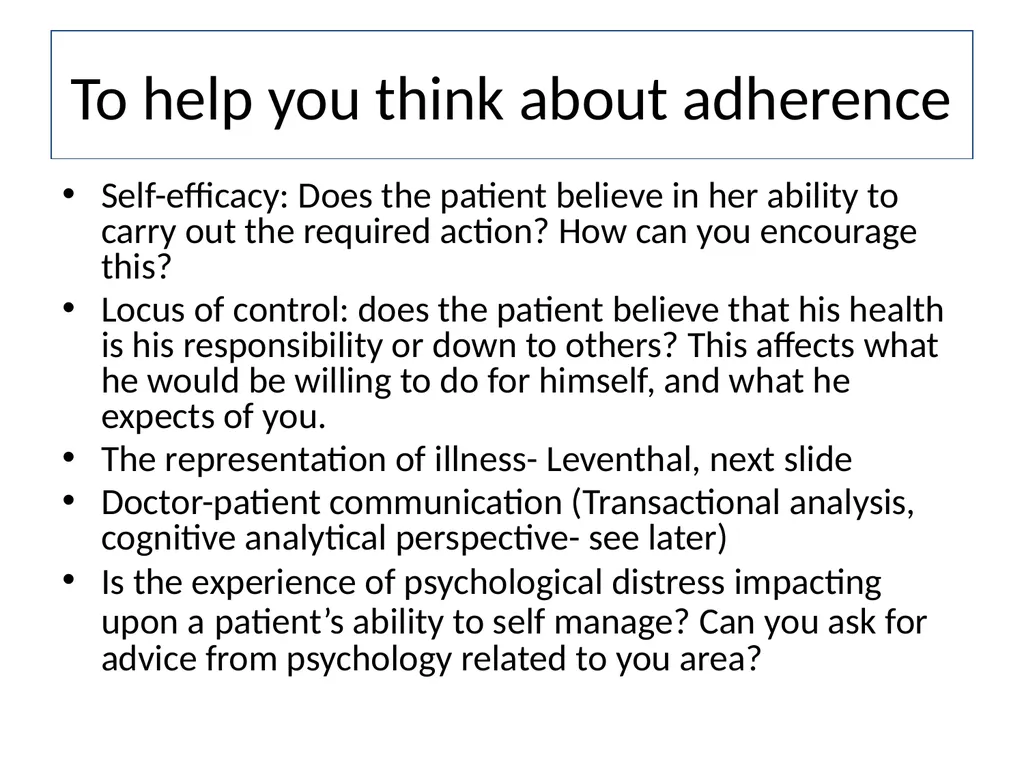
slide18. To help you think about adherence Self-efficacy: Does the patient believe in her ability to carry out the required action? How can you encourage this?
Locus of control: does the patient believe that his health is his responsibility or down to others? This affects what he would be willing to do for himself, and what he expects of you.
The representation of illness- Leventhal, next slide
Doctor-patient communication (Transactional analysis, cognitive analytical perspective- see later)
Is the experience of psychological distress impacting upon a patient’s ability to self manage? Can you ask for advice from psychology related to you area?<br>
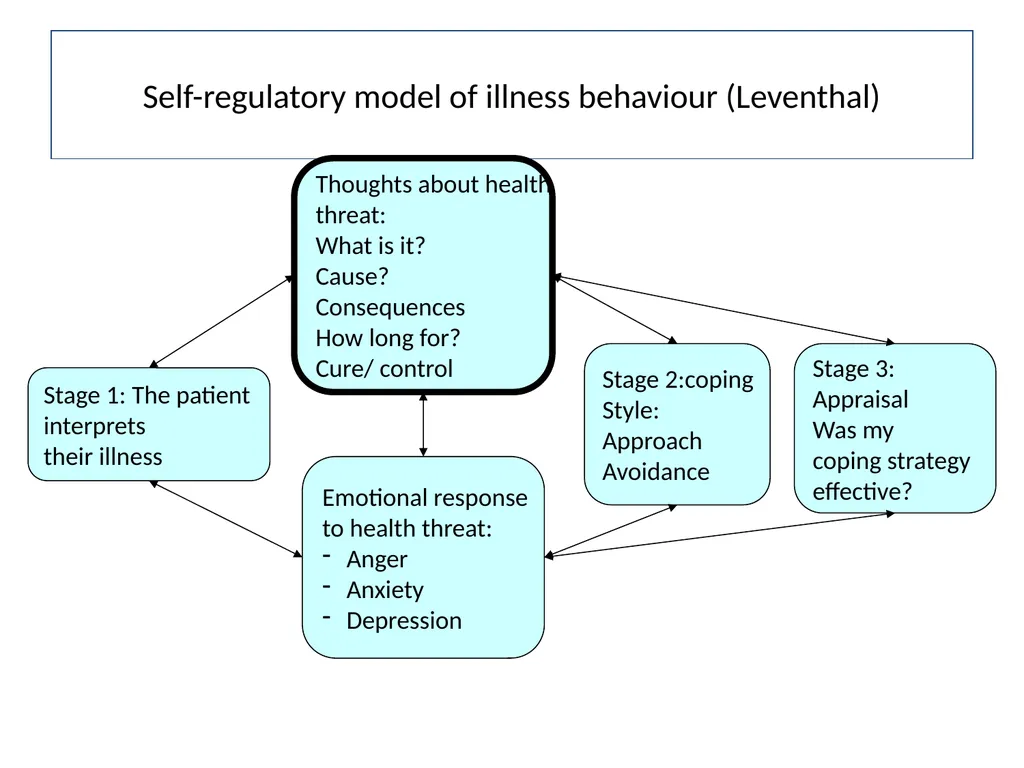
slide19. Self-regulatory model of illness behaviour (Leventhal) Stage 1: The patient
interprets
their illness Thoughts about health
threat:
What is it?
Cause?
Consequences
How long for?
Cure/ control Emotional response
to health threat:
Anger
Anxiety
Depression Stage 2:coping
Style:
Approach
Avoidance Stage 3:
Appraisal
Was my
coping strategy
effective?<br>
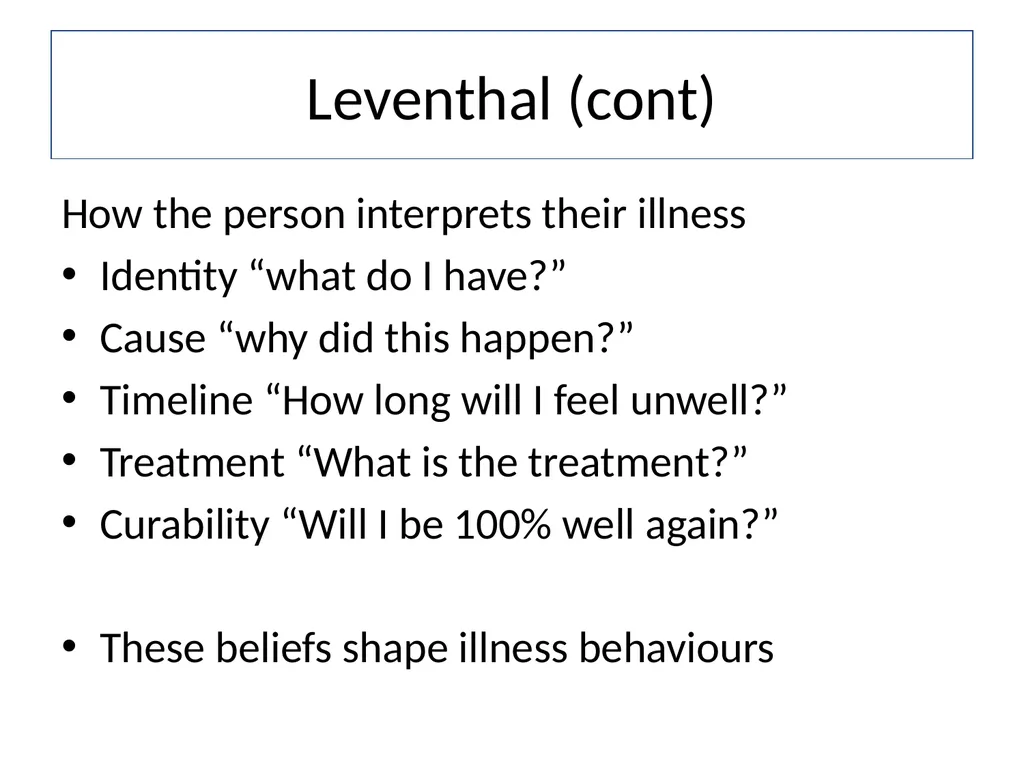
slide20. Leventhal (cont) How the person interprets their illness
Identity “what do I have?”
Cause “why did this happen?”
Timeline “How long will I feel unwell?”
Treatment “What is the treatment?”
Curability “Will I be 100% well again?”
These beliefs shape illness behaviours<br>
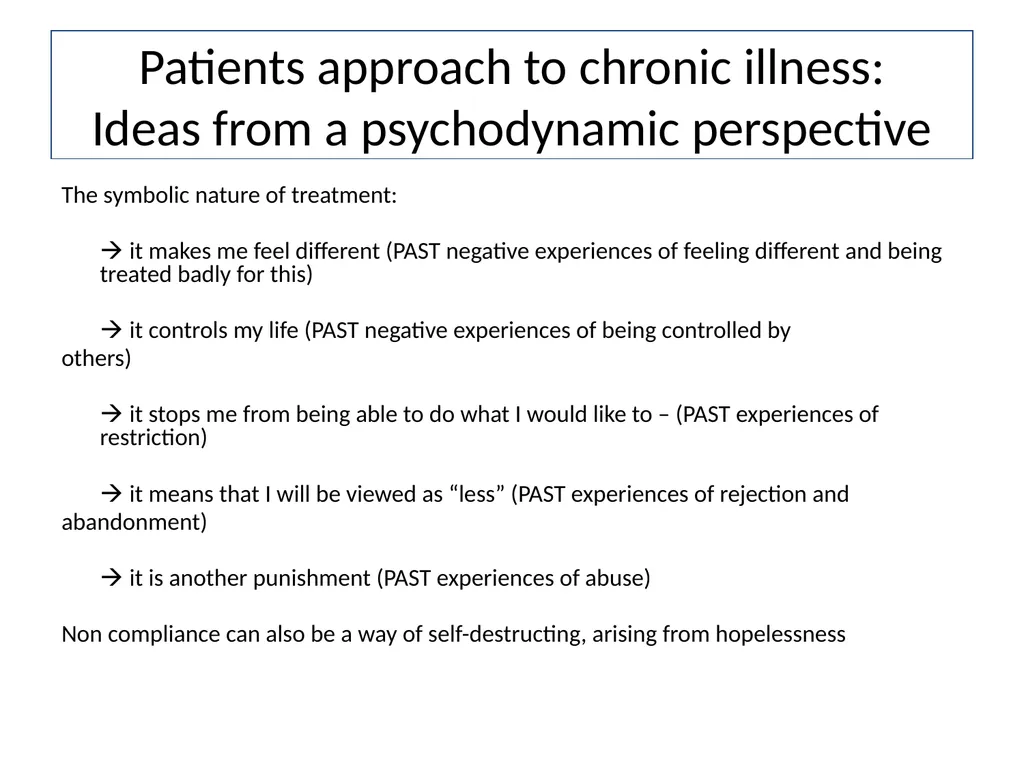
slide21. Patients approach to chronic illness: Ideas from a psychodynamic perspective The symbolic nature of treatment:
it makes me feel different (PAST negative experiences of feeling different and being treated badly for this)
it controls my life (PAST negative experiences of being controlled by
others)
it stops me from being able to do what I would like to – (PAST experiences of restriction)
it means that I will be viewed as “less” (PAST experiences of rejection and
abandonment)
it is another punishment (PAST experiences of abuse)
Non compliance can also be a way of self-destructing, arising from hopelessness<br>
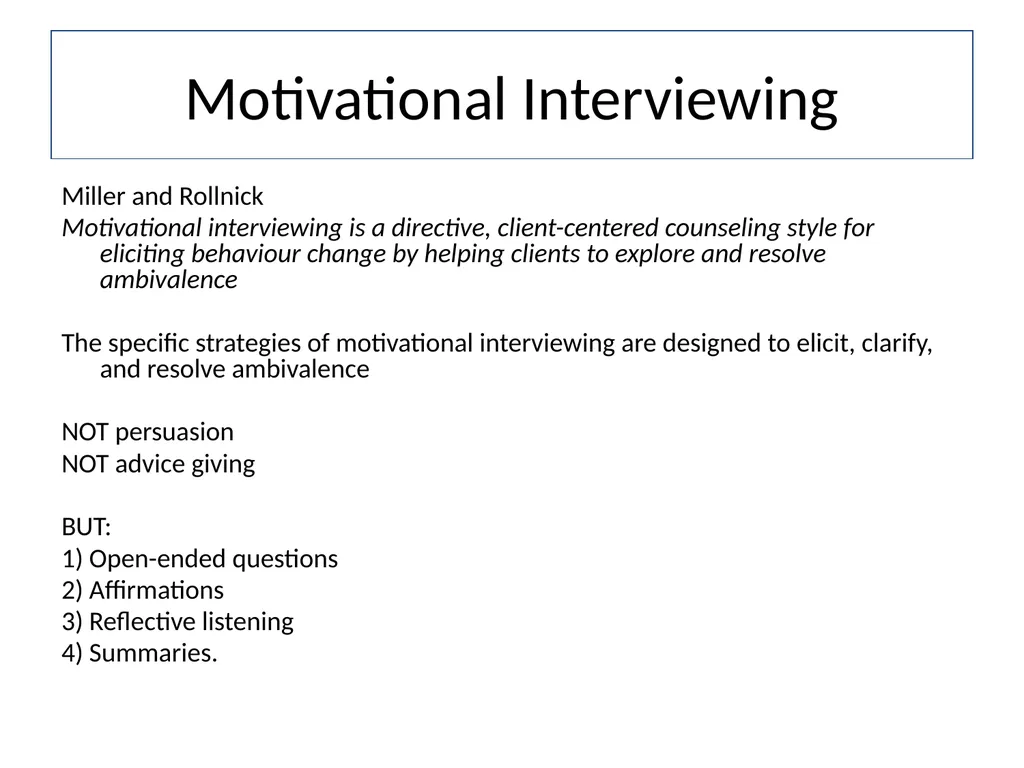
slide22. Motivational Interviewing Miller and Rollnick
Motivational interviewing is a directive, client-centered counseling style for eliciting behaviour change by helping clients to explore and resolve ambivalence
The specific strategies of motivational interviewing are designed to elicit, clarify, and resolve ambivalence
NOT persuasion
NOT advice giving
BUT:
1) Open-ended questions
2) Affirmations
3) Reflective listening
4) Summaries.<br>
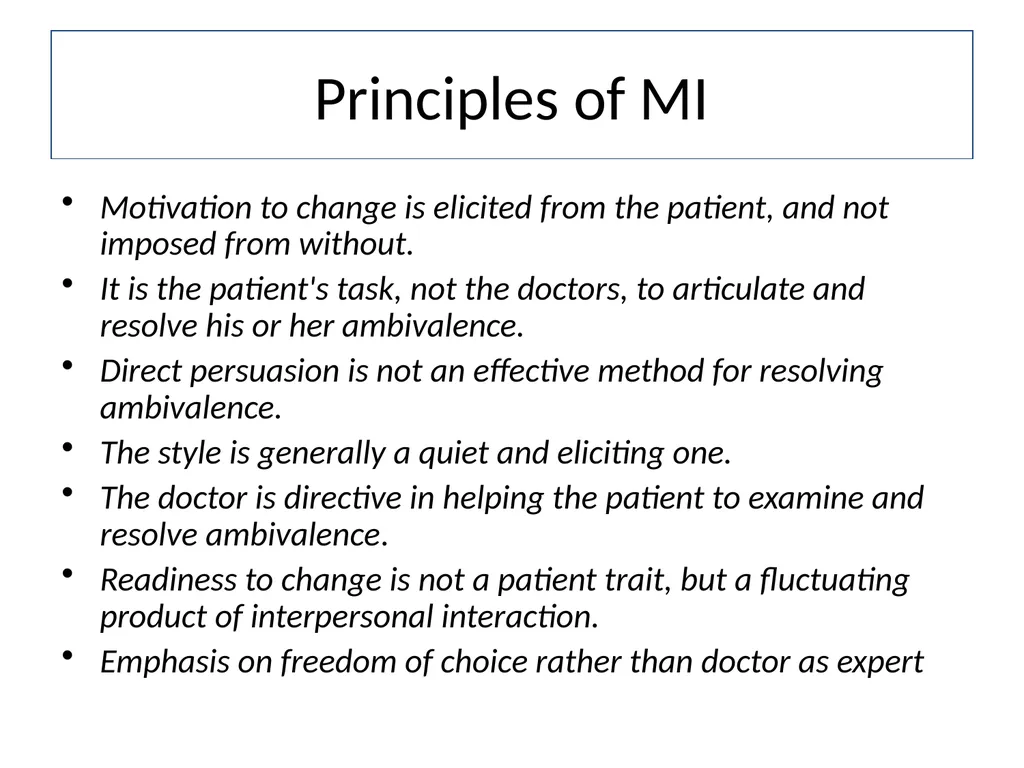
slide23. Principles of MI Motivation to change is elicited from the patient, and not imposed from without.
It is the patient's task, not the doctors, to articulate and resolve his or her ambivalence.
Direct persuasion is not an effective method for resolving ambivalence.
The style is generally a quiet and eliciting one.
The doctor is directive in helping the patient to examine and resolve ambivalence.
Readiness to change is not a patient trait, but a fluctuating product of interpersonal interaction.
Emphasis on freedom of choice rather than doctor as expert<br>
slide24. Stages of Change Prochaska and DiClemente (originally 1982) produced a
model of behaviour change that is used within Motivational Interviewing. Not linear, but dynamic:
Pre-contemplation: not intending to make changes
Contemplation: considering a change
Preparation: making small changes
Action: engaging in a new behaviour
Maintenance: sustaining the change over time
Thus different approaches by HCPs to patients needed
according to stage.
The stages of change model is useful when considering poor health behaviours (e.g. smoking, drinking alcohol). A person is unlikely to take your advice and “give up” until they are ready to do so<br>
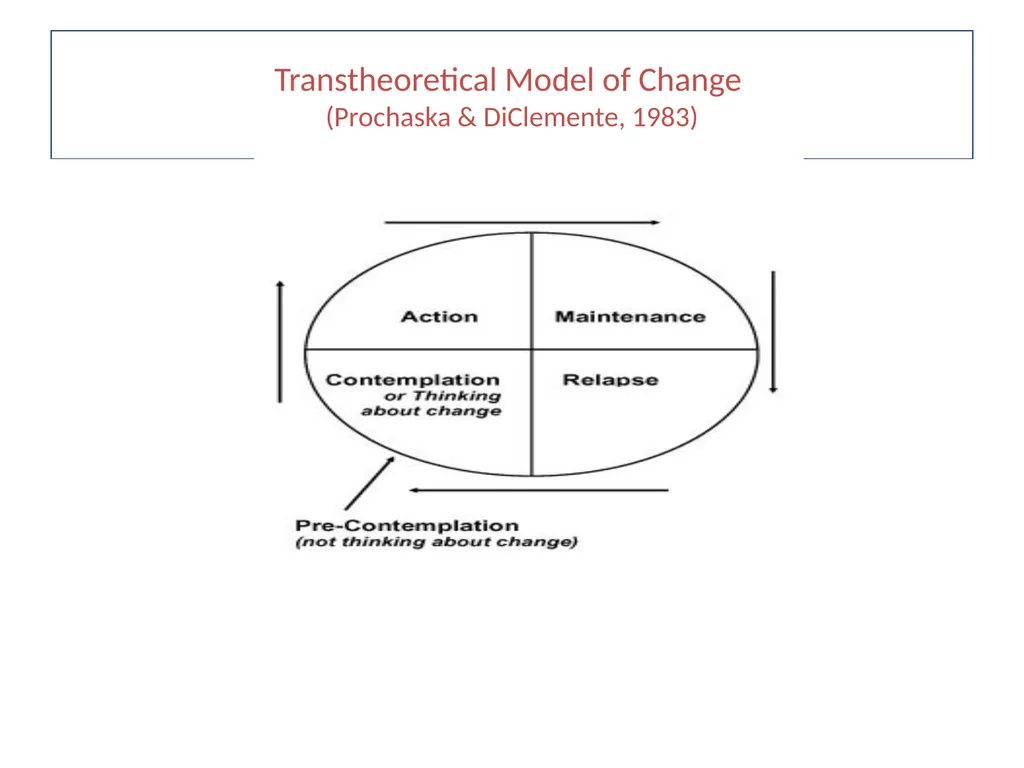
slide25. Transtheoretical Model of Change (Prochaska & DiClemente, 1983)<br>
slide26. Stages of change (2) At different stages, the individual weighs up the costs and benefits in different ways.
Eg: smoking
Precontemplation: “I am happy to be a smoker” “Stopping smoking will make me anxious”
Contemplation: “I’ve been unwell, perhaps I should give up smoking”
Preparation: “I will cut down on smoking”
Action: “I have stopped smoking”
Maintenance: “I have stopped smoking for several months, and I feel healthier”<br>
slide27. MI style questions that may be of use What concerns you about …. ?
What is good about the way things are at the moment? Not so good?
What would be the worst case scenario if you didn’t make any changes?
If you were going to set a goal, what would it be?
Acknowledge challenges, emphasise personal choice, build confidence based on past success<br>
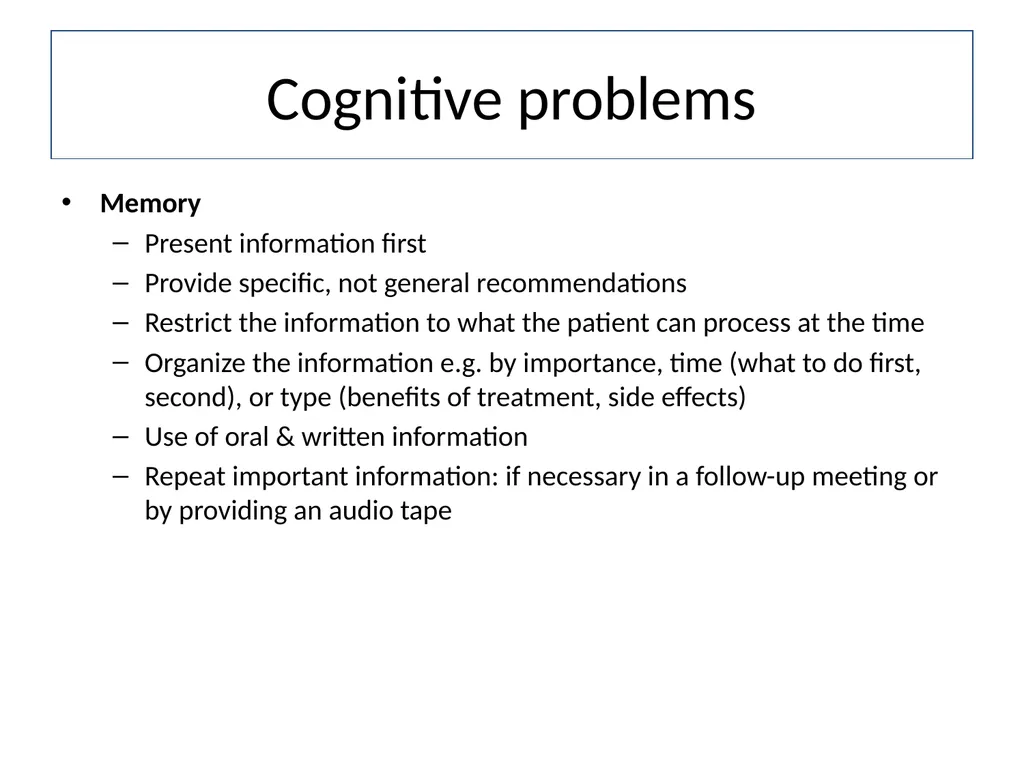
slide28. Cognitive problems Memory
Present information first
Provide specific, not general recommendations
Restrict the information to what the patient can process at the time
Organize the information e.g. by importance, time (what to do first, second), or type (benefits of treatment, side effects)
Use of oral & written information
Repeat important information: if necessary in a follow-up meeting or by providing an audio tape<br>
slide29. Considering patient interactions Their effect upon us and how we affect them!
Transactional analysis
Reciprocal Roles (CAT)
Transference<br>
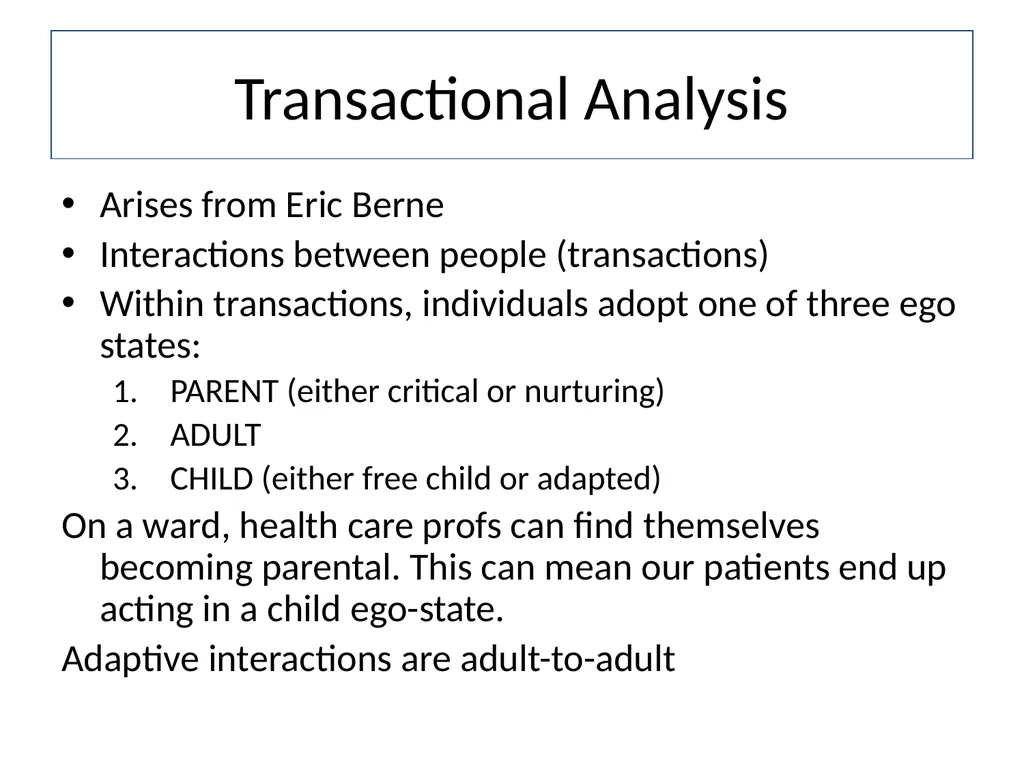
slide30. Transactional Analysis Arises from Eric Berne
Interactions between people (transactions)
Within transactions, individuals adopt one of three ego states:
PARENT (either critical or nurturing)
ADULT
CHILD (either free child or adapted)
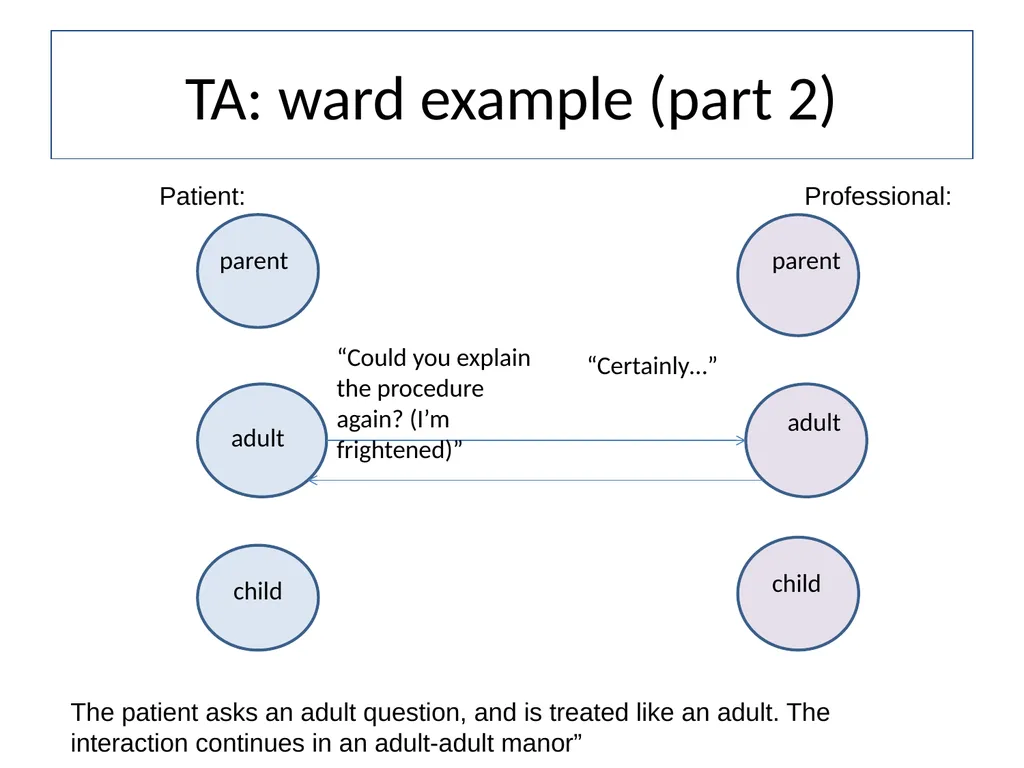
On a ward, health care profs can find themselves becoming parental. This can mean our patients end up acting in a child ego-state.
Adaptive interactions are adult-to-adult<br>
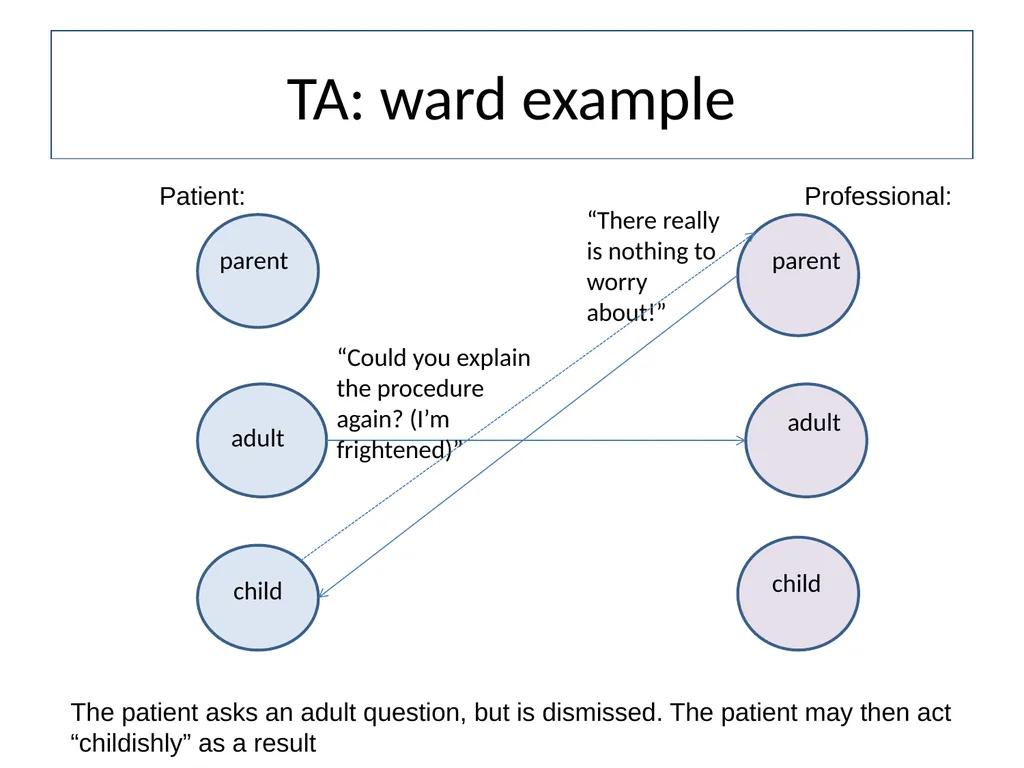
slide31. TA: ward example parent parent adult adult child child “Could you explain the procedure again? (I’m frightened)” “There really is nothing to worry about!” Patient: Professional: The patient asks an adult question, but is dismissed. The patient may then act “childishly” as a result<br>
slide32. TA: ward example (part 2) parent parent adult adult child child “Could you explain the procedure again? (I’m frightened)” “Certainly…” Patient: Professional: The patient asks an adult question, and is treated like an adult. The interaction continues in an adult-adult manor”<br>
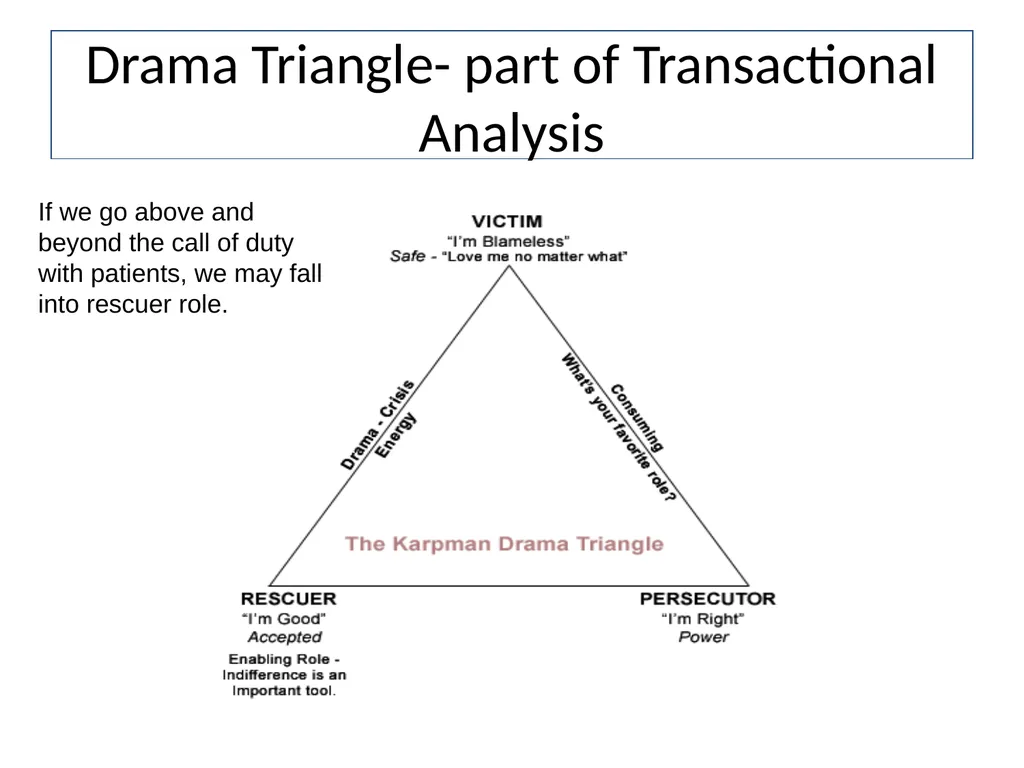
slide33. Drama Triangle- part of Transactional Analysis If we go above and beyond the call of duty with patients, we may fall into rescuer role.<br>
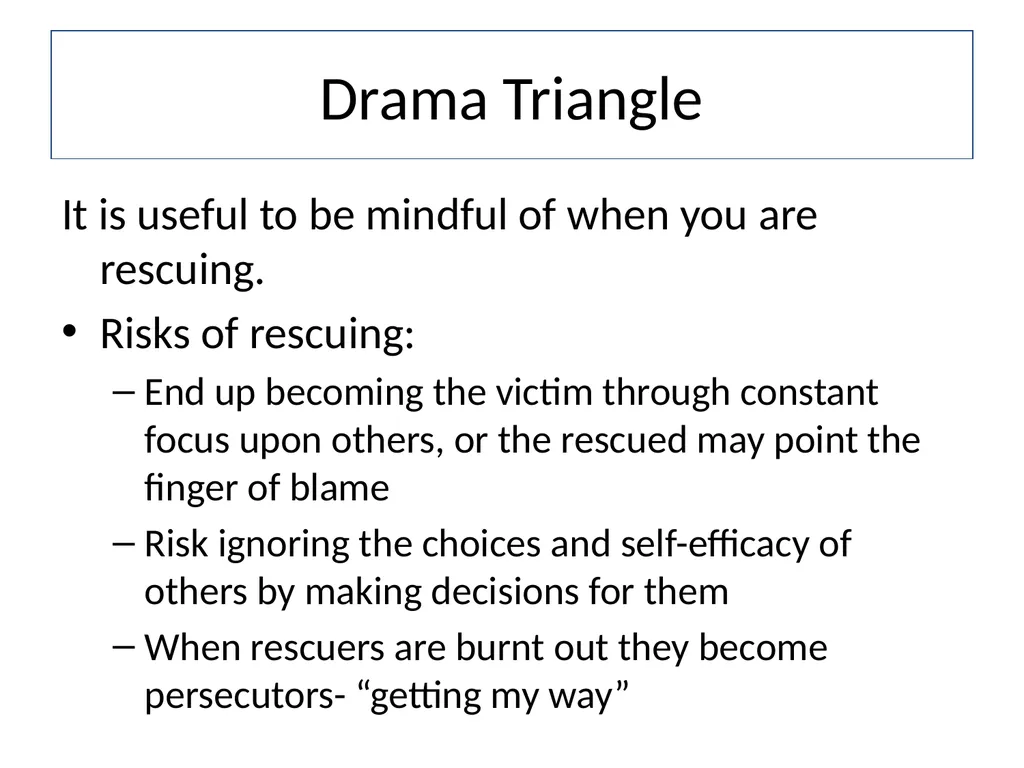
slide34. Drama Triangle It is useful to be mindful of when you are rescuing.
Risks of rescuing:
End up becoming the victim through constant focus upon others, or the rescued may point the finger of blame
Risk ignoring the choices and self-efficacy of others by making decisions for them
When rescuers are burnt out they become persecutors- “getting my way”<br>
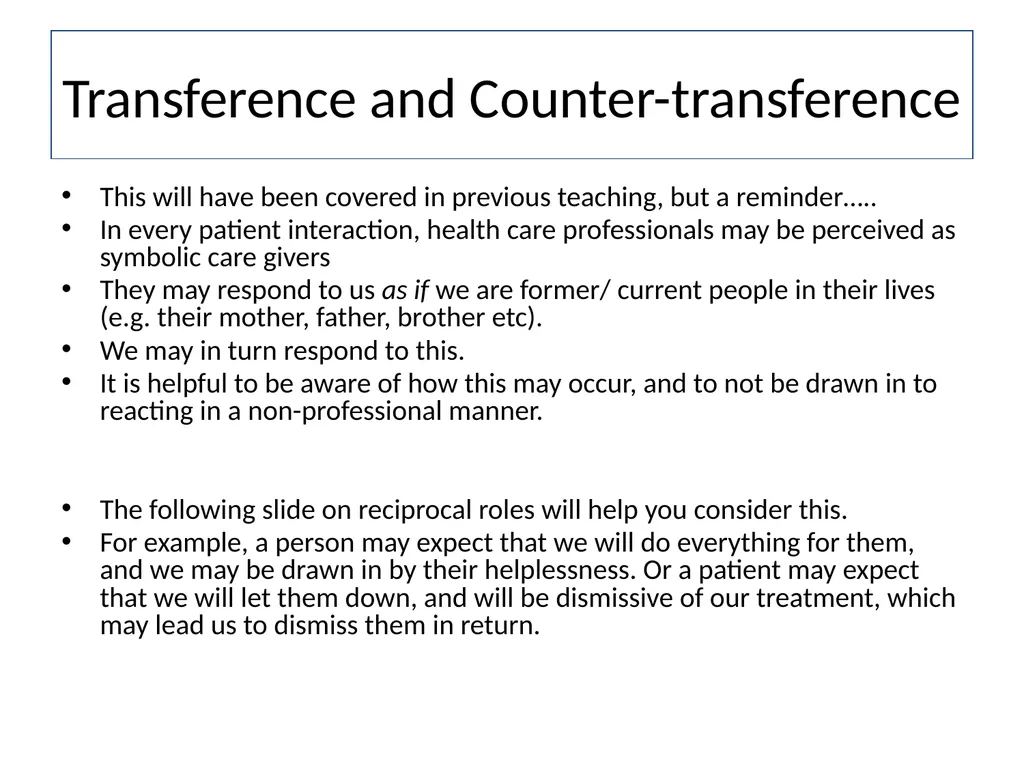
slide35. Transference and Counter-transference This will have been covered in previous teaching, but a reminder…..
In every patient interaction, health care professionals may be perceived as symbolic care givers
They may respond to us as if we are former/ current people in their lives (e.g. their mother, father, brother etc).
We may in turn respond to this.
It is helpful to be aware of how this may occur, and to not be drawn in to reacting in a non-professional manner.
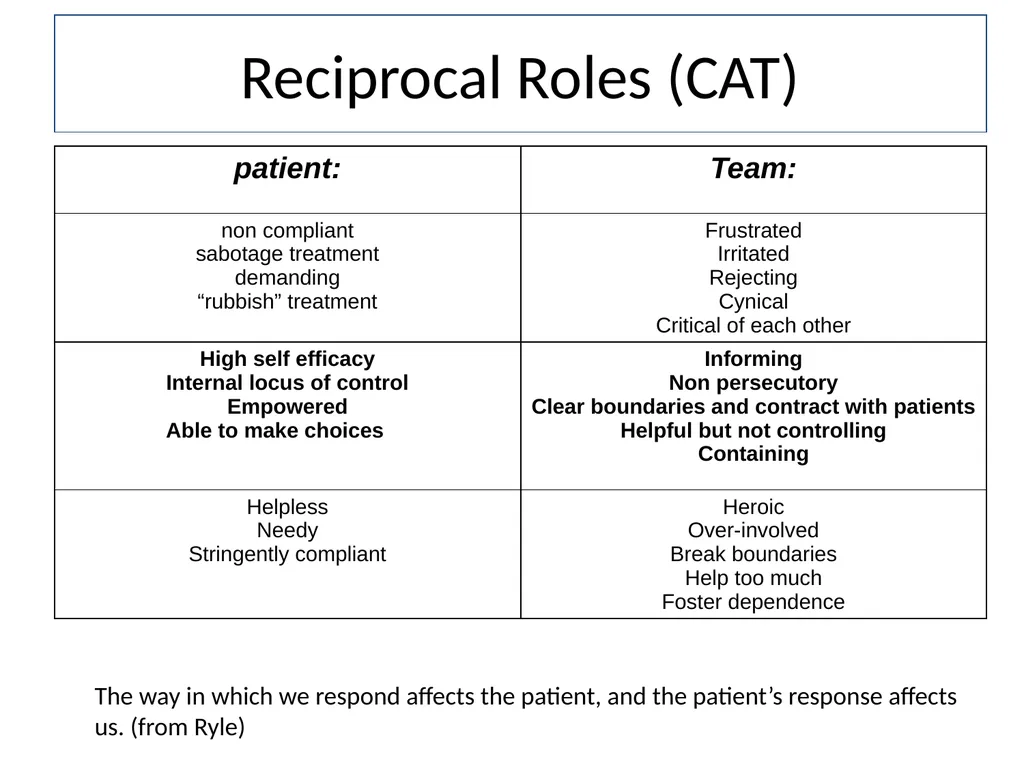
The following slide on reciprocal roles will help you consider this.
For example, a person may expect that we will do everything for them, and we may be drawn in by their helplessness. Or a patient may expect that we will let them down, and will be dismissive of our treatment, which may lead us to dismiss them in return.<br>
slide36. Reciprocal Roles (CAT) The way in which we respond affects the patient, and the patient’s response affects us. (from Ryle)<br>
slide2. Demanding and unreasonable patients (or patients with a high IQ) Challenges:
Lack of experience
Emotional patients
Intimidating patients
Lack of background to patients’ demands
Money
Resources
Conflicting messages from other healthcare professionals What to do:
Nothing
Document everything
Senior support, second opinion
Access ‘ICE’
Avoid ‘maybes’
Explain why for and not for
Avoid personalising conversation
What not to do:
Don’t give in to unreasonable demands
Don’t argue
Don’t lie, or blag it
Don’t offer temporary measures
Don’t put yourself in danger<br>
slide3. Patients with dementia or psychosis Challenges:
Lack of experience
Lack of insight
Aggression – paranoid
Multiple medical problems
Reliance of history from relatives
Lots of social problems, inc. alcohol and drugs
Medico-legal issues What to do:
Safe environment
Chaperone
Low stimulus environment
Excellent communication skills and patience
Non-judgemental
What not to do:
Don’t ignore physical health
Don’t rush the consultation<br>
slide4. Patients with multiple or complex problems Challenges:
Time limitations
Spotting the red flag
Satisfying the patient
Lack of experience What to do:
Give wiggle-room
Reassure
Clinical judgment
Prioritise
Bring back
Safety net
Documentation
Double appointments
What not to do:
Do not ignore / disregard
Do not get frustrated
Do not argue<br>
slide5. Relatives of patients Challenges:
Different agendas
Multiple people present
Family feuds
Emotional state
Unrealistic expectations What to do:
Preparation
Ask the patient what they want
Try to identify a point to contact
Suggest a formal appointment
Document conversations
Keep them informed
Nurse present
Keep patient main focus of care
Be honest and realistic
What not to do:
No transference / counter-transference
Don’t break patient confidentiality
Don’t make unrealistic promises
Don’t take sides<br>
slide6. Patients with personality disorders Challenges:
Communication issues
Consent / capacity
Unpredictable
Staff safety What to do:
Stay very calm
Involve Psychiatry
What not to do:
Don’t confront patient<br>
slide7. Prejudiced patients Challenges:
Might not agree with treatment
May compromise their care
May think they know better What to do:
Educate them
Time to think
Offer alternative care
Remain unbiased
What not to do:
React to prejudices
Take it personally<br>
slide8. Manipulative patients Challenges:
They say the right things to get what they want
They have knowledge of the system What to do:
Make team members aware
Involve other healthcare professionals
Negotiate
What not to do:
Don’t confront them
Don’t pander<br>
slide9. Suicidal patients Challenges:
Defensive medicine
Risk
Sustaining empathy
Prejudice
Establishing trust What to do:
D/w another medical professional
Risk assessment scoring
Advice from Crisis team
Check previous notes
Ask about protective factors
Let them talk
Good documentation
Keep an open mind
What not to do:
Don’t give tips
Don’t dismiss concerns
Don’t be judgmental
Care with prescribing<br>
slide10. DNAR (Do Not Attempt Resuscitation) patients Challenges:
Patient / family refusal
Conflicting opinions in the team
Patient not fully aware of illness
Respect
Experience & information
Emotional / upsetting
Fear of being misunderstood / passive
Balance between Guidelines and Policies and Ethics What to do:
Discuss with seniors, MDU/MPS, seniors, family, patient
Have a go
Ensure private setting / chaperone
Document properly, explain clearly, facilitate audit
Take your time, express empathy
What not to do:
Don’t make decision alone
Don’t act in public
Don’t be lax with documentation<br>
slide11. Aggressive (especially drunk) patients Challenges:
Low inhibitions
Low levels of consciousness
Difficult to treat / refusals What to do:
Protocol
What not to do:
Don’t rise to the bait
Don’t miss potential injuries
Don’t judge them<br>
slide12. Child patients / patients with low IQ What to do:
Non-verbal communication
Charts, pictures, toys
Examples, e.g. on teddy
Use mother / carer What not to do:
Don’t patronise
Don’t speak really slowly
Don’t use complicated language / jargon<br>
slide13. Patients who speak a different language What to do:
Use qualified interpreters
Ask patient to summarise
Non-verbal communication What not to do:
Don’t use children to translate
Don’t speak only to interpreter
Don’t use too many closed questions<br>
slide14. Patients who have difficulties in expression (e.g. dysphasia, deafness) What to do:
Check understanding
Non-verbal communication, e.g. blinking, writing
Collateral history What not to do:
Don’t rush
Don’t presume the patient is dumb<br>
slide15. Patients with communication barriers Challenges:
Misunderstandings
Frustration
Harder to build rapport
Time – takes longer
Interpreters (dilution of communication, confidentiality)
Cultural issues<br>
slide16. FY2 communication: Useful tools from the field of Psychology Dr Julie Highfield
Clinical Psychologist
Cardiac Rehab and Renal Services- UHCW<br>
slide17. Areas covered The following are some ideas from the field of clinical psychology which may help you when considering why some interactions with clients can be difficult. It is not intended as an exhaustive list.
The kinds of things covered are:
Some thoughts on why patients may struggle to adhere to your advice. This includes thinking about how patient represent illness (from Leventhal), and from psychodynamic ideas, and motivation for change (with ideas from motivational interviewing).
Some thoughts on the way in which a patient may act and how this shapes our behaviour and then their behaviour in turn- drawing from Transactional analysis, reciprocal roles (CAT), and transference.<br>
slide18. To help you think about adherence Self-efficacy: Does the patient believe in her ability to carry out the required action? How can you encourage this?
Locus of control: does the patient believe that his health is his responsibility or down to others? This affects what he would be willing to do for himself, and what he expects of you.
The representation of illness- Leventhal, next slide
Doctor-patient communication (Transactional analysis, cognitive analytical perspective- see later)
Is the experience of psychological distress impacting upon a patient’s ability to self manage? Can you ask for advice from psychology related to you area?<br>
slide19. Self-regulatory model of illness behaviour (Leventhal) Stage 1: The patient
interprets
their illness Thoughts about health
threat:
What is it?
Cause?
Consequences
How long for?
Cure/ control Emotional response
to health threat:
Anger
Anxiety
Depression Stage 2:coping
Style:
Approach
Avoidance Stage 3:
Appraisal
Was my
coping strategy
effective?<br>
slide20. Leventhal (cont) How the person interprets their illness
Identity “what do I have?”
Cause “why did this happen?”
Timeline “How long will I feel unwell?”
Treatment “What is the treatment?”
Curability “Will I be 100% well again?”
These beliefs shape illness behaviours<br>
slide21. Patients approach to chronic illness: Ideas from a psychodynamic perspective The symbolic nature of treatment:
it makes me feel different (PAST negative experiences of feeling different and being treated badly for this)
it controls my life (PAST negative experiences of being controlled by
others)
it stops me from being able to do what I would like to – (PAST experiences of restriction)
it means that I will be viewed as “less” (PAST experiences of rejection and
abandonment)
it is another punishment (PAST experiences of abuse)
Non compliance can also be a way of self-destructing, arising from hopelessness<br>
slide22. Motivational Interviewing Miller and Rollnick
Motivational interviewing is a directive, client-centered counseling style for eliciting behaviour change by helping clients to explore and resolve ambivalence
The specific strategies of motivational interviewing are designed to elicit, clarify, and resolve ambivalence
NOT persuasion
NOT advice giving
BUT:
1) Open-ended questions
2) Affirmations
3) Reflective listening
4) Summaries.<br>
slide23. Principles of MI Motivation to change is elicited from the patient, and not imposed from without.
It is the patient's task, not the doctors, to articulate and resolve his or her ambivalence.
Direct persuasion is not an effective method for resolving ambivalence.
The style is generally a quiet and eliciting one.
The doctor is directive in helping the patient to examine and resolve ambivalence.
Readiness to change is not a patient trait, but a fluctuating product of interpersonal interaction.
Emphasis on freedom of choice rather than doctor as expert<br>
slide24. Stages of Change Prochaska and DiClemente (originally 1982) produced a
model of behaviour change that is used within Motivational Interviewing. Not linear, but dynamic:
Pre-contemplation: not intending to make changes
Contemplation: considering a change
Preparation: making small changes
Action: engaging in a new behaviour
Maintenance: sustaining the change over time
Thus different approaches by HCPs to patients needed
according to stage.
The stages of change model is useful when considering poor health behaviours (e.g. smoking, drinking alcohol). A person is unlikely to take your advice and “give up” until they are ready to do so<br>
slide25. Transtheoretical Model of Change (Prochaska & DiClemente, 1983)<br>
slide26. Stages of change (2) At different stages, the individual weighs up the costs and benefits in different ways.
Eg: smoking
Precontemplation: “I am happy to be a smoker” “Stopping smoking will make me anxious”
Contemplation: “I’ve been unwell, perhaps I should give up smoking”
Preparation: “I will cut down on smoking”
Action: “I have stopped smoking”
Maintenance: “I have stopped smoking for several months, and I feel healthier”<br>
slide27. MI style questions that may be of use What concerns you about …. ?
What is good about the way things are at the moment? Not so good?
What would be the worst case scenario if you didn’t make any changes?
If you were going to set a goal, what would it be?
Acknowledge challenges, emphasise personal choice, build confidence based on past success<br>
slide28. Cognitive problems Memory
Present information first
Provide specific, not general recommendations
Restrict the information to what the patient can process at the time
Organize the information e.g. by importance, time (what to do first, second), or type (benefits of treatment, side effects)
Use of oral & written information
Repeat important information: if necessary in a follow-up meeting or by providing an audio tape<br>
slide29. Considering patient interactions Their effect upon us and how we affect them!
Transactional analysis
Reciprocal Roles (CAT)
Transference<br>
slide30. Transactional Analysis Arises from Eric Berne
Interactions between people (transactions)
Within transactions, individuals adopt one of three ego states:
PARENT (either critical or nurturing)
ADULT
CHILD (either free child or adapted)
On a ward, health care profs can find themselves becoming parental. This can mean our patients end up acting in a child ego-state.
Adaptive interactions are adult-to-adult<br>
slide31. TA: ward example parent parent adult adult child child “Could you explain the procedure again? (I’m frightened)” “There really is nothing to worry about!” Patient: Professional: The patient asks an adult question, but is dismissed. The patient may then act “childishly” as a result<br>
slide32. TA: ward example (part 2) parent parent adult adult child child “Could you explain the procedure again? (I’m frightened)” “Certainly…” Patient: Professional: The patient asks an adult question, and is treated like an adult. The interaction continues in an adult-adult manor”<br>
slide33. Drama Triangle- part of Transactional Analysis If we go above and beyond the call of duty with patients, we may fall into rescuer role.<br>
slide34. Drama Triangle It is useful to be mindful of when you are rescuing.
Risks of rescuing:
End up becoming the victim through constant focus upon others, or the rescued may point the finger of blame
Risk ignoring the choices and self-efficacy of others by making decisions for them
When rescuers are burnt out they become persecutors- “getting my way”<br>
slide35. Transference and Counter-transference This will have been covered in previous teaching, but a reminder…..
In every patient interaction, health care professionals may be perceived as symbolic care givers
They may respond to us as if we are former/ current people in their lives (e.g. their mother, father, brother etc).
We may in turn respond to this.
It is helpful to be aware of how this may occur, and to not be drawn in to reacting in a non-professional manner.
The following slide on reciprocal roles will help you consider this.
For example, a person may expect that we will do everything for them, and we may be drawn in by their helplessness. Or a patient may expect that we will let them down, and will be dismissive of our treatment, which may lead us to dismiss them in return.<br>
slide36. Reciprocal Roles (CAT) The way in which we respond affects the patient, and the patient’s response affects us. (from Ryle)<br>