
Decision Guide for Multidisciplinary Teams
T
Published · 40 slides · 0 views
1 / 1
Description
Decision Guide for Multidisciplinary Teams Addressing Problematic Sexual Behaviors National Childrens Alliance Problematic Sexual Behavior Workgroup 2022 What to expect and how we got here Examine the overall issue of Problematic Sexual
Related Topics
Share
Embed code
Download this presentation From Below
"Decision Guide for Multidisciplinary Teams" is the property of its rightful owner. Permission is granted to download and print the materials on this website for personal, non-commercial use only, and to display it on your personal computer provided you do not modify the materials and that you retain all copyright notices contained in the materials. By downloading content from our website, you accept the terms of this agreement.
Presentation Transcript
01
Decision Guide for Multidisciplinary Teams Addressing Problematic Sexual Behaviors National Children’s Alliance
Problematic Sexual Behavior Workgroup
2022<br>
Problematic Sexual Behavior Workgroup
2022<br>
02
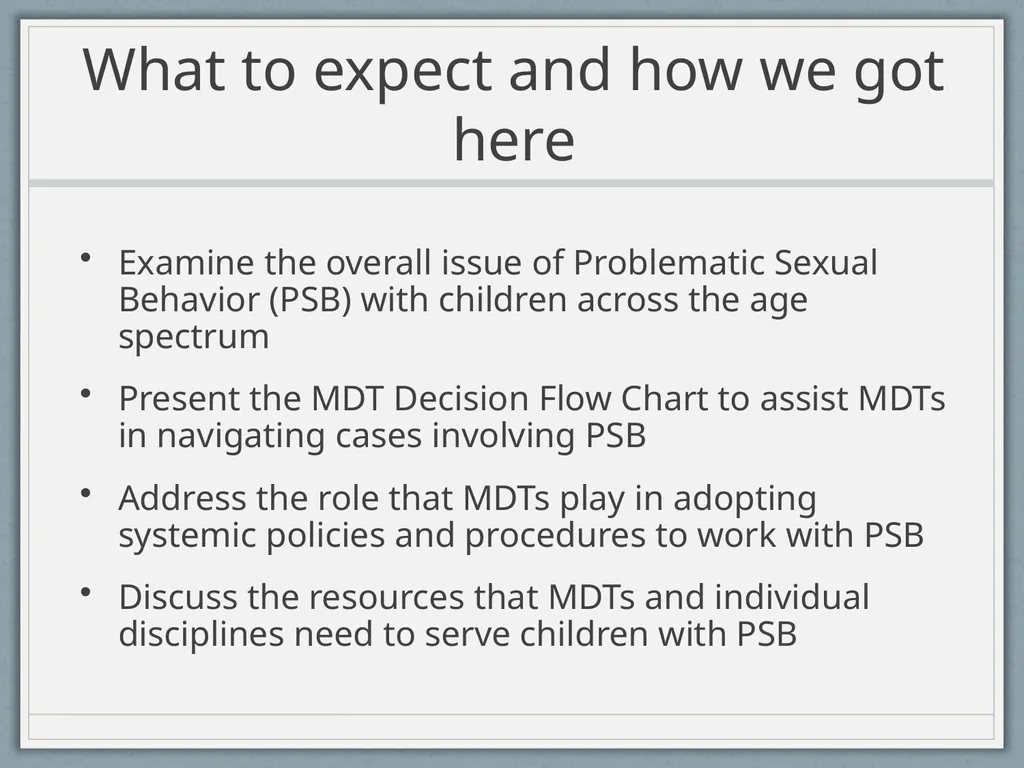
What to expect and how we got here Examine the overall issue of Problematic Sexual Behavior (PSB) with children across the age spectrum
Present the MDT Decision Flow Chart to assist MDTs in navigating cases involving PSB
Address the role that MDTs play in adopting systemic policies and procedures to work with PSB
Discuss the resources that MDTs and individual disciplines need to serve children with PSB<br>
Present the MDT Decision Flow Chart to assist MDTs in navigating cases involving PSB
Address the role that MDTs play in adopting systemic policies and procedures to work with PSB
Discuss the resources that MDTs and individual disciplines need to serve children with PSB<br>
03
Things for MDT Members to Consider when
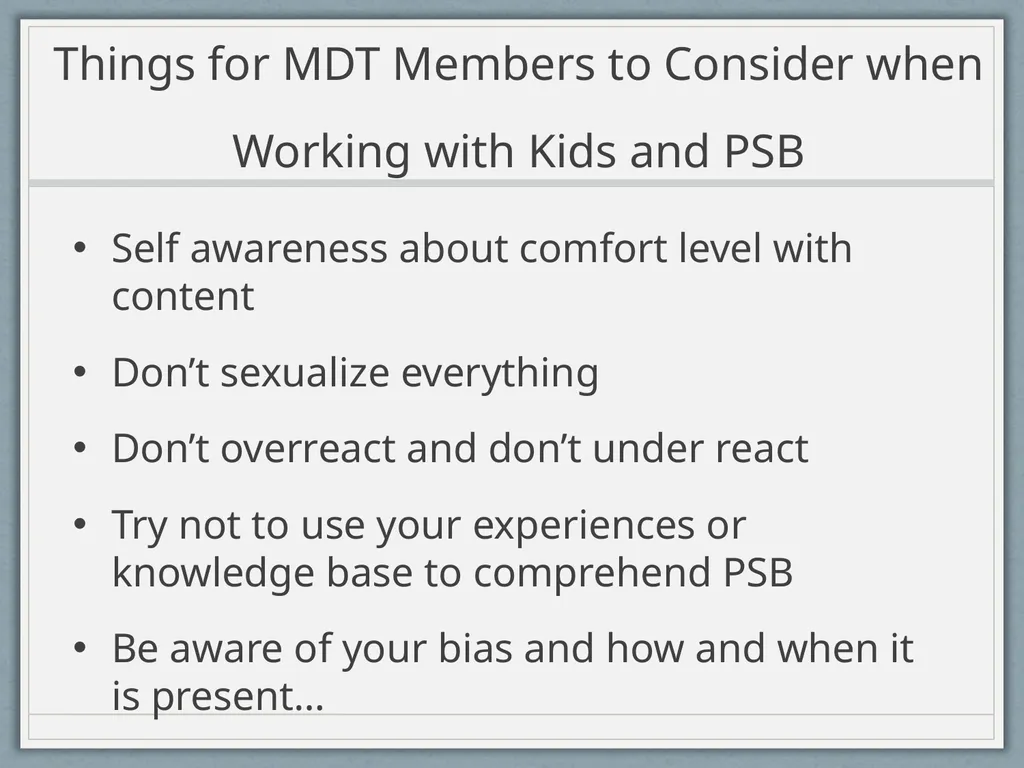
Working with Kids and PSB Self awareness about comfort level with content
Don’t sexualize everything
Don’t overreact and don’t under react
Try not to use your experiences or knowledge base to comprehend PSB
Be aware of your bias and how and when it is present…<br>
Don’t sexualize everything
Don’t overreact and don’t under react
Try not to use your experiences or knowledge base to comprehend PSB
Be aware of your bias and how and when it is present…<br>
04
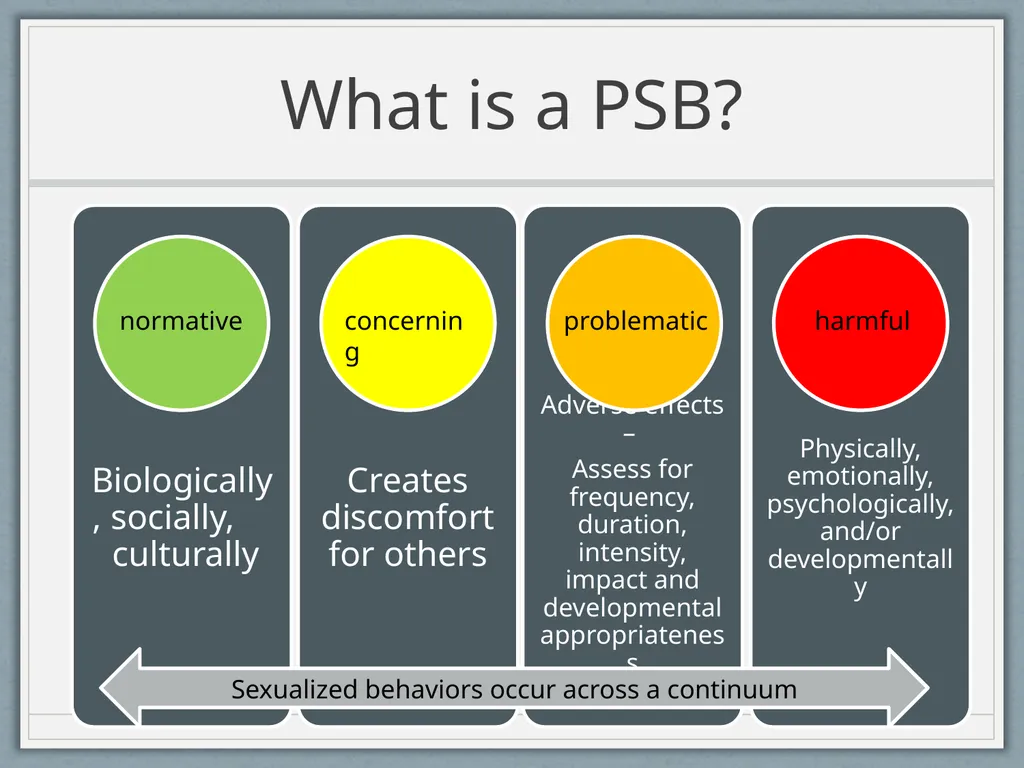
What is a PSB? normative concerning problematic harmful Sexualized behaviors occur across a continuum<br>
05
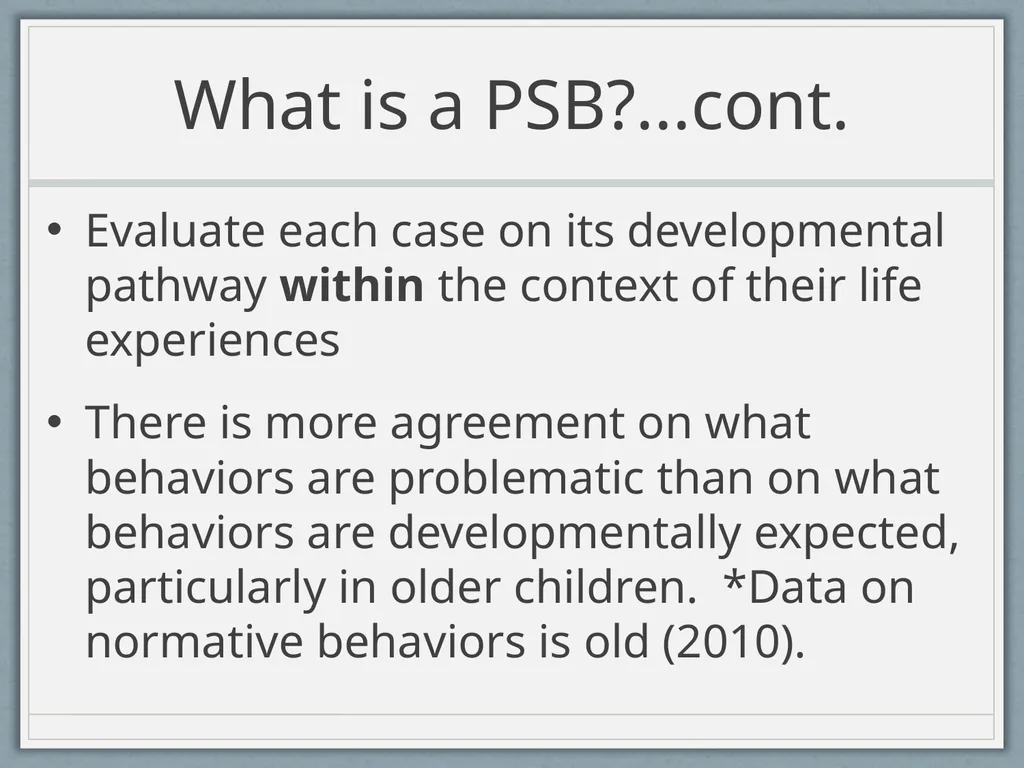
What is a PSB?...cont. Evaluate each case on its developmental pathway within the context of their life experiences
There is more agreement on what behaviors are problematic than on what behaviors are developmentally expected, particularly in older children. *Data on normative behaviors is old (2010).<br>
There is more agreement on what behaviors are problematic than on what behaviors are developmentally expected, particularly in older children. *Data on normative behaviors is old (2010).<br>
06
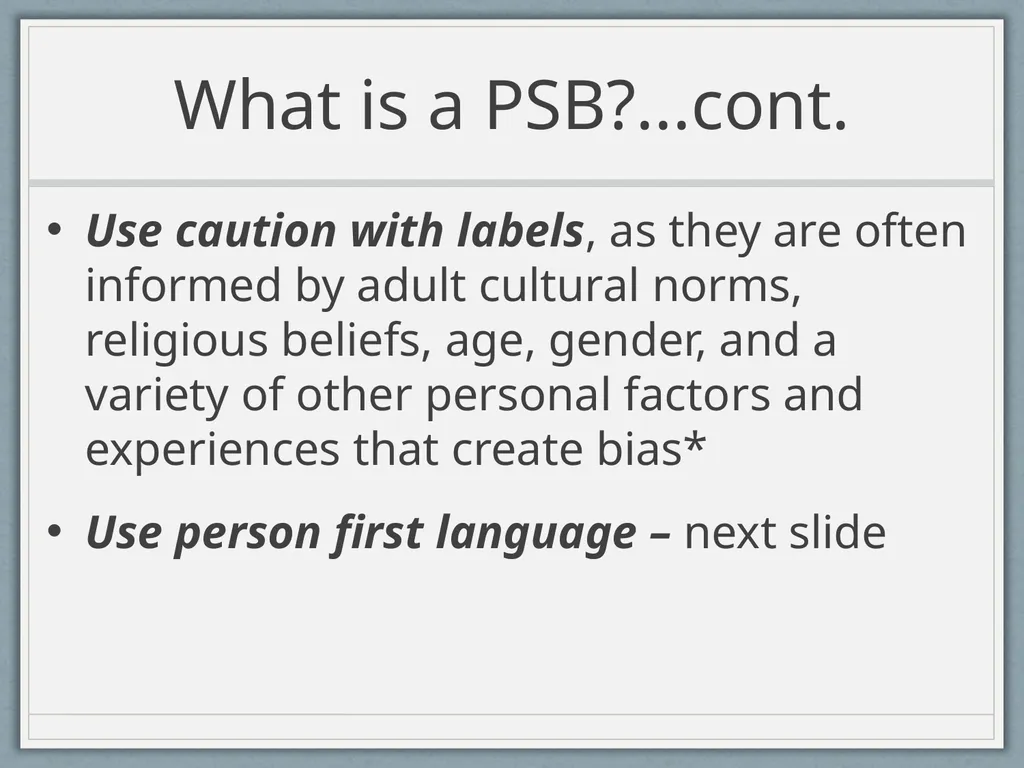
What is a PSB?...cont. Use caution with labels, as they are often informed by adult cultural norms, religious beliefs, age, gender, and a variety of other personal factors and experiences that create bias*
Use person first language – next slide<br>
Use person first language – next slide<br>
07
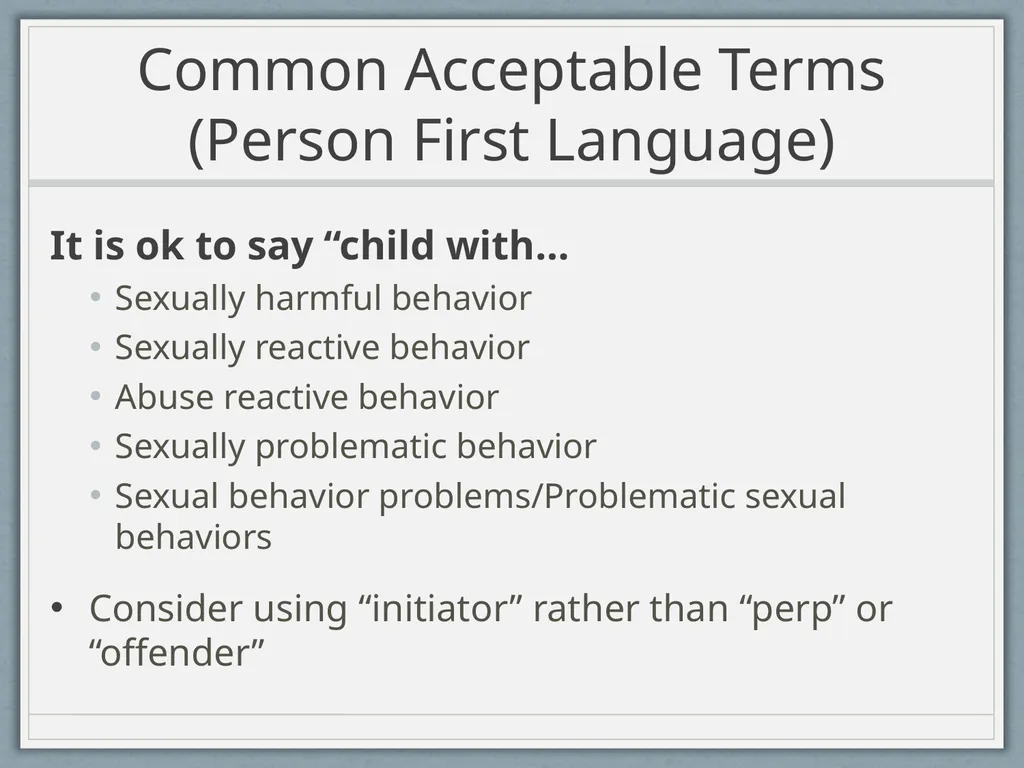
Common Acceptable Terms (Person First Language) It is ok to say “child with…
Sexually harmful behavior
Sexually reactive behavior
Abuse reactive behavior
Sexually problematic behavior
Sexual behavior problems/Problematic sexual behaviors
Consider using “initiator” rather than “perp” or “offender”<br>
Sexually harmful behavior
Sexually reactive behavior
Abuse reactive behavior
Sexually problematic behavior
Sexual behavior problems/Problematic sexual behaviors
Consider using “initiator” rather than “perp” or “offender”<br>
08
Predator
Pedophile
Child Molester
Sex Offender
Sexual Deviant
Serial Rapist
Psychopath
Monster Terms to Avoid Do NOT refer to the child with PSB as a… Why might this be important?<br>
Pedophile
Child Molester
Sex Offender
Sexual Deviant
Serial Rapist
Psychopath
Monster Terms to Avoid Do NOT refer to the child with PSB as a… Why might this be important?<br>
09
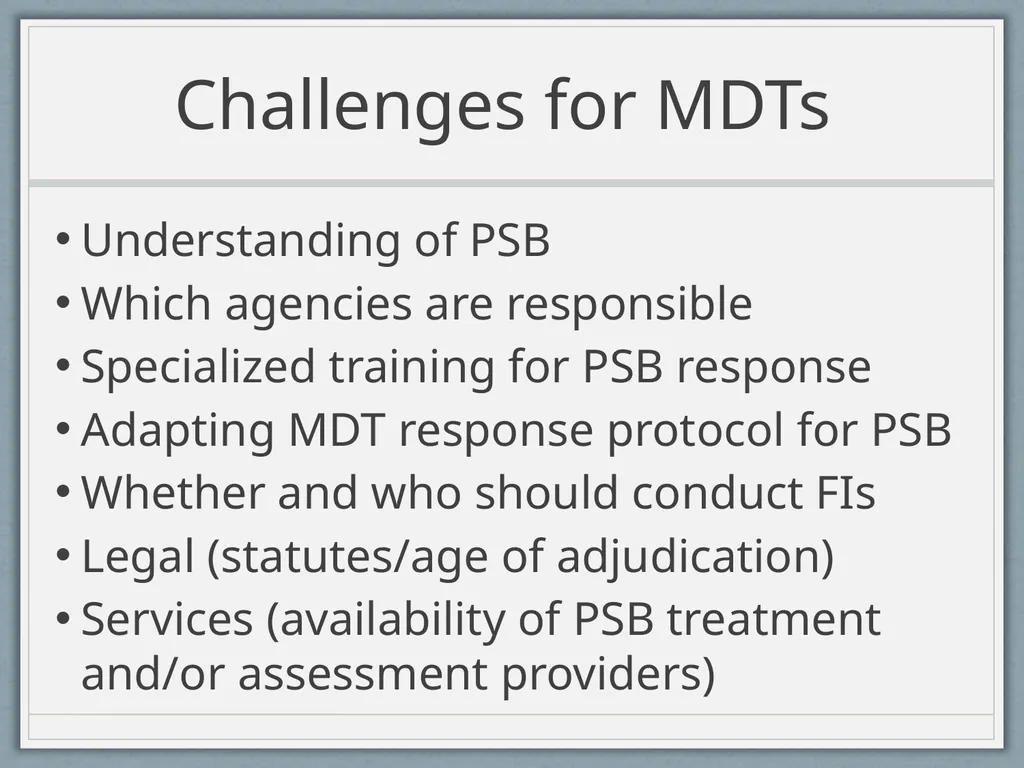
Challenges for MDTs Understanding of PSB
Which agencies are responsible
Specialized training for PSB response
Adapting MDT response protocol for PSB
Whether and who should conduct FIs
Legal (statutes/age of adjudication)
Services (availability of PSB treatment and/or assessment providers)<br>
Which agencies are responsible
Specialized training for PSB response
Adapting MDT response protocol for PSB
Whether and who should conduct FIs
Legal (statutes/age of adjudication)
Services (availability of PSB treatment and/or assessment providers)<br>
10
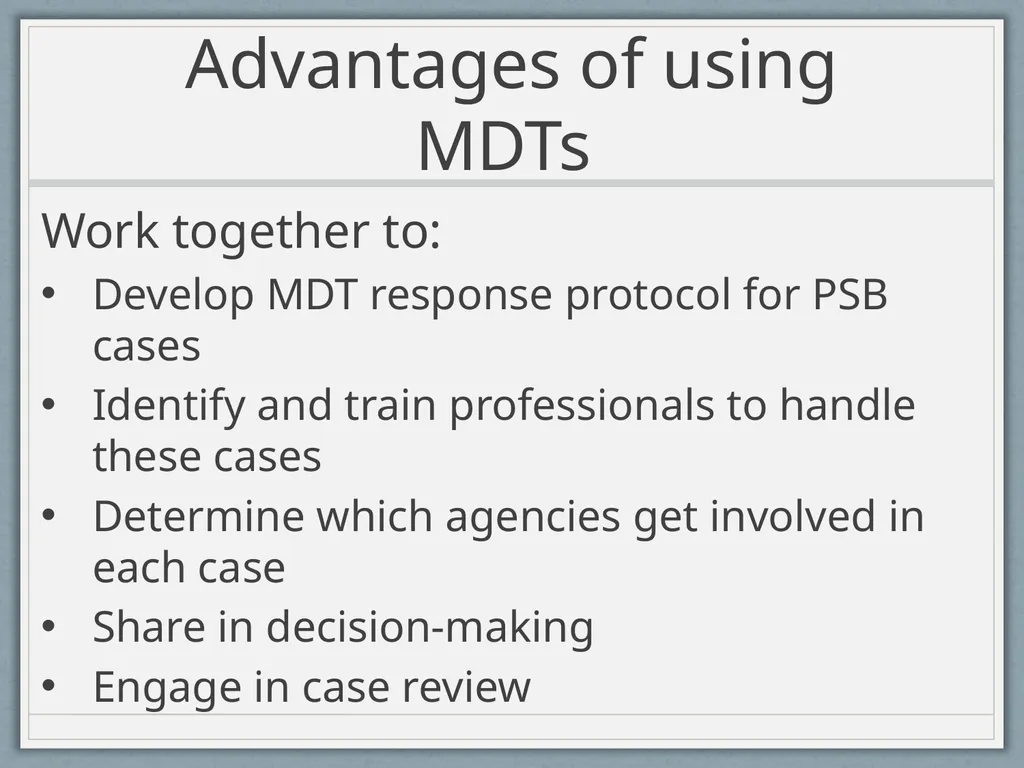
Advantages of using MDTs Work together to:
Develop MDT response protocol for PSB cases
Identify and train professionals to handle these cases
Determine which agencies get involved in each case
Share in decision-making
Engage in case review<br>
Develop MDT response protocol for PSB cases
Identify and train professionals to handle these cases
Determine which agencies get involved in each case
Share in decision-making
Engage in case review<br>
11
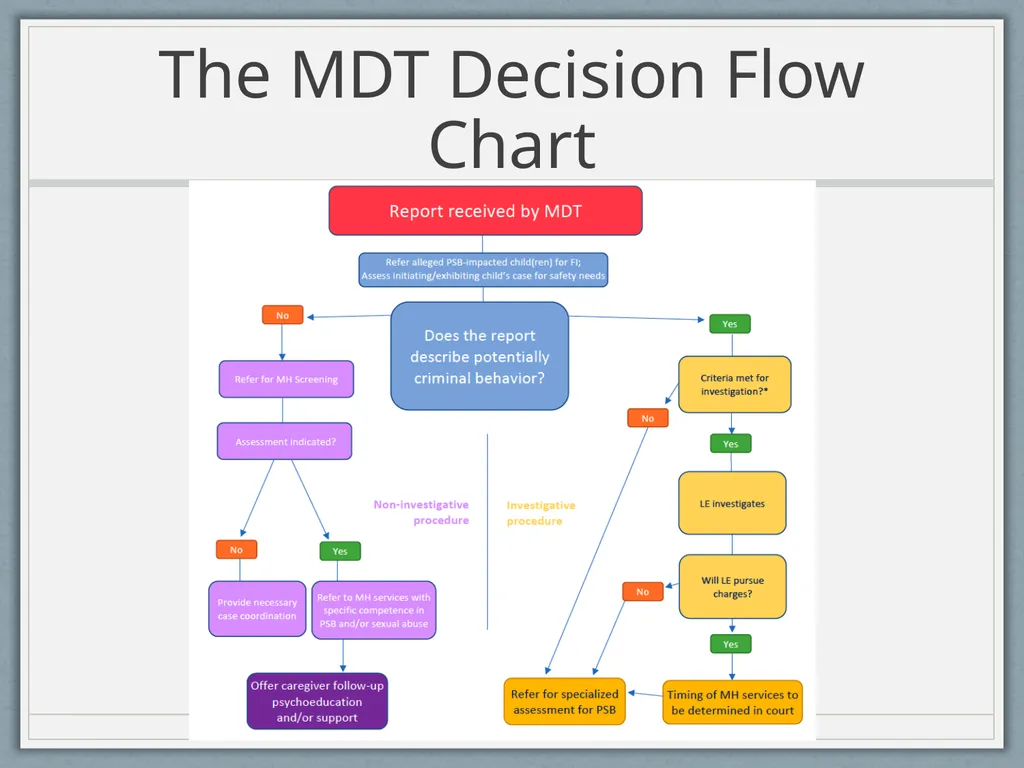
The MDT Decision Flow Chart<br>
12
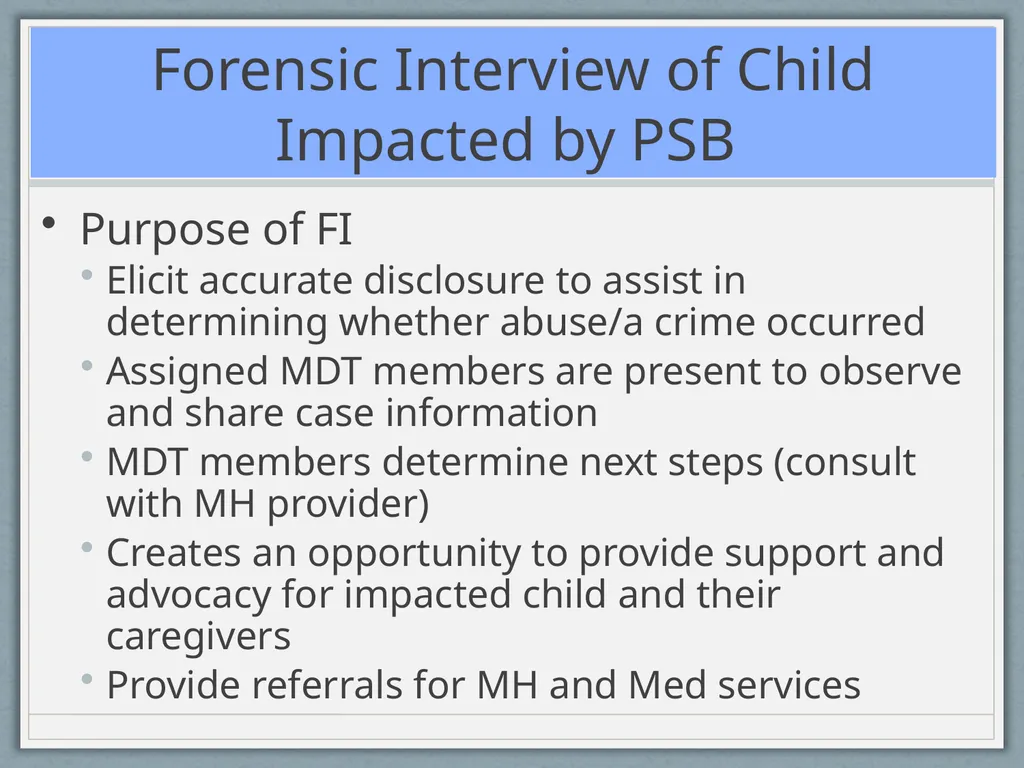
Forensic Interview of Child Impacted by PSB Purpose of FI
Elicit accurate disclosure to assist in determining whether abuse/a crime occurred
Assigned MDT members are present to observe and share case information
MDT members determine next steps (consult with MH provider)
Creates an opportunity to provide support and advocacy for impacted child and their caregivers
Provide referrals for MH and Med services<br>
Elicit accurate disclosure to assist in determining whether abuse/a crime occurred
Assigned MDT members are present to observe and share case information
MDT members determine next steps (consult with MH provider)
Creates an opportunity to provide support and advocacy for impacted child and their caregivers
Provide referrals for MH and Med services<br>
13
The MDT Decision Flow Chart
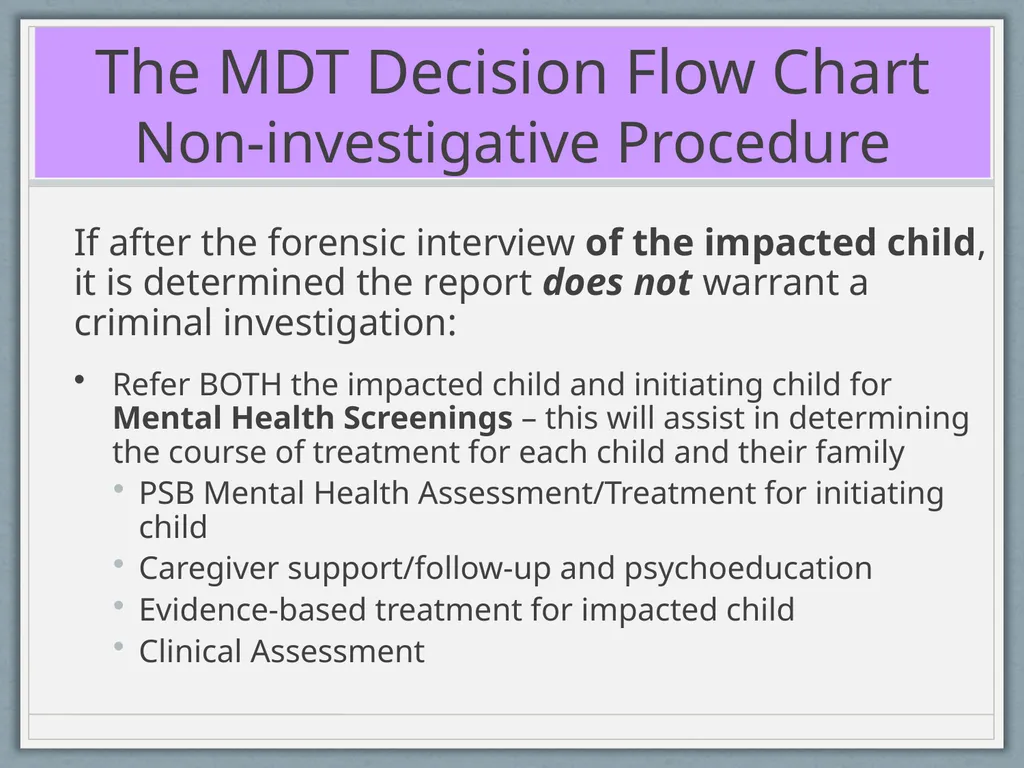
Non-investigative Procedure If after the forensic interview of the impacted child, it is determined the report does not warrant a criminal investigation:
Refer BOTH the impacted child and initiating child for Mental Health Screenings – this will assist in determining the course of treatment for each child and their family
PSB Mental Health Assessment/Treatment for initiating child
Caregiver support/follow-up and psychoeducation
Evidence-based treatment for impacted child
Clinical Assessment<br>
Refer BOTH the impacted child and initiating child for Mental Health Screenings – this will assist in determining the course of treatment for each child and their family
PSB Mental Health Assessment/Treatment for initiating child
Caregiver support/follow-up and psychoeducation
Evidence-based treatment for impacted child
Clinical Assessment<br>
14
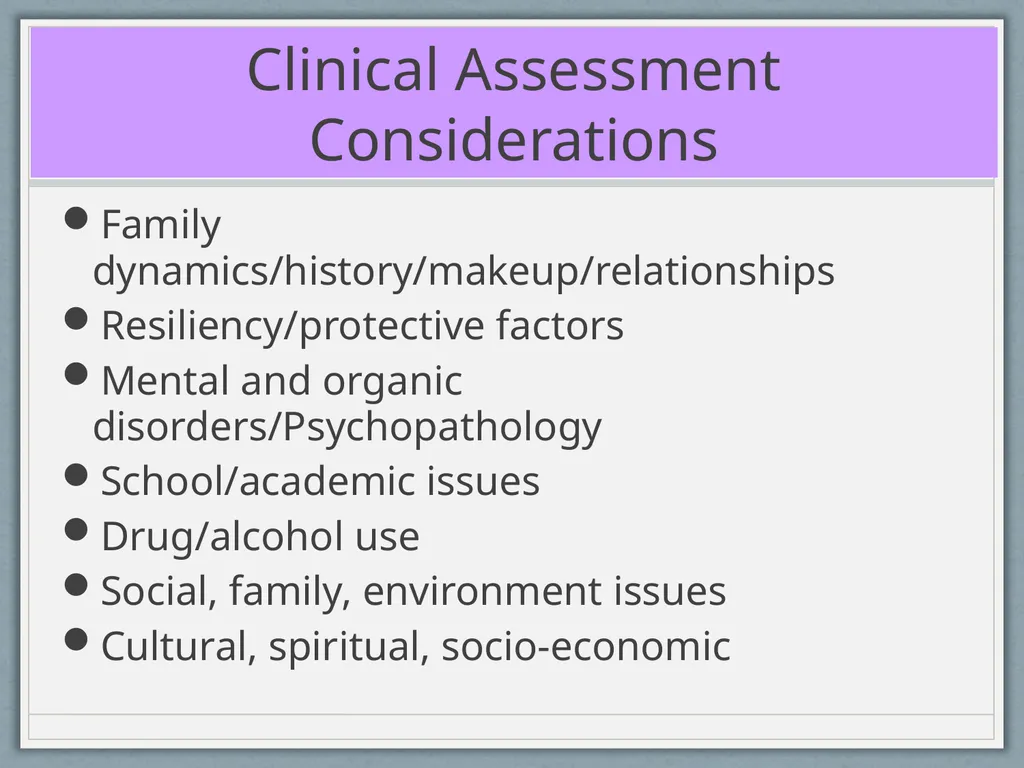
Clinical Assessment Considerations Family dynamics/history/makeup/relationships
Resiliency/protective factors
Mental and organic disorders/Psychopathology
School/academic issues
Drug/alcohol use
Social, family, environment issues
Cultural, spiritual, socio-economic<br>
Resiliency/protective factors
Mental and organic disorders/Psychopathology
School/academic issues
Drug/alcohol use
Social, family, environment issues
Cultural, spiritual, socio-economic<br>
15
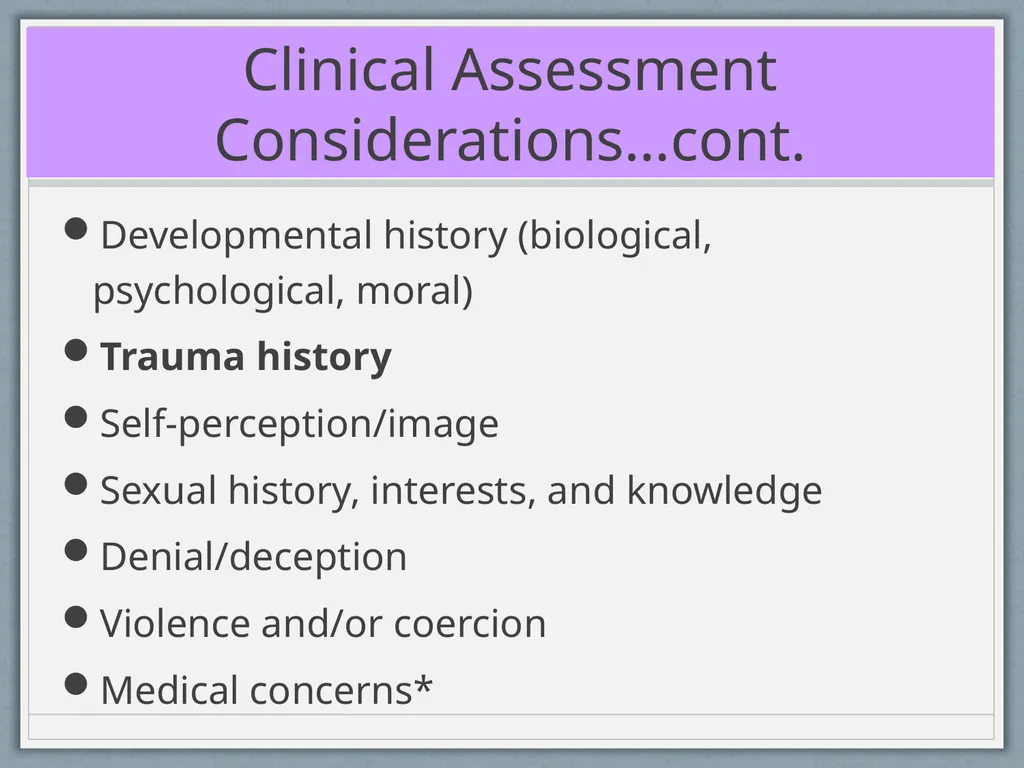
Clinical Assessment Considerations…cont. Developmental history (biological, psychological, moral)
Trauma history
Self-perception/image
Sexual history, interests, and knowledge
Denial/deception
Violence and/or coercion
Medical concerns*<br>
Trauma history
Self-perception/image
Sexual history, interests, and knowledge
Denial/deception
Violence and/or coercion
Medical concerns*<br>
16
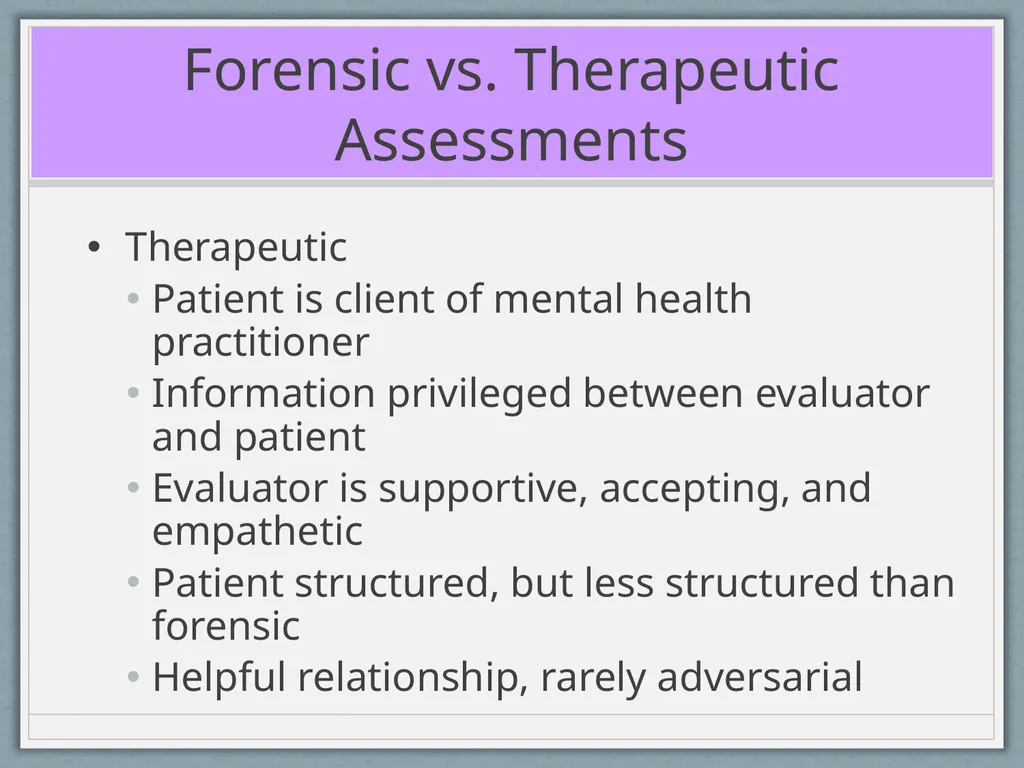
Forensic vs. Therapeutic Assessments Therapeutic
Patient is client of mental health practitioner
Information privileged between evaluator and patient
Evaluator is supportive, accepting, and empathetic
Patient structured, but less structured than forensic
Helpful relationship, rarely adversarial<br>
Patient is client of mental health practitioner
Information privileged between evaluator and patient
Evaluator is supportive, accepting, and empathetic
Patient structured, but less structured than forensic
Helpful relationship, rarely adversarial<br>
17
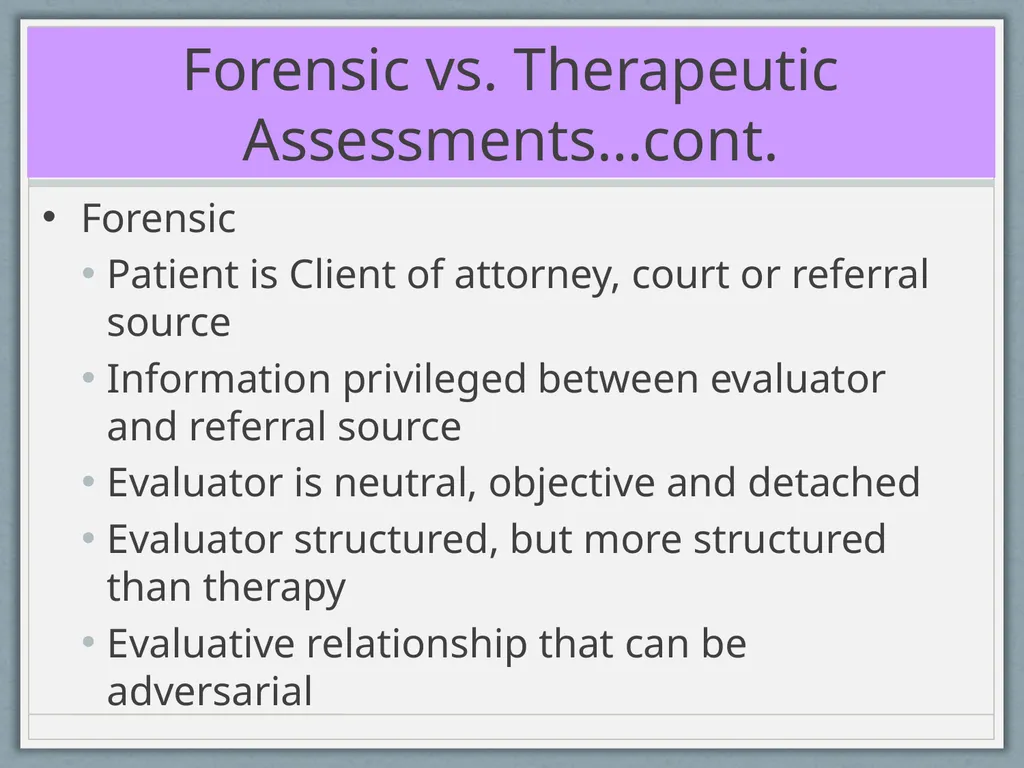
Forensic vs. Therapeutic Assessments…cont. Forensic
Patient is Client of attorney, court or referral source
Information privileged between evaluator and referral source
Evaluator is neutral, objective and detached
Evaluator structured, but more structured than therapy
Evaluative relationship that can be adversarial<br>
Patient is Client of attorney, court or referral source
Information privileged between evaluator and referral source
Evaluator is neutral, objective and detached
Evaluator structured, but more structured than therapy
Evaluative relationship that can be adversarial<br>
18
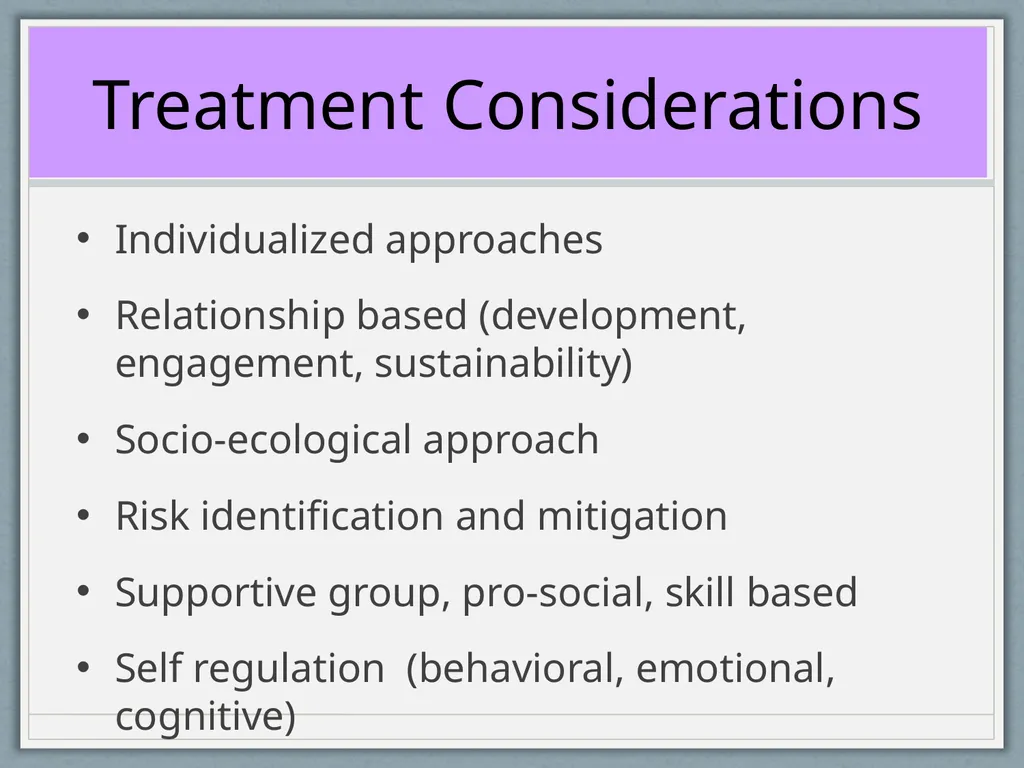
Treatment Considerations Individualized approaches
Relationship based (development, engagement, sustainability)
Socio-ecological approach
Risk identification and mitigation
Supportive group, pro-social, skill based
Self regulation (behavioral, emotional, cognitive)<br>
Relationship based (development, engagement, sustainability)
Socio-ecological approach
Risk identification and mitigation
Supportive group, pro-social, skill based
Self regulation (behavioral, emotional, cognitive)<br>
19
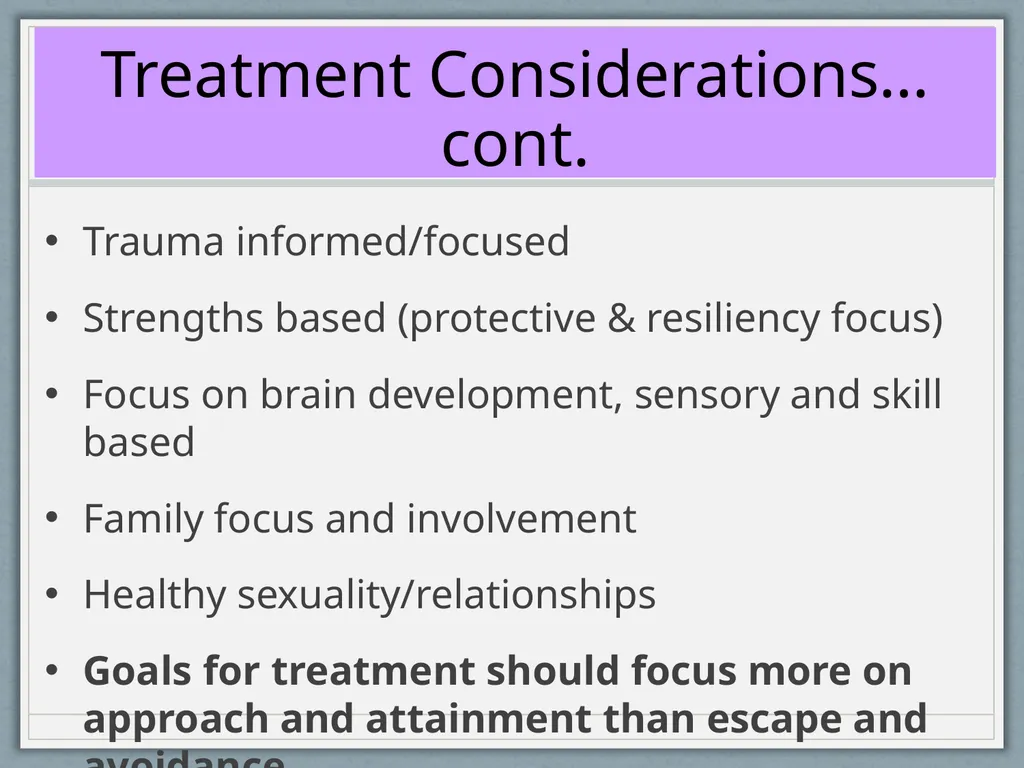
Treatment Considerations…cont. Trauma informed/focused
Strengths based (protective & resiliency focus)
Focus on brain development, sensory and skill based
Family focus and involvement
Healthy sexuality/relationships
Goals for treatment should focus more on approach and attainment than escape and avoidance<br>
Strengths based (protective & resiliency focus)
Focus on brain development, sensory and skill based
Family focus and involvement
Healthy sexuality/relationships
Goals for treatment should focus more on approach and attainment than escape and avoidance<br>
20
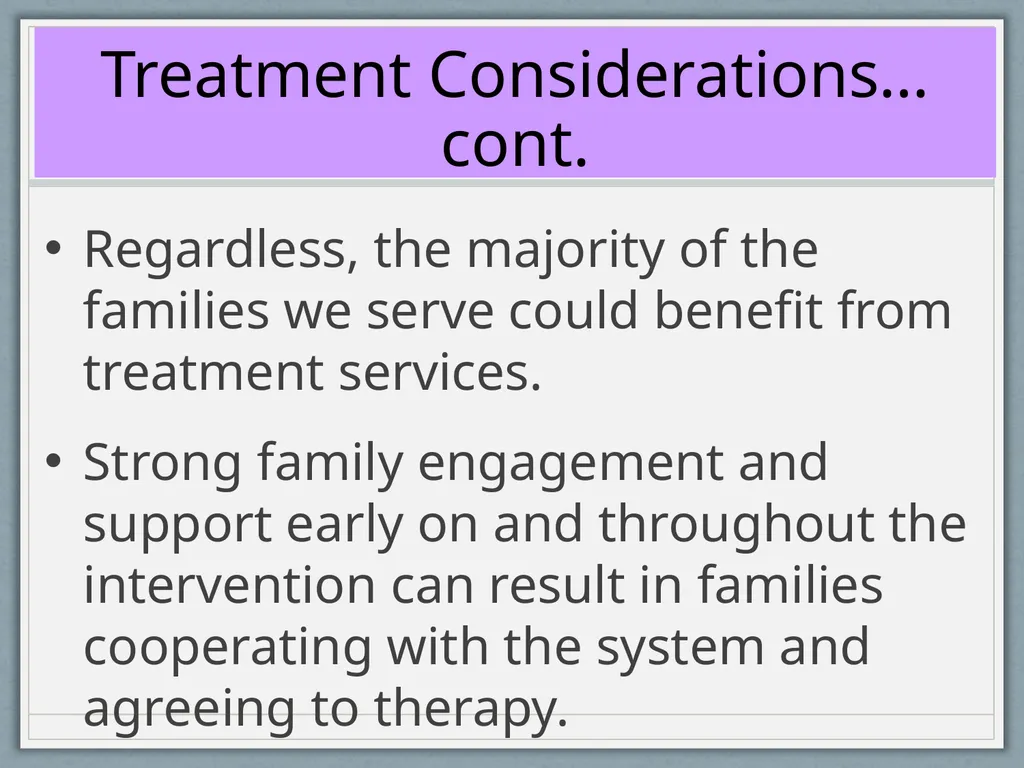
Treatment Considerations…cont. Regardless, the majority of the families we serve could benefit from treatment services.
Strong family engagement and support early on and throughout the intervention can result in families cooperating with the system and agreeing to therapy.<br>
Strong family engagement and support early on and throughout the intervention can result in families cooperating with the system and agreeing to therapy.<br>
21
The MDT Decision Flow Chart
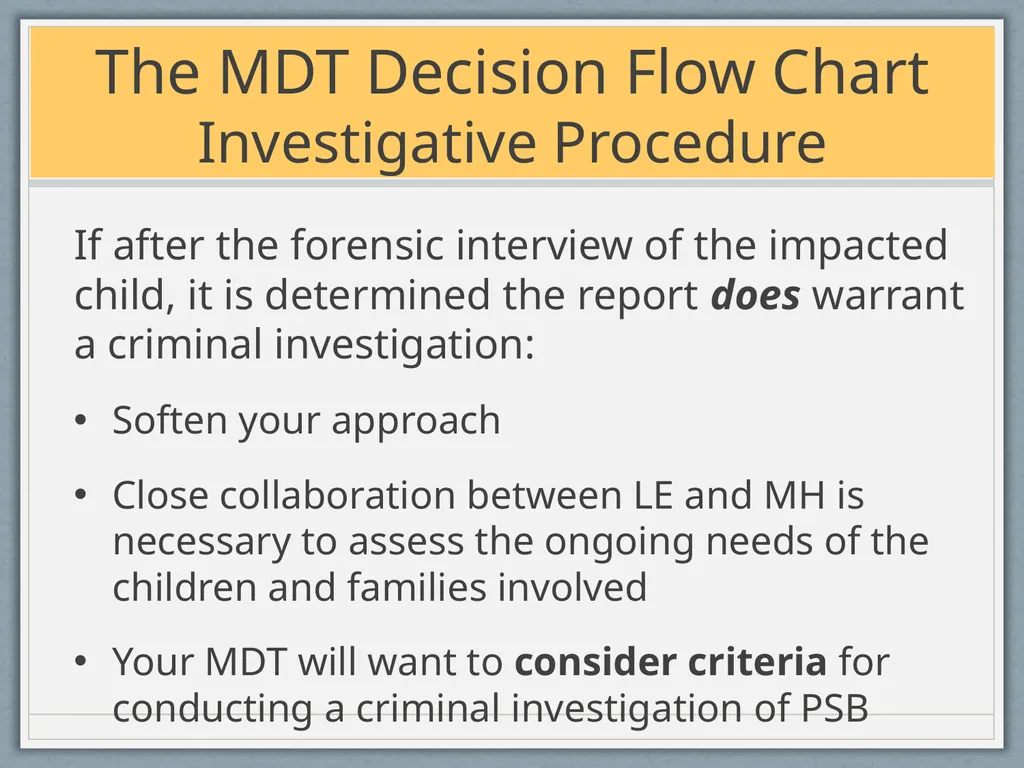
Investigative Procedure If after the forensic interview of the impacted child, it is determined the report does warrant a criminal investigation:
Soften your approach
Close collaboration between LE and MH is necessary to assess the ongoing needs of the children and families involved
Your MDT will want to consider criteria for conducting a criminal investigation of PSB<br>
Soften your approach
Close collaboration between LE and MH is necessary to assess the ongoing needs of the children and families involved
Your MDT will want to consider criteria for conducting a criminal investigation of PSB<br>
22
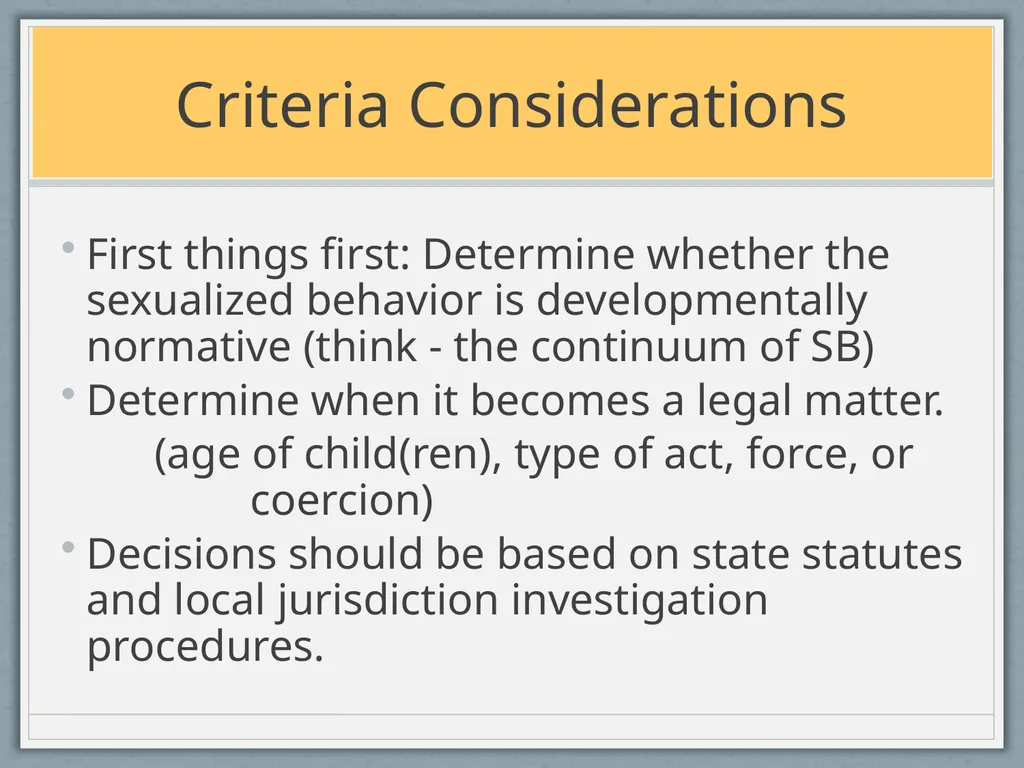
Criteria Considerations First things first: Determine whether the sexualized behavior is developmentally normative (think - the continuum of SB)
Determine when it becomes a legal matter.
(age of child(ren), type of act, force, or coercion)
Decisions should be based on state statutes and local jurisdiction investigation procedures.<br>
Determine when it becomes a legal matter.
(age of child(ren), type of act, force, or coercion)
Decisions should be based on state statutes and local jurisdiction investigation procedures.<br>
23
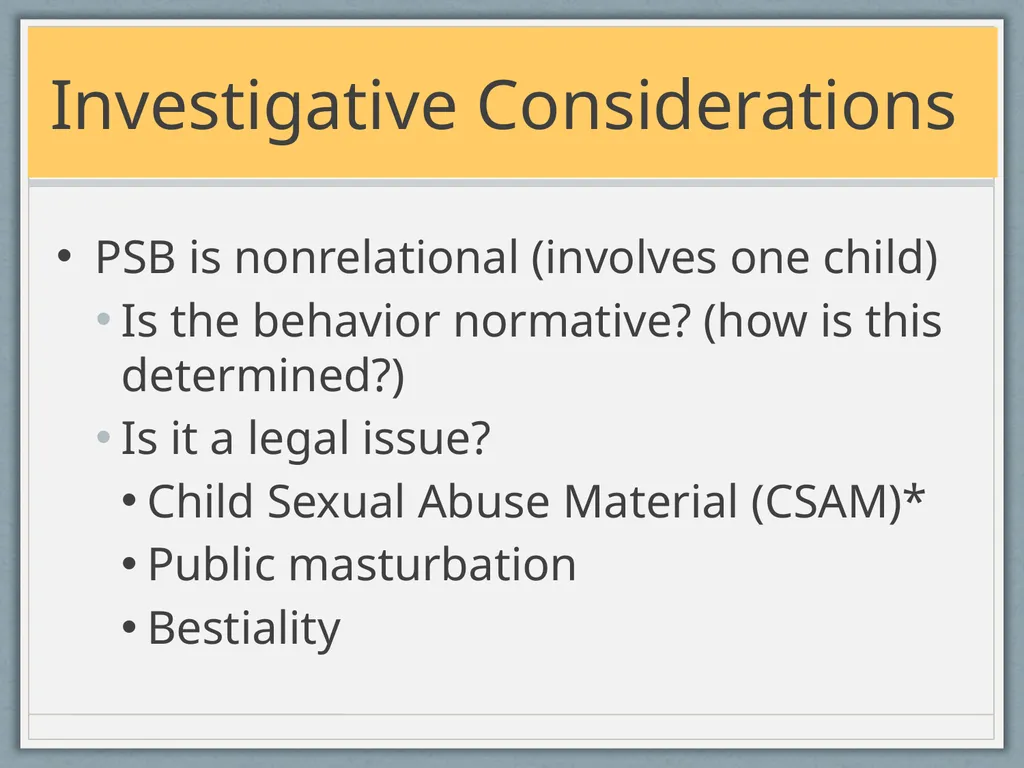
Investigative Considerations PSB is nonrelational (involves one child)
Is the behavior normative? (how is this determined?)
Is it a legal issue?
Child Sexual Abuse Material (CSAM)*
Public masturbation
Bestiality<br>
Is the behavior normative? (how is this determined?)
Is it a legal issue?
Child Sexual Abuse Material (CSAM)*
Public masturbation
Bestiality<br>
24
Investigative Questions… cont. PSB is relational (involves multiple children)
Is the behavior normative?
Is it a legal issue?
Involves coercion, force, manipulation, pressure
Causes harm, anxiety, discomfort, adverse response
Recipients age
Substance facilitated
Are there other legal matters? (non-sexual)
Were they abused?<br>
Is the behavior normative?
Is it a legal issue?
Involves coercion, force, manipulation, pressure
Causes harm, anxiety, discomfort, adverse response
Recipients age
Substance facilitated
Are there other legal matters? (non-sexual)
Were they abused?<br>
25
Reasons for interviewing the child with PSB?
Enter in Chat Investigative Considerations<br>
Enter in Chat Investigative Considerations<br>
26
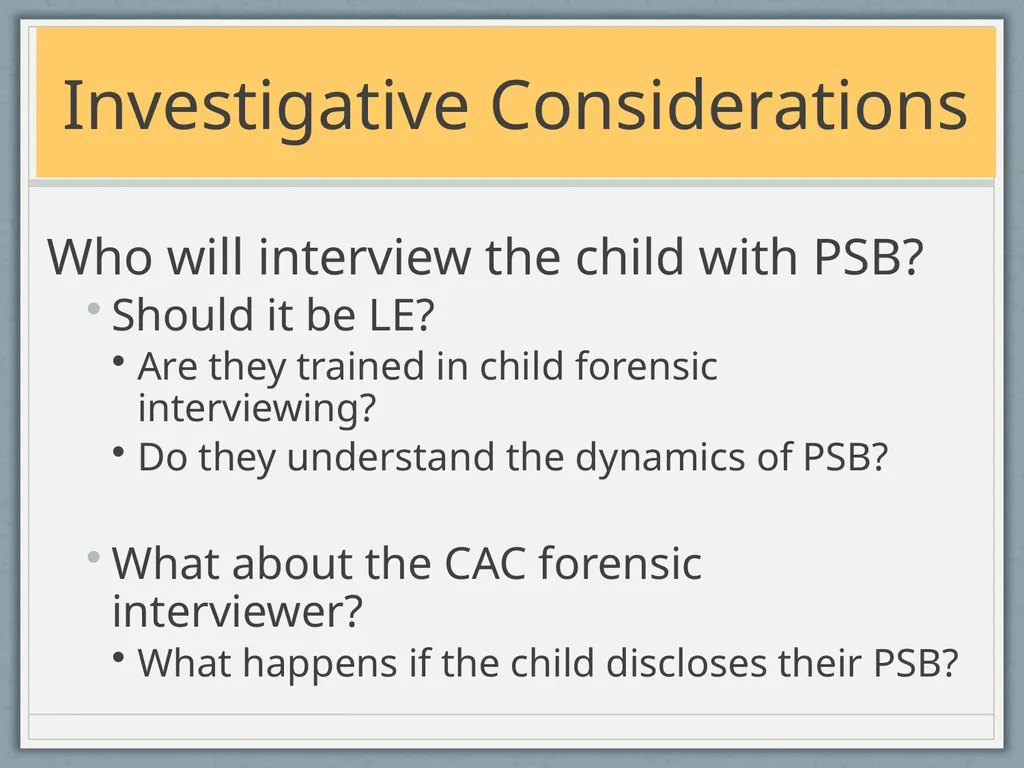
Who will interview the child with PSB?
Should it be LE?
Are they trained in child forensic interviewing?
Do they understand the dynamics of PSB?
What about the CAC forensic interviewer?
What happens if the child discloses their PSB? Investigative Considerations<br>
Should it be LE?
Are they trained in child forensic interviewing?
Do they understand the dynamics of PSB?
What about the CAC forensic interviewer?
What happens if the child discloses their PSB? Investigative Considerations<br>
27
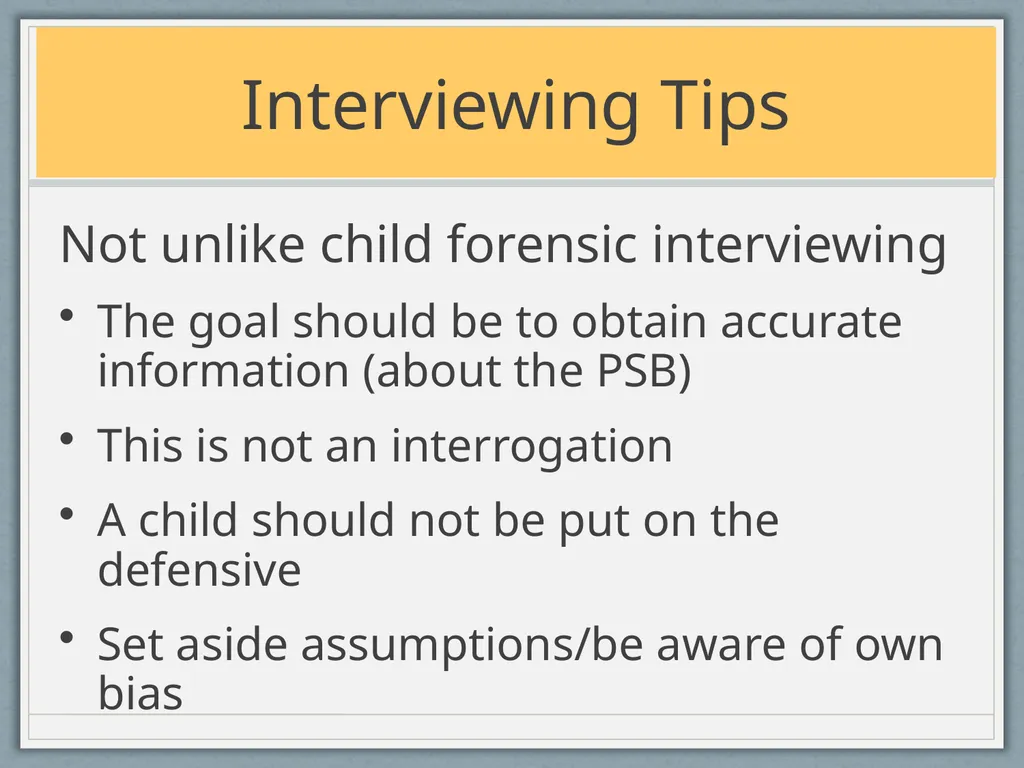
Not unlike child forensic interviewing
The goal should be to obtain accurate information (about the PSB)
This is not an interrogation
A child should not be put on the defensive
Set aside assumptions/be aware of own bias Interviewing Tips<br>
The goal should be to obtain accurate information (about the PSB)
This is not an interrogation
A child should not be put on the defensive
Set aside assumptions/be aware of own bias Interviewing Tips<br>
28
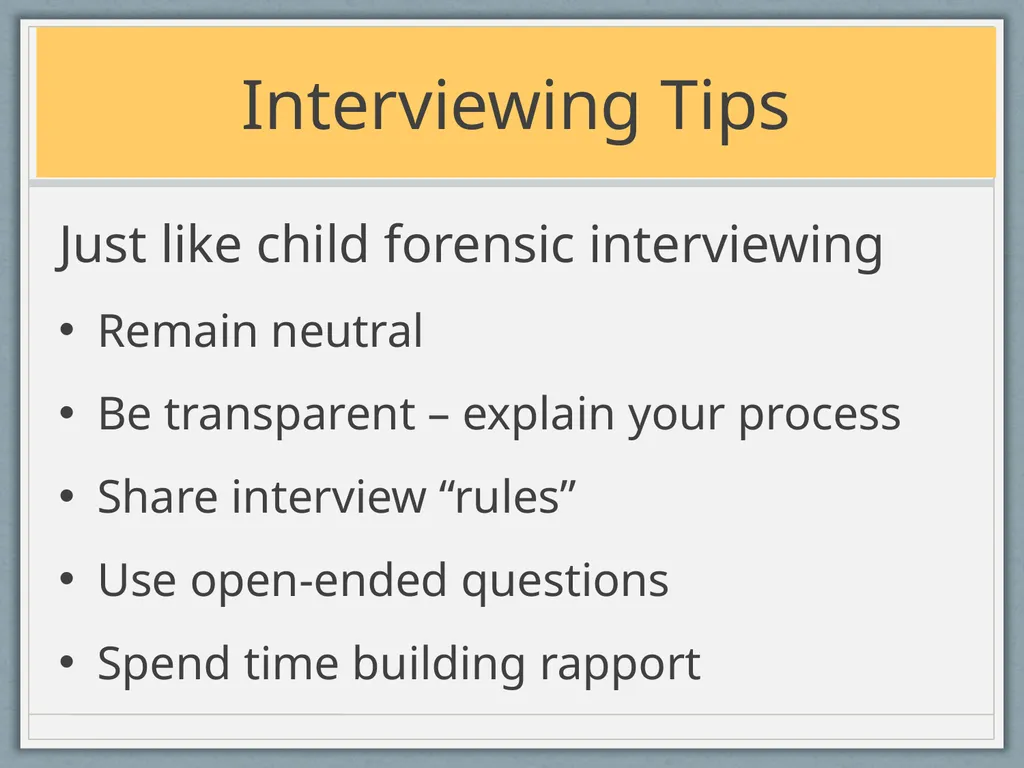
Just like child forensic interviewing
Remain neutral
Be transparent – explain your process
Share interview “rules”
Use open-ended questions
Spend time building rapport Interviewing Tips<br>
Remain neutral
Be transparent – explain your process
Share interview “rules”
Use open-ended questions
Spend time building rapport Interviewing Tips<br>
29
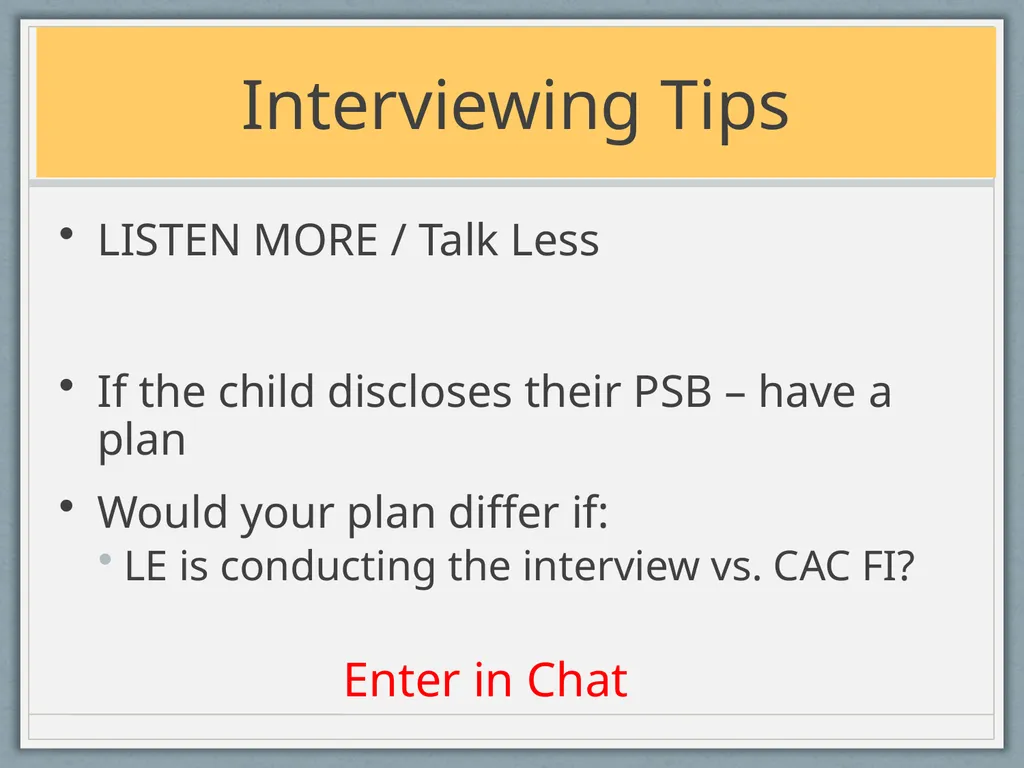
LISTEN MORE / Talk Less
If the child discloses their PSB – have a plan
Would your plan differ if:
LE is conducting the interview vs. CAC FI?
Enter in Chat Interviewing Tips<br>
If the child discloses their PSB – have a plan
Would your plan differ if:
LE is conducting the interview vs. CAC FI?
Enter in Chat Interviewing Tips<br>
30
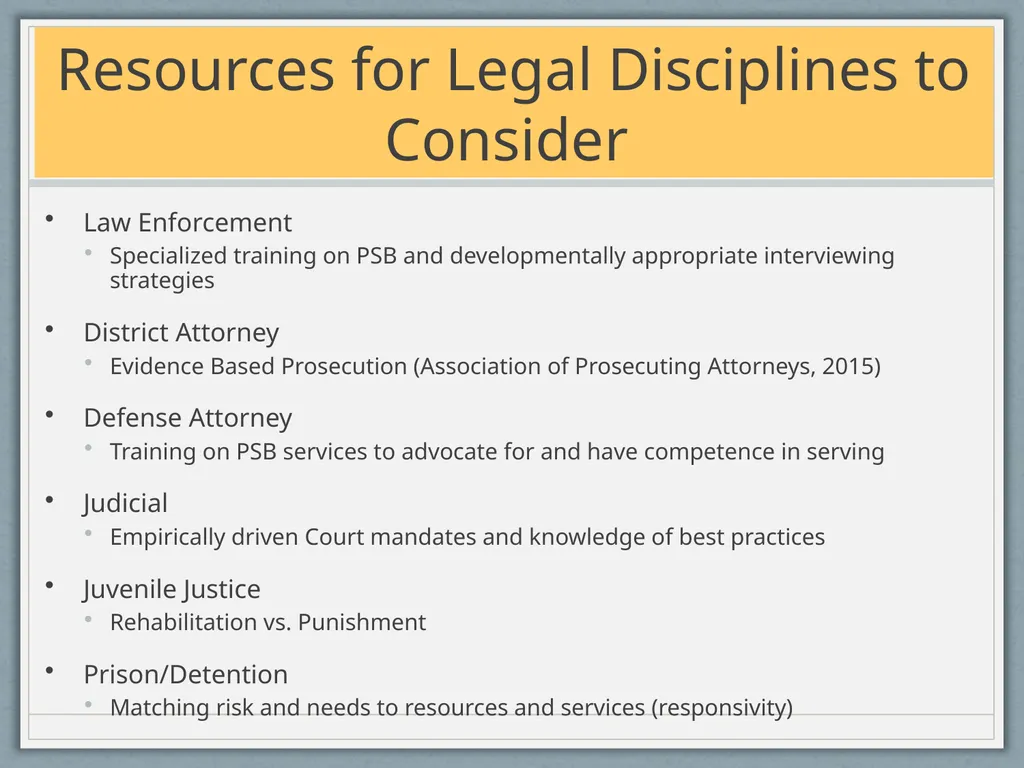
Resources for Legal Disciplines to Consider Law Enforcement
Specialized training on PSB and developmentally appropriate interviewing strategies
District Attorney
Evidence Based Prosecution (Association of Prosecuting Attorneys, 2015)
Defense Attorney
Training on PSB services to advocate for and have competence in serving
Judicial
Empirically driven Court mandates and knowledge of best practices
Juvenile Justice
Rehabilitation vs. Punishment
Prison/Detention
Matching risk and needs to resources and services (responsivity)<br>
Specialized training on PSB and developmentally appropriate interviewing strategies
District Attorney
Evidence Based Prosecution (Association of Prosecuting Attorneys, 2015)
Defense Attorney
Training on PSB services to advocate for and have competence in serving
Judicial
Empirically driven Court mandates and knowledge of best practices
Juvenile Justice
Rehabilitation vs. Punishment
Prison/Detention
Matching risk and needs to resources and services (responsivity)<br>
31
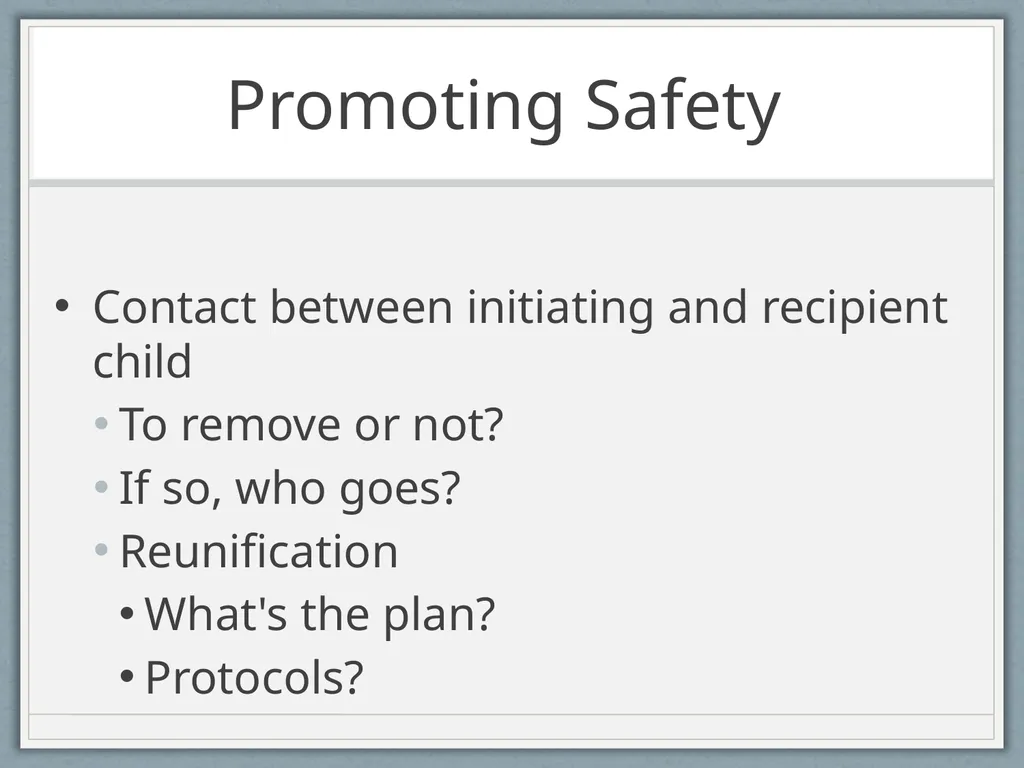
Promoting Safety Contact between initiating and recipient child
To remove or not?
If so, who goes?
Reunification
What's the plan?
Protocols?<br>
To remove or not?
If so, who goes?
Reunification
What's the plan?
Protocols?<br>
32
CPS and PSB Again, how cases are handled vary by state and even by your local agency
Is supervision linked or contributing to the abuse?
Awareness
Culpability
Capacity
Who has been harmed?
How does CPS and law enforcement collaborate on cases?
Does a sexualized behavior indicate sexual abuse?
When and if to utilize a CME/FI<br>
Is supervision linked or contributing to the abuse?
Awareness
Culpability
Capacity
Who has been harmed?
How does CPS and law enforcement collaborate on cases?
Does a sexualized behavior indicate sexual abuse?
When and if to utilize a CME/FI<br>
33
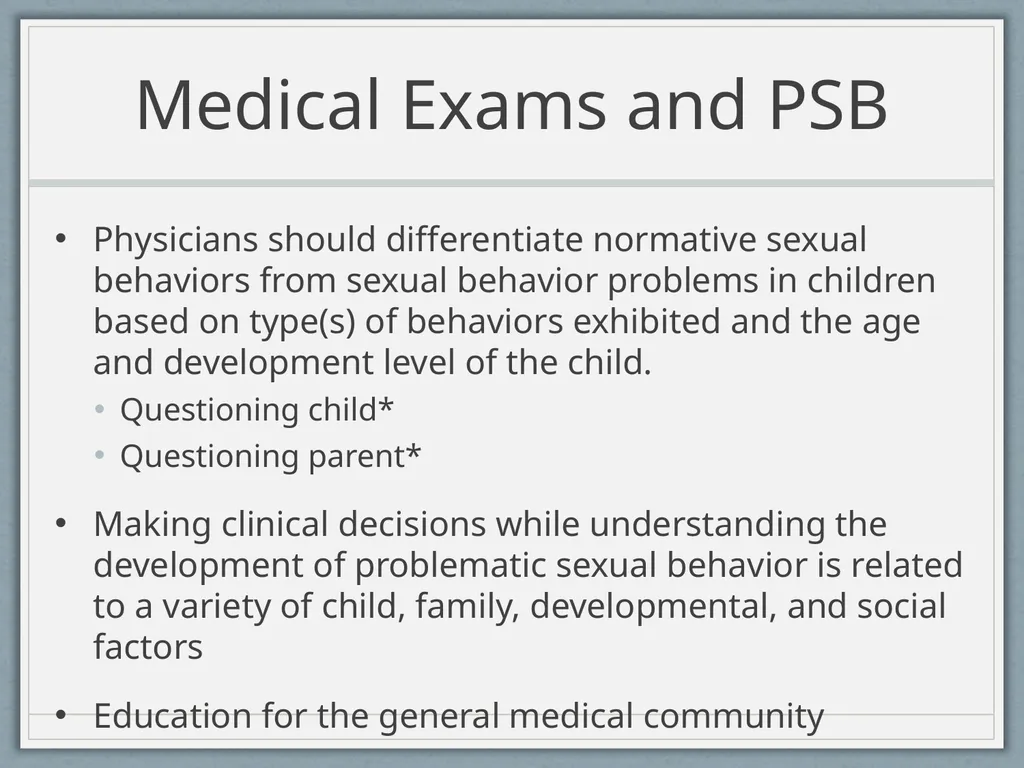
Medical Exams and PSB Physicians should differentiate normative sexual behaviors from sexual behavior problems in children based on type(s) of behaviors exhibited and the age and development level of the child.
Questioning child*
Questioning parent*
Making clinical decisions while understanding the development of problematic sexual behavior is related to a variety of child, family, developmental, and social factors
Education for the general medical community<br>
Questioning child*
Questioning parent*
Making clinical decisions while understanding the development of problematic sexual behavior is related to a variety of child, family, developmental, and social factors
Education for the general medical community<br>
34
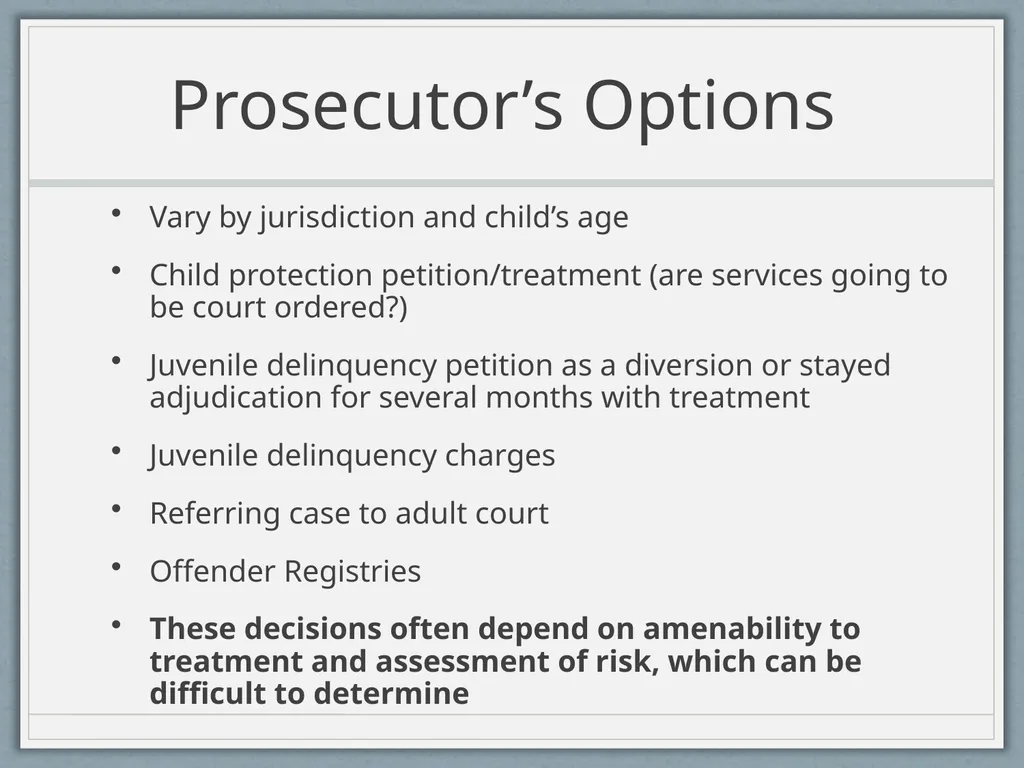
Prosecutor’s Options Vary by jurisdiction and child’s age
Child protection petition/treatment (are services going to be court ordered?)
Juvenile delinquency petition as a diversion or stayed adjudication for several months with treatment
Juvenile delinquency charges
Referring case to adult court
Offender Registries
These decisions often depend on amenability to treatment and assessment of risk, which can be difficult to determine<br>
Child protection petition/treatment (are services going to be court ordered?)
Juvenile delinquency petition as a diversion or stayed adjudication for several months with treatment
Juvenile delinquency charges
Referring case to adult court
Offender Registries
These decisions often depend on amenability to treatment and assessment of risk, which can be difficult to determine<br>
35
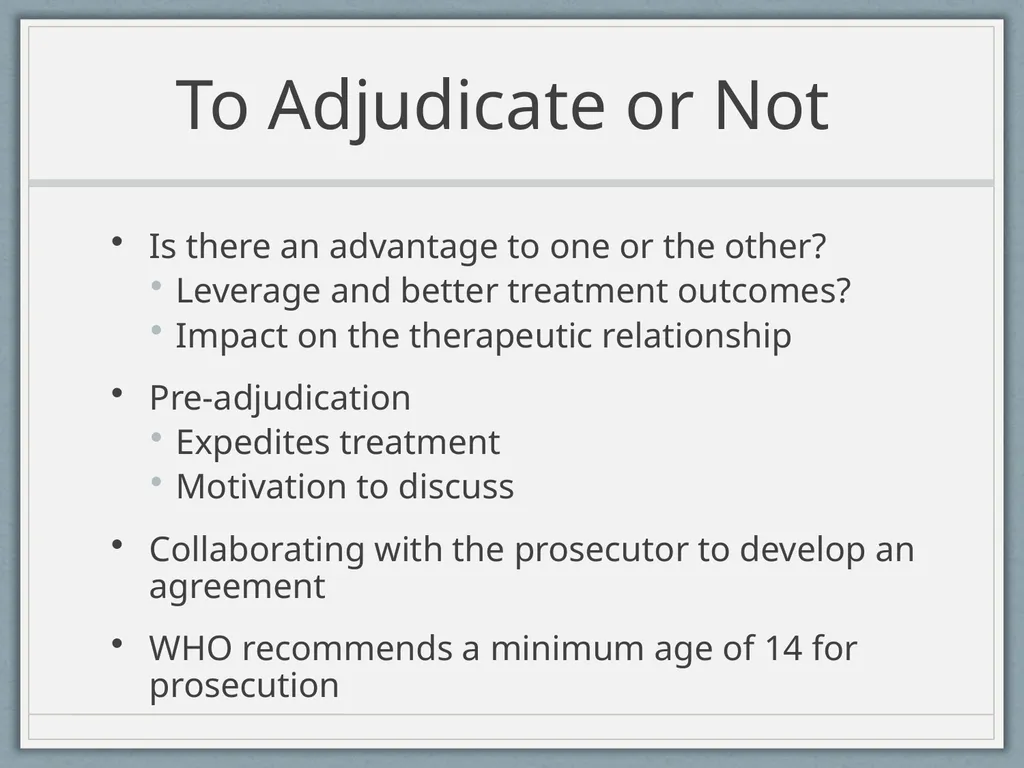
To Adjudicate or Not Is there an advantage to one or the other?
Leverage and better treatment outcomes?
Impact on the therapeutic relationship
Pre-adjudication
Expedites treatment
Motivation to discuss
Collaborating with the prosecutor to develop an agreement
WHO recommends a minimum age of 14 for prosecution<br>
Leverage and better treatment outcomes?
Impact on the therapeutic relationship
Pre-adjudication
Expedites treatment
Motivation to discuss
Collaborating with the prosecutor to develop an agreement
WHO recommends a minimum age of 14 for prosecution<br>
36
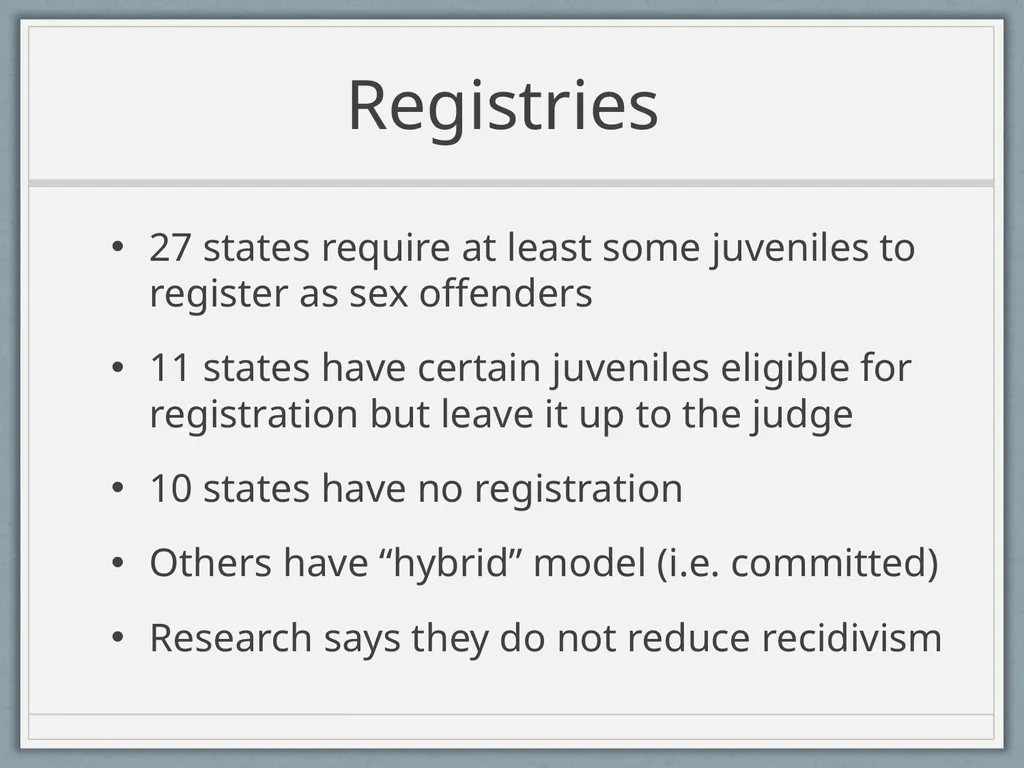
Registries 27 states require at least some juveniles to register as sex offenders
11 states have certain juveniles eligible for registration but leave it up to the judge
10 states have no registration
Others have “hybrid” model (i.e. committed)
Research says they do not reduce recidivism<br>
11 states have certain juveniles eligible for registration but leave it up to the judge
10 states have no registration
Others have “hybrid” model (i.e. committed)
Research says they do not reduce recidivism<br>
37
Factors for the courts Juvenile’s age
Prior experience with the law
Physical and mental condition at the time of investigation
Legal counsel (adequate)
Presence of parental support
Duration of investigation/interrogation
Conditions imposed during investigation/interrogation<br>
Prior experience with the law
Physical and mental condition at the time of investigation
Legal counsel (adequate)
Presence of parental support
Duration of investigation/interrogation
Conditions imposed during investigation/interrogation<br>
38
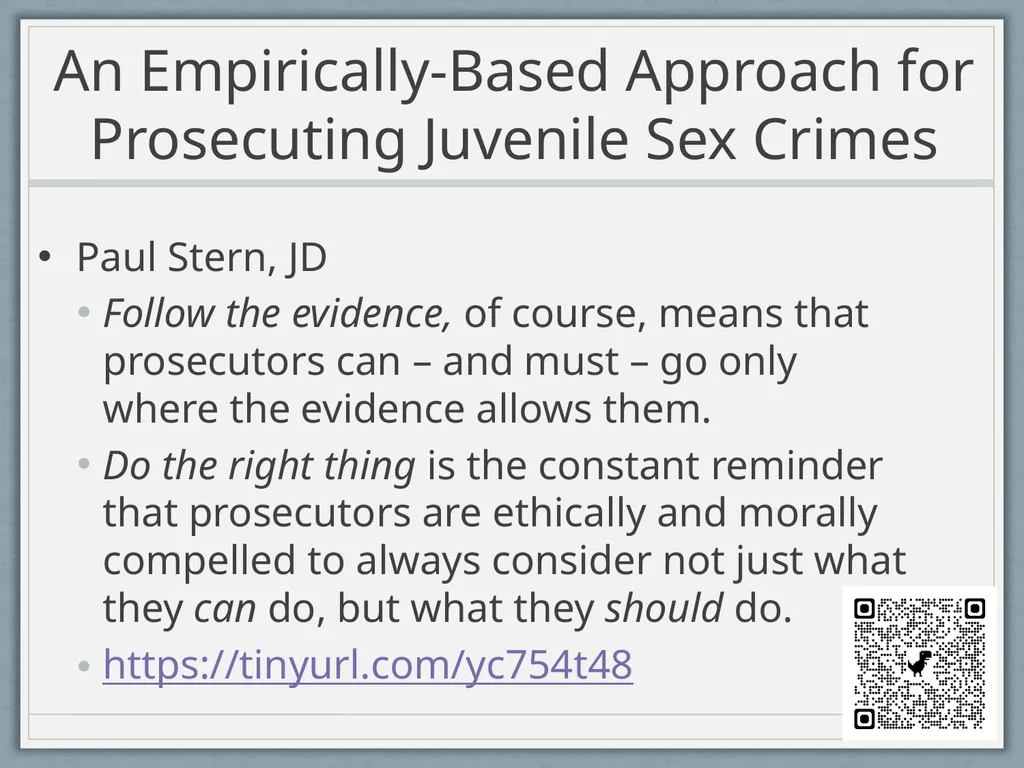
An Empirically-Based Approach for Prosecuting Juvenile Sex Crimes Paul Stern, JD
Follow the evidence, of course, means that prosecutors can – and must – go only where the evidence allows them.
Do the right thing is the constant reminder that prosecutors are ethically and morally compelled to always consider not just what they can do, but what they should do.
https://tinyurl.com/yc754t48<br>
Follow the evidence, of course, means that prosecutors can – and must – go only where the evidence allows them.
Do the right thing is the constant reminder that prosecutors are ethically and morally compelled to always consider not just what they can do, but what they should do.
https://tinyurl.com/yc754t48<br>
39
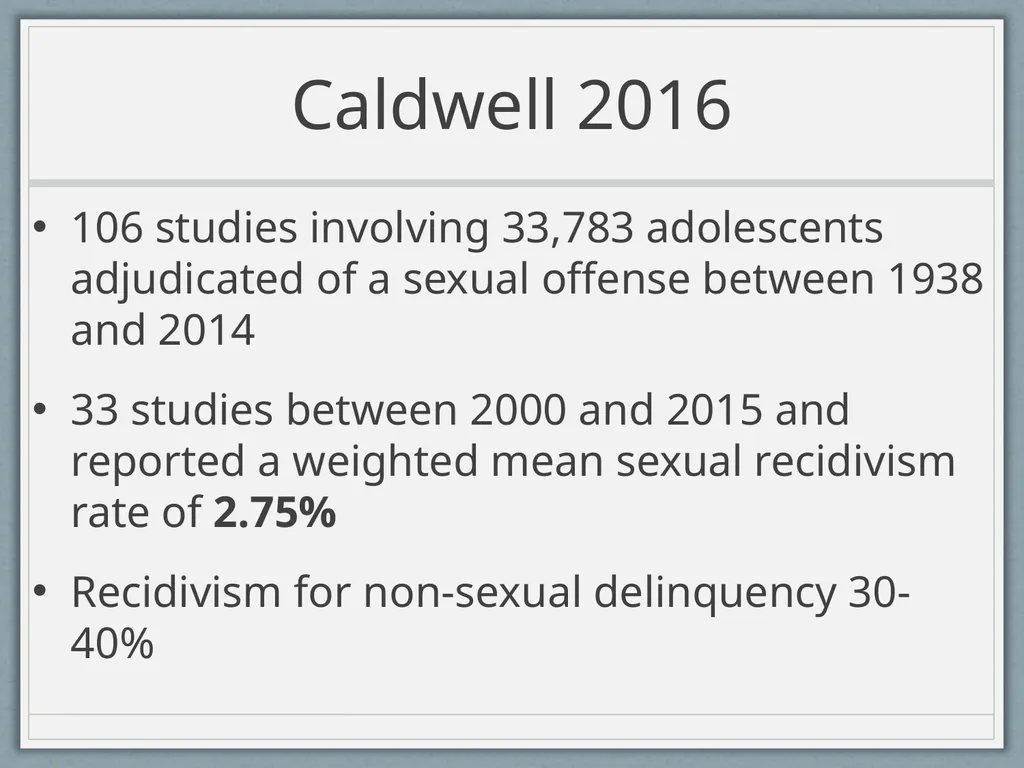
Caldwell 2016 106 studies involving 33,783 adolescents adjudicated of a sexual offense between 1938 and 2014
33 studies between 2000 and 2015 and reported a weighted mean sexual recidivism rate of 2.75%
Recidivism for non-sexual delinquency 30-40%<br>
33 studies between 2000 and 2015 and reported a weighted mean sexual recidivism rate of 2.75%
Recidivism for non-sexual delinquency 30-40%<br>
40
System Needs Considerations for CACs Creating a unified response to identify and treat children with PSB, providing families direction and support
Creating policies and practices to support children with PSB and those impacted by their behavior.
Collecting data on reported cases and case outcomes.<br>
Creating policies and practices to support children with PSB and those impacted by their behavior.
Collecting data on reported cases and case outcomes.<br>
41
System Needs Considerations for CACs Training opportunities for MDT members:
Intro to PSB (NCA Engage)
Training for MH on evidence-based or evidence-informed treatment for children with PSB, children impacted by PSB, and their caregivers
Interview training for LE for interviewing children with PSB<br>
Intro to PSB (NCA Engage)
Training for MH on evidence-based or evidence-informed treatment for children with PSB, children impacted by PSB, and their caregivers
Interview training for LE for interviewing children with PSB<br>
42
Considerations for Policy Change Prevention and education
Early identification (and intervention)
Collaborative community response (to include, DJJ & schools)
Emphasis on evidence-based/supported treatment/approaches
Promoting safe and healthy communities
Funding to achieve all the above<br>
Early identification (and intervention)
Collaborative community response (to include, DJJ & schools)
Emphasis on evidence-based/supported treatment/approaches
Promoting safe and healthy communities
Funding to achieve all the above<br>
43
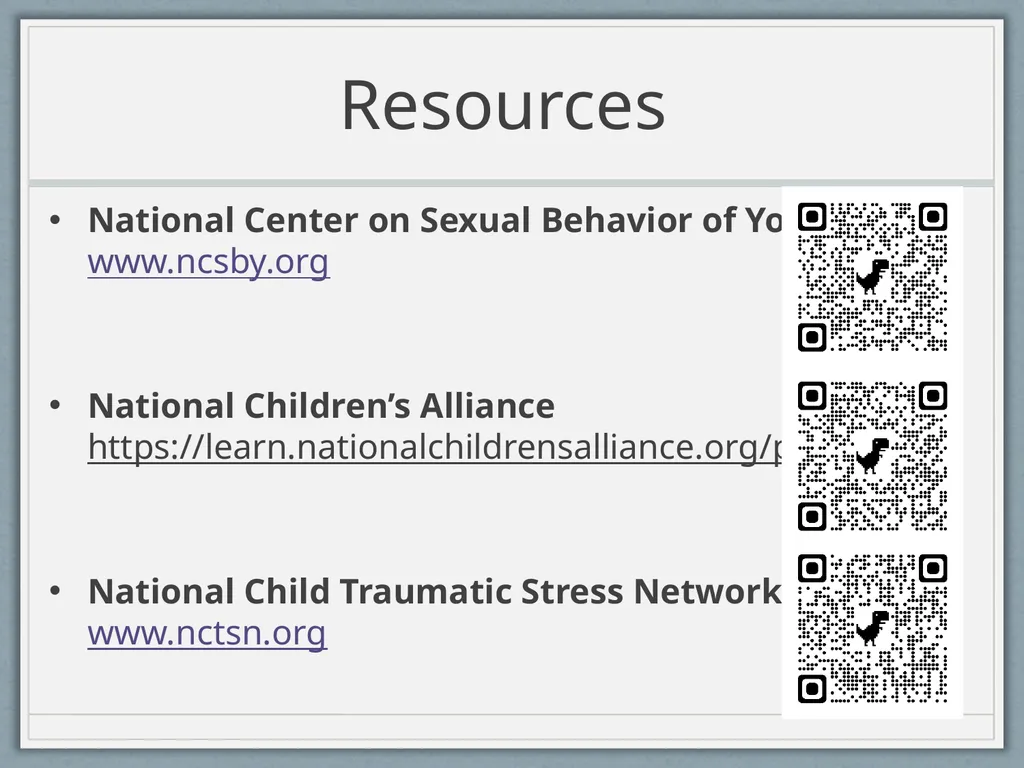
Resources National Center on Sexual Behavior of Youth www.ncsby.org
National Children’s Alliance https://learn.nationalchildrensalliance.org/psb
National Child Traumatic Stress Network www.nctsn.org<br>
National Children’s Alliance https://learn.nationalchildrensalliance.org/psb
National Child Traumatic Stress Network www.nctsn.org<br>
44
Thank you Geoff Sidoli, MSW, LCSW
Executive Director: Mountain CAC – Asheville, NC
gsidoli@mtncac.org
Jerri Sites, MA
Consultant: Child Protection Concepts, LLC
jerri@childprotectionconcepts.com<br>
Executive Director: Mountain CAC – Asheville, NC
gsidoli@mtncac.org
Jerri Sites, MA
Consultant: Child Protection Concepts, LLC
jerri@childprotectionconcepts.com<br>