Decision Making Decision Making Decision making is the process of making choices by identifying a decision, gathering information, and assessing alternative resolutions. Using a step-by-step decision-making process can help you make more
"Decision Making Decision Making Decision making is" is the property of its rightful owner. Permission is granted to
download and print the materials on this website for personal, non-commercial use only, and to display it
on your personal computer provided you do not modify the materials and that you retain all copyright
notices contained in the materials. By downloading content from our website, you accept the terms of this
agreement.
Presentation Transcript
01
Decision Making<br>
02
Decision Making Decision making is the process of making choices by identifying a decision, gathering information, and assessing alternative resolutions. Using a step-by-step decision-making process can help you make more deliberate, thoughtful decisions by organizing relevant information and defining alternatives.
Decision-making is perhaps the most important component of a manager's activities. It plays the most important role in the planning process. When the managers plan, they decide on many matters as what goals their organisation will pursue, what resources they will use, and who will perform each required task.
“Decision making is a process involving information, choice of alternative actions, implementations, and evaluation that is directed to the achievement of certain stated goals.”
Decision making is described as the essence of a manager's job because it is utilized in all four managerial functions of planning, organizing, leading and controlling. Decisions, both large and small, are made every day by managers and they have the potential to affect others.<br>
03
Characteristics of Decision Making The following are the characteristics of decision making:
• Decision making is a selection process.
• Decision making is the end process. It is preceded by detailed discussion and selection of alternatives.
• Decision making is the application of intellectual abilities to a great extent.
• Decision making is a dynamic process.
• Decision making is situational.
• A decision may be either negative or positive.
• Decision making involves the evaluation of available alternatives through critical appraisal methods.
• Decision is taken to achieve the objectives of an organisation.<br>
04
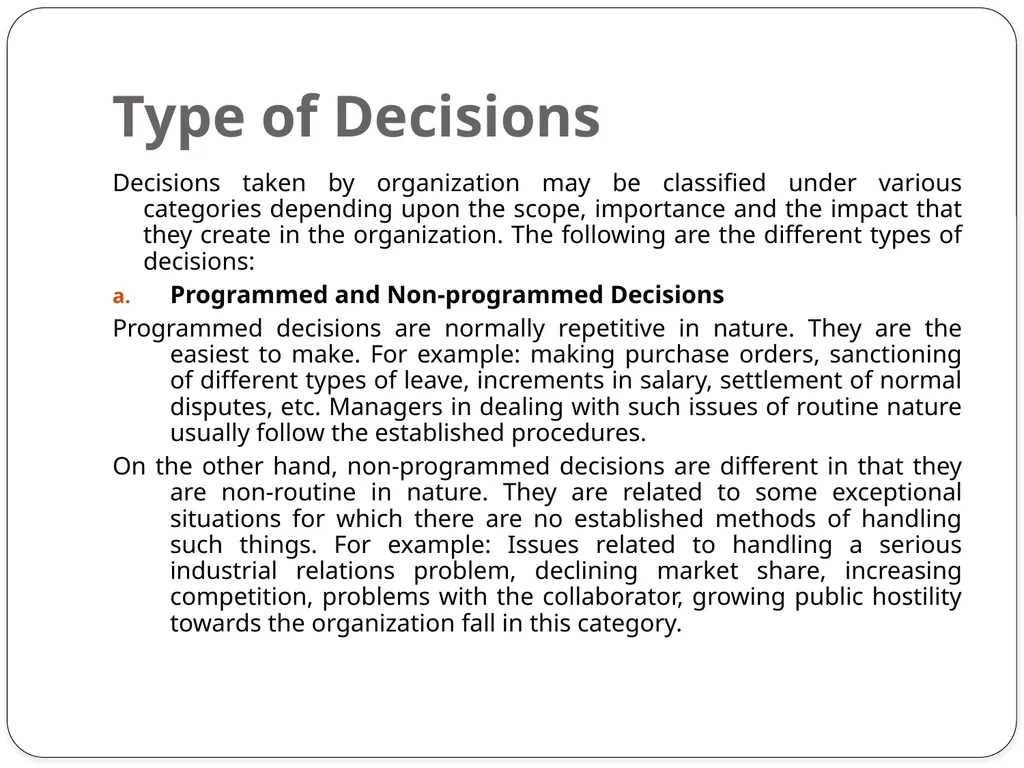
Type of Decisions Decisions taken by organization may be classified under various categories depending upon the scope, importance and the impact that they create in the organization. The following are the different types of decisions:
Programmed and Non-programmed Decisions
Programmed decisions are normally repetitive in nature. They are the easiest to make. For example: making purchase orders, sanctioning of different types of leave, increments in salary, settlement of normal disputes, etc. Managers in dealing with such issues of routine nature usually follow the established procedures.
On the other hand, non-programmed decisions are different in that they are non-routine in nature. They are related to some exceptional situations for which there are no established methods of handling such things. For example: Issues related to handling a serious industrial relations problem, declining market share, increasing competition, problems with the collaborator, growing public hostility towards the organization fall in this category.<br>
05
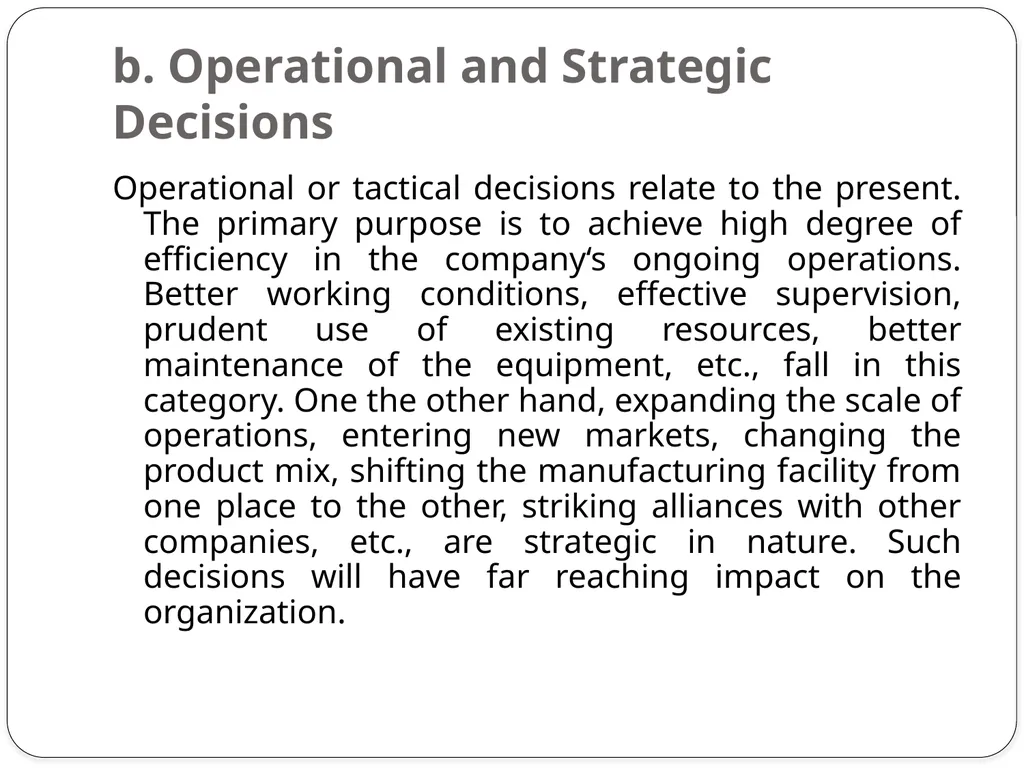
b. Operational and Strategic Decisions Operational or tactical decisions relate to the present. The primary purpose is to achieve high degree of efficiency in the company‘s ongoing operations. Better working conditions, effective supervision, prudent use of existing resources, better maintenance of the equipment, etc., fall in this category. One the other hand, expanding the scale of operations, entering new markets, changing the product mix, shifting the manufacturing facility from one place to the other, striking alliances with other companies, etc., are strategic in nature. Such decisions will have far reaching impact on the organization.<br>
06
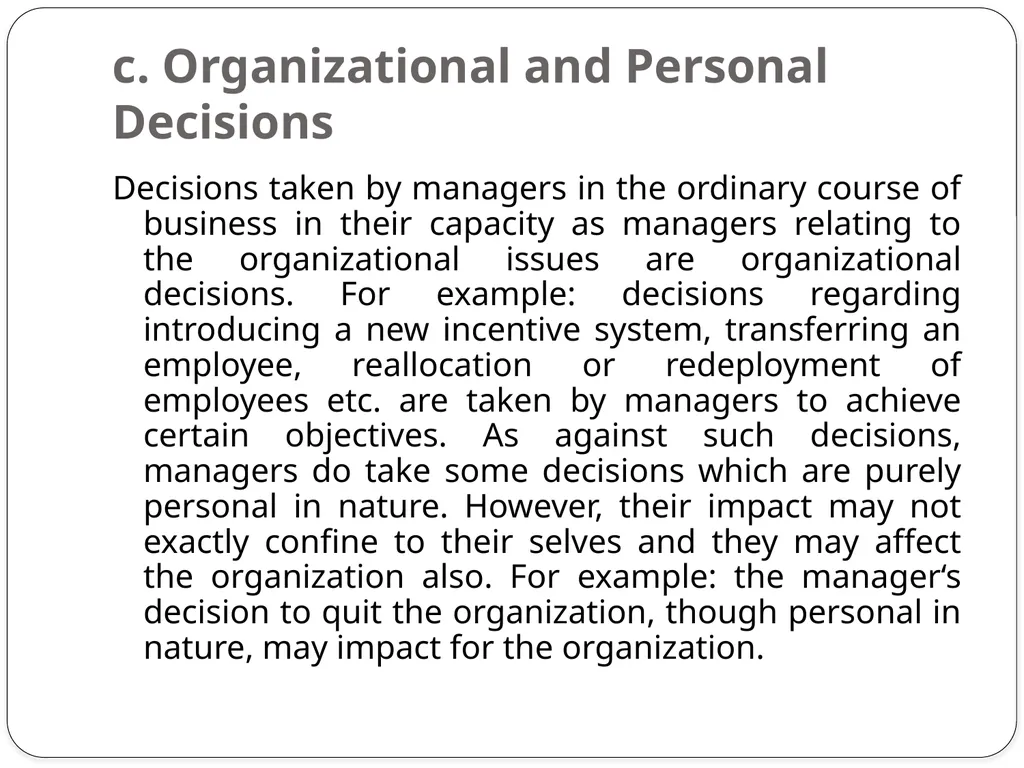
c. Organizational and Personal Decisions Decisions taken by managers in the ordinary course of business in their capacity as managers relating to the organizational issues are organizational decisions. For example: decisions regarding introducing a new incentive system, transferring an employee, reallocation or redeployment of employees etc. are taken by managers to achieve certain objectives. As against such decisions, managers do take some decisions which are purely personal in nature. However, their impact may not exactly confine to their selves and they may affect the organization also. For example: the manager‘s decision to quit the organization, though personal in nature, may impact for the organization.<br>
07
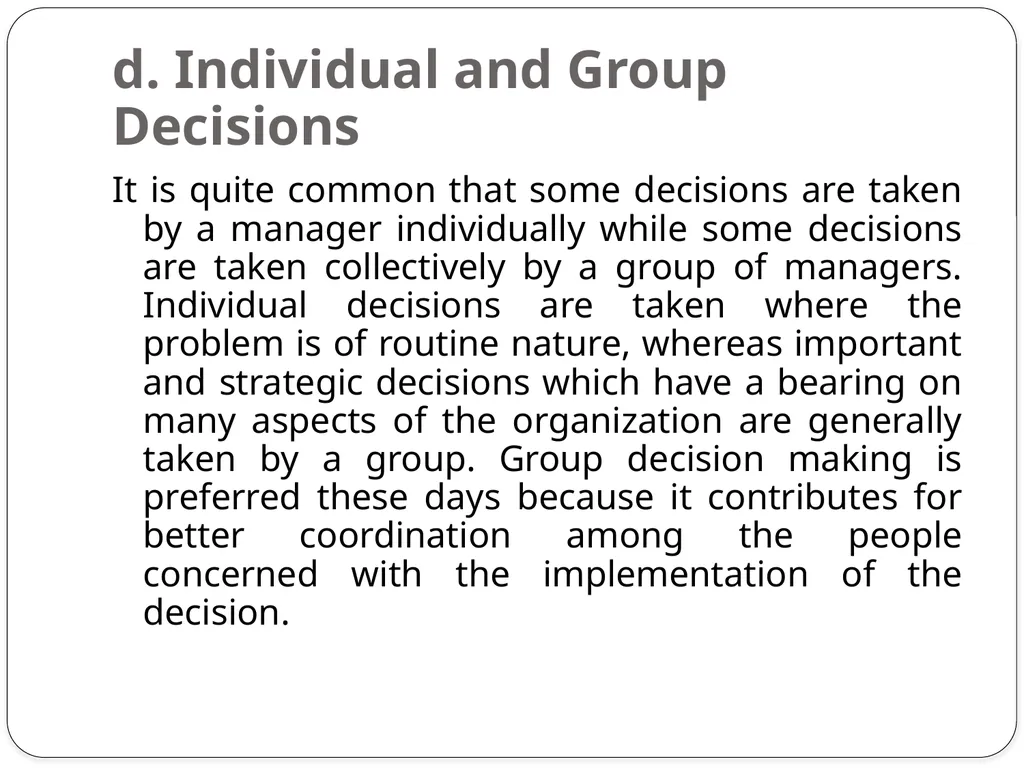
d. Individual and Group Decisions It is quite common that some decisions are taken by a manager individually while some decisions are taken collectively by a group of managers. Individual decisions are taken where the problem is of routine nature, whereas important and strategic decisions which have a bearing on many aspects of the organization are generally taken by a group. Group decision making is preferred these days because it contributes for better coordination among the people concerned with the implementation of the decision.<br>