
DEEP DIVE Training to provide information and


Description: DEEP DIVE Training to provide information and support for Nottinghamshire schools re Ofsted DEEP DIVE music inspections MUSIC SUBJECT LEADERS ANTHEM (Tune: John Browns BodyLittle Peter Rabbit) Im a subject leader and I havent got a
Related Topics
Download Presentation
"DEEP DIVE Training to provide information and" is the property of its rightful owner. Permission is granted to download and print the materials on this website for personal, non-commercial use only, and to display it on your personal computer provided you do not modify the materials and that you retain all copyright notices contained in the materials. By downloading content from our website, you accept the terms of this agreement.
Presentation Transcript
slide1. DEEP DIVE Training to provide information and support
for Nottinghamshire schools
re Ofsted ‘DEEP DIVE’ music inspections<br>
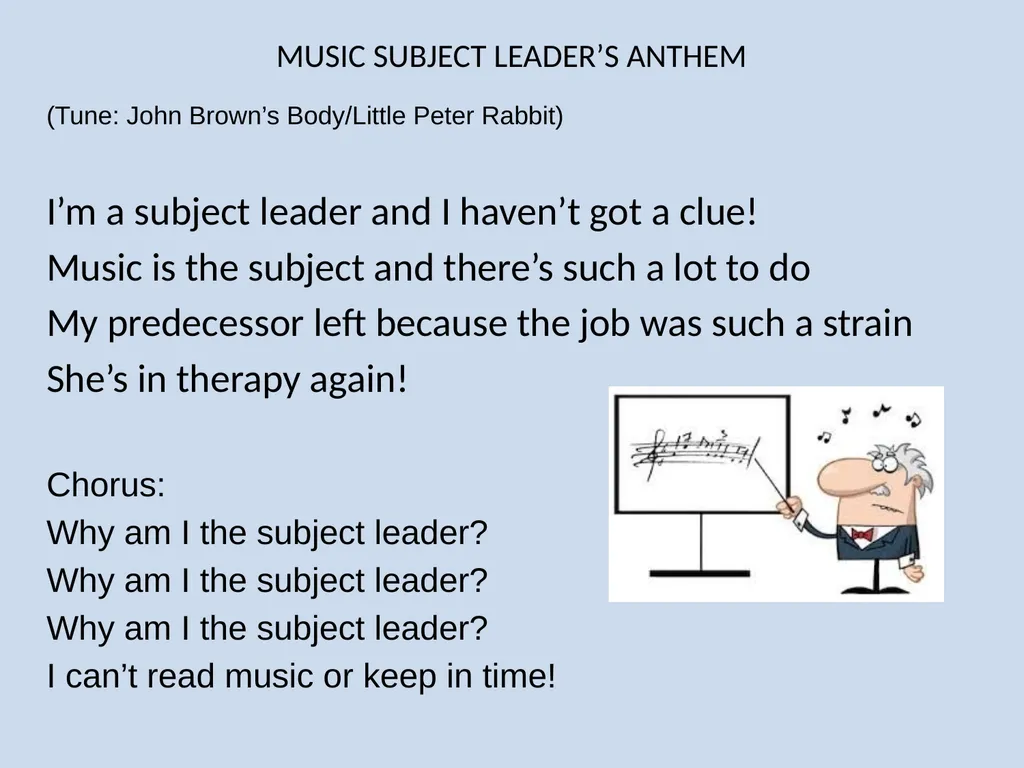
slide2. MUSIC SUBJECT LEADER’S ANTHEM (Tune: John Brown’s Body/Little Peter Rabbit)
I’m a subject leader and I haven’t got a clue!
Music is the subject and there’s such a lot to do
My predecessor left because the job was such a strain
She’s in therapy again!
Chorus:
Why am I the subject leader?
Why am I the subject leader?
Why am I the subject leader?
I can’t read music or keep in time!<br>
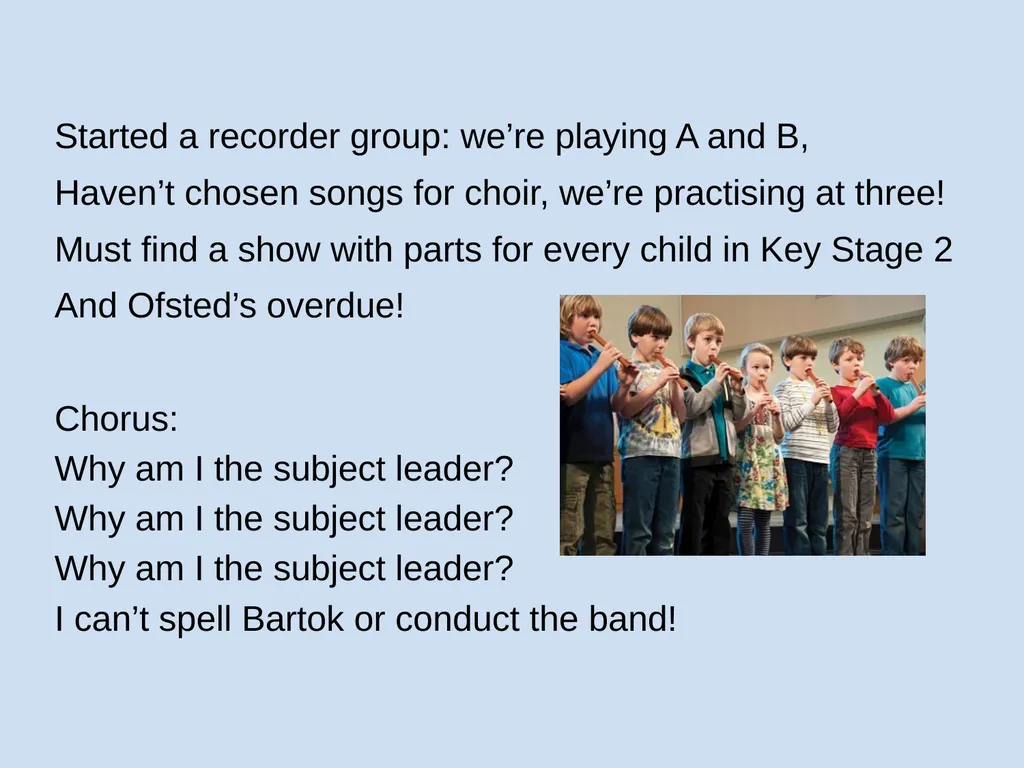
slide3. Started a recorder group: we’re playing A and B,
Haven’t chosen songs for choir, we’re practising at three!
Must find a show with parts for every child in Key Stage 2
And Ofsted’s overdue!
Chorus:
Why am I the subject leader?
Why am I the subject leader?
Why am I the subject leader?
I can’t spell Bartok or conduct the band!<br>
slide4. I’m a subject leader and it’s driving me insane!
Someone’s pinched the hymn book
And that parent’s here again!
The scheme of work is useless
And the peri’s always late
And Ofsted’s here at eight!
Chorus:
Why am I the subject leader?
Why am I the subject leader?
Why am I the subject leader?
I can’t sing for toffee and I’m always flat!<br>
slide5. Abandoned the recorder group: we couldn’t manage E
Locked the hall piano and I cannot find the key.
I must produce an action plan - assessments for Class 4
And Ofsted’s at the door!
Chorus:
Why am I the subject leader?
Why am I the subject leader?
Why am I the subject leader?
It’s not the job for me!<br>
slide6. Evidence so far ….. Evidence from primary DD inspections
What were inspectors asking/looking for?
Examples available on the Nottinghamshire Music Education Hub website<br>
slide7. 1.Training to support ‘Deep Dive’ inspections NATIONAL CURRICULUM PROGRAMME OF STUDY
Aims: to ensure that all pupils:
perform, listen to, review and evaluate music across a range of historical periods, genres, styles and traditions, including the works of the great composers and musicians.
learn to sing and to use their voices
to create and compose music on their own and with others
have the opportunity to learn a musical instrument
use technology appropriately
have the opportunity to progress to the next level of musical excellence.
understand and explore how music is created, produced and communicated, including through the inter-related dimensions: pitch, duration, dynamics, tempo, timbre, texture and appropriate musical notations.<br>
slide8. 2.Training to support ‘Deep Dive’ inspections NATIONAL CURRICULUM PROGRAMME OF STUDY
Key stage 1: Pupils should be taught to:
use voices expressively and creatively by singing songs & speaking chants & rhymes
play tuned and untuned instruments musically
listen with concentration & understanding to a range of high-quality live & recorded music
experiment with, create, select and combine sounds using the inter-related dimensions of music.
Key stage 2 : Pupils should be taught to sing and play musically with increasing confidence and control. They should develop an understanding of musical composition, organising and manipulating ideas within musical structures and reproducing sounds from aural memory.
Pupils should be taught to:
play and perform in solo and ensemble contexts, using their voices and playing musical instruments with increasing accuracy, fluency, control and expression
improvise and compose music for a range of purposes using the inter-related dimensions of music
listen with attention to detail and recall sounds with increasing aural memory
use and understand staff and other musical notations
appreciate and understand a wide range of high-quality live and recorded music drawn from different traditions and from great composers and musicians
develop an understanding of the history of music<br>
slide9. 3.Training to support ‘Deep Dive’ inspections What is the recommended length and frequency of music lessons in primary schools?
Most educators share the opinion that lessons should be taught weekly for:
KS1: 30 minutes
KS2: 45- 60 minutes
‘Carousel’ arrangements are not ideal for music<br>
slide10. 4.Training to support ‘Deep Dive’ inspections Is the school’s music scheme fit for purpose?
Charanga/ Music Express cover all NC requirements
Music Express: Collins have developed new ‘skills’ documents – available at https://collins.co.uk/pages/primary-music-music-express-skills-progression-and-curriculum-mapping
Curriculum maps for each year group (1-6)
Summary of skills for each year group (1-6)
Table of skills progression across the year groups
2-year rolling programme for mixed-age classes
FREE scheme ‘MUSIC MADE SIMPLE’ available on the website
*** Check that the music content offered in other curriculum frameworks fully covers NC requirements<br>
slide11. 5.Training to support ‘Deep Dive’ inspections Are teachers, TAs or other musicians teaching in schools, adequately skilled and confident to deliver music lessons?
Training offers:
CPD courses and annual music conference
Charanga training is available
Music Express training is available from Collins (naomi.cook@harpercollins.co.uk)
CME (Certificate for Music Educators: Trinity or ABRSM) is a recognised national qualification available at centres nationwide e.g. MEHEM and a ‘Fast-Track’ Primary CME programme at the University of Northampton<br>
slide12. 6.Training to support ‘Deep Dive’ inspections Is long, medium and short term planning in place?
Charanga and Music Express both provide detailed planning at each level
*** Check other curriculum frameworks for adequate music planning<br>
slide13. 7.Training to support ‘Deep Dive’ inspections Is there a year-on-year Action Plan with clear success criteria?
Music Action Plan formats will vary from school to school but they should set out achievable aims that reflect practitioners’ and pupils’ needs and support the development of music across the school.
(Action Plan example available on the website)<br>
slide14. 8.Training to support ‘Deep Dive’ inspections Does the school follow a clear progression route for music, citing skills, knowledge and experience that all pupils will acquire on their musical ‘journey’?
Nottinghamshire Progression Pathways (on the website) offers a progression map for EYFS – KS5
Charanga & Music Express provide progressive and age-appropriate musical content in all units of work.
*** Check that other curriculum frameworks provide musical progression<br>
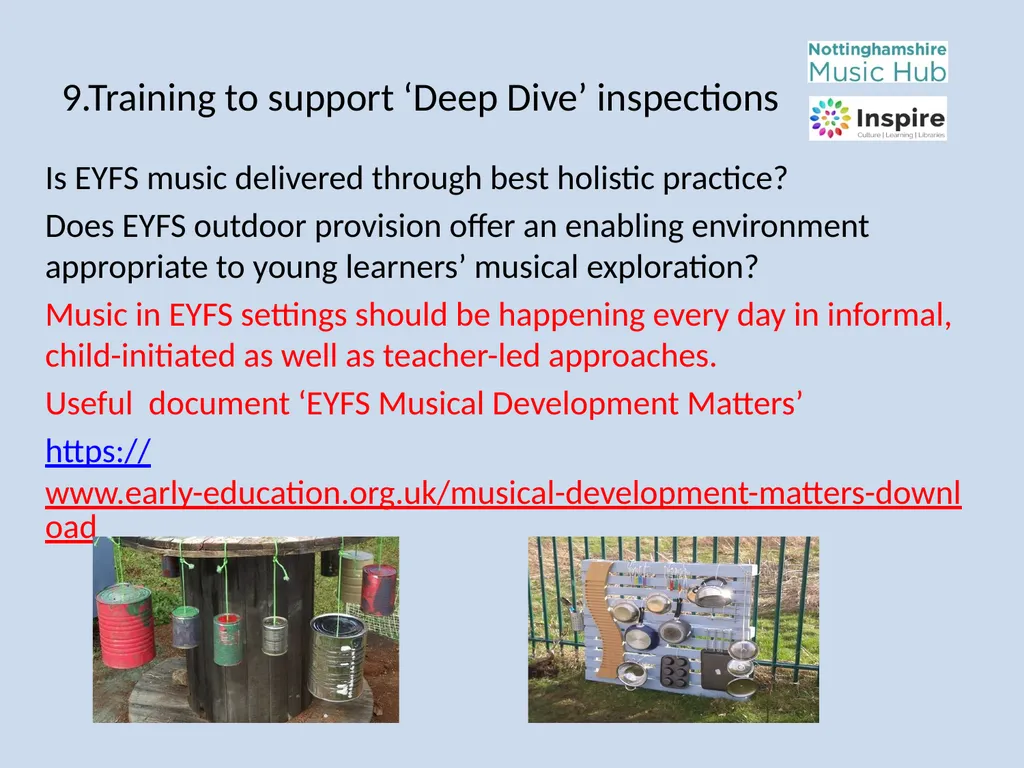
slide15. 9.Training to support ‘Deep Dive’ inspections Is EYFS music delivered through best holistic practice?
Does EYFS outdoor provision offer an enabling environment appropriate to young learners’ musical exploration?
Music in EYFS settings should be happening every day in informal, child-initiated as well as teacher-led approaches.
Useful document ‘EYFS Musical Development Matters’
https://www.early-education.org.uk/musical-development-matters-download<br>
slide16. 10.Training to support ‘Deep Dive’ inspections How is the quality of music provision monitored?
Planning to be submitted to subject leader plus short iPad video clips uploaded to class folders on the school server.
Ideally ‘drop-in’ lesson observations for curriculum and WCIT whole class instrumental teaching, led by subject leader perhaps joined by SLT. Consider inviting the school governor responsible for music to attend?
Ofsted document: ‘Music in Schools, promoting good practice’ aimed Heads, Governors re observing lessons<br>
slide17. 11.Training to support ‘Deep Dive’ inspections How are SEND, EAL etc. pupils’ needs accommodated in music lessons?
Printed lesson plans annotated to show how pupils with specific needs are accommodated. If not possible for every lesson, then for each unit (an example is found on the website)<br>
slide18. 12.Training to support ‘Deep Dive’ inspections How is delivery differentiated in mixed age classes?
Charanga provides Gold, Silver, Bronze differentiated tasks
Music Express:
same unit titles for adjacent year groups
‘skills analysis’ documents
2-year rolling programme for mixed age groups
https://collins.co.uk/pages/primary-music-music-express-skills-progression-and-curriculum-mapping<br>
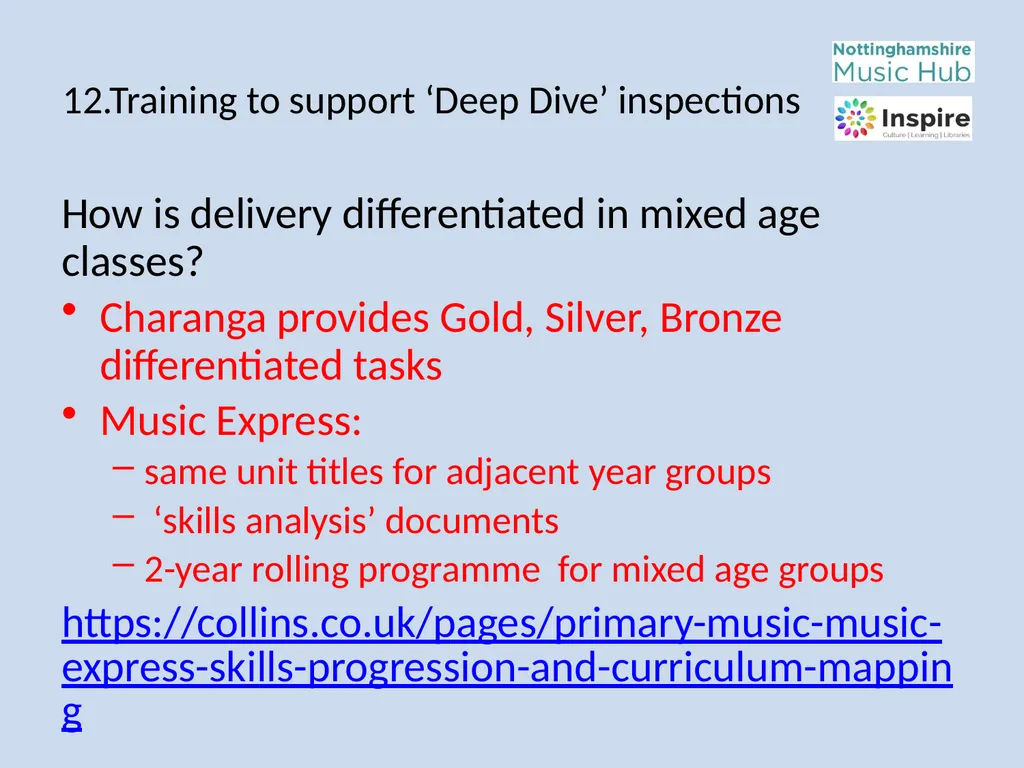
slide19. 13.Training to support ‘Deep Dive’ inspections Is percussion provision adequate and stored appropriately? Is technology readily accessible e.g. iPads
Percussion trolleys are often placed in awkward spaces/cupboards with instruments crammed on inaccessible shelves.
Better to divide up percussion between Y1/2, 3/4, 5/6 and keep in large plastic boxes in classrooms with a ‘chart’ of instrument contents with photos & names.
Check that sufficient tuned percussion is available. Six sets of chime bars sold in plastic cases are cheaper than one wooden xylophone (£179)<br>
slide20. 14.Training to support ‘Deep Dive’ inspections Do classes sing every day/week?
Are there opportunities for each KS to sing together?
Is repertoire appropriate – does it demonstrate progression?
Encourage staff to sing with pupils every day: singing underpins well-being, releases endorphins & promotes listening& social interaction.
Impossible to cover appropriate repertoire/progression for Reception-Y6 in whole school singing assemblies; consider separate Key Stage singing led fortnightly.
‘Sing Up’ - over 750 songs; a menu for different age groups, topics, musical styles etc; recordings, backing/echo tracks, teaching notes and song-based units of work.
Music Express and Charanga also have Song Banks
A vocal progression document from ‘Minimum Expected Standards’ is available on the website
A staff choir is a wonderful endorsement of the value of singing!!!<br>
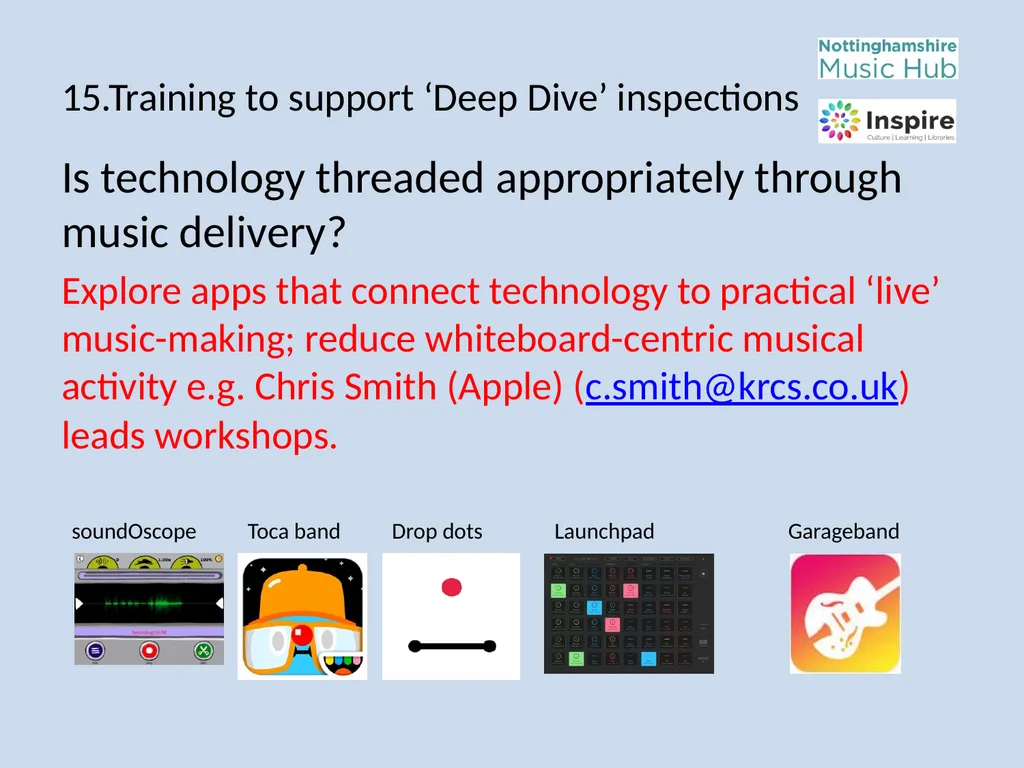
slide21. 15.Training to support ‘Deep Dive’ inspections Is technology threaded appropriately through music delivery?
Explore apps that connect technology to practical ‘live’ music-making; reduce whiteboard-centric musical activity e.g. Chris Smith (Apple) (c.smith@krcs.co.uk) leads workshops.
soundOscope Toca band Drop dots Launchpad Garageband<br>
slide22. 16.Training to support ‘Deep Dive’ inspections Are pupils engaged in regular and creative music-making – do they identify as ‘musicians’ and ‘composers’?
Generalist teachers are often uncomfortable with the composing/improvising component of NC music.
Pupils should be given regular opportunities to create their own music, beginning with exploration at EYFS and developing towards greater competence through experimentation and knowledge of the interrelated dimensions. Compositions should incorporate voices, percussion, WCIT instruments and technology.
Music Express/Charanga offer ample scope for creative outcomes but opportunities for pupils music-making should not be bypassed!
A document showing progression of the NC composing strand is found on the website.<br>
slide23. 17.Training to support ‘Deep Dive’ inspections Which classes have WCIT?
How is progress monitored? Is there dialogue between tutor and attending adult/subject leader?
A useful dialogue document is available on the website for Y3,4,5 and 6, offering an overview of achievement after each unit.<br>
slide24. 18.Training to support ‘Deep Dive’ inspections How is WCIT incorporated into the life of the school? e.g. assembly performances, showcase opportunities. Is there ‘continuation’ after participation?
Maximise exposure of pupils’ instrumental playing… more than just the end of term ‘showcase’. Take video clips, photographs and keep a record of in-school performances.
Encourage pupils who show aptitude or whose well-being needs are being addressed by additional tuition, to continue.<br>
slide25. 19.Training to support ‘Deep Dive’ inspections 1: Is there any additional instrumental tuition for individual pupils/small groups? Funded by parents, covered by the school/ PP? How are players integrated into the musical life of the school?
2: Be aware of and keep a record of pupils who learn instruments privately outside school or who sing in community/faith choirs/groups?
Use the dialogue documents (slide 17) to record achievements of those in additional tuition groups and make efforts to include these players, AND those who acquire musical skills independently outside school, in in-school performances.<br>
slide26. 20.Training to support ‘Deep Dive’ inspections Which music activities go beyond National Curriculum requirements i.e. enrichment?
Are these organised by the Hub or ‘private enterprise’ e.g.
• Projects with Arts organisations
• Live music events provided by the Hub
• Combined school festivals or cluster events
• In-house performances/shows to parents
• Hub/Music Service recital team visits
Emphasis on genuine legacy, not ‘one-off’ tokenistic experiences.<br>
slide27. 21.Training to support ‘Deep Dive’ inspections How do you instil a love of music and acquaintance with a broad range of music?
Carefully selected listening music e.g. music played in assemblies, with appropriate background information to provide context, via a PowerPoint slide bearing an image, featured instruments, any relevant ‘elements’….
(NC: listen to music from historical periods, genres, styles and traditions, including the works of the great composers and musicians; an understanding of the history of music)
BBC Ten Pieces
ABRSM Classical 100<br>
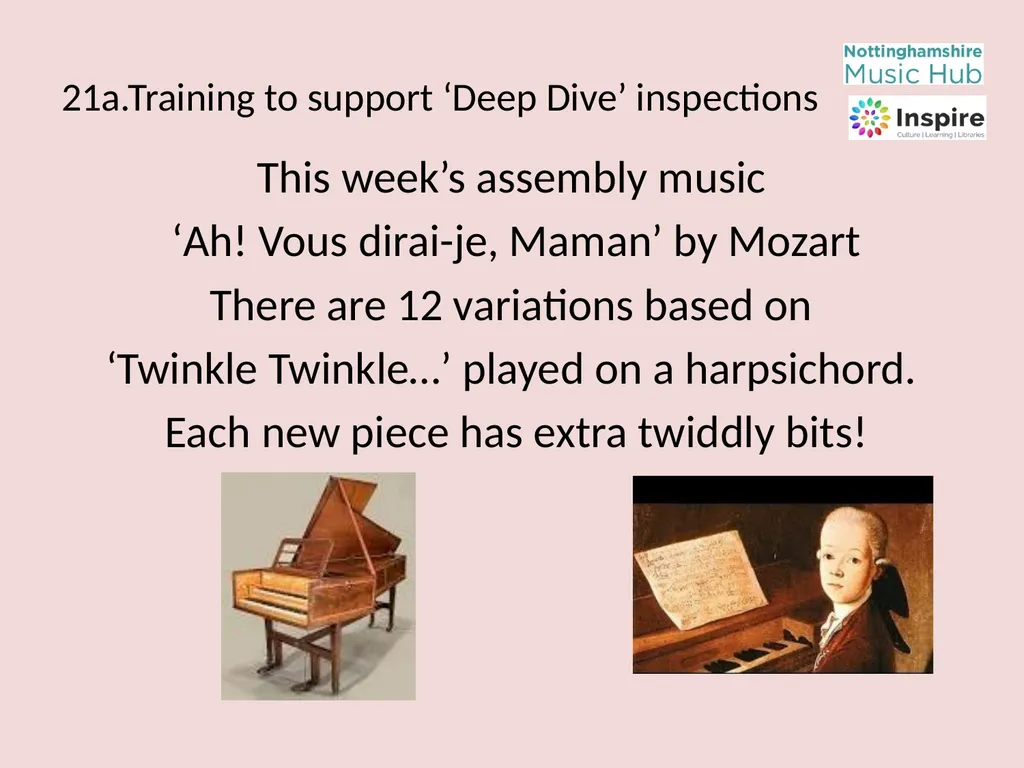
slide28. 21a.Training to support ‘Deep Dive’ inspections This week’s assembly music
‘Ah! Vous dirai-je, Maman’ by Mozart
There are 12 variations based on
‘Twinkle Twinkle…’ played on a harpsichord.
Each new piece has extra twiddly bits!<br>
slide29. 22.Training to support ‘Deep Dive’ inspections What are the lunchtime or out-of-hours music activities offered at your school? Are they truly inclusive? i.e. do members come from ‘identified groups’ e.g. SEND, Pupil Premium, FSM, EAL …boys etc.
Maintain and check registers of attending pupils and be proactive and creative in organising clubs and activities that appeal to ‘hard-to-reach’ pupils.
Some may be unable to attend after school so lunchtime may be a better option.<br>
slide30. 23.Training to support ‘Deep Dive’ inspections Which Hub events are regularly attended?
How are links with Hub maintained?
Be informed of events and maintain links using the Hub social media platforms e.g. Facebook / Twitter<br>
slide31. 24.Training to support ‘Deep Dive’ inspections Do performances form a regular part of school life?
Performances are crucial because they ….
Make a statement that music is ‘important’ in school life
Create an ambassadorial function; make schools more ‘visible’
Forge valuable links with community and parents
Increase pupils’ self confidence, self-assurance and well-being
Provides important social contact
Adds to your school’s ‘cultural capital’<br>
slide32. 25.Training to support ‘Deep Dive’ inspections How does music feature in cross-curricular or topic-based planning? Is it age-appropriate, does it maintains progression of skills, knowledge and understanding?
The danger of incorporating random cross-curricular material occurs when content is inappropriately matched to pupils’ musical experience:
‘Minimum Expected Standards’ document can provide a ‘check-list’ of age-appropriate content
Music Express scheme is topic-based<br>
slide33. 26.Training to support ‘Deep Dive’ inspections How do key skills and knowledge contribute to the acquisition of ‘cultural capital’ (preparing pupils to take advantage of opportunities in future life) particularly for pupils from disadvantaged backgrounds?
‘Cultural capital’ will be assured if, alongside other strong arts provision, your school offers rich, varied, high quality creative musical experiences for pupils.
Consider also ‘ArtsMark’ and ‘Arts Award’<br>
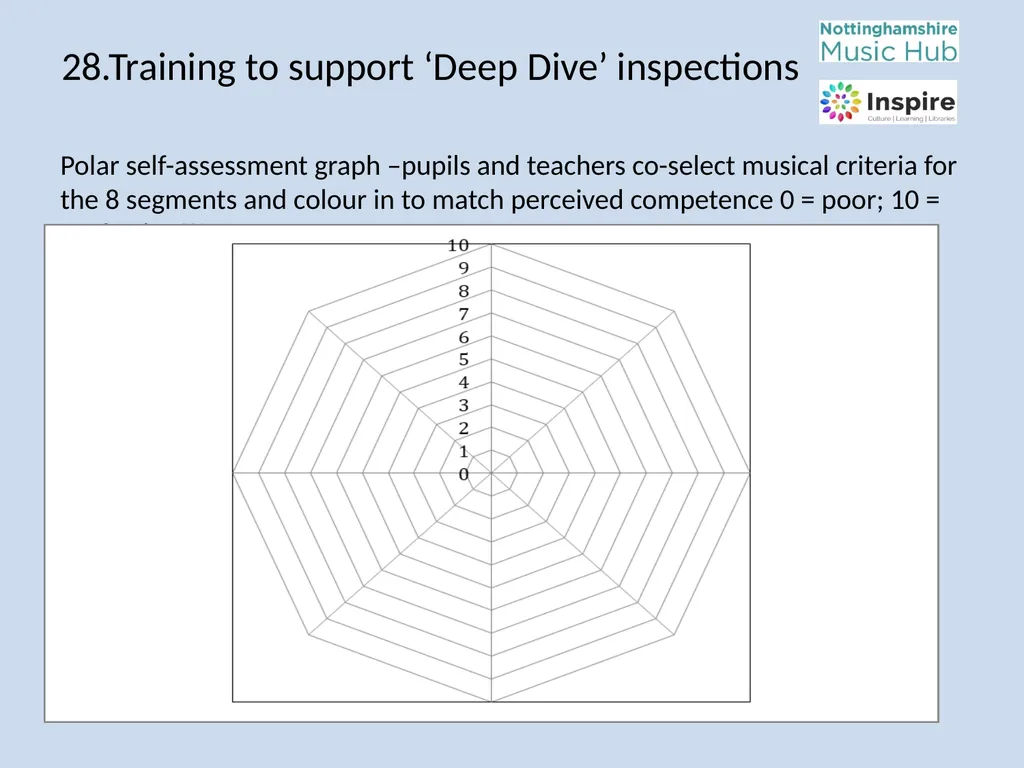
slide34. 27.Training to support ‘Deep Dive’ inspections How is pupil progress measured, monitored and recorded in practical and manageable ways? Do older pupils self-assess showing independent development of musical skills and competences? e.g. polar graphs?
‘Formal music assessment in primary music should be as hands off and as light touch as possible.’ Keith Swanwick
Commercial schemes offer assessment formats
The website has a flexible three-tier assessment framework document based with space to record teachers’ brief personalised comments.
Class folders on school servers for uploading footage of music-making –e.g. at the beginning and end of each unit
Include any tangible evidence e.g. graphic scores, screen-grabs<br>
slide35. 28.Training to support ‘Deep Dive’ inspections Polar self-assessment graph –pupils and teachers co-select musical criteria for the 8 segments and colour in to match perceived competence 0 = poor; 10 = perfection!!!<br>
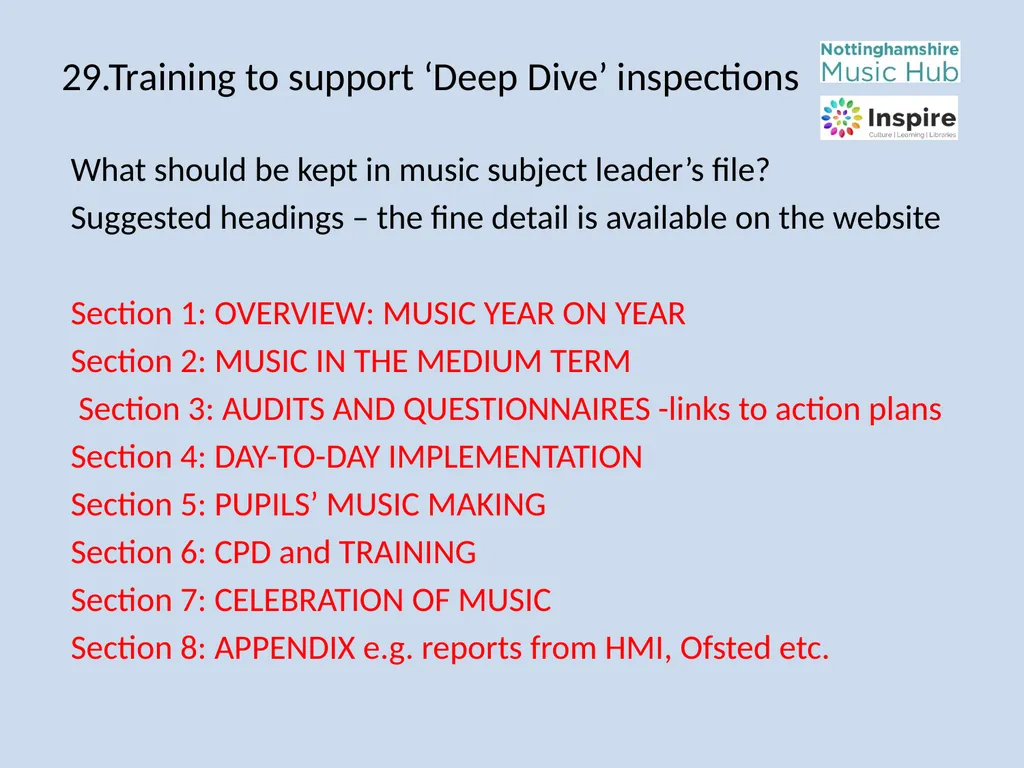
slide36. 29.Training to support ‘Deep Dive’ inspections What should be kept in music subject leader’s file?
Suggested headings – the fine detail is available on the website
Section 1: OVERVIEW: MUSIC YEAR ON YEAR
Section 2: MUSIC IN THE MEDIUM TERM
Section 3: AUDITS AND QUESTIONNAIRES -links to action plans
Section 4: DAY-TO-DAY IMPLEMENTATION
Section 5: PUPILS’ MUSIC MAKING
Section 6: CPD and TRAINING
Section 7: CELEBRATION OF MUSIC
Section 8: APPENDIX e.g. reports from HMI, Ofsted etc.<br>
slide37. 30.Training to support ‘Deep Dive’ inspections Final thoughts … and support routes offered by the Hub
www.inspireculture.org.uk/nottinghamshire-music-hub/
Social Media: Facebook; Twitter; Instagram
Inspire Music Awards
Arts Award templates and support
Progression Pathways from EYFS-KS5
Launch of new membership packages from Sept 2020
School consultation visits
CPD training in house
Singing strategy and Singing Hub School network with free resources (physical and online)
Subsidised Charanga subscription and Charanga training
Free Music Mark schools membership (including free resource bank)<br>
for Nottinghamshire schools
re Ofsted ‘DEEP DIVE’ music inspections<br>
slide2. MUSIC SUBJECT LEADER’S ANTHEM (Tune: John Brown’s Body/Little Peter Rabbit)
I’m a subject leader and I haven’t got a clue!
Music is the subject and there’s such a lot to do
My predecessor left because the job was such a strain
She’s in therapy again!
Chorus:
Why am I the subject leader?
Why am I the subject leader?
Why am I the subject leader?
I can’t read music or keep in time!<br>
slide3. Started a recorder group: we’re playing A and B,
Haven’t chosen songs for choir, we’re practising at three!
Must find a show with parts for every child in Key Stage 2
And Ofsted’s overdue!
Chorus:
Why am I the subject leader?
Why am I the subject leader?
Why am I the subject leader?
I can’t spell Bartok or conduct the band!<br>
slide4. I’m a subject leader and it’s driving me insane!
Someone’s pinched the hymn book
And that parent’s here again!
The scheme of work is useless
And the peri’s always late
And Ofsted’s here at eight!
Chorus:
Why am I the subject leader?
Why am I the subject leader?
Why am I the subject leader?
I can’t sing for toffee and I’m always flat!<br>
slide5. Abandoned the recorder group: we couldn’t manage E
Locked the hall piano and I cannot find the key.
I must produce an action plan - assessments for Class 4
And Ofsted’s at the door!
Chorus:
Why am I the subject leader?
Why am I the subject leader?
Why am I the subject leader?
It’s not the job for me!<br>
slide6. Evidence so far ….. Evidence from primary DD inspections
What were inspectors asking/looking for?
Examples available on the Nottinghamshire Music Education Hub website<br>
slide7. 1.Training to support ‘Deep Dive’ inspections NATIONAL CURRICULUM PROGRAMME OF STUDY
Aims: to ensure that all pupils:
perform, listen to, review and evaluate music across a range of historical periods, genres, styles and traditions, including the works of the great composers and musicians.
learn to sing and to use their voices
to create and compose music on their own and with others
have the opportunity to learn a musical instrument
use technology appropriately
have the opportunity to progress to the next level of musical excellence.
understand and explore how music is created, produced and communicated, including through the inter-related dimensions: pitch, duration, dynamics, tempo, timbre, texture and appropriate musical notations.<br>
slide8. 2.Training to support ‘Deep Dive’ inspections NATIONAL CURRICULUM PROGRAMME OF STUDY
Key stage 1: Pupils should be taught to:
use voices expressively and creatively by singing songs & speaking chants & rhymes
play tuned and untuned instruments musically
listen with concentration & understanding to a range of high-quality live & recorded music
experiment with, create, select and combine sounds using the inter-related dimensions of music.
Key stage 2 : Pupils should be taught to sing and play musically with increasing confidence and control. They should develop an understanding of musical composition, organising and manipulating ideas within musical structures and reproducing sounds from aural memory.
Pupils should be taught to:
play and perform in solo and ensemble contexts, using their voices and playing musical instruments with increasing accuracy, fluency, control and expression
improvise and compose music for a range of purposes using the inter-related dimensions of music
listen with attention to detail and recall sounds with increasing aural memory
use and understand staff and other musical notations
appreciate and understand a wide range of high-quality live and recorded music drawn from different traditions and from great composers and musicians
develop an understanding of the history of music<br>
slide9. 3.Training to support ‘Deep Dive’ inspections What is the recommended length and frequency of music lessons in primary schools?
Most educators share the opinion that lessons should be taught weekly for:
KS1: 30 minutes
KS2: 45- 60 minutes
‘Carousel’ arrangements are not ideal for music<br>
slide10. 4.Training to support ‘Deep Dive’ inspections Is the school’s music scheme fit for purpose?
Charanga/ Music Express cover all NC requirements
Music Express: Collins have developed new ‘skills’ documents – available at https://collins.co.uk/pages/primary-music-music-express-skills-progression-and-curriculum-mapping
Curriculum maps for each year group (1-6)
Summary of skills for each year group (1-6)
Table of skills progression across the year groups
2-year rolling programme for mixed-age classes
FREE scheme ‘MUSIC MADE SIMPLE’ available on the website
*** Check that the music content offered in other curriculum frameworks fully covers NC requirements<br>
slide11. 5.Training to support ‘Deep Dive’ inspections Are teachers, TAs or other musicians teaching in schools, adequately skilled and confident to deliver music lessons?
Training offers:
CPD courses and annual music conference
Charanga training is available
Music Express training is available from Collins (naomi.cook@harpercollins.co.uk)
CME (Certificate for Music Educators: Trinity or ABRSM) is a recognised national qualification available at centres nationwide e.g. MEHEM and a ‘Fast-Track’ Primary CME programme at the University of Northampton<br>
slide12. 6.Training to support ‘Deep Dive’ inspections Is long, medium and short term planning in place?
Charanga and Music Express both provide detailed planning at each level
*** Check other curriculum frameworks for adequate music planning<br>
slide13. 7.Training to support ‘Deep Dive’ inspections Is there a year-on-year Action Plan with clear success criteria?
Music Action Plan formats will vary from school to school but they should set out achievable aims that reflect practitioners’ and pupils’ needs and support the development of music across the school.
(Action Plan example available on the website)<br>
slide14. 8.Training to support ‘Deep Dive’ inspections Does the school follow a clear progression route for music, citing skills, knowledge and experience that all pupils will acquire on their musical ‘journey’?
Nottinghamshire Progression Pathways (on the website) offers a progression map for EYFS – KS5
Charanga & Music Express provide progressive and age-appropriate musical content in all units of work.
*** Check that other curriculum frameworks provide musical progression<br>
slide15. 9.Training to support ‘Deep Dive’ inspections Is EYFS music delivered through best holistic practice?
Does EYFS outdoor provision offer an enabling environment appropriate to young learners’ musical exploration?
Music in EYFS settings should be happening every day in informal, child-initiated as well as teacher-led approaches.
Useful document ‘EYFS Musical Development Matters’
https://www.early-education.org.uk/musical-development-matters-download<br>
slide16. 10.Training to support ‘Deep Dive’ inspections How is the quality of music provision monitored?
Planning to be submitted to subject leader plus short iPad video clips uploaded to class folders on the school server.
Ideally ‘drop-in’ lesson observations for curriculum and WCIT whole class instrumental teaching, led by subject leader perhaps joined by SLT. Consider inviting the school governor responsible for music to attend?
Ofsted document: ‘Music in Schools, promoting good practice’ aimed Heads, Governors re observing lessons<br>
slide17. 11.Training to support ‘Deep Dive’ inspections How are SEND, EAL etc. pupils’ needs accommodated in music lessons?
Printed lesson plans annotated to show how pupils with specific needs are accommodated. If not possible for every lesson, then for each unit (an example is found on the website)<br>
slide18. 12.Training to support ‘Deep Dive’ inspections How is delivery differentiated in mixed age classes?
Charanga provides Gold, Silver, Bronze differentiated tasks
Music Express:
same unit titles for adjacent year groups
‘skills analysis’ documents
2-year rolling programme for mixed age groups
https://collins.co.uk/pages/primary-music-music-express-skills-progression-and-curriculum-mapping<br>
slide19. 13.Training to support ‘Deep Dive’ inspections Is percussion provision adequate and stored appropriately? Is technology readily accessible e.g. iPads
Percussion trolleys are often placed in awkward spaces/cupboards with instruments crammed on inaccessible shelves.
Better to divide up percussion between Y1/2, 3/4, 5/6 and keep in large plastic boxes in classrooms with a ‘chart’ of instrument contents with photos & names.
Check that sufficient tuned percussion is available. Six sets of chime bars sold in plastic cases are cheaper than one wooden xylophone (£179)<br>
slide20. 14.Training to support ‘Deep Dive’ inspections Do classes sing every day/week?
Are there opportunities for each KS to sing together?
Is repertoire appropriate – does it demonstrate progression?
Encourage staff to sing with pupils every day: singing underpins well-being, releases endorphins & promotes listening& social interaction.
Impossible to cover appropriate repertoire/progression for Reception-Y6 in whole school singing assemblies; consider separate Key Stage singing led fortnightly.
‘Sing Up’ - over 750 songs; a menu for different age groups, topics, musical styles etc; recordings, backing/echo tracks, teaching notes and song-based units of work.
Music Express and Charanga also have Song Banks
A vocal progression document from ‘Minimum Expected Standards’ is available on the website
A staff choir is a wonderful endorsement of the value of singing!!!<br>
slide21. 15.Training to support ‘Deep Dive’ inspections Is technology threaded appropriately through music delivery?
Explore apps that connect technology to practical ‘live’ music-making; reduce whiteboard-centric musical activity e.g. Chris Smith (Apple) (c.smith@krcs.co.uk) leads workshops.
soundOscope Toca band Drop dots Launchpad Garageband<br>
slide22. 16.Training to support ‘Deep Dive’ inspections Are pupils engaged in regular and creative music-making – do they identify as ‘musicians’ and ‘composers’?
Generalist teachers are often uncomfortable with the composing/improvising component of NC music.
Pupils should be given regular opportunities to create their own music, beginning with exploration at EYFS and developing towards greater competence through experimentation and knowledge of the interrelated dimensions. Compositions should incorporate voices, percussion, WCIT instruments and technology.
Music Express/Charanga offer ample scope for creative outcomes but opportunities for pupils music-making should not be bypassed!
A document showing progression of the NC composing strand is found on the website.<br>
slide23. 17.Training to support ‘Deep Dive’ inspections Which classes have WCIT?
How is progress monitored? Is there dialogue between tutor and attending adult/subject leader?
A useful dialogue document is available on the website for Y3,4,5 and 6, offering an overview of achievement after each unit.<br>
slide24. 18.Training to support ‘Deep Dive’ inspections How is WCIT incorporated into the life of the school? e.g. assembly performances, showcase opportunities. Is there ‘continuation’ after participation?
Maximise exposure of pupils’ instrumental playing… more than just the end of term ‘showcase’. Take video clips, photographs and keep a record of in-school performances.
Encourage pupils who show aptitude or whose well-being needs are being addressed by additional tuition, to continue.<br>
slide25. 19.Training to support ‘Deep Dive’ inspections 1: Is there any additional instrumental tuition for individual pupils/small groups? Funded by parents, covered by the school/ PP? How are players integrated into the musical life of the school?
2: Be aware of and keep a record of pupils who learn instruments privately outside school or who sing in community/faith choirs/groups?
Use the dialogue documents (slide 17) to record achievements of those in additional tuition groups and make efforts to include these players, AND those who acquire musical skills independently outside school, in in-school performances.<br>
slide26. 20.Training to support ‘Deep Dive’ inspections Which music activities go beyond National Curriculum requirements i.e. enrichment?
Are these organised by the Hub or ‘private enterprise’ e.g.
• Projects with Arts organisations
• Live music events provided by the Hub
• Combined school festivals or cluster events
• In-house performances/shows to parents
• Hub/Music Service recital team visits
Emphasis on genuine legacy, not ‘one-off’ tokenistic experiences.<br>
slide27. 21.Training to support ‘Deep Dive’ inspections How do you instil a love of music and acquaintance with a broad range of music?
Carefully selected listening music e.g. music played in assemblies, with appropriate background information to provide context, via a PowerPoint slide bearing an image, featured instruments, any relevant ‘elements’….
(NC: listen to music from historical periods, genres, styles and traditions, including the works of the great composers and musicians; an understanding of the history of music)
BBC Ten Pieces
ABRSM Classical 100<br>
slide28. 21a.Training to support ‘Deep Dive’ inspections This week’s assembly music
‘Ah! Vous dirai-je, Maman’ by Mozart
There are 12 variations based on
‘Twinkle Twinkle…’ played on a harpsichord.
Each new piece has extra twiddly bits!<br>
slide29. 22.Training to support ‘Deep Dive’ inspections What are the lunchtime or out-of-hours music activities offered at your school? Are they truly inclusive? i.e. do members come from ‘identified groups’ e.g. SEND, Pupil Premium, FSM, EAL …boys etc.
Maintain and check registers of attending pupils and be proactive and creative in organising clubs and activities that appeal to ‘hard-to-reach’ pupils.
Some may be unable to attend after school so lunchtime may be a better option.<br>
slide30. 23.Training to support ‘Deep Dive’ inspections Which Hub events are regularly attended?
How are links with Hub maintained?
Be informed of events and maintain links using the Hub social media platforms e.g. Facebook / Twitter<br>
slide31. 24.Training to support ‘Deep Dive’ inspections Do performances form a regular part of school life?
Performances are crucial because they ….
Make a statement that music is ‘important’ in school life
Create an ambassadorial function; make schools more ‘visible’
Forge valuable links with community and parents
Increase pupils’ self confidence, self-assurance and well-being
Provides important social contact
Adds to your school’s ‘cultural capital’<br>
slide32. 25.Training to support ‘Deep Dive’ inspections How does music feature in cross-curricular or topic-based planning? Is it age-appropriate, does it maintains progression of skills, knowledge and understanding?
The danger of incorporating random cross-curricular material occurs when content is inappropriately matched to pupils’ musical experience:
‘Minimum Expected Standards’ document can provide a ‘check-list’ of age-appropriate content
Music Express scheme is topic-based<br>
slide33. 26.Training to support ‘Deep Dive’ inspections How do key skills and knowledge contribute to the acquisition of ‘cultural capital’ (preparing pupils to take advantage of opportunities in future life) particularly for pupils from disadvantaged backgrounds?
‘Cultural capital’ will be assured if, alongside other strong arts provision, your school offers rich, varied, high quality creative musical experiences for pupils.
Consider also ‘ArtsMark’ and ‘Arts Award’<br>
slide34. 27.Training to support ‘Deep Dive’ inspections How is pupil progress measured, monitored and recorded in practical and manageable ways? Do older pupils self-assess showing independent development of musical skills and competences? e.g. polar graphs?
‘Formal music assessment in primary music should be as hands off and as light touch as possible.’ Keith Swanwick
Commercial schemes offer assessment formats
The website has a flexible three-tier assessment framework document based with space to record teachers’ brief personalised comments.
Class folders on school servers for uploading footage of music-making –e.g. at the beginning and end of each unit
Include any tangible evidence e.g. graphic scores, screen-grabs<br>
slide35. 28.Training to support ‘Deep Dive’ inspections Polar self-assessment graph –pupils and teachers co-select musical criteria for the 8 segments and colour in to match perceived competence 0 = poor; 10 = perfection!!!<br>
slide36. 29.Training to support ‘Deep Dive’ inspections What should be kept in music subject leader’s file?
Suggested headings – the fine detail is available on the website
Section 1: OVERVIEW: MUSIC YEAR ON YEAR
Section 2: MUSIC IN THE MEDIUM TERM
Section 3: AUDITS AND QUESTIONNAIRES -links to action plans
Section 4: DAY-TO-DAY IMPLEMENTATION
Section 5: PUPILS’ MUSIC MAKING
Section 6: CPD and TRAINING
Section 7: CELEBRATION OF MUSIC
Section 8: APPENDIX e.g. reports from HMI, Ofsted etc.<br>
slide37. 30.Training to support ‘Deep Dive’ inspections Final thoughts … and support routes offered by the Hub
www.inspireculture.org.uk/nottinghamshire-music-hub/
Social Media: Facebook; Twitter; Instagram
Inspire Music Awards
Arts Award templates and support
Progression Pathways from EYFS-KS5
Launch of new membership packages from Sept 2020
School consultation visits
CPD training in house
Singing strategy and Singing Hub School network with free resources (physical and online)
Subsidised Charanga subscription and Charanga training
Free Music Mark schools membership (including free resource bank)<br>