
DELETE THIS SLIDE PRIOR TO PRESENTATION This
SB
Published · 44 slides · 0 views
1 / 1

Description
DELETE THIS SLIDE PRIOR TO PRESENTATION This PowerPoint serves as a template presentation which introduces topics related to air quality and is part of a suite of presentations provided by the EPA for the Megacities program. See speaker
Related Topics
Share
Embed code
Download this presentation From Below
"DELETE THIS SLIDE PRIOR TO PRESENTATION This" is the property of its rightful owner. Permission is granted to download and print the materials on this website for personal, non-commercial use only, and to display it on your personal computer provided you do not modify the materials and that you retain all copyright notices contained in the materials. By downloading content from our website, you accept the terms of this agreement.
Presentation Transcript
01
DELETE THIS SLIDE PRIOR TO PRESENTATION This PowerPoint serves as a template presentation which introduces topics related to air quality and is part of a suite of presentations provided by the EPA for the Megacities program.
See speaker notes for an additional description of slide content. Slides should be edited or added to as necessary for your particular needs. Slides with highlighted yellow text require the addition of specific context and information for your city. 1<br>
See speaker notes for an additional description of slide content. Slides should be edited or added to as necessary for your particular needs. Slides with highlighted yellow text require the addition of specific context and information for your city. 1<br>
02
Air Quality Management Plan Development<br>
03
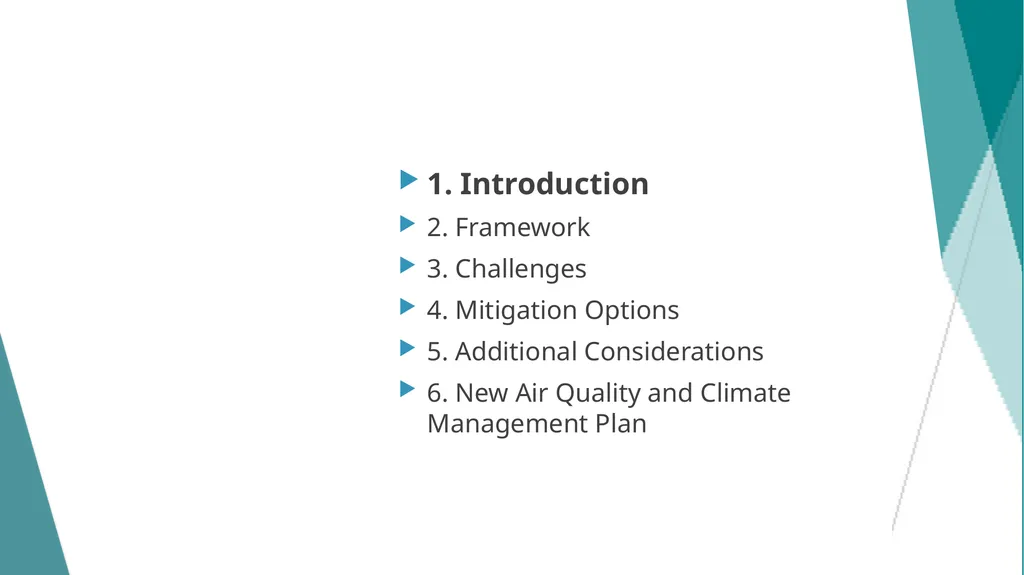
Overview 1. Introduction
2. Framework
3. Challenges
4. Mitigation Options
5. Additional Considerations
6. New Air Quality and Climate Management Plan 3<br>
2. Framework
3. Challenges
4. Mitigation Options
5. Additional Considerations
6. New Air Quality and Climate Management Plan 3<br>
04
Section 1: Introduction 1. Introduction
2. Framework
3. Challenges
4. Mitigation Options
5. Additional Considerations
6. New Air Quality and Climate Management Plan 4<br>
2. Framework
3. Challenges
4. Mitigation Options
5. Additional Considerations
6. New Air Quality and Climate Management Plan 4<br>
05
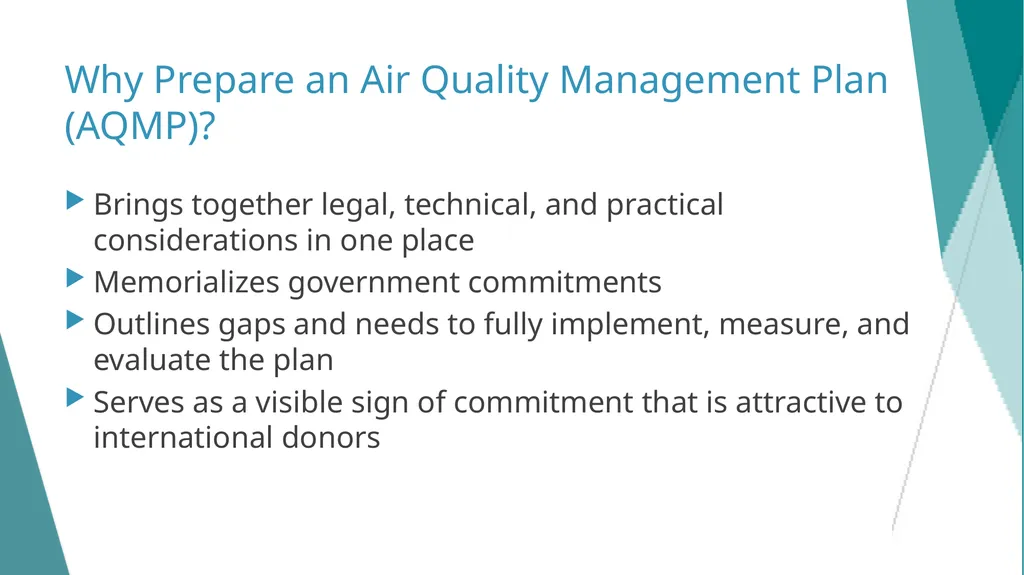
Why Prepare an Air Quality Management Plan (AQMP)? Brings together legal, technical, and practical considerations in one place
Memorializes government commitments
Outlines gaps and needs to fully implement, measure, and evaluate the plan
Serves as a visible sign of commitment that is attractive to international donors 5<br>
Memorializes government commitments
Outlines gaps and needs to fully implement, measure, and evaluate the plan
Serves as a visible sign of commitment that is attractive to international donors 5<br>
06
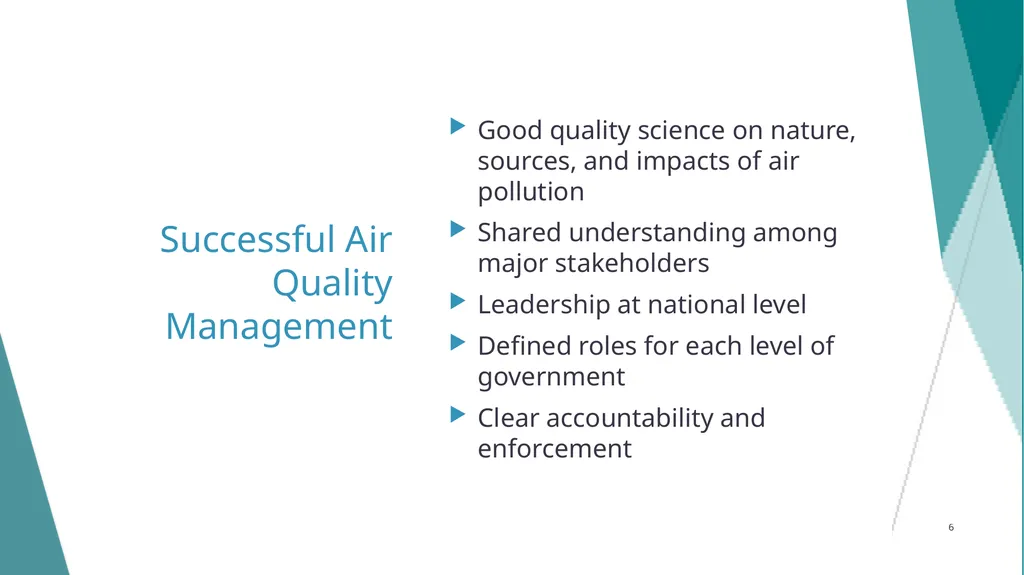
Successful Air Quality Management Good quality science on nature, sources, and impacts of air pollution
Shared understanding among major stakeholders
Leadership at national level
Defined roles for each level of government
Clear accountability and enforcement 6<br>
Shared understanding among major stakeholders
Leadership at national level
Defined roles for each level of government
Clear accountability and enforcement 6<br>
07
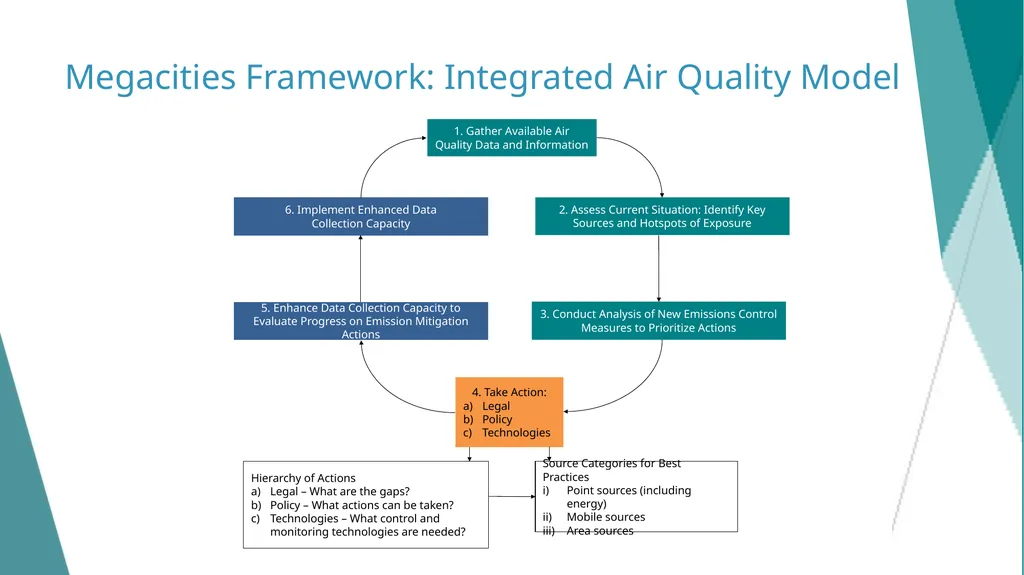
Megacities Framework: Integrated Air Quality Model<br>
08
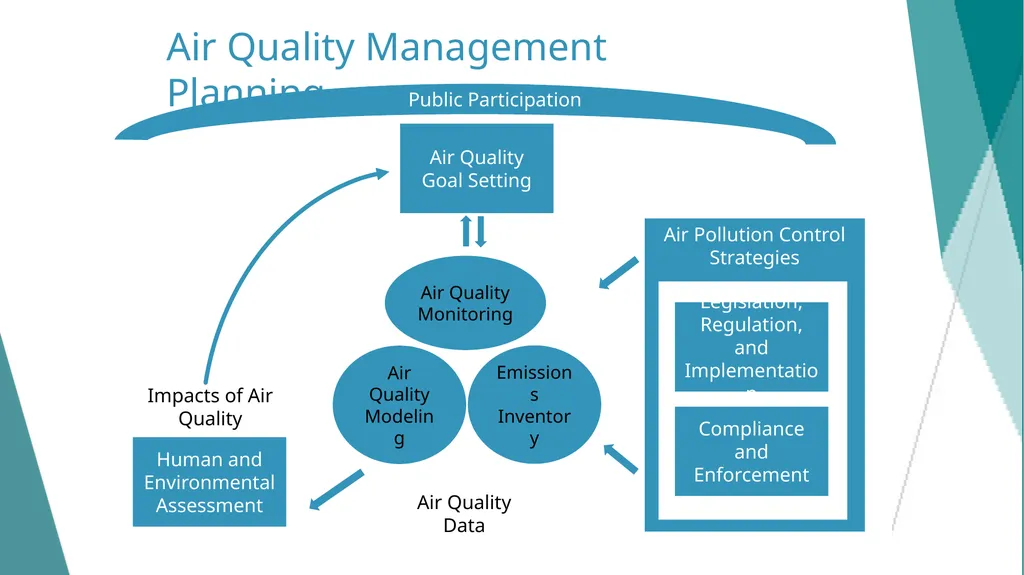
Air Quality Management Planning Air Quality Goal Setting Public Participation Air Quality Modeling<br>
09
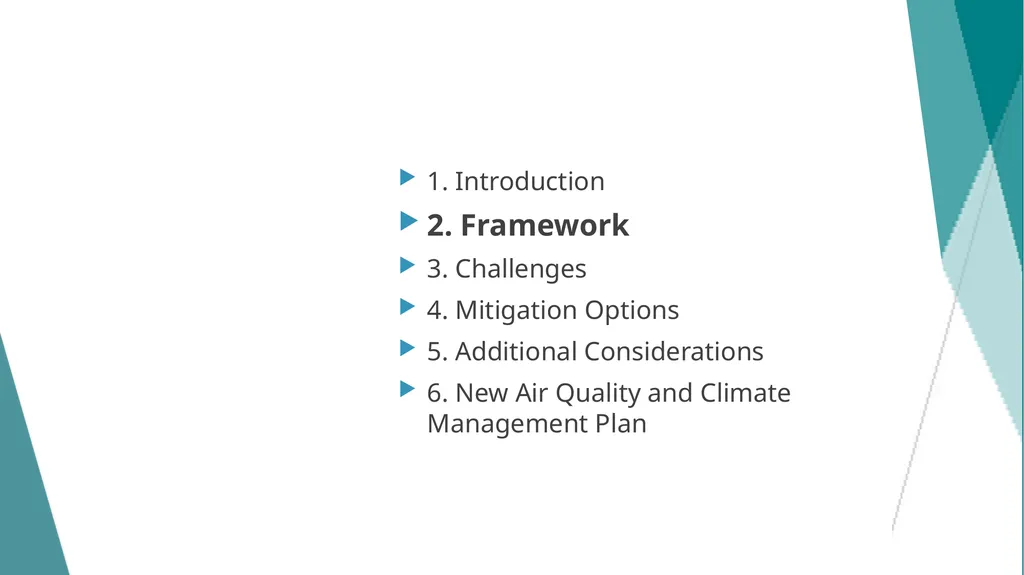
Section 2: Framework 1. Introduction
2. Framework
3. Challenges
4. Mitigation Options
5. Additional Considerations
6. New Air Quality and Climate Management Plan 9<br>
2. Framework
3. Challenges
4. Mitigation Options
5. Additional Considerations
6. New Air Quality and Climate Management Plan 9<br>
10
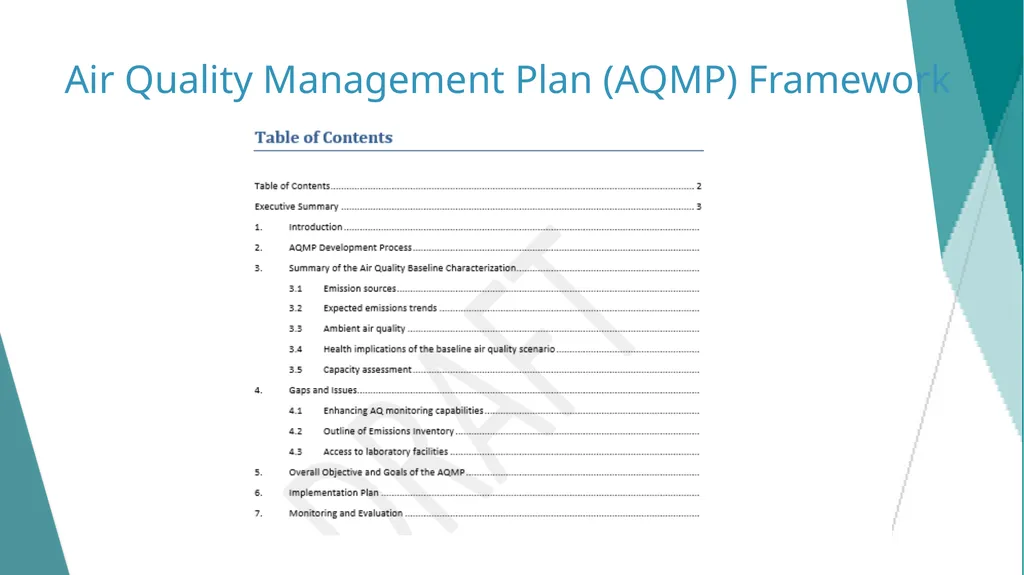
Air Quality Management Plan (AQMP) Framework 10<br>
11
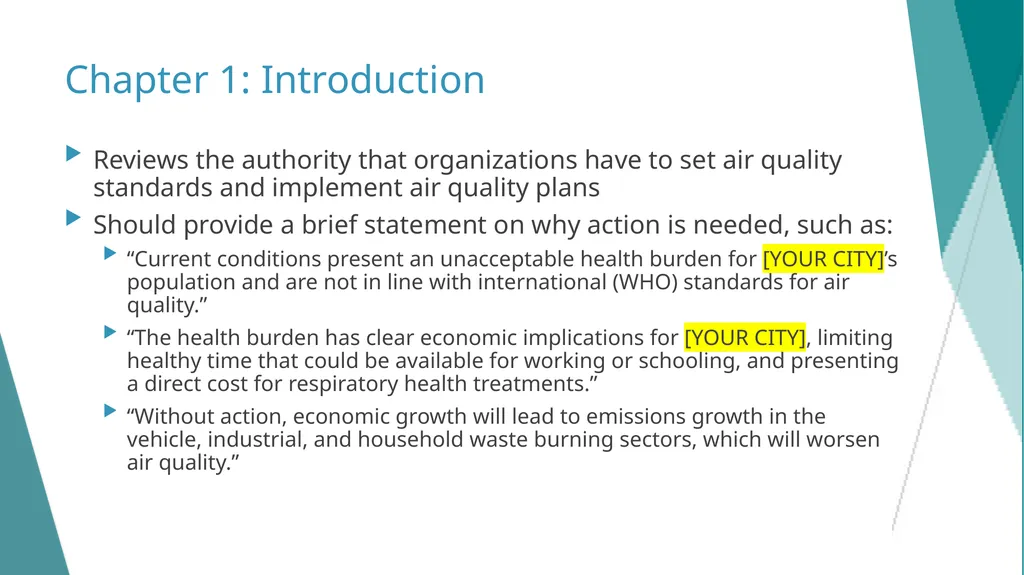
Chapter 1: Introduction Reviews the authority that organizations have to set air quality standards and implement air quality plans
Should provide a brief statement on why action is needed, such as:
“Current conditions present an unacceptable health burden for [YOUR CITY]’s population and are not in line with international (WHO) standards for air quality.”
“The health burden has clear economic implications for [YOUR CITY], limiting healthy time that could be available for working or schooling, and presenting a direct cost for respiratory health treatments.”
“Without action, economic growth will lead to emissions growth in the vehicle, industrial, and household waste burning sectors, which will worsen air quality.” 11<br>
Should provide a brief statement on why action is needed, such as:
“Current conditions present an unacceptable health burden for [YOUR CITY]’s population and are not in line with international (WHO) standards for air quality.”
“The health burden has clear economic implications for [YOUR CITY], limiting healthy time that could be available for working or schooling, and presenting a direct cost for respiratory health treatments.”
“Without action, economic growth will lead to emissions growth in the vehicle, industrial, and household waste burning sectors, which will worsen air quality.” 11<br>
12
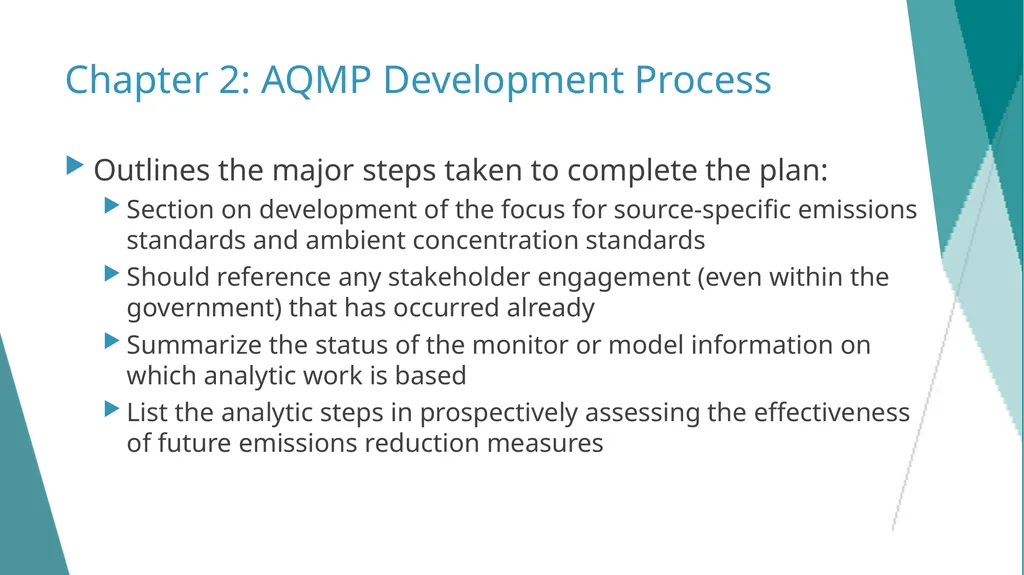
Chapter 2: AQMP Development Process Outlines the major steps taken to complete the plan:
Section on development of the focus for source-specific emissions standards and ambient concentration standards
Should reference any stakeholder engagement (even within the government) that has occurred already
Summarize the status of the monitor or model information on which analytic work is based
List the analytic steps in prospectively assessing the effectiveness of future emissions reduction measures 12<br>
Section on development of the focus for source-specific emissions standards and ambient concentration standards
Should reference any stakeholder engagement (even within the government) that has occurred already
Summarize the status of the monitor or model information on which analytic work is based
List the analytic steps in prospectively assessing the effectiveness of future emissions reduction measures 12<br>
13
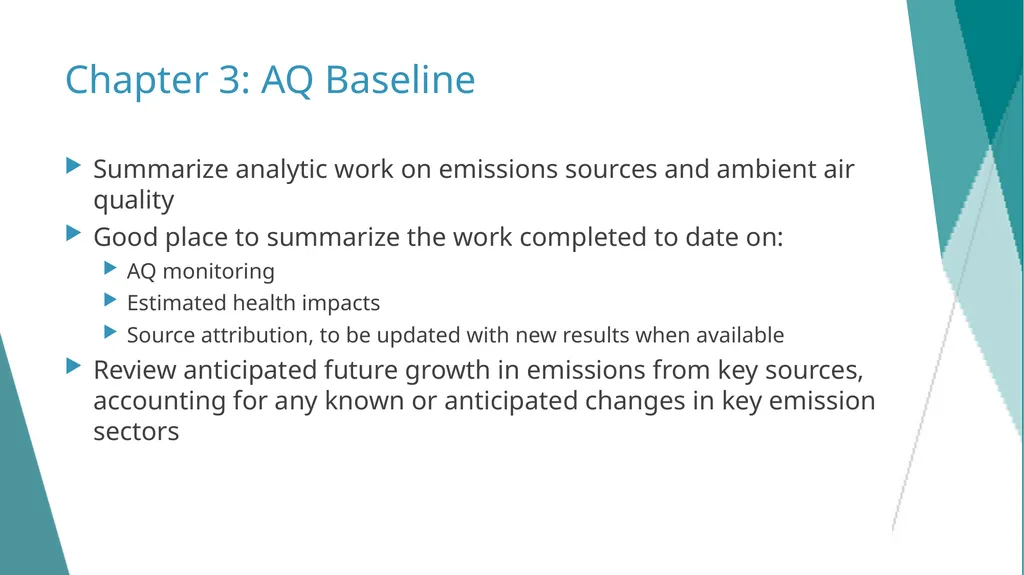
Chapter 3: AQ Baseline Summarize analytic work on emissions sources and ambient air quality
Good place to summarize the work completed to date on:
AQ monitoring
Estimated health impacts
Source attribution, to be updated with new results when available
Review anticipated future growth in emissions from key sources, accounting for any known or anticipated changes in key emission sectors 13<br>
Good place to summarize the work completed to date on:
AQ monitoring
Estimated health impacts
Source attribution, to be updated with new results when available
Review anticipated future growth in emissions from key sources, accounting for any known or anticipated changes in key emission sectors 13<br>
14
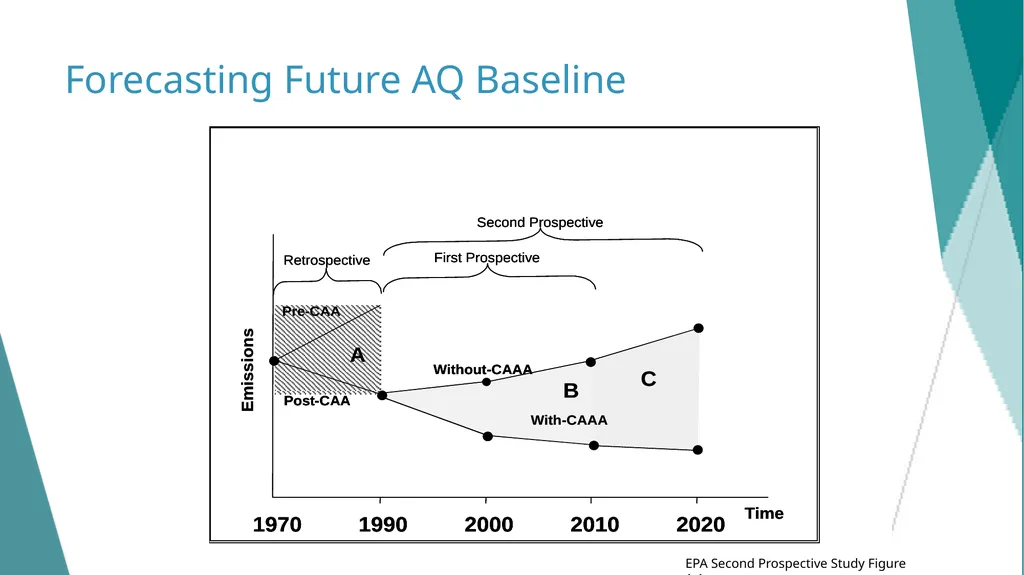
Forecasting Future AQ Baseline EPA Second Prospective Study Figure 1-1 14<br>
15
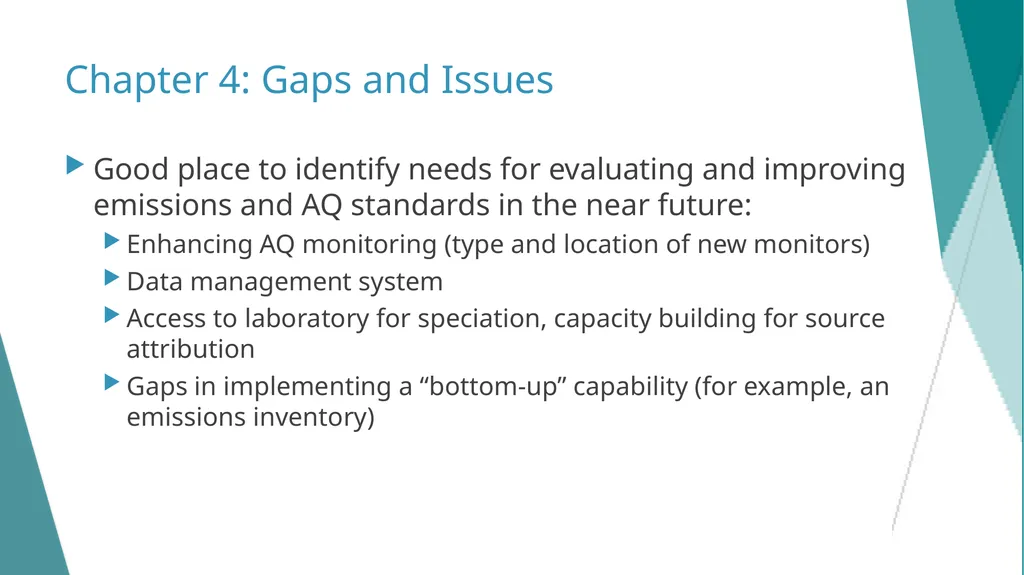
Chapter 4: Gaps and Issues Good place to identify needs for evaluating and improving emissions and AQ standards in the near future:
Enhancing AQ monitoring (type and location of new monitors)
Data management system
Access to laboratory for speciation, capacity building for source attribution
Gaps in implementing a “bottom-up” capability (for example, an emissions inventory) 15<br>
Enhancing AQ monitoring (type and location of new monitors)
Data management system
Access to laboratory for speciation, capacity building for source attribution
Gaps in implementing a “bottom-up” capability (for example, an emissions inventory) 15<br>
16
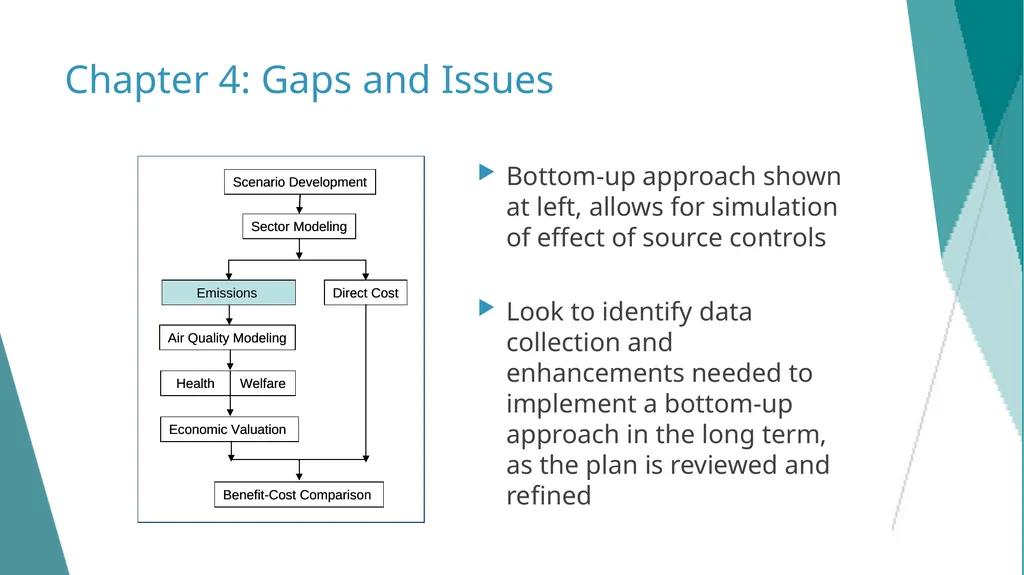
Chapter 4: Gaps and Issues Bottom-up approach shown at left, allows for simulation of effect of source controls
Look to identify data collection and enhancements needed to implement a bottom-up approach in the long term, as the plan is reviewed and refined 16<br>
Look to identify data collection and enhancements needed to implement a bottom-up approach in the long term, as the plan is reviewed and refined 16<br>
17
Chapter 5: Overall Objective of AQMP If not covered in first chapters, can state objective here
Needs to be agreed to by all partners/stakeholders
Example from Waterberg AQMP:
“Ambient air quality in the Waterberg Bojanala Priority Area is brought into full compliance with national ambient air quality standards by 2020 and the state is maintained as the region develops.” 17<br>
Needs to be agreed to by all partners/stakeholders
Example from Waterberg AQMP:
“Ambient air quality in the Waterberg Bojanala Priority Area is brought into full compliance with national ambient air quality standards by 2020 and the state is maintained as the region develops.” 17<br>
18
Chapter 6: Specific Goals of AQMP Very important to state goals as prerequisite for implementation plan/roles and responsibilities
Also needs to be agreed to by all partners/stakeholders
Examples from Waterberg AQMP:
“Cooperative governance in the WBPA promotes the implementation of the AQMP.”
“Air quality management in the WBPA is supported by effective systems and tools.”
“Ambient concentrations of air pollutants comply with the NAAQS in the WBPA as a result of emission reductions.”
Air quality decision making in the WBPA is informed by sound research.
Knowledge and the understanding of air quality amongst stakeholders in the WBPA is enhanced. 18<br>
Also needs to be agreed to by all partners/stakeholders
Examples from Waterberg AQMP:
“Cooperative governance in the WBPA promotes the implementation of the AQMP.”
“Air quality management in the WBPA is supported by effective systems and tools.”
“Ambient concentrations of air pollutants comply with the NAAQS in the WBPA as a result of emission reductions.”
Air quality decision making in the WBPA is informed by sound research.
Knowledge and the understanding of air quality amongst stakeholders in the WBPA is enhanced. 18<br>
19
Chapter 7: Implementation Plan Should reflect an investment in the process of standard setting, implementation, and enforcement across multiple institutions
At minimum, need representatives from:
Federal Ministries (Environment, Energy, Health, and Transport)
Mayor’s office and agencies
Also requires outreach to regulated entities
Advisory Committee provides a forum for gaining commitment of governmental stakeholders 19<br>
At minimum, need representatives from:
Federal Ministries (Environment, Energy, Health, and Transport)
Mayor’s office and agencies
Also requires outreach to regulated entities
Advisory Committee provides a forum for gaining commitment of governmental stakeholders 19<br>
20
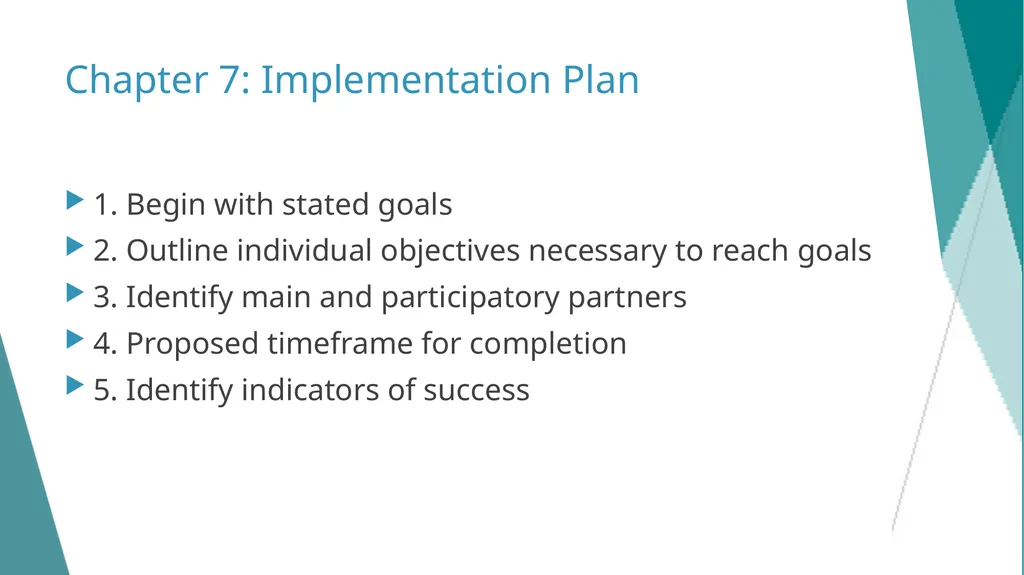
Chapter 7: Implementation Plan 1. Begin with stated goals
2. Outline individual objectives necessary to reach goals
3. Identify main and participatory partners
4. Proposed timeframe for completion
5. Identify indicators of success 20<br>
2. Outline individual objectives necessary to reach goals
3. Identify main and participatory partners
4. Proposed timeframe for completion
5. Identify indicators of success 20<br>
21
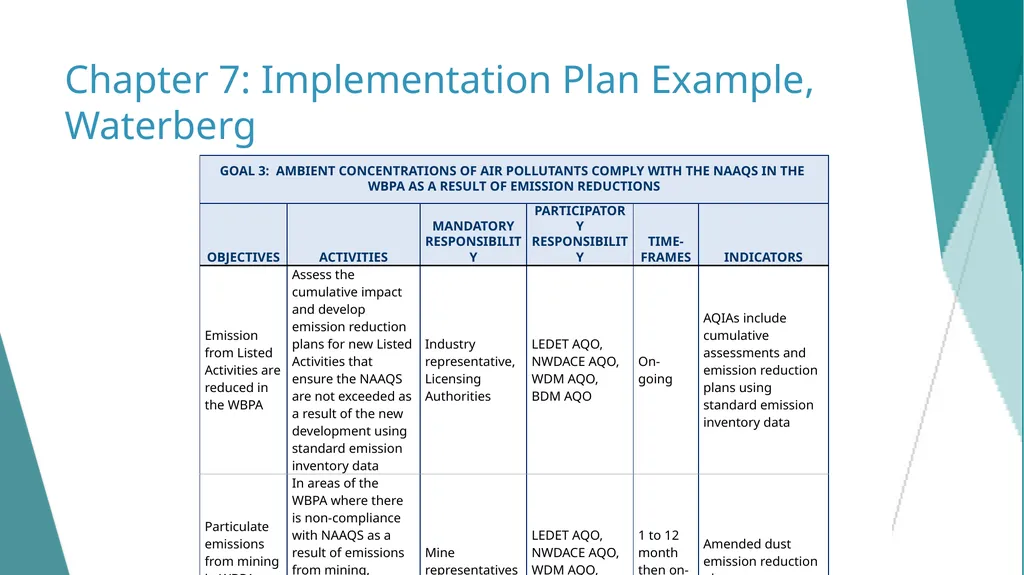
Chapter 7: Implementation Plan Example, Waterberg 21<br>
22
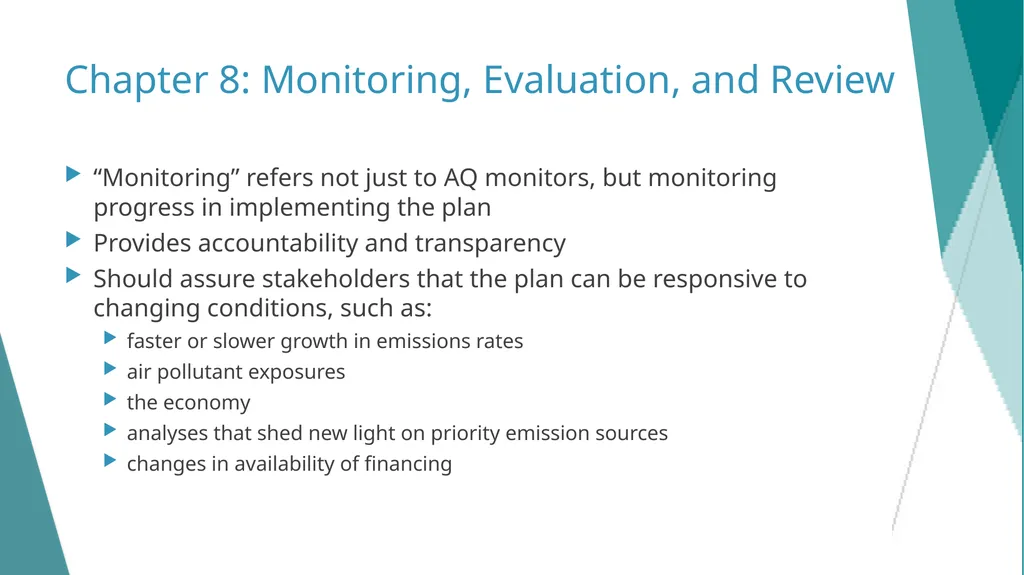
Chapter 8: Monitoring, Evaluation, and Review “Monitoring” refers not just to AQ monitors, but monitoring progress in implementing the plan
Provides accountability and transparency
Should assure stakeholders that the plan can be responsive to changing conditions, such as:
faster or slower growth in emissions rates
air pollutant exposures
the economy
analyses that shed new light on priority emission sources
changes in availability of financing 22<br>
Provides accountability and transparency
Should assure stakeholders that the plan can be responsive to changing conditions, such as:
faster or slower growth in emissions rates
air pollutant exposures
the economy
analyses that shed new light on priority emission sources
changes in availability of financing 22<br>
23
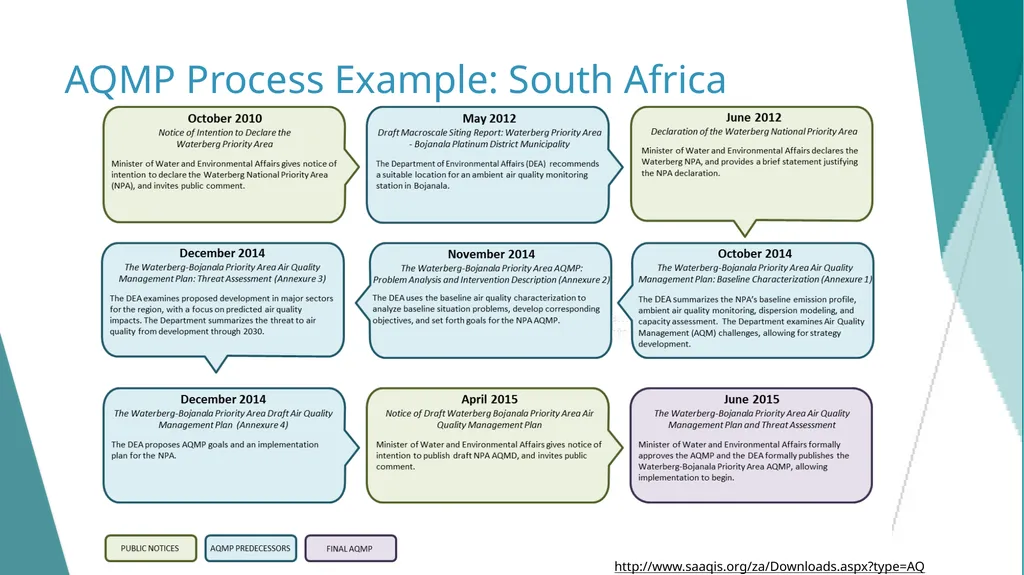
AQMP Process Example: South Africa http://www.saaqis.org/za/Downloads.aspx?type=AQ 23<br>
24
Section 3: Challenges 1. Introduction
2. Framework
3. Challenges
4. Mitigation Options
5. Additional Considerations
6. New Air Quality and Climate Management Plan 24<br>
2. Framework
3. Challenges
4. Mitigation Options
5. Additional Considerations
6. New Air Quality and Climate Management Plan 24<br>
25
Challenges in Building an AQMP Assessing the impact of both current air quality health burden, and changes to air pollutant concentrations and health under proposed air quality standards
Developing a process for identifying roles and responsibilities for all AQMP steps
Reaching agreement on the most urgent needs for capacity building, equipment, and technology 25<br>
Developing a process for identifying roles and responsibilities for all AQMP steps
Reaching agreement on the most urgent needs for capacity building, equipment, and technology 25<br>
26
Regulatory Challenges Standards may need to be updated:
Are ambient standards health-based?
Do they address the pollutants of concern?
Are they consistent with WHO guidelines?
Enforcement and compliance may be weak:
Is it clear which agencies are responsible for enforcement?
Do institutions have the right equipment to measure compliance?
Legal authority may be inadequate:
Are goals and objectives for clean air established in law?
Does the law provide a process to resolve conflicts between economic development and clean air?<br>
Are ambient standards health-based?
Do they address the pollutants of concern?
Are they consistent with WHO guidelines?
Enforcement and compliance may be weak:
Is it clear which agencies are responsible for enforcement?
Do institutions have the right equipment to measure compliance?
Legal authority may be inadequate:
Are goals and objectives for clean air established in law?
Does the law provide a process to resolve conflicts between economic development and clean air?<br>
27
Technical Challenges Understanding of health and economic implications of air pollution may be incomplete:
Do air pollution control institutions have capacity to assess health risks?
Can these institutions make a business case for clean air?
Required data may be unavailable:
Is there an emission inventory?
Is monitor data accessible?
Is there a data management plan and system?
Equipment may be lacking:
Can emissions levels for mobile and stationary sources be tested with modern equipment?
Is emissions control technology available?<br>
Do air pollution control institutions have capacity to assess health risks?
Can these institutions make a business case for clean air?
Required data may be unavailable:
Is there an emission inventory?
Is monitor data accessible?
Is there a data management plan and system?
Equipment may be lacking:
Can emissions levels for mobile and stationary sources be tested with modern equipment?
Is emissions control technology available?<br>
28
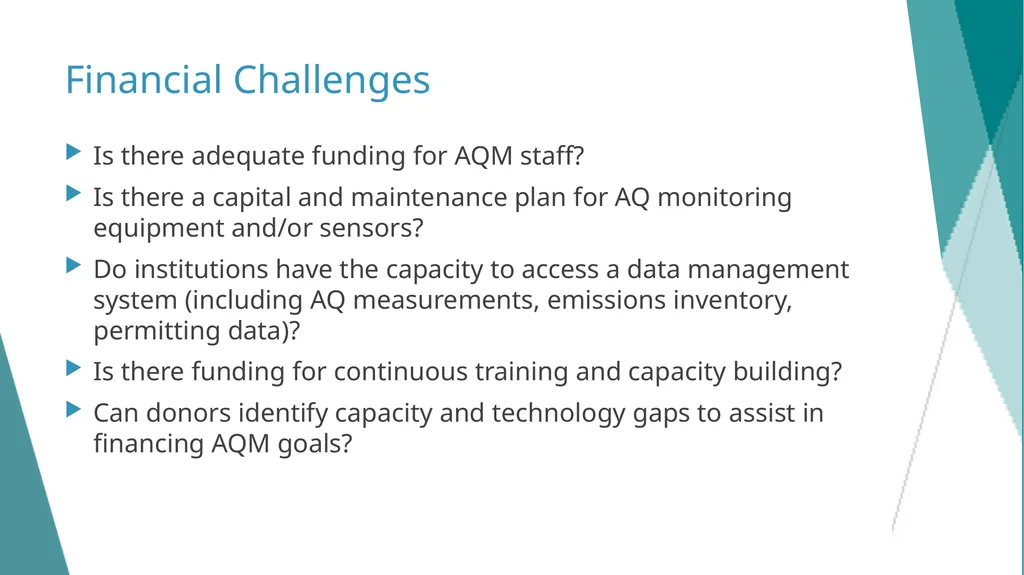
Financial Challenges Is there adequate funding for AQM staff?
Is there a capital and maintenance plan for AQ monitoring equipment and/or sensors?
Do institutions have the capacity to access a data management system (including AQ measurements, emissions inventory, permitting data)?
Is there funding for continuous training and capacity building?
Can donors identify capacity and technology gaps to assist in financing AQM goals?<br>
Is there a capital and maintenance plan for AQ monitoring equipment and/or sensors?
Do institutions have the capacity to access a data management system (including AQ measurements, emissions inventory, permitting data)?
Is there funding for continuous training and capacity building?
Can donors identify capacity and technology gaps to assist in financing AQM goals?<br>
29
Section 4: Mitigation Options 1. Introduction
2. Framework
3. Challenges
4. Mitigation Options
5. Additional Considerations
6. New Air Quality and Climate Management Plan 29<br>
2. Framework
3. Challenges
4. Mitigation Options
5. Additional Considerations
6. New Air Quality and Climate Management Plan 29<br>
30
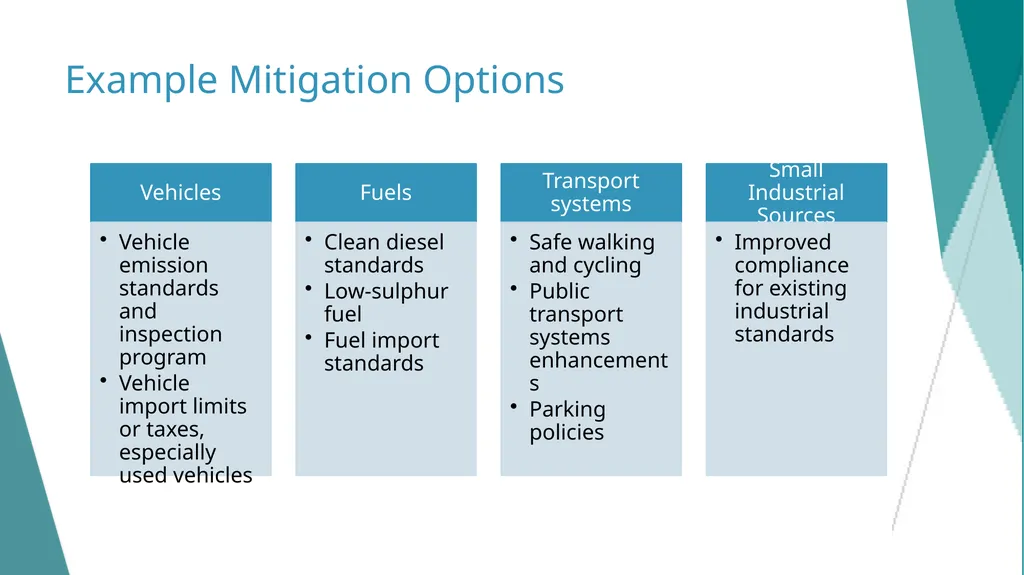
Example Mitigation Options 30<br>
31
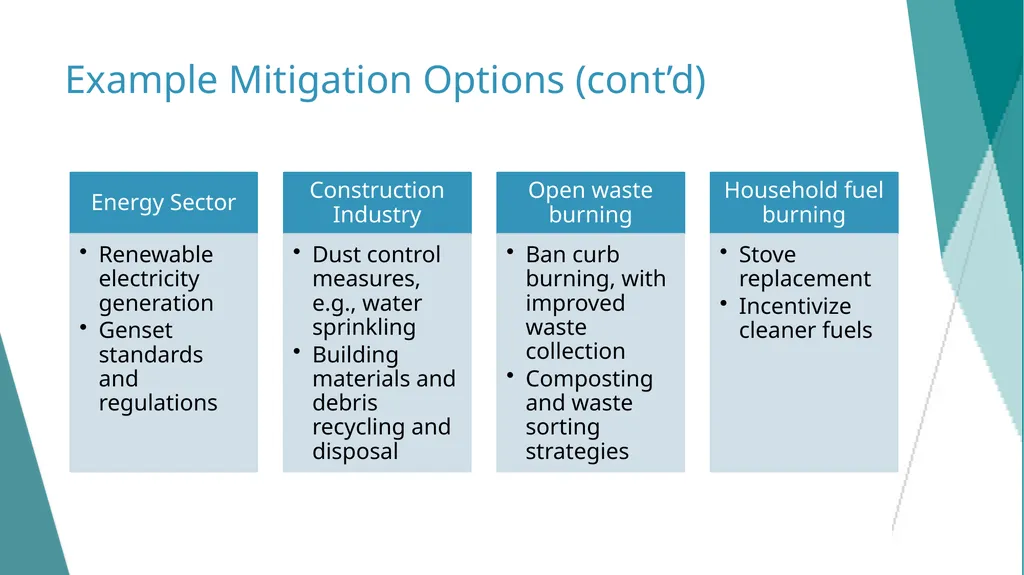
Example Mitigation Options (cont’d) 31<br>
32
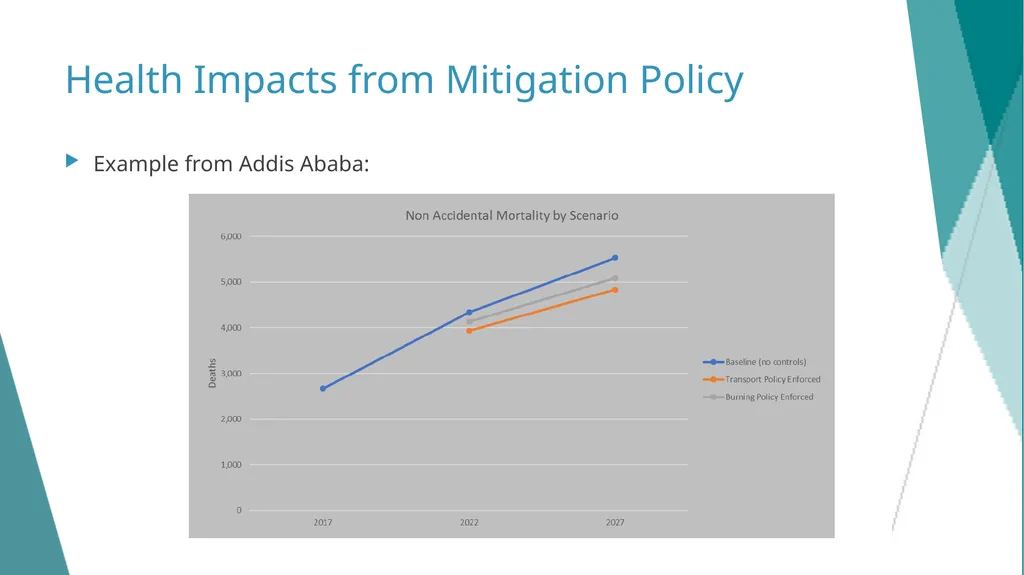
Health Impacts from Mitigation Policy Example from Addis Ababa: 32<br>
33
Section 5: Additional Considerations 1. Introduction
2. Framework
3. Challenges
4. Mitigation Options
5. Additional Considerations
6. New Air Quality and Climate Management Plan 33<br>
2. Framework
3. Challenges
4. Mitigation Options
5. Additional Considerations
6. New Air Quality and Climate Management Plan 33<br>
34
Building a “Business Case” for the AQMP What does it mean to create a “business case”?
From South Coast Air Quality Management District:
“A business case could exist where a technology, fuel, or other strategy reduces emissions and also improves energy efficiency, reduces fuel or maintenance costs, creates new job opportunities, or has other cost savings and economic benefits.”
Examples:
In transport sector, fuel efficiency savings can be enough to justify moving to newer vehicles
In stationary source sector, industry can be motivated by funding incentives and/or permitting flexibility for low emitting technologies 34<br>
From South Coast Air Quality Management District:
“A business case could exist where a technology, fuel, or other strategy reduces emissions and also improves energy efficiency, reduces fuel or maintenance costs, creates new job opportunities, or has other cost savings and economic benefits.”
Examples:
In transport sector, fuel efficiency savings can be enough to justify moving to newer vehicles
In stationary source sector, industry can be motivated by funding incentives and/or permitting flexibility for low emitting technologies 34<br>
35
Compliance and Enforcement Responsibilities Will a regulatory program be necessary for AQMP implementation?
Which government ministry, department or agency will be responsible for developing and implementing the regulatory program?
Legal mandate: Federal/State/City?
Formulation of policy/legislation/standards/guidelines?
Coordination and supervision?
Compliance monitoring and enforcement? 35<br>
Which government ministry, department or agency will be responsible for developing and implementing the regulatory program?
Legal mandate: Federal/State/City?
Formulation of policy/legislation/standards/guidelines?
Coordination and supervision?
Compliance monitoring and enforcement? 35<br>
36
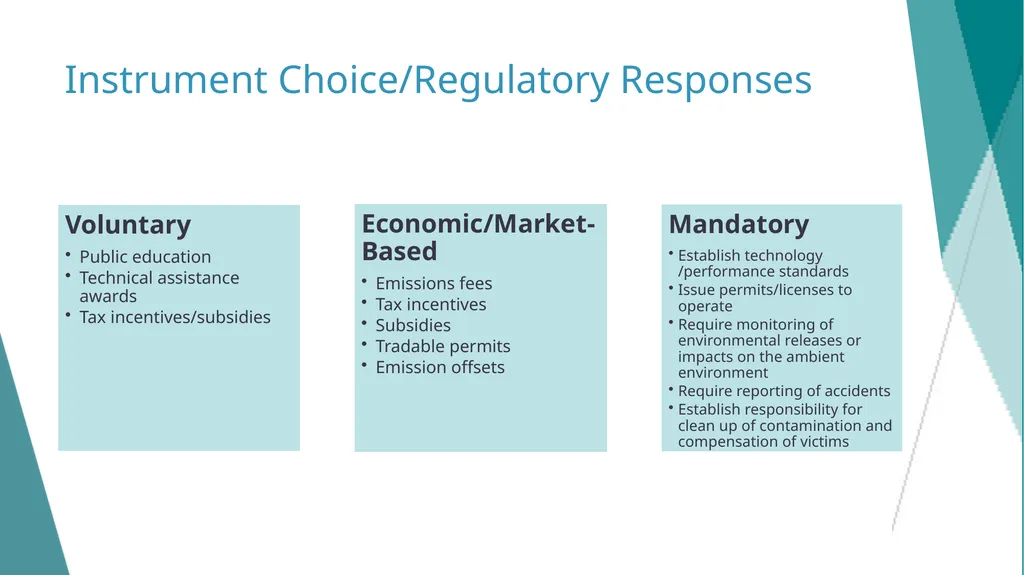
Instrument Choice/Regulatory Responses 36<br>
37
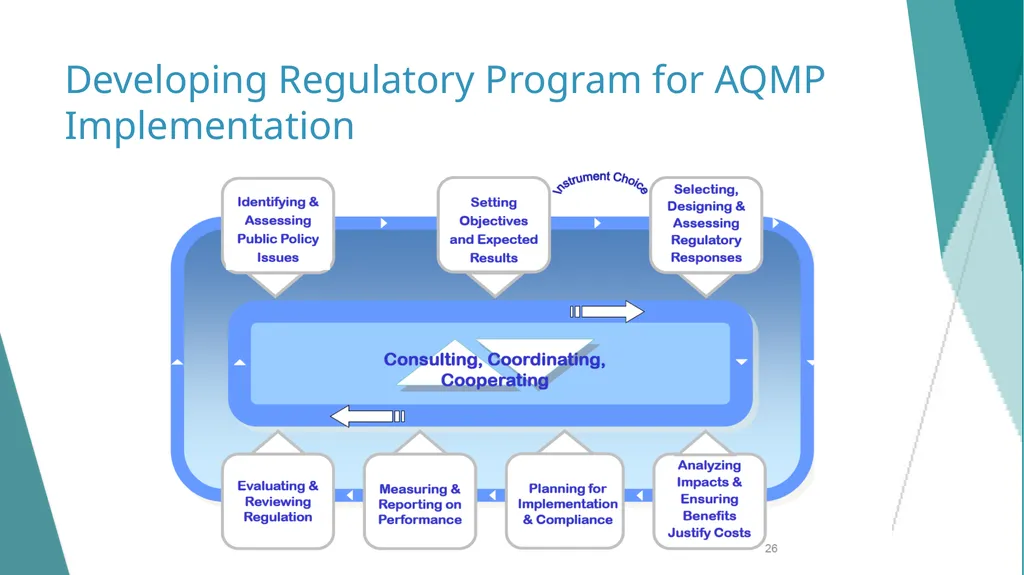
Developing Regulatory Program for AQMP Implementation 37<br>
38
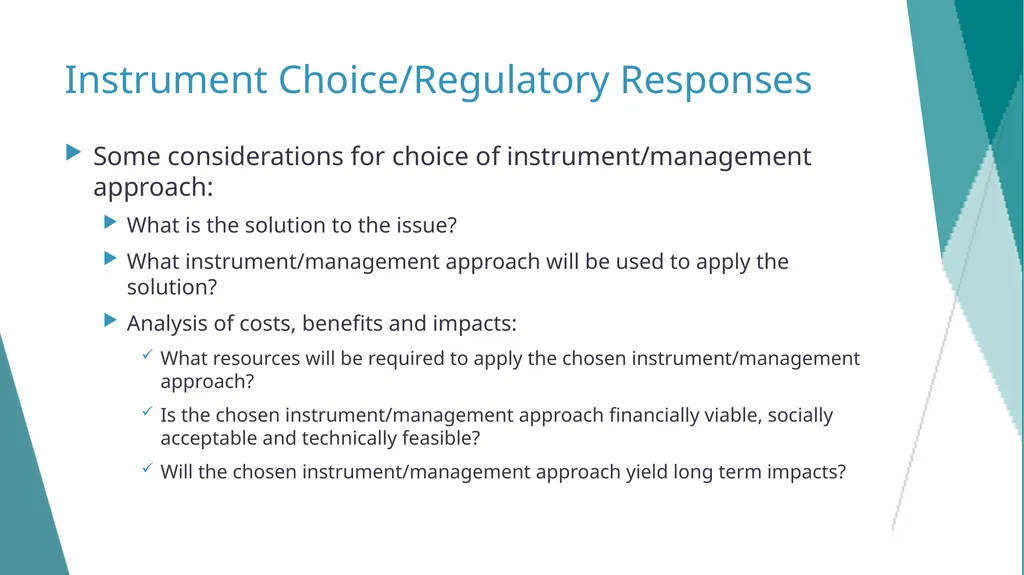
Instrument Choice/Regulatory Responses Some considerations for choice of instrument/management approach:
What is the solution to the issue?
What instrument/management approach will be used to apply the solution?
Analysis of costs, benefits and impacts:
What resources will be required to apply the chosen instrument/management approach?
Is the chosen instrument/management approach financially viable, socially acceptable and technically feasible?
Will the chosen instrument/management approach yield long term impacts? 38<br>
What is the solution to the issue?
What instrument/management approach will be used to apply the solution?
Analysis of costs, benefits and impacts:
What resources will be required to apply the chosen instrument/management approach?
Is the chosen instrument/management approach financially viable, socially acceptable and technically feasible?
Will the chosen instrument/management approach yield long term impacts? 38<br>
39
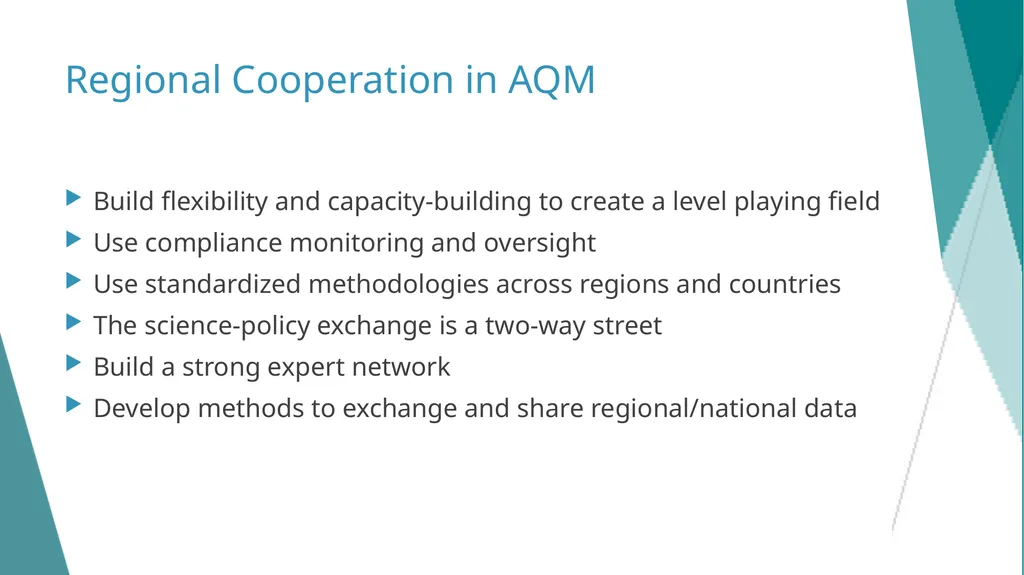
Regional Cooperation in AQM Build flexibility and capacity-building to create a level playing field
Use compliance monitoring and oversight
Use standardized methodologies across regions and countries
The science-policy exchange is a two-way street
Build a strong expert network
Develop methods to exchange and share regional/national data 39<br>
Use compliance monitoring and oversight
Use standardized methodologies across regions and countries
The science-policy exchange is a two-way street
Build a strong expert network
Develop methods to exchange and share regional/national data 39<br>
40
Section 6: New Air Quality and Climate Management Plan 1. Introduction
2. Framework
3. Challenges
4. Mitigation Options
5. Additional Considerations
6. New Air Quality and Climate Management Plan 40<br>
2. Framework
3. Challenges
4. Mitigation Options
5. Additional Considerations
6. New Air Quality and Climate Management Plan 40<br>
41
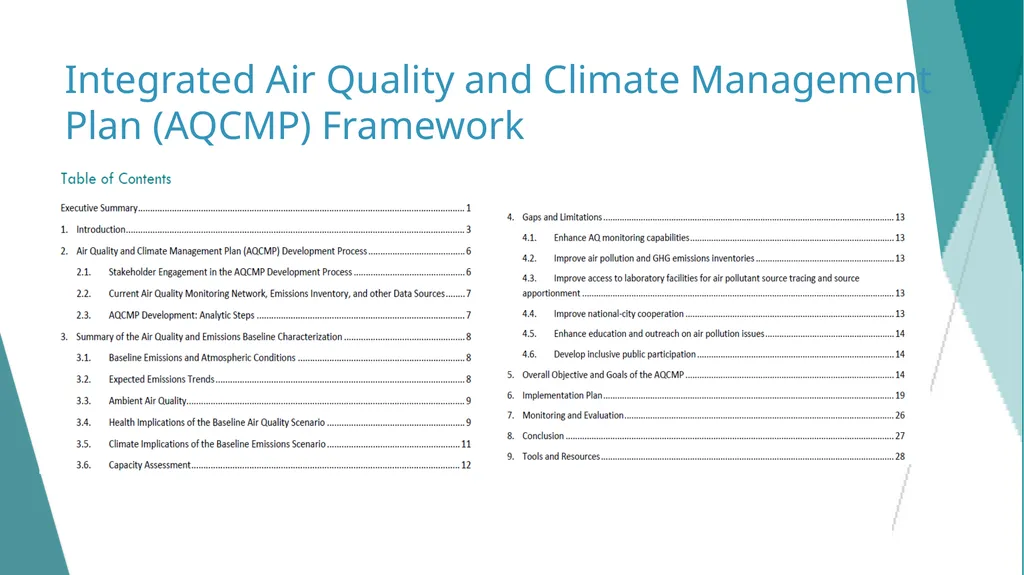
Integrated Air Quality and Climate Management Plan (AQCMP) Framework 41<br>
42
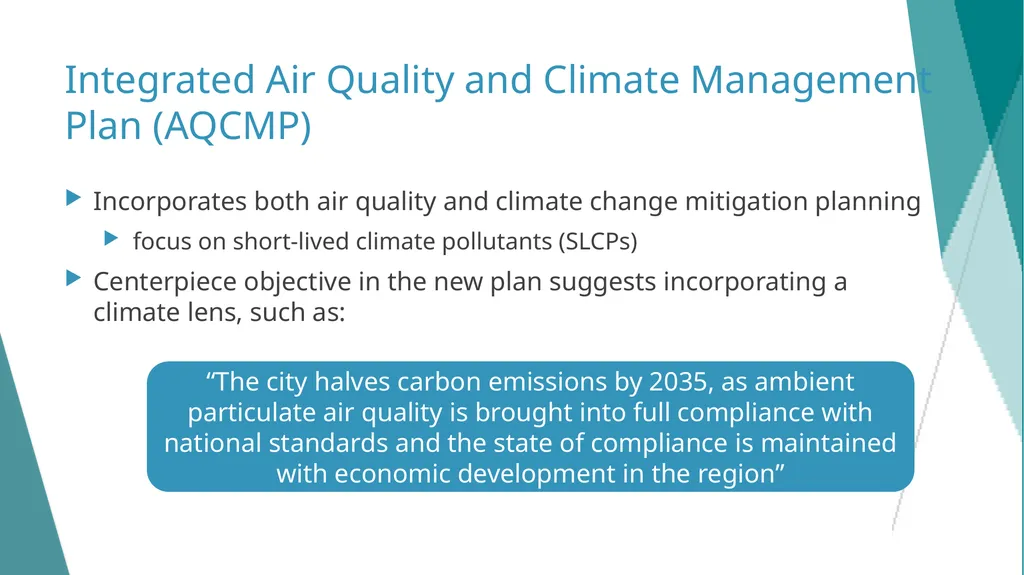
Integrated Air Quality and Climate Management Plan (AQCMP) Incorporates both air quality and climate change mitigation planning
focus on short-lived climate pollutants (SLCPs)
Centerpiece objective in the new plan suggests incorporating a climate lens, such as: 42 “The city halves carbon emissions by 2035, as ambient particulate air quality is brought into full compliance with national standards and the state of compliance is maintained with economic development in the region”<br>
focus on short-lived climate pollutants (SLCPs)
Centerpiece objective in the new plan suggests incorporating a climate lens, such as: 42 “The city halves carbon emissions by 2035, as ambient particulate air quality is brought into full compliance with national standards and the state of compliance is maintained with economic development in the region”<br>
43
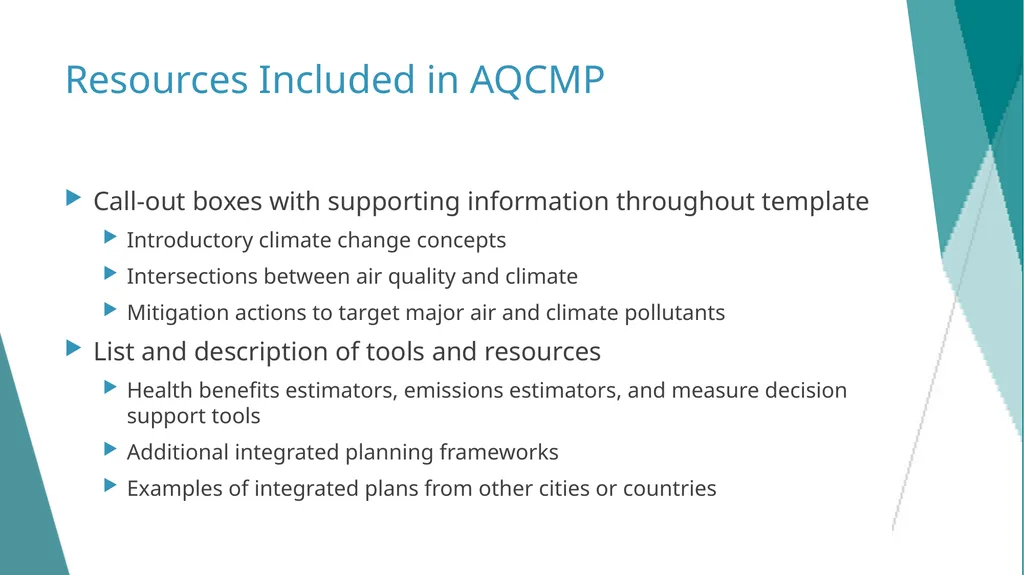
Resources Included in AQCMP Call-out boxes with supporting information throughout template
Introductory climate change concepts
Intersections between air quality and climate
Mitigation actions to target major air and climate pollutants
List and description of tools and resources
Health benefits estimators, emissions estimators, and measure decision support tools
Additional integrated planning frameworks
Examples of integrated plans from other cities or countries 43<br>
Introductory climate change concepts
Intersections between air quality and climate
Mitigation actions to target major air and climate pollutants
List and description of tools and resources
Health benefits estimators, emissions estimators, and measure decision support tools
Additional integrated planning frameworks
Examples of integrated plans from other cities or countries 43<br>
44
Thank you! 44<br>