
Delivery Plan July 2015- March 2016 Bridging the
KB
Published · 8 slides · 0 views

1 / 1
Description
Delivery Plan July 2015- March 2016 Bridging the gap between smaller charities social enterprises, and social investors Overview This plan covers the period 1 July 2015 31 March 2016 (after which point our plans will run concurrently
Related Topics
Share
Embed code
Download this presentation From Below
"Delivery Plan July 2015- March 2016 Bridging the" is the property of its rightful owner. Permission is granted to download and print the materials on this website for personal, non-commercial use only, and to display it on your personal computer provided you do not modify the materials and that you retain all copyright notices contained in the materials. By downloading content from our website, you accept the terms of this agreement.
Presentation Transcript
01
Delivery Plan
July 2015- March 2016
Bridging the gap between smaller charities & social enterprises,
and social investors<br>
02
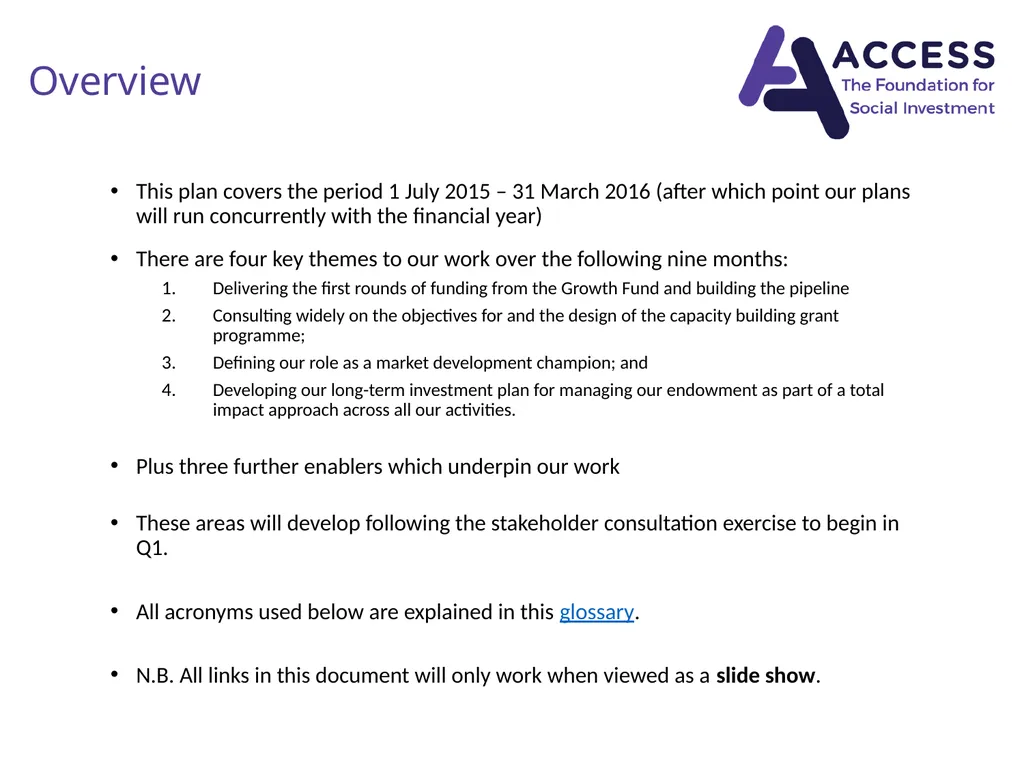
Overview This plan covers the period 1 July 2015 – 31 March 2016 (after which point our plans will run concurrently with the financial year)
There are four key themes to our work over the following nine months:
Delivering the first rounds of funding from the Growth Fund and building the pipeline
Consulting widely on the objectives for and the design of the capacity building grant programme;
Defining our role as a market development champion; and
Developing our long-term investment plan for managing our endowment as part of a total impact approach across all our activities.
Plus three further enablers which underpin our work
These areas will develop following the stakeholder consultation exercise to begin in Q1.
All acronyms used below are explained in this glossary.
N.B. All links in this document will only work when viewed as a slide show.<br>
There are four key themes to our work over the following nine months:
Delivering the first rounds of funding from the Growth Fund and building the pipeline
Consulting widely on the objectives for and the design of the capacity building grant programme;
Defining our role as a market development champion; and
Developing our long-term investment plan for managing our endowment as part of a total impact approach across all our activities.
Plus three further enablers which underpin our work
These areas will develop following the stakeholder consultation exercise to begin in Q1.
All acronyms used below are explained in this glossary.
N.B. All links in this document will only work when viewed as a slide show.<br>
03
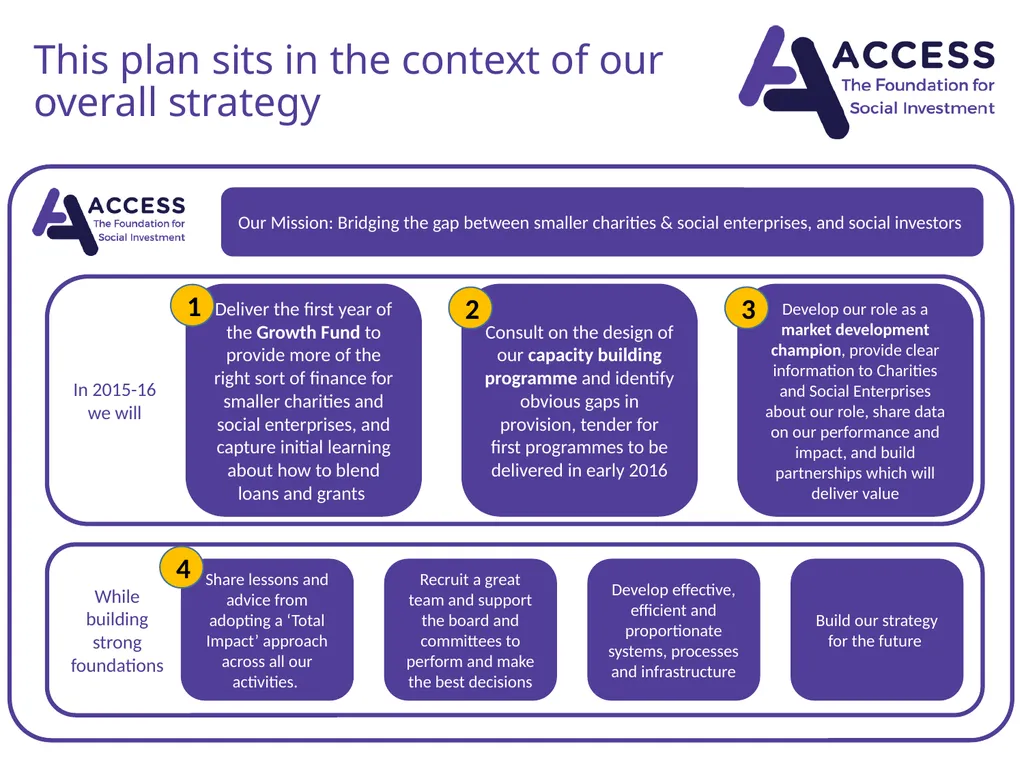
Our Mission: Bridging the gap between smaller charities & social enterprises, and social investors Deliver the first year of the Growth Fund to provide more of the right sort of finance for smaller charities and social enterprises, and capture initial learning about how to blend loans and grants Consult on the design of our capacity building programme and identify obvious gaps in provision, tender for first programmes to be delivered in early 2016 Develop our role as a market development champion, provide clear information to Charities and Social Enterprises about our role, share data on our performance and impact, and build partnerships which will deliver value In 2015-16 we will While building strong foundations Share lessons and advice from adopting a ‘Total Impact’ approach across all our activities. Recruit a great team and support the board and committees to perform and make the best decisions Develop effective, efficient and proportionate systems, processes and infrastructure Build our strategy for the future This plan sits in the context of our overall strategy 1 2 3 4<br>
04
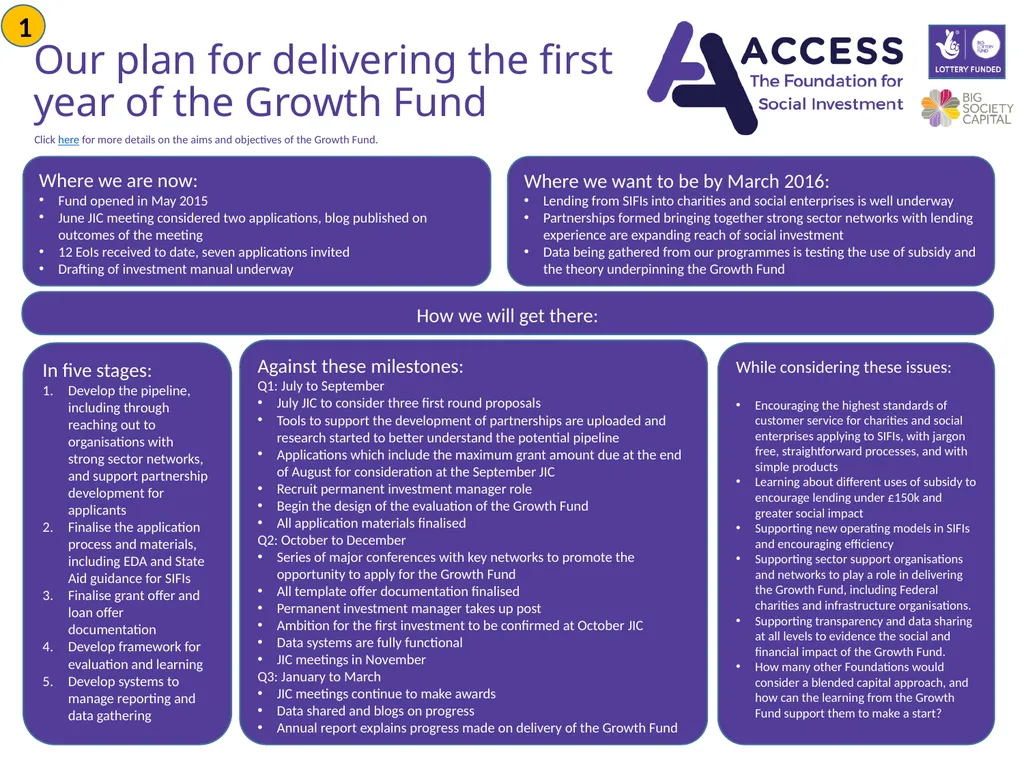
Our plan for delivering the first year of the Growth Fund Where we are now:
Fund opened in May 2015
June JIC meeting considered two applications, blog published on outcomes of the meeting
12 EoIs received to date, seven applications invited
Drafting of investment manual underway Where we want to be by March 2016:
Lending from SIFIs into charities and social enterprises is well underway
Partnerships formed bringing together strong sector networks with lending experience are expanding reach of social investment
Data being gathered from our programmes is testing the use of subsidy and the theory underpinning the Growth Fund Against these milestones:
Q1: July to September
July JIC to consider three first round proposals
Tools to support the development of partnerships are uploaded and research started to better understand the potential pipeline
Applications which include the maximum grant amount due at the end of August for consideration at the September JIC
Recruit permanent investment manager role
Begin the design of the evaluation of the Growth Fund
All application materials finalised
Q2: October to December
Series of major conferences with key networks to promote the opportunity to apply for the Growth Fund
All template offer documentation finalised
Permanent investment manager takes up post
Ambition for the first investment to be confirmed at October JIC
Data systems are fully functional
JIC meetings in November
Q3: January to March
JIC meetings continue to make awards
Data shared and blogs on progress
Annual report explains progress made on delivery of the Growth Fund How we will get there: While considering these issues:
Encouraging the highest standards of customer service for charities and social enterprises applying to SIFIs, with jargon free, straightforward processes, and with simple products
Learning about different uses of subsidy to encourage lending under £150k and greater social impact
Supporting new operating models in SIFIs and encouraging efficiency
Supporting sector support organisations and networks to play a role in delivering the Growth Fund, including Federal charities and infrastructure organisations.
Supporting transparency and data sharing at all levels to evidence the social and financial impact of the Growth Fund.
How many other Foundations would consider a blended capital approach, and how can the learning from the Growth Fund support them to make a start? In five stages:
Develop the pipeline, including through reaching out to organisations with strong sector networks, and support partnership development for applicants
Finalise the application process and materials, including EDA and State Aid guidance for SIFIs
Finalise grant offer and loan offer documentation
Develop framework for evaluation and learning
Develop systems to manage reporting and data gathering 1 Click here for more details on the aims and objectives of the Growth Fund.<br>
Fund opened in May 2015
June JIC meeting considered two applications, blog published on outcomes of the meeting
12 EoIs received to date, seven applications invited
Drafting of investment manual underway Where we want to be by March 2016:
Lending from SIFIs into charities and social enterprises is well underway
Partnerships formed bringing together strong sector networks with lending experience are expanding reach of social investment
Data being gathered from our programmes is testing the use of subsidy and the theory underpinning the Growth Fund Against these milestones:
Q1: July to September
July JIC to consider three first round proposals
Tools to support the development of partnerships are uploaded and research started to better understand the potential pipeline
Applications which include the maximum grant amount due at the end of August for consideration at the September JIC
Recruit permanent investment manager role
Begin the design of the evaluation of the Growth Fund
All application materials finalised
Q2: October to December
Series of major conferences with key networks to promote the opportunity to apply for the Growth Fund
All template offer documentation finalised
Permanent investment manager takes up post
Ambition for the first investment to be confirmed at October JIC
Data systems are fully functional
JIC meetings in November
Q3: January to March
JIC meetings continue to make awards
Data shared and blogs on progress
Annual report explains progress made on delivery of the Growth Fund How we will get there: While considering these issues:
Encouraging the highest standards of customer service for charities and social enterprises applying to SIFIs, with jargon free, straightforward processes, and with simple products
Learning about different uses of subsidy to encourage lending under £150k and greater social impact
Supporting new operating models in SIFIs and encouraging efficiency
Supporting sector support organisations and networks to play a role in delivering the Growth Fund, including Federal charities and infrastructure organisations.
Supporting transparency and data sharing at all levels to evidence the social and financial impact of the Growth Fund.
How many other Foundations would consider a blended capital approach, and how can the learning from the Growth Fund support them to make a start? In five stages:
Develop the pipeline, including through reaching out to organisations with strong sector networks, and support partnership development for applicants
Finalise the application process and materials, including EDA and State Aid guidance for SIFIs
Finalise grant offer and loan offer documentation
Develop framework for evaluation and learning
Develop systems to manage reporting and data gathering 1 Click here for more details on the aims and objectives of the Growth Fund.<br>
05
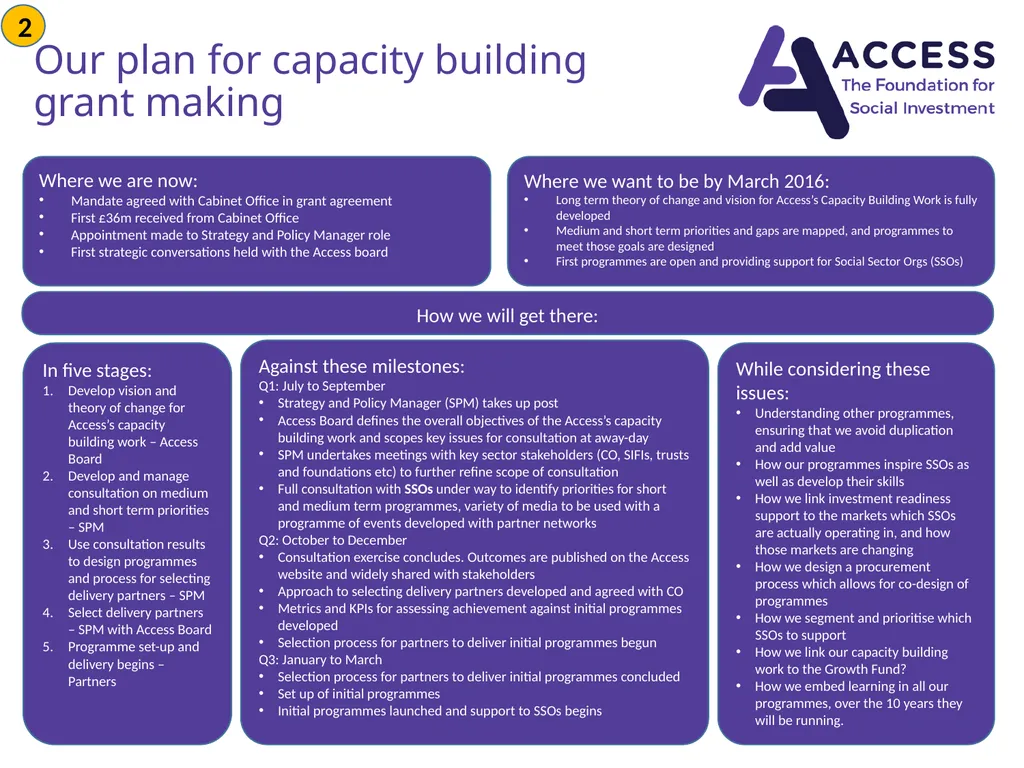
Our plan for capacity building grant making Where we are now:
Mandate agreed with Cabinet Office in grant agreement
First £36m received from Cabinet Office
Appointment made to Strategy and Policy Manager role
First strategic conversations held with the Access board Where we want to be by March 2016:
Long term theory of change and vision for Access’s Capacity Building Work is fully developed
Medium and short term priorities and gaps are mapped, and programmes to meet those goals are designed
First programmes are open and providing support for Social Sector Orgs (SSOs) Against these milestones:
Q1: July to September
Strategy and Policy Manager (SPM) takes up post
Access Board defines the overall objectives of the Access’s capacity building work and scopes key issues for consultation at away-day
SPM undertakes meetings with key sector stakeholders (CO, SIFIs, trusts and foundations etc) to further refine scope of consultation
Full consultation with SSOs under way to identify priorities for short and medium term programmes, variety of media to be used with a programme of events developed with partner networks
Q2: October to December
Consultation exercise concludes. Outcomes are published on the Access website and widely shared with stakeholders
Approach to selecting delivery partners developed and agreed with CO
Metrics and KPIs for assessing achievement against initial programmes developed
Selection process for partners to deliver initial programmes begun
Q3: January to March
Selection process for partners to deliver initial programmes concluded
Set up of initial programmes
Initial programmes launched and support to SSOs begins How we will get there: While considering these issues:
Understanding other programmes, ensuring that we avoid duplication and add value
How our programmes inspire SSOs as well as develop their skills
How we link investment readiness support to the markets which SSOs are actually operating in, and how those markets are changing
How we design a procurement process which allows for co-design of programmes
How we segment and prioritise which SSOs to support
How we link our capacity building work to the Growth Fund?
How we embed learning in all our programmes, over the 10 years they will be running. In five stages:
Develop vision and theory of change for Access’s capacity building work – Access Board
Develop and manage consultation on medium and short term priorities – SPM
Use consultation results to design programmes and process for selecting delivery partners – SPM
Select delivery partners – SPM with Access Board
Programme set-up and delivery begins – Partners 2<br>
Mandate agreed with Cabinet Office in grant agreement
First £36m received from Cabinet Office
Appointment made to Strategy and Policy Manager role
First strategic conversations held with the Access board Where we want to be by March 2016:
Long term theory of change and vision for Access’s Capacity Building Work is fully developed
Medium and short term priorities and gaps are mapped, and programmes to meet those goals are designed
First programmes are open and providing support for Social Sector Orgs (SSOs) Against these milestones:
Q1: July to September
Strategy and Policy Manager (SPM) takes up post
Access Board defines the overall objectives of the Access’s capacity building work and scopes key issues for consultation at away-day
SPM undertakes meetings with key sector stakeholders (CO, SIFIs, trusts and foundations etc) to further refine scope of consultation
Full consultation with SSOs under way to identify priorities for short and medium term programmes, variety of media to be used with a programme of events developed with partner networks
Q2: October to December
Consultation exercise concludes. Outcomes are published on the Access website and widely shared with stakeholders
Approach to selecting delivery partners developed and agreed with CO
Metrics and KPIs for assessing achievement against initial programmes developed
Selection process for partners to deliver initial programmes begun
Q3: January to March
Selection process for partners to deliver initial programmes concluded
Set up of initial programmes
Initial programmes launched and support to SSOs begins How we will get there: While considering these issues:
Understanding other programmes, ensuring that we avoid duplication and add value
How our programmes inspire SSOs as well as develop their skills
How we link investment readiness support to the markets which SSOs are actually operating in, and how those markets are changing
How we design a procurement process which allows for co-design of programmes
How we segment and prioritise which SSOs to support
How we link our capacity building work to the Growth Fund?
How we embed learning in all our programmes, over the 10 years they will be running. In five stages:
Develop vision and theory of change for Access’s capacity building work – Access Board
Develop and manage consultation on medium and short term priorities – SPM
Use consultation results to design programmes and process for selecting delivery partners – SPM
Select delivery partners – SPM with Access Board
Programme set-up and delivery begins – Partners 2<br>
06
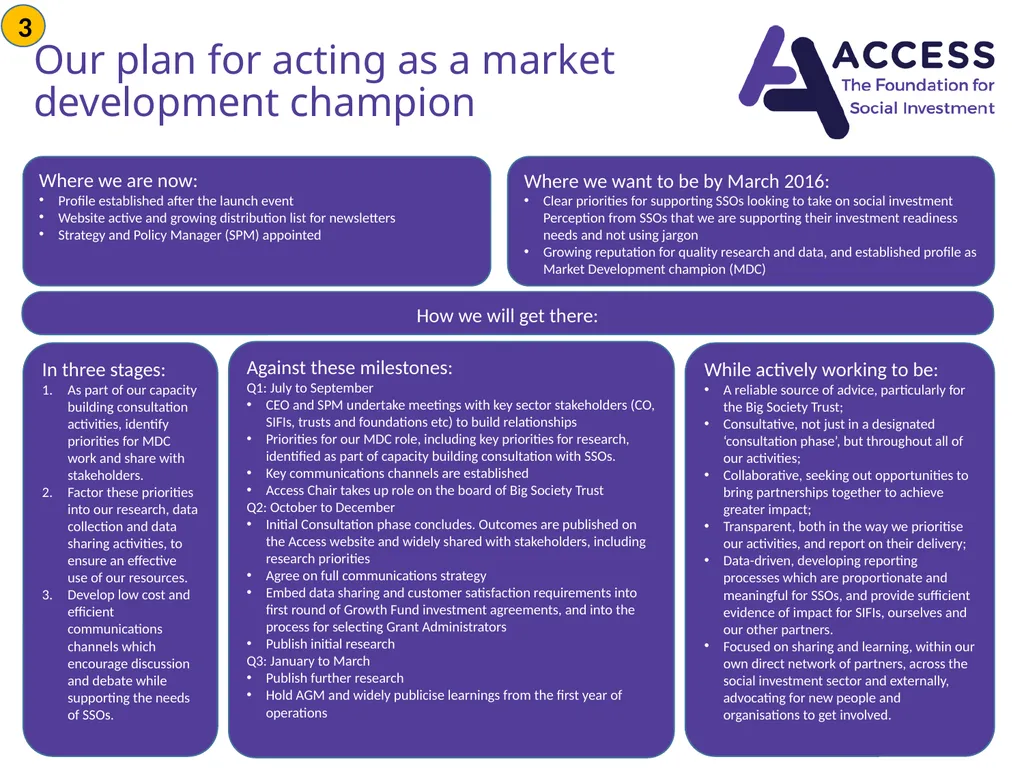
Our plan for acting as a market development champion Where we are now:
Profile established after the launch event
Website active and growing distribution list for newsletters
Strategy and Policy Manager (SPM) appointed Where we want to be by March 2016:
Clear priorities for supporting SSOs looking to take on social investment Perception from SSOs that we are supporting their investment readiness needs and not using jargon
Growing reputation for quality research and data, and established profile as Market Development champion (MDC) Against these milestones:
Q1: July to September
CEO and SPM undertake meetings with key sector stakeholders (CO, SIFIs, trusts and foundations etc) to build relationships
Priorities for our MDC role, including key priorities for research, identified as part of capacity building consultation with SSOs.
Key communications channels are established
Access Chair takes up role on the board of Big Society Trust
Q2: October to December
Initial Consultation phase concludes. Outcomes are published on the Access website and widely shared with stakeholders, including research priorities
Agree on full communications strategy
Embed data sharing and customer satisfaction requirements into first round of Growth Fund investment agreements, and into the process for selecting Grant Administrators
Publish initial research
Q3: January to March
Publish further research
Hold AGM and widely publicise learnings from the first year of operations How we will get there: While actively working to be:
A reliable source of advice, particularly for the Big Society Trust;
Consultative, not just in a designated ‘consultation phase’, but throughout all of our activities;
Collaborative, seeking out opportunities to bring partnerships together to achieve greater impact;
Transparent, both in the way we prioritise our activities, and report on their delivery;
Data-driven, developing reporting processes which are proportionate and meaningful for SSOs, and provide sufficient evidence of impact for SIFIs, ourselves and our other partners.
Focused on sharing and learning, within our own direct network of partners, across the social investment sector and externally, advocating for new people and organisations to get involved. In three stages:
As part of our capacity building consultation activities, identify priorities for MDC work and share with stakeholders.
Factor these priorities into our research, data collection and data sharing activities, to ensure an effective use of our resources.
Develop low cost and efficient communications channels which encourage discussion and debate while supporting the needs of SSOs. 3<br>
Profile established after the launch event
Website active and growing distribution list for newsletters
Strategy and Policy Manager (SPM) appointed Where we want to be by March 2016:
Clear priorities for supporting SSOs looking to take on social investment Perception from SSOs that we are supporting their investment readiness needs and not using jargon
Growing reputation for quality research and data, and established profile as Market Development champion (MDC) Against these milestones:
Q1: July to September
CEO and SPM undertake meetings with key sector stakeholders (CO, SIFIs, trusts and foundations etc) to build relationships
Priorities for our MDC role, including key priorities for research, identified as part of capacity building consultation with SSOs.
Key communications channels are established
Access Chair takes up role on the board of Big Society Trust
Q2: October to December
Initial Consultation phase concludes. Outcomes are published on the Access website and widely shared with stakeholders, including research priorities
Agree on full communications strategy
Embed data sharing and customer satisfaction requirements into first round of Growth Fund investment agreements, and into the process for selecting Grant Administrators
Publish initial research
Q3: January to March
Publish further research
Hold AGM and widely publicise learnings from the first year of operations How we will get there: While actively working to be:
A reliable source of advice, particularly for the Big Society Trust;
Consultative, not just in a designated ‘consultation phase’, but throughout all of our activities;
Collaborative, seeking out opportunities to bring partnerships together to achieve greater impact;
Transparent, both in the way we prioritise our activities, and report on their delivery;
Data-driven, developing reporting processes which are proportionate and meaningful for SSOs, and provide sufficient evidence of impact for SIFIs, ourselves and our other partners.
Focused on sharing and learning, within our own direct network of partners, across the social investment sector and externally, advocating for new people and organisations to get involved. In three stages:
As part of our capacity building consultation activities, identify priorities for MDC work and share with stakeholders.
Factor these priorities into our research, data collection and data sharing activities, to ensure an effective use of our resources.
Develop low cost and efficient communications channels which encourage discussion and debate while supporting the needs of SSOs. 3<br>
07
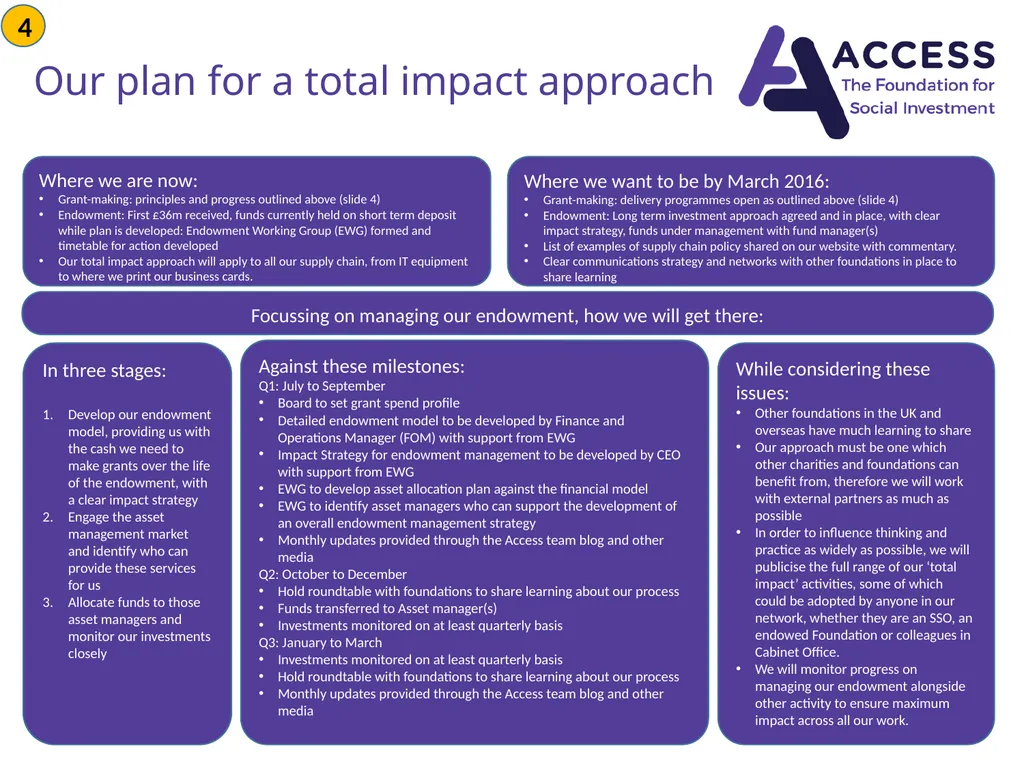
Our plan for a total impact approach Where we are now:
Grant-making: principles and progress outlined above (slide 4)
Endowment: First £36m received, funds currently held on short term deposit while plan is developed: Endowment Working Group (EWG) formed and timetable for action developed
Our total impact approach will apply to all our supply chain, from IT equipment to where we print our business cards. Where we want to be by March 2016:
Grant-making: delivery programmes open as outlined above (slide 4)
Endowment: Long term investment approach agreed and in place, with clear impact strategy, funds under management with fund manager(s)
List of examples of supply chain policy shared on our website with commentary.
Clear communications strategy and networks with other foundations in place to share learning Against these milestones:
Q1: July to September
Board to set grant spend profile
Detailed endowment model to be developed by Finance and Operations Manager (FOM) with support from EWG
Impact Strategy for endowment management to be developed by CEO with support from EWG
EWG to develop asset allocation plan against the financial model
EWG to identify asset managers who can support the development of an overall endowment management strategy
Monthly updates provided through the Access team blog and other media
Q2: October to December
Hold roundtable with foundations to share learning about our process
Funds transferred to Asset manager(s)
Investments monitored on at least quarterly basis
Q3: January to March
Investments monitored on at least quarterly basis
Hold roundtable with foundations to share learning about our process
Monthly updates provided through the Access team blog and other media Focussing on managing our endowment, how we will get there: While considering these issues:
Other foundations in the UK and overseas have much learning to share
Our approach must be one which other charities and foundations can benefit from, therefore we will work with external partners as much as possible
In order to influence thinking and practice as widely as possible, we will publicise the full range of our ‘total impact’ activities, some of which could be adopted by anyone in our network, whether they are an SSO, an endowed Foundation or colleagues in Cabinet Office.
We will monitor progress on managing our endowment alongside other activity to ensure maximum impact across all our work. In three stages:
Develop our endowment model, providing us with the cash we need to make grants over the life of the endowment, with a clear impact strategy
Engage the asset management market and identify who can provide these services for us
Allocate funds to those asset managers and monitor our investments closely 4<br>
Grant-making: principles and progress outlined above (slide 4)
Endowment: First £36m received, funds currently held on short term deposit while plan is developed: Endowment Working Group (EWG) formed and timetable for action developed
Our total impact approach will apply to all our supply chain, from IT equipment to where we print our business cards. Where we want to be by March 2016:
Grant-making: delivery programmes open as outlined above (slide 4)
Endowment: Long term investment approach agreed and in place, with clear impact strategy, funds under management with fund manager(s)
List of examples of supply chain policy shared on our website with commentary.
Clear communications strategy and networks with other foundations in place to share learning Against these milestones:
Q1: July to September
Board to set grant spend profile
Detailed endowment model to be developed by Finance and Operations Manager (FOM) with support from EWG
Impact Strategy for endowment management to be developed by CEO with support from EWG
EWG to develop asset allocation plan against the financial model
EWG to identify asset managers who can support the development of an overall endowment management strategy
Monthly updates provided through the Access team blog and other media
Q2: October to December
Hold roundtable with foundations to share learning about our process
Funds transferred to Asset manager(s)
Investments monitored on at least quarterly basis
Q3: January to March
Investments monitored on at least quarterly basis
Hold roundtable with foundations to share learning about our process
Monthly updates provided through the Access team blog and other media Focussing on managing our endowment, how we will get there: While considering these issues:
Other foundations in the UK and overseas have much learning to share
Our approach must be one which other charities and foundations can benefit from, therefore we will work with external partners as much as possible
In order to influence thinking and practice as widely as possible, we will publicise the full range of our ‘total impact’ activities, some of which could be adopted by anyone in our network, whether they are an SSO, an endowed Foundation or colleagues in Cabinet Office.
We will monitor progress on managing our endowment alongside other activity to ensure maximum impact across all our work. In three stages:
Develop our endowment model, providing us with the cash we need to make grants over the life of the endowment, with a clear impact strategy
Engage the asset management market and identify who can provide these services for us
Allocate funds to those asset managers and monitor our investments closely 4<br>
08
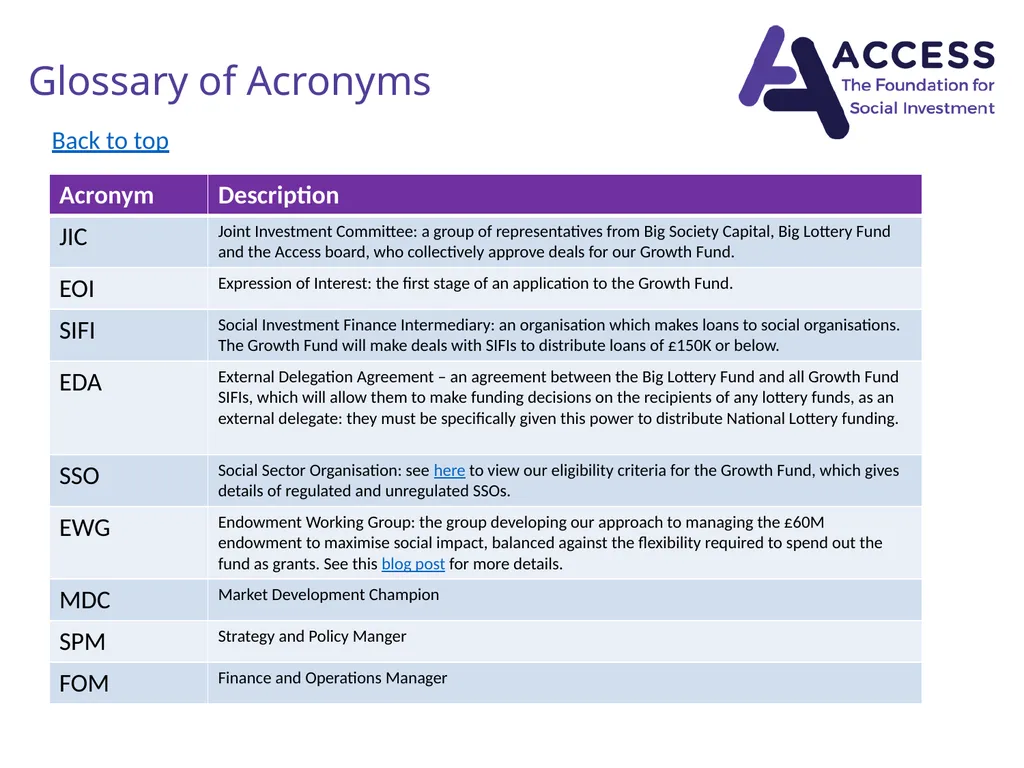
Glossary of Acronyms Back to top<br>