Democracy in Theory and Practice 1. Introduction
Description: Democracy in Theory and Practice 1. Introduction Dr Max Jaede, 2020 Outline of this class Welcome and introductions What do we mean by democracy? Democratic theory as a field of study Approach of this course Course format and
Related Topics
Download Presentation
"Democracy in Theory and Practice 1. Introduction" is the property of its rightful owner. Permission is granted to download and print the materials on this website for personal, non-commercial use only, and to display it on your personal computer provided you do not modify the materials and that you retain all copyright notices contained in the materials. By downloading content from our website, you accept the terms of this agreement.
Presentation Transcript
slide1. Democracy in Theoryand Practice 1. Introduction Dr Max Jaede, 2020<br>
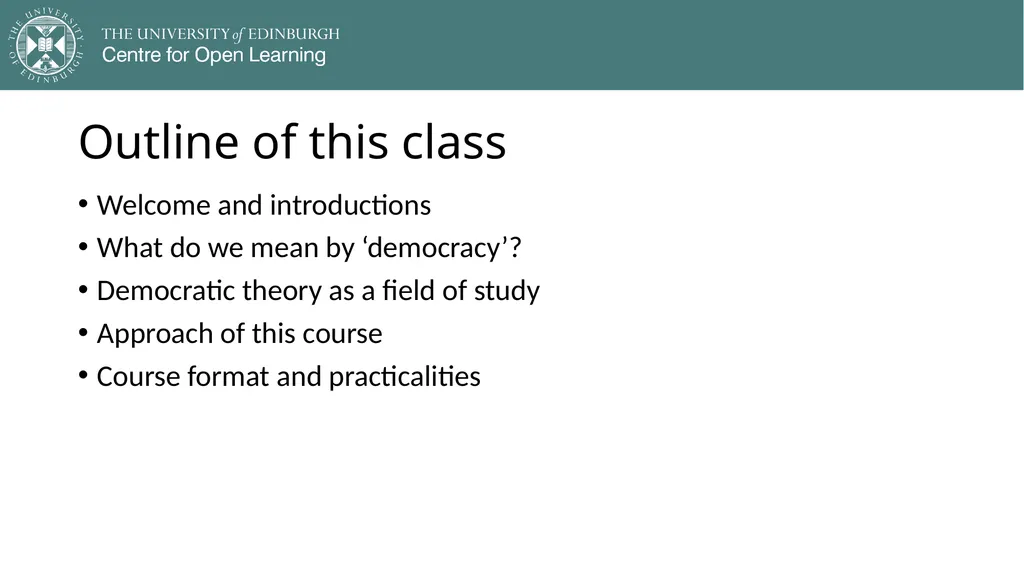
slide2. Outline of this class Welcome and introductions
What do we mean by ‘democracy’?
Democratic theory as a field of study
Approach of this course
Course format and practicalities<br>
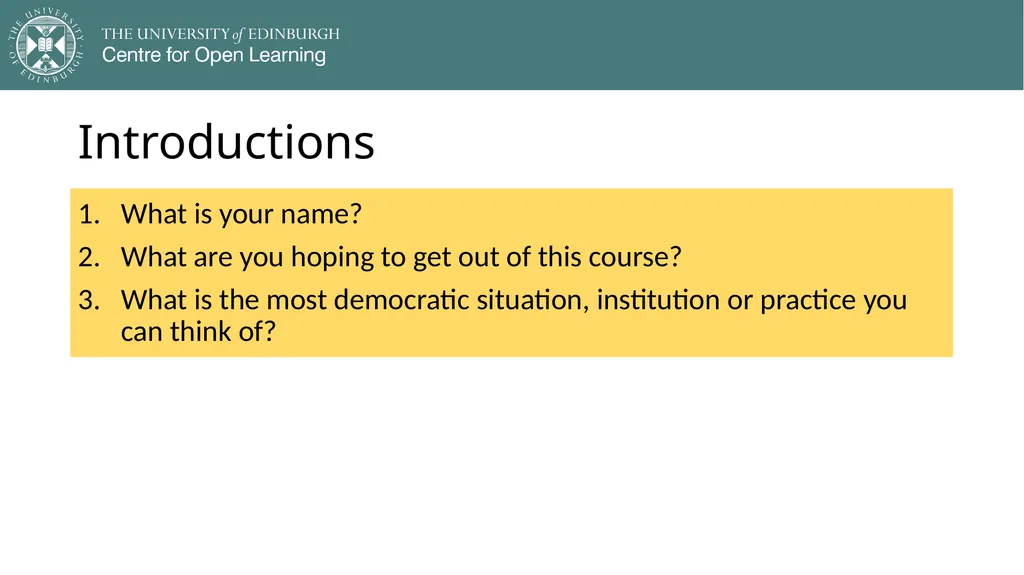
slide3. Introductions What is your name?
What are you hoping to get out of this course?
What is the most democratic situation, institution or practice you can think of?<br>
slide4. What do we mean by ‘democracy’?<br>
slide5. Democracy as rule by the people The word derives from the ancient Greek demokratia, a compound of demos (the people) and kratia (rule), so ‘democracy’ means rule by the people
But it’s not as simple as it seems! What is meant by ‘rule by’ and ‘the people’ is not obvious, and democratic ideas evolved considerably over the course of history
E.g., representation vs. direct participation in government? ‘The people’ as a select few vs. voting rights for all adult citizens?<br>
slide6. Democracy as a matter of degree Much political rhetoric (and some political scientists) suggest that democracy is a matter of either/or – either societies are democratic or they are not
By contrast, most democratic theorists hold that democracy is a matter of degree, which means that even ‘democratic’ societies only approximate democratic ideals<br>
slide7. Democracy as a contested concept ‘Democracy’ is one of the most widely accepted political values and political actors often invoke it to justify or criticise certain courses of action, yet they use the term to mean very different things
Democracy can be classified as an ‘essentially contested concept’ in that its meaning is subject to ongoing debate and, by its nature, contestable
We can only examine to what extent political practices approximate particular understandings of democratic ideals<br>
slide8. Democratic theory as a field of study<br>
slide9. What is a ‘theory’? In general, a ‘theory’ is a set of statements intended to explain or evaluate certain phenomena
Democratic theories seek to give coherent expression to a set of values, beliefs and principles which may be shared more widely by other people
Democratic theories can be used to identify and distinguish political positions and underlying values, clarify what is at stake in debates, and inform or critically assess political practices<br>
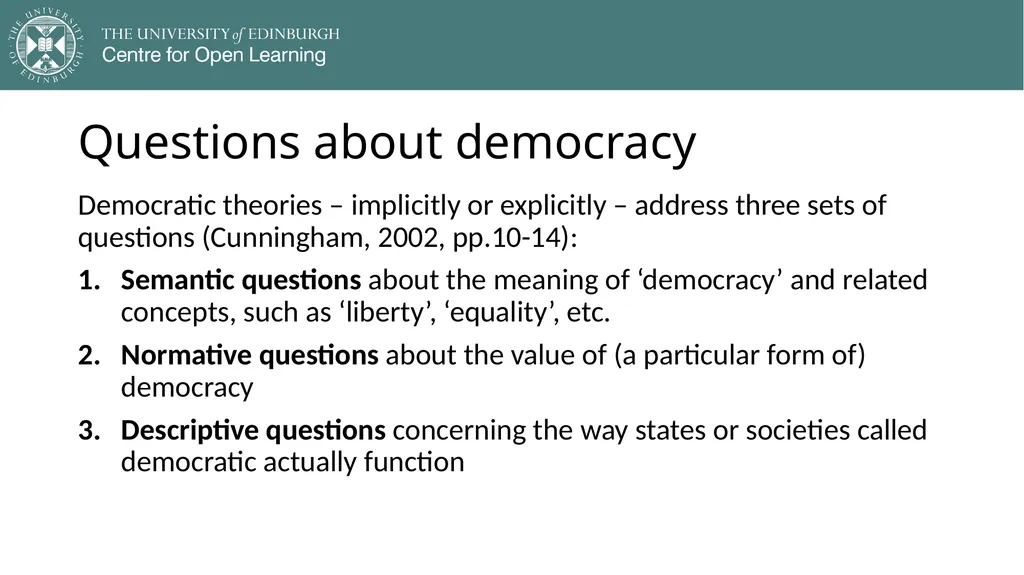
slide10. Questions about democracy Democratic theories – implicitly or explicitly – address three sets of questions (Cunningham, 2002, pp.10-14):
Semantic questions about the meaning of ‘democracy’ and related concepts, such as ‘liberty’, ‘equality’, etc.
Normative questions about the value of (a particular form of) democracy
Descriptive questions concerning the way states or societies called democratic actually function<br>
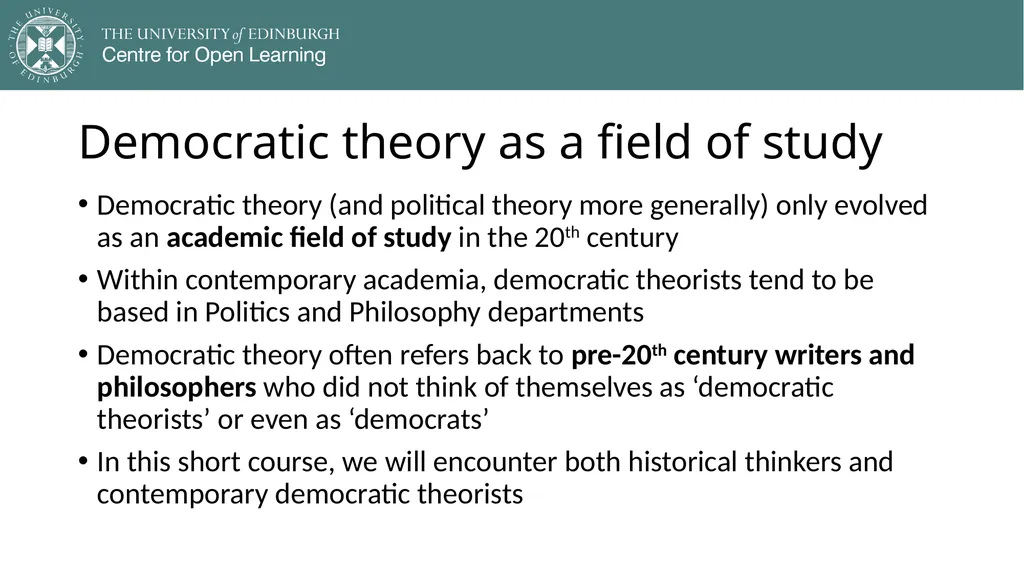
slide11. Democratic theory as a field of study Democratic theory (and political theory more generally) only evolved as an academic field of study in the 20th century
Within contemporary academia, democratic theorists tend to be based in Politics and Philosophy departments
Democratic theory often refers back to pre-20th century writers and philosophers who did not think of themselves as ‘democratic theorists’ or even as ‘democrats’
In this short course, we will encounter both historical thinkers and contemporary democratic theorists<br>
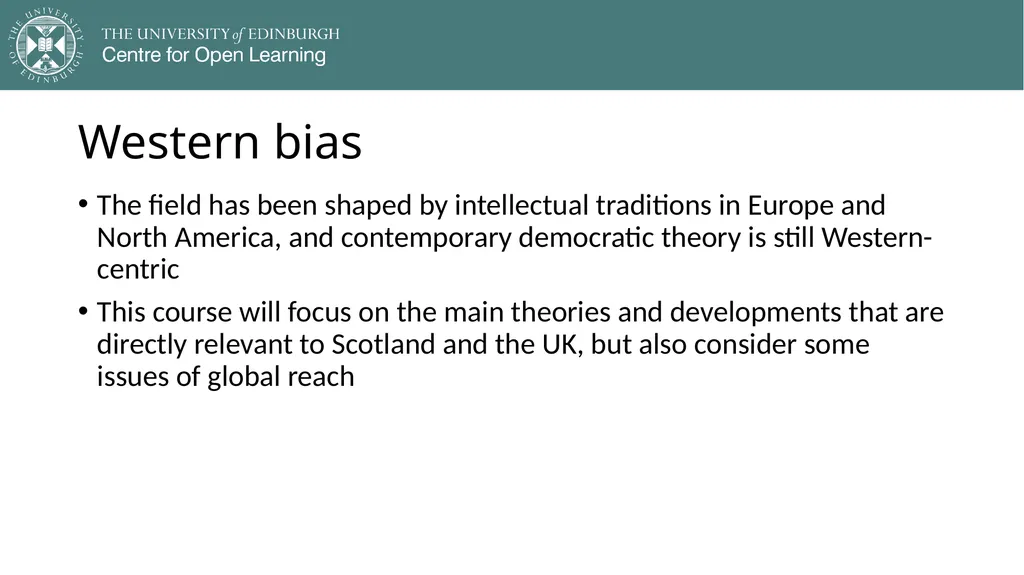
slide12. Western bias The field has been shaped by intellectual traditions in Europe and North America, and contemporary democratic theory is still Western-centric
This course will focus on the main theories and developments that are directly relevant to Scotland and the UK, but also consider some issues of global reach<br>
slide13. Approach of this course<br>
slide14. A historical approach We will adopt a broadly historical approach to distinguish three intellectual traditions (or ‘classic models’ of democracy), and to trace the evolution of modern mass democracies
In addition, we will look at more recent political developments – from Thatcherism and globalisation to the rise of right-wing populism in the 21st century – which provide the backdrop for contemporary debates in democratic theory<br>
slide15. Theory and practice The course aim is not to discuss theoretical questions in the abstract, or to evaluate different democratic theories
Rather, we will use theories as tools to contrast different meanings of democracy, and to critically examine to what extent democratic aspirations are realised in practice
We will frequently discuss concrete examples, but the course does not systematically examine practices in a specific context (such as Scotland or the UK)<br>
slide16. Democratic learning The course aims to provide opportunities for students to reflect on their experiences as citizens, engage in dialogue with each other, and (individually and collectively) direct their own learning
As part of the credit assessment, you will conduct a case study on a topic of your own choosing
In Week 10, we will discuss topics suggested by the class and you are invited to present findings of your case study<br>
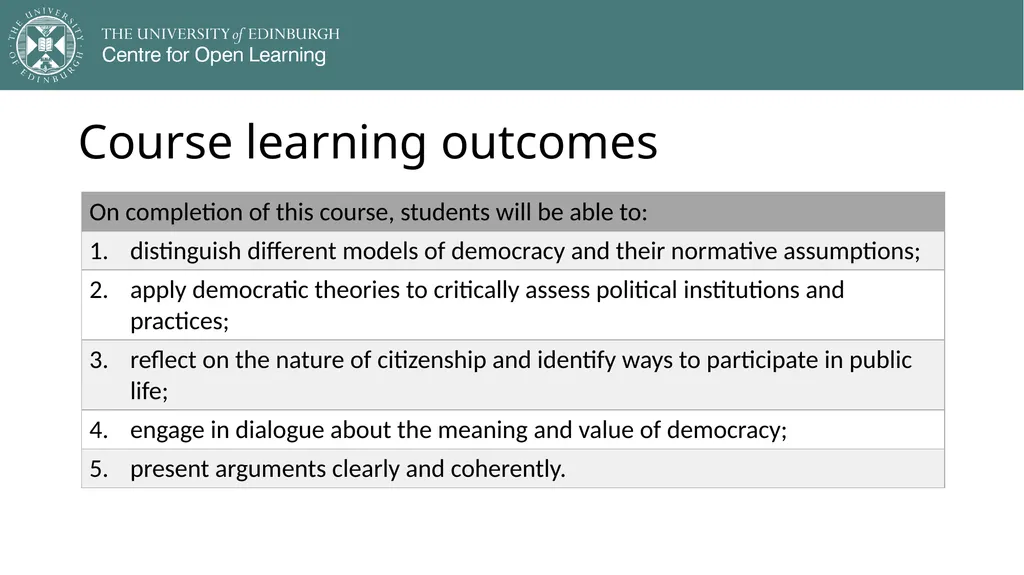
slide17. Course learning outcomes<br>
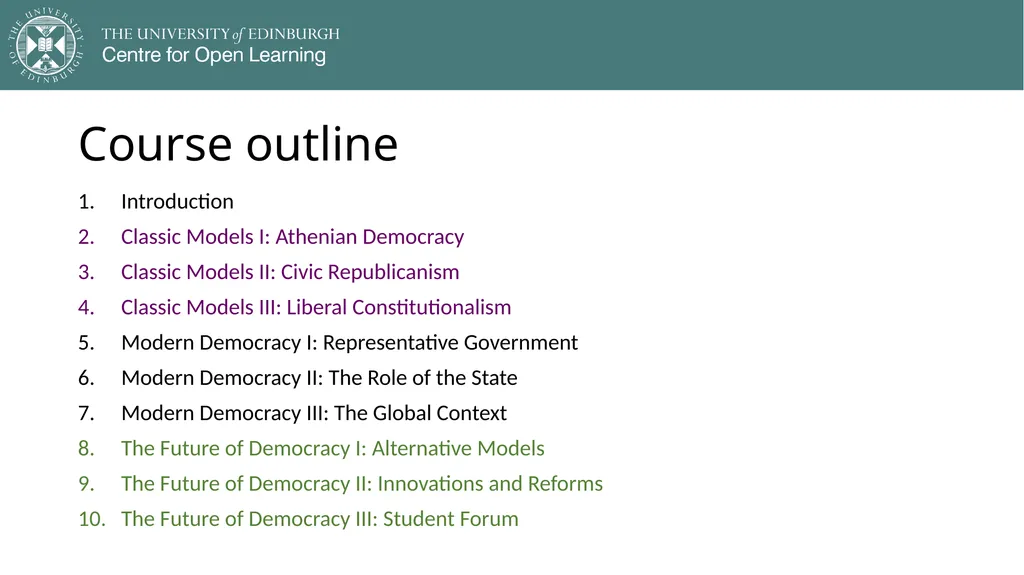
slide18. Course outline Introduction
Classic Models I: Athenian Democracy
Classic Models II: Civic Republicanism
Classic Models III: Liberal Constitutionalism
Modern Democracy I: Representative Government
Modern Democracy II: The Role of the State
Modern Democracy III: The Global Context
The Future of Democracy I: Alternative Models
The Future of Democracy II: Innovations and Reforms
The Future of Democracy III: Student Forum<br>
slide19. Reading and discussion<br>
slide20. Reading and discussion Read the excerpt from Fishkin (2011) on the handout; take notes and write down your thoughts:
What ‘innovative’ democratic method did the Greek PASOK party employ in 2006?
In what ways does this 21st century project resemble democratic practices in ancient Athens?<br>
slide21. Reference list Cunningham, F., 2002. Introduction: In: Theories of Democracy: A Critical Introduction. London: Routledge.
Fishkin, J.S., 2011. Democratic Aspirations. In: When the People Speak: Deliberative Democracy and Public Consultation. Oxford: Oxford University Press. Ch. 1.
Held, D., 2006. Introduction. In: Models of Democracy. 3rd ed. Cambridge: Polity.<br>
slide22. This presentation is an Open Educational Resource. It was originally created for a lifelong learning course (SCQF level 7) at the Centre for Open Learning. You are free to use, share, and adapt this work. To view a copy of the license, visit https://creativecommons.org/licenses/by-sa/4.0/
© Max Jaede, University of Edinburgh, 2020, CC BY-SA 4.0<br>
slide23. Centre for Open LearningThe University of EdinburghPaterson’s LandHolyrood RoadEdinburgh EH8 8AQT: 0131 6504400E: col@ed.ac.ukW: www.ed.ac.uk/open-learningFacebook: www.facebook.com/uoeshortcoursesTwitter: www.twitter.com/uoeshortcourses<br>

slide2. Outline of this class Welcome and introductions
What do we mean by ‘democracy’?
Democratic theory as a field of study
Approach of this course
Course format and practicalities<br>
slide3. Introductions What is your name?
What are you hoping to get out of this course?
What is the most democratic situation, institution or practice you can think of?<br>
slide4. What do we mean by ‘democracy’?<br>
slide5. Democracy as rule by the people The word derives from the ancient Greek demokratia, a compound of demos (the people) and kratia (rule), so ‘democracy’ means rule by the people
But it’s not as simple as it seems! What is meant by ‘rule by’ and ‘the people’ is not obvious, and democratic ideas evolved considerably over the course of history
E.g., representation vs. direct participation in government? ‘The people’ as a select few vs. voting rights for all adult citizens?<br>
slide6. Democracy as a matter of degree Much political rhetoric (and some political scientists) suggest that democracy is a matter of either/or – either societies are democratic or they are not
By contrast, most democratic theorists hold that democracy is a matter of degree, which means that even ‘democratic’ societies only approximate democratic ideals<br>
slide7. Democracy as a contested concept ‘Democracy’ is one of the most widely accepted political values and political actors often invoke it to justify or criticise certain courses of action, yet they use the term to mean very different things
Democracy can be classified as an ‘essentially contested concept’ in that its meaning is subject to ongoing debate and, by its nature, contestable
We can only examine to what extent political practices approximate particular understandings of democratic ideals<br>
slide8. Democratic theory as a field of study<br>
slide9. What is a ‘theory’? In general, a ‘theory’ is a set of statements intended to explain or evaluate certain phenomena
Democratic theories seek to give coherent expression to a set of values, beliefs and principles which may be shared more widely by other people
Democratic theories can be used to identify and distinguish political positions and underlying values, clarify what is at stake in debates, and inform or critically assess political practices<br>
slide10. Questions about democracy Democratic theories – implicitly or explicitly – address three sets of questions (Cunningham, 2002, pp.10-14):
Semantic questions about the meaning of ‘democracy’ and related concepts, such as ‘liberty’, ‘equality’, etc.
Normative questions about the value of (a particular form of) democracy
Descriptive questions concerning the way states or societies called democratic actually function<br>
slide11. Democratic theory as a field of study Democratic theory (and political theory more generally) only evolved as an academic field of study in the 20th century
Within contemporary academia, democratic theorists tend to be based in Politics and Philosophy departments
Democratic theory often refers back to pre-20th century writers and philosophers who did not think of themselves as ‘democratic theorists’ or even as ‘democrats’
In this short course, we will encounter both historical thinkers and contemporary democratic theorists<br>
slide12. Western bias The field has been shaped by intellectual traditions in Europe and North America, and contemporary democratic theory is still Western-centric
This course will focus on the main theories and developments that are directly relevant to Scotland and the UK, but also consider some issues of global reach<br>
slide13. Approach of this course<br>
slide14. A historical approach We will adopt a broadly historical approach to distinguish three intellectual traditions (or ‘classic models’ of democracy), and to trace the evolution of modern mass democracies
In addition, we will look at more recent political developments – from Thatcherism and globalisation to the rise of right-wing populism in the 21st century – which provide the backdrop for contemporary debates in democratic theory<br>
slide15. Theory and practice The course aim is not to discuss theoretical questions in the abstract, or to evaluate different democratic theories
Rather, we will use theories as tools to contrast different meanings of democracy, and to critically examine to what extent democratic aspirations are realised in practice
We will frequently discuss concrete examples, but the course does not systematically examine practices in a specific context (such as Scotland or the UK)<br>
slide16. Democratic learning The course aims to provide opportunities for students to reflect on their experiences as citizens, engage in dialogue with each other, and (individually and collectively) direct their own learning
As part of the credit assessment, you will conduct a case study on a topic of your own choosing
In Week 10, we will discuss topics suggested by the class and you are invited to present findings of your case study<br>
slide17. Course learning outcomes<br>
slide18. Course outline Introduction
Classic Models I: Athenian Democracy
Classic Models II: Civic Republicanism
Classic Models III: Liberal Constitutionalism
Modern Democracy I: Representative Government
Modern Democracy II: The Role of the State
Modern Democracy III: The Global Context
The Future of Democracy I: Alternative Models
The Future of Democracy II: Innovations and Reforms
The Future of Democracy III: Student Forum<br>
slide19. Reading and discussion<br>
slide20. Reading and discussion Read the excerpt from Fishkin (2011) on the handout; take notes and write down your thoughts:
What ‘innovative’ democratic method did the Greek PASOK party employ in 2006?
In what ways does this 21st century project resemble democratic practices in ancient Athens?<br>
slide21. Reference list Cunningham, F., 2002. Introduction: In: Theories of Democracy: A Critical Introduction. London: Routledge.
Fishkin, J.S., 2011. Democratic Aspirations. In: When the People Speak: Deliberative Democracy and Public Consultation. Oxford: Oxford University Press. Ch. 1.
Held, D., 2006. Introduction. In: Models of Democracy. 3rd ed. Cambridge: Polity.<br>
slide22. This presentation is an Open Educational Resource. It was originally created for a lifelong learning course (SCQF level 7) at the Centre for Open Learning. You are free to use, share, and adapt this work. To view a copy of the license, visit https://creativecommons.org/licenses/by-sa/4.0/
© Max Jaede, University of Edinburgh, 2020, CC BY-SA 4.0<br>
slide23. Centre for Open LearningThe University of EdinburghPaterson’s LandHolyrood RoadEdinburgh EH8 8AQT: 0131 6504400E: col@ed.ac.ukW: www.ed.ac.uk/open-learningFacebook: www.facebook.com/uoeshortcoursesTwitter: www.twitter.com/uoeshortcourses<br>