Demonstration Of Respect For Patient Samples Competency Demonstration of respect for patient samples sent to the laboratory for performance of laboratory tests in the detection of microbial agents causing infectious diseases Case scenarios
"Demonstration Of Respect For Patient Samples" is the property of its rightful owner. Permission is granted to
download and print the materials on this website for personal, non-commercial use only, and to display it
on your personal computer provided you do not modify the materials and that you retain all copyright
notices contained in the materials. By downloading content from our website, you accept the terms of this
agreement.
Presentation Transcript
01
Demonstration Of Respect For Patient Samples<br>
02
Competency Demonstration of respect for patient samples sent to the laboratory for performance of laboratory tests in the detection of microbial agents causing infectious diseases<br>
03
Case scenarios<br>
04
1. Rejection due to improper transport Sequestrum from a chronic osteomyelitis case was debrided and sent for culture and sensitivity
The sample was rejected by the laboratory mentioning that it was received in formalin, hence unsuitable for culture
There is no more sample available for culture now<br>
05
2. Specimen did not reach the laboratory A critically ill 5 year old child’s CSF report is awaited for 3 days
On enquiry, laboratory says it did not receive the sample
On further probing, it was found that the nursing staff had kept the sample container in his pocket and mistakenly taken it outside the hospital and had dropped it somewhere, and did not submit it to the laboratory for testing
Now the baby needs to undergo lumbar puncture again, results may not be the same as antibiotics are give and need to wait for some more days for the culture report<br>
06
3. Misguided report due to inadequate information in requisition form Urologist calls up the laboratory to discuss about ‘insignificant bacteriuria’ culture report of a pyelonephritis patient
He says it was a percutaneous nephrostomy sample and asks for the organism and antimicrobial sensitivity
Microbiologist says it was written as urine sample on the request form, some gram negative bacillus had grown and the count was less than 10,000 CFU/ml, so it was thought to be a periurethral commensal and the isolates was discarded and hence further testing can not be done<br>
07
4. Rejection due to improper collection A suspected pulmonary tuberculosis patient, who would travel 30 km from his village to the private hospital in the city, had submitted spot sputum sample the previous day and an early morning sample today for acid fast staining
Reports of both the samples mentioned “many epithelial cells s/o excessive salivary contamination”, repeat with the proper sample
The doctor found it very difficult to convince the patient to submit proper samples again and pay for them too<br>
08
Essential background knowledge Appropriate sample for test planned: sample type, amount, collection procedure, preservative if any, container type used and its transportation and storage
Appropriate labelling for correct sample identification
Accompanying clinical information for correlation
Possible medicolegal/Sociocultural/Ethical issues following incomplete/incorrect sample identification, relevant clinical information for correlation, proper storage or transportation<br>
09
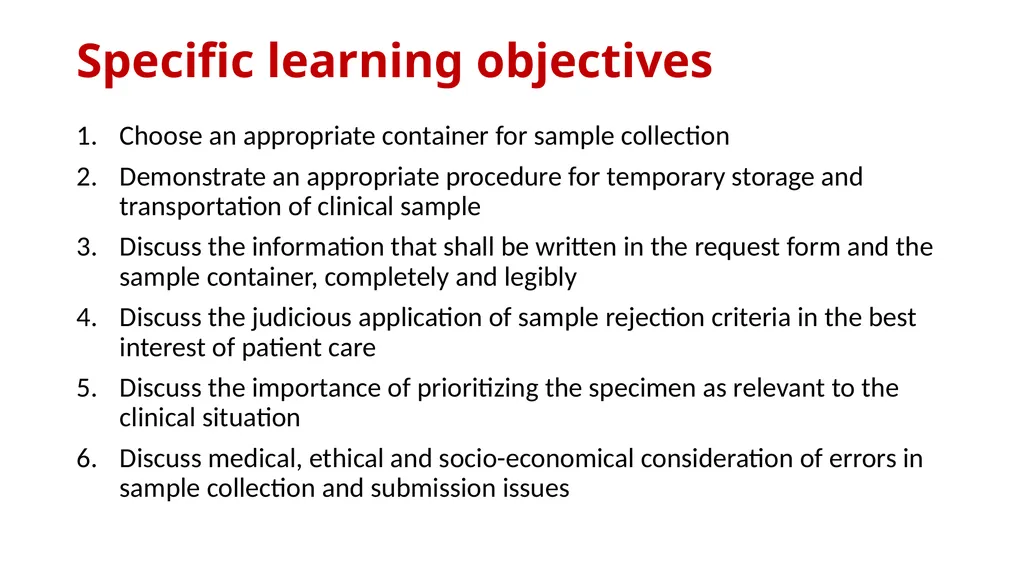
Specific learning objectives Choose an appropriate container for sample collection
Demonstrate an appropriate procedure for temporary storage and transportation of clinical sample
Discuss the information that shall be written in the request form and the sample container, completely and legibly
Discuss the judicious application of sample rejection criteria in the best interest of patient care
Discuss the importance of prioritizing the specimen as relevant to the clinical situation
Discuss medical, ethical and socio-economical consideration of errors in sample collection and submission issues<br>
10
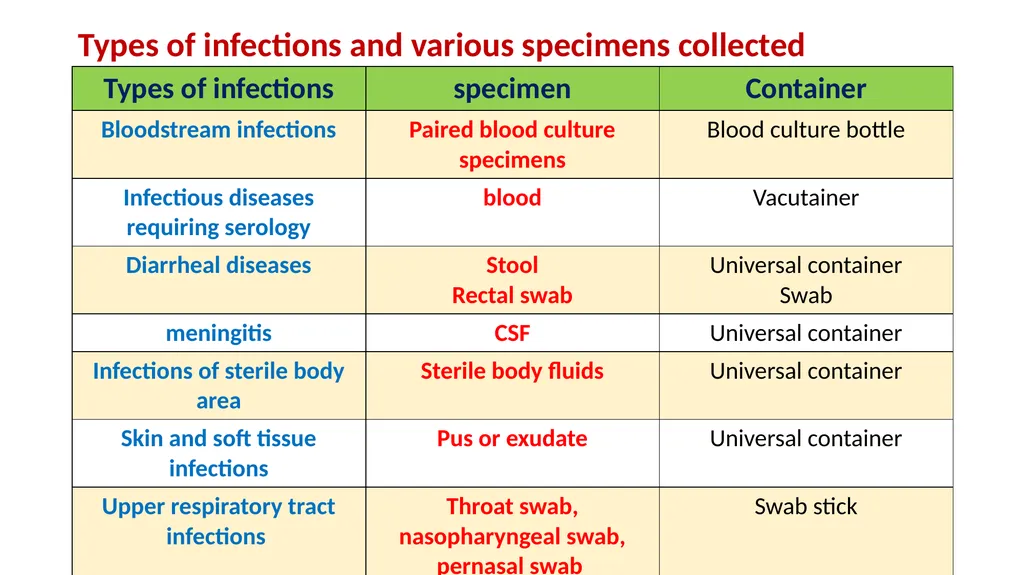
Types of infections and various specimens collected<br>
11
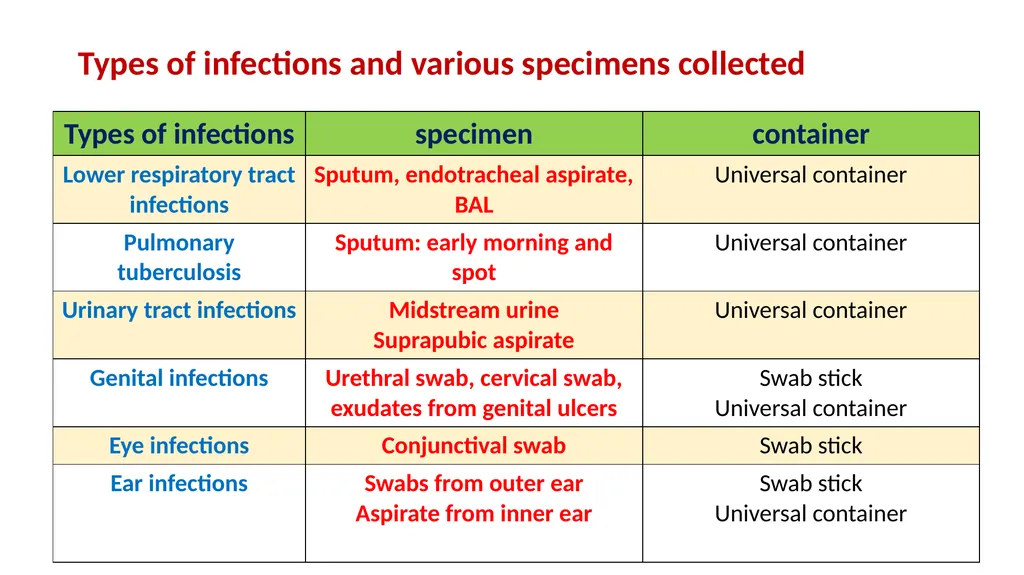
Types of infections and various specimens collected<br>
12
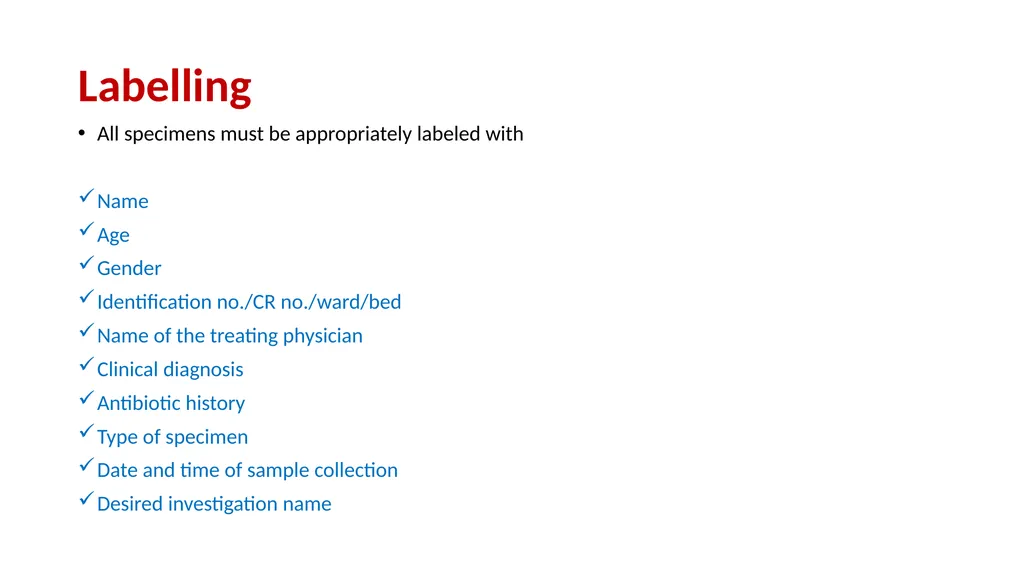
Labelling All specimens must be appropriately labeled with
Name
Age
Gender
Identification no./CR no./ward/bed
Name of the treating physician
Clinical diagnosis
Antibiotic history
Type of specimen
Date and time of sample collection
Desired investigation name<br>
13
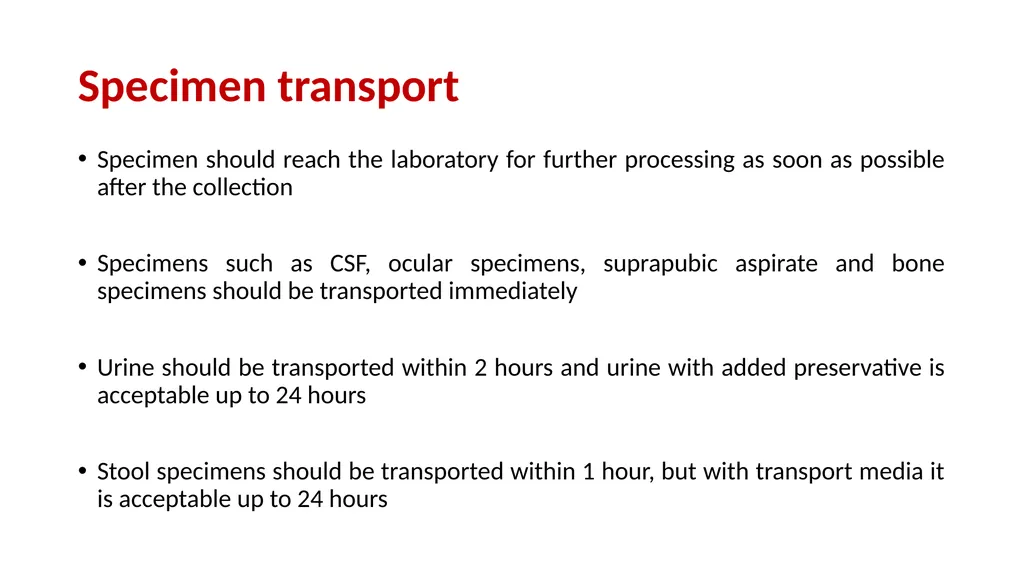
Specimen transport Specimen should reach the laboratory for further processing as soon as possible after the collection
Specimens such as CSF, ocular specimens, suprapubic aspirate and bone specimens should be transported immediately
Urine should be transported within 2 hours and urine with added preservative is acceptable up to 24 hours
Stool specimens should be transported within 1 hour, but with transport media it is acceptable up to 24 hours<br>
14
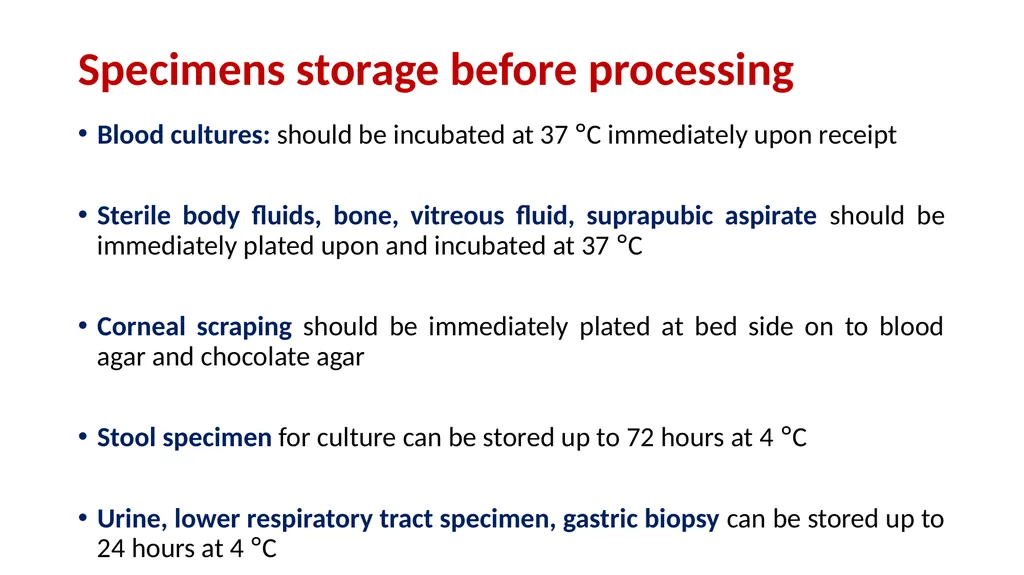
Specimens storage before processing Blood cultures: should be incubated at 37 °C immediately upon receipt
Sterile body fluids, bone, vitreous fluid, suprapubic aspirate should be immediately plated upon and incubated at 37 °C
Corneal scraping should be immediately plated at bed side on to blood agar and chocolate agar
Stool specimen for culture can be stored up to 72 hours at 4 °C
Urine, lower respiratory tract specimen, gastric biopsy can be stored up to 24 hours at 4 °C<br>
15
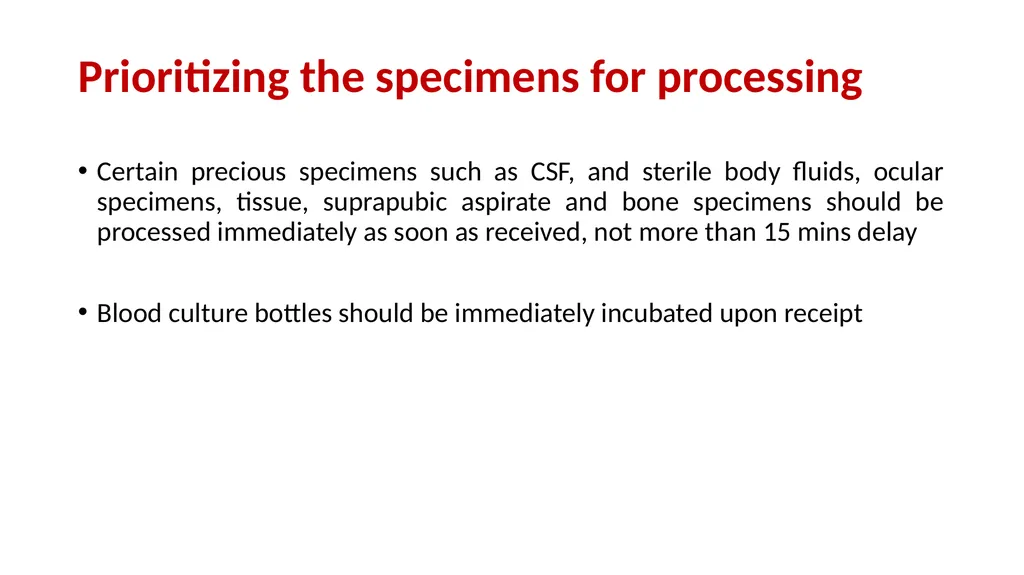
Prioritizing the specimens for processing Certain precious specimens such as CSF, and sterile body fluids, ocular specimens, tissue, suprapubic aspirate and bone specimens should be processed immediately as soon as received, not more than 15 mins delay
Blood culture bottles should be immediately incubated upon receipt<br>
16
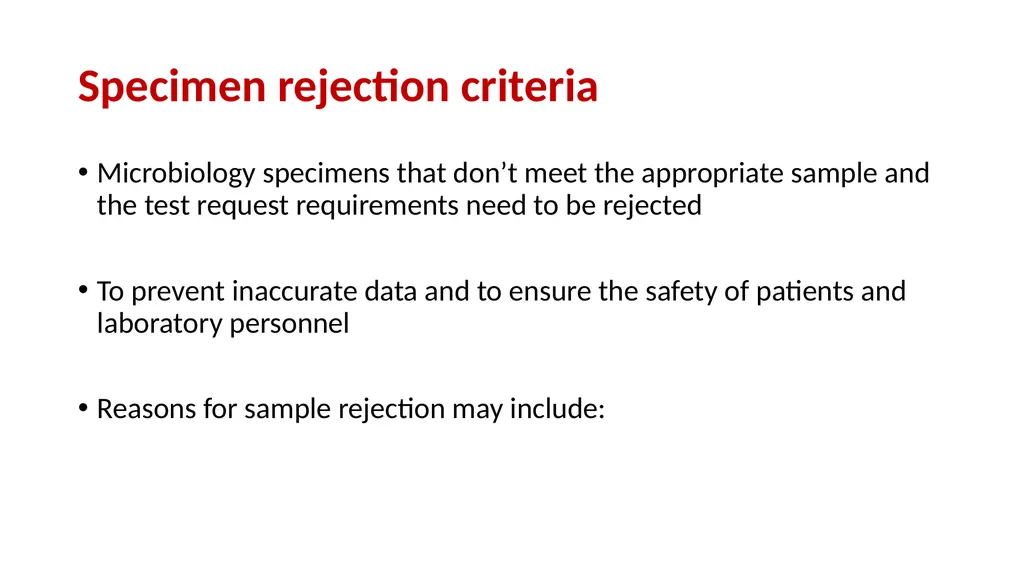
Specimen rejection criteria Microbiology specimens that don’t meet the appropriate sample and the test request requirements need to be rejected
To prevent inaccurate data and to ensure the safety of patients and laboratory personnel
Reasons for sample rejection may include:<br>
17
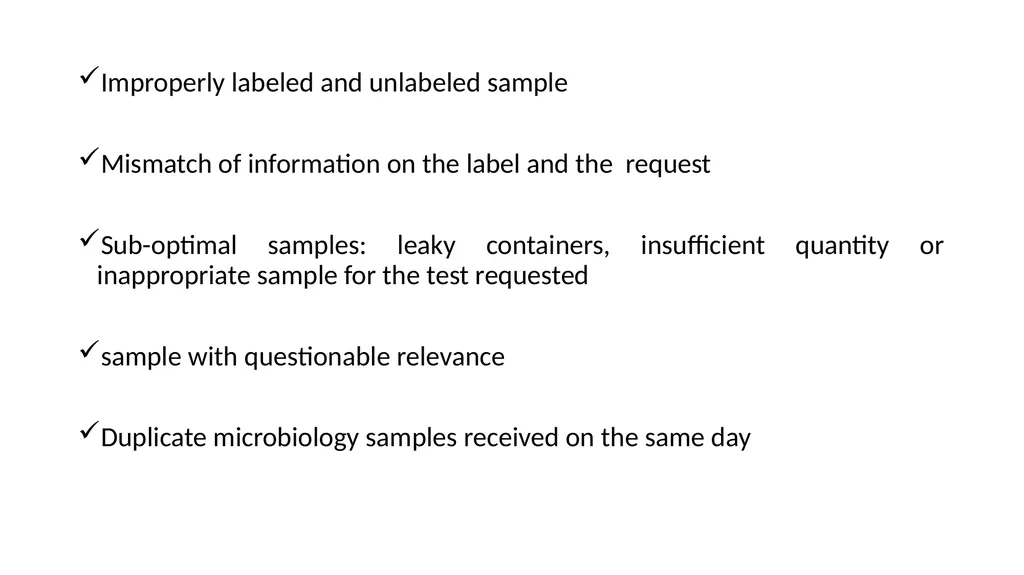
Improperly labeled and unlabeled sample
Mismatch of information on the label and the request
Sub-optimal samples: leaky containers, insufficient quantity or inappropriate sample for the test requested
sample with questionable relevance
Duplicate microbiology samples received on the same day<br>
18
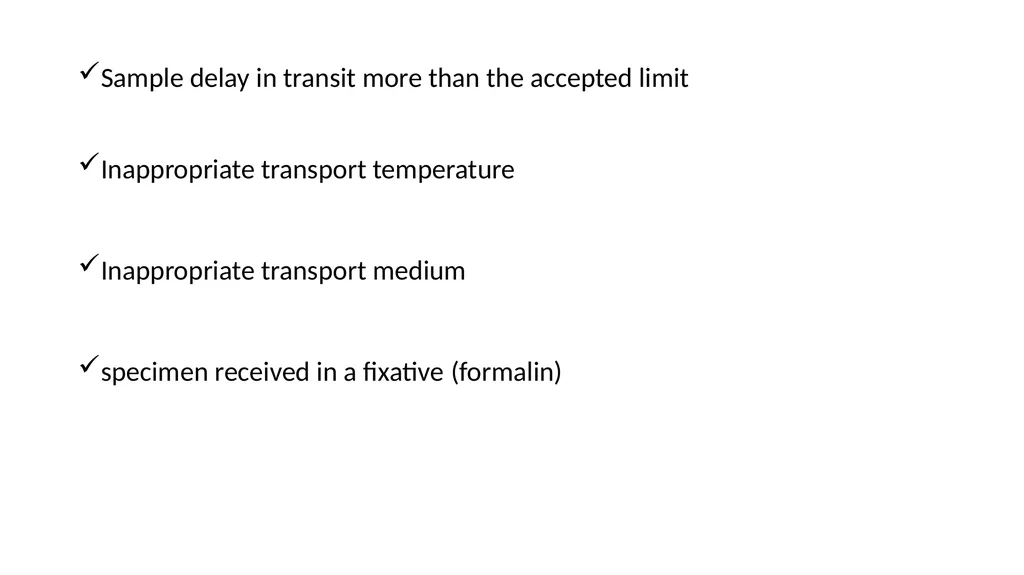
Sample delay in transit more than the accepted limit