
Depot training for Practice Nurses Presented by
AM
Published · 44 slides · 0 views

1 / 1







Description
Depot training for Practice Nurses Presented by KarmJit Dhillon, Oisagie Emmanuel Usideme and Leon Kaday commtuniy matrons for MINT Question for participants: Where will you be administering depot injections, in the community, in a depot
Related Topics
Share
Embed code
Download this presentation From Below
"Depot training for Practice Nurses Presented by" is the property of its rightful owner. Permission is granted to download and print the materials on this website for personal, non-commercial use only, and to display it on your personal computer provided you do not modify the materials and that you retain all copyright notices contained in the materials. By downloading content from our website, you accept the terms of this agreement.
Presentation Transcript
01
Depot training for Practice Nurses Presented by KarmJit Dhillon, Oisagie Emmanuel Usideme and Leon Kaday commtuniy matron’s for MINT<br>
02
Question for participants: Where will you be administering depot injections, in the community, in a depot clinic or in individual appointments with patients?<br>
03
The ten rights of medication administration otherwise known as the ten R’s 1. Right patient- Positively identity the patient ask what is your name, address DOB to confirm identity , never say is your name…etc
2. Right medication- Verify that the medication being administered is the correct one . Check expiry date of medication before administration
3. Right dose Check the prescription. Confirm the appropriateness of the dose using the BNF or local guidelines. If necessary, calculate the dose and have another nurse calculate the dose independently<br>
2. Right medication- Verify that the medication being administered is the correct one . Check expiry date of medication before administration
3. Right dose Check the prescription. Confirm the appropriateness of the dose using the BNF or local guidelines. If necessary, calculate the dose and have another nurse calculate the dose independently<br>
04
4. Right route. Confirm the correct route prevents harmful effects and ensure optimal drug absorption
5. Right time and Frequency Check the frequency of the prescribed medication. Double-check that you are giving the prescribed at the correct time. Confirm when the last dose was given.
6. Right Documentation Record the time dose route and any revelent information in the care record. Is the prescription on the medication chart valid. Is full information contained in the chart including allergy's Ten R’s<br>
5. Right time and Frequency Check the frequency of the prescribed medication. Double-check that you are giving the prescribed at the correct time. Confirm when the last dose was given.
6. Right Documentation Record the time dose route and any revelent information in the care record. Is the prescription on the medication chart valid. Is full information contained in the chart including allergy's Ten R’s<br>
05
Ten R’S 7. Right to refuse
Ensure you have the patient consent to administer medications. Be aware that patients do have a right to refuse medication
8. Right assessment Check your patient actually needs the medication. Check for contraindications. Baseline observations if required.
9. Right evaluation
Ensure the medication is working the way it should. Ensure medications are reviewed regularly. Ongoing observations if required.
10. Right education Provide clear and concise information about the medication being taken. Increase health literacy. Provide leaflets, sign post to sources of information<br>
Ensure you have the patient consent to administer medications. Be aware that patients do have a right to refuse medication
8. Right assessment Check your patient actually needs the medication. Check for contraindications. Baseline observations if required.
9. Right evaluation
Ensure the medication is working the way it should. Ensure medications are reviewed regularly. Ongoing observations if required.
10. Right education Provide clear and concise information about the medication being taken. Increase health literacy. Provide leaflets, sign post to sources of information<br>
06
NMC The code: 13: Recognise and work within the limits of your competence
13.3 ask for help from a suitably qualified and experienced professional to carry out any action or procedure that is beyond the limits of your competence
13.5 complete the necessary training before carrying out a new role
18: Advise on, prescribe, supply, dispense or administer medicines within the limits of your training and competence, the law, our guidance and other relevant policies, guidance and regulations<br>
13.3 ask for help from a suitably qualified and experienced professional to carry out any action or procedure that is beyond the limits of your competence
13.5 complete the necessary training before carrying out a new role
18: Advise on, prescribe, supply, dispense or administer medicines within the limits of your training and competence, the law, our guidance and other relevant policies, guidance and regulations<br>
07
Question for participants: what sites do you use to administer depot injections in your practice?<br>
08
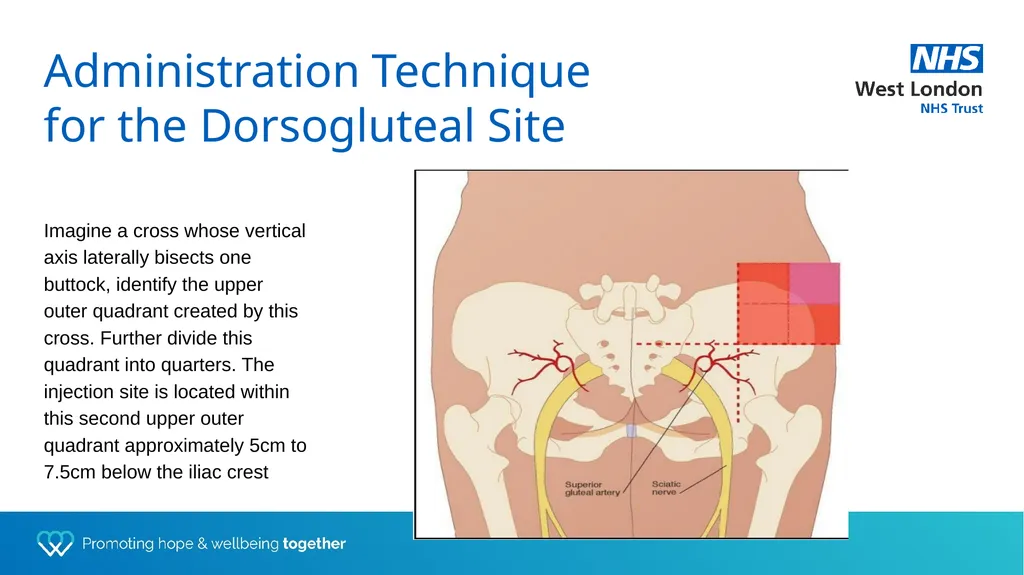
Administration Technique for the Dorsogluteal Site
Imagine a cross whose vertical
axis laterally bisects one
buttock, identify the upper
outer quadrant created by this
cross. Further divide this
quadrant into quarters. The
injection site is located within
this second upper outer
quadrant approximately 5cm to
7.5cm below the iliac crest<br>
Imagine a cross whose vertical
axis laterally bisects one
buttock, identify the upper
outer quadrant created by this
cross. Further divide this
quadrant into quarters. The
injection site is located within
this second upper outer
quadrant approximately 5cm to
7.5cm below the iliac crest<br>
09
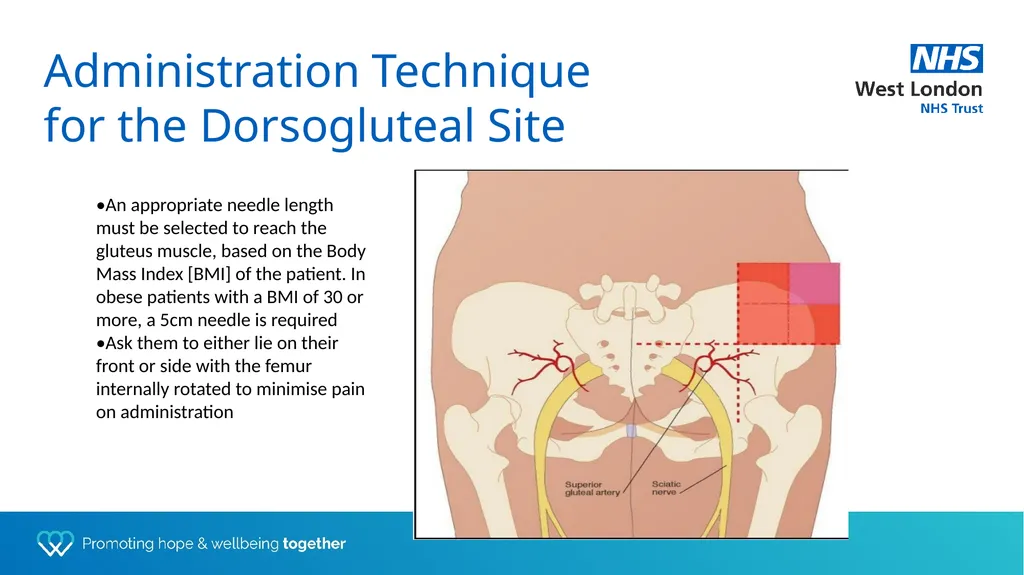
Administration Technique for the Dorsogluteal Site •An appropriate needle length
must be selected to reach the
gluteus muscle, based on the Body
Mass Index [BMI] of the patient. In
obese patients with a BMI of 30 or
more, a 5cm needle is required
•Ask them to either lie on their
front or side with the femur
internally rotated to minimise pain
on administration<br>
must be selected to reach the
gluteus muscle, based on the Body
Mass Index [BMI] of the patient. In
obese patients with a BMI of 30 or
more, a 5cm needle is required
•Ask them to either lie on their
front or side with the femur
internally rotated to minimise pain
on administration<br>
10
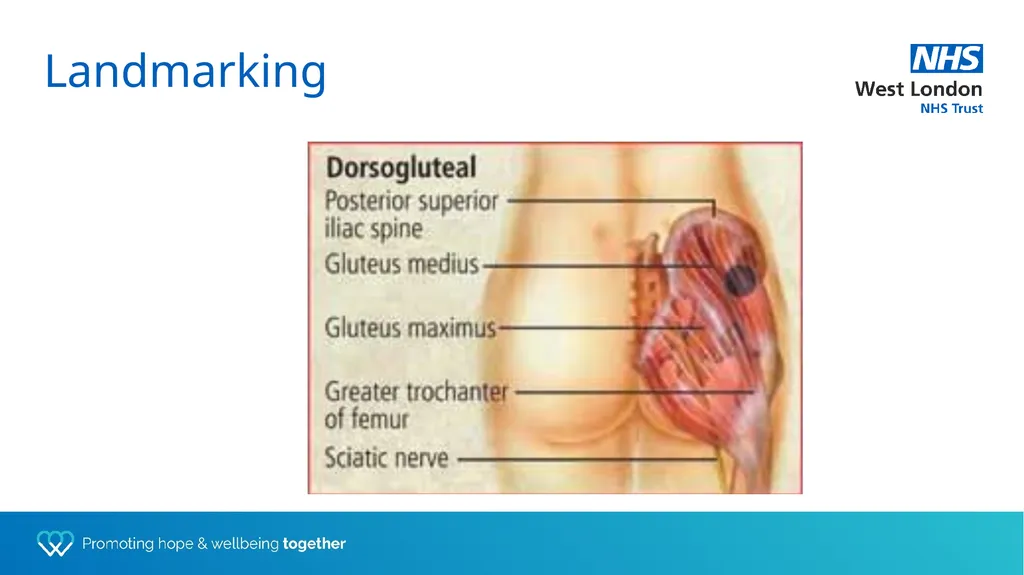
Landmarking<br>
11
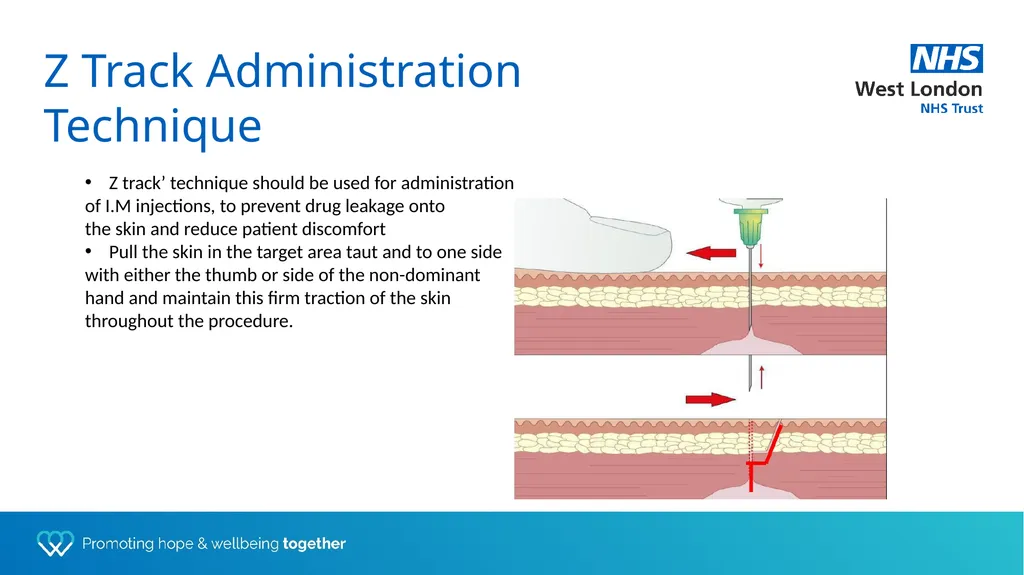
Z Track Administration Technique Z track’ technique should be used for administration
of I.M injections, to prevent drug leakage onto
the skin and reduce patient discomfort
Pull the skin in the target area taut and to one side
with either the thumb or side of the non-dominant
hand and maintain this firm traction of the skin
throughout the procedure.<br>
of I.M injections, to prevent drug leakage onto
the skin and reduce patient discomfort
Pull the skin in the target area taut and to one side
with either the thumb or side of the non-dominant
hand and maintain this firm traction of the skin
throughout the procedure.<br>
12
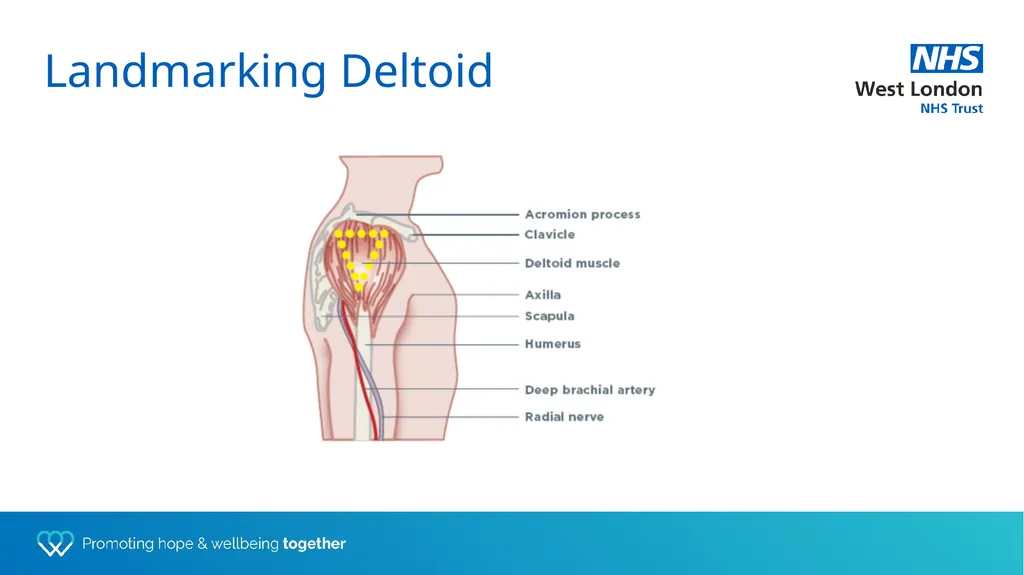
Landmarking Deltoid<br>
13
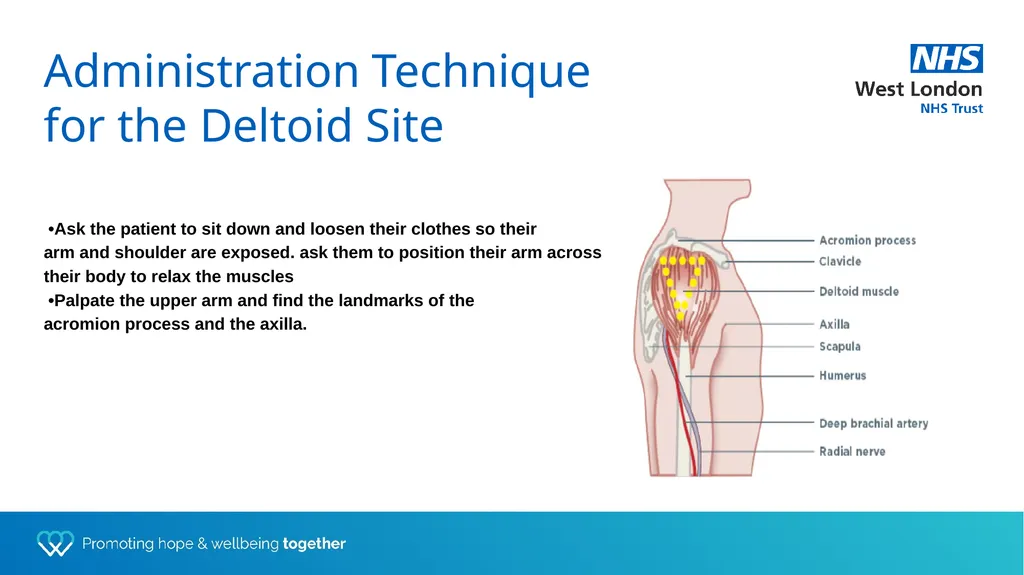
Administration Technique for the Deltoid Site
•Ask the patient to sit down and loosen their clothes so their
arm and shoulder are exposed. ask them to position their arm across
their body to relax the muscles
•Palpate the upper arm and find the landmarks of the
acromion process and the axilla.<br>
•Ask the patient to sit down and loosen their clothes so their
arm and shoulder are exposed. ask them to position their arm across
their body to relax the muscles
•Palpate the upper arm and find the landmarks of the
acromion process and the axilla.<br>
14
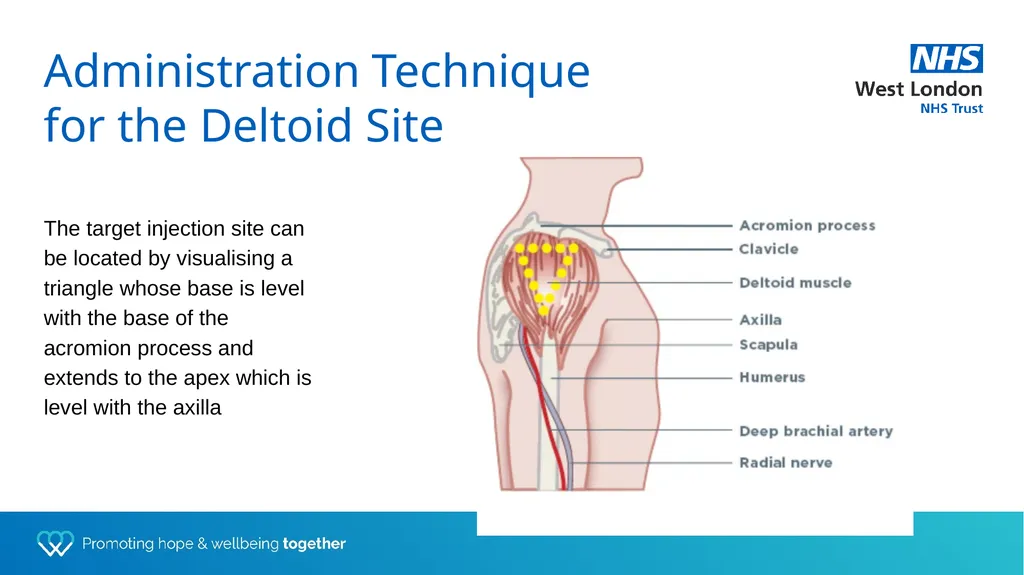
Administration Technique for the Deltoid Site
The target injection site can
be located by visualising a
triangle whose base is level
with the base of the
acromion process and
extends to the apex which is
level with the axilla<br>
The target injection site can
be located by visualising a
triangle whose base is level
with the base of the
acromion process and
extends to the apex which is
level with the axilla<br>
15
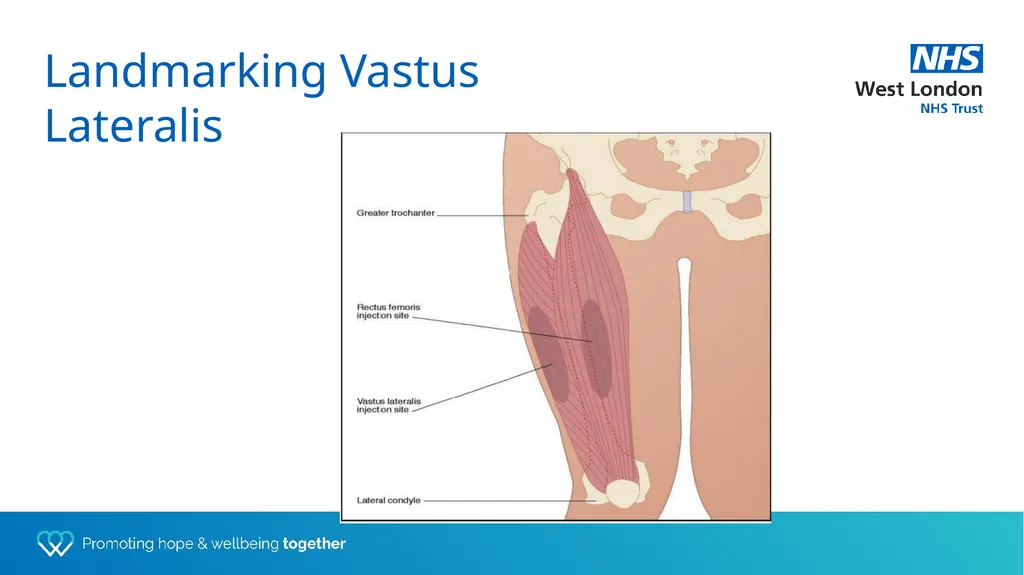
Landmarking Vastus Lateralis<br>
16
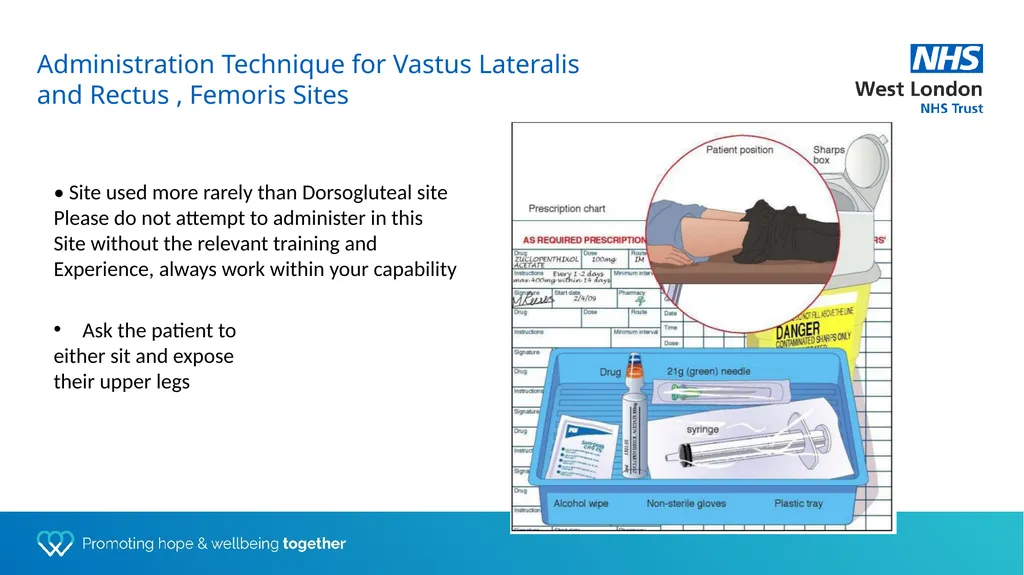
Administration Technique for Vastus Lateralis and Rectus , Femoris Sites • Site used more rarely than Dorsogluteal site
Please do not attempt to administer in this
Site without the relevant training and
Experience, always work within your capability
Ask the patient to
either sit and expose
their upper legs<br>
Please do not attempt to administer in this
Site without the relevant training and
Experience, always work within your capability
Ask the patient to
either sit and expose
their upper legs<br>
17
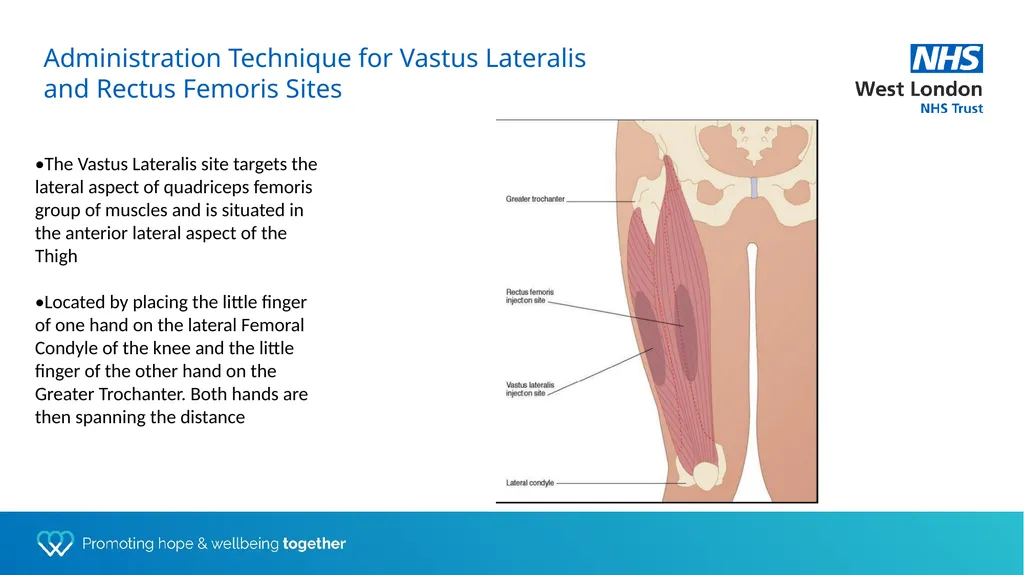
Administration Technique for Vastus Lateralis and Rectus Femoris Sites •The Vastus Lateralis site targets the
lateral aspect of quadriceps femoris
group of muscles and is situated in
the anterior lateral aspect of the
Thigh
•Located by placing the little finger
of one hand on the lateral Femoral
Condyle of the knee and the little
finger of the other hand on the
Greater Trochanter. Both hands are
then spanning the distance<br>
lateral aspect of quadriceps femoris
group of muscles and is situated in
the anterior lateral aspect of the
Thigh
•Located by placing the little finger
of one hand on the lateral Femoral
Condyle of the knee and the little
finger of the other hand on the
Greater Trochanter. Both hands are
then spanning the distance<br>
18
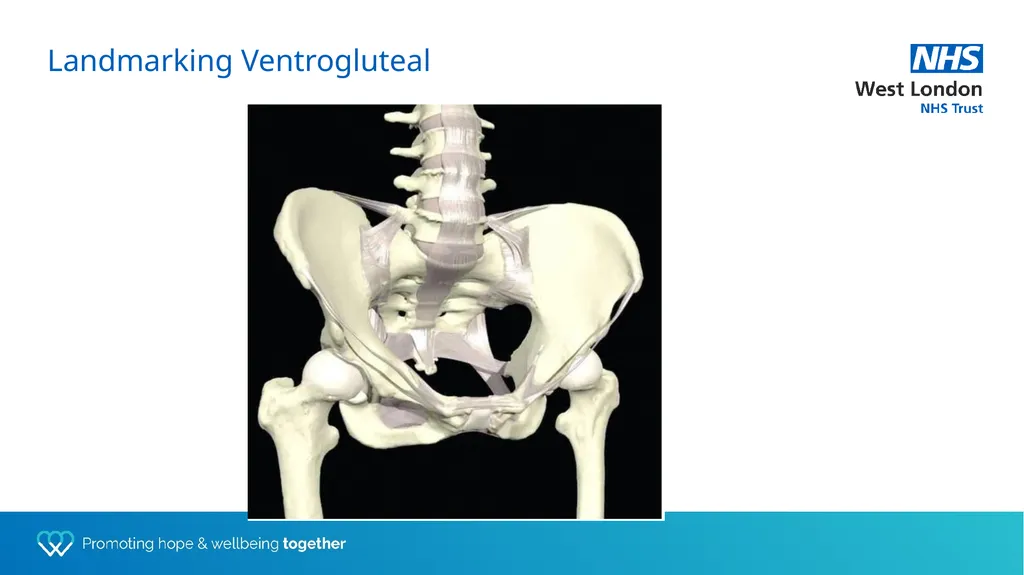
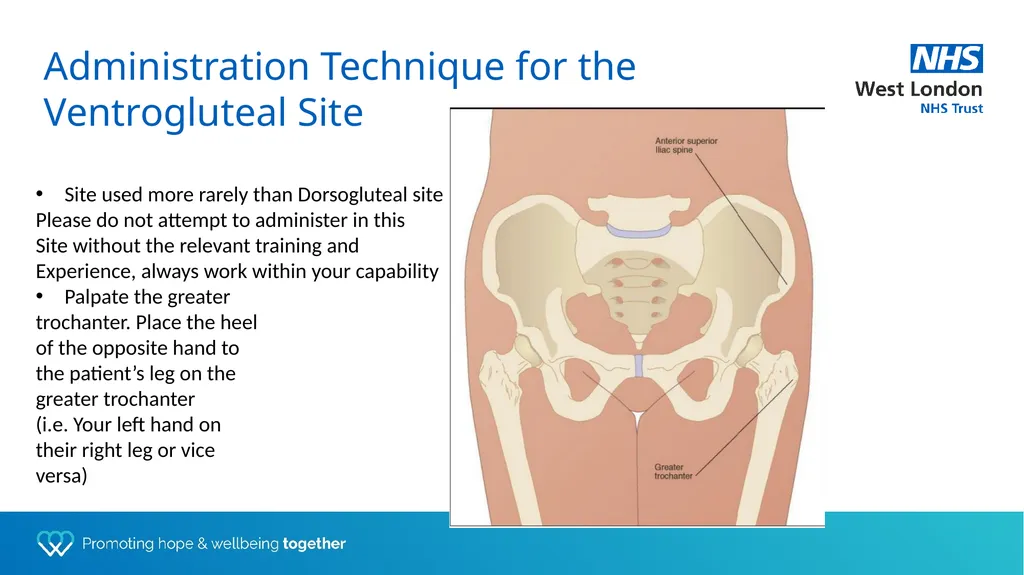
Landmarking Ventrogluteal<br>
19
Administration Technique for the Ventrogluteal Site Site used more rarely than Dorsogluteal site
Please do not attempt to administer in this
Site without the relevant training and
Experience, always work within your capability
Palpate the greater
trochanter. Place the heel
of the opposite hand to
the patient’s leg on the
greater trochanter
(i.e. Your left hand on
their right leg or vice
versa)<br>
Please do not attempt to administer in this
Site without the relevant training and
Experience, always work within your capability
Palpate the greater
trochanter. Place the heel
of the opposite hand to
the patient’s leg on the
greater trochanter
(i.e. Your left hand on
their right leg or vice
versa)<br>
20
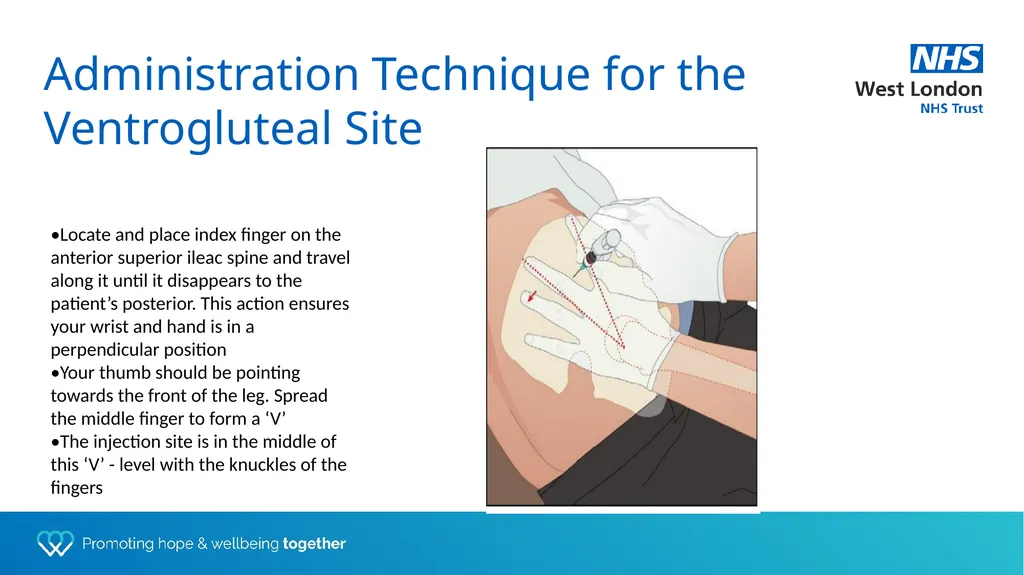
Administration Technique for the Ventrogluteal Site •Locate and place index finger on the
anterior superior ileac spine and travel
along it until it disappears to the
patient’s posterior. This action ensures
your wrist and hand is in a
perpendicular position
•Your thumb should be pointing
towards the front of the leg. Spread
the middle finger to form a ‘V’
•The injection site is in the middle of
this ‘V’ - level with the knuckles of the
fingers<br>
anterior superior ileac spine and travel
along it until it disappears to the
patient’s posterior. This action ensures
your wrist and hand is in a
perpendicular position
•Your thumb should be pointing
towards the front of the leg. Spread
the middle finger to form a ‘V’
•The injection site is in the middle of
this ‘V’ - level with the knuckles of the
fingers<br>
21
Question for participants: What are the arrangements for disposing of clinical waste and sharps in your area ?<br>
22
The Storage and Security of Depot / Long Acting Injections All Depot / Long Acting Injections should be stored within Pharmacy approved lockable
cupboards.
The medication cupboards should be kept locked when not in use and not left unattended whilst unlocked.
The injections should be stored in accordance with the Monitoring and Recording of
Ambient (Room) and Refrigerator Temperatures SOP
All medicine cupboard keys must be kept separate from other department / team base keys. They must be clearly identified and kept together within a locked key box or safe. The key box or safe must be attached to a permanent fixture in a safe location within the team base.
Access to medication refrigerators and cupboards is restricted to Registered Nursing staff within the community team
NMC The code 18.4 take all steps to keep medicines stored securely<br>
cupboards.
The medication cupboards should be kept locked when not in use and not left unattended whilst unlocked.
The injections should be stored in accordance with the Monitoring and Recording of
Ambient (Room) and Refrigerator Temperatures SOP
All medicine cupboard keys must be kept separate from other department / team base keys. They must be clearly identified and kept together within a locked key box or safe. The key box or safe must be attached to a permanent fixture in a safe location within the team base.
Access to medication refrigerators and cupboards is restricted to Registered Nursing staff within the community team
NMC The code 18.4 take all steps to keep medicines stored securely<br>
23
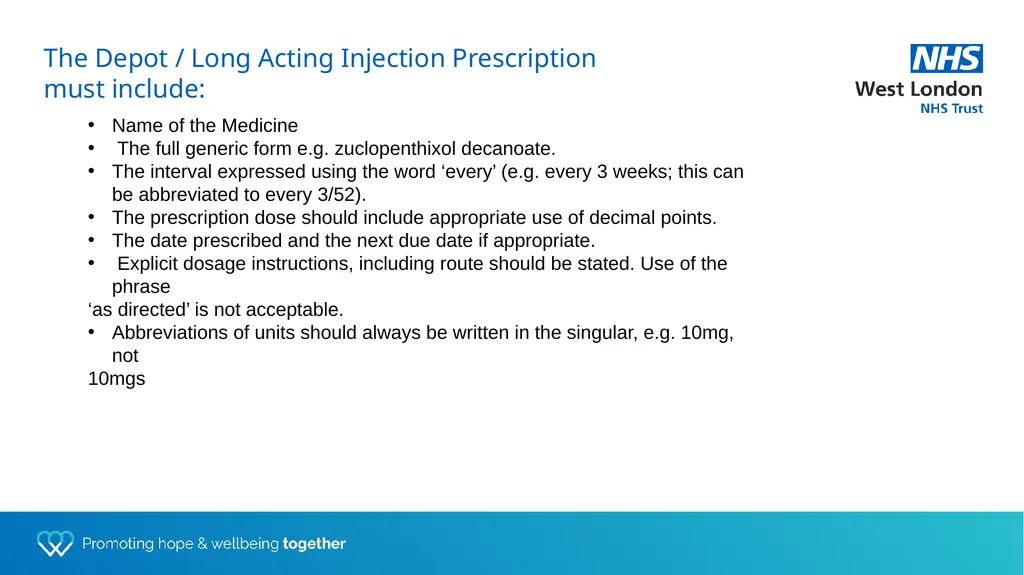
The Depot / Long Acting Injection Prescription must include: The full generic form e.g. zuclopenthixol decanoate.
The interval expressed using the word ‘every’ (e.g. every 3 weeks; this can be abbreviated to every 3/52).
The prescription dose should include appropriate use of decimal points.
Name of the Medicine
The date prescribed and the next due date if appropriate.
Explicit dosage instructions, including route should be stated. Use of the phrase
‘as directed’ is not acceptable.
Abbreviations of units should always be written in the singular, e.g. 10mg, not
10mgs<br>
The interval expressed using the word ‘every’ (e.g. every 3 weeks; this can be abbreviated to every 3/52).
The prescription dose should include appropriate use of decimal points.
Name of the Medicine
The date prescribed and the next due date if appropriate.
Explicit dosage instructions, including route should be stated. Use of the phrase
‘as directed’ is not acceptable.
Abbreviations of units should always be written in the singular, e.g. 10mg, not
10mgs<br>
24
The Depot / Long Acting Injection Prescription must include: Name of the Medicine
The full generic form e.g. zuclopenthixol decanoate.
The interval expressed using the word ‘every’ (e.g. every 3 weeks; this can be abbreviated to every 3/52).
The prescription dose should include appropriate use of decimal points.
The date prescribed and the next due date if appropriate.
Explicit dosage instructions, including route should be stated. Use of the phrase
‘as directed’ is not acceptable.
Abbreviations of units should always be written in the singular, e.g. 10mg, not
10mgs<br>
The full generic form e.g. zuclopenthixol decanoate.
The interval expressed using the word ‘every’ (e.g. every 3 weeks; this can be abbreviated to every 3/52).
The prescription dose should include appropriate use of decimal points.
The date prescribed and the next due date if appropriate.
Explicit dosage instructions, including route should be stated. Use of the phrase
‘as directed’ is not acceptable.
Abbreviations of units should always be written in the singular, e.g. 10mg, not
10mgs<br>
25
Prescribing Incidents Prescribing incidents are defined as, and not limited to:
• The wrong medicine
• The wrong dose of medicine
• The wrong frequency
• The wrong route
• The wrong due date of administration outside of the acceptable window as agreed by the prescriber
• Failure to sign the prescription / patient allergies / Hypersensitivities.
All prescribing incidents must be reported via your organisations Incident Reporting System.<br>
• The wrong medicine
• The wrong dose of medicine
• The wrong frequency
• The wrong route
• The wrong due date of administration outside of the acceptable window as agreed by the prescriber
• Failure to sign the prescription / patient allergies / Hypersensitivities.
All prescribing incidents must be reported via your organisations Incident Reporting System.<br>
26
Monitoring side-effects / Adverse Drug Reactions Prescribers must fully inform patients of possible side-effects / adverse drug reactions that could be caused by the injection prior to prescribing it and should be offered patient information leaflet (Choice & Medication leaflet).
• During every contact, the Registered Mental Health nurse, must actively ask patients about side-effects / adverse drug reactions that the patient may be experiencing.
• If the Registered Mental Health nurse, becomes aware of or observes any adverse drug reaction following the administration of the Depot / Long Acting Injection, they should contact the relevant medical team without delay.
• Details of any serious adverse effects relating to or suspected to relate to the administration of Depot / Long Acting Injections should be recorded in the patient’s record and this information should be related to the prescriber.<br>
• During every contact, the Registered Mental Health nurse, must actively ask patients about side-effects / adverse drug reactions that the patient may be experiencing.
• If the Registered Mental Health nurse, becomes aware of or observes any adverse drug reaction following the administration of the Depot / Long Acting Injection, they should contact the relevant medical team without delay.
• Details of any serious adverse effects relating to or suspected to relate to the administration of Depot / Long Acting Injections should be recorded in the patient’s record and this information should be related to the prescriber.<br>
27
The Administration of Depot / Long Acting Injections 1. Depot / Long Acting Injections must only be administered with a valid, a clearly written and unambiguous prescription, using the generic name of the injection, on the Trust approved community Depot / Long Acting Injection prescription and administration Card.
IM Depot / Long Acting Injection must be administered by a Registered Mental Health nurse, or a Nurse in training under the direct supervision of a Registered Nurse.<br>
IM Depot / Long Acting Injection must be administered by a Registered Mental Health nurse, or a Nurse in training under the direct supervision of a Registered Nurse.<br>
28
The Administration of Depot / Long Acting Injections 2. • The person who administers a medicine is responsible and accountable for their action /omissions.
• The registered nurse responsible for the administration of the IM injection must ensure that any required calculation is correct. A second practitioner must independently calculate the dose in order to cross check the medication due to be administered to minimise the risk of error.<br>
• The registered nurse responsible for the administration of the IM injection must ensure that any required calculation is correct. A second practitioner must independently calculate the dose in order to cross check the medication due to be administered to minimise the risk of error.<br>
29
Documentation Each written entry should include the standards as outlined within the Trust clinical
record keeping policy and NMC record keeping guidelines.
Each entry should include:
Prescribed injection administered
Concordance and compliance
Mental health presentation
Expressed or observed adverse effects
Next due date of administration
Any other concerns voiced or noted within the consultation
Completion of Community Depot/Long Acting Injection Prescription and
Administration Card.<br>
record keeping policy and NMC record keeping guidelines.
Each entry should include:
Prescribed injection administered
Concordance and compliance
Mental health presentation
Expressed or observed adverse effects
Next due date of administration
Any other concerns voiced or noted within the consultation
Completion of Community Depot/Long Acting Injection Prescription and
Administration Card.<br>
30
DNA’s and late administration (for info only) : The Policy of West London NHS Trust is to contact service users if they do not attend appointments. This may also involve liaison with referrer / other interested parties, within the remit of our legal responsibility for patient confidentiality
During this follow up the professional involved may need to ascertain if there are any significant concerns, Harm to self / neglect, Harm to others, Safeguarding, Nature of mental health.
If there are concerns there should be further discussion with service user , Agreement about the venue for next contact Involve other agencies as appropriate.
Depending on concerns and level of contact there may be need to be a Planned appointment / visit
or an Unannounced visit
Some medications may need to be reiterated if administration has been delayed, please consult with the appropriate Dr and/or your pharmacy.<br>
During this follow up the professional involved may need to ascertain if there are any significant concerns, Harm to self / neglect, Harm to others, Safeguarding, Nature of mental health.
If there are concerns there should be further discussion with service user , Agreement about the venue for next contact Involve other agencies as appropriate.
Depending on concerns and level of contact there may be need to be a Planned appointment / visit
or an Unannounced visit
Some medications may need to be reiterated if administration has been delayed, please consult with the appropriate Dr and/or your pharmacy.<br>
31
Contact details for Ealing MINT teams Ealing MINT North: ealingnorthmint@westlondon.nhs.uk
020 8483 2700
Ealing MINT South: EalingSouthallMINT@westlondon.nhs.uk
0208483 2789
Ealing MINT Acton: EalingActonMINT@westlondon.nhs.uk
020 8483 1720<br>
020 8483 2700
Ealing MINT South: EalingSouthallMINT@westlondon.nhs.uk
0208483 2789
Ealing MINT Acton: EalingActonMINT@westlondon.nhs.uk
020 8483 1720<br>
32
Typical Antipsychotic depot medication These first generation antipsychotics are a class of antipsychotic drugs first developed in the 1950s and used to treat psychosis related to symptoms of Schizophrenia and other mental health diagnosis, these include :
Flupentixol decanoate trade name include Depixol and/or Psytixol
Haloperidol decanoate trade name Haldol Decanoate
Zuclopenthixol decanoate trade name Clopixol Decanoate
See BNF (British National Formulary for indications and dose, important safety information , cautions, interactions, side-effects, monitoring requirements and other information)<br>
Flupentixol decanoate trade name include Depixol and/or Psytixol
Haloperidol decanoate trade name Haldol Decanoate
Zuclopenthixol decanoate trade name Clopixol Decanoate
See BNF (British National Formulary for indications and dose, important safety information , cautions, interactions, side-effects, monitoring requirements and other information)<br>
33
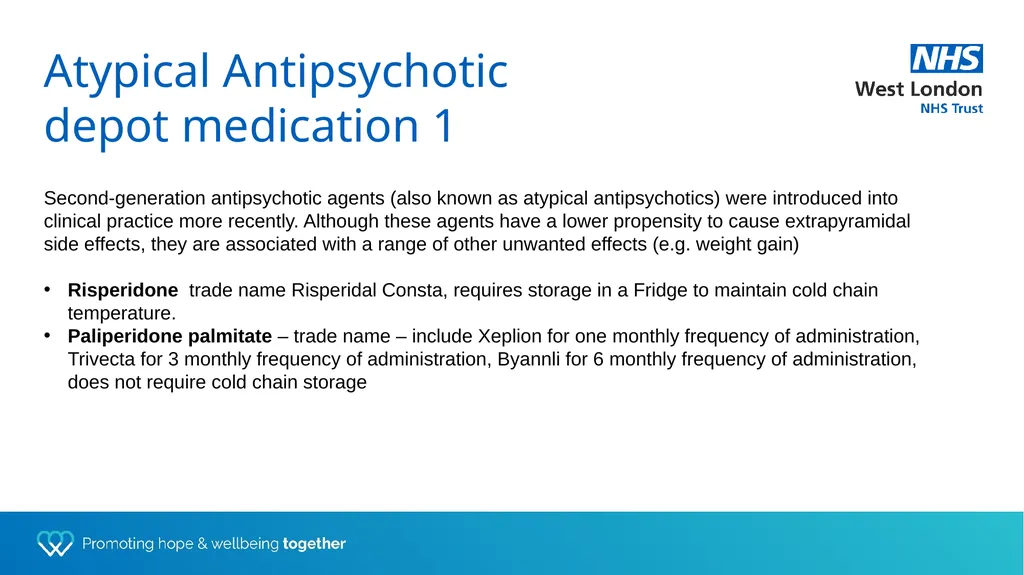
Atypical Antipsychotic depot medication 1 Second-generation antipsychotic agents (also known as atypical antipsychotics) were introduced into clinical practice more recently. Although these agents have a lower propensity to cause extrapyramidal side effects, they are associated with a range of other unwanted effects (e.g. weight gain)
Risperidone trade name Risperidal Consta, requires storage in a Fridge to maintain cold chain temperature.
Paliperidone palmitate – trade name – include Xeplion for one monthly frequency of administration, Trivecta for 3 monthly frequency of administration, Byannli for 6 monthly frequency of administration, does not require cold chain storage<br>
Risperidone trade name Risperidal Consta, requires storage in a Fridge to maintain cold chain temperature.
Paliperidone palmitate – trade name – include Xeplion for one monthly frequency of administration, Trivecta for 3 monthly frequency of administration, Byannli for 6 monthly frequency of administration, does not require cold chain storage<br>
34
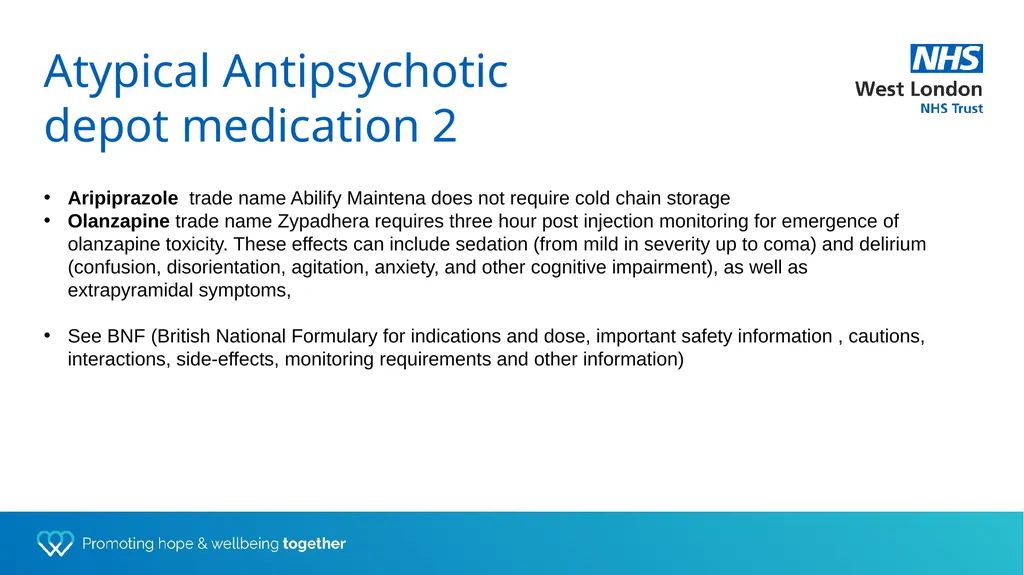
Atypical Antipsychotic depot medication 2 Aripiprazole trade name Abilify Maintena does not require cold chain storage
Olanzapine trade name Zypadhera requires three hour post injection monitoring for emergence of olanzapine toxicity. These effects can include sedation (from mild in severity up to coma) and delirium (confusion, disorientation, agitation, anxiety, and other cognitive impairment), as well as extrapyramidal symptoms,
See BNF (British National Formulary for indications and dose, important safety information , cautions, interactions, side-effects, monitoring requirements and other information)<br>
Olanzapine trade name Zypadhera requires three hour post injection monitoring for emergence of olanzapine toxicity. These effects can include sedation (from mild in severity up to coma) and delirium (confusion, disorientation, agitation, anxiety, and other cognitive impairment), as well as extrapyramidal symptoms,
See BNF (British National Formulary for indications and dose, important safety information , cautions, interactions, side-effects, monitoring requirements and other information)<br>
35
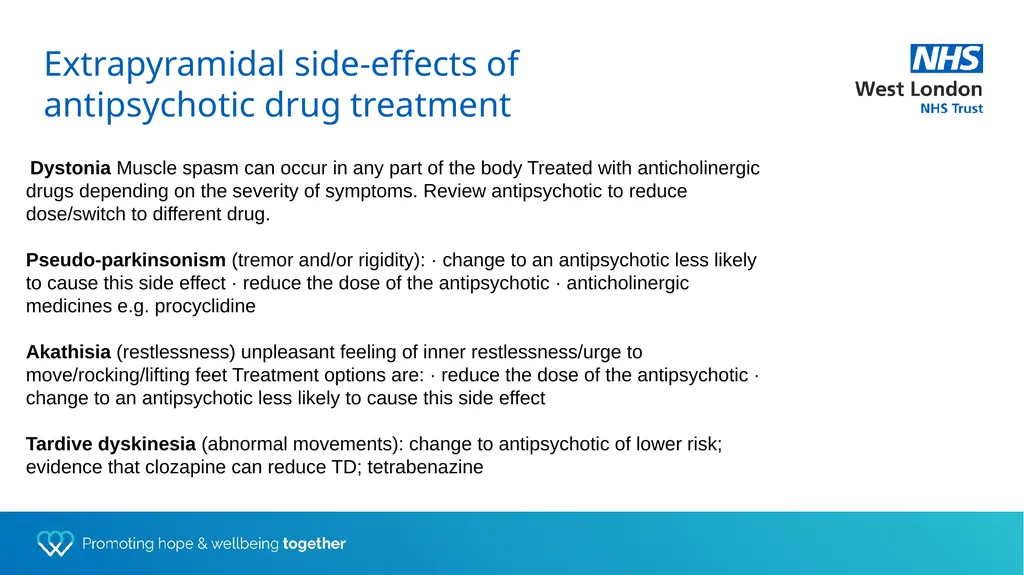
Extrapyramidal side-effects of antipsychotic drug treatment Dystonia Muscle spasm can occur in any part of the body Treated with anticholinergic drugs depending on the severity of symptoms. Review antipsychotic to reduce dose/switch to different drug.
Pseudo-parkinsonism (tremor and/or rigidity): · change to an antipsychotic less likely to cause this side effect · reduce the dose of the antipsychotic · anticholinergic medicines e.g. procyclidine
Akathisia (restlessness) unpleasant feeling of inner restlessness/urge to move/rocking/lifting feet Treatment options are: · reduce the dose of the antipsychotic · change to an antipsychotic less likely to cause this side effect
Tardive dyskinesia (abnormal movements): change to antipsychotic of lower risk; evidence that clozapine can reduce TD; tetrabenazine<br>
Pseudo-parkinsonism (tremor and/or rigidity): · change to an antipsychotic less likely to cause this side effect · reduce the dose of the antipsychotic · anticholinergic medicines e.g. procyclidine
Akathisia (restlessness) unpleasant feeling of inner restlessness/urge to move/rocking/lifting feet Treatment options are: · reduce the dose of the antipsychotic · change to an antipsychotic less likely to cause this side effect
Tardive dyskinesia (abnormal movements): change to antipsychotic of lower risk; evidence that clozapine can reduce TD; tetrabenazine<br>
36
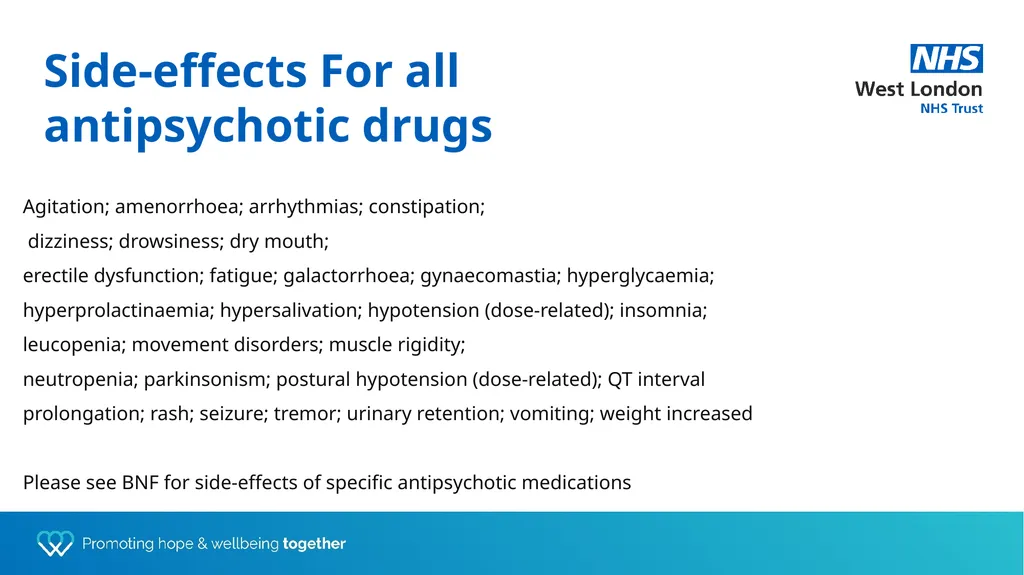
Side-effects For all antipsychotic drugs Agitation; amenorrhoea; arrhythmias; constipation;
dizziness; drowsiness; dry mouth;
erectile dysfunction; fatigue; galactorrhoea; gynaecomastia; hyperglycaemia; hyperprolactinaemia; hypersalivation; hypotension (dose-related); insomnia; leucopenia; movement disorders; muscle rigidity;
neutropenia; parkinsonism; postural hypotension (dose-related); QT interval prolongation; rash; seizure; tremor; urinary retention; vomiting; weight increased
Please see BNF for side-effects of specific antipsychotic medications<br>
dizziness; drowsiness; dry mouth;
erectile dysfunction; fatigue; galactorrhoea; gynaecomastia; hyperglycaemia; hyperprolactinaemia; hypersalivation; hypotension (dose-related); insomnia; leucopenia; movement disorders; muscle rigidity;
neutropenia; parkinsonism; postural hypotension (dose-related); QT interval prolongation; rash; seizure; tremor; urinary retention; vomiting; weight increased
Please see BNF for side-effects of specific antipsychotic medications<br>
37
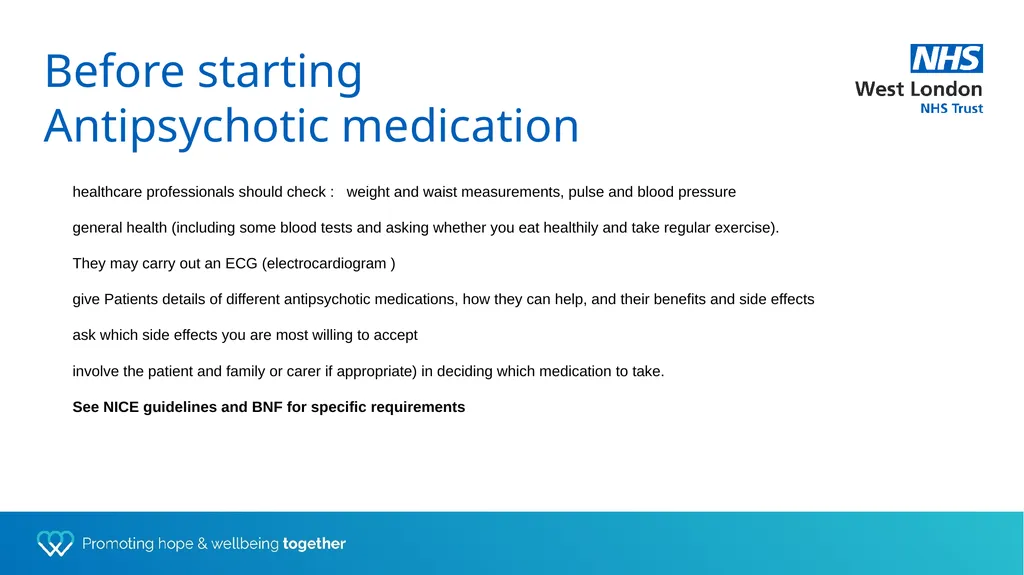
Before starting Antipsychotic medication healthcare professionals should check : weight and waist measurements, pulse and blood pressure
general health (including some blood tests and asking whether you eat healthily and take regular exercise).
They may carry out an ECG (electrocardiogram )
give Patients details of different antipsychotic medications, how they can help, and their benefits and side effects
ask which side effects you are most willing to accept
involve the patient and family or carer if appropriate) in deciding which medication to take.
See NICE guidelines and BNF for specific requirements<br>
general health (including some blood tests and asking whether you eat healthily and take regular exercise).
They may carry out an ECG (electrocardiogram )
give Patients details of different antipsychotic medications, how they can help, and their benefits and side effects
ask which side effects you are most willing to accept
involve the patient and family or carer if appropriate) in deciding which medication to take.
See NICE guidelines and BNF for specific requirements<br>
38
Monitoring requirements
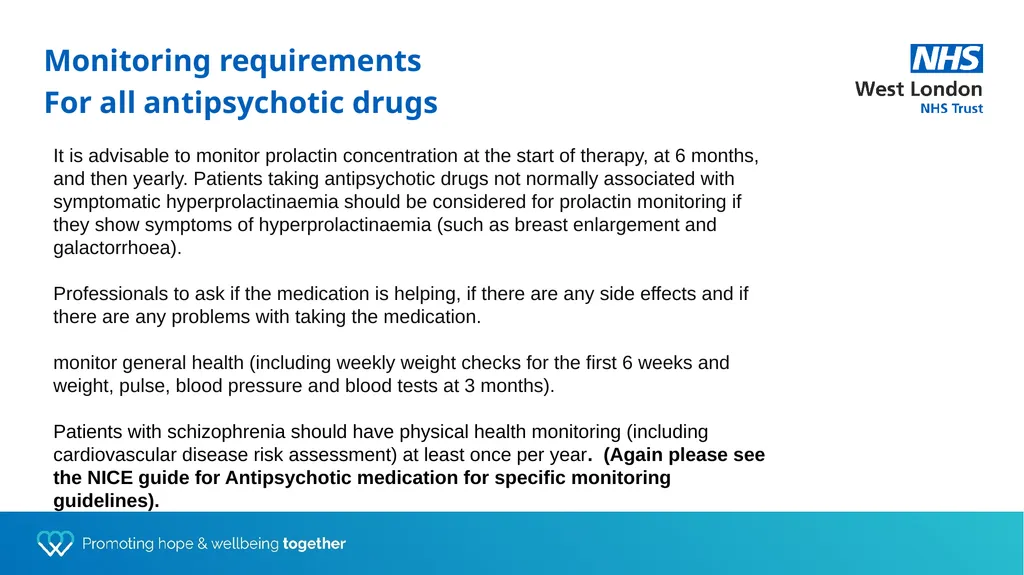
For all antipsychotic drugs It is advisable to monitor prolactin concentration at the start of therapy, at 6 months, and then yearly. Patients taking antipsychotic drugs not normally associated with symptomatic hyperprolactinaemia should be considered for prolactin monitoring if they show symptoms of hyperprolactinaemia (such as breast enlargement and galactorrhoea).
Professionals to ask if the medication is helping, if there are any side effects and if there are any problems with taking the medication.
monitor general health (including weekly weight checks for the first 6 weeks and weight, pulse, blood pressure and blood tests at 3 months).
Patients with schizophrenia should have physical health monitoring (including cardiovascular disease risk assessment) at least once per year. (Again please see the NICE guide for Antipsychotic medication for specific monitoring guidelines).<br>
For all antipsychotic drugs It is advisable to monitor prolactin concentration at the start of therapy, at 6 months, and then yearly. Patients taking antipsychotic drugs not normally associated with symptomatic hyperprolactinaemia should be considered for prolactin monitoring if they show symptoms of hyperprolactinaemia (such as breast enlargement and galactorrhoea).
Professionals to ask if the medication is helping, if there are any side effects and if there are any problems with taking the medication.
monitor general health (including weekly weight checks for the first 6 weeks and weight, pulse, blood pressure and blood tests at 3 months).
Patients with schizophrenia should have physical health monitoring (including cardiovascular disease risk assessment) at least once per year. (Again please see the NICE guide for Antipsychotic medication for specific monitoring guidelines).<br>
39
Diagnosis: Schizophrenia Schizophrenia is a long-term mental health condition. It causes a range of different psychological symptoms.
Doctors often describe schizophrenia as a type of psychosis. This means the person may not always be able to distinguish their own thoughts and ideas from reality.
Symptoms of schizophrenia can include:
hallucinations – hearing or seeing things that do not exist outside of the mind
delusions – unusual beliefs not based on reality
muddled thoughts and speech based on hallucinations or delusions
losing interest in everyday activities
not wanting to look after yourself and your needs, such as not caring about your personal hygiene
feeling disconnected from your feelings or emotions
People with schizophrenia do not have a split personality. Schizophrenia does not usually cause someone to be violent.<br>
Doctors often describe schizophrenia as a type of psychosis. This means the person may not always be able to distinguish their own thoughts and ideas from reality.
Symptoms of schizophrenia can include:
hallucinations – hearing or seeing things that do not exist outside of the mind
delusions – unusual beliefs not based on reality
muddled thoughts and speech based on hallucinations or delusions
losing interest in everyday activities
not wanting to look after yourself and your needs, such as not caring about your personal hygiene
feeling disconnected from your feelings or emotions
People with schizophrenia do not have a split personality. Schizophrenia does not usually cause someone to be violent.<br>
40
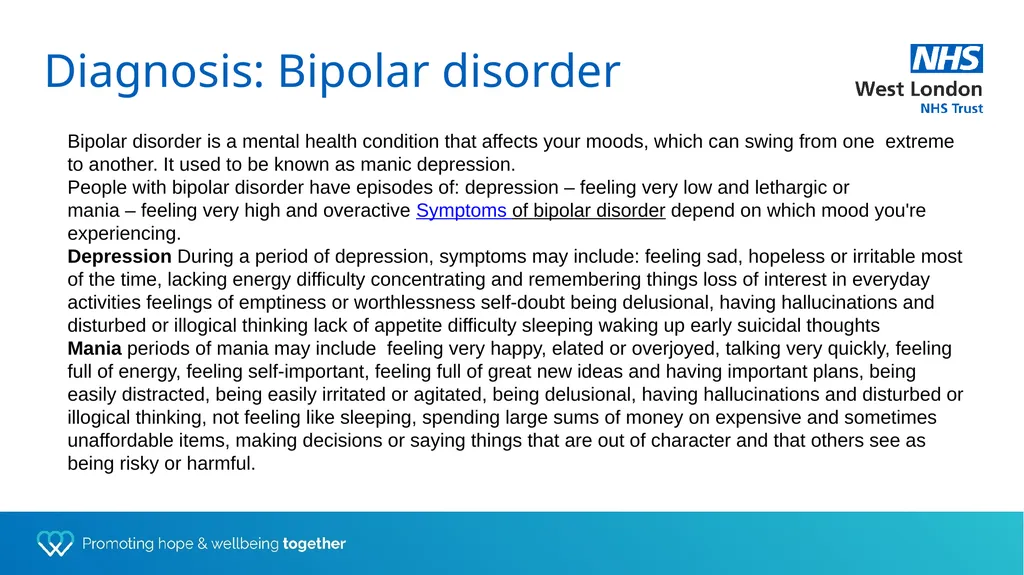
Diagnosis: Bipolar disorder Bipolar disorder is a mental health condition that affects your moods, which can swing from one extreme to another. It used to be known as manic depression.
People with bipolar disorder have episodes of: depression – feeling very low and lethargic or
mania – feeling very high and overactive Symptoms of bipolar disorder depend on which mood you're experiencing.
Depression During a period of depression, symptoms may include: feeling sad, hopeless or irritable most of the time, lacking energy difficulty concentrating and remembering things loss of interest in everyday activities feelings of emptiness or worthlessness self-doubt being delusional, having hallucinations and disturbed or illogical thinking lack of appetite difficulty sleeping waking up early suicidal thoughts
Mania periods of mania may include feeling very happy, elated or overjoyed, talking very quickly, feeling full of energy, feeling self-important, feeling full of great new ideas and having important plans, being easily distracted, being easily irritated or agitated, being delusional, having hallucinations and disturbed or illogical thinking, not feeling like sleeping, spending large sums of money on expensive and sometimes unaffordable items, making decisions or saying things that are out of character and that others see as being risky or harmful.<br>
People with bipolar disorder have episodes of: depression – feeling very low and lethargic or
mania – feeling very high and overactive Symptoms of bipolar disorder depend on which mood you're experiencing.
Depression During a period of depression, symptoms may include: feeling sad, hopeless or irritable most of the time, lacking energy difficulty concentrating and remembering things loss of interest in everyday activities feelings of emptiness or worthlessness self-doubt being delusional, having hallucinations and disturbed or illogical thinking lack of appetite difficulty sleeping waking up early suicidal thoughts
Mania periods of mania may include feeling very happy, elated or overjoyed, talking very quickly, feeling full of energy, feeling self-important, feeling full of great new ideas and having important plans, being easily distracted, being easily irritated or agitated, being delusional, having hallucinations and disturbed or illogical thinking, not feeling like sleeping, spending large sums of money on expensive and sometimes unaffordable items, making decisions or saying things that are out of character and that others see as being risky or harmful.<br>
41
Diagnosis: Schizoaffective disorder Schizoaffective disorder is a mental illness that can affect thoughts, mood and behaviour. symptoms of bipolar disorder and schizophrenia may be present. These symptoms could include mania, depression and psychosis.<br>
42
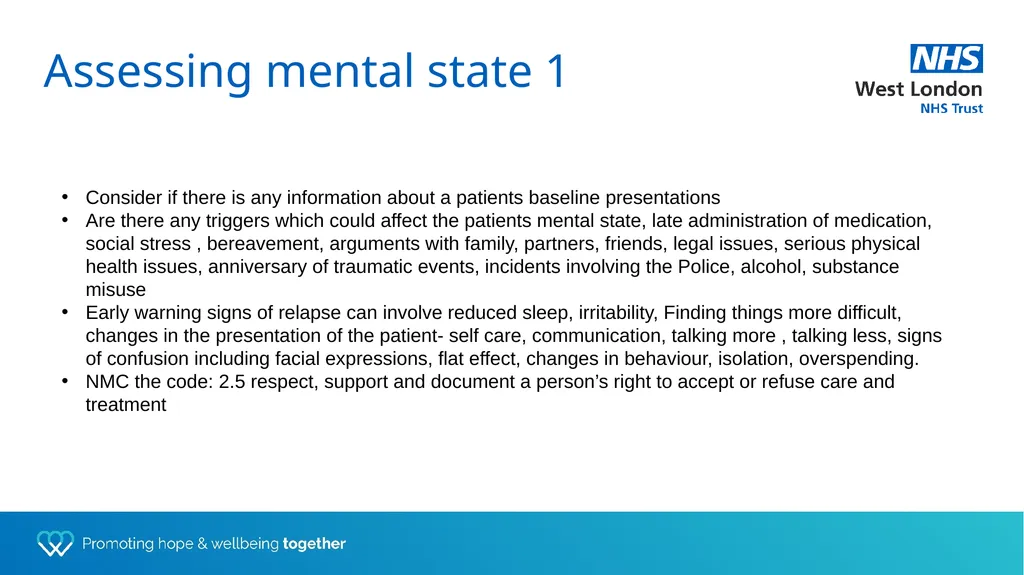
Assessing mental state 1 Consider if there is any information about a patients baseline presentations
Are there any triggers which could affect the patients mental state, late administration of medication, social stress , bereavement, arguments with family, partners, friends, legal issues, serious physical health issues, anniversary of traumatic events, incidents involving the Police, alcohol, substance misuse
Early warning signs of relapse can involve reduced sleep, irritability, Finding things more difficult, changes in the presentation of the patient- self care, communication, talking more , talking less, signs of confusion including facial expressions, flat effect, changes in behaviour, isolation, overspending.
NMC the code: 2.5 respect, support and document a person’s right to accept or refuse care and treatment<br>
Are there any triggers which could affect the patients mental state, late administration of medication, social stress , bereavement, arguments with family, partners, friends, legal issues, serious physical health issues, anniversary of traumatic events, incidents involving the Police, alcohol, substance misuse
Early warning signs of relapse can involve reduced sleep, irritability, Finding things more difficult, changes in the presentation of the patient- self care, communication, talking more , talking less, signs of confusion including facial expressions, flat effect, changes in behaviour, isolation, overspending.
NMC the code: 2.5 respect, support and document a person’s right to accept or refuse care and treatment<br>
43
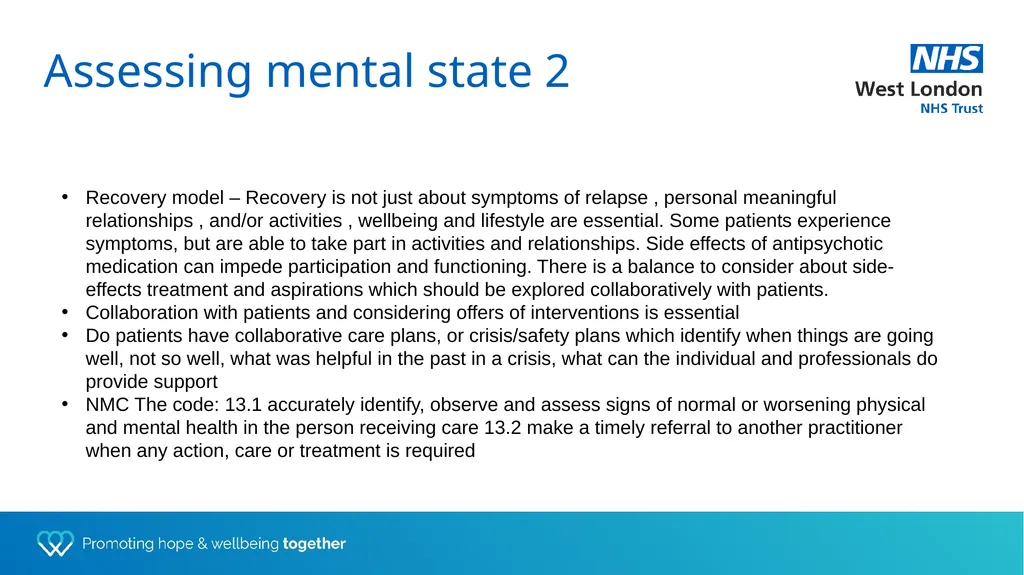
Assessing mental state 2 Recovery model – Recovery is not just about symptoms of relapse , personal meaningful relationships , and/or activities , wellbeing and lifestyle are essential. Some patients experience symptoms, but are able to take part in activities and relationships. Side effects of antipsychotic medication can impede participation and functioning. There is a balance to consider about side-effects treatment and aspirations which should be explored collaboratively with patients.
Collaboration with patients and considering offers of interventions is essential
Do patients have collaborative care plans, or crisis/safety plans which identify when things are going well, not so well, what was helpful in the past in a crisis, what can the individual and professionals do provide support
NMC The code: 13.1 accurately identify, observe and assess signs of normal or worsening physical and mental health in the person receiving care 13.2 make a timely referral to another practitioner when any action, care or treatment is required<br>
Collaboration with patients and considering offers of interventions is essential
Do patients have collaborative care plans, or crisis/safety plans which identify when things are going well, not so well, what was helpful in the past in a crisis, what can the individual and professionals do provide support
NMC The code: 13.1 accurately identify, observe and assess signs of normal or worsening physical and mental health in the person receiving care 13.2 make a timely referral to another practitioner when any action, care or treatment is required<br>