
Depression in Medical Settings APM Resident
DP
Published · 52 slides · 0 views

1 / 1

Description
Depression in Medical Settings APM Resident Education Curriculum Revised 2019: Christopher Wilson, DO, Iqbal Ahmed, MD Revised 2013: Sermsak Lolak, MD Revised 2011: Robert C. Joseph, MD, MS Original version: Pamela Diefenbach, MD, FAPM,
Related Topics
Share
Embed code
Download this presentation From Below
"Depression in Medical Settings APM Resident" is the property of its rightful owner. Permission is granted to download and print the materials on this website for personal, non-commercial use only, and to display it on your personal computer provided you do not modify the materials and that you retain all copyright notices contained in the materials. By downloading content from our website, you accept the terms of this agreement.
Presentation Transcript
01
Depression in Medical Settings APM Resident Education Curriculum Revised 2019: Christopher Wilson, DO, Iqbal Ahmed, MD
Revised 2013: Sermsak Lolak, MD
Revised 2011: Robert C. Joseph, MD, MS
Original version: Pamela Diefenbach, MD, FAPM, Lead Psychiatrist, Mental Health Integration in Primary Care, Veterans Affairs Greater Los Angeles Healthcare System, Clinical Professor of Psychiatry & Biobehavioral Sciences,
UCLA David Geffen School of Medicine & UCLA Semel Institute of Neuroscience
Version of March 15, 2019<br>
Revised 2013: Sermsak Lolak, MD
Revised 2011: Robert C. Joseph, MD, MS
Original version: Pamela Diefenbach, MD, FAPM, Lead Psychiatrist, Mental Health Integration in Primary Care, Veterans Affairs Greater Los Angeles Healthcare System, Clinical Professor of Psychiatry & Biobehavioral Sciences,
UCLA David Geffen School of Medicine & UCLA Semel Institute of Neuroscience
Version of March 15, 2019<br>
02
Learning Objectives By the end of the lecture, the viewer will be able to:
Describe the types and characteristics of depression in a variety of medical settings
Appreciate the diverse medical conditions, medication therapies and psychiatric conditions that contribute to depressive symptoms
List the evidence-based therapies for depression in the medically ill<br>
Describe the types and characteristics of depression in a variety of medical settings
Appreciate the diverse medical conditions, medication therapies and psychiatric conditions that contribute to depressive symptoms
List the evidence-based therapies for depression in the medically ill<br>
03
Overview Classification of depression
Prevalence in medical Settings
Evaluation
Time course and associations
Treatment<br>
Prevalence in medical Settings
Evaluation
Time course and associations
Treatment<br>
04
Depressive Disorders (DSM-5) Major Depressive Disorder
Persistent Depressive Disorder (Dysthymia)
Adjustment disorder With depressed mood
Depressive Disorder Due to Another Medical Condition
Substance/Medication-Induced Depressive Disorder
Premenstrual Dysphoric Disorder<br>
Persistent Depressive Disorder (Dysthymia)
Adjustment disorder With depressed mood
Depressive Disorder Due to Another Medical Condition
Substance/Medication-Induced Depressive Disorder
Premenstrual Dysphoric Disorder<br>
05
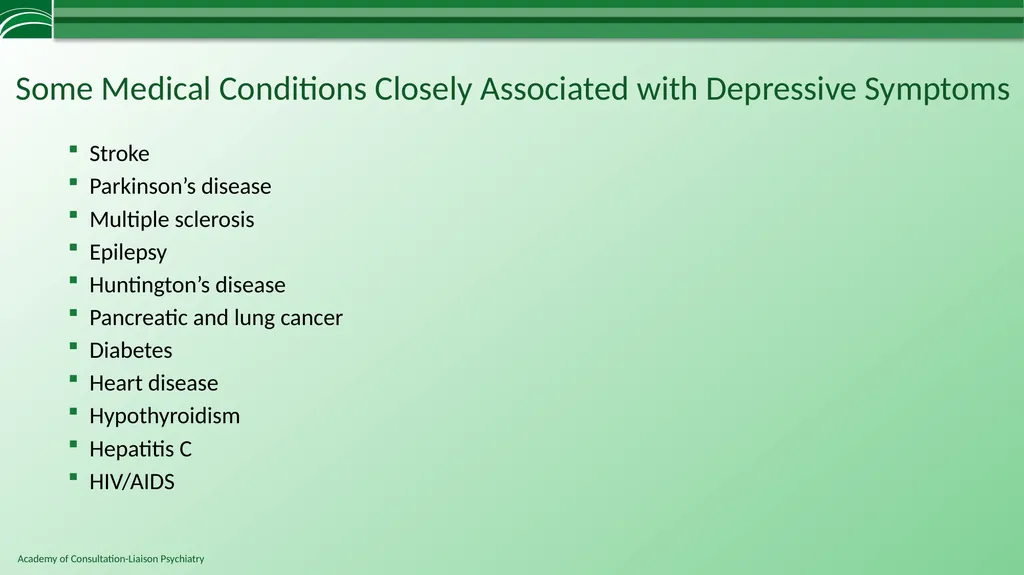
Some Medical Conditions Closely Associated with Depressive Symptoms Stroke
Parkinson’s disease
Multiple sclerosis
Epilepsy
Huntington’s disease
Pancreatic and lung cancer
Diabetes
Heart disease
Hypothyroidism
Hepatitis C
HIV/AIDS<br>
Parkinson’s disease
Multiple sclerosis
Epilepsy
Huntington’s disease
Pancreatic and lung cancer
Diabetes
Heart disease
Hypothyroidism
Hepatitis C
HIV/AIDS<br>
06
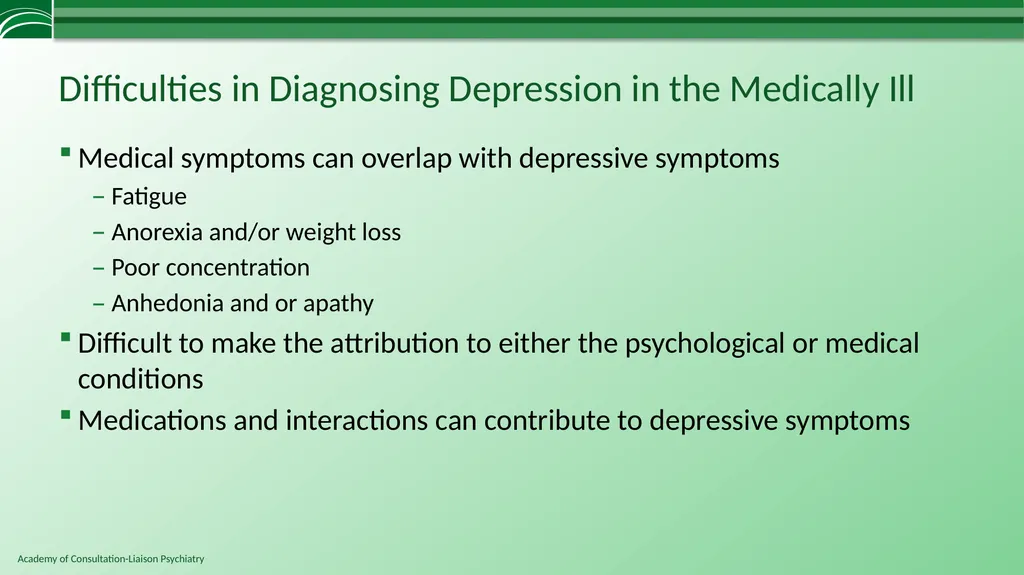
Difficulties in Diagnosing Depression in the Medically Ill Medical symptoms can overlap with depressive symptoms
Fatigue
Anorexia and/or weight loss
Poor concentration
Anhedonia and or apathy
Difficult to make the attribution to either the psychological or medical conditions
Medications and interactions can contribute to depressive symptoms<br>
Fatigue
Anorexia and/or weight loss
Poor concentration
Anhedonia and or apathy
Difficult to make the attribution to either the psychological or medical conditions
Medications and interactions can contribute to depressive symptoms<br>
07
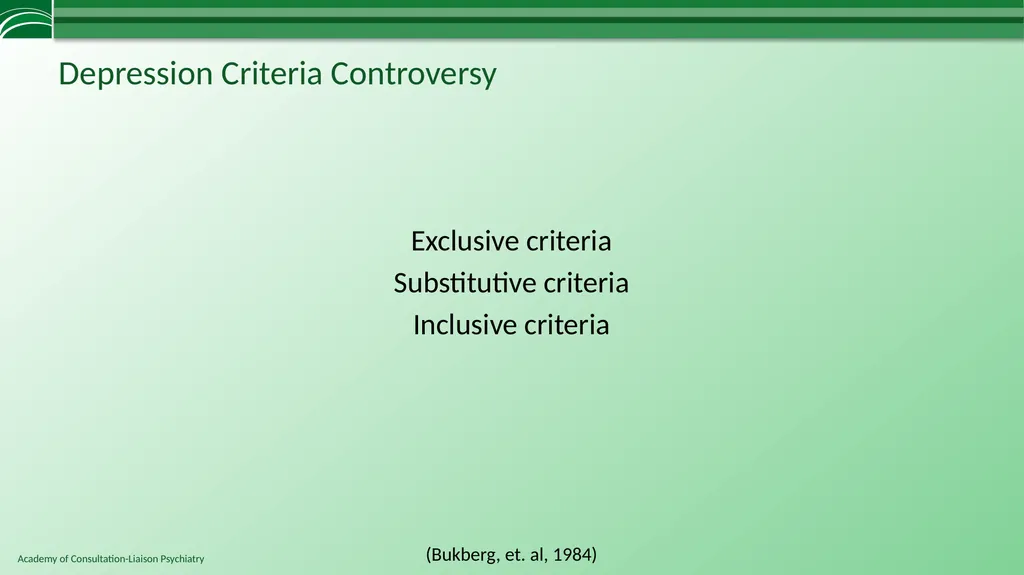
Depression Criteria Controversy Exclusive criteria
Substitutive criteria
Inclusive criteria (Bukberg, et. al, 1984)<br>
Substitutive criteria
Inclusive criteria (Bukberg, et. al, 1984)<br>
08
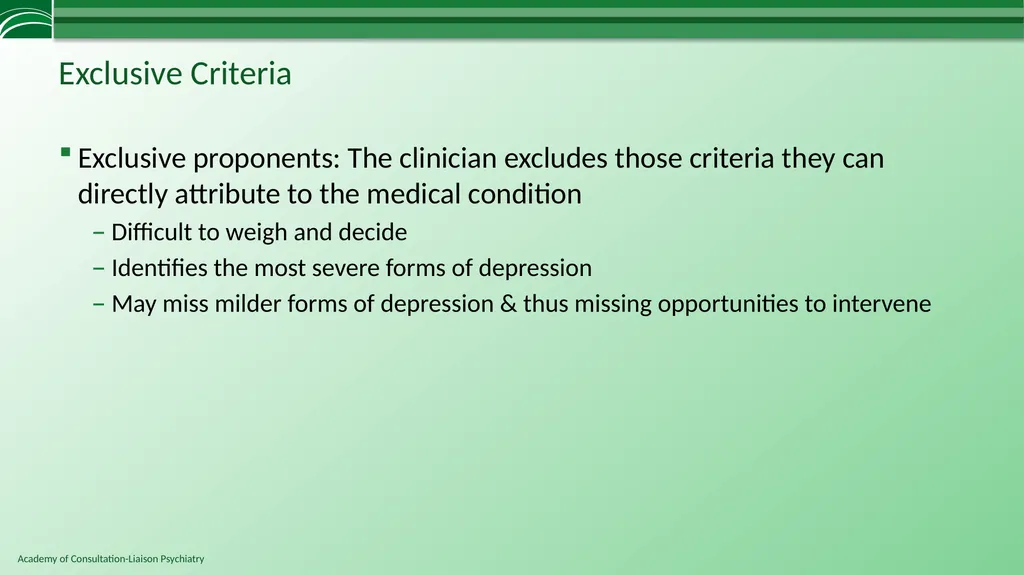
Exclusive Criteria Exclusive proponents: The clinician excludes those criteria they can directly attribute to the medical condition
Difficult to weigh and decide
Identifies the most severe forms of depression
May miss milder forms of depression & thus missing opportunities to intervene<br>
Difficult to weigh and decide
Identifies the most severe forms of depression
May miss milder forms of depression & thus missing opportunities to intervene<br>
09
Substitutive Criteria More weight is given to the psychological symptoms of depression, not the somatic symptoms of depression
Substitution of symptoms such as irritability, tearfulness, social withdrawal
Unclear which symptoms to include or exclude
Excludes some somatic symptoms
May miss severe forms of depression
Approach not widely adopted<br>
Substitution of symptoms such as irritability, tearfulness, social withdrawal
Unclear which symptoms to include or exclude
Excludes some somatic symptoms
May miss severe forms of depression
Approach not widely adopted<br>
10
Inclusive Criteria Inclusive approach: all symptoms are included without any weight to medical condition
Shown to be the most sensitive and reliable approach<br>
Shown to be the most sensitive and reliable approach<br>
11
Depression in medical illness Coexistence
Induced by illness or medications
Causes or exacerbates somatic symptoms<br>
Induced by illness or medications
Causes or exacerbates somatic symptoms<br>
12
Prevalence in Medical Settings<br>
13
Prevalence in Primary Care Clinics 5-15% depends on population, settings<br>
14
Depression and Heart Disease Major depression: 16-23%
Depressed mood: 37-35%
Depression associated with:
Myocardial infarction
Angioplasty
Congestive heart failure
Coronary bypass graft surgery
Coronary artery disease
Independent risk factor for sudden death and morbidity<br>
Depressed mood: 37-35%
Depression associated with:
Myocardial infarction
Angioplasty
Congestive heart failure
Coronary bypass graft surgery
Coronary artery disease
Independent risk factor for sudden death and morbidity<br>
15
Depression and Cancer Associated more with pancreatic, lung, brain and oropharyngeal cancers
Prevalence 25% (17-32%) in meta-analysis of 24 studies
Comorbid with anxiety in half of patients
Depression is associated with a decrease in treatment compliance
Can also be side effects of chemotherapy/steroids<br>
Prevalence 25% (17-32%) in meta-analysis of 24 studies
Comorbid with anxiety in half of patients
Depression is associated with a decrease in treatment compliance
Can also be side effects of chemotherapy/steroids<br>
16
Depression and Diabetes Up to one-third of patients with Type 2 DM has depression
Depression can lead to poor compliance and poor medical outcomes
Among patients with Type 2 DM, those with comorbid depression appear to be at greater risk for death from non-cardiovascular, non-cancer causes compared to those without depression<br>
Depression can lead to poor compliance and poor medical outcomes
Among patients with Type 2 DM, those with comorbid depression appear to be at greater risk for death from non-cardiovascular, non-cancer causes compared to those without depression<br>
17
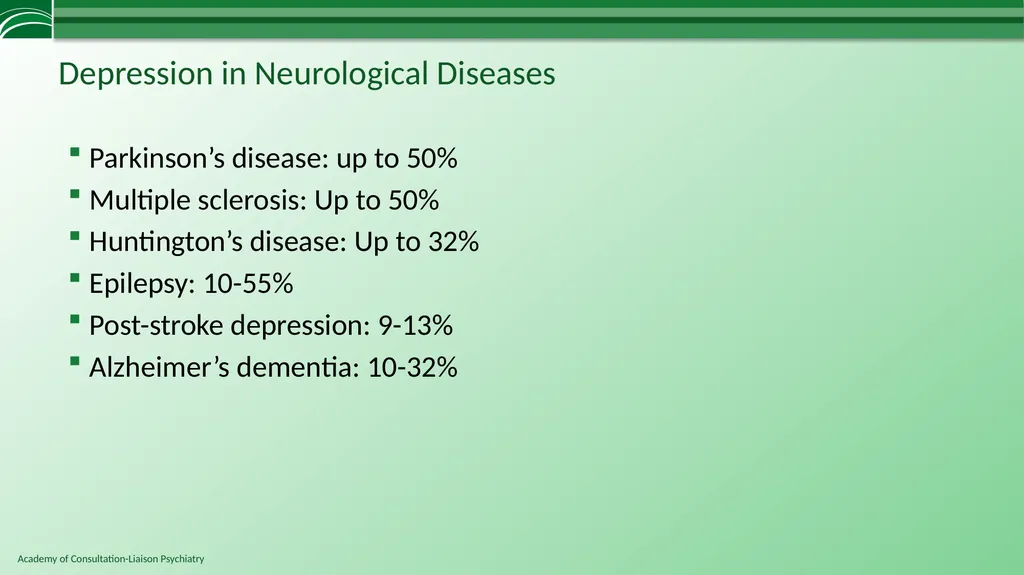
Depression in Neurological Diseases Parkinson’s disease: up to 50%
Multiple sclerosis: Up to 50%
Huntington’s disease: Up to 32%
Epilepsy: 10-55%
Post-stroke depression: 9-13%
Alzheimer’s dementia: 10-32%<br>
Multiple sclerosis: Up to 50%
Huntington’s disease: Up to 32%
Epilepsy: 10-55%
Post-stroke depression: 9-13%
Alzheimer’s dementia: 10-32%<br>
18
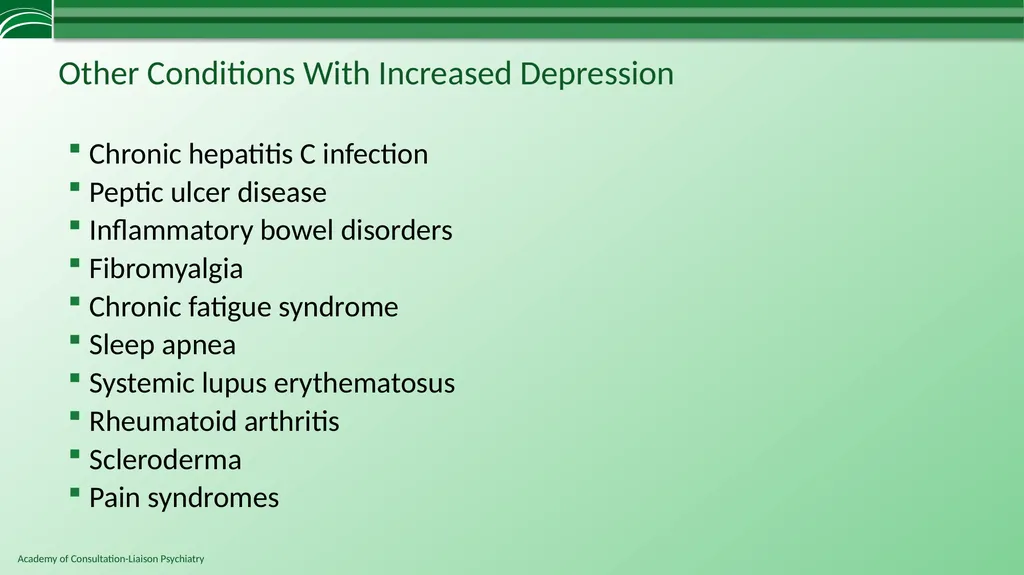
Other Conditions With Increased Depression Chronic hepatitis C infection
Peptic ulcer disease
Inflammatory bowel disorders
Fibromyalgia
Chronic fatigue syndrome
Sleep apnea
Systemic lupus erythematosus
Rheumatoid arthritis
Scleroderma
Pain syndromes<br>
Peptic ulcer disease
Inflammatory bowel disorders
Fibromyalgia
Chronic fatigue syndrome
Sleep apnea
Systemic lupus erythematosus
Rheumatoid arthritis
Scleroderma
Pain syndromes<br>
19
Evaluation<br>
20
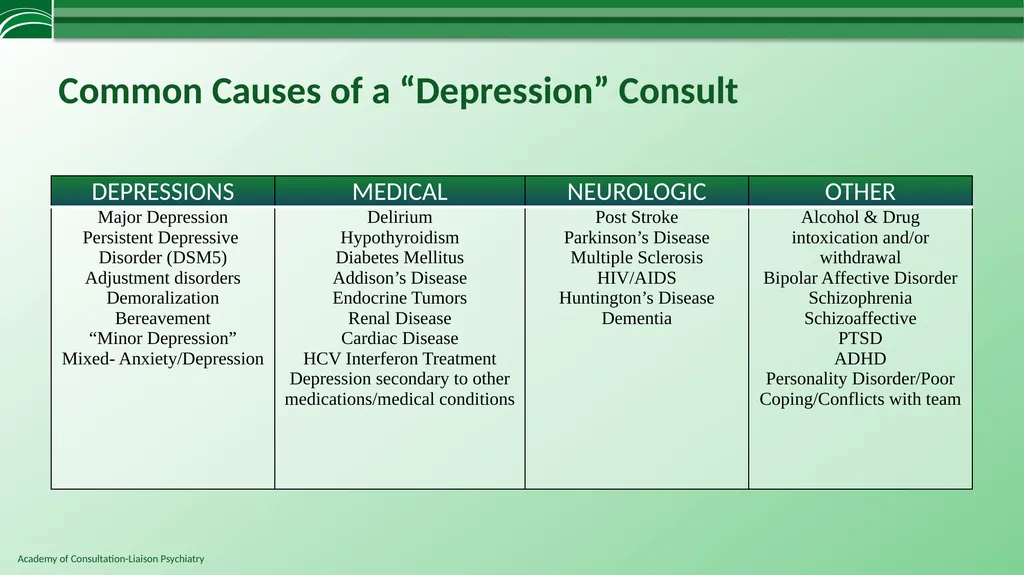
Common Causes of a “Depression” Consult<br>
21
Medical Symptoms Mimicking Depressive Symptoms Apathy
Weight loss
Change in sleep
Psychomotor retardation
Fatigue
Difficulty concentrating
Thoughts of death but not depressed mood<br>
Weight loss
Change in sleep
Psychomotor retardation
Fatigue
Difficulty concentrating
Thoughts of death but not depressed mood<br>
22
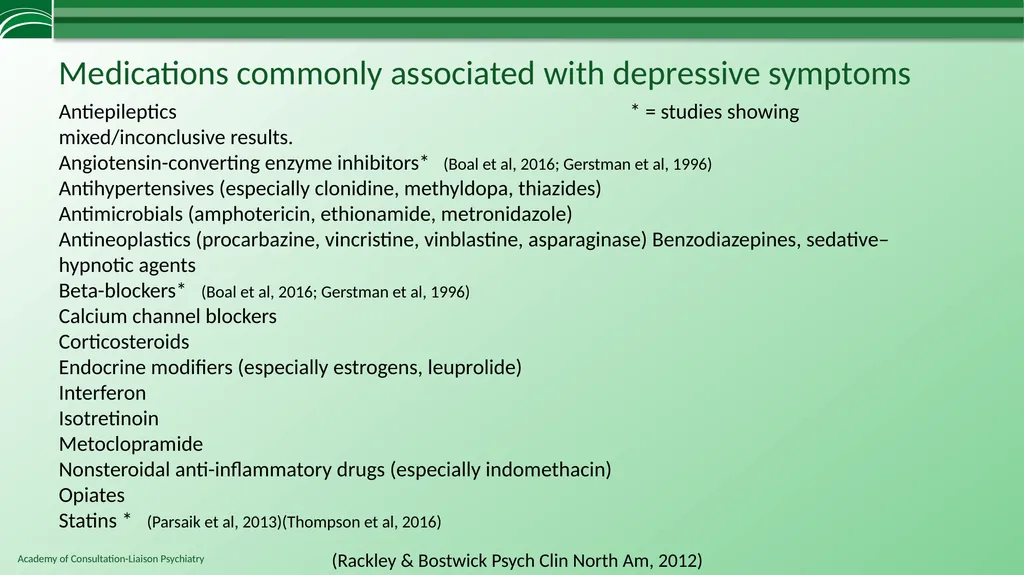
Medications commonly associated with depressive symptoms Antiepileptics * = studies showing mixed/inconclusive results.
Angiotensin-converting enzyme inhibitors* (Boal et al, 2016; Gerstman et al, 1996)
Antihypertensives (especially clonidine, methyldopa, thiazides)
Antimicrobials (amphotericin, ethionamide, metronidazole)
Antineoplastics (procarbazine, vincristine, vinblastine, asparaginase) Benzodiazepines, sedative–hypnotic agents Beta-blockers* (Boal et al, 2016; Gerstman et al, 1996) Calcium channel blockers Corticosteroids Endocrine modifiers (especially estrogens, leuprolide) Interferon Isotretinoin Metoclopramide Nonsteroidal anti-inflammatory drugs (especially indomethacin)
Opiates Statins * (Parsaik et al, 2013)(Thompson et al, 2016) (Rackley & Bostwick Psych Clin North Am, 2012)<br>
Antimicrobials (amphotericin, ethionamide, metronidazole)
Antineoplastics (procarbazine, vincristine, vinblastine, asparaginase) Benzodiazepines, sedative–hypnotic agents Beta-blockers* (Boal et al, 2016; Gerstman et al, 1996) Calcium channel blockers Corticosteroids Endocrine modifiers (especially estrogens, leuprolide) Interferon Isotretinoin Metoclopramide Nonsteroidal anti-inflammatory drugs (especially indomethacin)
Opiates Statins * (Parsaik et al, 2013)(Thompson et al, 2016) (Rackley & Bostwick Psych Clin North Am, 2012)<br>
23
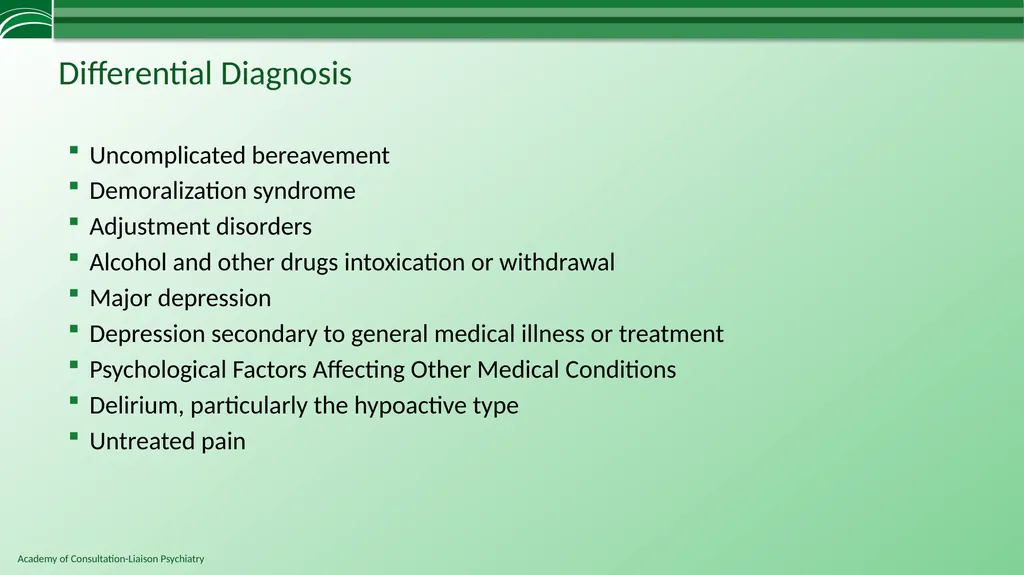
Differential Diagnosis Uncomplicated bereavement
Demoralization syndrome
Adjustment disorders
Alcohol and other drugs intoxication or withdrawal
Major depression
Depression secondary to general medical illness or treatment
Psychological Factors Affecting Other Medical Conditions
Delirium, particularly the hypoactive type
Untreated pain<br>
Demoralization syndrome
Adjustment disorders
Alcohol and other drugs intoxication or withdrawal
Major depression
Depression secondary to general medical illness or treatment
Psychological Factors Affecting Other Medical Conditions
Delirium, particularly the hypoactive type
Untreated pain<br>
24
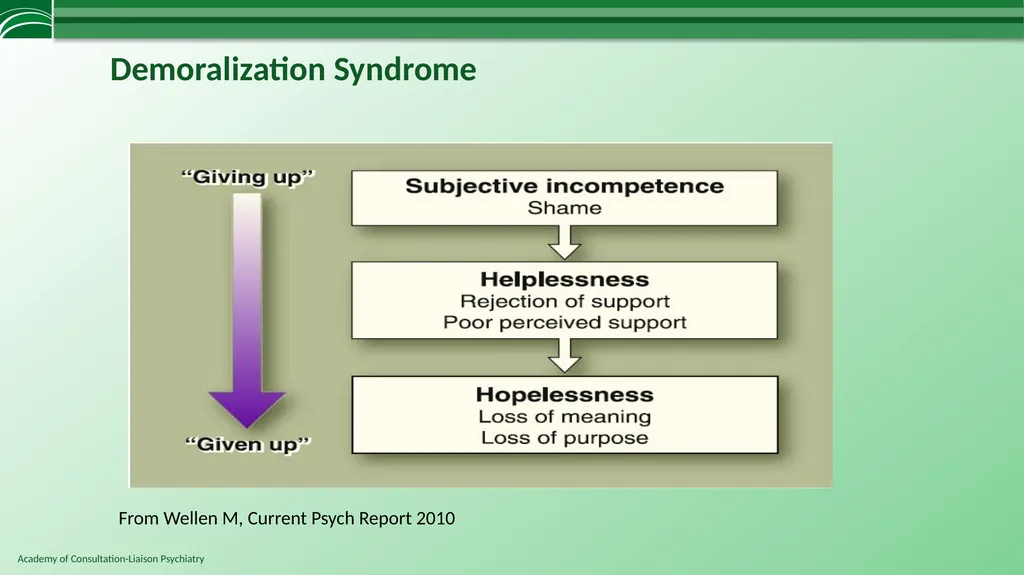
Demoralization Syndrome From Wellen M, Current Psych Report 2010<br>
25
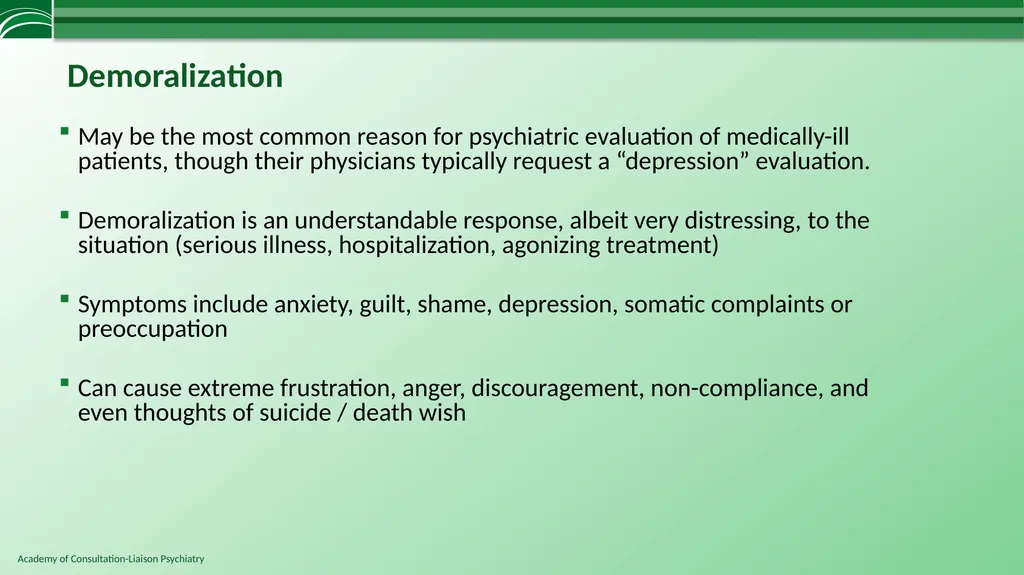
Demoralization May be the most common reason for psychiatric evaluation of medically-ill patients, though their physicians typically request a “depression” evaluation.
Demoralization is an understandable response, albeit very distressing, to the situation (serious illness, hospitalization, agonizing treatment)
Symptoms include anxiety, guilt, shame, depression, somatic complaints or preoccupation
Can cause extreme frustration, anger, discouragement, non-compliance, and even thoughts of suicide / death wish<br>
Demoralization is an understandable response, albeit very distressing, to the situation (serious illness, hospitalization, agonizing treatment)
Symptoms include anxiety, guilt, shame, depression, somatic complaints or preoccupation
Can cause extreme frustration, anger, discouragement, non-compliance, and even thoughts of suicide / death wish<br>
26
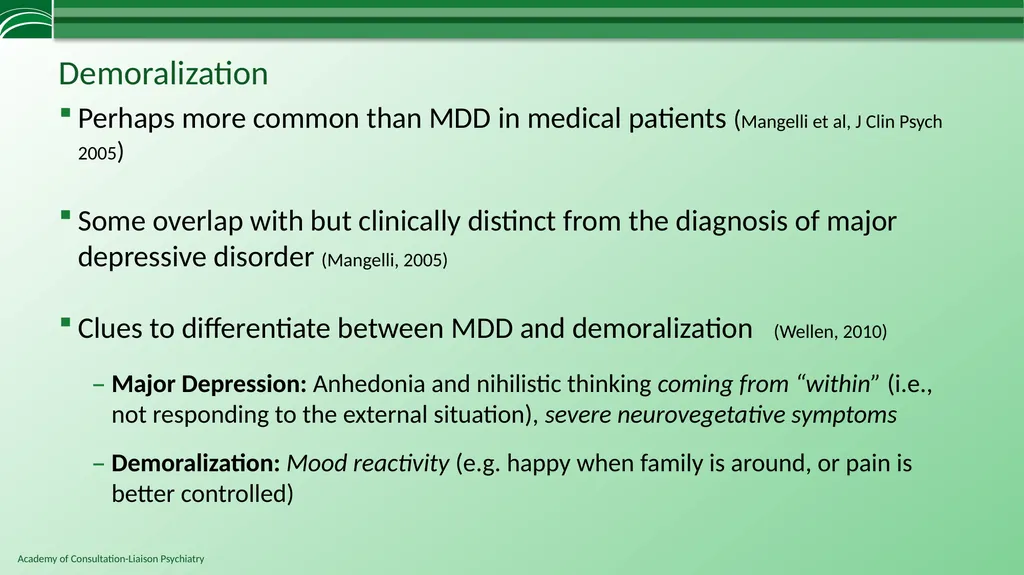
Demoralization Perhaps more common than MDD in medical patients (Mangelli et al, J Clin Psych 2005)
Some overlap with but clinically distinct from the diagnosis of major depressive disorder (Mangelli, 2005)
Clues to differentiate between MDD and demoralization (Wellen, 2010)
Major Depression: Anhedonia and nihilistic thinking coming from “within” (i.e., not responding to the external situation), severe neurovegetative symptoms
Demoralization: Mood reactivity (e.g. happy when family is around, or pain is better controlled)<br>
Some overlap with but clinically distinct from the diagnosis of major depressive disorder (Mangelli, 2005)
Clues to differentiate between MDD and demoralization (Wellen, 2010)
Major Depression: Anhedonia and nihilistic thinking coming from “within” (i.e., not responding to the external situation), severe neurovegetative symptoms
Demoralization: Mood reactivity (e.g. happy when family is around, or pain is better controlled)<br>
27
Psychiatric Evaluation: Inpatient Challenges Lack of privacy in shared rooms
Lack of confidentiality if family at bedside
Interruptions:
Patient off to procedures
Other staff coming to see patient
Patient resistant to see psychiatry<br>
Lack of confidentiality if family at bedside
Interruptions:
Patient off to procedures
Other staff coming to see patient
Patient resistant to see psychiatry<br>
28
Psychiatric Interview: Outpatient Challenges Patient may not show for the appointment
Cognitive impairment
Doesn’t want the evaluation
May not have access to extensive chart
Resistance to seeing psychiatry
“I’m not crazy! You need to help someone who’s really sick”
Stigma
Treatment non-adherence
Decision to include family if available<br>
Cognitive impairment
Doesn’t want the evaluation
May not have access to extensive chart
Resistance to seeing psychiatry
“I’m not crazy! You need to help someone who’s really sick”
Stigma
Treatment non-adherence
Decision to include family if available<br>
29
Time Course and Associations<br>
30
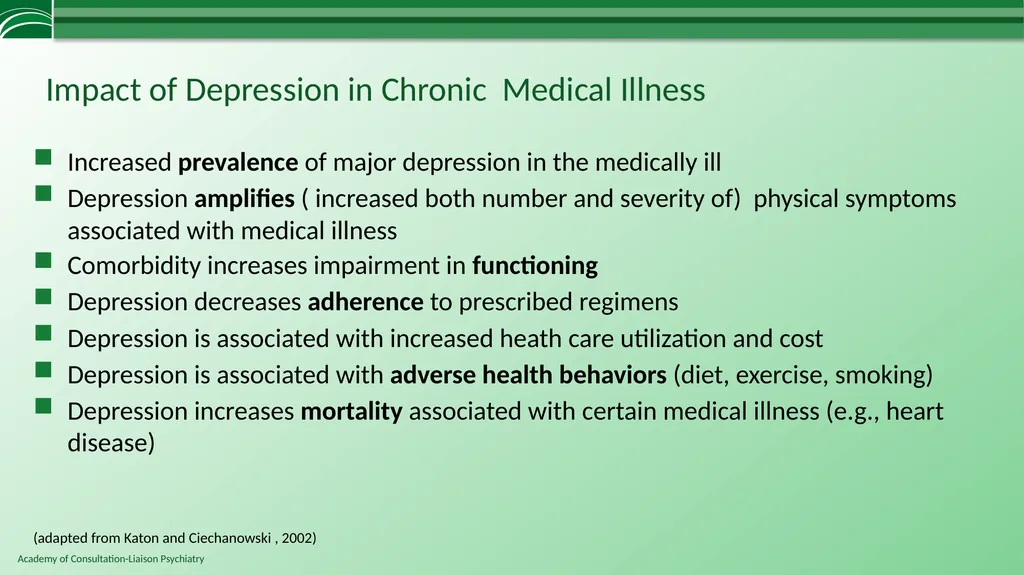
Impact of Depression in Chronic Medical Illness Increased prevalence of major depression in the medically ill
Depression amplifies ( increased both number and severity of) physical symptoms associated with medical illness
Comorbidity increases impairment in functioning
Depression decreases adherence to prescribed regimens
Depression is associated with increased heath care utilization and cost
Depression is associated with adverse health behaviors (diet, exercise, smoking)
Depression increases mortality associated with certain medical illness (e.g., heart disease)
(adapted from Katon and Ciechanowski , 2002)<br>
Depression amplifies ( increased both number and severity of) physical symptoms associated with medical illness
Comorbidity increases impairment in functioning
Depression decreases adherence to prescribed regimens
Depression is associated with increased heath care utilization and cost
Depression is associated with adverse health behaviors (diet, exercise, smoking)
Depression increases mortality associated with certain medical illness (e.g., heart disease)
(adapted from Katon and Ciechanowski , 2002)<br>
31
“It is important that somatic symptoms associated with depression should not be confused with somatoform disorders . . . Indeed, results from several surveys suggest that depression, rather than somatoform disorders, may account for most of the somatization symptoms seen in primary care.”
(Tylee A, Gandhi P. The importance of somatic symptoms in depression in primary care. Prim Care Companion J Clin Psychiatry, 2005)<br>
(Tylee A, Gandhi P. The importance of somatic symptoms in depression in primary care. Prim Care Companion J Clin Psychiatry, 2005)<br>
32
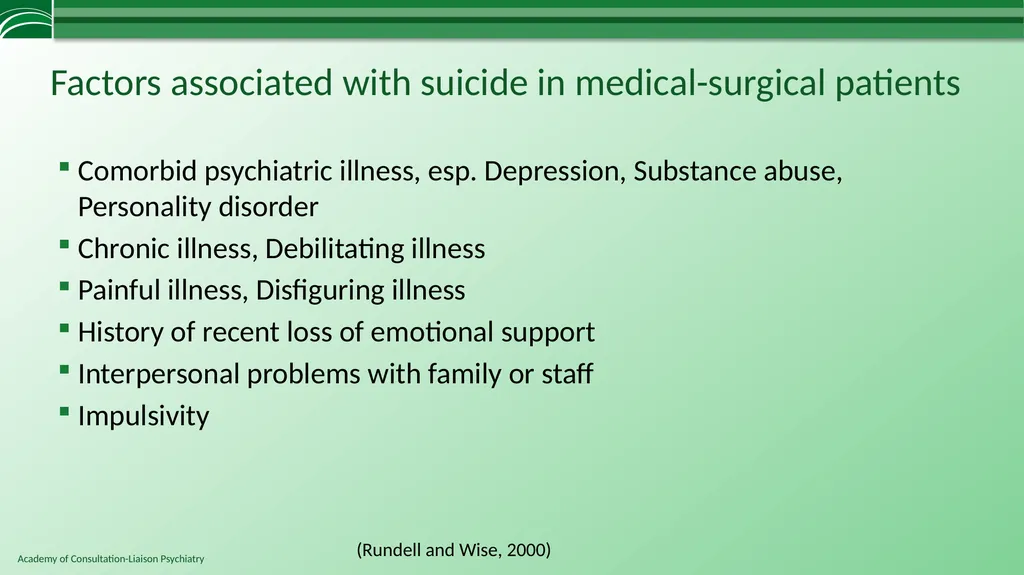
Factors associated with suicide in medical-surgical patients Comorbid psychiatric illness, esp. Depression, Substance abuse, Personality disorder
Chronic illness, Debilitating illness
Painful illness, Disfiguring illness
History of recent loss of emotional support
Interpersonal problems with family or staff
Impulsivity (Rundell and Wise, 2000)<br>
Chronic illness, Debilitating illness
Painful illness, Disfiguring illness
History of recent loss of emotional support
Interpersonal problems with family or staff
Impulsivity (Rundell and Wise, 2000)<br>
33
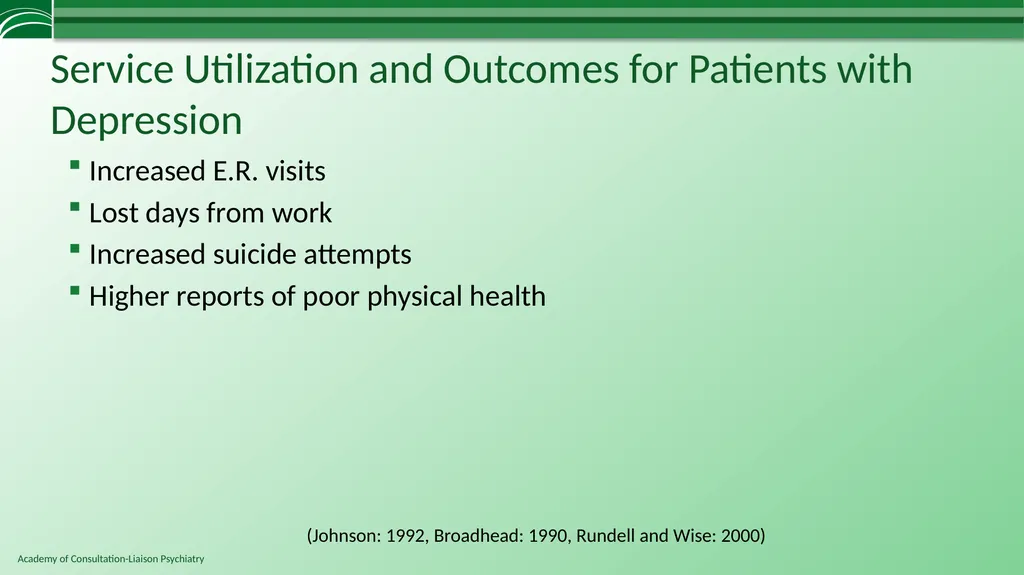
Service Utilization and Outcomes for Patients with Depression Increased E.R. visits
Lost days from work
Increased suicide attempts
Higher reports of poor physical health (Johnson: 1992, Broadhead: 1990, Rundell and Wise: 2000)<br>
Lost days from work
Increased suicide attempts
Higher reports of poor physical health (Johnson: 1992, Broadhead: 1990, Rundell and Wise: 2000)<br>
34
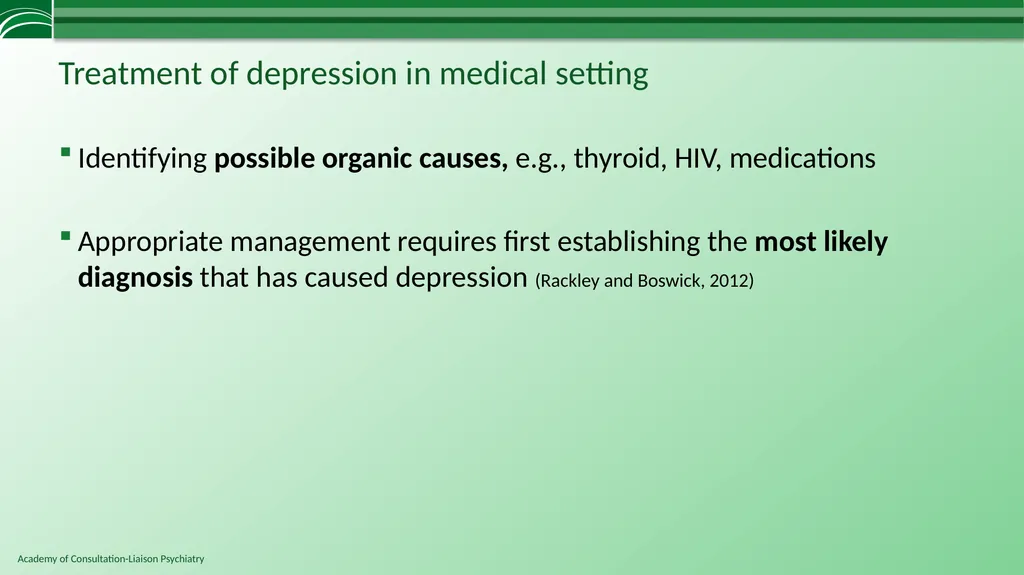
Treatment of depression in medical setting Identifying possible organic causes, e.g., thyroid, HIV, medications
Appropriate management requires first establishing the most likely diagnosis that has caused depression (Rackley and Boswick, 2012)<br>
Appropriate management requires first establishing the most likely diagnosis that has caused depression (Rackley and Boswick, 2012)<br>
35
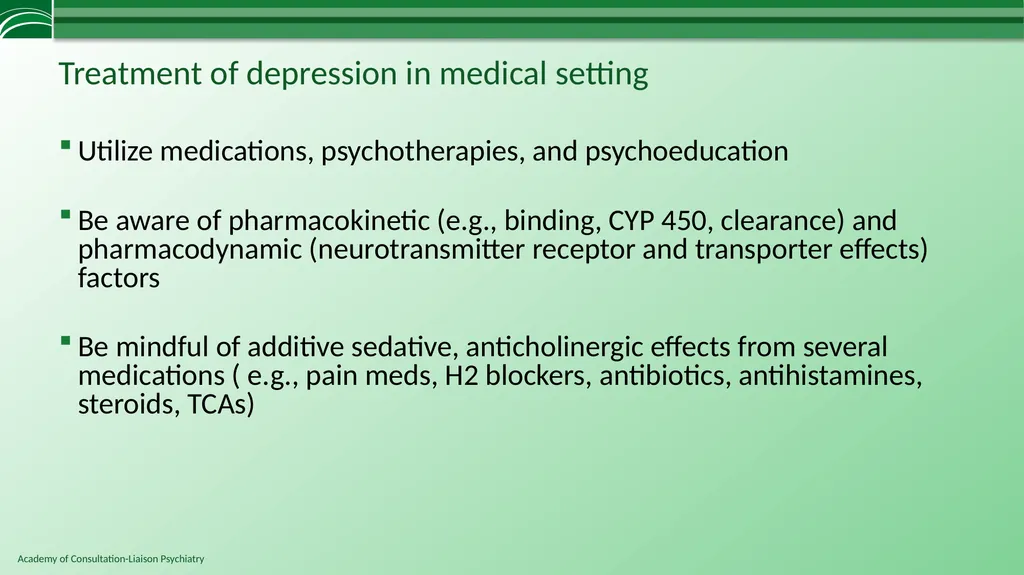
Treatment of depression in medical setting Utilize medications, psychotherapies, and psychoeducation
Be aware of pharmacokinetic (e.g., binding, CYP 450, clearance) and pharmacodynamic (neurotransmitter receptor and transporter effects) factors
Be mindful of additive sedative, anticholinergic effects from several medications ( e.g., pain meds, H2 blockers, antibiotics, antihistamines, steroids, TCAs)<br>
Be aware of pharmacokinetic (e.g., binding, CYP 450, clearance) and pharmacodynamic (neurotransmitter receptor and transporter effects) factors
Be mindful of additive sedative, anticholinergic effects from several medications ( e.g., pain meds, H2 blockers, antibiotics, antihistamines, steroids, TCAs)<br>
36
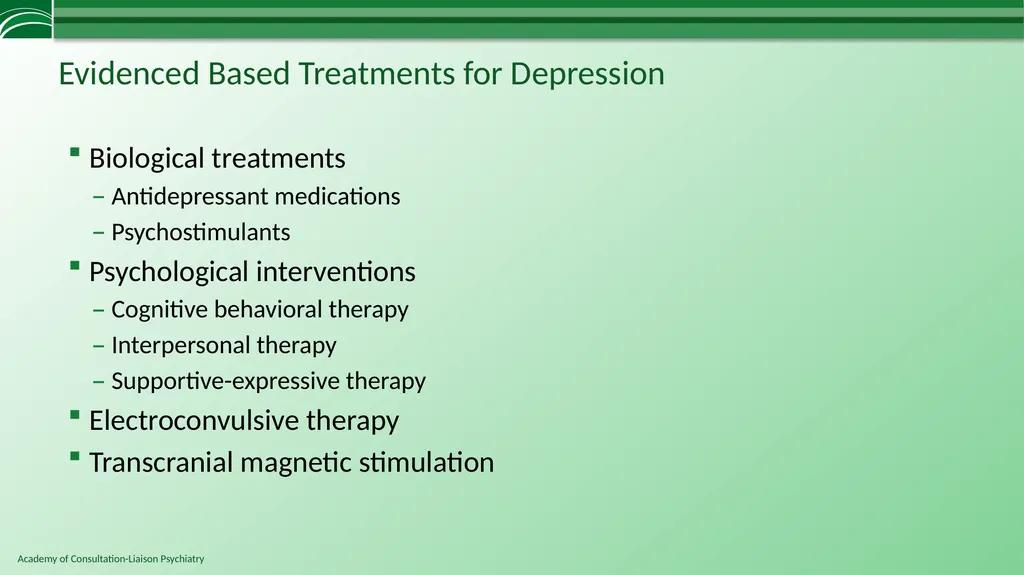
Evidenced Based Treatments for Depression Biological treatments
Antidepressant medications
Psychostimulants
Psychological interventions
Cognitive behavioral therapy
Interpersonal therapy
Supportive-expressive therapy
Electroconvulsive therapy
Transcranial magnetic stimulation<br>
Antidepressant medications
Psychostimulants
Psychological interventions
Cognitive behavioral therapy
Interpersonal therapy
Supportive-expressive therapy
Electroconvulsive therapy
Transcranial magnetic stimulation<br>
37
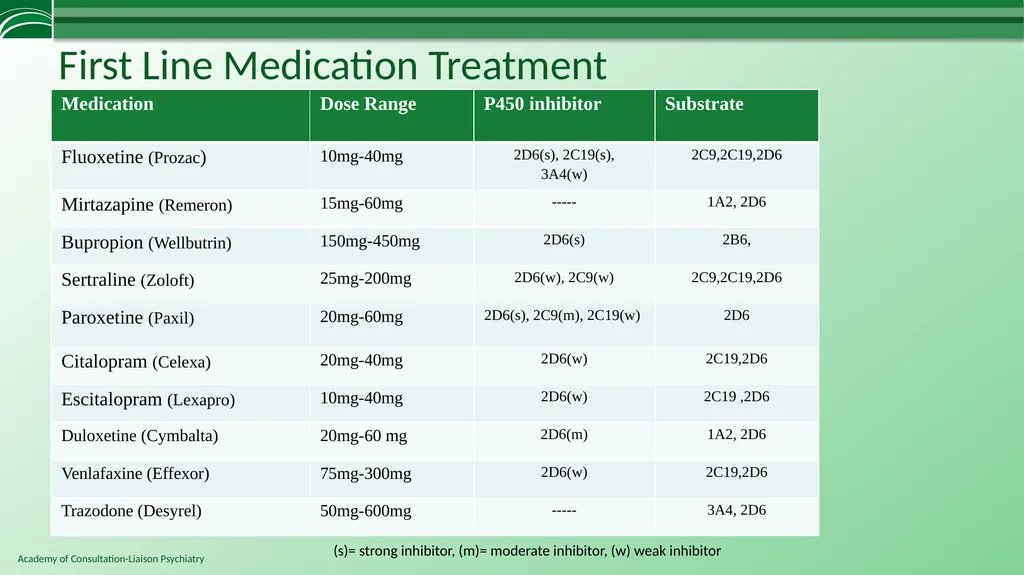
First Line Medication Treatment (s)= strong inhibitor, (m)= moderate inhibitor, (w) weak inhibitor<br>
38
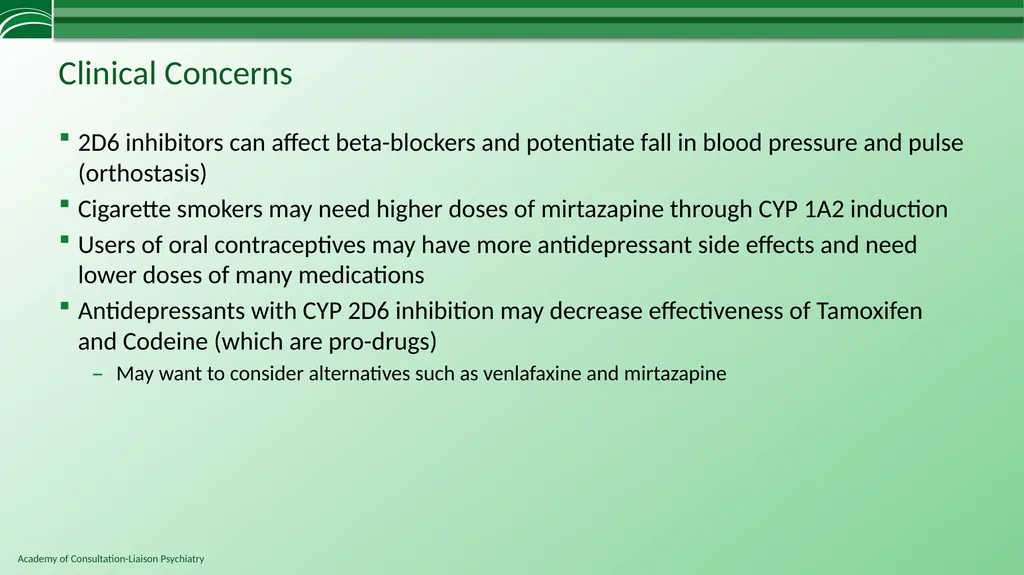
Clinical Concerns 2D6 inhibitors can affect beta-blockers and potentiate fall in blood pressure and pulse (orthostasis)
Cigarette smokers may need higher doses of mirtazapine through CYP 1A2 induction
Users of oral contraceptives may have more antidepressant side effects and need lower doses of many medications
Antidepressants with CYP 2D6 inhibition may decrease effectiveness of Tamoxifen and Codeine (which are pro-drugs)
May want to consider alternatives such as venlafaxine and mirtazapine<br>
Cigarette smokers may need higher doses of mirtazapine through CYP 1A2 induction
Users of oral contraceptives may have more antidepressant side effects and need lower doses of many medications
Antidepressants with CYP 2D6 inhibition may decrease effectiveness of Tamoxifen and Codeine (which are pro-drugs)
May want to consider alternatives such as venlafaxine and mirtazapine<br>
39
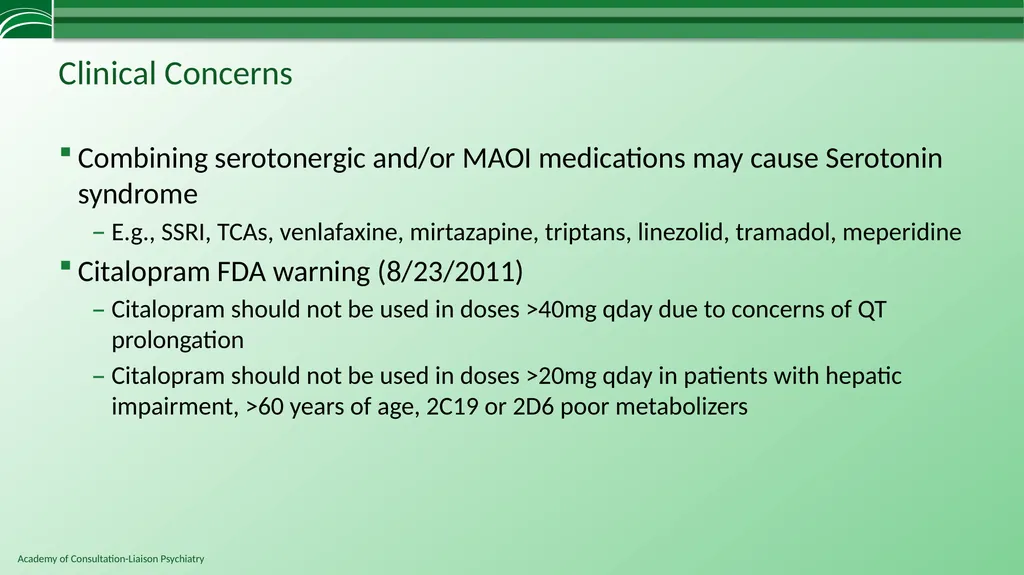
Clinical Concerns Combining serotonergic and/or MAOI medications may cause Serotonin syndrome
E.g., SSRI, TCAs, venlafaxine, mirtazapine, triptans, linezolid, tramadol, meperidine
Citalopram FDA warning (8/23/2011)
Citalopram should not be used in doses >40mg qday due to concerns of QT prolongation
Citalopram should not be used in doses >20mg qday in patients with hepatic impairment, >60 years of age, 2C19 or 2D6 poor metabolizers<br>
E.g., SSRI, TCAs, venlafaxine, mirtazapine, triptans, linezolid, tramadol, meperidine
Citalopram FDA warning (8/23/2011)
Citalopram should not be used in doses >40mg qday due to concerns of QT prolongation
Citalopram should not be used in doses >20mg qday in patients with hepatic impairment, >60 years of age, 2C19 or 2D6 poor metabolizers<br>
40
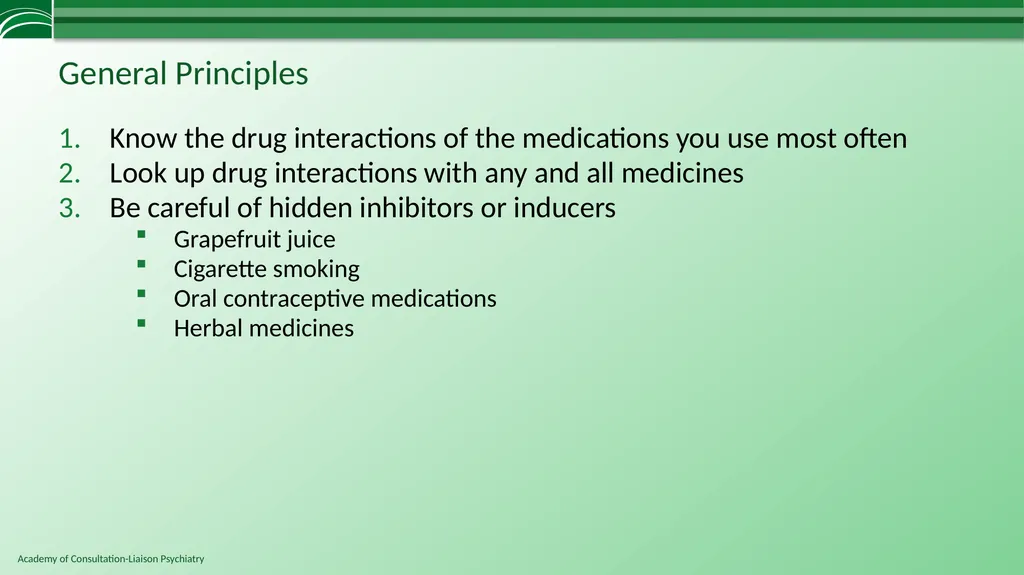
General Principles Know the drug interactions of the medications you use most often
Look up drug interactions with any and all medicines
Be careful of hidden inhibitors or inducers
Grapefruit juice
Cigarette smoking
Oral contraceptive medications
Herbal medicines<br>
Look up drug interactions with any and all medicines
Be careful of hidden inhibitors or inducers
Grapefruit juice
Cigarette smoking
Oral contraceptive medications
Herbal medicines<br>
41
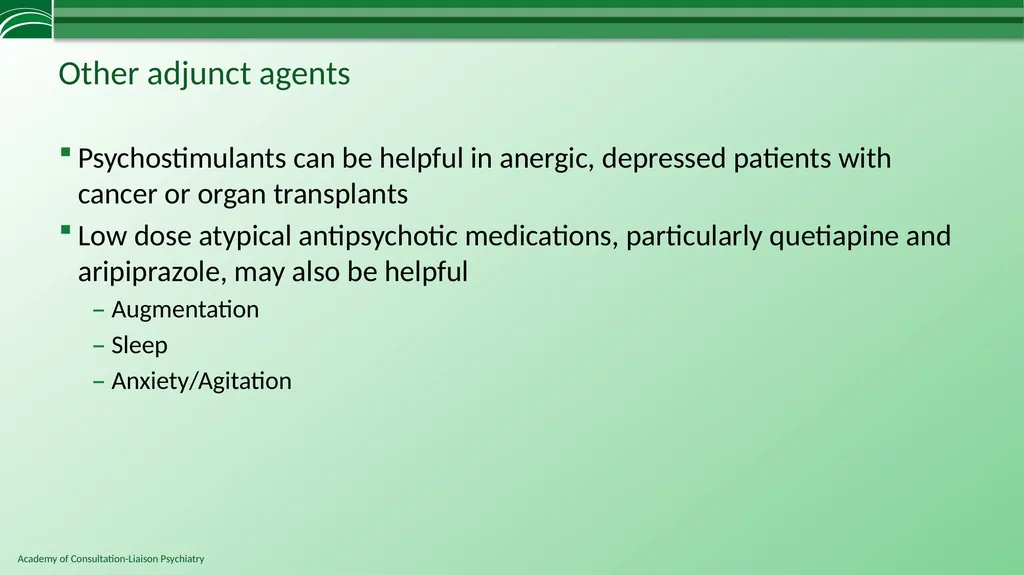
Other adjunct agents Psychostimulants can be helpful in anergic, depressed patients with cancer or organ transplants
Low dose atypical antipsychotic medications, particularly quetiapine and aripiprazole, may also be helpful
Augmentation
Sleep
Anxiety/Agitation<br>
Low dose atypical antipsychotic medications, particularly quetiapine and aripiprazole, may also be helpful
Augmentation
Sleep
Anxiety/Agitation<br>
42
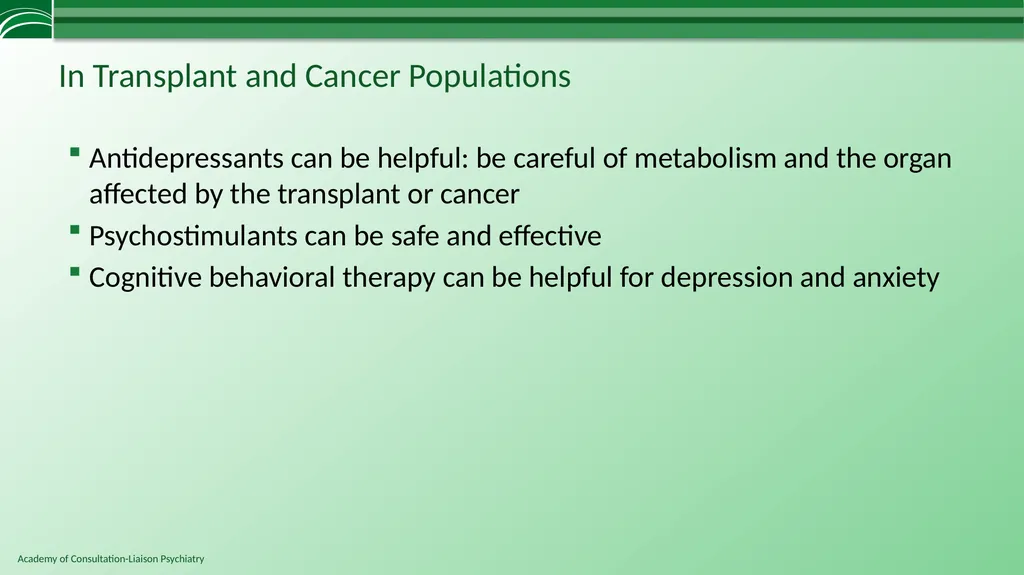
In Transplant and Cancer Populations Antidepressants can be helpful: be careful of metabolism and the organ affected by the transplant or cancer
Psychostimulants can be safe and effective
Cognitive behavioral therapy can be helpful for depression and anxiety<br>
Psychostimulants can be safe and effective
Cognitive behavioral therapy can be helpful for depression and anxiety<br>
43
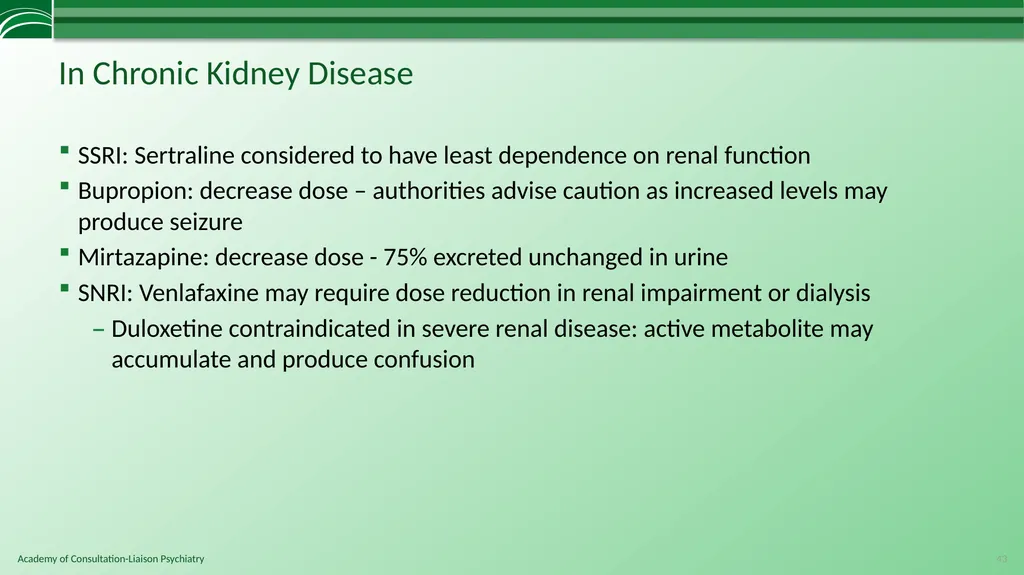
In Chronic Kidney Disease SSRI: Sertraline considered to have least dependence on renal function
Bupropion: decrease dose – authorities advise caution as increased levels may produce seizure
Mirtazapine: decrease dose - 75% excreted unchanged in urine
SNRI: Venlafaxine may require dose reduction in renal impairment or dialysis
Duloxetine contraindicated in severe renal disease: active metabolite may accumulate and produce confusion 43<br>
Bupropion: decrease dose – authorities advise caution as increased levels may produce seizure
Mirtazapine: decrease dose - 75% excreted unchanged in urine
SNRI: Venlafaxine may require dose reduction in renal impairment or dialysis
Duloxetine contraindicated in severe renal disease: active metabolite may accumulate and produce confusion 43<br>
44
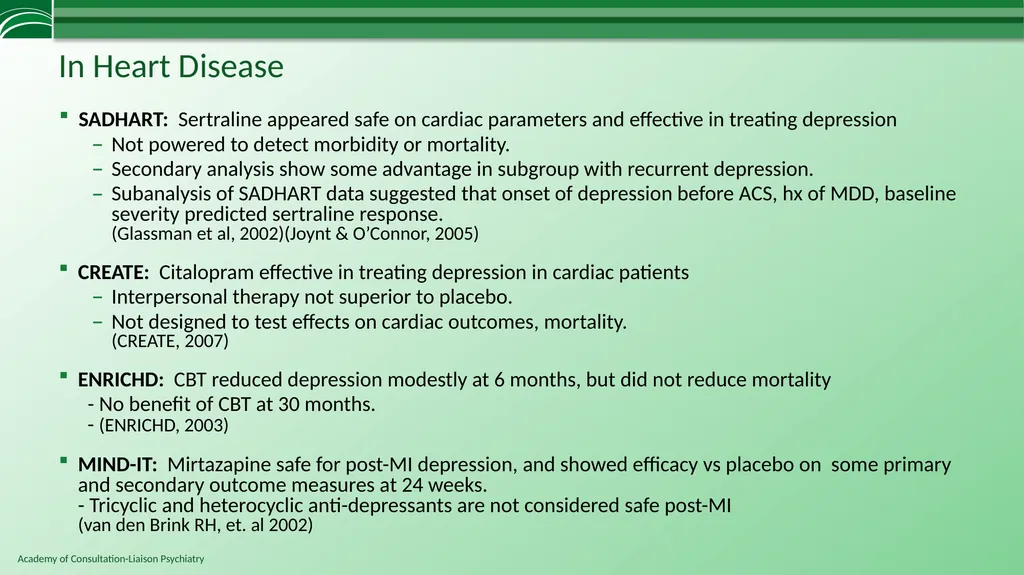
In Heart Disease SADHART: Sertraline appeared safe on cardiac parameters and effective in treating depression
Not powered to detect morbidity or mortality.
Secondary analysis show some advantage in subgroup with recurrent depression.
Subanalysis of SADHART data suggested that onset of depression before ACS, hx of MDD, baseline severity predicted sertraline response. (Glassman et al, 2002)(Joynt & O’Connor, 2005)
CREATE: Citalopram effective in treating depression in cardiac patients
Interpersonal therapy not superior to placebo.
Not designed to test effects on cardiac outcomes, mortality. (CREATE, 2007)
ENRICHD: CBT reduced depression modestly at 6 months, but did not reduce mortality
- No benefit of CBT at 30 months. - (ENRICHD, 2003)
MIND-IT: Mirtazapine safe for post-MI depression, and showed efficacy vs placebo on some primary and secondary outcome measures at 24 weeks. - Tricyclic and heterocyclic anti-depressants are not considered safe post-MI (van den Brink RH, et. al 2002)<br>
Not powered to detect morbidity or mortality.
Secondary analysis show some advantage in subgroup with recurrent depression.
Subanalysis of SADHART data suggested that onset of depression before ACS, hx of MDD, baseline severity predicted sertraline response. (Glassman et al, 2002)(Joynt & O’Connor, 2005)
CREATE: Citalopram effective in treating depression in cardiac patients
Interpersonal therapy not superior to placebo.
Not designed to test effects on cardiac outcomes, mortality. (CREATE, 2007)
ENRICHD: CBT reduced depression modestly at 6 months, but did not reduce mortality
- No benefit of CBT at 30 months. - (ENRICHD, 2003)
MIND-IT: Mirtazapine safe for post-MI depression, and showed efficacy vs placebo on some primary and secondary outcome measures at 24 weeks. - Tricyclic and heterocyclic anti-depressants are not considered safe post-MI (van den Brink RH, et. al 2002)<br>
45
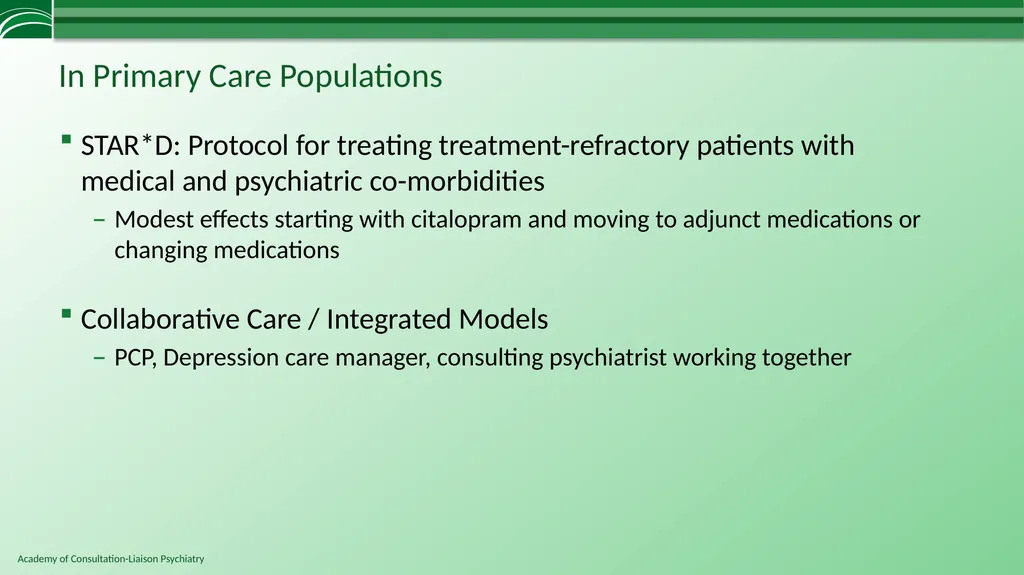
In Primary Care Populations STAR*D: Protocol for treating treatment-refractory patients with medical and psychiatric co-morbidities
Modest effects starting with citalopram and moving to adjunct medications or changing medications
Collaborative Care / Integrated Models
PCP, Depression care manager, consulting psychiatrist working together<br>
Modest effects starting with citalopram and moving to adjunct medications or changing medications
Collaborative Care / Integrated Models
PCP, Depression care manager, consulting psychiatrist working together<br>
46
Treatment Resistance Factors<br>
47
Up to 50% of patients stop antidepressants
within three months (Simon,1993; Lin,1995; Sansone, 2012)<br>
within three months (Simon,1993; Lin,1995; Sansone, 2012)<br>
48
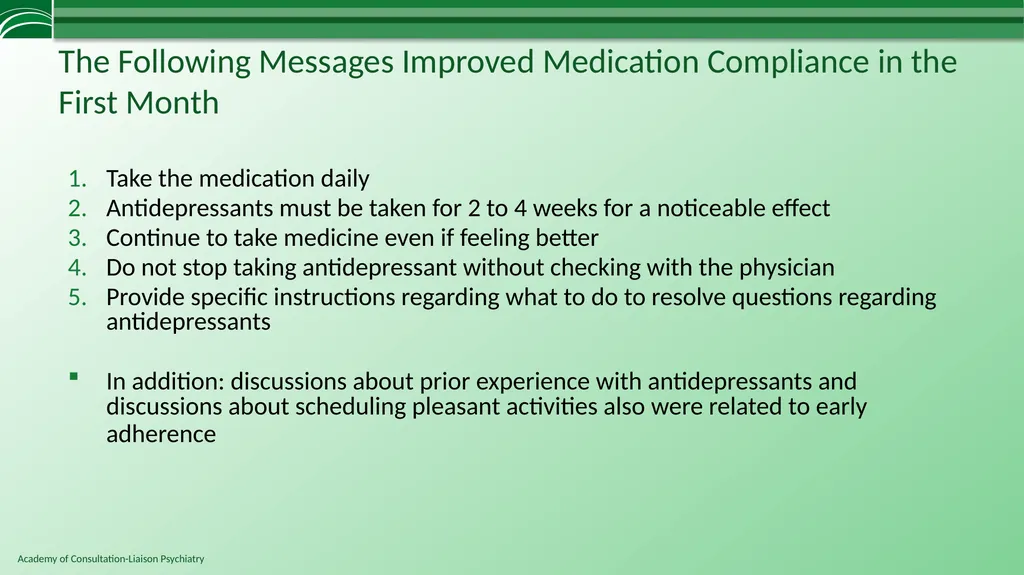
The Following Messages Improved Medication Compliance in the First Month Take the medication daily
Antidepressants must be taken for 2 to 4 weeks for a noticeable effect
Continue to take medicine even if feeling better
Do not stop taking antidepressant without checking with the physician
Provide specific instructions regarding what to do to resolve questions regarding antidepressants
In addition: discussions about prior experience with antidepressants and discussions about scheduling pleasant activities also were related to early adherence<br>
Antidepressants must be taken for 2 to 4 weeks for a noticeable effect
Continue to take medicine even if feeling better
Do not stop taking antidepressant without checking with the physician
Provide specific instructions regarding what to do to resolve questions regarding antidepressants
In addition: discussions about prior experience with antidepressants and discussions about scheduling pleasant activities also were related to early adherence<br>
49
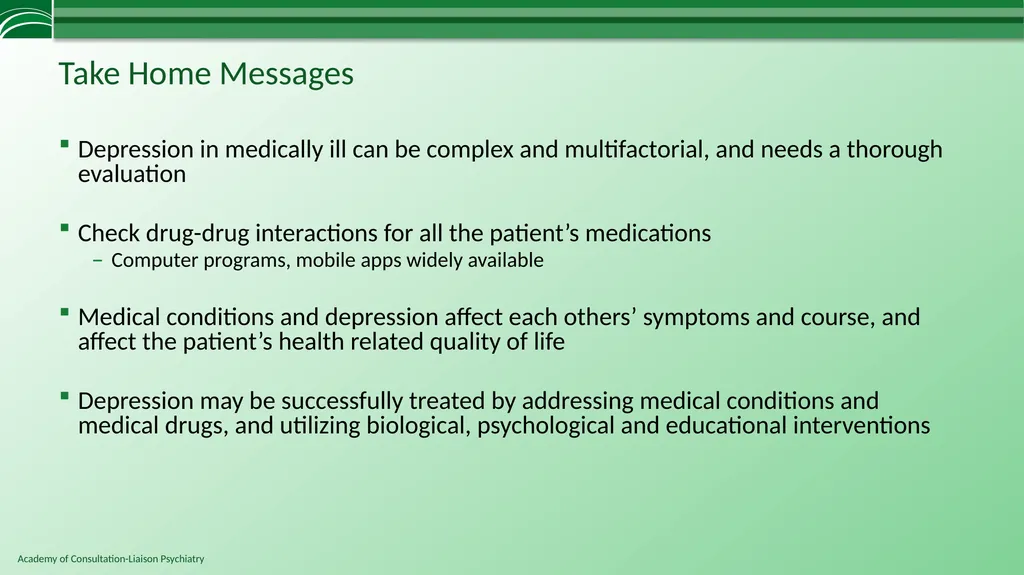
Take Home Messages Depression in medically ill can be complex and multifactorial, and needs a thorough evaluation
Check drug-drug interactions for all the patient’s medications
Computer programs, mobile apps widely available
Medical conditions and depression affect each others’ symptoms and course, and affect the patient’s health related quality of life
Depression may be successfully treated by addressing medical conditions and medical drugs, and utilizing biological, psychological and educational interventions<br>
Check drug-drug interactions for all the patient’s medications
Computer programs, mobile apps widely available
Medical conditions and depression affect each others’ symptoms and course, and affect the patient’s health related quality of life
Depression may be successfully treated by addressing medical conditions and medical drugs, and utilizing biological, psychological and educational interventions<br>
50
References Boal AH, et al. Monotherapy with major antihypertensive drug classes and risk of hospital admissions for mood disorders. Hypertension 2016; 1132-1138.
Bukberg J, Penman J, Holland J. Depression in hospitalized cancer patients. J Psychosomatic Medicine 1984; 46(3):199-211.
Broadhead WE, Blazer DG, George LK, et al. Depression, disability days, and days lost from work in a prospective epidemiologic survey. JAMA 1990;264(19):2524-8.
Carney RM, Blumenthal JA, Freedland KE, et.al. Depression and late mortality after myocardial infarction in the Enhancing Recovery in Coronary Heart Disease (ENRICHD) study. Psychosom Med 2004;66(4):466-74.
Coleman SM, Katon W, Lin E.Depression and Death in Diabetes; 10-Year Follow-Up of All-Cause and Cause-Specific Mortality in a Diabetic Cohort Psychosomatics 2013 ;54,( 5) :428-436
Cozza KL, Armstrong SC, Oesterheld JR: Concise Guide to Drug Interaction Principles for Medical Practice: Cytochrome P450s, UGTs, P-Glycoproteins, Second Edition. Washington, DC, American Psychiatric Publishing, 2003
Flockhart DA. Drug Interactions: Cytochrome P450 Drug Interaction Table. Indiana University School of Medicine (2007). http://medicine.iupui.edu/clinpharm/ddis/" Accessed October 26, 2017.
Frasure-Smith N, Lesperance F, Talajic M. Depression following myocardial infarction. Impact on 6-month survival. JAMA 1993;270(15):1819-25.
Gerstman BB, et al. The incidence of depression in new users of beta-blockers and selected antihypertensives. Journal of Clinical Epidemiology 1996; 49(7):809-815.
Glassman AH, O'Connor CM, Califf RM, et.al. Sertraline treatment of major depression in patients with acute MI or unstable angina. JAMA 2002;288(6):701-709.
Griffith JL, Gaby L. Brief psychotherapy at the bedside: countering demoralization from medical Illness. Psychosomatics. 2005 Mar-Apr;46(2):109-16.5.<br>
Bukberg J, Penman J, Holland J. Depression in hospitalized cancer patients. J Psychosomatic Medicine 1984; 46(3):199-211.
Broadhead WE, Blazer DG, George LK, et al. Depression, disability days, and days lost from work in a prospective epidemiologic survey. JAMA 1990;264(19):2524-8.
Carney RM, Blumenthal JA, Freedland KE, et.al. Depression and late mortality after myocardial infarction in the Enhancing Recovery in Coronary Heart Disease (ENRICHD) study. Psychosom Med 2004;66(4):466-74.
Coleman SM, Katon W, Lin E.Depression and Death in Diabetes; 10-Year Follow-Up of All-Cause and Cause-Specific Mortality in a Diabetic Cohort Psychosomatics 2013 ;54,( 5) :428-436
Cozza KL, Armstrong SC, Oesterheld JR: Concise Guide to Drug Interaction Principles for Medical Practice: Cytochrome P450s, UGTs, P-Glycoproteins, Second Edition. Washington, DC, American Psychiatric Publishing, 2003
Flockhart DA. Drug Interactions: Cytochrome P450 Drug Interaction Table. Indiana University School of Medicine (2007). http://medicine.iupui.edu/clinpharm/ddis/" Accessed October 26, 2017.
Frasure-Smith N, Lesperance F, Talajic M. Depression following myocardial infarction. Impact on 6-month survival. JAMA 1993;270(15):1819-25.
Gerstman BB, et al. The incidence of depression in new users of beta-blockers and selected antihypertensives. Journal of Clinical Epidemiology 1996; 49(7):809-815.
Glassman AH, O'Connor CM, Califf RM, et.al. Sertraline treatment of major depression in patients with acute MI or unstable angina. JAMA 2002;288(6):701-709.
Griffith JL, Gaby L. Brief psychotherapy at the bedside: countering demoralization from medical Illness. Psychosomatics. 2005 Mar-Apr;46(2):109-16.5.<br>
51
References Horwath E, Johnson J, Klerman GL, et al. Depressive symptoms as relative and attributable risk factors for first-onset major depression. Archives of General Psychiatry 1992;49(10):817-23.
Johnson J, Weissman MM, Klerman GL. Service utilization and social morbidity associated with depressive symptoms in the community. JAMA 1992; 267(11):1478-83.
Joynt KE, O’Connor CM. Lessons from SADHART, ENRICHD, and other trials. Psychosomatic Medicine 2005; 67(1): S63-S66.
Katon W, Ciechanowski P. Impact of major depression on chronic medical illness. J Psychosom Res. 2002 Oct;53(4):859-63
Levenson JL. Textbook of Psychosomatic Medicine, Second edition . The American Psychiatric Publishing, Inc. Washing DC, 2011.
Lin EHB, VonKorff M, Katon W, Bush W, Simon T, et al. The role of the primary care physician in patients’ adherence to antidepressant therapy. Medical Care 1995, 33(1): 67-74.
Parsaik AK et al. Statin use and risk of depression: a systematic review and meta-analysis. Journal of Affective Disorder 2014; 160:62-67.
Regier DA, Narrow WE, Rae DS, et al. The de facto US mental and addictive disorders service system. Epidemiologic catchment area prospective 1-year prevalence rates of disorders and services. Archives of General Psychiatry 1993; 50(2): 85-94.
Sansone RA, Sansone LA. Antidepressant adherence: are patients taking their medications? Innov Clin Neurosci 2012; 9(4-5):41-46.
Simon GE, Katon WJ, Von Korff M, et.al. Cost-effectiveness of a collaborative care program for primary care patients with persistent depression. Am. J. Psych. 2001; 158(10): 1638-1644.
Slavney PR. Diagnosing demoralization in consultation psychiatry. Psychosomatics 1999;40(4):325-9.
Thompson PD, et al. Statin-associated side effects. Journal of American College of Cardiology 2016;67:2395-2410.<br>
Johnson J, Weissman MM, Klerman GL. Service utilization and social morbidity associated with depressive symptoms in the community. JAMA 1992; 267(11):1478-83.
Joynt KE, O’Connor CM. Lessons from SADHART, ENRICHD, and other trials. Psychosomatic Medicine 2005; 67(1): S63-S66.
Katon W, Ciechanowski P. Impact of major depression on chronic medical illness. J Psychosom Res. 2002 Oct;53(4):859-63
Levenson JL. Textbook of Psychosomatic Medicine, Second edition . The American Psychiatric Publishing, Inc. Washing DC, 2011.
Lin EHB, VonKorff M, Katon W, Bush W, Simon T, et al. The role of the primary care physician in patients’ adherence to antidepressant therapy. Medical Care 1995, 33(1): 67-74.
Parsaik AK et al. Statin use and risk of depression: a systematic review and meta-analysis. Journal of Affective Disorder 2014; 160:62-67.
Regier DA, Narrow WE, Rae DS, et al. The de facto US mental and addictive disorders service system. Epidemiologic catchment area prospective 1-year prevalence rates of disorders and services. Archives of General Psychiatry 1993; 50(2): 85-94.
Sansone RA, Sansone LA. Antidepressant adherence: are patients taking their medications? Innov Clin Neurosci 2012; 9(4-5):41-46.
Simon GE, Katon WJ, Von Korff M, et.al. Cost-effectiveness of a collaborative care program for primary care patients with persistent depression. Am. J. Psych. 2001; 158(10): 1638-1644.
Slavney PR. Diagnosing demoralization in consultation psychiatry. Psychosomatics 1999;40(4):325-9.
Thompson PD, et al. Statin-associated side effects. Journal of American College of Cardiology 2016;67:2395-2410.<br>
52
References Trivedi MH, Rush AJ, Wisniewski SR, et al. Evaluation of outcomes with citalopram for depression using measurement-based care in STAR*D: implications for clinical practice. American Journal of Psychiatry 2006; 163(1): 28-40.
Wells KB; Burnam MA; Rogers W; Hays R; Camp P. The course of depression in adult outpatients. Results from the Medical Outcomes Study. Archives of General Psychiatry 1992; 49(10): 788-94.
Writing Committee for the ENRICHD Investigators. The effects of treating depression and low perceived social support on clinical events after myocardial infarction: the enhancing recovery in coronary heart disease patients (ENRICHD) Randomized Trial. JAMA 2003; 289: 3106-3116.
Writing Committee for the CREATE Investigators. Effects of citalopram and interpersonal psychotherapy on depression in patients with coronary artery disease. The Canadian Cardiac Randomized Evaluation of Antidepressant and Psychotherapy Efficacy (CREATE) Trial. American Medical Association 2007; 297(4): 367-379.
Van den Brink RH, et. al. Treatment of depression after myocardial infarction and the effects of cardiac prognosis and quality of life: rational and outline of the Myocardial Infarction and Depression-Intervention trial (MIND-IT). Am. Heart J 2002: 144: 219-225.<br>
Wells KB; Burnam MA; Rogers W; Hays R; Camp P. The course of depression in adult outpatients. Results from the Medical Outcomes Study. Archives of General Psychiatry 1992; 49(10): 788-94.
Writing Committee for the ENRICHD Investigators. The effects of treating depression and low perceived social support on clinical events after myocardial infarction: the enhancing recovery in coronary heart disease patients (ENRICHD) Randomized Trial. JAMA 2003; 289: 3106-3116.
Writing Committee for the CREATE Investigators. Effects of citalopram and interpersonal psychotherapy on depression in patients with coronary artery disease. The Canadian Cardiac Randomized Evaluation of Antidepressant and Psychotherapy Efficacy (CREATE) Trial. American Medical Association 2007; 297(4): 367-379.
Van den Brink RH, et. al. Treatment of depression after myocardial infarction and the effects of cardiac prognosis and quality of life: rational and outline of the Myocardial Infarction and Depression-Intervention trial (MIND-IT). Am. Heart J 2002: 144: 219-225.<br>