
Designing and Implementing a Relationship Policy
Description: Designing and Implementing a Relationship Policy Credits: Dix, Paul. When the Adults Change, Everything Changes (pp. 61-62). Crown House Publishing. Kindle Edition. Jung, Lee Ann and Smith, Dominique. Tear Down your Behaviour Chart.
Related Topics
Download Presentation
"Designing and Implementing a Relationship Policy" is the property of its rightful owner. Permission is granted to download and print the materials on this website for personal, non-commercial use only, and to display it on your personal computer provided you do not modify the materials and that you retain all copyright notices contained in the materials. By downloading content from our website, you accept the terms of this agreement.
Presentation Transcript
slide1. Designing and Implementing
a Relationship Policy Credits: Dix, Paul. When the Adults Change, Everything Changes (pp. 61-62). Crown House Publishing. Kindle Edition. Jung, Lee Ann and Smith, Dominique. Tear Down your Behaviour Chart. Classroom Management Reimagined Pages 12-18. September 2018
Kohn, Alfie. Rewards are Still Bad News (25 years later). New York Times. October 2018<br>
slide2. Designing and Implementing a Relationship Policy Discussion Document Why change from the existing policy? There will always be a small minority of children who will demonstrate challenging behaviour and our existing policy simply doesn’t work for them. These children cause the most disruption and are the ones that need the most support. Using behaviour charts where a child moves from green through to red because of their behaviour is a ‘shaming’ experience. Do we want to shame our children into submission? In removing a child from the classroom, you signal to the child that you are unable to deal with their behaviour. This gives the child’s behaviour ‘value’ – something they are good at and can be depended on.<br>
slide3. Behaviour Management in Schools It is widely recognised that ’consistency’ is the key to effective behaviour management but what does that look like?
Every teacher has their own style and way of teaching so firstly, teaching is not consistent. As we have already seen, our existing policy is not being applied consistently across the school.
Consistency is difficult – think of your own behaviour. Are you consistent in the way you behave each day towards your colleagues and family?
Children need to be sure that every member of staff will respond in the same way to their behaviour, good or bad, and our actions should always reflect this high level of consistency.<br>
slide4. Designing a policy that embodies consistency How children come into our classrooms
There has been lots of posts on social media showing teachers offering their children a greeting before they come into the classroom. A handshake, a cuddle or a high five, chosen by the child gives each one a feeling that their teacher cares about them, that they are important and have value.
Is this something we could do here? Or is there another way that we could all meet our children in a consistent way? This ensures that day starts in the same way for every child in the school.
Fantastic Walking
In one school in the north of England, they have put in place ‘Fantastic Walking’. All staff and children walk through the corridors with their hands behind their backs, chest out, walking proudly. It is how everyone in the school moves around. Children are taught how to do this to show their pride in the school.<br>
slide5. Designing a policy that embodies consistency ‘Praise in public, criticise in private’
No adult would welcome their name being moved to ‘amber’ then ’red’ on a public, behaviour display board. Can you imagine how you would feel if this was introduced in the staff room?
Yet we think it’s okay to ‘shame’ children in this way. Shaming children does not result in better behaviour, it simply drives resentment and damages self-esteem.
Recognition Board
Switch the system to a recognition board, deciding on the behaviour that you would like to encourage in your classroom. Write this on the top of your board and then write a child’s name on it when you see the behaviour being shown. The recognition board does not seek to shower praise on an individual but drive a collaborative focus, ‘we are one team, focused on one learning behaviour and moving in one direction.’<br>
slide6. Designing a policy that embodies consistency Recognition Board
Children’s names stay on the Recognition Board, even if they later exhibit unwelcome behaviour. Their poor choice does not counteract their earlier behaviour.
Poor behaviour should still be dealt with robustly, but this behaviour is not everyone else’s business and should be addressed privately wherever possible. The advertising of poor behaviour doesn’t help but routinely advertising the behaviour you do want to see, does.<br>
slide7. Designing a policy that embodies consistency Token Economies are Corrupt
Token economies, where an individual is rewarded with a merit or a team point, can never be consistent. It always rewards the highest achievers or the worst behaved – the most ‘visible’ children – and is open to abuse by adults and children alike.
Give out too many rewards, the system is devalued, give out too few and the children become discouraged. There is lots of evidence that shows that rewards don’t work. A number of studies for example have shown that children become less concerned about others’ wellbeing if they were rewarded for demonstrating helping or sharing behaviour. Students also become less excited about learning after they have been given an inducement to complete work.
The best that carrots – or sticks – can do is change an individual’s behaviour temporarily. They can never create a lasting commitment to an action or value and often have exactly the opposite effect.
Token economies build inconsistency into a behaviour plan, dividing children into high and low scorers and staff into categories depending upon their generosity. Children know how to subvert the system by making sure they are caught doing the right thing. It turns behaviour into a school wide game.<br>
slide8. Designing a policy that embodies consistency Being Deliberately Bothered
Our policy tries to focus on the needs of the child, but the way we manage behaviour is detached from this aim.
The most difficult behaviours can emerge from those who have attachment issues at home. They need to have a consistent relationship with another adult. The small stuff, the daily acts of care, the perpetual generosity of spirit, the interest we show in their lives demonstrates that we value them, that they are appreciated and cared about.
Bribing children to behave well is an unsustainable strategy. Using positive recognition, or being bothered, means that you know how to make each child feel appreciated and important. This takes time, effort and commitment. Some children find their sense of importance through fame; their work on display, applause in collective worship or their work being read out by their teacher. Others find their importance in a quiet word, an extra responsibility or subtle, discreet reinforcement.<br>
slide9. Designing a policy that embodies consistency If you constantly reward minimum standards, then children will only strive for minimum standards. If you reward children for going ‘over and above’ then there is no limit to their excellent behaviour.
This mantra should be referred to often, mark it with the children:
“What Holly just did by collecting all the brushes by herself has saved me a lot of time and effort. That is over and above Holly. Thank you, that is fantastic.”
Use it when putting names onto the recognition board, if you do give out an award and when talking to parents. Focusing on behaviour that is over and above creates an immediate shift in expectations. It gives the children something more than bare minimum to achieve. How you recognise these children should become the heart of your practice.<br>
slide10. Designing a policy that embodies consistency Building Emotional Currency
Great teachers build emotional currency with their children deliberately. They know that there will be a time when it can be spent – a crisis averted, an angry acceleration halted. It is the smiley face drawn on a piece of work, a book brought in about a topic a child is passionate about, the positive mention you make to another member of staff and the time you always make despite your heavy and insane workload.
With some children it can take a long time for the drip effect to break down barriers, but it always works. Some adults just give up too quickly. Done well, the drip effect of positive recognition beats grand material rewards that shine brightly but soon fade.
Think about yourself when a colleagues gives you a compliment. The warm glow is long lasting.<br>
slide11. Designing a policy that embodies consistency Notes Home
At the top of the recognition hierarchy is an acknowledgement that gives parents a positive message about their child.
The positive note home is high level recognition. Perhaps just one child from the class will earn the note and perhaps there are weeks when no-one will earn this award. The positive note serves two functions. It is sincere recognition for those students who have gone over and above consistently, and it is also a great tactical move.
The positive note enables you to mark the achievement with the child. You are framing them with their best behaviour, their greatest effort, their greatest show of resilience. You are paying large amounts of emotional currency into the bank. It is a moment you may need to return to next week when the child’s behaviour has taken a turn for the worse and you need to remind them of the learner they really are.<br>
slide12. Designing a policy that embodies consistency Notes Home
It would be wrong to reward a child with a note home who, after a week of chaos, decides to be compliant for twenty minutes on a Friday afternoon. It is tempting as we are training ourselves to respond positively to appropriate behaviour. The issues is proportionate response. It would be proportionate to say ‘thank you.’
Balance is critical, if you were to significantly reward this child with a note home, other children would be astonished. They come to school every day, are well mannered, polite and committed but have never received a note home.
Notes home should be accessible to everyone, so perhaps a child who begins to demonstrate self regulation in their behaviour is awarded a quarter of a note, or a third building up to a complete note.<br>
slide13. Designing a policy that embodies consistency Noticing the Unnoticed - Hot Chocolate Friday
A small ripple of kindness and being bothered from the top goes a long way. Hot Chocolate Friday is one such initiative.
Hot Chocolate Friday is targeted at those children who behave impeccably but are too easily forgotten. As we’ve seen, it might be tempting to invite those children who have been appallingly behaved as soon as they are able to behave appropriately for an afternoon. While we should recognise their determination to behave, it is not on a par with the child who is making all the effort, all the time but none of the noise.<br>
slide14. Designing a policy that embodies consistency Consistency of Staff
’Strip out the negative emotion and be professionally rational. I mean completely strip it out. Refuse to entertain the screw face, irritated tone or sharp word. Do not allow yourself to shout, point or give even the whiff of physical authority. Make your response to even the most appalling behaviour matter of fact. Be outwardly shocked by nothing. If you resist the urge to respond emotionally for 30 days it becomes routine, easy, normal – even working in the most extreme circumstances.
’CERTAINTY BEATS WEIGHT OF SANCTION EVERY TIME’.
The most damaged children need the most certainty from you. To succeed with them, and for them, it is the everyday certainties that make them feel safe enough to learn. Certainty provides a particular challenge to teachers as they are intelligent enough to realise that nothing is certain and that we are but blimps blundering about in finite space and time. It is also particularly difficult to be certain on every decision, every time, particularly when you are finding your feet with a new class.’
Dix, Paul. When the Adults Change, Everything Changes (pp. 61-62). Crown House Publishing. Kindle Edition.<br>
slide15. Designing a policy that embodies consistency Staff Behaviour
‘Parent on your Shoulder’
A good way to regulate your response to poor behaviour is to imagine the child’s parent on your shoulder, listening to your words.
‘What would the Best Teacher in the World do Now?’
Ask yourself this question to help you decide if you are uncertain.
Let’s face it, we all know when we have dealt with something badly. We feel it, we regret it, we wish we could go back in time and do it differently.<br>
slide16. Designing a policy that embodies consistency Keystone Routines
Across the whole school, there should be some keystone routines that are universal. The way children come into classrooms, move around the school, sit in collective worship, behave in the dining room and the way their behaviour is recognised and responded to. The whole school, including the children should be responsible for identifying and agreeing the keystone routines.
Within classrooms there will be different routines set down by the class teacher. This is necessary because of the different ages, curriculum and the teacher’s personal timetable (PPA etc). These routines should be decided upon, taught and revisited by each class teacher to ensure consistency. Routines may differ depending upon the subject being taught, a PE lesson will necessitate different routines to a maths lesson.
Develop and refine your own repetitious routines. What will you always say? What order will you say it in? How will you make it encouraging and affirmative? What will you use to punctuate the routine (e.g. gesture, positioning, vocal tone, music, props, technology)? How will you teach/ reteach the routine to make sure it is productive? What will it look like when it works perfectly? What will the pupils be doing? What will you be doing?<br>
slide17. Designing a policy that embodies consistency What are X School’s Golden Rules? Kind hands, kind words.
Indoor voices.
Walk inside.
Put your hand up if you want to contribute.
Say please and thank you.
No hats inside school.
Look after school property.
Tidy up properly.
Don’t forget your PE kit/reading book/homework.
Line up quietly.
Don’t talk in collective worship.
Sit still, don’t fidget.
Show respect.
Can you think of anymore? What would our children say if we asked them what the school rules were? What would the staff say? I’m not sure myself, if we don’t know what our priorities are, how can we expect the children to know?<br>
slide18. Designing a policy that embodies consistency Five pillars of practice for all adults:
Consistent, calm, adult behaviour.
First attention for best conduct.
Relentless routines.
Scripting difficult interactions.
Restorative follow-up.
Three whole-school rules, such as RRS:
Ready
Respect
Safe
Children would then be taught what each of these rules would look like across the school, in classrooms and on the playground. In each classroom it will look different because of the teacher, ages of children and the necessary routines in place.<br>
slide19. Designing a policy that embodies consistency Seven ways to weave rules into the life of the school
Weave the language of the rules throughout the institution so they are a key reference point for everyone.
Prominent on the website.
Awards evenings with every award focused on one of ready, respectful or safe.
Strong focus in staff induction programmes.
Highlighted on open days and parent consultations.
Newsletters with examples of learners demonstrating the core behaviours.
Displays in the entrance demonstrating children’s commitment to self-regulation around these behaviours.<br>
slide20. Designing a policy that embodies consistency Using Scripted Responses
How often do you find yourself using a default language when dealing with inappropriate behaviour?
Why am I waiting for you?
Would you do that at home?
When I was your age, I wouldn’t have dared to speak to a teacher like that
Be honest, do you recognise any of these? I do (number 2 particularly).
When your improvised skills are impaired, a back up script is very useful. One that deals with the behaviour and protects the teacher and child, one that limits the damage an improvised script risks.
In addition, what you say to a child can be undermined by a sharp tone or careless physical cues, so care must be taken when using a script. The smallest throw away comment or action can stay with someone for a lifetime. When I was a child, I was allowed to go into a room on my own during Art to work on record album covers. I did this for several art lessons in a row, then I thought it was a treat but as an adult I have realised that it was easier for the teacher to allow this than to teach me the skills I needed. I always felt that I was uncreative and poor at art and it was only when I started teaching myself that I understood that wasn’t the case.<br>
slide21. Designing a policy that embodies consistency Using a Scripted Response
Go to where the child is sitting and quietly say
”I noticed you are ……….” (having trouble getting started/struggling to get going/wandering around the classroom. Describe the inappropriate behaviour.
“It was the rule about ……. “(lining up/staying on task/sitting in your seat that you broke. Identify the rule that has been broken.
“You have chosen to ……..” (move to the back/catch up with your work at lunchtime/speak to me after class. Give the child a consequence.
“Do you remember last week when ……..” (you showed how well you could listen/helped me tidy up/got that note sent home? Refer back to previous good behaviour.
“That is who I need to see today.” Reinforce the good behaviour.
”Thank you for listening.” Then walk away and give the child some take-up time.
We would need to define our own script if we felt this one was inappropriate.<br>
slide22. Designing a policy that embodies consistency Seven assertive sentence stems to set you off on the right foot
You need to … (speak to me at the side of the room).
I need to see you … (following the agreed routine).
I expect … (to see your table immaculately tidy in the next two minutes).
I know you will … (help Kyra to clean the pen off her face).
Thank you for … (letting go of her hair, let’s walk and talk).
I have heard what you said, now you must … (collect your things calmly and move to the thinking spot).
We will … (have a better day tomorrow)!<br>
slide23. Designing a policy that embodies consistency Seven juicy bits of script
You need to understand that every choice has a consequence. If you choose to do the work, that would be fantastic, and this will happen … If you choose not to do the work, then this will happen … I’ll leave you to make your decision.
Do you remember yesterday when you helped me to tidy up? That is the Stefan I need to see today, that is the Stefan you can be all the time.
I don’t like your behaviour. Your behaviour is disruptive, damaging and dangerous. I don’t like your behaviour, but I believe that you can be a success.
I am not leaving; I care about what happens. You are going to be brilliant.
What do you think the poor choices were that caught my attention?
What do you think you could do to avoid this happening in the next lesson?
Darrel it’s not like you to … (kick doors/shout out/shake the hamster).<br>
slide24. Designing a policy that embodies consistency Managing Behaviour
We can learn a great deal about managing the most extreme behaviour by looking at the home. When a child behaves appallingly at home, he/she is chastised, sent to bed, perhaps sat on the ‘naughty step’. The sanction is swift, and it is the conversation that seeks to change behaviour. The parent cannot exclude or isolate the child for more than a few hours. They are forced to help repair the damage. It cannot be delegated to someone else. The child cannot simply be removed. So why should the adult model in school be any different?
What if we simply took exclusion away? We agree that the children who come to our school are the children that we must find a way to succeed with. We play the cards we are dealt. There is no chance of changing them around, getting rid of the tricky ones and importing lovely ones. What if we simply accepted that all children have additional needs, stopped labelling them as ‘special’ and became accepting of every card in our pack? If sanctions and exclusion solved behaviour, we wouldn’t still be talking about it. Only when we learn absolute tolerance will we stop going through the same old arguments. After all, an outstanding school is a school that can succeed with all learners, not just the compliant ones.
Dix, Paul. When the Adults Change, Everything Changes (p. 111). Crown House Publishing. Kindle Edition.<br>
slide25. Designing a policy that embodies consistency Secondary Behaviours
Adults who respond to secondary behaviours often find themselves in an insane argument that cannot be won. Try to recognise secondary behaviours for what they really are – diversions to a different argument. This allows you to stay focused on what you really want. The angry child who sits down aggressively with a loud tut has complied with the primary behaviour (sitting down). The secondary behaviour is calculated to provoke, to invite a further row. Although everything about the rudeness screams at you to respond, don’t do it, it rarely ends well. There is always a better time and place to address the secondary behaviour, never in the heat of the moment.<br>
slide26. Designing a policy that embodies consistency Ten ways to manage secondary behaviours
Don’t bite back with your words.
Refuse to chase secondary behaviours or engage in a power play.
Use choice if you can but not if it inflames the situation.
Resist the urge to bring up past misdemeanors: ‘This is the twenty-third time this term that you have refused to follow instructions!’
Don’t follow learners when they walk away, unless you must because of clear and present safety concerns (e.g., your classroom door opens on to a main road). Often the act of following can provoke another peak in anger.
Remember that you are the adult. Focus on the outcome that you want, not the argument.
Ask questions and try not to make accusations.
Focus on what is happening next. You can uncover what has just happened later.
Whenever possible move the student to a safe space out of public view and the pressure of an audience.
Shift into listening mode. This is not a time for lengthy speeches. Less will almost certainly be more.<br>
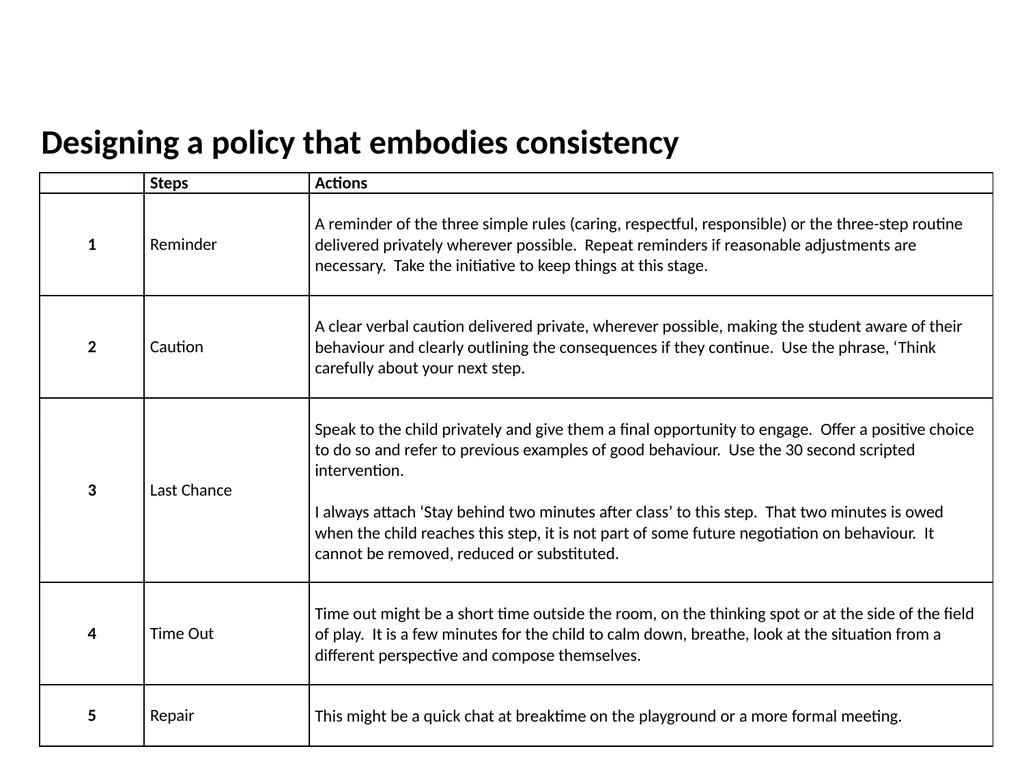
slide27. Designing a policy that embodies consistency<br>
slide28. Designing a policy that embodies consistency Missed Work
If a child needs to catch up or pay back time lost in learning, then a simple imposition is quick, effective and takes no precious time away from staff.
Impositions are additional work that must be completed that evening, countersigned by the parent and returned first thing in the morning. The parent is able to see that there are expectations which are not being met, the child understands that there are natural consequences for not completing work and the responsibility for making up time is left with the child, not the adult.
All that is needed is a short pre-written note that can be stapled to the work with a space for a parent signature, a reminder of the time it needs to be delivered to the teacher and an indication of the amount of work that must be completed.
Making children stay in at playtime to complete work is counter-productive as many of the children that would be affected desperately need this physical activity.<br>
slide29. Designing a policy that embodies consistency Restorative Conversations
A restorative conversation should be more than a series of questions. The behaviour of the adult lies at the heart of it all. Small things matter, the body language, the way the room is set up, the tone and the inflection used when speaking.
Often completing an activity with the child or simply walking and talking offers the best opportunity for an honest exchange, removing the fear that the child might be feeling.<br>
slide30. Designing a policy that embodies consistency The Restorative Five
Five questions is enough.
Write them in your diary or notebook so you have them to hand whenever you need them. As you address each question together remember that in-between your truth and their truth is the truth.
For young children, five questions might be too many, so choose two that you feel are particularly pertinent to the child. For example, it may be working on empathy so that they understand that pushing in the line in front of other children is unfair.<br>
slide31. Designing a policy that embodies consistency Children need to be taught about the relationship policy; the steps need to be made clear to them so that they understand what will happen if they behave inappropriately.
They need to take on and live by our three rules (caring, respect and responsibility).
They need to be given strategies to deal with anger, such as self-talk, walking away, counting to ten. They need to understand when they behave inappropriately lots of other people are affected, not just themselves.
Within our PSHE curriculum, we should link our values and the behaviours we want to encourage in our children to practical, engaging lessons that shape our children’s thinking and their understanding.
A weekly values assembly just doesn’t cut it.
We would never expect children to be able to think mathematically, without teaching and giving them opportunities to practise this skill.<br>
slide32. Designing a policy that embodies consistency For a relationship policy that lays out how to manage behaviour, it is important that it is easy to remember, simple to administer and makes sense to all the school staff.
A behaviour blueprint, is a sheet that everyone uses daily as an aide-memoir and no member of staff deviates from. Without this simple agreement there is no chance of a truly consistent approach.
However, all staff must buy into the process of agreeing this blueprint and be given the opportunity to add to the debate.<br>
slide33. Designing a policy that embodies consistency Behaviour Blueprint
Let’s simplify policy to promote the greatest consistency in practice. Three rules relentlessly reinforced, pursued positively by all adults, referred to in every conversation about behaviour and emphasised in every part of school life. A single A4 blueprint with straightforward agreements on adult behaviour, positive recognition and consistent steps. A song sheet that everyone can sing from. Simple ways to recognise outstanding behaviour, simple scripts for intervening in poor behaviour, simple ways to begin restorative conversations.<br>
slide34. Designing a policy that embodies consistency The 30 Day Magic
’There is something special about 30 days. A few days after deciding to change a habit it is all too easy to slip back into your old ways. After a week the transition back is effortless, easy. Yet as you progress deeper into the 30 days the new behaviours become more natural. You have changed your defaults and returning to the old ways would take a conscious effort. At the end of the 30 days new habits have become normalised. Of course, you can go back to old ways of behaving and responding, but it won’t be by accident. It will jar like the new habits jarred in the first week of transition.’
’Don’t think about changing your habits for ever. Fix your sights on 30 days and the routine will carry you far beyond that. I have lost count of the schools I have worked with to initiate a change for 30 days and discovered they are sticking with the change years later. One school we revisited recently still had their pledge ribbons tied to their lanyards five years after my first visit.’
Dix, Paul. When the Adults Change, Everything Changes (p. 179). Crown House Publishing. Kindle Edition.<br>
slide35. Designing a policy that embodies consistency Conclusion
’A focus on adult behaviour is the only responsible approach. Emotionally mature adults are flexible enough to change, to be present in the toughest moments and to judge slowly.'
‘They are patient, encouraging and kind. Through the fog of anger, they keep everyone safe. In the calm light of day, they build rapport and emotional currency. Their expectations are always high, and they will never drop their own standards because of the poor behaviour of a learner.’
‘The adults who work with the most difficult behaviours are always in control of themselves before they attempt to take control of others. Build a school that is full of them and there are no limits to achievement.’
Dix, Paul. When the Adults Change, Everything Changes (p. 185). Crown House Publishing. Kindle Edition.<br>
a Relationship Policy Credits: Dix, Paul. When the Adults Change, Everything Changes (pp. 61-62). Crown House Publishing. Kindle Edition. Jung, Lee Ann and Smith, Dominique. Tear Down your Behaviour Chart. Classroom Management Reimagined Pages 12-18. September 2018
Kohn, Alfie. Rewards are Still Bad News (25 years later). New York Times. October 2018<br>
slide2. Designing and Implementing a Relationship Policy Discussion Document Why change from the existing policy? There will always be a small minority of children who will demonstrate challenging behaviour and our existing policy simply doesn’t work for them. These children cause the most disruption and are the ones that need the most support. Using behaviour charts where a child moves from green through to red because of their behaviour is a ‘shaming’ experience. Do we want to shame our children into submission? In removing a child from the classroom, you signal to the child that you are unable to deal with their behaviour. This gives the child’s behaviour ‘value’ – something they are good at and can be depended on.<br>
slide3. Behaviour Management in Schools It is widely recognised that ’consistency’ is the key to effective behaviour management but what does that look like?
Every teacher has their own style and way of teaching so firstly, teaching is not consistent. As we have already seen, our existing policy is not being applied consistently across the school.
Consistency is difficult – think of your own behaviour. Are you consistent in the way you behave each day towards your colleagues and family?
Children need to be sure that every member of staff will respond in the same way to their behaviour, good or bad, and our actions should always reflect this high level of consistency.<br>
slide4. Designing a policy that embodies consistency How children come into our classrooms
There has been lots of posts on social media showing teachers offering their children a greeting before they come into the classroom. A handshake, a cuddle or a high five, chosen by the child gives each one a feeling that their teacher cares about them, that they are important and have value.
Is this something we could do here? Or is there another way that we could all meet our children in a consistent way? This ensures that day starts in the same way for every child in the school.
Fantastic Walking
In one school in the north of England, they have put in place ‘Fantastic Walking’. All staff and children walk through the corridors with their hands behind their backs, chest out, walking proudly. It is how everyone in the school moves around. Children are taught how to do this to show their pride in the school.<br>
slide5. Designing a policy that embodies consistency ‘Praise in public, criticise in private’
No adult would welcome their name being moved to ‘amber’ then ’red’ on a public, behaviour display board. Can you imagine how you would feel if this was introduced in the staff room?
Yet we think it’s okay to ‘shame’ children in this way. Shaming children does not result in better behaviour, it simply drives resentment and damages self-esteem.
Recognition Board
Switch the system to a recognition board, deciding on the behaviour that you would like to encourage in your classroom. Write this on the top of your board and then write a child’s name on it when you see the behaviour being shown. The recognition board does not seek to shower praise on an individual but drive a collaborative focus, ‘we are one team, focused on one learning behaviour and moving in one direction.’<br>
slide6. Designing a policy that embodies consistency Recognition Board
Children’s names stay on the Recognition Board, even if they later exhibit unwelcome behaviour. Their poor choice does not counteract their earlier behaviour.
Poor behaviour should still be dealt with robustly, but this behaviour is not everyone else’s business and should be addressed privately wherever possible. The advertising of poor behaviour doesn’t help but routinely advertising the behaviour you do want to see, does.<br>
slide7. Designing a policy that embodies consistency Token Economies are Corrupt
Token economies, where an individual is rewarded with a merit or a team point, can never be consistent. It always rewards the highest achievers or the worst behaved – the most ‘visible’ children – and is open to abuse by adults and children alike.
Give out too many rewards, the system is devalued, give out too few and the children become discouraged. There is lots of evidence that shows that rewards don’t work. A number of studies for example have shown that children become less concerned about others’ wellbeing if they were rewarded for demonstrating helping or sharing behaviour. Students also become less excited about learning after they have been given an inducement to complete work.
The best that carrots – or sticks – can do is change an individual’s behaviour temporarily. They can never create a lasting commitment to an action or value and often have exactly the opposite effect.
Token economies build inconsistency into a behaviour plan, dividing children into high and low scorers and staff into categories depending upon their generosity. Children know how to subvert the system by making sure they are caught doing the right thing. It turns behaviour into a school wide game.<br>
slide8. Designing a policy that embodies consistency Being Deliberately Bothered
Our policy tries to focus on the needs of the child, but the way we manage behaviour is detached from this aim.
The most difficult behaviours can emerge from those who have attachment issues at home. They need to have a consistent relationship with another adult. The small stuff, the daily acts of care, the perpetual generosity of spirit, the interest we show in their lives demonstrates that we value them, that they are appreciated and cared about.
Bribing children to behave well is an unsustainable strategy. Using positive recognition, or being bothered, means that you know how to make each child feel appreciated and important. This takes time, effort and commitment. Some children find their sense of importance through fame; their work on display, applause in collective worship or their work being read out by their teacher. Others find their importance in a quiet word, an extra responsibility or subtle, discreet reinforcement.<br>
slide9. Designing a policy that embodies consistency If you constantly reward minimum standards, then children will only strive for minimum standards. If you reward children for going ‘over and above’ then there is no limit to their excellent behaviour.
This mantra should be referred to often, mark it with the children:
“What Holly just did by collecting all the brushes by herself has saved me a lot of time and effort. That is over and above Holly. Thank you, that is fantastic.”
Use it when putting names onto the recognition board, if you do give out an award and when talking to parents. Focusing on behaviour that is over and above creates an immediate shift in expectations. It gives the children something more than bare minimum to achieve. How you recognise these children should become the heart of your practice.<br>
slide10. Designing a policy that embodies consistency Building Emotional Currency
Great teachers build emotional currency with their children deliberately. They know that there will be a time when it can be spent – a crisis averted, an angry acceleration halted. It is the smiley face drawn on a piece of work, a book brought in about a topic a child is passionate about, the positive mention you make to another member of staff and the time you always make despite your heavy and insane workload.
With some children it can take a long time for the drip effect to break down barriers, but it always works. Some adults just give up too quickly. Done well, the drip effect of positive recognition beats grand material rewards that shine brightly but soon fade.
Think about yourself when a colleagues gives you a compliment. The warm glow is long lasting.<br>
slide11. Designing a policy that embodies consistency Notes Home
At the top of the recognition hierarchy is an acknowledgement that gives parents a positive message about their child.
The positive note home is high level recognition. Perhaps just one child from the class will earn the note and perhaps there are weeks when no-one will earn this award. The positive note serves two functions. It is sincere recognition for those students who have gone over and above consistently, and it is also a great tactical move.
The positive note enables you to mark the achievement with the child. You are framing them with their best behaviour, their greatest effort, their greatest show of resilience. You are paying large amounts of emotional currency into the bank. It is a moment you may need to return to next week when the child’s behaviour has taken a turn for the worse and you need to remind them of the learner they really are.<br>
slide12. Designing a policy that embodies consistency Notes Home
It would be wrong to reward a child with a note home who, after a week of chaos, decides to be compliant for twenty minutes on a Friday afternoon. It is tempting as we are training ourselves to respond positively to appropriate behaviour. The issues is proportionate response. It would be proportionate to say ‘thank you.’
Balance is critical, if you were to significantly reward this child with a note home, other children would be astonished. They come to school every day, are well mannered, polite and committed but have never received a note home.
Notes home should be accessible to everyone, so perhaps a child who begins to demonstrate self regulation in their behaviour is awarded a quarter of a note, or a third building up to a complete note.<br>
slide13. Designing a policy that embodies consistency Noticing the Unnoticed - Hot Chocolate Friday
A small ripple of kindness and being bothered from the top goes a long way. Hot Chocolate Friday is one such initiative.
Hot Chocolate Friday is targeted at those children who behave impeccably but are too easily forgotten. As we’ve seen, it might be tempting to invite those children who have been appallingly behaved as soon as they are able to behave appropriately for an afternoon. While we should recognise their determination to behave, it is not on a par with the child who is making all the effort, all the time but none of the noise.<br>
slide14. Designing a policy that embodies consistency Consistency of Staff
’Strip out the negative emotion and be professionally rational. I mean completely strip it out. Refuse to entertain the screw face, irritated tone or sharp word. Do not allow yourself to shout, point or give even the whiff of physical authority. Make your response to even the most appalling behaviour matter of fact. Be outwardly shocked by nothing. If you resist the urge to respond emotionally for 30 days it becomes routine, easy, normal – even working in the most extreme circumstances.
’CERTAINTY BEATS WEIGHT OF SANCTION EVERY TIME’.
The most damaged children need the most certainty from you. To succeed with them, and for them, it is the everyday certainties that make them feel safe enough to learn. Certainty provides a particular challenge to teachers as they are intelligent enough to realise that nothing is certain and that we are but blimps blundering about in finite space and time. It is also particularly difficult to be certain on every decision, every time, particularly when you are finding your feet with a new class.’
Dix, Paul. When the Adults Change, Everything Changes (pp. 61-62). Crown House Publishing. Kindle Edition.<br>
slide15. Designing a policy that embodies consistency Staff Behaviour
‘Parent on your Shoulder’
A good way to regulate your response to poor behaviour is to imagine the child’s parent on your shoulder, listening to your words.
‘What would the Best Teacher in the World do Now?’
Ask yourself this question to help you decide if you are uncertain.
Let’s face it, we all know when we have dealt with something badly. We feel it, we regret it, we wish we could go back in time and do it differently.<br>
slide16. Designing a policy that embodies consistency Keystone Routines
Across the whole school, there should be some keystone routines that are universal. The way children come into classrooms, move around the school, sit in collective worship, behave in the dining room and the way their behaviour is recognised and responded to. The whole school, including the children should be responsible for identifying and agreeing the keystone routines.
Within classrooms there will be different routines set down by the class teacher. This is necessary because of the different ages, curriculum and the teacher’s personal timetable (PPA etc). These routines should be decided upon, taught and revisited by each class teacher to ensure consistency. Routines may differ depending upon the subject being taught, a PE lesson will necessitate different routines to a maths lesson.
Develop and refine your own repetitious routines. What will you always say? What order will you say it in? How will you make it encouraging and affirmative? What will you use to punctuate the routine (e.g. gesture, positioning, vocal tone, music, props, technology)? How will you teach/ reteach the routine to make sure it is productive? What will it look like when it works perfectly? What will the pupils be doing? What will you be doing?<br>
slide17. Designing a policy that embodies consistency What are X School’s Golden Rules? Kind hands, kind words.
Indoor voices.
Walk inside.
Put your hand up if you want to contribute.
Say please and thank you.
No hats inside school.
Look after school property.
Tidy up properly.
Don’t forget your PE kit/reading book/homework.
Line up quietly.
Don’t talk in collective worship.
Sit still, don’t fidget.
Show respect.
Can you think of anymore? What would our children say if we asked them what the school rules were? What would the staff say? I’m not sure myself, if we don’t know what our priorities are, how can we expect the children to know?<br>
slide18. Designing a policy that embodies consistency Five pillars of practice for all adults:
Consistent, calm, adult behaviour.
First attention for best conduct.
Relentless routines.
Scripting difficult interactions.
Restorative follow-up.
Three whole-school rules, such as RRS:
Ready
Respect
Safe
Children would then be taught what each of these rules would look like across the school, in classrooms and on the playground. In each classroom it will look different because of the teacher, ages of children and the necessary routines in place.<br>
slide19. Designing a policy that embodies consistency Seven ways to weave rules into the life of the school
Weave the language of the rules throughout the institution so they are a key reference point for everyone.
Prominent on the website.
Awards evenings with every award focused on one of ready, respectful or safe.
Strong focus in staff induction programmes.
Highlighted on open days and parent consultations.
Newsletters with examples of learners demonstrating the core behaviours.
Displays in the entrance demonstrating children’s commitment to self-regulation around these behaviours.<br>
slide20. Designing a policy that embodies consistency Using Scripted Responses
How often do you find yourself using a default language when dealing with inappropriate behaviour?
Why am I waiting for you?
Would you do that at home?
When I was your age, I wouldn’t have dared to speak to a teacher like that
Be honest, do you recognise any of these? I do (number 2 particularly).
When your improvised skills are impaired, a back up script is very useful. One that deals with the behaviour and protects the teacher and child, one that limits the damage an improvised script risks.
In addition, what you say to a child can be undermined by a sharp tone or careless physical cues, so care must be taken when using a script. The smallest throw away comment or action can stay with someone for a lifetime. When I was a child, I was allowed to go into a room on my own during Art to work on record album covers. I did this for several art lessons in a row, then I thought it was a treat but as an adult I have realised that it was easier for the teacher to allow this than to teach me the skills I needed. I always felt that I was uncreative and poor at art and it was only when I started teaching myself that I understood that wasn’t the case.<br>
slide21. Designing a policy that embodies consistency Using a Scripted Response
Go to where the child is sitting and quietly say
”I noticed you are ……….” (having trouble getting started/struggling to get going/wandering around the classroom. Describe the inappropriate behaviour.
“It was the rule about ……. “(lining up/staying on task/sitting in your seat that you broke. Identify the rule that has been broken.
“You have chosen to ……..” (move to the back/catch up with your work at lunchtime/speak to me after class. Give the child a consequence.
“Do you remember last week when ……..” (you showed how well you could listen/helped me tidy up/got that note sent home? Refer back to previous good behaviour.
“That is who I need to see today.” Reinforce the good behaviour.
”Thank you for listening.” Then walk away and give the child some take-up time.
We would need to define our own script if we felt this one was inappropriate.<br>
slide22. Designing a policy that embodies consistency Seven assertive sentence stems to set you off on the right foot
You need to … (speak to me at the side of the room).
I need to see you … (following the agreed routine).
I expect … (to see your table immaculately tidy in the next two minutes).
I know you will … (help Kyra to clean the pen off her face).
Thank you for … (letting go of her hair, let’s walk and talk).
I have heard what you said, now you must … (collect your things calmly and move to the thinking spot).
We will … (have a better day tomorrow)!<br>
slide23. Designing a policy that embodies consistency Seven juicy bits of script
You need to understand that every choice has a consequence. If you choose to do the work, that would be fantastic, and this will happen … If you choose not to do the work, then this will happen … I’ll leave you to make your decision.
Do you remember yesterday when you helped me to tidy up? That is the Stefan I need to see today, that is the Stefan you can be all the time.
I don’t like your behaviour. Your behaviour is disruptive, damaging and dangerous. I don’t like your behaviour, but I believe that you can be a success.
I am not leaving; I care about what happens. You are going to be brilliant.
What do you think the poor choices were that caught my attention?
What do you think you could do to avoid this happening in the next lesson?
Darrel it’s not like you to … (kick doors/shout out/shake the hamster).<br>
slide24. Designing a policy that embodies consistency Managing Behaviour
We can learn a great deal about managing the most extreme behaviour by looking at the home. When a child behaves appallingly at home, he/she is chastised, sent to bed, perhaps sat on the ‘naughty step’. The sanction is swift, and it is the conversation that seeks to change behaviour. The parent cannot exclude or isolate the child for more than a few hours. They are forced to help repair the damage. It cannot be delegated to someone else. The child cannot simply be removed. So why should the adult model in school be any different?
What if we simply took exclusion away? We agree that the children who come to our school are the children that we must find a way to succeed with. We play the cards we are dealt. There is no chance of changing them around, getting rid of the tricky ones and importing lovely ones. What if we simply accepted that all children have additional needs, stopped labelling them as ‘special’ and became accepting of every card in our pack? If sanctions and exclusion solved behaviour, we wouldn’t still be talking about it. Only when we learn absolute tolerance will we stop going through the same old arguments. After all, an outstanding school is a school that can succeed with all learners, not just the compliant ones.
Dix, Paul. When the Adults Change, Everything Changes (p. 111). Crown House Publishing. Kindle Edition.<br>
slide25. Designing a policy that embodies consistency Secondary Behaviours
Adults who respond to secondary behaviours often find themselves in an insane argument that cannot be won. Try to recognise secondary behaviours for what they really are – diversions to a different argument. This allows you to stay focused on what you really want. The angry child who sits down aggressively with a loud tut has complied with the primary behaviour (sitting down). The secondary behaviour is calculated to provoke, to invite a further row. Although everything about the rudeness screams at you to respond, don’t do it, it rarely ends well. There is always a better time and place to address the secondary behaviour, never in the heat of the moment.<br>
slide26. Designing a policy that embodies consistency Ten ways to manage secondary behaviours
Don’t bite back with your words.
Refuse to chase secondary behaviours or engage in a power play.
Use choice if you can but not if it inflames the situation.
Resist the urge to bring up past misdemeanors: ‘This is the twenty-third time this term that you have refused to follow instructions!’
Don’t follow learners when they walk away, unless you must because of clear and present safety concerns (e.g., your classroom door opens on to a main road). Often the act of following can provoke another peak in anger.
Remember that you are the adult. Focus on the outcome that you want, not the argument.
Ask questions and try not to make accusations.
Focus on what is happening next. You can uncover what has just happened later.
Whenever possible move the student to a safe space out of public view and the pressure of an audience.
Shift into listening mode. This is not a time for lengthy speeches. Less will almost certainly be more.<br>
slide27. Designing a policy that embodies consistency<br>
slide28. Designing a policy that embodies consistency Missed Work
If a child needs to catch up or pay back time lost in learning, then a simple imposition is quick, effective and takes no precious time away from staff.
Impositions are additional work that must be completed that evening, countersigned by the parent and returned first thing in the morning. The parent is able to see that there are expectations which are not being met, the child understands that there are natural consequences for not completing work and the responsibility for making up time is left with the child, not the adult.
All that is needed is a short pre-written note that can be stapled to the work with a space for a parent signature, a reminder of the time it needs to be delivered to the teacher and an indication of the amount of work that must be completed.
Making children stay in at playtime to complete work is counter-productive as many of the children that would be affected desperately need this physical activity.<br>
slide29. Designing a policy that embodies consistency Restorative Conversations
A restorative conversation should be more than a series of questions. The behaviour of the adult lies at the heart of it all. Small things matter, the body language, the way the room is set up, the tone and the inflection used when speaking.
Often completing an activity with the child or simply walking and talking offers the best opportunity for an honest exchange, removing the fear that the child might be feeling.<br>
slide30. Designing a policy that embodies consistency The Restorative Five
Five questions is enough.
Write them in your diary or notebook so you have them to hand whenever you need them. As you address each question together remember that in-between your truth and their truth is the truth.
For young children, five questions might be too many, so choose two that you feel are particularly pertinent to the child. For example, it may be working on empathy so that they understand that pushing in the line in front of other children is unfair.<br>
slide31. Designing a policy that embodies consistency Children need to be taught about the relationship policy; the steps need to be made clear to them so that they understand what will happen if they behave inappropriately.
They need to take on and live by our three rules (caring, respect and responsibility).
They need to be given strategies to deal with anger, such as self-talk, walking away, counting to ten. They need to understand when they behave inappropriately lots of other people are affected, not just themselves.
Within our PSHE curriculum, we should link our values and the behaviours we want to encourage in our children to practical, engaging lessons that shape our children’s thinking and their understanding.
A weekly values assembly just doesn’t cut it.
We would never expect children to be able to think mathematically, without teaching and giving them opportunities to practise this skill.<br>
slide32. Designing a policy that embodies consistency For a relationship policy that lays out how to manage behaviour, it is important that it is easy to remember, simple to administer and makes sense to all the school staff.
A behaviour blueprint, is a sheet that everyone uses daily as an aide-memoir and no member of staff deviates from. Without this simple agreement there is no chance of a truly consistent approach.
However, all staff must buy into the process of agreeing this blueprint and be given the opportunity to add to the debate.<br>
slide33. Designing a policy that embodies consistency Behaviour Blueprint
Let’s simplify policy to promote the greatest consistency in practice. Three rules relentlessly reinforced, pursued positively by all adults, referred to in every conversation about behaviour and emphasised in every part of school life. A single A4 blueprint with straightforward agreements on adult behaviour, positive recognition and consistent steps. A song sheet that everyone can sing from. Simple ways to recognise outstanding behaviour, simple scripts for intervening in poor behaviour, simple ways to begin restorative conversations.<br>
slide34. Designing a policy that embodies consistency The 30 Day Magic
’There is something special about 30 days. A few days after deciding to change a habit it is all too easy to slip back into your old ways. After a week the transition back is effortless, easy. Yet as you progress deeper into the 30 days the new behaviours become more natural. You have changed your defaults and returning to the old ways would take a conscious effort. At the end of the 30 days new habits have become normalised. Of course, you can go back to old ways of behaving and responding, but it won’t be by accident. It will jar like the new habits jarred in the first week of transition.’
’Don’t think about changing your habits for ever. Fix your sights on 30 days and the routine will carry you far beyond that. I have lost count of the schools I have worked with to initiate a change for 30 days and discovered they are sticking with the change years later. One school we revisited recently still had their pledge ribbons tied to their lanyards five years after my first visit.’
Dix, Paul. When the Adults Change, Everything Changes (p. 179). Crown House Publishing. Kindle Edition.<br>
slide35. Designing a policy that embodies consistency Conclusion
’A focus on adult behaviour is the only responsible approach. Emotionally mature adults are flexible enough to change, to be present in the toughest moments and to judge slowly.'
‘They are patient, encouraging and kind. Through the fog of anger, they keep everyone safe. In the calm light of day, they build rapport and emotional currency. Their expectations are always high, and they will never drop their own standards because of the poor behaviour of a learner.’
‘The adults who work with the most difficult behaviours are always in control of themselves before they attempt to take control of others. Build a school that is full of them and there are no limits to achievement.’
Dix, Paul. When the Adults Change, Everything Changes (p. 185). Crown House Publishing. Kindle Edition.<br>