
Developing your skills in Adult Safeguarding
T
Published · 37 slides · 0 views

1 / 1


Description
Developing your skills in Adult Safeguarding Investigation Presented by Sarah Williams Solicitor and Safeguarding Consultant www.safeguardingcircle.co.uk sarahsafeguardingcircle.co.uk 1 Safeguardingcircle, 2022 Session Objectives core
Related Topics
Share
Embed code
Download this presentation From Below
"Developing your skills in Adult Safeguarding" is the property of its rightful owner. Permission is granted to download and print the materials on this website for personal, non-commercial use only, and to display it on your personal computer provided you do not modify the materials and that you retain all copyright notices contained in the materials. By downloading content from our website, you accept the terms of this agreement.
Presentation Transcript
01
Developing your skills in Adult Safeguarding Investigation Presented by Sarah Williams
Solicitor and Safeguarding Consultant
www.safeguardingcircle.co.uk
sarah@safeguardingcircle.co.uk 1 © Safeguardingcircle, 2022<br>
Solicitor and Safeguarding Consultant
www.safeguardingcircle.co.uk
sarah@safeguardingcircle.co.uk 1 © Safeguardingcircle, 2022<br>
02
Session Objectives core skills needed to lead or contribute to an Adult Safeguarding Investigation or review
understanding and apply the key concepts of evidence, its preservation, interview, MSP and the process of decision making, resolution and recovery, and outcome
developing skills and knowledge to effectively contribute to and co-ordinate multi-agency response when working with allegations of abuse in respect of protection planning
the principles, processes and practice skills involved in undertaking ongoing/further enquiries and preparing for the outcome meeting
investigation techniques to understand what went wrong
escalating investigations to Safeguarding Adults Reviews © Safeguardingcircle, 2022 2<br>
understanding and apply the key concepts of evidence, its preservation, interview, MSP and the process of decision making, resolution and recovery, and outcome
developing skills and knowledge to effectively contribute to and co-ordinate multi-agency response when working with allegations of abuse in respect of protection planning
the principles, processes and practice skills involved in undertaking ongoing/further enquiries and preparing for the outcome meeting
investigation techniques to understand what went wrong
escalating investigations to Safeguarding Adults Reviews © Safeguardingcircle, 2022 2<br>
03
Core skills: Legal Literacy Each matter must be decided on the facts of that specific case, taking into account the duties in legislation, regulations and guidance. These are public law decisions so practitioners must also be confident they can demonstrate, in court if necessary, they have:
Upheld principles that decision making is lawful, reasonable and fair
Protected against breaches of the adult/ PACH’s human rights and advanced the principles of the Equality Act 2010
All decisions respect autonomy, where there is reasonable cause to believe a person lacks capacity all decision are made with regards to the duties set out in the Mental Capacity Act 2005, practitioners also need to be mindful of external pressures than can impair free will
Met obligations under the Data Protection Act 2018 and regulations.
Evidence gathered during enquiries can only be used in courts if it has been collected in a manner consistent with fundamental legal principles. It is crucial therefore that, from the start of any enquiry, officers demonstrate that they have actively considered overarching legal principles. Doing so, establishes you as a credible expert, entitled to give both factually and opinion evidence. © Safeguardingcircle, 2022 3<br>
Upheld principles that decision making is lawful, reasonable and fair
Protected against breaches of the adult/ PACH’s human rights and advanced the principles of the Equality Act 2010
All decisions respect autonomy, where there is reasonable cause to believe a person lacks capacity all decision are made with regards to the duties set out in the Mental Capacity Act 2005, practitioners also need to be mindful of external pressures than can impair free will
Met obligations under the Data Protection Act 2018 and regulations.
Evidence gathered during enquiries can only be used in courts if it has been collected in a manner consistent with fundamental legal principles. It is crucial therefore that, from the start of any enquiry, officers demonstrate that they have actively considered overarching legal principles. Doing so, establishes you as a credible expert, entitled to give both factually and opinion evidence. © Safeguardingcircle, 2022 3<br>
04
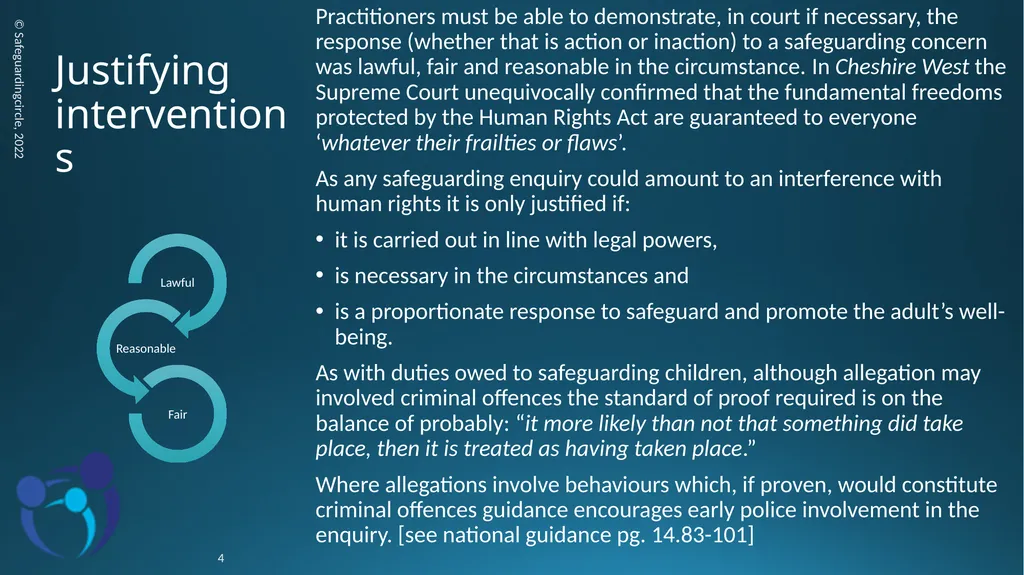
Justifying interventions Practitioners must be able to demonstrate, in court if necessary, the response (whether that is action or inaction) to a safeguarding concern was lawful, fair and reasonable in the circumstance. In Cheshire West the Supreme Court unequivocally confirmed that the fundamental freedoms protected by the Human Rights Act are guaranteed to everyone ‘whatever their frailties or flaws’.
As any safeguarding enquiry could amount to an interference with human rights it is only justified if:
it is carried out in line with legal powers,
is necessary in the circumstances and
is a proportionate response to safeguard and promote the adult’s well-being.
As with duties owed to safeguarding children, although allegation may involved criminal offences the standard of proof required is on the balance of probably: “it more likely than not that something did take place, then it is treated as having taken place.”
Where allegations involve behaviours which, if proven, would constitute criminal offences guidance encourages early police involvement in the enquiry. [see national guidance pg. 14.83-101] 4 © Safeguardingcircle, 2022<br>
As any safeguarding enquiry could amount to an interference with human rights it is only justified if:
it is carried out in line with legal powers,
is necessary in the circumstances and
is a proportionate response to safeguard and promote the adult’s well-being.
As with duties owed to safeguarding children, although allegation may involved criminal offences the standard of proof required is on the balance of probably: “it more likely than not that something did take place, then it is treated as having taken place.”
Where allegations involve behaviours which, if proven, would constitute criminal offences guidance encourages early police involvement in the enquiry. [see national guidance pg. 14.83-101] 4 © Safeguardingcircle, 2022<br>
05
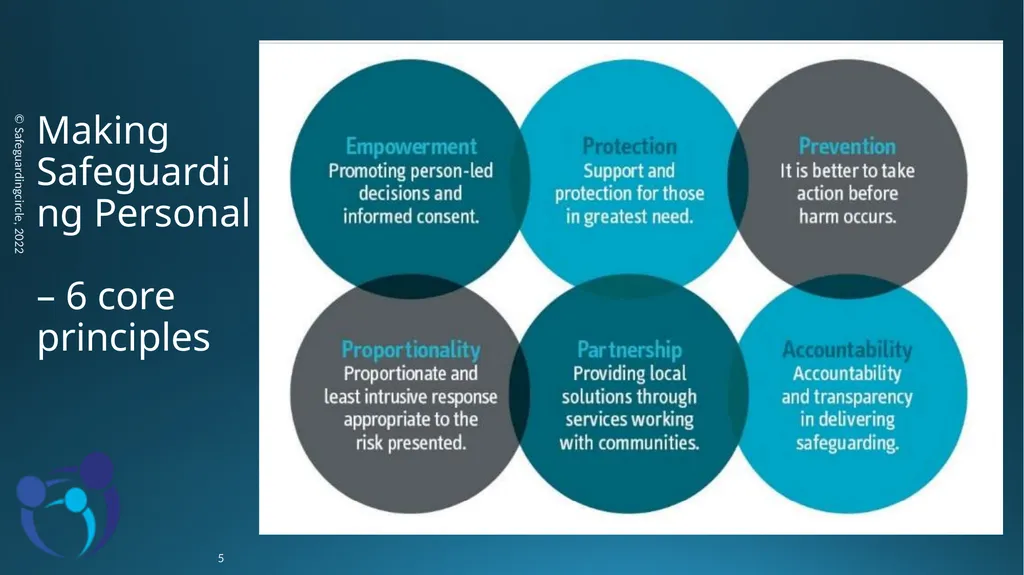
Making Safeguarding Personal
– 6 core principles © Safeguardingcircle, 2022 5<br>
06
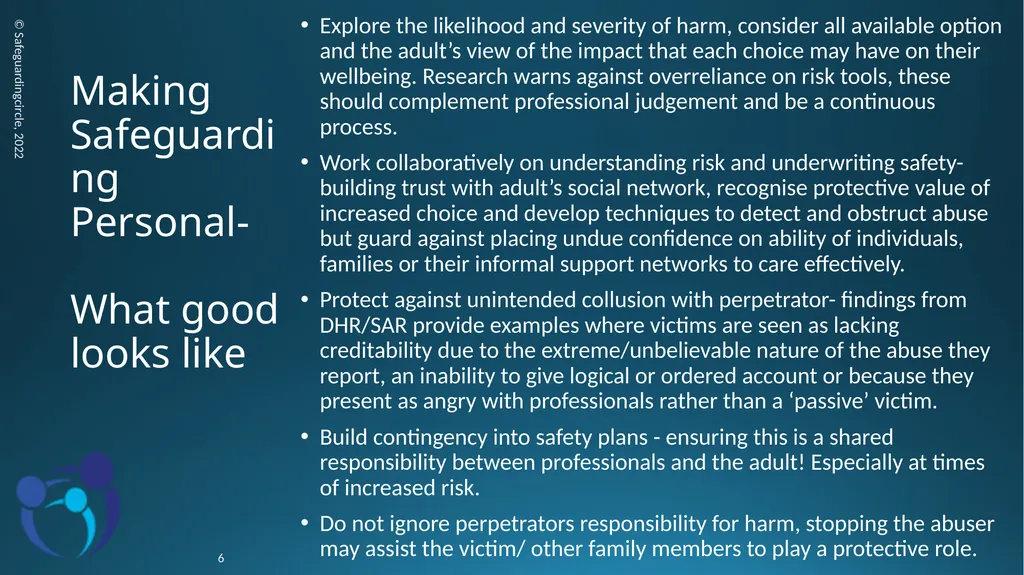
Explore the likelihood and severity of harm, consider all available option and the adult’s view of the impact that each choice may have on their wellbeing. Research warns against overreliance on risk tools, these should complement professional judgement and be a continuous process.
Work collaboratively on understanding risk and underwriting safety- building trust with adult’s social network, recognise protective value of increased choice and develop techniques to detect and obstruct abuse but guard against placing undue confidence on ability of individuals, families or their informal support networks to care effectively.
Protect against unintended collusion with perpetrator- findings from DHR/SAR provide examples where victims are seen as lacking creditability due to the extreme/unbelievable nature of the abuse they report, an inability to give logical or ordered account or because they present as angry with professionals rather than a ‘passive’ victim.
Build contingency into safety plans - ensuring this is a shared responsibility between professionals and the adult! Especially at times of increased risk.
Do not ignore perpetrators responsibility for harm, stopping the abuser may assist the victim/ other family members to play a protective role. 6 Making Safeguarding Personal- What good looks like © Safeguardingcircle, 2022<br>
Work collaboratively on understanding risk and underwriting safety- building trust with adult’s social network, recognise protective value of increased choice and develop techniques to detect and obstruct abuse but guard against placing undue confidence on ability of individuals, families or their informal support networks to care effectively.
Protect against unintended collusion with perpetrator- findings from DHR/SAR provide examples where victims are seen as lacking creditability due to the extreme/unbelievable nature of the abuse they report, an inability to give logical or ordered account or because they present as angry with professionals rather than a ‘passive’ victim.
Build contingency into safety plans - ensuring this is a shared responsibility between professionals and the adult! Especially at times of increased risk.
Do not ignore perpetrators responsibility for harm, stopping the abuser may assist the victim/ other family members to play a protective role. 6 Making Safeguarding Personal- What good looks like © Safeguardingcircle, 2022<br>
07
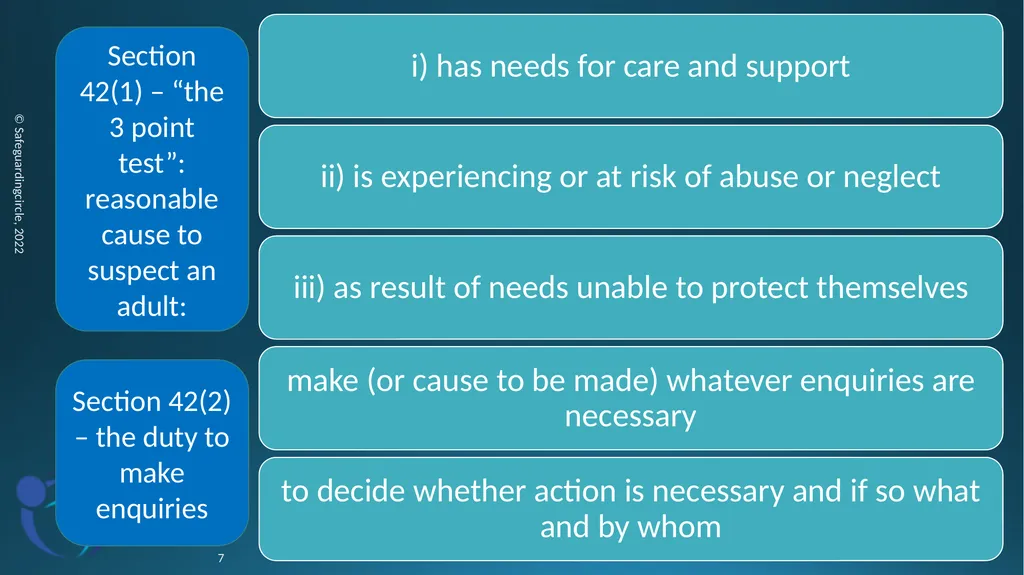
© Safeguardingcircle, 2022 7 Section 42(1) – “the 3 point test”: reasonable cause to suspect an adult: Section 42(2) – the duty to make enquiries<br>
08
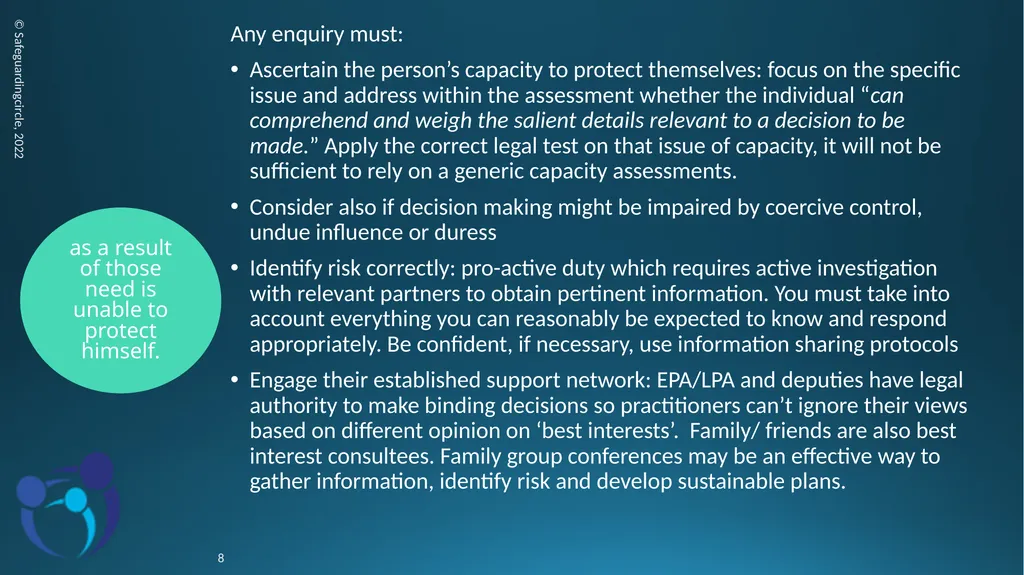
Any enquiry must:
Ascertain the person’s capacity to protect themselves: focus on the specific issue and address within the assessment whether the individual “can comprehend and weigh the salient details relevant to a decision to be made.” Apply the correct legal test on that issue of capacity, it will not be sufficient to rely on a generic capacity assessments.
Consider also if decision making might be impaired by coercive control, undue influence or duress
Identify risk correctly: pro-active duty which requires active investigation with relevant partners to obtain pertinent information. You must take into account everything you can reasonably be expected to know and respond appropriately. Be confident, if necessary, use information sharing protocols
Engage their established support network: EPA/LPA and deputies have legal authority to make binding decisions so practitioners can’t ignore their views based on different opinion on ‘best interests’. Family/ friends are also best interest consultees. Family group conferences may be an effective way to gather information, identify risk and develop sustainable plans. 8 as a result of those need is unable to protect himself. © Safeguardingcircle, 2022<br>
Ascertain the person’s capacity to protect themselves: focus on the specific issue and address within the assessment whether the individual “can comprehend and weigh the salient details relevant to a decision to be made.” Apply the correct legal test on that issue of capacity, it will not be sufficient to rely on a generic capacity assessments.
Consider also if decision making might be impaired by coercive control, undue influence or duress
Identify risk correctly: pro-active duty which requires active investigation with relevant partners to obtain pertinent information. You must take into account everything you can reasonably be expected to know and respond appropriately. Be confident, if necessary, use information sharing protocols
Engage their established support network: EPA/LPA and deputies have legal authority to make binding decisions so practitioners can’t ignore their views based on different opinion on ‘best interests’. Family/ friends are also best interest consultees. Family group conferences may be an effective way to gather information, identify risk and develop sustainable plans. 8 as a result of those need is unable to protect himself. © Safeguardingcircle, 2022<br>
09
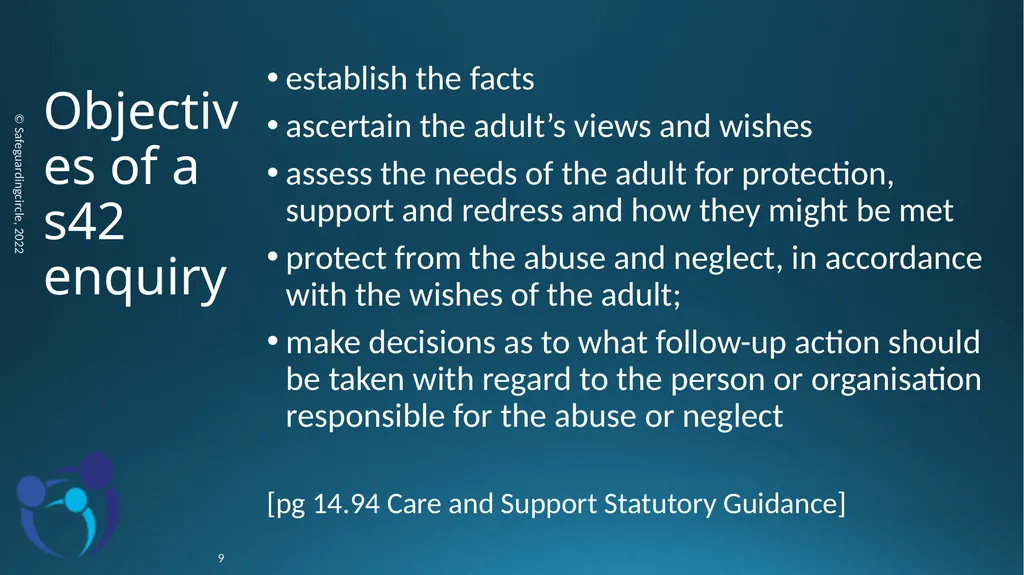
Objectives of a s42 enquiry establish the facts
ascertain the adult’s views and wishes
assess the needs of the adult for protection, support and redress and how they might be met
protect from the abuse and neglect, in accordance with the wishes of the adult;
make decisions as to what follow-up action should be taken with regard to the person or organisation responsible for the abuse or neglect
[pg 14.94 Care and Support Statutory Guidance] © Safeguardingcircle, 2022 9<br>
ascertain the adult’s views and wishes
assess the needs of the adult for protection, support and redress and how they might be met
protect from the abuse and neglect, in accordance with the wishes of the adult;
make decisions as to what follow-up action should be taken with regard to the person or organisation responsible for the abuse or neglect
[pg 14.94 Care and Support Statutory Guidance] © Safeguardingcircle, 2022 9<br>
10
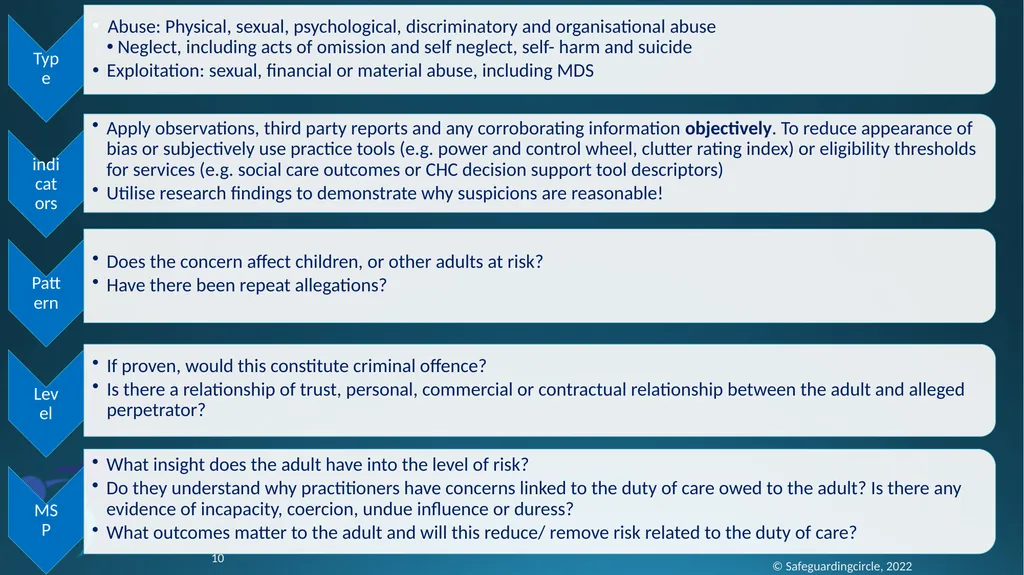
10 © Safeguardingcircle, 2022<br>
11
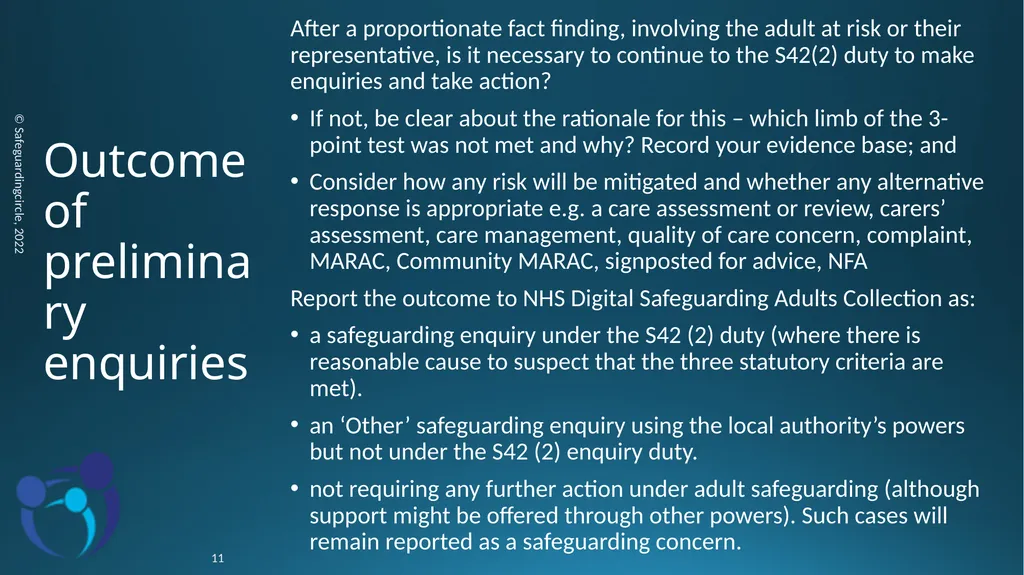
Outcome of preliminary enquiries After a proportionate fact finding, involving the adult at risk or their representative, is it necessary to continue to the S42(2) duty to make enquiries and take action?
If not, be clear about the rationale for this – which limb of the 3-point test was not met and why? Record your evidence base; and
Consider how any risk will be mitigated and whether any alternative response is appropriate e.g. a care assessment or review, carers’ assessment, care management, quality of care concern, complaint, MARAC, Community MARAC, signposted for advice, NFA
Report the outcome to NHS Digital Safeguarding Adults Collection as:
a safeguarding enquiry under the S42 (2) duty (where there is reasonable cause to suspect that the three statutory criteria are met).
an ‘Other’ safeguarding enquiry using the local authority’s powers but not under the S42 (2) enquiry duty.
not requiring any further action under adult safeguarding (although support might be offered through other powers). Such cases will remain reported as a safeguarding concern. © Safeguardingcircle, 2022 11<br>
If not, be clear about the rationale for this – which limb of the 3-point test was not met and why? Record your evidence base; and
Consider how any risk will be mitigated and whether any alternative response is appropriate e.g. a care assessment or review, carers’ assessment, care management, quality of care concern, complaint, MARAC, Community MARAC, signposted for advice, NFA
Report the outcome to NHS Digital Safeguarding Adults Collection as:
a safeguarding enquiry under the S42 (2) duty (where there is reasonable cause to suspect that the three statutory criteria are met).
an ‘Other’ safeguarding enquiry using the local authority’s powers but not under the S42 (2) enquiry duty.
not requiring any further action under adult safeguarding (although support might be offered through other powers). Such cases will remain reported as a safeguarding concern. © Safeguardingcircle, 2022 11<br>
12
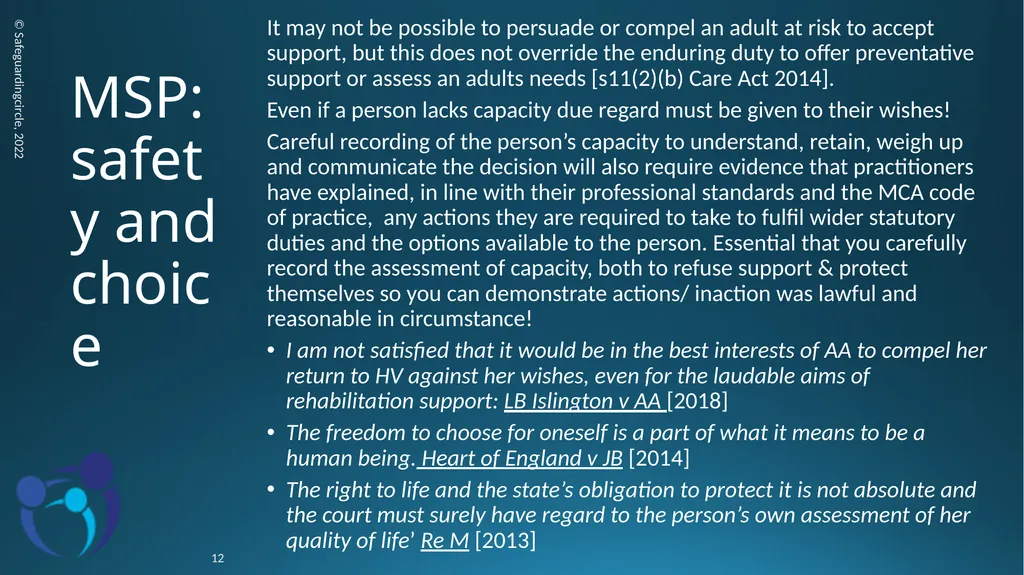
MSP: safety and choice It may not be possible to persuade or compel an adult at risk to accept support, but this does not override the enduring duty to offer preventative support or assess an adults needs [s11(2)(b) Care Act 2014].
Even if a person lacks capacity due regard must be given to their wishes!
Careful recording of the person’s capacity to understand, retain, weigh up and communicate the decision will also require evidence that practitioners have explained, in line with their professional standards and the MCA code of practice, any actions they are required to take to fulfil wider statutory duties and the options available to the person. Essential that you carefully record the assessment of capacity, both to refuse support & protect themselves so you can demonstrate actions/ inaction was lawful and reasonable in circumstance!
I am not satisfied that it would be in the best interests of AA to compel her return to HV against her wishes, even for the laudable aims of rehabilitation support: LB Islington v AA [2018]
The freedom to choose for oneself is a part of what it means to be a human being. Heart of England v JB [2014]
The right to life and the state’s obligation to protect it is not absolute and the court must surely have regard to the person’s own assessment of her quality of life’ Re M [2013] 12 © Safeguardingcircle, 2022<br>
Even if a person lacks capacity due regard must be given to their wishes!
Careful recording of the person’s capacity to understand, retain, weigh up and communicate the decision will also require evidence that practitioners have explained, in line with their professional standards and the MCA code of practice, any actions they are required to take to fulfil wider statutory duties and the options available to the person. Essential that you carefully record the assessment of capacity, both to refuse support & protect themselves so you can demonstrate actions/ inaction was lawful and reasonable in circumstance!
I am not satisfied that it would be in the best interests of AA to compel her return to HV against her wishes, even for the laudable aims of rehabilitation support: LB Islington v AA [2018]
The freedom to choose for oneself is a part of what it means to be a human being. Heart of England v JB [2014]
The right to life and the state’s obligation to protect it is not absolute and the court must surely have regard to the person’s own assessment of her quality of life’ Re M [2013] 12 © Safeguardingcircle, 2022<br>
13
S. 79(2) expressly prohibits the delegation of certain functions including the duty to cooperate and adult safeguarding functions. It also confirms that, where a function has been delegated, the local authority remains liable (and subject to Judicial Review) for anything done or omitted to be done by the person with delegated responsibility. Local policy will specify who can act as a safeguarding coordinator under NHS/LA partnership arrangements and provide guidance on who might lead each type of enquiry. It also details the minimum expectations for the LA when delegating lead role
s6-7 Care Act: Relevant partners, including Police, DWP, health and housing providers, must co-operate with the local authority generally and on specific cases when exercising their functions. Refusals are only permitted if it is incompatible with their own duties or would have adverse effect. Any refusal to co-operate must be set out in writing.
s45 Care Act: duty for anyone asked to supply information to the SAB for the purpose of enabling or assisting the SAB to exercise its functions provided that the SAB considers their functions or activities mean they are likely to have information that it relevant to the exercise of the SAB functions.
Article 6: right to a fair trial: Durham CC v Dunn [2012] CPR rules regarding litigation disclosure could override DPA and will be determined by the courts balancing article 6 rights over art 8 rights 13 © Safeguardingcircle, 2022 s.42(2) Duty: must make (or cause to be made) necessary enquiries<br>
s6-7 Care Act: Relevant partners, including Police, DWP, health and housing providers, must co-operate with the local authority generally and on specific cases when exercising their functions. Refusals are only permitted if it is incompatible with their own duties or would have adverse effect. Any refusal to co-operate must be set out in writing.
s45 Care Act: duty for anyone asked to supply information to the SAB for the purpose of enabling or assisting the SAB to exercise its functions provided that the SAB considers their functions or activities mean they are likely to have information that it relevant to the exercise of the SAB functions.
Article 6: right to a fair trial: Durham CC v Dunn [2012] CPR rules regarding litigation disclosure could override DPA and will be determined by the courts balancing article 6 rights over art 8 rights 13 © Safeguardingcircle, 2022 s.42(2) Duty: must make (or cause to be made) necessary enquiries<br>
14
Investigative powers It is important to highlight that despite imposing duties to carry out enquiries the act does not provide practitioners with any new powers to investigate; there are no associated powers of entry or rights of access to an individual suspected of being an adult at risk. Practitioners must therefore rely on existing powers to gain evidence and access to an adult at risk, including police powers, where obstructed.
It may be appropriate to consider powers of entry under:
Mental Health Act 1983- s115 or s135 (requires warrant)
Public Health Act 1984- s32
Housing Act 2004- part 1
Environmental Protection Act 1990
Police have free standing powers of entry: to arrest someone for an indictable offence (s17(1)(b) PACE or there is a risk to life and limb (s17(1)(e) PACE, but this power limited as must demonstrate reasonable concern of serious bodily injury: Baker v CPS [2009] Police common law powers to enter to deal with a breach of the peace only applies in emergencies and when harm is actually done or likely to be done to a person/property in their presence: Blench v DPP [2004] 14 © Safeguardingcircle, 2022<br>
It may be appropriate to consider powers of entry under:
Mental Health Act 1983- s115 or s135 (requires warrant)
Public Health Act 1984- s32
Housing Act 2004- part 1
Environmental Protection Act 1990
Police have free standing powers of entry: to arrest someone for an indictable offence (s17(1)(b) PACE or there is a risk to life and limb (s17(1)(e) PACE, but this power limited as must demonstrate reasonable concern of serious bodily injury: Baker v CPS [2009] Police common law powers to enter to deal with a breach of the peace only applies in emergencies and when harm is actually done or likely to be done to a person/property in their presence: Blench v DPP [2004] 14 © Safeguardingcircle, 2022<br>
15
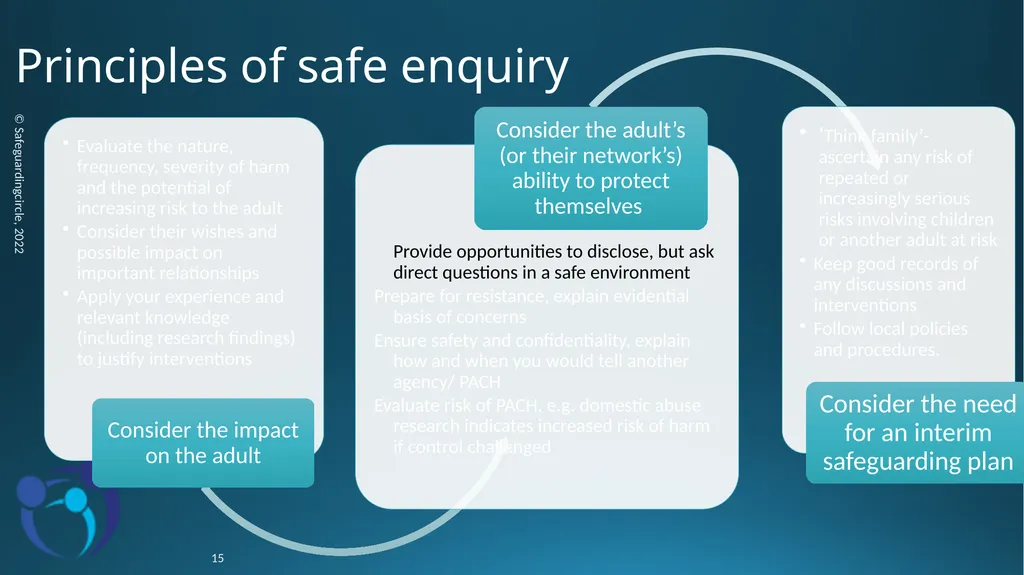
Principles of safe enquiry 15 © Safeguardingcircle, 2022<br>
16
how to avoid the pitfalls...
PEACE Planning and preparation
Understand the concern, read case materials available to you and actively search for gaps in information. Ascertain what type of evidence is required to investigate the alleged harm.
Consider how best to engage with the adult, their wider support network, the perpetrator. Identify what support the adult at risk might need to engage in the safeguarding process. Appoint an advocate if required! This can be done in the ‘information gathering stage’. 16 © Safeguardingcircle, 2022<br>
Understand the concern, read case materials available to you and actively search for gaps in information. Ascertain what type of evidence is required to investigate the alleged harm.
Consider how best to engage with the adult, their wider support network, the perpetrator. Identify what support the adult at risk might need to engage in the safeguarding process. Appoint an advocate if required! This can be done in the ‘information gathering stage’. 16 © Safeguardingcircle, 2022<br>
17
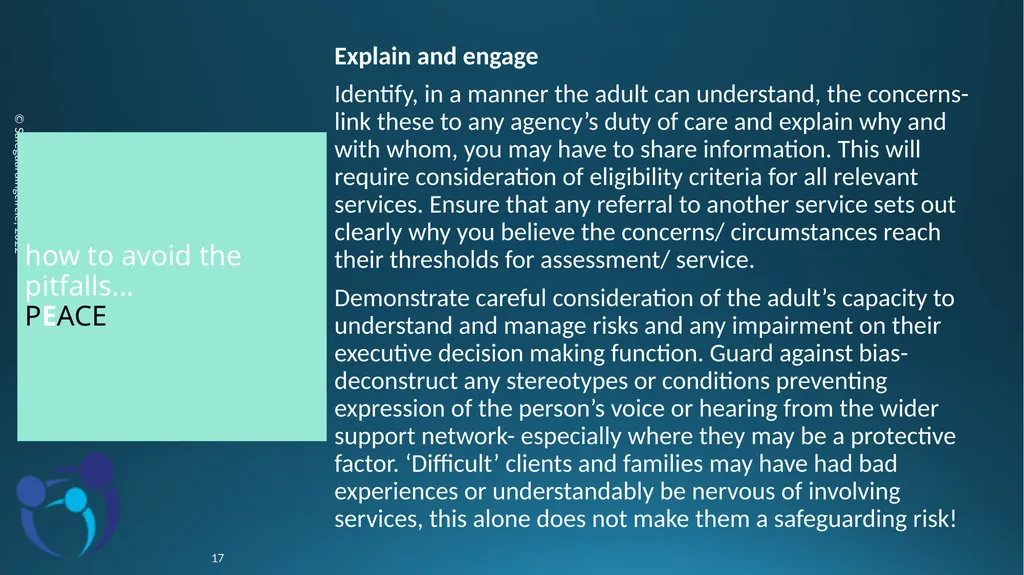
how to avoid the pitfalls...
PEACE Explain and engage
Identify, in a manner the adult can understand, the concerns- link these to any agency’s duty of care and explain why and with whom, you may have to share information. This will require consideration of eligibility criteria for all relevant services. Ensure that any referral to another service sets out clearly why you believe the concerns/ circumstances reach their thresholds for assessment/ service.
Demonstrate careful consideration of the adult’s capacity to understand and manage risks and any impairment on their executive decision making function. Guard against bias- deconstruct any stereotypes or conditions preventing expression of the person’s voice or hearing from the wider support network- especially where they may be a protective factor. ‘Difficult’ clients and families may have had bad experiences or understandably be nervous of involving services, this alone does not make them a safeguarding risk! 17 © Safeguardingcircle, 2022<br>
Identify, in a manner the adult can understand, the concerns- link these to any agency’s duty of care and explain why and with whom, you may have to share information. This will require consideration of eligibility criteria for all relevant services. Ensure that any referral to another service sets out clearly why you believe the concerns/ circumstances reach their thresholds for assessment/ service.
Demonstrate careful consideration of the adult’s capacity to understand and manage risks and any impairment on their executive decision making function. Guard against bias- deconstruct any stereotypes or conditions preventing expression of the person’s voice or hearing from the wider support network- especially where they may be a protective factor. ‘Difficult’ clients and families may have had bad experiences or understandably be nervous of involving services, this alone does not make them a safeguarding risk! 17 © Safeguardingcircle, 2022<br>
18
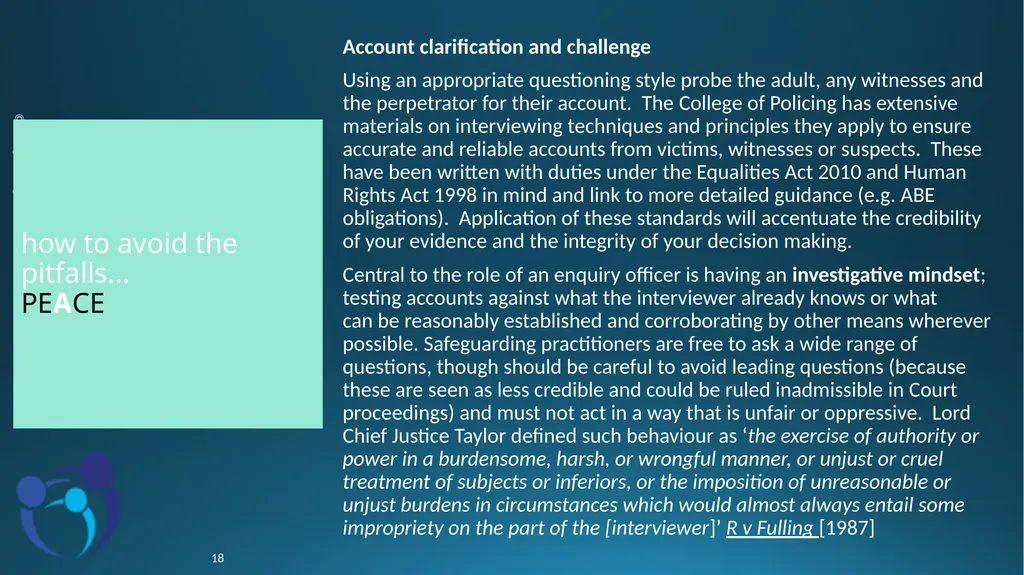
how to avoid the pitfalls...
PEACE Account clarification and challenge
Using an appropriate questioning style probe the adult, any witnesses and the perpetrator for their account. The College of Policing has extensive materials on interviewing techniques and principles they apply to ensure accurate and reliable accounts from victims, witnesses or suspects. These have been written with duties under the Equalities Act 2010 and Human Rights Act 1998 in mind and link to more detailed guidance (e.g. ABE obligations). Application of these standards will accentuate the credibility of your evidence and the integrity of your decision making.
Central to the role of an enquiry officer is having an investigative mindset; testing accounts against what the interviewer already knows or what can be reasonably established and corroborating by other means wherever possible. Safeguarding practitioners are free to ask a wide range of questions, though should be careful to avoid leading questions (because these are seen as less credible and could be ruled inadmissible in Court proceedings) and must not act in a way that is unfair or oppressive. Lord Chief Justice Taylor defined such behaviour as ‘the exercise of authority or power in a burdensome, harsh, or wrongful manner, or unjust or cruel treatment of subjects or inferiors, or the imposition of unreasonable or unjust burdens in circumstances which would almost always entail some impropriety on the part of the [interviewer]’ R v Fulling [1987] 18 © Safeguardingcircle, 2022<br>
Using an appropriate questioning style probe the adult, any witnesses and the perpetrator for their account. The College of Policing has extensive materials on interviewing techniques and principles they apply to ensure accurate and reliable accounts from victims, witnesses or suspects. These have been written with duties under the Equalities Act 2010 and Human Rights Act 1998 in mind and link to more detailed guidance (e.g. ABE obligations). Application of these standards will accentuate the credibility of your evidence and the integrity of your decision making.
Central to the role of an enquiry officer is having an investigative mindset; testing accounts against what the interviewer already knows or what can be reasonably established and corroborating by other means wherever possible. Safeguarding practitioners are free to ask a wide range of questions, though should be careful to avoid leading questions (because these are seen as less credible and could be ruled inadmissible in Court proceedings) and must not act in a way that is unfair or oppressive. Lord Chief Justice Taylor defined such behaviour as ‘the exercise of authority or power in a burdensome, harsh, or wrongful manner, or unjust or cruel treatment of subjects or inferiors, or the imposition of unreasonable or unjust burdens in circumstances which would almost always entail some impropriety on the part of the [interviewer]’ R v Fulling [1987] 18 © Safeguardingcircle, 2022<br>
19
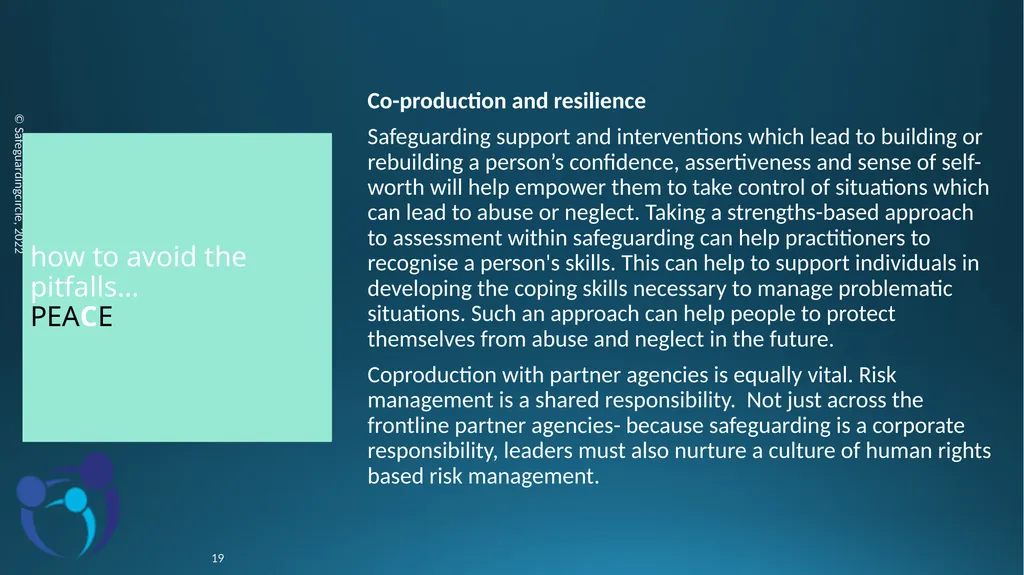
how to avoid the pitfalls...
PEACE Co-production and resilience
Safeguarding support and interventions which lead to building or rebuilding a person’s confidence, assertiveness and sense of self-worth will help empower them to take control of situations which can lead to abuse or neglect. Taking a strengths-based approach to assessment within safeguarding can help practitioners to recognise a person's skills. This can help to support individuals in developing the coping skills necessary to manage problematic situations. Such an approach can help people to protect themselves from abuse and neglect in the future.
Coproduction with partner agencies is equally vital. Risk management is a shared responsibility. Not just across the frontline partner agencies- because safeguarding is a corporate responsibility, leaders must also nurture a culture of human rights based risk management. 19 © Safeguardingcircle, 2022<br>
Safeguarding support and interventions which lead to building or rebuilding a person’s confidence, assertiveness and sense of self-worth will help empower them to take control of situations which can lead to abuse or neglect. Taking a strengths-based approach to assessment within safeguarding can help practitioners to recognise a person's skills. This can help to support individuals in developing the coping skills necessary to manage problematic situations. Such an approach can help people to protect themselves from abuse and neglect in the future.
Coproduction with partner agencies is equally vital. Risk management is a shared responsibility. Not just across the frontline partner agencies- because safeguarding is a corporate responsibility, leaders must also nurture a culture of human rights based risk management. 19 © Safeguardingcircle, 2022<br>
20
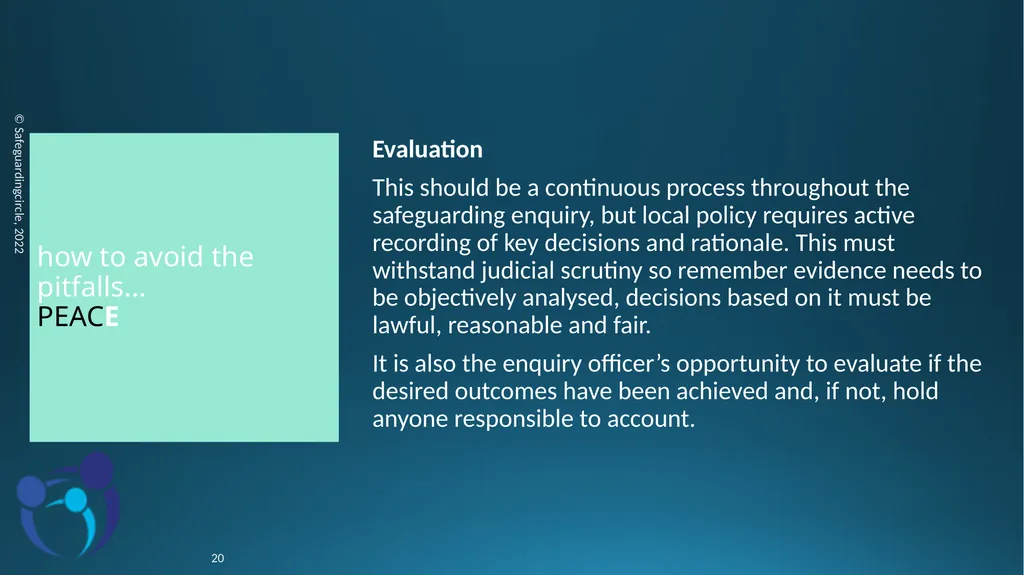
how to avoid the pitfalls...
PEACE Evaluation
This should be a continuous process throughout the safeguarding enquiry, but local policy requires active recording of key decisions and rationale. This must withstand judicial scrutiny so remember evidence needs to be objectively analysed, decisions based on it must be lawful, reasonable and fair.
It is also the enquiry officer’s opportunity to evaluate if the desired outcomes have been achieved and, if not, hold anyone responsible to account. 20 © Safeguardingcircle, 2022<br>
This should be a continuous process throughout the safeguarding enquiry, but local policy requires active recording of key decisions and rationale. This must withstand judicial scrutiny so remember evidence needs to be objectively analysed, decisions based on it must be lawful, reasonable and fair.
It is also the enquiry officer’s opportunity to evaluate if the desired outcomes have been achieved and, if not, hold anyone responsible to account. 20 © Safeguardingcircle, 2022<br>
21
Record keeping Keep a clear record of the evidence gathered and reviewed during your investigation in a central location/file that can be accessed by your line management (while complying with the DPA!)
A record of all actions and decisions must be made. Good record keeping is a vital component of professional practice. Learning lessons from past mistakes and missed opportunities highlighted in Safeguarding Adult Reviews, Serious Case Reviews and other reports emphasize the need for quality recording especially when managing abuse, neglect and risk. This includes providing rationale for actions and decisions, whether or not they were taken.
Quality recording of adult safeguarding does not only safeguard the specific adult at risk, but also protects workers by evidencing decision making is based on the information available at the time.
There are also specific obligations to record views of the adult at risk as well as rationale for key decisions including information sharing, mental capacity assessments, risk analysis and intervention decisions and actions taken to reduce risk
Persistent record keeping failures may also indicate poor care amounting to organisational abuse. 21 © Safeguardingcircle, 2022<br>
A record of all actions and decisions must be made. Good record keeping is a vital component of professional practice. Learning lessons from past mistakes and missed opportunities highlighted in Safeguarding Adult Reviews, Serious Case Reviews and other reports emphasize the need for quality recording especially when managing abuse, neglect and risk. This includes providing rationale for actions and decisions, whether or not they were taken.
Quality recording of adult safeguarding does not only safeguard the specific adult at risk, but also protects workers by evidencing decision making is based on the information available at the time.
There are also specific obligations to record views of the adult at risk as well as rationale for key decisions including information sharing, mental capacity assessments, risk analysis and intervention decisions and actions taken to reduce risk
Persistent record keeping failures may also indicate poor care amounting to organisational abuse. 21 © Safeguardingcircle, 2022<br>
22
Collating evidence: proportion-ality You should agree the scope of the evidence at the initial strategy meeting (but be confident to ask for more if needed)
Be proportionate in your approach, keeping in mind the nature and severity of the risk, the impact on resources and the adult’s objectives
Carefully consider which agencies and individuals need to be involved
Weigh what evidence is required to properly investigate the allegation or risk identified
Relevant case notes or chronologies
Care plans, CPA care plans, risk assessments, MCA assessments
CCTV, bank statements
Witnesses and how to obtain the information from them (in writing, through an advocate, through interview)
Policies, procedures and guidance
Previous safeguarding referrals and processes – this is essential to enable you to identify patterns and escalation of risk © Safeguardingcircle, 2022 22<br>
Be proportionate in your approach, keeping in mind the nature and severity of the risk, the impact on resources and the adult’s objectives
Carefully consider which agencies and individuals need to be involved
Weigh what evidence is required to properly investigate the allegation or risk identified
Relevant case notes or chronologies
Care plans, CPA care plans, risk assessments, MCA assessments
CCTV, bank statements
Witnesses and how to obtain the information from them (in writing, through an advocate, through interview)
Policies, procedures and guidance
Previous safeguarding referrals and processes – this is essential to enable you to identify patterns and escalation of risk © Safeguardingcircle, 2022 22<br>
23
Evidence: court standards Probative – it must add value to the case and be credible
Not prejudicial – factual, fair and impartial
Relevant – it must relate to the investigate and make the allegation more or less provable
Accurate – it must describe the facts as accurately as possible to help you decide what is true
Coherent – it must be presented in a way that makes sense and is easy to understand, usually in chronological order and in an appropriate level of detail
Provable – through physical or witness evidence
This enables the decision maker to weigh the credibility and value of the evidence to reach a decision as to the trust of the matter © Safeguardingcircle, 2022 23<br>
Not prejudicial – factual, fair and impartial
Relevant – it must relate to the investigate and make the allegation more or less provable
Accurate – it must describe the facts as accurately as possible to help you decide what is true
Coherent – it must be presented in a way that makes sense and is easy to understand, usually in chronological order and in an appropriate level of detail
Provable – through physical or witness evidence
This enables the decision maker to weigh the credibility and value of the evidence to reach a decision as to the trust of the matter © Safeguardingcircle, 2022 23<br>
24
Classes of evidence Direct evidence – known personally to the witness, what they saw, heard or smelled
Circumstance evidence – allows a conclusion to be drawn from a set of circumstances
Hearsay is second-hand evidence that someone has told you or was overheard or written; it can be used in certain circumstances, but you must assess the weight to be given to it
Primary evidence – an original document
Secondary evidence – a copy of a document or verbal evidence about its contents
Forensic evidence – analysis/testing by an expert
Expert evidence – an opinion from an expert on a topic outside the knowledge of a layperson © Safeguardingcircle, 2022 24<br>
Circumstance evidence – allows a conclusion to be drawn from a set of circumstances
Hearsay is second-hand evidence that someone has told you or was overheard or written; it can be used in certain circumstances, but you must assess the weight to be given to it
Primary evidence – an original document
Secondary evidence – a copy of a document or verbal evidence about its contents
Forensic evidence – analysis/testing by an expert
Expert evidence – an opinion from an expert on a topic outside the knowledge of a layperson © Safeguardingcircle, 2022 24<br>
25
Early discussions with a witness It may be appropriate to elicit a brief account through initial questioning (eg to establish where the alleged incident took place, who was involved or might hold further evidence) then return to interview some witnesses more fully. Basic principles:
a) Listen to the witness.
b) Do not stop a witness who is freely recalling significant events.
c) Where it is necessary to ask questions, they should, as far as possible in the circumstances, be open-ended or specific-closed rather than forced choice, leading or multiple.
d) Ask no more questions than are necessary in the circumstances to take immediate action.
e) Make a comprehensive note of the discussion, taking care to record the timing, setting and people present as well as what was said by the witness and anybody else present (particularly the actual questions asked of the witness)
f) Make a note of the demeanour of the witness and anything else that might be relevant to any subsequent formal interview or the wider investigation.
g) Fully record any comments made by the witness or events that might be relevant to the legal process up to the time of the interview. © Safeguardingcircle, 2022 25<br>
a) Listen to the witness.
b) Do not stop a witness who is freely recalling significant events.
c) Where it is necessary to ask questions, they should, as far as possible in the circumstances, be open-ended or specific-closed rather than forced choice, leading or multiple.
d) Ask no more questions than are necessary in the circumstances to take immediate action.
e) Make a comprehensive note of the discussion, taking care to record the timing, setting and people present as well as what was said by the witness and anybody else present (particularly the actual questions asked of the witness)
f) Make a note of the demeanour of the witness and anything else that might be relevant to any subsequent formal interview or the wider investigation.
g) Fully record any comments made by the witness or events that might be relevant to the legal process up to the time of the interview. © Safeguardingcircle, 2022 25<br>
26
Interviews
Achieving Best Evidence in Criminal Proceedings Guidance on interviewing victims and witnesses, and guidance on using special measures Planning is key to a successful interview – the case should be thoroughly reviewed before embarking on interviews.
Ensure you have identified the key issues you need to ask about (while being responsive to new issues that arise)
Structure the interview – allow a narrative account, then open questions on one key issue/time period, narrowing to closed questions to clarify specifics, before moving to the next issue
Give them an opportunity to explain significant inconsistencies/omissions in the evidence at the end of the interview
Avoid jargon and ask questions in a way that the person can understand, using a translator or advocate to support the process if necessary
Keep detailed notes and give a copy to the individual so that they can respond to any inaccuracies. A recording may be appropriate depending on the nature of the investigation. © Safeguardingcircle, 2022 26<br>
Ensure you have identified the key issues you need to ask about (while being responsive to new issues that arise)
Structure the interview – allow a narrative account, then open questions on one key issue/time period, narrowing to closed questions to clarify specifics, before moving to the next issue
Give them an opportunity to explain significant inconsistencies/omissions in the evidence at the end of the interview
Avoid jargon and ask questions in a way that the person can understand, using a translator or advocate to support the process if necessary
Keep detailed notes and give a copy to the individual so that they can respond to any inaccuracies. A recording may be appropriate depending on the nature of the investigation. © Safeguardingcircle, 2022 26<br>
27
Language is very important! Check everyone who needs to know understands what you mean!
‘vulnerable adult’ is subjective and is defined differently in Care Act, PACE, Vetting and Barring legislation.
‘challenging behaviour’ is also subjective- use objective measures e.g. NHS CHC Decision Support Tool
Distinguish facts from your opinion and back this up with objective evidence.
Munby P in the Darlington Judgment criticising the social worker’s evidence reminded us ‘We are not ‘guardians of morality. The justification for State intervention is harm to children, not parental immorality.’
She was drunk’ is opinion. ’she was slurring her words, stumbling and smelt strongly of alcohol’ is fact and justification for you (and possibly the Court) to form the opinion she was drunk. 27 © Safeguardingcircle, 2022<br>
‘vulnerable adult’ is subjective and is defined differently in Care Act, PACE, Vetting and Barring legislation.
‘challenging behaviour’ is also subjective- use objective measures e.g. NHS CHC Decision Support Tool
Distinguish facts from your opinion and back this up with objective evidence.
Munby P in the Darlington Judgment criticising the social worker’s evidence reminded us ‘We are not ‘guardians of morality. The justification for State intervention is harm to children, not parental immorality.’
She was drunk’ is opinion. ’she was slurring her words, stumbling and smelt strongly of alcohol’ is fact and justification for you (and possibly the Court) to form the opinion she was drunk. 27 © Safeguardingcircle, 2022<br>
28
Mechanisms for supporting vulnerable witnesses or victims of crime The Youth Justice and Criminal Evidence Act 1999 introduced a raft of ‘special measures’ to support witnesses in criminal trials give their best evidence and to help reduce some of the anxiety adults with care and support needs may feel when attending Court.
There are a range of options, such as use of screens to shield witnesses from alleged perpetrators, use of live-link or recorded evidence-in-chief and the use of an intermediary to help witnesses understand the questions they are being asked and to give their answers accurately. Adults at risk may also be entitled to advocacy support or may benefit from input from voluntary or charitable sector, such as Victim Support.
Victim commissioners, part of the Offices of Police and Crime Commissioners, may also be a good point of contact to signpost practitioners to resources in the local area and provide details of the local strategy for victim support. 28 © Safeguardingcircle, 2022<br>
There are a range of options, such as use of screens to shield witnesses from alleged perpetrators, use of live-link or recorded evidence-in-chief and the use of an intermediary to help witnesses understand the questions they are being asked and to give their answers accurately. Adults at risk may also be entitled to advocacy support or may benefit from input from voluntary or charitable sector, such as Victim Support.
Victim commissioners, part of the Offices of Police and Crime Commissioners, may also be a good point of contact to signpost practitioners to resources in the local area and provide details of the local strategy for victim support. 28 © Safeguardingcircle, 2022<br>
29
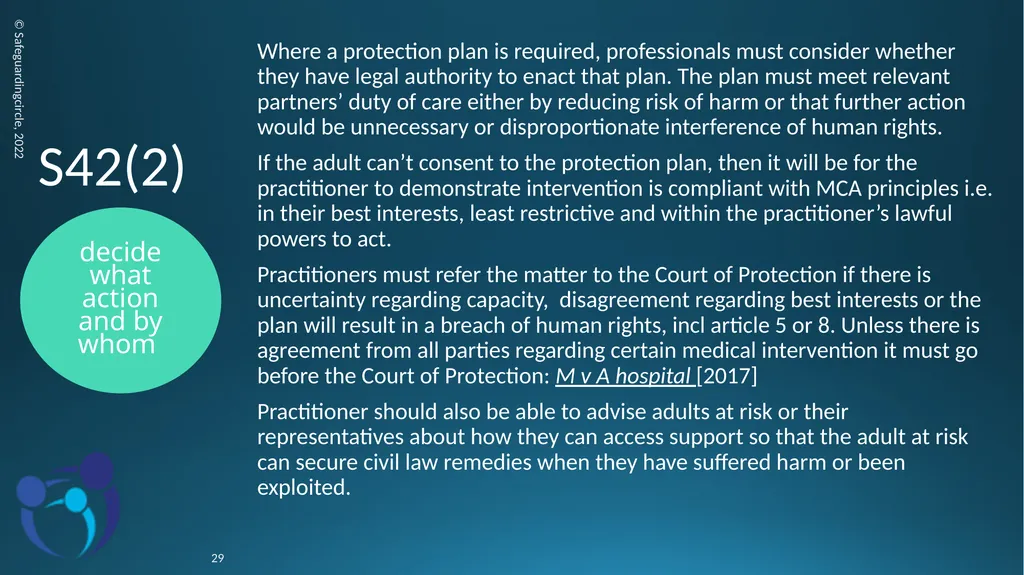
Where a protection plan is required, professionals must consider whether they have legal authority to enact that plan. The plan must meet relevant partners’ duty of care either by reducing risk of harm or that further action would be unnecessary or disproportionate interference of human rights.
If the adult can’t consent to the protection plan, then it will be for the practitioner to demonstrate intervention is compliant with MCA principles i.e. in their best interests, least restrictive and within the practitioner’s lawful powers to act.
Practitioners must refer the matter to the Court of Protection if there is uncertainty regarding capacity, disagreement regarding best interests or the plan will result in a breach of human rights, incl article 5 or 8. Unless there is agreement from all parties regarding certain medical intervention it must go before the Court of Protection: M v A hospital [2017]
Practitioner should also be able to advise adults at risk or their representatives about how they can access support so that the adult at risk can secure civil law remedies when they have suffered harm or been exploited. 29 © Safeguardingcircle, 2022 decide what action and by whom S42(2)<br>
If the adult can’t consent to the protection plan, then it will be for the practitioner to demonstrate intervention is compliant with MCA principles i.e. in their best interests, least restrictive and within the practitioner’s lawful powers to act.
Practitioners must refer the matter to the Court of Protection if there is uncertainty regarding capacity, disagreement regarding best interests or the plan will result in a breach of human rights, incl article 5 or 8. Unless there is agreement from all parties regarding certain medical intervention it must go before the Court of Protection: M v A hospital [2017]
Practitioner should also be able to advise adults at risk or their representatives about how they can access support so that the adult at risk can secure civil law remedies when they have suffered harm or been exploited. 29 © Safeguardingcircle, 2022 decide what action and by whom S42(2)<br>
30
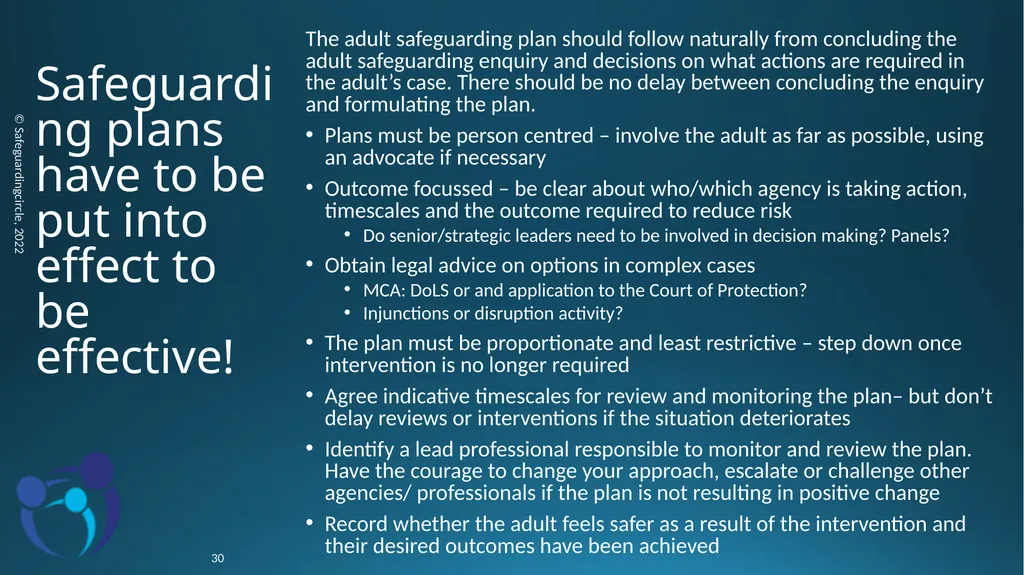
Safeguarding plans have to be put into effect to be effective! The adult safeguarding plan should follow naturally from concluding the adult safeguarding enquiry and decisions on what actions are required in the adult’s case. There should be no delay between concluding the enquiry and formulating the plan.
Plans must be person centred – involve the adult as far as possible, using an advocate if necessary
Outcome focussed – be clear about who/which agency is taking action, timescales and the outcome required to reduce risk
Do senior/strategic leaders need to be involved in decision making? Panels?
Obtain legal advice on options in complex cases
MCA: DoLS or and application to the Court of Protection?
Injunctions or disruption activity?
The plan must be proportionate and least restrictive – step down once intervention is no longer required
Agree indicative timescales for review and monitoring the plan– but don’t delay reviews or interventions if the situation deteriorates
Identify a lead professional responsible to monitor and review the plan. Have the courage to change your approach, escalate or challenge other agencies/ professionals if the plan is not resulting in positive change
Record whether the adult feels safer as a result of the intervention and their desired outcomes have been achieved © Safeguardingcircle, 2022 30<br>
Plans must be person centred – involve the adult as far as possible, using an advocate if necessary
Outcome focussed – be clear about who/which agency is taking action, timescales and the outcome required to reduce risk
Do senior/strategic leaders need to be involved in decision making? Panels?
Obtain legal advice on options in complex cases
MCA: DoLS or and application to the Court of Protection?
Injunctions or disruption activity?
The plan must be proportionate and least restrictive – step down once intervention is no longer required
Agree indicative timescales for review and monitoring the plan– but don’t delay reviews or interventions if the situation deteriorates
Identify a lead professional responsible to monitor and review the plan. Have the courage to change your approach, escalate or challenge other agencies/ professionals if the plan is not resulting in positive change
Record whether the adult feels safer as a result of the intervention and their desired outcomes have been achieved © Safeguardingcircle, 2022 30<br>
31
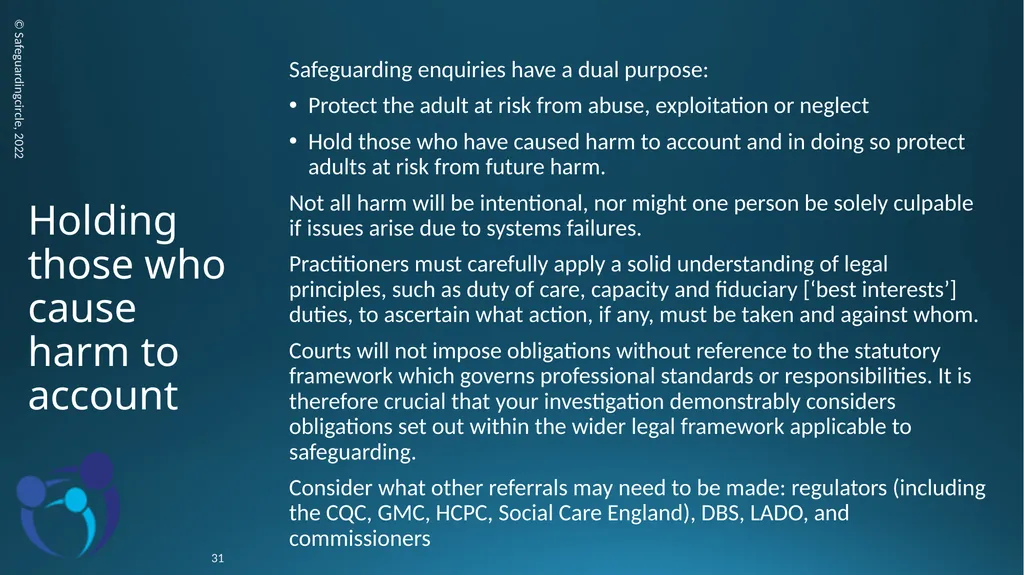
Holding those who cause harm to account Safeguarding enquiries have a dual purpose:
Protect the adult at risk from abuse, exploitation or neglect
Hold those who have caused harm to account and in doing so protect adults at risk from future harm.
Not all harm will be intentional, nor might one person be solely culpable if issues arise due to systems failures.
Practitioners must carefully apply a solid understanding of legal principles, such as duty of care, capacity and fiduciary [‘best interests’] duties, to ascertain what action, if any, must be taken and against whom.
Courts will not impose obligations without reference to the statutory framework which governs professional standards or responsibilities. It is therefore crucial that your investigation demonstrably considers obligations set out within the wider legal framework applicable to safeguarding.
Consider what other referrals may need to be made: regulators (including the CQC, GMC, HCPC, Social Care England), DBS, LADO, and commissioners 31 © Safeguardingcircle, 2022<br>
Protect the adult at risk from abuse, exploitation or neglect
Hold those who have caused harm to account and in doing so protect adults at risk from future harm.
Not all harm will be intentional, nor might one person be solely culpable if issues arise due to systems failures.
Practitioners must carefully apply a solid understanding of legal principles, such as duty of care, capacity and fiduciary [‘best interests’] duties, to ascertain what action, if any, must be taken and against whom.
Courts will not impose obligations without reference to the statutory framework which governs professional standards or responsibilities. It is therefore crucial that your investigation demonstrably considers obligations set out within the wider legal framework applicable to safeguarding.
Consider what other referrals may need to be made: regulators (including the CQC, GMC, HCPC, Social Care England), DBS, LADO, and commissioners 31 © Safeguardingcircle, 2022<br>
32
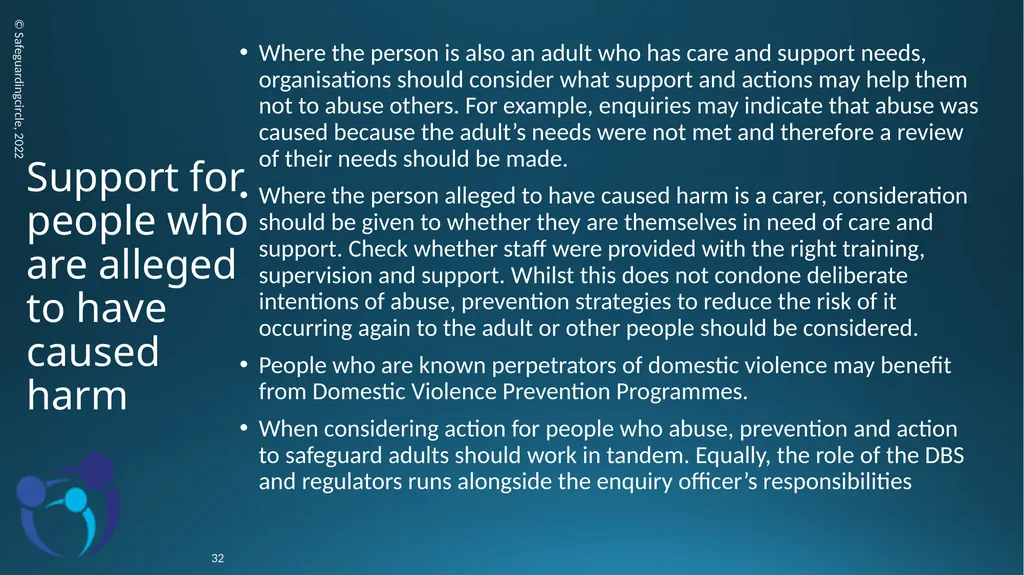
Support for people who are alleged to have caused harm Where the person is also an adult who has care and support needs, organisations should consider what support and actions may help them not to abuse others. For example, enquiries may indicate that abuse was caused because the adult’s needs were not met and therefore a review of their needs should be made.
Where the person alleged to have caused harm is a carer, consideration should be given to whether they are themselves in need of care and support. Check whether staff were provided with the right training, supervision and support. Whilst this does not condone deliberate intentions of abuse, prevention strategies to reduce the risk of it occurring again to the adult or other people should be considered.
People who are known perpetrators of domestic violence may benefit from Domestic Violence Prevention Programmes.
When considering action for people who abuse, prevention and action to safeguard adults should work in tandem. Equally, the role of the DBS and regulators runs alongside the enquiry officer’s responsibilities 32 © Safeguardingcircle, 2022<br>
Where the person alleged to have caused harm is a carer, consideration should be given to whether they are themselves in need of care and support. Check whether staff were provided with the right training, supervision and support. Whilst this does not condone deliberate intentions of abuse, prevention strategies to reduce the risk of it occurring again to the adult or other people should be considered.
People who are known perpetrators of domestic violence may benefit from Domestic Violence Prevention Programmes.
When considering action for people who abuse, prevention and action to safeguard adults should work in tandem. Equally, the role of the DBS and regulators runs alongside the enquiry officer’s responsibilities 32 © Safeguardingcircle, 2022<br>
33
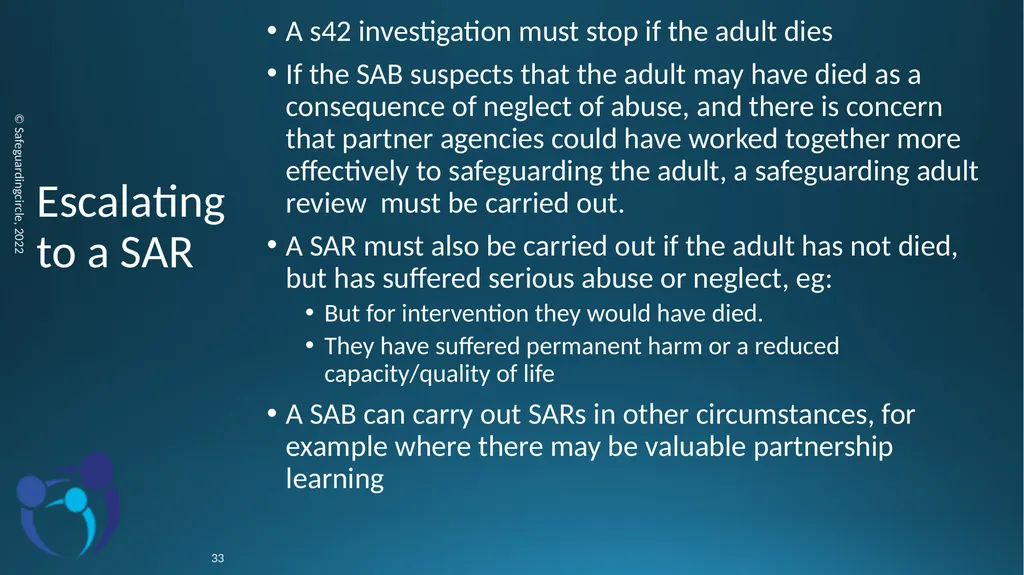
Escalating to a SAR © Safeguardingcircle, 2022 33 A s42 investigation must stop if the adult dies
If the SAB suspects that the adult may have died as a consequence of neglect of abuse, and there is concern that partner agencies could have worked together more effectively to safeguarding the adult, a safeguarding adult review must be carried out.
A SAR must also be carried out if the adult has not died, but has suffered serious abuse or neglect, eg:
But for intervention they would have died.
They have suffered permanent harm or a reduced capacity/quality of life
A SAB can carry out SARs in other circumstances, for example where there may be valuable partnership learning<br>
If the SAB suspects that the adult may have died as a consequence of neglect of abuse, and there is concern that partner agencies could have worked together more effectively to safeguarding the adult, a safeguarding adult review must be carried out.
A SAR must also be carried out if the adult has not died, but has suffered serious abuse or neglect, eg:
But for intervention they would have died.
They have suffered permanent harm or a reduced capacity/quality of life
A SAB can carry out SARs in other circumstances, for example where there may be valuable partnership learning<br>
34
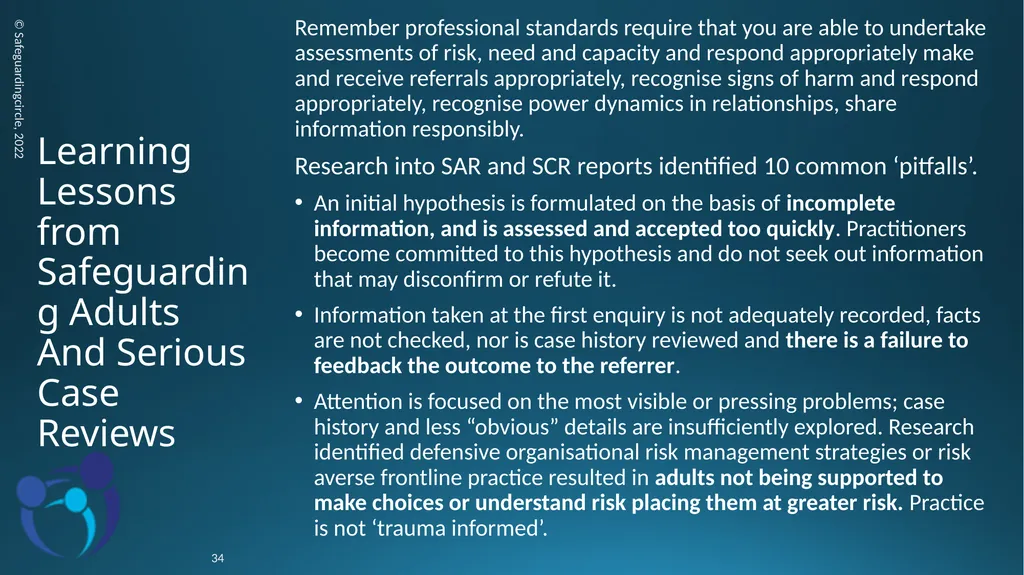
Learning Lessons from Safeguarding Adults And Serious Case Reviews Remember professional standards require that you are able to undertake assessments of risk, need and capacity and respond appropriately make and receive referrals appropriately, recognise signs of harm and respond appropriately, recognise power dynamics in relationships, share information responsibly.
Research into SAR and SCR reports identified 10 common ‘pitfalls’.
An initial hypothesis is formulated on the basis of incomplete information, and is assessed and accepted too quickly. Practitioners become committed to this hypothesis and do not seek out information that may disconfirm or refute it.
Information taken at the first enquiry is not adequately recorded, facts are not checked, nor is case history reviewed and there is a failure to feedback the outcome to the referrer.
Attention is focused on the most visible or pressing problems; case history and less “obvious” details are insufficiently explored. Research identified defensive organisational risk management strategies or risk averse frontline practice resulted in adults not being supported to make choices or understand risk placing them at greater risk. Practice is not ‘trauma informed’. 34 © Safeguardingcircle, 2022<br>
Research into SAR and SCR reports identified 10 common ‘pitfalls’.
An initial hypothesis is formulated on the basis of incomplete information, and is assessed and accepted too quickly. Practitioners become committed to this hypothesis and do not seek out information that may disconfirm or refute it.
Information taken at the first enquiry is not adequately recorded, facts are not checked, nor is case history reviewed and there is a failure to feedback the outcome to the referrer.
Attention is focused on the most visible or pressing problems; case history and less “obvious” details are insufficiently explored. Research identified defensive organisational risk management strategies or risk averse frontline practice resulted in adults not being supported to make choices or understand risk placing them at greater risk. Practice is not ‘trauma informed’. 34 © Safeguardingcircle, 2022<br>
35
Legal duties to consult and appoint advocates are not always applied so:
Insufficient weight is given to information from family, friends and neighbours. Insufficient attention is paid to what adult/children say, how they look and how they behave. NB: NICE guidance on assessing executive capacity.
There is insufficient full engagement with parents and other family carers to assess risk. The SAR review found an absence of ‘think family’ approach.
Initial decisions that are overly focused on age categories or the characteristics of the adult at risk, meaning that contextual safeguarding for young people is unaddressed or adults are left at unacceptable risk.
There is insufficient support/supervision to enable practitioners to work effectively with service users who are uncooperative, ambivalent, confrontational, avoidant or aggressive.
Throughout the initial assessment process, professionals do not clearly check that others have understood their communication. There is an assumption that information shared is information understood.
Case responsibility is diluted in the context of multi-agency working, impacting both on referrals and response. The local authority may inappropriately signpost families to other agencies, with no follow up. SAR review found failures to identify safeguarding procedures and lack of legal literacy frustrated multi-agency strategies.
R (Barrett) v Westminster City Council [2015] signposting to universal services will only be lawful if they actually exist and meet P’s identified needs 35 © Safeguardingcircle, 2022<br>
Insufficient weight is given to information from family, friends and neighbours. Insufficient attention is paid to what adult/children say, how they look and how they behave. NB: NICE guidance on assessing executive capacity.
There is insufficient full engagement with parents and other family carers to assess risk. The SAR review found an absence of ‘think family’ approach.
Initial decisions that are overly focused on age categories or the characteristics of the adult at risk, meaning that contextual safeguarding for young people is unaddressed or adults are left at unacceptable risk.
There is insufficient support/supervision to enable practitioners to work effectively with service users who are uncooperative, ambivalent, confrontational, avoidant or aggressive.
Throughout the initial assessment process, professionals do not clearly check that others have understood their communication. There is an assumption that information shared is information understood.
Case responsibility is diluted in the context of multi-agency working, impacting both on referrals and response. The local authority may inappropriately signpost families to other agencies, with no follow up. SAR review found failures to identify safeguarding procedures and lack of legal literacy frustrated multi-agency strategies.
R (Barrett) v Westminster City Council [2015] signposting to universal services will only be lawful if they actually exist and meet P’s identified needs 35 © Safeguardingcircle, 2022<br>
36
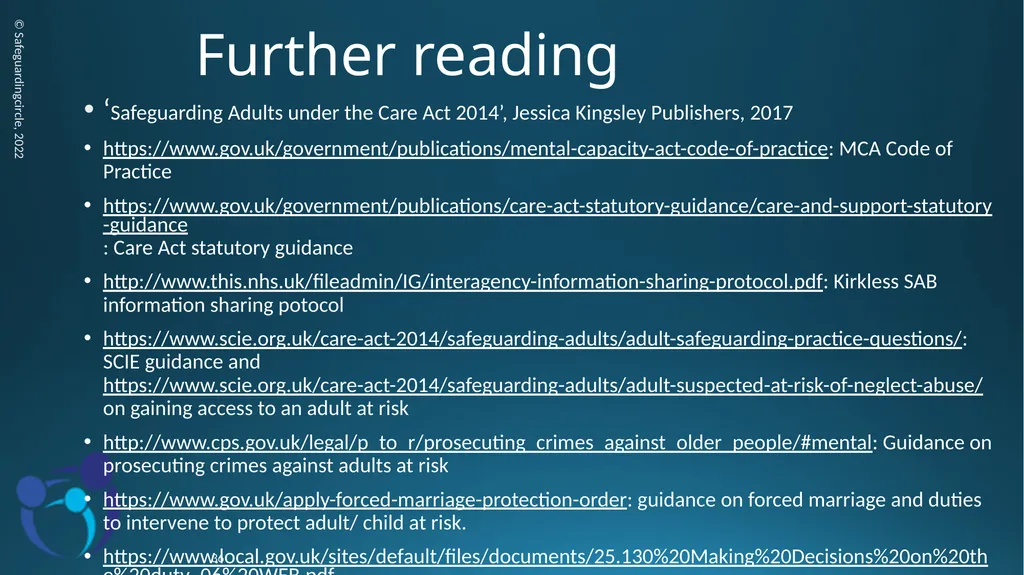
Further reading ‘Safeguarding Adults under the Care Act 2014’, Jessica Kingsley Publishers, 2017
https://www.gov.uk/government/publications/mental-capacity-act-code-of-practice: MCA Code of Practice
https://www.gov.uk/government/publications/care-act-statutory-guidance/care-and-support-statutory-guidance: Care Act statutory guidance
http://www.this.nhs.uk/fileadmin/IG/interagency-information-sharing-protocol.pdf: Kirkless SAB information sharing potocol
https://www.scie.org.uk/care-act-2014/safeguarding-adults/adult-safeguarding-practice-questions/: SCIE guidance and https://www.scie.org.uk/care-act-2014/safeguarding-adults/adult-suspected-at-risk-of-neglect-abuse/ on gaining access to an adult at risk
http://www.cps.gov.uk/legal/p_to_r/prosecuting_crimes_against_older_people/#mental: Guidance on prosecuting crimes against adults at risk
https://www.gov.uk/apply-forced-marriage-protection-order: guidance on forced marriage and duties to intervene to protect adult/ child at risk.
https://www.local.gov.uk/sites/default/files/documents/25.130%20Making%20Decisions%20on%20the%20duty_06%20WEB.pdf: LGA and ADASS guidance on decision making re s42 enquiries 36 © Safeguardingcircle, 2022<br>
https://www.gov.uk/government/publications/mental-capacity-act-code-of-practice: MCA Code of Practice
https://www.gov.uk/government/publications/care-act-statutory-guidance/care-and-support-statutory-guidance: Care Act statutory guidance
http://www.this.nhs.uk/fileadmin/IG/interagency-information-sharing-protocol.pdf: Kirkless SAB information sharing potocol
https://www.scie.org.uk/care-act-2014/safeguarding-adults/adult-safeguarding-practice-questions/: SCIE guidance and https://www.scie.org.uk/care-act-2014/safeguarding-adults/adult-suspected-at-risk-of-neglect-abuse/ on gaining access to an adult at risk
http://www.cps.gov.uk/legal/p_to_r/prosecuting_crimes_against_older_people/#mental: Guidance on prosecuting crimes against adults at risk
https://www.gov.uk/apply-forced-marriage-protection-order: guidance on forced marriage and duties to intervene to protect adult/ child at risk.
https://www.local.gov.uk/sites/default/files/documents/25.130%20Making%20Decisions%20on%20the%20duty_06%20WEB.pdf: LGA and ADASS guidance on decision making re s42 enquiries 36 © Safeguardingcircle, 2022<br>
37
Thank you for listening… 37 © Safeguardingcircle, 2022<br>