
Development is a Human Right Contents: What is the
JO
Published · 26 slides · 0 views

1 / 1

Description
Development is a Human Right Contents: What is the Right to Development? Who are the rights holders and duty bearers of the Right to Development? The Right to Development in Regional Human Rights Systems and Instruments The Right to
Related Topics
Share
Embed code
Download this presentation From Below
"Development is a Human Right Contents: What is the" is the property of its rightful owner. Permission is granted to download and print the materials on this website for personal, non-commercial use only, and to display it on your personal computer provided you do not modify the materials and that you retain all copyright notices contained in the materials. By downloading content from our website, you accept the terms of this agreement.
Presentation Transcript
01
Development is a Human Right<br>
02
Contents: What is the Right to Development?
Who are the rights holders and duty bearers of the Right to Development?
The Right to Development in Regional Human Rights Systems and Instruments
The Right to Development and the 2030 Agenda / SDGs<br>
Who are the rights holders and duty bearers of the Right to Development?
The Right to Development in Regional Human Rights Systems and Instruments
The Right to Development and the 2030 Agenda / SDGs<br>
03
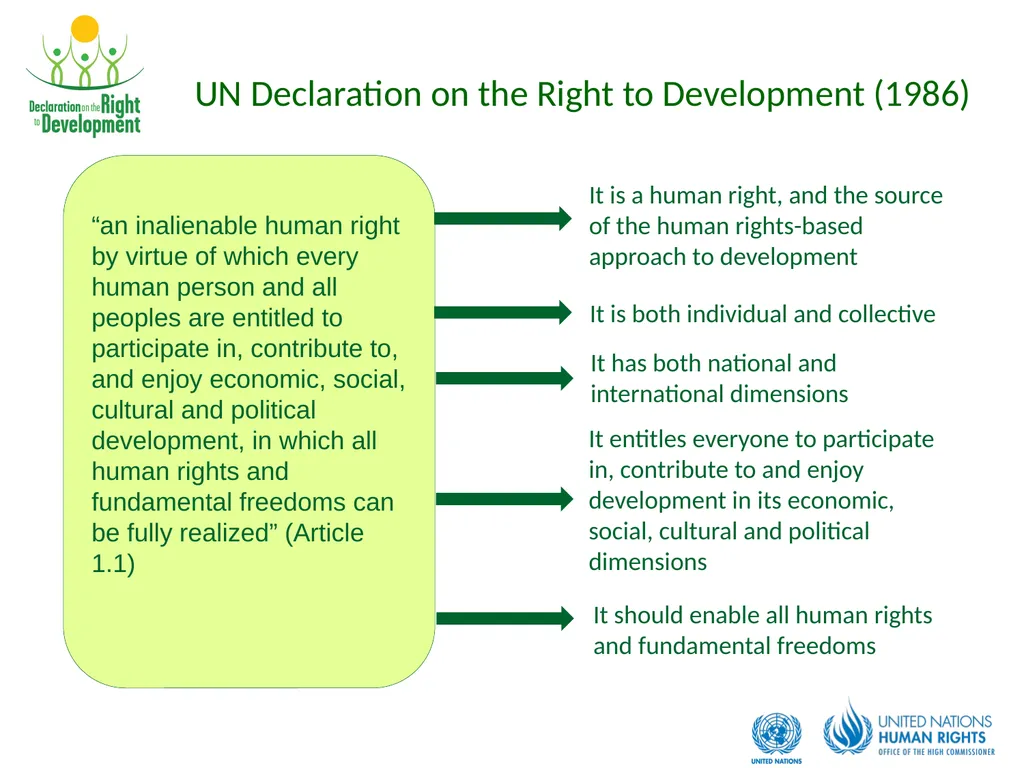
UN Declaration on the Right to Development (1986) “an inalienable human right by virtue of which every human person and all peoples are entitled to participate in, contribute to, and enjoy economic, social, cultural and political development, in which all human rights and fundamental freedoms can be fully realized” (Article 1.1) It is a human right, and the source of the human rights-based approach to development It is both individual and collective It entitles everyone to participate in, contribute to and enjoy development in its economic, social, cultural and political dimensions It has both national and international dimensions It should enable all human rights and fundamental freedoms<br>
04
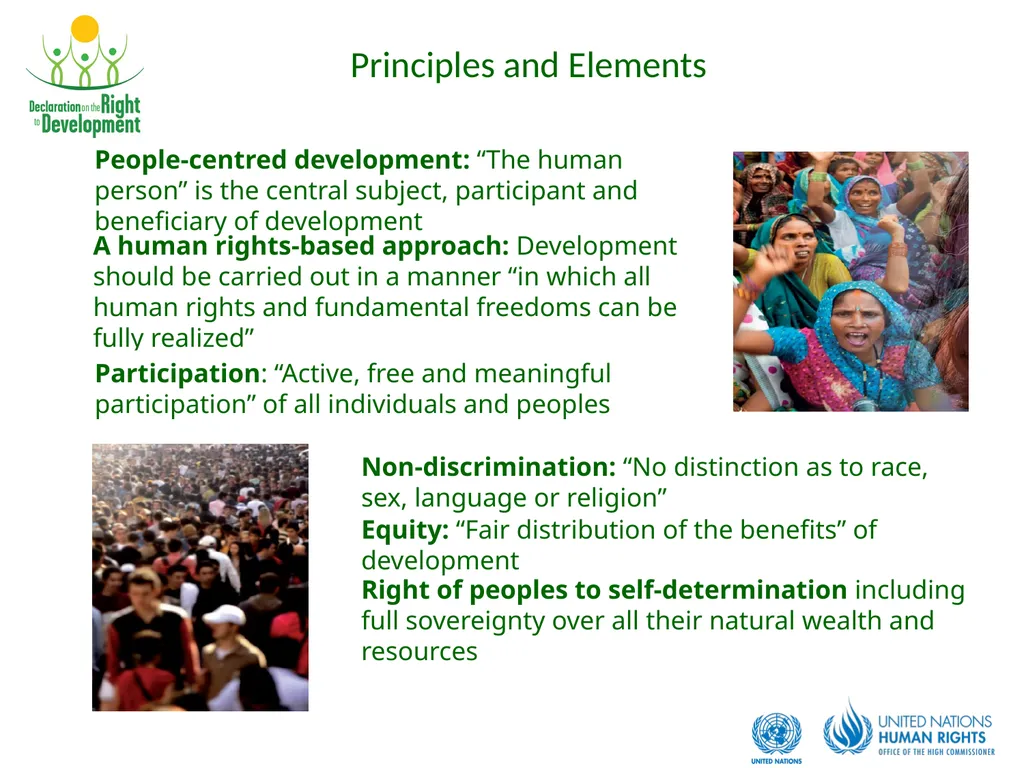
Principles and Elements People-centred development: “The human person” is the central subject, participant and beneficiary of development A human rights-based approach: Development should be carried out in a manner “in which all human rights and fundamental freedoms can be fully realized” Equity: “Fair distribution of the benefits” of development Participation: “Active, free and meaningful participation” of all individuals and peoples Right of peoples to self-determination including full sovereignty over all their natural wealth and resources Non-discrimination: “No distinction as to race, sex, language or religion”<br>
05
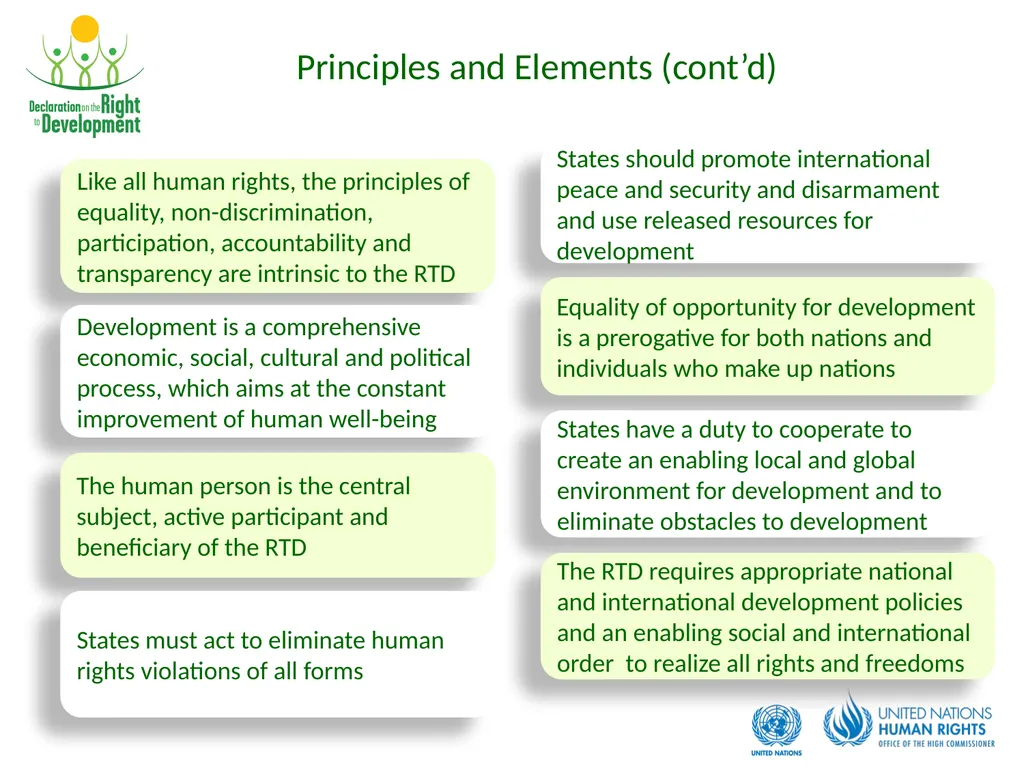
Like all human rights, the principles of equality, non-discrimination, participation, accountability and transparency are intrinsic to the RTD Development is a comprehensive economic, social, cultural and political process, which aims at the constant improvement of human well-being The human person is the central subject, active participant and beneficiary of the RTD States must act to eliminate human rights violations of all forms States should promote international peace and security and disarmament and use released resources for development Equality of opportunity for development is a prerogative for both nations and individuals who make up nations States have a duty to cooperate to create an enabling local and global environment for development and to eliminate obstacles to development The RTD requires appropriate national and international development policies and an enabling social and international order to realize all rights and freedoms Principles and Elements (cont’d)<br>
06
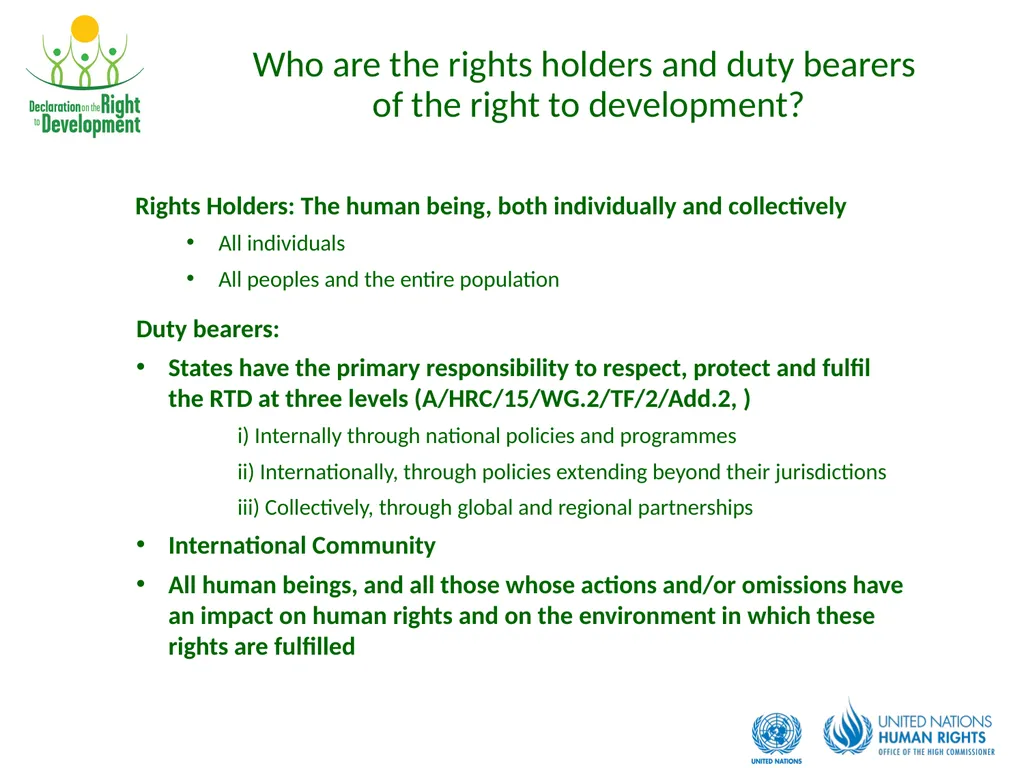
Who are the rights holders and duty bearers
of the right to development? Rights Holders: The human being, both individually and collectively
All individuals
All peoples and the entire population Duty bearers:
States have the primary responsibility to respect, protect and fulfil the RTD at three levels (A/HRC/15/WG.2/TF/2/Add.2, )
i) Internally through national policies and programmes
ii) Internationally, through policies extending beyond their jurisdictions
iii) Collectively, through global and regional partnerships
International Community
All human beings, and all those whose actions and/or omissions have an impact on human rights and on the environment in which these rights are fulfilled<br>
07
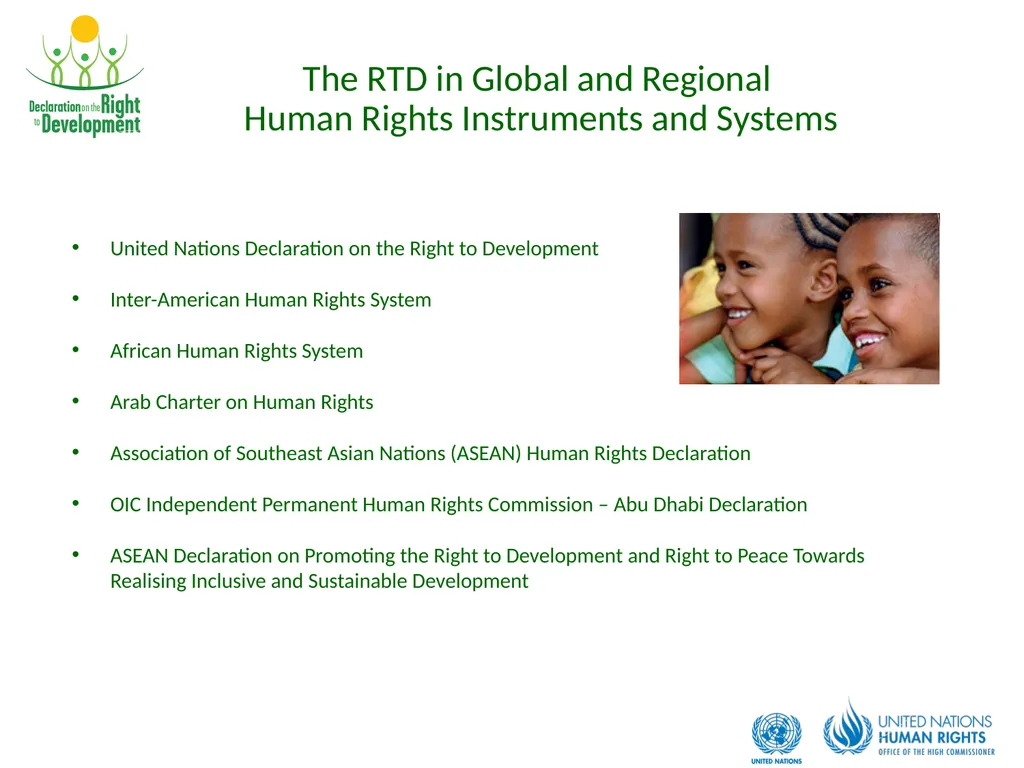
United Nations Declaration on the Right to Development
Inter-American Human Rights System
African Human Rights System
Arab Charter on Human Rights
Association of Southeast Asian Nations (ASEAN) Human Rights Declaration
OIC Independent Permanent Human Rights Commission – Abu Dhabi Declaration
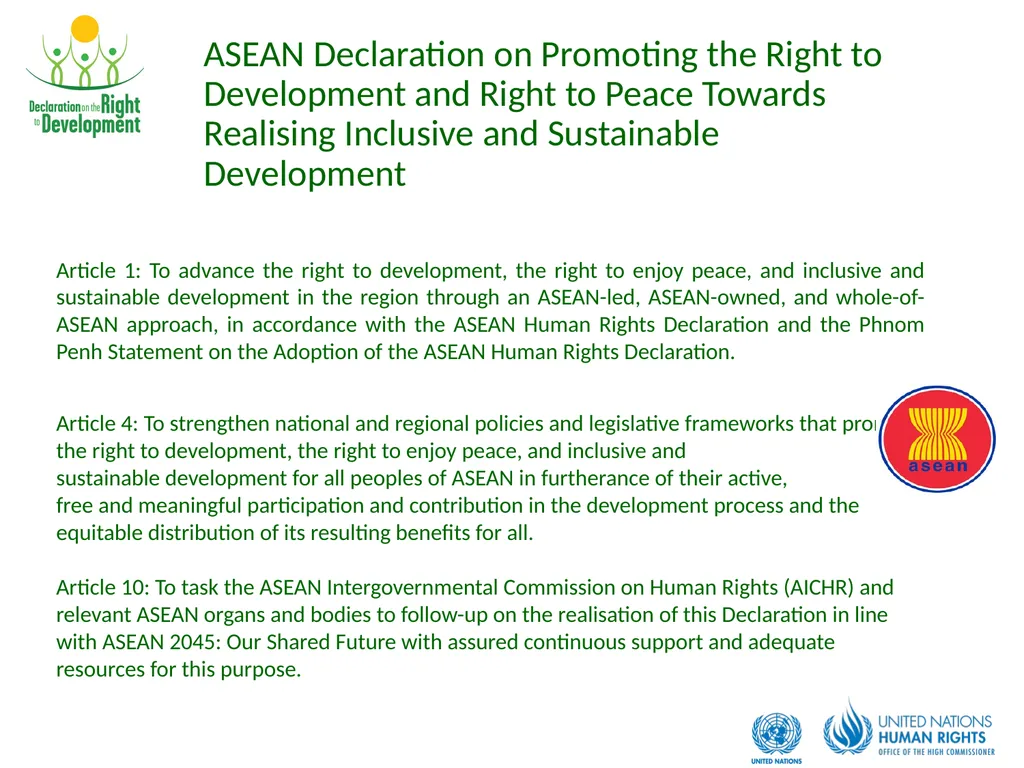
ASEAN Declaration on Promoting the Right to Development and Right to Peace Towards Realising Inclusive and Sustainable Development The RTD in Global and Regional Human Rights Instruments and Systems<br>
08
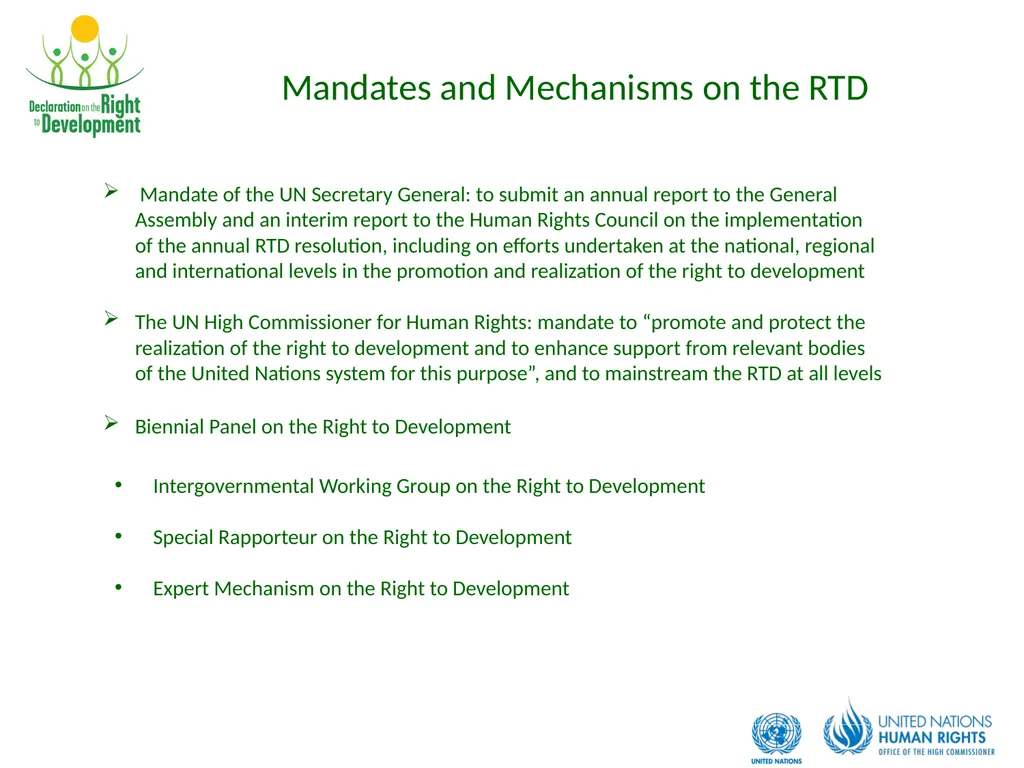
Intergovernmental Working Group on the Right to Development
Special Rapporteur on the Right to Development
Expert Mechanism on the Right to Development Mandates and Mechanisms on the RTD Mandate of the UN Secretary General: to submit an annual report to the General Assembly and an interim report to the Human Rights Council on the implementation of the annual RTD resolution, including on efforts undertaken at the national, regional and international levels in the promotion and realization of the right to development
The UN High Commissioner for Human Rights: mandate to “promote and protect the realization of the right to development and to enhance support from relevant bodies of the United Nations system for this purpose”, and to mainstream the RTD at all levels Biennial Panel on the Right to Development<br>
09
The Draft Covenant on the Right to Development In 2023, the Human Rights Council adopted resolution A/HRC/RES/54/18
whereby it transmitted the Draft International Covenant on the Right to Development A/HRC/54/50 to the General Assembly. (And A/HRC/54/50/Add.1 with the commentaries)
The General Assembly noted in its resolution A/RES/78/203 that the Draft Covenant has been submitted to the General Assembly for its consideration, negotiation and subsequent adoption.<br>
10
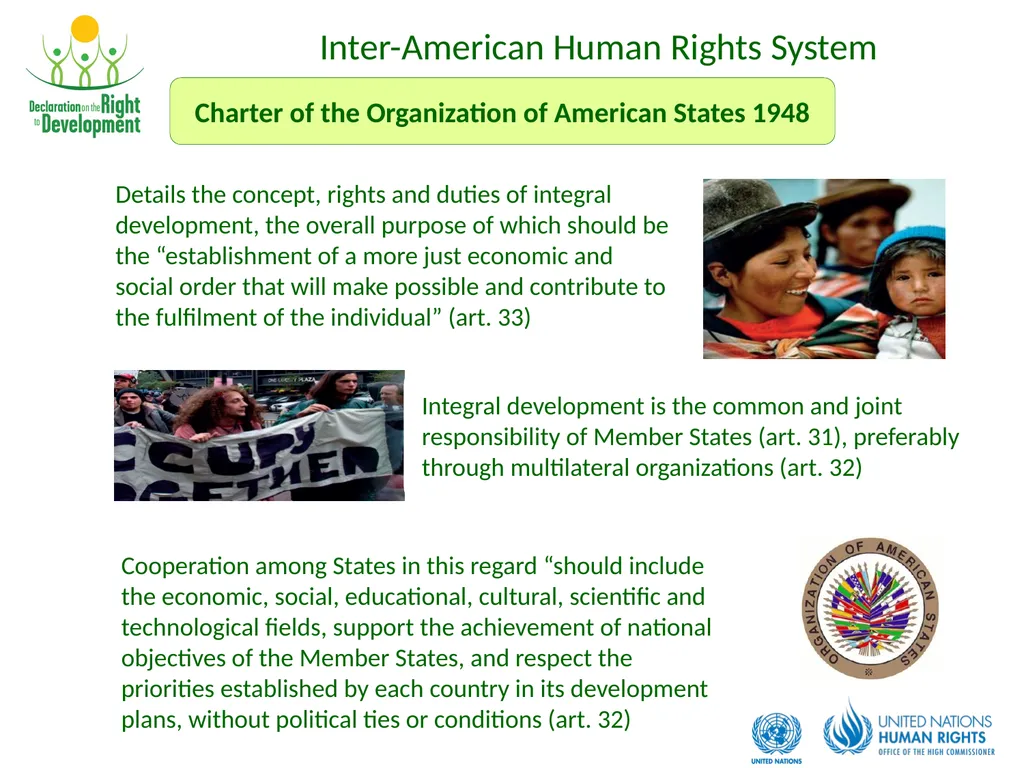
Inter-American Human Rights System Details the concept, rights and duties of integral development, the overall purpose of which should be the “establishment of a more just economic and social order that will make possible and contribute to the fulfilment of the individual” (art. 33) Integral development is the common and joint responsibility of Member States (art. 31), preferably through multilateral organizations (art. 32) Cooperation among States in this regard “should include the economic, social, educational, cultural, scientific and technological fields, support the achievement of national objectives of the Member States, and respect the priorities established by each country in its development plans, without political ties or conditions (art. 32) Charter of the Organization of American States 1948<br>
11
Inter-American Human Rights System (cont’d) Article 26. Progressive Development
The States Parties undertake to adopt measures, both internally and through international cooperation, especially those of an economic and technical nature, with a view to achieving progressively, by legislation or other appropriate means, the full realization of the rights implicit in the economic, social, educational, scientific, and cultural standards set forth in the Charter of the Organization of American States as amended by the Protocol of Buenos Aires American Convention on Human Rights 1969<br>
The States Parties undertake to adopt measures, both internally and through international cooperation, especially those of an economic and technical nature, with a view to achieving progressively, by legislation or other appropriate means, the full realization of the rights implicit in the economic, social, educational, scientific, and cultural standards set forth in the Charter of the Organization of American States as amended by the Protocol of Buenos Aires American Convention on Human Rights 1969<br>
12
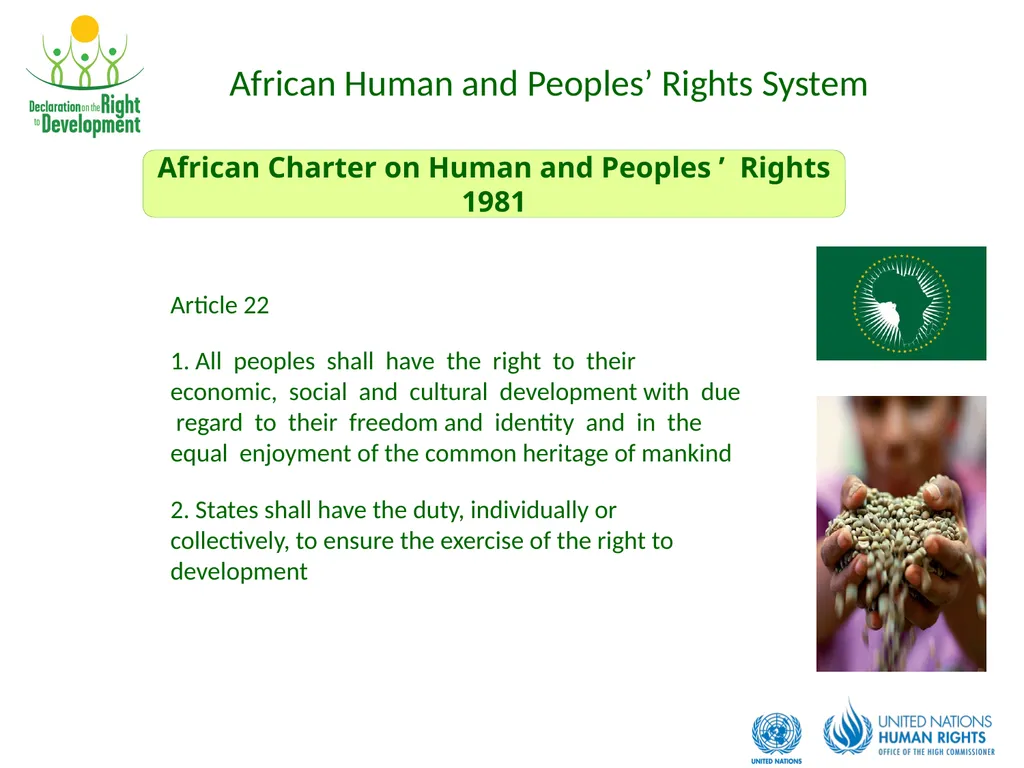
Article 22
1. All peoples shall have the right to their economic, social and cultural development with due regard to their freedom and identity and in the equal enjoyment of the common heritage of mankind
2. States shall have the duty, individually or collectively, to ensure the exercise of the right to development African Charter on Human and Peoples ’ Rights 1981 African Human and Peoples’ Rights System<br>
13
55/96 : Social and Economic Rights Action Center (SERAC) and Center for Economic and Social Rights (CESR) / Nigeria (2001)
227/99 Democratic Republic of Congo / Burundi, Rwanda, Uganda (2003)
266/03 Kevin Mgwanga Gunme et al / Cameroon (2009)
279/03-296/05 : Sudan Human Rights Organisation & Centre on Housing Rights and Evictions (COHRE) / Sudan (2009)
276/03 Centre for Minority Rights Development (Kenya) and Minority Rights Group (on behalf of Endorois Welfare Council) / Kenya (2009)
Resolution on the preparation of a General Comment on the right to development in Africa - ACHPR.Res.586 (LXXIX) 2024
006/2012 – African Commission on Human and Peoples’ Rights v. Republic of Kenya (2017) African Commission on Human and Peoples ’ Rights African Court on Human and Peoples ’ Rights African Human and Peoples’ Rights System (cont’d)<br>
14
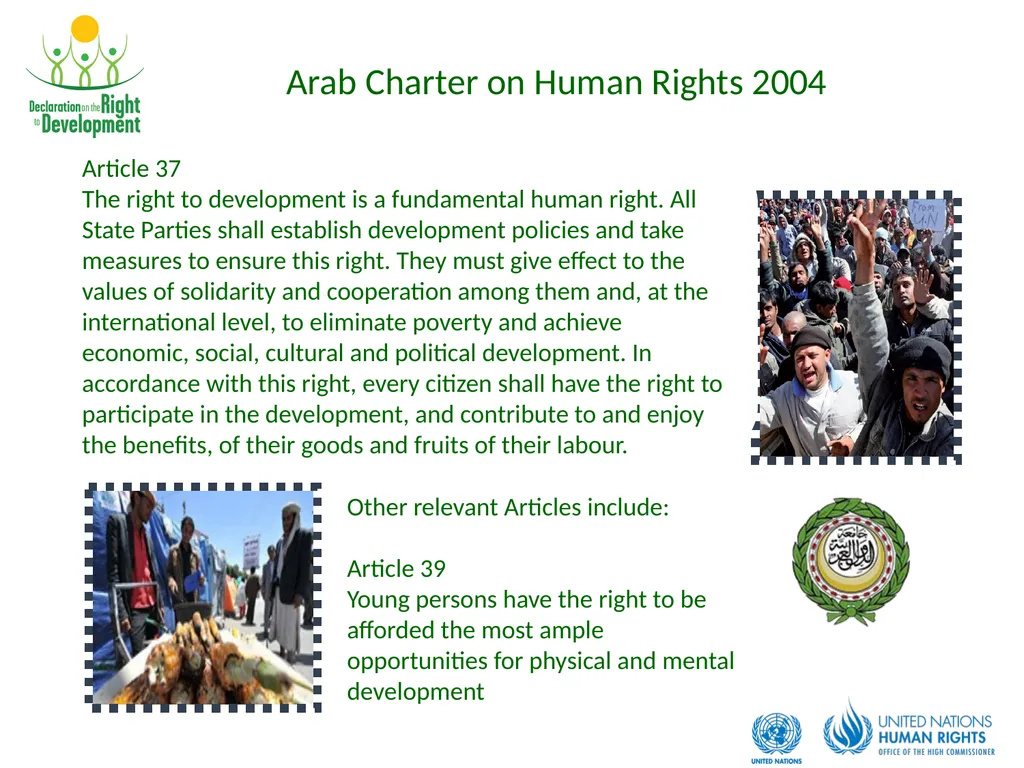
Arab Charter on Human Rights 2004 Article 37
The right to development is a fundamental human right. All State Parties shall establish development policies and take measures to ensure this right. They must give effect to the values of solidarity and cooperation among them and, at the international level, to eliminate poverty and achieve economic, social, cultural and political development. In accordance with this right, every citizen shall have the right to participate in the development, and contribute to and enjoy the benefits, of their goods and fruits of their labour. Other relevant Articles include:
Article 39
Young persons have the right to be afforded the most ample opportunities for physical and mental development<br>
Article 39
Young persons have the right to be afforded the most ample opportunities for physical and mental development<br>
15
Association of Southeast Asian Nations (ASEAN) Human Rights Declaration 2012 A section of the ASEAN Human Rights Declaration (2012) is devoted to the right to development. In paragraph 37, Member States recognize that the implementation of the right to development requires effective development policies at the national level as well as international cooperation, and that States should mainstream aspects of the right to development into ASEAN community building as well as work with the international community to promote development See also:
Paragraph 35 (definition based on the UN Declaration on the RTD)
Paragraph 36 (On the duty to adopt development programmes including sustainable development and progressive narrowing of the development gap in ASEAN<br>
Paragraph 35 (definition based on the UN Declaration on the RTD)
Paragraph 36 (On the duty to adopt development programmes including sustainable development and progressive narrowing of the development gap in ASEAN<br>
16
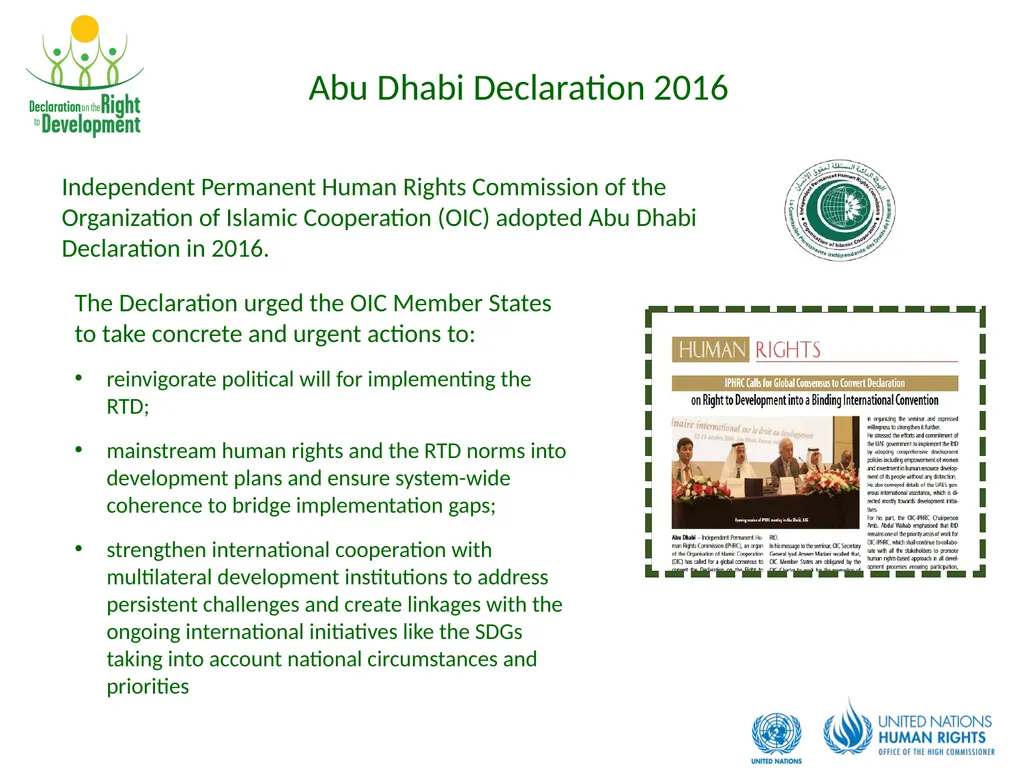
Abu Dhabi Declaration 2016 The Declaration urged the OIC Member States to take concrete and urgent actions to:
reinvigorate political will for implementing the RTD;
mainstream human rights and the RTD norms into development plans and ensure system-wide coherence to bridge implementation gaps;
strengthen international cooperation with multilateral development institutions to address persistent challenges and create linkages with the ongoing international initiatives like the SDGs taking into account national circumstances and priorities Independent Permanent Human Rights Commission of the Organization of Islamic Cooperation (OIC) adopted Abu Dhabi Declaration in 2016.<br>
17
ASEAN Declaration on Promoting the Right to Development and Right to Peace Towards Realising Inclusive and Sustainable Development Article 1: To advance the right to development, the right to enjoy peace, and inclusive and sustainable development in the region through an ASEAN-led, ASEAN-owned, and whole-of-ASEAN approach, in accordance with the ASEAN Human Rights Declaration and the Phnom Penh Statement on the Adoption of the ASEAN Human Rights Declaration.
Article 4: To strengthen national and regional policies and legislative frameworks that promote the right to development, the right to enjoy peace, and inclusive and
sustainable development for all peoples of ASEAN in furtherance of their active,
free and meaningful participation and contribution in the development process and the equitable distribution of its resulting benefits for all.
Article 10: To task the ASEAN Intergovernmental Commission on Human Rights (AICHR) and relevant ASEAN organs and bodies to follow-up on the realisation of this Declaration in line with ASEAN 2045: Our Shared Future with assured continuous support and adequate resources for this purpose.<br>
18
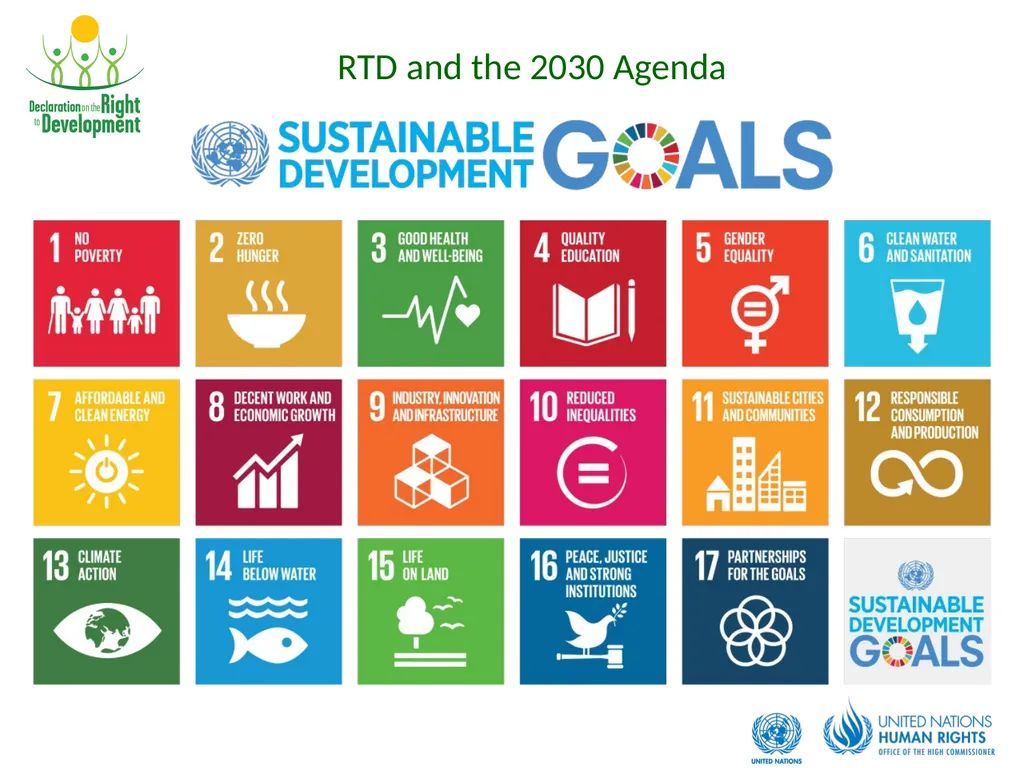
RTD and the 2030 Agenda<br>
19
RTD and the 2030 Agenda and SDGs, the Sevilla Commitment and the Paris Agreement International cooperation, solidarity and friendly relations are essential to realizing the RTD, and for the comprehensive development of developing countries (RTD Declaration - Preamble, Arts. 1.2, 3, 4, 6 and others).
The RTD requires good governance, equality of opportunity for all in their access to basic resources and services, fair distribution of income, an active role for women in the development process and economic and social reforms to eradicate social injustice (RTD Declaration Art.8).
The 2030 Agenda is informed by the RTD Declaration (para. 10) and recognizes respect for human rights, including the right to development, as a prerequisite for peace and security and for sustainable development (para. 35).
Trade, investment, finance, aid, debt, technology, intellectual property and other such global arrangements must be addressed through the RTD's normative framework, to create an enabling international environment for development.<br>
20
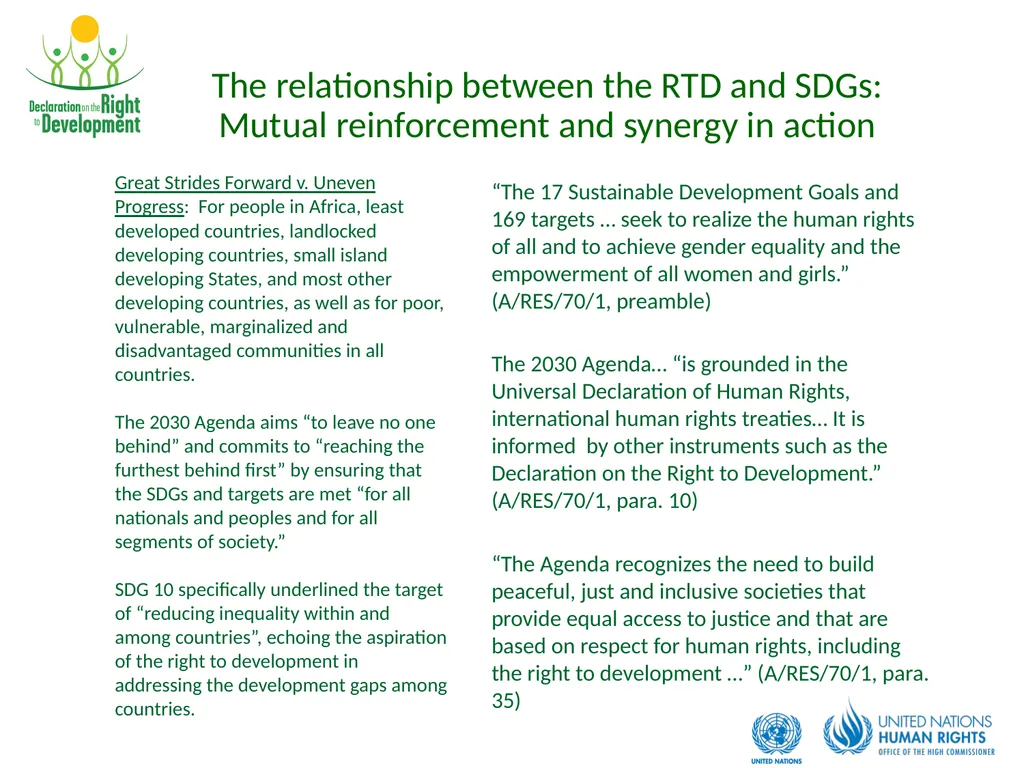
The relationship between the RTD and SDGs:
Mutual reinforcement and synergy in action “The 17 Sustainable Development Goals and 169 targets … seek to realize the human rights of all and to achieve gender equality and the empowerment of all women and girls.” (A/RES/70/1, preamble)
The 2030 Agenda… “is grounded in the Universal Declaration of Human Rights, international human rights treaties… It is informed by other instruments such as the Declaration on the Right to Development.” (A/RES/70/1, para. 10)
“The Agenda recognizes the need to build peaceful, just and inclusive societies that provide equal access to justice and that are based on respect for human rights, including the right to development …” (A/RES/70/1, para. 35) Great Strides Forward v. Uneven Progress: For people in Africa, least developed countries, landlocked developing countries, small island developing States, and most other developing countries, as well as for poor, vulnerable, marginalized and disadvantaged communities in all countries.
The 2030 Agenda aims “to leave no one behind” and commits to “reaching the furthest behind first” by ensuring that the SDGs and targets are met “for all nationals and peoples and for all segments of society.”
SDG 10 specifically underlined the target of “reducing inequality within and among countries”, echoing the aspiration of the right to development in addressing the development gaps among countries.<br>
21
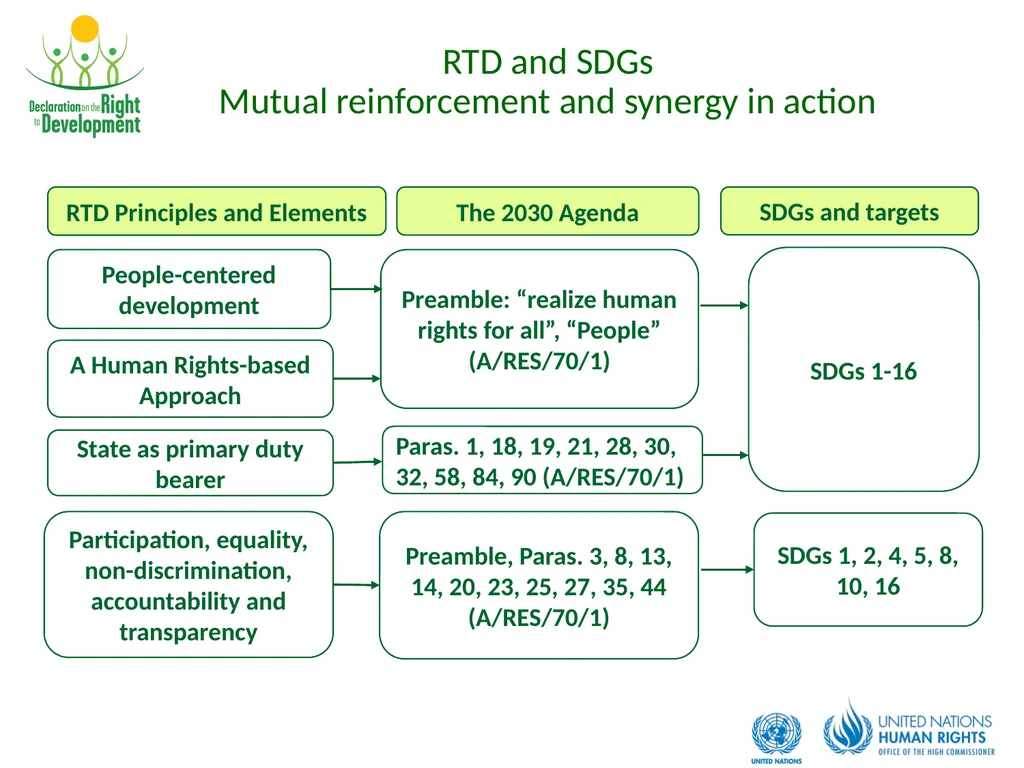
RTD Principles and Elements People-centered development A Human Rights-based Approach State as primary duty bearer The 2030 Agenda Preamble: “realize human rights for all”, “People” (A/RES/70/1) SDGs and targets SDGs 1-16 Paras. 1, 18, 19, 21, 28, 30, 32, 58, 84, 90 (A/RES/70/1) Participation, equality, non-discrimination, accountability and transparency SDGs 1, 2, 4, 5, 8, 10, 16 Preamble, Paras. 3, 8, 13, 14, 20, 23, 25, 27, 35, 44 (A/RES/70/1) RTD and SDGs
Mutual reinforcement and synergy in action<br>
Mutual reinforcement and synergy in action<br>
22
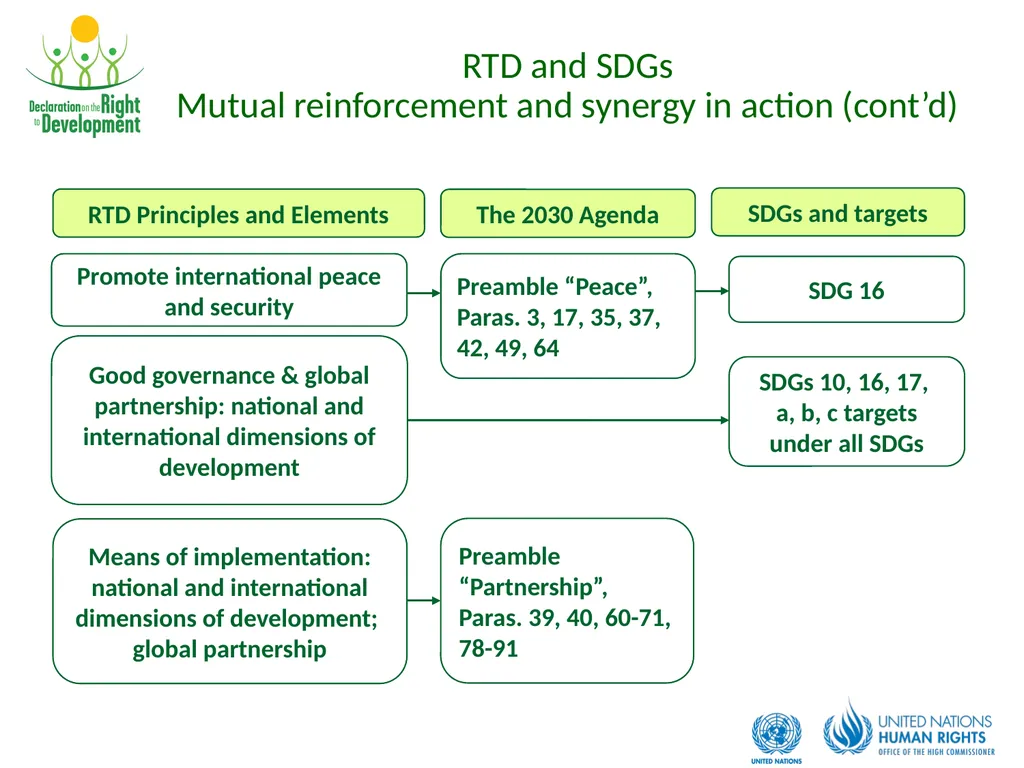
Means of implementation: national and international dimensions of development;
global partnership Promote international peace and security Preamble “Peace”, Paras. 3, 17, 35, 37, 42, 49, 64 SDG 16 RTD Principles and Elements The 2030 Agenda SDGs and targets Preamble “Partnership”, Paras. 39, 40, 60-71, 78-91 Good governance & global partnership: national and international dimensions of development SDGs 10, 16, 17,
a, b, c targets under all SDGs RTD and SDGs
Mutual reinforcement and synergy in action (cont’d)<br>
Mutual reinforcement and synergy in action (cont’d)<br>
23
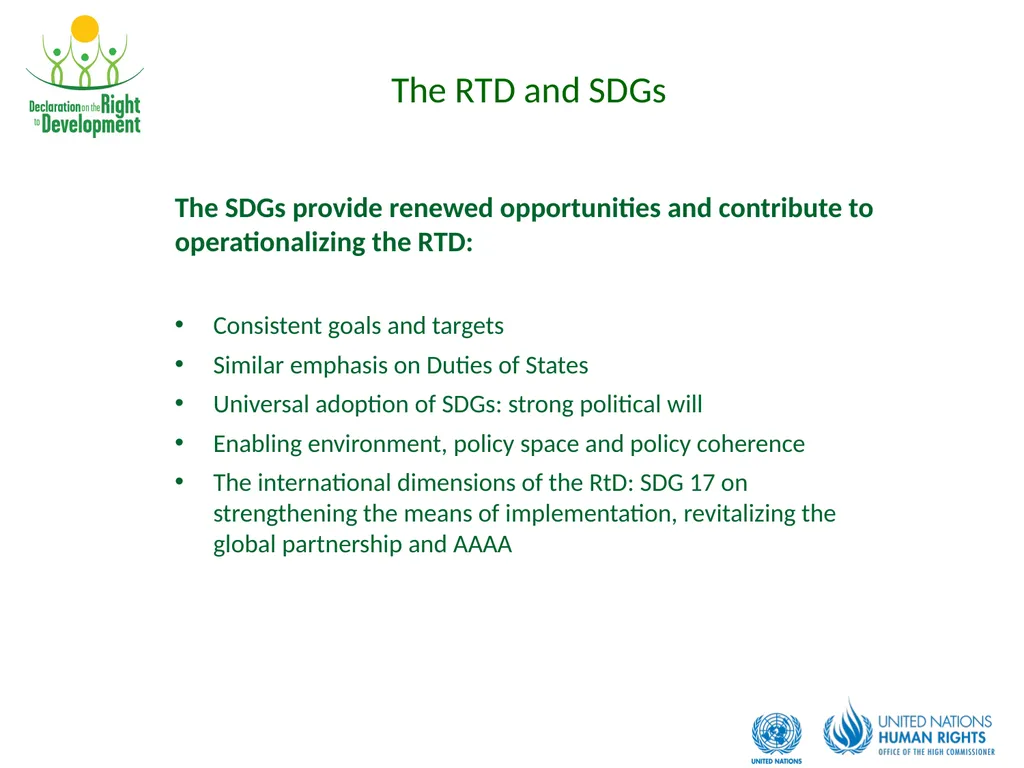
The RTD and SDGs The SDGs provide renewed opportunities and contribute to operationalizing the RTD:
Consistent goals and targets
Similar emphasis on Duties of States
Universal adoption of SDGs: strong political will
Enabling environment, policy space and policy coherence
The international dimensions of the RtD: SDG 17 on strengthening the means of implementation, revitalizing the global partnership and AAAA<br>
24
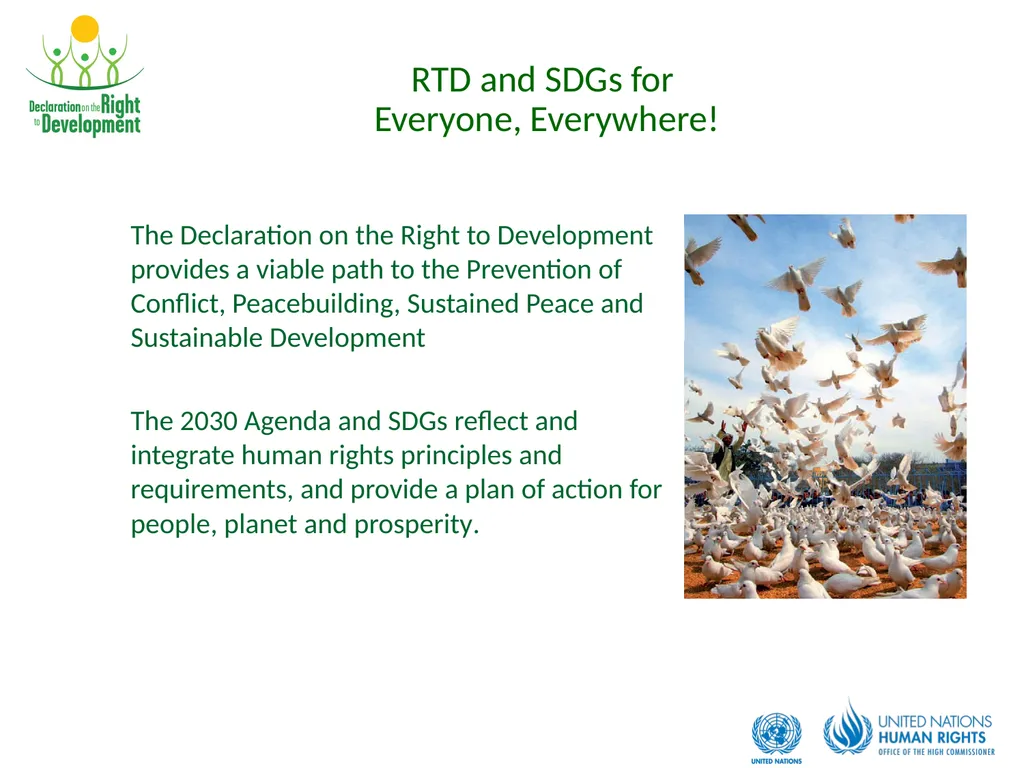
RTD and SDGs for
Everyone, Everywhere! The Declaration on the Right to Development provides a viable path to the Prevention of Conflict, Peacebuilding, Sustained Peace and Sustainable Development The 2030 Agenda and SDGs reflect and integrate human rights principles and requirements, and provide a plan of action for people, planet and prosperity.<br>
25
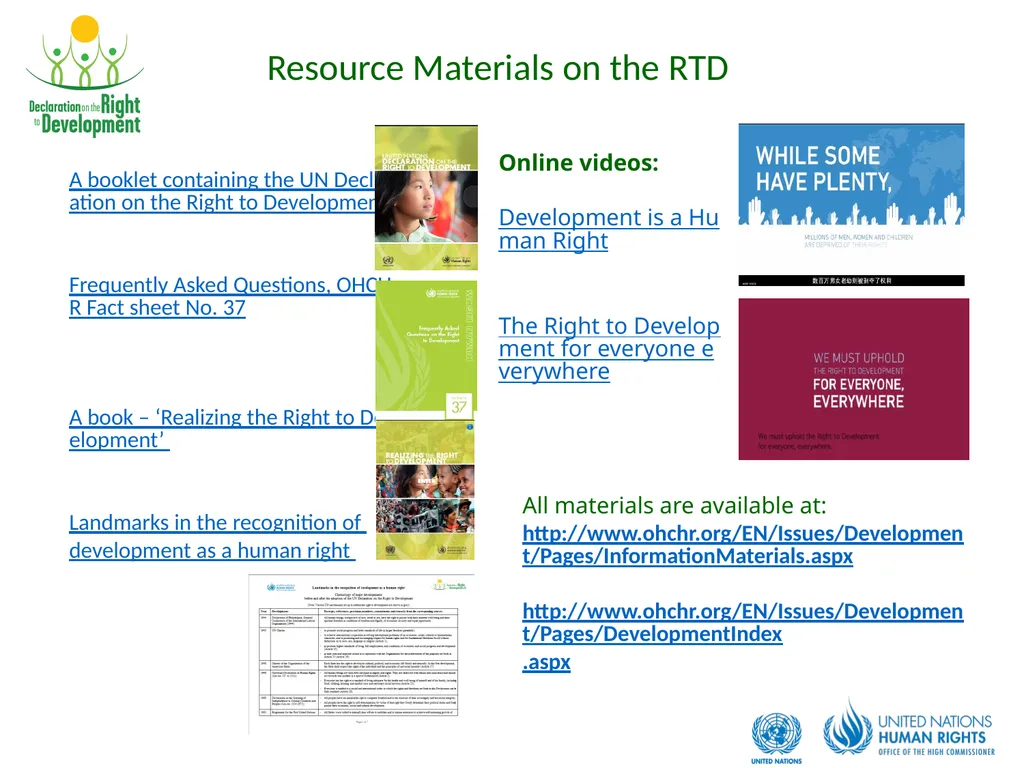
Resource Materials on the RTD A booklet containing the UN Declaration on the Right to Development
Frequently Asked Questions, OHCHR Fact sheet No. 37
A book – ‘Realizing the Right to Development’
Landmarks in the recognition of development as a human right Online videos:
Development is a Human Right
The Right to Development for everyone everywhere All materials are available at:
http://www.ohchr.org/EN/Issues/Development/Pages/InformationMaterials.aspx
http://www.ohchr.org/EN/Issues/Development/Pages/DevelopmentIndex.aspx<br>
26
Thank you!
Contact
ohchr-r2d@un.org<br>
Contact
ohchr-r2d@un.org<br>