
DEVELOPMENT OF FINGERPRINTS CHAPTER 6 CHANCE
LD
Published · 17 slides · 0 views

1 / 1


Description
DEVELOPMENT OF FINGERPRINTS CHAPTER 6 CHANCE PRINTS Chance prints are impressions left behind by the friction ridge skin of fingers, palms, or feet that are typically invisible to the naked eye. These impressions are created when sweat,
Related Topics
Share
Embed code
Download this presentation From Below
"DEVELOPMENT OF FINGERPRINTS CHAPTER 6 CHANCE" is the property of its rightful owner. Permission is granted to download and print the materials on this website for personal, non-commercial use only, and to display it on your personal computer provided you do not modify the materials and that you retain all copyright notices contained in the materials. By downloading content from our website, you accept the terms of this agreement.
Presentation Transcript
01
DEVELOPMENT OF FINGERPRINTS CHAPTER 6<br>
02
CHANCE PRINTS
Chance prints are impressions left behind by the friction ridge skin of fingers, palms, or feet that are typically invisible to the naked eye. These impressions are created when sweat, oils, or other substances from the skin are transferred onto a surface, such as a door handle, window, or other object.
Latent prints can be found at crime scenes and are a valuable type of physical evidence in criminal investigations. They can be used to identify suspects or confirm the presence of individuals at a crime scene. The analysis and comparison of latent prints requires specialized training and expertise in forensic science.
To make latent prints visible, forensic examiners use a variety of techniques, such as dusting with fingerprint powder, using chemical reagents to enhance the print, or using alternate light sources to visualize the print. Once the latent print is visible, it can be photographed or lifted from the surface using tape or other methods for further analysis and comparison.
Latent prints are unique to each individual and are considered a reliable form of identification. Because of this, latent prints are often used by law enforcement agencies as a means of identifying individuals and linking them to crimes.<br>
Chance prints are impressions left behind by the friction ridge skin of fingers, palms, or feet that are typically invisible to the naked eye. These impressions are created when sweat, oils, or other substances from the skin are transferred onto a surface, such as a door handle, window, or other object.
Latent prints can be found at crime scenes and are a valuable type of physical evidence in criminal investigations. They can be used to identify suspects or confirm the presence of individuals at a crime scene. The analysis and comparison of latent prints requires specialized training and expertise in forensic science.
To make latent prints visible, forensic examiners use a variety of techniques, such as dusting with fingerprint powder, using chemical reagents to enhance the print, or using alternate light sources to visualize the print. Once the latent print is visible, it can be photographed or lifted from the surface using tape or other methods for further analysis and comparison.
Latent prints are unique to each individual and are considered a reliable form of identification. Because of this, latent prints are often used by law enforcement agencies as a means of identifying individuals and linking them to crimes.<br>
03
TYPES OF CHANCE PRINTS AT CRIME SCENE
Fingerprints:
Fingerprints are the most common type of chance print found at a crime scene. They are left when someone touches a surface and leaves behind a pattern of ridges and valleys.
Footprints:
Footprints are another common type of chance print found at a crime scene. They can be left when someone walks on the surface and leaves behind a pattern of ridges and valleys.
Lip prints:-
Lip prints are a type of impression evidence that can be found on surfaces that have come into contact with a person's lips. Similar to friction ridge skin on the fingers and palms, the lip has a unique pattern of lines and ridges that can be used for identification purposes.<br>
Fingerprints:
Fingerprints are the most common type of chance print found at a crime scene. They are left when someone touches a surface and leaves behind a pattern of ridges and valleys.
Footprints:
Footprints are another common type of chance print found at a crime scene. They can be left when someone walks on the surface and leaves behind a pattern of ridges and valleys.
Lip prints:-
Lip prints are a type of impression evidence that can be found on surfaces that have come into contact with a person's lips. Similar to friction ridge skin on the fingers and palms, the lip has a unique pattern of lines and ridges that can be used for identification purposes.<br>
04
PALM PRINTS:-
Palm prints are impressions left by the friction ridge skin on the palms of the hands. Like fingerprints, palm prints are unique to each individual and can be used for identification purposes in criminal investigations.
Palm prints can be left behind at crime scenes when an individual touches a surface with their palm, such as a door or window. They can also be left on objects that the individual handled with their palms, such as a weapon or a tool.
Palm prints are typically larger than fingerprints, and they can contain more information that can be used to identify a suspect. In addition to the pattern of ridges and lines on the palm, the presence of scars, cuts, or other features on the palm can also be used for identification.<br>
Palm prints are impressions left by the friction ridge skin on the palms of the hands. Like fingerprints, palm prints are unique to each individual and can be used for identification purposes in criminal investigations.
Palm prints can be left behind at crime scenes when an individual touches a surface with their palm, such as a door or window. They can also be left on objects that the individual handled with their palms, such as a weapon or a tool.
Palm prints are typically larger than fingerprints, and they can contain more information that can be used to identify a suspect. In addition to the pattern of ridges and lines on the palm, the presence of scars, cuts, or other features on the palm can also be used for identification.<br>
05
EAR PRINTS:-
Latent ear prints, also known as ear prints or ear impressions, are a type of impression evidence that can be used for identification purposes in criminal investigations. Similar to fingerprints and palm prints, the ear has a unique pattern of ridges and curves that can be used to identify individuals.
Latent ear prints can be left behind on surfaces when an individual's ear comes into contact with the surface. For example, if an individual presses their ear against a door or window, a latent ear print may be left behind.<br>
Latent ear prints, also known as ear prints or ear impressions, are a type of impression evidence that can be used for identification purposes in criminal investigations. Similar to fingerprints and palm prints, the ear has a unique pattern of ridges and curves that can be used to identify individuals.
Latent ear prints can be left behind on surfaces when an individual's ear comes into contact with the surface. For example, if an individual presses their ear against a door or window, a latent ear print may be left behind.<br>
06
Different Development Methods
POWDER DUSTING METHODS
FUMING METHODS
CHEMICAL METHODS
INSTRUMENTAL METHODS<br>
POWDER DUSTING METHODS
FUMING METHODS
CHEMICAL METHODS
INSTRUMENTAL METHODS<br>
07
POWDER METHOD
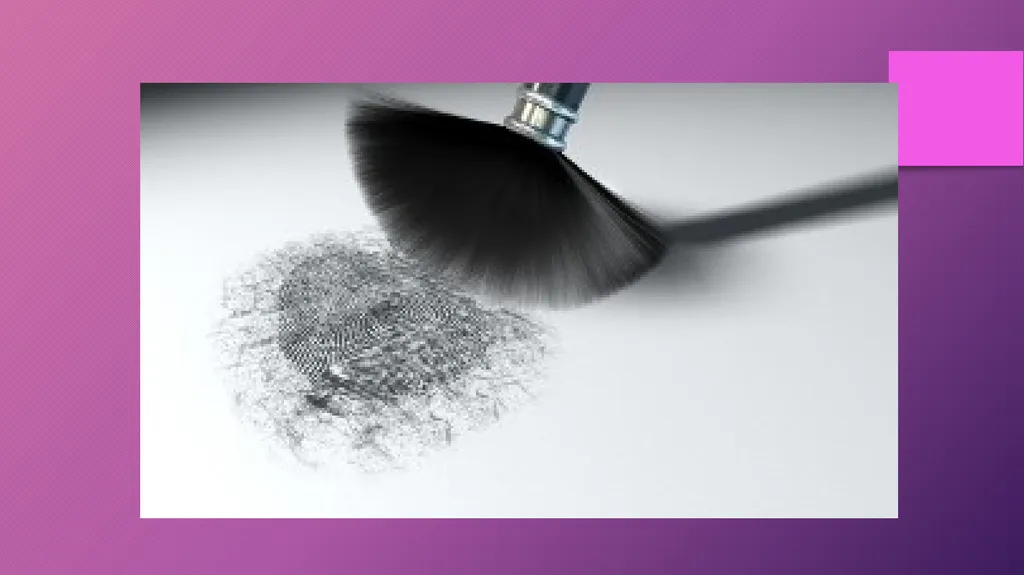
Dusting with fingerprint powder is one of the most widely used techniques for developing latent prints. The powder is applied to the surface where the print is suspected to be present, and it adheres to the natural oils and sweat deposited in the ridges of the print.
Here are the steps for using the powder method:
Select the appropriate color of fingerprint powder for the surface you will be working on. Typically, black or white powder is used, but other colors may be used as well.
Use a small amount of powder on a brush or applicator, and tap off any excess powder.
Lightly brush the powder onto the surface where the fingerprint is suspected to be present. Use a circular motion to apply the powder evenly.<br>
Dusting with fingerprint powder is one of the most widely used techniques for developing latent prints. The powder is applied to the surface where the print is suspected to be present, and it adheres to the natural oils and sweat deposited in the ridges of the print.
Here are the steps for using the powder method:
Select the appropriate color of fingerprint powder for the surface you will be working on. Typically, black or white powder is used, but other colors may be used as well.
Use a small amount of powder on a brush or applicator, and tap off any excess powder.
Lightly brush the powder onto the surface where the fingerprint is suspected to be present. Use a circular motion to apply the powder evenly.<br>
08
Once the powder is applied, gently blow off any excess powder that has not adhered to the fingerprint residue.
The fingerprint should now be visible in the powder. Carefully lift the print using clear tape or lifting tape.
Once the print is lifted, it can be mounted on a fingerprint card for further analysis and comparison.
It is important to note that the powder method is not always suitable for all surfaces or situations. For example, on some surfaces, the powder may not adhere well, and on others, it may damage the surface. In addition, certain conditions, such as humidity, may affect the effectiveness of the powder method. In such cases, alternative methods such as chemical reagents or cyanoacrylate fuming may be more appropriate for developing latent fingerprints.<br>
The fingerprint should now be visible in the powder. Carefully lift the print using clear tape or lifting tape.
Once the print is lifted, it can be mounted on a fingerprint card for further analysis and comparison.
It is important to note that the powder method is not always suitable for all surfaces or situations. For example, on some surfaces, the powder may not adhere well, and on others, it may damage the surface. In addition, certain conditions, such as humidity, may affect the effectiveness of the powder method. In such cases, alternative methods such as chemical reagents or cyanoacrylate fuming may be more appropriate for developing latent fingerprints.<br>
09
FUMING METHODS
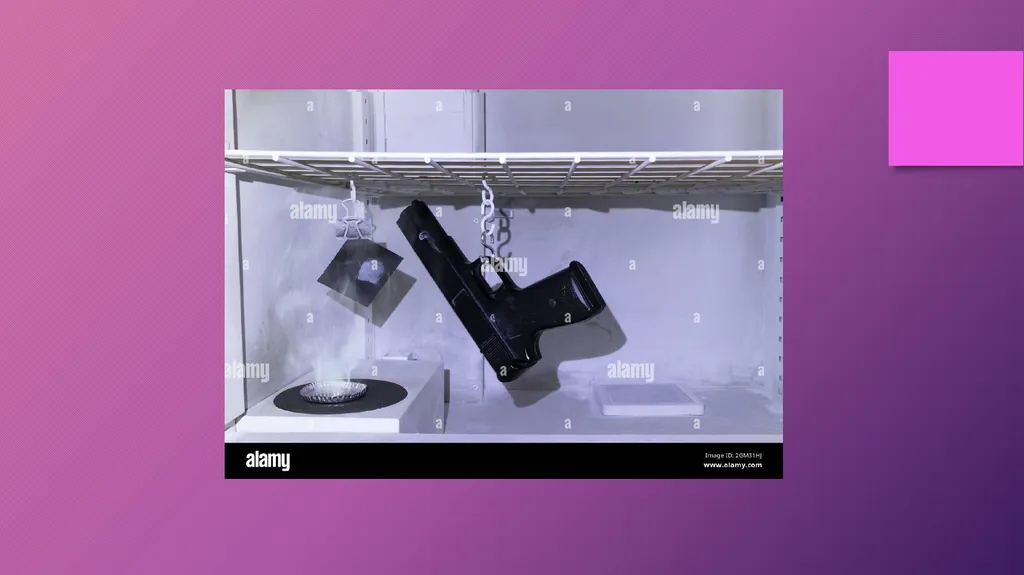
The fuming method of developing latent prints is a technique that uses cyanoacrylate vapor to make the invisible fingerprints visible. Here are the steps for using the fuming method:
Place the object containing the latent print into a fuming chamber, which can be a commercially available chamber or one that is constructed specifically for this purpose.
Place a small amount of cyanoacrylate, also known as superglue, onto a hot plate or in a separate container inside the chamber.
Heat the cyanoacrylate until it vaporizes and forms a white smoke.
Allow the cyanoacrylate vapor to circulate in the chamber for several minutes. The vapor will react with the amino acids and other substances in the print residue, forming a white, visible print.<br>
The fuming method of developing latent prints is a technique that uses cyanoacrylate vapor to make the invisible fingerprints visible. Here are the steps for using the fuming method:
Place the object containing the latent print into a fuming chamber, which can be a commercially available chamber or one that is constructed specifically for this purpose.
Place a small amount of cyanoacrylate, also known as superglue, onto a hot plate or in a separate container inside the chamber.
Heat the cyanoacrylate until it vaporizes and forms a white smoke.
Allow the cyanoacrylate vapor to circulate in the chamber for several minutes. The vapor will react with the amino acids and other substances in the print residue, forming a white, visible print.<br>
10
After the fuming process is complete, remove the object from the chamber and allow it to cool.
To preserve the print, it can be lifted using tape or a lifting device and transferred to a fingerprint card for further analysis and comparison.
The fuming method is an effective way to develop latent prints on nonporous surfaces such as metal, glass, and plastic. It is important to note that this method may not be suitable for all surfaces and situations, and other development methods such as chemical reagents or powder may be more appropriate. In addition, the fuming process can be hazardous if not done properly, and appropriate safety precautions should be taken.<br>
To preserve the print, it can be lifted using tape or a lifting device and transferred to a fingerprint card for further analysis and comparison.
The fuming method is an effective way to develop latent prints on nonporous surfaces such as metal, glass, and plastic. It is important to note that this method may not be suitable for all surfaces and situations, and other development methods such as chemical reagents or powder may be more appropriate. In addition, the fuming process can be hazardous if not done properly, and appropriate safety precautions should be taken.<br>
11
CHEMICAL METHODS:-
Chemical methods of developing latent prints involve the use of chemical reagents that react with the substances in the print residue to make the print visible. Here are some common chemical methods of developing latent prints:
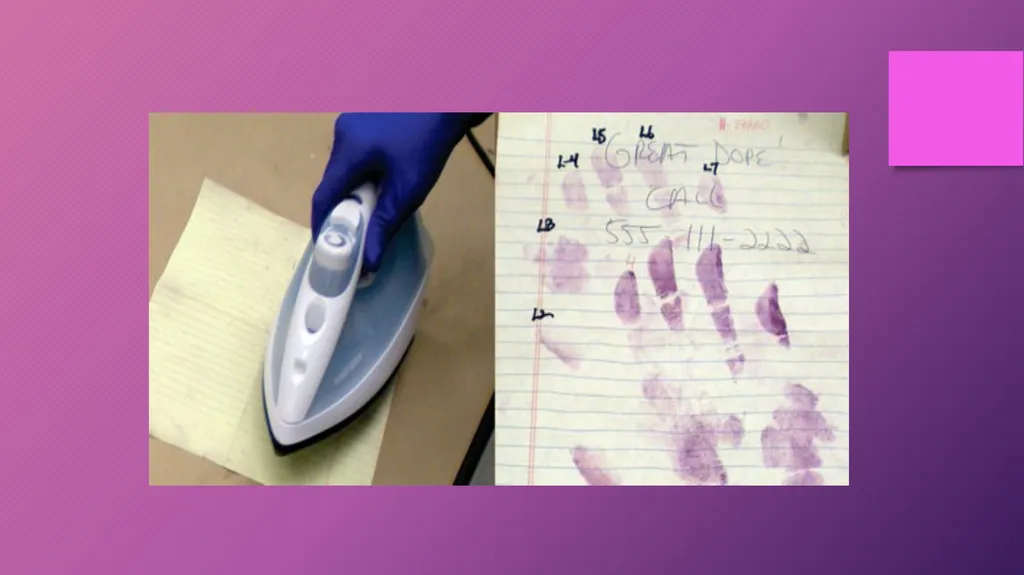
Ninhydrin: Ninhydrin is a chemical reagent that reacts with amino acids in sweat to create a purple or blue color. The item containing the latent print is sprayed with a solution of ninhydrin, which is then heated to speed up the reaction. The print will become visible within a few hours.
DFO (1,8-Diazafluoren-9-one): DFO is a chemical that reacts with the fatty acids in the print residue. The item containing the latent print is dipped in a solution of DFO and then exposed to UV light. The print will appear as a yellow or orange color.<br>
Chemical methods of developing latent prints involve the use of chemical reagents that react with the substances in the print residue to make the print visible. Here are some common chemical methods of developing latent prints:
Ninhydrin: Ninhydrin is a chemical reagent that reacts with amino acids in sweat to create a purple or blue color. The item containing the latent print is sprayed with a solution of ninhydrin, which is then heated to speed up the reaction. The print will become visible within a few hours.
DFO (1,8-Diazafluoren-9-one): DFO is a chemical that reacts with the fatty acids in the print residue. The item containing the latent print is dipped in a solution of DFO and then exposed to UV light. The print will appear as a yellow or orange color.<br>
12
Silver Nitrate: Silver nitrate is a chemical reagent that reacts with chloride ions in the print residue to create a silver chloride precipitate. The item containing the latent print is dipped in a solution of silver nitrate, and then exposed to UV light. The print will appear as a black or brown color.
Physical Developer: Physical developer is a chemical reagent that reacts with the metal ions in the print residue. The item containing the latent print is soaked in a solution of physical developer, which will react with the metal ions and create a visible print. The print will appear as a black or brown color.
It is important to note that chemical methods of developing latent prints may not be suitable for all surfaces and situations, and alternative methods such as powder or cyanoacrylate fuming may be more appropriate. In addition, some chemicals used in the process may be hazardous, and appropriate safety precautions should be taken.<br>
Physical Developer: Physical developer is a chemical reagent that reacts with the metal ions in the print residue. The item containing the latent print is soaked in a solution of physical developer, which will react with the metal ions and create a visible print. The print will appear as a black or brown color.
It is important to note that chemical methods of developing latent prints may not be suitable for all surfaces and situations, and alternative methods such as powder or cyanoacrylate fuming may be more appropriate. In addition, some chemicals used in the process may be hazardous, and appropriate safety precautions should be taken.<br>
13
INSTRUMENT USE FOR DEVELOPING
Forensic Light Source: A forensic light source is used to examine evidence under different wavelengths of light, such as ultraviolet or infrared light, to enhance the visibility of latent fingerprints. The light source can also be used to detect trace evidence such as hair or fibers.
Electron Microscope: An electron microscope is used to examine the three-dimensional structure of latent prints and can provide detailed information about the composition and morphology of the print residue. This instrument is often used in conjunction with other methods such as chemical or powder methods to provide a more complete picture of the latent print.<br>
Forensic Light Source: A forensic light source is used to examine evidence under different wavelengths of light, such as ultraviolet or infrared light, to enhance the visibility of latent fingerprints. The light source can also be used to detect trace evidence such as hair or fibers.
Electron Microscope: An electron microscope is used to examine the three-dimensional structure of latent prints and can provide detailed information about the composition and morphology of the print residue. This instrument is often used in conjunction with other methods such as chemical or powder methods to provide a more complete picture of the latent print.<br>
14
X-ray Fluorescence (XRF) Spectrometer: XRF spectrometry is used to identify the elemental composition of the print residue, which can help to determine the source of the print and provide additional evidence for the investigation.
Mass Spectrometer: A mass spectrometer is used to analyze the chemical composition of the print residue. This instrument is often used in conjunction with other methods such as gas chromatography to identify specific compounds present in the print residue.
It is important to note that the use of these instruments requires specialized training and expertise, and they may not be available in all forensic laboratories. Moreover, instrumental methods are often used in conjunction with other methods such as chemical or powder methods to provide a more complete picture of the latent print.<br>
Mass Spectrometer: A mass spectrometer is used to analyze the chemical composition of the print residue. This instrument is often used in conjunction with other methods such as gas chromatography to identify specific compounds present in the print residue.
It is important to note that the use of these instruments requires specialized training and expertise, and they may not be available in all forensic laboratories. Moreover, instrumental methods are often used in conjunction with other methods such as chemical or powder methods to provide a more complete picture of the latent print.<br>