
Diagnosing and Managing PSP & CBS Dr Boyd Ghosh










Description: Diagnosing and Managing PSP CBS Dr Boyd Ghosh PSPA Masterclass 25th June 2025 boyd.ghoshuhs.nhs.uk Disclosures Lectured for UCB and GSK on atypical Parkinsonism Advisory board for NICE, UCB, Immunobrain and Biogen Drug trials for Biogen,
Related Topics
Download Presentation
"Diagnosing and Managing PSP & CBS Dr Boyd Ghosh" is the property of its rightful owner. Permission is granted to download and print the materials on this website for personal, non-commercial use only, and to display it on your personal computer provided you do not modify the materials and that you retain all copyright notices contained in the materials. By downloading content from our website, you accept the terms of this agreement.
Presentation Transcript
slide1. Diagnosing and Managing
PSP & CBS Dr Boyd Ghosh
PSPA Masterclass 25th June 2025
boyd.ghosh@uhs.nhs.uk<br>
slide2. Disclosures Lectured for UCB and GSK on atypical Parkinsonism
Advisory board for NICE, UCB, Immunobrain and Biogen
Drug trials for Biogen, Ferrer, UCB, Pfizer, TauRx, Novartis, Takeda and Laboratoire Français de Fractionnement et de Biotechnologies
Trustee and member of research committee for the PSP Association<br>
slide3. Aims At the end of this session participants will:
Know when to consider a diagnosis of PSP or CBS
Have an approach to aid diagnosis of PSP and CBS
Know management pathways for patients with PSP and CBS (some self study)
Have an overview of proteinopathies and potential treatment<br>
slide4. Plan of campaign Revision of PSP and CBS phenotypes
Contrast PSP and CBS with IPD
Discuss difficulties that PSP and CBS patients have in early stages
Highlight ways to help patient and carer
Prioritise videos and discussion
Resources for you to review by yourself *<br>
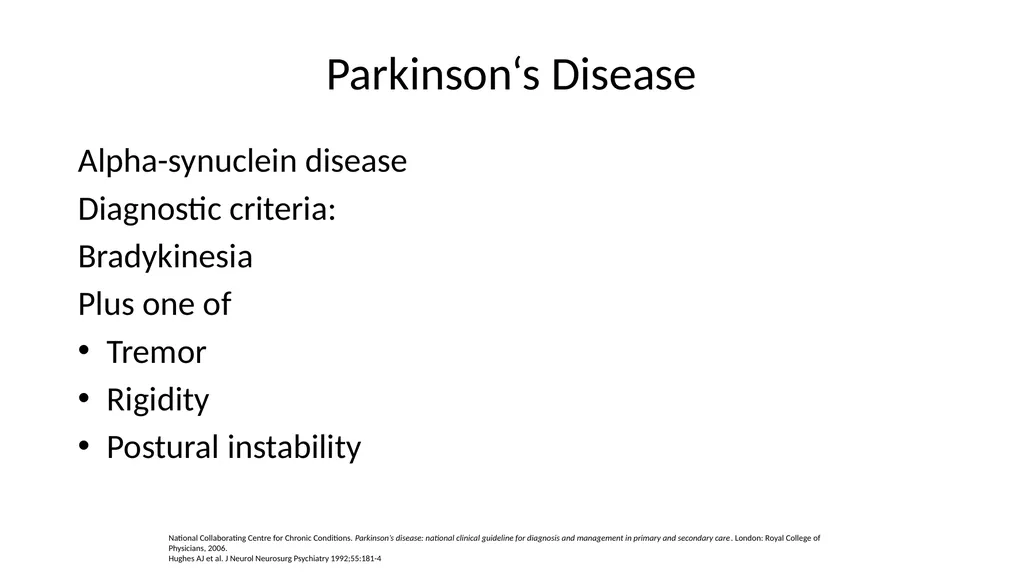
slide5. Parkinson‘s Disease Alpha-synuclein disease
Diagnostic criteria:
Bradykinesia
Plus one of
Tremor
Rigidity
Postural instability National Collaborating Centre for Chronic Conditions. Parkinson’s disease: national clinical guideline for diagnosis and management in primary and secondary care. London: Royal College of Physicians, 2006.
Hughes AJ et al. J Neurol Neurosurg Psychiatry 1992;55:181-4<br>
slide6. Parkinson’s disease<br>
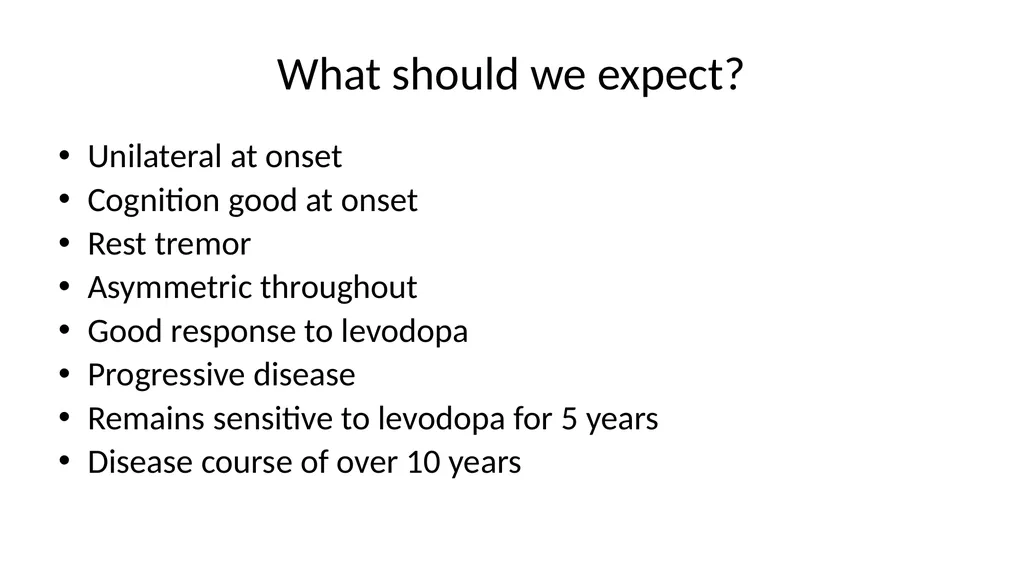
slide7. What should we expect? Unilateral at onset
Cognition good at onset
Rest tremor
Asymmetric throughout
Good response to levodopa
Progressive disease
Remains sensitive to levodopa for 5 years
Disease course of over 10 years<br>
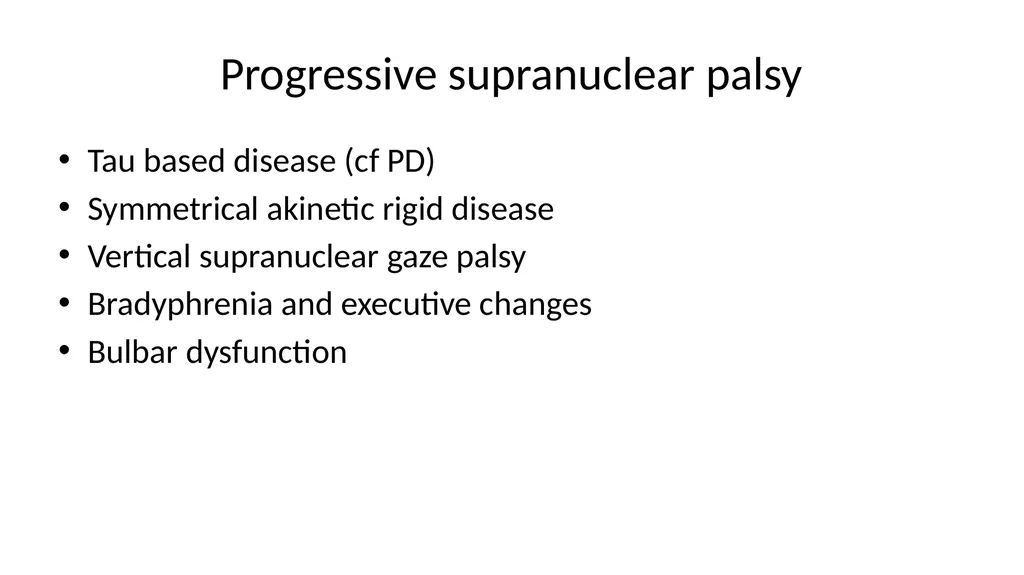
slide8. Progressive supranuclear palsy Tau based disease (cf PD)
Symmetrical akinetic rigid disease
Vertical supranuclear gaze palsy
Bradyphrenia and executive changes
Bulbar dysfunction<br>
slide9. Video of PSP<br>
slide10. Which saccades are abnormal?<br>
slide11. Which saccades were abnormal?<br>
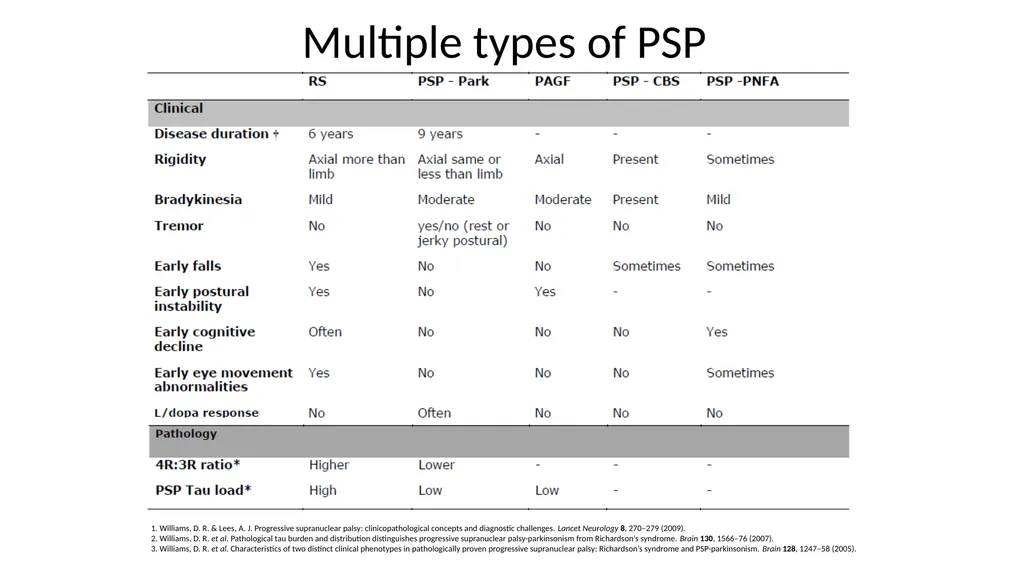
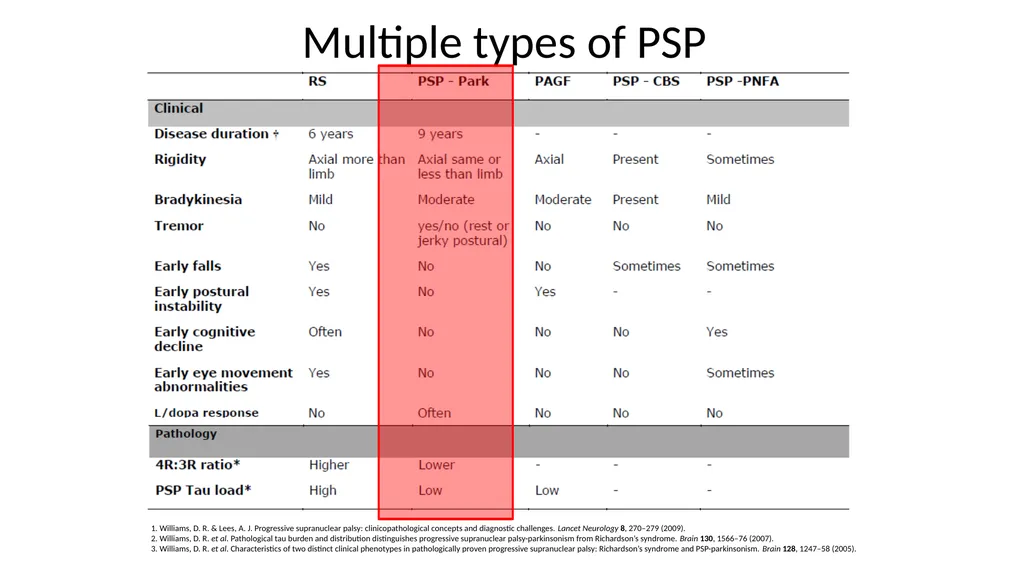
slide12. Multiple types of PSP 1. Williams, D. R. & Lees, A. J. Progressive supranuclear palsy: clinicopathological concepts and diagnostic challenges. Lancet Neurology 8, 270–279 (2009).
2. Williams, D. R. et al. Pathological tau burden and distribution distinguishes progressive supranuclear palsy-parkinsonism from Richardson’s syndrome. Brain 130, 1566–76 (2007).
3. Williams, D. R. et al. Characteristics of two distinct clinical phenotypes in pathologically proven progressive supranuclear palsy: Richardson’s syndrome and PSP-parkinsonism. Brain 128, 1247–58 (2005).<br>
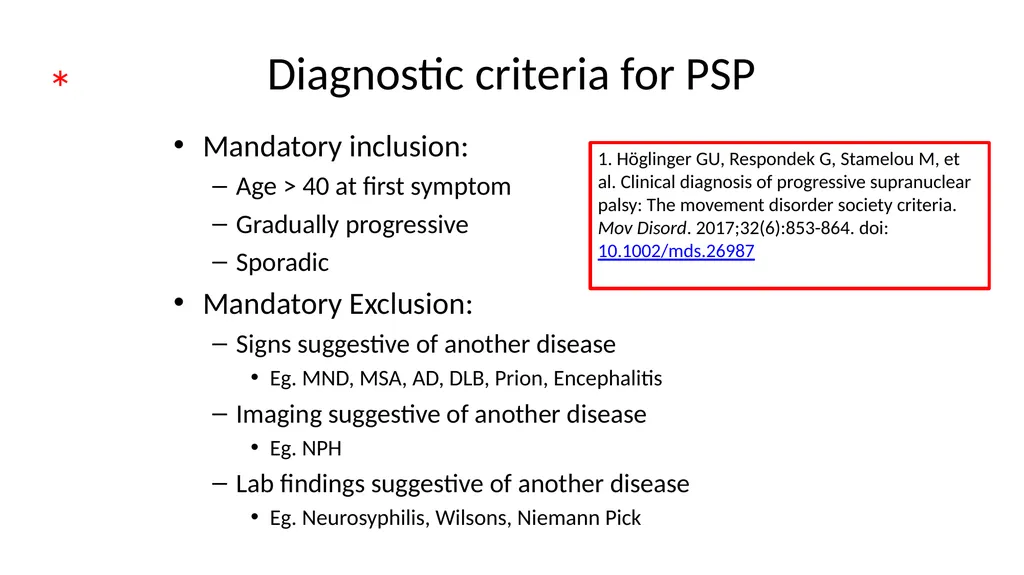
slide13. Diagnostic criteria for PSP Mandatory inclusion:
Age > 40 at first symptom
Gradually progressive
Sporadic
Mandatory Exclusion:
Signs suggestive of another disease
Eg. MND, MSA, AD, DLB, Prion, Encephalitis
Imaging suggestive of another disease
Eg. NPH
Lab findings suggestive of another disease
Eg. Neurosyphilis, Wilsons, Niemann Pick 1. Höglinger GU, Respondek G, Stamelou M, et al. Clinical diagnosis of progressive supranuclear palsy: The movement disorder society criteria. Mov Disord. 2017;32(6):853-864. doi:10.1002/mds.26987 *<br>
slide14. 1.Höglinger, G. U. et al. Clinical diagnosis of progressive supranuclear palsy: The movement disorder society criteria. Mov. Disord. 32, 853–864 (2017). *<br>
slide15. 1.Höglinger, G. U. et al. Clinical diagnosis of progressive supranuclear palsy: The movement disorder society criteria. Mov. Disord. 32, 853–864 (2017). *<br>
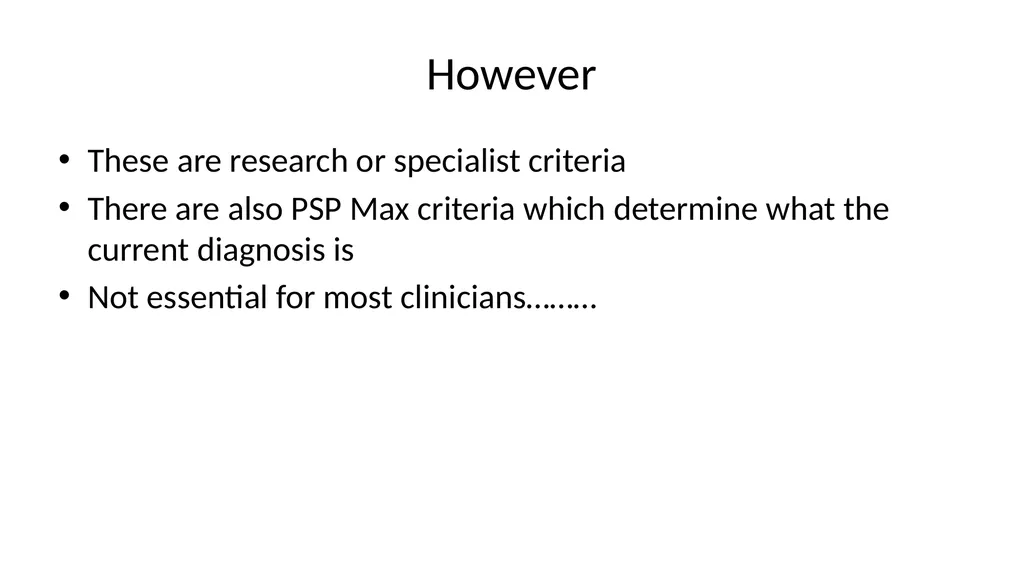
slide16. However These are research or specialist criteria
There are also PSP Max criteria which determine what the current diagnosis is
Not essential for most clinicians………<br>
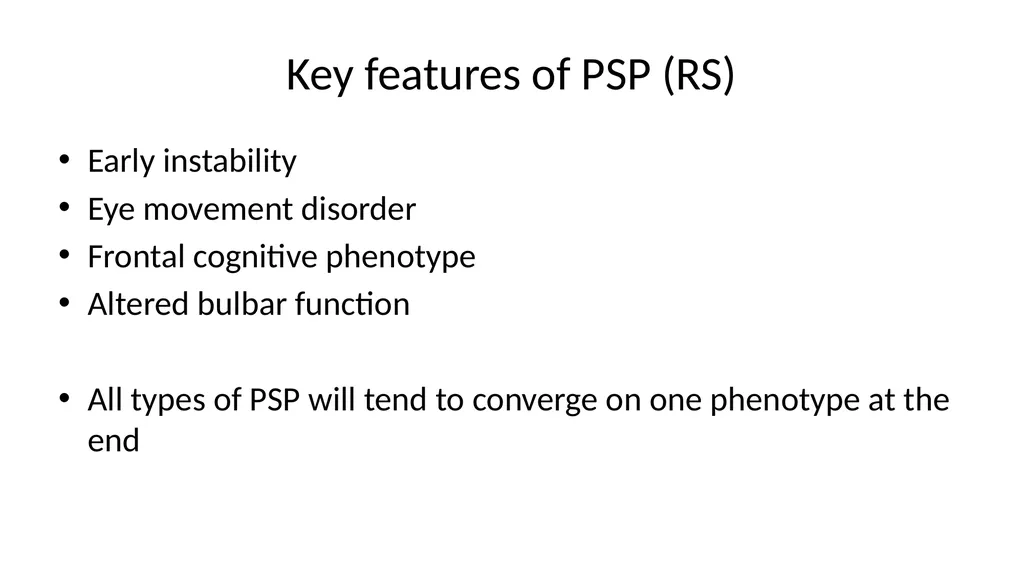
slide17. Key features of PSP (RS) Early instability
Eye movement disorder
Frontal cognitive phenotype
Altered bulbar function
All types of PSP will tend to converge on one phenotype at the end<br>
slide18. Multiple types of PSP 1. Williams, D. R. & Lees, A. J. Progressive supranuclear palsy: clinicopathological concepts and diagnostic challenges. Lancet Neurology 8, 270–279 (2009).
2. Williams, D. R. et al. Pathological tau burden and distribution distinguishes progressive supranuclear palsy-parkinsonism from Richardson’s syndrome. Brain 130, 1566–76 (2007).
3. Williams, D. R. et al. Characteristics of two distinct clinical phenotypes in pathologically proven progressive supranuclear palsy: Richardson’s syndrome and PSP-parkinsonism. Brain 128, 1247–58 (2005).<br>
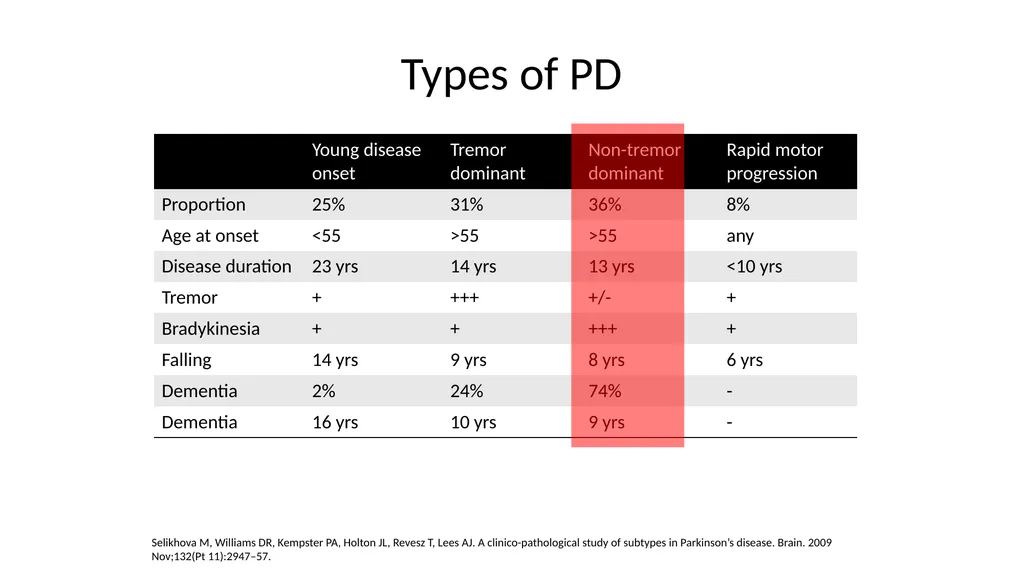
slide19. Types of PD Selikhova M, Williams DR, Kempster PA, Holton JL, Revesz T, Lees AJ. A clinico-pathological study of subtypes in Parkinson’s disease. Brain. 2009 Nov;132(Pt 11):2947–57.<br>
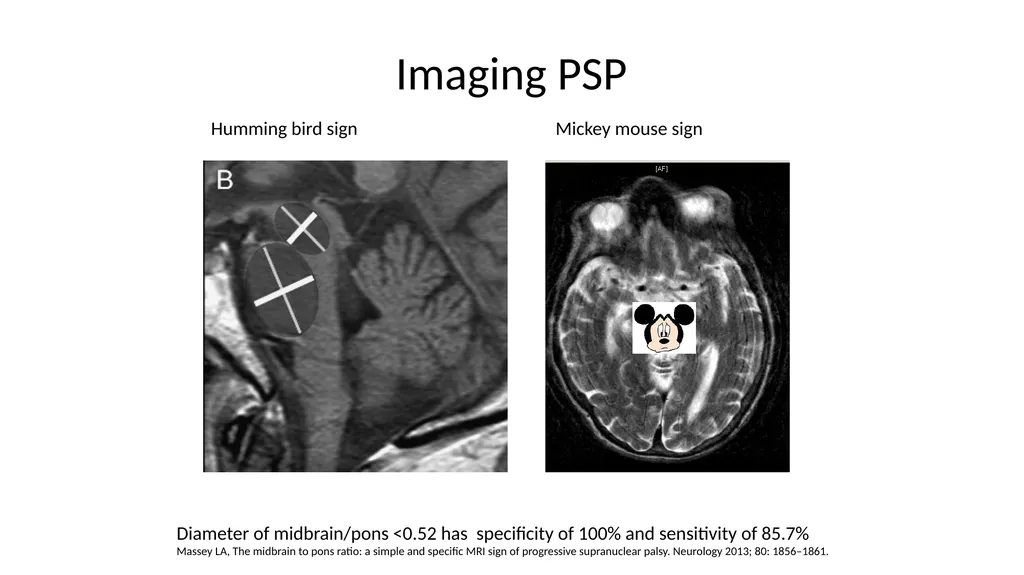
slide20. Imaging PSP Humming bird sign Mickey mouse sign Diameter of midbrain/pons <0.52 has specificity of 100% and sensitivity of 85.7%
Massey LA, The midbrain to pons ratio: a simple and specific MRI sign of progressive supranuclear palsy. Neurology 2013; 80: 1856–1861.<br>
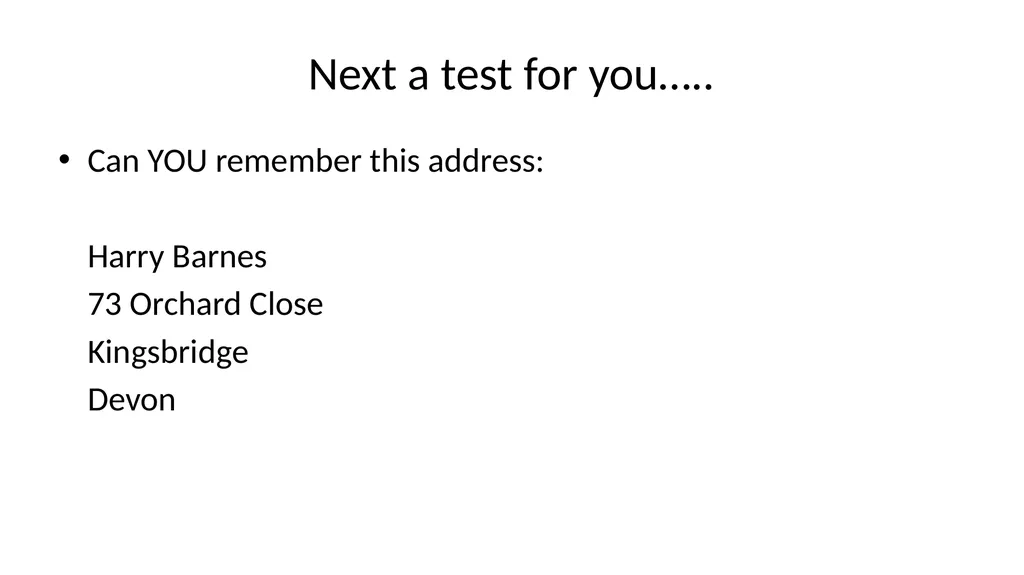
slide21. Next a test for you….. Can YOU remember this address:
Harry Barnes
73 Orchard Close
Kingsbridge
Devon<br>
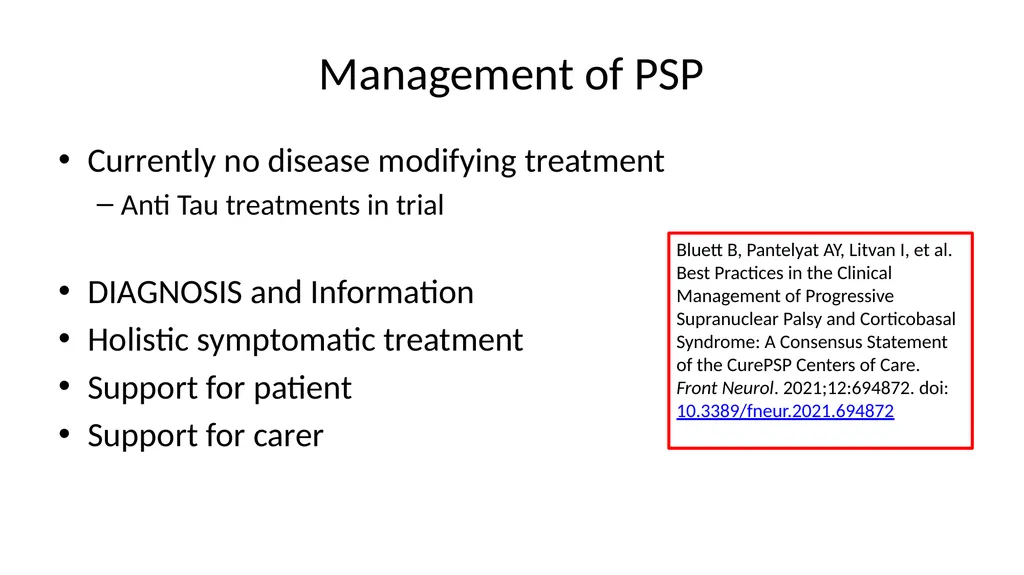
slide22. Management of PSP Currently no disease modifying treatment
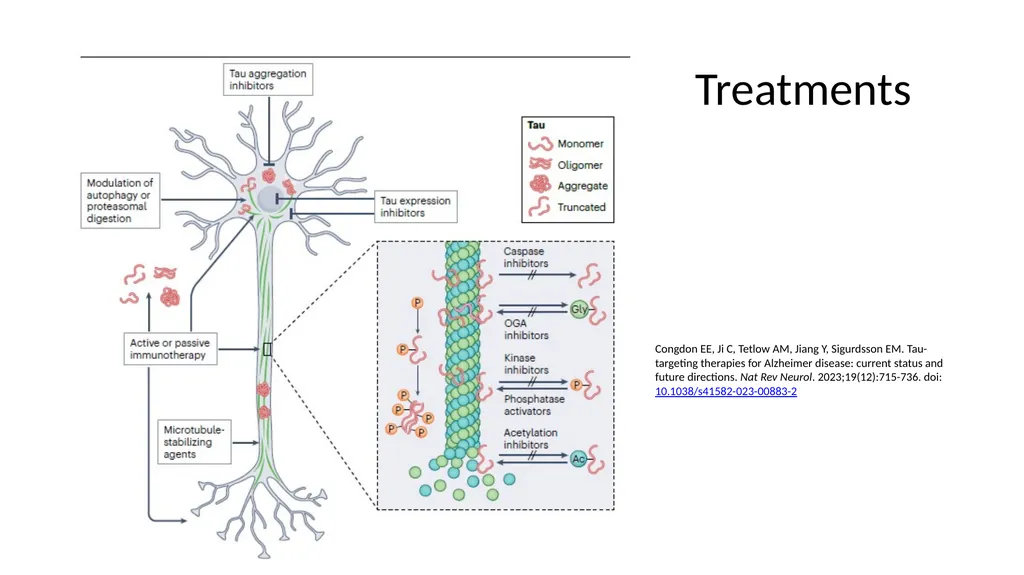
Anti Tau treatments in trial
DIAGNOSIS and Information
Holistic symptomatic treatment
Support for patient
Support for carer Bluett B, Pantelyat AY, Litvan I, et al. Best Practices in the Clinical Management of Progressive Supranuclear Palsy and Corticobasal Syndrome: A Consensus Statement of the CurePSP Centers of Care. Front Neurol. 2021;12:694872. doi:10.3389/fneur.2021.694872<br>
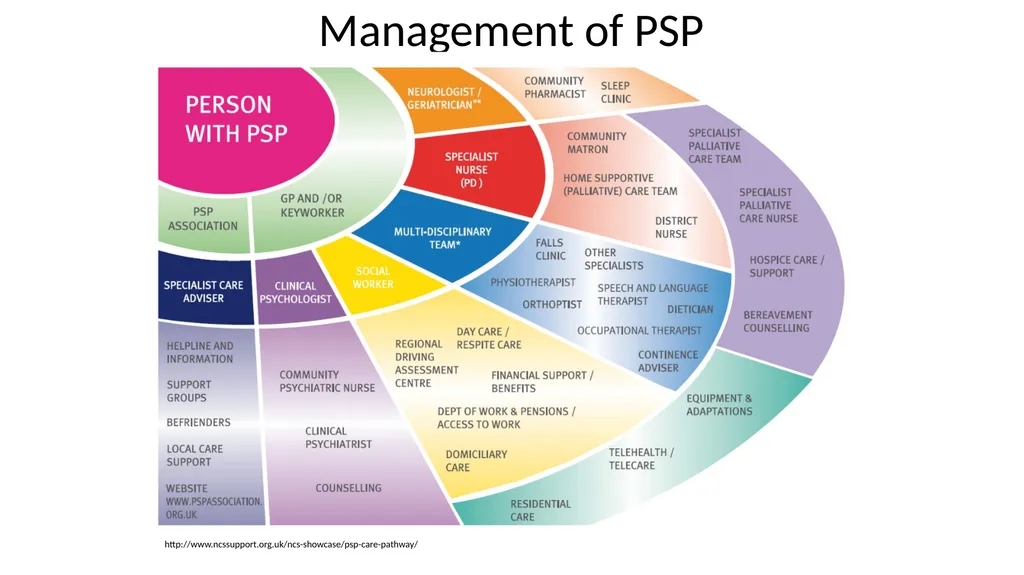
slide23. Management of PSP http://www.ncssupport.org.uk/ncs-showcase/psp-care-pathway/<br>
slide24. PSP Problems early on Falls
Gaze problems
Start of swallowing problems
Speech
Impulsivity
“Bloody mindedness” – executive function
Social cognition deficits
Depression and apathy<br>
slide25. Falls - standing<br>
slide26. Falls and mobility Get balance on standing and turning
Levodopa can provide some benefit about 30%
Amantadine can help – particularly as stimulation
Watch for hallucinations with amantadine<br>
slide27. Gaze problems Seen already
Can’t look down
Trips over particularly on stairs - impulsivity
Can’t see food on plate – periscope glasses
Difficult to read – RNIB aids
Can’t look up
More difficult to participate socially when sitting
Can’t look sideways
Difficult to read
May contribute to retrocollis<br>
slide28. Swallow and speech May start “early”
Meals > 30 mins – cold food
Coughing and choking – respiratory arrest
Aspiration
Think of gastrostomy early
Before weight loss
Able to open mouth?
Indistinct speech
Greater social isolation
Greater pressure on carer<br>
slide29. Impulsivity Go up stairs suddenly
Get up to answer door…..and fall down
Bend over to pick up fluff ….while being helped to walk
PD meds exacerbate?<br>
slide30. Cognitive function Often overlooked
Can differentiate PSP from other diseases
Can YOU remember the address?<br>
slide32. Retrieval is a problem – recognition is often better
Executive dysfunction can frustrate carers – seem bloody minded<br>
slide33. Social cognition The ability to interpret what others think or feel
Includes basic emotion recognition eg. sad, angry
Extends to more complex interpretations eg. bored, disaffected
Patients with PSP have difficulties….<br>
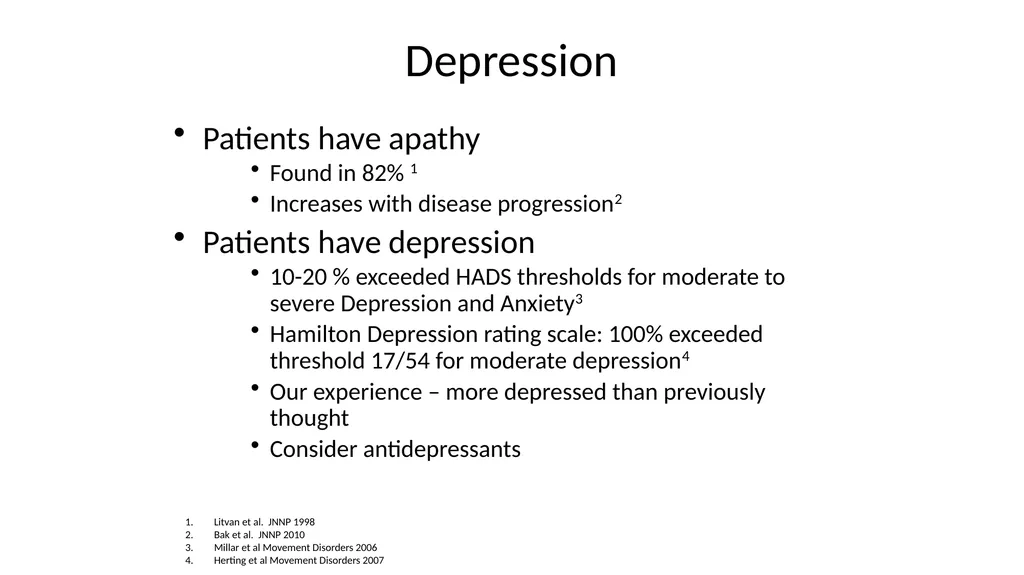
slide34. Depression Patients have apathy
Found in 82% 1
Increases with disease progression2
Patients have depression
10-20 % exceeded HADS thresholds for moderate to severe Depression and Anxiety3
Hamilton Depression rating scale: 100% exceeded threshold 17/54 for moderate depression4
Our experience – more depressed than previously thought
Consider antidepressants Litvan et al. JNNP 1998
Bak et al. JNNP 2010
Millar et al Movement Disorders 2006
Herting et al Movement Disorders 2007<br>
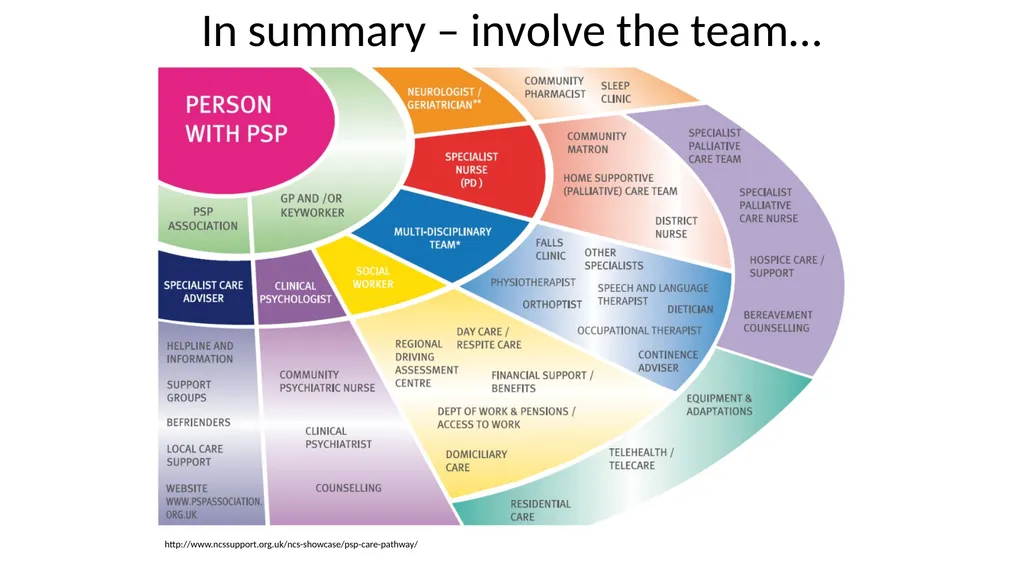
slide35. In summary – involve the team… http://www.ncssupport.org.uk/ncs-showcase/psp-care-pathway/<br>
slide36. Even in early PSP consider: Palliative care register
Advance directives
Advanced care planning
Gastrostomy
Liaison with Palliative care teams<br>
slide37. Cortico-basal Syndrome Pathological and clinical diagnosis may be different
CBD is tau based disease
CBS may be Alzheimer’s pathology or other
Predominantly asymmetric<br>
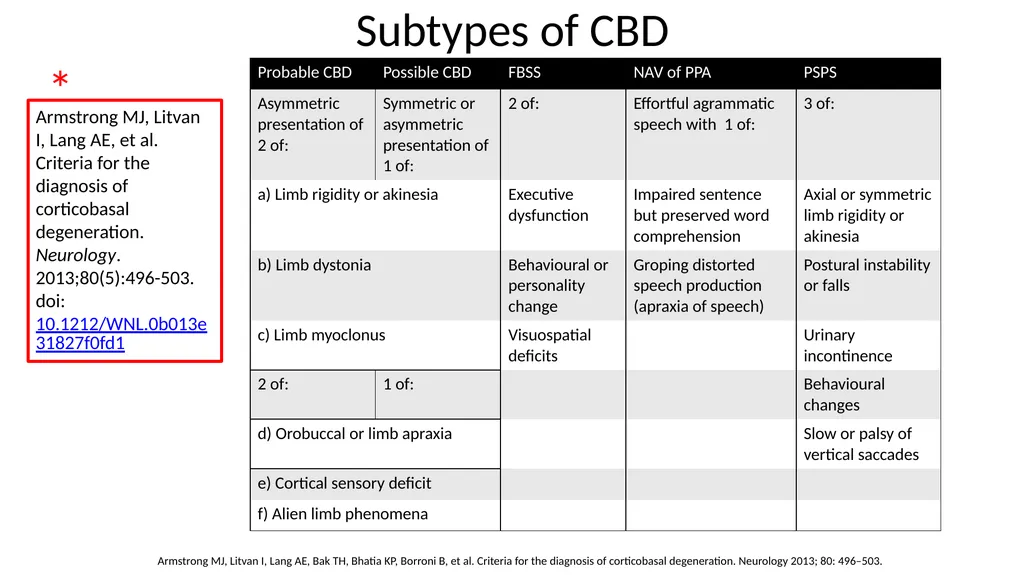
slide38. Subtypes of CBD Armstrong MJ, Litvan I, Lang AE, Bak TH, Bhatia KP, Borroni B, et al. Criteria for the diagnosis of corticobasal degeneration. Neurology 2013; 80: 496–503. Armstrong MJ, Litvan I, Lang AE, et al. Criteria for the diagnosis of corticobasal degeneration. Neurology. 2013;80(5):496-503. doi:10.1212/WNL.0b013e31827f0fd1 *<br>
slide39. Diagnostic criteria for CBD *<br>
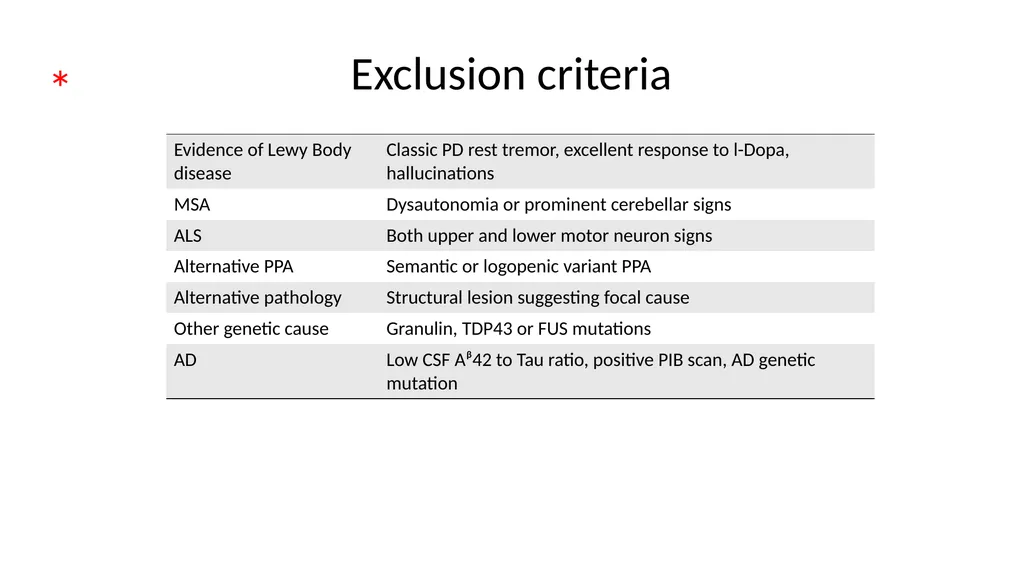
slide40. Exclusion criteria *<br>
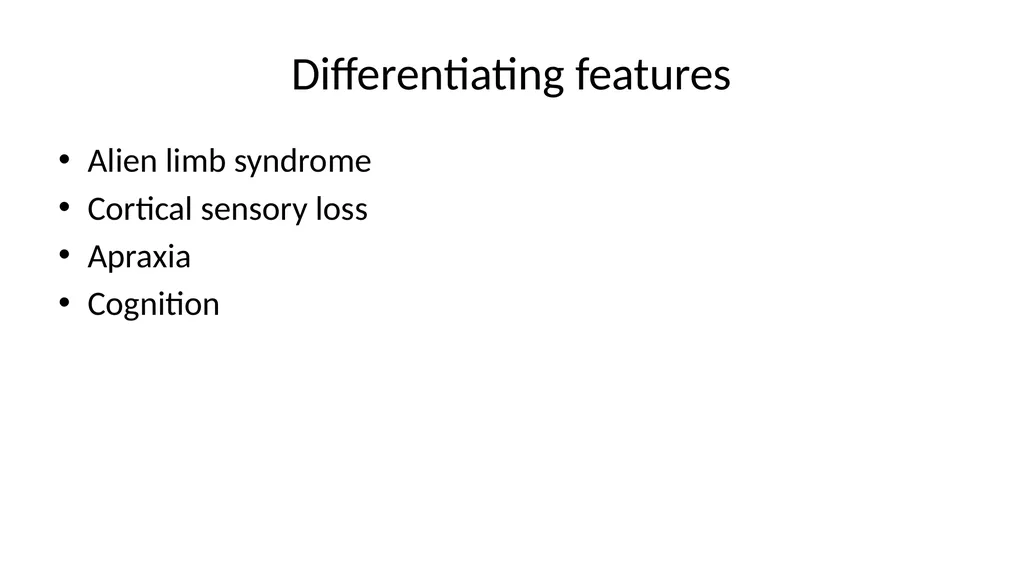
slide41. Differentiating features Alien limb syndrome
Cortical sensory loss
Apraxia
Cognition<br>
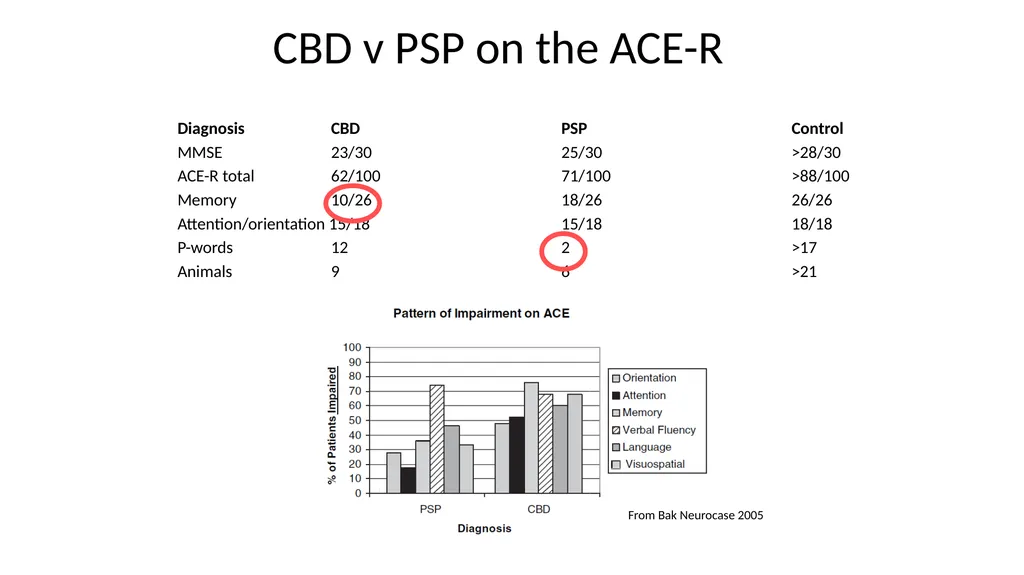
slide42. Diagnosis CBD PSP Control
MMSE 23/30 25/30 >28/30
ACE-R total 62/100 71/100 >88/100
Memory 10/26 18/26 26/26
Attention/orientation 15/18 15/18 18/18
P-words 12 2 >17
Animals 9 6 >21 CBD v PSP on the ACE-R From Bak Neurocase 2005<br>
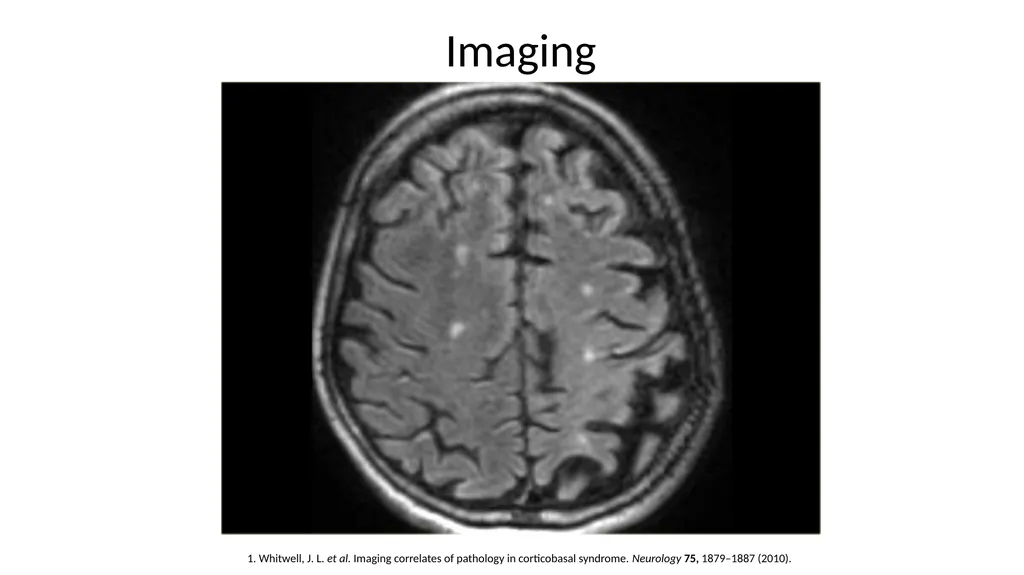
slide43. Imaging 1. Whitwell, J. L. et al. Imaging correlates of pathology in corticobasal syndrome. Neurology 75, 1879–1887 (2010).<br>
slide44. Management As for PSP
Botox for dystonia
Cholinesterase inhibitors for cognition?<br>
slide45. Proteinopathy treatments<br>
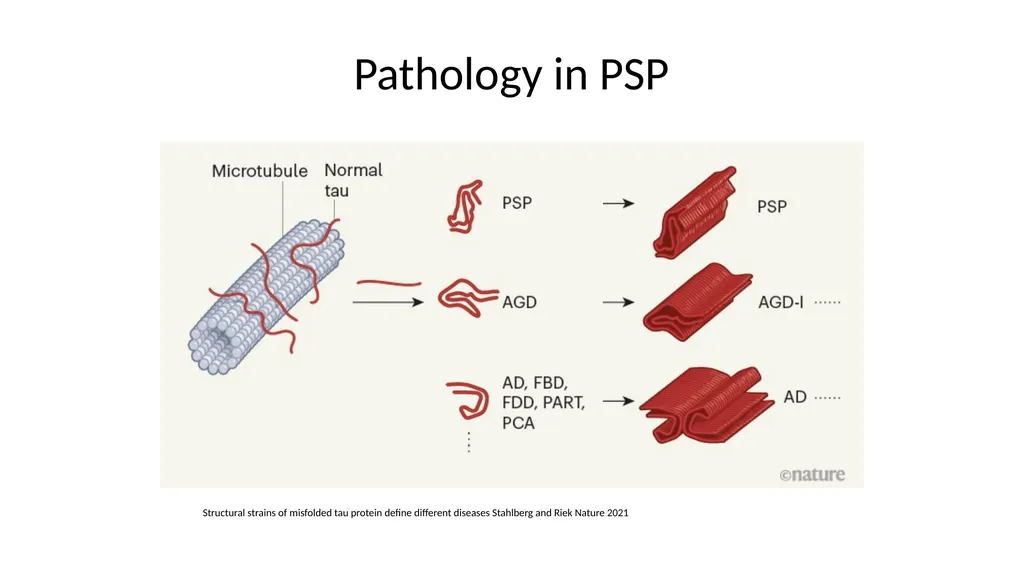
slide46. Structural strains of misfolded tau protein define different diseases Stahlberg and Riek Nature 2021 Pathology in PSP<br>
slide47. Thomas Vogels, Antoine Leuzy, Claudia Cicognola, Nicholas J. Ashton, Tomas Smolek, Michal Novak, Kaj Blennow, Henrik Zetterberg, Tomas Hromadka, Norbert Zilka, Michael Schöll,
Propagation of Tau Pathology: Integrating Insights From Postmortem and In Vivo Studies, Biological Psychiatry, Volume 87, Issue 9, 2020, Spread of PSP<br>
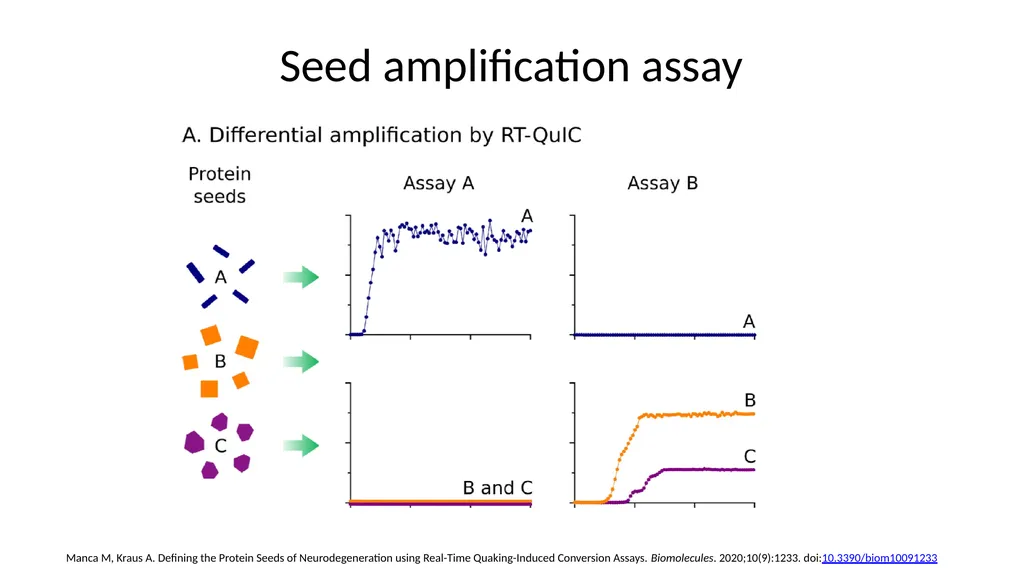
slide48. Seed amplification assay Manca M, Kraus A. Defining the Protein Seeds of Neurodegeneration using Real-Time Quaking-Induced Conversion Assays. Biomolecules. 2020;10(9):1233. doi:10.3390/biom10091233<br>
slide49. Treatments Congdon EE, Ji C, Tetlow AM, Jiang Y, Sigurdsson EM. Tau-targeting therapies for Alzheimer disease: current status and future directions. Nat Rev Neurol. 2023;19(12):715-736. doi:10.1038/s41582-023-00883-2<br>
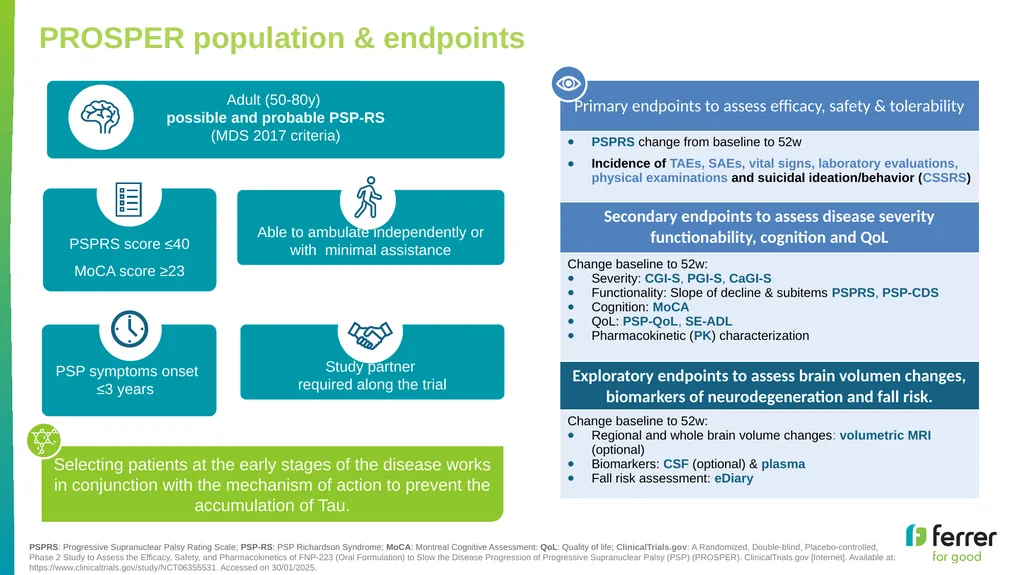
slide50. Study partner required along the trial PSPRS score ≤40
MoCA score ≥23 Able to ambulate independently or with minimal assistance Adult (50-80y)
possible and probable PSP-RS (MDS 2017 criteria) PSPRS: Progressive Supranuclear Palsy Rating Scale; PSP-RS: PSP Richardson Syndrome; MoCA: Montreal Cognitive Assessment: QoL: Quality of life; ClinicalTrials.gov: A Randomized, Double-blind, Placebo-controlled, Phase 2 Study to Assess the Efficacy, Safety, and Pharmacokinetics of FNP-223 (Oral Formulation) to Slow the Disease Progression of Progressive Supranuclear Palsy (PSP) (PROSPER). ClinicalTrials.gov [Internet]. Available at: https://www.clinicaltrials.gov/study/NCT06355531. Accessed on 30/01/2025. PSP symptoms onset
≤3 years Selecting patients at the early stages of the disease works in conjunction with the mechanism of action to prevent the accumulation of Tau. PROSPER population & endpoints<br>
slide51. BNPA Annual Meeting
12th & 13th March 2026
BNPA Teaching weekend
12-14th December 2025
Website: www.bnpa.org.uk<br>
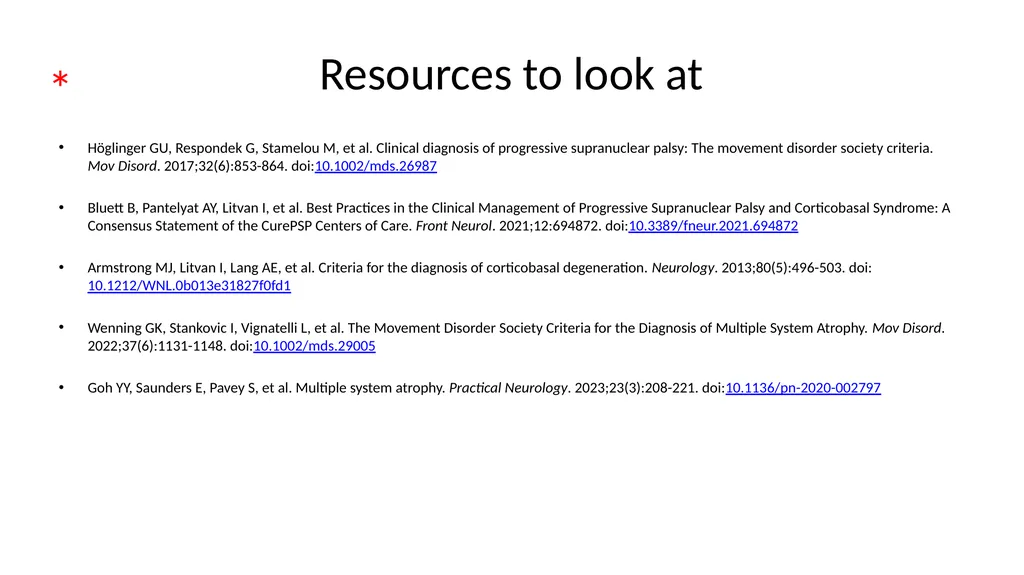
slide52. Resources to look at Höglinger GU, Respondek G, Stamelou M, et al. Clinical diagnosis of progressive supranuclear palsy: The movement disorder society criteria. Mov Disord. 2017;32(6):853-864. doi:10.1002/mds.26987
Bluett B, Pantelyat AY, Litvan I, et al. Best Practices in the Clinical Management of Progressive Supranuclear Palsy and Corticobasal Syndrome: A Consensus Statement of the CurePSP Centers of Care. Front Neurol. 2021;12:694872. doi:10.3389/fneur.2021.694872
Armstrong MJ, Litvan I, Lang AE, et al. Criteria for the diagnosis of corticobasal degeneration. Neurology. 2013;80(5):496-503. doi:10.1212/WNL.0b013e31827f0fd1
Wenning GK, Stankovic I, Vignatelli L, et al. The Movement Disorder Society Criteria for the Diagnosis of Multiple System Atrophy. Mov Disord. 2022;37(6):1131-1148. doi:10.1002/mds.29005
Goh YY, Saunders E, Pavey S, et al. Multiple system atrophy. Practical Neurology. 2023;23(3):208-221. doi:10.1136/pn-2020-002797 *<br>
slide53. Any questions? Thank you for your attention<br>
slide54. Aims At the end of this session participants will:
Know when to consider a diagnosis of PSP or CBS
Have an approach to aid diagnosis of PSP and CBS
Know management pathways for patients with PSP and CBS (some self study)
Have an overview of proteinopathies and potential treatment<br>
PSPA Masterclass 25th June 2025
boyd.ghosh@uhs.nhs.uk<br>
slide2. Disclosures Lectured for UCB and GSK on atypical Parkinsonism
Advisory board for NICE, UCB, Immunobrain and Biogen
Drug trials for Biogen, Ferrer, UCB, Pfizer, TauRx, Novartis, Takeda and Laboratoire Français de Fractionnement et de Biotechnologies
Trustee and member of research committee for the PSP Association<br>
slide3. Aims At the end of this session participants will:
Know when to consider a diagnosis of PSP or CBS
Have an approach to aid diagnosis of PSP and CBS
Know management pathways for patients with PSP and CBS (some self study)
Have an overview of proteinopathies and potential treatment<br>
slide4. Plan of campaign Revision of PSP and CBS phenotypes
Contrast PSP and CBS with IPD
Discuss difficulties that PSP and CBS patients have in early stages
Highlight ways to help patient and carer
Prioritise videos and discussion
Resources for you to review by yourself *<br>
slide5. Parkinson‘s Disease Alpha-synuclein disease
Diagnostic criteria:
Bradykinesia
Plus one of
Tremor
Rigidity
Postural instability National Collaborating Centre for Chronic Conditions. Parkinson’s disease: national clinical guideline for diagnosis and management in primary and secondary care. London: Royal College of Physicians, 2006.
Hughes AJ et al. J Neurol Neurosurg Psychiatry 1992;55:181-4<br>
slide6. Parkinson’s disease<br>
slide7. What should we expect? Unilateral at onset
Cognition good at onset
Rest tremor
Asymmetric throughout
Good response to levodopa
Progressive disease
Remains sensitive to levodopa for 5 years
Disease course of over 10 years<br>
slide8. Progressive supranuclear palsy Tau based disease (cf PD)
Symmetrical akinetic rigid disease
Vertical supranuclear gaze palsy
Bradyphrenia and executive changes
Bulbar dysfunction<br>
slide9. Video of PSP<br>
slide10. Which saccades are abnormal?<br>
slide11. Which saccades were abnormal?<br>
slide12. Multiple types of PSP 1. Williams, D. R. & Lees, A. J. Progressive supranuclear palsy: clinicopathological concepts and diagnostic challenges. Lancet Neurology 8, 270–279 (2009).
2. Williams, D. R. et al. Pathological tau burden and distribution distinguishes progressive supranuclear palsy-parkinsonism from Richardson’s syndrome. Brain 130, 1566–76 (2007).
3. Williams, D. R. et al. Characteristics of two distinct clinical phenotypes in pathologically proven progressive supranuclear palsy: Richardson’s syndrome and PSP-parkinsonism. Brain 128, 1247–58 (2005).<br>
slide13. Diagnostic criteria for PSP Mandatory inclusion:
Age > 40 at first symptom
Gradually progressive
Sporadic
Mandatory Exclusion:
Signs suggestive of another disease
Eg. MND, MSA, AD, DLB, Prion, Encephalitis
Imaging suggestive of another disease
Eg. NPH
Lab findings suggestive of another disease
Eg. Neurosyphilis, Wilsons, Niemann Pick 1. Höglinger GU, Respondek G, Stamelou M, et al. Clinical diagnosis of progressive supranuclear palsy: The movement disorder society criteria. Mov Disord. 2017;32(6):853-864. doi:10.1002/mds.26987 *<br>
slide14. 1.Höglinger, G. U. et al. Clinical diagnosis of progressive supranuclear palsy: The movement disorder society criteria. Mov. Disord. 32, 853–864 (2017). *<br>
slide15. 1.Höglinger, G. U. et al. Clinical diagnosis of progressive supranuclear palsy: The movement disorder society criteria. Mov. Disord. 32, 853–864 (2017). *<br>
slide16. However These are research or specialist criteria
There are also PSP Max criteria which determine what the current diagnosis is
Not essential for most clinicians………<br>
slide17. Key features of PSP (RS) Early instability
Eye movement disorder
Frontal cognitive phenotype
Altered bulbar function
All types of PSP will tend to converge on one phenotype at the end<br>
slide18. Multiple types of PSP 1. Williams, D. R. & Lees, A. J. Progressive supranuclear palsy: clinicopathological concepts and diagnostic challenges. Lancet Neurology 8, 270–279 (2009).
2. Williams, D. R. et al. Pathological tau burden and distribution distinguishes progressive supranuclear palsy-parkinsonism from Richardson’s syndrome. Brain 130, 1566–76 (2007).
3. Williams, D. R. et al. Characteristics of two distinct clinical phenotypes in pathologically proven progressive supranuclear palsy: Richardson’s syndrome and PSP-parkinsonism. Brain 128, 1247–58 (2005).<br>
slide19. Types of PD Selikhova M, Williams DR, Kempster PA, Holton JL, Revesz T, Lees AJ. A clinico-pathological study of subtypes in Parkinson’s disease. Brain. 2009 Nov;132(Pt 11):2947–57.<br>
slide20. Imaging PSP Humming bird sign Mickey mouse sign Diameter of midbrain/pons <0.52 has specificity of 100% and sensitivity of 85.7%
Massey LA, The midbrain to pons ratio: a simple and specific MRI sign of progressive supranuclear palsy. Neurology 2013; 80: 1856–1861.<br>
slide21. Next a test for you….. Can YOU remember this address:
Harry Barnes
73 Orchard Close
Kingsbridge
Devon<br>
slide22. Management of PSP Currently no disease modifying treatment
Anti Tau treatments in trial
DIAGNOSIS and Information
Holistic symptomatic treatment
Support for patient
Support for carer Bluett B, Pantelyat AY, Litvan I, et al. Best Practices in the Clinical Management of Progressive Supranuclear Palsy and Corticobasal Syndrome: A Consensus Statement of the CurePSP Centers of Care. Front Neurol. 2021;12:694872. doi:10.3389/fneur.2021.694872<br>
slide23. Management of PSP http://www.ncssupport.org.uk/ncs-showcase/psp-care-pathway/<br>
slide24. PSP Problems early on Falls
Gaze problems
Start of swallowing problems
Speech
Impulsivity
“Bloody mindedness” – executive function
Social cognition deficits
Depression and apathy<br>
slide25. Falls - standing<br>
slide26. Falls and mobility Get balance on standing and turning
Levodopa can provide some benefit about 30%
Amantadine can help – particularly as stimulation
Watch for hallucinations with amantadine<br>
slide27. Gaze problems Seen already
Can’t look down
Trips over particularly on stairs - impulsivity
Can’t see food on plate – periscope glasses
Difficult to read – RNIB aids
Can’t look up
More difficult to participate socially when sitting
Can’t look sideways
Difficult to read
May contribute to retrocollis<br>
slide28. Swallow and speech May start “early”
Meals > 30 mins – cold food
Coughing and choking – respiratory arrest
Aspiration
Think of gastrostomy early
Before weight loss
Able to open mouth?
Indistinct speech
Greater social isolation
Greater pressure on carer<br>
slide29. Impulsivity Go up stairs suddenly
Get up to answer door…..and fall down
Bend over to pick up fluff ….while being helped to walk
PD meds exacerbate?<br>
slide30. Cognitive function Often overlooked
Can differentiate PSP from other diseases
Can YOU remember the address?<br>
slide32. Retrieval is a problem – recognition is often better
Executive dysfunction can frustrate carers – seem bloody minded<br>
slide33. Social cognition The ability to interpret what others think or feel
Includes basic emotion recognition eg. sad, angry
Extends to more complex interpretations eg. bored, disaffected
Patients with PSP have difficulties….<br>
slide34. Depression Patients have apathy
Found in 82% 1
Increases with disease progression2
Patients have depression
10-20 % exceeded HADS thresholds for moderate to severe Depression and Anxiety3
Hamilton Depression rating scale: 100% exceeded threshold 17/54 for moderate depression4
Our experience – more depressed than previously thought
Consider antidepressants Litvan et al. JNNP 1998
Bak et al. JNNP 2010
Millar et al Movement Disorders 2006
Herting et al Movement Disorders 2007<br>
slide35. In summary – involve the team… http://www.ncssupport.org.uk/ncs-showcase/psp-care-pathway/<br>
slide36. Even in early PSP consider: Palliative care register
Advance directives
Advanced care planning
Gastrostomy
Liaison with Palliative care teams<br>
slide37. Cortico-basal Syndrome Pathological and clinical diagnosis may be different
CBD is tau based disease
CBS may be Alzheimer’s pathology or other
Predominantly asymmetric<br>
slide38. Subtypes of CBD Armstrong MJ, Litvan I, Lang AE, Bak TH, Bhatia KP, Borroni B, et al. Criteria for the diagnosis of corticobasal degeneration. Neurology 2013; 80: 496–503. Armstrong MJ, Litvan I, Lang AE, et al. Criteria for the diagnosis of corticobasal degeneration. Neurology. 2013;80(5):496-503. doi:10.1212/WNL.0b013e31827f0fd1 *<br>
slide39. Diagnostic criteria for CBD *<br>
slide40. Exclusion criteria *<br>
slide41. Differentiating features Alien limb syndrome
Cortical sensory loss
Apraxia
Cognition<br>
slide42. Diagnosis CBD PSP Control
MMSE 23/30 25/30 >28/30
ACE-R total 62/100 71/100 >88/100
Memory 10/26 18/26 26/26
Attention/orientation 15/18 15/18 18/18
P-words 12 2 >17
Animals 9 6 >21 CBD v PSP on the ACE-R From Bak Neurocase 2005<br>
slide43. Imaging 1. Whitwell, J. L. et al. Imaging correlates of pathology in corticobasal syndrome. Neurology 75, 1879–1887 (2010).<br>
slide44. Management As for PSP
Botox for dystonia
Cholinesterase inhibitors for cognition?<br>
slide45. Proteinopathy treatments<br>
slide46. Structural strains of misfolded tau protein define different diseases Stahlberg and Riek Nature 2021 Pathology in PSP<br>
slide47. Thomas Vogels, Antoine Leuzy, Claudia Cicognola, Nicholas J. Ashton, Tomas Smolek, Michal Novak, Kaj Blennow, Henrik Zetterberg, Tomas Hromadka, Norbert Zilka, Michael Schöll,
Propagation of Tau Pathology: Integrating Insights From Postmortem and In Vivo Studies, Biological Psychiatry, Volume 87, Issue 9, 2020, Spread of PSP<br>
slide48. Seed amplification assay Manca M, Kraus A. Defining the Protein Seeds of Neurodegeneration using Real-Time Quaking-Induced Conversion Assays. Biomolecules. 2020;10(9):1233. doi:10.3390/biom10091233<br>
slide49. Treatments Congdon EE, Ji C, Tetlow AM, Jiang Y, Sigurdsson EM. Tau-targeting therapies for Alzheimer disease: current status and future directions. Nat Rev Neurol. 2023;19(12):715-736. doi:10.1038/s41582-023-00883-2<br>
slide50. Study partner required along the trial PSPRS score ≤40
MoCA score ≥23 Able to ambulate independently or with minimal assistance Adult (50-80y)
possible and probable PSP-RS (MDS 2017 criteria) PSPRS: Progressive Supranuclear Palsy Rating Scale; PSP-RS: PSP Richardson Syndrome; MoCA: Montreal Cognitive Assessment: QoL: Quality of life; ClinicalTrials.gov: A Randomized, Double-blind, Placebo-controlled, Phase 2 Study to Assess the Efficacy, Safety, and Pharmacokinetics of FNP-223 (Oral Formulation) to Slow the Disease Progression of Progressive Supranuclear Palsy (PSP) (PROSPER). ClinicalTrials.gov [Internet]. Available at: https://www.clinicaltrials.gov/study/NCT06355531. Accessed on 30/01/2025. PSP symptoms onset
≤3 years Selecting patients at the early stages of the disease works in conjunction with the mechanism of action to prevent the accumulation of Tau. PROSPER population & endpoints<br>
slide51. BNPA Annual Meeting
12th & 13th March 2026
BNPA Teaching weekend
12-14th December 2025
Website: www.bnpa.org.uk<br>
slide52. Resources to look at Höglinger GU, Respondek G, Stamelou M, et al. Clinical diagnosis of progressive supranuclear palsy: The movement disorder society criteria. Mov Disord. 2017;32(6):853-864. doi:10.1002/mds.26987
Bluett B, Pantelyat AY, Litvan I, et al. Best Practices in the Clinical Management of Progressive Supranuclear Palsy and Corticobasal Syndrome: A Consensus Statement of the CurePSP Centers of Care. Front Neurol. 2021;12:694872. doi:10.3389/fneur.2021.694872
Armstrong MJ, Litvan I, Lang AE, et al. Criteria for the diagnosis of corticobasal degeneration. Neurology. 2013;80(5):496-503. doi:10.1212/WNL.0b013e31827f0fd1
Wenning GK, Stankovic I, Vignatelli L, et al. The Movement Disorder Society Criteria for the Diagnosis of Multiple System Atrophy. Mov Disord. 2022;37(6):1131-1148. doi:10.1002/mds.29005
Goh YY, Saunders E, Pavey S, et al. Multiple system atrophy. Practical Neurology. 2023;23(3):208-221. doi:10.1136/pn-2020-002797 *<br>
slide53. Any questions? Thank you for your attention<br>
slide54. Aims At the end of this session participants will:
Know when to consider a diagnosis of PSP or CBS
Have an approach to aid diagnosis of PSP and CBS
Know management pathways for patients with PSP and CBS (some self study)
Have an overview of proteinopathies and potential treatment<br>