
Dialectical Behavioral Therapy in College



Description: Dialectical Behavioral Therapy in College Counseling Groups Vanessa Stein, LCSW Kristal Pollack, LCSW Presenter Information Kristal Pollack is a LCSW who graduated from FSU and FIU has been with CAPS since August 2013. Interests include
Related Topics
Download Presentation
"Dialectical Behavioral Therapy in College" is the property of its rightful owner. Permission is granted to download and print the materials on this website for personal, non-commercial use only, and to display it on your personal computer provided you do not modify the materials and that you retain all copyright notices contained in the materials. By downloading content from our website, you accept the terms of this agreement.
Presentation Transcript
slide1. Dialectical Behavioral Therapy
in College Counseling Groups Vanessa Stein, LCSW
Kristal Pollack, LCSW<br>
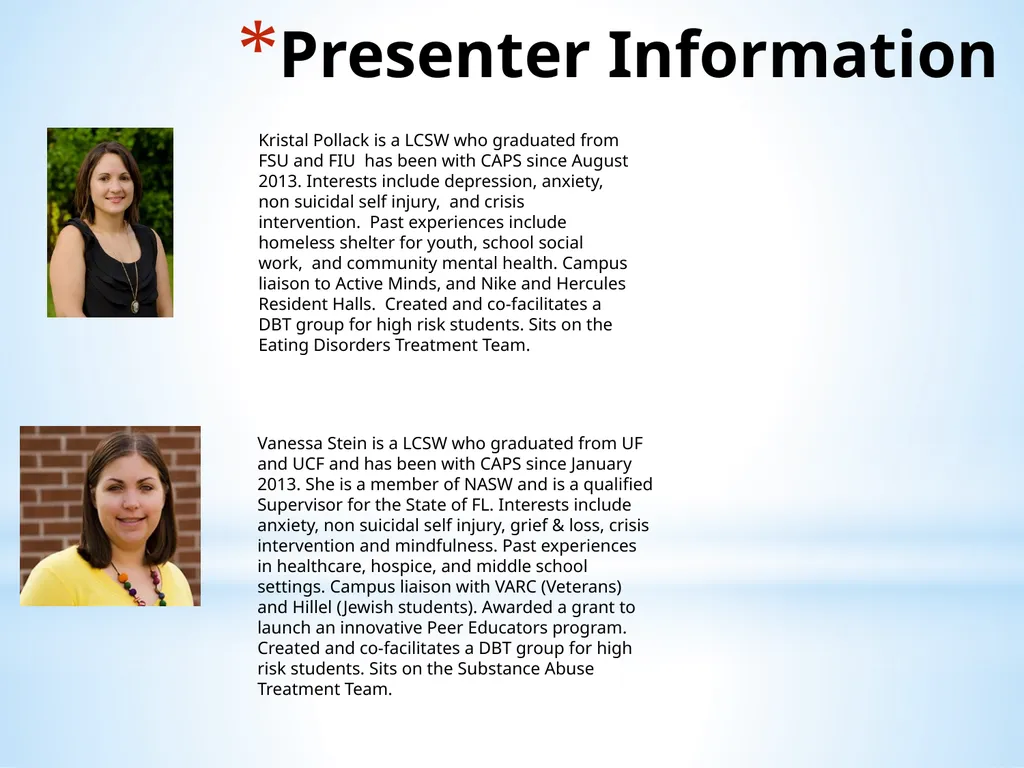
slide2. Presenter Information Kristal Pollack is a LCSW who graduated from FSU and FIU has been with CAPS since August 2013. Interests include depression, anxiety, non suicidal self injury, and crisis intervention. Past experiences include homeless shelter for youth, school social work, and community mental health. Campus liaison to Active Minds, and Nike and Hercules Resident Halls. Created and co-facilitates a DBT group for high risk students. Sits on the Eating Disorders Treatment Team. Vanessa Stein is a LCSW who graduated from UF and UCF and has been with CAPS since January 2013. She is a member of NASW and is a qualified Supervisor for the State of FL. Interests include anxiety, non suicidal self injury, grief & loss, crisis intervention and mindfulness. Past experiences in healthcare, hospice, and middle school settings. Campus liaison with VARC (Veterans) and Hillel (Jewish students). Awarded a grant to launch an innovative Peer Educators program. Created and co-facilitates a DBT group for high risk students. Sits on the Substance Abuse Treatment Team.<br>
slide3. Opposite Action http://www.youtube.com/watch?v=2MDReKsP3sQ<br>
slide4. About UCF CAPS Clinical Services at CAPS provides comprehensive psychological services to the UCF community.
We promote practices that are student centered and aspire to be seen as an essential resource to the UCF community.
In this effort, we offer a range of clinical services focusing on student’s psychological and developmental needs.
We provide short term individual, couples and group counseling, workshops, campus presentations, crisis intervention, animal assisted therapy, expressive arts therapy, a peer educators program, yoga therapy and other innovative interventions<br>
slide5. UCF Care Management Team The purpose of the Care Management Team (CMT) is to provide wrap-around services to students. This approach provides a valuable bridge between our internal departments on campus and other services in the community in an effort to provide UCF students with integrated mental health care. The CMT strives to serve the needs of our students and the University through efforts to coordinate case management, monitor referrals, promote coordination and monitoring of care through collaboration among departments or agencies, improve communication, and facilitate coordination and continuity of care in complex cases.<br>
slide6. UCF Care Management Team CAPS has three full time Licensed Clinical Social Workers assigned as Care Managers
In 2013, CMT saw 207 students at 617 unique appointments
CMT assist students, who previously might have “fallen through the cracks,” with issues such as:
Chronic mental health concerns
Suicidal and homicidal thoughts
Non-suicidal self-injury
Substance use
Complex medical needs
Financial stress
Lack of insurance
Lack of basic essentials
Learning disabilities
Lack of motivation for change
Medication compliance<br>
slide7. Up until Spring 2014 CMT clients were only able to be seen for short term individual counseling for symptom stabilization and connection to community providers for long term counseling
Many CMT clients were not able to participate in group counseling
CMT therapists saw a need to address presenting issues and developed a Dialectical Behavioral Therapy group specifically for CMT clients Treatment for Our High Risk/Complex Clients<br>
slide8. Dialectical Behavior Therapy is a research-based, cognitive-behavioral treatment developed by Marsha Linehan at the University of Washington, to help clients with the suicidal and self-harm behaviors often seen in Borderline Personality Disorder. DBT has since then been modified as a treatment for other complex and challenging mental disorders that involve emotional dysregulation. Clients with these disorders often have great difficulty managing the emotional and relational crises of their lives because they lack the needed behavioral coping skills. Goals of skills training in DBT is to learn and refine skills in changing behaviors, emotional, and thinking patterns associated with problems that are causing distress. What is DBT?<br>
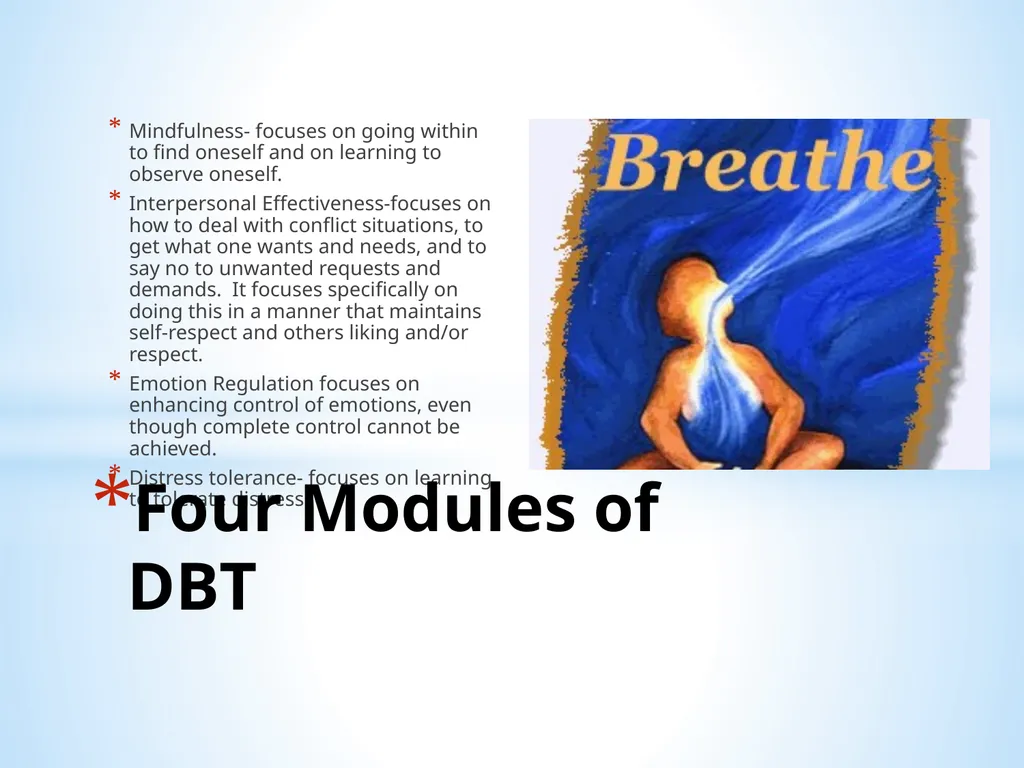
slide9. Mindfulness- focuses on going within to find oneself and on learning to observe oneself.
Interpersonal Effectiveness-focuses on how to deal with conflict situations, to get what one wants and needs, and to say no to unwanted requests and demands. It focuses specifically on doing this in a manner that maintains self-respect and others liking and/or respect.
Emotion Regulation focuses on enhancing control of emotions, even though complete control cannot be achieved.
Distress tolerance- focuses on learning to tolerate distress. Four Modules of DBT<br>
slide10. Let’s Be Mindful!<br>
slide11. Previous Workshop UCF CAPS held a workshop on DBT for three semesters
The workshop was a series of 4, one hour sessions, each focusing on a different module of DBT
Interventions were worksheet/handout based, as well as discussion of DBT
Attendance was low, as 1-2 clients participated each session<br>
slide12. Change in Structure After evaluating the structure of the workshop, and assessing the need for a more therapeutic DBT group, it was decided to create the Finding Balance in Life group to address the needs of our high risk, complex clients.
Identified clients are screened for appropriateness
To assess continued risk for each client, they are given the Counseling Center Assessment of Psychological Symptoms (CCAPS) prior to each session. Any risk identified is assessed by group clinician(s)
To manage risk two clinicians run the group, as well as an additional 30 minutes added to group time (1.5 hours total)<br>
slide13. Group Sessions 12 sessions total
Group session 1 focused on Introduction to Group, consents, and overview of DBT
Group session 2 focused on Mindfulness
Group session 3-5 focused on interpersonal skills
Group session 6-8 focused on Emotion Regulation
Group Session 9-11 focused on Distress Tolerance
Group Session 12 focused on completion of group<br>
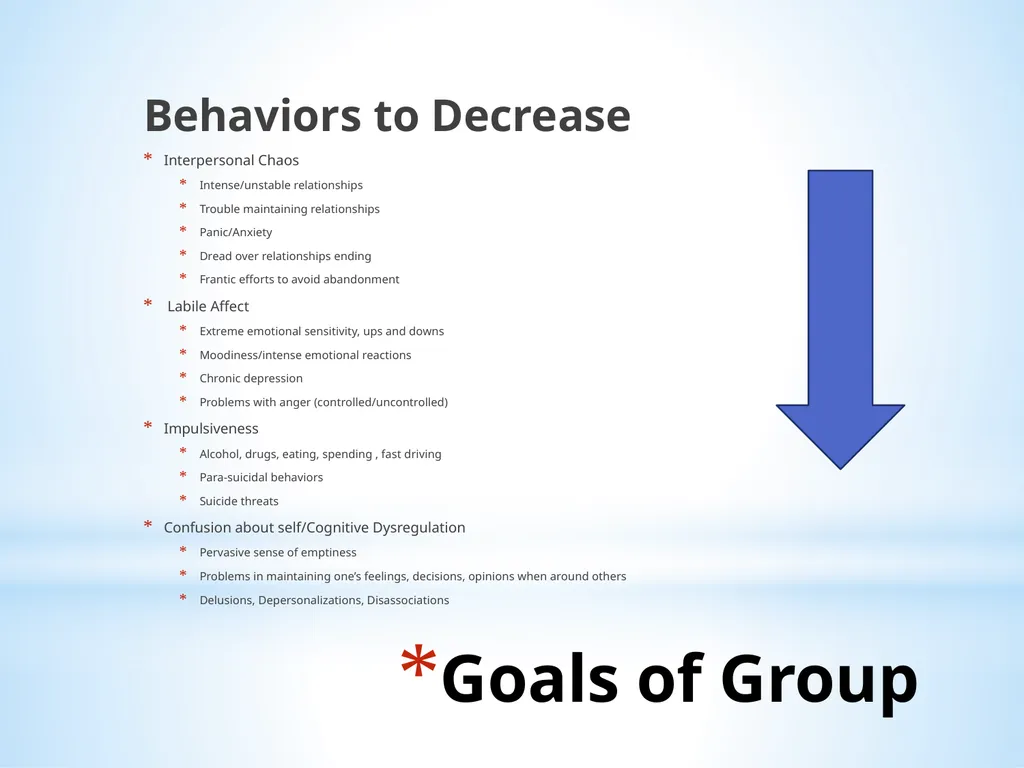
slide14. Goals of Group Behaviors to Decrease
Interpersonal Chaos
Intense/unstable relationships
Trouble maintaining relationships
Panic/Anxiety
Dread over relationships ending
Frantic efforts to avoid abandonment
Labile Affect
Extreme emotional sensitivity, ups and downs
Moodiness/intense emotional reactions
Chronic depression
Problems with anger (controlled/uncontrolled)
Impulsiveness
Alcohol, drugs, eating, spending , fast driving
Para-suicidal behaviors
Suicide threats
Confusion about self/Cognitive Dysregulation
Pervasive sense of emptiness
Problems in maintaining one’s feelings, decisions, opinions when around others
Delusions, Depersonalizations, Disassociations<br>
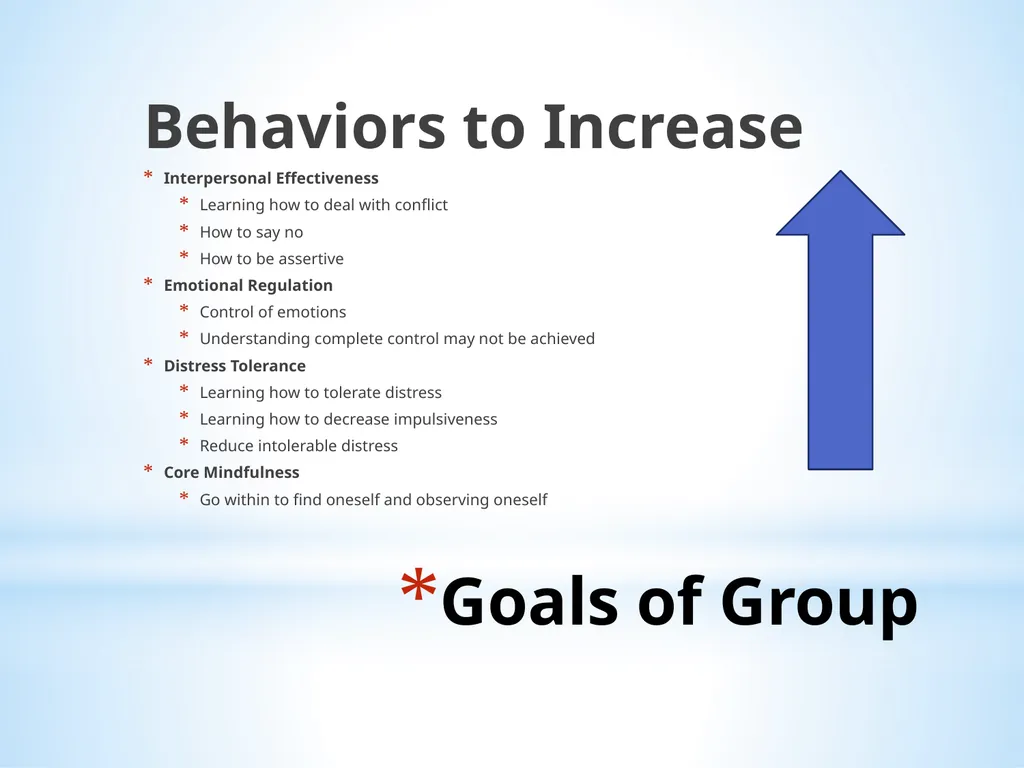
slide15. Goals of Group Behaviors to Increase
Interpersonal Effectiveness
Learning how to deal with conflict
How to say no
How to be assertive
Emotional Regulation
Control of emotions
Understanding complete control may not be achieved
Distress Tolerance
Learning how to tolerate distress
Learning how to decrease impulsiveness
Reduce intolerable distress
Core Mindfulness
Go within to find oneself and observing oneself<br>
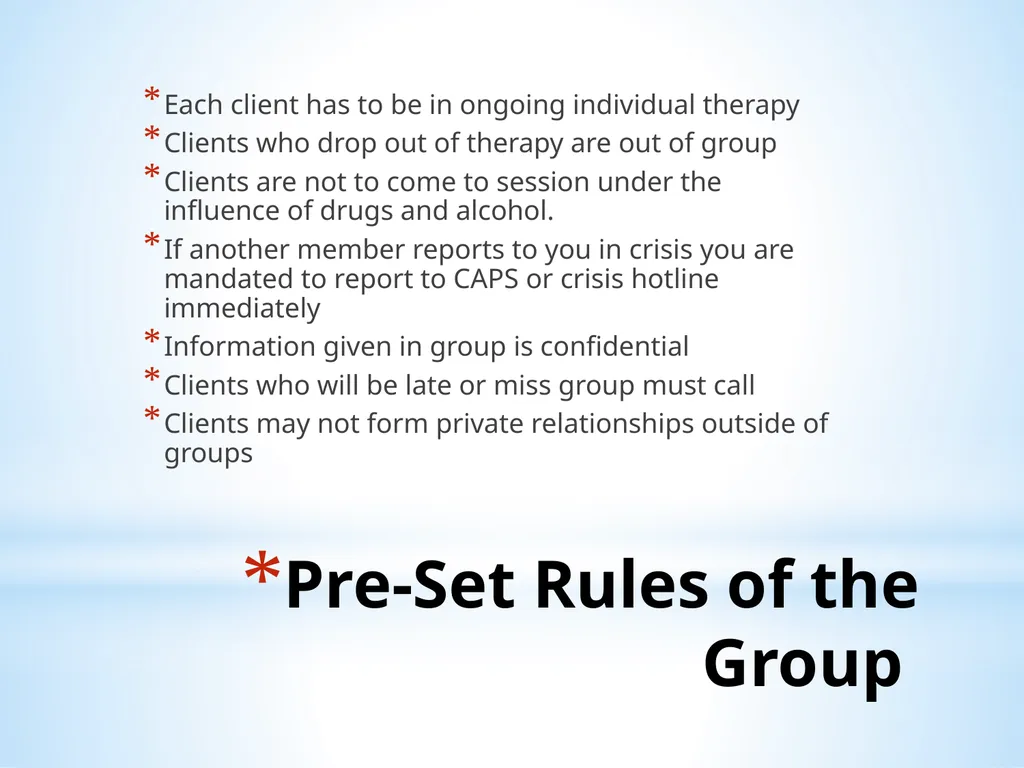
slide16. Pre-Set Rules of the Group Each client has to be in ongoing individual therapy
Clients who drop out of therapy are out of group
Clients are not to come to session under the influence of drugs and alcohol.
If another member reports to you in crisis you are mandated to report to CAPS or crisis hotline immediately
Information given in group is confidential
Clients who will be late or miss group must call
Clients may not form private relationships outside of groups<br>
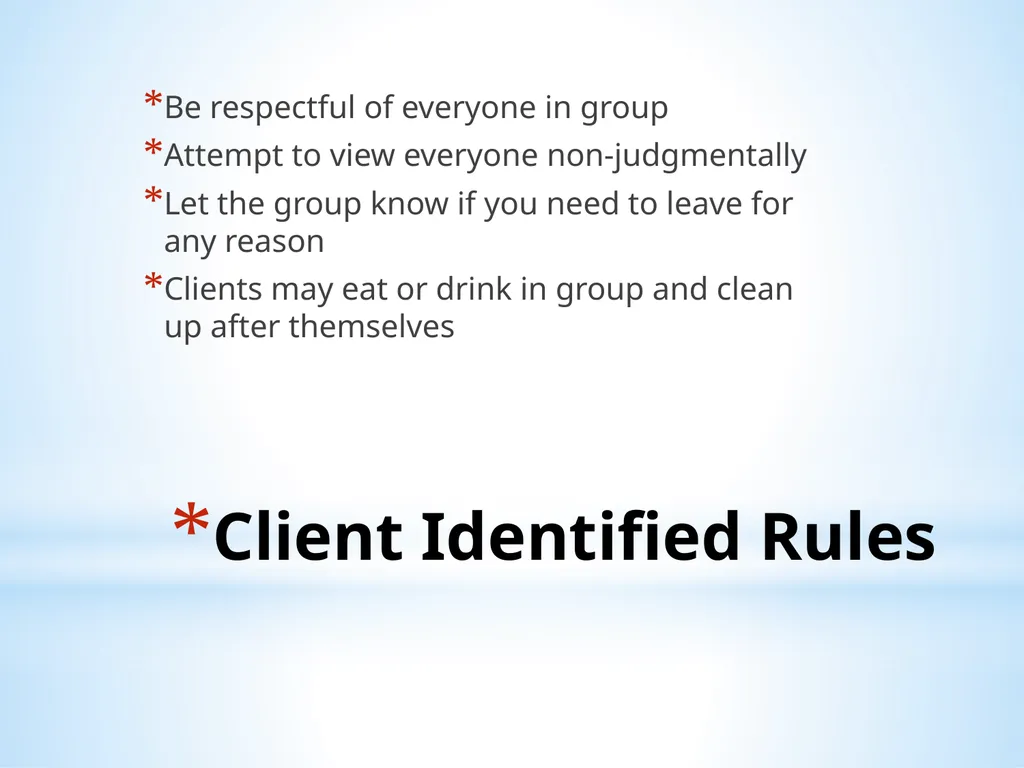
slide17. Client Identified Rules Be respectful of everyone in group
Attempt to view everyone non-judgmentally
Let the group know if you need to leave for any reason
Clients may eat or drink in group and clean up after themselves<br>
slide18. Group Schedule Feelings check in/CCAPS review
Mindfulness Activity
Teach Skill
Practice Skill
Review rating scale/diary card from previous week, and pass out for next week
Set goal for next week
Mindfulness Activity<br>
slide19. First Semester Spring 2014 was first semester of DBT group
Four members CMT clients were original members
Two members dropped out of group without continued individual counseling
One member was added to group who was not CMT client
Although intermittent compliance and group inconsistency, CCAPS evidenced effective treatment intervention<br>
slide20. Program Evaluation Doctoral Intern at CAPS developed a procedure to evaluate the Finding Balance in Life group
Valid screening tools are administered intermittently throughout group (DASS- Depression Anxiety Stress Scale, DERS-Difficulties in Emotional Regulation Scale)
These are used in conjunction with qualitative evaluations
Evaluate data and determine treatment effectiveness
These screeners were not completed this semester, as we used CCAPS for program evaluation<br>
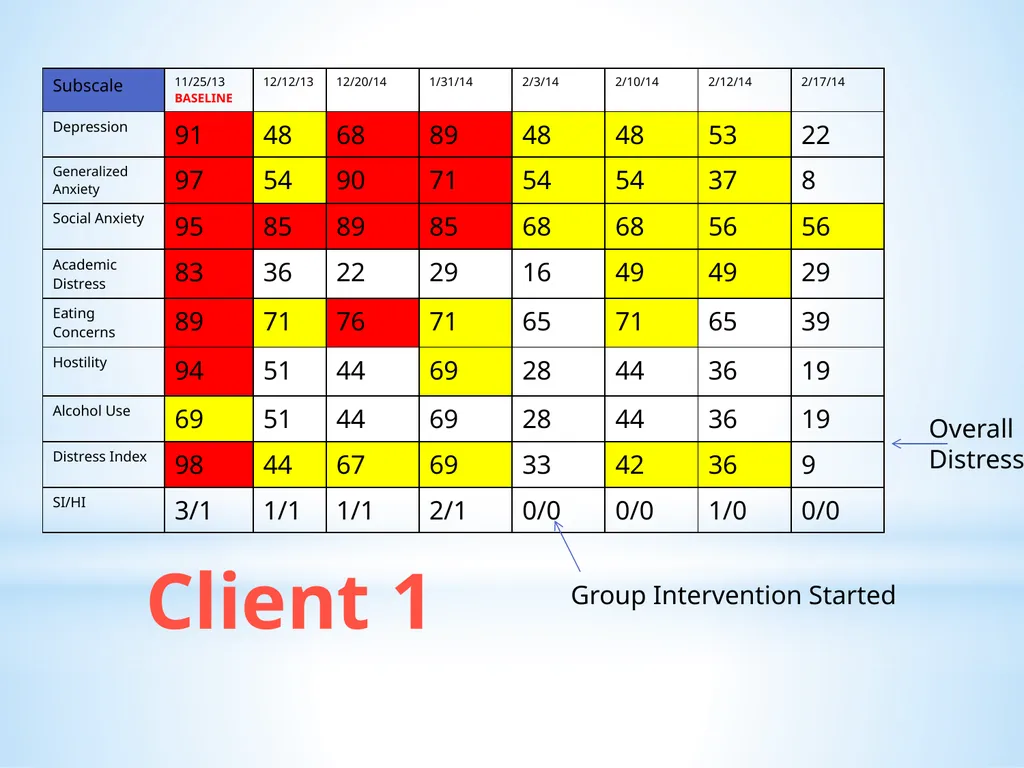
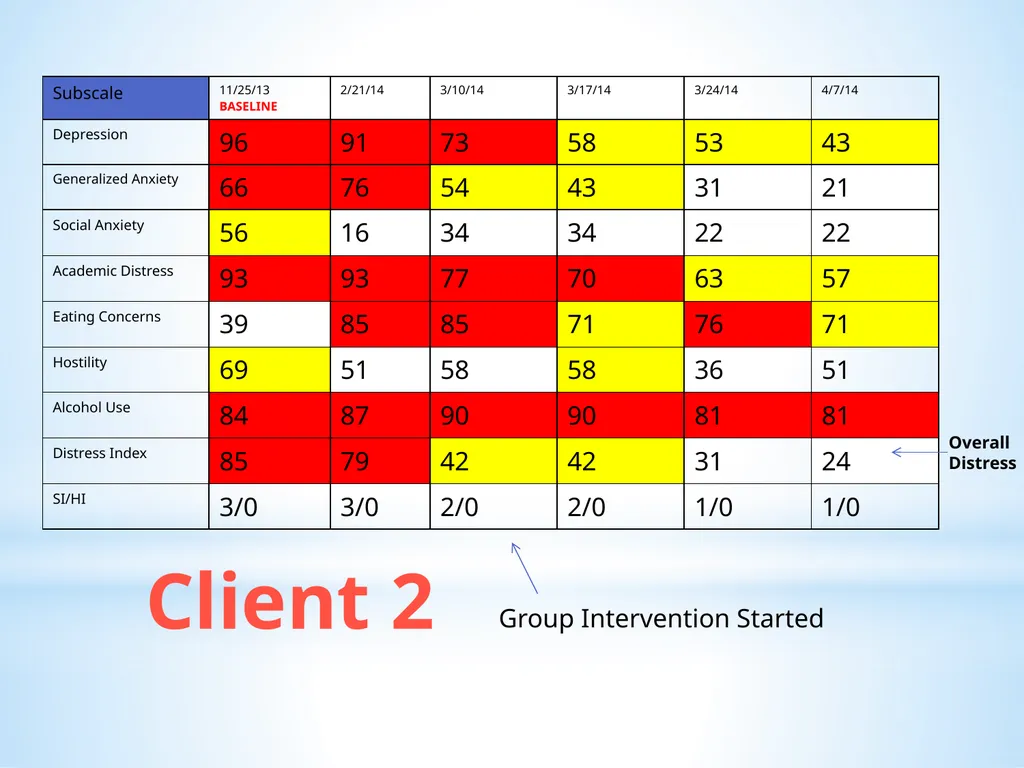
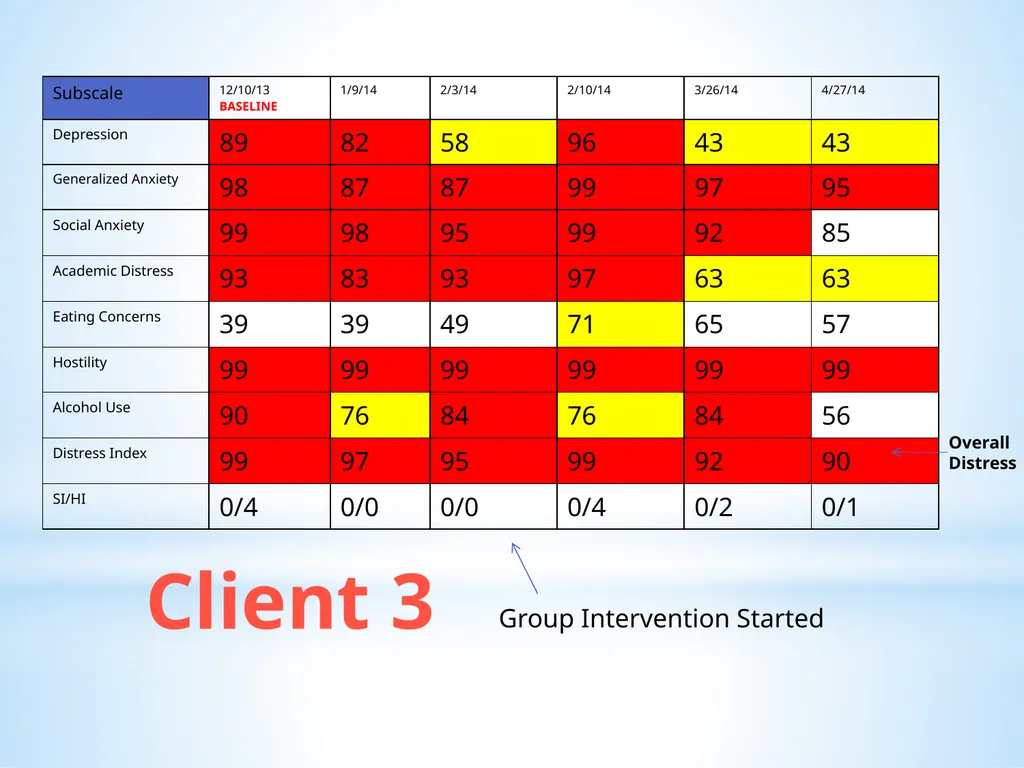
slide21. CCAPS Is intended to meet the clinical, research, and administrative needs of the counseling center field
It is comprised of 7 subscales including: Depression, Generalized Anxiety, Social Anxiety, Academic Distress, Eating Concerns, Hostility, and Alcohol Use.
Measures Suicidal Ideations, Homicidal Ideations, and rates overall Distress
Severity indicators highlight distress, problematic areas, and possible diagnosis
Symptoms are highlighted in yellow for mild-moderate severity, and marked in red for severe distress<br>
slide22. Overall
Distress Client 1<br>
slide23. Overall
Distress Client 2<br>
slide24. Overall
Distress Client 3<br>
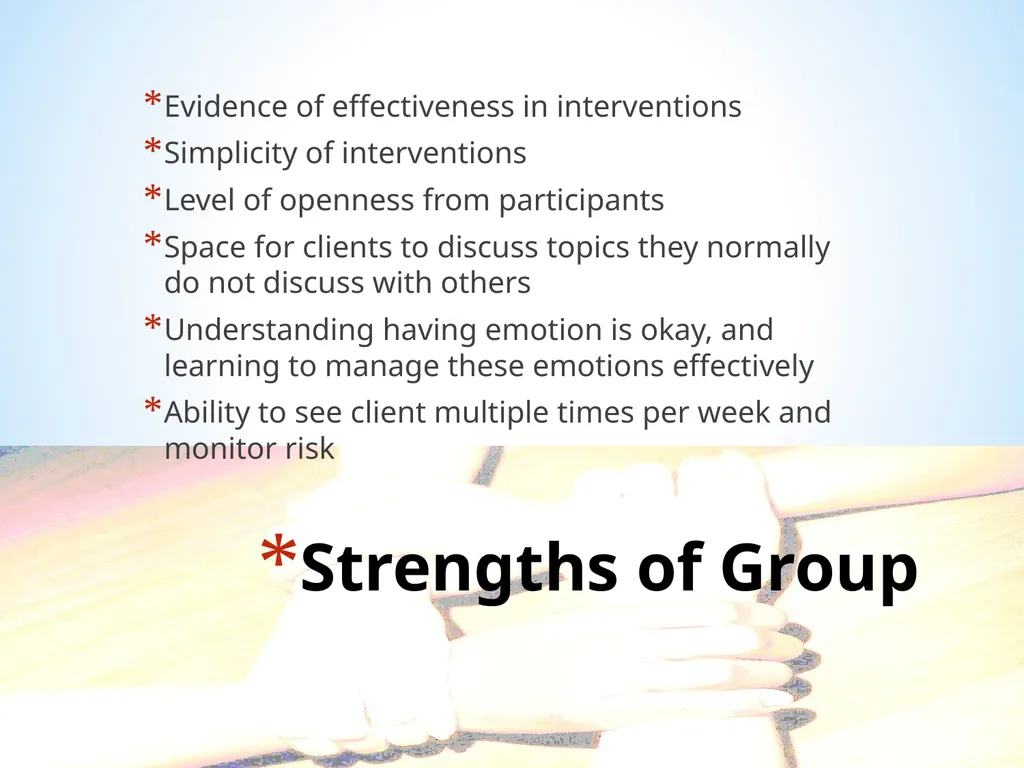
slide25. Strengths of Group Evidence of effectiveness in interventions
Simplicity of interventions
Level of openness from participants
Space for clients to discuss topics they normally do not discuss with others
Understanding having emotion is okay, and learning to manage these emotions effectively
Ability to see client multiple times per week and monitor risk<br>
slide26. Challenges of Group Emotional instability and commitment of group members
High drop out rate
Low motivation of members
Resistance of members
Setting not appropriate for true DBT<br>
slide27. Changes to Implement Each group member will have to sign contracts, identifying which modules will impact their life/why, and share with the group
If a member misses one group, the group as a whole will do a chain analysis as to why the member missed the group
If a member misses a second group the member will have to complete a chain analysis on their own, and present it to the group
If the client drops out of group they will be provided check ins until they are connected to community provider
As a group the last 30 minutes will be reviewing diary cards and setting goals
We will be recruiting members from all staff members and be offering case conferences to those clinicians 2 x a semester to assist in any issues coming up individually with diary cards, DBT techniques, etc.<br>
slide28. Questions?<br>
in College Counseling Groups Vanessa Stein, LCSW
Kristal Pollack, LCSW<br>
slide2. Presenter Information Kristal Pollack is a LCSW who graduated from FSU and FIU has been with CAPS since August 2013. Interests include depression, anxiety, non suicidal self injury, and crisis intervention. Past experiences include homeless shelter for youth, school social work, and community mental health. Campus liaison to Active Minds, and Nike and Hercules Resident Halls. Created and co-facilitates a DBT group for high risk students. Sits on the Eating Disorders Treatment Team. Vanessa Stein is a LCSW who graduated from UF and UCF and has been with CAPS since January 2013. She is a member of NASW and is a qualified Supervisor for the State of FL. Interests include anxiety, non suicidal self injury, grief & loss, crisis intervention and mindfulness. Past experiences in healthcare, hospice, and middle school settings. Campus liaison with VARC (Veterans) and Hillel (Jewish students). Awarded a grant to launch an innovative Peer Educators program. Created and co-facilitates a DBT group for high risk students. Sits on the Substance Abuse Treatment Team.<br>
slide3. Opposite Action http://www.youtube.com/watch?v=2MDReKsP3sQ<br>
slide4. About UCF CAPS Clinical Services at CAPS provides comprehensive psychological services to the UCF community.
We promote practices that are student centered and aspire to be seen as an essential resource to the UCF community.
In this effort, we offer a range of clinical services focusing on student’s psychological and developmental needs.
We provide short term individual, couples and group counseling, workshops, campus presentations, crisis intervention, animal assisted therapy, expressive arts therapy, a peer educators program, yoga therapy and other innovative interventions<br>
slide5. UCF Care Management Team The purpose of the Care Management Team (CMT) is to provide wrap-around services to students. This approach provides a valuable bridge between our internal departments on campus and other services in the community in an effort to provide UCF students with integrated mental health care. The CMT strives to serve the needs of our students and the University through efforts to coordinate case management, monitor referrals, promote coordination and monitoring of care through collaboration among departments or agencies, improve communication, and facilitate coordination and continuity of care in complex cases.<br>
slide6. UCF Care Management Team CAPS has three full time Licensed Clinical Social Workers assigned as Care Managers
In 2013, CMT saw 207 students at 617 unique appointments
CMT assist students, who previously might have “fallen through the cracks,” with issues such as:
Chronic mental health concerns
Suicidal and homicidal thoughts
Non-suicidal self-injury
Substance use
Complex medical needs
Financial stress
Lack of insurance
Lack of basic essentials
Learning disabilities
Lack of motivation for change
Medication compliance<br>
slide7. Up until Spring 2014 CMT clients were only able to be seen for short term individual counseling for symptom stabilization and connection to community providers for long term counseling
Many CMT clients were not able to participate in group counseling
CMT therapists saw a need to address presenting issues and developed a Dialectical Behavioral Therapy group specifically for CMT clients Treatment for Our High Risk/Complex Clients<br>
slide8. Dialectical Behavior Therapy is a research-based, cognitive-behavioral treatment developed by Marsha Linehan at the University of Washington, to help clients with the suicidal and self-harm behaviors often seen in Borderline Personality Disorder. DBT has since then been modified as a treatment for other complex and challenging mental disorders that involve emotional dysregulation. Clients with these disorders often have great difficulty managing the emotional and relational crises of their lives because they lack the needed behavioral coping skills. Goals of skills training in DBT is to learn and refine skills in changing behaviors, emotional, and thinking patterns associated with problems that are causing distress. What is DBT?<br>
slide9. Mindfulness- focuses on going within to find oneself and on learning to observe oneself.
Interpersonal Effectiveness-focuses on how to deal with conflict situations, to get what one wants and needs, and to say no to unwanted requests and demands. It focuses specifically on doing this in a manner that maintains self-respect and others liking and/or respect.
Emotion Regulation focuses on enhancing control of emotions, even though complete control cannot be achieved.
Distress tolerance- focuses on learning to tolerate distress. Four Modules of DBT<br>
slide10. Let’s Be Mindful!<br>
slide11. Previous Workshop UCF CAPS held a workshop on DBT for three semesters
The workshop was a series of 4, one hour sessions, each focusing on a different module of DBT
Interventions were worksheet/handout based, as well as discussion of DBT
Attendance was low, as 1-2 clients participated each session<br>
slide12. Change in Structure After evaluating the structure of the workshop, and assessing the need for a more therapeutic DBT group, it was decided to create the Finding Balance in Life group to address the needs of our high risk, complex clients.
Identified clients are screened for appropriateness
To assess continued risk for each client, they are given the Counseling Center Assessment of Psychological Symptoms (CCAPS) prior to each session. Any risk identified is assessed by group clinician(s)
To manage risk two clinicians run the group, as well as an additional 30 minutes added to group time (1.5 hours total)<br>
slide13. Group Sessions 12 sessions total
Group session 1 focused on Introduction to Group, consents, and overview of DBT
Group session 2 focused on Mindfulness
Group session 3-5 focused on interpersonal skills
Group session 6-8 focused on Emotion Regulation
Group Session 9-11 focused on Distress Tolerance
Group Session 12 focused on completion of group<br>
slide14. Goals of Group Behaviors to Decrease
Interpersonal Chaos
Intense/unstable relationships
Trouble maintaining relationships
Panic/Anxiety
Dread over relationships ending
Frantic efforts to avoid abandonment
Labile Affect
Extreme emotional sensitivity, ups and downs
Moodiness/intense emotional reactions
Chronic depression
Problems with anger (controlled/uncontrolled)
Impulsiveness
Alcohol, drugs, eating, spending , fast driving
Para-suicidal behaviors
Suicide threats
Confusion about self/Cognitive Dysregulation
Pervasive sense of emptiness
Problems in maintaining one’s feelings, decisions, opinions when around others
Delusions, Depersonalizations, Disassociations<br>
slide15. Goals of Group Behaviors to Increase
Interpersonal Effectiveness
Learning how to deal with conflict
How to say no
How to be assertive
Emotional Regulation
Control of emotions
Understanding complete control may not be achieved
Distress Tolerance
Learning how to tolerate distress
Learning how to decrease impulsiveness
Reduce intolerable distress
Core Mindfulness
Go within to find oneself and observing oneself<br>
slide16. Pre-Set Rules of the Group Each client has to be in ongoing individual therapy
Clients who drop out of therapy are out of group
Clients are not to come to session under the influence of drugs and alcohol.
If another member reports to you in crisis you are mandated to report to CAPS or crisis hotline immediately
Information given in group is confidential
Clients who will be late or miss group must call
Clients may not form private relationships outside of groups<br>
slide17. Client Identified Rules Be respectful of everyone in group
Attempt to view everyone non-judgmentally
Let the group know if you need to leave for any reason
Clients may eat or drink in group and clean up after themselves<br>
slide18. Group Schedule Feelings check in/CCAPS review
Mindfulness Activity
Teach Skill
Practice Skill
Review rating scale/diary card from previous week, and pass out for next week
Set goal for next week
Mindfulness Activity<br>
slide19. First Semester Spring 2014 was first semester of DBT group
Four members CMT clients were original members
Two members dropped out of group without continued individual counseling
One member was added to group who was not CMT client
Although intermittent compliance and group inconsistency, CCAPS evidenced effective treatment intervention<br>
slide20. Program Evaluation Doctoral Intern at CAPS developed a procedure to evaluate the Finding Balance in Life group
Valid screening tools are administered intermittently throughout group (DASS- Depression Anxiety Stress Scale, DERS-Difficulties in Emotional Regulation Scale)
These are used in conjunction with qualitative evaluations
Evaluate data and determine treatment effectiveness
These screeners were not completed this semester, as we used CCAPS for program evaluation<br>
slide21. CCAPS Is intended to meet the clinical, research, and administrative needs of the counseling center field
It is comprised of 7 subscales including: Depression, Generalized Anxiety, Social Anxiety, Academic Distress, Eating Concerns, Hostility, and Alcohol Use.
Measures Suicidal Ideations, Homicidal Ideations, and rates overall Distress
Severity indicators highlight distress, problematic areas, and possible diagnosis
Symptoms are highlighted in yellow for mild-moderate severity, and marked in red for severe distress<br>
slide22. Overall
Distress Client 1<br>
slide23. Overall
Distress Client 2<br>
slide24. Overall
Distress Client 3<br>
slide25. Strengths of Group Evidence of effectiveness in interventions
Simplicity of interventions
Level of openness from participants
Space for clients to discuss topics they normally do not discuss with others
Understanding having emotion is okay, and learning to manage these emotions effectively
Ability to see client multiple times per week and monitor risk<br>
slide26. Challenges of Group Emotional instability and commitment of group members
High drop out rate
Low motivation of members
Resistance of members
Setting not appropriate for true DBT<br>
slide27. Changes to Implement Each group member will have to sign contracts, identifying which modules will impact their life/why, and share with the group
If a member misses one group, the group as a whole will do a chain analysis as to why the member missed the group
If a member misses a second group the member will have to complete a chain analysis on their own, and present it to the group
If the client drops out of group they will be provided check ins until they are connected to community provider
As a group the last 30 minutes will be reviewing diary cards and setting goals
We will be recruiting members from all staff members and be offering case conferences to those clinicians 2 x a semester to assist in any issues coming up individually with diary cards, DBT techniques, etc.<br>
slide28. Questions?<br>