01
Diamond’s Mission Statement Diamond Offshore Drilling is committed to operate at the highest possible level of operational integrity and quality, while emphasizing exemplary performance in the areas of health, safety, environmental protection, and regulatory compliance.
Diamond Offshore's mission is to exceed Customer expectations and continually set the standard of excellence as we assist our Customers in their worldwide efforts to discover and produce offshore petroleum resources.<br>
04
Other Policies STOP WORK POLICY
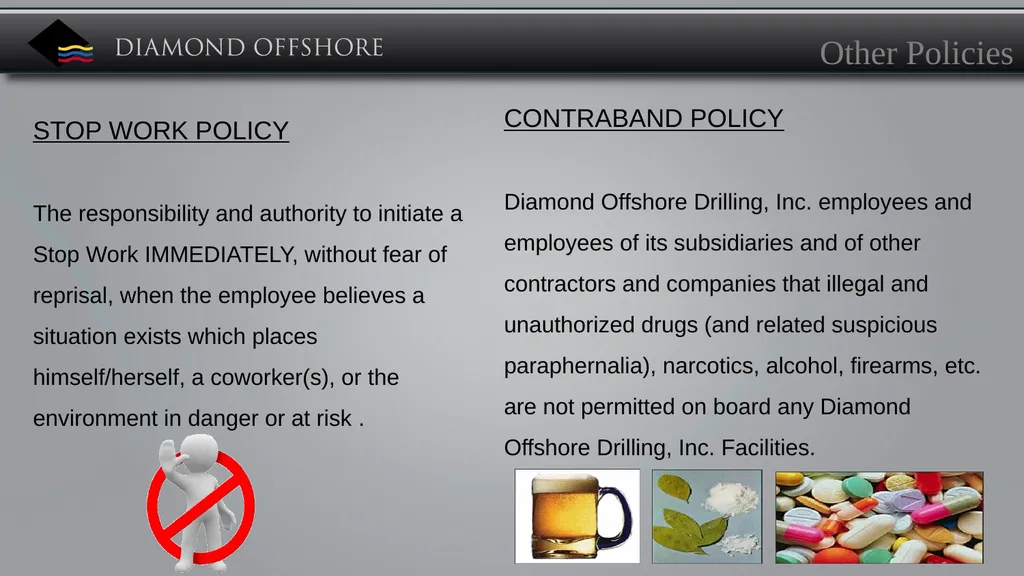
The responsibility and authority to initiate a Stop Work IMMEDIATELY, without fear of reprisal, when the employee believes a situation exists which places himself/herself, a coworker(s), or the environment in danger or at risk . CONTRABAND POLICY
Diamond Offshore Drilling, Inc. employees and employees of its subsidiaries and of other contractors and companies that illegal and unauthorized drugs (and related suspicious paraphernalia), narcotics, alcohol, firearms, etc. are not permitted on board any Diamond Offshore Drilling, Inc. Facilities.<br>
05
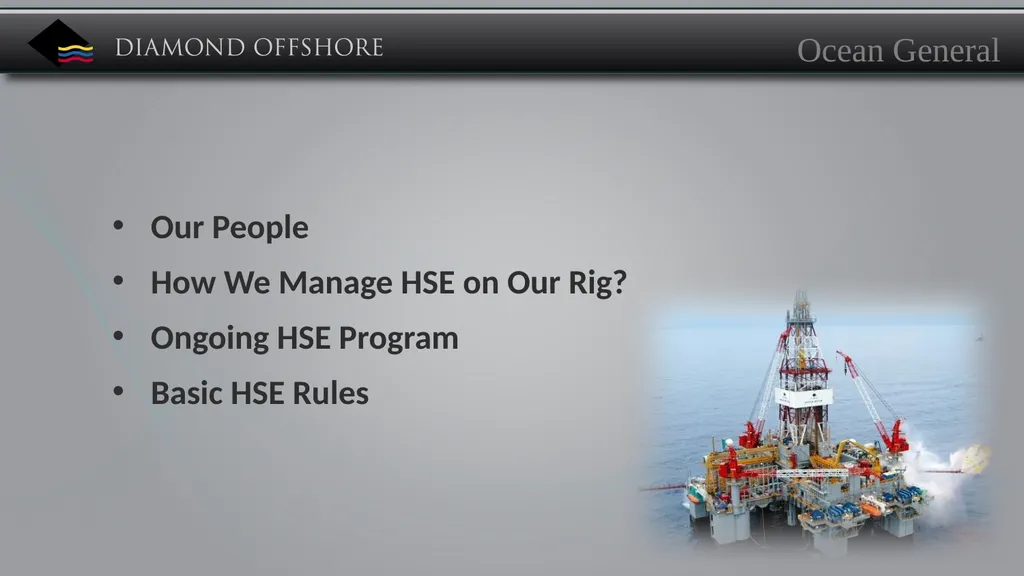
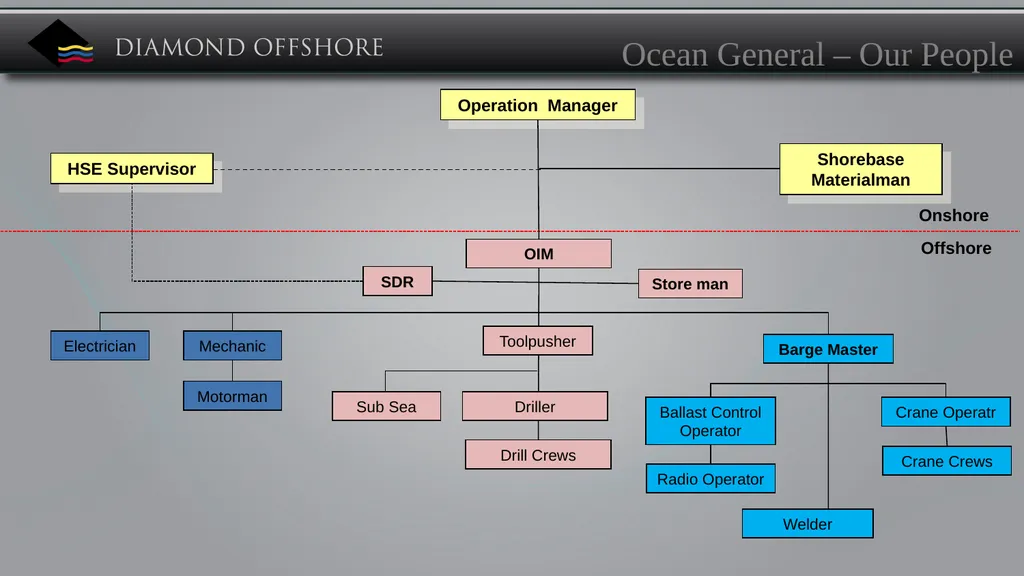
Our People
How We Manage HSE on Our Rig?
Ongoing HSE Program
Basic HSE Rules Ocean General<br>
06
HSE Supervisor Operation Manager Electrician Mechanic Ballast Control Operator Crane Operatr Toolpusher Drill Crews Store man SDR OIM Welder Sub Sea Offshore Onshore Ocean General – Our People Driller Barge Master Radio Operator Crane Crews Shorebase Materialman Motorman<br>
07
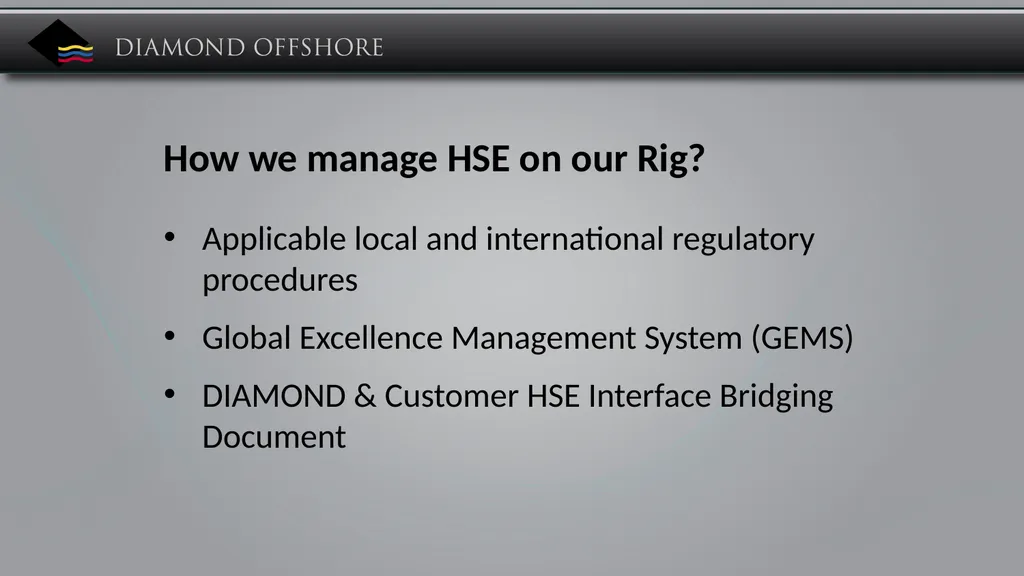
How we manage HSE on our Rig? Applicable local and international regulatory procedures
Global Excellence Management System (GEMS)
DIAMOND & Customer HSE Interface Bridging Document<br>
08
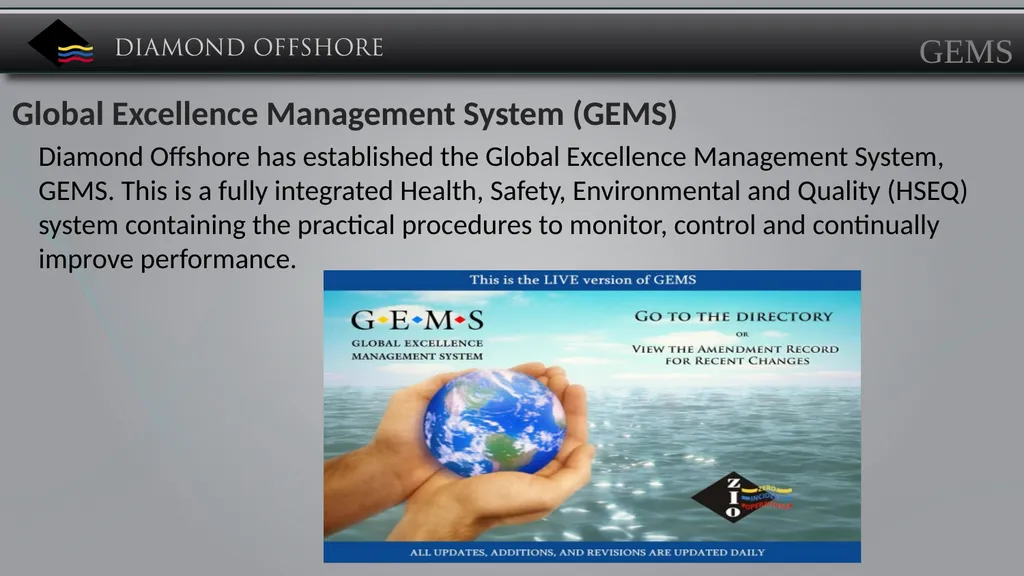
Diamond Offshore has established the Global Excellence Management System, GEMS. This is a fully integrated Health, Safety, Environmental and Quality (HSEQ) system containing the practical procedures to monitor, control and continually improve performance. Global Excellence Management System (GEMS) GEMS<br>
09
Global Excellence Management System (GEMS)
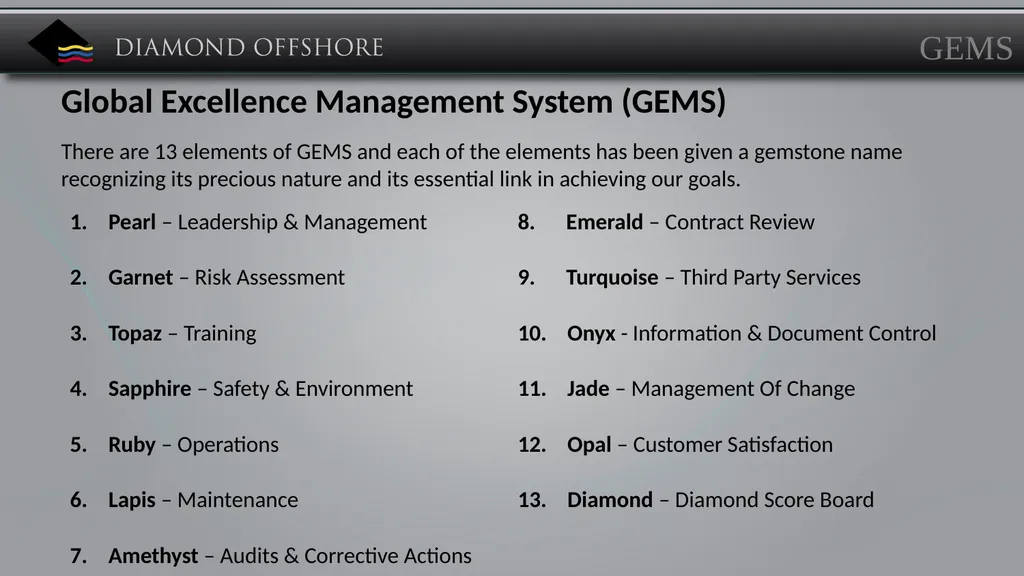
There are 13 elements of GEMS and each of the elements has been given a gemstone name recognizing its precious nature and its essential link in achieving our goals. GEMS<br>
10
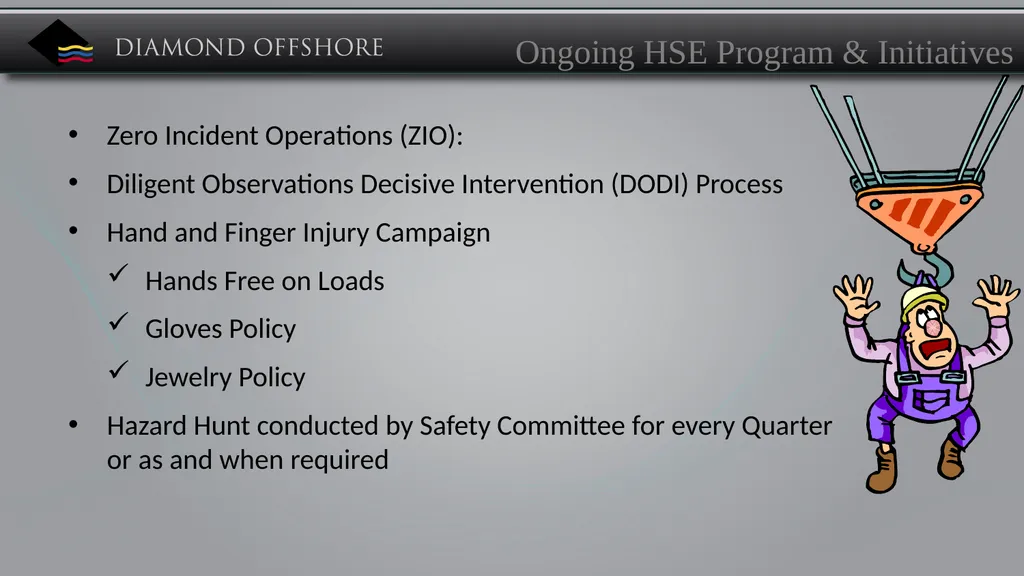
Ongoing HSE Program & Initiatives Zero Incident Operations (ZIO):
Diligent Observations Decisive Intervention (DODI) Process
Hand and Finger Injury Campaign
Hands Free on Loads
Gloves Policy
Jewelry Policy
Hazard Hunt conducted by Safety Committee for every Quarter or as and when required<br>
11
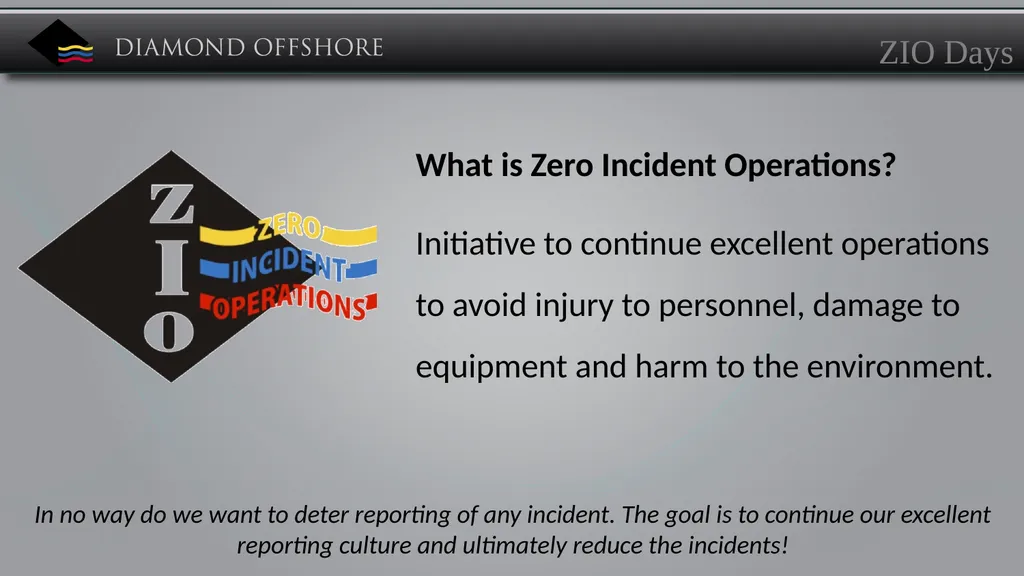
ZIO Days What is Zero Incident Operations?
Initiative to continue excellent operations to avoid injury to personnel, damage to equipment and harm to the environment. In no way do we want to deter reporting of any incident. The goal is to continue our excellent reporting culture and ultimately reduce the incidents!<br>
12
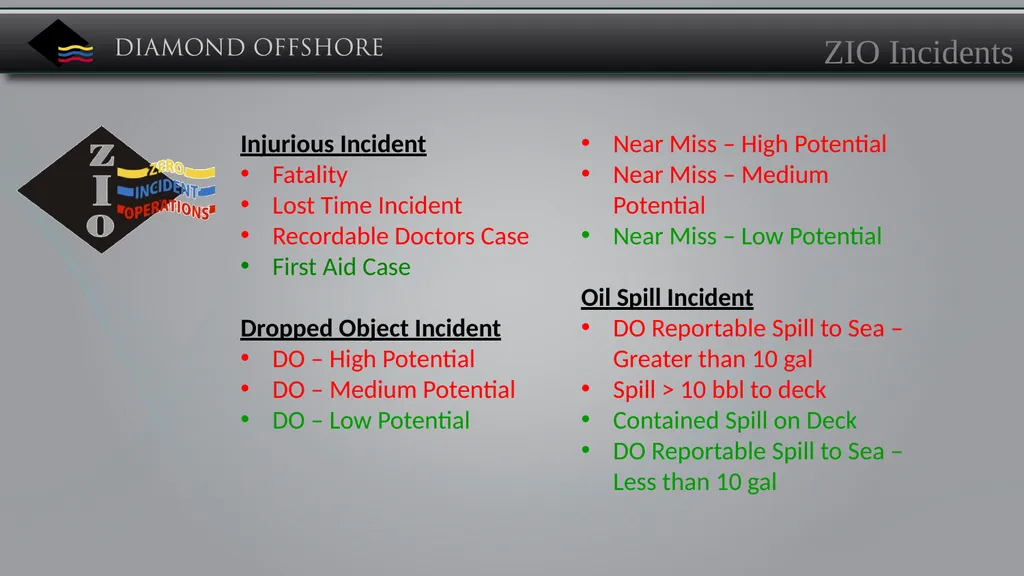
ZIO Incidents Injurious Incident
Fatality
Lost Time Incident
Recordable Doctors Case
First Aid Case
Dropped Object Incident
DO – High Potential
DO – Medium Potential
DO – Low Potential
Non-Injurious Incidents
Near Miss – High Potential
Near Miss – Medium Potential
Near Miss – Low Potential
Oil Spill Incident
DO Reportable Spill to Sea – Greater than 10 gal
Spill > 10 bbl to deck
Contained Spill on Deck
DO Reportable Spill to Sea – Less than 10 gal<br>
13
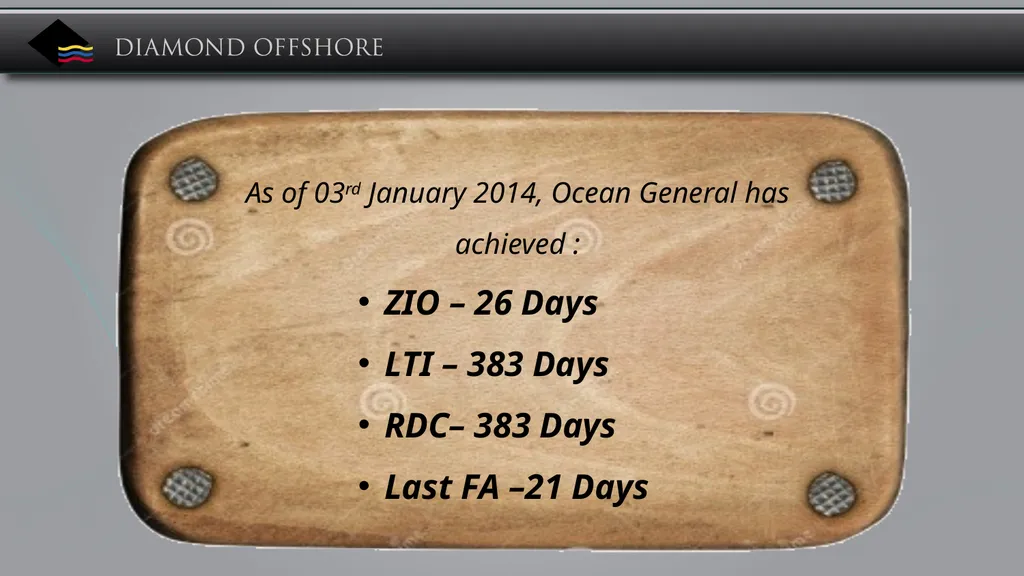
As of 03rd January 2014, Ocean General has achieved :
ZIO – 26 Days
LTI – 383 Days
RDC– 383 Days
Last FA –21 Days<br>
14
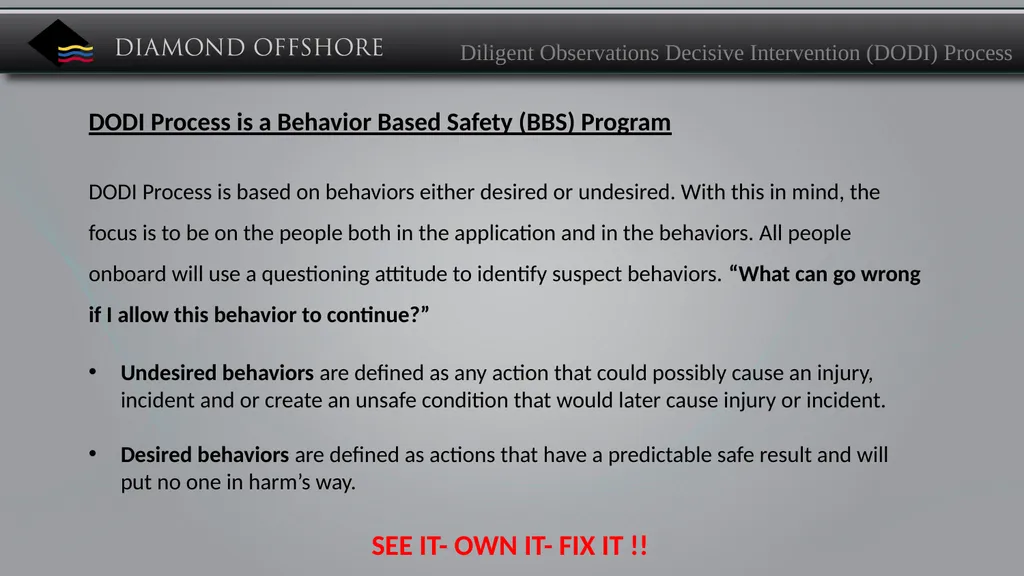
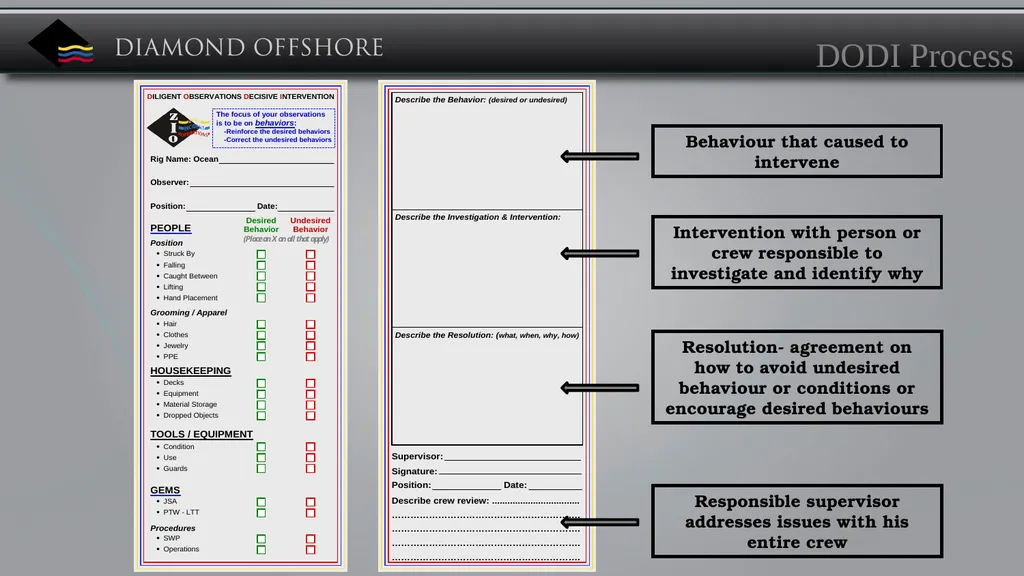
Diligent Observations Decisive Intervention (DODI) Process DODI Process is a Behavior Based Safety (BBS) Program
DODI Process is based on behaviors either desired or undesired. With this in mind, the focus is to be on the people both in the application and in the behaviors. All people onboard will use a questioning attitude to identify suspect behaviors. “What can go wrong if I allow this behavior to continue?”
Undesired behaviors are defined as any action that could possibly cause an injury, incident and or create an unsafe condition that would later cause injury or incident.
Desired behaviors are defined as actions that have a predictable safe result and will put no one in harm’s way. SEE IT- OWN IT- FIX IT !!<br>
16
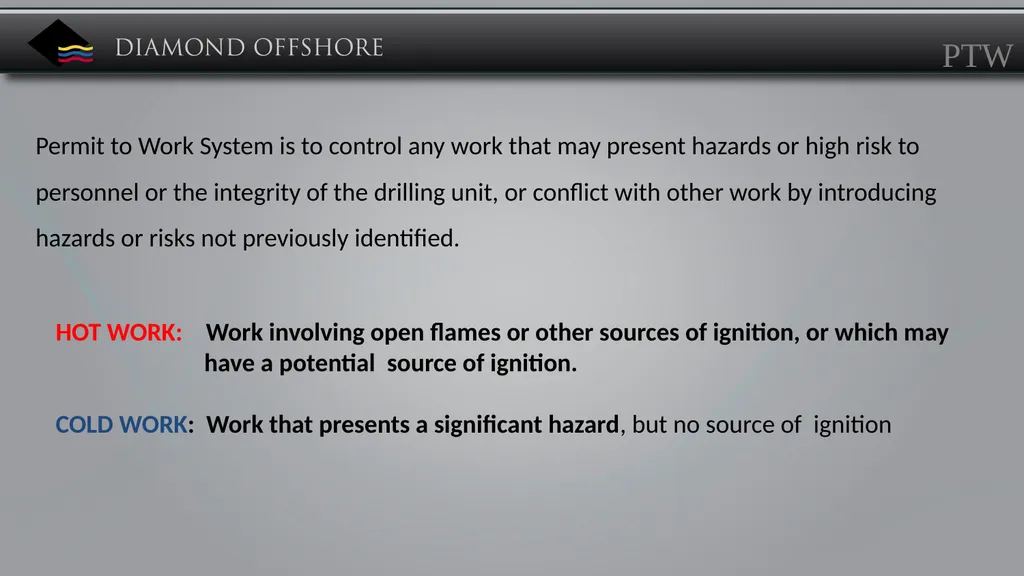
PTW Permit to Work System is to control any work that may present hazards or high risk to personnel or the integrity of the drilling unit, or conflict with other work by introducing hazards or risks not previously identified. HOT WORK: Work involving open flames or other sources of ignition, or which may have a potential source of ignition.
COLD WORK: Work that presents a significant hazard, but no source of ignition<br>
17
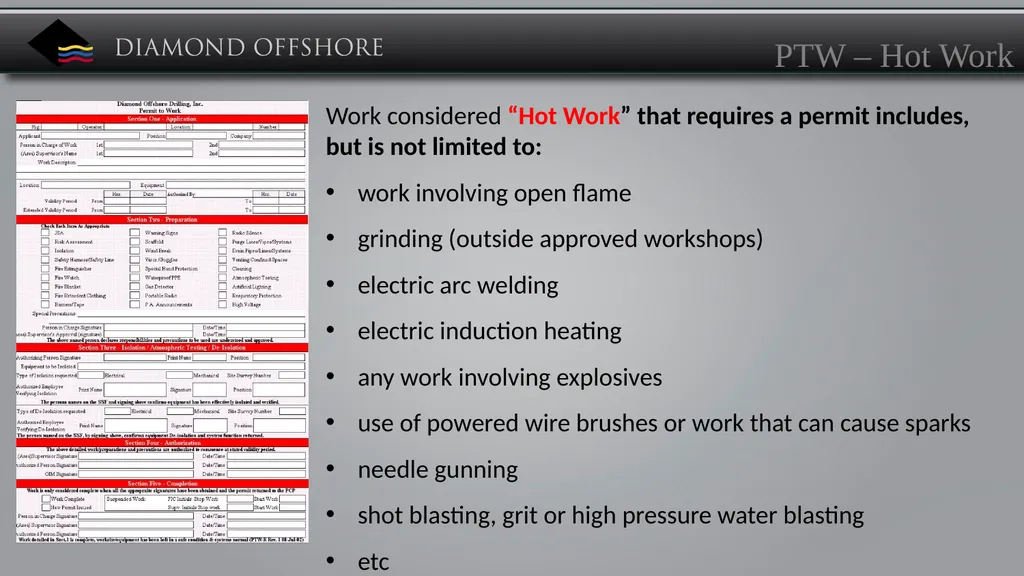
PTW – Hot Work Work considered “Hot Work” that requires a permit includes, but is not limited to:
work involving open flame
grinding (outside approved workshops)
electric arc welding
electric induction heating
any work involving explosives
use of powered wire brushes or work that can cause sparks
needle gunning
shot blasting, grit or high pressure water blasting
etc<br>
18
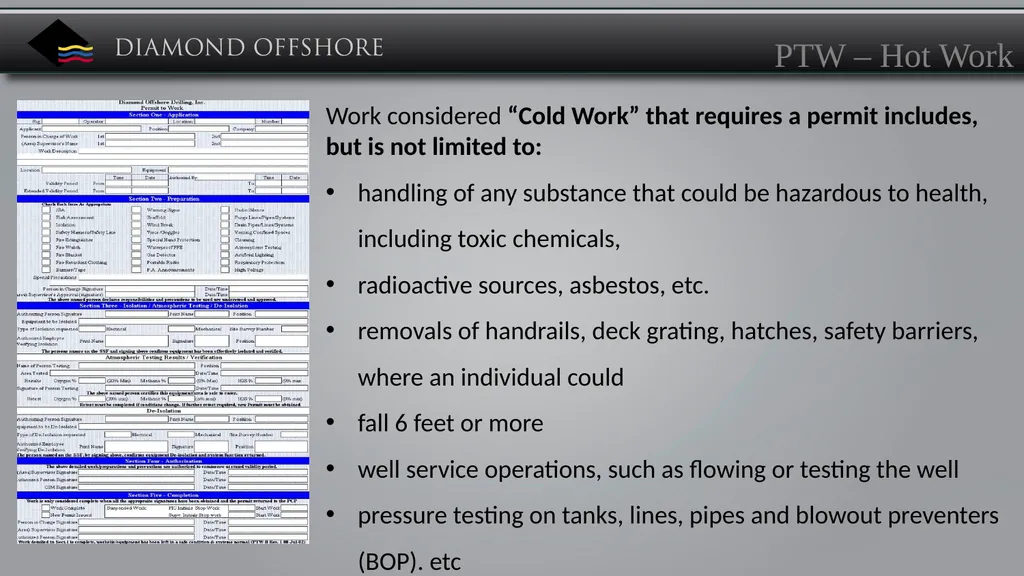
PTW – Hot Work Work considered “Cold Work” that requires a permit includes, but is not limited to:
handling of any substance that could be hazardous to health, including toxic chemicals,
radioactive sources, asbestos, etc.
removals of handrails, deck grating, hatches, safety barriers, where an individual could
fall 6 feet or more
well service operations, such as flowing or testing the well
pressure testing on tanks, lines, pipes and blowout preventers (BOP). etc<br>
19
PTW - Training PTW Training
Level 1, Level 2 and Lock/Tag/Try (LTT)
Training must be completed initially (on your first hitch on rig) and on an annual basis by all personnel using the PTW system.
All Diamond personnel and 3rd Parties that are required to do PTW and LTT training. It is applicable to certain types of work undertaken by any person on the unit, including employees of Diamond Offshore, the Customer and all Third Parties.<br>
20
Job Safety Analysis Job Safety Analysis (JSA)
The Job Safety Analysis is a tool that is used daily. ALL personnel are required to undertake JSAs on jobs that they plan to carry out. The JSA video will explain in detail the Diamond Offshore Philosophy on JSAs. After Action Review (AAR)
Did everything match the original plan?
Were the results as expected?
What went wrong?
What improvements can be made?
Revise the JSA based on the results of the critique<br>
21
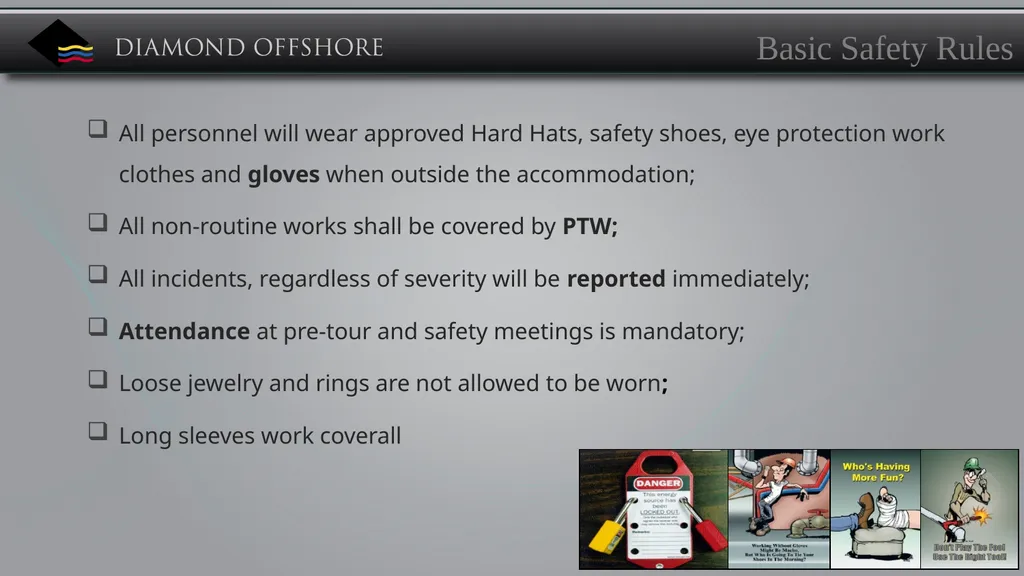
Basic Safety Rules All personnel will wear approved Hard Hats, safety shoes, eye protection work clothes and gloves when outside the accommodation;
All non-routine works shall be covered by PTW;
All incidents, regardless of severity will be reported immediately;
Attendance at pre-tour and safety meetings is mandatory;
Loose jewelry and rings are not allowed to be worn;
Long sleeves work coverall<br>
22
A full body harness must be worn when working more than 6 feet (1.8 mtr) above the closest landing point;
We practice NO HANDS ON LOAD!!!;
Stay clear of suspended load;
Etc Basic Safety Rules Cont’d<br>
23
Thank You If in doubt, Safety always takes priority
NO EXCEPTIONS!<br>