DIFFERENT TERMINOLOGIES USED IN REPERTORY BY DR SUPRIYA JADHAV ASSISTANT PROFESSOR DEPARTMENT OF REPERTORY KLE HOMOEOPATHIC MEDICAL COLLEGE RUBRIC: The term Rubric is originated from the Latin word Rubrica which means heading or
"DIFFERENT TERMINOLOGIES USED IN REPERTORY BY DR" is the property of its rightful owner. Permission is granted to
download and print the materials on this website for personal, non-commercial use only, and to display it
on your personal computer provided you do not modify the materials and that you retain all copyright
notices contained in the materials. By downloading content from our website, you accept the terms of this
agreement.
Presentation Transcript
01
DIFFERENT TERMINOLOGIES USED IN REPERTORY
BY
DR SUPRIYA JADHAV
ASSISTANT PROFESSOR
DEPARTMENT OF REPERTORY
KLE HOMOEOPATHIC MEDICAL COLLEGE<br>
02
RUBRIC:
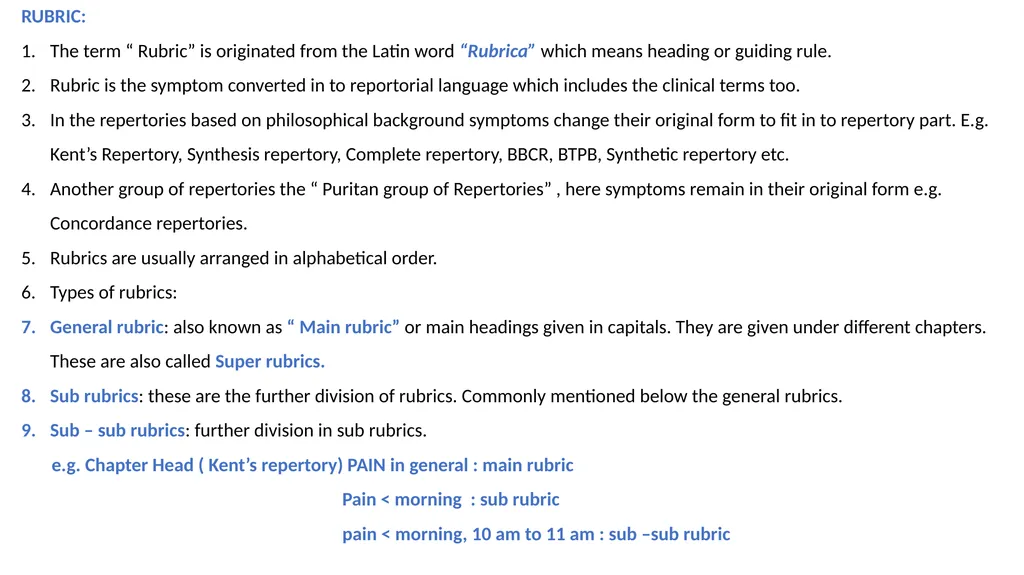
The term “ Rubric” is originated from the Latin word “Rubrica” which means heading or guiding rule.
Rubric is the symptom converted in to reportorial language which includes the clinical terms too.
In the repertories based on philosophical background symptoms change their original form to fit in to repertory part. E.g. Kent’s Repertory, Synthesis repertory, Complete repertory, BBCR, BTPB, Synthetic repertory etc.
Another group of repertories the “ Puritan group of Repertories” , here symptoms remain in their original form e.g. Concordance repertories.
Rubrics are usually arranged in alphabetical order.
Types of rubrics:
General rubric: also known as “ Main rubric” or main headings given in capitals. They are given under different chapters. These are also called Super rubrics.
Sub rubrics: these are the further division of rubrics. Commonly mentioned below the general rubrics.
Sub – sub rubrics: further division in sub rubrics.
e.g. Chapter Head ( Kent’s repertory) PAIN in general : main rubric
Pain < morning : sub rubric
pain < morning, 10 am to 11 am : sub –sub rubric<br>
03
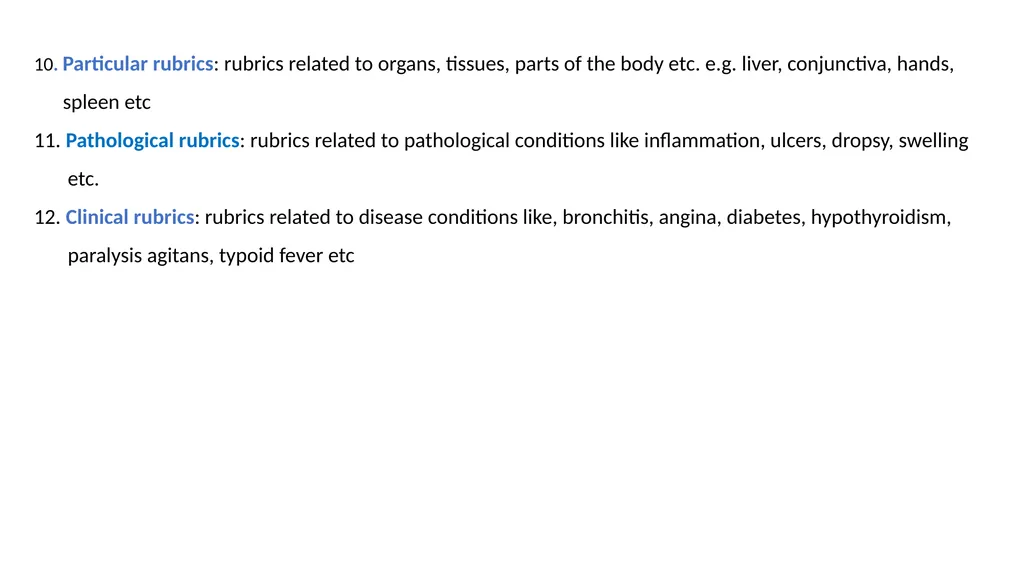
10. Particular rubrics: rubrics related to organs, tissues, parts of the body etc. e.g. liver, conjunctiva, hands,
spleen etc
11. Pathological rubrics: rubrics related to pathological conditions like inflammation, ulcers, dropsy, swelling
etc.
12. Clinical rubrics: rubrics related to disease conditions like, bronchitis, angina, diabetes, hypothyroidism,
paralysis agitans, typoid fever etc<br>
04
Synthesis of Rubric
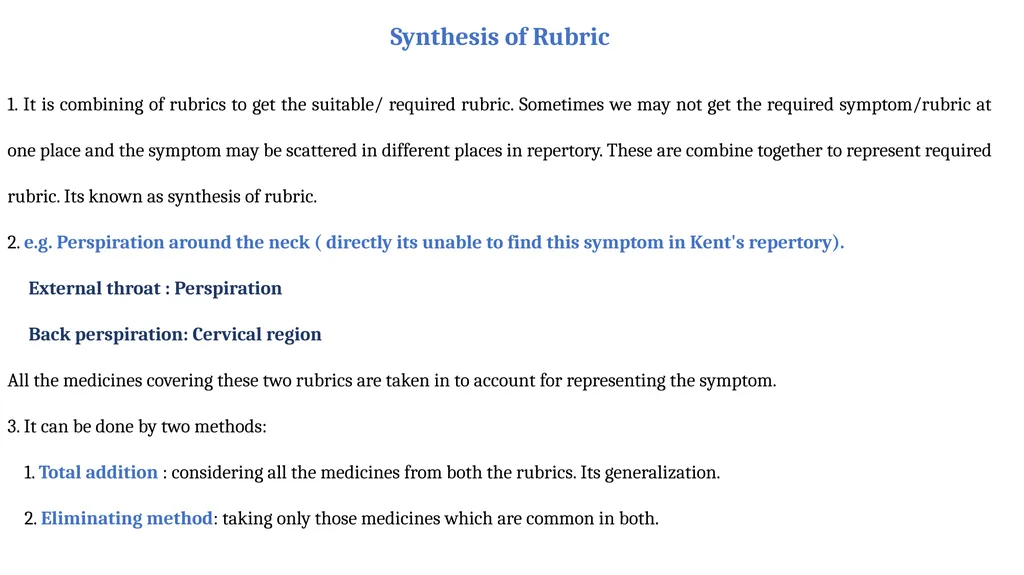
1. It is combining of rubrics to get the suitable/ required rubric. Sometimes we may not get the required symptom/rubric at one place and the symptom may be scattered in different places in repertory. These are combine together to represent required rubric. Its known as synthesis of rubric.
2. e.g. Perspiration around the neck ( directly its unable to find this symptom in Kent's repertory).
External throat : Perspiration
Back perspiration: Cervical region
All the medicines covering these two rubrics are taken in to account for representing the symptom.
3. It can be done by two methods:
1. Total addition : considering all the medicines from both the rubrics. Its generalization.
2. Eliminating method: taking only those medicines which are common in both.<br>
05
CROSS REFERANCE
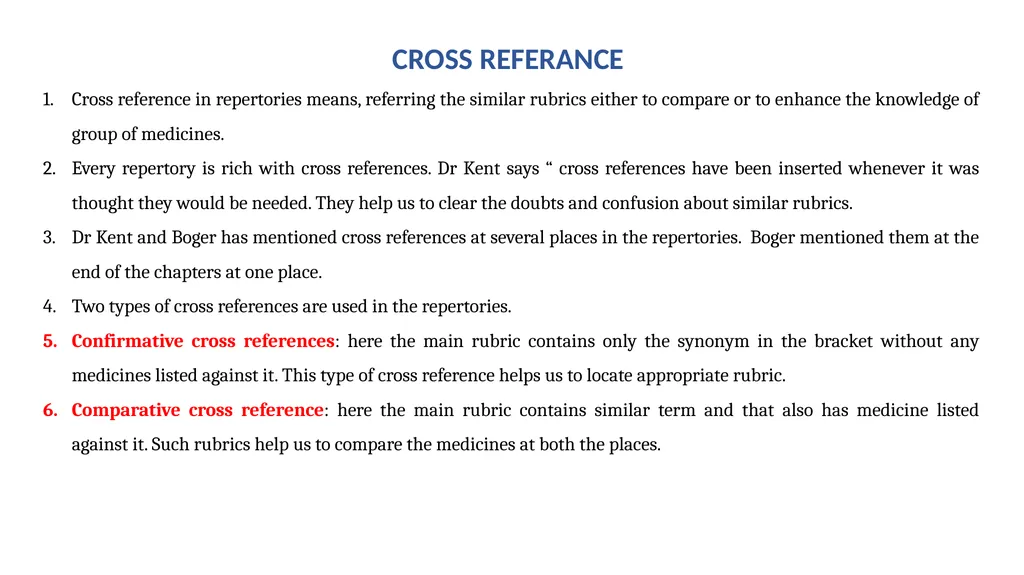
Cross reference in repertories means, referring the similar rubrics either to compare or to enhance the knowledge of group of medicines.
Every repertory is rich with cross references. Dr Kent says “ cross references have been inserted whenever it was thought they would be needed. They help us to clear the doubts and confusion about similar rubrics.
Dr Kent and Boger has mentioned cross references at several places in the repertories. Boger mentioned them at the end of the chapters at one place.
Two types of cross references are used in the repertories.
Confirmative cross references: here the main rubric contains only the synonym in the bracket without any medicines listed against it. This type of cross reference helps us to locate appropriate rubric.
Comparative cross reference: here the main rubric contains similar term and that also has medicine listed against it. Such rubrics help us to compare the medicines at both the places.<br>
06
Repertorial totality and PDF ( POTENTIAL DIFFERENTIAL FIELD)
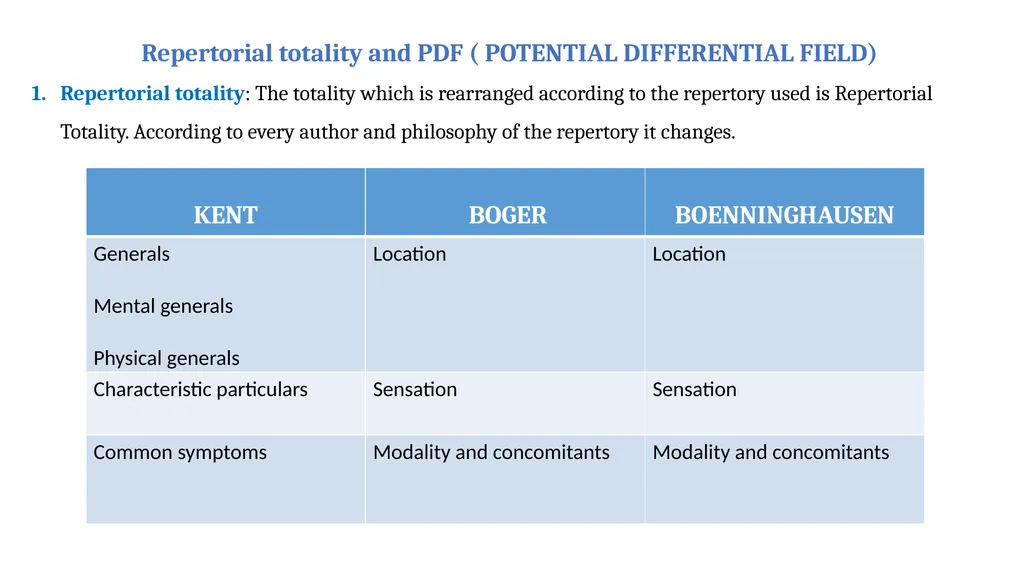
Repertorial totality: The totality which is rearranged according to the repertory used is Repertorial Totality. According to every author and philosophy of the repertory it changes.<br>
07
POTENTIAL DIFFERENTIAL FIELD (PDF)
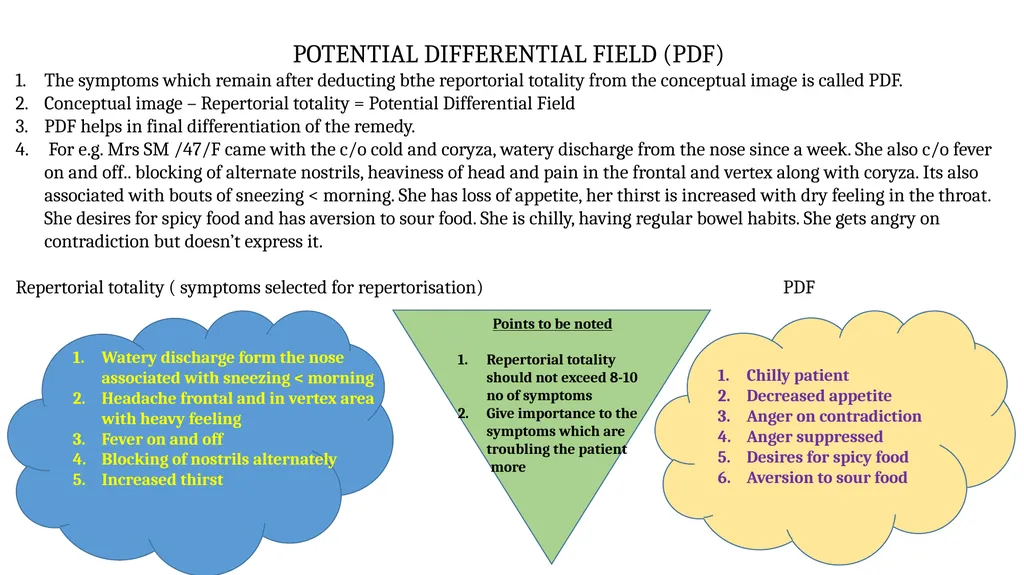
The symptoms which remain after deducting bthe reportorial totality from the conceptual image is called PDF.
Conceptual image – Repertorial totality = Potential Differential Field
PDF helps in final differentiation of the remedy.
For e.g. Mrs SM /47/F came with the c/o cold and coryza, watery discharge from the nose since a week. She also c/o fever on and off.. blocking of alternate nostrils, heaviness of head and pain in the frontal and vertex along with coryza. Its also associated with bouts of sneezing < morning. She has loss of appetite, her thirst is increased with dry feeling in the throat. She desires for spicy food and has aversion to sour food. She is chilly, having regular bowel habits. She gets angry on contradiction but doesn’t express it.
Repertorial totality ( symptoms selected for repertorisation) PDF Watery discharge form the nose associated with sneezing < morning
Headache frontal and in vertex area with heavy feeling
Fever on and off
Blocking of nostrils alternately
Increased thirst Chilly patient
Decreased appetite
Anger on contradiction
Anger suppressed
Desires for spicy food
Aversion to sour food Points to be noted
Repertorial totality should not exceed 8-10 no of symptoms
Give importance to the symptoms which are troubling the patient
more<br>