
Different types of Reading Material and ways of


Description: Different types of Reading Material and ways of keeping them in Library For B.Ed Ist Semester Students (Punjabi University) By Ms. Sarita Gulati Librarian Shivalik Institute of Education and Research, Mohali Reading Material The
Related Topics
Download Presentation
"Different types of Reading Material and ways of" is the property of its rightful owner. Permission is granted to download and print the materials on this website for personal, non-commercial use only, and to display it on your personal computer provided you do not modify the materials and that you retain all copyright notices contained in the materials. By downloading content from our website, you accept the terms of this agreement.
Presentation Transcript
slide1. Different types of Reading Material
and ways of keeping them in Library
For B.Ed Ist Semester Students
(Punjabi University)
By
Ms. Sarita Gulati
Librarian
Shivalik Institute of Education and Research, Mohali<br>
slide2. Reading Material The source/material from where we get information after reading is called Reading Material. Library resources are considered as reading materials such as books, periodicals, magazines, newspapers, databases, e-resources etc.
Types of Reading Materials
1. Traditional resource
2. Electronic resources<br>
slide3. Traditional Resources It includes print reading material that could be published or unpublished. These may be books, magazines, reference books, periodicals, articles, dictionaries, guide books etc. that are organized based on their information contents. Different kinds of traditional reading materials have been classified in 3 groups such as
Primary source
Secondary Source
Tertiary source<br>
slide4. PRIMARY SOURCES Primary sources are original materials.
They have not been filtered through interpretation or evaluation.
They are usually the first formal appearance of results in physical, print or electronic format.
They present original thinking, report a discovery, or share new information.
Such resources are unorganized.<br>
slide5. Some types of primary sources include Original documents like speeches, manuscripts, new film footage, autobiographies, official records. Example book : The Story of My Experiments with Truth is the autobiography of Mohandas K. Gandhi
Creative works: Drama, novels, music, art
Artifacts: pottery, building, furniture<br>
slide6. Examples Audio recordings (e.g. radio or internet broadcasts)
Diaries, Notes, Autobiographies
Internet Communications (e.g. email, chat transcripts)
Interviews (e.g., oral histories, telephone, e-mail);
Journal articles describing original research or containing original analysis
Dissertations or theses (may also be secondary)
Letters, Postcards, & other forms of correspondence
Original Documents (i.e. birth certificates, wills, marriage licenses)
Photographs, Speeches
newspaper articles (may also be secondary)
Survey Results and Analysis (e.g. market surveys, public opinion polls)
Video recordings (e.g. television or internet broadcasts)<br>
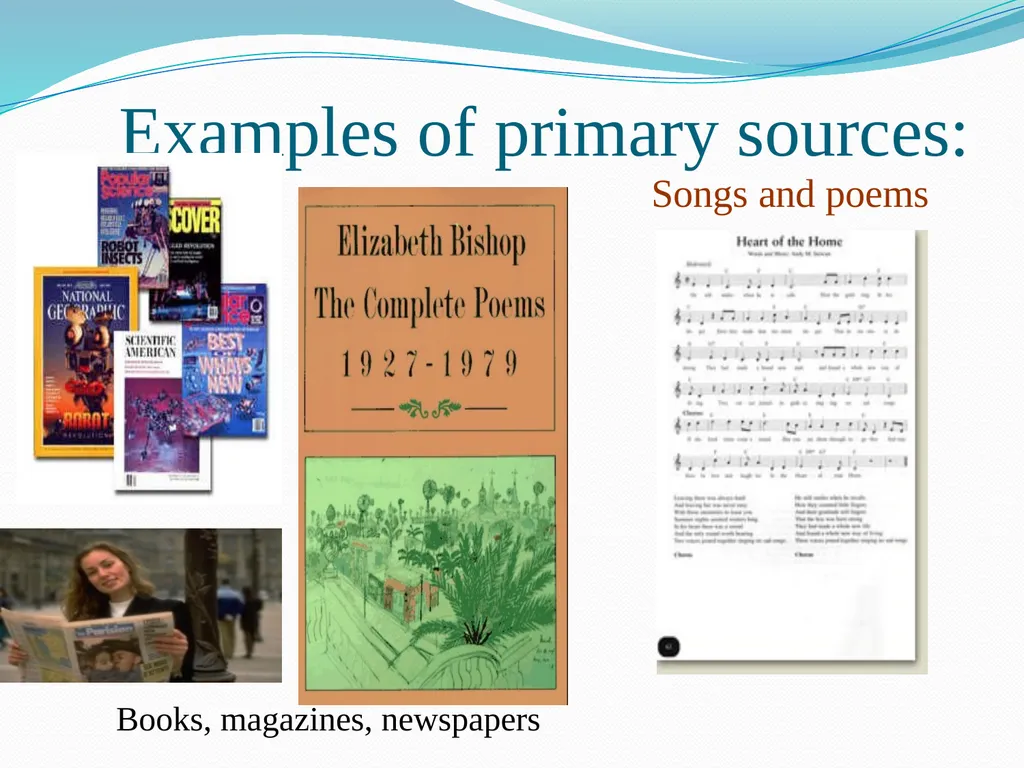
slide7. Examples of primary sources: Books, magazines, newspapers Songs and poems<br>
slide8. SECONDARY SOURCES These contain chiefly known information i.e second hand information.
Result carried out are edited by someone else and then publish.
These are organised and arranged according to a definite plan.
They don’t carry new and original information
They are complied from primary sources.
They are interpretations and evaluations of primary sources<br>
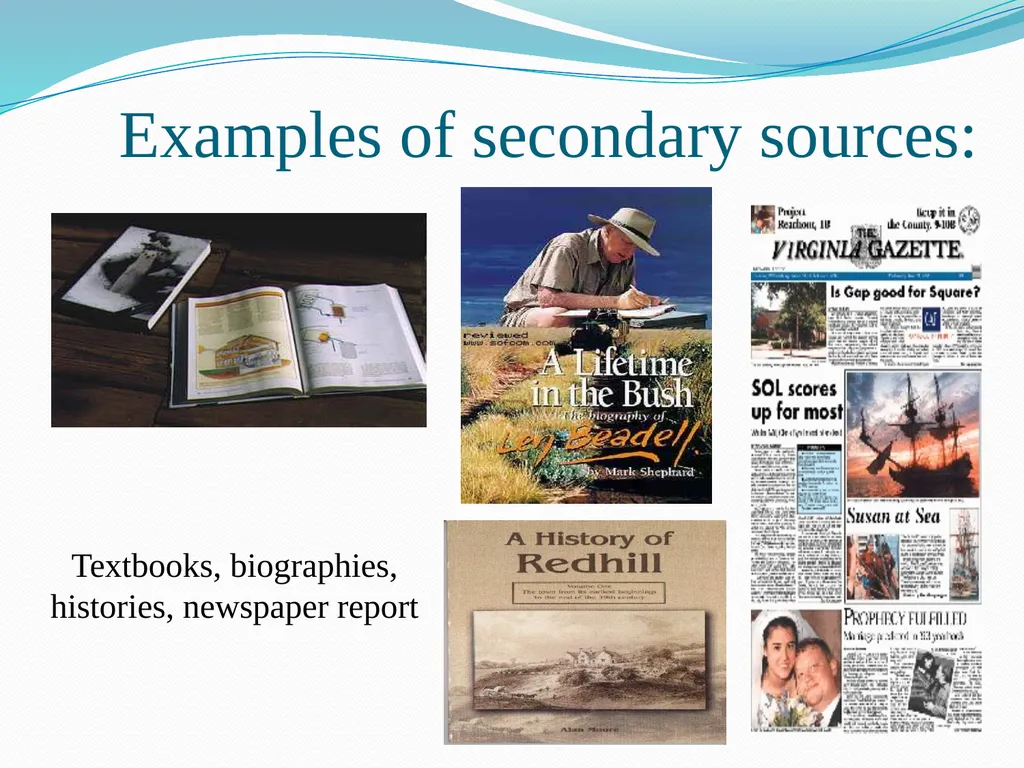
slide9. Examples of secondary sources: Textbooks, biographies, histories, newspaper report<br>
slide10. Examples Biographical works
Periodical, Indexing periodicals, Abstracting periodicals
Reviews
Textbooks(standard book used for instruction)
Reference books (dictionary, encyclopaedia, handbook)
Magazine and newspaper articles (except eyewitness accounts, original reporting or analysis)
Books, other than fiction and autobiography<br>
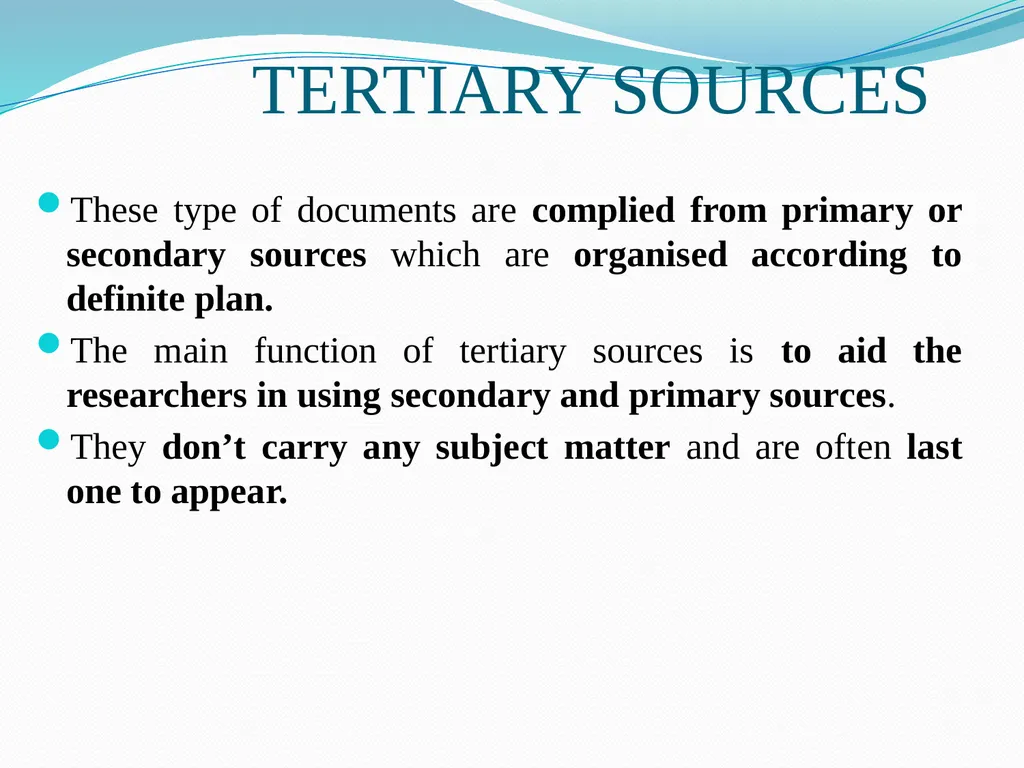
slide11. TERTIARY SOURCES These type of documents are complied from primary or secondary sources which are organised according to definite plan.
The main function of tertiary sources is to aid the researchers in using secondary and primary sources.
They don’t carry any subject matter and are often last one to appear.<br>
slide12. Examples Directories
Fact Books
Databases
Guide to literature (a reference guide to recently published articles in periodical, magazines and scholarly journals).<br>
slide13. Electronic Resources<br>
slide14. E-Resource An e-resource is material which requires computer in order to access its content and make it useful. Both online and offline resources such as online material and CD-ROMs fall within the scope of e-resources.
It covers bibliographic databases, electronic reference books, search engines for full text books and digital collection of data.
According to Library and Information Technology Glossary “ E-resource is an information products that a library provides through a computer network... .."<br>
slide15. Types of e-resources E-Books
E-Journals
E-Zine
E-Thesis and dissertation (ETD)
E-newspaper
CD-ROM
Databases<br>
slide16. E-Book An E-book is a book in electronic format.
“A book composed in or converted to digital format for display on a computer screen or handheld device is an E-book”.
It is downloaded to a Computer, PC, Laptop, Mobile, and is read on the screen.<br>
slide17. Benefits We don't have to go to a bookstore to buy them, neither wait for them for days, weeks.
No trees are required to manufacture paper for the pages of E-books.
We can easily download an E-book.
E-books take up less space and are portable.
We can read E-books everywhere, on the bus, train, airplane.
We can carry a great number of E-books.
E-books can show links, for easy access to more information and related websites.
E-books are searchable and Fonts can be resized.
E-books are very easy to sell and distribute.
It is possible to purchase an E-book 24 hours a day.<br>
slide18. E-Journals An electronic journal is a periodical publication which is published in electronic format, usually on the Internet.
Benefits
We can e-mail articles or download them for printing.
It can be used simultaneously by more than one user.
It provides timely access and at the rate of 24 X 7 X 365 formula.
Hypertext links allow us to move to different sections within individual journals or articles and can link to related resources on the Internet.
E-Journals can include more images and audio-visual material.<br>
slide19. E- Magazines An e-zines are magazines or publications issued in an electronic form. Nearly every major magazine has a Web site, where either some selected or all of the articles can be read.
Benefits
Articles can be published without delay and can be instantly accessed from all over the world.
Comfortable searching mechanisms and individual collections of articles, depending on the readers’ interests, can be provided.
Interactive services like discussion groups or chat can be integrated.
It integrates various types of media like audio, video etc.<br>
slide20. E- Thesis and Dissertation (ETD) The term ETD (E-Thesis and Dissertation) refers to a master's dissertation or doctoral thesis that is archived and circulated electronically rather than archived and circulated in print.
Benefits
Theses submitted in support of a PhD are difficult to access, as they are only collected by the library of the university that granted the degree. ETDs can be easily located, readily accessible and delivered over the Web.
It empowers students to convey a richer message through the use of multimedia and hypermedia technologies.
It lower the cost of submitting and handling theses and dissertations.<br>
slide21. E-Newspaper An e-newspaper is a self-contained/complete and refreshable version of a traditional newspaper that acquires and holds information electronically.
Benefits
It’s immediately accessible and convenient.
Provide easy options for turning pages, linking to dynamic indexes, searching, saving and printing etc.
E-newspapers offer multimedia and hyperlink features.<br>
slide22. CD-ROM : Compact Disk-Read-Only Memory It is a type of optical disk capable of storing large amounts of data which cannot be erased. A single CD-ROM has the storage capacity of 700 floppy disks or 3,00,000 text pages.
Advantages of CD-ROM
It can be used for back files of journals, databases for information retrieval.
It has reliability, permanence, durability, high capacity and scope for mass data distribution.<br>
slide23. Databases A database is an electronic system that allows data to be easily accessed, manipulated and updated. A database is used by an organization as a method of storing, managing and retrieving information.
Advantages of Database
A database can be accessed by multiple users at the same time.
Searching for information within a large amount of data is much faster using a database
It allows for data sharing among other users who have access to the system.<br>
slide24. Ways of keeping Library Resources in Library<br>
slide25. 1. Open and Close access system
2.Library Classification<br>
slide26. Close access system Books are kept under locks in the almirahs.
Reader is slave to catalogue(only means to search the book) and library attendant.
Reader is not allowed to take books of his interest.
Steps
Check catalogue
Give a slip having bibliographic information to attendant
Attendant find the book.
If reader is not satisfied then again refer the catalogue and so on…
Sometimes book is not available and sometimes not according to taste of reader.
Reader gets discouraged sometimes.<br>
slide27. Merits No chances of misplacement: The chances of misplacement of book can be reduced because books are taken out and kept by library attendant only. So there is no fear of misplacement of the books.
Useful for small libraries: This system is very effective for small libraries where collection of books, number of users, library staff is less.
No fear of theft: It reduces the chances of theft and damage of books. It is the duty of library staff member to search the books for users and bring it outside. In this way, it may be possible to reduce the chances of theft and damage of books.
Useful for primary school: Primary school students don’t know how to use catalogue card. So library staff helps the user in finding books for them. So it’s good for primary school students.<br>
slide28. DEMERITS Not implemented in big libraries: It is used in libraries that have less collection of books. In Libraries having huge collection, this system cannot be implemented. So this system cannot be applicable in college or university libraries. It can be operated in small libraries only.
Waste time of user and staff: In close access system, users have to write detail information of the book like author, title, publisher, call no. etc. and give it to the library staff member. The staff member takes out the book for the users. It takes a lot of time of user as well as staff.<br>
slide29. Books not used properly: As user is dependent on staff and cannot explore books themselves so books are not used properly. It doesn’t satisfy 1st law ” Books are for use”.
User can’t express book requirement: Some users can’t express their book requirements. So they cannot get the right book as per their requirement therefore it doesn’t satisfy 2nd law “Every reader his/her book”.
Third law is not achieved: In this system, the users have no option to select the book. So few books that might be useful remain untouched. It doesn’t satisfy 3rd law “Every book its reader”.<br>
slide30. Open Access system Opportunity to see and examine the books with freedom.
Reader can look anywhere and everywhere in the stacks.
Reader can easily find any specific book. His curiosity for further reading is increased.
Steps
Books are kept in stacks.
Arranged in proper order.
Reader Refer catalogue and go to stack and easily get the book.<br>
slide31. Merits No need to depend on library staff: The users are not dependent on library staff. They can access the book of their interest. There is no restriction of any kind.
Time saving: It saves time and energy of library staff as well as of user both. In close access, library staff searches the book for user that waste time of user as well as of staff.
Extra work: The library staff can do other work in extra time as staff is not required for searching books for users.<br>
slide32. Proper use of books: In this system, the users have an option to select the book after reading the contents of the book. He finds some other books related to the topic.
Library work can be completed by less staff member: In this system, less staff is required as user independently access library books.
Famous method: This system is widely accepted in big libraries like college and universities.
Develop self-study habit : Users can directly access books and develop self-study habits.<br>
slide33. DEMERITS More chances of theft and damage: In open access system, chances of book theft and damage are more. Some users even tear the pages of the book.
Fear of replacement of books: There are more chances of misplacement of books. The books in more demand are misplaced by the users. So books are to be properly replaced at their proper place.
More Requirements of dusting and shelving: In this system, there is a need to maintain the books regularly. Staff is required for daily shelving and dusting and keeping the books in proper place.
Necessity of security guard: There is need to appoint security guard to avoid theft in library. He has to check user’s books before leaving the library.<br>
slide34. Precautions of the theft activities from the library Personal bags not allowed in the library: Bags, personal books of students and their belongings are not allowed in the library. These should be deposited at the property counter. While going out of the library the property so deposited must be taken back.
Book proof window: Libraries have windows for fresh air and to purify the environment. But some naughty students steal library books by throwing them outside the library. So windows in library should be book proof.
One door for entry and exit: There should be one door for entry and exit. Books should be checked before leaving the library by security guard to avoid theft in library.
CCTV (closed circuit television): The security of books and other materials providing information in a library is quite essential. CCTV should be installed at in library to avoid theft of books. The CCTV cameras are used for surveillance in libraries to safe guard its possession of books and information.<br>
slide35. Classification<br>
slide36. Classification Derived from “Latin” word “Classic”. It Means “Process of grouping” .
Classification is a process of grouping like entities together and separating unlike entities.
Arrangements of ideas /objects in a systematic order.<br>
slide37. We do Classification in our daily lives eg kitchen, classroom etc. This is done to improve the efficiency of the various operations. But in library classification we are concerned with documents, and the aim is to arrange these in the most helpful and permanent order.<br>
slide38. Definitions According to New Encyclopedia Britannica, Classification is an arrangement adopted by libraries to facilitate its clientele/users to find documents quickly and easily.
According to W.C.B. Sayers “Classification is the “arrangement of books on shelves or description of them in the manner which is most helpful to those who read.”<br>
slide39. Classification Systems Libraries store and manage thousands of materials. These materials need to be organized in a manner that allows the easiest possible access for the readers.
Classification Systems are the tools libraries use to organize books and other library materials.
Classification Systems consists of subjects that can be located by call number.<br>
slide40. Cont… Classification Systems all use a system of letters and numbers to denote a particular subject.
Call Numbers are the primary access point for finding library materials. Call number provide information to users and Library staff members that help them to locate books and other library materials.<br>
slide41. Benefits It brings like books together: Classification arranges books in an order most convenient to the readers and the librarians. Readers should find all the related books together and librarians should minimum time and energy in locating the documents.
It saves time: Classification is a great time saving device for readers, as well as librarians and thus fulfils the demand of the fourth law of library science.
It reveals the weakness and strength of the collection: As classification arranges books on shelf by subject, it clearly shows which subjects have a good collection, and which subjects require more attention.
It helps in bibliographic research: Classification helps in the compilation of bibliographies, catalogues and union catalogues.
It helps in stock verification: Classification plays a significant role in the stock taking procedure.<br>
slide42. Need and Purpose of Classification Storage and retrieval :Due to nature of documents and different forms of documents it has become necessary to arrange them systematically for the purpose of storage and retrieval.
Satisfy law- The main purpose of library classification is to satisfy the laws of library science by arranging books in systematic manner, so that the reader are able to retrieve the books from shelf easily without the help of staff.
In order to provide reference service effectively, it is essential that the document should be arranged systematically.<br>
slide43. Correct Replacement - It is essential that library classification should enable the correct replacement of documents after they have been returned from use.
Withdrawal of Document from Stock: In this case, the need arises to withdraw a document from the library collection for some reason, and then library classification should facilitate such a withdrawal.
Addition of New Document: Library would acquire new documents from time to time therefore library classification should help in finding the most helpful place for each of those among the existing collection of the library.
Book Display: The collection in an open access library is well presented and guided. Library classification should be helpful in the organization of book displays.<br>
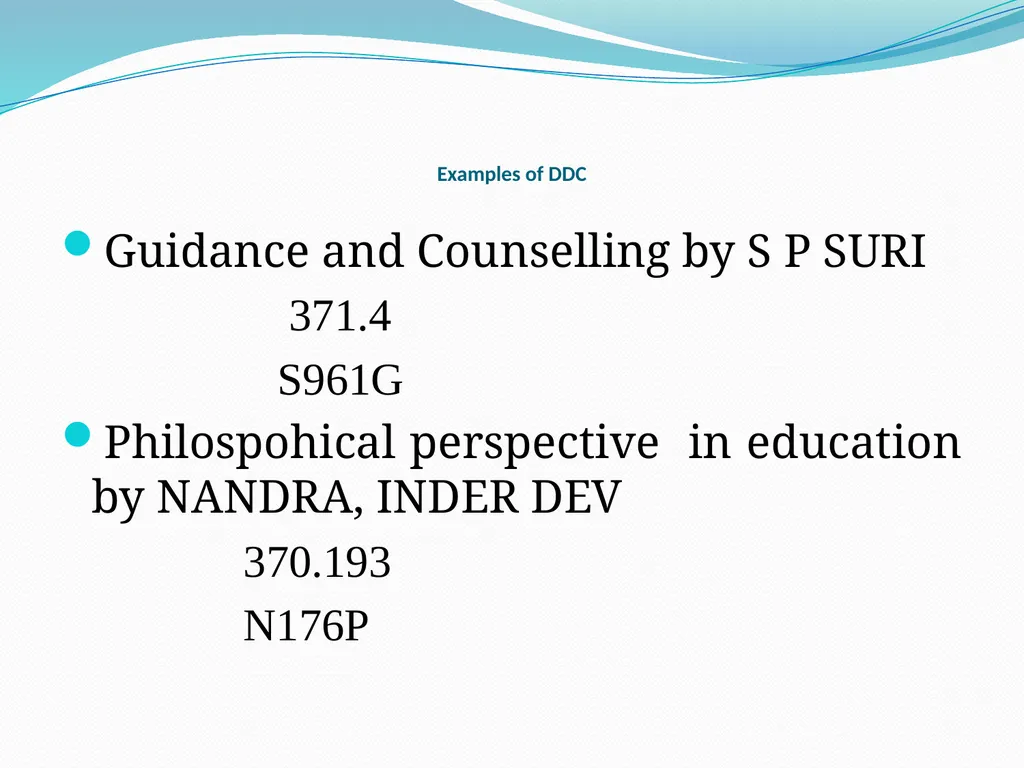
slide44. Examples of DDC Guidance and Counselling by S P SURI
371.4
S961G
Philospohical perspective in education by NANDRA, INDER DEV
370.193
N176P<br>
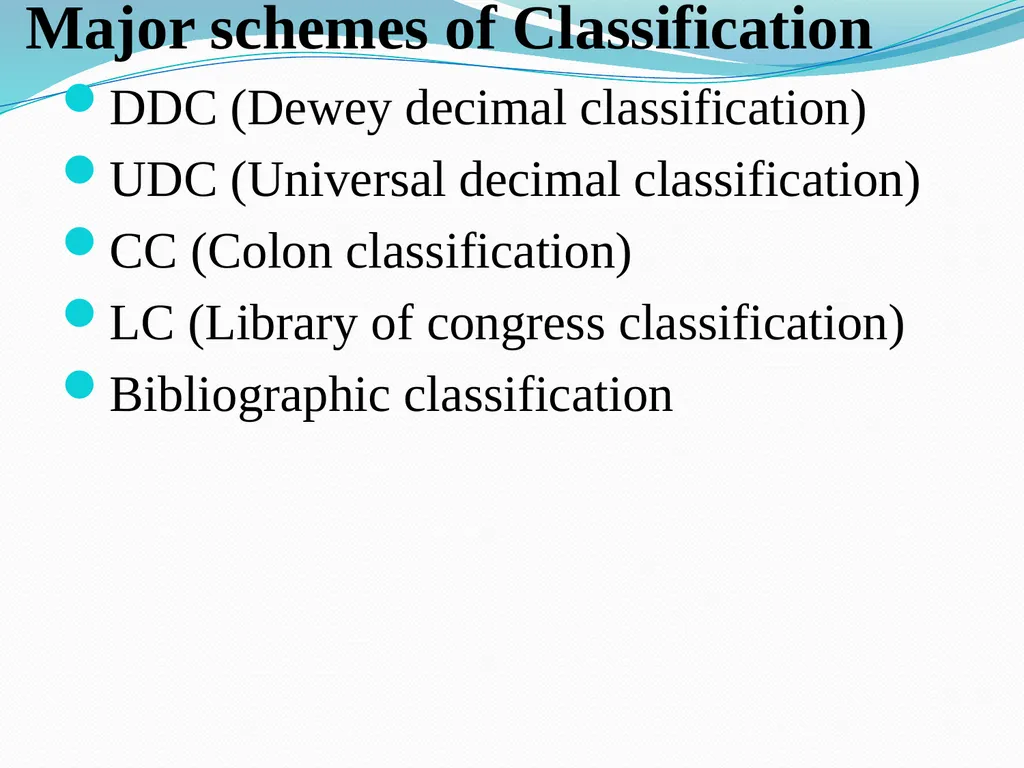
slide45. Major schemes of Classification DDC (Dewey decimal classification)
UDC (Universal decimal classification)
CC (Colon classification)
LC (Library of congress classification)
Bibliographic classification<br>
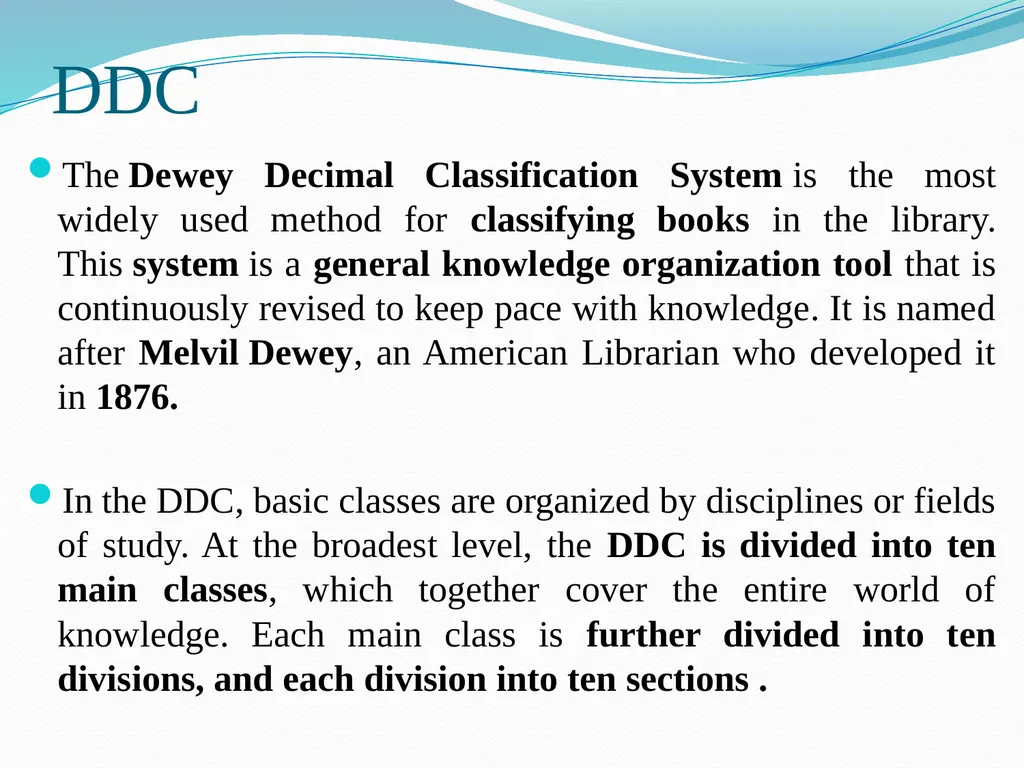
slide46. DDC The Dewey Decimal Classification System is the most widely used method for classifying books in the library. This system is a general knowledge organization tool that is continuously revised to keep pace with knowledge. It is named after Melvil Dewey, an American Librarian who developed it in 1876.
In the DDC, basic classes are organized by disciplines or fields of study. At the broadest level, the DDC is divided into ten main classes, which together cover the entire world of knowledge. Each main class is further divided into ten divisions, and each division into ten sections .<br>
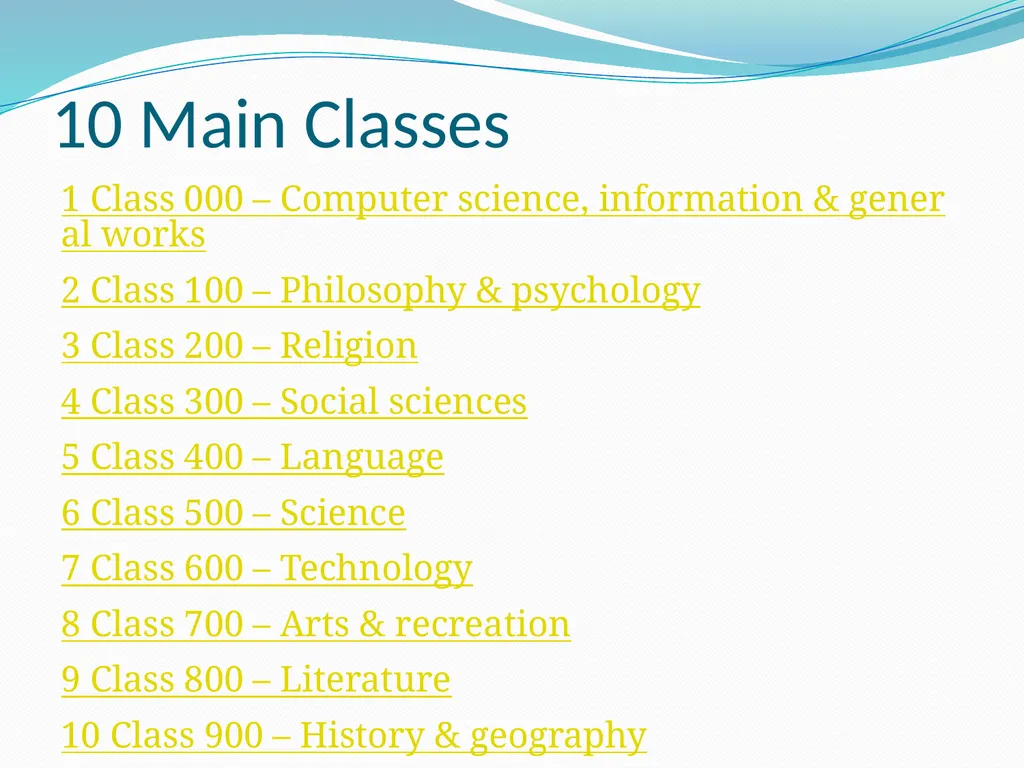
slide47. 10 Main Classes 1 Class 000 – Computer science, information & general works
2 Class 100 – Philosophy & psychology
3 Class 200 – Religion
4 Class 300 – Social sciences
5 Class 400 – Language
6 Class 500 – Science
7 Class 600 – Technology
8 Class 700 – Arts & recreation
9 Class 800 – Literature
10 Class 900 – History & geography<br>
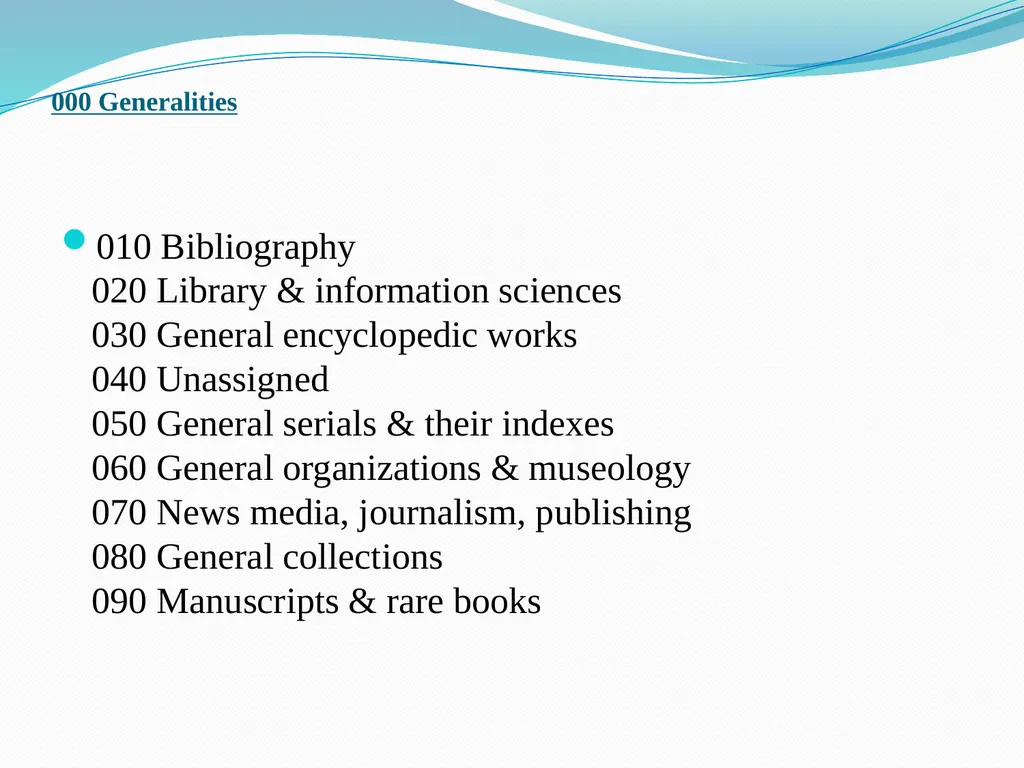
slide48. 000 Generalities 010 Bibliography 020 Library & information sciences 030 General encyclopedic works 040 Unassigned 050 General serials & their indexes 060 General organizations & museology 070 News media, journalism, publishing 080 General collections 090 Manuscripts & rare books<br>
slide49. 100 Philosophy and psychology
110 Metaphysics 120 Epistemology, causation, humankind 130 Paranormal phenomena, occult 140 Specific philosophical schools 150 Psychology 160 Logic 170 Ethics (moral philosophy) 180 Ancient, medieval, Oriental philosophy 190 Modern Western philosophy<br>
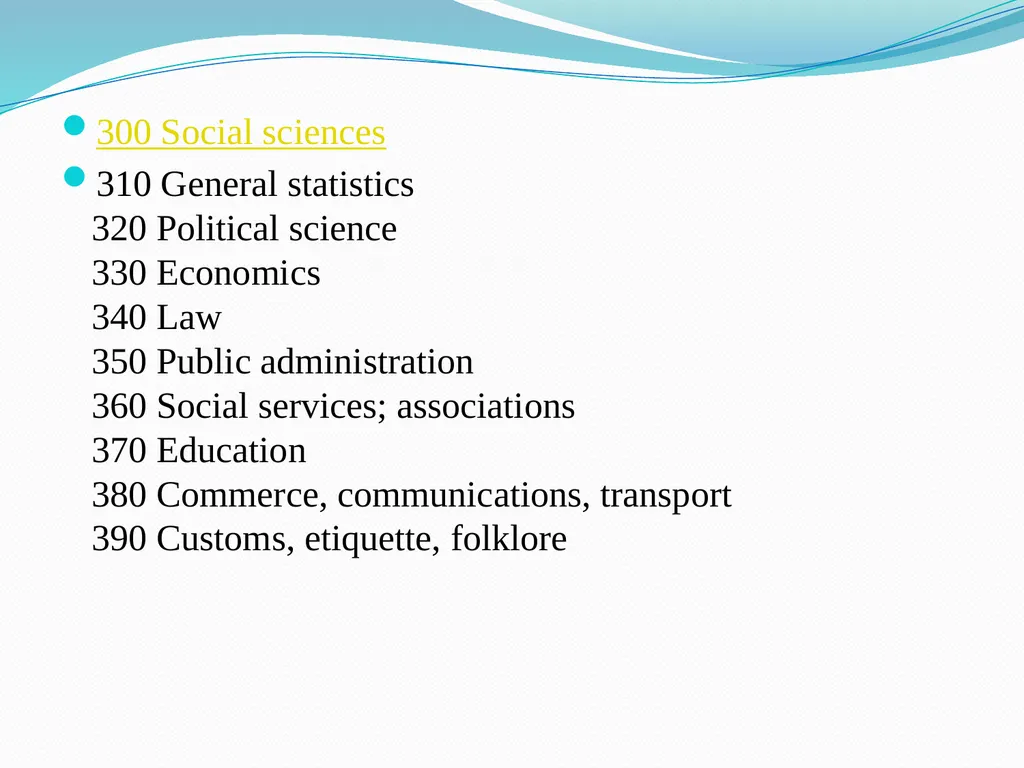
slide50. 300 Social sciences
310 General statistics 320 Political science 330 Economics 340 Law 350 Public administration 360 Social services; associations 370 Education 380 Commerce, communications, transport 390 Customs, etiquette, folklore<br>
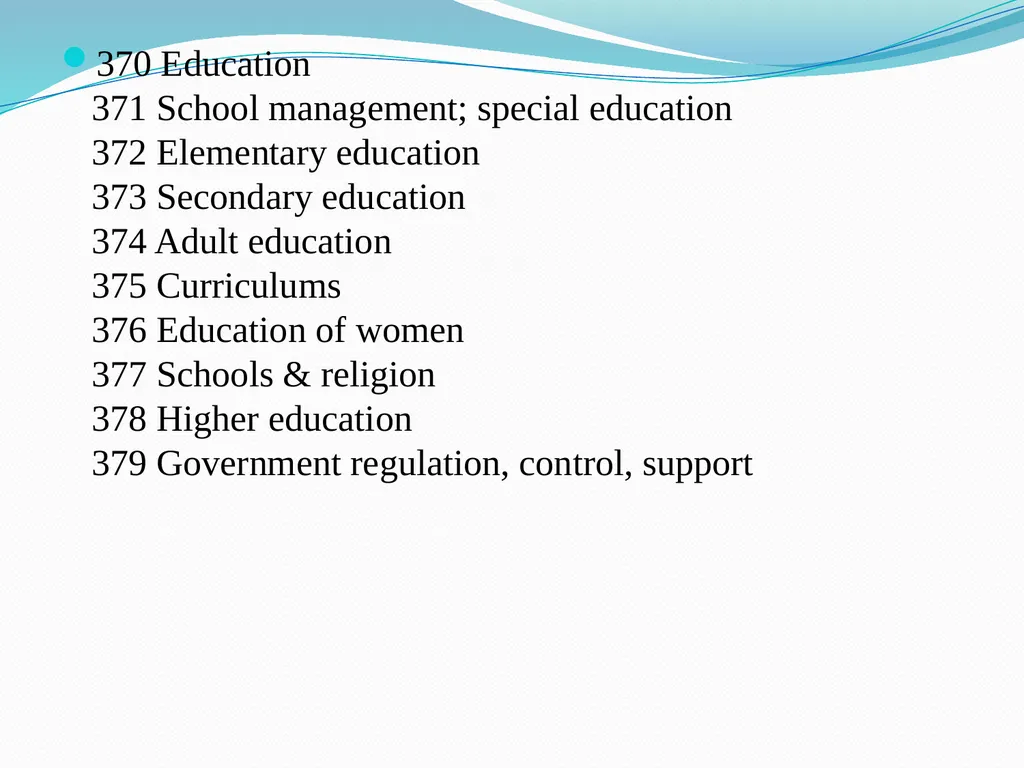
slide51. 370 Education 371 School management; special education 372 Elementary education 373 Secondary education 374 Adult education 375 Curriculums 376 Education of women 377 Schools & religion 378 Higher education 379 Government regulation, control, support<br>
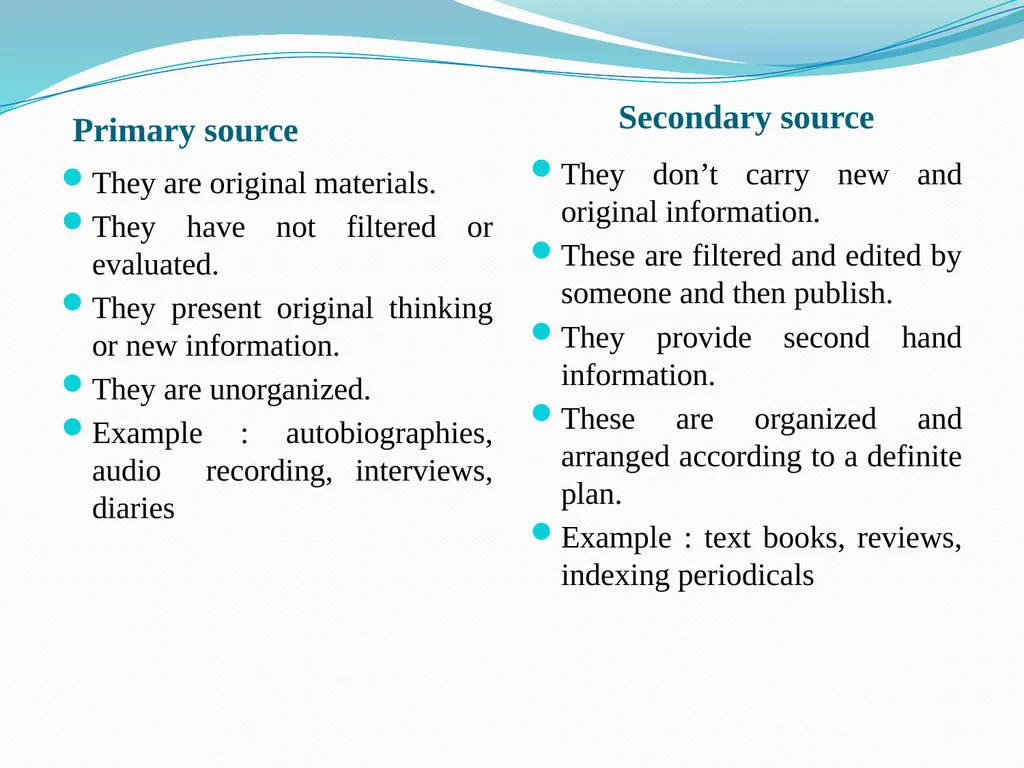
slide52. Primary source Secondary source They are original materials.
They have not filtered or evaluated.
They present original thinking or new information.
They are unorganized.
Example : autobiographies, audio recording, interviews, diaries They don’t carry new and original information.
These are filtered and edited by someone and then publish.
They provide second hand information.
These are organized and arranged according to a definite plan.
Example : text books, reviews, indexing periodicals<br>
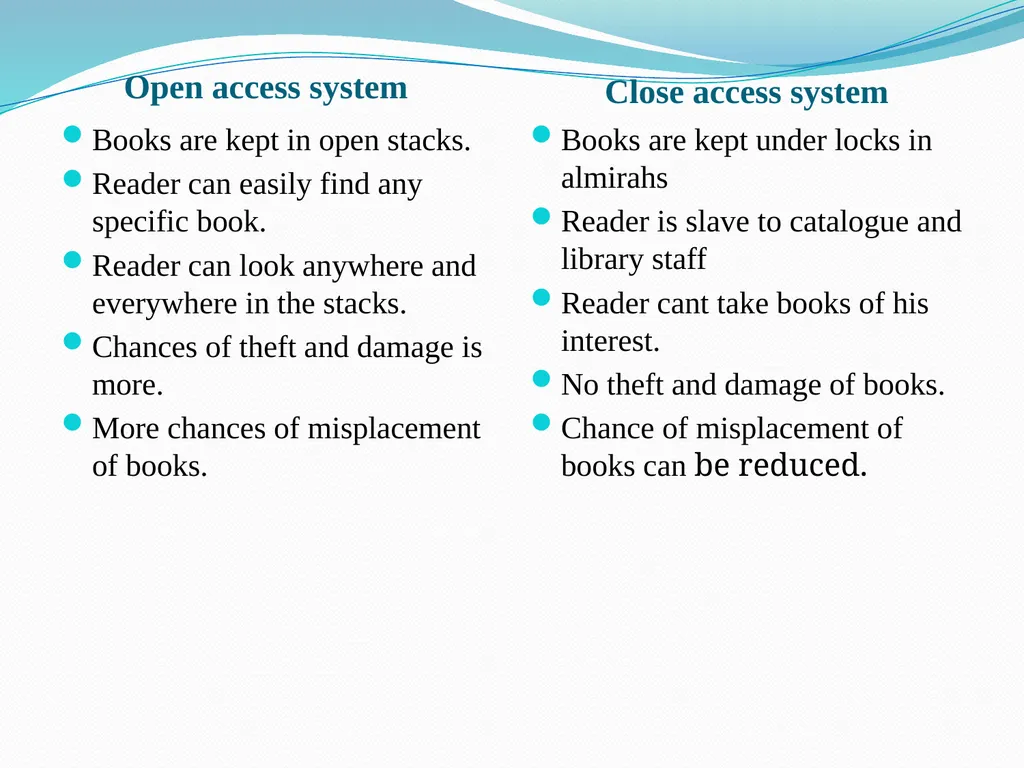
slide53. Open access system Close access system Books are kept in open stacks.
Reader can easily find any specific book.
Reader can look anywhere and everywhere in the stacks.
Chances of theft and damage is more.
More chances of misplacement of books. Books are kept under locks in almirahs
Reader is slave to catalogue and library staff
Reader cant take books of his interest.
No theft and damage of books.
Chance of misplacement of books can be reduced.<br>
slide2. Reading Material The source/material from where we get information after reading is called Reading Material. Library resources are considered as reading materials such as books, periodicals, magazines, newspapers, databases, e-resources etc.
Types of Reading Materials
1. Traditional resource
2. Electronic resources<br>
slide3. Traditional Resources It includes print reading material that could be published or unpublished. These may be books, magazines, reference books, periodicals, articles, dictionaries, guide books etc. that are organized based on their information contents. Different kinds of traditional reading materials have been classified in 3 groups such as
Primary source
Secondary Source
Tertiary source<br>
slide4. PRIMARY SOURCES Primary sources are original materials.
They have not been filtered through interpretation or evaluation.
They are usually the first formal appearance of results in physical, print or electronic format.
They present original thinking, report a discovery, or share new information.
Such resources are unorganized.<br>
slide5. Some types of primary sources include Original documents like speeches, manuscripts, new film footage, autobiographies, official records. Example book : The Story of My Experiments with Truth is the autobiography of Mohandas K. Gandhi
Creative works: Drama, novels, music, art
Artifacts: pottery, building, furniture<br>
slide6. Examples Audio recordings (e.g. radio or internet broadcasts)
Diaries, Notes, Autobiographies
Internet Communications (e.g. email, chat transcripts)
Interviews (e.g., oral histories, telephone, e-mail);
Journal articles describing original research or containing original analysis
Dissertations or theses (may also be secondary)
Letters, Postcards, & other forms of correspondence
Original Documents (i.e. birth certificates, wills, marriage licenses)
Photographs, Speeches
newspaper articles (may also be secondary)
Survey Results and Analysis (e.g. market surveys, public opinion polls)
Video recordings (e.g. television or internet broadcasts)<br>
slide7. Examples of primary sources: Books, magazines, newspapers Songs and poems<br>
slide8. SECONDARY SOURCES These contain chiefly known information i.e second hand information.
Result carried out are edited by someone else and then publish.
These are organised and arranged according to a definite plan.
They don’t carry new and original information
They are complied from primary sources.
They are interpretations and evaluations of primary sources<br>
slide9. Examples of secondary sources: Textbooks, biographies, histories, newspaper report<br>
slide10. Examples Biographical works
Periodical, Indexing periodicals, Abstracting periodicals
Reviews
Textbooks(standard book used for instruction)
Reference books (dictionary, encyclopaedia, handbook)
Magazine and newspaper articles (except eyewitness accounts, original reporting or analysis)
Books, other than fiction and autobiography<br>
slide11. TERTIARY SOURCES These type of documents are complied from primary or secondary sources which are organised according to definite plan.
The main function of tertiary sources is to aid the researchers in using secondary and primary sources.
They don’t carry any subject matter and are often last one to appear.<br>
slide12. Examples Directories
Fact Books
Databases
Guide to literature (a reference guide to recently published articles in periodical, magazines and scholarly journals).<br>
slide13. Electronic Resources<br>
slide14. E-Resource An e-resource is material which requires computer in order to access its content and make it useful. Both online and offline resources such as online material and CD-ROMs fall within the scope of e-resources.
It covers bibliographic databases, electronic reference books, search engines for full text books and digital collection of data.
According to Library and Information Technology Glossary “ E-resource is an information products that a library provides through a computer network... .."<br>
slide15. Types of e-resources E-Books
E-Journals
E-Zine
E-Thesis and dissertation (ETD)
E-newspaper
CD-ROM
Databases<br>
slide16. E-Book An E-book is a book in electronic format.
“A book composed in or converted to digital format for display on a computer screen or handheld device is an E-book”.
It is downloaded to a Computer, PC, Laptop, Mobile, and is read on the screen.<br>
slide17. Benefits We don't have to go to a bookstore to buy them, neither wait for them for days, weeks.
No trees are required to manufacture paper for the pages of E-books.
We can easily download an E-book.
E-books take up less space and are portable.
We can read E-books everywhere, on the bus, train, airplane.
We can carry a great number of E-books.
E-books can show links, for easy access to more information and related websites.
E-books are searchable and Fonts can be resized.
E-books are very easy to sell and distribute.
It is possible to purchase an E-book 24 hours a day.<br>
slide18. E-Journals An electronic journal is a periodical publication which is published in electronic format, usually on the Internet.
Benefits
We can e-mail articles or download them for printing.
It can be used simultaneously by more than one user.
It provides timely access and at the rate of 24 X 7 X 365 formula.
Hypertext links allow us to move to different sections within individual journals or articles and can link to related resources on the Internet.
E-Journals can include more images and audio-visual material.<br>
slide19. E- Magazines An e-zines are magazines or publications issued in an electronic form. Nearly every major magazine has a Web site, where either some selected or all of the articles can be read.
Benefits
Articles can be published without delay and can be instantly accessed from all over the world.
Comfortable searching mechanisms and individual collections of articles, depending on the readers’ interests, can be provided.
Interactive services like discussion groups or chat can be integrated.
It integrates various types of media like audio, video etc.<br>
slide20. E- Thesis and Dissertation (ETD) The term ETD (E-Thesis and Dissertation) refers to a master's dissertation or doctoral thesis that is archived and circulated electronically rather than archived and circulated in print.
Benefits
Theses submitted in support of a PhD are difficult to access, as they are only collected by the library of the university that granted the degree. ETDs can be easily located, readily accessible and delivered over the Web.
It empowers students to convey a richer message through the use of multimedia and hypermedia technologies.
It lower the cost of submitting and handling theses and dissertations.<br>
slide21. E-Newspaper An e-newspaper is a self-contained/complete and refreshable version of a traditional newspaper that acquires and holds information electronically.
Benefits
It’s immediately accessible and convenient.
Provide easy options for turning pages, linking to dynamic indexes, searching, saving and printing etc.
E-newspapers offer multimedia and hyperlink features.<br>
slide22. CD-ROM : Compact Disk-Read-Only Memory It is a type of optical disk capable of storing large amounts of data which cannot be erased. A single CD-ROM has the storage capacity of 700 floppy disks or 3,00,000 text pages.
Advantages of CD-ROM
It can be used for back files of journals, databases for information retrieval.
It has reliability, permanence, durability, high capacity and scope for mass data distribution.<br>
slide23. Databases A database is an electronic system that allows data to be easily accessed, manipulated and updated. A database is used by an organization as a method of storing, managing and retrieving information.
Advantages of Database
A database can be accessed by multiple users at the same time.
Searching for information within a large amount of data is much faster using a database
It allows for data sharing among other users who have access to the system.<br>
slide24. Ways of keeping Library Resources in Library<br>
slide25. 1. Open and Close access system
2.Library Classification<br>
slide26. Close access system Books are kept under locks in the almirahs.
Reader is slave to catalogue(only means to search the book) and library attendant.
Reader is not allowed to take books of his interest.
Steps
Check catalogue
Give a slip having bibliographic information to attendant
Attendant find the book.
If reader is not satisfied then again refer the catalogue and so on…
Sometimes book is not available and sometimes not according to taste of reader.
Reader gets discouraged sometimes.<br>
slide27. Merits No chances of misplacement: The chances of misplacement of book can be reduced because books are taken out and kept by library attendant only. So there is no fear of misplacement of the books.
Useful for small libraries: This system is very effective for small libraries where collection of books, number of users, library staff is less.
No fear of theft: It reduces the chances of theft and damage of books. It is the duty of library staff member to search the books for users and bring it outside. In this way, it may be possible to reduce the chances of theft and damage of books.
Useful for primary school: Primary school students don’t know how to use catalogue card. So library staff helps the user in finding books for them. So it’s good for primary school students.<br>
slide28. DEMERITS Not implemented in big libraries: It is used in libraries that have less collection of books. In Libraries having huge collection, this system cannot be implemented. So this system cannot be applicable in college or university libraries. It can be operated in small libraries only.
Waste time of user and staff: In close access system, users have to write detail information of the book like author, title, publisher, call no. etc. and give it to the library staff member. The staff member takes out the book for the users. It takes a lot of time of user as well as staff.<br>
slide29. Books not used properly: As user is dependent on staff and cannot explore books themselves so books are not used properly. It doesn’t satisfy 1st law ” Books are for use”.
User can’t express book requirement: Some users can’t express their book requirements. So they cannot get the right book as per their requirement therefore it doesn’t satisfy 2nd law “Every reader his/her book”.
Third law is not achieved: In this system, the users have no option to select the book. So few books that might be useful remain untouched. It doesn’t satisfy 3rd law “Every book its reader”.<br>
slide30. Open Access system Opportunity to see and examine the books with freedom.
Reader can look anywhere and everywhere in the stacks.
Reader can easily find any specific book. His curiosity for further reading is increased.
Steps
Books are kept in stacks.
Arranged in proper order.
Reader Refer catalogue and go to stack and easily get the book.<br>
slide31. Merits No need to depend on library staff: The users are not dependent on library staff. They can access the book of their interest. There is no restriction of any kind.
Time saving: It saves time and energy of library staff as well as of user both. In close access, library staff searches the book for user that waste time of user as well as of staff.
Extra work: The library staff can do other work in extra time as staff is not required for searching books for users.<br>
slide32. Proper use of books: In this system, the users have an option to select the book after reading the contents of the book. He finds some other books related to the topic.
Library work can be completed by less staff member: In this system, less staff is required as user independently access library books.
Famous method: This system is widely accepted in big libraries like college and universities.
Develop self-study habit : Users can directly access books and develop self-study habits.<br>
slide33. DEMERITS More chances of theft and damage: In open access system, chances of book theft and damage are more. Some users even tear the pages of the book.
Fear of replacement of books: There are more chances of misplacement of books. The books in more demand are misplaced by the users. So books are to be properly replaced at their proper place.
More Requirements of dusting and shelving: In this system, there is a need to maintain the books regularly. Staff is required for daily shelving and dusting and keeping the books in proper place.
Necessity of security guard: There is need to appoint security guard to avoid theft in library. He has to check user’s books before leaving the library.<br>
slide34. Precautions of the theft activities from the library Personal bags not allowed in the library: Bags, personal books of students and their belongings are not allowed in the library. These should be deposited at the property counter. While going out of the library the property so deposited must be taken back.
Book proof window: Libraries have windows for fresh air and to purify the environment. But some naughty students steal library books by throwing them outside the library. So windows in library should be book proof.
One door for entry and exit: There should be one door for entry and exit. Books should be checked before leaving the library by security guard to avoid theft in library.
CCTV (closed circuit television): The security of books and other materials providing information in a library is quite essential. CCTV should be installed at in library to avoid theft of books. The CCTV cameras are used for surveillance in libraries to safe guard its possession of books and information.<br>
slide35. Classification<br>
slide36. Classification Derived from “Latin” word “Classic”. It Means “Process of grouping” .
Classification is a process of grouping like entities together and separating unlike entities.
Arrangements of ideas /objects in a systematic order.<br>
slide37. We do Classification in our daily lives eg kitchen, classroom etc. This is done to improve the efficiency of the various operations. But in library classification we are concerned with documents, and the aim is to arrange these in the most helpful and permanent order.<br>
slide38. Definitions According to New Encyclopedia Britannica, Classification is an arrangement adopted by libraries to facilitate its clientele/users to find documents quickly and easily.
According to W.C.B. Sayers “Classification is the “arrangement of books on shelves or description of them in the manner which is most helpful to those who read.”<br>
slide39. Classification Systems Libraries store and manage thousands of materials. These materials need to be organized in a manner that allows the easiest possible access for the readers.
Classification Systems are the tools libraries use to organize books and other library materials.
Classification Systems consists of subjects that can be located by call number.<br>
slide40. Cont… Classification Systems all use a system of letters and numbers to denote a particular subject.
Call Numbers are the primary access point for finding library materials. Call number provide information to users and Library staff members that help them to locate books and other library materials.<br>
slide41. Benefits It brings like books together: Classification arranges books in an order most convenient to the readers and the librarians. Readers should find all the related books together and librarians should minimum time and energy in locating the documents.
It saves time: Classification is a great time saving device for readers, as well as librarians and thus fulfils the demand of the fourth law of library science.
It reveals the weakness and strength of the collection: As classification arranges books on shelf by subject, it clearly shows which subjects have a good collection, and which subjects require more attention.
It helps in bibliographic research: Classification helps in the compilation of bibliographies, catalogues and union catalogues.
It helps in stock verification: Classification plays a significant role in the stock taking procedure.<br>
slide42. Need and Purpose of Classification Storage and retrieval :Due to nature of documents and different forms of documents it has become necessary to arrange them systematically for the purpose of storage and retrieval.
Satisfy law- The main purpose of library classification is to satisfy the laws of library science by arranging books in systematic manner, so that the reader are able to retrieve the books from shelf easily without the help of staff.
In order to provide reference service effectively, it is essential that the document should be arranged systematically.<br>
slide43. Correct Replacement - It is essential that library classification should enable the correct replacement of documents after they have been returned from use.
Withdrawal of Document from Stock: In this case, the need arises to withdraw a document from the library collection for some reason, and then library classification should facilitate such a withdrawal.
Addition of New Document: Library would acquire new documents from time to time therefore library classification should help in finding the most helpful place for each of those among the existing collection of the library.
Book Display: The collection in an open access library is well presented and guided. Library classification should be helpful in the organization of book displays.<br>
slide44. Examples of DDC Guidance and Counselling by S P SURI
371.4
S961G
Philospohical perspective in education by NANDRA, INDER DEV
370.193
N176P<br>
slide45. Major schemes of Classification DDC (Dewey decimal classification)
UDC (Universal decimal classification)
CC (Colon classification)
LC (Library of congress classification)
Bibliographic classification<br>
slide46. DDC The Dewey Decimal Classification System is the most widely used method for classifying books in the library. This system is a general knowledge organization tool that is continuously revised to keep pace with knowledge. It is named after Melvil Dewey, an American Librarian who developed it in 1876.
In the DDC, basic classes are organized by disciplines or fields of study. At the broadest level, the DDC is divided into ten main classes, which together cover the entire world of knowledge. Each main class is further divided into ten divisions, and each division into ten sections .<br>
slide47. 10 Main Classes 1 Class 000 – Computer science, information & general works
2 Class 100 – Philosophy & psychology
3 Class 200 – Religion
4 Class 300 – Social sciences
5 Class 400 – Language
6 Class 500 – Science
7 Class 600 – Technology
8 Class 700 – Arts & recreation
9 Class 800 – Literature
10 Class 900 – History & geography<br>
slide48. 000 Generalities 010 Bibliography 020 Library & information sciences 030 General encyclopedic works 040 Unassigned 050 General serials & their indexes 060 General organizations & museology 070 News media, journalism, publishing 080 General collections 090 Manuscripts & rare books<br>
slide49. 100 Philosophy and psychology
110 Metaphysics 120 Epistemology, causation, humankind 130 Paranormal phenomena, occult 140 Specific philosophical schools 150 Psychology 160 Logic 170 Ethics (moral philosophy) 180 Ancient, medieval, Oriental philosophy 190 Modern Western philosophy<br>
slide50. 300 Social sciences
310 General statistics 320 Political science 330 Economics 340 Law 350 Public administration 360 Social services; associations 370 Education 380 Commerce, communications, transport 390 Customs, etiquette, folklore<br>
slide51. 370 Education 371 School management; special education 372 Elementary education 373 Secondary education 374 Adult education 375 Curriculums 376 Education of women 377 Schools & religion 378 Higher education 379 Government regulation, control, support<br>
slide52. Primary source Secondary source They are original materials.
They have not filtered or evaluated.
They present original thinking or new information.
They are unorganized.
Example : autobiographies, audio recording, interviews, diaries They don’t carry new and original information.
These are filtered and edited by someone and then publish.
They provide second hand information.
These are organized and arranged according to a definite plan.
Example : text books, reviews, indexing periodicals<br>
slide53. Open access system Close access system Books are kept in open stacks.
Reader can easily find any specific book.
Reader can look anywhere and everywhere in the stacks.
Chances of theft and damage is more.
More chances of misplacement of books. Books are kept under locks in almirahs
Reader is slave to catalogue and library staff
Reader cant take books of his interest.
No theft and damage of books.
Chance of misplacement of books can be reduced.<br>