
Dipartimento di Ingegneria Industriale e
TA
Published · 41 slides · 0 views

1 / 1

Description
Dipartimento di Ingegneria Industriale e dellInformazione via Roma 29, 81031 Aversa, Italy Speaker: Oronzio Manca Master Degree in InnovativeTechnologies in Energy Efficient Buildings for Russian Armenian Universities and Stakeholders
Related Topics
Share
Embed code
Download this presentation From Below
"Dipartimento di Ingegneria Industriale e" is the property of its rightful owner. Permission is granted to download and print the materials on this website for personal, non-commercial use only, and to display it on your personal computer provided you do not modify the materials and that you retain all copyright notices contained in the materials. By downloading content from our website, you accept the terms of this agreement.
Presentation Transcript
01
Dipartimento di Ingegneria Industriale e dell’Informazione
via Roma 29, 81031 Aversa, Italy Speaker: Oronzio Manca Master Degree in InnovativeTechnologies in Energy Efficient Buildings for Russian & Armenian Universities and Stakeholders MARUEEB project 561890-EPP-1-2015-1-IT-EPPKA2-CBHE-JP Insulating Materials<br>
via Roma 29, 81031 Aversa, Italy Speaker: Oronzio Manca Master Degree in InnovativeTechnologies in Energy Efficient Buildings for Russian & Armenian Universities and Stakeholders MARUEEB project 561890-EPP-1-2015-1-IT-EPPKA2-CBHE-JP Insulating Materials<br>
02
INSULATING MATERIALS There are no clear definitions.
Typically this concept is linked to a low value.
Cork: first material used in construction as insulation.
The thermal conductivity of a material decreases with increasing its porosity.<br>
Typically this concept is linked to a low value.
Cork: first material used in construction as insulation.
The thermal conductivity of a material decreases with increasing its porosity.<br>
03
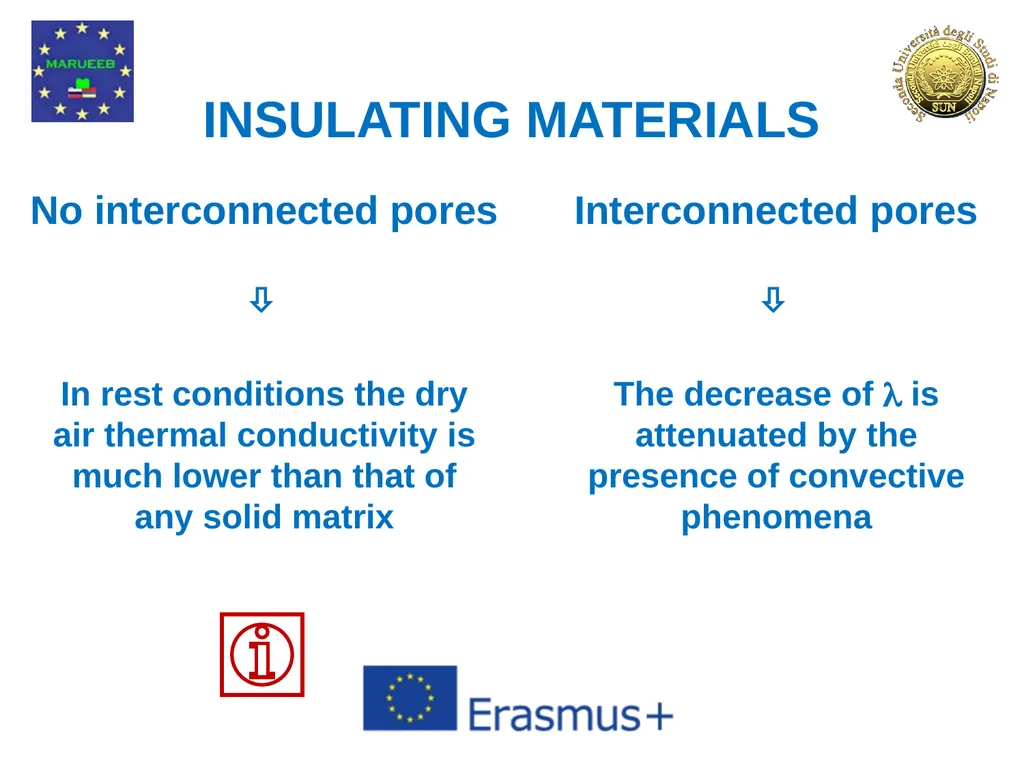
INSULATING MATERIALS No interconnected pores Interconnected pores In rest conditions the dry air thermal conductivity is much lower than that of any solid matrix The decrease of is attenuated by the presence of convective phenomena<br>
04
CLASSIFICATION Mineral insulating
Vegetal insulating
Synthetic insulating With reference to the nature of the solid structure Mineral insulating:
they result from technological processes that have as a basic component a mineral or a mineral rock<br>
Vegetal insulating
Synthetic insulating With reference to the nature of the solid structure Mineral insulating:
they result from technological processes that have as a basic component a mineral or a mineral rock<br>
05
CLASSIFICATION Mineral insulating
Vegetal insulating
Synthetic insulating With reference to the nature of the solid structure Vegetal insulating:
they have as a basic component a vegetal material with a variety of processes depending on the raw material used<br>
Vegetal insulating
Synthetic insulating With reference to the nature of the solid structure Vegetal insulating:
they have as a basic component a vegetal material with a variety of processes depending on the raw material used<br>
06
CLASSIFICATION Mineral insulating
Vegetal insulating
Synthetic insulating With reference to the nature of the solid structure Synthetic insulating:
are high molecular weight materials obtained by synthesis of organic compounds with low molecular weight<br>
Vegetal insulating
Synthetic insulating With reference to the nature of the solid structure Synthetic insulating:
are high molecular weight materials obtained by synthesis of organic compounds with low molecular weight<br>
07
CLASSIFICATION Mineral insulating: glass fibers, perlite, vermiculite, foamed clay, ...
Vegetal insulating: panels made of wood fibers, cork, cellulose, ...
Synthetic insulating: plastic materials, synthetic resins, ... With reference to the nature of the solid structure<br>
Vegetal insulating: panels made of wood fibers, cork, cellulose, ...
Synthetic insulating: plastic materials, synthetic resins, ... With reference to the nature of the solid structure<br>
08
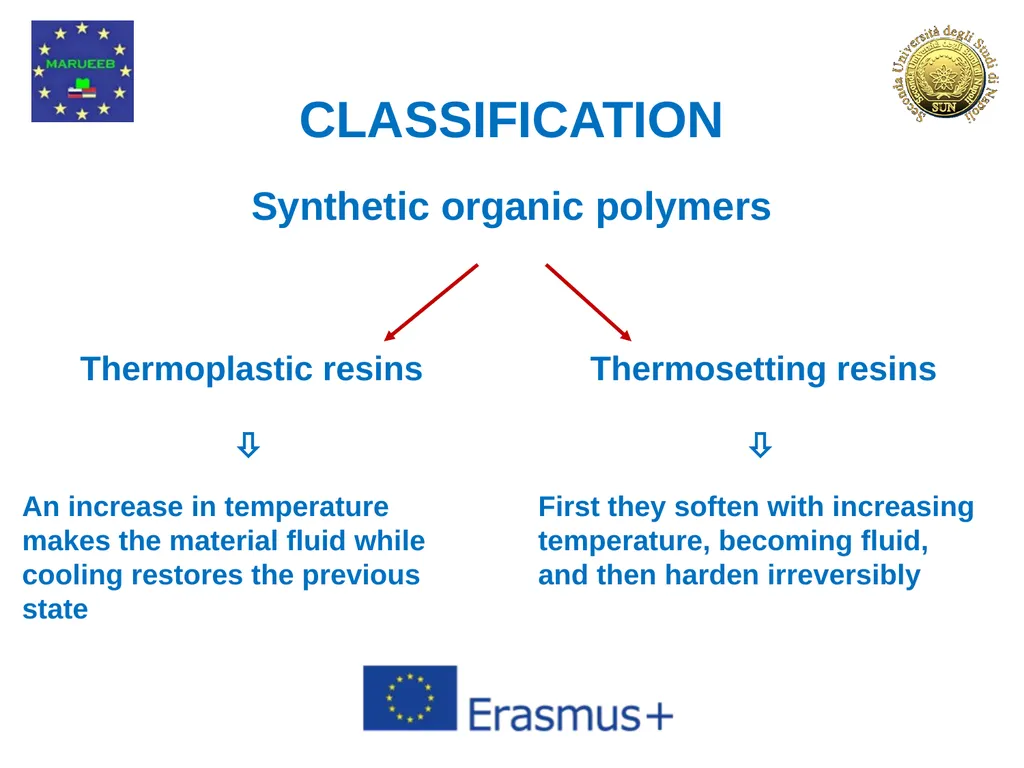
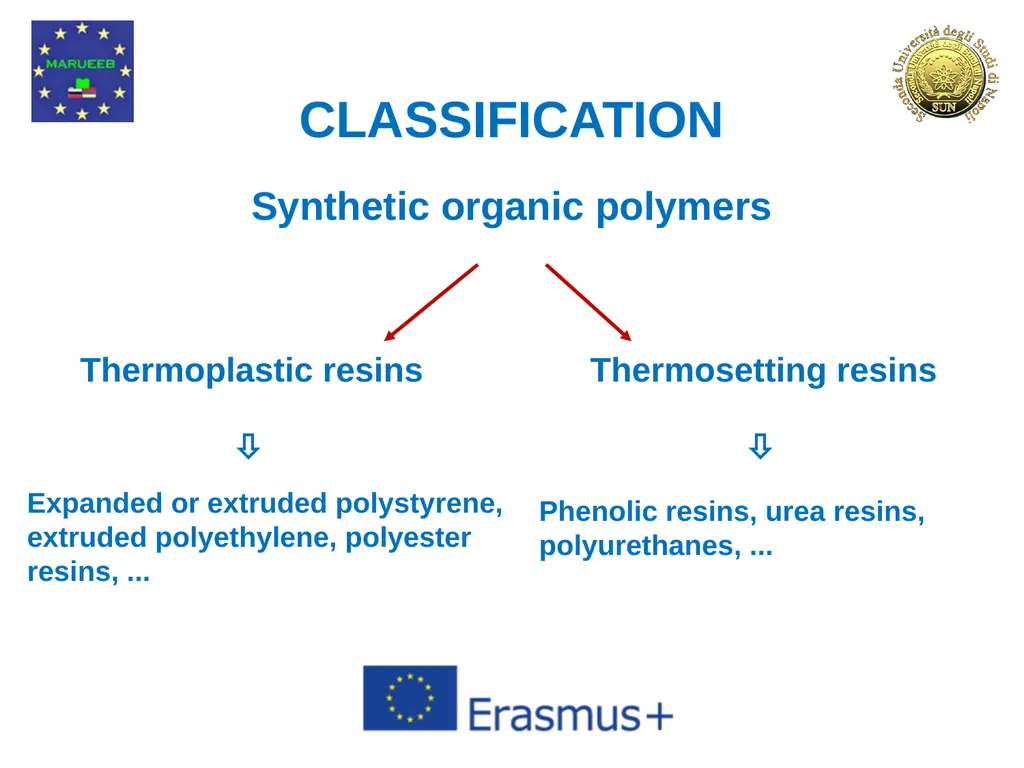
CLASSIFICATION Thermoplastic resins Synthetic organic polymers Thermosetting resins First they soften with increasing temperature, becoming fluid, and then harden irreversibly An increase in temperature makes the material fluid while cooling restores the previous state<br>
09
CLASSIFICATION Thermoplastic resins Synthetic organic polymers Thermosetting resins Expanded or extruded polystyrene, extruded polyethylene, polyester resins, ... Phenolic resins, urea resins, polyurethanes, ...<br>
10
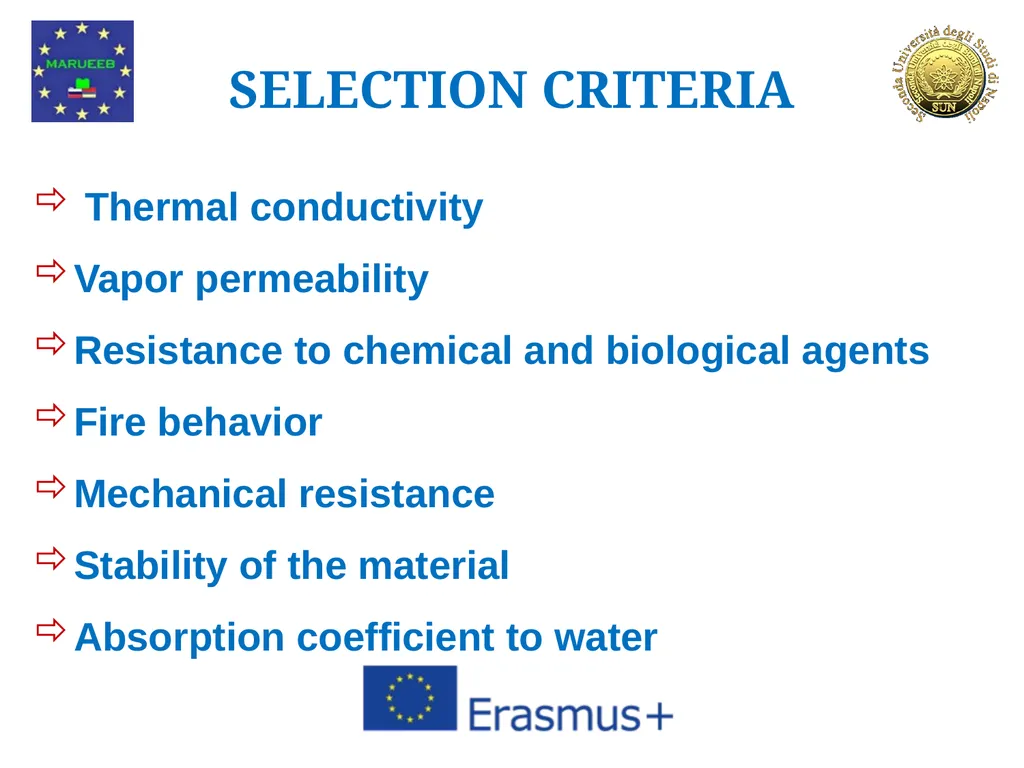
SELECTION CRITERIA Thermal conductivity
Vapor permeability
Resistance to chemical and biological agents
Fire behavior
Mechanical resistance
Stability of the material
Absorption coefficient to water<br>
Vapor permeability
Resistance to chemical and biological agents
Fire behavior
Mechanical resistance
Stability of the material
Absorption coefficient to water<br>
11
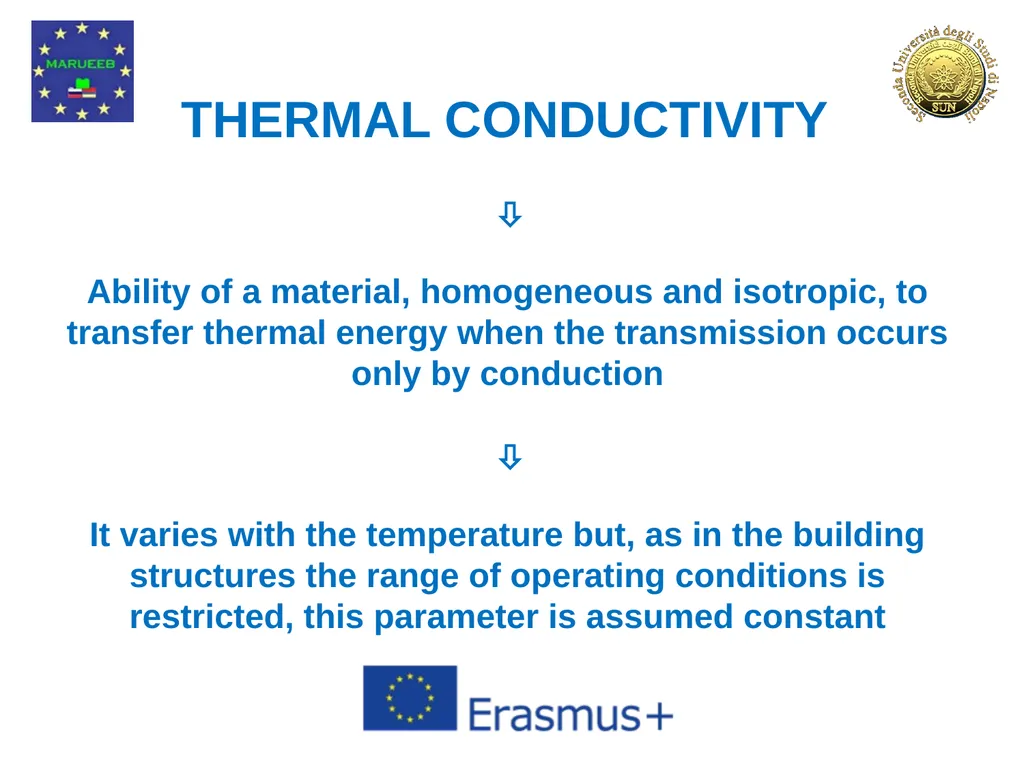
THERMAL CONDUCTIVITY Ability of a material, homogeneous and isotropic, to transfer thermal energy when the transmission occurs only by conduction It varies with the temperature but, as in the building structures the range of operating conditions is restricted, this parameter is assumed constant <br>
12
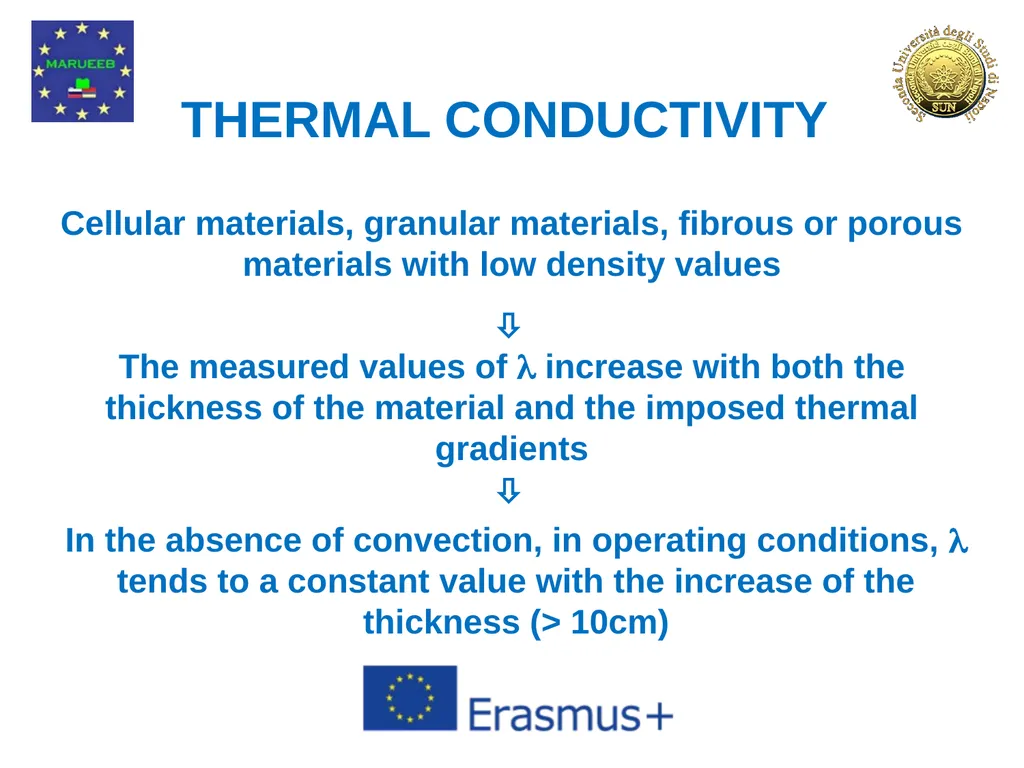
THERMAL CONDUCTIVITY Cellular materials, granular materials, fibrous or porous materials with low density values The measured values of increase with both the thickness of the material and the imposed thermal gradients In the absence of convection, in operating conditions, tends to a constant value with the increase of the thickness (> 10cm)<br>
13
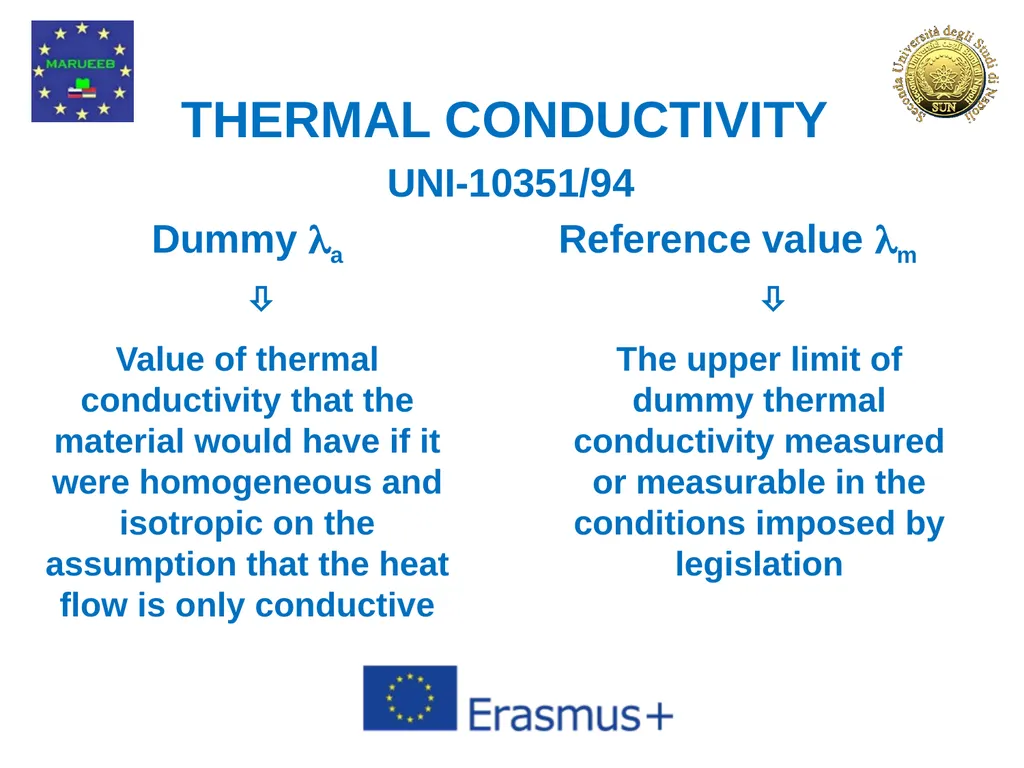
THERMAL CONDUCTIVITY UNI-10351/94 Value of thermal conductivity that the material would have if it were homogeneous and isotropic on the assumption that the heat flow is only conductive Dummy a Reference value m The upper limit of dummy thermal conductivity measured or measurable in the conditions imposed by legislation<br>
14
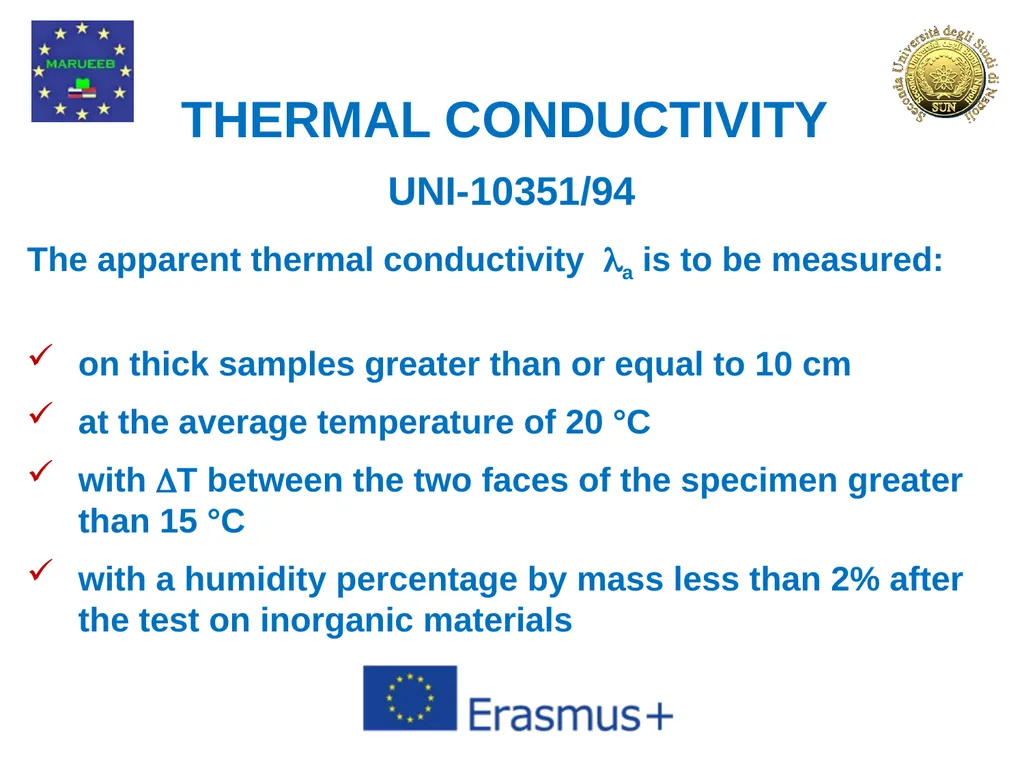
THERMAL CONDUCTIVITY UNI-10351/94 The apparent thermal conductivity a is to be measured:
on thick samples greater than or equal to 10 cm
at the average temperature of 20 °C
with T between the two faces of the specimen greater than 15 °C
with a humidity percentage by mass less than 2% after the test on inorganic materials<br>
on thick samples greater than or equal to 10 cm
at the average temperature of 20 °C
with T between the two faces of the specimen greater than 15 °C
with a humidity percentage by mass less than 2% after the test on inorganic materials<br>
15
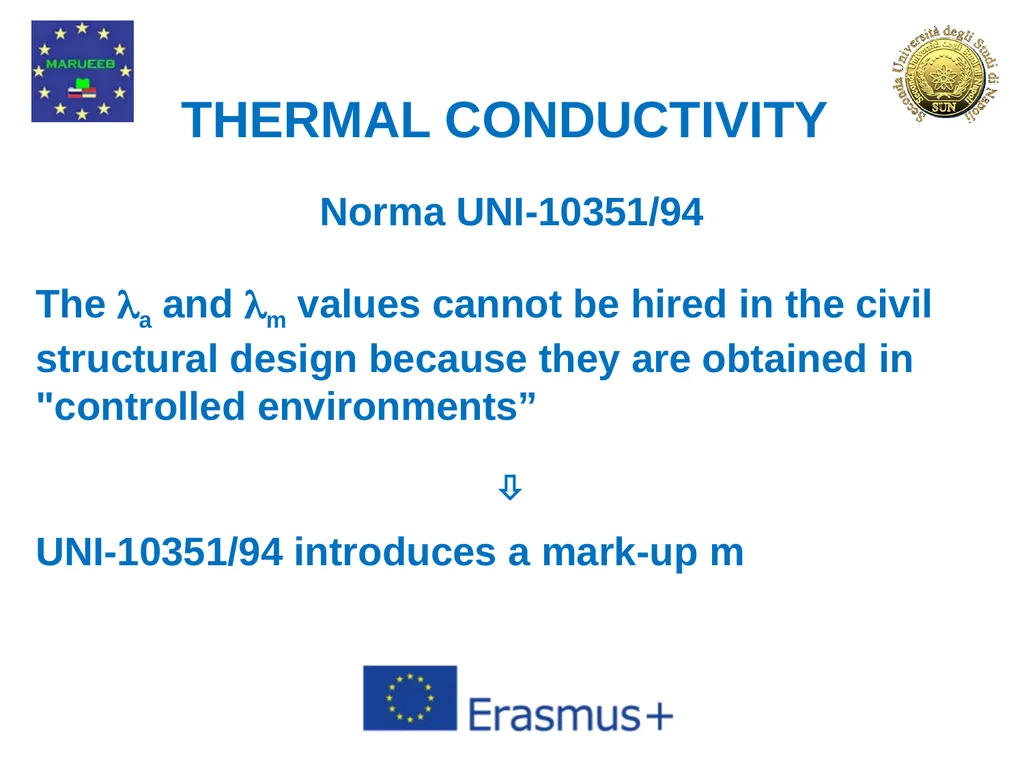
THERMAL CONDUCTIVITY Norma UNI-10351/94 The a and m values cannot be hired in the civil structural design because they are obtained in "controlled environments” UNI-10351/94 introduces a mark-up m<br>
16
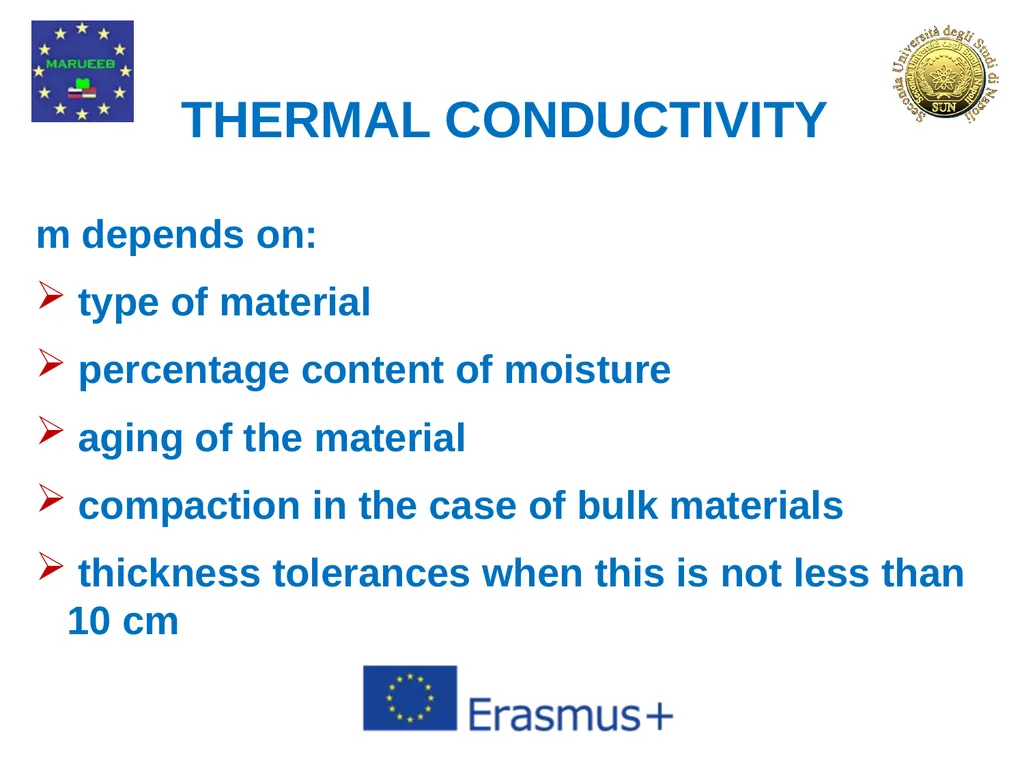
THERMAL CONDUCTIVITY m depends on:
type of material
percentage content of moisture
aging of the material
compaction in the case of bulk materials
thickness tolerances when this is not less than 10 cm<br>
type of material
percentage content of moisture
aging of the material
compaction in the case of bulk materials
thickness tolerances when this is not less than 10 cm<br>
17
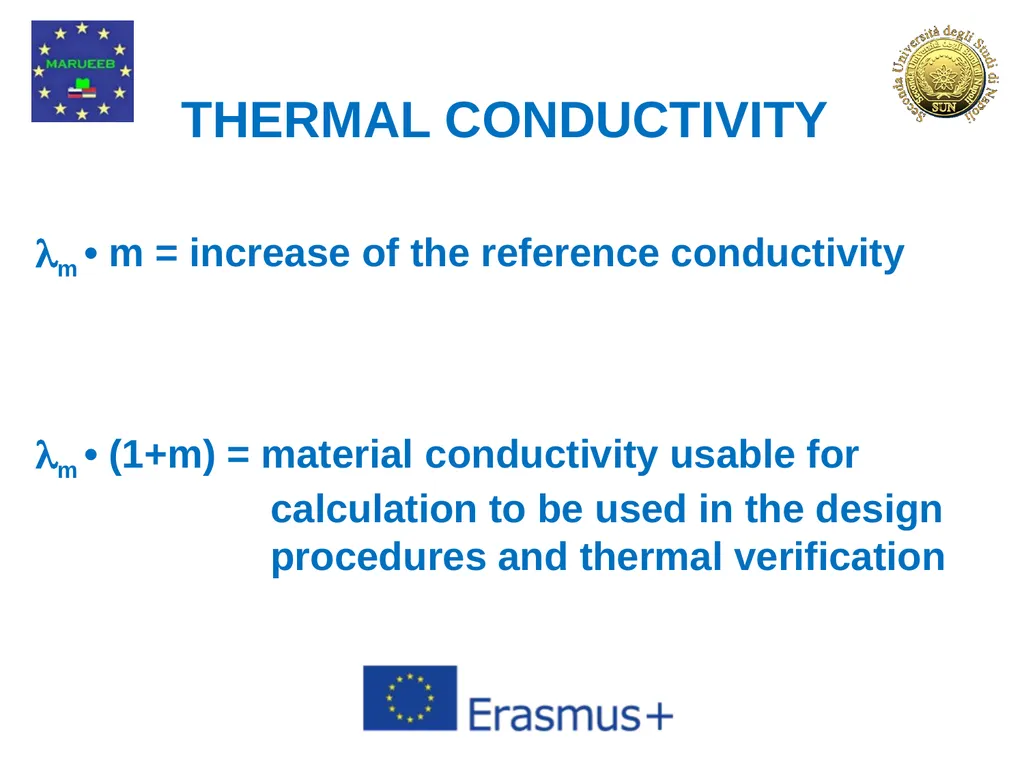
THERMAL CONDUCTIVITY m • m = increase of the reference conductivity m • (1+m) = material conductivity usable for calculation to be used in the design procedures and thermal verification<br>
18
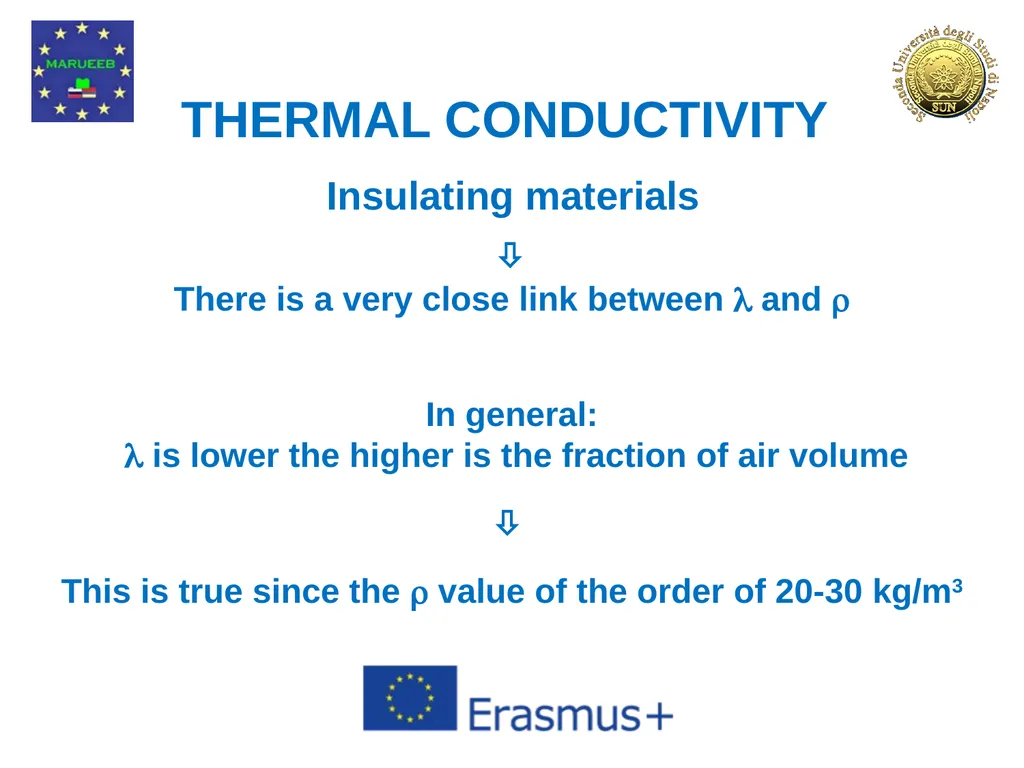
THERMAL CONDUCTIVITY Insulating materials There is a very close link between and In general:
is lower the higher is the fraction of air volume This is true since the value of the order of 20-30 kg/m3<br>
19
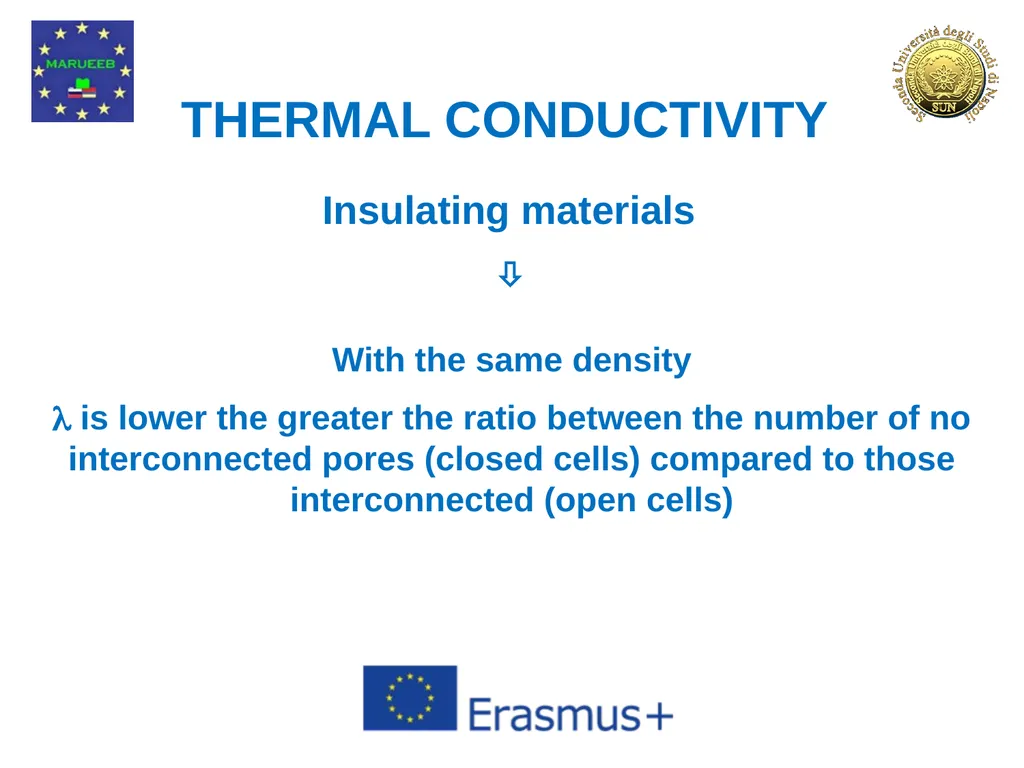
THERMAL CONDUCTIVITY Insulating materials With the same density
is lower the greater the ratio between the number of no interconnected pores (closed cells) compared to those interconnected (open cells) <br>
is lower the greater the ratio between the number of no interconnected pores (closed cells) compared to those interconnected (open cells) <br>
20
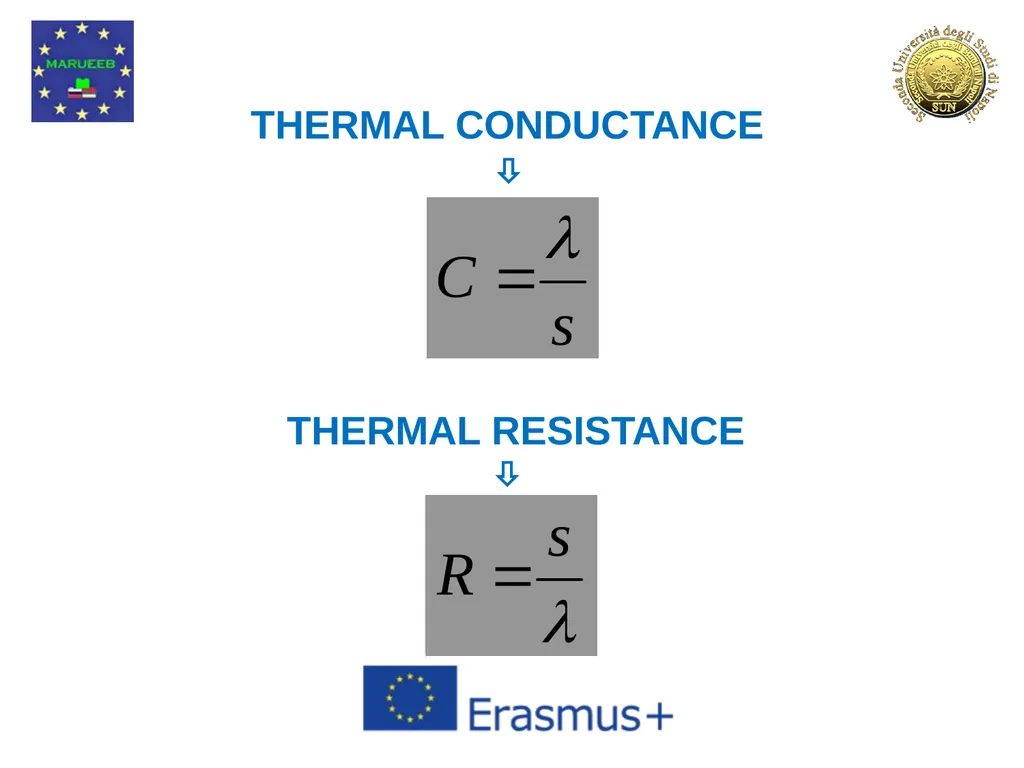
thermal conductance Thermal resistance <br>
21
Vapor permeability Ability of a material to vapor diffusion and depends on the chemical composition, structure and porosity of the material It varies with the temperature and pressure but, given the small variation that these properties have in the building field, this parameter is assumed constant <br>
22
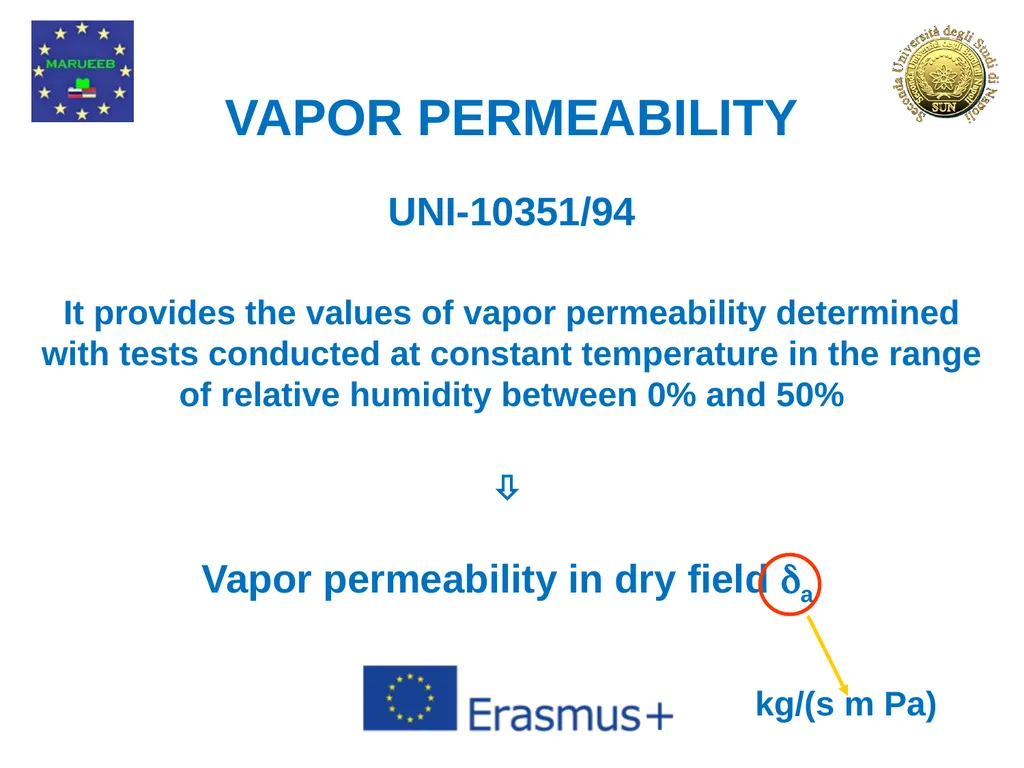
Vapor permeability UNI-10351/94 It provides the values of vapor permeability determined with tests conducted at constant temperature in the range of relative humidity between 0% and 50% Vapor permeability in dry field a kg/(s m Pa)<br>
23
Vapor permeability UNI-10351/94 The hygrometric behavior of the material in work can be significantly different from that of laboratory UNI-10351/94 provides the values of vapor permeability in moist field u<br>
24
Vapor permeability UNI-10351/94 For several materials the data relating to vapor permeability are limited and uncertain UNI-10351/94 provides a unique value of permeability preceded by the sign <br>
25
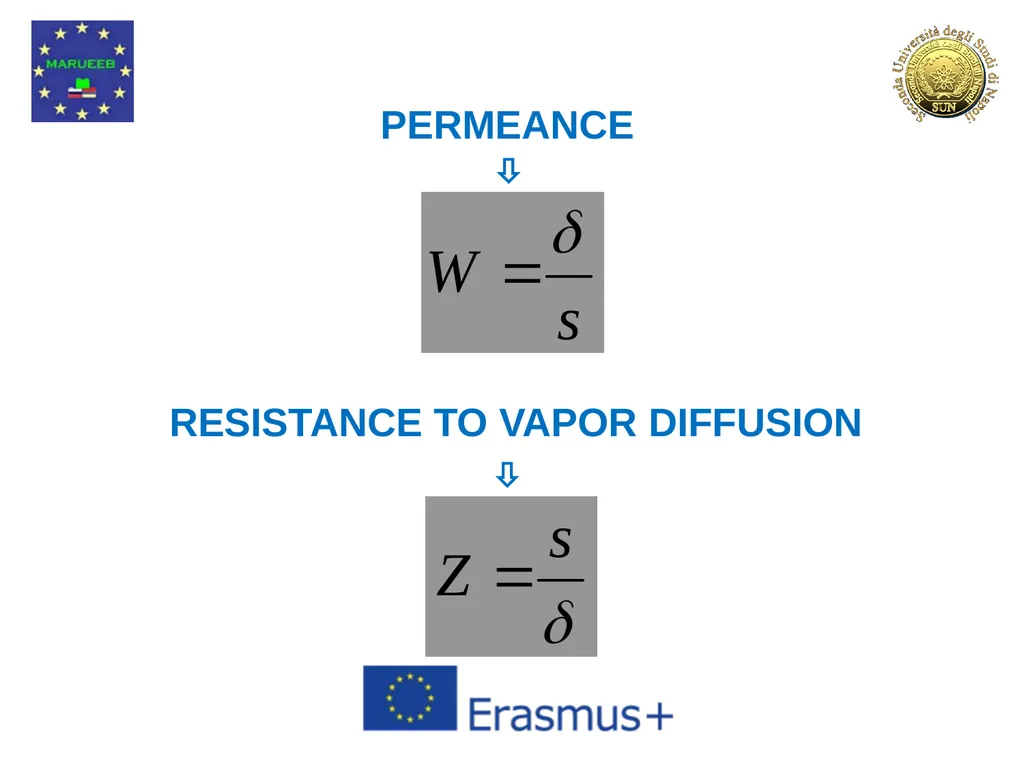
permeance RESISTANCE TO VAPOR DIFFUSION <br>
26
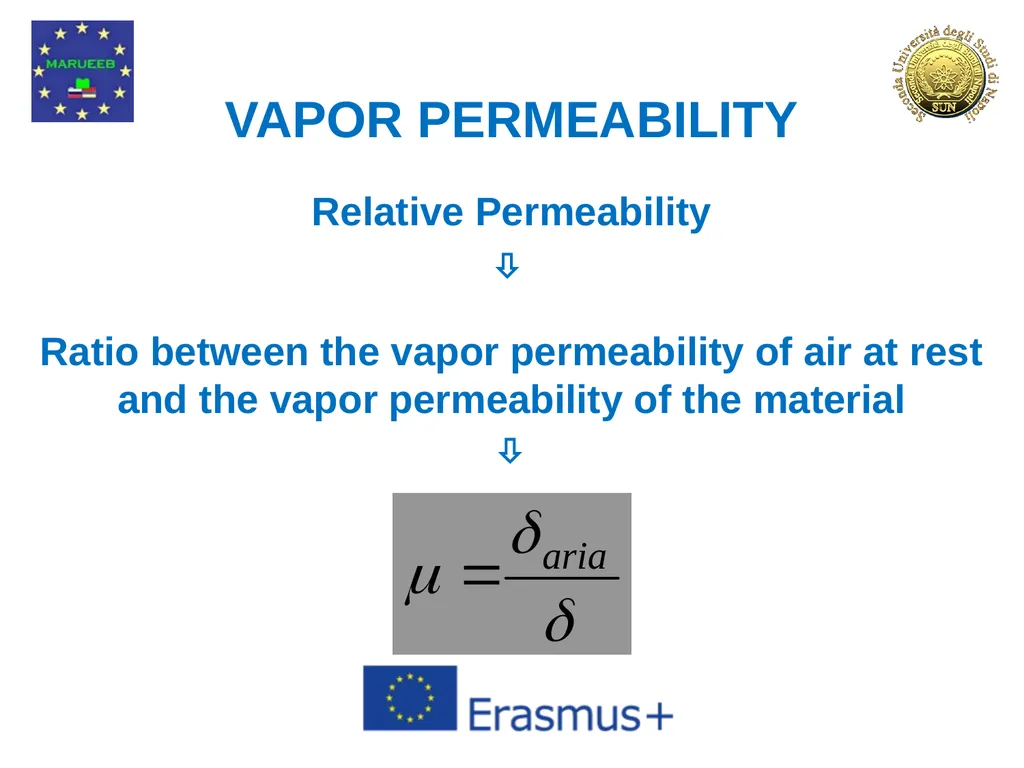
Vapor permeability Relative Permeability Ratio between the vapor permeability of air at rest and the vapor permeability of the material <br>
27
Resistance to chemical and biological agents It is important to know for each insulating material which are substances that can attack it chemically It is necessary to verify the behavior of the material under the action of biological agents <br>
28
FIRE BEHAVIOUR Under current rules, the buildings are divided into classes, depending on the extent of the fire hazard The class indicates, in minutes, the minimum period of the fire resistance of the structures or components <br>
29
FIRE BEHAVIOUR The fire behavior of a material must be evaluated not only according to the intrinsic characteristics of the material itself, but also in function of: its position in the element structure
the fire behavior of the other materials constituting the structural element
the type of building
the building's target<br>
the fire behavior of the other materials constituting the structural element
the type of building
the building's target<br>
30
FIRE BEHAVIOUR Fire resistance Attitude of an element to preserve the characteristics of stability R, retaining E and heat insulation I The E It is expressed in minutes<br>
31
FIRE BEHAVIOUR Fire resistance R: ability to retain the mechanical strength under the fire action
E: ability to not let pass or produce flames, vapors or hot gases<br>
E: ability to not let pass or produce flames, vapors or hot gases<br>
32
FIRE BEHAVIOUR Fire reaction Level of participation of a combustible material to a fire to which it is subjected It describes the behavior of the material during the ignition phase and its spread<br>
33
MECHANICAL RESISTANCE The mechanical properties are those which the material manifests under the action of a load The compressive resistance of the insulating material takes on particular importance in the case of insulation of horizontal structures<br>
34
MECHANICAL RESISTANCE Compressive resistance The unit load value which causes the breakage of a regular geometric shape specimen, subjected to a normal compressive stress with free lateral expansion It increases with increasing density <br>
35
DIMENSIONAL STABILITY Most of the thermal insulators is produced with technologies that use cooking ovens or exothermic reactions The cooling can cause a reduction in size, which is particularly strong in the first successive times to the production<br>
36
DIMENSIONAL STABILITY This shrinkage increases with increasing density of the material The regulation establishes the conditions under which the tests shall be performed <br>
37
WATER ABSORPTION Capacity of the material to be imbibed with water This characteristic is evaluated by the percentage change in volume of a series of specimens to a predetermined temperature after they have been immersed in water for an established period of time <br>
38
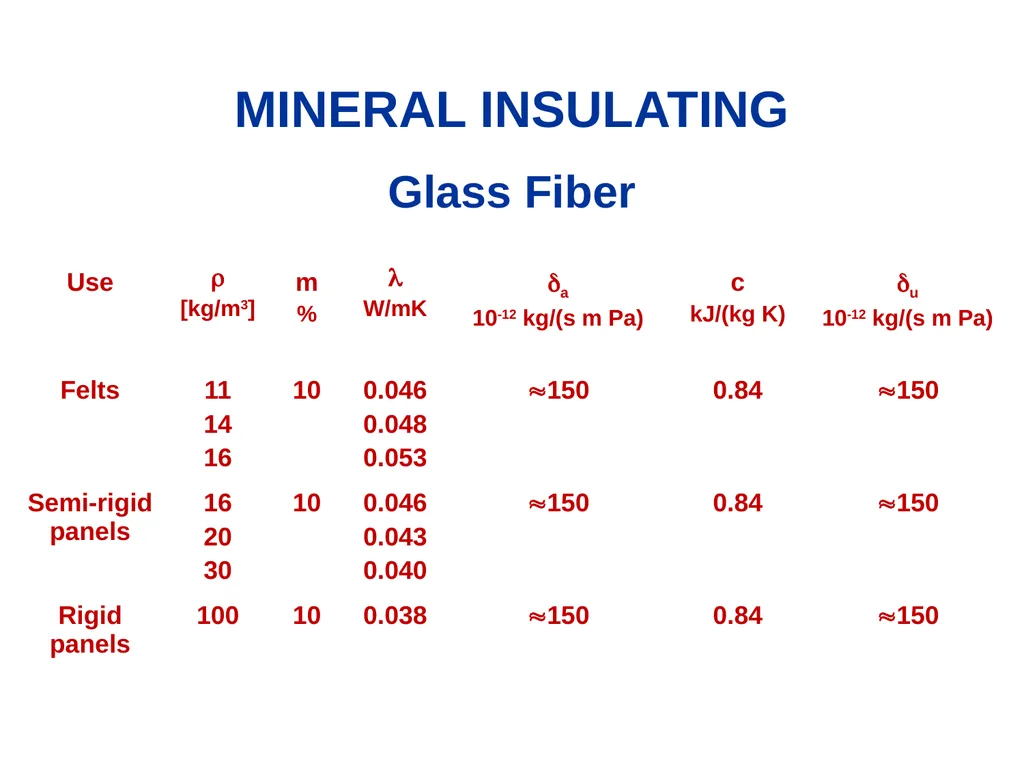
MINERAL INSULATING Glass Fiber<br>
39
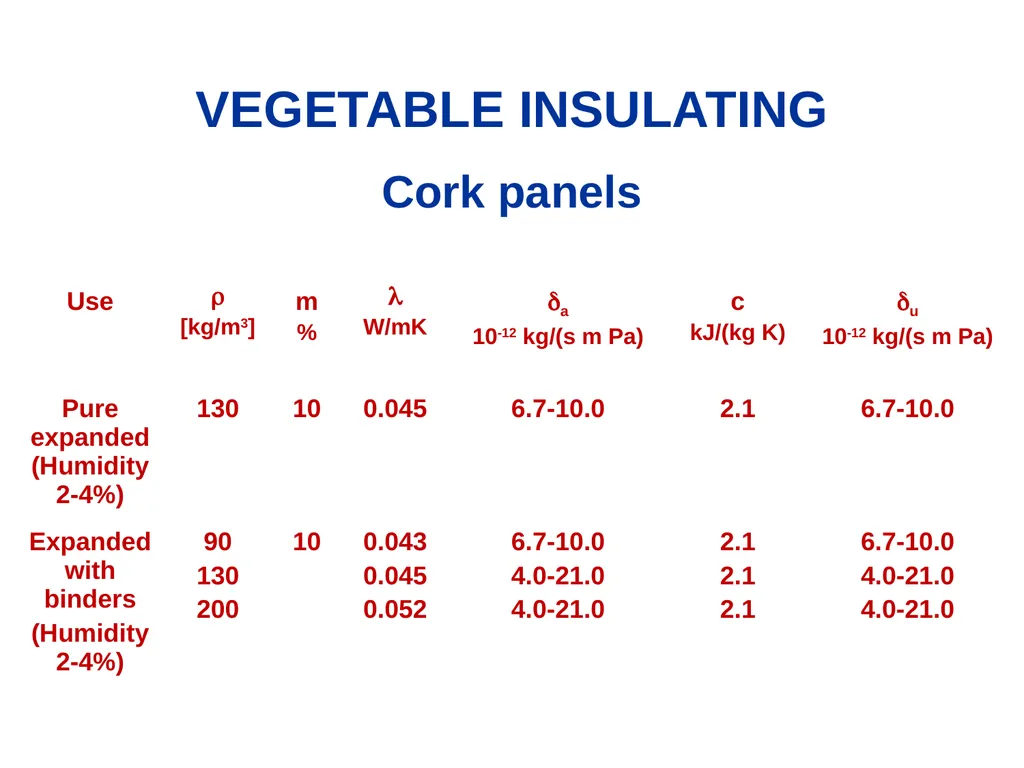
VEGETABLE INSULATING Cork panels<br>
40
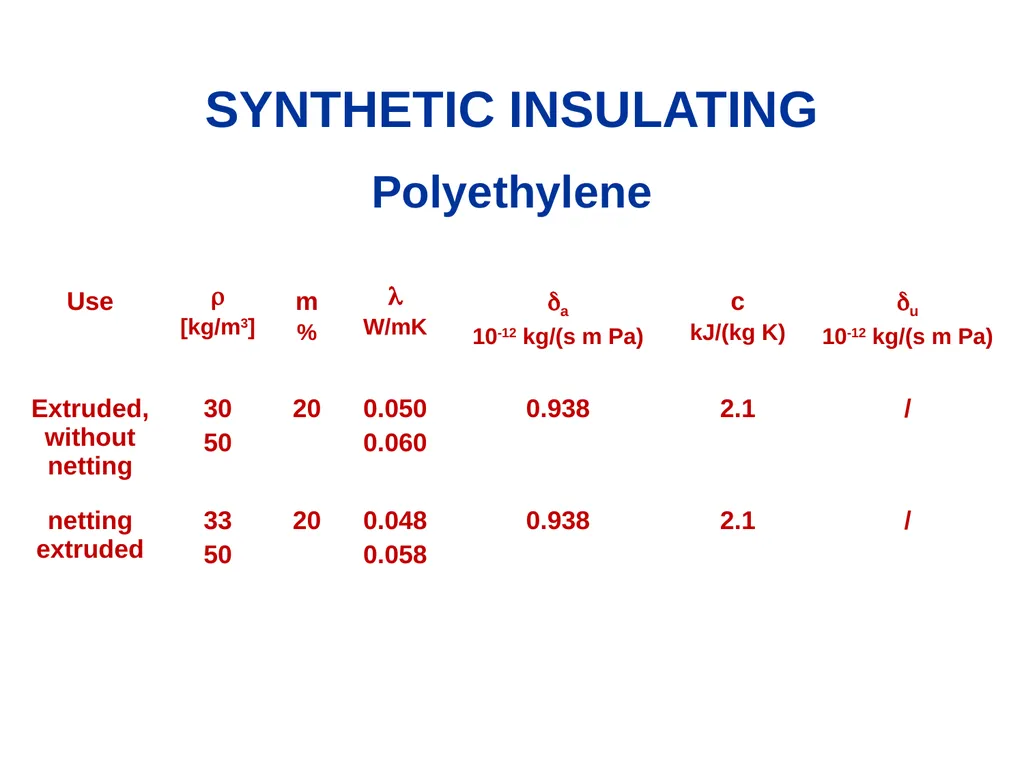
SYNTHETIC INSULATING Polyethylene<br>