
DISASTERS, CONFLICT & FRAGILITY: A JOINT AGENDA
PM
Published · 12 slides · 0 views

1 / 1
Description
DISASTERS, CONFLICT FRAGILITY: A JOINT AGENDA OPTIONS FOR GFDRR LILIANNE FAN 17th Meeting of the GFDRR Consultative Group April 27, 2016 Introduction At the Fall 2015 meeting of the Consultative Group (Berlin, 28-29 Oct., 2015), the GFDRR
Related Topics
Share
Embed code
Download this presentation From Below
"DISASTERS, CONFLICT & FRAGILITY: A JOINT AGENDA" is the property of its rightful owner. Permission is granted to download and print the materials on this website for personal, non-commercial use only, and to display it on your personal computer provided you do not modify the materials and that you retain all copyright notices contained in the materials. By downloading content from our website, you accept the terms of this agreement.
Presentation Transcript
01
DISASTERS, CONFLICT & FRAGILITY:
A JOINT AGENDA
OPTIONS FOR GFDRR LILIANNE FAN
17th Meeting of the GFDRR Consultative Group
April 27, 2016<br>
17th Meeting of the GFDRR Consultative Group
April 27, 2016<br>
02
Introduction At the Fall 2015 meeting of the Consultative Group (Berlin, 28-29 Oct., 2015), the GFDRR Secretariat was asked to prepare a discussion paper on the nexus between disasters, conflict and fragility.
Aims of the paper:
Provide analysis on current thinking about the intersections between disasters, conflict, fragility, forced displacement, and other crises.
Provide some thoughts on potential avenues for GFDRR’s future engagement in fragile and conflict-affected contexts.<br>
Aims of the paper:
Provide analysis on current thinking about the intersections between disasters, conflict, fragility, forced displacement, and other crises.
Provide some thoughts on potential avenues for GFDRR’s future engagement in fragile and conflict-affected contexts.<br>
03
Evolving Role of GFDRR and WB in Fragile and in Conflict-Affected States GFDRR has since its inception been working in fragile countries affected by or vulnerable to disasters has mobilized significant investments in countries such as Haiti, Togo, Somalia, and Afghanistan.
The past two years have seen a dramatic increase in demand for GFDRR’s risk and post-disaster assessment methodologies to be applied to conflict contexts, including Syria, Iraq, Gaza, Nigeria, Ukraine, and Yemen.
Proactive recognition of conflict as a future driver of WB activity and broader rethinking of the World Bank’s role in reducing fragility and addressing multiple, interconnected and future risks.
These processes could have a direct impact on the strategic directions of Bank lending over the next three years, including the IDA 18 replenishment negotiations taking place in 2016.<br>
The past two years have seen a dramatic increase in demand for GFDRR’s risk and post-disaster assessment methodologies to be applied to conflict contexts, including Syria, Iraq, Gaza, Nigeria, Ukraine, and Yemen.
Proactive recognition of conflict as a future driver of WB activity and broader rethinking of the World Bank’s role in reducing fragility and addressing multiple, interconnected and future risks.
These processes could have a direct impact on the strategic directions of Bank lending over the next three years, including the IDA 18 replenishment negotiations taking place in 2016.<br>
04
1. GFDRR’s engagements in conflict and fragile contexts include the following:
Since its inception, GFDRR has expended over 13% of its resources to conduct work in 25+ fragile and conflict-affected countries.
Four of GFDRR’s country partners – namely Haiti, Papua New Guinea, Togo, and Yemen – are members of the g7+, a voluntary association of countries affected by conflict and that are now in transition.
In response to requests from country governments and Bank teams, GFDRR has also recently supported the implementation of PDNAs and DNAs in seven countries affected by conflict, violence and forced displacement: Syria, Iraq, Yemen, Lebanon, Palestine (Gaza), Ukraine, and Nigeria. Four Key Findings<br>
Since its inception, GFDRR has expended over 13% of its resources to conduct work in 25+ fragile and conflict-affected countries.
Four of GFDRR’s country partners – namely Haiti, Papua New Guinea, Togo, and Yemen – are members of the g7+, a voluntary association of countries affected by conflict and that are now in transition.
In response to requests from country governments and Bank teams, GFDRR has also recently supported the implementation of PDNAs and DNAs in seven countries affected by conflict, violence and forced displacement: Syria, Iraq, Yemen, Lebanon, Palestine (Gaza), Ukraine, and Nigeria. Four Key Findings<br>
05
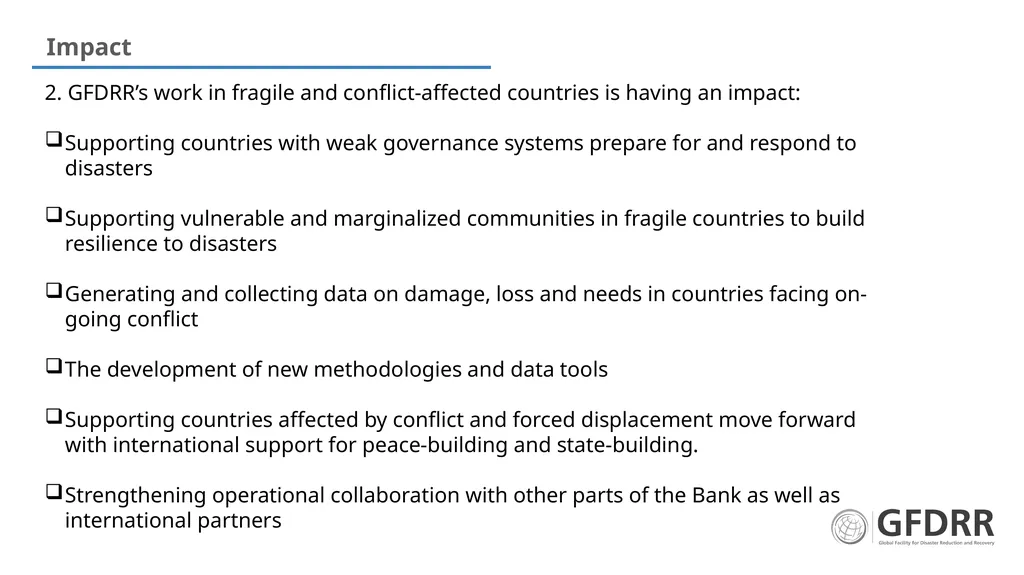
Impact 2. GFDRR’s work in fragile and conflict-affected countries is having an impact:
Supporting countries with weak governance systems prepare for and respond to disasters
Supporting vulnerable and marginalized communities in fragile countries to build resilience to disasters
Generating and collecting data on damage, loss and needs in countries facing on-going conflict
The development of new methodologies and data tools
Supporting countries affected by conflict and forced displacement move forward with international support for peace-building and state-building.
Strengthening operational collaboration with other parts of the Bank as well as international partners<br>
Supporting countries with weak governance systems prepare for and respond to disasters
Supporting vulnerable and marginalized communities in fragile countries to build resilience to disasters
Generating and collecting data on damage, loss and needs in countries facing on-going conflict
The development of new methodologies and data tools
Supporting countries affected by conflict and forced displacement move forward with international support for peace-building and state-building.
Strengthening operational collaboration with other parts of the Bank as well as international partners<br>
06
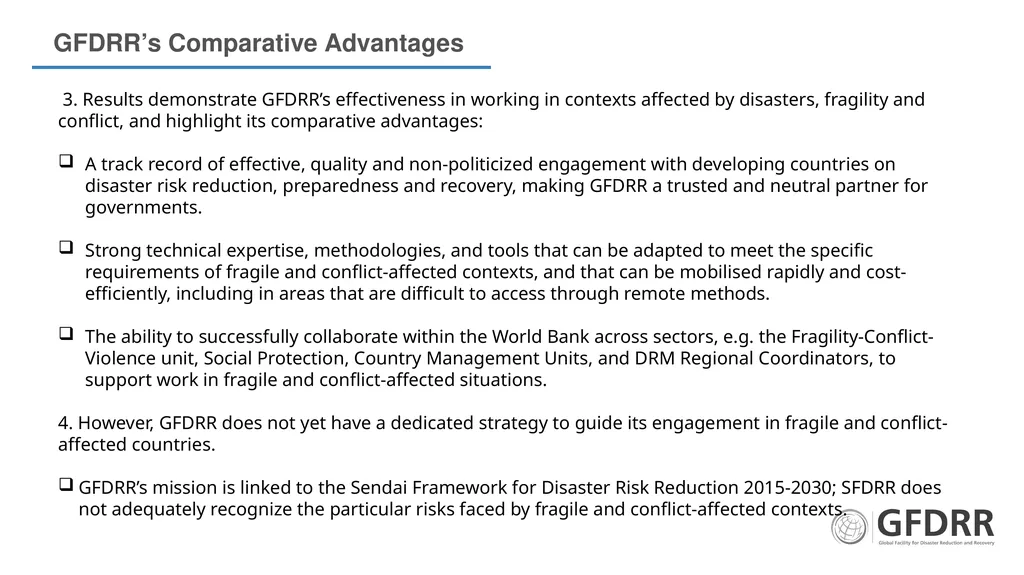
3. Results demonstrate GFDRR’s effectiveness in working in contexts affected by disasters, fragility and conflict, and highlight its comparative advantages:
A track record of effective, quality and non-politicized engagement with developing countries on disaster risk reduction, preparedness and recovery, making GFDRR a trusted and neutral partner for governments.
Strong technical expertise, methodologies, and tools that can be adapted to meet the specific requirements of fragile and conflict-affected contexts, and that can be mobilised rapidly and cost-efficiently, including in areas that are difficult to access through remote methods.
The ability to successfully collaborate within the World Bank across sectors, e.g. the Fragility-Conflict-Violence unit, Social Protection, Country Management Units, and DRM Regional Coordinators, to support work in fragile and conflict-affected situations.
4. However, GFDRR does not yet have a dedicated strategy to guide its engagement in fragile and conflict-affected countries.
GFDRR’s mission is linked to the Sendai Framework for Disaster Risk Reduction 2015-2030; SFDRR does not adequately recognize the particular risks faced by fragile and conflict-affected contexts. GFDRR’s Comparative Advantages<br>
A track record of effective, quality and non-politicized engagement with developing countries on disaster risk reduction, preparedness and recovery, making GFDRR a trusted and neutral partner for governments.
Strong technical expertise, methodologies, and tools that can be adapted to meet the specific requirements of fragile and conflict-affected contexts, and that can be mobilised rapidly and cost-efficiently, including in areas that are difficult to access through remote methods.
The ability to successfully collaborate within the World Bank across sectors, e.g. the Fragility-Conflict-Violence unit, Social Protection, Country Management Units, and DRM Regional Coordinators, to support work in fragile and conflict-affected situations.
4. However, GFDRR does not yet have a dedicated strategy to guide its engagement in fragile and conflict-affected countries.
GFDRR’s mission is linked to the Sendai Framework for Disaster Risk Reduction 2015-2030; SFDRR does not adequately recognize the particular risks faced by fragile and conflict-affected contexts. GFDRR’s Comparative Advantages<br>
07
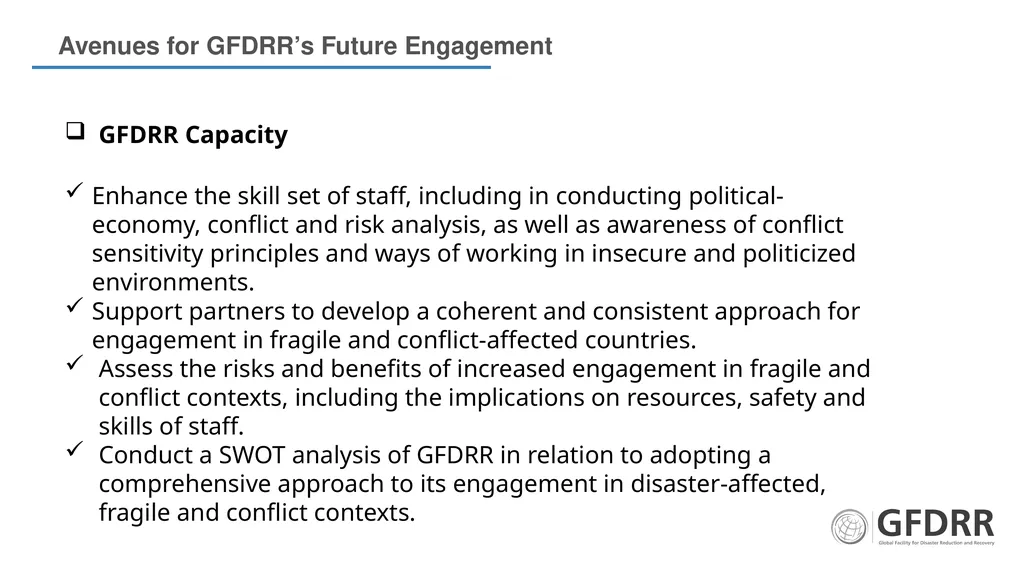
Avenues for GFDRR’s Future Engagement GFDRR Capacity
Enhance the skill set of staff, including in conducting political-economy, conflict and risk analysis, as well as awareness of conflict sensitivity principles and ways of working in insecure and politicized environments.
Support partners to develop a coherent and consistent approach for engagement in fragile and conflict-affected countries.
Assess the risks and benefits of increased engagement in fragile and conflict contexts, including the implications on resources, safety and skills of staff.
Conduct a SWOT analysis of GFDRR in relation to adopting a comprehensive approach to its engagement in disaster-affected, fragile and conflict contexts.<br>
Enhance the skill set of staff, including in conducting political-economy, conflict and risk analysis, as well as awareness of conflict sensitivity principles and ways of working in insecure and politicized environments.
Support partners to develop a coherent and consistent approach for engagement in fragile and conflict-affected countries.
Assess the risks and benefits of increased engagement in fragile and conflict contexts, including the implications on resources, safety and skills of staff.
Conduct a SWOT analysis of GFDRR in relation to adopting a comprehensive approach to its engagement in disaster-affected, fragile and conflict contexts.<br>
08
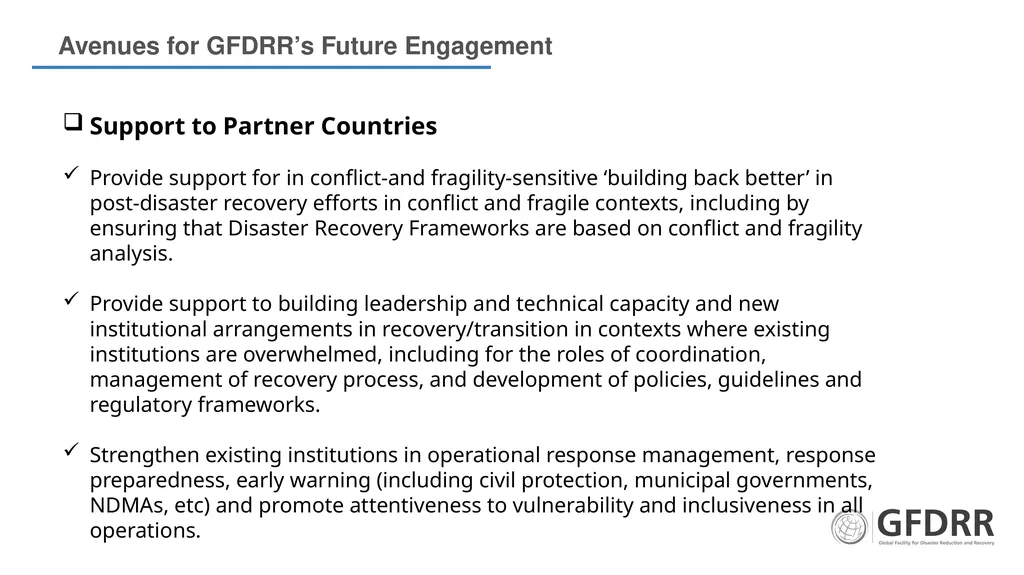
Avenues for GFDRR’s Future Engagement Support to Partner Countries
Provide support for in conflict-and fragility-sensitive ‘building back better’ in post-disaster recovery efforts in conflict and fragile contexts, including by ensuring that Disaster Recovery Frameworks are based on conflict and fragility analysis.
Provide support to building leadership and technical capacity and new institutional arrangements in recovery/transition in contexts where existing institutions are overwhelmed, including for the roles of coordination, management of recovery process, and development of policies, guidelines and regulatory frameworks.
Strengthen existing institutions in operational response management, response preparedness, early warning (including civil protection, municipal governments, NDMAs, etc) and promote attentiveness to vulnerability and inclusiveness in all operations.<br>
Provide support for in conflict-and fragility-sensitive ‘building back better’ in post-disaster recovery efforts in conflict and fragile contexts, including by ensuring that Disaster Recovery Frameworks are based on conflict and fragility analysis.
Provide support to building leadership and technical capacity and new institutional arrangements in recovery/transition in contexts where existing institutions are overwhelmed, including for the roles of coordination, management of recovery process, and development of policies, guidelines and regulatory frameworks.
Strengthen existing institutions in operational response management, response preparedness, early warning (including civil protection, municipal governments, NDMAs, etc) and promote attentiveness to vulnerability and inclusiveness in all operations.<br>
09
Avenues for GFDRR’s Future Engagement Tools and Knowledge Development
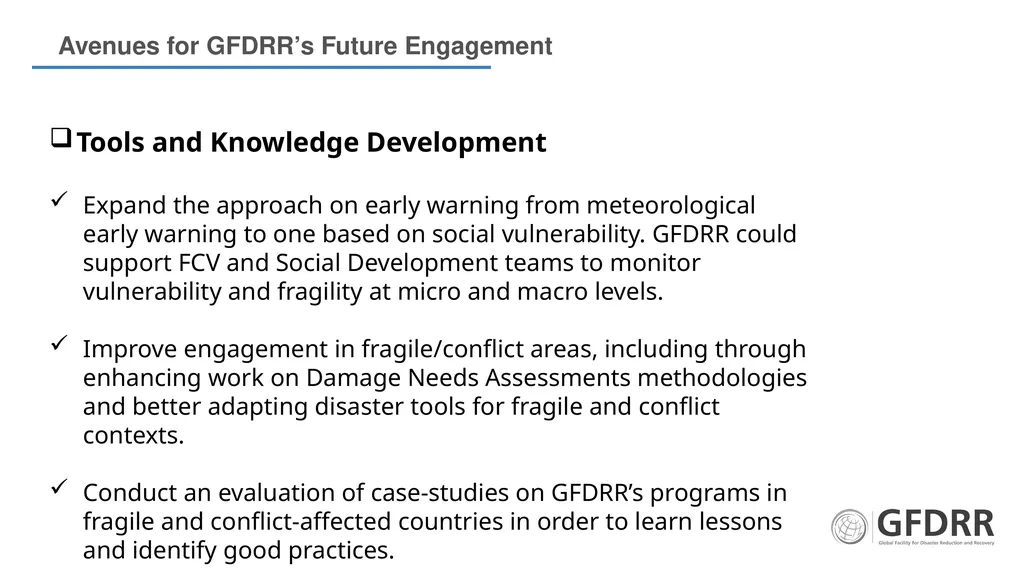
Expand the approach on early warning from meteorological early warning to one based on social vulnerability. GFDRR could support FCV and Social Development teams to monitor vulnerability and fragility at micro and macro levels.
Improve engagement in fragile/conflict areas, including through enhancing work on Damage Needs Assessments methodologies and better adapting disaster tools for fragile and conflict contexts.
Conduct an evaluation of case-studies on GFDRR’s programs in fragile and conflict-affected countries in order to learn lessons and identify good practices.<br>
Expand the approach on early warning from meteorological early warning to one based on social vulnerability. GFDRR could support FCV and Social Development teams to monitor vulnerability and fragility at micro and macro levels.
Improve engagement in fragile/conflict areas, including through enhancing work on Damage Needs Assessments methodologies and better adapting disaster tools for fragile and conflict contexts.
Conduct an evaluation of case-studies on GFDRR’s programs in fragile and conflict-affected countries in order to learn lessons and identify good practices.<br>
10
Avenues for GFDRR’s Future Engagement Internal and External Partnerships
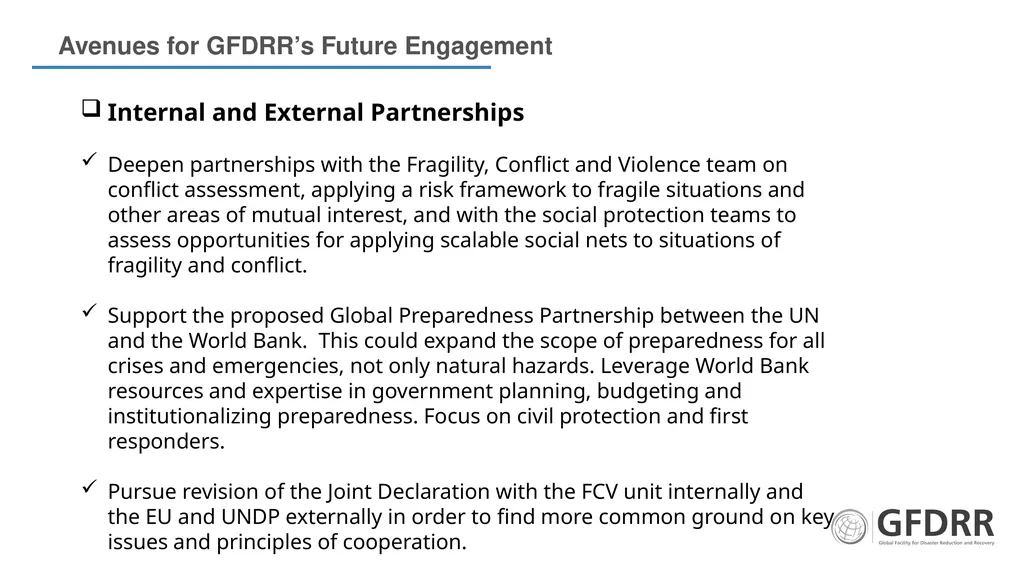
Deepen partnerships with the Fragility, Conflict and Violence team on conflict assessment, applying a risk framework to fragile situations and other areas of mutual interest, and with the social protection teams to assess opportunities for applying scalable social nets to situations of fragility and conflict.
Support the proposed Global Preparedness Partnership between the UN and the World Bank. This could expand the scope of preparedness for all crises and emergencies, not only natural hazards. Leverage World Bank resources and expertise in government planning, budgeting and institutionalizing preparedness. Focus on civil protection and first responders.
Pursue revision of the Joint Declaration with the FCV unit internally and the EU and UNDP externally in order to find more common ground on key issues and principles of cooperation.<br>
Deepen partnerships with the Fragility, Conflict and Violence team on conflict assessment, applying a risk framework to fragile situations and other areas of mutual interest, and with the social protection teams to assess opportunities for applying scalable social nets to situations of fragility and conflict.
Support the proposed Global Preparedness Partnership between the UN and the World Bank. This could expand the scope of preparedness for all crises and emergencies, not only natural hazards. Leverage World Bank resources and expertise in government planning, budgeting and institutionalizing preparedness. Focus on civil protection and first responders.
Pursue revision of the Joint Declaration with the FCV unit internally and the EU and UNDP externally in order to find more common ground on key issues and principles of cooperation.<br>
11
Comments and Suggestions Editorial comments
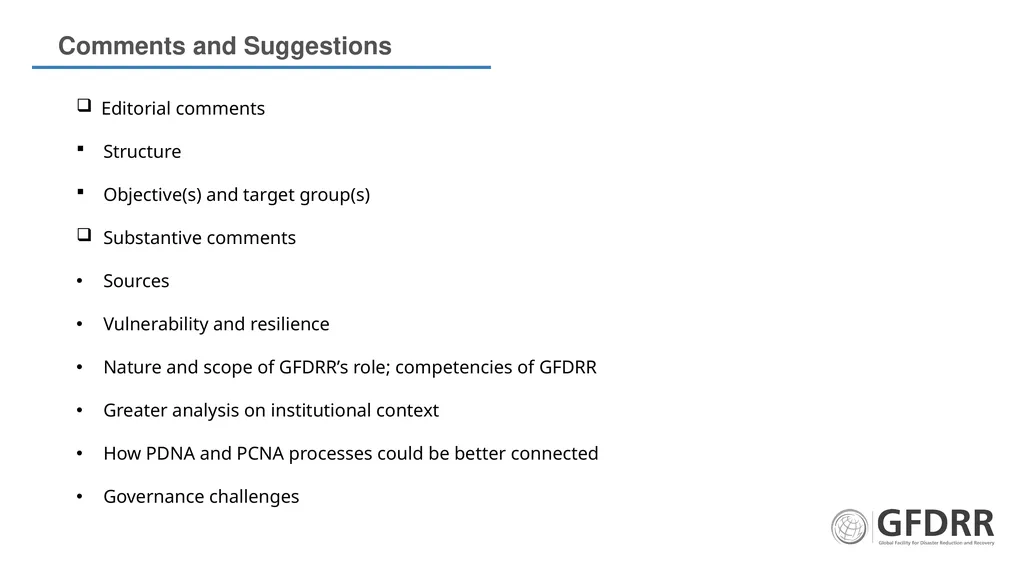
Structure
Objective(s) and target group(s)
Substantive comments
Sources
Vulnerability and resilience
Nature and scope of GFDRR’s role; competencies of GFDRR
Greater analysis on institutional context
How PDNA and PCNA processes could be better connected
Governance challenges<br>
Structure
Objective(s) and target group(s)
Substantive comments
Sources
Vulnerability and resilience
Nature and scope of GFDRR’s role; competencies of GFDRR
Greater analysis on institutional context
How PDNA and PCNA processes could be better connected
Governance challenges<br>
12
Issues for further discussion/ decision Length and level of detail:
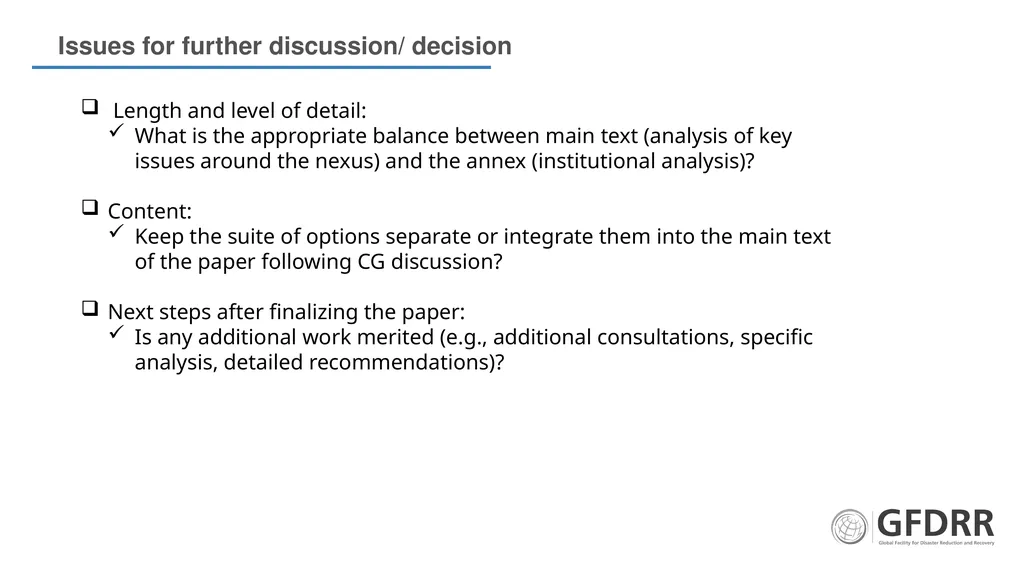
What is the appropriate balance between main text (analysis of key issues around the nexus) and the annex (institutional analysis)?
Content:
Keep the suite of options separate or integrate them into the main text of the paper following CG discussion?
Next steps after finalizing the paper:
Is any additional work merited (e.g., additional consultations, specific analysis, detailed recommendations)?<br>
What is the appropriate balance between main text (analysis of key issues around the nexus) and the annex (institutional analysis)?
Content:
Keep the suite of options separate or integrate them into the main text of the paper following CG discussion?
Next steps after finalizing the paper:
Is any additional work merited (e.g., additional consultations, specific analysis, detailed recommendations)?<br>