
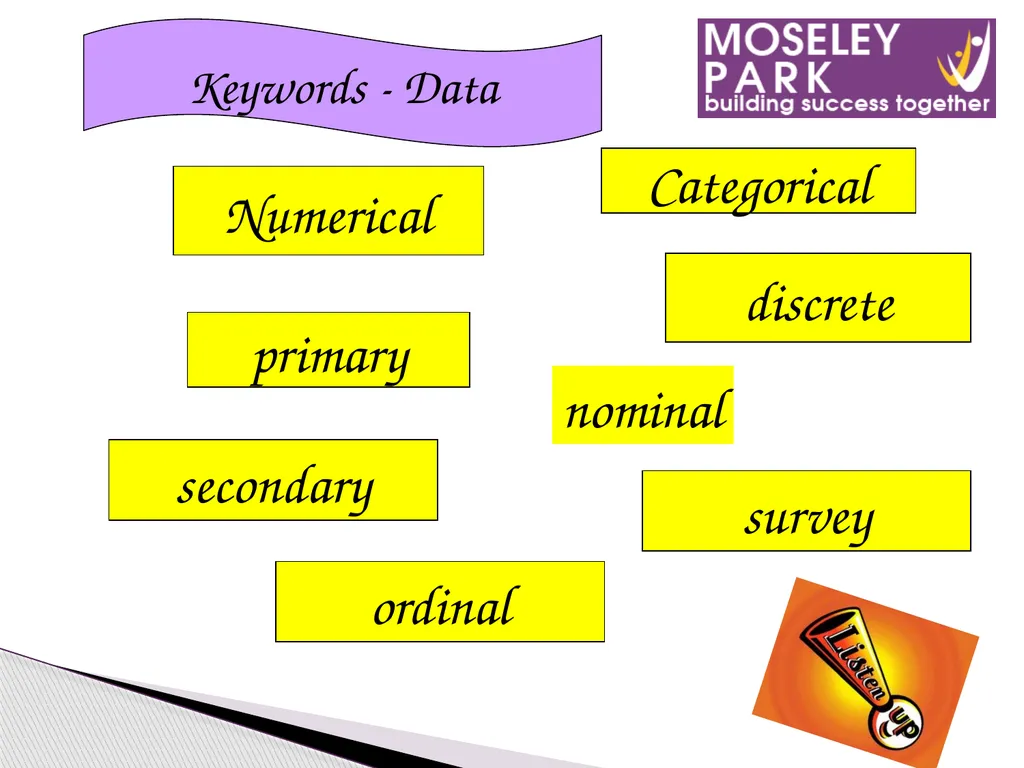
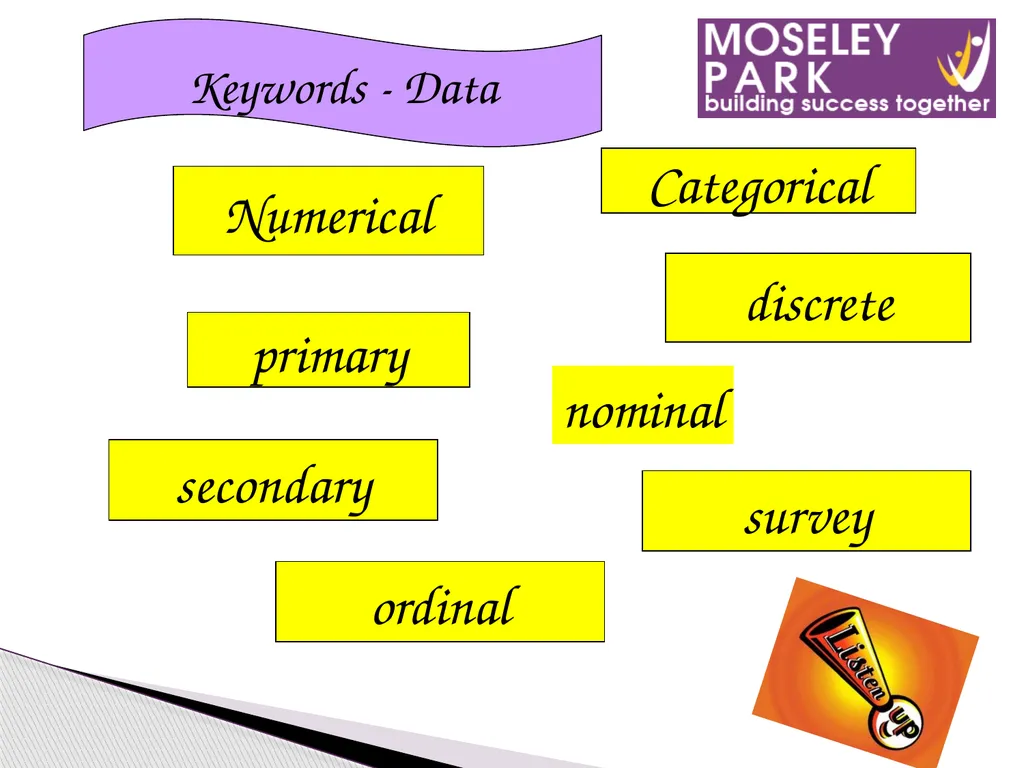
discrete secondary Categorical primary Numerical

Description: discrete secondary Categorical primary Numerical nominal Keywords - Data ordinal survey Learning Objective: Today we will look at the different types of data and how to group this data effectively. Stratified Sampling. 14072017 Key words:
Related Topics
Download Presentation
"discrete secondary Categorical primary Numerical" is the property of its rightful owner. Permission is granted to download and print the materials on this website for personal, non-commercial use only, and to display it on your personal computer provided you do not modify the materials and that you retain all copyright notices contained in the materials. By downloading content from our website, you accept the terms of this agreement.
Presentation Transcript
slide1. discrete secondary Categorical primary Numerical nominal Keywords - Data ordinal survey<br>
slide2. Learning Objective:
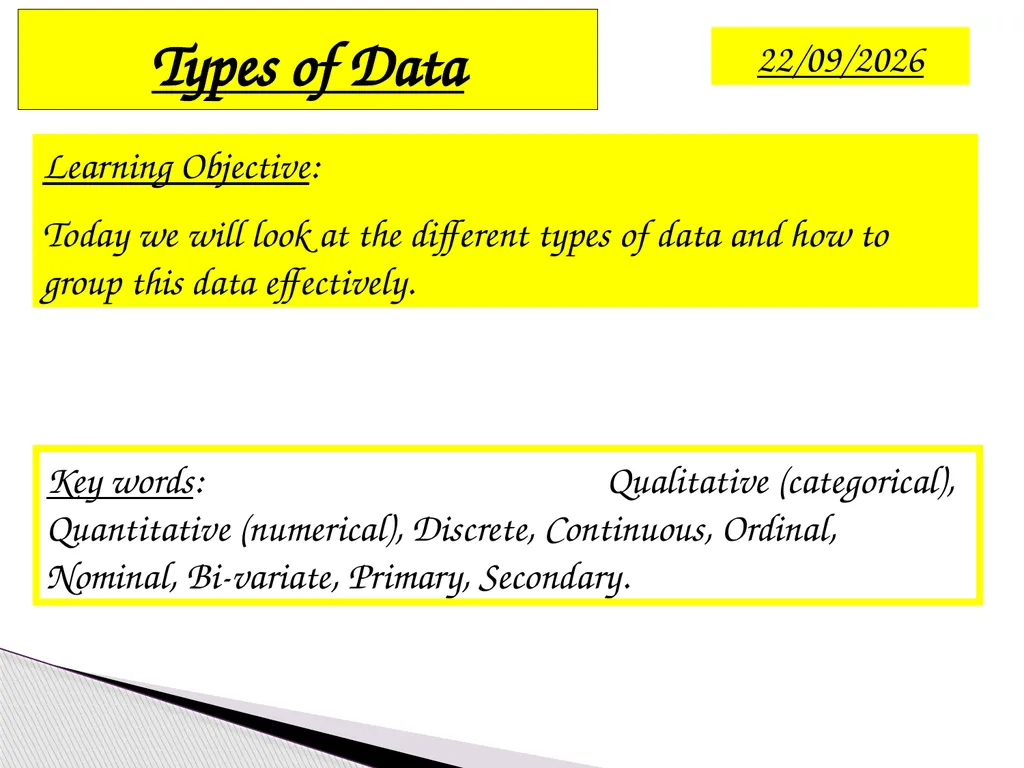
Today we will look at the different types of data and how to group this data effectively. Stratified Sampling. 14/07/2017 Key words: Qualitative (categorical), Quantitative (numerical), Discrete, Continuous, Ordinal, Nominal, Bi-variate, Primary, Secondary. Types of Data<br>
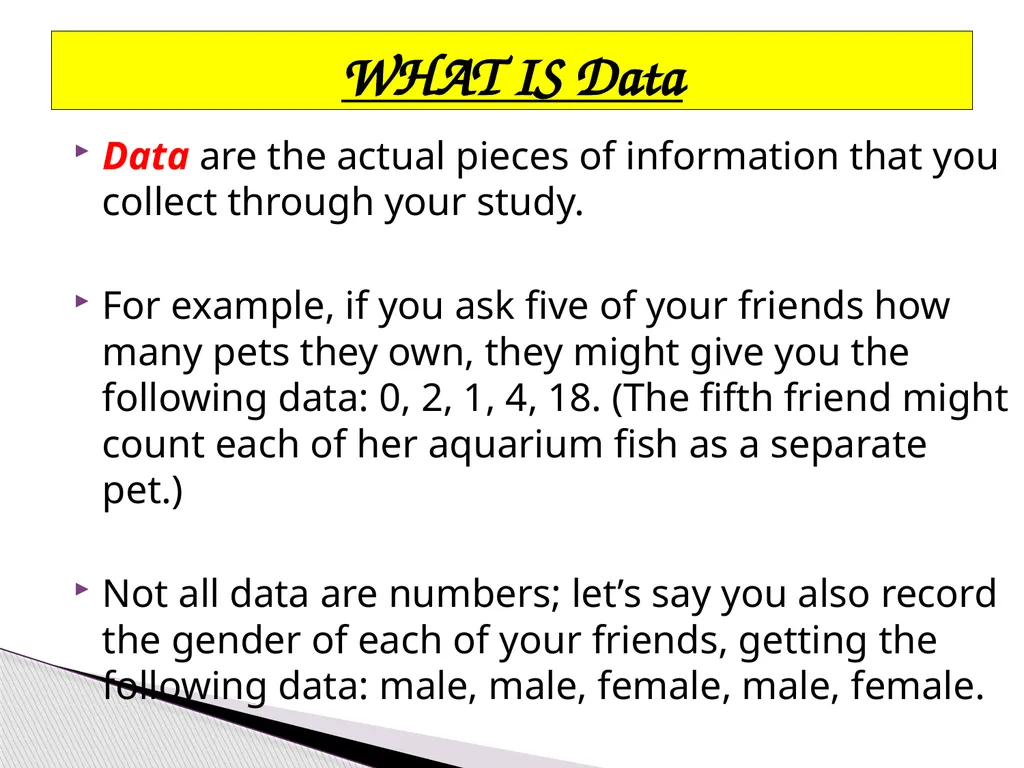
slide3. Data are the actual pieces of information that you collect through your study.
For example, if you ask five of your friends how many pets they own, they might give you the following data: 0, 2, 1, 4, 18. (The fifth friend might count each of her aquarium fish as a separate pet.)
Not all data are numbers; let’s say you also record the gender of each of your friends, getting the following data: male, male, female, male, female. WHAT IS Data<br>
slide4. Types of Data When you are faced with data, either that you have collected or that you have sourced from elsewhere, you need to know what kind of data it is to represent it properly.
For example, will we be able to show it in a pie chart or a scatter graph?<br>
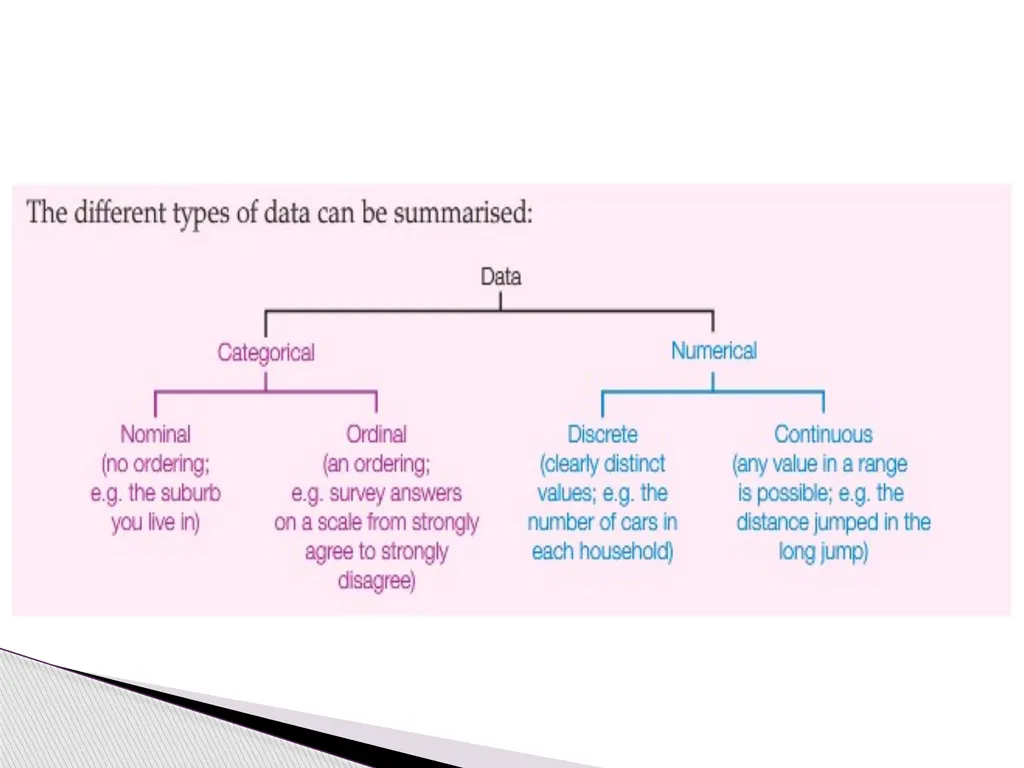
slide5. Types of Data Data can be divided into two basic types
1) Numerical data sets (also called quantitative data)
2) Categorical data sets (also called qualitative data)<br>
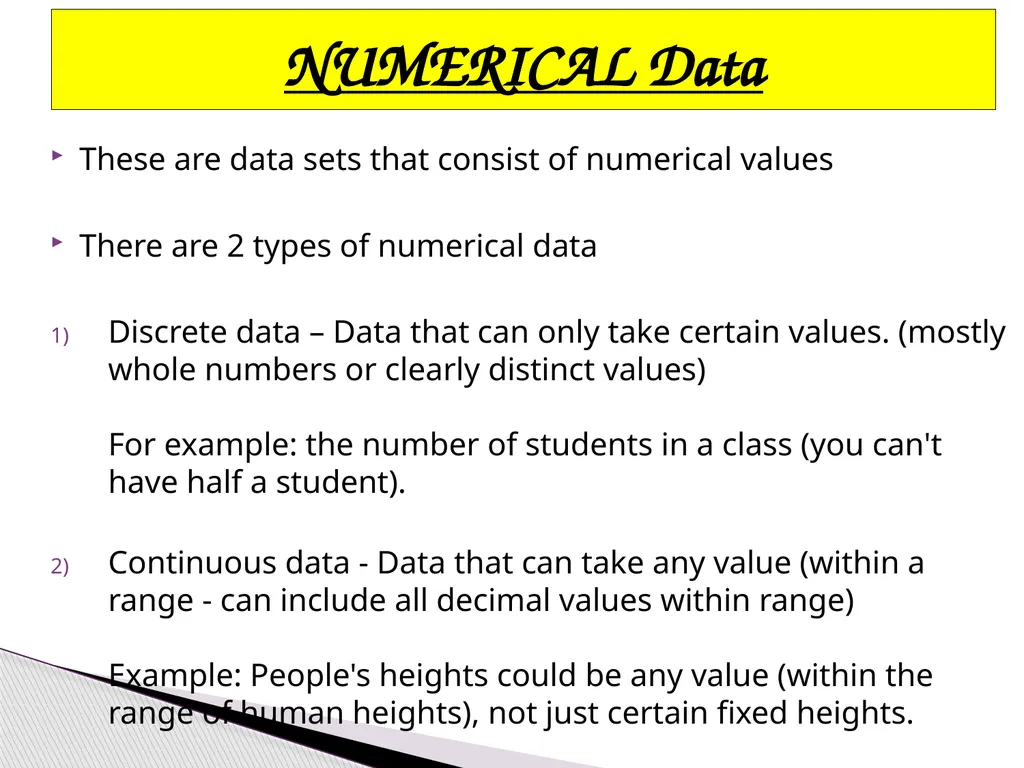
slide6. NUMERICAL Data These are data sets that consist of numerical values
There are 2 types of numerical data
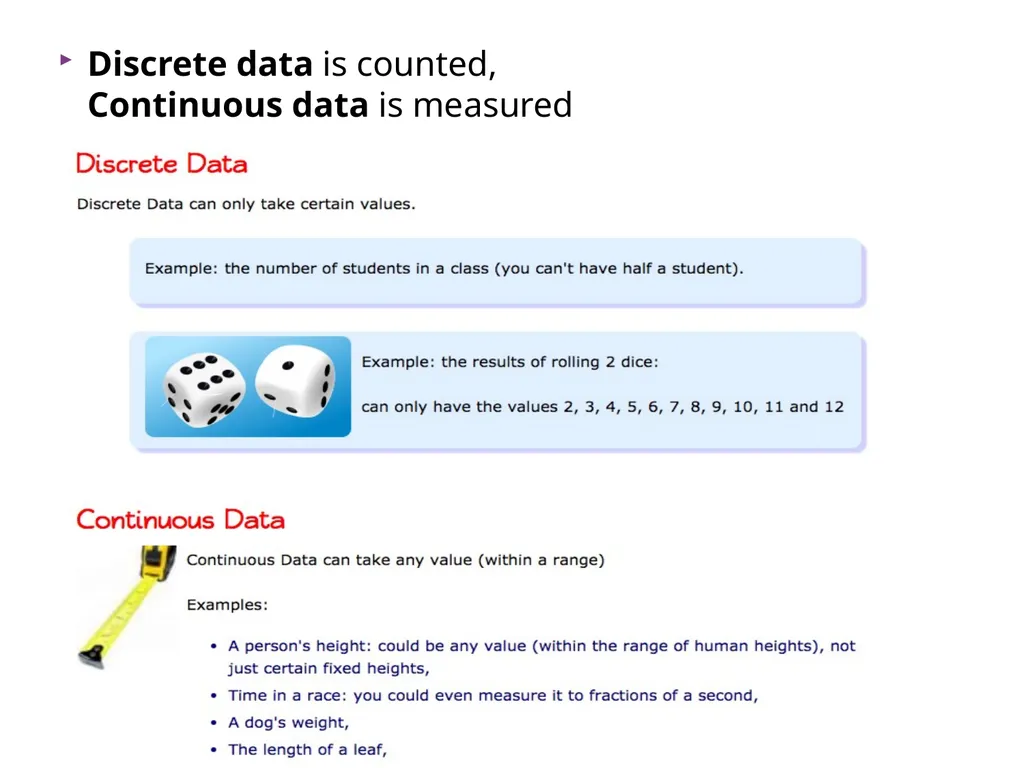
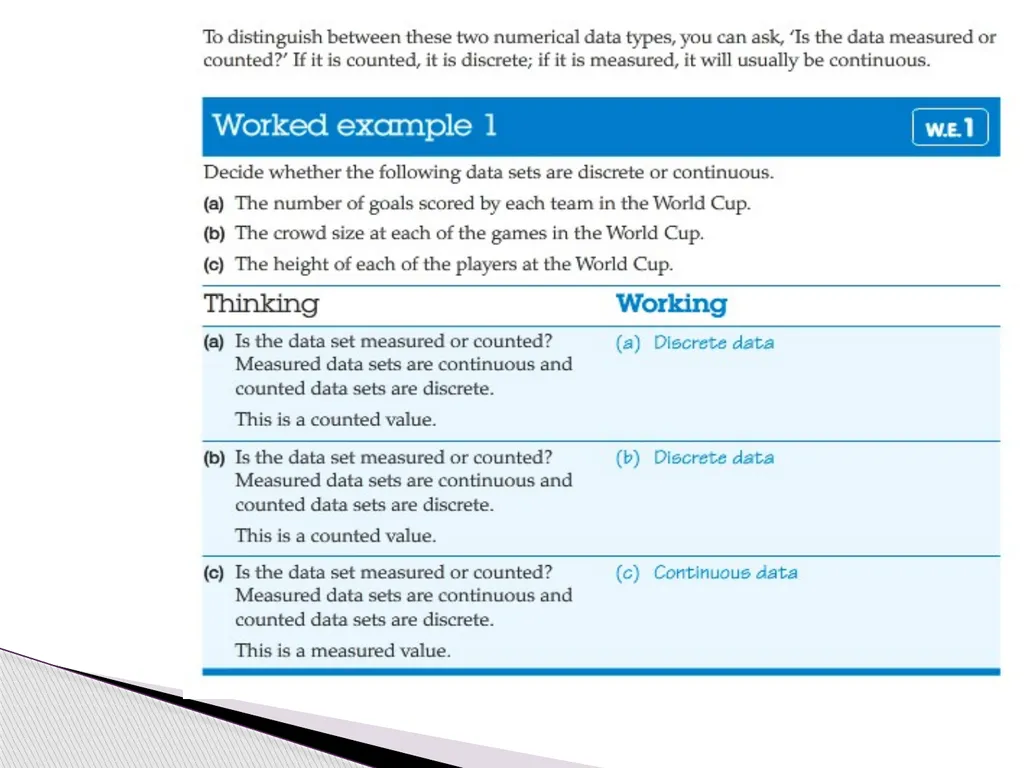
Discrete data – Data that can only take certain values. (mostly whole numbers or clearly distinct values) For example: the number of students in a class (you can't have half a student).
Continuous data - Data that can take any value (within a range - can include all decimal values within range) Example: People's heights could be any value (within the range of human heights), not just certain fixed heights.<br>
slide7. Discrete data is counted, Continuous data is measured<br>
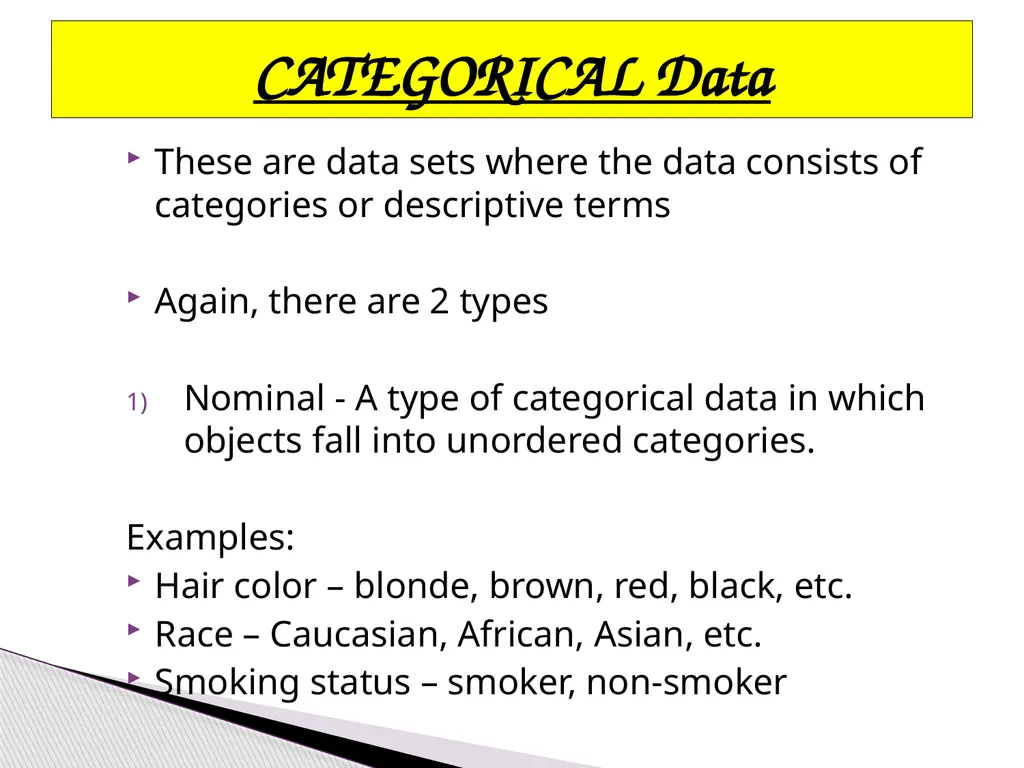
slide9. These are data sets where the data consists of categories or descriptive terms
Again, there are 2 types
Nominal - A type of categorical data in which objects fall into unordered categories.
Examples:
Hair color – blonde, brown, red, black, etc.
Race – Caucasian, African, Asian, etc.
Smoking status – smoker, non-smoker CATEGORICAL Data<br>
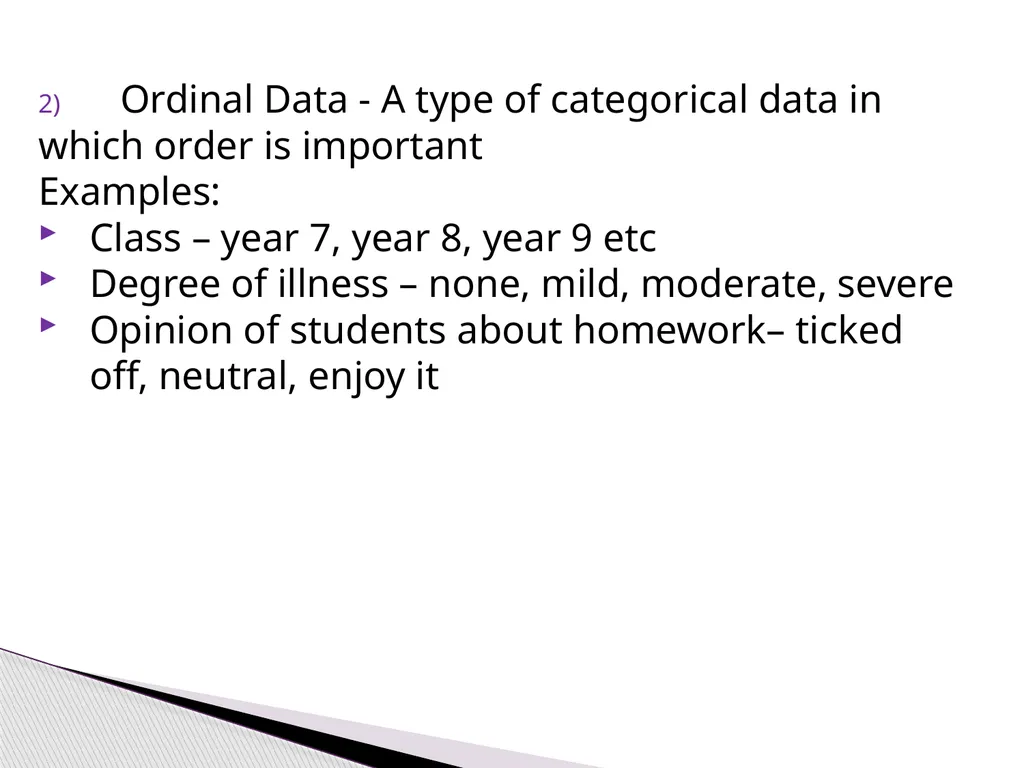
slide10. 2) Ordinal Data - A type of categorical data in which order is important
Examples:
Class – year 7, year 8, year 9 etc
Degree of illness – none, mild, moderate, severe
Opinion of students about homework– ticked off, neutral, enjoy it<br>
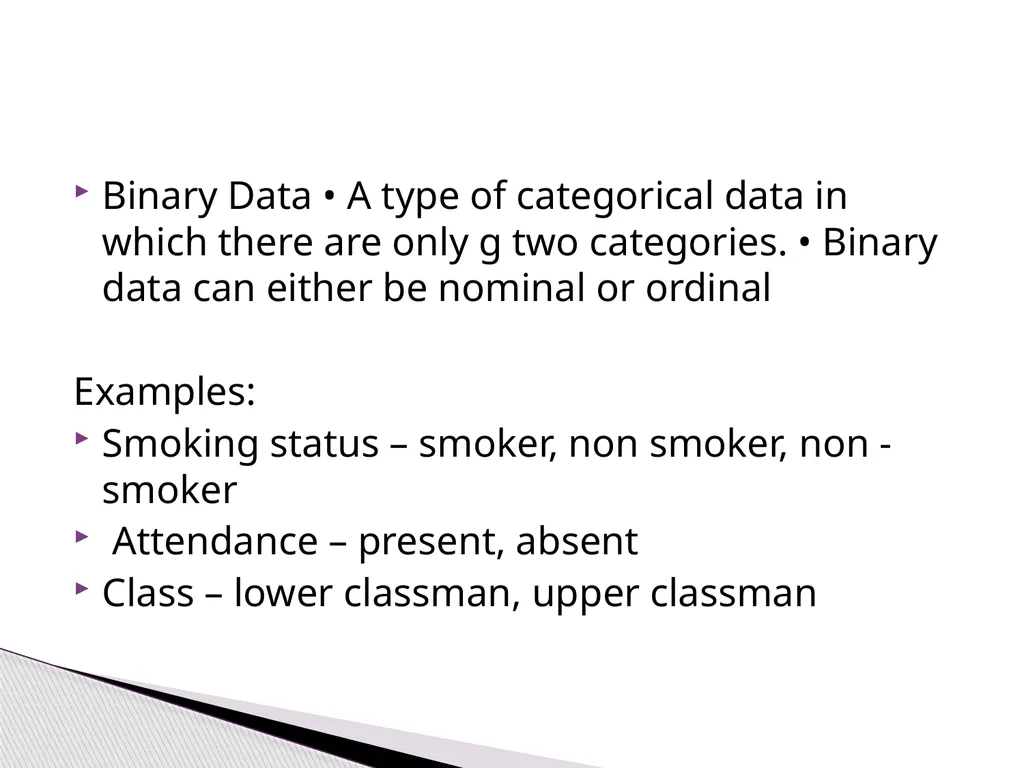
slide12. Binary Data • A type of categorical data in which there are only g two categories. • Binary data can either be nominal or ordinal
Examples:
Smoking status – smoker, non smoker, non -smoker
Attendance – present, absent
Class – lower classman, upper classman<br>
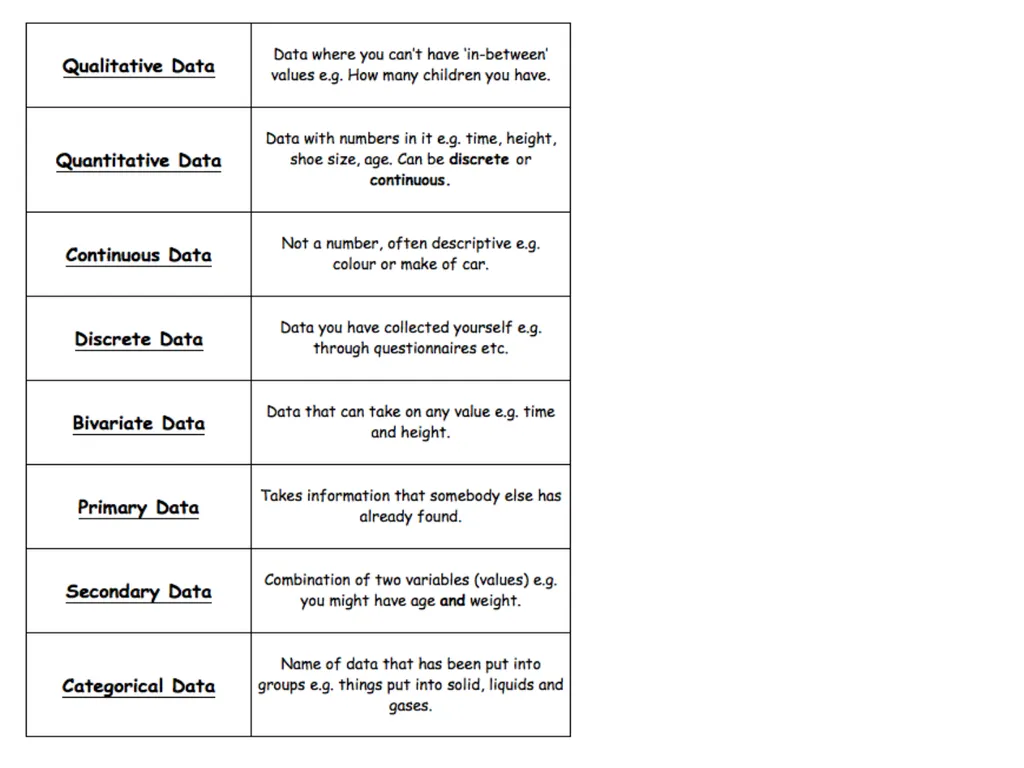
slide13. Task One On your desk are the key words you need to know when looking at types of data. You need to cut out the key words, and match them to the definition. EXTENSION: What diagrams could you use to show each piece of data?<br>
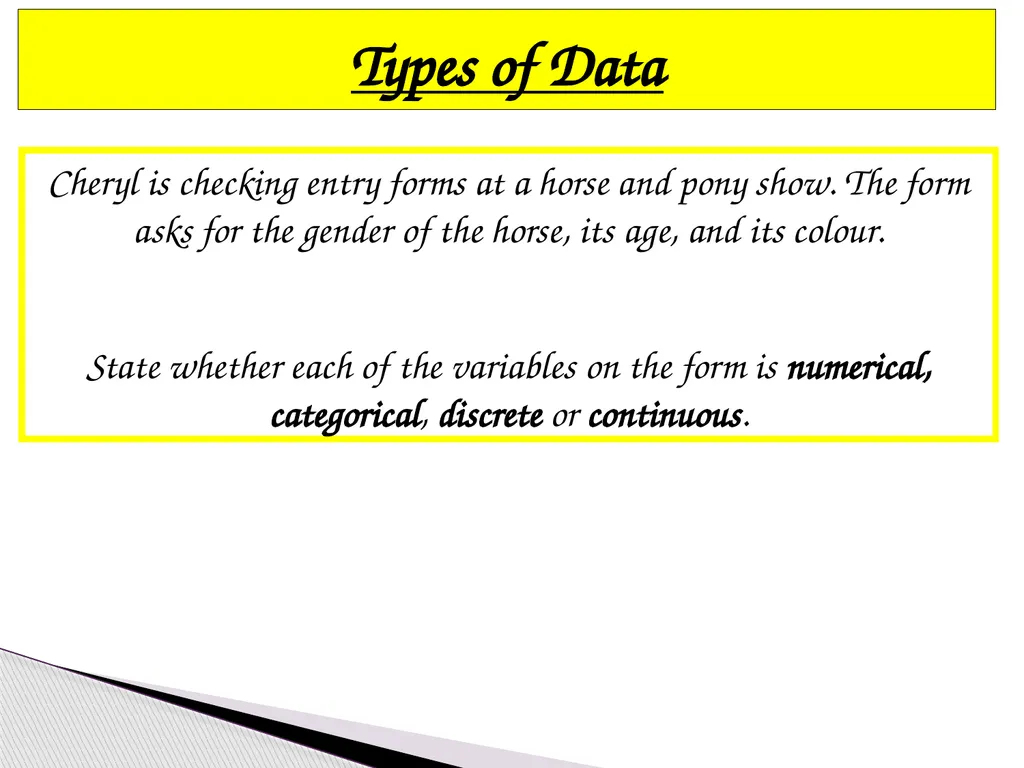
slide15. Types of Data Cheryl is checking entry forms at a horse and pony show. The form asks for the gender of the horse, its age, and its colour.
State whether each of the variables on the form is numerical, categorical, discrete or continuous.<br>
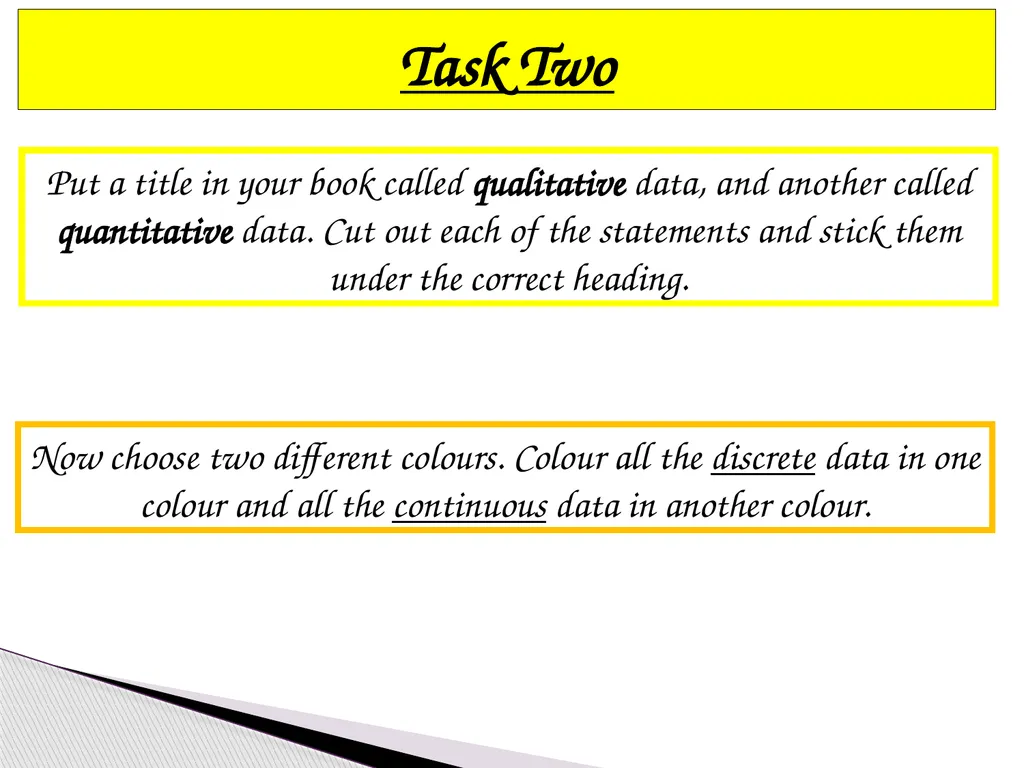
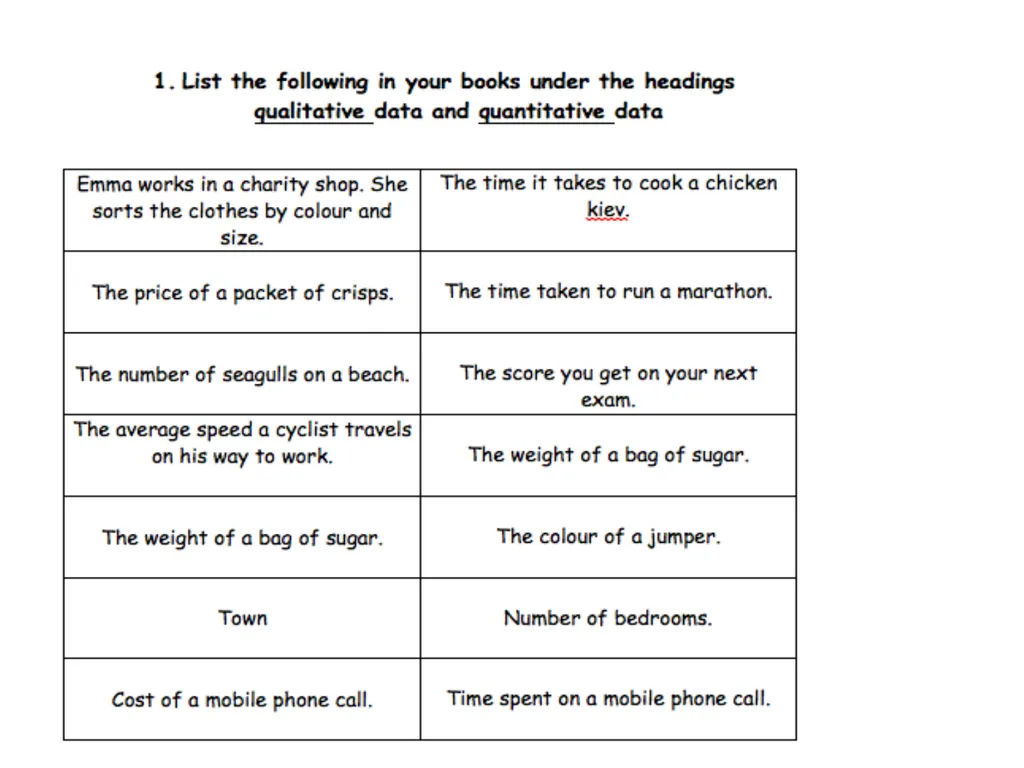
slide16. Task Two Put a title in your book called qualitative data, and another called quantitative data. Cut out each of the statements and stick them under the correct heading. Now choose two different colours. Colour all the discrete data in one colour and all the continuous data in another colour.<br>
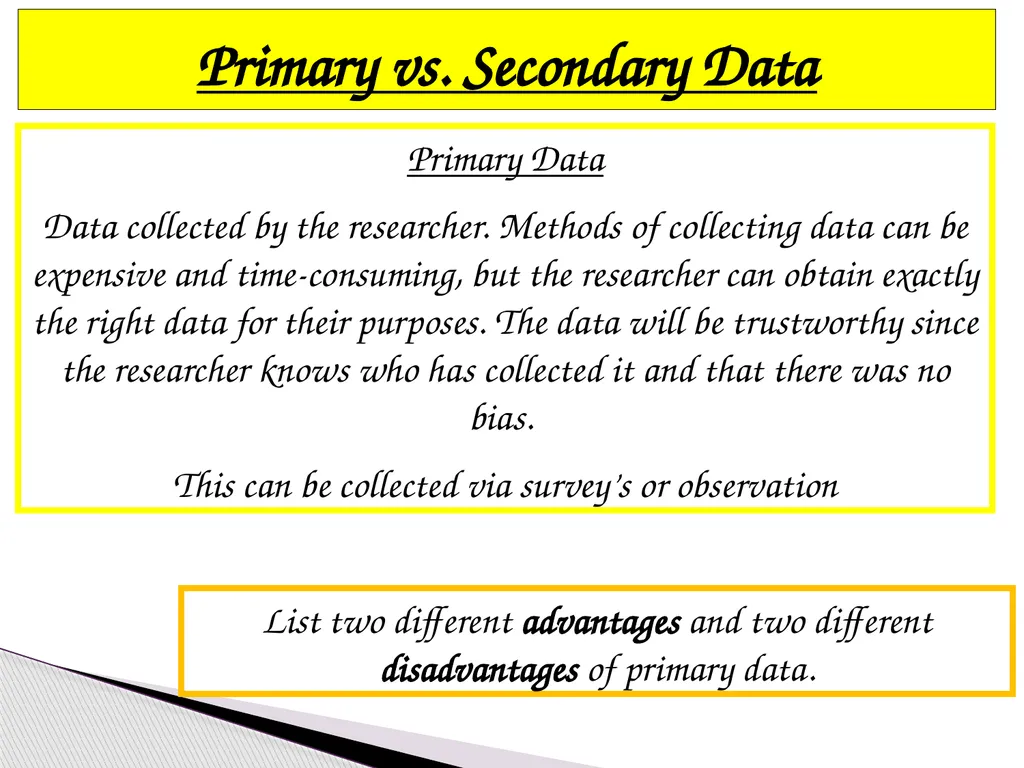
slide18. Primary vs. Secondary Data Primary Data
Data collected by the researcher. Methods of collecting data can be expensive and time-consuming, but the researcher can obtain exactly the right data for their purposes. The data will be trustworthy since the researcher knows who has collected it and that there was no bias.
This can be collected via survey’s or observation List two different advantages and two different disadvantages of primary data.<br>
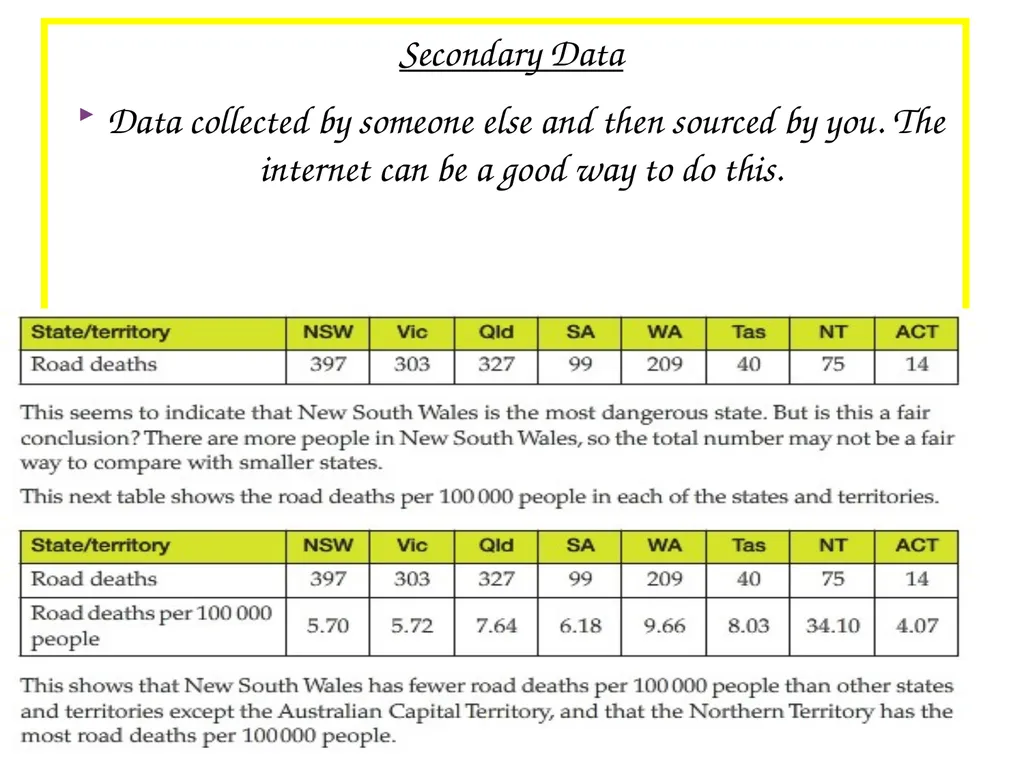
slide19. Secondary Data
Data collected by someone else and then sourced by you. The internet can be a good way to do this.<br>
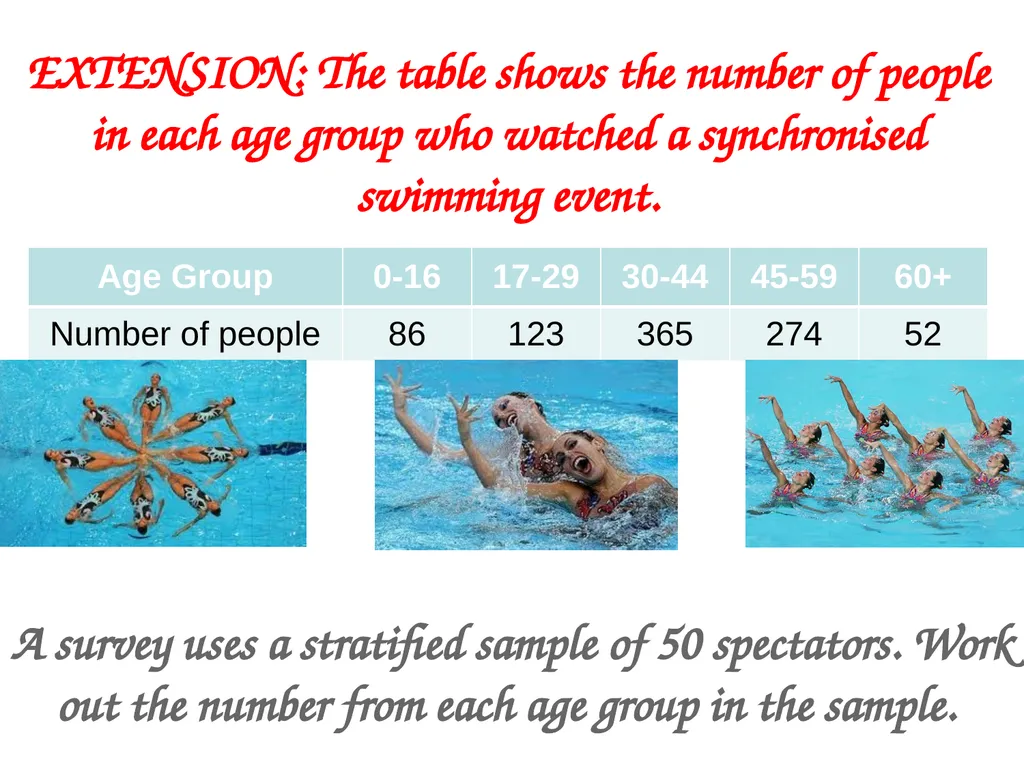
slide20. EXTENSION: The table shows the number of people in each age group who watched a synchronised swimming event. A survey uses a stratified sample of 50 spectators. Work out the number from each age group in the sample.<br>
slide2. Learning Objective:
Today we will look at the different types of data and how to group this data effectively. Stratified Sampling. 14/07/2017 Key words: Qualitative (categorical), Quantitative (numerical), Discrete, Continuous, Ordinal, Nominal, Bi-variate, Primary, Secondary. Types of Data<br>
slide3. Data are the actual pieces of information that you collect through your study.
For example, if you ask five of your friends how many pets they own, they might give you the following data: 0, 2, 1, 4, 18. (The fifth friend might count each of her aquarium fish as a separate pet.)
Not all data are numbers; let’s say you also record the gender of each of your friends, getting the following data: male, male, female, male, female. WHAT IS Data<br>
slide4. Types of Data When you are faced with data, either that you have collected or that you have sourced from elsewhere, you need to know what kind of data it is to represent it properly.
For example, will we be able to show it in a pie chart or a scatter graph?<br>
slide5. Types of Data Data can be divided into two basic types
1) Numerical data sets (also called quantitative data)
2) Categorical data sets (also called qualitative data)<br>
slide6. NUMERICAL Data These are data sets that consist of numerical values
There are 2 types of numerical data
Discrete data – Data that can only take certain values. (mostly whole numbers or clearly distinct values) For example: the number of students in a class (you can't have half a student).
Continuous data - Data that can take any value (within a range - can include all decimal values within range) Example: People's heights could be any value (within the range of human heights), not just certain fixed heights.<br>
slide7. Discrete data is counted, Continuous data is measured<br>
slide9. These are data sets where the data consists of categories or descriptive terms
Again, there are 2 types
Nominal - A type of categorical data in which objects fall into unordered categories.
Examples:
Hair color – blonde, brown, red, black, etc.
Race – Caucasian, African, Asian, etc.
Smoking status – smoker, non-smoker CATEGORICAL Data<br>
slide10. 2) Ordinal Data - A type of categorical data in which order is important
Examples:
Class – year 7, year 8, year 9 etc
Degree of illness – none, mild, moderate, severe
Opinion of students about homework– ticked off, neutral, enjoy it<br>
slide12. Binary Data • A type of categorical data in which there are only g two categories. • Binary data can either be nominal or ordinal
Examples:
Smoking status – smoker, non smoker, non -smoker
Attendance – present, absent
Class – lower classman, upper classman<br>
slide13. Task One On your desk are the key words you need to know when looking at types of data. You need to cut out the key words, and match them to the definition. EXTENSION: What diagrams could you use to show each piece of data?<br>
slide15. Types of Data Cheryl is checking entry forms at a horse and pony show. The form asks for the gender of the horse, its age, and its colour.
State whether each of the variables on the form is numerical, categorical, discrete or continuous.<br>
slide16. Task Two Put a title in your book called qualitative data, and another called quantitative data. Cut out each of the statements and stick them under the correct heading. Now choose two different colours. Colour all the discrete data in one colour and all the continuous data in another colour.<br>
slide18. Primary vs. Secondary Data Primary Data
Data collected by the researcher. Methods of collecting data can be expensive and time-consuming, but the researcher can obtain exactly the right data for their purposes. The data will be trustworthy since the researcher knows who has collected it and that there was no bias.
This can be collected via survey’s or observation List two different advantages and two different disadvantages of primary data.<br>
slide19. Secondary Data
Data collected by someone else and then sourced by you. The internet can be a good way to do this.<br>
slide20. EXTENSION: The table shows the number of people in each age group who watched a synchronised swimming event. A survey uses a stratified sample of 50 spectators. Work out the number from each age group in the sample.<br>