
Distributed Interactive Simulation (DIS) 101 Mark
MT
Published · 57 slides · 0 views
1 / 1
Description
Distributed Interactive Simulation (DIS) 101 Mark McCall DIS PDG Chair markmccallsisostds.org Overview General DIS Overview DIS History DIS Documents Key Definitions and Concepts PDU Families The Updated DIS Version 7 Standard IEEE 1278
Related Topics
Share
Embed code
Download this presentation From Below
"Distributed Interactive Simulation (DIS) 101 Mark" is the property of its rightful owner. Permission is granted to download and print the materials on this website for personal, non-commercial use only, and to display it on your personal computer provided you do not modify the materials and that you retain all copyright notices contained in the materials. By downloading content from our website, you accept the terms of this agreement.
Presentation Transcript
01
Distributed Interactive Simulation (DIS) 101 Mark McCall
DIS PDG Chair
markmccall@sisostds.org<br>
DIS PDG Chair
markmccall@sisostds.org<br>
02
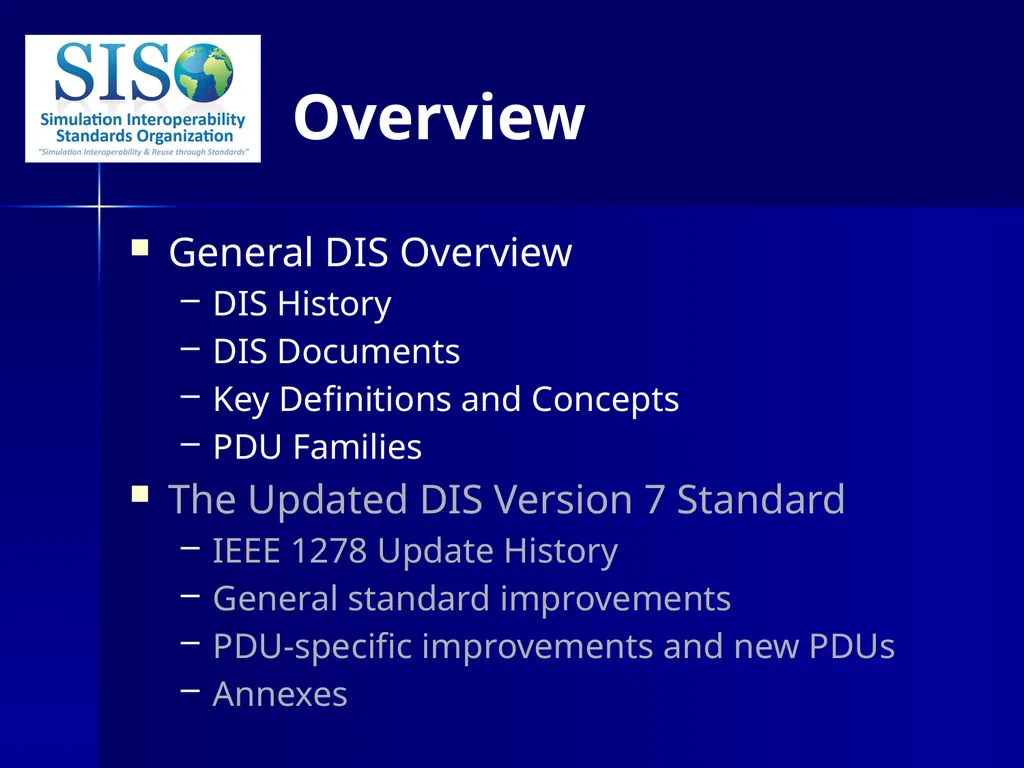
Overview General DIS Overview
DIS History
DIS Documents
Key Definitions and Concepts
PDU Families
The Updated DIS Version 7 Standard
IEEE 1278 Update History
General standard improvements
PDU-specific improvements and new PDUs
Annexes<br>
DIS History
DIS Documents
Key Definitions and Concepts
PDU Families
The Updated DIS Version 7 Standard
IEEE 1278 Update History
General standard improvements
PDU-specific improvements and new PDUs
Annexes<br>
03
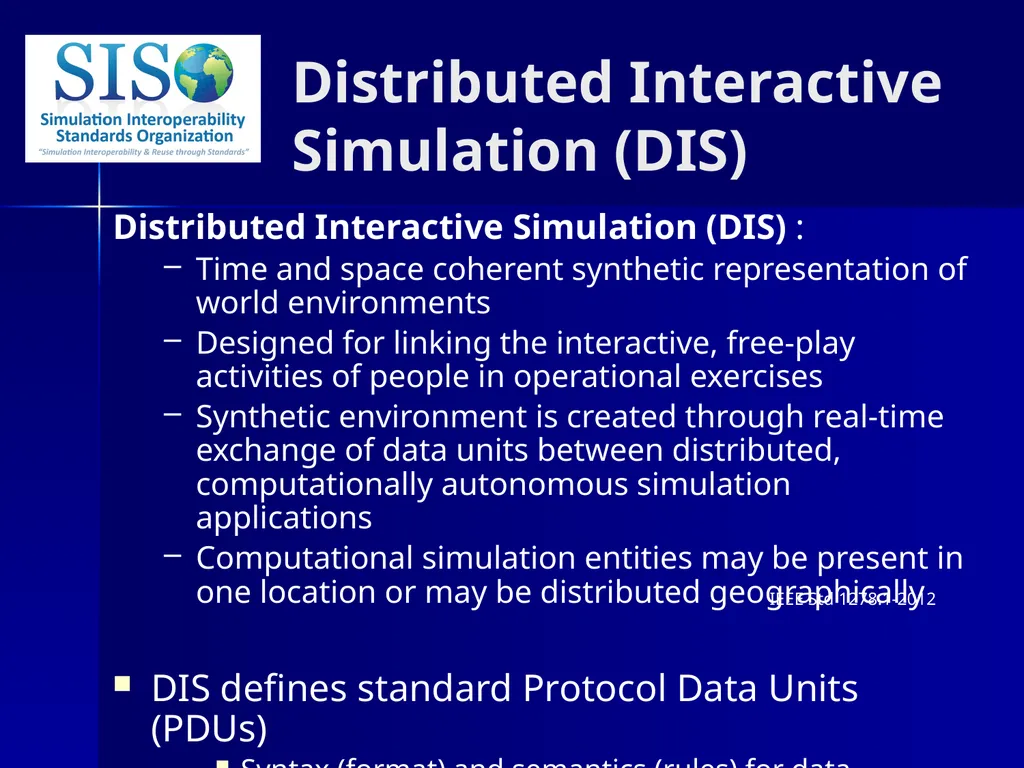
Distributed Interactive Simulation (DIS) Distributed Interactive Simulation (DIS) :
Time and space coherent synthetic representation of world environments
Designed for linking the interactive, free-play activities of people in operational exercises
Synthetic environment is created through real-time exchange of data units between distributed, computationally autonomous simulation applications
Computational simulation entities may be present in one location or may be distributed geographically
DIS defines standard Protocol Data Units (PDUs)
Syntax (format) and semantics (rules) for data exchange and simulation interoperability IEEE Std 1278.1-2012<br>
Time and space coherent synthetic representation of world environments
Designed for linking the interactive, free-play activities of people in operational exercises
Synthetic environment is created through real-time exchange of data units between distributed, computationally autonomous simulation applications
Computational simulation entities may be present in one location or may be distributed geographically
DIS defines standard Protocol Data Units (PDUs)
Syntax (format) and semantics (rules) for data exchange and simulation interoperability IEEE Std 1278.1-2012<br>
04
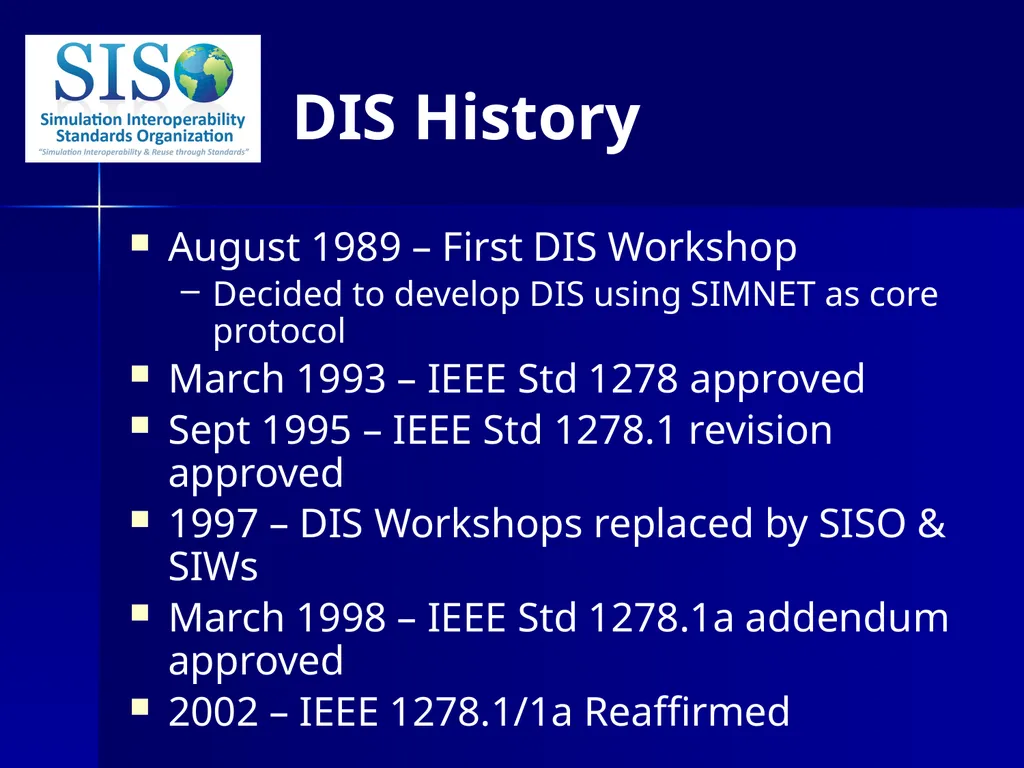
DIS History August 1989 – First DIS Workshop
Decided to develop DIS using SIMNET as core protocol
March 1993 – IEEE Std 1278 approved
Sept 1995 – IEEE Std 1278.1 revision approved
1997 – DIS Workshops replaced by SISO & SIWs
March 1998 – IEEE Std 1278.1a addendum approved
2002 – IEEE 1278.1/1a Reaffirmed<br>
Decided to develop DIS using SIMNET as core protocol
March 1993 – IEEE Std 1278 approved
Sept 1995 – IEEE Std 1278.1 revision approved
1997 – DIS Workshops replaced by SISO & SIWs
March 1998 – IEEE Std 1278.1a addendum approved
2002 – IEEE 1278.1/1a Reaffirmed<br>
05
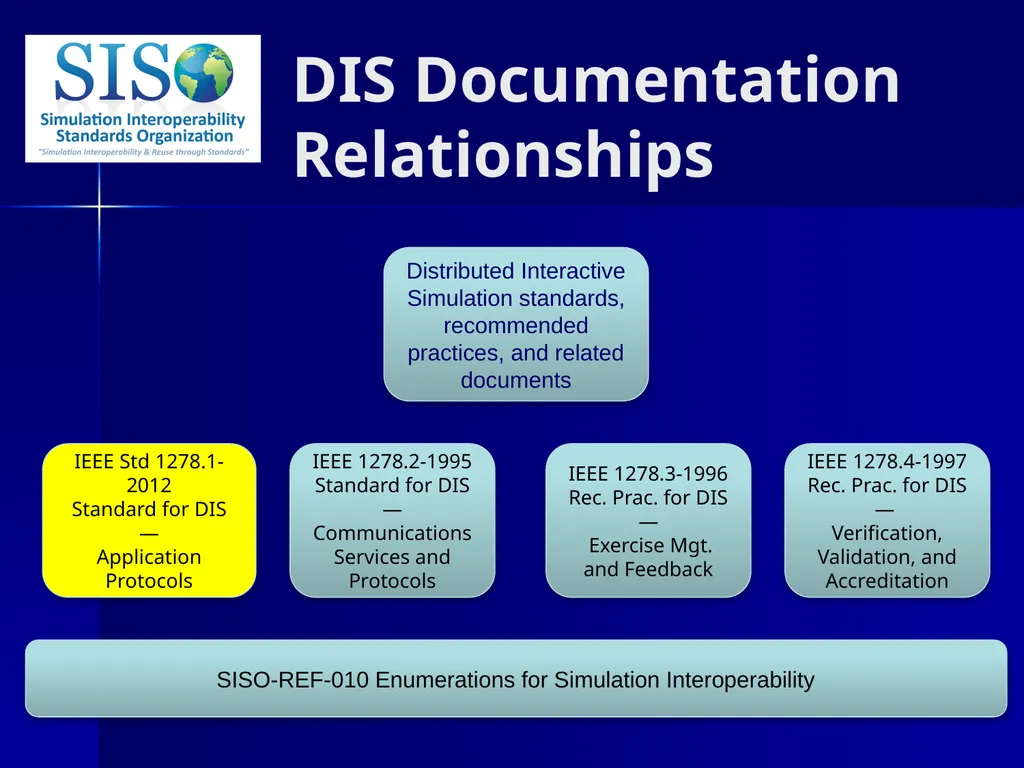
DIS Documentation Relationships Distributed Interactive Simulation standards, recommended practices, and related documents IEEE Std 1278.1- 2012
Standard for DIS
—
Application Protocols SISO-REF-010 Enumerations for Simulation Interoperability IEEE 1278.2-1995
Standard for DIS — Communications Services and Protocols IEEE 1278.3-1996
Rec. Prac. for DIS —
Exercise Mgt. and Feedback IEEE 1278.4-1997
Rec. Prac. for DIS —
Verification, Validation, and Accreditation<br>
Standard for DIS
—
Application Protocols SISO-REF-010 Enumerations for Simulation Interoperability IEEE 1278.2-1995
Standard for DIS — Communications Services and Protocols IEEE 1278.3-1996
Rec. Prac. for DIS —
Exercise Mgt. and Feedback IEEE 1278.4-1997
Rec. Prac. for DIS —
Verification, Validation, and Accreditation<br>
06
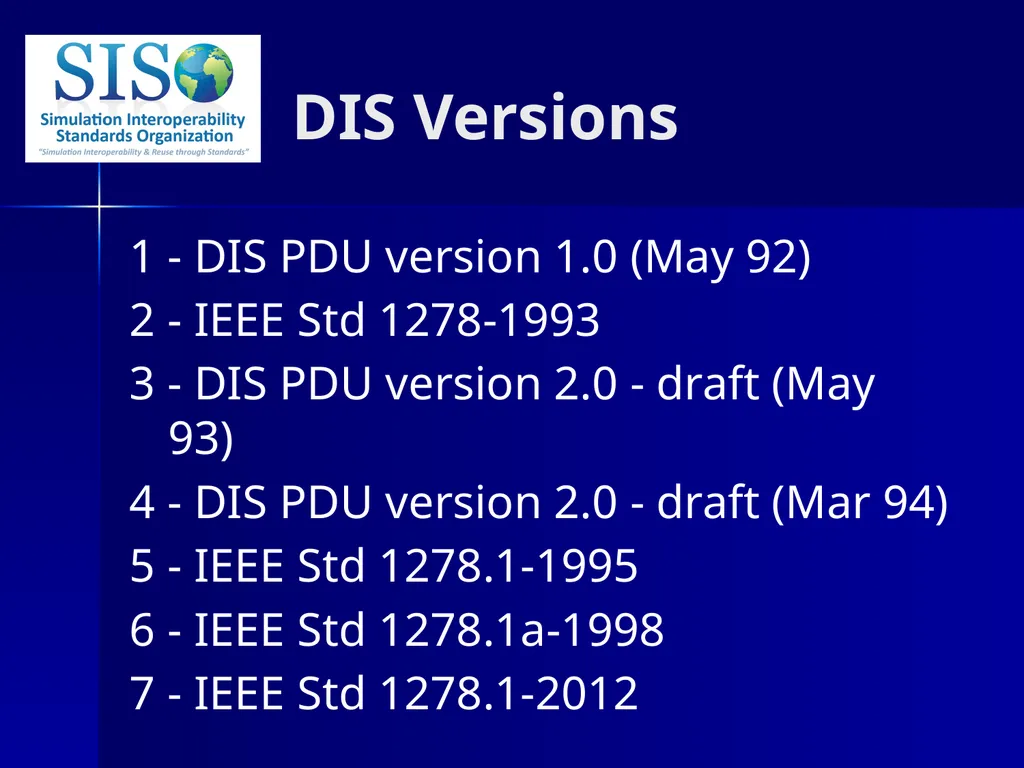
DIS Versions 1 - DIS PDU version 1.0 (May 92)
2 - IEEE Std 1278-1993
3 - DIS PDU version 2.0 - draft (May 93)
4 - DIS PDU version 2.0 - draft (Mar 94)
5 - IEEE Std 1278.1-1995
6 - IEEE Std 1278.1a-1998
7 - IEEE Std 1278.1-2012<br>
2 - IEEE Std 1278-1993
3 - DIS PDU version 2.0 - draft (May 93)
4 - DIS PDU version 2.0 - draft (Mar 94)
5 - IEEE Std 1278.1-1995
6 - IEEE Std 1278.1a-1998
7 - IEEE Std 1278.1-2012<br>
07
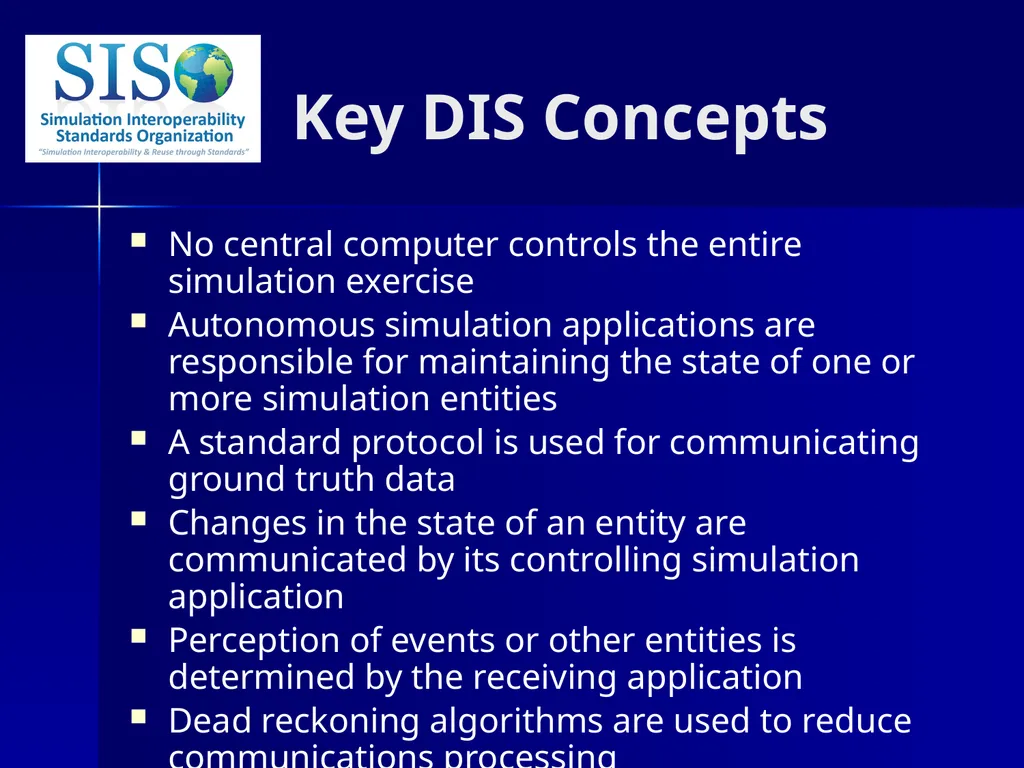
Key DIS Concepts No central computer controls the entire simulation exercise
Autonomous simulation applications are responsible for maintaining the state of one or more simulation entities
A standard protocol is used for communicating ground truth data
Changes in the state of an entity are communicated by its controlling simulation application
Perception of events or other entities is determined by the receiving application
Dead reckoning algorithms are used to reduce communications processing<br>
Autonomous simulation applications are responsible for maintaining the state of one or more simulation entities
A standard protocol is used for communicating ground truth data
Changes in the state of an entity are communicated by its controlling simulation application
Perception of events or other entities is determined by the receiving application
Dead reckoning algorithms are used to reduce communications processing<br>
08
Key DIS Definitions
(1 of 5) Simulation application:
Executing software on a host computer that models all or part of the representation of one or more simulation entities
Executing software on a host computer that models all or part of the world phenomena for the purpose of training or experimentation
Receives and processes information concerning entities created by peer simulation applications through the exchange of DIS PDUs
More than one simulation application may simultaneously execute on a host computer IEEE Std 1278.1-2012<br>
Executing software on a host computer that models all or part of the representation of one or more simulation entities
Executing software on a host computer that models all or part of the world phenomena for the purpose of training or experimentation
Receives and processes information concerning entities created by peer simulation applications through the exchange of DIS PDUs
More than one simulation application may simultaneously execute on a host computer IEEE Std 1278.1-2012<br>
09
Key DIS Definitions
(2 of 5) Host Computer:
Computer that supports one or more simulation applications
Host computers participating in a simulation exercise are connected by network(s) including local area networks, wide area networks, radio frequency links, etc IEEE Std 1278.1-2012<br>
Computer that supports one or more simulation applications
Host computers participating in a simulation exercise are connected by network(s) including local area networks, wide area networks, radio frequency links, etc IEEE Std 1278.1-2012<br>
10
Key DIS Definitions
(3 of 5) Simulation entity:
A physical object in the synthetic environment that is created and controlled by a simulation application and affected by the exchange of DIS PDUs
It is possible that a simulation application may be controlling more than one simulation entity IEEE Std 1278.1-2012<br>
A physical object in the synthetic environment that is created and controlled by a simulation application and affected by the exchange of DIS PDUs
It is possible that a simulation application may be controlling more than one simulation entity IEEE Std 1278.1-2012<br>
11
Key DIS Definitions
(4 of 5) Simulation exercise:
An exercise that consists of one or more interacting simulation applications
Simulations participating in the same simulation exercise share a common identifying number called the exercise identifier
Simulations utilize correlated representations of the synthetic environment collection and distribution of certain types of data which they operate IEEE Std 1278.1-2012<br>
An exercise that consists of one or more interacting simulation applications
Simulations participating in the same simulation exercise share a common identifying number called the exercise identifier
Simulations utilize correlated representations of the synthetic environment collection and distribution of certain types of data which they operate IEEE Std 1278.1-2012<br>
12
Key DIS Definitions
(5 of 5) Simulation environment:
The operational environment surrounding the simulation entities
Includes terrain, atmospheric, and oceanographic information
Participants in the same DIS exercise will be using environment information that is adequately correlated for the type of exercise to be performed IEEE Std 1278.1-2012<br>
The operational environment surrounding the simulation entities
Includes terrain, atmospheric, and oceanographic information
Participants in the same DIS exercise will be using environment information that is adequately correlated for the type of exercise to be performed IEEE Std 1278.1-2012<br>
13
PDU Families Entity information/interaction
Warfare
Logistics
Simulation Management
Distributed Emission Regeneration
Radio Communications
Entity Management
Minefield
Synthetic Environment
Simulation Management with Reliability
Live Entity
Non-Real Time protocol
Information Operations<br>
Warfare
Logistics
Simulation Management
Distributed Emission Regeneration
Radio Communications
Entity Management
Minefield
Synthetic Environment
Simulation Management with Reliability
Live Entity
Non-Real Time protocol
Information Operations<br>
14
PDU Families (Cont) Entity information/interaction
Appearance of an entity
Location of an entity
Entity collisions
Attribute PDU (Version 7)
Warfare
Weapons
Expendables
Explosions
Fire/Detonate
Directed Energy (Version 7)
Entity Damage Status (Version 7)<br>
Appearance of an entity
Location of an entity
Entity collisions
Attribute PDU (Version 7)
Warfare
Weapons
Expendables
Explosions
Fire/Detonate
Directed Energy (Version 7)
Entity Damage Status (Version 7)<br>
15
PDU Families (Cont) Logistics
Representation of logistics support
Request and Response
Resupply
Repair
Simulation Management
Centralized control of a simulation exercise
Start, restart, maintenance, shutdown, data collection, data distribution
Optional – used as required and supported<br>
Representation of logistics support
Request and Response
Resupply
Repair
Simulation Management
Centralized control of a simulation exercise
Start, restart, maintenance, shutdown, data collection, data distribution
Optional – used as required and supported<br>
16
PDU Families (Cont) Distributed Emission Regeneration
Simulation of emissions
Electromagnetic – Radar, IFF
Underwater Acoustics
Laser Designators
Emitting entity describes the emission
Sensing entity responsible for regeneration of emission at required fidelity
Radio Communications
Audio and Digital communications
Sending entity describes communications device
Sending entity provides the message
Receiving entities determine if they can receive the signal and determine what to do about the message
Tactical Data Links simulated using these PDUs<br>
Simulation of emissions
Electromagnetic – Radar, IFF
Underwater Acoustics
Laser Designators
Emitting entity describes the emission
Sensing entity responsible for regeneration of emission at required fidelity
Radio Communications
Audio and Digital communications
Sending entity describes communications device
Sending entity provides the message
Receiving entities determine if they can receive the signal and determine what to do about the message
Tactical Data Links simulated using these PDUs<br>
17
PDU Families (Cont) Entity Management
Four alternative methods for managing entities
Entity aggregation for large scale exercises
Communication of state of aggregated entities
Transferring ownership of an entity
Hierarchical linkage of separately hosted entities
Minefield
Location of mines/minefields
Appearance of mines/minefields
Other pertinent details
Synthetic Environment
Process approach used to exchange information about smoke, contrails, dust, obscurants, toxic chemicals
Object approach used to exchange information about point, line, or areal objects in environment<br>
Four alternative methods for managing entities
Entity aggregation for large scale exercises
Communication of state of aggregated entities
Transferring ownership of an entity
Hierarchical linkage of separately hosted entities
Minefield
Location of mines/minefields
Appearance of mines/minefields
Other pertinent details
Synthetic Environment
Process approach used to exchange information about smoke, contrails, dust, obscurants, toxic chemicals
Object approach used to exchange information about point, line, or areal objects in environment<br>
18
PDU Families (Cont) Simulation Management with Reliability
Uses simulation management PDUs
Specifies use of reliable communications
Optional – use as required and supported
Information Operations (Version 7)
Simulate the use of electronic warfare, computer network attack, military deception, etc
Influence or disrupt decision making
Predicted effects are transmitted
Perceived effects are reported<br>
Uses simulation management PDUs
Specifies use of reliable communications
Optional – use as required and supported
Information Operations (Version 7)
Simulate the use of electronic warfare, computer network attack, military deception, etc
Influence or disrupt decision making
Predicted effects are transmitted
Perceived effects are reported<br>
19
PDU Families (Cont) Non-Real Time protocol
Most DIS exercises are human-in-the-loop and operate in real time
Defines how DIS PDUs can be in non-real time exercise
Live Entity Information/Interaction protocol
Designed for bandwidth-limited range interactions
Architectural changes to PDUs to conserve bandwidth<br>
Most DIS exercises are human-in-the-loop and operate in real time
Defines how DIS PDUs can be in non-real time exercise
Live Entity Information/Interaction protocol
Designed for bandwidth-limited range interactions
Architectural changes to PDUs to conserve bandwidth<br>
20
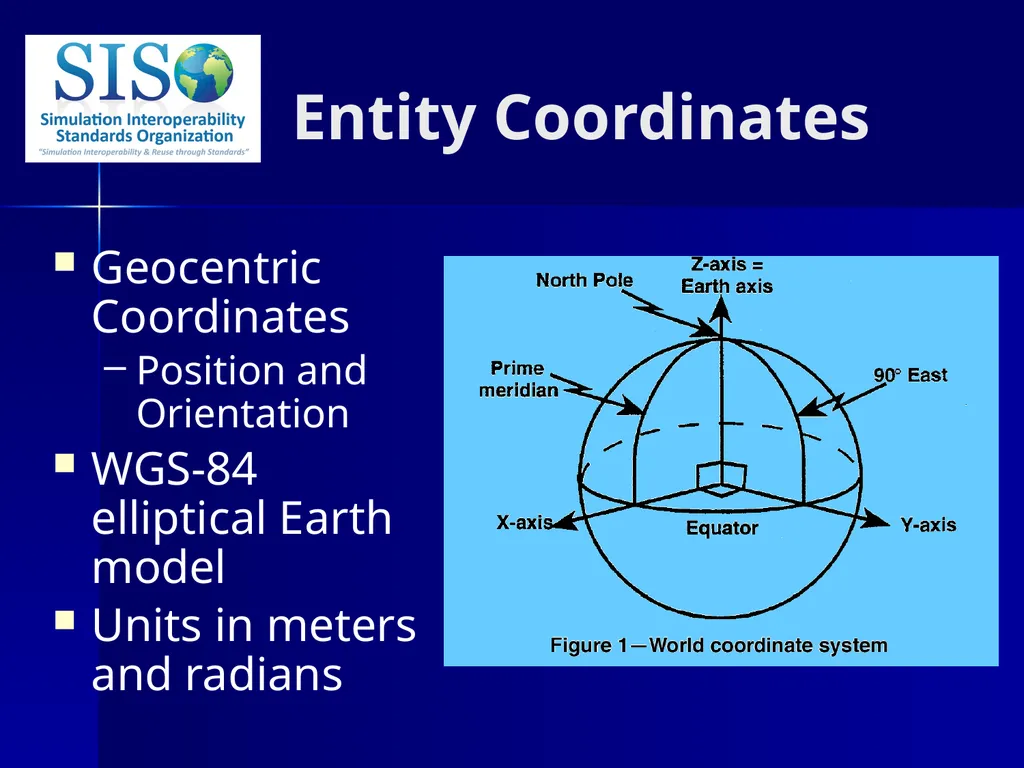
Entity Coordinates Geocentric Coordinates
Position and Orientation
WGS-84 elliptical Earth model
Units in meters and radians<br>
Position and Orientation
WGS-84 elliptical Earth model
Units in meters and radians<br>
21
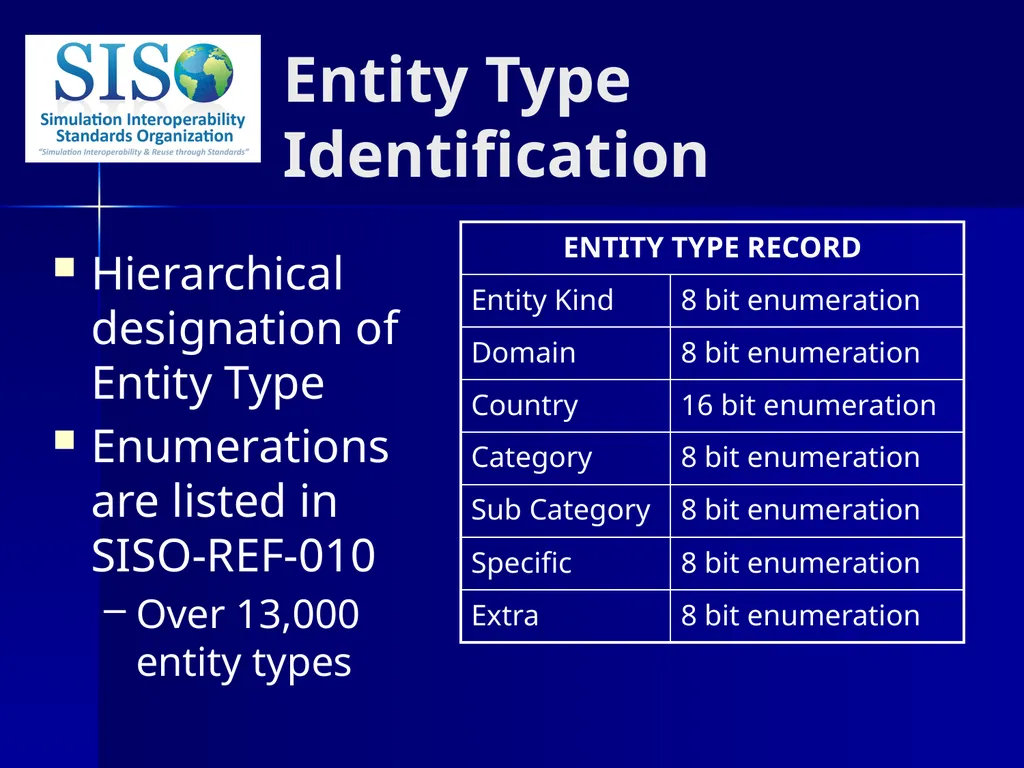
Entity Type Identification Hierarchical designation of Entity Type
Enumerations are listed in SISO-REF-010
Over 13,000 entity types<br>
Enumerations are listed in SISO-REF-010
Over 13,000 entity types<br>
22
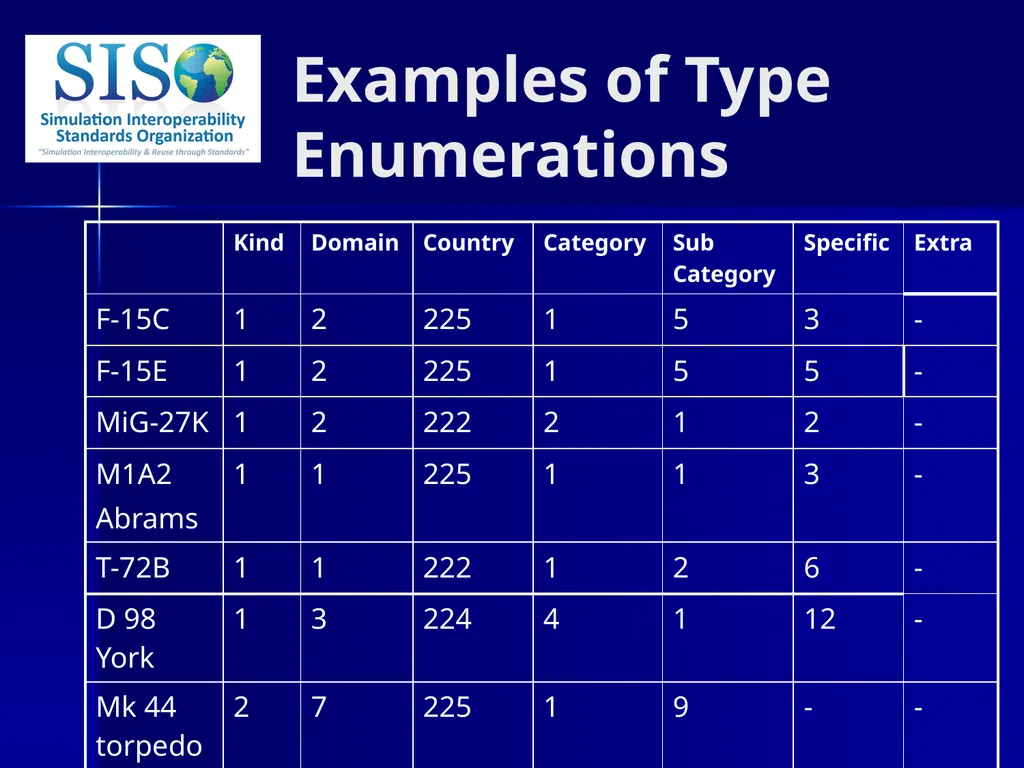
Examples of Type Enumerations<br>
23
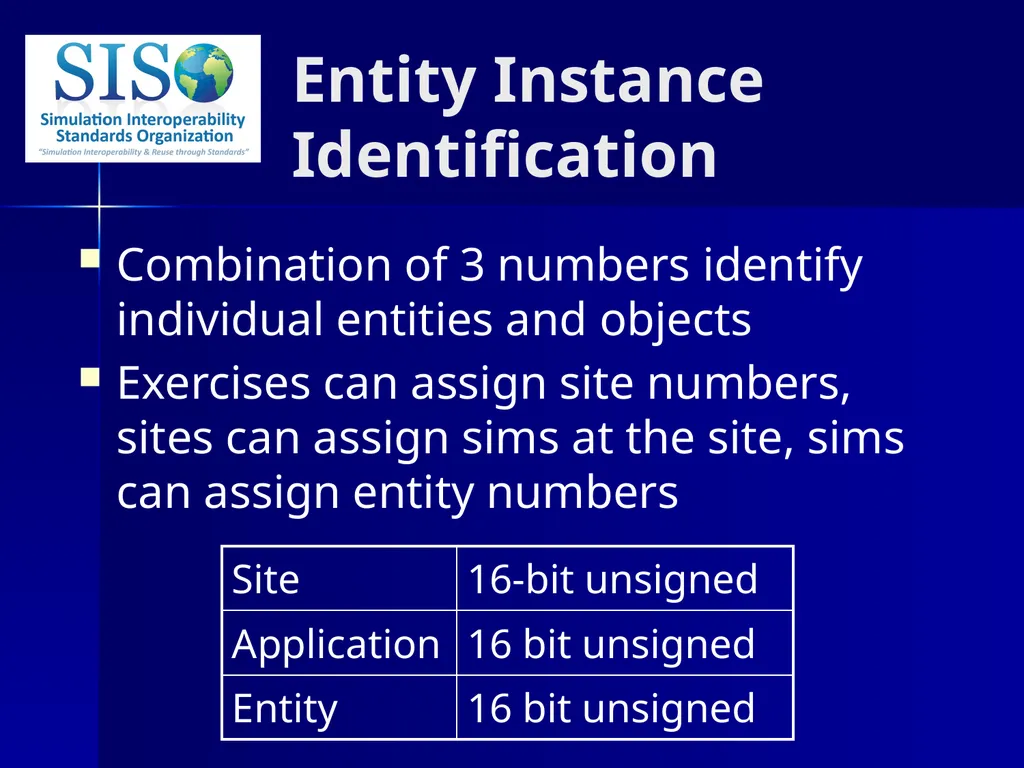
Entity Instance Identification Combination of 3 numbers identify individual entities and objects
Exercises can assign site numbers, sites can assign sims at the site, sims can assign entity numbers<br>
Exercises can assign site numbers, sites can assign sims at the site, sims can assign entity numbers<br>
24
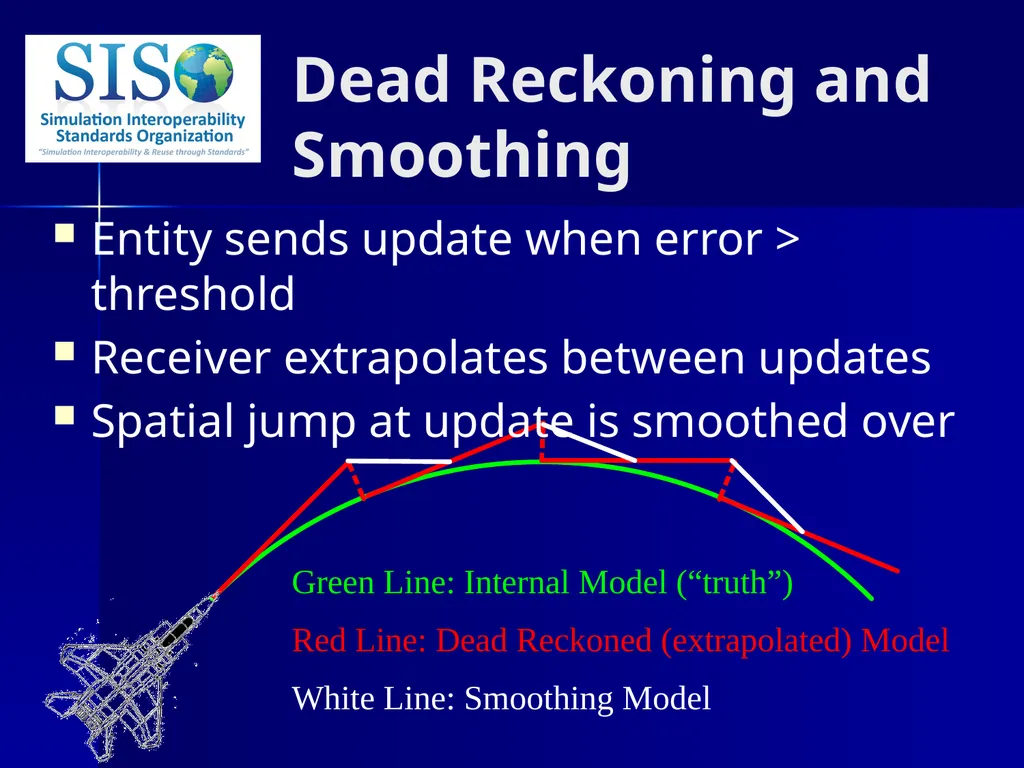
Dead Reckoning and Smoothing Green Line: Internal Model (“truth”)
Red Line: Dead Reckoned (extrapolated) Model
White Line: Smoothing Model Entity sends update when error > threshold
Receiver extrapolates between updates
Spatial jump at update is smoothed over<br>
Red Line: Dead Reckoned (extrapolated) Model
White Line: Smoothing Model Entity sends update when error > threshold
Receiver extrapolates between updates
Spatial jump at update is smoothed over<br>
25
Overview General DIS Overview
DIS History
DIS Documents
Key Definitions and Concepts
PDU Families
The Updated DIS Version 7 Standard
IEEE 1278 Update History
General standard improvements
PDU-specific improvements and new PDUs
Annexes<br>
DIS History
DIS Documents
Key Definitions and Concepts
PDU Families
The Updated DIS Version 7 Standard
IEEE 1278 Update History
General standard improvements
PDU-specific improvements and new PDUs
Annexes<br>
26
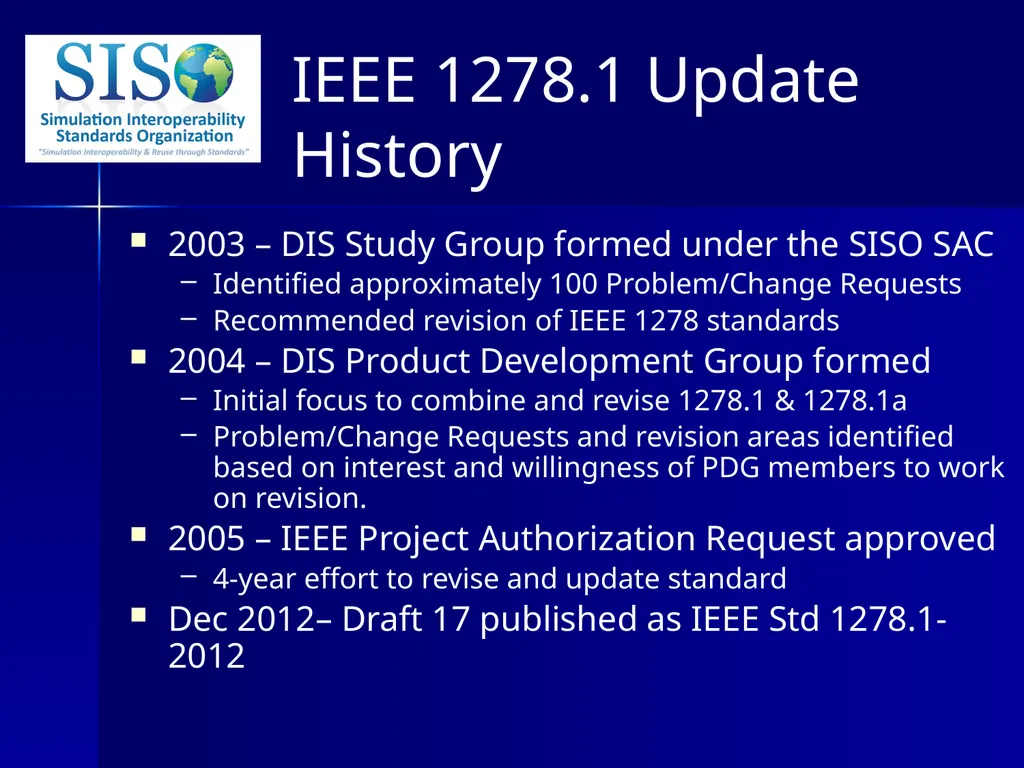
IEEE 1278.1 Update History 2003 – DIS Study Group formed under the SISO SAC
Identified approximately 100 Problem/Change Requests
Recommended revision of IEEE 1278 standards
2004 – DIS Product Development Group formed
Initial focus to combine and revise 1278.1 & 1278.1a
Problem/Change Requests and revision areas identified based on interest and willingness of PDG members to work on revision.
2005 – IEEE Project Authorization Request approved
4-year effort to revise and update standard
Dec 2012– Draft 17 published as IEEE Std 1278.1-2012<br>
Identified approximately 100 Problem/Change Requests
Recommended revision of IEEE 1278 standards
2004 – DIS Product Development Group formed
Initial focus to combine and revise 1278.1 & 1278.1a
Problem/Change Requests and revision areas identified based on interest and willingness of PDG members to work on revision.
2005 – IEEE Project Authorization Request approved
4-year effort to revise and update standard
Dec 2012– Draft 17 published as IEEE Std 1278.1-2012<br>
27
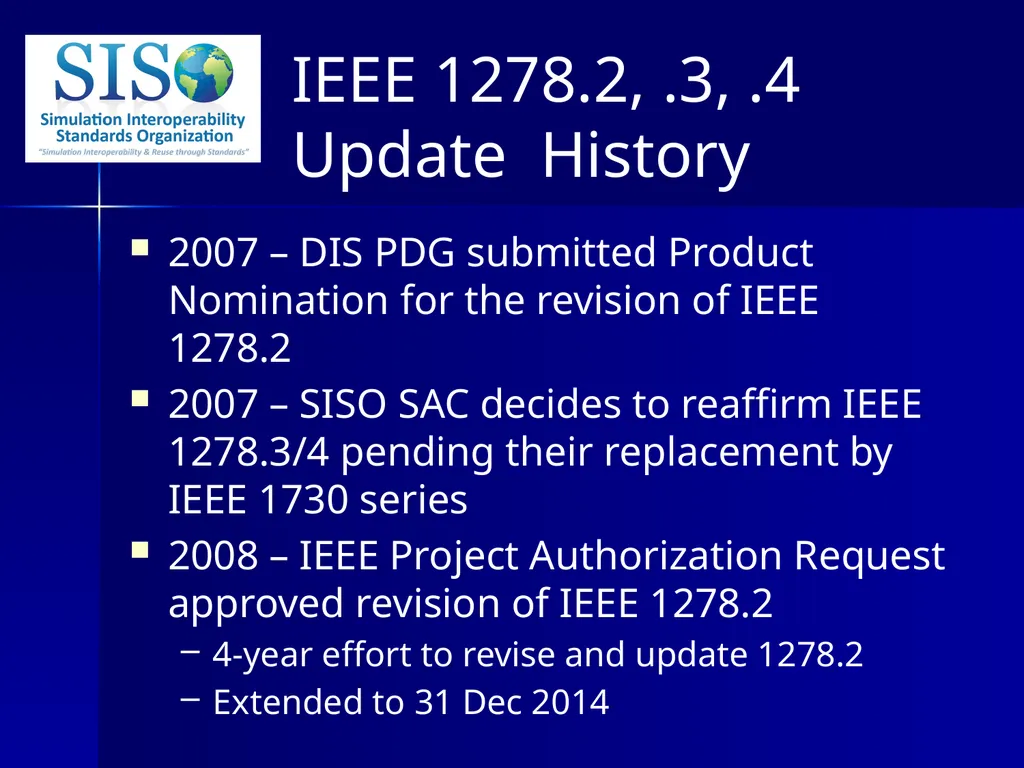
IEEE 1278.2, .3, .4 Update History 2007 – DIS PDG submitted Product Nomination for the revision of IEEE 1278.2
2007 – SISO SAC decides to reaffirm IEEE 1278.3/4 pending their replacement by IEEE 1730 series
2008 – IEEE Project Authorization Request approved revision of IEEE 1278.2
4-year effort to revise and update 1278.2
Extended to 31 Dec 2014<br>
2007 – SISO SAC decides to reaffirm IEEE 1278.3/4 pending their replacement by IEEE 1730 series
2008 – IEEE Project Authorization Request approved revision of IEEE 1278.2
4-year effort to revise and update 1278.2
Extended to 31 Dec 2014<br>
28
DIS V7 - Extensive clarifications New and improved rules
Lessons learned from 15 years of use
New standard is 747 pages
The 1995 and 1998 standards combined were 330 pages Even if you have no plans to use any of the new features, the new standard is still extremely useful<br>
Lessons learned from 15 years of use
New standard is 747 pages
The 1995 and 1998 standards combined were 330 pages Even if you have no plans to use any of the new features, the new standard is still extremely useful<br>
29
Compatibility with Version 5/6 Almost every change in the PDU formats and rules are backward compatible with Version 5/6 PDUs
Most changes are also forward compatible (i.e. Version 5 simulations can still make sense of Version 7 PDUs)
Use of former padding fields
New sims can add info, old sims ignore it<br>
Most changes are also forward compatible (i.e. Version 5 simulations can still make sense of Version 7 PDUs)
Use of former padding fields
New sims can add info, old sims ignore it<br>
30
DIS Exercise Rules The DIS Exercise section 4.2 has been expanded significantly
A comprehensive section covering simulations, objects, heartbeats, timeouts, thresholds, gateways and protocol version<br>
A comprehensive section covering simulations, objects, heartbeats, timeouts, thresholds, gateways and protocol version<br>
31
Objects and Identifiers Clearer definition of “object” and “entity”
Entities are objects that have an ESPDU
Other objects are usually attached to entities or are things such as environmental objects
Confusion on the 3rd number of the Site-App-Entity IDs is cleared up
Non-object IDs clarified
e.g. Simulation IDs, Request IDs<br>
Entities are objects that have an ESPDU
Other objects are usually attached to entities or are things such as environmental objects
Confusion on the 3rd number of the Site-App-Entity IDs is cleared up
Non-object IDs clarified
e.g. Simulation IDs, Request IDs<br>
32
Variable Heartbeat Periods Entity State default heartbeat periods now defined by entity kind, domain, and whether moving or stationary
Other PDU types have individual default heartbeat periods
Standard defines defaults
Exercises can set actual values
Provides flexibility and reduces the number of heartbeat updates<br>
Other PDU types have individual default heartbeat periods
Standard defines defaults
Exercises can set actual values
Provides flexibility and reduces the number of heartbeat updates<br>
33
Protocol Version Rules Lack of rules on use of Versions 5 or 6 led to confusion
Rules for interoperability between Version 5/6 and Version 7 are defined
Mixed version exercises are allowed
A single sim may issue both 5/6 and 7
Must obey rules of the version in the PDU, both sending and receiving<br>
Rules for interoperability between Version 5/6 and Version 7 are defined
Mixed version exercises are allowed
A single sim may issue both 5/6 and 7
Must obey rules of the version in the PDU, both sending and receiving<br>
34
Transfer Ownership The Transfer Control function has been renamed to Transfer Ownership
The Transfer Control Request PDU has been renamed the Transfer Ownership PDU
The entire Transfer Ownership function has been revised to improve its functionality
It is now closer to how TO has been done in actual simulations for many years<br>
The Transfer Control Request PDU has been renamed the Transfer Ownership PDU
The entire Transfer Ownership function has been revised to improve its functionality
It is now closer to how TO has been done in actual simulations for many years<br>
35
Time Time requirements have been extensively clarified and revised
Absolute, relative, simulation time
Timestamp usage
Time synchronization
Absolute Time does not have to be synched to a GPS Time source, just to some source agreed to by the exercise
New 8 page Annex of additional info<br>
Absolute, relative, simulation time
Timestamp usage
Time synchronization
Absolute Time does not have to be synched to a GPS Time source, just to some source agreed to by the exercise
New 8 page Annex of additional info<br>
36
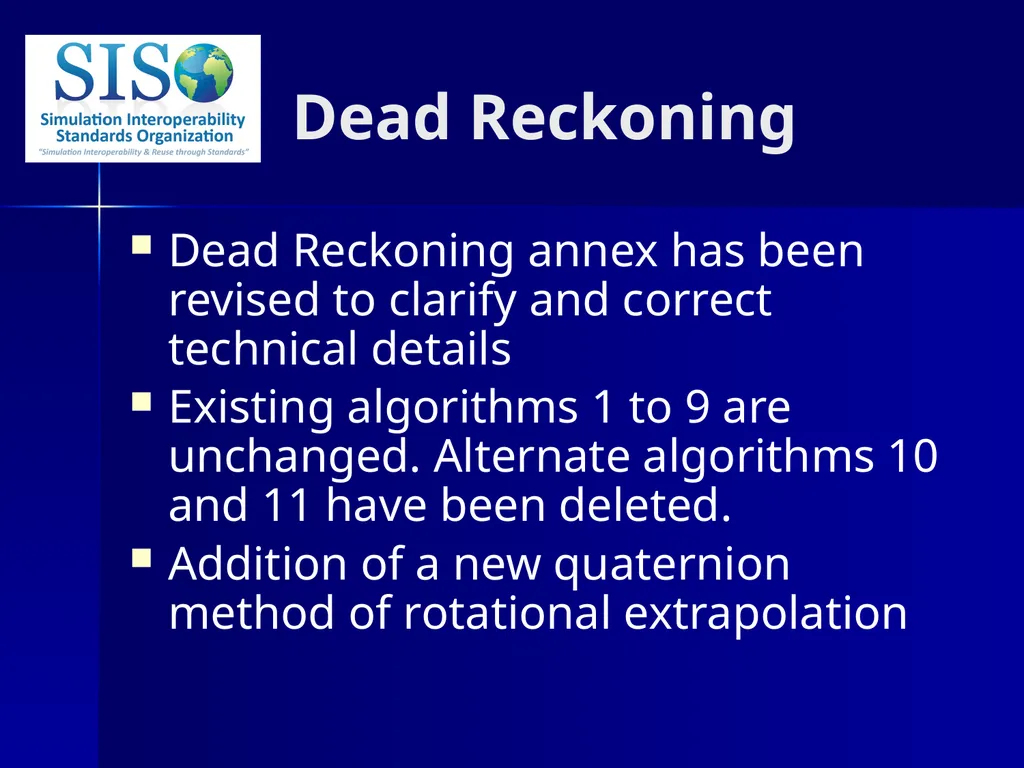
Dead Reckoning Dead Reckoning annex has been revised to clarify and correct technical details
Existing algorithms 1 to 9 are unchanged. Alternate algorithms 10 and 11 have been deleted.
Addition of a new quaternion method of rotational extrapolation<br>
Existing algorithms 1 to 9 are unchanged. Alternate algorithms 10 and 11 have been deleted.
Addition of a new quaternion method of rotational extrapolation<br>
37
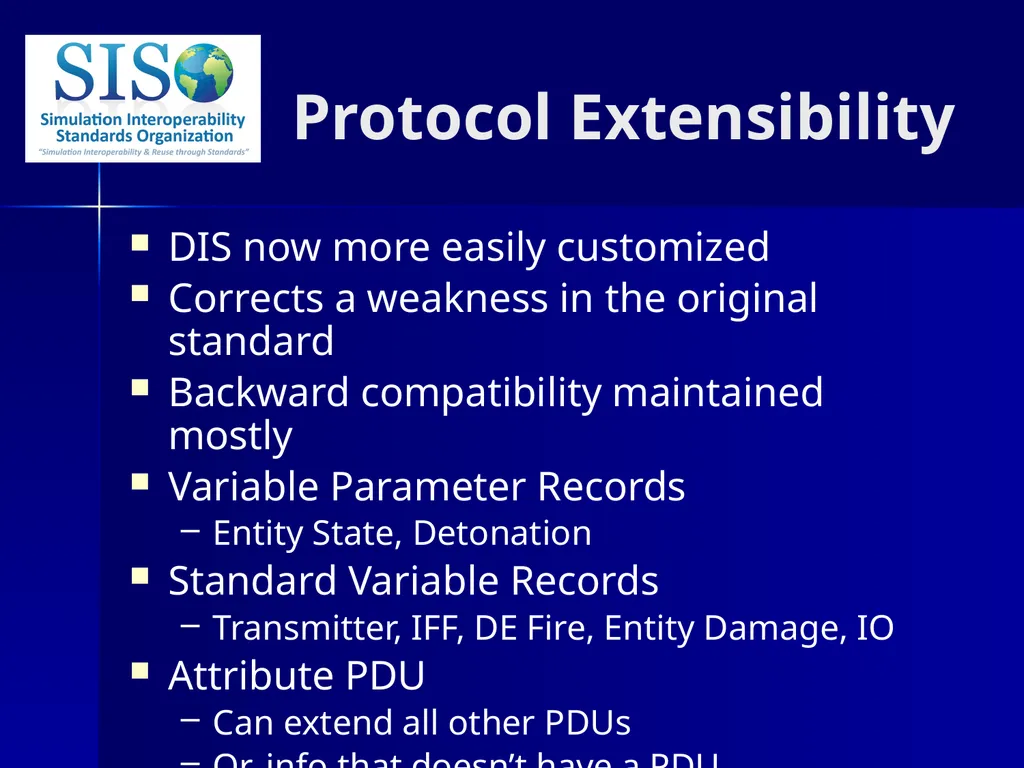
Protocol Extensibility DIS now more easily customized
Corrects a weakness in the original standard
Backward compatibility maintained mostly
Variable Parameter Records
Entity State, Detonation
Standard Variable Records
Transmitter, IFF, DE Fire, Entity Damage, IO
Attribute PDU
Can extend all other PDUs
Or, info that doesn’t have a PDU<br>
Corrects a weakness in the original standard
Backward compatibility maintained mostly
Variable Parameter Records
Entity State, Detonation
Standard Variable Records
Transmitter, IFF, DE Fire, Entity Damage, IO
Attribute PDU
Can extend all other PDUs
Or, info that doesn’t have a PDU<br>
38
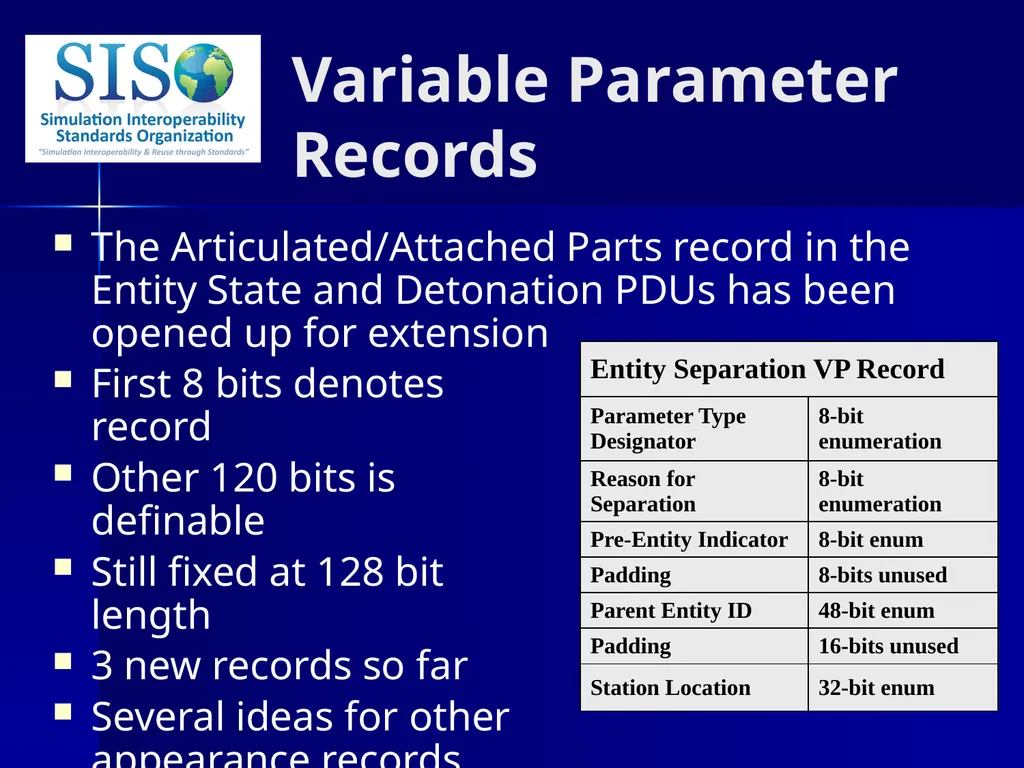
Variable Parameter Records The Articulated/Attached Parts record in the Entity State and Detonation PDUs has been opened up for extension First 8 bits denotes record
Other 120 bits is definable
Still fixed at 128 bit length
3 new records so far
Several ideas for other appearance records<br>
Other 120 bits is definable
Still fixed at 128 bit length
3 new records so far
Several ideas for other appearance records<br>
39
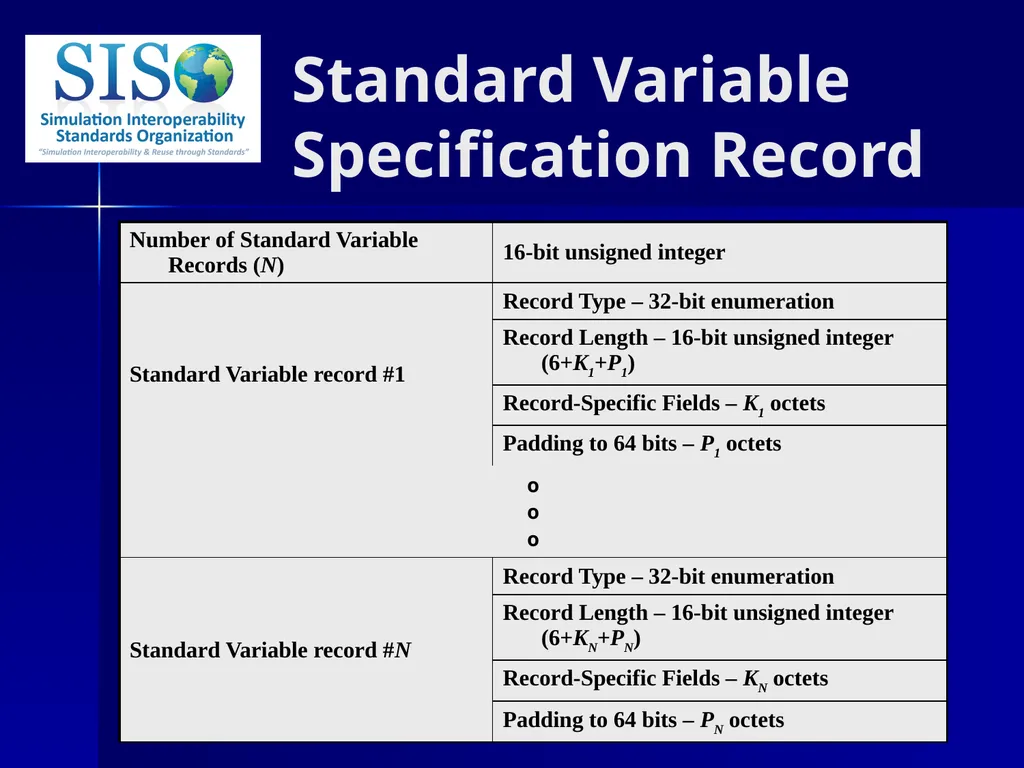
Standard Variable Specification Record<br>
40
Uses of Standard Variable Spec Record Transmitter PDU – Variable Transmitter Parameters records
IFF PDU Layers 3, 4, 5 – IFF Data records
Directed Energy Fire PDU – DE records
Entity Damage Status PDU – Damage Description records
IO PDUs – IO records
Attribute PDU – Attribute records
All future PDUs to contain Std Var records<br>
IFF PDU Layers 3, 4, 5 – IFF Data records
Directed Energy Fire PDU – DE records
Entity Damage Status PDU – Damage Description records
IO PDUs – IO records
Attribute PDU – Attribute records
All future PDUs to contain Std Var records<br>
41
The Attribute PDU Allows existing PDUs to be extended without breaking forward or backward compatibility
The PDU contains sets of Attribute records
Each set is tied to an entity or object
Attribute records are open format Standard Variable records
Not allowed to contain information that already exists in other PDUs
Otherwise, there would be confusion about which PDU to use<br>
The PDU contains sets of Attribute records
Each set is tied to an entity or object
Attribute records are open format Standard Variable records
Not allowed to contain information that already exists in other PDUs
Otherwise, there would be confusion about which PDU to use<br>
42
The Attribute PDU (cont) A transient PDU can be extended by attaching an Attribute PDU to it
This is called Coupled Extension
Requires PDU Bundling
State PDUs can be extended by sending Attribute PDUS at any time
Or, the Attribute PDU can be coupled<br>
This is called Coupled Extension
Requires PDU Bundling
State PDUs can be extended by sending Attribute PDUS at any time
Or, the Attribute PDU can be coupled<br>
43
PDU Bundling rules clarified Improves network efficiency by allowing one or more PDUs to be concatenated in a UDP datagram
Bundling rules given in 1278.2
Tradeoff between delaying PDUs to build bigger bundles
Latency vs. network efficiency
Max size of bundle also explained<br>
Bundling rules given in 1278.2
Tradeoff between delaying PDUs to build bigger bundles
Latency vs. network efficiency
Max size of bundle also explained<br>
44
Maximum PDU Size Max PDU size clarified to be 8K bytes
Original 1278.2 mentions 8K but didn’t have a clear rule
1400 bytes is still a good limit where possible
Network MTU is the guideline
Avoids fragmentation - more efficient transfer
8K size is available for large data sets or bundles<br>
Original 1278.2 mentions 8K but didn’t have a clear rule
1400 bytes is still a good limit where possible
Network MTU is the guideline
Avoids fragmentation - more efficient transfer
8K size is available for large data sets or bundles<br>
45
Expanded Weapons Support Fire and Detonate PDUs now have better support for:
Expendables (IR flares, chaff)
Non-munition explosions such as kinetic weapon or secondary explosions (e.g. fuel tank)
Original Burst Descriptor record is now:
Munition Descriptor record (unchanged)
Expendable Descriptor record
Explosion Descriptor record for non-munition explosions<br>
Expendables (IR flares, chaff)
Non-munition explosions such as kinetic weapon or secondary explosions (e.g. fuel tank)
Original Burst Descriptor record is now:
Munition Descriptor record (unchanged)
Expendable Descriptor record
Explosion Descriptor record for non-munition explosions<br>
46
Entity Separation Clarified and includes support for:
Multi-stage missile separation
Portraying submunitions
Variable Parameter records for Separation
Entity Type VP record
Separation VP record
Towed Decoys
Association VP record<br>
Multi-stage missile separation
Portraying submunitions
Variable Parameter records for Separation
Entity Type VP record
Separation VP record
Towed Decoys
Association VP record<br>
47
Electromagnetic Emissions Better description of radar beam parameters, scan volumes, phased array radar
Jammer field redefined to better support a wider range of multi-resolution simulations<br>
Jammer field redefined to better support a wider range of multi-resolution simulations<br>
48
Partial Updates for Emissions Original standard was not clear if every system for an entity had to be included in every PDU update
It is now clear that this is not necessary
Systems can be spread across multiple PDUs
Can send only changed systems and beams
This potentially breaks forward and backward compatibility
However, the 1995 standard was ambiguous on this matter so compatibility is difficult regardless<br>
It is now clear that this is not necessary
Systems can be spread across multiple PDUs
Can send only changed systems and beams
This potentially breaks forward and backward compatibility
However, the 1995 standard was ambiguous on this matter so compatibility is difficult regardless<br>
49
IFF Mode 5/S New layers in the IFF PDU
Layer 3 for Mode 5 IFF
Layer 4 for Mode S IFF
Layer 5 open for other IFF capabilities
All IFF record formats presently contained in the SISO-REF-010 Enumeration document have been moved into the standard
The requirements related to each IFF transponder and interrogator system type are clearly specified in a new Annex<br>
Layer 3 for Mode 5 IFF
Layer 4 for Mode S IFF
Layer 5 open for other IFF capabilities
All IFF record formats presently contained in the SISO-REF-010 Enumeration document have been moved into the standard
The requirements related to each IFF transponder and interrogator system type are clearly specified in a new Annex<br>
50
Major Radio Simulation Changes Extensive Transmitter PDU clarifications
Transmitter PDU heartbeats must be sent even if Power is off
Must contain all radio parameter settings
New annex for radio systems specifics
New basic and High Fidelity HAVE QUICK Radio records
SINCGARS and JTIDS/MIDS radio MP records moved from DIS Enumeration document
New Variable Transmitter Parameter (VTP) Record format
Minor forward compatible software change<br>
Transmitter PDU heartbeats must be sent even if Power is off
Must contain all radio parameter settings
New annex for radio systems specifics
New basic and High Fidelity HAVE QUICK Radio records
SINCGARS and JTIDS/MIDS radio MP records moved from DIS Enumeration document
New Variable Transmitter Parameter (VTP) Record format
Minor forward compatible software change<br>
51
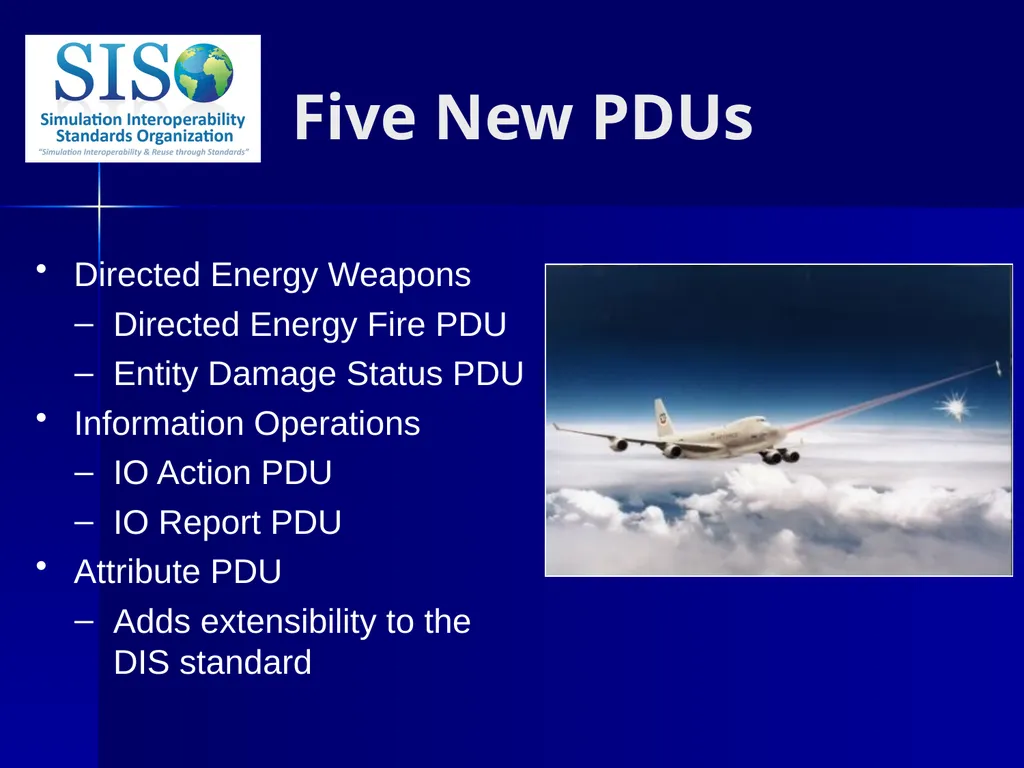
Five New PDUs Directed Energy Weapons
Directed Energy Fire PDU
Entity Damage Status PDU
Information Operations
IO Action PDU
IO Report PDU
Attribute PDU
Adds extensibility to the DIS standard<br>
Directed Energy Fire PDU
Entity Damage Status PDU
Information Operations
IO Action PDU
IO Report PDU
Attribute PDU
Adds extensibility to the DIS standard<br>
52
Directed Energy Fire PDU Supports high-fidelity directed energy engagements
Conveys detailed characteristics of the energy deposition
Type of weapon (e.g. Laser, Microwave)
Duration
Beam shape<br>
Conveys detailed characteristics of the energy deposition
Type of weapon (e.g. Laser, Microwave)
Duration
Beam shape<br>
53
Entity Damage Status PDU Allows an entity to report high-fidelity damage details of themselves
Originally designed for directed energy weapons to help direct their fire
Opened up to communicate any type of damage<br>
Originally designed for directed energy weapons to help direct their fire
Opened up to communicate any type of damage<br>
54
Information Operations IO supports interoperability of simulated electronic warfare, computer network operations, military deception, and similar operations used to influence or disrupt enemy decision making
IO Action PDU can contain the predicted effects of an attack
The actual effects of an attack are communicated in IO report PDU<br>
IO Action PDU can contain the predicted effects of an attack
The actual effects of an attack are communicated in IO report PDU<br>
55
Annexes Annex A Warfare. Additional requirements to support the warfare functional area
Annex B Specific Transponder and Interrogator Systems for IFF
Annex C Radio Systems. Details of specific radio systems
Annex D Objects. Details of object types and primary and secondary identifiers
Annex E Dead reckoning definitions and algorithms<br>
Annex B Specific Transponder and Interrogator Systems for IFF
Annex C Radio Systems. Details of specific radio systems
Annex D Objects. Details of object types and primary and secondary identifiers
Annex E Dead reckoning definitions and algorithms<br>
56
Annexes (cont) Annex F Heartbeats, Timeouts, Thresholds. Guidance on interoperability when some simulations have implemented the new entity timeout requirements and some have not.
Annex G Time Calculations and Uses. Additional information on time and its uses in a distributed simulation environment
Annex H Transfer Ownership. Detailed requirements for transfer ownership.
Annex I Articulated and Attached Parts<br>
Annex G Time Calculations and Uses. Additional information on time and its uses in a distributed simulation environment
Annex H Transfer Ownership. Detailed requirements for transfer ownership.
Annex I Articulated and Attached Parts<br>
57
Questions<br>