
Diversity, Equal Opportunity, and
LD
Published · 27 slides · 0 views
1 / 1

Description
Diversity, Equal Opportunity, and Nondiscrimination Annual Refresher Training Commanders Intent CAP provides an inclusive and welcoming environment for all members and ensures that educational, membership, and operational decisions are
Related Topics
Share
Embed code
Download this presentation From Below
"Diversity, Equal Opportunity, and" is the property of its rightful owner. Permission is granted to download and print the materials on this website for personal, non-commercial use only, and to display it on your personal computer provided you do not modify the materials and that you retain all copyright notices contained in the materials. By downloading content from our website, you accept the terms of this agreement.
Presentation Transcript
01
Diversity, Equal Opportunity, and Nondiscrimination Annual Refresher Training<br>
02
Commander’s Intent CAP provides an inclusive and welcoming environment for all members and ensures that educational, membership, and operational decisions are based on each individual’s abilities and qualifications.
The opportunity to participate and progress is limited only by a member's ability, participation, and performance.
Commanders at all levels are responsible for ensuring that members under their command are aware of and adhere to CAP’s nondiscrimination policy.<br>
The opportunity to participate and progress is limited only by a member's ability, participation, and performance.
Commanders at all levels are responsible for ensuring that members under their command are aware of and adhere to CAP’s nondiscrimination policy.<br>
03
2020-2024 Strategic Plan Goal 4. Model volunteerism and servant leadership as a respected nonprofit that embraces the power of diversity and inclusion.
Diversity is a critical component of successful organizations. Ensuring that an organization embraces, seeks and celebrates diversity brings richness to the organization.
Diversity of thought, gender, ethnicity and age makes the organization stronger.
A key factor to achieving broad diversity is having an organization that is inclusive – all members have the same opportunity to participate, to be valued and to be successful.
Each member joins CAP for a different reason. Just like the diversity in our membership, so too is the diversity in the contributions each one makes, the levels they may attain in CAP and the satisfaction each receives by being a member.<br>
Diversity is a critical component of successful organizations. Ensuring that an organization embraces, seeks and celebrates diversity brings richness to the organization.
Diversity of thought, gender, ethnicity and age makes the organization stronger.
A key factor to achieving broad diversity is having an organization that is inclusive – all members have the same opportunity to participate, to be valued and to be successful.
Each member joins CAP for a different reason. Just like the diversity in our membership, so too is the diversity in the contributions each one makes, the levels they may attain in CAP and the satisfaction each receives by being a member.<br>
04
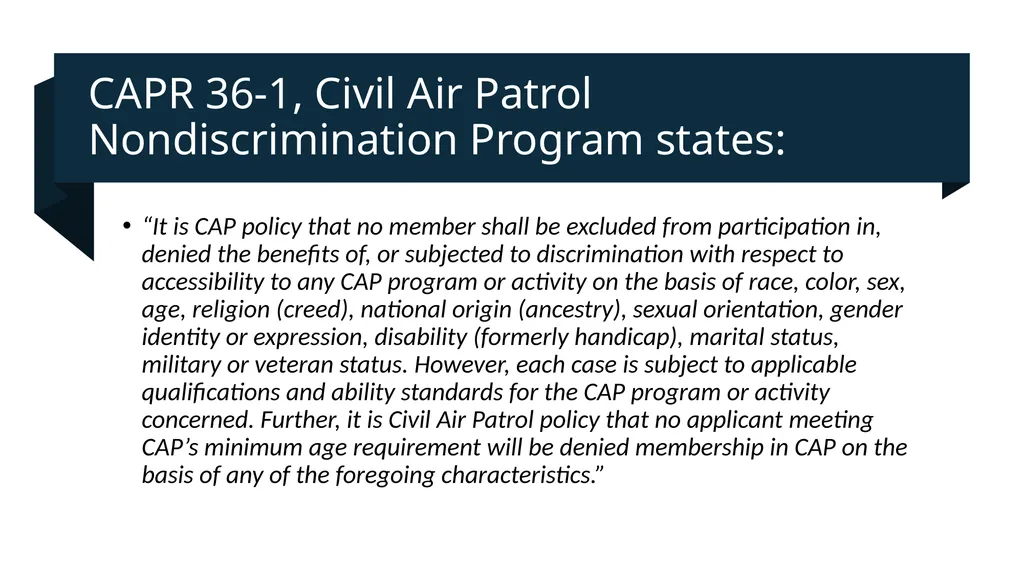
CAPR 36-1, Civil Air Patrol Nondiscrimination Program states: “It is CAP policy that no member shall be excluded from participation in, denied the benefits of, or subjected to discrimination with respect to accessibility to any CAP program or activity on the basis of race, color, sex, age, religion (creed), national origin (ancestry), sexual orientation, gender identity or expression, disability (formerly handicap), marital status, military or veteran status. However, each case is subject to applicable qualifications and ability standards for the CAP program or activity concerned. Further, it is Civil Air Patrol policy that no applicant meeting CAP’s minimum age requirement will be denied membership in CAP on the basis of any of the foregoing characteristics.”<br>
05
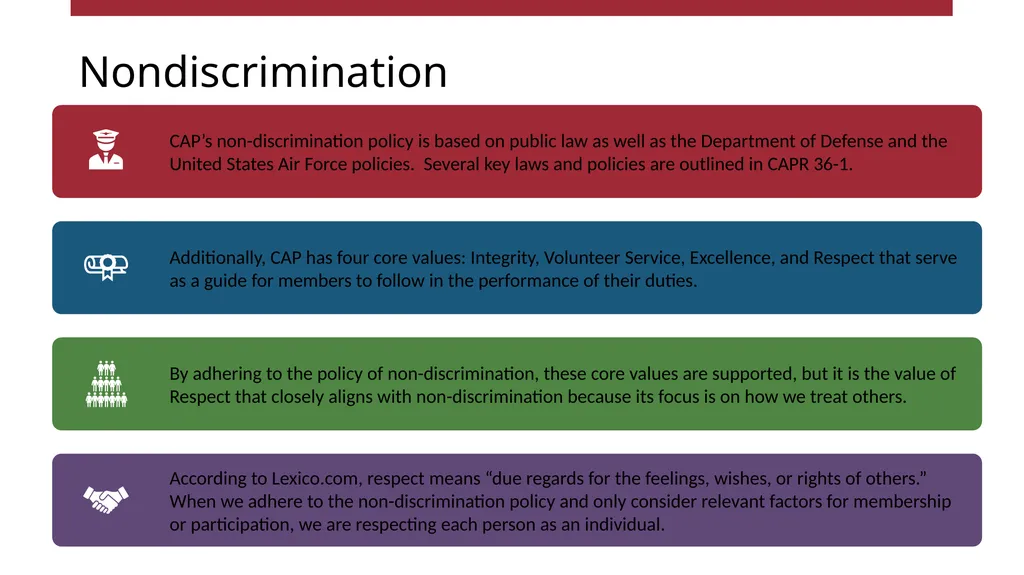
Nondiscrimination<br>
06
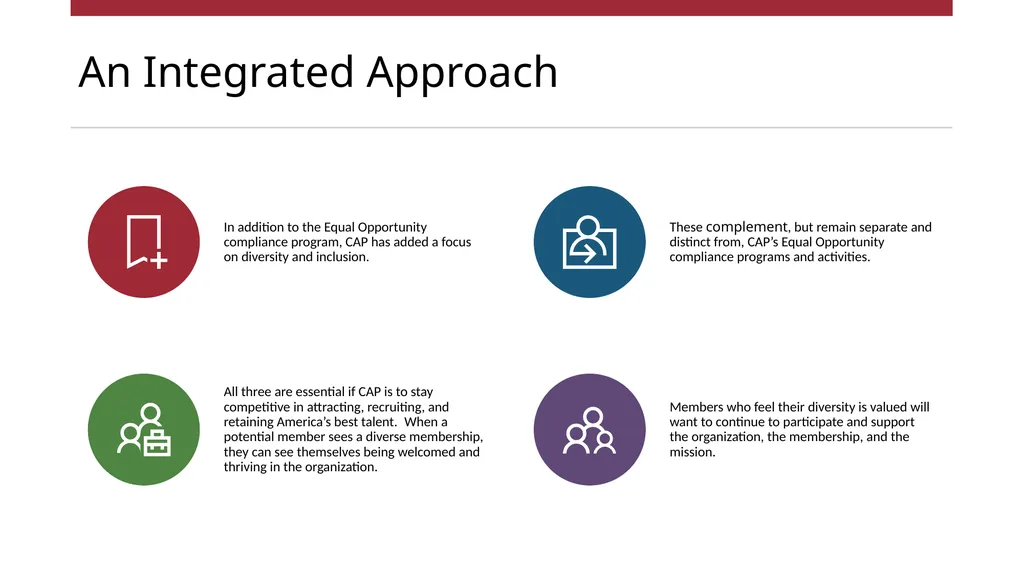
An Integrated Approach<br>
07
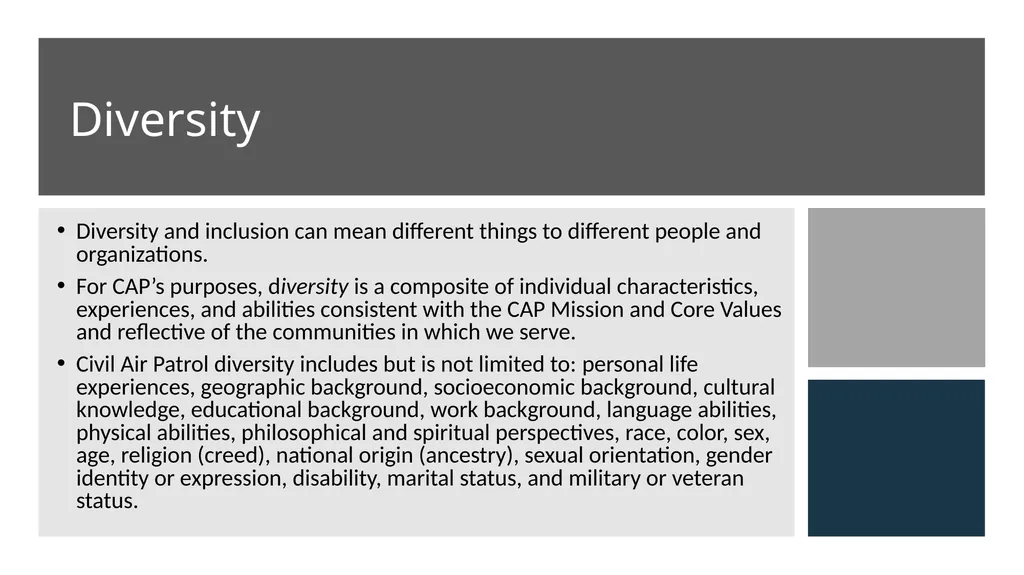
Diversity Diversity and inclusion can mean different things to different people and organizations.
For CAP’s purposes, diversity is a composite of individual characteristics, experiences, and abilities consistent with the CAP Mission and Core Values and reflective of the communities in which we serve.
Civil Air Patrol diversity includes but is not limited to: personal life experiences, geographic background, socioeconomic background, cultural knowledge, educational background, work background, language abilities, physical abilities, philosophical and spiritual perspectives, race, color, sex, age, religion (creed), national origin (ancestry), sexual orientation, gender identity or expression, disability, marital status, and military or veteran status.<br>
For CAP’s purposes, diversity is a composite of individual characteristics, experiences, and abilities consistent with the CAP Mission and Core Values and reflective of the communities in which we serve.
Civil Air Patrol diversity includes but is not limited to: personal life experiences, geographic background, socioeconomic background, cultural knowledge, educational background, work background, language abilities, physical abilities, philosophical and spiritual perspectives, race, color, sex, age, religion (creed), national origin (ancestry), sexual orientation, gender identity or expression, disability, marital status, and military or veteran status.<br>
08
Inclusion Inclusion is the process of creating a culture where all members of the organization are encouraged to make their fullest contributions to the success of the group, and where there are no unnecessary barriers to success.
Every member shares responsibility for ensuring that the talents and capabilities of each individual are recognized, valued, and used toward enhancing mission accomplishment.<br>
Every member shares responsibility for ensuring that the talents and capabilities of each individual are recognized, valued, and used toward enhancing mission accomplishment.<br>
09
Strength in Diversity Diversity is critical for strong support for our local communities across the United States.
We gain strength by leveraging the diversity of all members and creating an inclusive environment in which each member is valued and encouraged to provide ideas critical to innovation, optimization, and organizational mission success.<br>
We gain strength by leveraging the diversity of all members and creating an inclusive environment in which each member is valued and encouraged to provide ideas critical to innovation, optimization, and organizational mission success.<br>
10
Benefits of a Diverse Organization Being true to our core values demands that we create a diverse and inclusive organization. Diversity makes our organization stronger and contributes to excellence in many ways.
For example, decision-making and operational capabilities are enhanced by diversity among our members, helping make CAP more agile, innovative, and effective.
It opens the door to creative solutions to problems and enables us to perform our missions better as they expand and increase in complexity. It assists in attracting, recruiting, and retaining volunteers.
Additionally, pursuing diversity encourages sharing the opportunities in CAP with more people across our communities, including youth who can benefit from the cadet program and adults who are looking for ways to serve.<br>
For example, decision-making and operational capabilities are enhanced by diversity among our members, helping make CAP more agile, innovative, and effective.
It opens the door to creative solutions to problems and enables us to perform our missions better as they expand and increase in complexity. It assists in attracting, recruiting, and retaining volunteers.
Additionally, pursuing diversity encourages sharing the opportunities in CAP with more people across our communities, including youth who can benefit from the cadet program and adults who are looking for ways to serve.<br>
11
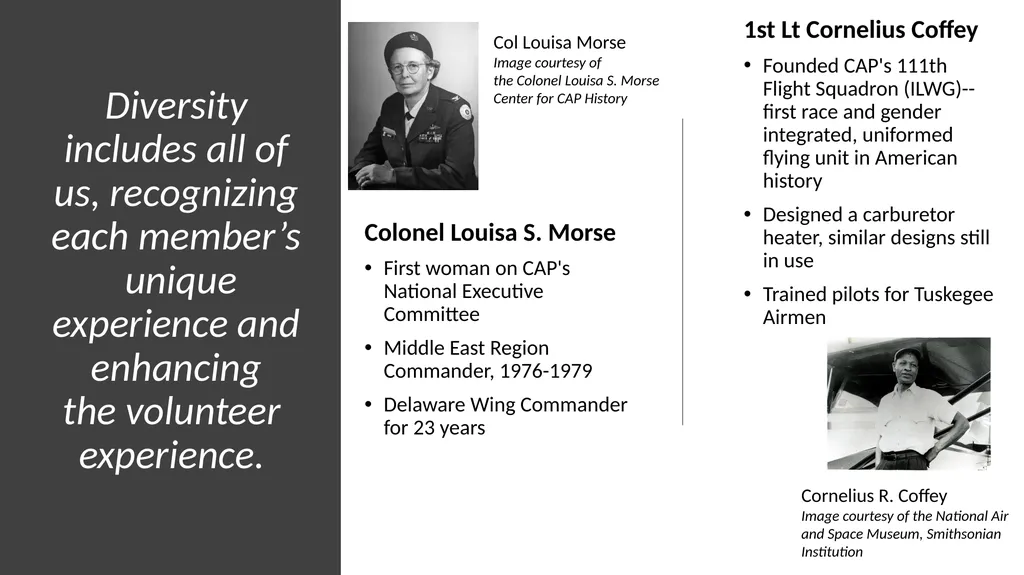
Diversity includes all of us, recognizing each member’s unique experience and enhancing the volunteer
experience. Colonel Louisa S. Morse
First woman on CAP's National Executive Committee
Middle East Region Commander, 1976-1979
Delaware Wing Commander for 23 years 1st Lt Cornelius Coffey
Founded CAP's 111th Flight Squadron (ILWG)--first race and gender integrated, uniformed flying unit in American history
Designed a carburetor heater, similar designs still in use
Trained pilots for Tuskegee Airmen Cornelius R. Coffey
Image courtesy of the National Air and Space Museum, Smithsonian Institution Col Louisa Morse
Image courtesy of the Colonel Louisa S. Morse Center for CAP History<br>
First woman on CAP's National Executive Committee
Middle East Region Commander, 1976-1979
Delaware Wing Commander for 23 years 1st Lt Cornelius Coffey
Founded CAP's 111th Flight Squadron (ILWG)--first race and gender integrated, uniformed flying unit in American history
Designed a carburetor heater, similar designs still in use
Trained pilots for Tuskegee Airmen Cornelius R. Coffey
Image courtesy of the National Air and Space Museum, Smithsonian Institution Col Louisa Morse
Image courtesy of the Colonel Louisa S. Morse Center for CAP History<br>
12
Reasonable
Accommodations Reasonable accommodations are simply those modifications needed to ensure members with a disability have equal access to the rights and privileges of CAP membership.
An accommodation may also be made for other reasons, such as faith, dietary requirements, or gender identity.
Accommodations must be reasonable for the circumstances and cannot impose an undue hardship for the organization.
They cannot remove essential functions for the job requirement or program. They must be requested with adequate advanced notice (at least 30 days) to provide time to discuss options and adjust.<br>
An accommodation may also be made for other reasons, such as faith, dietary requirements, or gender identity.
Accommodations must be reasonable for the circumstances and cannot impose an undue hardship for the organization.
They cannot remove essential functions for the job requirement or program. They must be requested with adequate advanced notice (at least 30 days) to provide time to discuss options and adjust.<br>
13
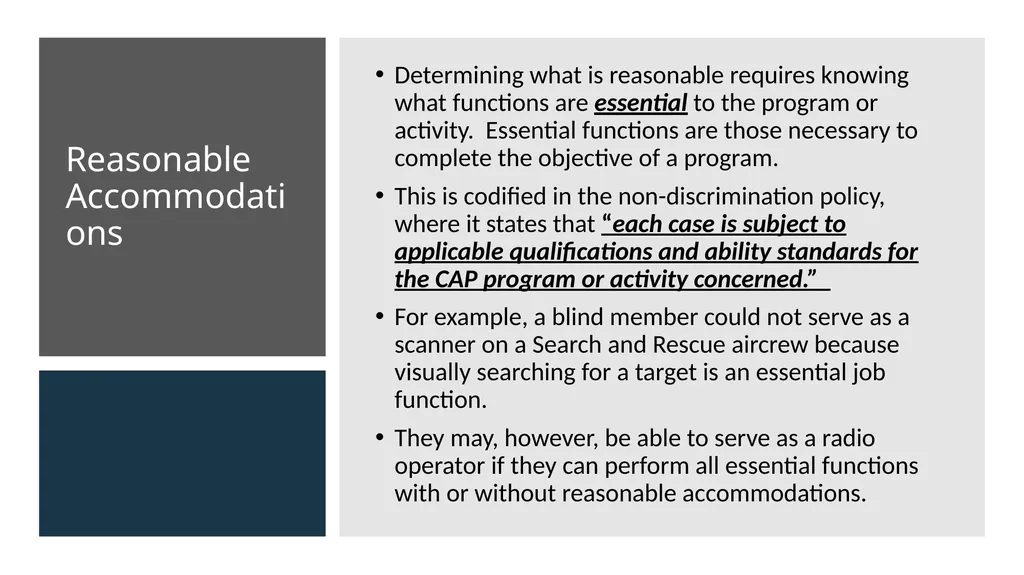
Reasonable Accommodations Determining what is reasonable requires knowing what functions are essential to the program or activity. Essential functions are those necessary to complete the objective of a program.
This is codified in the non-discrimination policy, where it states that “each case is subject to applicable qualifications and ability standards for the CAP program or activity concerned.”
For example, a blind member could not serve as a scanner on a Search and Rescue aircrew because visually searching for a target is an essential job function.
They may, however, be able to serve as a radio operator if they can perform all essential functions with or without reasonable accommodations.<br>
This is codified in the non-discrimination policy, where it states that “each case is subject to applicable qualifications and ability standards for the CAP program or activity concerned.”
For example, a blind member could not serve as a scanner on a Search and Rescue aircrew because visually searching for a target is an essential job function.
They may, however, be able to serve as a radio operator if they can perform all essential functions with or without reasonable accommodations.<br>
14
Accommodation Examples<br>
15
Accommodation Examples<br>
16
Accommodation Examples<br>
17
Uniform Waivers In addition to making reasonable accommodations to the environment, members may request a waiver of uniform wear standards to wear neat and conservative religious apparel that may not be already authorized under the current regulations.
Additionally, CAP members who have evidence of a medical diagnosis of gender dysphoria may also request a uniform waiver to wear the uniform of the gender they identify with.<br>
Additionally, CAP members who have evidence of a medical diagnosis of gender dysphoria may also request a uniform waiver to wear the uniform of the gender they identify with.<br>
18
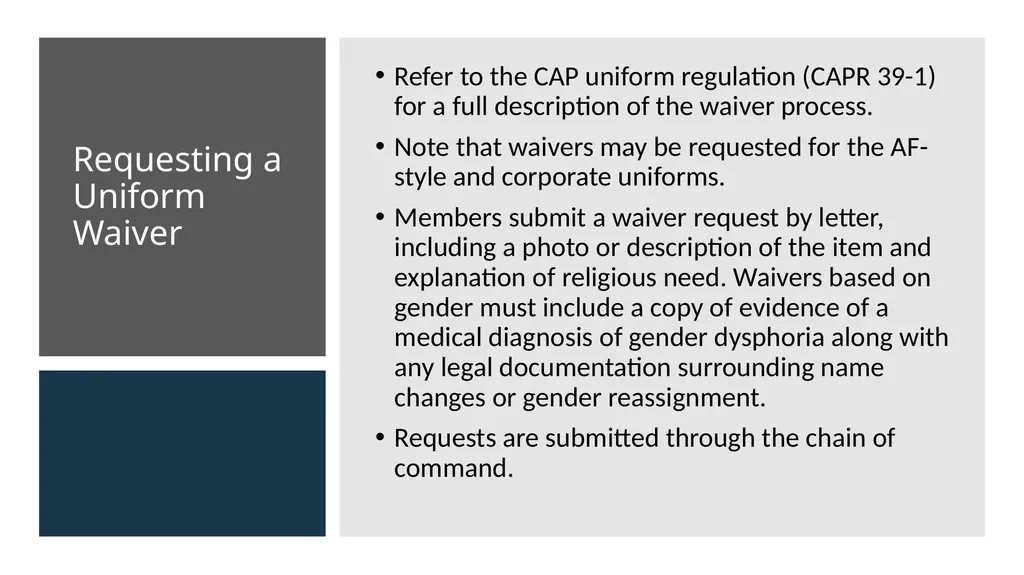
Requesting a
Uniform Waiver Refer to the CAP uniform regulation (CAPR 39-1) for a full description of the waiver process.
Note that waivers may be requested for the AF-style and corporate uniforms.
Members submit a waiver request by letter, including a photo or description of the item and explanation of religious need. Waivers based on gender must include a copy of evidence of a medical diagnosis of gender dysphoria along with any legal documentation surrounding name changes or gender reassignment.
Requests are submitted through the chain of command.<br>
Note that waivers may be requested for the AF-style and corporate uniforms.
Members submit a waiver request by letter, including a photo or description of the item and explanation of religious need. Waivers based on gender must include a copy of evidence of a medical diagnosis of gender dysphoria along with any legal documentation surrounding name changes or gender reassignment.
Requests are submitted through the chain of command.<br>
19
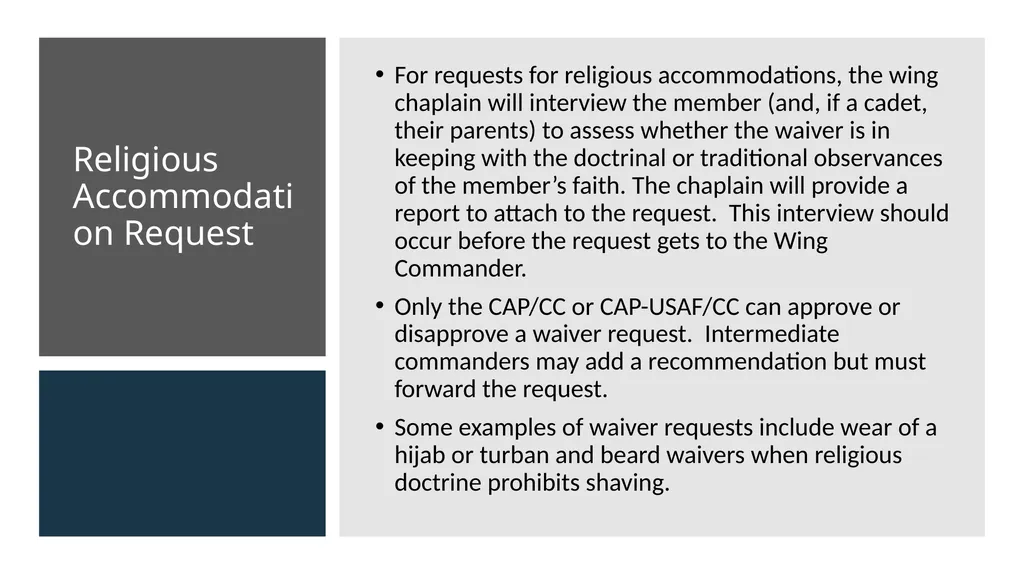
Religious Accommodation Request For requests for religious accommodations, the wing chaplain will interview the member (and, if a cadet, their parents) to assess whether the waiver is in keeping with the doctrinal or traditional observances of the member’s faith. The chaplain will provide a report to attach to the request. This interview should occur before the request gets to the Wing Commander.
Only the CAP/CC or CAP-USAF/CC can approve or disapprove a waiver request. Intermediate commanders may add a recommendation but must forward the request.
Some examples of waiver requests include wear of a hijab or turban and beard waivers when religious doctrine prohibits shaving.<br>
Only the CAP/CC or CAP-USAF/CC can approve or disapprove a waiver request. Intermediate commanders may add a recommendation but must forward the request.
Some examples of waiver requests include wear of a hijab or turban and beard waivers when religious doctrine prohibits shaving.<br>
20
Commander’s Responsibilities Support reasonable accommodations
Ensure processes are transparent and consistent. Examples:
Selection process for a position is defined, shared, and followed
No additional skills added to ES qualifications unless based on local conditions and required of all trainees
Identify situations that could lead to discrimination
Take action at lowest level to resolve issues
Refer to EOO, if appropriate<br>
Ensure processes are transparent and consistent. Examples:
Selection process for a position is defined, shared, and followed
No additional skills added to ES qualifications unless based on local conditions and required of all trainees
Identify situations that could lead to discrimination
Take action at lowest level to resolve issues
Refer to EOO, if appropriate<br>
21
Complaints under the Nondiscrimination Policy<br>
22
Complaints
under the Nondiscrimination Policy CAP's Equal Opportunity Officer (EOO) shall be responsible for implementing a program for addressing the nondiscrimination concerns of and for the handling of all discrimination allegations/complaints that relate to CAP volunteer members.
If the non-discrimination policy is not followed and a member believes they have been discriminated against, they have the right to file a complaint under CAPR 36-2, Complaints Under the Civil Air Patrol Nondiscrimination Policy.<br>
If the non-discrimination policy is not followed and a member believes they have been discriminated against, they have the right to file a complaint under CAPR 36-2, Complaints Under the Civil Air Patrol Nondiscrimination Policy.<br>
23
Requirements for Filing a Complaint Only members, the parents, or legal guardians of cadet members under the age of 18 filing for the cadet member, or non-members alleging denial of membership due to discrimination, have the right to file a complaint under the non-discrimination policy.
All complaints of discrimination should be in writing, dated and signed by the complainant, and submitted within 60 days of the occurrence or action upon which the complaint is based or learning of the occurrence or action.<br>
All complaints of discrimination should be in writing, dated and signed by the complainant, and submitted within 60 days of the occurrence or action upon which the complaint is based or learning of the occurrence or action.<br>
24
Contacting the Equal Opportunity Officer Complaints may be submitted to the Equal Opportunity Officer (EOO) by email (eo@capnhq.gov), by mail, or delivered personally.
Contacting the EOO for assistance in determining if an allegation/complaint constitutes discrimination is not considered a violation of the chain of command.
No member shall be retaliated against or suffer reprisals for filing a complaint or participating in an investigation.<br>
Contacting the EOO for assistance in determining if an allegation/complaint constitutes discrimination is not considered a violation of the chain of command.
No member shall be retaliated against or suffer reprisals for filing a complaint or participating in an investigation.<br>
25
The previous requirements are just a summary of the process: members should review the entire process in CAPR 36-2 for full details.<br>
26
Resources CAPR 36-1, Civil Air Patrol Nondiscrimination Program
CAPR 36-2, Complaints Under The Civil Air Patrol Nondiscrimination Program
National Commander's Nondiscrimination Memo
CAP Pamphlet 1-10, Suggested Best Practices for Including Individuals with Special Needs, for additional guidelines and examples on accommodations.<br>
CAPR 36-2, Complaints Under The Civil Air Patrol Nondiscrimination Program
National Commander's Nondiscrimination Memo
CAP Pamphlet 1-10, Suggested Best Practices for Including Individuals with Special Needs, for additional guidelines and examples on accommodations.<br>
27
Conclusion CAP’s non-discrimination policy is based on public law as well as the Department of Defense and the United States Air Force policies.
Every member shares responsibility for ensuring that the talents and capabilities of each individual are recognized, valued, and used toward enhancing mission accomplishment.
We gain strength by leveraging the diversity of all members and creating an inclusive environment in which each member is valued and encouraged to provide ideas critical to innovation, optimization, and organizational mission success.<br>
Every member shares responsibility for ensuring that the talents and capabilities of each individual are recognized, valued, and used toward enhancing mission accomplishment.
We gain strength by leveraging the diversity of all members and creating an inclusive environment in which each member is valued and encouraged to provide ideas critical to innovation, optimization, and organizational mission success.<br>