04
Signs of Plagiarism When Information that is not “common knowledge” is included without mention of source
When style and tone of writing changes abruptly<br>
05
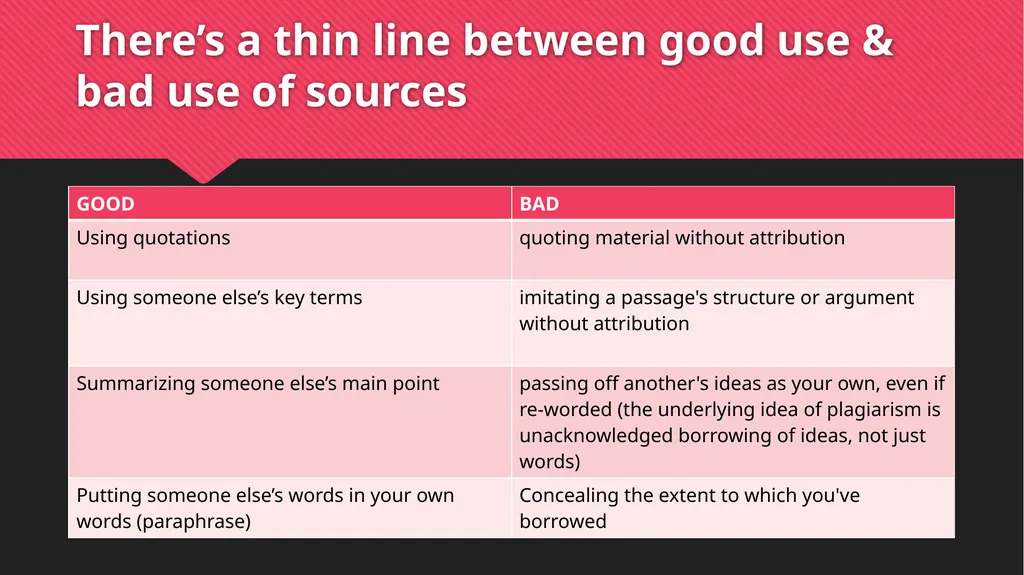
There’s a thin line between good use & bad use of sources<br>
06
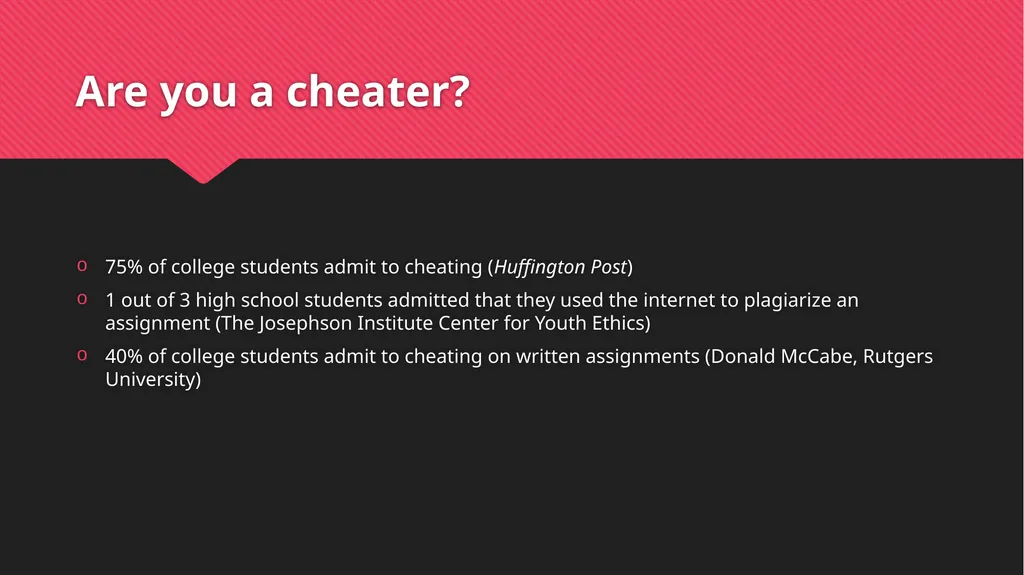
Are you a cheater? 75% of college students admit to cheating (Huffington Post)
1 out of 3 high school students admitted that they used the internet to plagiarize an assignment (The Josephson Institute Center for Youth Ethics)
40% of college students admit to cheating on written assignments (Donald McCabe, Rutgers University)<br>
07
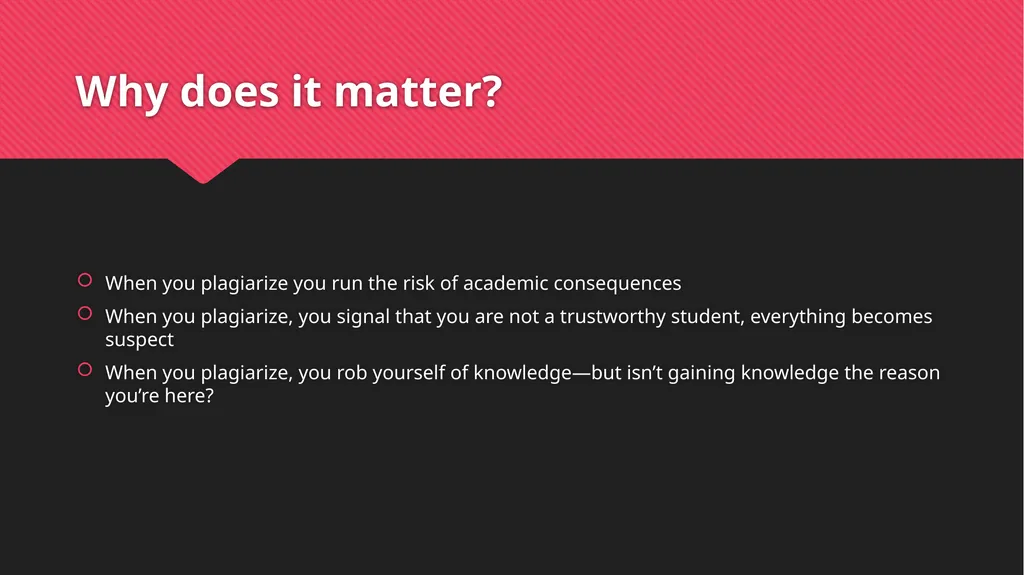
Why does it matter? When you plagiarize you run the risk of academic consequences
When you plagiarize, you signal that you are not a trustworthy student, everything becomes suspect
When you plagiarize, you rob yourself of knowledge—but isn’t gaining knowledge the reason you’re here?<br>
08
“But research is too hard…” It’s not hard, it just takes time<br>
09
3 Steps to Avoid Plagiarism Researching
Note-taking
Documenting<br>
10
Researching Estimate the amount of time you think it will take to conduct your research, and then double it!
Expect to make trips to the library—or at least the library databases
Allow time for gathering materials
Allow time for reading<br>
11
Reading Read the chapter (or article) to get a basic understanding
In a sentence write what the main point of the
chapter is (hint: what’s the title?)
Read through the 2nd time more slowly—
section by section
Write a sentence or 2 summary of each section in the margin or in your notebook<br>
12
Trouble understanding something you read?
Email your teacher
Partner up—with a classmate or study group
Call on us! Make an appointment at the Writing Center<br>
13
Note-taking Sloppy note taking increases the risk that you will unintentionally plagiarize.
Unless you have taken notes carefully, it may be hard to tell whether you copied certain passages exactly, paraphrased them, or wrote them yourself.
This is especially problematic when using electronic source materials, since they can so easily be copied and pasted into your own documents.<br>
14
Note-taking Identify words that you copy directly (put quotations around them!)
Jot down the page number and author or title
Keep a working bibliography
Keep a research log<br>
15
Bibliography? It’s another word for “Works Cited” or “Reference” list
Go to Purdue Owl for guidance on what information is needed for each type of source
This will be based on the style of documentation required (APA? MLA? Other?)
And the type of source it is (website? Journal article? Book?)<br>
16
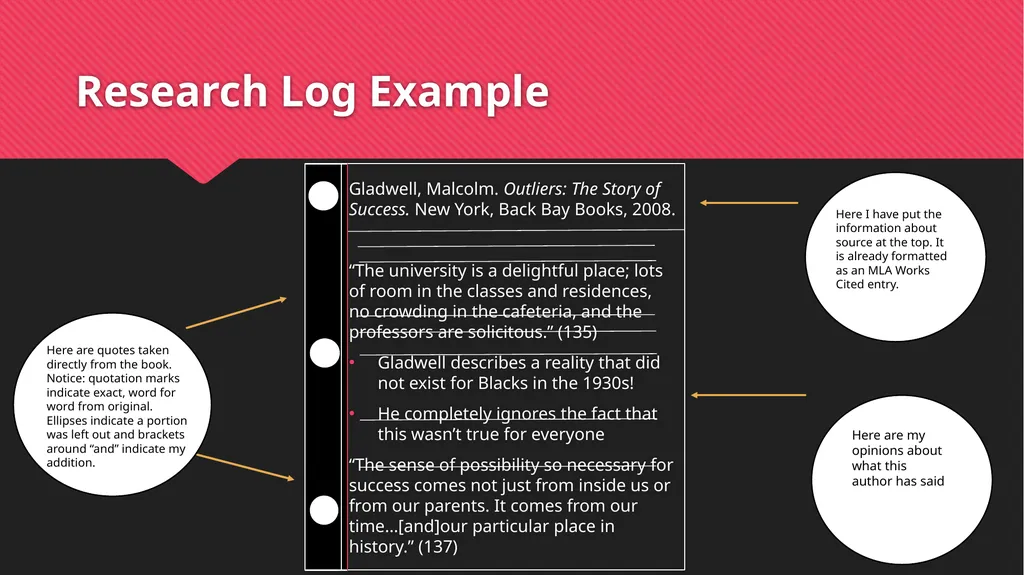
Research Log? A notebook that contains only the notes that you take while doing research
For each source you begin with the bibliographic information, then follow with the notes and quotes that come from that source<br>
17
Research Log Example Gladwell, Malcolm. Outliers: The Story of Success. New York, Back Bay Books, 2008.
“The university is a delightful place; lots of room in the classes and residences, no crowding in the cafeteria, and the professors are solicitous.” (135)
Gladwell describes a reality that did not exist for Blacks in the 1930s!
He completely ignores the fact that this wasn’t true for everyone
“The sense of possibility so necessary for success comes not just from inside us or from our parents. It comes from our time…[and]our particular place in history.” (137) Here I have put the information about source at the top. It is already formatted as an MLA Works Cited entry. Here are my opinions about what this author has said Here are quotes taken directly from the book. Notice: quotation marks indicate exact, word for word from original. Ellipses indicate a portion was left out and brackets around “and” indicate my addition.<br>
18
Documenting Any time you incorporate into your writing ideas, words, key phrases, or pictures that were not originally created by you, you must give credit to the original author by citing the source.<br>
19
What do we mean by “cite”? To cite means to signal to the reader where the words, information or ideas that come from another source begins AND where it ends.
In other words, “to cite” is to introduce and end each use of a source with appropriate documentation (i.e. signal phrase and end text citation or footnote)<br>
20
Plagiarism comes in all shapes and sizes! Direct Plagiarism
Copying word-for-word from an outside source without quotes or citation<br>
21
Mosaic Plagiarism
Interweaving one's own words with that of an outside source in an effort to camouflage "stolen" information and pass it off as completely original work.<br>
22
Insufficient Acknowledgement
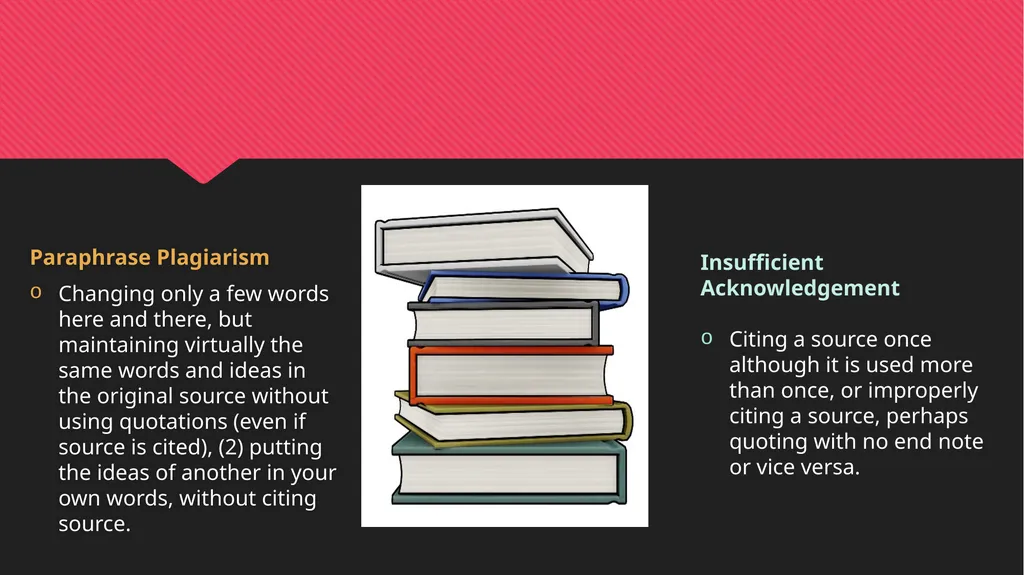
Citing a source once although it is used more than once, or improperly citing a source, perhaps quoting with no end note or vice versa. Paraphrase Plagiarism
Changing only a few words here and there, but maintaining virtually the same words and ideas in the original source without using quotations (even if source is cited), (2) putting the ideas of another in your own words, without citing source.<br>
23
Do you know how to paraphrase? Link to this video is available on “Write Place” web page where you found this presentation.<br>
24
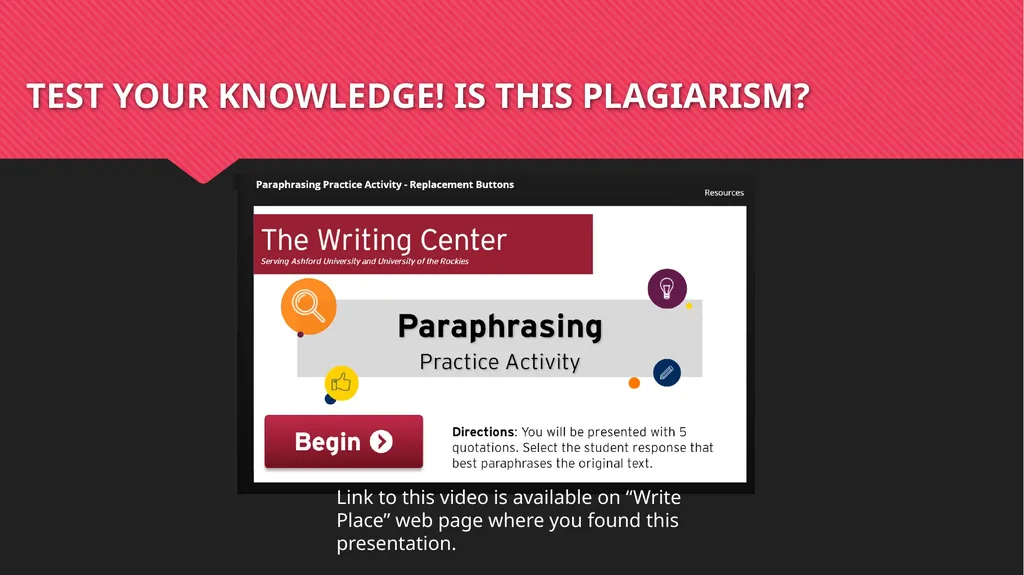
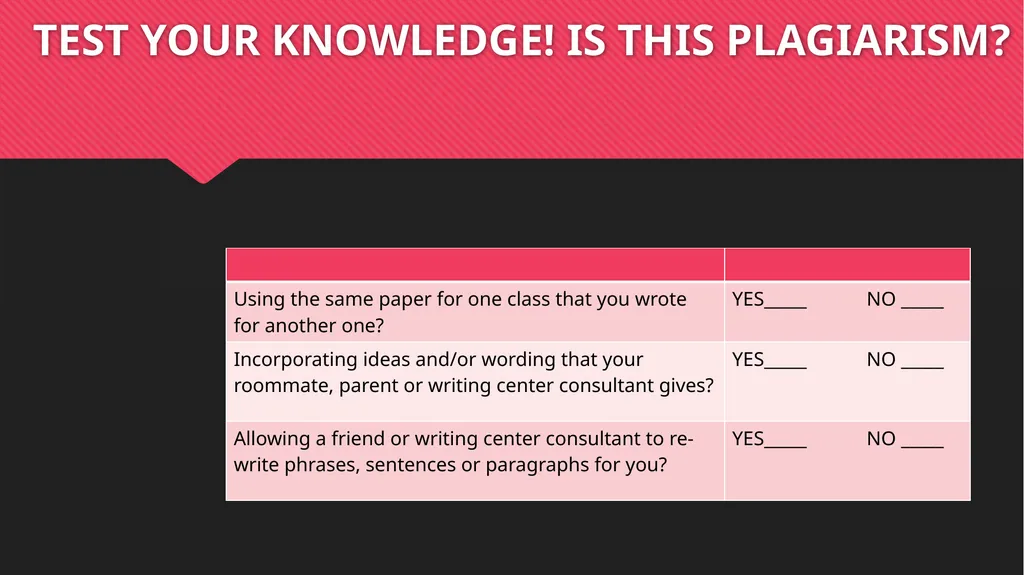
TEST YOUR KNOWLEDGE! IS THIS PLAGIARISM? Link to this video is available on “Write Place” web page where you found this presentation.<br>
25
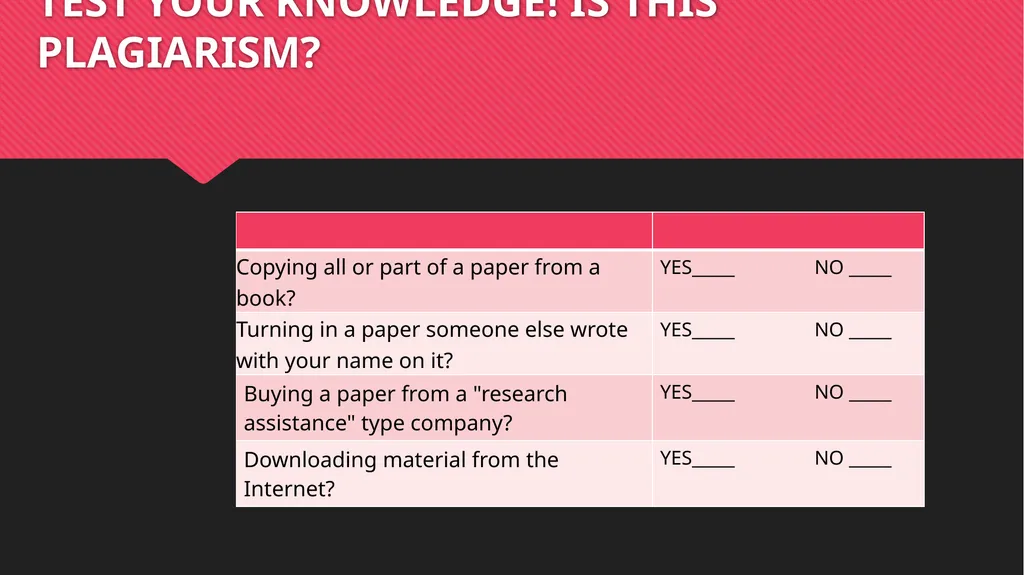
TEST YOUR KNOWLEDGE! IS THIS PLAGIARISM?<br>
26
TEST YOUR KNOWLEDGE! IS THIS PLAGIARISM?<br>
27
Link to this video is available on “Write Place” web page where you found this presentation.<br>