
Documentation: How Chaplains Communicate with
SB
Published · 31 slides · 0 views
1 / 1



Description
Documentation: How Chaplains Communicate with Staff Dr. Charles James Parker, EdD, MDiv, APBCC-HPC Director, Hospice Palliative Care Division Spiritual Care Association New York, NY Discussion Journey March 19 Noon ET- Spiritual
Related Topics
Download this presentation From Below
"Documentation: How Chaplains Communicate with" is the property of its rightful owner. Permission is granted to download and print the materials on this website for personal, non-commercial use only, and to display it on your personal computer provided you do not modify the materials and that you retain all copyright notices contained in the materials. By downloading content from our website, you accept the terms of this agreement.
Share
Embed code
Presentation Transcript
01
Documentation: How Chaplains Communicate with Staff Dr. Charles James Parker, EdD, MDiv, APBCC-HPC Director, Hospice & Palliative Care Division
Spiritual Care Association New York, NY<br>
Spiritual Care Association New York, NY<br>
02
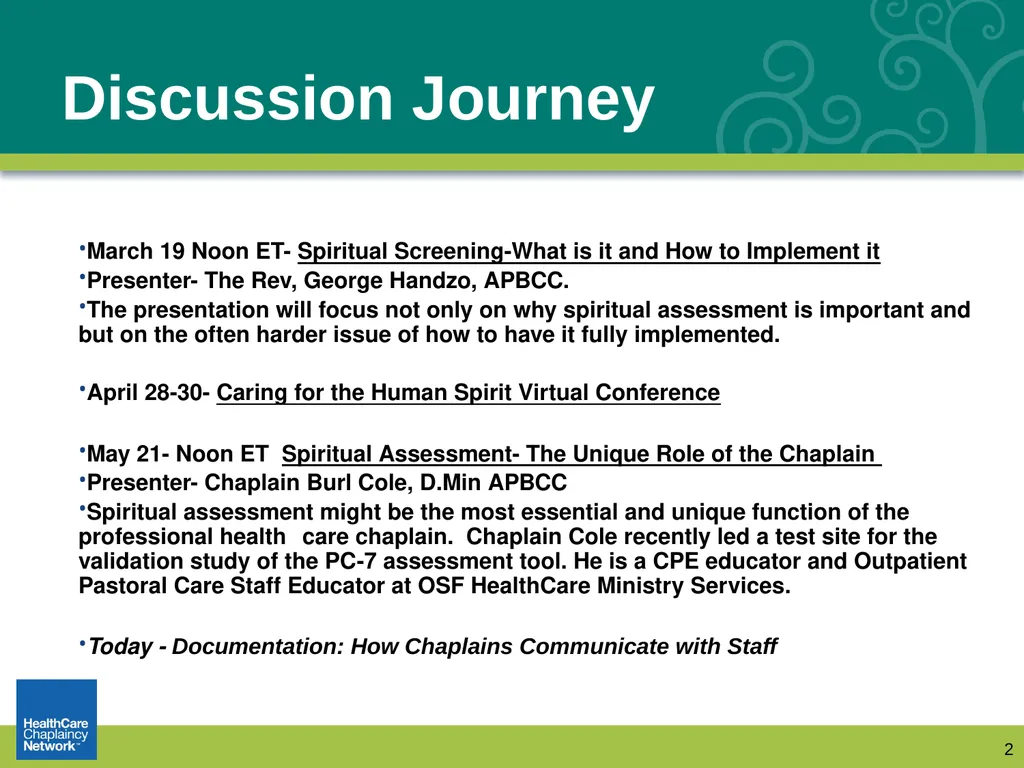
Discussion Journey March 19 Noon ET- Spiritual Screening-What is it and How to Implement it
Presenter- The Rev, George Handzo, APBCC.
The presentation will focus not only on why spiritual assessment is important and but on the often harder issue of how to have it fully implemented.
April 28-30- Caring for the Human Spirit Virtual Conference
May 21- Noon ET Spiritual Assessment- The Unique Role of the Chaplain
Presenter- Chaplain Burl Cole, D.Min APBCC
Spiritual assessment might be the most essential and unique function of the professional health care chaplain. Chaplain Cole recently led a test site for the validation study of the PC-7 assessment tool. He is a CPE educator and Outpatient Pastoral Care Staff Educator at OSF HealthCare Ministry Services.
Today - Documentation: How Chaplains Communicate with Staff<br>
Presenter- The Rev, George Handzo, APBCC.
The presentation will focus not only on why spiritual assessment is important and but on the often harder issue of how to have it fully implemented.
April 28-30- Caring for the Human Spirit Virtual Conference
May 21- Noon ET Spiritual Assessment- The Unique Role of the Chaplain
Presenter- Chaplain Burl Cole, D.Min APBCC
Spiritual assessment might be the most essential and unique function of the professional health care chaplain. Chaplain Cole recently led a test site for the validation study of the PC-7 assessment tool. He is a CPE educator and Outpatient Pastoral Care Staff Educator at OSF HealthCare Ministry Services.
Today - Documentation: How Chaplains Communicate with Staff<br>
03
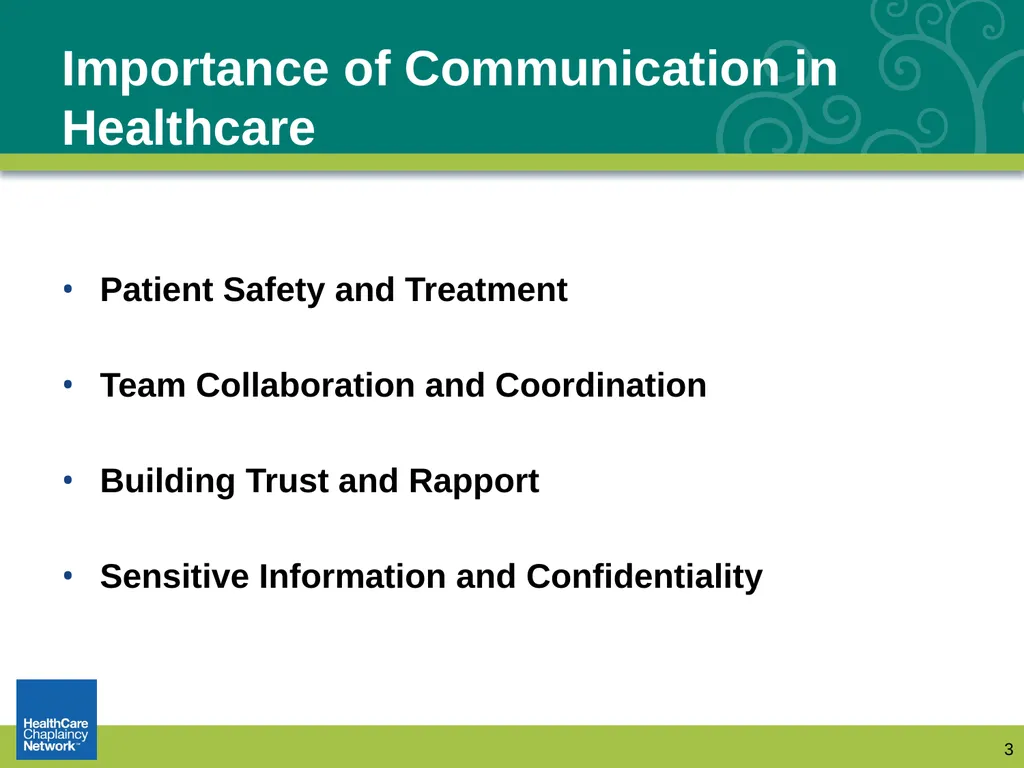
Importance of Communication in Healthcare Patient Safety and Treatment
Team Collaboration and Coordination
Building Trust and Rapport
Sensitive Information and Confidentiality<br>
Team Collaboration and Coordination
Building Trust and Rapport
Sensitive Information and Confidentiality<br>
04
Effective Team Communication Ensures patients receive the best possible care
Reduces errors and mistakes
Promotes a positive work environment
Creates a sense of teamwork
Communicates goals and expectations<br>
Reduces errors and mistakes
Promotes a positive work environment
Creates a sense of teamwork
Communicates goals and expectations<br>
05
Importance of Documentation in Healthcare Patient Safety and Quality of Care
Communication and Coordination
Reimbursement and Quality Reporting
Legal and Ethical Considerations<br>
Communication and Coordination
Reimbursement and Quality Reporting
Legal and Ethical Considerations<br>
06
Problems with Chaplain Documentation Lack of Standardized Language
Focus on Chaplain’s Perspective
Difficulty Communicating Nuance
Concerns about Patient Privacy
Varied Expectations<br>
Focus on Chaplain’s Perspective
Difficulty Communicating Nuance
Concerns about Patient Privacy
Varied Expectations<br>
07
Resolving the Problem with Chaplain Documentation Clarity and Accuracy
Patient-Centered Approach
Interdisciplinary Communication
Specific Documentation Points<br>
Patient-Centered Approach
Interdisciplinary Communication
Specific Documentation Points<br>
08
What Should Be the Chaplain Documentation Process? Reflection of Patient Encounter
Utilization of a Charting/Documentation Framework
Utilization of the Chaplaincy Taxonomy
Development of a Spiritual Care Plan
Bring it All Together in the Chart
Continuous Interdisciplinary Communication<br>
Utilization of a Charting/Documentation Framework
Utilization of the Chaplaincy Taxonomy
Development of a Spiritual Care Plan
Bring it All Together in the Chart
Continuous Interdisciplinary Communication<br>
09
Reflection of Patient Encounter Importance of Reflection
Aspects of Reflection
Methods of Reflection<br>
Aspects of Reflection
Methods of Reflection<br>
10
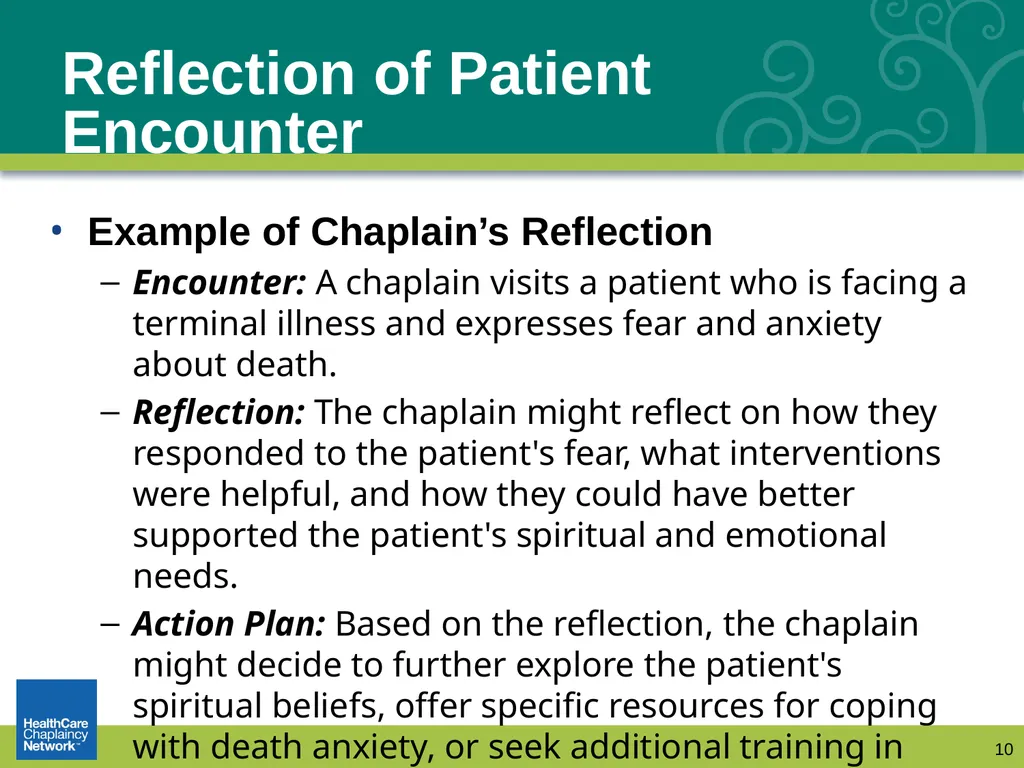
Reflection of Patient Encounter Example of Chaplain’s Reflection
Encounter: A chaplain visits a patient who is facing a terminal illness and expresses fear and anxiety about death.
Reflection: The chaplain might reflect on how they responded to the patient's fear, what interventions were helpful, and how they could have better supported the patient's spiritual and emotional needs.
Action Plan: Based on the reflection, the chaplain might decide to further explore the patient's spiritual beliefs, offer specific resources for coping with death anxiety, or seek additional training in end-of-life care.<br>
Encounter: A chaplain visits a patient who is facing a terminal illness and expresses fear and anxiety about death.
Reflection: The chaplain might reflect on how they responded to the patient's fear, what interventions were helpful, and how they could have better supported the patient's spiritual and emotional needs.
Action Plan: Based on the reflection, the chaplain might decide to further explore the patient's spiritual beliefs, offer specific resources for coping with death anxiety, or seek additional training in end-of-life care.<br>
11
Now it’s time for the chaplain to start the charting process<br>
12
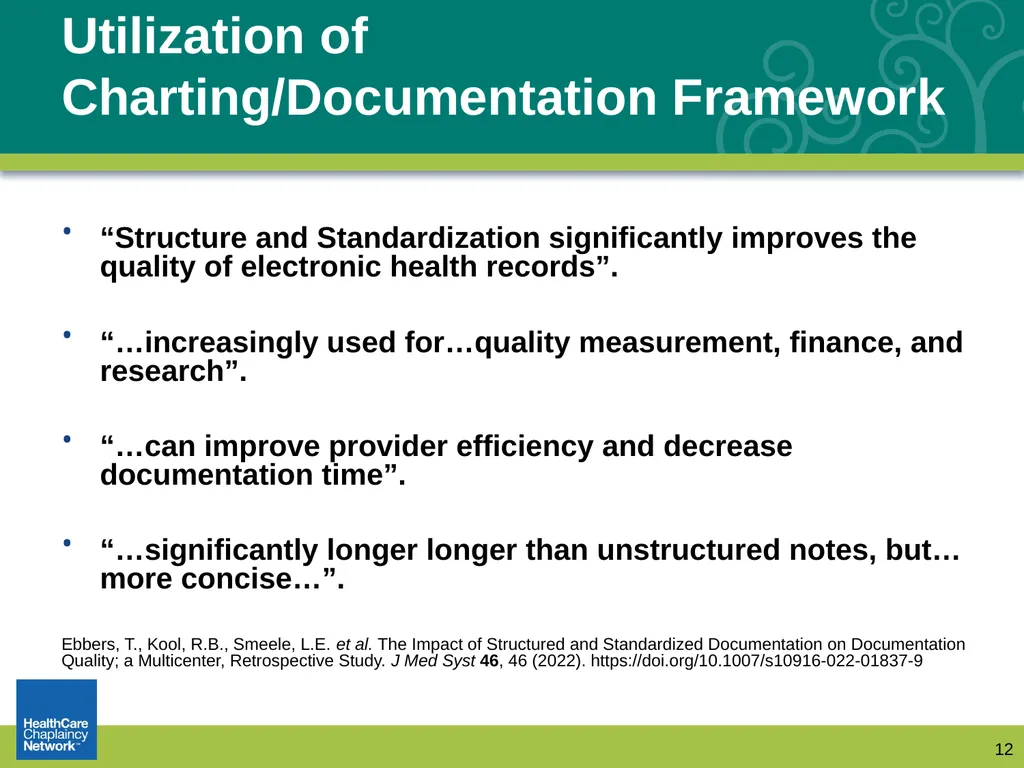
Utilization of Charting/Documentation Framework “Structure and Standardization significantly improves the quality of electronic health records”.
“…increasingly used for…quality measurement, finance, and research”.
“…can improve provider efficiency and decrease documentation time”.
“…significantly longer longer than unstructured notes, but…more concise…”.
Ebbers, T., Kool, R.B., Smeele, L.E. et al. The Impact of Structured and Standardized Documentation on Documentation Quality; a Multicenter, Retrospective Study. J Med Syst 46, 46 (2022). https://doi.org/10.1007/s10916-022-01837-9<br>
“…increasingly used for…quality measurement, finance, and research”.
“…can improve provider efficiency and decrease documentation time”.
“…significantly longer longer than unstructured notes, but…more concise…”.
Ebbers, T., Kool, R.B., Smeele, L.E. et al. The Impact of Structured and Standardized Documentation on Documentation Quality; a Multicenter, Retrospective Study. J Med Syst 46, 46 (2022). https://doi.org/10.1007/s10916-022-01837-9<br>
13
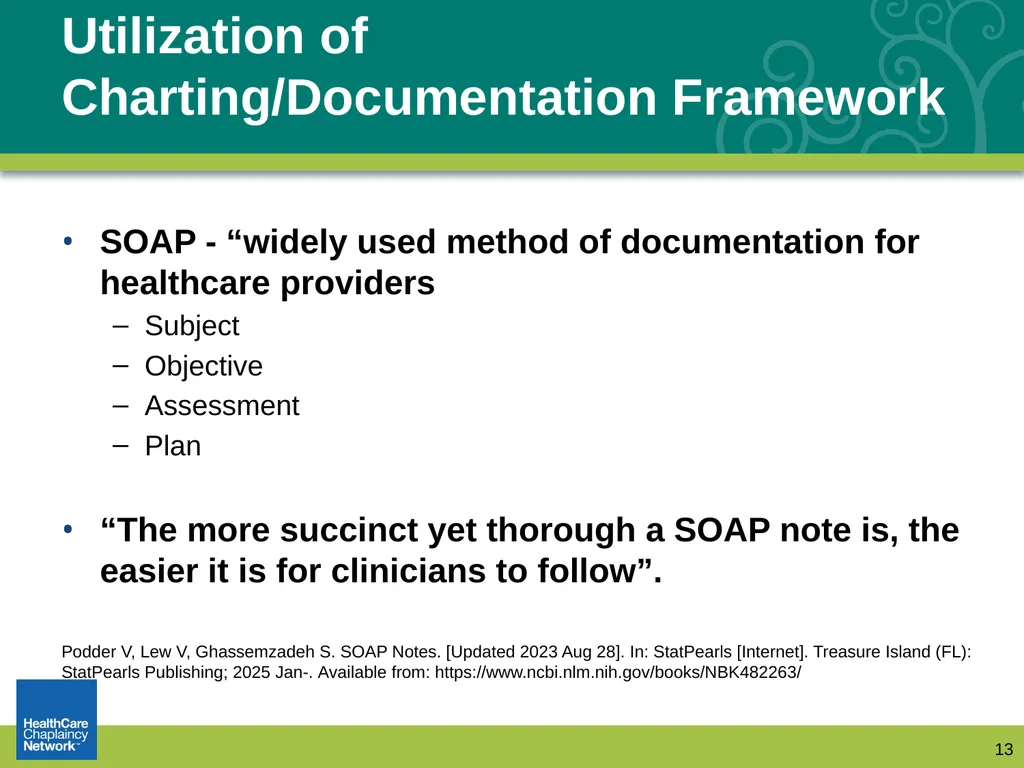
Utilization of Charting/Documentation Framework SOAP - “widely used method of documentation for healthcare providers
Subject
Objective
Assessment
Plan
“The more succinct yet thorough a SOAP note is, the easier it is for clinicians to follow”.
Podder V, Lew V, Ghassemzadeh S. SOAP Notes. [Updated 2023 Aug 28]. In: StatPearls [Internet]. Treasure Island (FL): StatPearls Publishing; 2025 Jan-. Available from: https://www.ncbi.nlm.nih.gov/books/NBK482263/<br>
Subject
Objective
Assessment
Plan
“The more succinct yet thorough a SOAP note is, the easier it is for clinicians to follow”.
Podder V, Lew V, Ghassemzadeh S. SOAP Notes. [Updated 2023 Aug 28]. In: StatPearls [Internet]. Treasure Island (FL): StatPearls Publishing; 2025 Jan-. Available from: https://www.ncbi.nlm.nih.gov/books/NBK482263/<br>
14
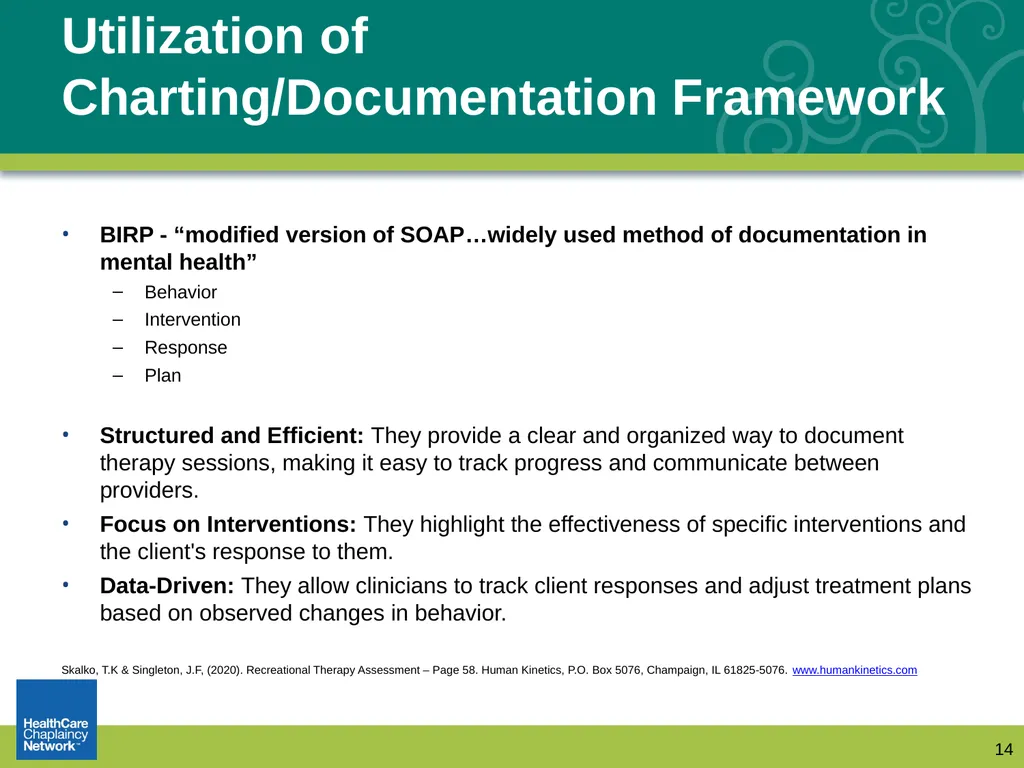
Utilization of Charting/Documentation Framework BIRP - “modified version of SOAP…widely used method of documentation in mental health”
Behavior
Intervention
Response
Plan
Structured and Efficient: They provide a clear and organized way to document therapy sessions, making it easy to track progress and communicate between providers.
Focus on Interventions: They highlight the effectiveness of specific interventions and the client's response to them.
Data-Driven: They allow clinicians to track client responses and adjust treatment plans based on observed changes in behavior.
Skalko, T.K & Singleton, J.F, (2020). Recreational Therapy Assessment – Page 58. Human Kinetics, P.O. Box 5076, Champaign, IL 61825-5076. www.humankinetics.com<br>
Behavior
Intervention
Response
Plan
Structured and Efficient: They provide a clear and organized way to document therapy sessions, making it easy to track progress and communicate between providers.
Focus on Interventions: They highlight the effectiveness of specific interventions and the client's response to them.
Data-Driven: They allow clinicians to track client responses and adjust treatment plans based on observed changes in behavior.
Skalko, T.K & Singleton, J.F, (2020). Recreational Therapy Assessment – Page 58. Human Kinetics, P.O. Box 5076, Champaign, IL 61825-5076. www.humankinetics.com<br>
15
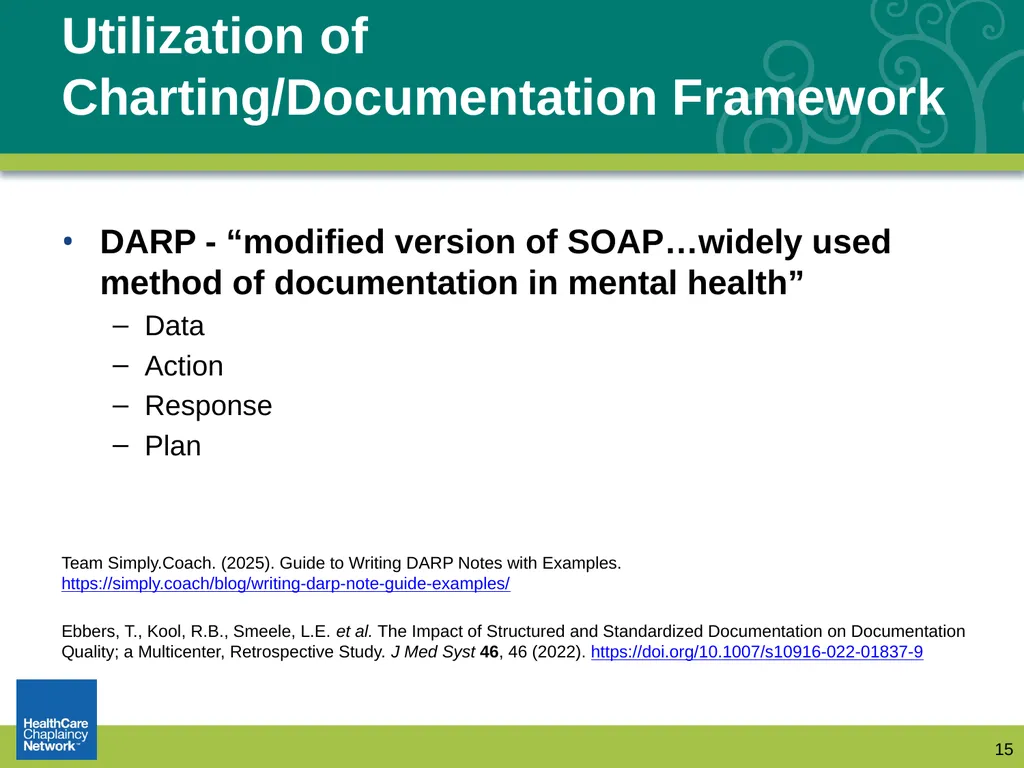
Utilization of Charting/Documentation Framework DARP - “modified version of SOAP…widely used method of documentation in mental health”
Data
Action
Response
Plan
Team Simply.Coach. (2025). Guide to Writing DARP Notes with Examples. https://simply.coach/blog/writing-darp-note-guide-examples/
Ebbers, T., Kool, R.B., Smeele, L.E. et al. The Impact of Structured and Standardized Documentation on Documentation Quality; a Multicenter, Retrospective Study. J Med Syst 46, 46 (2022). https://doi.org/10.1007/s10916-022-01837-9<br>
Data
Action
Response
Plan
Team Simply.Coach. (2025). Guide to Writing DARP Notes with Examples. https://simply.coach/blog/writing-darp-note-guide-examples/
Ebbers, T., Kool, R.B., Smeele, L.E. et al. The Impact of Structured and Standardized Documentation on Documentation Quality; a Multicenter, Retrospective Study. J Med Syst 46, 46 (2022). https://doi.org/10.1007/s10916-022-01837-9<br>
16
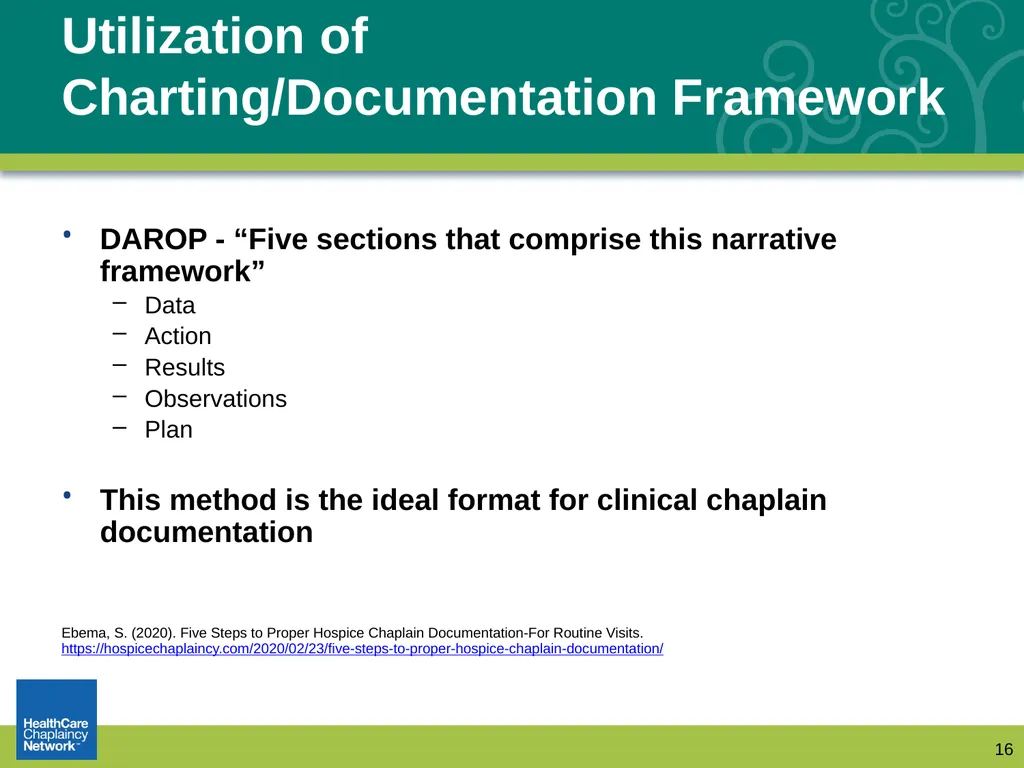
Utilization of Charting/Documentation Framework DAROP - “Five sections that comprise this narrative framework”
Data
Action
Results
Observations
Plan
This method is the ideal format for clinical chaplain documentation
Ebema, S. (2020). Five Steps to Proper Hospice Chaplain Documentation-For Routine Visits. https://hospicechaplaincy.com/2020/02/23/five-steps-to-proper-hospice-chaplain-documentation/<br>
Data
Action
Results
Observations
Plan
This method is the ideal format for clinical chaplain documentation
Ebema, S. (2020). Five Steps to Proper Hospice Chaplain Documentation-For Routine Visits. https://hospicechaplaincy.com/2020/02/23/five-steps-to-proper-hospice-chaplain-documentation/<br>
17
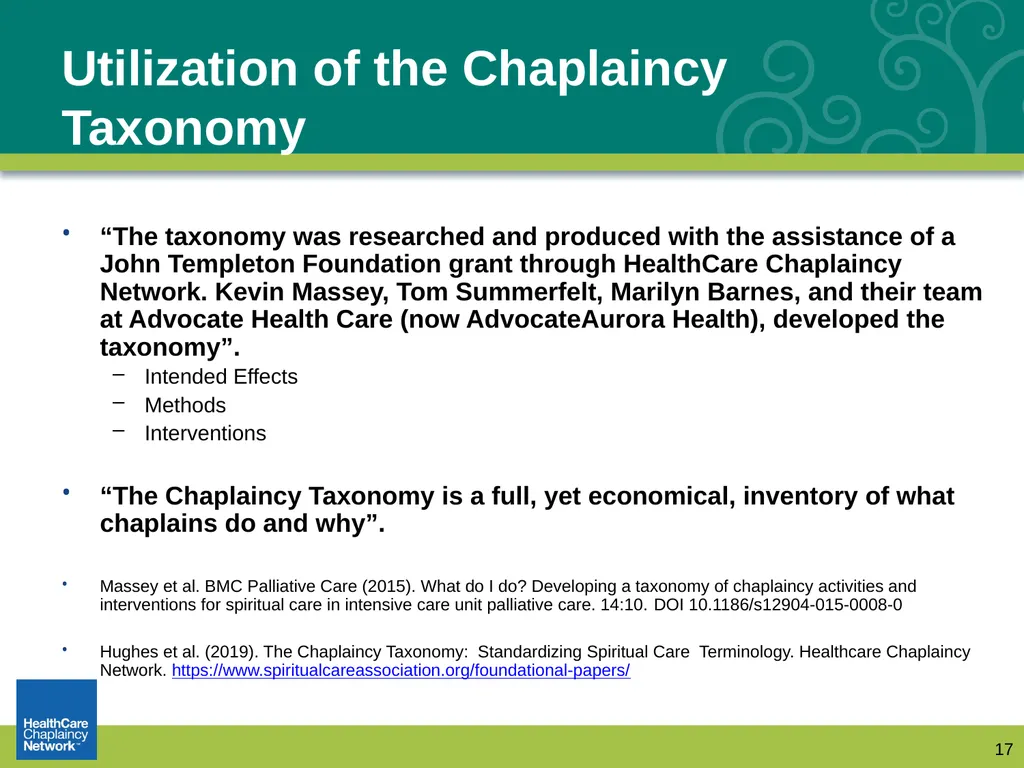
Utilization of the Chaplaincy Taxonomy “The taxonomy was researched and produced with the assistance of a John Templeton Foundation grant through HealthCare Chaplaincy Network. Kevin Massey, Tom Summerfelt, Marilyn Barnes, and their team at Advocate Health Care (now AdvocateAurora Health), developed the taxonomy”.
Intended Effects
Methods
Interventions
“The Chaplaincy Taxonomy is a full, yet economical, inventory of what chaplains do and why”.
Massey et al. BMC Palliative Care (2015). What do I do? Developing a taxonomy of chaplaincy activities and interventions for spiritual care in intensive care unit palliative care. 14:10. DOI 10.1186/s12904-015-0008-0
Hughes et al. (2019). The Chaplaincy Taxonomy: Standardizing Spiritual Care Terminology. Healthcare Chaplaincy Network. https://www.spiritualcareassociation.org/foundational-papers/<br>
Intended Effects
Methods
Interventions
“The Chaplaincy Taxonomy is a full, yet economical, inventory of what chaplains do and why”.
Massey et al. BMC Palliative Care (2015). What do I do? Developing a taxonomy of chaplaincy activities and interventions for spiritual care in intensive care unit palliative care. 14:10. DOI 10.1186/s12904-015-0008-0
Hughes et al. (2019). The Chaplaincy Taxonomy: Standardizing Spiritual Care Terminology. Healthcare Chaplaincy Network. https://www.spiritualcareassociation.org/foundational-papers/<br>
18
Massey et al. BMC Palliative Care (2015). What do I do? Developing a taxonomy of chaplaincy activities and interventions for spiritual care in intensive care unit palliative care. 14:10. DOI 10.1186/s12904-015-0008-0
Hughes et al. (2019). The Chaplaincy Taxonomy: Standardizing Spiritual Care Terminology. Healthcare Chaplaincy Network. https://www.spiritualcareassociation.org/foundational-papers/ Utilization of the Chaplaincy Taxonomy Intended Effects (Goal)
“This is the desired contributing outcome the chaplain is striving to help address or meet. It is the goal or the perceived need of the encounter. Intended Effects seek to articulate “Why” the chaplains did what they did. To what end is the chaplain working?”<br>
Hughes et al. (2019). The Chaplaincy Taxonomy: Standardizing Spiritual Care Terminology. Healthcare Chaplaincy Network. https://www.spiritualcareassociation.org/foundational-papers/ Utilization of the Chaplaincy Taxonomy Intended Effects (Goal)
“This is the desired contributing outcome the chaplain is striving to help address or meet. It is the goal or the perceived need of the encounter. Intended Effects seek to articulate “Why” the chaplains did what they did. To what end is the chaplain working?”<br>
19
Massey et al. BMC Palliative Care (2015). What do I do? Developing a taxonomy of chaplaincy activities and interventions for spiritual care in intensive care unit palliative care. 14:10. DOI 10.1186/s12904-015-0008-0
Hughes et al. (2019). The Chaplaincy Taxonomy: Standardizing Spiritual Care Terminology. Healthcare Chaplaincy Network. https://www.spiritualcareassociation.org/foundational-papers/ Utilization of the Chaplaincy Taxonomy Methods (Description):
“…is the way in which a specific action or activity supports a purpose, goal, and outcome. This is the “How” of the chaplaincy encounter.”<br>
Hughes et al. (2019). The Chaplaincy Taxonomy: Standardizing Spiritual Care Terminology. Healthcare Chaplaincy Network. https://www.spiritualcareassociation.org/foundational-papers/ Utilization of the Chaplaincy Taxonomy Methods (Description):
“…is the way in which a specific action or activity supports a purpose, goal, and outcome. This is the “How” of the chaplaincy encounter.”<br>
20
Massey et al. BMC Palliative Care (2015). What do I do? Developing a taxonomy of chaplaincy activities and interventions for spiritual care in intensive care unit palliative care. 14:10. DOI 10.1186/s12904-015-0008-0
Hughes et al. (2019). The Chaplaincy Taxonomy: Standardizing Spiritual Care Terminology. Healthcare Chaplaincy Network. https://www.spiritualcareassociation.org/foundational-papers/ Utilization of the Chaplaincy Taxonomy “This is the “What” of the encounter.”<br>
Hughes et al. (2019). The Chaplaincy Taxonomy: Standardizing Spiritual Care Terminology. Healthcare Chaplaincy Network. https://www.spiritualcareassociation.org/foundational-papers/ Utilization of the Chaplaincy Taxonomy “This is the “What” of the encounter.”<br>
21
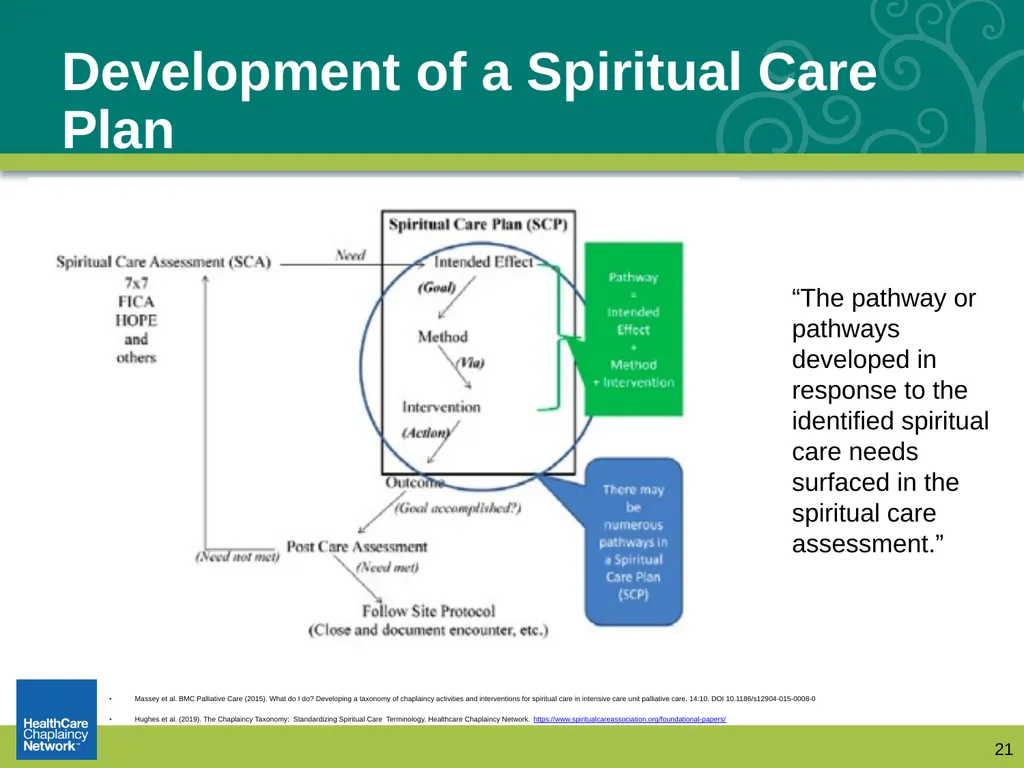
Development of a Spiritual Care Plan Massey et al. BMC Palliative Care (2015). What do I do? Developing a taxonomy of chaplaincy activities and interventions for spiritual care in intensive care unit palliative care. 14:10. DOI 10.1186/s12904-015-0008-0
Hughes et al. (2019). The Chaplaincy Taxonomy: Standardizing Spiritual Care Terminology. Healthcare Chaplaincy Network. https://www.spiritualcareassociation.org/foundational-papers/ “The pathway or pathways developed in response to the identified spiritual care needs surfaced in the spiritual care assessment.”<br>
Hughes et al. (2019). The Chaplaincy Taxonomy: Standardizing Spiritual Care Terminology. Healthcare Chaplaincy Network. https://www.spiritualcareassociation.org/foundational-papers/ “The pathway or pathways developed in response to the identified spiritual care needs surfaced in the spiritual care assessment.”<br>
22
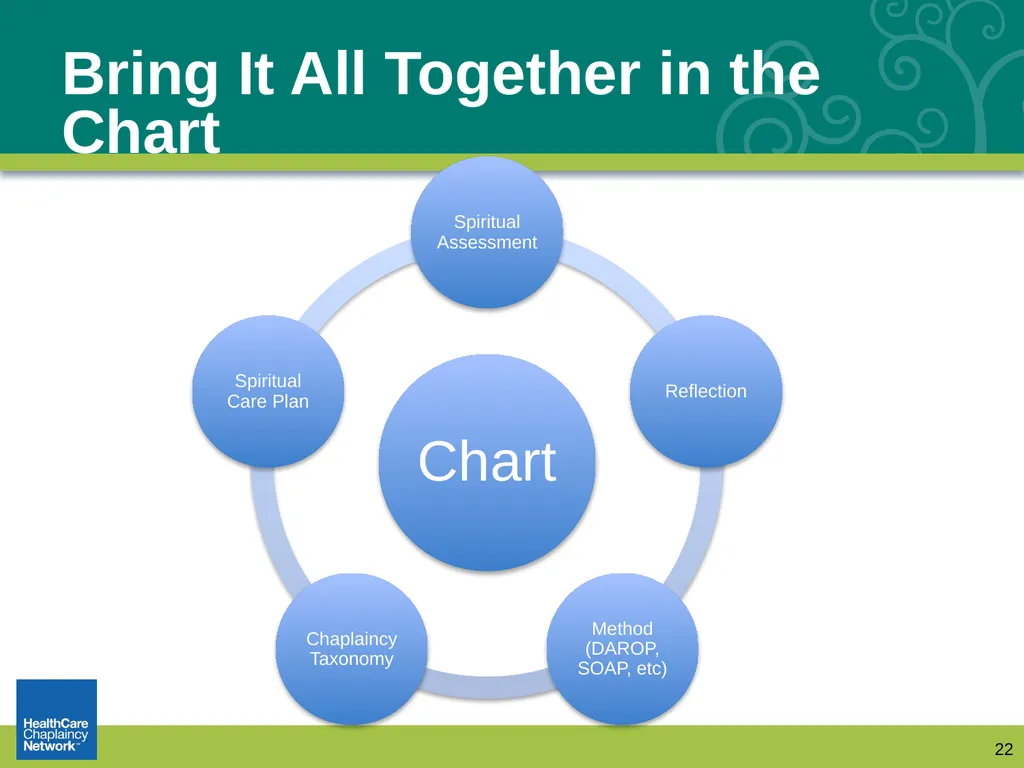
Bring It All Together in the Chart<br>
23
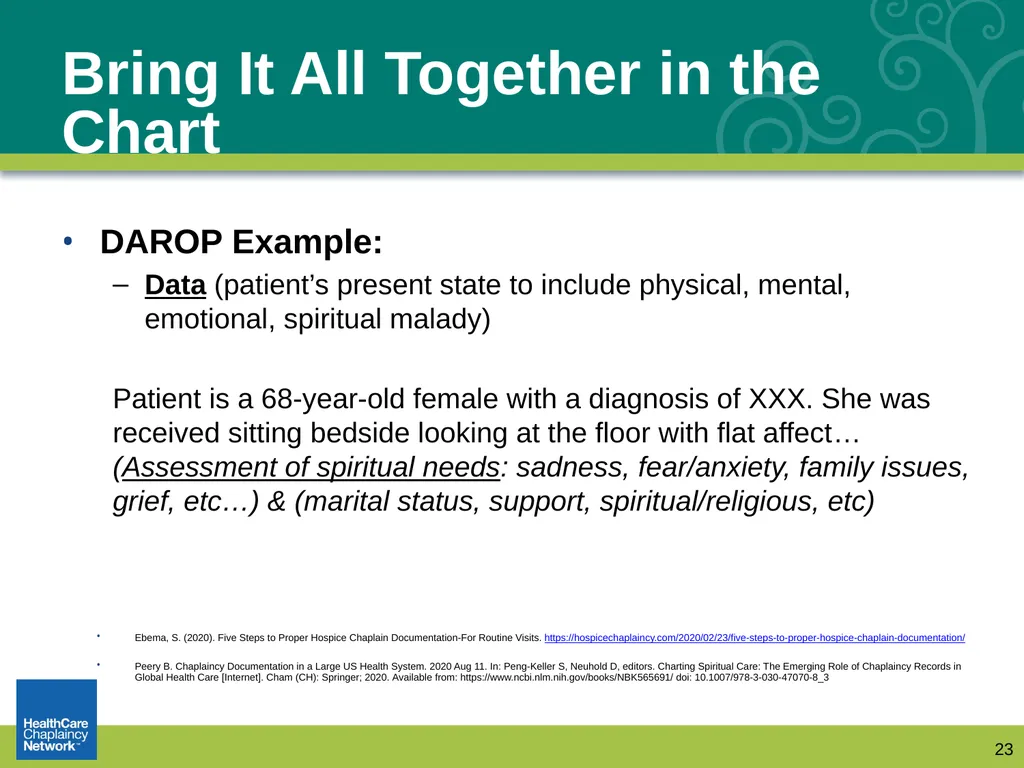
Bring It All Together in the Chart DAROP Example:
Data (patient’s present state to include physical, mental, emotional, spiritual malady)
Patient is a 68-year-old female with a diagnosis of XXX. She was received sitting bedside looking at the floor with flat affect…(Assessment of spiritual needs: sadness, fear/anxiety, family issues, grief, etc…) & (marital status, support, spiritual/religious, etc) Ebema, S. (2020). Five Steps to Proper Hospice Chaplain Documentation-For Routine Visits. https://hospicechaplaincy.com/2020/02/23/five-steps-to-proper-hospice-chaplain-documentation/
Peery B. Chaplaincy Documentation in a Large US Health System. 2020 Aug 11. In: Peng-Keller S, Neuhold D, editors. Charting Spiritual Care: The Emerging Role of Chaplaincy Records in Global Health Care [Internet]. Cham (CH): Springer; 2020. Available from: https://www.ncbi.nlm.nih.gov/books/NBK565691/ doi: 10.1007/978-3-030-47070-8_3<br>
Data (patient’s present state to include physical, mental, emotional, spiritual malady)
Patient is a 68-year-old female with a diagnosis of XXX. She was received sitting bedside looking at the floor with flat affect…(Assessment of spiritual needs: sadness, fear/anxiety, family issues, grief, etc…) & (marital status, support, spiritual/religious, etc) Ebema, S. (2020). Five Steps to Proper Hospice Chaplain Documentation-For Routine Visits. https://hospicechaplaincy.com/2020/02/23/five-steps-to-proper-hospice-chaplain-documentation/
Peery B. Chaplaincy Documentation in a Large US Health System. 2020 Aug 11. In: Peng-Keller S, Neuhold D, editors. Charting Spiritual Care: The Emerging Role of Chaplaincy Records in Global Health Care [Internet]. Cham (CH): Springer; 2020. Available from: https://www.ncbi.nlm.nih.gov/books/NBK565691/ doi: 10.1007/978-3-030-47070-8_3<br>
24
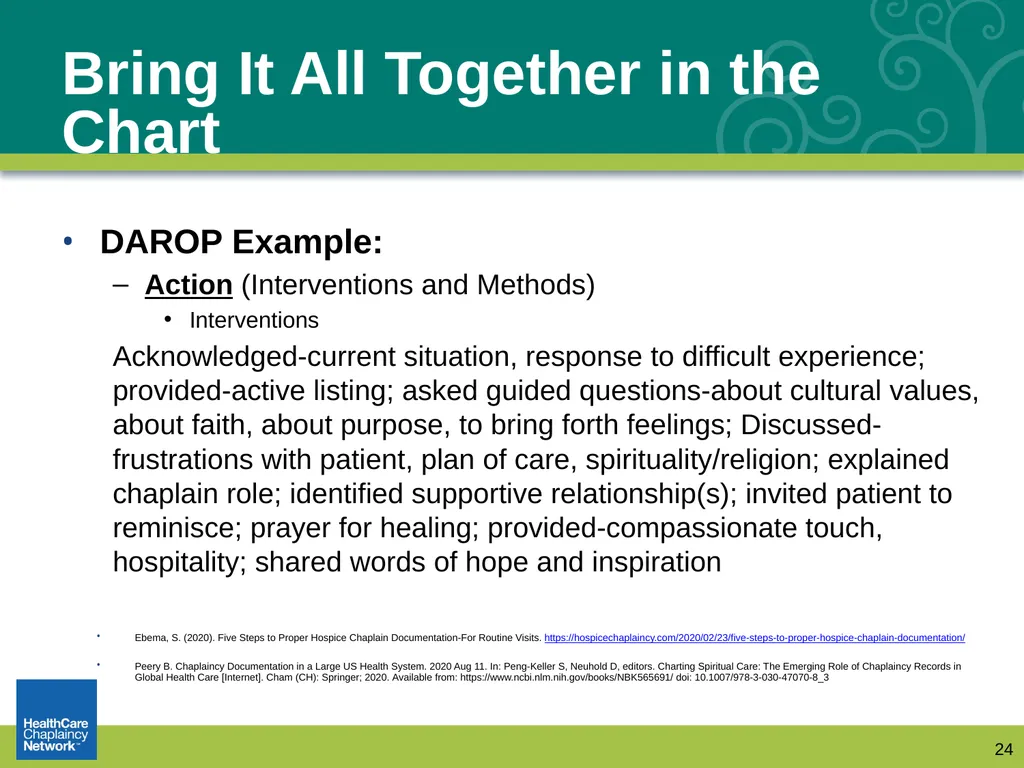
Bring It All Together in the Chart DAROP Example:
Action (Interventions and Methods)
Interventions
Acknowledged-current situation, response to difficult experience; provided-active listing; asked guided questions-about cultural values, about faith, about purpose, to bring forth feelings; Discussed-frustrations with patient, plan of care, spirituality/religion; explained chaplain role; identified supportive relationship(s); invited patient to reminisce; prayer for healing; provided-compassionate touch, hospitality; shared words of hope and inspiration Ebema, S. (2020). Five Steps to Proper Hospice Chaplain Documentation-For Routine Visits. https://hospicechaplaincy.com/2020/02/23/five-steps-to-proper-hospice-chaplain-documentation/
Peery B. Chaplaincy Documentation in a Large US Health System. 2020 Aug 11. In: Peng-Keller S, Neuhold D, editors. Charting Spiritual Care: The Emerging Role of Chaplaincy Records in Global Health Care [Internet]. Cham (CH): Springer; 2020. Available from: https://www.ncbi.nlm.nih.gov/books/NBK565691/ doi: 10.1007/978-3-030-47070-8_3<br>
Action (Interventions and Methods)
Interventions
Acknowledged-current situation, response to difficult experience; provided-active listing; asked guided questions-about cultural values, about faith, about purpose, to bring forth feelings; Discussed-frustrations with patient, plan of care, spirituality/religion; explained chaplain role; identified supportive relationship(s); invited patient to reminisce; prayer for healing; provided-compassionate touch, hospitality; shared words of hope and inspiration Ebema, S. (2020). Five Steps to Proper Hospice Chaplain Documentation-For Routine Visits. https://hospicechaplaincy.com/2020/02/23/five-steps-to-proper-hospice-chaplain-documentation/
Peery B. Chaplaincy Documentation in a Large US Health System. 2020 Aug 11. In: Peng-Keller S, Neuhold D, editors. Charting Spiritual Care: The Emerging Role of Chaplaincy Records in Global Health Care [Internet]. Cham (CH): Springer; 2020. Available from: https://www.ncbi.nlm.nih.gov/books/NBK565691/ doi: 10.1007/978-3-030-47070-8_3<br>
25
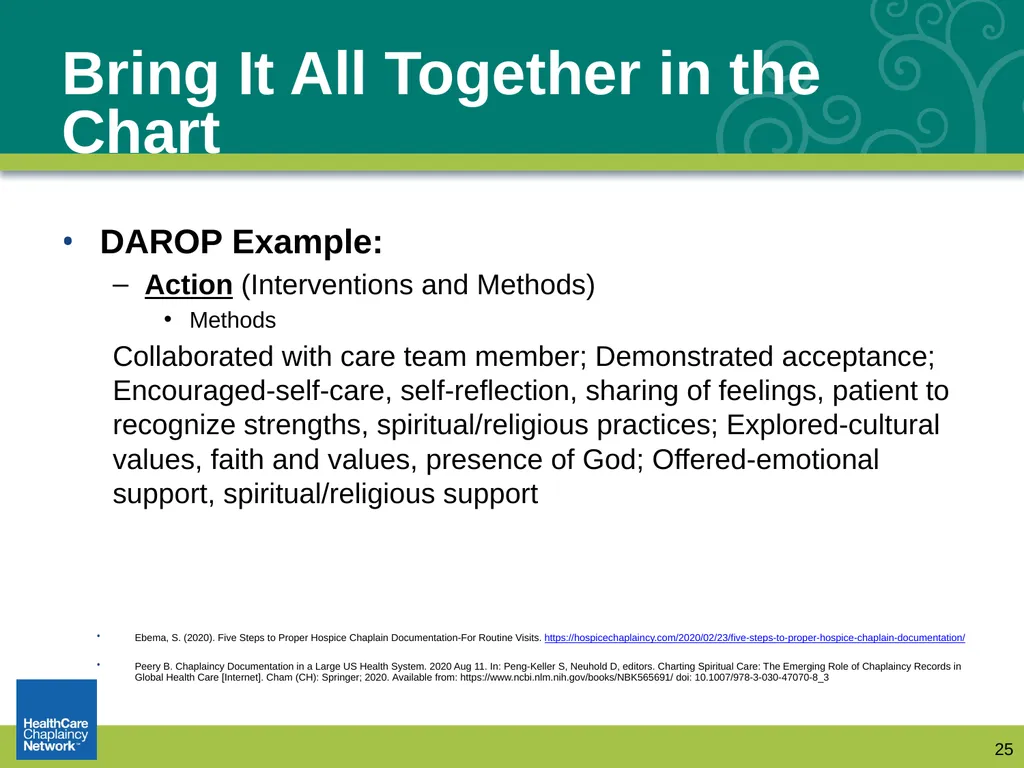
Bring It All Together in the Chart DAROP Example:
Action (Interventions and Methods)
Methods
Collaborated with care team member; Demonstrated acceptance; Encouraged-self-care, self-reflection, sharing of feelings, patient to recognize strengths, spiritual/religious practices; Explored-cultural values, faith and values, presence of God; Offered-emotional support, spiritual/religious support Ebema, S. (2020). Five Steps to Proper Hospice Chaplain Documentation-For Routine Visits. https://hospicechaplaincy.com/2020/02/23/five-steps-to-proper-hospice-chaplain-documentation/
Peery B. Chaplaincy Documentation in a Large US Health System. 2020 Aug 11. In: Peng-Keller S, Neuhold D, editors. Charting Spiritual Care: The Emerging Role of Chaplaincy Records in Global Health Care [Internet]. Cham (CH): Springer; 2020. Available from: https://www.ncbi.nlm.nih.gov/books/NBK565691/ doi: 10.1007/978-3-030-47070-8_3<br>
Action (Interventions and Methods)
Methods
Collaborated with care team member; Demonstrated acceptance; Encouraged-self-care, self-reflection, sharing of feelings, patient to recognize strengths, spiritual/religious practices; Explored-cultural values, faith and values, presence of God; Offered-emotional support, spiritual/religious support Ebema, S. (2020). Five Steps to Proper Hospice Chaplain Documentation-For Routine Visits. https://hospicechaplaincy.com/2020/02/23/five-steps-to-proper-hospice-chaplain-documentation/
Peery B. Chaplaincy Documentation in a Large US Health System. 2020 Aug 11. In: Peng-Keller S, Neuhold D, editors. Charting Spiritual Care: The Emerging Role of Chaplaincy Records in Global Health Care [Internet]. Cham (CH): Springer; 2020. Available from: https://www.ncbi.nlm.nih.gov/books/NBK565691/ doi: 10.1007/978-3-030-47070-8_3<br>
26
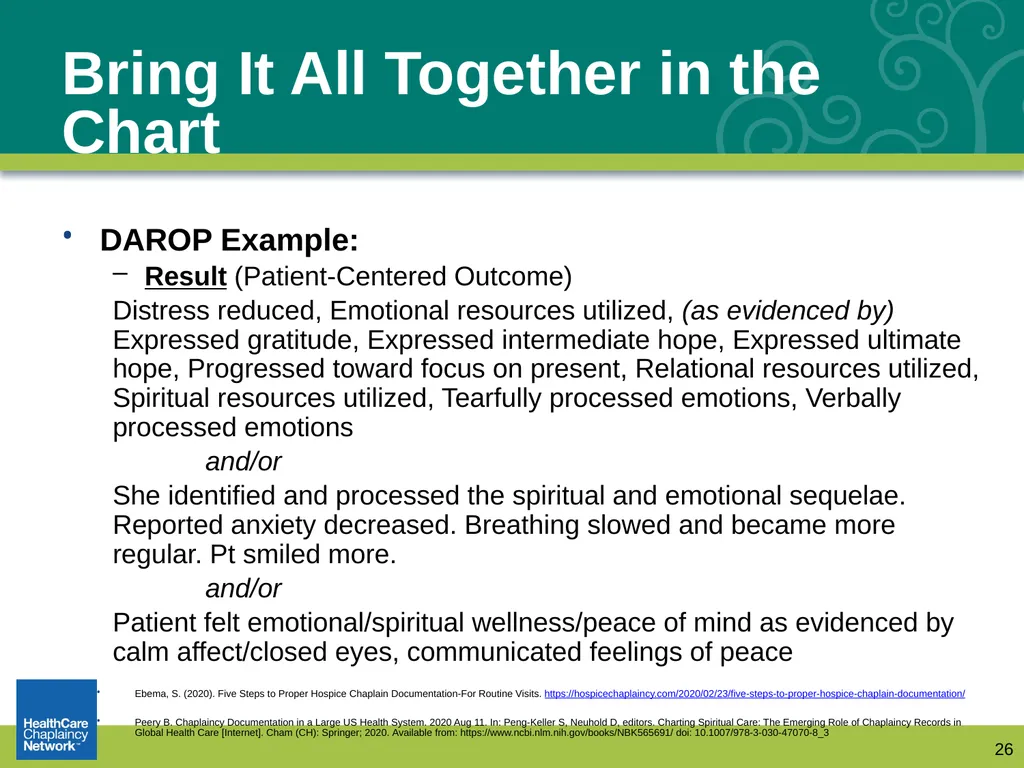
Bring It All Together in the Chart DAROP Example:
Result (Patient-Centered Outcome)
Distress reduced, Emotional resources utilized, (as evidenced by) Expressed gratitude, Expressed intermediate hope, Expressed ultimate hope, Progressed toward focus on present, Relational resources utilized, Spiritual resources utilized, Tearfully processed emotions, Verbally processed emotions
and/or
She identified and processed the spiritual and emotional sequelae. Reported anxiety decreased. Breathing slowed and became more regular. Pt smiled more.
and/or
Patient felt emotional/spiritual wellness/peace of mind as evidenced by calm affect/closed eyes, communicated feelings of peace Ebema, S. (2020). Five Steps to Proper Hospice Chaplain Documentation-For Routine Visits. https://hospicechaplaincy.com/2020/02/23/five-steps-to-proper-hospice-chaplain-documentation/
Peery B. Chaplaincy Documentation in a Large US Health System. 2020 Aug 11. In: Peng-Keller S, Neuhold D, editors. Charting Spiritual Care: The Emerging Role of Chaplaincy Records in Global Health Care [Internet]. Cham (CH): Springer; 2020. Available from: https://www.ncbi.nlm.nih.gov/books/NBK565691/ doi: 10.1007/978-3-030-47070-8_3<br>
Result (Patient-Centered Outcome)
Distress reduced, Emotional resources utilized, (as evidenced by) Expressed gratitude, Expressed intermediate hope, Expressed ultimate hope, Progressed toward focus on present, Relational resources utilized, Spiritual resources utilized, Tearfully processed emotions, Verbally processed emotions
and/or
She identified and processed the spiritual and emotional sequelae. Reported anxiety decreased. Breathing slowed and became more regular. Pt smiled more.
and/or
Patient felt emotional/spiritual wellness/peace of mind as evidenced by calm affect/closed eyes, communicated feelings of peace Ebema, S. (2020). Five Steps to Proper Hospice Chaplain Documentation-For Routine Visits. https://hospicechaplaincy.com/2020/02/23/five-steps-to-proper-hospice-chaplain-documentation/
Peery B. Chaplaincy Documentation in a Large US Health System. 2020 Aug 11. In: Peng-Keller S, Neuhold D, editors. Charting Spiritual Care: The Emerging Role of Chaplaincy Records in Global Health Care [Internet]. Cham (CH): Springer; 2020. Available from: https://www.ncbi.nlm.nih.gov/books/NBK565691/ doi: 10.1007/978-3-030-47070-8_3<br>
27
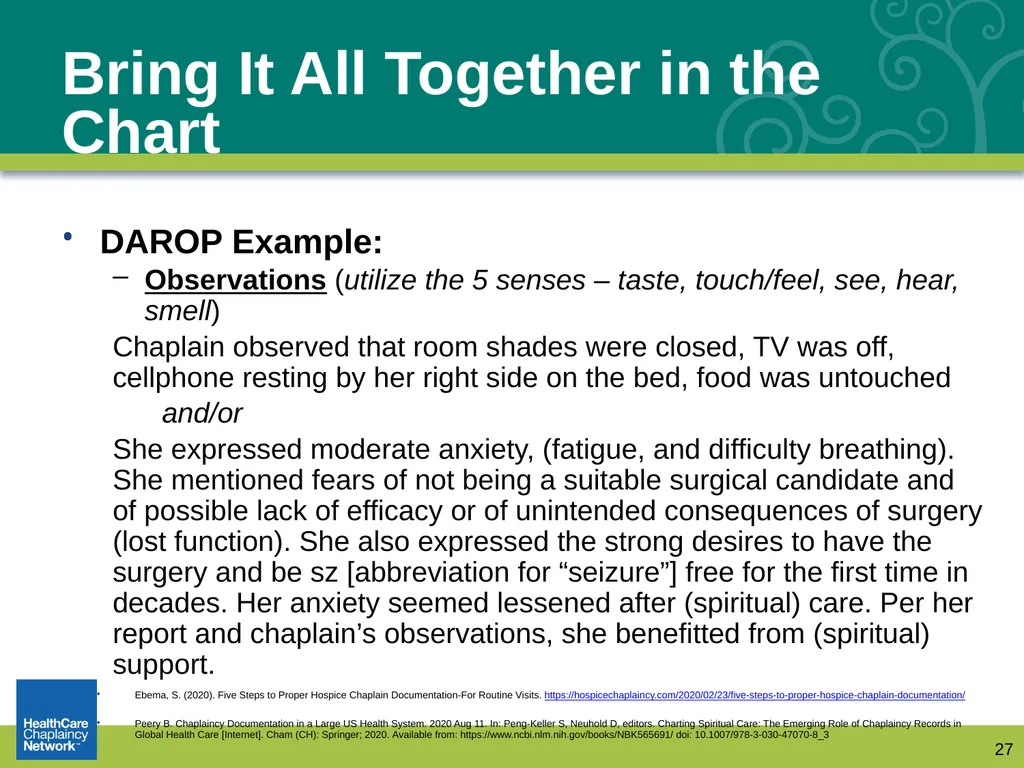
Bring It All Together in the Chart DAROP Example:
Observations (utilize the 5 senses – taste, touch/feel, see, hear, smell)
Chaplain observed that room shades were closed, TV was off, cellphone resting by her right side on the bed, food was untouched
and/or
She expressed moderate anxiety, (fatigue, and difficulty breathing). She mentioned fears of not being a suitable surgical candidate and of possible lack of efficacy or of unintended consequences of surgery (lost function). She also expressed the strong desires to have the surgery and be sz [abbreviation for “seizure”] free for the first time in decades. Her anxiety seemed lessened after (spiritual) care. Per her report and chaplain’s observations, she benefitted from (spiritual) support. Ebema, S. (2020). Five Steps to Proper Hospice Chaplain Documentation-For Routine Visits. https://hospicechaplaincy.com/2020/02/23/five-steps-to-proper-hospice-chaplain-documentation/
Peery B. Chaplaincy Documentation in a Large US Health System. 2020 Aug 11. In: Peng-Keller S, Neuhold D, editors. Charting Spiritual Care: The Emerging Role of Chaplaincy Records in Global Health Care [Internet]. Cham (CH): Springer; 2020. Available from: https://www.ncbi.nlm.nih.gov/books/NBK565691/ doi: 10.1007/978-3-030-47070-8_3<br>
Observations (utilize the 5 senses – taste, touch/feel, see, hear, smell)
Chaplain observed that room shades were closed, TV was off, cellphone resting by her right side on the bed, food was untouched
and/or
She expressed moderate anxiety, (fatigue, and difficulty breathing). She mentioned fears of not being a suitable surgical candidate and of possible lack of efficacy or of unintended consequences of surgery (lost function). She also expressed the strong desires to have the surgery and be sz [abbreviation for “seizure”] free for the first time in decades. Her anxiety seemed lessened after (spiritual) care. Per her report and chaplain’s observations, she benefitted from (spiritual) support. Ebema, S. (2020). Five Steps to Proper Hospice Chaplain Documentation-For Routine Visits. https://hospicechaplaincy.com/2020/02/23/five-steps-to-proper-hospice-chaplain-documentation/
Peery B. Chaplaincy Documentation in a Large US Health System. 2020 Aug 11. In: Peng-Keller S, Neuhold D, editors. Charting Spiritual Care: The Emerging Role of Chaplaincy Records in Global Health Care [Internet]. Cham (CH): Springer; 2020. Available from: https://www.ncbi.nlm.nih.gov/books/NBK565691/ doi: 10.1007/978-3-030-47070-8_3<br>
28
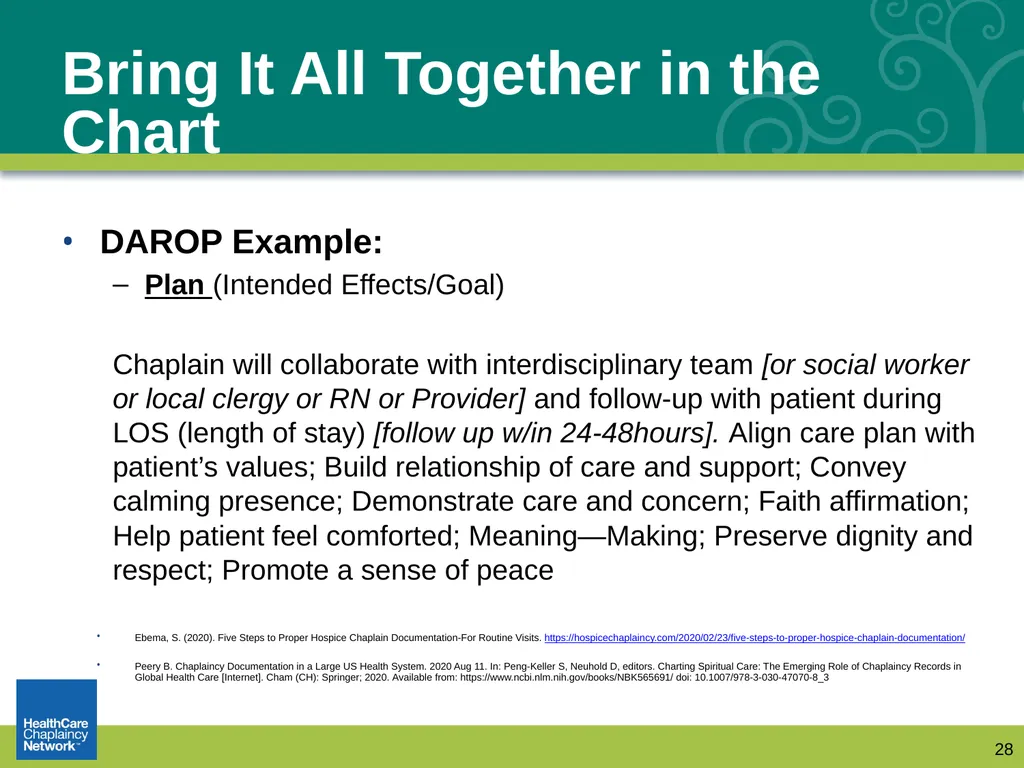
Bring It All Together in the Chart DAROP Example:
Plan (Intended Effects/Goal)
Chaplain will collaborate with interdisciplinary team [or social worker or local clergy or RN or Provider] and follow-up with patient during LOS (length of stay) [follow up w/in 24-48hours]. Align care plan with patient’s values; Build relationship of care and support; Convey calming presence; Demonstrate care and concern; Faith affirmation; Help patient feel comforted; Meaning—Making; Preserve dignity and respect; Promote a sense of peace Ebema, S. (2020). Five Steps to Proper Hospice Chaplain Documentation-For Routine Visits. https://hospicechaplaincy.com/2020/02/23/five-steps-to-proper-hospice-chaplain-documentation/
Peery B. Chaplaincy Documentation in a Large US Health System. 2020 Aug 11. In: Peng-Keller S, Neuhold D, editors. Charting Spiritual Care: The Emerging Role of Chaplaincy Records in Global Health Care [Internet]. Cham (CH): Springer; 2020. Available from: https://www.ncbi.nlm.nih.gov/books/NBK565691/ doi: 10.1007/978-3-030-47070-8_3<br>
Plan (Intended Effects/Goal)
Chaplain will collaborate with interdisciplinary team [or social worker or local clergy or RN or Provider] and follow-up with patient during LOS (length of stay) [follow up w/in 24-48hours]. Align care plan with patient’s values; Build relationship of care and support; Convey calming presence; Demonstrate care and concern; Faith affirmation; Help patient feel comforted; Meaning—Making; Preserve dignity and respect; Promote a sense of peace Ebema, S. (2020). Five Steps to Proper Hospice Chaplain Documentation-For Routine Visits. https://hospicechaplaincy.com/2020/02/23/five-steps-to-proper-hospice-chaplain-documentation/
Peery B. Chaplaincy Documentation in a Large US Health System. 2020 Aug 11. In: Peng-Keller S, Neuhold D, editors. Charting Spiritual Care: The Emerging Role of Chaplaincy Records in Global Health Care [Internet]. Cham (CH): Springer; 2020. Available from: https://www.ncbi.nlm.nih.gov/books/NBK565691/ doi: 10.1007/978-3-030-47070-8_3<br>
29
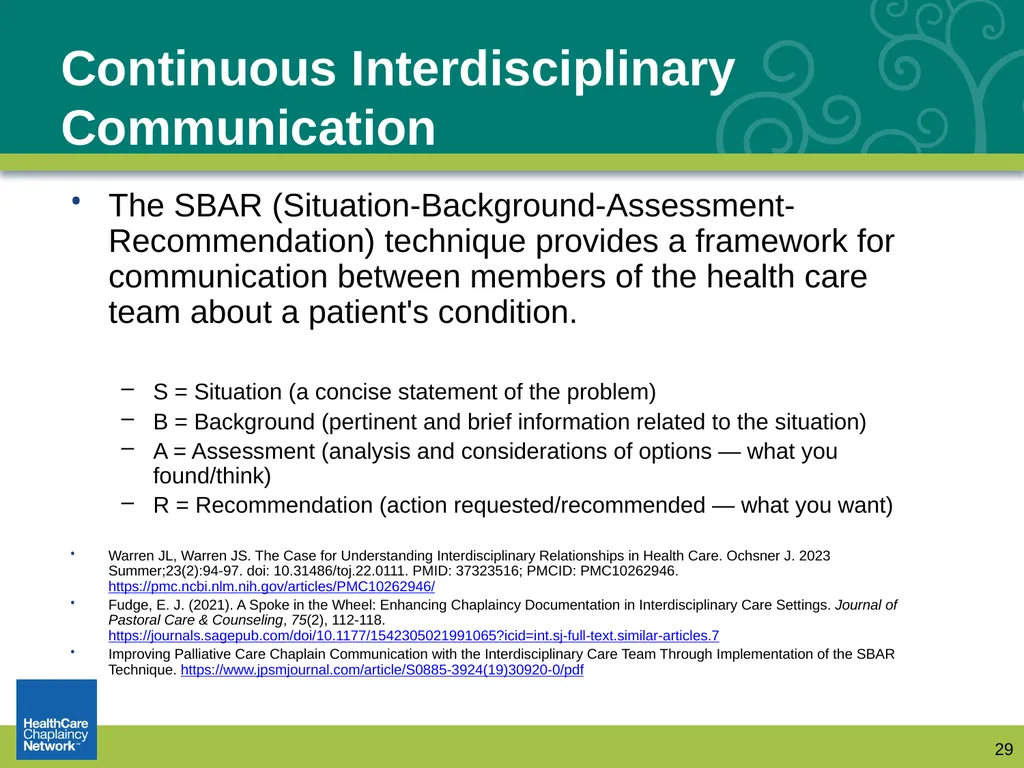
Continuous Interdisciplinary Communication The SBAR (Situation-Background-Assessment-Recommendation) technique provides a framework for communication between members of the health care team about a patient's condition.
S = Situation (a concise statement of the problem)
B = Background (pertinent and brief information related to the situation)
A = Assessment (analysis and considerations of options — what you found/think)
R = Recommendation (action requested/recommended — what you want)
Warren JL, Warren JS. The Case for Understanding Interdisciplinary Relationships in Health Care. Ochsner J. 2023 Summer;23(2):94-97. doi: 10.31486/toj.22.0111. PMID: 37323516; PMCID: PMC10262946. https://pmc.ncbi.nlm.nih.gov/articles/PMC10262946/
Fudge, E. J. (2021). A Spoke in the Wheel: Enhancing Chaplaincy Documentation in Interdisciplinary Care Settings. Journal of Pastoral Care & Counseling, 75(2), 112-118. https://journals.sagepub.com/doi/10.1177/1542305021991065?icid=int.sj-full-text.similar-articles.7
Improving Palliative Care Chaplain Communication with the Interdisciplinary Care Team Through Implementation of the SBAR Technique. https://www.jpsmjournal.com/article/S0885-3924(19)30920-0/pdf<br>
S = Situation (a concise statement of the problem)
B = Background (pertinent and brief information related to the situation)
A = Assessment (analysis and considerations of options — what you found/think)
R = Recommendation (action requested/recommended — what you want)
Warren JL, Warren JS. The Case for Understanding Interdisciplinary Relationships in Health Care. Ochsner J. 2023 Summer;23(2):94-97. doi: 10.31486/toj.22.0111. PMID: 37323516; PMCID: PMC10262946. https://pmc.ncbi.nlm.nih.gov/articles/PMC10262946/
Fudge, E. J. (2021). A Spoke in the Wheel: Enhancing Chaplaincy Documentation in Interdisciplinary Care Settings. Journal of Pastoral Care & Counseling, 75(2), 112-118. https://journals.sagepub.com/doi/10.1177/1542305021991065?icid=int.sj-full-text.similar-articles.7
Improving Palliative Care Chaplain Communication with the Interdisciplinary Care Team Through Implementation of the SBAR Technique. https://www.jpsmjournal.com/article/S0885-3924(19)30920-0/pdf<br>
30
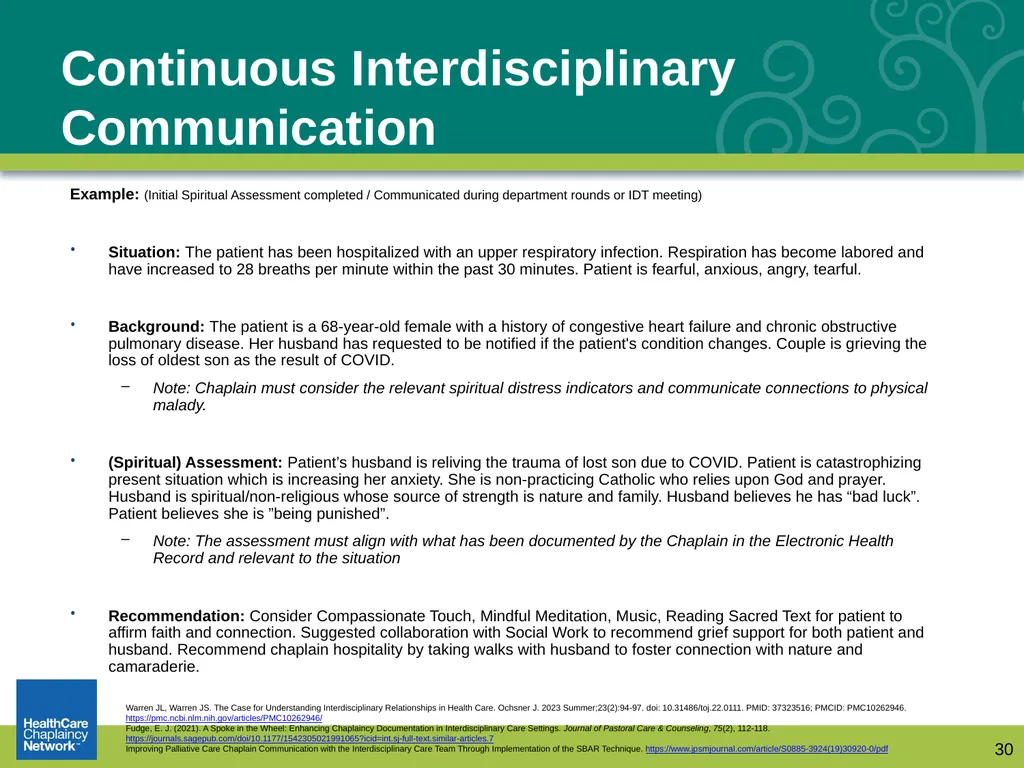
Continuous Interdisciplinary Communication Example: (Initial Spiritual Assessment completed / Communicated during department rounds or IDT meeting)
Situation: The patient has been hospitalized with an upper respiratory infection. Respiration has become labored and have increased to 28 breaths per minute within the past 30 minutes. Patient is fearful, anxious, angry, tearful.
Background: The patient is a 68-year-old female with a history of congestive heart failure and chronic obstructive pulmonary disease. Her husband has requested to be notified if the patient's condition changes. Couple is grieving the loss of oldest son as the result of COVID.
Note: Chaplain must consider the relevant spiritual distress indicators and communicate connections to physical malady.
(Spiritual) Assessment: Patient’s husband is reliving the trauma of lost son due to COVID. Patient is catastrophizing present situation which is increasing her anxiety. She is non-practicing Catholic who relies upon God and prayer. Husband is spiritual/non-religious whose source of strength is nature and family. Husband believes he has “bad luck”. Patient believes she is ”being punished”.
Note: The assessment must align with what has been documented by the Chaplain in the Electronic Health Record and relevant to the situation
Recommendation: Consider Compassionate Touch, Mindful Meditation, Music, Reading Sacred Text for patient to affirm faith and connection. Suggested collaboration with Social Work to recommend grief support for both patient and husband. Recommend chaplain hospitality by taking walks with husband to foster connection with nature and camaraderie. Warren JL, Warren JS. The Case for Understanding Interdisciplinary Relationships in Health Care. Ochsner J. 2023 Summer;23(2):94-97. doi: 10.31486/toj.22.0111. PMID: 37323516; PMCID: PMC10262946. https://pmc.ncbi.nlm.nih.gov/articles/PMC10262946/
Fudge, E. J. (2021). A Spoke in the Wheel: Enhancing Chaplaincy Documentation in Interdisciplinary Care Settings. Journal of Pastoral Care & Counseling, 75(2), 112-118. https://journals.sagepub.com/doi/10.1177/1542305021991065?icid=int.sj-full-text.similar-articles.7
Improving Palliative Care Chaplain Communication with the Interdisciplinary Care Team Through Implementation of the SBAR Technique. https://www.jpsmjournal.com/article/S0885-3924(19)30920-0/pdf<br>
Situation: The patient has been hospitalized with an upper respiratory infection. Respiration has become labored and have increased to 28 breaths per minute within the past 30 minutes. Patient is fearful, anxious, angry, tearful.
Background: The patient is a 68-year-old female with a history of congestive heart failure and chronic obstructive pulmonary disease. Her husband has requested to be notified if the patient's condition changes. Couple is grieving the loss of oldest son as the result of COVID.
Note: Chaplain must consider the relevant spiritual distress indicators and communicate connections to physical malady.
(Spiritual) Assessment: Patient’s husband is reliving the trauma of lost son due to COVID. Patient is catastrophizing present situation which is increasing her anxiety. She is non-practicing Catholic who relies upon God and prayer. Husband is spiritual/non-religious whose source of strength is nature and family. Husband believes he has “bad luck”. Patient believes she is ”being punished”.
Note: The assessment must align with what has been documented by the Chaplain in the Electronic Health Record and relevant to the situation
Recommendation: Consider Compassionate Touch, Mindful Meditation, Music, Reading Sacred Text for patient to affirm faith and connection. Suggested collaboration with Social Work to recommend grief support for both patient and husband. Recommend chaplain hospitality by taking walks with husband to foster connection with nature and camaraderie. Warren JL, Warren JS. The Case for Understanding Interdisciplinary Relationships in Health Care. Ochsner J. 2023 Summer;23(2):94-97. doi: 10.31486/toj.22.0111. PMID: 37323516; PMCID: PMC10262946. https://pmc.ncbi.nlm.nih.gov/articles/PMC10262946/
Fudge, E. J. (2021). A Spoke in the Wheel: Enhancing Chaplaincy Documentation in Interdisciplinary Care Settings. Journal of Pastoral Care & Counseling, 75(2), 112-118. https://journals.sagepub.com/doi/10.1177/1542305021991065?icid=int.sj-full-text.similar-articles.7
Improving Palliative Care Chaplain Communication with the Interdisciplinary Care Team Through Implementation of the SBAR Technique. https://www.jpsmjournal.com/article/S0885-3924(19)30920-0/pdf<br>
31
Thank You
cparker@spiritualcareassociation.org<br>
cparker@spiritualcareassociation.org<br>