
Documenting Our Work Surveys VAdata: Virginia’s
TA
Published · 24 slides · 0 views
1 / 1

Description
Documenting Our Work Surveys VAdata: Virginias Sexual and Domestic Violence Data Collection System Documenting Our Work The Documenting Our Work (DOW) project was initiated by Family Violence Prevention and Services Act (FVPSA) staff at
Related Topics
Share
Embed code
Download this presentation From Below
"Documenting Our Work Surveys VAdata: Virginia’s" is the property of its rightful owner. Permission is granted to download and print the materials on this website for personal, non-commercial use only, and to display it on your personal computer provided you do not modify the materials and that you retain all copyright notices contained in the materials. By downloading content from our website, you accept the terms of this agreement.
Presentation Transcript
01
Documenting Our Work Surveys VAdata: Virginia’s Sexual and Domestic Violence Data Collection System<br>
02
Documenting Our Work The Documenting Our Work (DOW) project was initiated by Family Violence Prevention and Services Act (FVPSA) staff at the U.S. Department of Health and Human Services and the National Resource Center on Domestic Violence.<br>
03
What is Documenting Our Work? Documenting Our Work is a national initiative to develop tools to gather outcome data on the impact and value of services provided by local domestic violence programs.
It requires a specific type of data collection—collecting data directly from survivors.<br>
It requires a specific type of data collection—collecting data directly from survivors.<br>
04
What are “outcomes”? Outcomes are the changes, benefits, learning or other effects that can happen as a result of services.
Outcomes help document that our services make a difference to survivors, and allow survivors to share about the impact of services in their own words.<br>
Outcomes help document that our services make a difference to survivors, and allow survivors to share about the impact of services in their own words.<br>
05
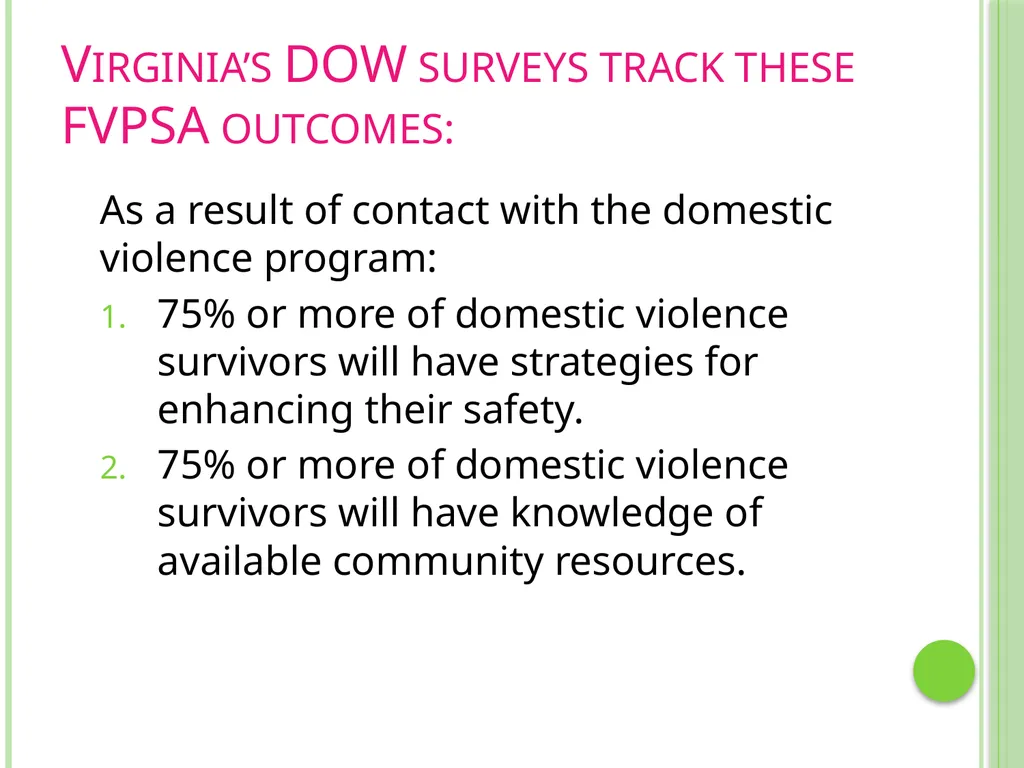
Virginia’s DOW surveys track these FVPSA outcomes: As a result of contact with the domestic violence program:
75% or more of domestic violence survivors will have strategies for enhancing their safety.
75% or more of domestic violence survivors will have knowledge of available community resources.<br>
75% or more of domestic violence survivors will have strategies for enhancing their safety.
75% or more of domestic violence survivors will have knowledge of available community resources.<br>
06
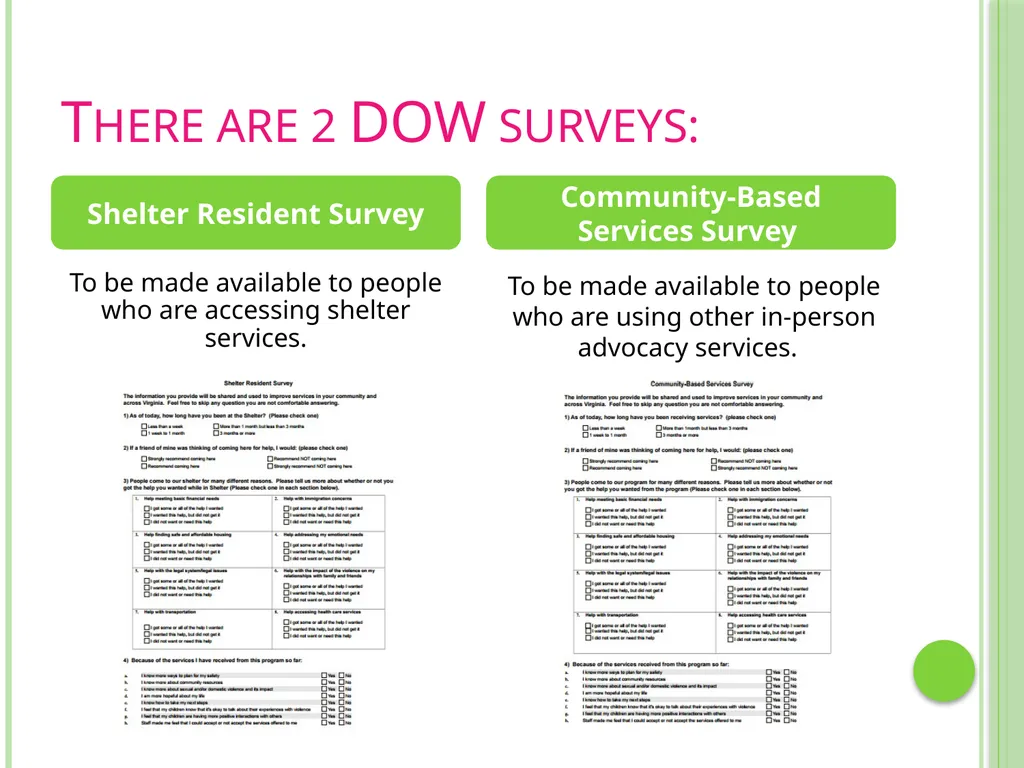
There are 2 DOW surveys: To be made available to people who are accessing shelter services. To be made available to people who are using other in-person advocacy services. Shelter Resident Survey Community-Based Services Survey<br>
07
What is included in the surveys? The Shelter Resident and Community-Based Services surveys are essentially identical.
Each survey:
offers adult survivors the opportunity to identify help that they needed and received (or did not).
provides some outcome information about the impact of services.
gives respondents the opportunity to share in their own words.<br>
Each survey:
offers adult survivors the opportunity to identify help that they needed and received (or did not).
provides some outcome information about the impact of services.
gives respondents the opportunity to share in their own words.<br>
08
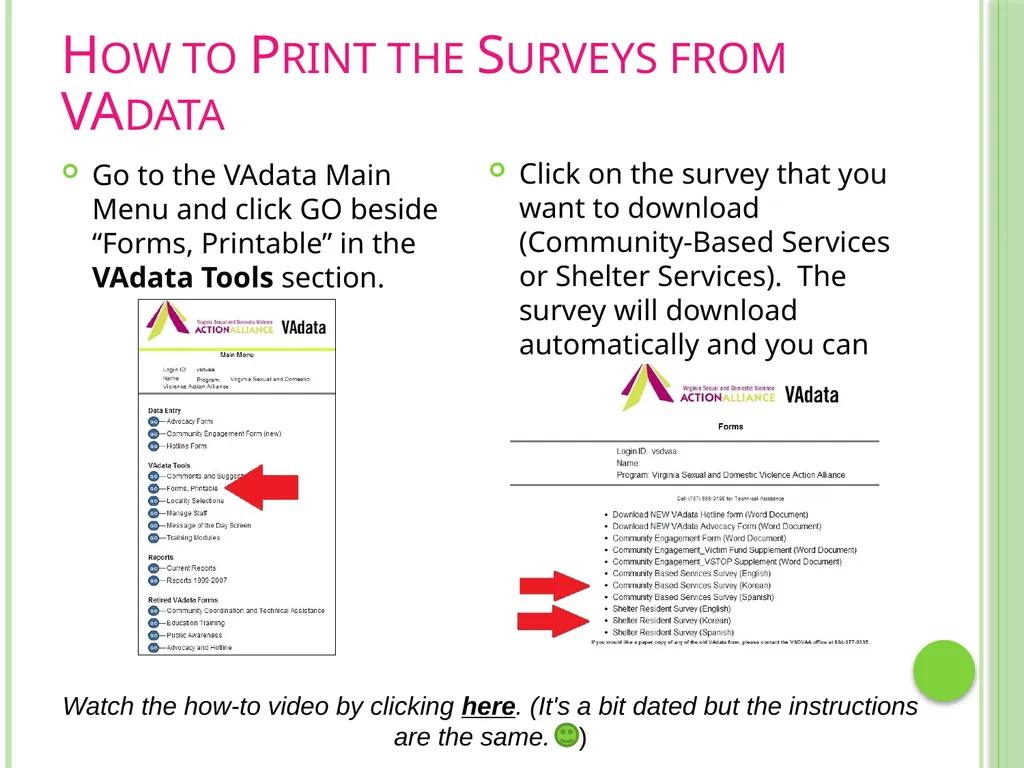
How to Print the Surveys from VAdata Go to the VAdata Main Menu and click GO beside “Forms, Printable” in the VAdata Tools section. Click on the survey that you want to download (Community-Based Services or Shelter Services). The survey will download automatically and you can print the .pdf form. Watch the how-to video by clicking here. (It's a bit dated but the instructions are the same. )<br>
09
When/How Do We Hand Out the Surveys? Community-Based Services: Give a survey to each adult who receives services from your agency on at least 3 different dates.
Shelter Services: Give a survey to residents at the point that you think they are about mid-way through their shelter stay.<br>
Shelter Services: Give a survey to residents at the point that you think they are about mid-way through their shelter stay.<br>
10
What happens When a Client Completes A Survey? Some agencies request that people completing the surveys put them in an envelope, seal it, and return it to you.
Some agencies choose to have a designated box where survivors can anonymously drop off the surveys.
We request that you send all completed surveys to Action Alliance, PO Box 8565, Richmond VA 23226 on a regular basis (preferably weekly) and no later than 15 days following the end of a calendar quarter (Jan. 15, April 15, July 15, Oct. 15). PLEASE DO NOT MAIL SURVEYS TO THE A.A. OFFICE ADDRESS.<br>
Some agencies choose to have a designated box where survivors can anonymously drop off the surveys.
We request that you send all completed surveys to Action Alliance, PO Box 8565, Richmond VA 23226 on a regular basis (preferably weekly) and no later than 15 days following the end of a calendar quarter (Jan. 15, April 15, July 15, Oct. 15). PLEASE DO NOT MAIL SURVEYS TO THE A.A. OFFICE ADDRESS.<br>
11
What Happens When the Action Alliance Receives the Surveys? Action Alliance staff will send them to an outside agency to enter the data.
Summarized DOW data will be provided via your regular VAdata reports.
The paper surveys will be shredded after they have been entered into VAdata, but a .pdf copy will be retained for quality assurance.
Remember, due to our need to protect the privacy and anonymity of survey respondents, agencies are not able to see their DOW survey results in VAdata for 90 days after the date surveys are received and coded into the system.<br>
Summarized DOW data will be provided via your regular VAdata reports.
The paper surveys will be shredded after they have been entered into VAdata, but a .pdf copy will be retained for quality assurance.
Remember, due to our need to protect the privacy and anonymity of survey respondents, agencies are not able to see their DOW survey results in VAdata for 90 days after the date surveys are received and coded into the system.<br>
12
How will this data be helpful to us? To improve services, including an examination of whether or not people from marginalized and/or underserved populations have different experiences with your services,
To document need,
To promote accountability to the people we serve.<br>
To document need,
To promote accountability to the people we serve.<br>
13
How will this data be helpful on a national level? These are outcomes that are valid, tested, and evidence-based,
The outcomes and survey questions were informed by people working in the domestic violence field and not imposed by an outsider,
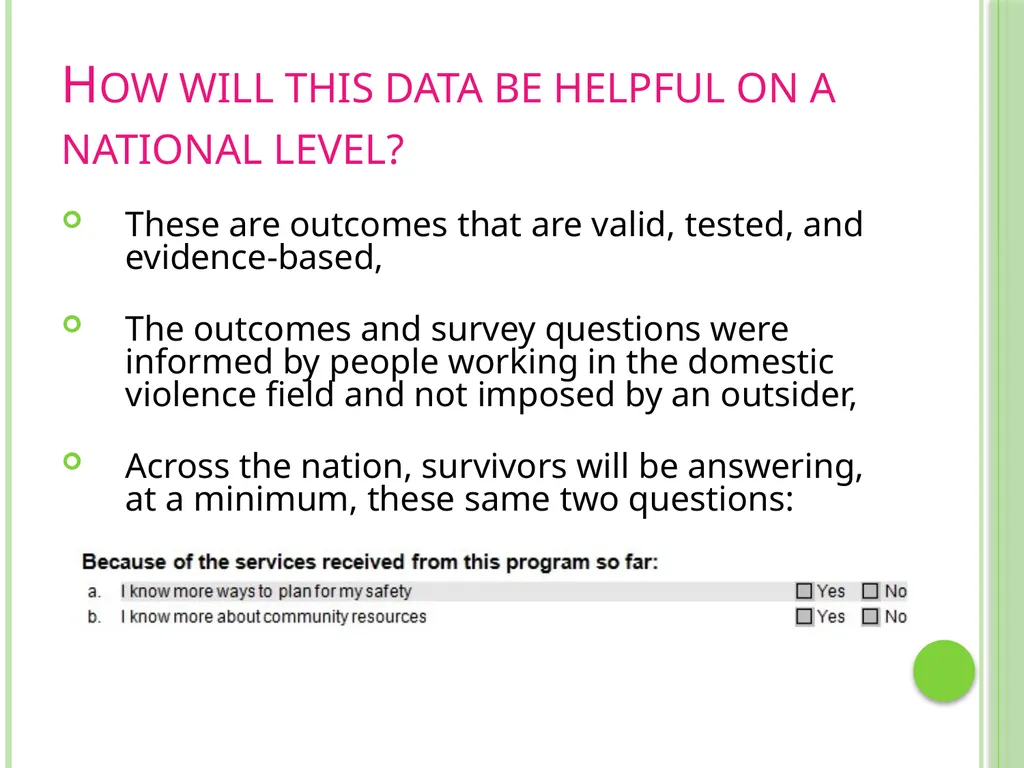
Across the nation, survivors will be answering, at a minimum, these same two questions:<br>
The outcomes and survey questions were informed by people working in the domestic violence field and not imposed by an outsider,
Across the nation, survivors will be answering, at a minimum, these same two questions:<br>
14
Will there be other outcomes from this data? All of this data can be used to document how people were helped as a result of your services.
There is even an opportunity for survivors to tell us what they would have done if your services had not existed.
In Virginia, this has provided some compelling qualitative data, all in a survivor’s own words:
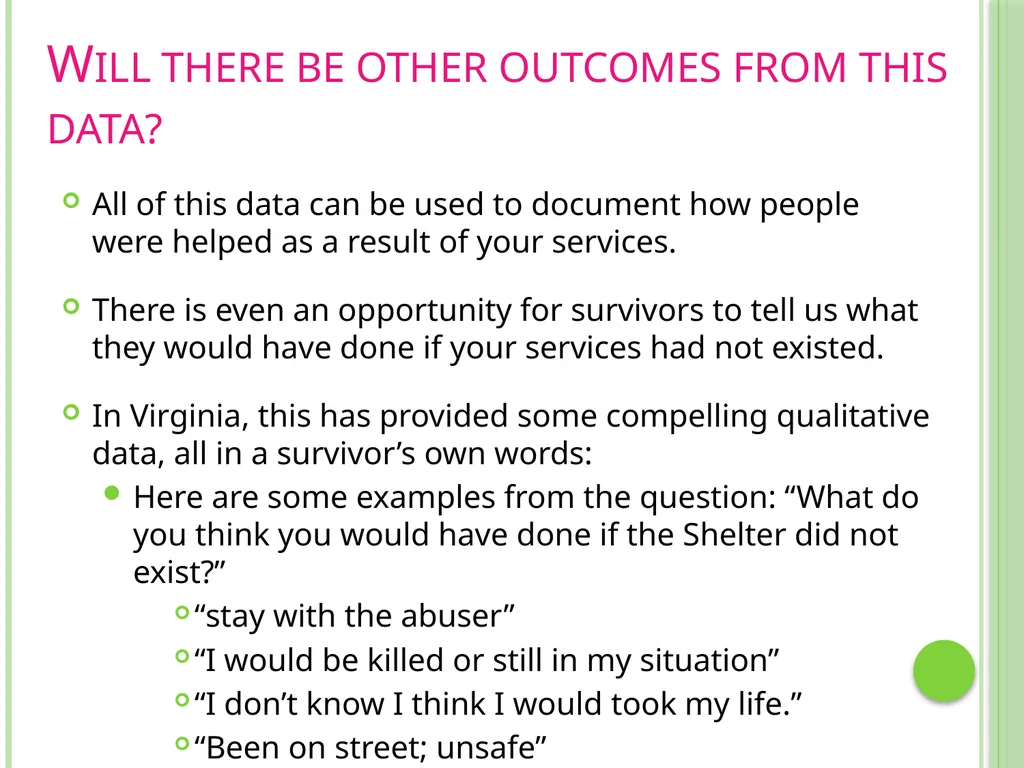
Here are some examples from the question: “What do you think you would have done if the Shelter did not exist?”
“stay with the abuser”
“I would be killed or still in my situation”
“I don’t know I think I would took my life.”
“Been on street; unsafe”<br>
There is even an opportunity for survivors to tell us what they would have done if your services had not existed.
In Virginia, this has provided some compelling qualitative data, all in a survivor’s own words:
Here are some examples from the question: “What do you think you would have done if the Shelter did not exist?”
“stay with the abuser”
“I would be killed or still in my situation”
“I don’t know I think I would took my life.”
“Been on street; unsafe”<br>
15
Questions About Documenting Our Work: What happens if the surveys are not completed and returned?
These surveys are completely VOLUNTARY.
People may choose, for whatever reason, not to return them.
What is important is that everyone is offered the opportunity to complete and return a survey.<br>
These surveys are completely VOLUNTARY.
People may choose, for whatever reason, not to return them.
What is important is that everyone is offered the opportunity to complete and return a survey.<br>
16
Questions (Cont.): What if someone leaves the shelter unexpectedly, without receiving a survey?
This is going to happen, and it’s not a problem.
The goal is to develop a system for distributing the surveys and to follow your system when possible.<br>
This is going to happen, and it’s not a problem.
The goal is to develop a system for distributing the surveys and to follow your system when possible.<br>
17
Questions (Cont.): What if an advocate forgets to give a person a survey on the planned date?
This, too, is going to happen. When there are new procedures in practice and/or new staff and volunteers in the agency, things get missed.
We encourage advocates to do what they can to assure that survivors are given the opportunity to participate.<br>
This, too, is going to happen. When there are new procedures in practice and/or new staff and volunteers in the agency, things get missed.
We encourage advocates to do what they can to assure that survivors are given the opportunity to participate.<br>
18
Questions (Cont.): Can or should we survey people more than once?
If a person has received significantly different services from your agency, it is acceptable to survey them for the different engagements.
If a person has received services from your agency for an extended period of time, it is okay to survey them more than once. It is suggested, however, not to survey them more than once in less than a 6-week period of time.
We encourage advocates to do what they can to assure that survivors are given the opportunity to participate.<br>
If a person has received significantly different services from your agency, it is acceptable to survey them for the different engagements.
If a person has received services from your agency for an extended period of time, it is okay to survey them more than once. It is suggested, however, not to survey them more than once in less than a 6-week period of time.
We encourage advocates to do what they can to assure that survivors are given the opportunity to participate.<br>
19
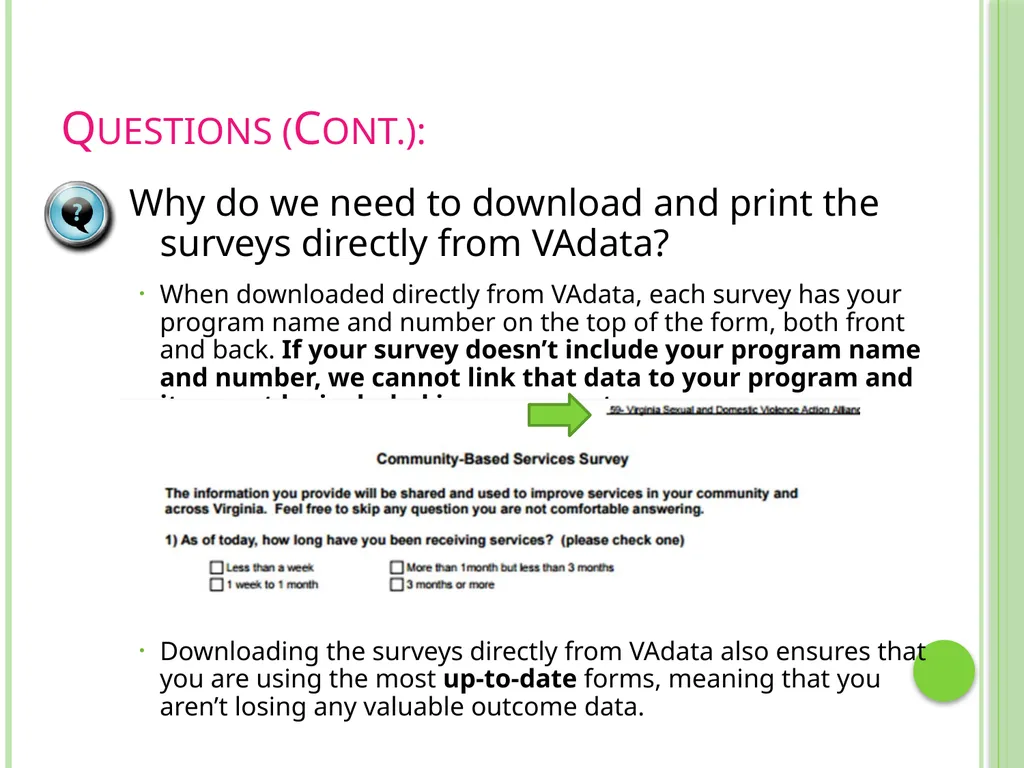
Questions (Cont.): Why do we need to download and print the surveys directly from VAdata? When downloaded directly from VAdata, each survey has your program name and number on the top of the form, both front and back. If your survey doesn’t include your program name and number, we cannot link that data to your program and it cannot be included in your reports.
Downloading the surveys directly from VAdata also ensures that you are using the most up-to-date forms, meaning that you aren’t losing any valuable outcome data.<br>
Downloading the surveys directly from VAdata also ensures that you are using the most up-to-date forms, meaning that you aren’t losing any valuable outcome data.<br>
20
Questions (Cont.): Why does the look/quality of the survey matter?
It is important to communicate to those we serve that their feedback is important to us. Providing survivors with a clean and legible survey conveys that we value their input. Surveys that look old (i.e. poor copies of copies, illegible print, copied sideways on the page, etc.) do not convey that.
We understand that printing surveys in bulk is efficient, but please make sure that you don’t compromise quality in the process.<br>
It is important to communicate to those we serve that their feedback is important to us. Providing survivors with a clean and legible survey conveys that we value their input. Surveys that look old (i.e. poor copies of copies, illegible print, copied sideways on the page, etc.) do not convey that.
We understand that printing surveys in bulk is efficient, but please make sure that you don’t compromise quality in the process.<br>
21
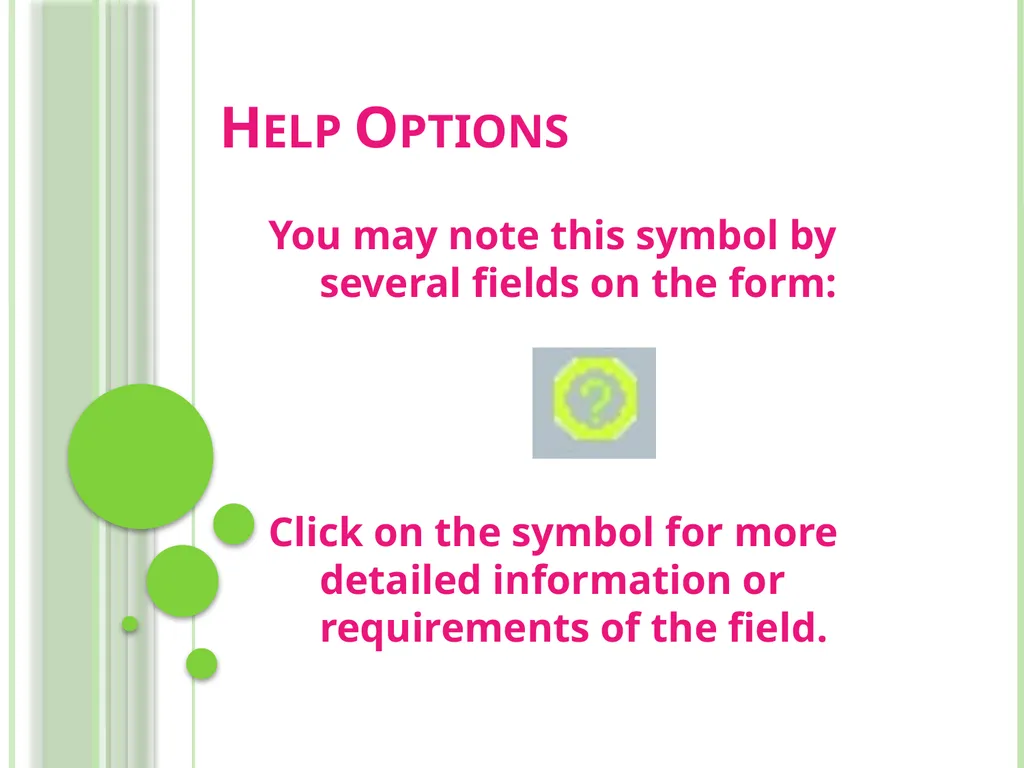
Help Options You may note this symbol by several fields on the form:
Click on the symbol for more detailed information or requirements of the field.<br>
Click on the symbol for more detailed information or requirements of the field.<br>
22
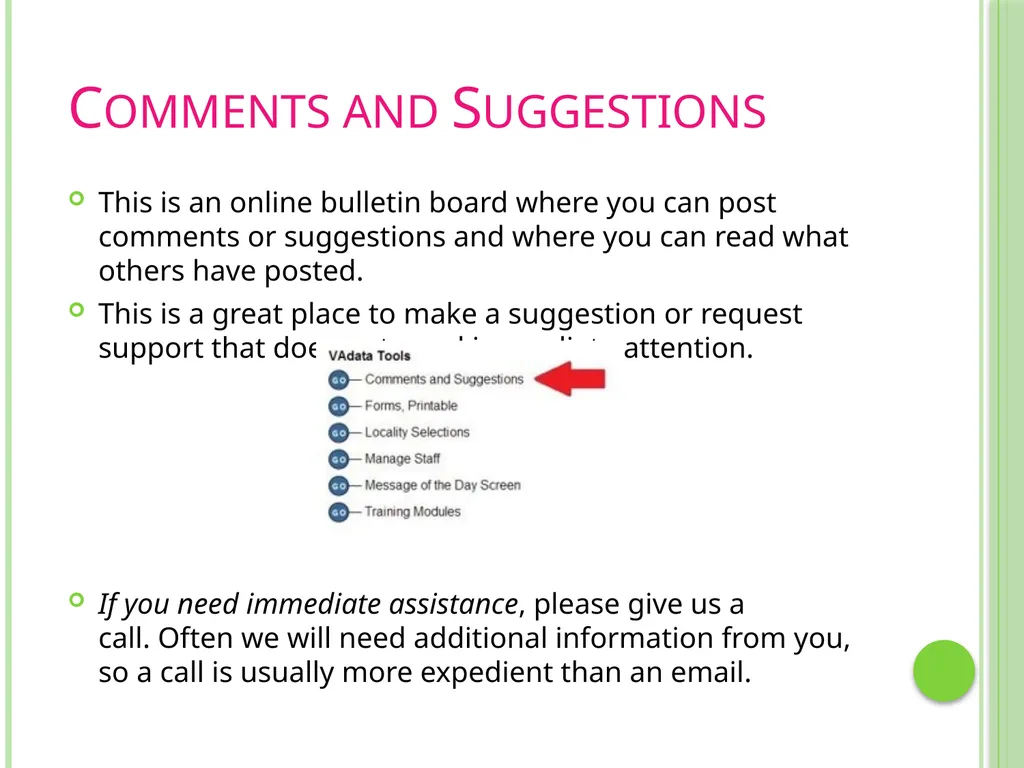
Comments and Suggestions This is an online bulletin board where you can post comments or suggestions and where you can read what others have posted.
This is a great place to make a suggestion or request support that does not need immediate attention.
If you need immediate assistance, please give us a call. Often we will need additional information from you, so a call is usually more expedient than an email.<br>
This is a great place to make a suggestion or request support that does not need immediate attention.
If you need immediate assistance, please give us a call. Often we will need additional information from you, so a call is usually more expedient than an email.<br>
23
HELP! VAdata’s not working. If you think something is wrong with VAdata, please let us know! Give us a call at 804.377.0335 or email us at vadataadmin@vsdvalliance.org.
We don’t use VAdata every day in the same ways you do, so sometimes the only way that we know something is broken is when you tell us.
We also like to talk with you by phone when you have questions, because we need additional information from you in order to adequately address your concern.<br>
We don’t use VAdata every day in the same ways you do, so sometimes the only way that we know something is broken is when you tell us.
We also like to talk with you by phone when you have questions, because we need additional information from you in order to adequately address your concern.<br>
24
Who do I contact if I have Questions? Tamara Mason,
SDVA Data System Manager
tmason@vsdvalliance.org or
804.377.0335<br>
SDVA Data System Manager
tmason@vsdvalliance.org or
804.377.0335<br>