
Doing Stylistic Analysis across Different
Description: Doing Stylistic Analysis across Different Linguistic Levels - II Overview Stylistic Analysis Semantics Stylistic Analysis Pragmatics Stylistic Analysis Discourse Stylistic Analysis Semantics At the semantic level, stylisticians are
Related Topics
Download Presentation
"Doing Stylistic Analysis across Different" is the property of its rightful owner. Permission is granted to download and print the materials on this website for personal, non-commercial use only, and to display it on your personal computer provided you do not modify the materials and that you retain all copyright notices contained in the materials. By downloading content from our website, you accept the terms of this agreement.
Presentation Transcript
slide1. Doing Stylistic Analysis across Different Linguistic Levels - II<br>
slide2. Overview Stylistic Analysis & Semantics
Stylistic Analysis & Pragmatics
Stylistic Analysis & Discourse<br>
slide3. Stylistic Analysis & Semantics At the semantic level, stylisticians are interested in how different semantic units encode meaning and how these units are linked together to form propositions.
Simpson (2004: 22) points out that the Halliday’s system of transitivity can be used to account for how ideational meaning, i.e. experiences, is encoded in language.
Unlike in traditional grammar, transitivity, here, is used in a broader semantic sense to refer to the way meanings are encoded in the clause and to the way different types of semantic ideational elements (i.e. participants, processes and circumstances) are represented in language (Halliday, 1971).<br>
slide4. Stylistic Analysis & Semantics In stylistic analysis, semantic foregrounding can be triggered by means of deviating sematic norms and repeating a semantic unit.
Short (1996: 43) defines semantic deviation as paradoxical or logically inconsistent meaning relations.
According to short’s (1996) argument , both metaphor and metonymy are considered types of semantic deviation.
Both Wales (2013: 37) and Burke (2014: 1) point out that unusual use of metonymy, metaphors or simile deviates some lexical norms and semantic regularities.<br>
slide5. Stylistic Analysis & Semantics Metaphor is a mapping process between two different lexical units belonging to two different conceptual domains.
Thus, metaphor involves a transfer from one conceptual domain to another to create some poetic effect.
In metaphor, the different domains are referred to as the ‘target domain’ and the ‘source domain’. “The target domain is the topic or concept that you want to describe through the metaphor while the source domain refers to the concept that you draw upon in order to create the metaphorical construction” (Simpson, 2004: 41).
Consider Emily Dickinson's poetic line “’Hope’ is the thing with feathers.
From a lexicogrammatical perspective, metaphor often used as predication strategy to provide an artistic description to processes and participants.<br>
slide6. Stylistic Analysis & Semantics Metonymy (as well as synecdoche) is a mapping process between different expressions both belonging to the same conceptual domain.
Thus, metonymy (as well as synecdoche) is “based on a transfer within a single conceptual domain” (Simpson, 2004: 43).
Consider the example: The White house released a statement yesterday.
From a lexicogrammatical perspective, metonymy is often used as a referential strategy to point to participants in an artistic way.<br>
slide7. Stylistic Analysis & Semantics The other type of semantic foregrounding is semantic repetition.
semantic repetition involves repeating certain semantic units to create poetic effects.
In Robert Burns’ poem ‘Red Red Rose’, the title itself involves a lexical repetition. This repetition is used to emphasize the brightness and vividness of the rose color.
In this poem, the phrases “my luv” and “my dear” are also used repetitively to emphasize the love that the persona of the poem has for his lover.
Semantic repetition can also be used to serve particular narrative depiction.
For instance, as shown by Gibbons and Whiteley (2018: 22-3), the novelist Lee Rourke employed semantic repetition in his novel ‘The Canal’ in order to indicate how office work is composed of monotonous routines.<br>
slide8. Stylistic Analysis & Semantics Tautology is a special type of semantic foregrounding, which Simpson (2004: 58) describes as a “semantic anomaly”.
Tautology is an ostensibly redundant statement in which an expression is repeated, as in ‘war is war’.
This type of foregrounding involves the use of both deviation and repetition.
A tautology replicates the basic premise of the proposition, and in doing so it deviates from the expected semantic norm of producing a logically meaningful proposition.
Simpson (2004: 57) asserts that many of E.E. Cummings’ “comparative and superlative structures are full-blown logical tautologies”, as in the lines:
‘the sea is . . . deeper than the sea’
‘the sky is . . . higher than the sky’.<br>
slide9. Stylistic Analysis & Pragmatics Pragmatically triggered foregrounding always involves irregularity, i.e. deviation from an expected pragmatic norms, rather than overregularity, i.e. repetition.
One form of pragmatic deviation is over-politeness and impoliteness which both involve deviating from generally expected verbal and social behaviors in a given context.
Over-politeness is defined as “behavior which is evaluated as too polite for the context” (Izadi, 2010: 13). In this sense, over-politeness violates the level of politeness appropriate for the context of use.
Over-politeness is used to renegotiate social relations between characters.
Paternoster (2012) investigates how impoliteness and over-politeness can be used in the fictional dialogues of crime novels to communicate attitudes and social relationships.<br>
slide10. Stylistic Analysis & Pragmatics Impoliteness can be used by novelists and playwrights as an “implicit characterization cue” (Culpeper, 2001 ) to portray social relations between different fictional characters in literary texts (Bousfield, 2014).
Chapman (2015) discusses how “changes in strategies of politeness or impoliteness might reflect on character development and on dramatic tension”.
For instance, and as shown by (Zidane, 2017), in Austen’s ‘Pride and Prejudice’ the character Lady Catherine resort to impoliteness to scold Elizabeth Bennet. This impoliteness exhibits the tense relation between these two characters and reveals their attitudes towards each other.
“Obstinate, headstrong girl! I am ashamed of you! Is this your gratitude for my attentions to you last spring? Is nothing due to me on that score?”<br>
slide11. Stylistic Analysis & Pragmatics Irrelevance constitutes the third type of pragmatic deviation, in which an expected communicative collaboration is violated.
Irrelevance can be employed strategically by novelists and playwrights to provide profound insights into their characters’ states , “particularly if the character has a condition that affects how they interact and socialize with others” (Lambrou, 2014: 146).
Lambrou (2014: 146) shows how irrelevance is apparent foregrounding technique in the narrative style of the fifteen-year-old autistic protagonist, Christopher Boone, in Mark Haddon’s ‘The Curious Incident of the Dog in the Night-Time’.
Irrelevance can also be employed to “reveal characters’ disrespect, boredom or inattentiveness”, as exhibited in the dialogue between Dobbin and Mr. Cuff in Thackeray’s Vanity Fair (Zidane, 2017: 514).<br>
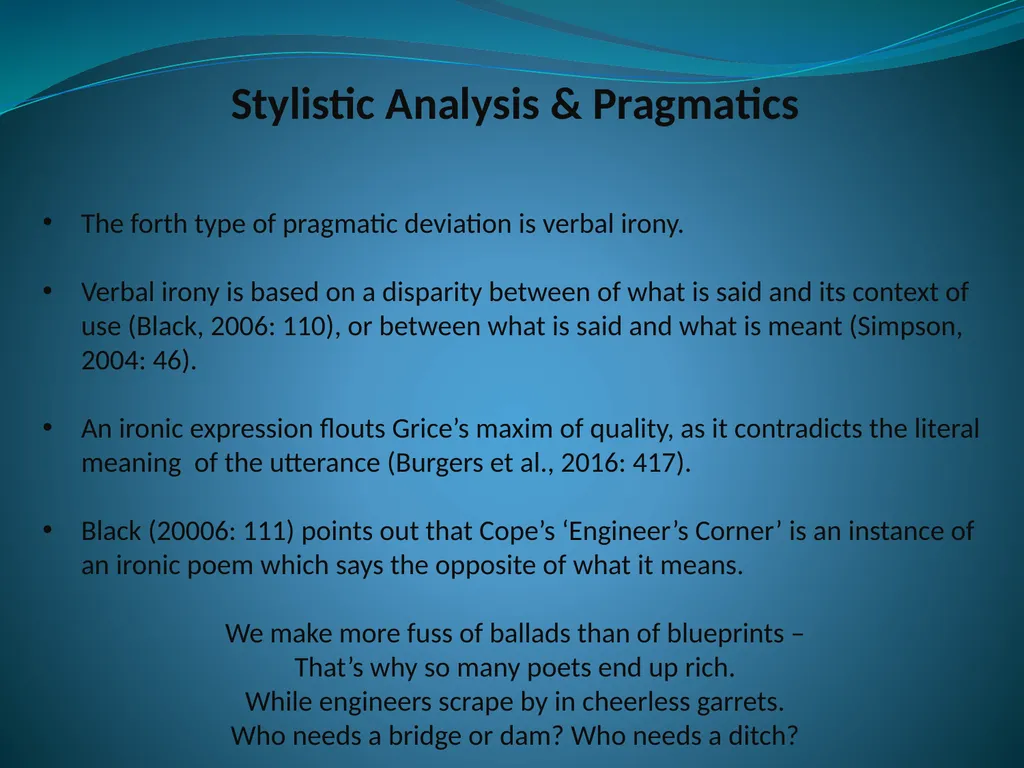
slide12. Stylistic Analysis & Pragmatics The forth type of pragmatic deviation is verbal irony.
Verbal irony is based on a disparity between of what is said and its context of use (Black, 2006: 110), or between what is said and what is meant (Simpson, 2004: 46).
An ironic expression flouts Grice’s maxim of quality, as it contradicts the literal meaning of the utterance (Burgers et al., 2016: 417).
Black (20006: 111) points out that Cope’s ‘Engineer’s Corner’ is an instance of an ironic poem which says the opposite of what it means.
We make more fuss of ballads than of blueprints –
That’s why so many poets end up rich.
While engineers scrape by in cheerless garrets.
Who needs a bridge or dam? Who needs a ditch?<br>
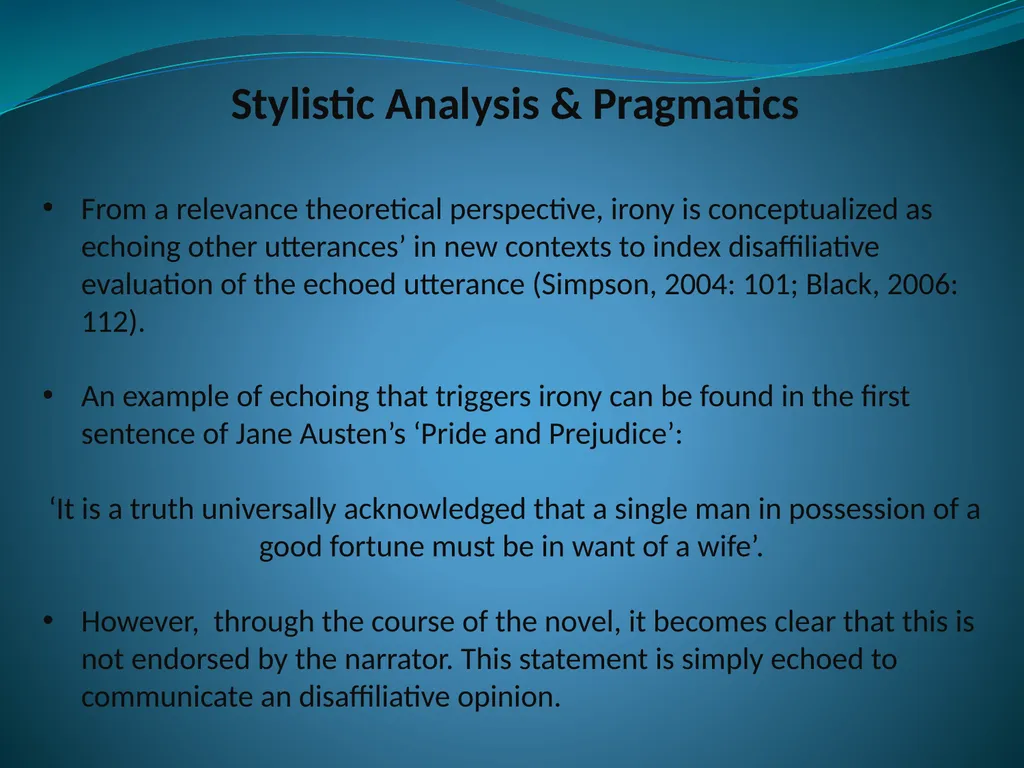
slide13. Stylistic Analysis & Pragmatics From a relevance theoretical perspective, irony is conceptualized as echoing other utterances’ in new contexts to index disaffiliative evaluation of the echoed utterance (Simpson, 2004: 101; Black, 2006: 112).
An example of echoing that triggers irony can be found in the first sentence of Jane Austen’s ‘Pride and Prejudice’:
‘It is a truth universally acknowledged that a single man in possession of a good fortune must be in want of a wife’.
However, through the course of the novel, it becomes clear that this is not endorsed by the narrator. This statement is simply echoed to communicate an disaffiliative opinion.<br>
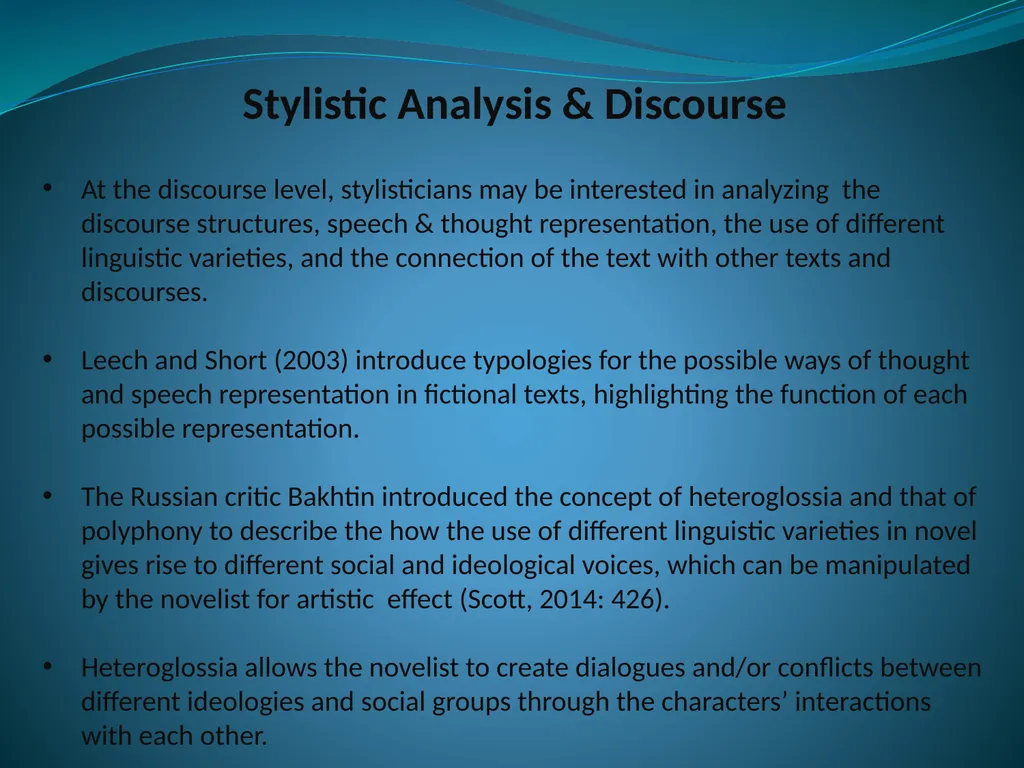
slide14. Stylistic Analysis & Discourse At the discourse level, stylisticians may be interested in analyzing the discourse structures, speech & thought representation, the use of different linguistic varieties, and the connection of the text with other texts and discourses.
Leech and Short (2003) introduce typologies for the possible ways of thought and speech representation in fictional texts, highlighting the function of each possible representation.
The Russian critic Bakhtin introduced the concept of heteroglossia and that of polyphony to describe the how the use of different linguistic varieties in novel gives rise to different social and ideological voices, which can be manipulated by the novelist for artistic effect (Scott, 2014: 426).
Heteroglossia allows the novelist to create dialogues and/or conflicts between different ideologies and social groups through the characters’ interactions with each other.<br>
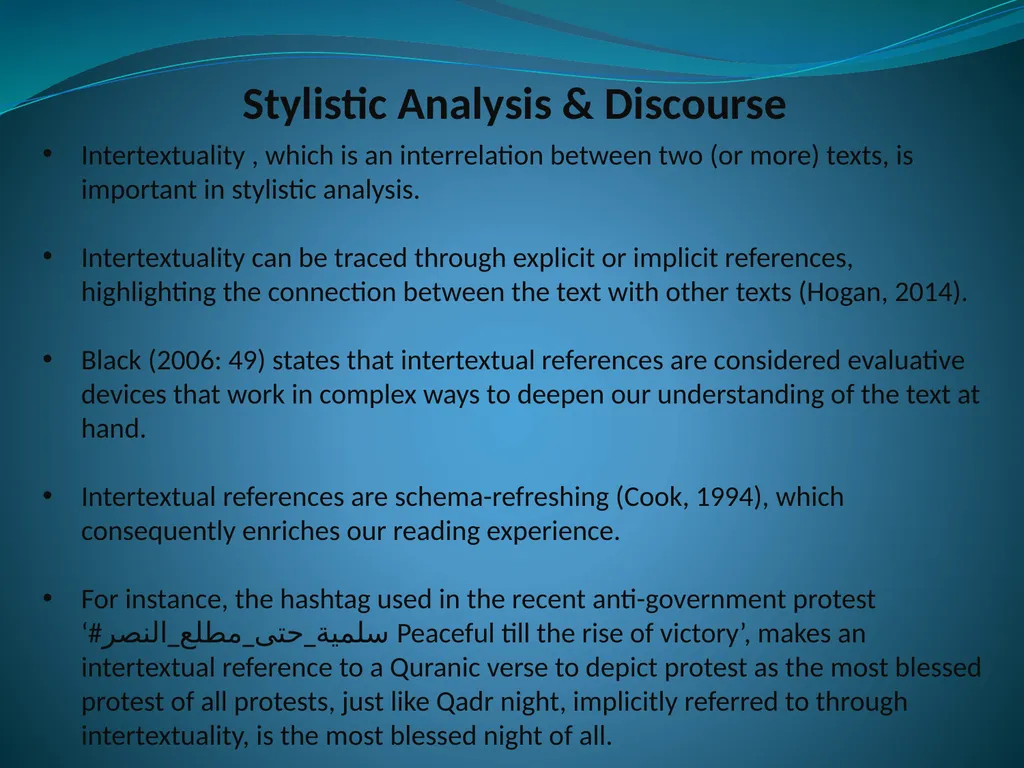
slide15. Stylistic Analysis & Discourse Intertextuality , which is an interrelation between two (or more) texts, is important in stylistic analysis.
Intertextuality can be traced through explicit or implicit references, highlighting the connection between the text with other texts (Hogan, 2014).
Black (2006: 49) states that intertextual references are considered evaluative devices that work in complex ways to deepen our understanding of the text at hand.
Intertextual references are schema-refreshing (Cook, 1994), which consequently enriches our reading experience.
For instance, the hashtag used in the recent anti-government protest ‘#سلمية_حتى_مطلع_النصر Peaceful till the rise of victory’, makes an intertextual reference to a Quranic verse to depict protest as the most blessed protest of all protests, just like Qadr night, implicitly referred to through intertextuality, is the most blessed night of all.<br>
slide16. Stylistic Analysis & Discourse Interdiscursivity involves explicit or implicit connection to other discourses and the activities and interactional practices associated with these discourses (Fairclough, 2003).
Interdiscursivity may defamiliarize texts, maximizing their stylistic effect and its persuasive load.
For instance, interdiscursivity can be found in the advertisements or political slogans in which the hashtag symbols (#) is used, even though the use of this symbol is associated with online discourse, rather than offline ones.<br>
slide17. References Burgers, C., Konijn, E.A. and Steen, G.J. (2016) Figurative framing: Shaping public discourse through metaphor, hyperbole, and irony. Communication Theory, 26(4), pp.410-430.
Cook, G. (1994). Discourse and Literature: The Interplay of Form and Mind. Oxford: Oxford University Press.
Culpeper, J. (2001) Language and characterisation: People in plays and other texts. London: Longman.
Fairclough, Norman. (2003) Analysing Discourse - textual research for social research. New York: Routledge .
Gibbons, A. & Whiteley, S. (2018) Contemporary Stylistics: Language, Cognition and Interpretation. Edinburgh: Edinburgh University Press.
Halliday, M. A. K. (1971), ‘Linguistic function and literary style: An inquiry into the language of William Golding’s The Inheritors’, in D. C. Freeman (ed.) (1981), Essays in Modern Stylistics. London and New York: Methuen.
Hogan, P. C. (2014) Intertextuality and Allusion. In Stockwell, p. & Whiteley, S. (Eds.) The Cambridge Handbook of Stylistics. Cambridge: Cambridge University Press.
Izadi, A. (2016) Over-politeness in Persian professional interactions. Journal of Pragmatics, 102, (1)13-23.
Lambrou, CM (2014) Stylistics, Conversation Analysis and the Cooperative Principles. In Burke, M. (Ed.) The Routledge Handbook of Stylistics. London: Routledge.
Paternoster, A. (2012) Inappropriate inspectors: Impoliteness and overpoliteness . In Ian Rankin’s and Andrea Camilleri’s crime series. Language and Literature, 21: 311–24.
Wales, K. (2011) A Dictionary of Stylistics. London: Routledge.
ZIDANE, R. (2017) THE EXPLOITATION OF PRAGMATIC DEVIATION IN LITERARY DISCOURSE. Ulakbilge Sosyal Bilimler Dergisi, 5(11), pp.507-531.<br>
slide2. Overview Stylistic Analysis & Semantics
Stylistic Analysis & Pragmatics
Stylistic Analysis & Discourse<br>
slide3. Stylistic Analysis & Semantics At the semantic level, stylisticians are interested in how different semantic units encode meaning and how these units are linked together to form propositions.
Simpson (2004: 22) points out that the Halliday’s system of transitivity can be used to account for how ideational meaning, i.e. experiences, is encoded in language.
Unlike in traditional grammar, transitivity, here, is used in a broader semantic sense to refer to the way meanings are encoded in the clause and to the way different types of semantic ideational elements (i.e. participants, processes and circumstances) are represented in language (Halliday, 1971).<br>
slide4. Stylistic Analysis & Semantics In stylistic analysis, semantic foregrounding can be triggered by means of deviating sematic norms and repeating a semantic unit.
Short (1996: 43) defines semantic deviation as paradoxical or logically inconsistent meaning relations.
According to short’s (1996) argument , both metaphor and metonymy are considered types of semantic deviation.
Both Wales (2013: 37) and Burke (2014: 1) point out that unusual use of metonymy, metaphors or simile deviates some lexical norms and semantic regularities.<br>
slide5. Stylistic Analysis & Semantics Metaphor is a mapping process between two different lexical units belonging to two different conceptual domains.
Thus, metaphor involves a transfer from one conceptual domain to another to create some poetic effect.
In metaphor, the different domains are referred to as the ‘target domain’ and the ‘source domain’. “The target domain is the topic or concept that you want to describe through the metaphor while the source domain refers to the concept that you draw upon in order to create the metaphorical construction” (Simpson, 2004: 41).
Consider Emily Dickinson's poetic line “’Hope’ is the thing with feathers.
From a lexicogrammatical perspective, metaphor often used as predication strategy to provide an artistic description to processes and participants.<br>
slide6. Stylistic Analysis & Semantics Metonymy (as well as synecdoche) is a mapping process between different expressions both belonging to the same conceptual domain.
Thus, metonymy (as well as synecdoche) is “based on a transfer within a single conceptual domain” (Simpson, 2004: 43).
Consider the example: The White house released a statement yesterday.
From a lexicogrammatical perspective, metonymy is often used as a referential strategy to point to participants in an artistic way.<br>
slide7. Stylistic Analysis & Semantics The other type of semantic foregrounding is semantic repetition.
semantic repetition involves repeating certain semantic units to create poetic effects.
In Robert Burns’ poem ‘Red Red Rose’, the title itself involves a lexical repetition. This repetition is used to emphasize the brightness and vividness of the rose color.
In this poem, the phrases “my luv” and “my dear” are also used repetitively to emphasize the love that the persona of the poem has for his lover.
Semantic repetition can also be used to serve particular narrative depiction.
For instance, as shown by Gibbons and Whiteley (2018: 22-3), the novelist Lee Rourke employed semantic repetition in his novel ‘The Canal’ in order to indicate how office work is composed of monotonous routines.<br>
slide8. Stylistic Analysis & Semantics Tautology is a special type of semantic foregrounding, which Simpson (2004: 58) describes as a “semantic anomaly”.
Tautology is an ostensibly redundant statement in which an expression is repeated, as in ‘war is war’.
This type of foregrounding involves the use of both deviation and repetition.
A tautology replicates the basic premise of the proposition, and in doing so it deviates from the expected semantic norm of producing a logically meaningful proposition.
Simpson (2004: 57) asserts that many of E.E. Cummings’ “comparative and superlative structures are full-blown logical tautologies”, as in the lines:
‘the sea is . . . deeper than the sea’
‘the sky is . . . higher than the sky’.<br>
slide9. Stylistic Analysis & Pragmatics Pragmatically triggered foregrounding always involves irregularity, i.e. deviation from an expected pragmatic norms, rather than overregularity, i.e. repetition.
One form of pragmatic deviation is over-politeness and impoliteness which both involve deviating from generally expected verbal and social behaviors in a given context.
Over-politeness is defined as “behavior which is evaluated as too polite for the context” (Izadi, 2010: 13). In this sense, over-politeness violates the level of politeness appropriate for the context of use.
Over-politeness is used to renegotiate social relations between characters.
Paternoster (2012) investigates how impoliteness and over-politeness can be used in the fictional dialogues of crime novels to communicate attitudes and social relationships.<br>
slide10. Stylistic Analysis & Pragmatics Impoliteness can be used by novelists and playwrights as an “implicit characterization cue” (Culpeper, 2001 ) to portray social relations between different fictional characters in literary texts (Bousfield, 2014).
Chapman (2015) discusses how “changes in strategies of politeness or impoliteness might reflect on character development and on dramatic tension”.
For instance, and as shown by (Zidane, 2017), in Austen’s ‘Pride and Prejudice’ the character Lady Catherine resort to impoliteness to scold Elizabeth Bennet. This impoliteness exhibits the tense relation between these two characters and reveals their attitudes towards each other.
“Obstinate, headstrong girl! I am ashamed of you! Is this your gratitude for my attentions to you last spring? Is nothing due to me on that score?”<br>
slide11. Stylistic Analysis & Pragmatics Irrelevance constitutes the third type of pragmatic deviation, in which an expected communicative collaboration is violated.
Irrelevance can be employed strategically by novelists and playwrights to provide profound insights into their characters’ states , “particularly if the character has a condition that affects how they interact and socialize with others” (Lambrou, 2014: 146).
Lambrou (2014: 146) shows how irrelevance is apparent foregrounding technique in the narrative style of the fifteen-year-old autistic protagonist, Christopher Boone, in Mark Haddon’s ‘The Curious Incident of the Dog in the Night-Time’.
Irrelevance can also be employed to “reveal characters’ disrespect, boredom or inattentiveness”, as exhibited in the dialogue between Dobbin and Mr. Cuff in Thackeray’s Vanity Fair (Zidane, 2017: 514).<br>
slide12. Stylistic Analysis & Pragmatics The forth type of pragmatic deviation is verbal irony.
Verbal irony is based on a disparity between of what is said and its context of use (Black, 2006: 110), or between what is said and what is meant (Simpson, 2004: 46).
An ironic expression flouts Grice’s maxim of quality, as it contradicts the literal meaning of the utterance (Burgers et al., 2016: 417).
Black (20006: 111) points out that Cope’s ‘Engineer’s Corner’ is an instance of an ironic poem which says the opposite of what it means.
We make more fuss of ballads than of blueprints –
That’s why so many poets end up rich.
While engineers scrape by in cheerless garrets.
Who needs a bridge or dam? Who needs a ditch?<br>
slide13. Stylistic Analysis & Pragmatics From a relevance theoretical perspective, irony is conceptualized as echoing other utterances’ in new contexts to index disaffiliative evaluation of the echoed utterance (Simpson, 2004: 101; Black, 2006: 112).
An example of echoing that triggers irony can be found in the first sentence of Jane Austen’s ‘Pride and Prejudice’:
‘It is a truth universally acknowledged that a single man in possession of a good fortune must be in want of a wife’.
However, through the course of the novel, it becomes clear that this is not endorsed by the narrator. This statement is simply echoed to communicate an disaffiliative opinion.<br>
slide14. Stylistic Analysis & Discourse At the discourse level, stylisticians may be interested in analyzing the discourse structures, speech & thought representation, the use of different linguistic varieties, and the connection of the text with other texts and discourses.
Leech and Short (2003) introduce typologies for the possible ways of thought and speech representation in fictional texts, highlighting the function of each possible representation.
The Russian critic Bakhtin introduced the concept of heteroglossia and that of polyphony to describe the how the use of different linguistic varieties in novel gives rise to different social and ideological voices, which can be manipulated by the novelist for artistic effect (Scott, 2014: 426).
Heteroglossia allows the novelist to create dialogues and/or conflicts between different ideologies and social groups through the characters’ interactions with each other.<br>
slide15. Stylistic Analysis & Discourse Intertextuality , which is an interrelation between two (or more) texts, is important in stylistic analysis.
Intertextuality can be traced through explicit or implicit references, highlighting the connection between the text with other texts (Hogan, 2014).
Black (2006: 49) states that intertextual references are considered evaluative devices that work in complex ways to deepen our understanding of the text at hand.
Intertextual references are schema-refreshing (Cook, 1994), which consequently enriches our reading experience.
For instance, the hashtag used in the recent anti-government protest ‘#سلمية_حتى_مطلع_النصر Peaceful till the rise of victory’, makes an intertextual reference to a Quranic verse to depict protest as the most blessed protest of all protests, just like Qadr night, implicitly referred to through intertextuality, is the most blessed night of all.<br>
slide16. Stylistic Analysis & Discourse Interdiscursivity involves explicit or implicit connection to other discourses and the activities and interactional practices associated with these discourses (Fairclough, 2003).
Interdiscursivity may defamiliarize texts, maximizing their stylistic effect and its persuasive load.
For instance, interdiscursivity can be found in the advertisements or political slogans in which the hashtag symbols (#) is used, even though the use of this symbol is associated with online discourse, rather than offline ones.<br>
slide17. References Burgers, C., Konijn, E.A. and Steen, G.J. (2016) Figurative framing: Shaping public discourse through metaphor, hyperbole, and irony. Communication Theory, 26(4), pp.410-430.
Cook, G. (1994). Discourse and Literature: The Interplay of Form and Mind. Oxford: Oxford University Press.
Culpeper, J. (2001) Language and characterisation: People in plays and other texts. London: Longman.
Fairclough, Norman. (2003) Analysing Discourse - textual research for social research. New York: Routledge .
Gibbons, A. & Whiteley, S. (2018) Contemporary Stylistics: Language, Cognition and Interpretation. Edinburgh: Edinburgh University Press.
Halliday, M. A. K. (1971), ‘Linguistic function and literary style: An inquiry into the language of William Golding’s The Inheritors’, in D. C. Freeman (ed.) (1981), Essays in Modern Stylistics. London and New York: Methuen.
Hogan, P. C. (2014) Intertextuality and Allusion. In Stockwell, p. & Whiteley, S. (Eds.) The Cambridge Handbook of Stylistics. Cambridge: Cambridge University Press.
Izadi, A. (2016) Over-politeness in Persian professional interactions. Journal of Pragmatics, 102, (1)13-23.
Lambrou, CM (2014) Stylistics, Conversation Analysis and the Cooperative Principles. In Burke, M. (Ed.) The Routledge Handbook of Stylistics. London: Routledge.
Paternoster, A. (2012) Inappropriate inspectors: Impoliteness and overpoliteness . In Ian Rankin’s and Andrea Camilleri’s crime series. Language and Literature, 21: 311–24.
Wales, K. (2011) A Dictionary of Stylistics. London: Routledge.
ZIDANE, R. (2017) THE EXPLOITATION OF PRAGMATIC DEVIATION IN LITERARY DISCOURSE. Ulakbilge Sosyal Bilimler Dergisi, 5(11), pp.507-531.<br>