Dont Be A Search Engine Optimist By: Angela Bergmann So what is SEO? SEO is short for Search Engine Optimization. What does this mean? According to Wikipedia, SEO is: Search engine optimization (SEO) is the process of affecting the
"Don’t Be A Search Engine Optimist By: Angela" is the property of its rightful owner. Permission is granted to
download and print the materials on this website for personal, non-commercial use only, and to display it
on your personal computer provided you do not modify the materials and that you retain all copyright
notices contained in the materials. By downloading content from our website, you accept the terms of this
agreement.
Presentation Transcript
01
Don’t Be A Search Engine Optimist By: Angela Bergmann<br>
02
So what is SEO? SEO is short for Search Engine Optimization.
What does this mean?
According to Wikipedia, SEO is:
“Search engine optimization (SEO) is the process of affecting the visibility of a website or a web page in a search engine's unpaid results - often referred to as "natural," "organic," or "earned" results.”<br>
03
And That’s Important To Me Because? SEO isn’t just about search engines.
It involves:
Content
Design
Coding
Social Media
Bottom line, keep in mind that people won’t find you if search engines can’t index your website!<br>
04
Snake Oil? Here’s the best part!
You may have heard that SEO is hard. There are certainly technical issues, with which professionals can greatly assist.
However!
There are plenty of basics you can master, and their application will make a valuable difference on your website.<br>
05
A Blog? But Why?! A blog is not a must, but it is a should. The entire point of your website is to establish yourself as an expert in your field/service/product. One way to do that is to blog about it.
First, search engines give weight to websites that are frequently updated with relevant content.
They also give weight to visitors coming back and sharing that content.
There is no better way to create that engagement than to blog.<br>
06
But What About That Other Stuff? Design, Coding, and Social Media are where WordPress becomes a key asset to your SEO strategy.
If you are using WordPress for your website…
If you are using a newer theme you found through the Theme Repository…
If you have a social sharing plugin installed like Jetpack's Publicize…
You’ve already tackled the majority of this.
If you haven’t yet, do it!<br>
07
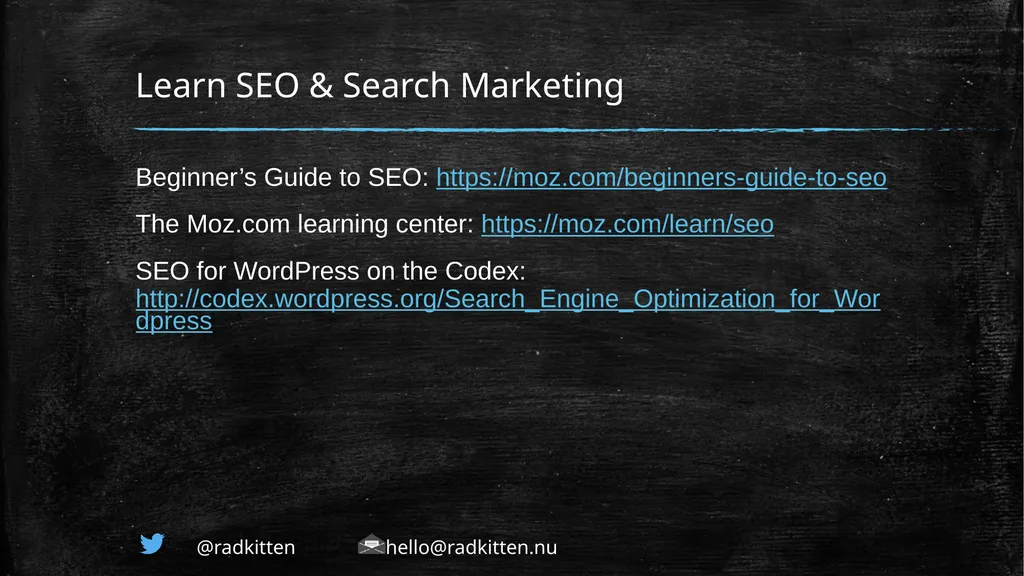
Learn SEO & Search Marketing Beginner’s Guide to SEO: https://moz.com/beginners-guide-to-seo
The Moz.com learning center: https://moz.com/learn/seo
SEO for WordPress on the Codex: http://codex.wordpress.org/Search_Engine_Optimization_for_Wordpress<br>
08
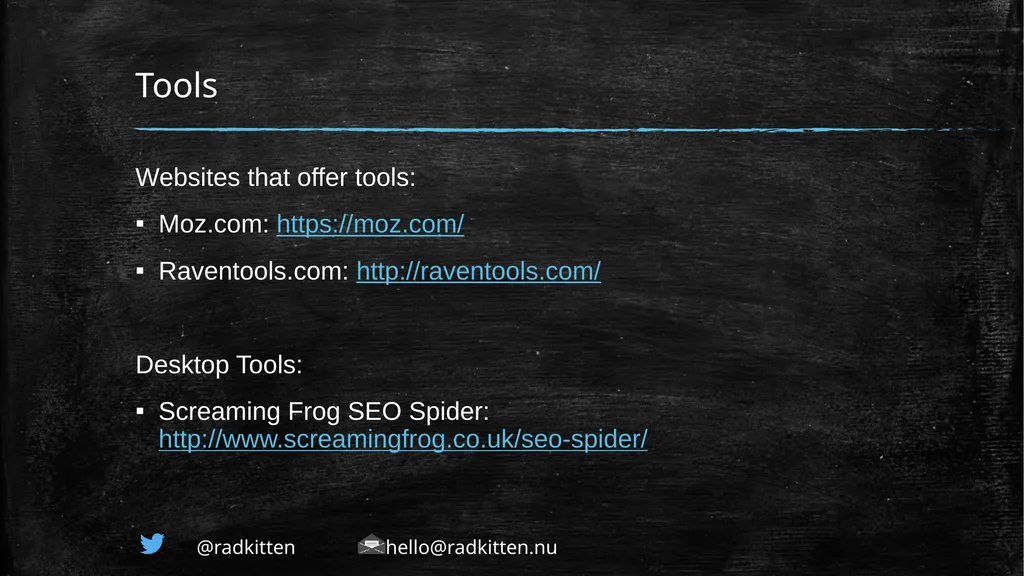
Tools Websites that offer tools:
Moz.com: https://moz.com/
Raventools.com: http://raventools.com/
Desktop Tools:
Screaming Frog SEO Spider: http://www.screamingfrog.co.uk/seo-spider/<br>
09
Stats Google Analytics:
http://www.google.com/analytics/
Google Webmaster Tools: https://www.google.com/webmasters/tools/home?hl=en
Bing Webmaster Tools:
http://www.bing.com/toolbox/webmaster<br>
10
In Conclusion Remember, SEO is important.
Don't be a Search Engine Optimist - someone that just hopes for the best<br>