Double and Triple DES Double DES(2DES) Introduction A cryptographic algorithm that applies the Data Encryption Standard (DES) encryption process twice. Double DES is an encryption approach which uses two example of DES on same plain text.
"Double and Triple DES Double DES(2DES)" is the property of its rightful owner. Permission is granted to
download and print the materials on this website for personal, non-commercial use only, and to display it
on your personal computer provided you do not modify the materials and that you retain all copyright
notices contained in the materials. By downloading content from our website, you accept the terms of this
agreement.
Presentation Transcript
01
Double and Triple DES<br>
02
Double DES(2DES) Introduction A cryptographic algorithm that applies the Data Encryption Standard (DES) encryption process twice.
Double DES is an encryption approach which uses two example of DES on same plain text. In both examples it provides different keys to encode the plain text.<br>
03
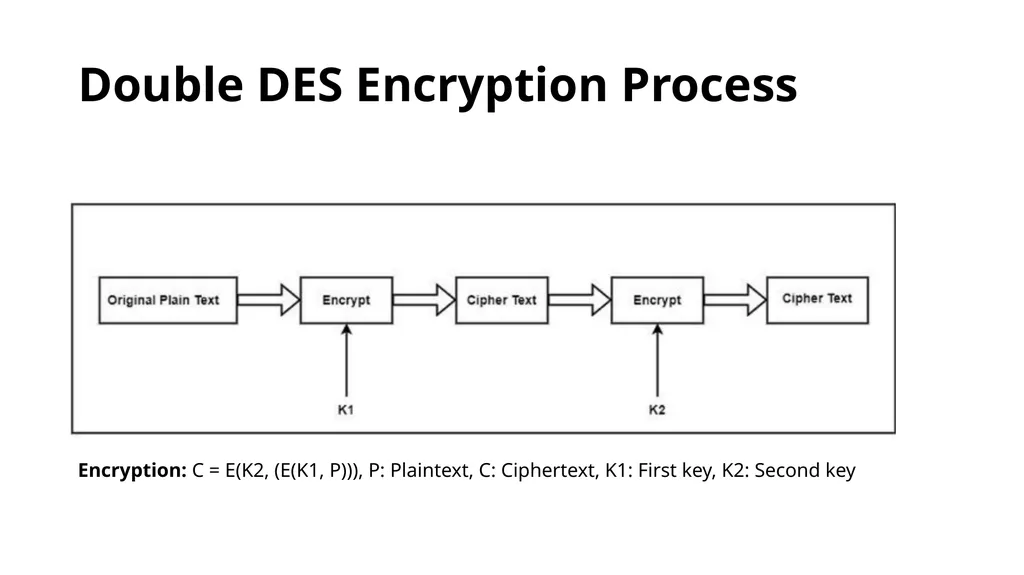
Double DES Encryption Process Encryption: C = E(K2, (E(K1, P))), P: Plaintext, C: Ciphertext, K1: First key, K2: Second key<br>
04
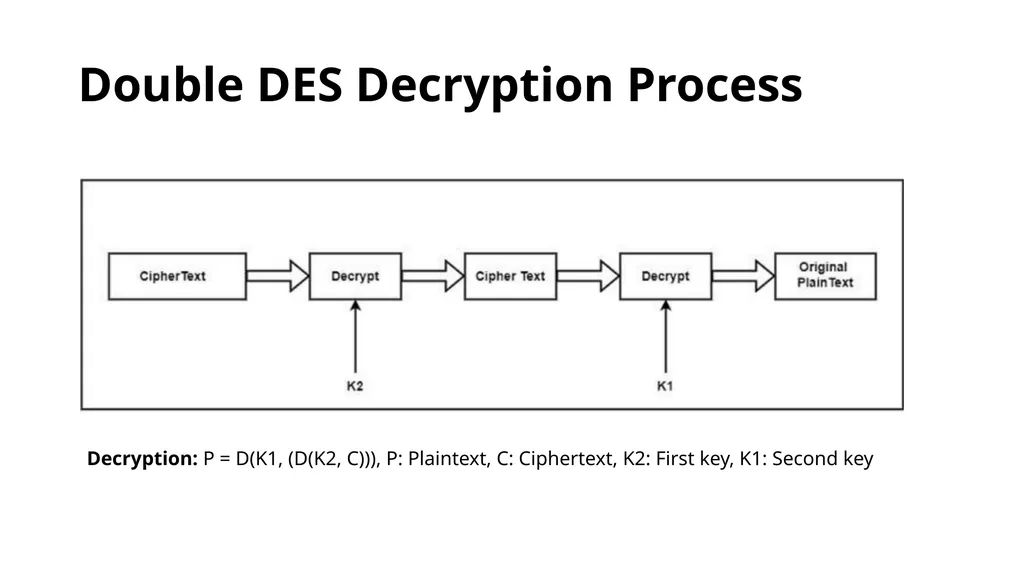
Double DES Decryption Process Decryption: P = D(K1, (D(K2, C))), P: Plaintext, C: Ciphertext, K2: First key, K1: Second key<br>
05
Key Space in Double DES Total key space: 22n where n is the key size in bits.
Example: With 56-bit keys, the total key space is 2112 .<br>
06
Meet-in-the-Middle Attack Overview The Meet-in-the-Middle attack, is a chosen plaintext attack, which means the attacker deliberately chooses certain Plaintext-Ciphertext pairs to analyse and exploit weaknesses in the encryption scheme.
It's important to understand that in a real-world scenario, an attacker might not have access to the exact plaintext and ciphertext pair but could infer patterns or characteristics of the plaintext based on the context or known data.
Meet-in-the-Middle attacks are particularly useful when dealing with multiple rounds of encryption, as in the case of Double DES.
The attack takes advantage of the fact that the attacker knows the outcome of the intermediate encryption and decryption steps, allowing them to identify potential key pairs more efficiently than a brute-force search.<br>
07
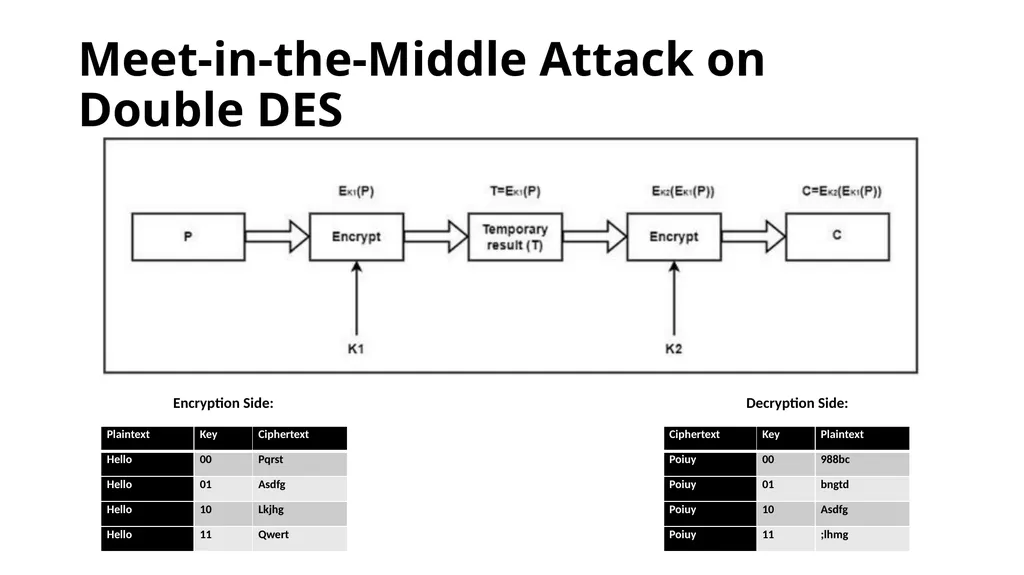
Meet-in-the-Middle Attack on Double DES The attacker, knowing a plaintext and its corresponding ciphertext (P and C), performs a precomputation step.
The attacker encrypts the plaintext P with all possible values of K1, storing the intermediate results in a table (T1):
T1 = {E(K1, P) for all K1}
Similarly, the attacker decrypts the known ciphertext C with all possible values of K2, storing the results in another table (T2):
T2 = {D(K2, C) for all K2}<br>
08
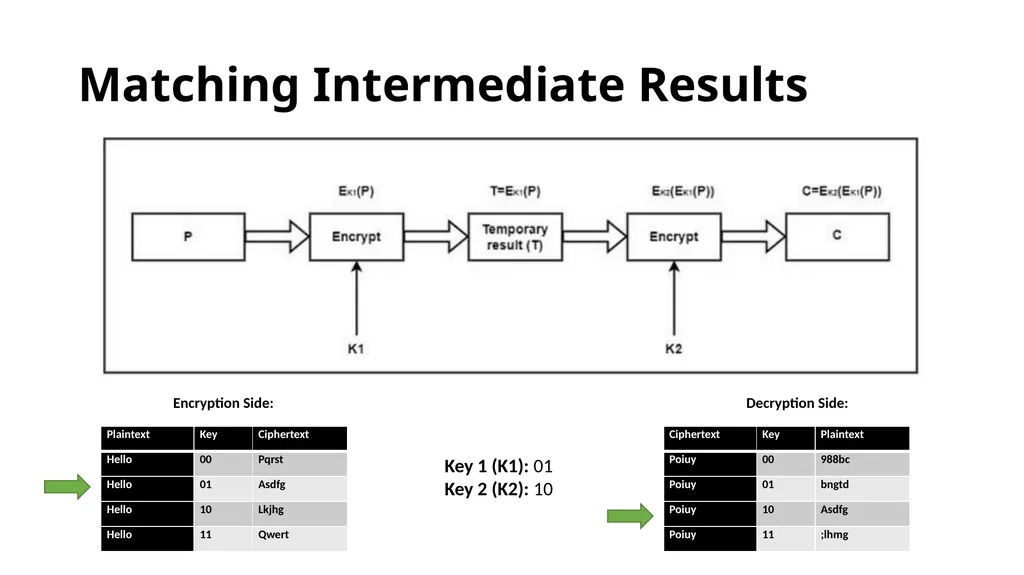
Meet-in-the-Middle Attack on Double DES Encryption Side: Decryption Side:<br>
09
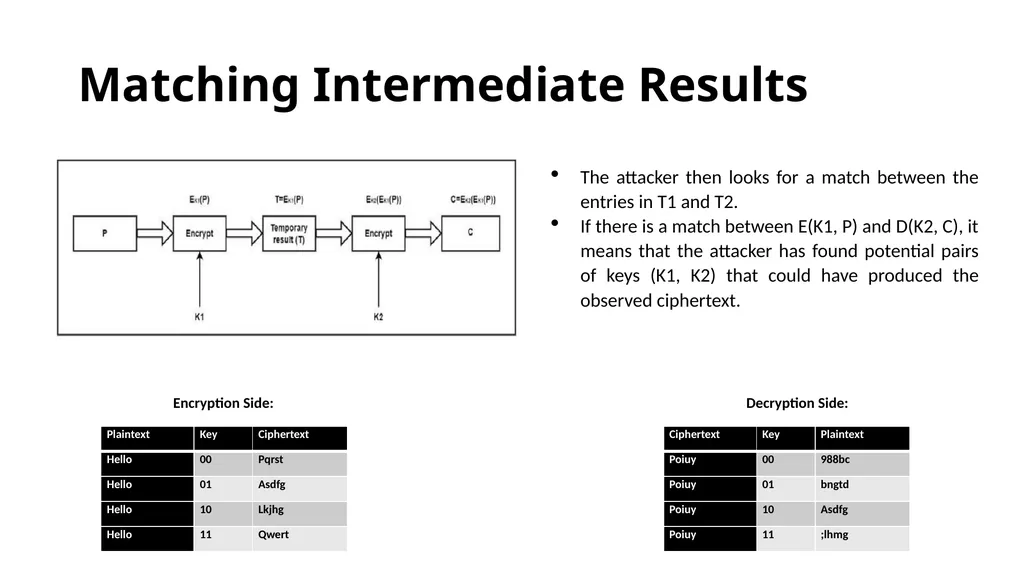
Matching Intermediate Results Encryption Side: Decryption Side: The attacker then looks for a match between the entries in T1 and T2.
If there is a match between E(K1, P) and D(K2, C), it means that the attacker has found potential pairs of keys (K1, K2) that could have produced the observed ciphertext.<br>
Decrypting with Potential Keys The attacker can then try decrypting the ciphertext with each potential key pair (K1, K2) until the original plaintext is obtained.
The correct key pair will yield the original plaintext, allowing the attacker to recover the encryption keys used in the Double DES process.<br>
12
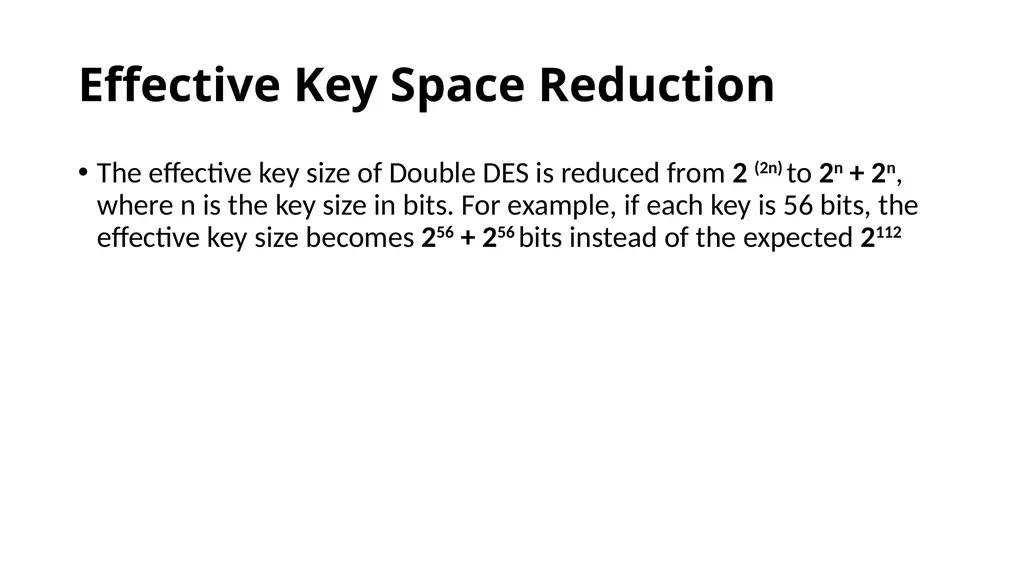
Effective Key Space Reduction The effective key size of Double DES is reduced from 2 (2n) to 2n + 2n, where n is the key size in bits. For example, if each key is 56 bits, the effective key size becomes 256 + 256 bits instead of the expected 2112<br>
13
Triple DES (3DES) Introduction The speed of exhaustive key searches against DES after 1990 began to cause discomfort amongst users of DES. However, users did not want to replace DES as it takes an enormous amount of time and money to change encryption algorithms that are widely adopted and embedded in large security architectures.
The pragmatic approach was not to abandon the DES completely, but to change the manner in which DES is used.
This led to the modified schemes of Triple DES (sometimes known as 3DES).
Incidentally, there are two variants of Triple DES known as:
3-key Triple DES (3TDES) and 2-key Triple DES (2TDES).<br>
14
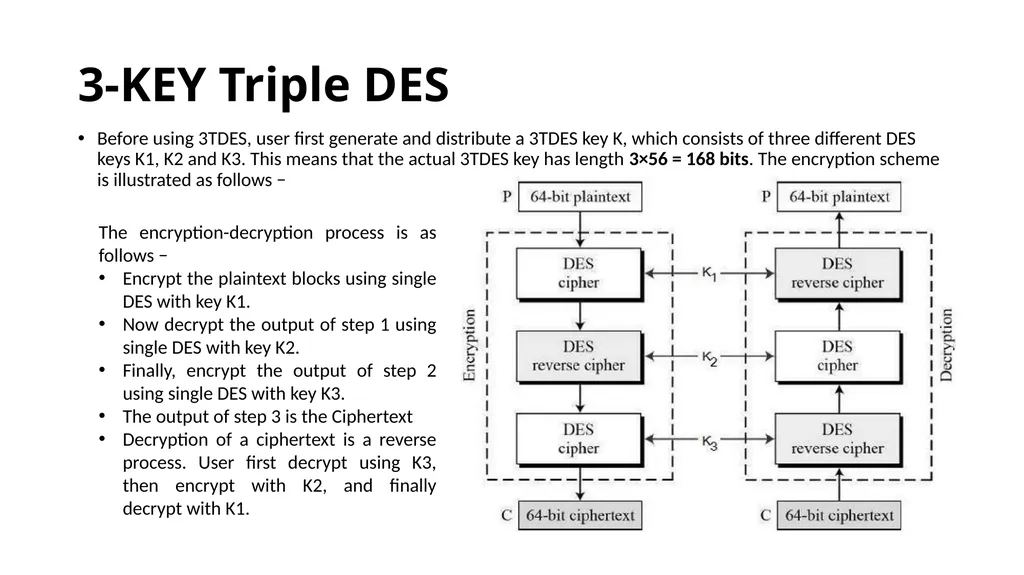
3-KEY Triple DES Before using 3TDES, user first generate and distribute a 3TDES key K, which consists of three different DES keys K1, K2 and K3. This means that the actual 3TDES key has length 3×56 = 168 bits. The encryption scheme is illustrated as follows − The encryption-decryption process is as follows −
Encrypt the plaintext blocks using single DES with key K1.
Now decrypt the output of step 1 using single DES with key K2.
Finally, encrypt the output of step 2 using single DES with key K3.
The output of step 3 is the Ciphertext
Decryption of a ciphertext is a reverse process. User first decrypt using K3, then encrypt with K2, and finally decrypt with K1.<br>
15
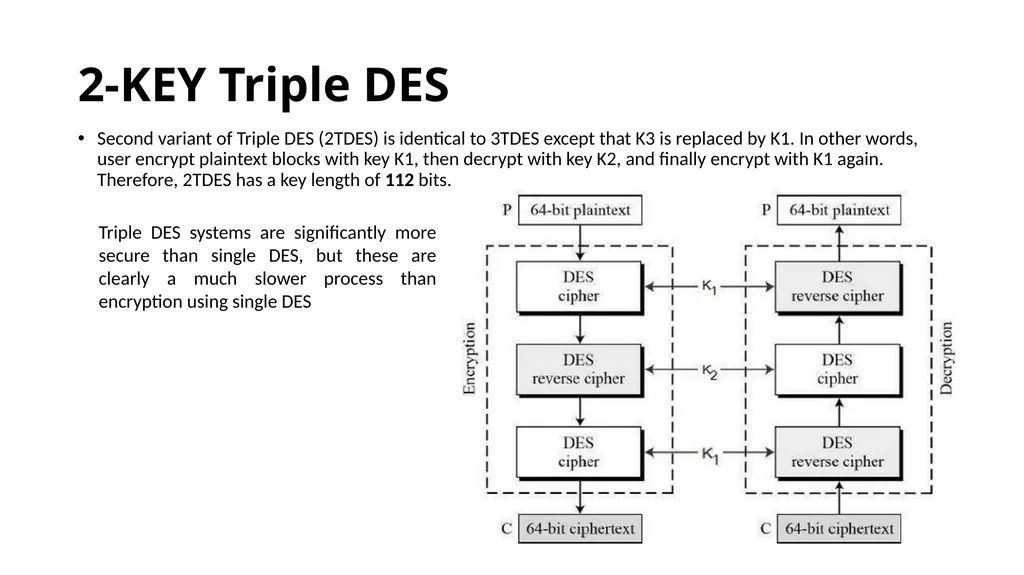
2-KEY Triple DES Second variant of Triple DES (2TDES) is identical to 3TDES except that K3 is replaced by K1. In other words, user encrypt plaintext blocks with key K1, then decrypt with key K2, and finally encrypt with K1 again. Therefore, 2TDES has a key length of 112 bits. Triple DES systems are significantly more secure than single DES, but these are clearly a much slower process than encryption using single DES<br>
16
Conclusion It's important to note that Double DES is no longer considered secure due to its vulnerability to Meet-in-the-Middle attacks. This is one of the reasons why modern cryptographic standards, such as Triple DES or AES, are recommended for secure encryption.
Triple DES uses three keys and encrypts the plaintext three times, providing a higher level of security compared to Double DES.<br>