
Dr Abdou GUERO Technical director, Niger basin
Description: Dr Abdou GUERO Technical director, Niger basin Authority (NBA) CLIMATE FINANCING FOR WATER AND TRANSBOUNDARY COOPERATION EXPERIENCE OF THE NIGER BASIN Panel discussion: Meeting the climate challenge 1. OPPORTUNITIES AND CHALLENGES RELATED
Related Topics
Download Presentation
"Dr Abdou GUERO Technical director, Niger basin" is the property of its rightful owner. Permission is granted to download and print the materials on this website for personal, non-commercial use only, and to display it on your personal computer provided you do not modify the materials and that you retain all copyright notices contained in the materials. By downloading content from our website, you accept the terms of this agreement.
Presentation Transcript
slide1. Dr Abdou GUERO
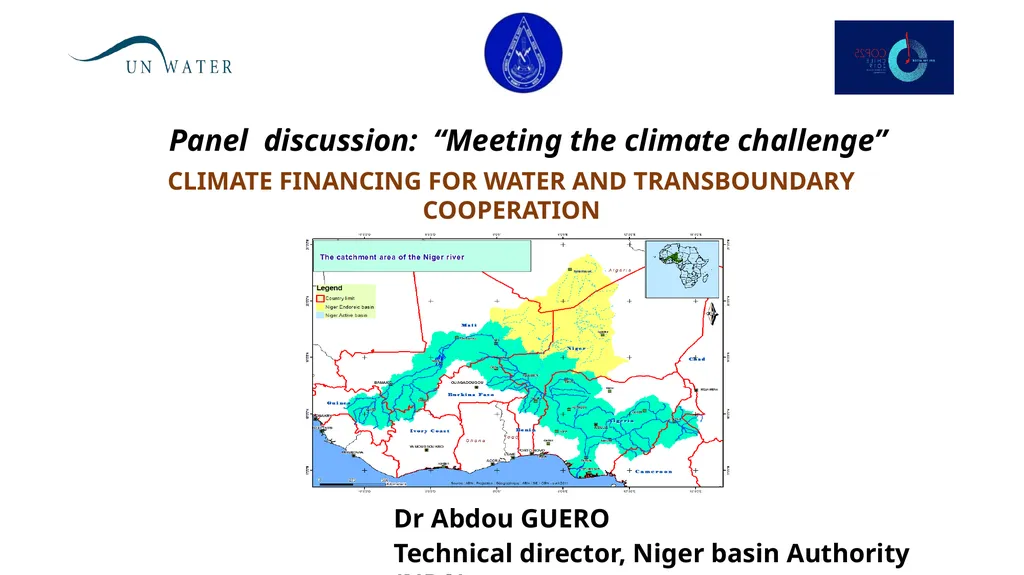
Technical director, Niger basin Authority (NBA) CLIMATE FINANCING FOR WATER AND TRANSBOUNDARY COOPERATION
EXPERIENCE OF THE NIGER BASIN Panel discussion: “Meeting the climate challenge”<br>
slide2. 1. OPPORTUNITIES AND CHALLENGES RELATED TO THE MOBILIZATION OF CLIMATE FUNDS FOR JOINT ACTIONS IN TRANSBOUNDARY BASINS OPPORTUNITIES
Mobilization of the International Community on Climate through the Paris Agreement, including through developed countries’ commitment to provide at least $ 100 billion per year between 2020 and 2025, from public and private sources, for mitigation and adaptation projects.
Commitments of RBOs’ Member Countries within the framework of the Paris Agreement, and willingness to pool means through climate investment priority plans and programs of cooperation institutions (NBA, G5-Sahel, LCBC, etc) to allow coordination of actions and avoid mis-adaptation at basin scale.
Commitment to countries of financial institutions and the United Nations system to facilitate funding to support climate resilience actions.
Possibility for RBOs to mobilize regional funds (often not accessible to countries) for adaptation measures at basin scale.<br>
slide3. CHALLENGES
Fulfilment of countries commitments (Contribution of each country and public or private funding sources).
Capacities of countries and RBOs to develop and implement relevant operational projects and programs required to mobilize funding announced by financial partners.
Development and implementation of legal frameworks required for transboundary cooperation;
Reduction of operational projects and programmes preparation duration (often too long due to weak countries capacity and donors procedures) 1. OPPORTUNITIES AND CHALLENGES RELATED TO THE MOBILIZATION OF CLIMATE FUNDS FOR JOINT ACTIONS IN TRANSBOUNDARY BASINS<br>
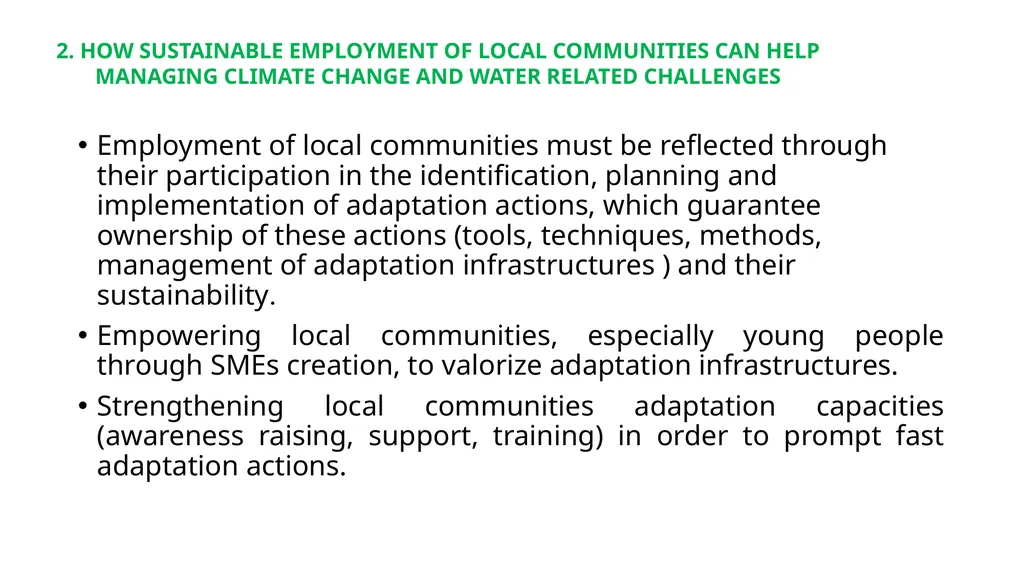
slide4. Employment of local communities must be reflected through their participation in the identification, planning and implementation of adaptation actions, which guarantee ownership of these actions (tools, techniques, methods, management of adaptation infrastructures ) and their sustainability.
Empowering local communities, especially young people through SMEs creation, to valorize adaptation infrastructures.
Strengthening local communities adaptation capacities (awareness raising, support, training) in order to prompt fast adaptation actions. 2. HOW SUSTAINABLE EMPLOYMENT OF LOCAL COMMUNITIES CAN HELP
MANAGING CLIMATE CHANGE AND WATER RELATED CHALLENGES<br>
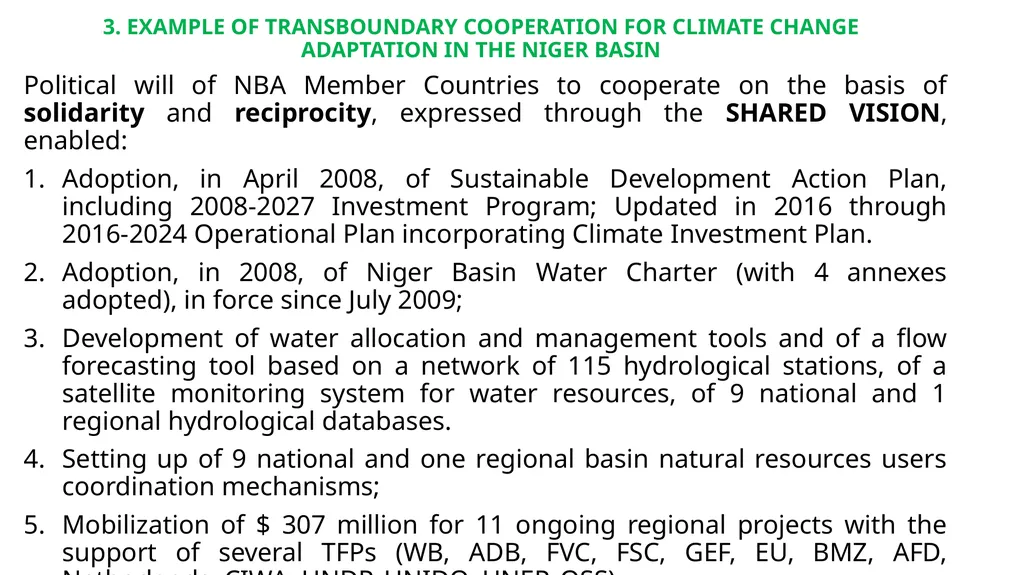
slide5. Political will of NBA Member Countries to cooperate on the basis of solidarity and reciprocity, expressed through the SHARED VISION, enabled:
Adoption, in April 2008, of Sustainable Development Action Plan, including 2008-2027 Investment Program; Updated in 2016 through 2016-2024 Operational Plan incorporating Climate Investment Plan.
Adoption, in 2008, of Niger Basin Water Charter (with 4 annexes adopted), in force since July 2009;
Development of water allocation and management tools and of a flow forecasting tool based on a network of 115 hydrological stations, of a satellite monitoring system for water resources, of 9 national and 1 regional hydrological databases.
Setting up of 9 national and one regional basin natural resources users coordination mechanisms;
Mobilization of $ 307 million for 11 ongoing regional projects with the support of several TFPs (WB, ADB, FVC, FSC, GEF, EU, BMZ, AFD, Netherlands, CIWA, UNDP, UNIDO, UNEP, OSS). 3. EXAMPLE OF TRANSBOUNDARY COOPERATION FOR CLIMATE CHANGE ADAPTATION IN THE NIGER BASIN<br>
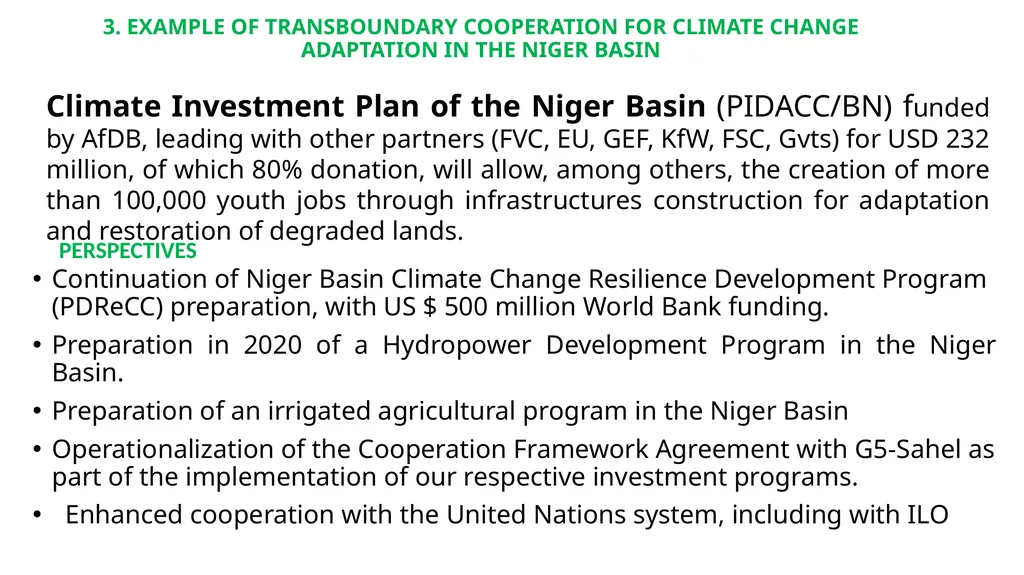
slide6. Climate Investment Plan of the Niger Basin (PIDACC/BN) funded by AfDB, leading with other partners (FVC, EU, GEF, KfW, FSC, Gvts) for USD 232 million, of which 80% donation, will allow, among others, the creation of more than 100,000 youth jobs through infrastructures construction for adaptation and restoration of degraded lands. Continuation of Niger Basin Climate Change Resilience Development Program (PDReCC) preparation, with US $ 500 million World Bank funding.
Preparation in 2020 of a Hydropower Development Program in the Niger Basin.
Preparation of an irrigated agricultural program in the Niger Basin
Operationalization of the Cooperation Framework Agreement with G5-Sahel as part of the implementation of our respective investment programs.
Enhanced cooperation with the United Nations system, including with ILO PERSPECTIVES 3. EXAMPLE OF TRANSBOUNDARY COOPERATION FOR CLIMATE CHANGE ADAPTATION IN THE NIGER BASIN<br>
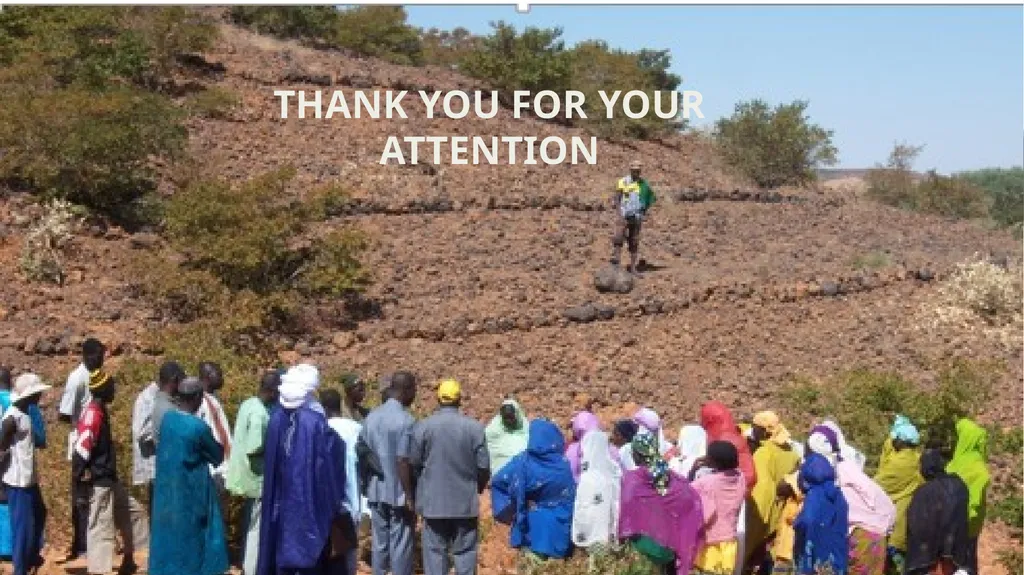
slide7. THANK YOU FOR YOUR ATTENTION<br>
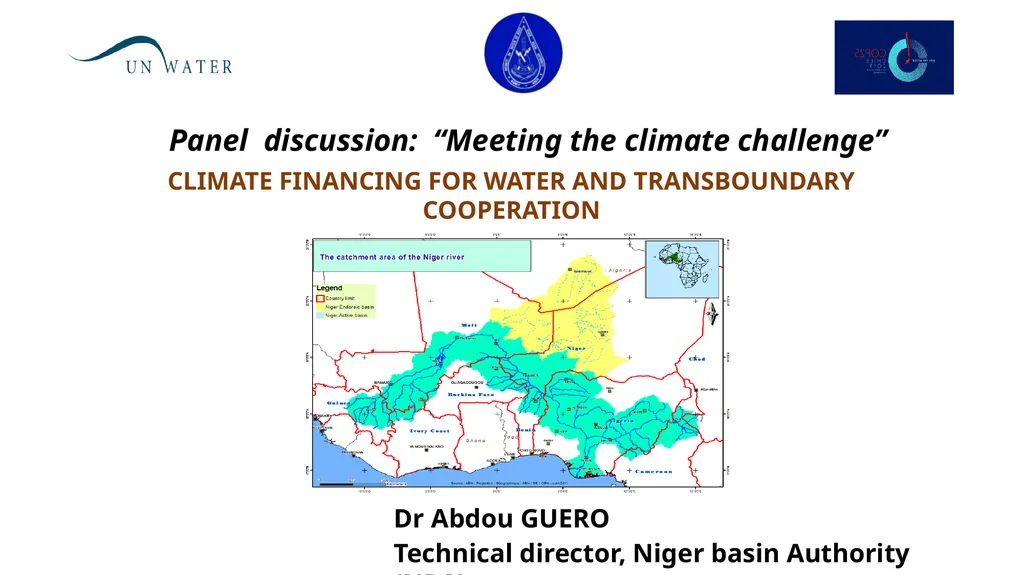
Technical director, Niger basin Authority (NBA) CLIMATE FINANCING FOR WATER AND TRANSBOUNDARY COOPERATION
EXPERIENCE OF THE NIGER BASIN Panel discussion: “Meeting the climate challenge”<br>
slide2. 1. OPPORTUNITIES AND CHALLENGES RELATED TO THE MOBILIZATION OF CLIMATE FUNDS FOR JOINT ACTIONS IN TRANSBOUNDARY BASINS OPPORTUNITIES
Mobilization of the International Community on Climate through the Paris Agreement, including through developed countries’ commitment to provide at least $ 100 billion per year between 2020 and 2025, from public and private sources, for mitigation and adaptation projects.
Commitments of RBOs’ Member Countries within the framework of the Paris Agreement, and willingness to pool means through climate investment priority plans and programs of cooperation institutions (NBA, G5-Sahel, LCBC, etc) to allow coordination of actions and avoid mis-adaptation at basin scale.
Commitment to countries of financial institutions and the United Nations system to facilitate funding to support climate resilience actions.
Possibility for RBOs to mobilize regional funds (often not accessible to countries) for adaptation measures at basin scale.<br>
slide3. CHALLENGES
Fulfilment of countries commitments (Contribution of each country and public or private funding sources).
Capacities of countries and RBOs to develop and implement relevant operational projects and programs required to mobilize funding announced by financial partners.
Development and implementation of legal frameworks required for transboundary cooperation;
Reduction of operational projects and programmes preparation duration (often too long due to weak countries capacity and donors procedures) 1. OPPORTUNITIES AND CHALLENGES RELATED TO THE MOBILIZATION OF CLIMATE FUNDS FOR JOINT ACTIONS IN TRANSBOUNDARY BASINS<br>
slide4. Employment of local communities must be reflected through their participation in the identification, planning and implementation of adaptation actions, which guarantee ownership of these actions (tools, techniques, methods, management of adaptation infrastructures ) and their sustainability.
Empowering local communities, especially young people through SMEs creation, to valorize adaptation infrastructures.
Strengthening local communities adaptation capacities (awareness raising, support, training) in order to prompt fast adaptation actions. 2. HOW SUSTAINABLE EMPLOYMENT OF LOCAL COMMUNITIES CAN HELP
MANAGING CLIMATE CHANGE AND WATER RELATED CHALLENGES<br>
slide5. Political will of NBA Member Countries to cooperate on the basis of solidarity and reciprocity, expressed through the SHARED VISION, enabled:
Adoption, in April 2008, of Sustainable Development Action Plan, including 2008-2027 Investment Program; Updated in 2016 through 2016-2024 Operational Plan incorporating Climate Investment Plan.
Adoption, in 2008, of Niger Basin Water Charter (with 4 annexes adopted), in force since July 2009;
Development of water allocation and management tools and of a flow forecasting tool based on a network of 115 hydrological stations, of a satellite monitoring system for water resources, of 9 national and 1 regional hydrological databases.
Setting up of 9 national and one regional basin natural resources users coordination mechanisms;
Mobilization of $ 307 million for 11 ongoing regional projects with the support of several TFPs (WB, ADB, FVC, FSC, GEF, EU, BMZ, AFD, Netherlands, CIWA, UNDP, UNIDO, UNEP, OSS). 3. EXAMPLE OF TRANSBOUNDARY COOPERATION FOR CLIMATE CHANGE ADAPTATION IN THE NIGER BASIN<br>
slide6. Climate Investment Plan of the Niger Basin (PIDACC/BN) funded by AfDB, leading with other partners (FVC, EU, GEF, KfW, FSC, Gvts) for USD 232 million, of which 80% donation, will allow, among others, the creation of more than 100,000 youth jobs through infrastructures construction for adaptation and restoration of degraded lands. Continuation of Niger Basin Climate Change Resilience Development Program (PDReCC) preparation, with US $ 500 million World Bank funding.
Preparation in 2020 of a Hydropower Development Program in the Niger Basin.
Preparation of an irrigated agricultural program in the Niger Basin
Operationalization of the Cooperation Framework Agreement with G5-Sahel as part of the implementation of our respective investment programs.
Enhanced cooperation with the United Nations system, including with ILO PERSPECTIVES 3. EXAMPLE OF TRANSBOUNDARY COOPERATION FOR CLIMATE CHANGE ADAPTATION IN THE NIGER BASIN<br>
slide7. THANK YOU FOR YOUR ATTENTION<br>