Dr. Kathleen Dooling ACIP Work Groups National Center for Immunization Respiratory Diseases Division of Bacterial Diseases Herpes Zoster Work Group Lead Division of Viral Diseases, CDC Outline Work Groups: Purpose Composition Rules of
"Dr. Kathleen Dooling ACIP Work Groups National" is the property of its rightful owner. Permission is granted to
download and print the materials on this website for personal, non-commercial use only, and to display it
on your personal computer provided you do not modify the materials and that you retain all copyright
notices contained in the materials. By downloading content from our website, you accept the terms of this
agreement.
Presentation Transcript
01
Dr. Kathleen Dooling ACIP Work Groups National Center for Immunization & Respiratory Diseases Division of Bacterial Diseases Herpes Zoster Work Group Lead
Division of Viral Diseases, CDC<br>
02
Outline Work Groups: Purpose & Composition
Rules of Engagement:
Conflicts of interest
Confidentiality
Working with the pharmaceutical industry
Work Group members: Roles and Responsibility<br>
03
Triggers to Establish a Work Group New or expanded vaccine license anticipated
Work Groups usually begin reviewing data at least 12-24 months prior to a potential decision on licensure
New critical data regarding safety/effectiveness, or programmatic issues etc.
Updates to existing recommendations anticipated
Regular review
Existing ACIP recommendations should be reviewed at least every 7 years, and either revised, renewed, or retired with a vote by ACIP<br>
04
So you need a NITAG Work Group… Who?
Internal
External
What needs to be in place to start working?<br>
05
Composition of ACIP Work Groups ACIP voting members (≥2, one serves as WG Chair)
ACIP ex-officio members (eg. regulatory, gov. research)
ACIP liaison representatives (eg. American Academy of Pediatrics, Council of State and Territorial Epidemiologists)
Invited consultants (external experts)
CDC staff
CDC WG Lead
Subject matter experts in pathogen, vaccine safety, and program<br>
06
So you need a NITAG Work Group… Who?
What should be in place to start working?
Terms of Reference
Declaration of interests/Conflict of interest
Confidentiality
Expectation of role/responsibility<br>
07
Terms of Reference for an ACIP Work Group Each Work Group operates under specific Terms of Reference (TORs) determined by the WG Chair and WG Lead at the time the WG is formed:
Background
Purpose or Objectives
Activities
Updated annually or when major changes to activities
Shared by Work Group during ACIP presentations<br>
08
Identifying Conflicts of Interest ACIP Work Group members serve a key scientific role in support of vaccine policy development. Conflicts of interest could interfere with the effective functioning of a Work Group.
To avoid undue influence or the appearance/perception of a conflict of interest, screening is conducted upon establishment of the Work Group and annually
Balance of ensuring limited potential conflicts of interest and need for expertise in the subject matter
Goal is to be transparent about potential conflicts<br>
09
What is a Conflict of Interest for WG members? Examples where a conflict of interest should prohibit Work Group membership:
A person or their immediate family is employed by a vaccine manufacturer or its parent company.
A person holds a paid advisory or consulting role with a vaccine manufacturer to perform work related to vaccines expected to be considered by the Work Group
Examples of potential conflicts of interest that should be disclosed but may not prohibit Work Group membership:
Conducting research studies funded by pharmaceutical companies and service on data monitoring boards
Uncompensated prior participation in advisory boards, or lectures on behalf of a pharmaceutical company<br>
10
Conflict of Interest for ACIP Work Group Members Participation in activities such as pharmaceutical advisory boards or uncompensated lectures should cease during tenure on the Work Group
Regardless of the level of financial involvement or other interest, if the Work Group member feels unable to provide objective advice, he/she must recuse him/herself<br>
11
Confidentiality Unlike ACIP meetings, Work Group discussions are confidential
Closed meetings via teleconference
Information distributed for meetings or shown during teleconferences is confidential
Work Group members should not discuss Work Group deliberations with anyone representing or employed by a vaccine manufacturer<br>
12
Why does confidentiality matter? What are the risks of sharing Work Group discussions?<br>
13
Work Group interaction with pharmaceutical companies Pharmaceutical companies can provide critical information
Work Groups should provide opportunities for companies to present if new data are available
All information, data, and slides are confidential
Pharmaceutical company employees should exit calls prior to Work Group deliberation on policy questions
If a pharmaceutical company wishes to present data to ACIP, it must be vetted by the Work Group first
The Work Group lead should present a summary of the group’s interpretation of the data presented by the company during the same ACIP session, if appropriate.<br>
14
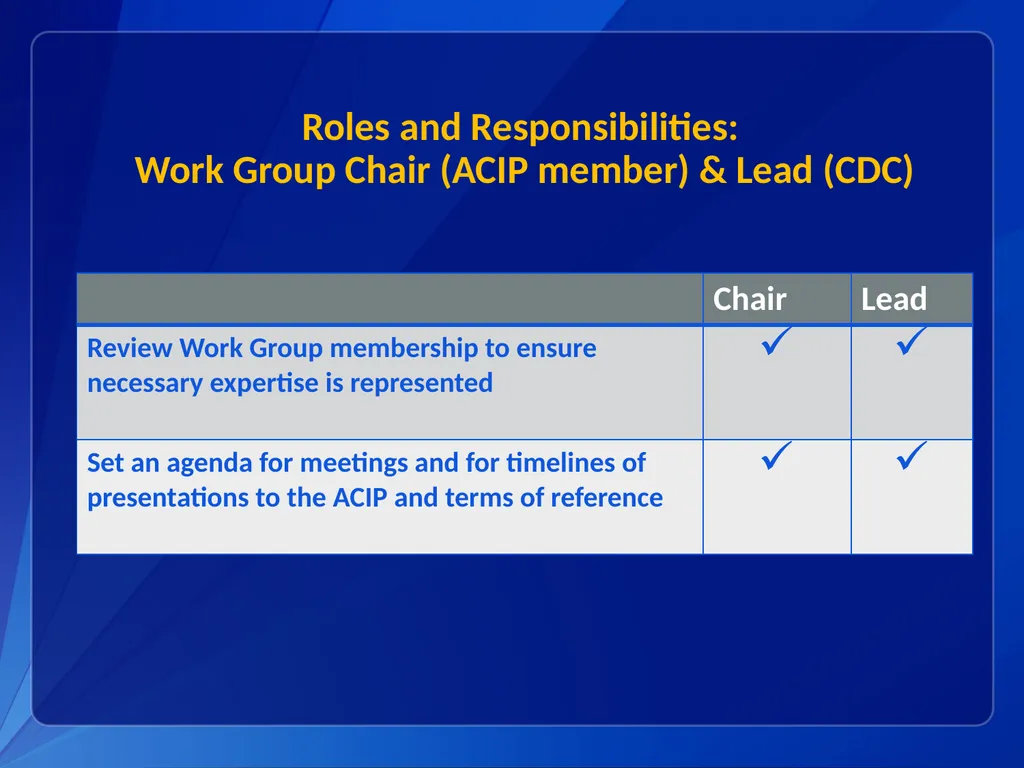
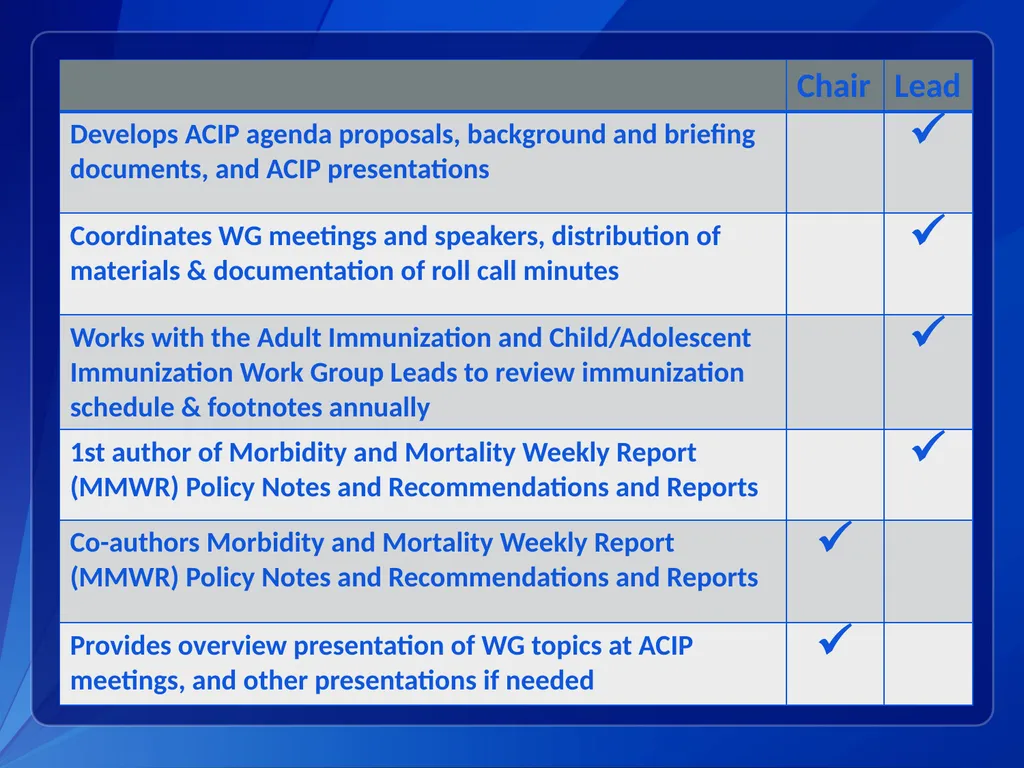
Roles and Responsibilities: Work Group Chair (ACIP member) & Lead (CDC)<br>
15
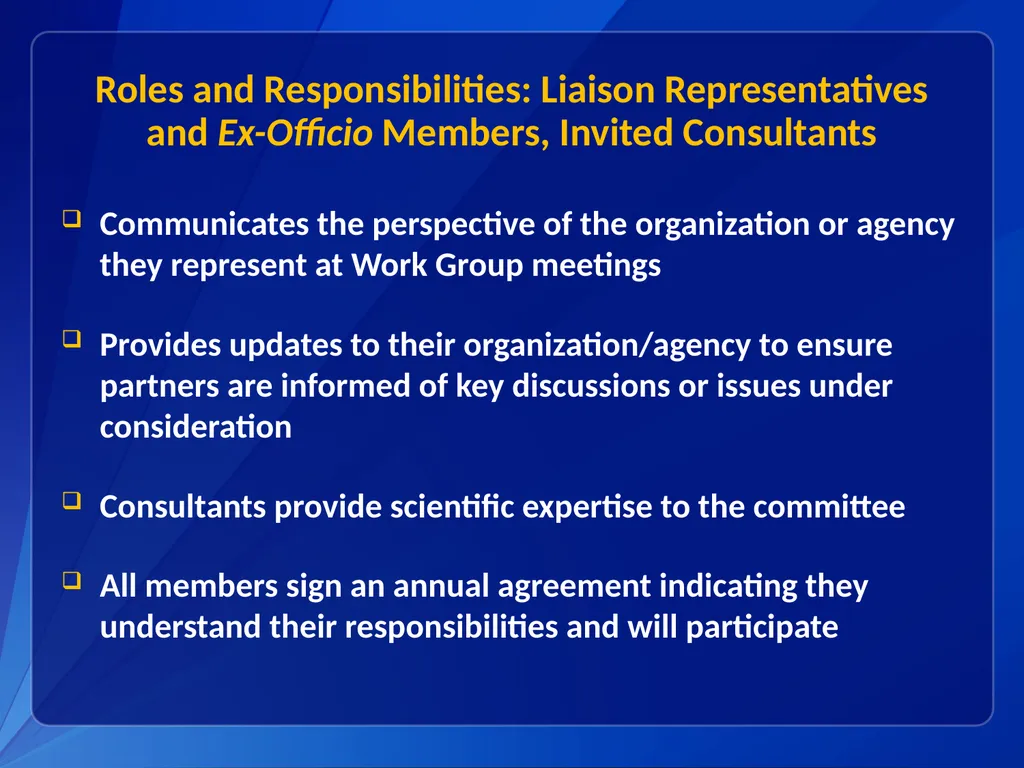
Roles and Responsibilities: Liaison Representatives and Ex-Officio Members, Invited Consultants Communicates the perspective of the organization or agency they represent at Work Group meetings
Provides updates to their organization/agency to ensure partners are informed of key discussions or issues under consideration
Consultants provide scientific expertise to the committee
All members sign an annual agreement indicating they understand their responsibilities and will participate<br>
16
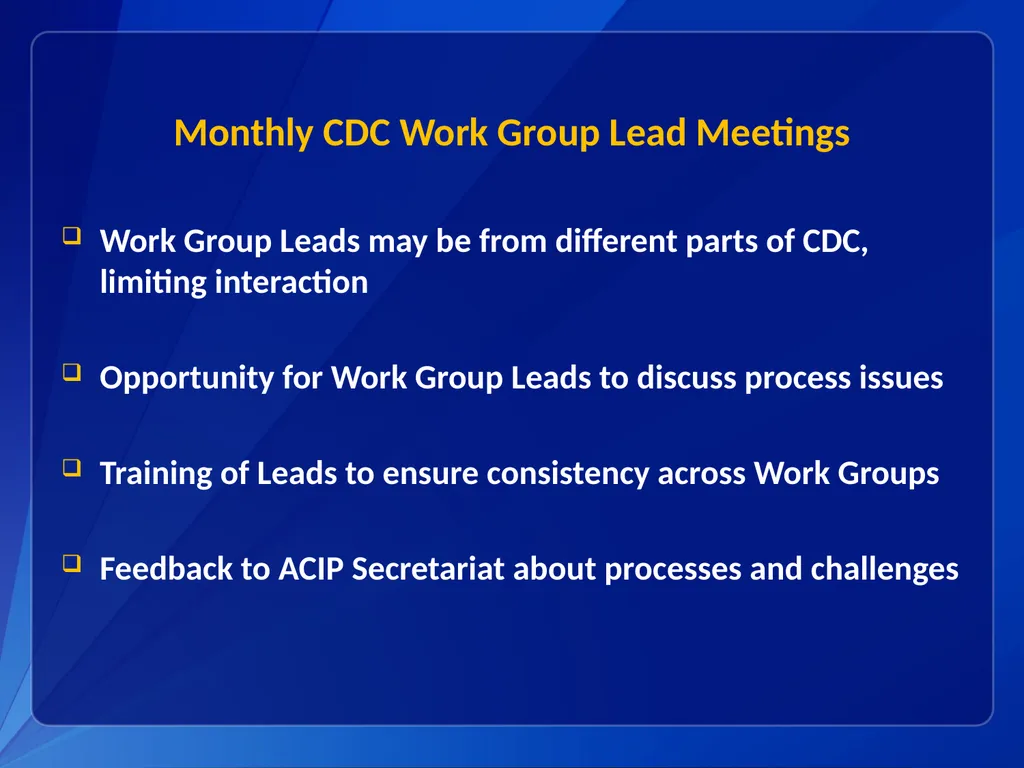
Monthly CDC Work Group Lead Meetings Work Group Leads may be from different parts of CDC, limiting interaction
Opportunity for Work Group Leads to discuss process issues
Training of Leads to ensure consistency across Work Groups
Feedback to ACIP Secretariat about processes and challenges<br>
17
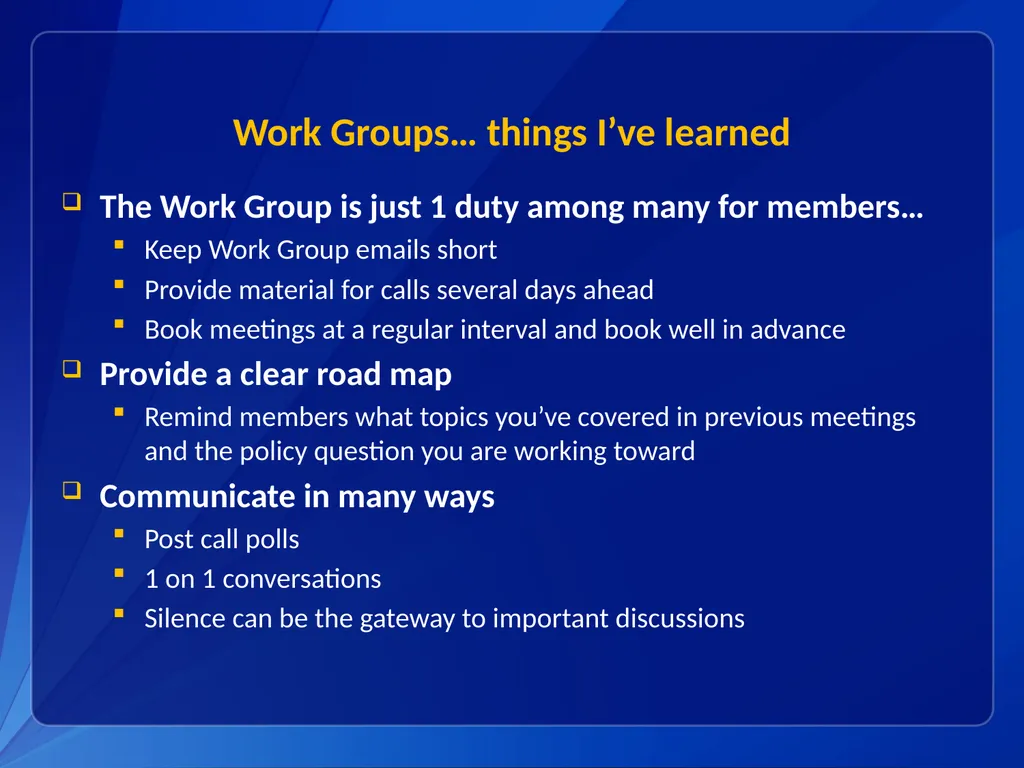
Work Groups… things I’ve learned The Work Group is just 1 duty among many for members…
Keep Work Group emails short
Provide material for calls several days ahead
Book meetings at a regular interval and book well in advance
Provide a clear road map
Remind members what topics you’ve covered in previous meetings and the policy question you are working toward
Communicate in many ways
Post call polls
1 on 1 conversations
Silence can be the gateway to important discussions<br>
18
Summary ACIP Work Groups do much of the heavy lifting in terms of reviewing and deliberating the evidence and considering policy recommendations
Being part of a work group is a commitment, but members continue to participate, in part, because of the strong sense of value that work groups have to the ACIP<br>