
Dr. Yacheng Sun, UC Boulder 1 Lecture 6 Conjoint
CS
Published · 41 slides · 0 views

1 / 1

Description
Dr. Yacheng Sun, UC Boulder 1 Lecture 6 Conjoint Analysis What is Conjoint Analysis? Research technique developed in early 70s Dictionary definition-- Conjoint: Joined together, combined. Marketers catch-phrase-- Features CONsidered
Related Topics
Share
Embed code
Download this presentation From Below
"Dr. Yacheng Sun, UC Boulder 1 Lecture 6 Conjoint" is the property of its rightful owner. Permission is granted to download and print the materials on this website for personal, non-commercial use only, and to display it on your personal computer provided you do not modify the materials and that you retain all copyright notices contained in the materials. By downloading content from our website, you accept the terms of this agreement.
Presentation Transcript
01
Dr. Yacheng Sun, UC Boulder 1 Lecture 6
Conjoint Analysis<br>
02
What is Conjoint Analysis? Research technique developed in early 70s
Dictionary definition-- “Conjoint: Joined together, combined.”
Marketer’s catch-phrase-- “Features CONsidered JOINTly” Dr. Yacheng Sun, UC Boulder 2<br>
Dictionary definition-- “Conjoint: Joined together, combined.”
Marketer’s catch-phrase-- “Features CONsidered JOINTly” Dr. Yacheng Sun, UC Boulder 2<br>
03
Demand Side of Equation Typical market research role is to focus first on demand side of the equation
After figuring out what buyers want, next assess whether it can be built/provided in a cost- effective manner
Measures how buyers value components of a product/service bundle Dr. Yacheng Sun, UC Boulder 3<br>
After figuring out what buyers want, next assess whether it can be built/provided in a cost- effective manner
Measures how buyers value components of a product/service bundle Dr. Yacheng Sun, UC Boulder 3<br>
04
Different Perspectives, Different Goals Buyers want all of the most desirable features at lowest possible price
Sellers want to maximize profits by: 1) minimizing costs of providing features
2) providing products that offer greater overall value than the competition Dr. Yacheng Sun, UC Boulder 4<br>
Sellers want to maximize profits by: 1) minimizing costs of providing features
2) providing products that offer greater overall value than the competition Dr. Yacheng Sun, UC Boulder 4<br>
05
A simple example We want to market a new golf ball.
There are three important product features.
Average Driving Distance
Average Ball Life
Price Dr. Yacheng Sun, UC Boulder 5<br>
There are three important product features.
Average Driving Distance
Average Ball Life
Price Dr. Yacheng Sun, UC Boulder 5<br>
06
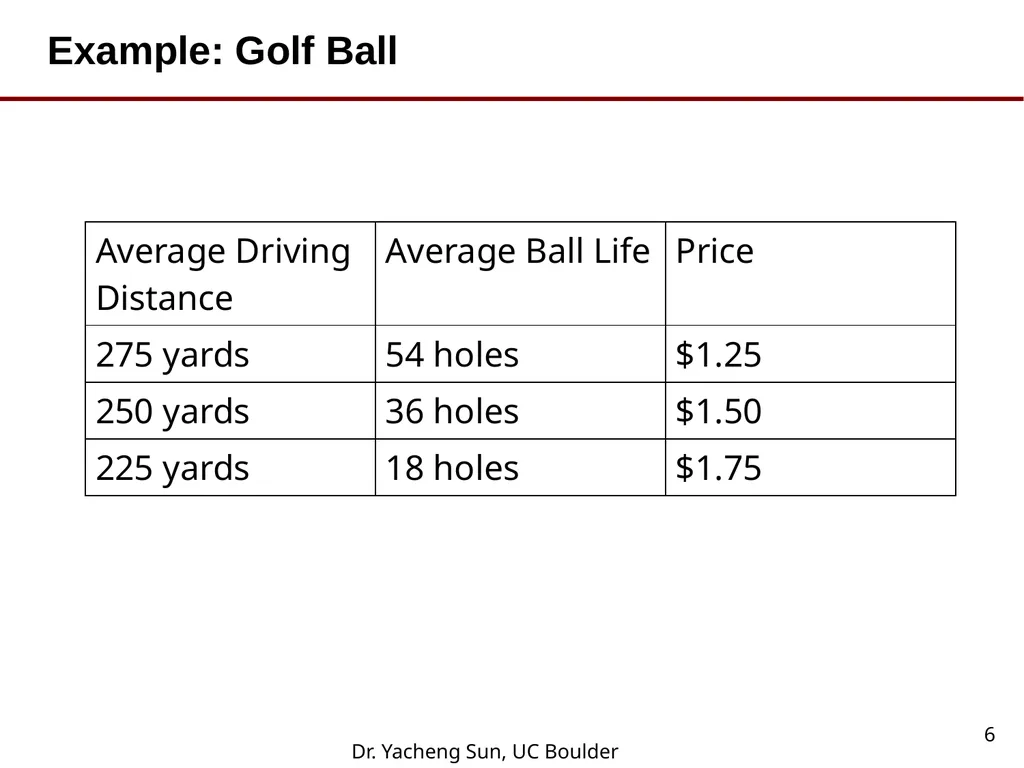
Example: Golf Ball Dr. Yacheng Sun, UC Boulder 6<br>
07
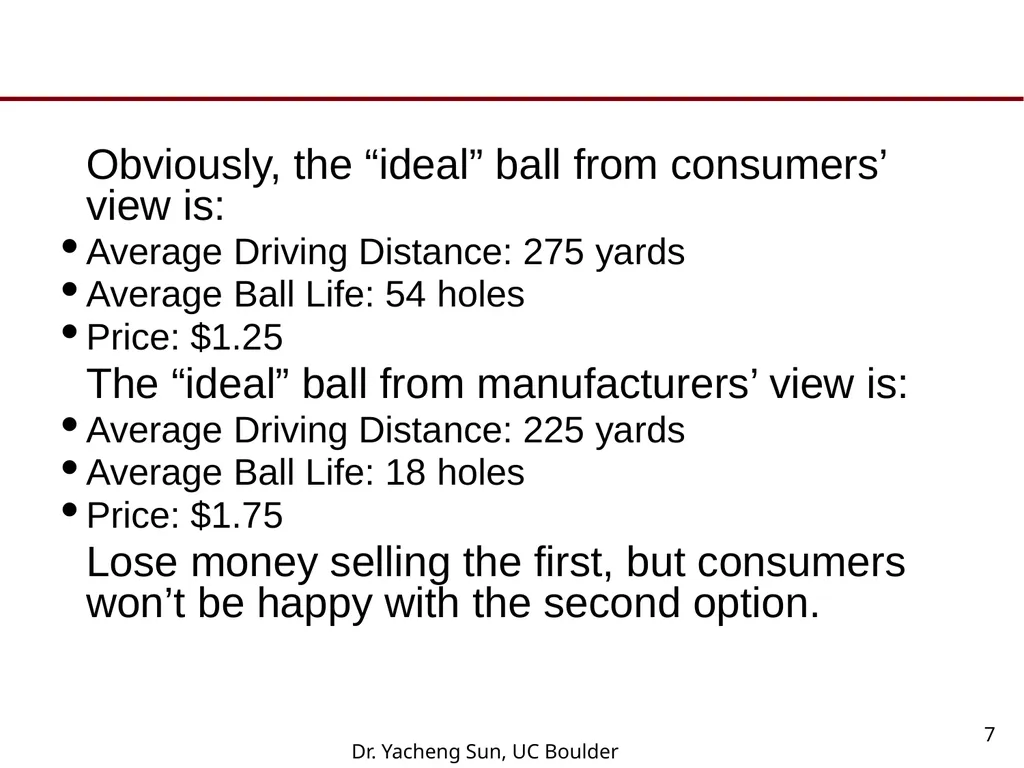
Obviously, the “ideal” ball from consumers’ view is:
Average Driving Distance: 275 yards
Average Ball Life: 54 holes
Price: $1.25
The “ideal” ball from manufacturers’ view is:
Average Driving Distance: 225 yards
Average Ball Life: 18 holes
Price: $1.75
Lose money selling the first, but consumers won’t be happy with the second option. Dr. Yacheng Sun, UC Boulder 7<br>
Average Driving Distance: 275 yards
Average Ball Life: 54 holes
Price: $1.25
The “ideal” ball from manufacturers’ view is:
Average Driving Distance: 225 yards
Average Ball Life: 18 holes
Price: $1.75
Lose money selling the first, but consumers won’t be happy with the second option. Dr. Yacheng Sun, UC Boulder 7<br>
08
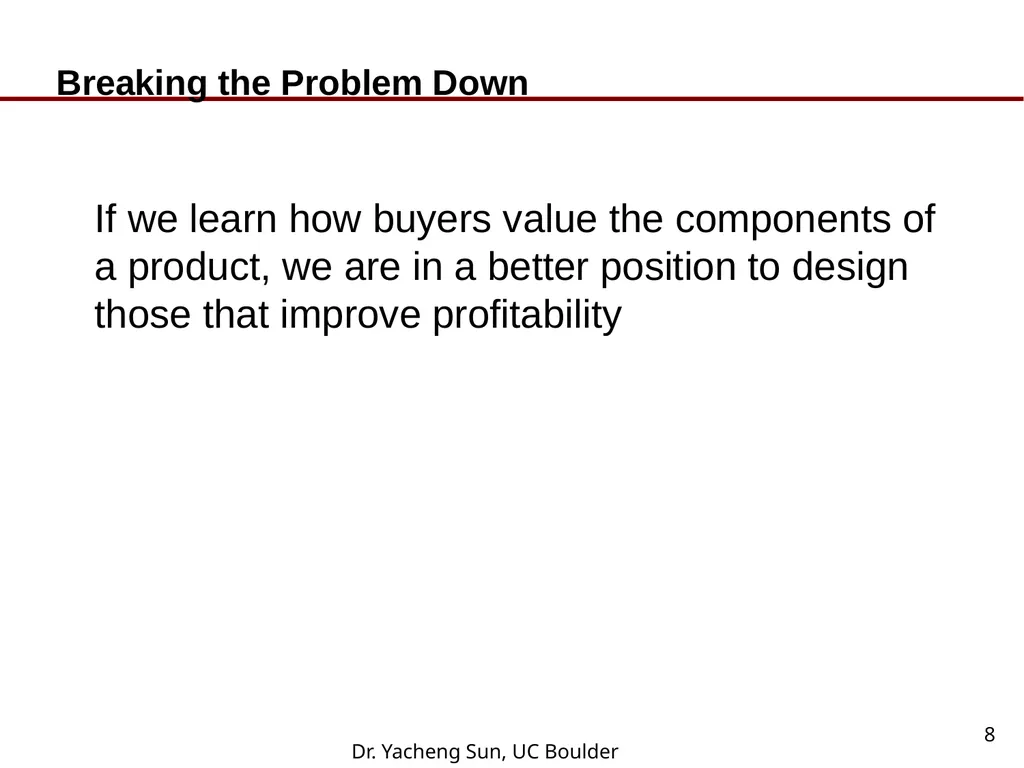
Breaking the Problem Down If we learn how buyers value the components of a product, we are in a better position to design those that improve profitability Dr. Yacheng Sun, UC Boulder 8<br>
09
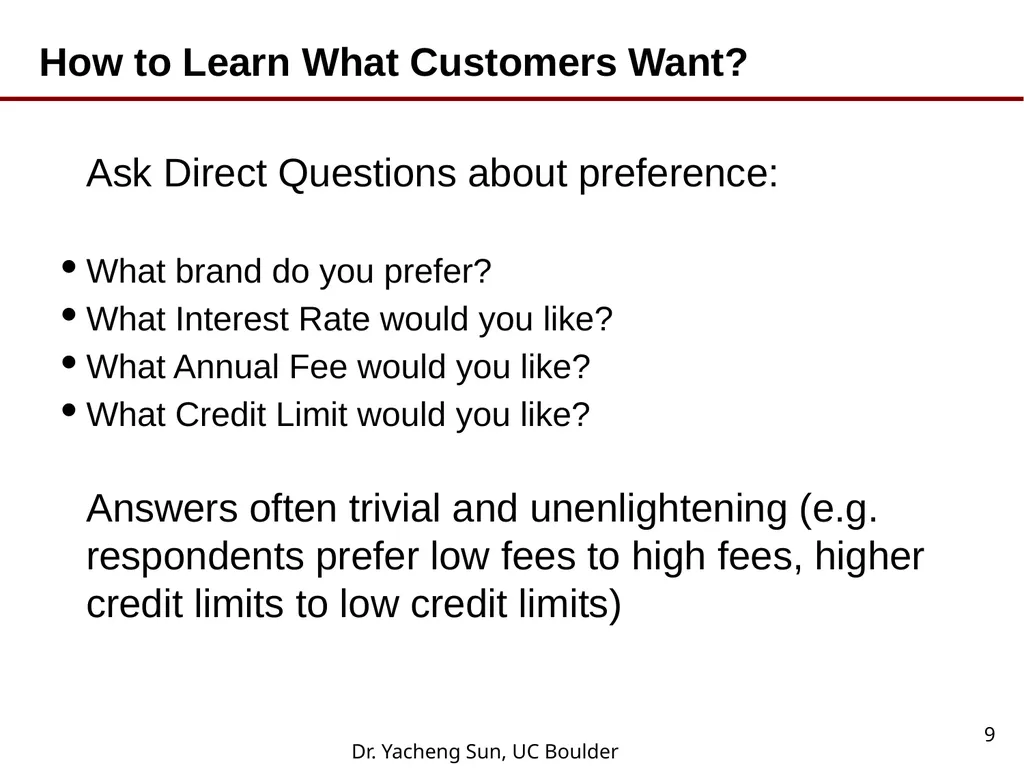
How to Learn What Customers Want? Ask Direct Questions about preference:
What brand do you prefer?
What Interest Rate would you like?
What Annual Fee would you like?
What Credit Limit would you like?
Answers often trivial and unenlightening (e.g. respondents prefer low fees to high fees, higher credit limits to low credit limits) Dr. Yacheng Sun, UC Boulder 9<br>
What brand do you prefer?
What Interest Rate would you like?
What Annual Fee would you like?
What Credit Limit would you like?
Answers often trivial and unenlightening (e.g. respondents prefer low fees to high fees, higher credit limits to low credit limits) Dr. Yacheng Sun, UC Boulder 9<br>
10
How to Learn What Is Important? Ask Direct Questions about importances
How important is it that you get the <<brand, interest rate, annual fee, credit limit>> that you want? Dr. Yacheng Sun, UC Boulder 10<br>
How important is it that you get the <<brand, interest rate, annual fee, credit limit>> that you want? Dr. Yacheng Sun, UC Boulder 10<br>
11
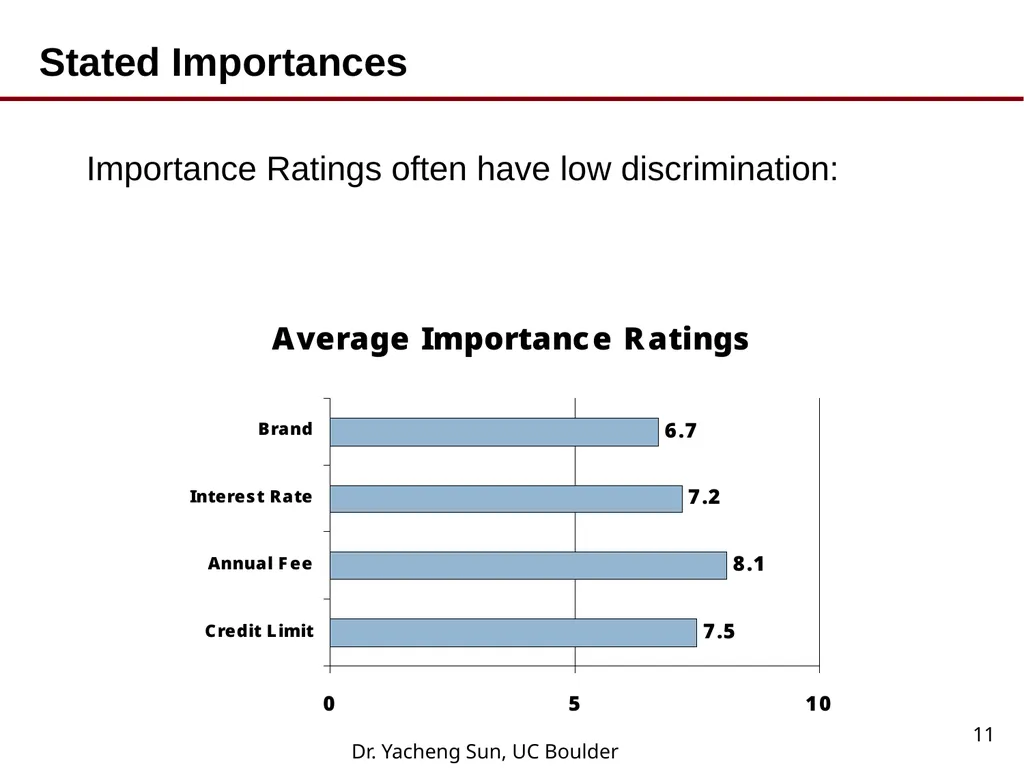
Stated Importances Importance Ratings often have low discrimination: Dr. Yacheng Sun, UC Boulder 11<br>
12
Stated Importances Answers often have ______________, with most answers falling in “very important” categories
Answers sometimes useful for segmenting market, but still not as actionable as could be Dr. Yacheng Sun, UC Boulder 12<br>
Answers sometimes useful for segmenting market, but still not as actionable as could be Dr. Yacheng Sun, UC Boulder 12<br>
13
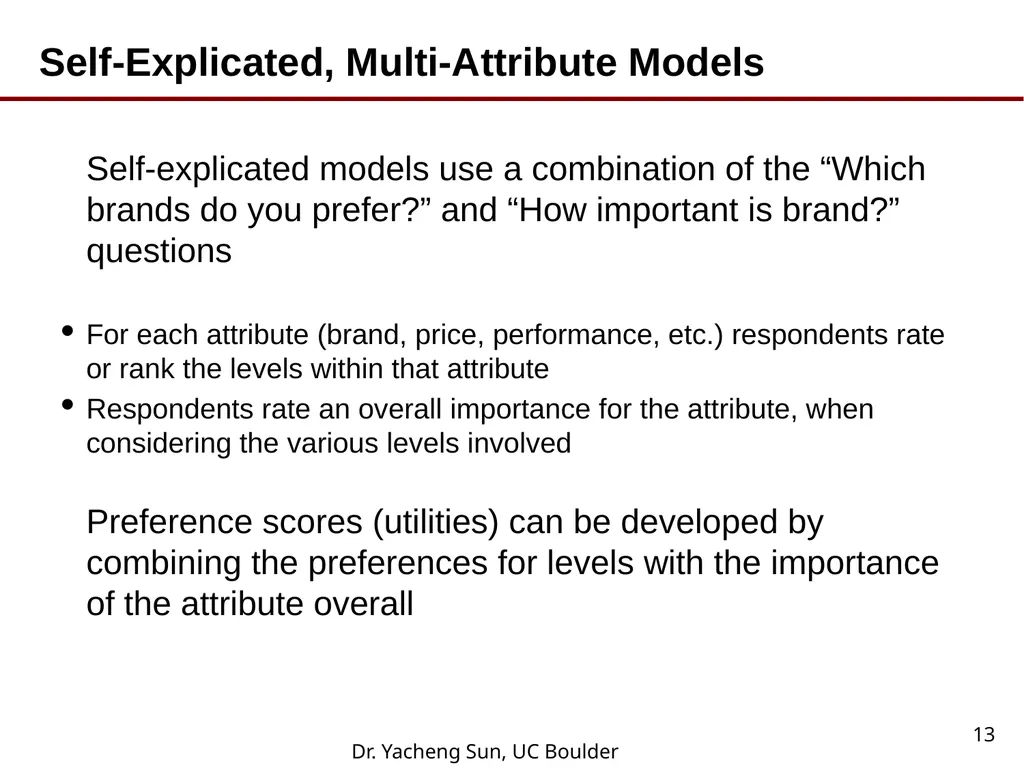
Self-Explicated, Multi-Attribute Models Self-explicated models use a combination of the “Which brands do you prefer?” and “How important is brand?” questions
For each attribute (brand, price, performance, etc.) respondents rate or rank the levels within that attribute
Respondents rate an overall importance for the attribute, when considering the various levels involved
Preference scores (utilities) can be developed by combining the preferences for levels with the importance of the attribute overall Dr. Yacheng Sun, UC Boulder 13<br>
For each attribute (brand, price, performance, etc.) respondents rate or rank the levels within that attribute
Respondents rate an overall importance for the attribute, when considering the various levels involved
Preference scores (utilities) can be developed by combining the preferences for levels with the importance of the attribute overall Dr. Yacheng Sun, UC Boulder 13<br>
14
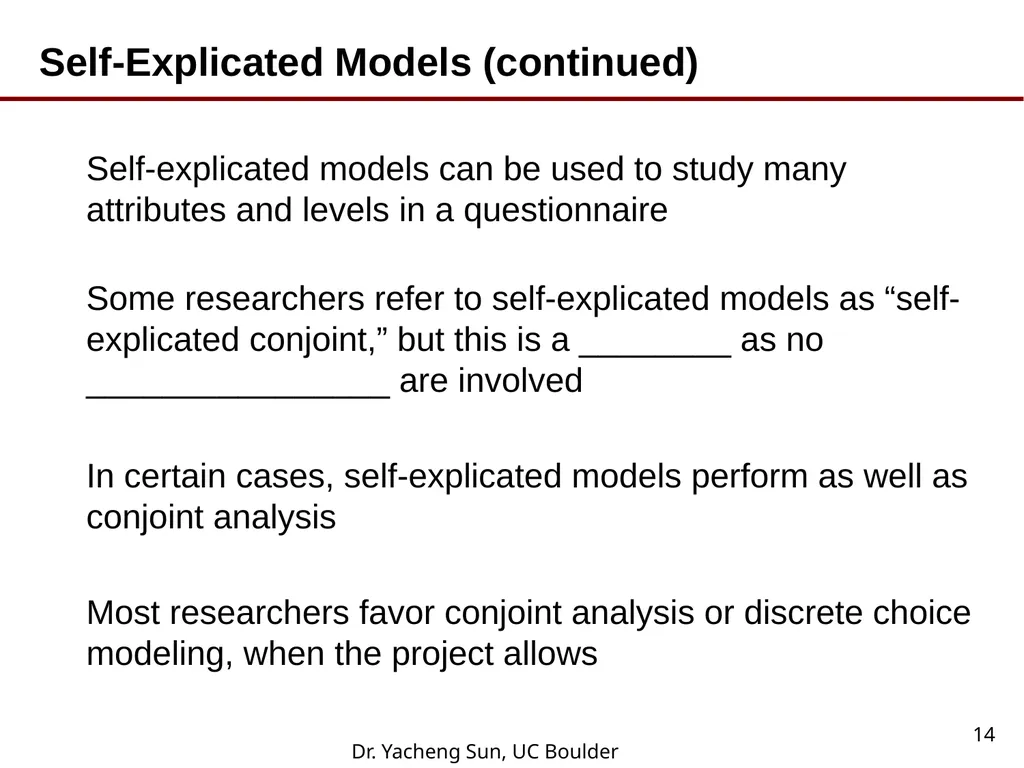
Self-Explicated Models (continued) Self-explicated models can be used to study many attributes and levels in a questionnaire
Some researchers refer to self-explicated models as “self-explicated conjoint,” but this is a ________ as no ________________ are involved
In certain cases, self-explicated models perform as well as conjoint analysis
Most researchers favor conjoint analysis or discrete choice modeling, when the project allows Dr. Yacheng Sun, UC Boulder 14<br>
Some researchers refer to self-explicated models as “self-explicated conjoint,” but this is a ________ as no ________________ are involved
In certain cases, self-explicated models perform as well as conjoint analysis
Most researchers favor conjoint analysis or discrete choice modeling, when the project allows Dr. Yacheng Sun, UC Boulder 14<br>
15
Conjoint Analysis Dr. Yacheng Sun, UC Boulder 15<br>
16
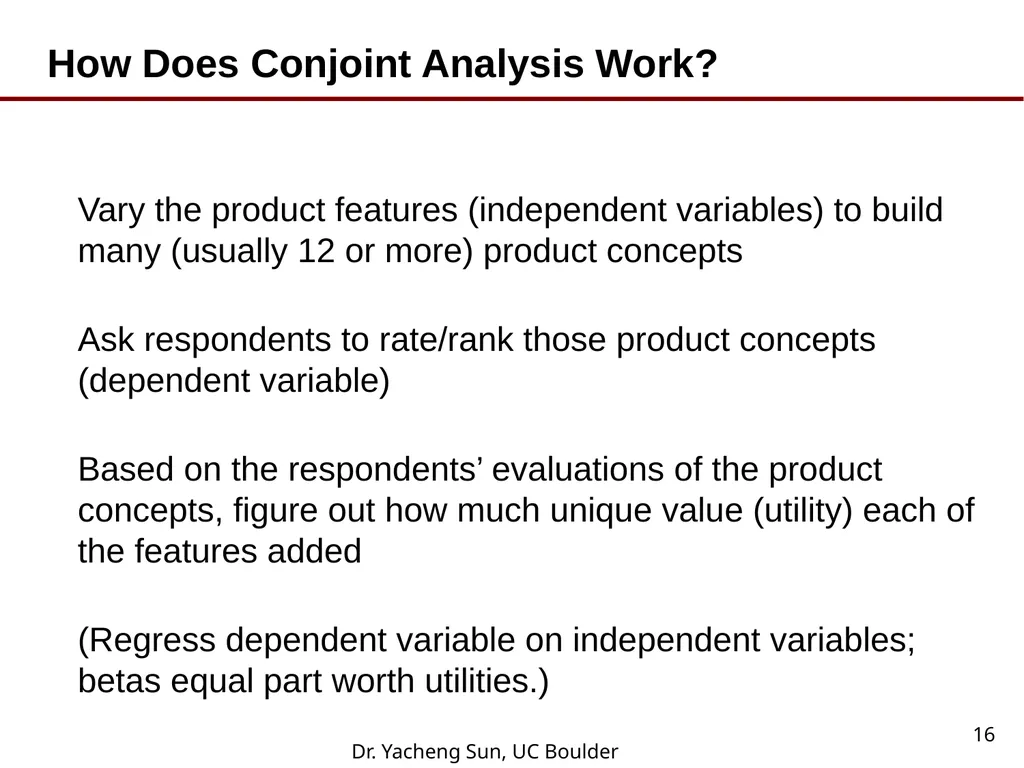
How Does Conjoint Analysis Work? Vary the product features (independent variables) to build many (usually 12 or more) product concepts
Ask respondents to rate/rank those product concepts (dependent variable)
Based on the respondents’ evaluations of the product concepts, figure out how much unique value (utility) each of the features added
(Regress dependent variable on independent variables; betas equal part worth utilities.) Dr. Yacheng Sun, UC Boulder 16<br>
Ask respondents to rate/rank those product concepts (dependent variable)
Based on the respondents’ evaluations of the product concepts, figure out how much unique value (utility) each of the features added
(Regress dependent variable on independent variables; betas equal part worth utilities.) Dr. Yacheng Sun, UC Boulder 16<br>
17
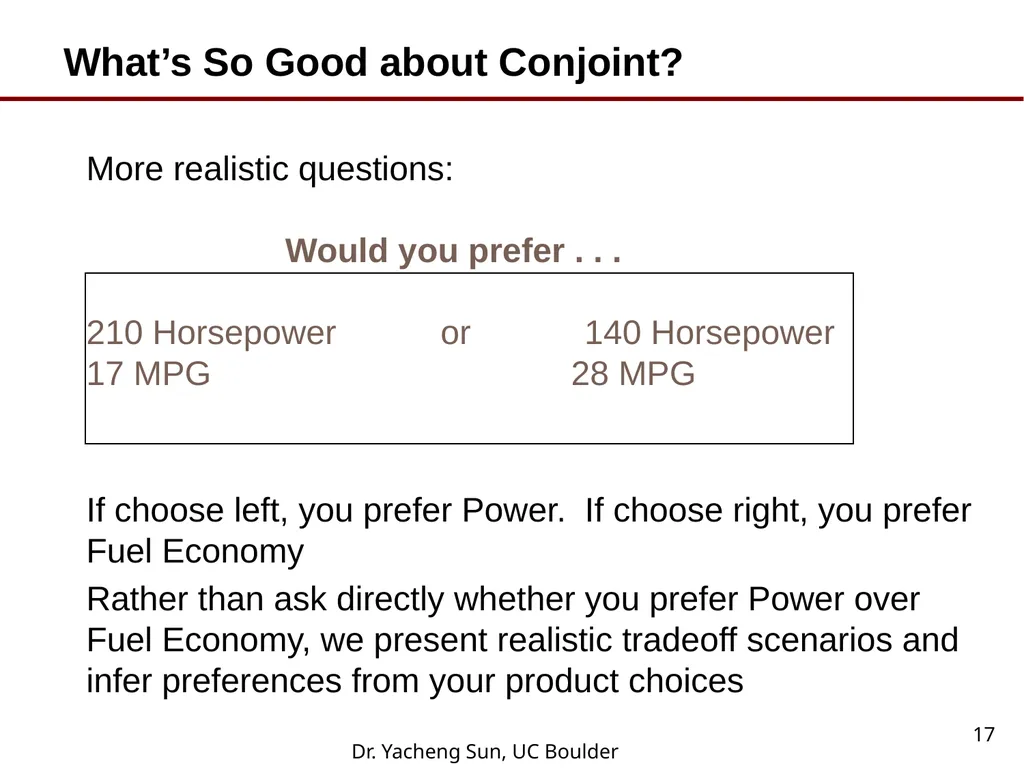
What’s So Good about Conjoint? More realistic questions:
Would you prefer . . .
210 Horsepower or 140 Horsepower
17 MPG 28 MPG
If choose left, you prefer Power. If choose right, you prefer Fuel Economy
Rather than ask directly whether you prefer Power over Fuel Economy, we present realistic tradeoff scenarios and infer preferences from your product choices Dr. Yacheng Sun, UC Boulder 17<br>
If choose left, you prefer Power. If choose right, you prefer Fuel Economy
Rather than ask directly whether you prefer Power over Fuel Economy, we present realistic tradeoff scenarios and infer preferences from your product choices Dr. Yacheng Sun, UC Boulder 17<br>
18
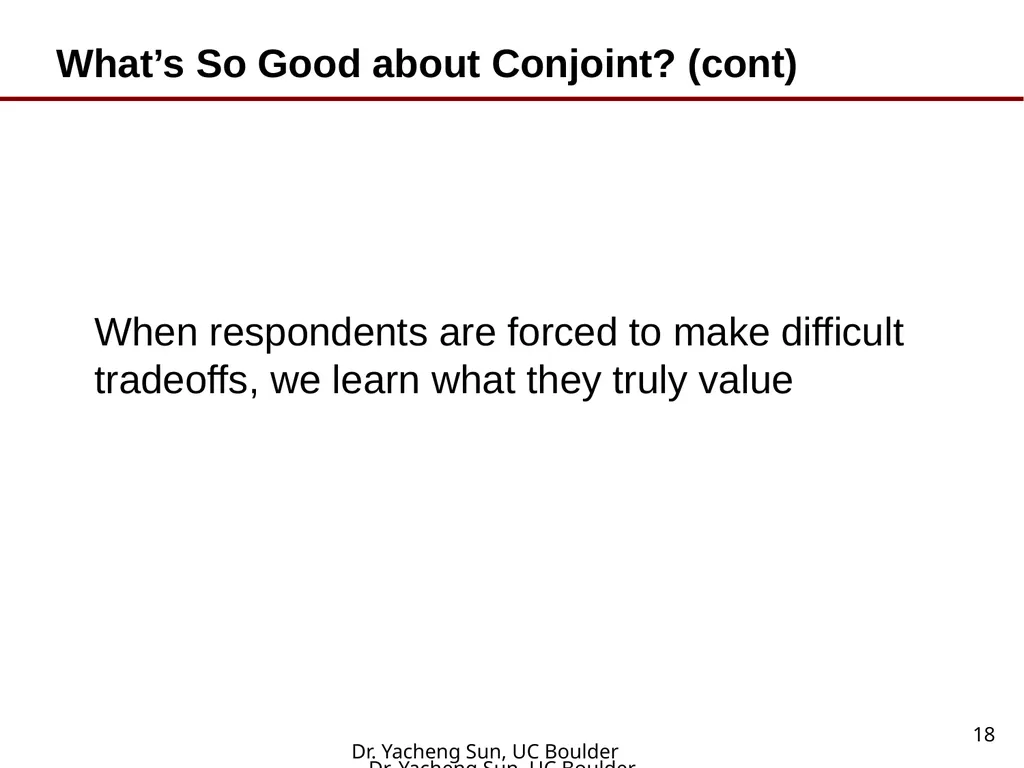
What’s So Good about Conjoint? (cont) When respondents are forced to make difficult tradeoffs, we learn what they truly value Dr. Yacheng Sun, UC Boulder Dr. Yacheng Sun, UC Boulder 18<br>
19
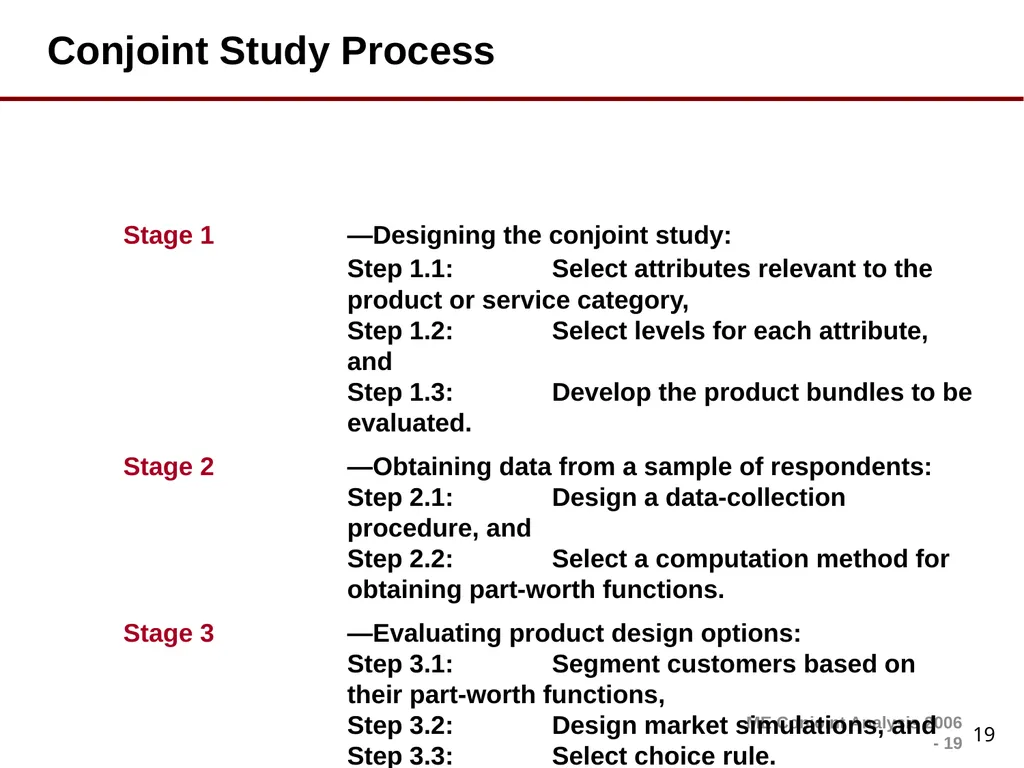
ME Conjoint Analysis 2006 - 19 Stage 1 —Designing the conjoint study:
Step 1.1: Select attributes relevant to the product or service category,
Step 1.2: Select levels for each attribute, and
Step 1.3: Develop the product bundles to be evaluated.
Stage 2 —Obtaining data from a sample of respondents:
Step 2.1: Design a data-collection procedure, and
Step 2.2: Select a computation method for obtaining part-worth functions.
Stage 3 —Evaluating product design options:
Step 3.1: Segment customers based on their part-worth functions,
Step 3.2: Design market simulations, and
Step 3.3: Select choice rule. Conjoint Study Process 19<br>
Step 1.1: Select attributes relevant to the product or service category,
Step 1.2: Select levels for each attribute, and
Step 1.3: Develop the product bundles to be evaluated.
Stage 2 —Obtaining data from a sample of respondents:
Step 2.1: Design a data-collection procedure, and
Step 2.2: Select a computation method for obtaining part-worth functions.
Stage 3 —Evaluating product design options:
Step 3.1: Segment customers based on their part-worth functions,
Step 3.2: Design market simulations, and
Step 3.3: Select choice rule. Conjoint Study Process 19<br>
20
State 1 – Design the Conjoint Study Dr. Yacheng Sun, UC Boulder 20<br>
21
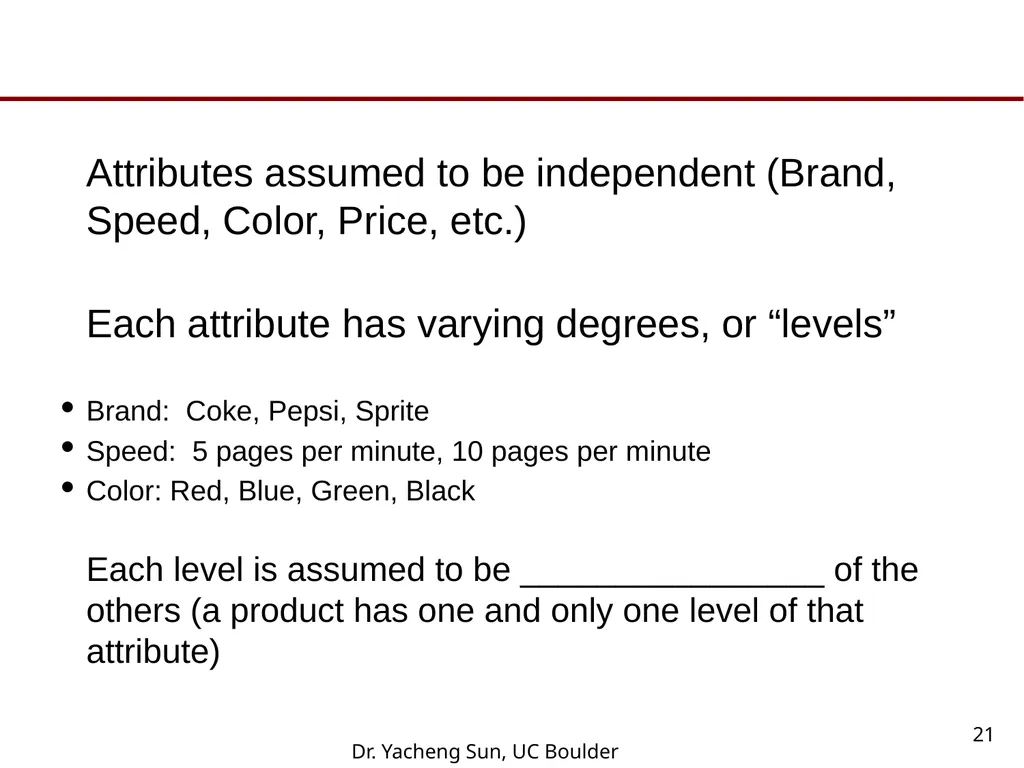
Attributes assumed to be independent (Brand, Speed, Color, Price, etc.)
Each attribute has varying degrees, or “levels”
Brand: Coke, Pepsi, Sprite
Speed: 5 pages per minute, 10 pages per minute
Color: Red, Blue, Green, Black
Each level is assumed to be ________________ of the others (a product has one and only one level of that attribute) Dr. Yacheng Sun, UC Boulder 21<br>
Each attribute has varying degrees, or “levels”
Brand: Coke, Pepsi, Sprite
Speed: 5 pages per minute, 10 pages per minute
Color: Red, Blue, Green, Black
Each level is assumed to be ________________ of the others (a product has one and only one level of that attribute) Dr. Yacheng Sun, UC Boulder 21<br>
22
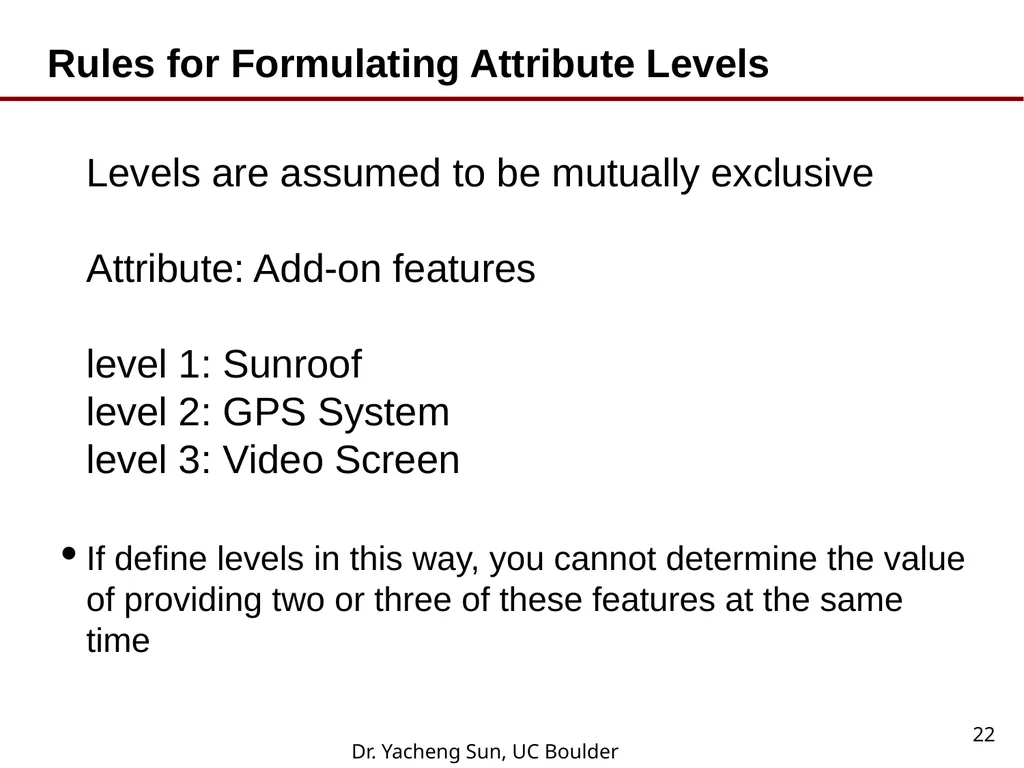
Rules for Formulating Attribute Levels Levels are assumed to be mutually exclusive
Attribute: Add-on features
level 1: Sunroof
level 2: GPS System
level 3: Video Screen
If define levels in this way, you cannot determine the value of providing two or three of these features at the same time Dr. Yacheng Sun, UC Boulder 22<br>
If define levels in this way, you cannot determine the value of providing two or three of these features at the same time Dr. Yacheng Sun, UC Boulder 22<br>
23
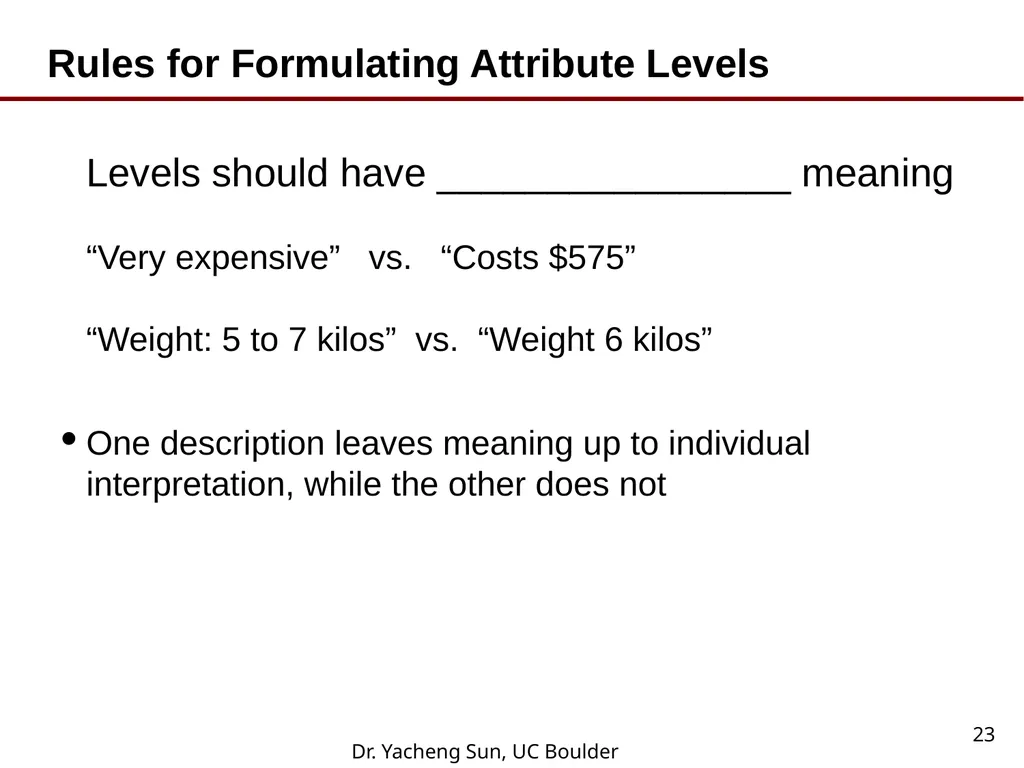
Rules for Formulating Attribute Levels Levels should have ________________ meaning
“Very expensive” vs. “Costs $575”
“Weight: 5 to 7 kilos” vs. “Weight 6 kilos”
One description leaves meaning up to individual interpretation, while the other does not Dr. Yacheng Sun, UC Boulder 23<br>
One description leaves meaning up to individual interpretation, while the other does not Dr. Yacheng Sun, UC Boulder 23<br>
24
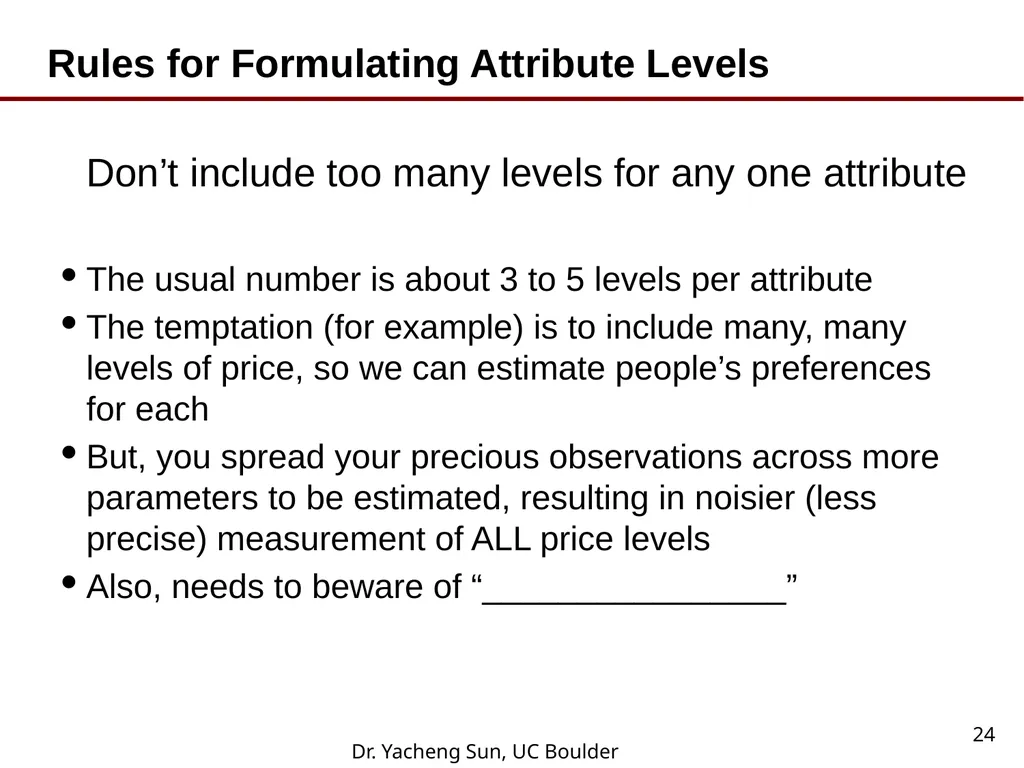
Rules for Formulating Attribute Levels Don’t include too many levels for any one attribute
The usual number is about 3 to 5 levels per attribute
The temptation (for example) is to include many, many levels of price, so we can estimate people’s preferences for each
But, you spread your precious observations across more parameters to be estimated, resulting in noisier (less precise) measurement of ALL price levels
Also, needs to beware of “________________” Dr. Yacheng Sun, UC Boulder 24<br>
The usual number is about 3 to 5 levels per attribute
The temptation (for example) is to include many, many levels of price, so we can estimate people’s preferences for each
But, you spread your precious observations across more parameters to be estimated, resulting in noisier (less precise) measurement of ALL price levels
Also, needs to beware of “________________” Dr. Yacheng Sun, UC Boulder 24<br>
25
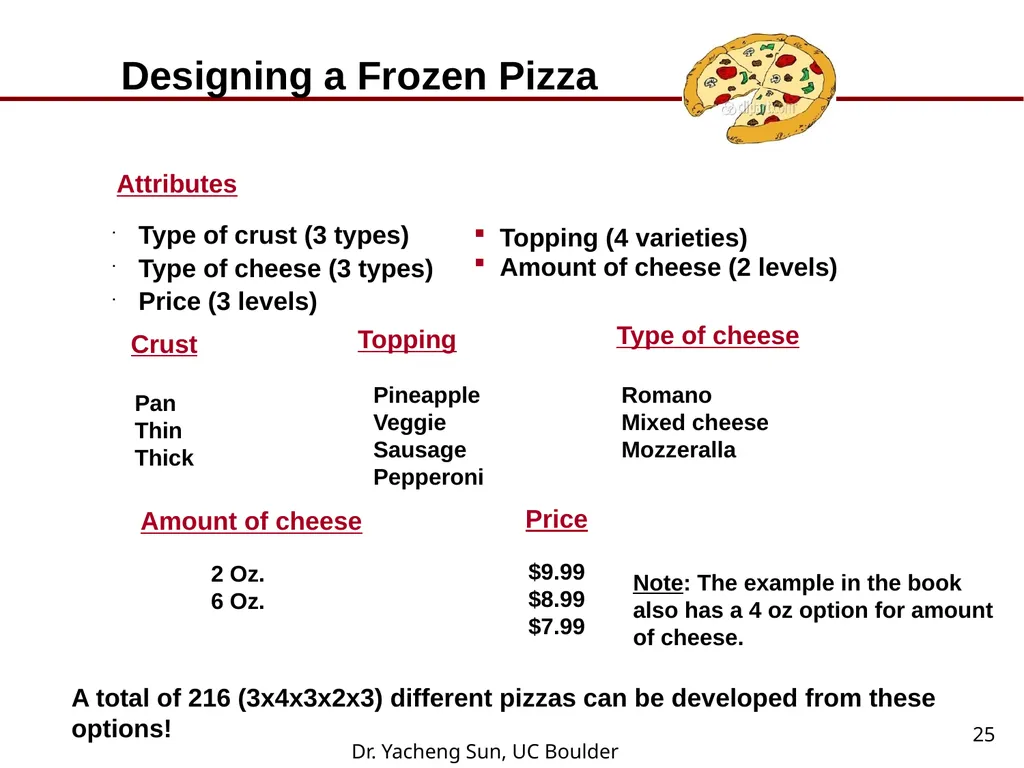
Type of crust (3 types)
Type of cheese (3 types)
Price (3 levels) Attributes Topping (4 varieties)
Amount of cheese (2 levels) A total of 216 (3x4x3x2x3) different pizzas can be developed from these options! Crust Topping Type of cheese Pan
Thin
Thick Pineapple
Veggie
Sausage
Pepperoni Romano
Mixed cheese
Mozzeralla Amount of cheese Price 2 Oz.
6 Oz. $9.99
$8.99
$7.99 Designing a Frozen Pizza Note: The example in the book also has a 4 oz option for amount of cheese. Dr. Yacheng Sun, UC Boulder 25<br>
Type of cheese (3 types)
Price (3 levels) Attributes Topping (4 varieties)
Amount of cheese (2 levels) A total of 216 (3x4x3x2x3) different pizzas can be developed from these options! Crust Topping Type of cheese Pan
Thin
Thick Pineapple
Veggie
Sausage
Pepperoni Romano
Mixed cheese
Mozzeralla Amount of cheese Price 2 Oz.
6 Oz. $9.99
$8.99
$7.99 Designing a Frozen Pizza Note: The example in the book also has a 4 oz option for amount of cheese. Dr. Yacheng Sun, UC Boulder 25<br>
26
State 2 – Obtain Data from A Sample of Respondents Dr. Yacheng Sun, UC Boulder 26<br>
27
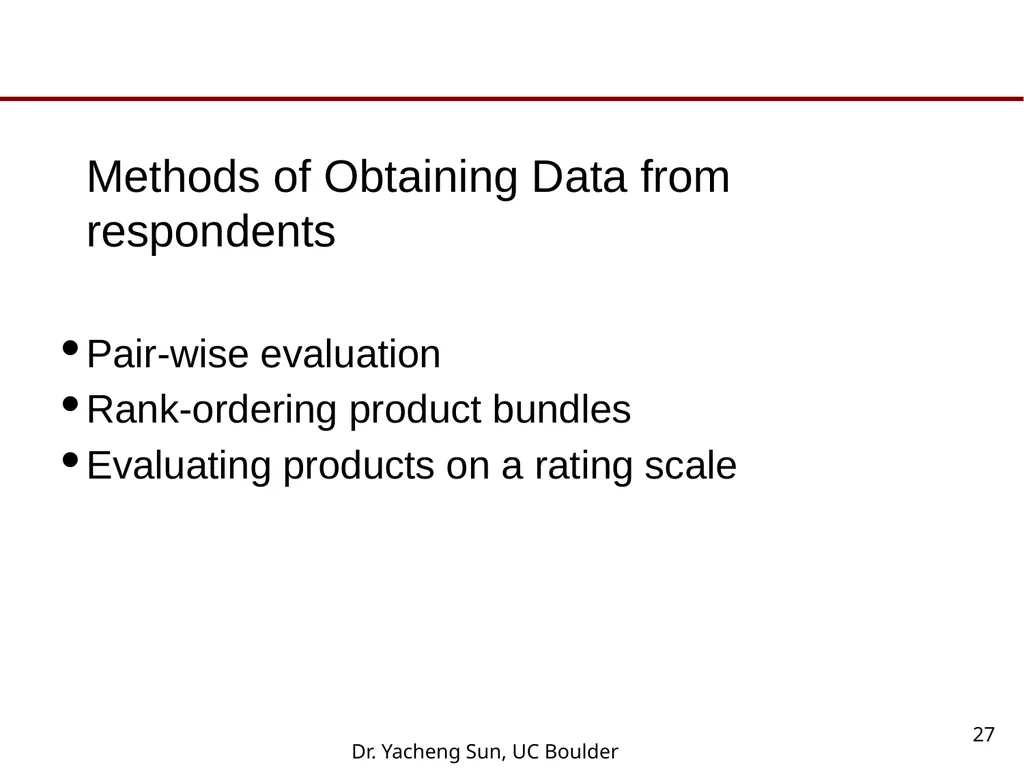
Methods of Obtaining Data from respondents
Pair-wise evaluation
Rank-ordering product bundles
Evaluating products on a rating scale Dr. Yacheng Sun, UC Boulder 27<br>
Pair-wise evaluation
Rank-ordering product bundles
Evaluating products on a rating scale Dr. Yacheng Sun, UC Boulder 27<br>
28
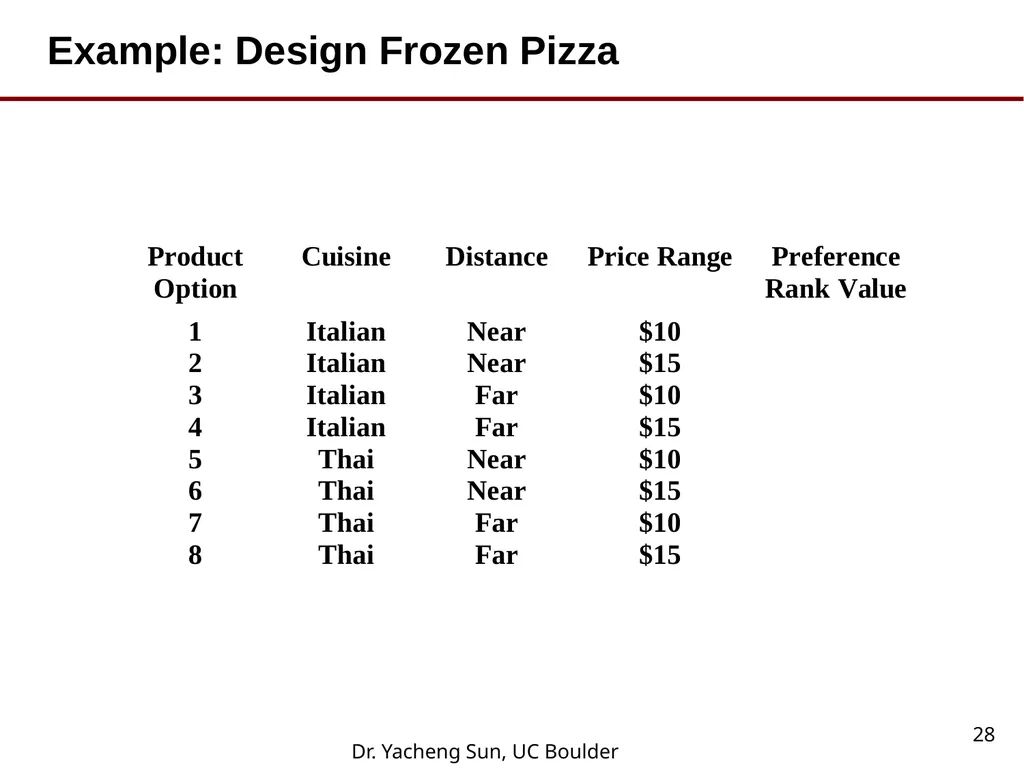
Example: Design Frozen Pizza Dr. Yacheng Sun, UC Boulder 28<br>
29
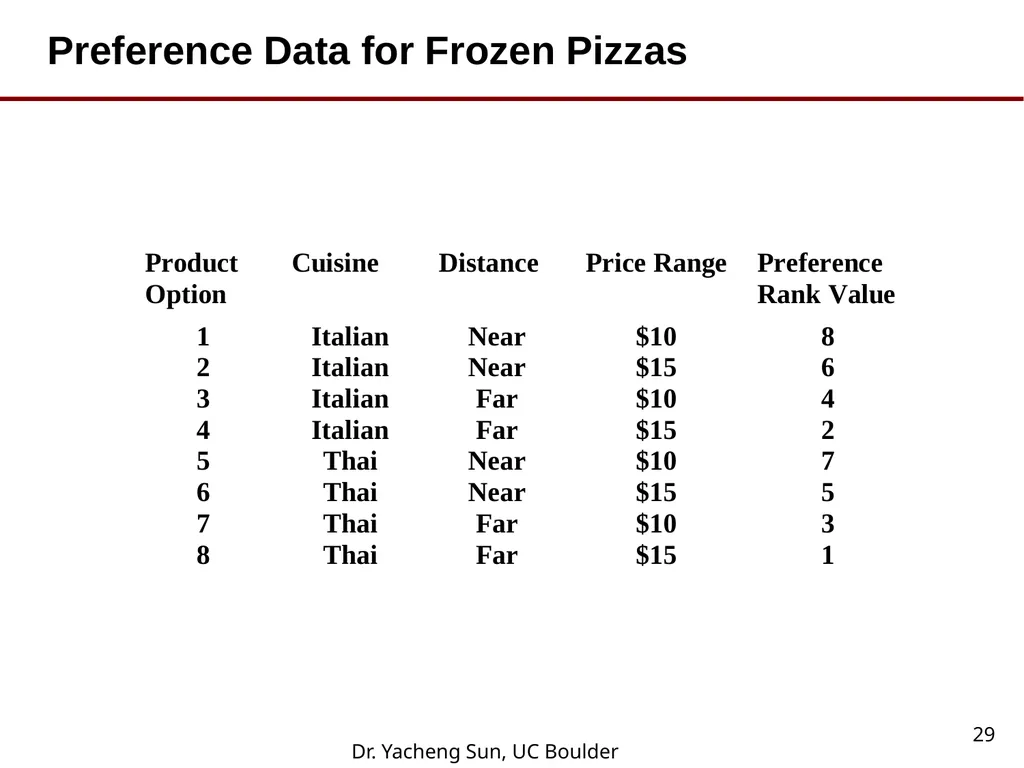
Preference Data for Frozen Pizzas Dr. Yacheng Sun, UC Boulder 29<br>
30
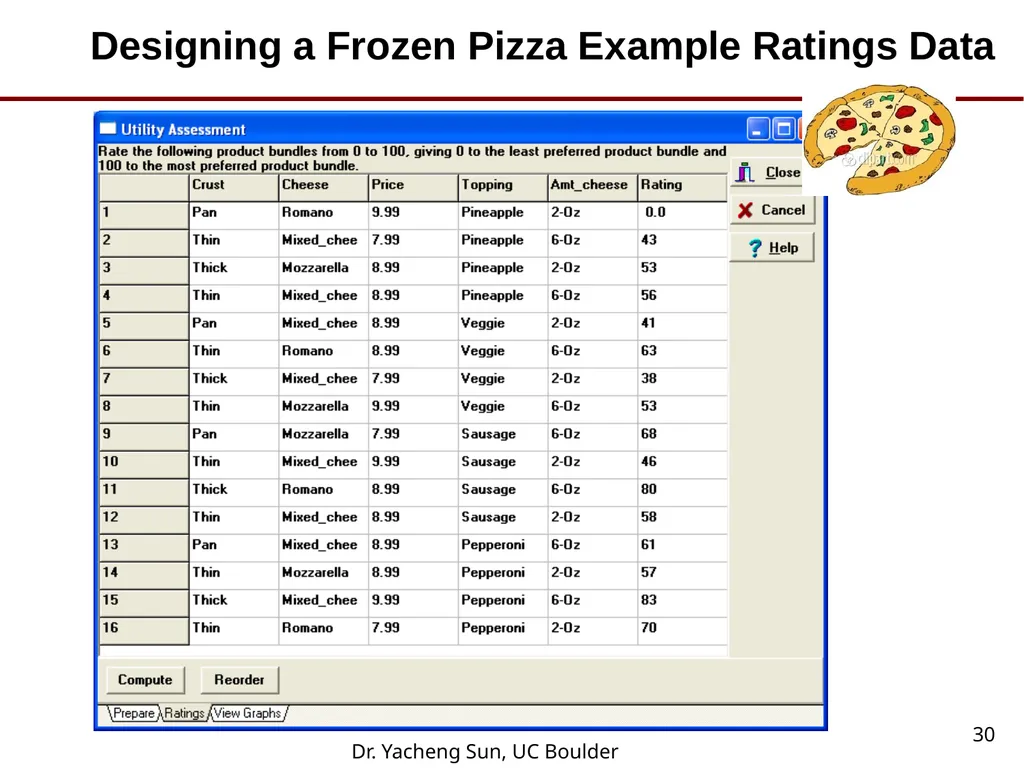
Designing a Frozen Pizza Example Ratings Data Dr. Yacheng Sun, UC Boulder 30<br>
31
State 3 – Evaluate Product Design Options Dr. Yacheng Sun, UC Boulder 31<br>
32
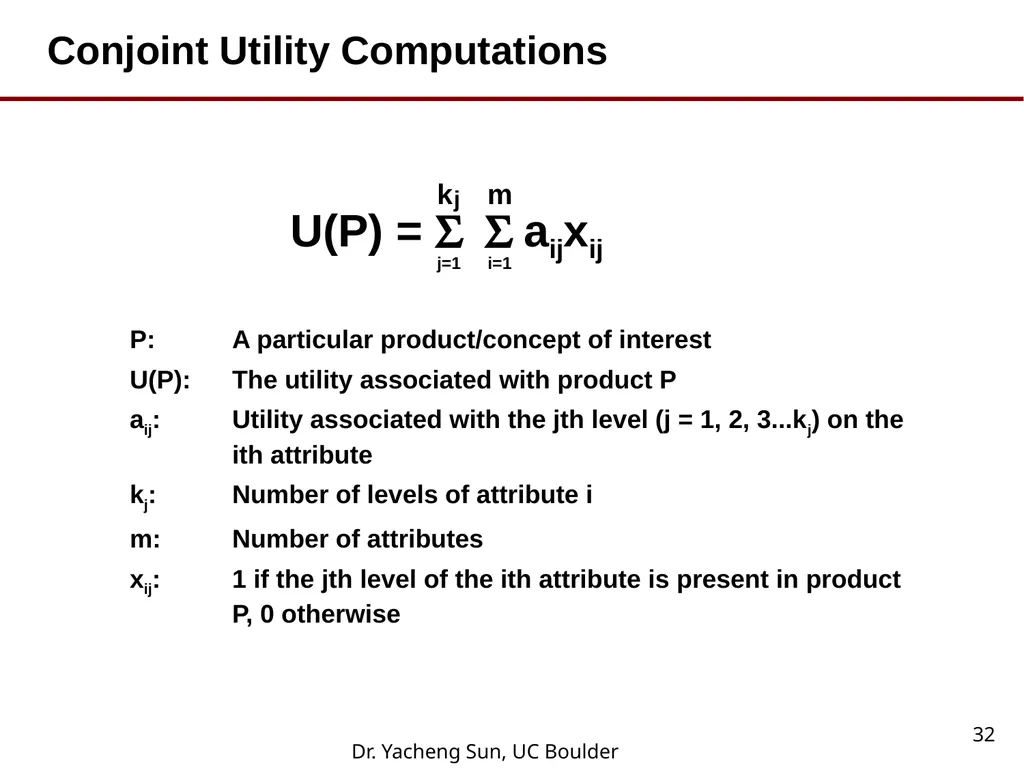
U(P) = S S aijxij k i=1 m j=1 P: A particular product/concept of interest
U(P): The utility associated with product P
aij: Utility associated with the jth level (j = 1, 2, 3...kj) on the ith attribute
kj: Number of levels of attribute i
m: Number of attributes
xij: 1 if the jth level of the ith attribute is present in product P, 0 otherwise Conjoint Utility Computations j Dr. Yacheng Sun, UC Boulder 32<br>
U(P): The utility associated with product P
aij: Utility associated with the jth level (j = 1, 2, 3...kj) on the ith attribute
kj: Number of levels of attribute i
m: Number of attributes
xij: 1 if the jth level of the ith attribute is present in product P, 0 otherwise Conjoint Utility Computations j Dr. Yacheng Sun, UC Boulder 32<br>
33
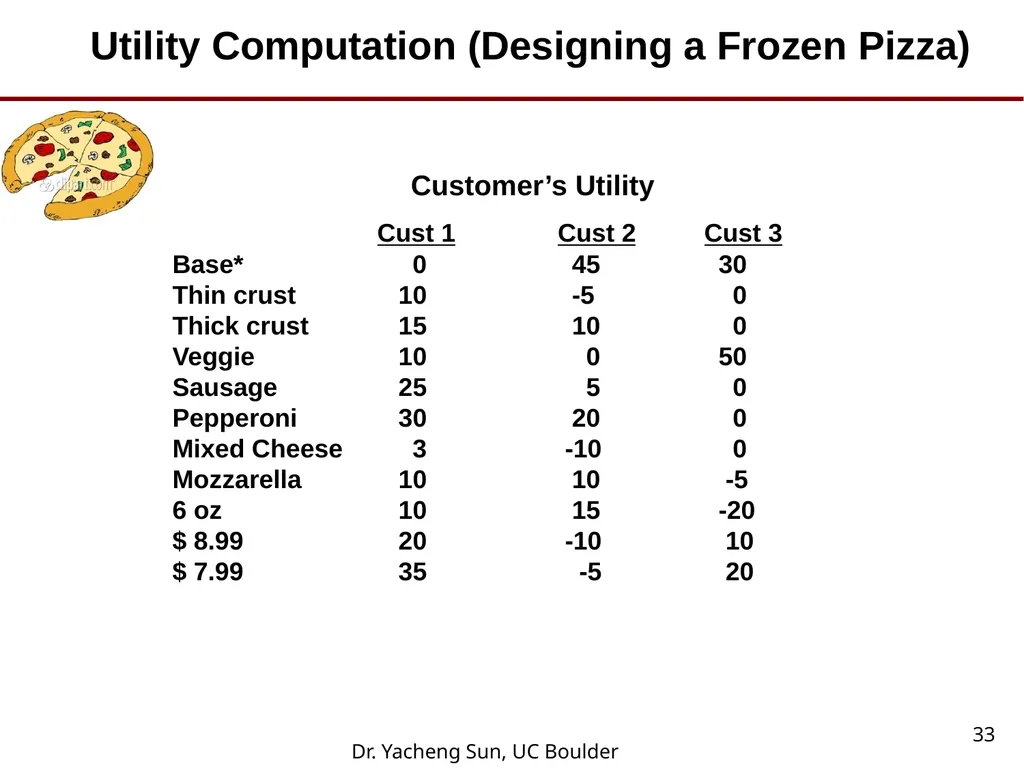
Utility Computation (Designing a Frozen Pizza) Dr. Yacheng Sun, UC Boulder 33<br>
34
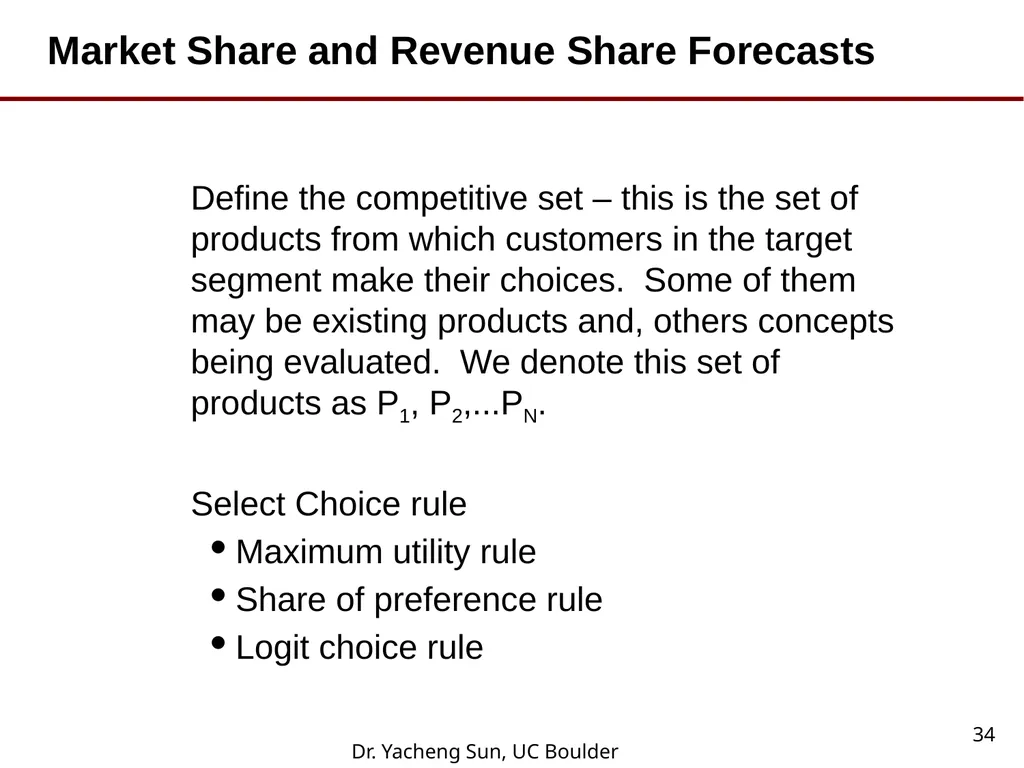
Define the competitive set – this is the set of products from which customers in the target segment make their choices. Some of them may be existing products and, others concepts being evaluated. We denote this set of products as P1, P2,...PN.
Select Choice rule
Maximum utility rule
Share of preference rule
Logit choice rule Market Share and Revenue Share Forecasts Dr. Yacheng Sun, UC Boulder 34<br>
Select Choice rule
Maximum utility rule
Share of preference rule
Logit choice rule Market Share and Revenue Share Forecasts Dr. Yacheng Sun, UC Boulder 34<br>
35
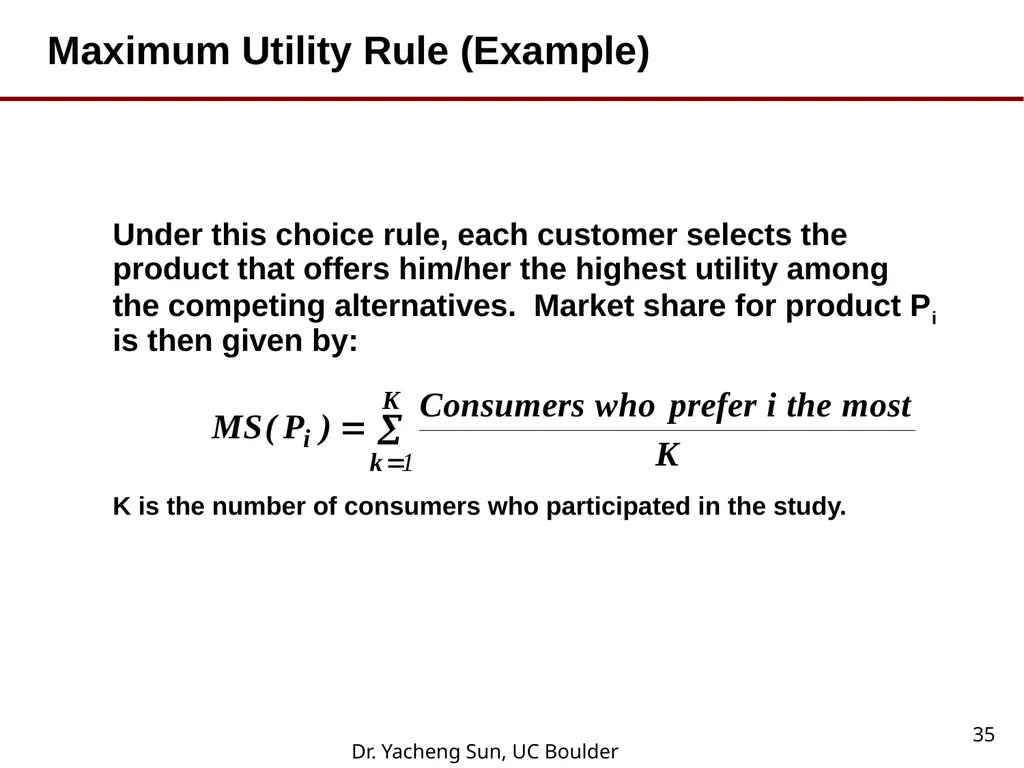
Maximum Utility Rule (Example) Under this choice rule, each customer selects the product that offers him/her the highest utility among the competing alternatives. Market share for product Pi is then given by:
K is the number of consumers who participated in the study. Dr. Yacheng Sun, UC Boulder 35<br>
K is the number of consumers who participated in the study. Dr. Yacheng Sun, UC Boulder 35<br>
36
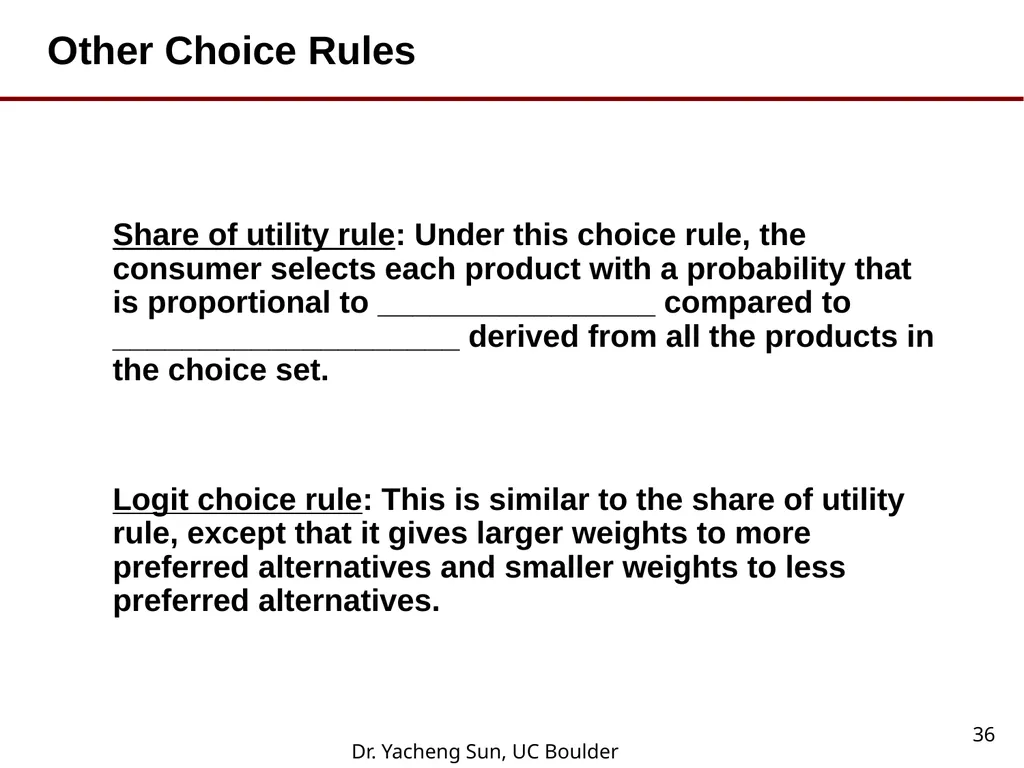
Other Choice Rules Share of utility rule: Under this choice rule, the consumer selects each product with a probability that is proportional to ________________ compared to ____________________ derived from all the products in the choice set.
Logit choice rule: This is similar to the share of utility rule, except that it gives larger weights to more preferred alternatives and smaller weights to less preferred alternatives. Dr. Yacheng Sun, UC Boulder 36<br>
Logit choice rule: This is similar to the share of utility rule, except that it gives larger weights to more preferred alternatives and smaller weights to less preferred alternatives. Dr. Yacheng Sun, UC Boulder 36<br>
37
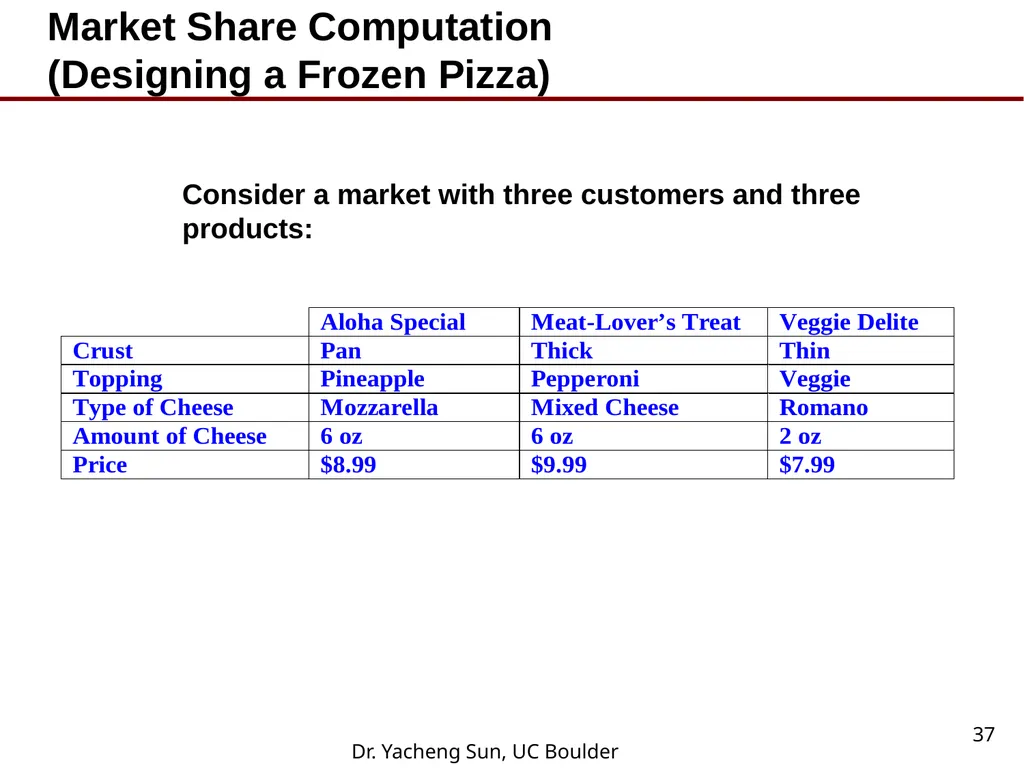
Market Share Computation
(Designing a Frozen Pizza) Consider a market with three customers and three products: Dr. Yacheng Sun, UC Boulder 37<br>
38
Market Share Computation
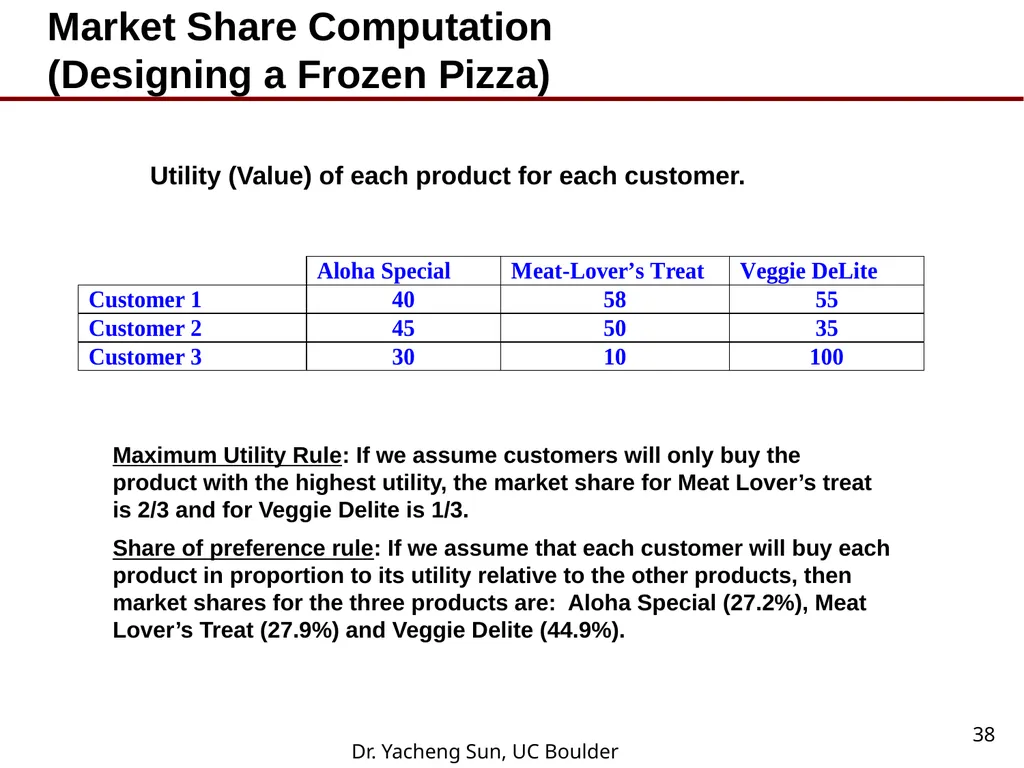
(Designing a Frozen Pizza) Utility (Value) of each product for each customer. Maximum Utility Rule: If we assume customers will only buy the product with the highest utility, the market share for Meat Lover’s treat is 2/3 and for Veggie Delite is 1/3.
Share of preference rule: If we assume that each customer will buy each product in proportion to its utility relative to the other products, then market shares for the three products are: Aloha Special (27.2%), Meat Lover’s Treat (27.9%) and Veggie Delite (44.9%). Dr. Yacheng Sun, UC Boulder 38<br>
Share of preference rule: If we assume that each customer will buy each product in proportion to its utility relative to the other products, then market shares for the three products are: Aloha Special (27.2%), Meat Lover’s Treat (27.9%) and Veggie Delite (44.9%). Dr. Yacheng Sun, UC Boulder 38<br>
39
Identifying Segments Based on
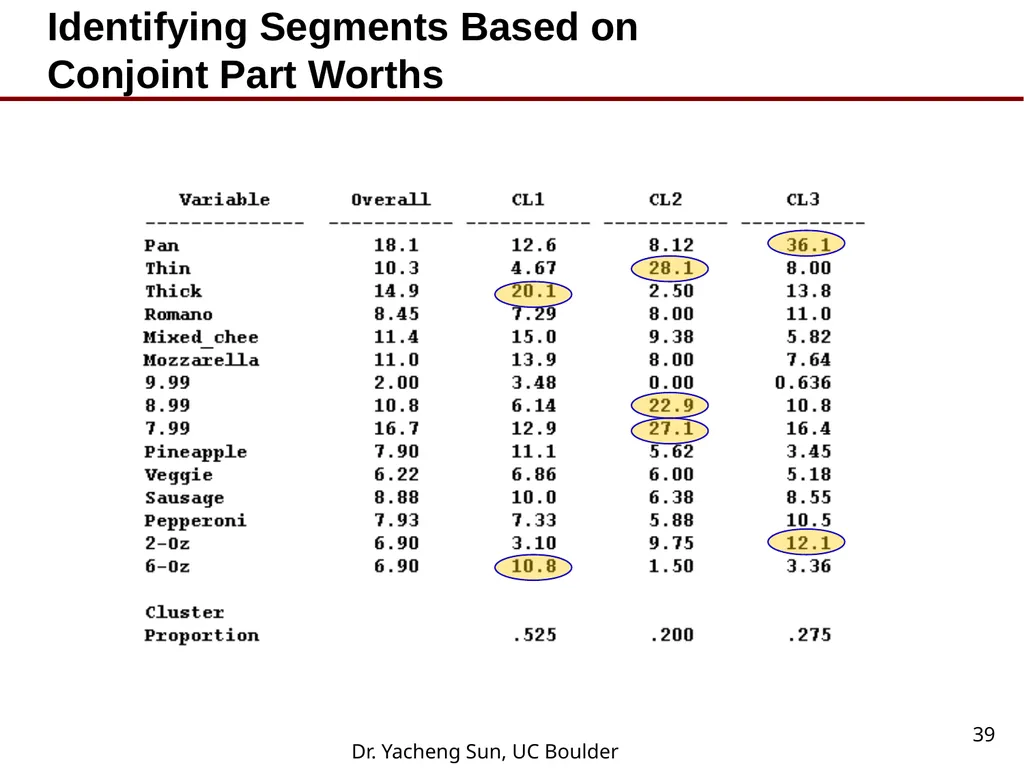
Conjoint Part Worths Dr. Yacheng Sun, UC Boulder 39<br>
40
Product Design for Specific Segments Design optimal product by segment
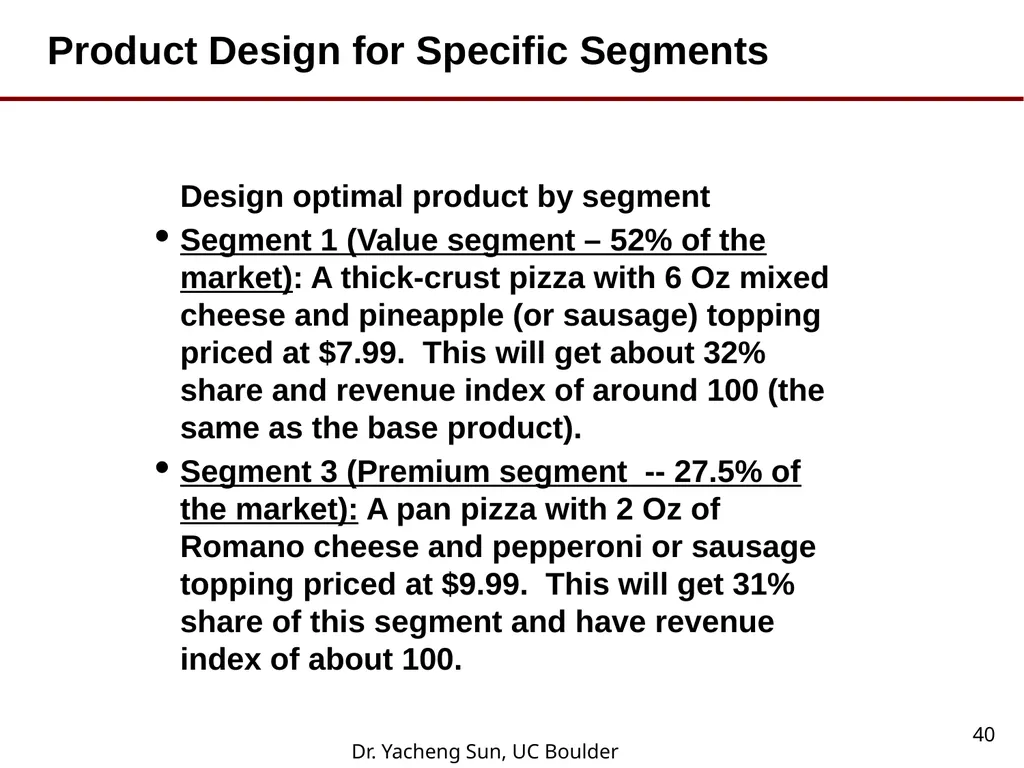
Segment 1 (Value segment – 52% of the market): A thick-crust pizza with 6 Oz mixed cheese and pineapple (or sausage) topping priced at $7.99. This will get about 32% share and revenue index of around 100 (the same as the base product).
Segment 3 (Premium segment -- 27.5% of the market): A pan pizza with 2 Oz of Romano cheese and pepperoni or sausage topping priced at $9.99. This will get 31% share of this segment and have revenue index of about 100. Dr. Yacheng Sun, UC Boulder 40<br>
Segment 1 (Value segment – 52% of the market): A thick-crust pizza with 6 Oz mixed cheese and pineapple (or sausage) topping priced at $7.99. This will get about 32% share and revenue index of around 100 (the same as the base product).
Segment 3 (Premium segment -- 27.5% of the market): A pan pizza with 2 Oz of Romano cheese and pepperoni or sausage topping priced at $9.99. This will get 31% share of this segment and have revenue index of about 100. Dr. Yacheng Sun, UC Boulder 40<br>
41
Next class: Price Levels and Policies Dr. Yacheng Sun, UC Boulder<br>