
DRAFT SKILLS GAP ANALYSIS TOOLKIT Skills Gap

Description: DRAFT SKILLS GAP ANALYSIS TOOLKIT Skills Gap Analysis Toolkit Contents Slide What is the toolkit? What is the approach? Roles and responsibilities Gathering inputs Hints and tips Workshop 1 - Where are we now? Workshop 2 - Where do we want
Related Topics
Download Presentation
"DRAFT SKILLS GAP ANALYSIS TOOLKIT Skills Gap" is the property of its rightful owner. Permission is granted to download and print the materials on this website for personal, non-commercial use only, and to display it on your personal computer provided you do not modify the materials and that you retain all copyright notices contained in the materials. By downloading content from our website, you accept the terms of this agreement.
Presentation Transcript
slide1. DRAFT SKILLS GAP ANALYSIS TOOLKIT<br>
slide2. Skills Gap Analysis Toolkit
Contents Slide
What is the toolkit?
What is the approach?
Roles and responsibilities
Gathering inputs
Hints and tips
Workshop 1 - Where are we now?
Workshop 2 - Where do we want to be?
- Output: Future Skills Summary
Workshop 3 - What is the gap?
- Output: Skills Gap Analysis Action Plan Please Note: This content is to be used in conjunction with the Data Template and Skills Dictionary<br>
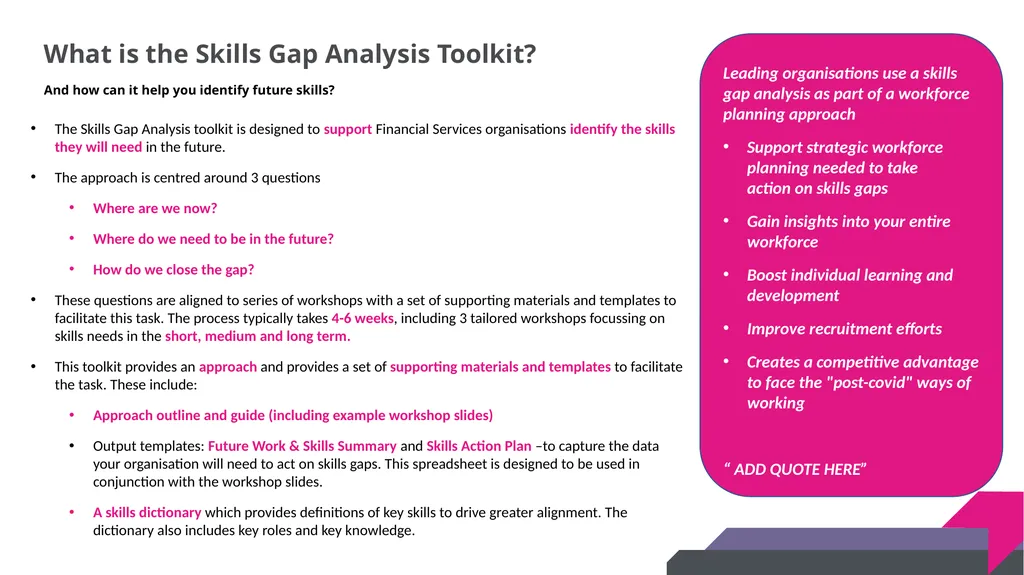
slide3. What is the Skills Gap Analysis Toolkit? And how can it help you identify future skills? The Skills Gap Analysis toolkit is designed to support Financial Services organisations identify the skills they will need in the future.
The approach is centred around 3 questions
Where are we now?
Where do we need to be in the future?
How do we close the gap?
These questions are aligned to series of workshops with a set of supporting materials and templates to facilitate this task. The process typically takes 4-6 weeks, including 3 tailored workshops focussing on skills needs in the short, medium and long term.
This toolkit provides an approach and provides a set of supporting materials and templates to facilitate the task. These include:
Approach outline and guide (including example workshop slides)
Output templates: Future Work & Skills Summary and Skills Action Plan –to capture the data your organisation will need to act on skills gaps. This spreadsheet is designed to be used in conjunction with the workshop slides.
A skills dictionary which provides definitions of key skills to drive greater alignment. The dictionary also includes key roles and key knowledge. Leading organisations use a skills gap analysis as part of a workforce planning approach
Support strategic workforce planning needed to take action on skills gaps
Gain insights into your entire workforce
Boost individual learning and development
Improve recruitment efforts
Creates a competitive advantage to face the "post-covid" ways of working
“ ADD QUOTE HERE”<br>
slide4. Gathering Inputs<br>
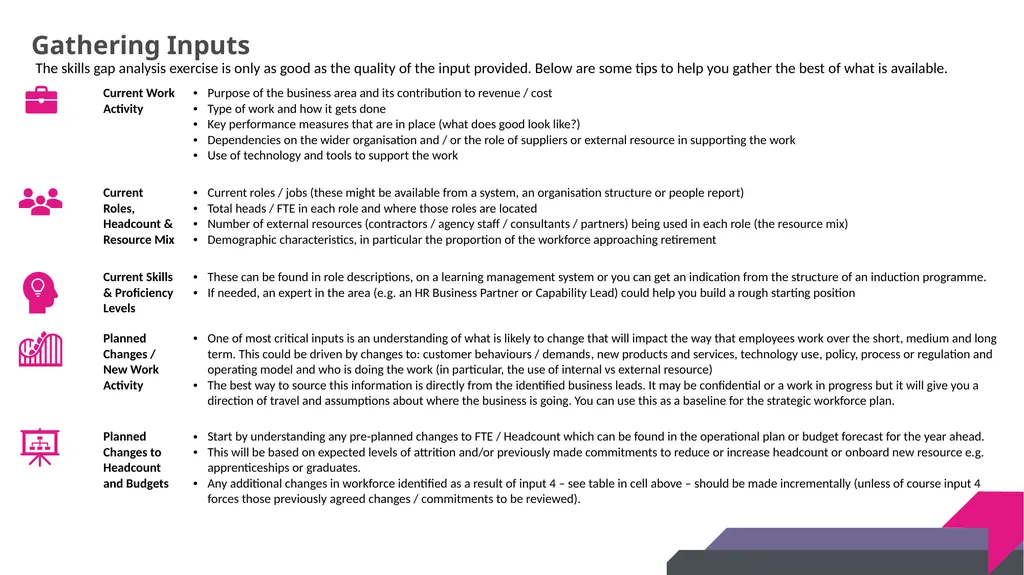
slide5. Gathering Inputs The skills gap analysis exercise is only as good as the quality of the input provided. Below are some tips to help you gather the best of what is available.<br>
slide6. Hints & Tips<br>
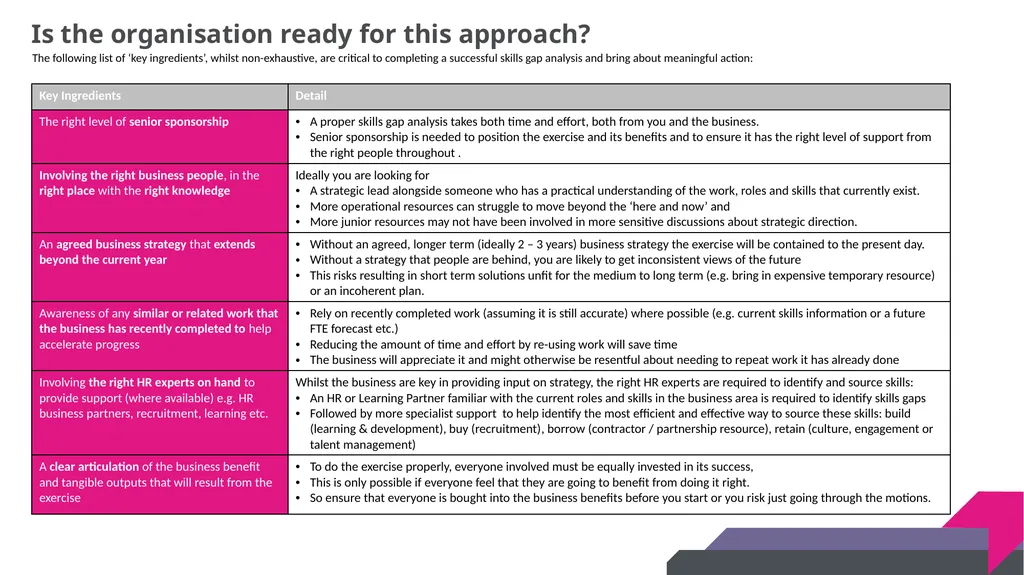
slide7. Is the organisation ready for this approach? The following list of ‘key ingredients’, whilst non-exhaustive, are critical to completing a successful skills gap analysis and bring about meaningful action:<br>
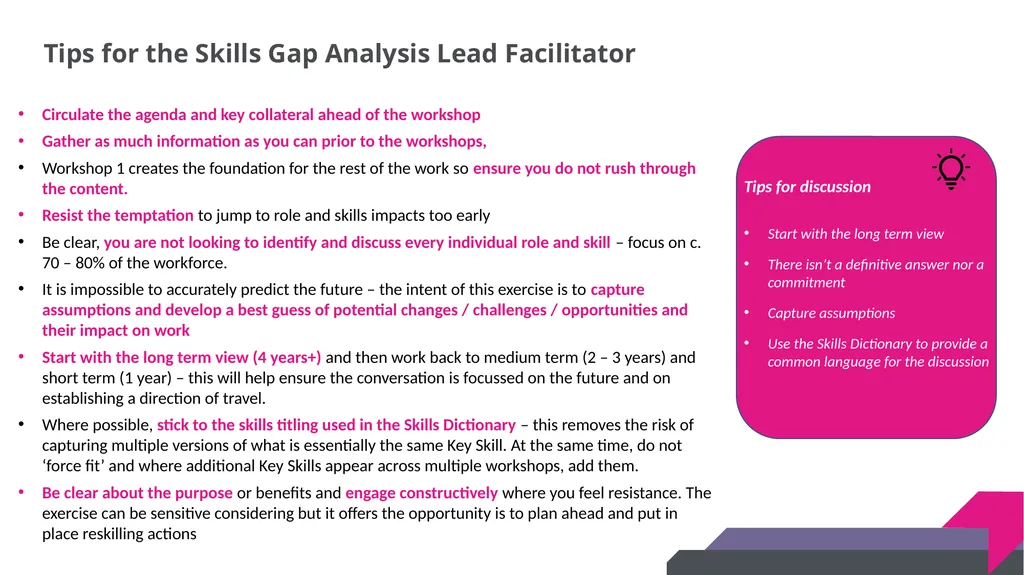
slide8. Tips for the Skills Gap Analysis Lead Facilitator Circulate the agenda and key collateral ahead of the workshop
Gather as much information as you can prior to the workshops,
Workshop 1 creates the foundation for the rest of the work so ensure you do not rush through the content.
Resist the temptation to jump to role and skills impacts too early
Be clear, you are not looking to identify and discuss every individual role and skill – focus on c. 70 – 80% of the workforce.
It is impossible to accurately predict the future – the intent of this exercise is to capture assumptions and develop a best guess of potential changes / challenges / opportunities and their impact on work
Start with the long term view (4 years+) and then work back to medium term (2 – 3 years) and short term (1 year) – this will help ensure the conversation is focussed on the future and on establishing a direction of travel.
Where possible, stick to the skills titling used in the Skills Dictionary – this removes the risk of capturing multiple versions of what is essentially the same Key Skill. At the same time, do not ‘force fit’ and where additional Key Skills appear across multiple workshops, add them.
Be clear about the purpose or benefits and engage constructively where you feel resistance. The exercise can be sensitive considering but it offers the opportunity is to plan ahead and put in place reskilling actions Tips for discussion
Start with the long term view
There isn’t a definitive answer nor a commitment
Capture assumptions
Use the Skills Dictionary to provide a common language for the discussion<br>
slide9. Workshop 1:
Where are we now?<br>
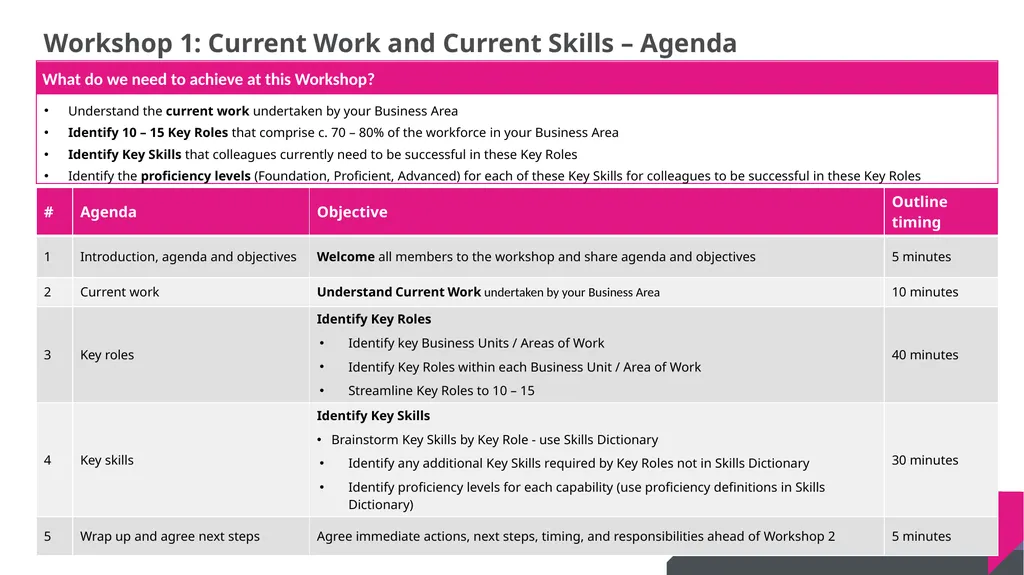
slide10. 10 Workshop 1: Current Work and Current Skills – Agenda Understand the current work undertaken by your Business Area
Identify 10 – 15 Key Roles that comprise c. 70 – 80% of the workforce in your Business Area
Identify Key Skills that colleagues currently need to be successful in these Key Roles
Identify the proficiency levels (Foundation, Proficient, Advanced) for each of these Key Skills for colleagues to be successful in these Key Roles What do we need to achieve at this Workshop?<br>
slide11. Workshop 1
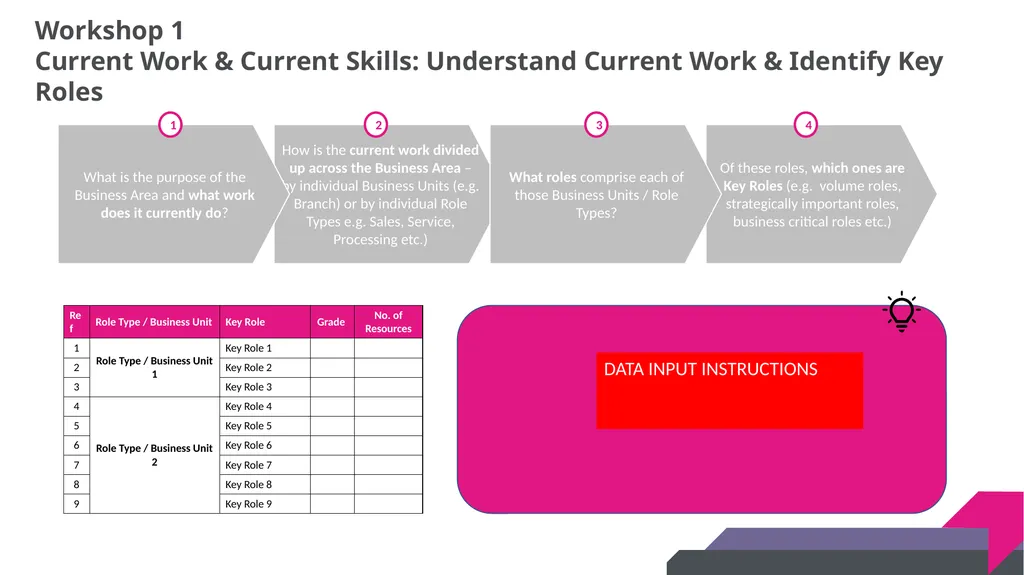
Current Work & Current Skills: Understand Current Work & Identify Key Roles 1 2 3 4 DATA INPUT INSTRUCTIONS<br>
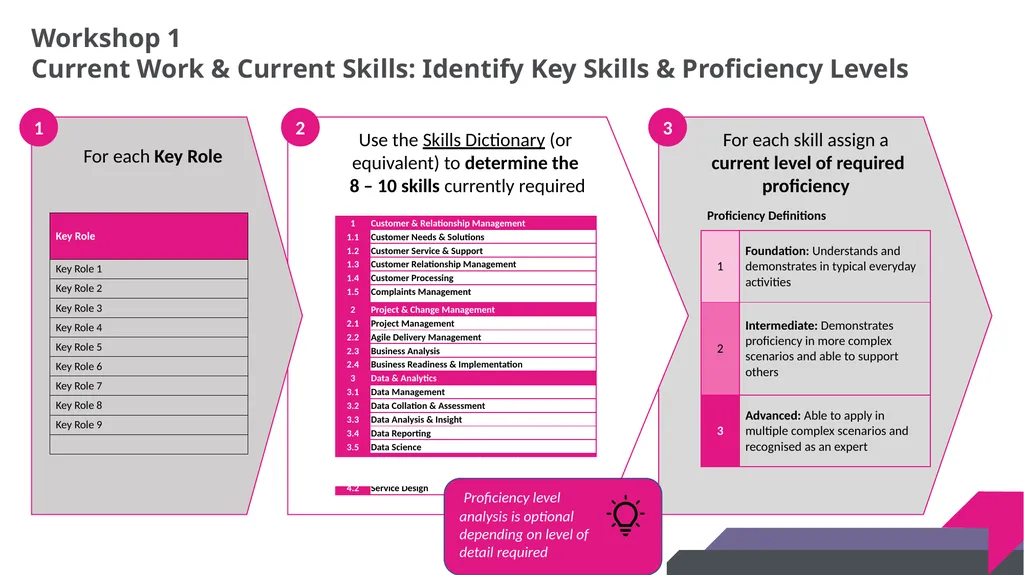
slide12. Workshop 1
Current Work & Current Skills: Identify Key Skills & Proficiency Levels For each skill assign a
current level of required proficiency Use the Skills Dictionary (or
equivalent) to determine the
8 – 10 skills currently required For each Key Role 1 2 3 Proficiency level analysis is optional depending on level of detail required<br>
slide13. Workshop 2:
Where do we want to be?<br>
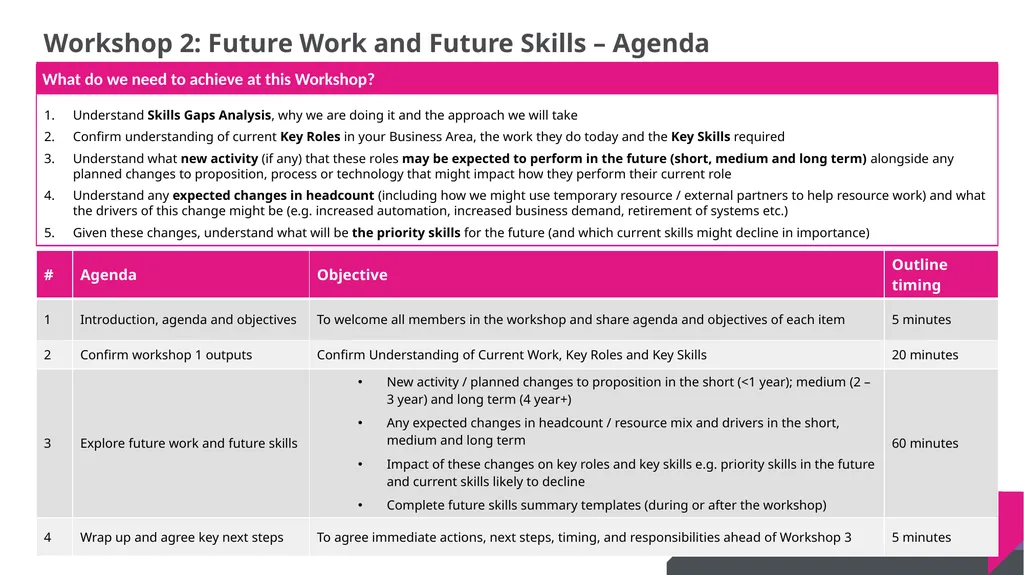
slide14. 14 Workshop 2: Future Work and Future Skills – Agenda Understand Skills Gaps Analysis, why we are doing it and the approach we will take
Confirm understanding of current Key Roles in your Business Area, the work they do today and the Key Skills required
Understand what new activity (if any) that these roles may be expected to perform in the future (short, medium and long term) alongside any planned changes to proposition, process or technology that might impact how they perform their current role
Understand any expected changes in headcount (including how we might use temporary resource / external partners to help resource work) and what the drivers of this change might be (e.g. increased automation, increased business demand, retirement of systems etc.)
Given these changes, understand what will be the priority skills for the future (and which current skills might decline in importance) What do we need to achieve at this Workshop?<br>
slide15. 15 Workshop 2
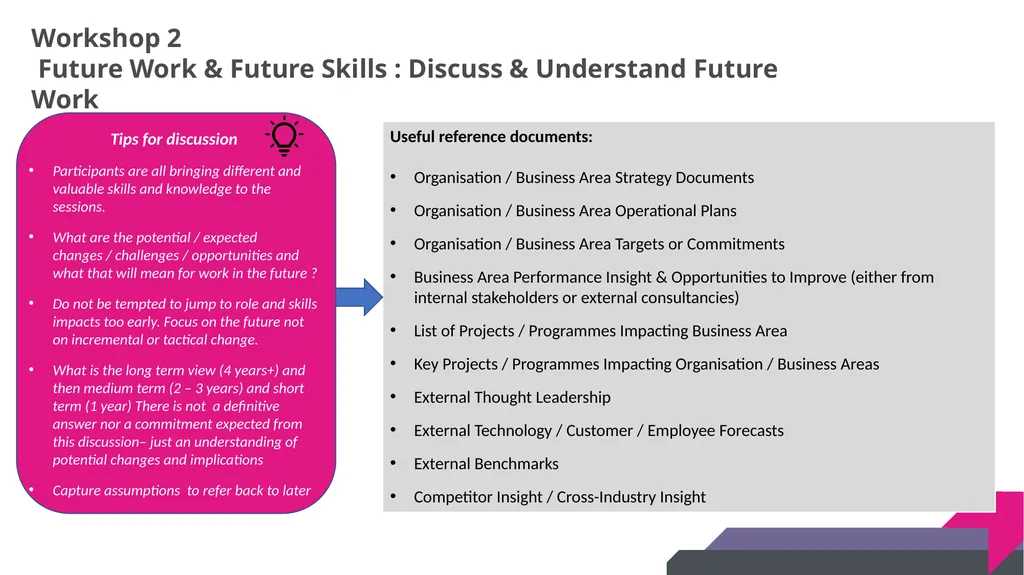
Future Work & Future Skills : Discuss & Understand Future Work Useful reference documents:
Organisation / Business Area Strategy Documents
Organisation / Business Area Operational Plans
Organisation / Business Area Targets or Commitments
Business Area Performance Insight & Opportunities to Improve (either from internal stakeholders or external consultancies)
List of Projects / Programmes Impacting Business Area
Key Projects / Programmes Impacting Organisation / Business Areas
External Thought Leadership
External Technology / Customer / Employee Forecasts
External Benchmarks
Competitor Insight / Cross-Industry Insight Tips for discussion
Participants are all bringing different and valuable skills and knowledge to the sessions.
What are the potential / expected changes / challenges / opportunities and what that will mean for work in the future ?
Do not be tempted to jump to role and skills impacts too early. Focus on the future not on incremental or tactical change.
What is the long term view (4 years+) and then medium term (2 – 3 years) and short term (1 year) There is not a definitive answer nor a commitment expected from this discussion– just an understanding of potential changes and implications
Capture assumptions to refer back to later<br>
slide16. 16 Workshop 2
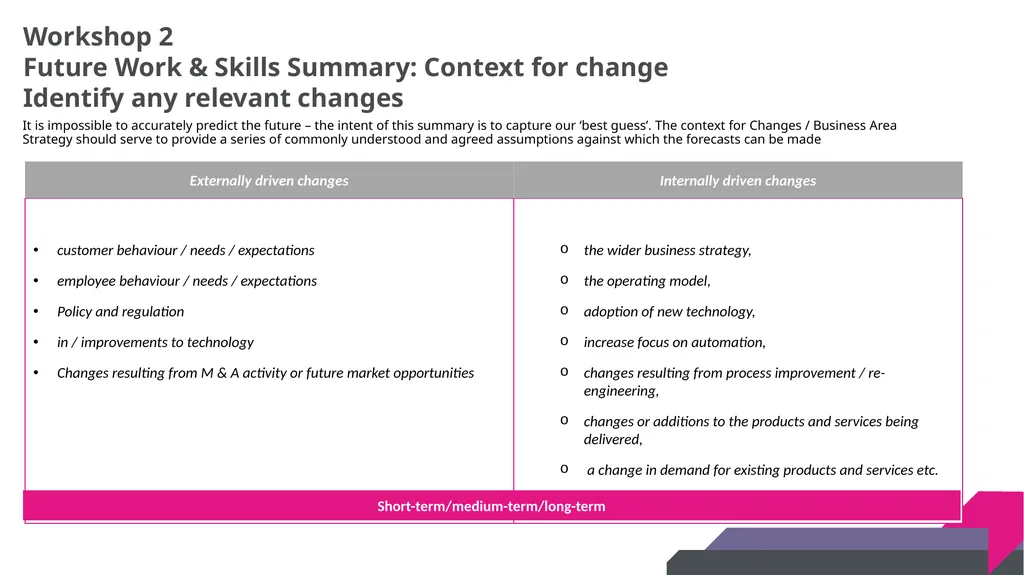
Future Work & Skills Summary: Context for change
Identify any relevant changes customer behaviour / needs / expectations
employee behaviour / needs / expectations
Policy and regulation
in / improvements to technology
Changes resulting from M & A activity or future market opportunities the wider business strategy,
the operating model,
adoption of new technology,
increase focus on automation,
changes resulting from process improvement / re-engineering,
changes or additions to the products and services being delivered,
a change in demand for existing products and services etc. Externally driven changes Internally driven changes Short-term/medium-term/long-term It is impossible to accurately predict the future – the intent of this summary is to capture our ‘best guess’. The context for Changes / Business Area Strategy should serve to provide a series of commonly understood and agreed assumptions against which the forecasts can be made<br>
slide17. Workshop 2
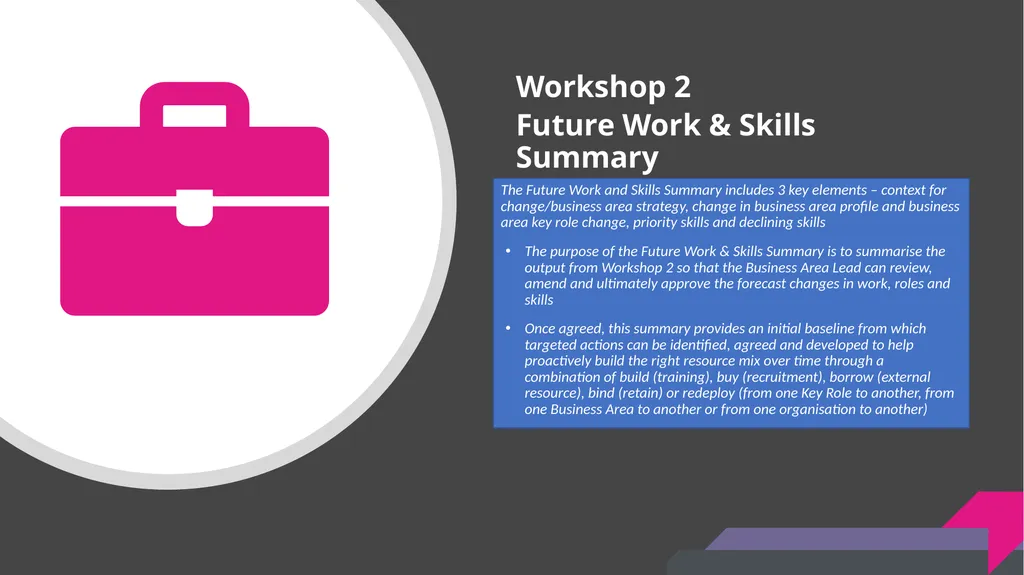
Future Work & Skills Summary The Future Work and Skills Summary includes 3 key elements – context for change/business area strategy, change in business area profile and business area key role change, priority skills and declining skills
The purpose of the Future Work & Skills Summary is to summarise the output from Workshop 2 so that the Business Area Lead can review, amend and ultimately approve the forecast changes in work, roles and skills
Once agreed, this summary provides an initial baseline from which targeted actions can be identified, agreed and developed to help proactively build the right resource mix over time through a combination of build (training), buy (recruitment), borrow (external resource), bind (retain) or redeploy (from one Key Role to another, from one Business Area to another or from one organisation to another)<br>
slide18. Workshop 2
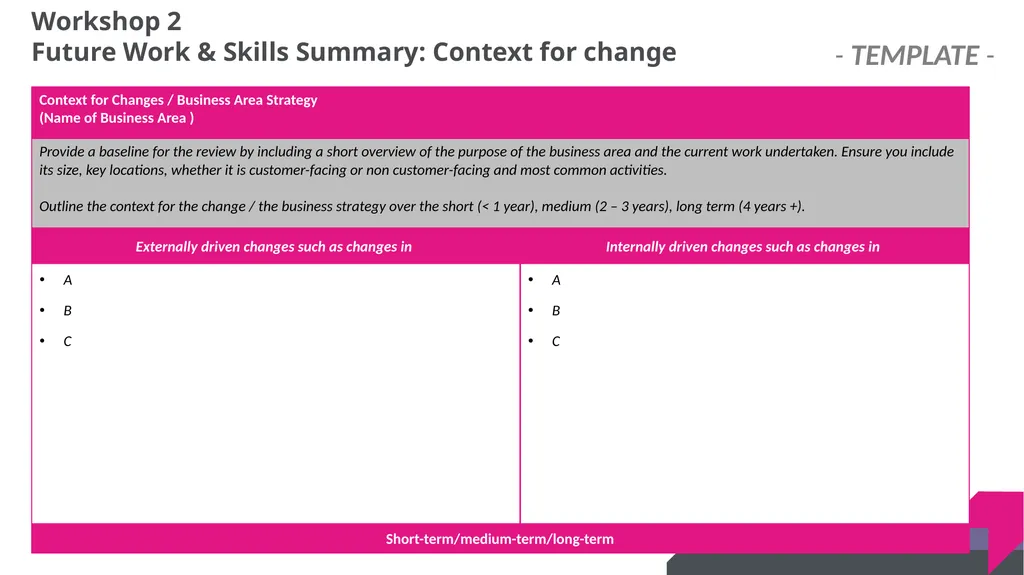
Future Work & Skills Summary: Context for change - TEMPLATE - A
B
C A
B
C Externally driven changes such as changes in Internally driven changes such as changes in Short-term/medium-term/long-term<br>
slide19. Workshop 2
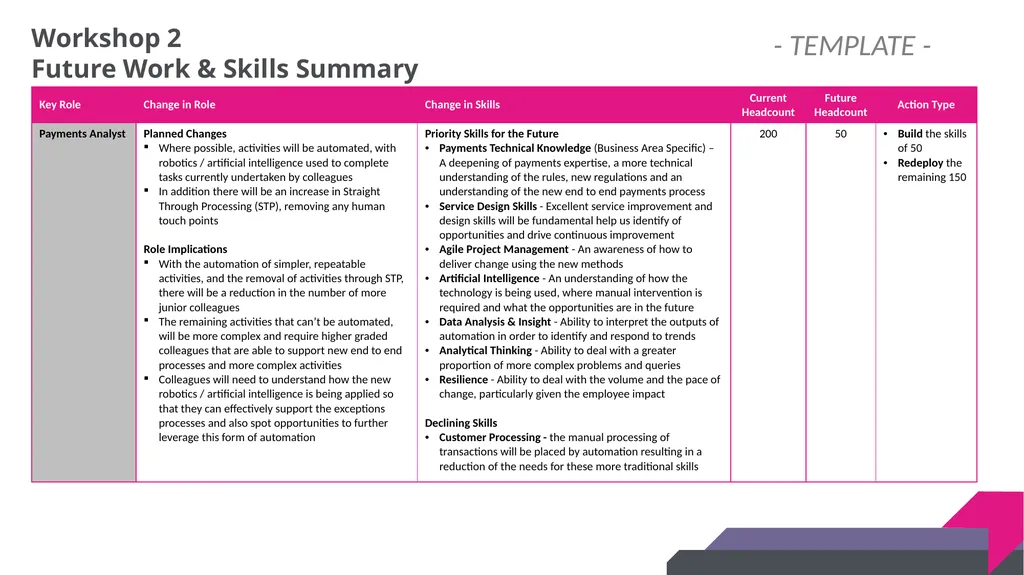
Future Work & Skills Summary - TEMPLATE -<br>
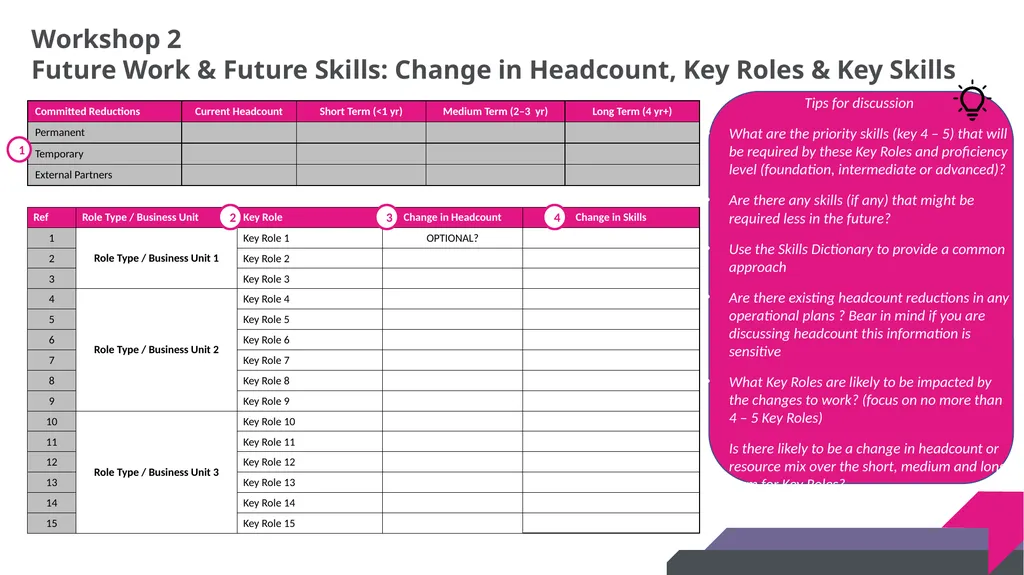
slide20. 1 2 3 4 Tips for discussion
What are the priority skills (key 4 – 5) that will be required by these Key Roles and proficiency level (foundation, intermediate or advanced)?
Are there any skills (if any) that might be required less in the future?
Use the Skills Dictionary to provide a common approach
Are there existing headcount reductions in any operational plans ? Bear in mind if you are discussing headcount this information is sensitive
What Key Roles are likely to be impacted by the changes to work? (focus on no more than 4 – 5 Key Roles)
Is there likely to be a change in headcount or resource mix over the short, medium and long term for Key Roles? Workshop 2
Future Work & Future Skills: Change in Headcount, Key Roles & Key Skills<br>
slide21. Workshop 2
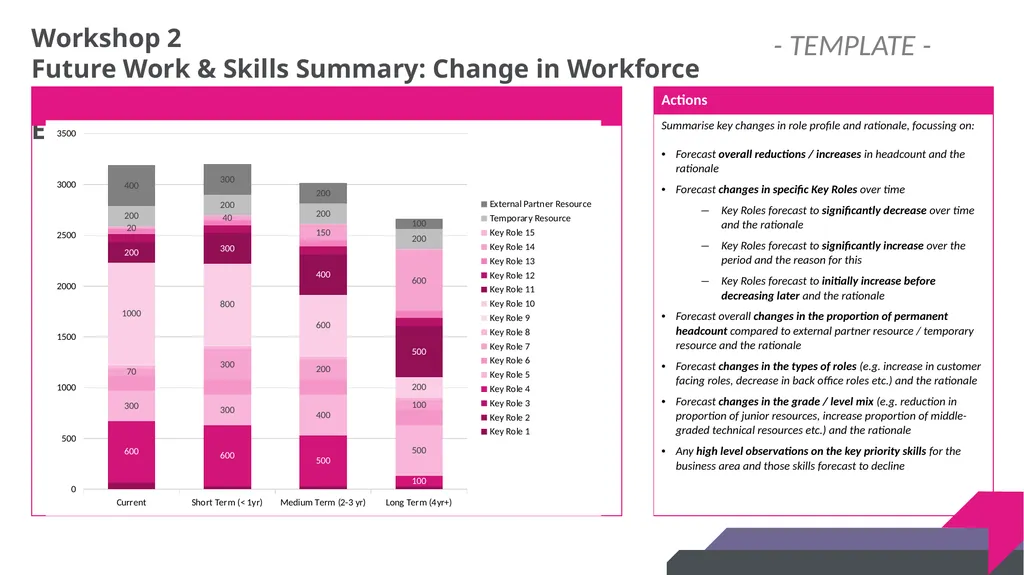
Future Work & Skills Summary: Change in Workforce Profile
EXAMPLE OUTPUT - TEMPLATE -<br>
slide22. Workshop 3:
What is the gap?<br>
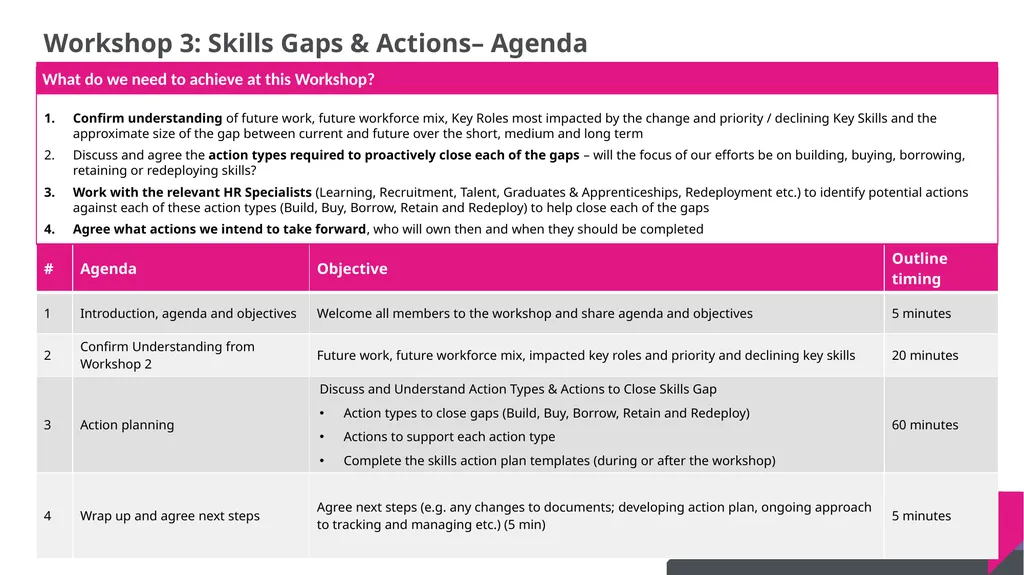
slide23. 23 Workshop 3: Skills Gaps & Actions– Agenda Confirm understanding of future work, future workforce mix, Key Roles most impacted by the change and priority / declining Key Skills and the approximate size of the gap between current and future over the short, medium and long term
Discuss and agree the action types required to proactively close each of the gaps – will the focus of our efforts be on building, buying, borrowing, retaining or redeploying skills?
Work with the relevant HR Specialists (Learning, Recruitment, Talent, Graduates & Apprenticeships, Redeployment etc.) to identify potential actions against each of these action types (Build, Buy, Borrow, Retain and Redeploy) to help close each of the gaps
Agree what actions we intend to take forward, who will own then and when they should be completed What do we need to achieve at this Workshop?<br>
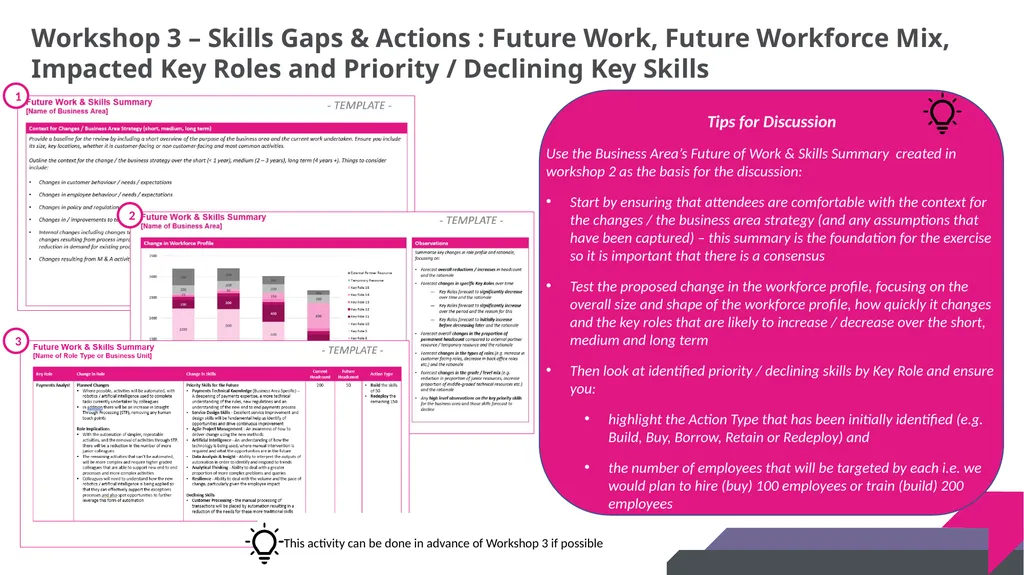
slide24. Workshop 3 – Skills Gaps & Actions : Future Work, Future Workforce Mix, Impacted Key Roles and Priority / Declining Key Skills 1 2 3 This activity can be done in advance of Workshop 3 if possible Tips for Discussion
Use the Business Area’s Future of Work & Skills Summary created in workshop 2 as the basis for the discussion:
Start by ensuring that attendees are comfortable with the context for the changes / the business area strategy (and any assumptions that have been captured) – this summary is the foundation for the exercise so it is important that there is a consensus
Test the proposed change in the workforce profile, focusing on the overall size and shape of the workforce profile, how quickly it changes and the key roles that are likely to increase / decrease over the short, medium and long term
Then look at identified priority / declining skills by Key Role and ensure you:
highlight the Action Type that has been initially identified (e.g. Build, Buy, Borrow, Retain or Redeploy) and
the number of employees that will be targeted by each i.e. we would plan to hire (buy) 100 employees or train (build) 200 employees<br>
slide25. Workshop 3 – Five Action Types to Close Gaps This includes Re-skilling / Up-skilling / Training existing staff.
Divided by length & complexity:
up to 1 week;
2 weeks up to 3 months;
3 months+ This covers bringing permanent resource into the workforce from outside.
Often the most expensive Action Type. Use if:
building the skills takes too long / is too expensive or
if an immediate injection of different skills is required This includes hiring Temporary staff and working with Partners.
Often more expensive than Building but faster to onboard than Buying. Use
As effective temporary cover until you have time to build skills internally
To deliver non-core activity in a more cost effective manner This means identifying populations who may be in roles or have skills that aren’t needed in the future and supporting them to be redeployed either elsewhere in the organisation or in another organisation.
Starting this process early is important. This means creating a retention plan to ensure that you do not lose those employees that already have the skills you need, whilst you are closing the gaps elsewhere. Buy Borrow Retain Redeploy Foundational Training Course
Online Skills & Knowledge Hubs
Technical Training Programmes
External Training Courses / Programme
Professional Qualifications / Accreditations
Apprenticeship Programme (Internal)
Internal Rotation Programmes
Short Term Job Secondments
On the Job Coaching Enhance Employee Value Proposition & Brand
Targeted Recruitment Campaign
Apprenticeship Programme (External)
Graduate Development Programmes Use of Fixed Term Contractors
Use of Strategic External Partnerships
Use of Consultancies Improve Reward & Recognition
Individually Align Role Purpose, Responsibilities & Activities
Offer Growth & Development (incl. Opportunities)
Improve Work Environment & Technology
Increase Work Flexibility & Autonomy
Improve Line Management & Support Online Re-skilling / Redeployment Hubs
Re-skilling incentives and time
Increased transparency of internal/external job opportunities
Dedicated Redeployment Support
Cross-organisational Redeployment Partnerships Consider which relevant Human Resources Specialist should lead on the relevant Action Type depending on which resources are available to ensure their expertise and experience is incorporated. For example; HR Learning Specialists could lead on the ‘Build’ discussion; Build<br>
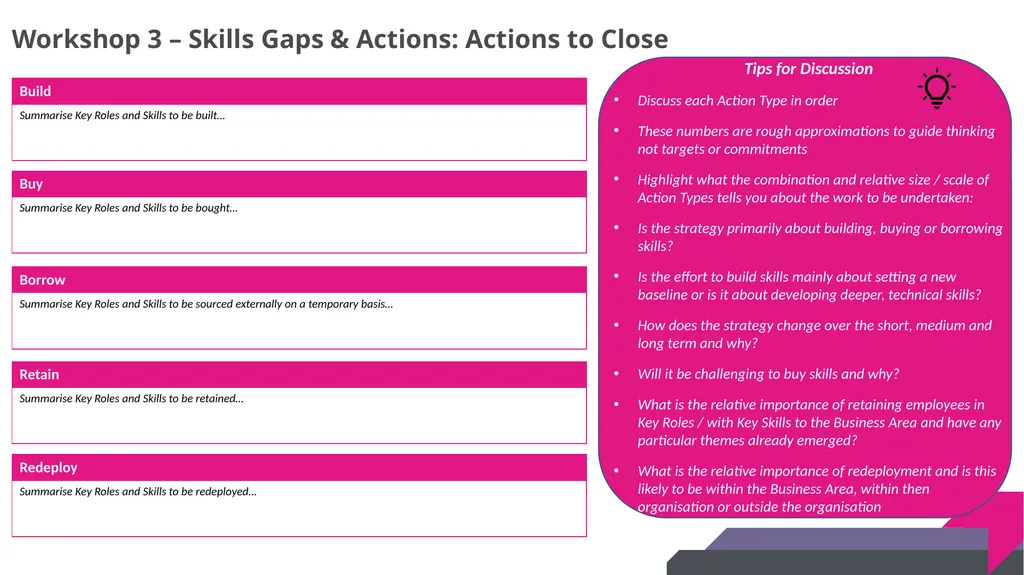
slide26. Workshop 3 – Skills Gaps & Actions: Actions to Close Tips for Discussion
Discuss each Action Type in order
These numbers are rough approximations to guide thinking not targets or commitments
Highlight what the combination and relative size / scale of Action Types tells you about the work to be undertaken:
Is the strategy primarily about building, buying or borrowing skills?
Is the effort to build skills mainly about setting a new baseline or is it about developing deeper, technical skills?
How does the strategy change over the short, medium and long term and why?
Will it be challenging to buy skills and why?
What is the relative importance of retaining employees in Key Roles / with Key Skills to the Business Area and have any particular themes already emerged?
What is the relative importance of redeployment and is this likely to be within the Business Area, within then organisation or outside the organisation<br>
slide27. Workshop 3
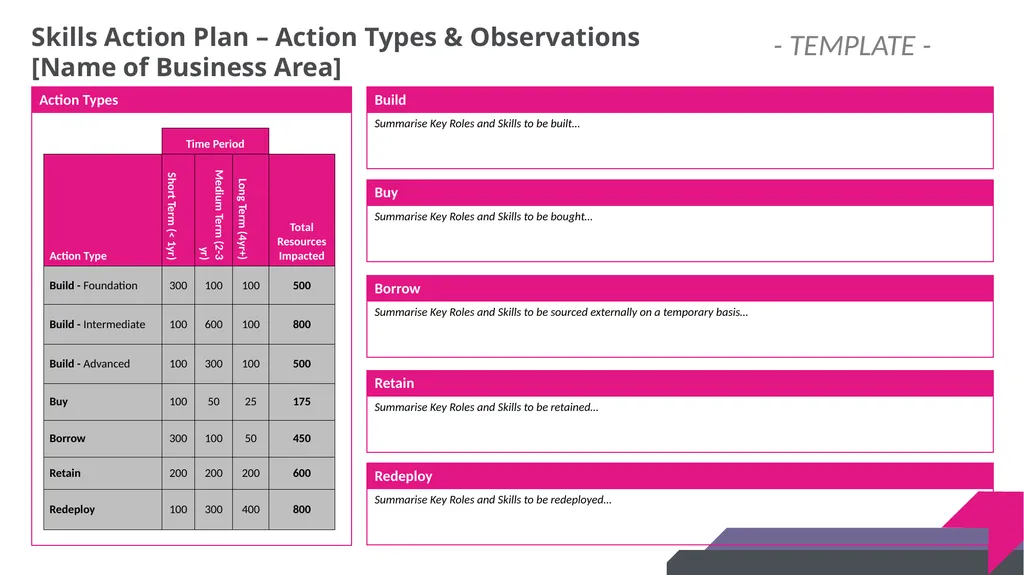
Skills Action Plan The Skills Action Plan helps to summarise, by business area, the outputs and actions from the 3 workshops in core templates. These can then be agreed and used in discussions with key stakeholders for the purpose of planning.<br>
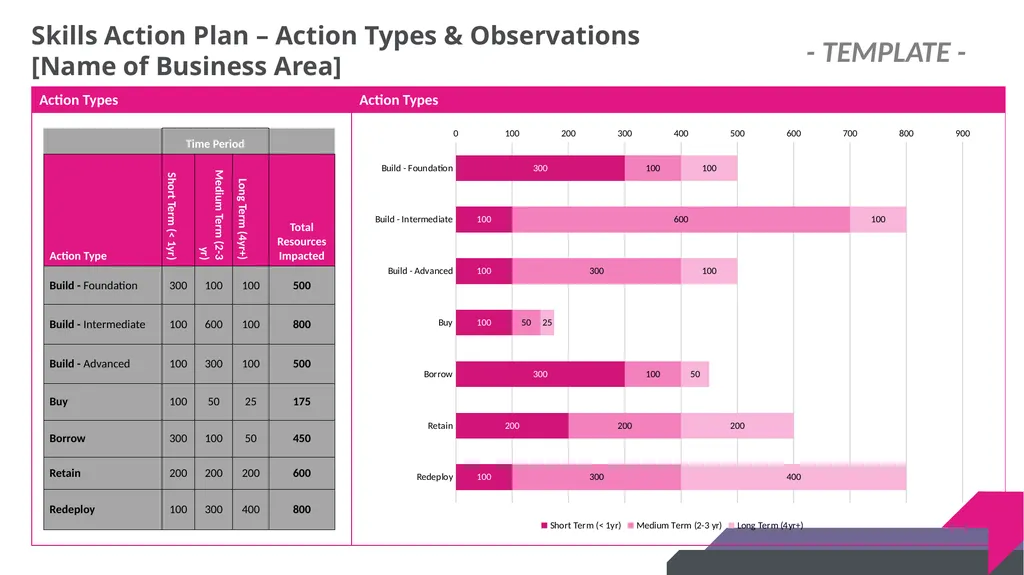
slide28. Skills Action Plan – Action Types & Observations
[Name of Business Area] - TEMPLATE -<br>
slide29. Skills Action Plan – Action Types & Observations
[Name of Business Area] - TEMPLATE -<br>
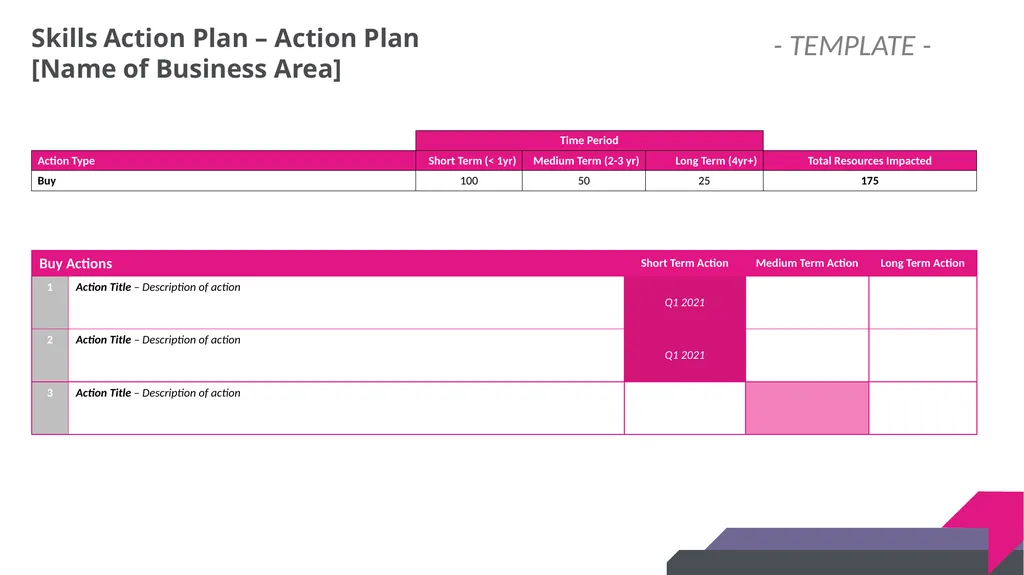
slide30. Skills Action Plan – Action Plan
[Name of Business Area] - TEMPLATE -<br>
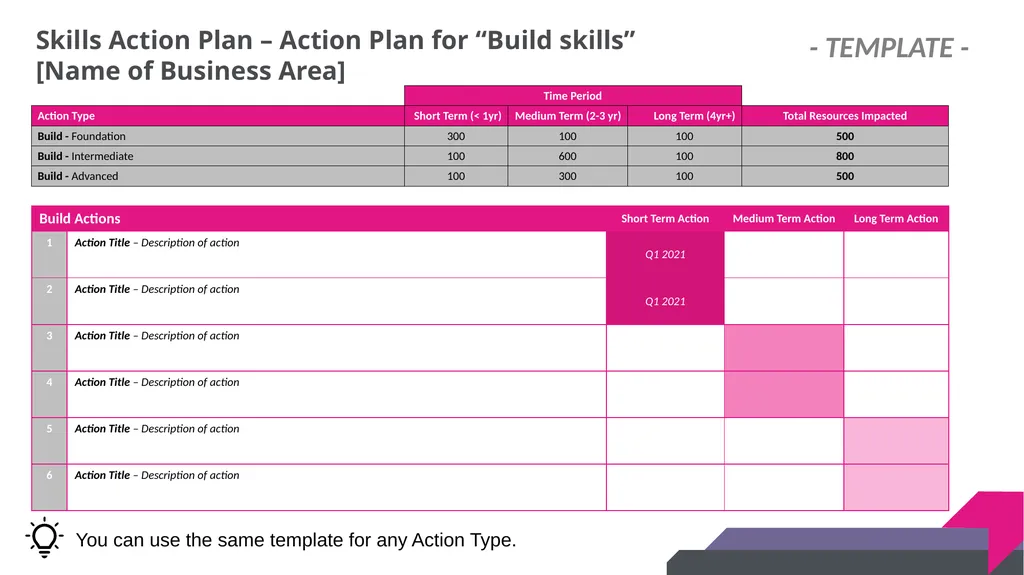
slide31. Skills Action Plan – Action Plan for “Build skills”
[Name of Business Area] - TEMPLATE - You can use the same template for any Action Type.<br>
slide2. Skills Gap Analysis Toolkit
Contents Slide
What is the toolkit?
What is the approach?
Roles and responsibilities
Gathering inputs
Hints and tips
Workshop 1 - Where are we now?
Workshop 2 - Where do we want to be?
- Output: Future Skills Summary
Workshop 3 - What is the gap?
- Output: Skills Gap Analysis Action Plan Please Note: This content is to be used in conjunction with the Data Template and Skills Dictionary<br>
slide3. What is the Skills Gap Analysis Toolkit? And how can it help you identify future skills? The Skills Gap Analysis toolkit is designed to support Financial Services organisations identify the skills they will need in the future.
The approach is centred around 3 questions
Where are we now?
Where do we need to be in the future?
How do we close the gap?
These questions are aligned to series of workshops with a set of supporting materials and templates to facilitate this task. The process typically takes 4-6 weeks, including 3 tailored workshops focussing on skills needs in the short, medium and long term.
This toolkit provides an approach and provides a set of supporting materials and templates to facilitate the task. These include:
Approach outline and guide (including example workshop slides)
Output templates: Future Work & Skills Summary and Skills Action Plan –to capture the data your organisation will need to act on skills gaps. This spreadsheet is designed to be used in conjunction with the workshop slides.
A skills dictionary which provides definitions of key skills to drive greater alignment. The dictionary also includes key roles and key knowledge. Leading organisations use a skills gap analysis as part of a workforce planning approach
Support strategic workforce planning needed to take action on skills gaps
Gain insights into your entire workforce
Boost individual learning and development
Improve recruitment efforts
Creates a competitive advantage to face the "post-covid" ways of working
“ ADD QUOTE HERE”<br>
slide4. Gathering Inputs<br>
slide5. Gathering Inputs The skills gap analysis exercise is only as good as the quality of the input provided. Below are some tips to help you gather the best of what is available.<br>
slide6. Hints & Tips<br>
slide7. Is the organisation ready for this approach? The following list of ‘key ingredients’, whilst non-exhaustive, are critical to completing a successful skills gap analysis and bring about meaningful action:<br>
slide8. Tips for the Skills Gap Analysis Lead Facilitator Circulate the agenda and key collateral ahead of the workshop
Gather as much information as you can prior to the workshops,
Workshop 1 creates the foundation for the rest of the work so ensure you do not rush through the content.
Resist the temptation to jump to role and skills impacts too early
Be clear, you are not looking to identify and discuss every individual role and skill – focus on c. 70 – 80% of the workforce.
It is impossible to accurately predict the future – the intent of this exercise is to capture assumptions and develop a best guess of potential changes / challenges / opportunities and their impact on work
Start with the long term view (4 years+) and then work back to medium term (2 – 3 years) and short term (1 year) – this will help ensure the conversation is focussed on the future and on establishing a direction of travel.
Where possible, stick to the skills titling used in the Skills Dictionary – this removes the risk of capturing multiple versions of what is essentially the same Key Skill. At the same time, do not ‘force fit’ and where additional Key Skills appear across multiple workshops, add them.
Be clear about the purpose or benefits and engage constructively where you feel resistance. The exercise can be sensitive considering but it offers the opportunity is to plan ahead and put in place reskilling actions Tips for discussion
Start with the long term view
There isn’t a definitive answer nor a commitment
Capture assumptions
Use the Skills Dictionary to provide a common language for the discussion<br>
slide9. Workshop 1:
Where are we now?<br>
slide10. 10 Workshop 1: Current Work and Current Skills – Agenda Understand the current work undertaken by your Business Area
Identify 10 – 15 Key Roles that comprise c. 70 – 80% of the workforce in your Business Area
Identify Key Skills that colleagues currently need to be successful in these Key Roles
Identify the proficiency levels (Foundation, Proficient, Advanced) for each of these Key Skills for colleagues to be successful in these Key Roles What do we need to achieve at this Workshop?<br>
slide11. Workshop 1
Current Work & Current Skills: Understand Current Work & Identify Key Roles 1 2 3 4 DATA INPUT INSTRUCTIONS<br>
slide12. Workshop 1
Current Work & Current Skills: Identify Key Skills & Proficiency Levels For each skill assign a
current level of required proficiency Use the Skills Dictionary (or
equivalent) to determine the
8 – 10 skills currently required For each Key Role 1 2 3 Proficiency level analysis is optional depending on level of detail required<br>
slide13. Workshop 2:
Where do we want to be?<br>
slide14. 14 Workshop 2: Future Work and Future Skills – Agenda Understand Skills Gaps Analysis, why we are doing it and the approach we will take
Confirm understanding of current Key Roles in your Business Area, the work they do today and the Key Skills required
Understand what new activity (if any) that these roles may be expected to perform in the future (short, medium and long term) alongside any planned changes to proposition, process or technology that might impact how they perform their current role
Understand any expected changes in headcount (including how we might use temporary resource / external partners to help resource work) and what the drivers of this change might be (e.g. increased automation, increased business demand, retirement of systems etc.)
Given these changes, understand what will be the priority skills for the future (and which current skills might decline in importance) What do we need to achieve at this Workshop?<br>
slide15. 15 Workshop 2
Future Work & Future Skills : Discuss & Understand Future Work Useful reference documents:
Organisation / Business Area Strategy Documents
Organisation / Business Area Operational Plans
Organisation / Business Area Targets or Commitments
Business Area Performance Insight & Opportunities to Improve (either from internal stakeholders or external consultancies)
List of Projects / Programmes Impacting Business Area
Key Projects / Programmes Impacting Organisation / Business Areas
External Thought Leadership
External Technology / Customer / Employee Forecasts
External Benchmarks
Competitor Insight / Cross-Industry Insight Tips for discussion
Participants are all bringing different and valuable skills and knowledge to the sessions.
What are the potential / expected changes / challenges / opportunities and what that will mean for work in the future ?
Do not be tempted to jump to role and skills impacts too early. Focus on the future not on incremental or tactical change.
What is the long term view (4 years+) and then medium term (2 – 3 years) and short term (1 year) There is not a definitive answer nor a commitment expected from this discussion– just an understanding of potential changes and implications
Capture assumptions to refer back to later<br>
slide16. 16 Workshop 2
Future Work & Skills Summary: Context for change
Identify any relevant changes customer behaviour / needs / expectations
employee behaviour / needs / expectations
Policy and regulation
in / improvements to technology
Changes resulting from M & A activity or future market opportunities the wider business strategy,
the operating model,
adoption of new technology,
increase focus on automation,
changes resulting from process improvement / re-engineering,
changes or additions to the products and services being delivered,
a change in demand for existing products and services etc. Externally driven changes Internally driven changes Short-term/medium-term/long-term It is impossible to accurately predict the future – the intent of this summary is to capture our ‘best guess’. The context for Changes / Business Area Strategy should serve to provide a series of commonly understood and agreed assumptions against which the forecasts can be made<br>
slide17. Workshop 2
Future Work & Skills Summary The Future Work and Skills Summary includes 3 key elements – context for change/business area strategy, change in business area profile and business area key role change, priority skills and declining skills
The purpose of the Future Work & Skills Summary is to summarise the output from Workshop 2 so that the Business Area Lead can review, amend and ultimately approve the forecast changes in work, roles and skills
Once agreed, this summary provides an initial baseline from which targeted actions can be identified, agreed and developed to help proactively build the right resource mix over time through a combination of build (training), buy (recruitment), borrow (external resource), bind (retain) or redeploy (from one Key Role to another, from one Business Area to another or from one organisation to another)<br>
slide18. Workshop 2
Future Work & Skills Summary: Context for change - TEMPLATE - A
B
C A
B
C Externally driven changes such as changes in Internally driven changes such as changes in Short-term/medium-term/long-term<br>
slide19. Workshop 2
Future Work & Skills Summary - TEMPLATE -<br>
slide20. 1 2 3 4 Tips for discussion
What are the priority skills (key 4 – 5) that will be required by these Key Roles and proficiency level (foundation, intermediate or advanced)?
Are there any skills (if any) that might be required less in the future?
Use the Skills Dictionary to provide a common approach
Are there existing headcount reductions in any operational plans ? Bear in mind if you are discussing headcount this information is sensitive
What Key Roles are likely to be impacted by the changes to work? (focus on no more than 4 – 5 Key Roles)
Is there likely to be a change in headcount or resource mix over the short, medium and long term for Key Roles? Workshop 2
Future Work & Future Skills: Change in Headcount, Key Roles & Key Skills<br>
slide21. Workshop 2
Future Work & Skills Summary: Change in Workforce Profile
EXAMPLE OUTPUT - TEMPLATE -<br>
slide22. Workshop 3:
What is the gap?<br>
slide23. 23 Workshop 3: Skills Gaps & Actions– Agenda Confirm understanding of future work, future workforce mix, Key Roles most impacted by the change and priority / declining Key Skills and the approximate size of the gap between current and future over the short, medium and long term
Discuss and agree the action types required to proactively close each of the gaps – will the focus of our efforts be on building, buying, borrowing, retaining or redeploying skills?
Work with the relevant HR Specialists (Learning, Recruitment, Talent, Graduates & Apprenticeships, Redeployment etc.) to identify potential actions against each of these action types (Build, Buy, Borrow, Retain and Redeploy) to help close each of the gaps
Agree what actions we intend to take forward, who will own then and when they should be completed What do we need to achieve at this Workshop?<br>
slide24. Workshop 3 – Skills Gaps & Actions : Future Work, Future Workforce Mix, Impacted Key Roles and Priority / Declining Key Skills 1 2 3 This activity can be done in advance of Workshop 3 if possible Tips for Discussion
Use the Business Area’s Future of Work & Skills Summary created in workshop 2 as the basis for the discussion:
Start by ensuring that attendees are comfortable with the context for the changes / the business area strategy (and any assumptions that have been captured) – this summary is the foundation for the exercise so it is important that there is a consensus
Test the proposed change in the workforce profile, focusing on the overall size and shape of the workforce profile, how quickly it changes and the key roles that are likely to increase / decrease over the short, medium and long term
Then look at identified priority / declining skills by Key Role and ensure you:
highlight the Action Type that has been initially identified (e.g. Build, Buy, Borrow, Retain or Redeploy) and
the number of employees that will be targeted by each i.e. we would plan to hire (buy) 100 employees or train (build) 200 employees<br>
slide25. Workshop 3 – Five Action Types to Close Gaps This includes Re-skilling / Up-skilling / Training existing staff.
Divided by length & complexity:
up to 1 week;
2 weeks up to 3 months;
3 months+ This covers bringing permanent resource into the workforce from outside.
Often the most expensive Action Type. Use if:
building the skills takes too long / is too expensive or
if an immediate injection of different skills is required This includes hiring Temporary staff and working with Partners.
Often more expensive than Building but faster to onboard than Buying. Use
As effective temporary cover until you have time to build skills internally
To deliver non-core activity in a more cost effective manner This means identifying populations who may be in roles or have skills that aren’t needed in the future and supporting them to be redeployed either elsewhere in the organisation or in another organisation.
Starting this process early is important. This means creating a retention plan to ensure that you do not lose those employees that already have the skills you need, whilst you are closing the gaps elsewhere. Buy Borrow Retain Redeploy Foundational Training Course
Online Skills & Knowledge Hubs
Technical Training Programmes
External Training Courses / Programme
Professional Qualifications / Accreditations
Apprenticeship Programme (Internal)
Internal Rotation Programmes
Short Term Job Secondments
On the Job Coaching Enhance Employee Value Proposition & Brand
Targeted Recruitment Campaign
Apprenticeship Programme (External)
Graduate Development Programmes Use of Fixed Term Contractors
Use of Strategic External Partnerships
Use of Consultancies Improve Reward & Recognition
Individually Align Role Purpose, Responsibilities & Activities
Offer Growth & Development (incl. Opportunities)
Improve Work Environment & Technology
Increase Work Flexibility & Autonomy
Improve Line Management & Support Online Re-skilling / Redeployment Hubs
Re-skilling incentives and time
Increased transparency of internal/external job opportunities
Dedicated Redeployment Support
Cross-organisational Redeployment Partnerships Consider which relevant Human Resources Specialist should lead on the relevant Action Type depending on which resources are available to ensure their expertise and experience is incorporated. For example; HR Learning Specialists could lead on the ‘Build’ discussion; Build<br>
slide26. Workshop 3 – Skills Gaps & Actions: Actions to Close Tips for Discussion
Discuss each Action Type in order
These numbers are rough approximations to guide thinking not targets or commitments
Highlight what the combination and relative size / scale of Action Types tells you about the work to be undertaken:
Is the strategy primarily about building, buying or borrowing skills?
Is the effort to build skills mainly about setting a new baseline or is it about developing deeper, technical skills?
How does the strategy change over the short, medium and long term and why?
Will it be challenging to buy skills and why?
What is the relative importance of retaining employees in Key Roles / with Key Skills to the Business Area and have any particular themes already emerged?
What is the relative importance of redeployment and is this likely to be within the Business Area, within then organisation or outside the organisation<br>
slide27. Workshop 3
Skills Action Plan The Skills Action Plan helps to summarise, by business area, the outputs and actions from the 3 workshops in core templates. These can then be agreed and used in discussions with key stakeholders for the purpose of planning.<br>
slide28. Skills Action Plan – Action Types & Observations
[Name of Business Area] - TEMPLATE -<br>
slide29. Skills Action Plan – Action Types & Observations
[Name of Business Area] - TEMPLATE -<br>
slide30. Skills Action Plan – Action Plan
[Name of Business Area] - TEMPLATE -<br>
slide31. Skills Action Plan – Action Plan for “Build skills”
[Name of Business Area] - TEMPLATE - You can use the same template for any Action Type.<br>