
Drug Allergy: A 2022 practice Parameter Update
Description: Drug Allergy: A 2022 practice Parameter Update Authors: David A. Khan, MD, Aleena Banerji, MD, Kimberly G. Blumenthal, MD, Elizabeth J. Phillips, MD, Roland Solensky, MD, Andrew A. White, MD, Jonathan A. Bernstein, MD, Derek K. Chu, MD,
Related Topics
Download Presentation
"Drug Allergy: A 2022 practice Parameter Update" is the property of its rightful owner. Permission is granted to download and print the materials on this website for personal, non-commercial use only, and to display it on your personal computer provided you do not modify the materials and that you retain all copyright notices contained in the materials. By downloading content from our website, you accept the terms of this agreement.
Presentation Transcript
slide1. Drug Allergy: A 2022 practice Parameter Update Authors: David A. Khan, MD, Aleena Banerji, MD, Kimberly G. Blumenthal, MD, Elizabeth J. Phillips, MD, Roland Solensky, MD, Andrew A. White, MD, Jonathan A. Bernstein, MD, Derek K. Chu, MD, PhD, Anne K. Ellis, MD, David BK Golden, MD, Matthew J. Greenhawt, MD, Caroline Horner, MD, Dennis Ledford, MD, Jay A. Lieberman, MD, John Oppenheimer, MD, Matthew A. Rank, MD, Marcus S. Shaker, MD, David R. Stukus, MD, Dana Wallace, MD, Julie Wang, MD
Chief Editor(s): David A. Khan, MD, David B. Golden, MD, Marcus Shaker, MD, and David R. Stukus, MD
Workgroup Contributors: David A. Khan, MD, Aleena Banerji, MD, Kimberly G. Blumenthal, MD, Elizabeth J. Phillips, MD, Roland Solensky, MD, Andrew A. White, MD<br>
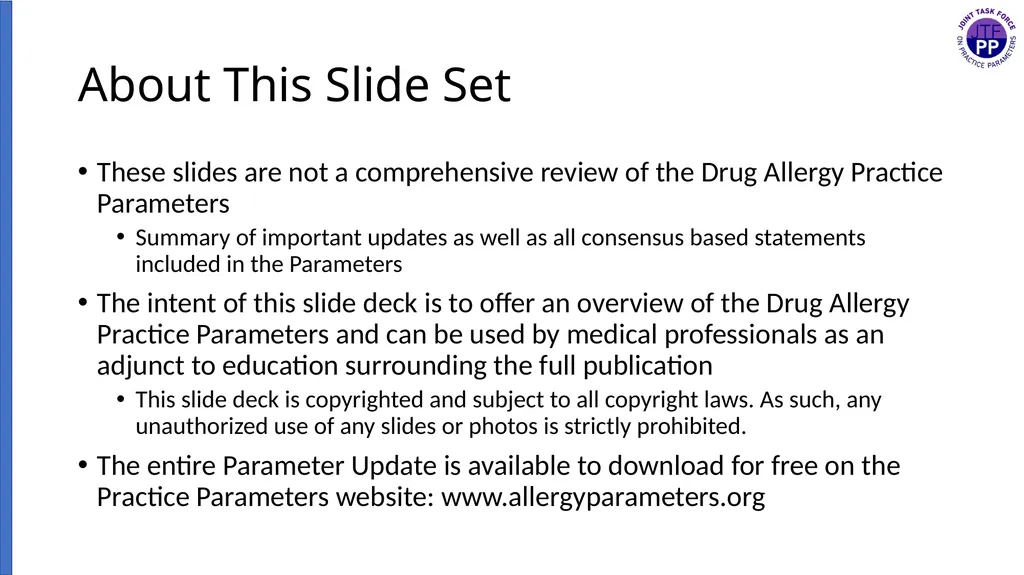
slide2. About This Slide Set These slides are not a comprehensive review of the Drug Allergy Practice Parameters
Summary of important updates as well as all consensus based statements included in the Parameters
The intent of this slide deck is to offer an overview of the Drug Allergy Practice Parameters and can be used by medical professionals as an adjunct to education surrounding the full publication
This slide deck is copyrighted and subject to all copyright laws. As such, any unauthorized use of any slides or photos is strictly prohibited.
The entire Parameter Update is available to download for free on the Practice Parameters website: www.allergyparameters.org<br>
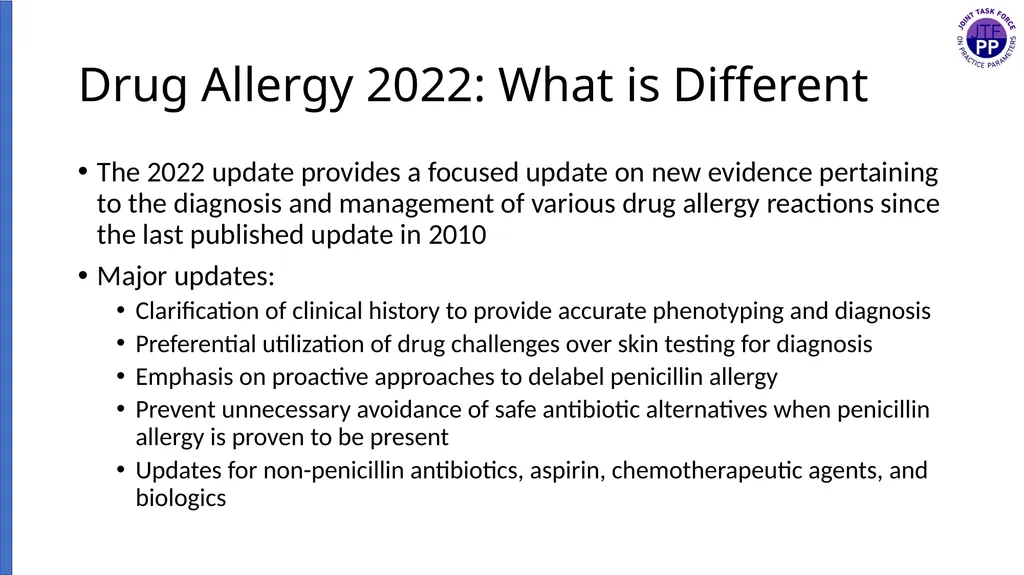
slide3. Drug Allergy 2022: What is Different The 2022 update provides a focused update on new evidence pertaining to the diagnosis and management of various drug allergy reactions since the last published update in 2010
Major updates:
Clarification of clinical history to provide accurate phenotyping and diagnosis
Preferential utilization of drug challenges over skin testing for diagnosis
Emphasis on proactive approaches to delabel penicillin allergy
Prevent unnecessary avoidance of safe antibiotic alternatives when penicillin allergy is proven to be present
Updates for non-penicillin antibiotics, aspirin, chemotherapeutic agents, and biologics<br>
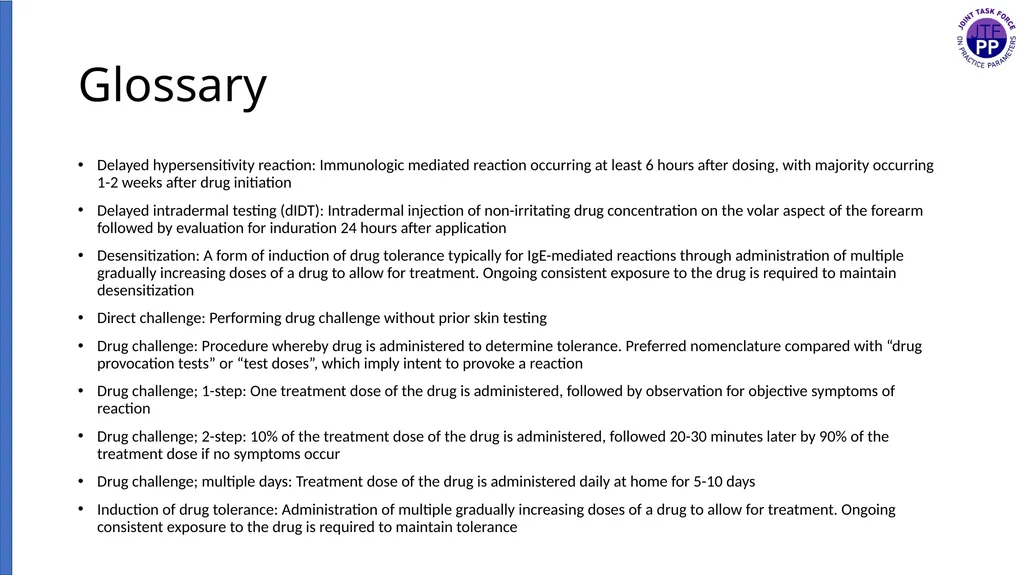
slide4. Glossary Delayed hypersensitivity reaction: Immunologic mediated reaction occurring at least 6 hours after dosing, with majority occurring 1-2 weeks after drug initiation
Delayed intradermal testing (dIDT): Intradermal injection of non-irritating drug concentration on the volar aspect of the forearm followed by evaluation for induration 24 hours after application
Desensitization: A form of induction of drug tolerance typically for IgE-mediated reactions through administration of multiple gradually increasing doses of a drug to allow for treatment. Ongoing consistent exposure to the drug is required to maintain desensitization
Direct challenge: Performing drug challenge without prior skin testing
Drug challenge: Procedure whereby drug is administered to determine tolerance. Preferred nomenclature compared with “drug provocation tests” or “test doses”, which imply intent to provoke a reaction
Drug challenge; 1-step: One treatment dose of the drug is administered, followed by observation for objective symptoms of reaction
Drug challenge; 2-step: 10% of the treatment dose of the drug is administered, followed 20-30 minutes later by 90% of the treatment dose if no symptoms occur
Drug challenge; multiple days: Treatment dose of the drug is administered daily at home for 5-10 days
Induction of drug tolerance: Administration of multiple gradually increasing doses of a drug to allow for treatment. Ongoing consistent exposure to the drug is required to maintain tolerance<br>
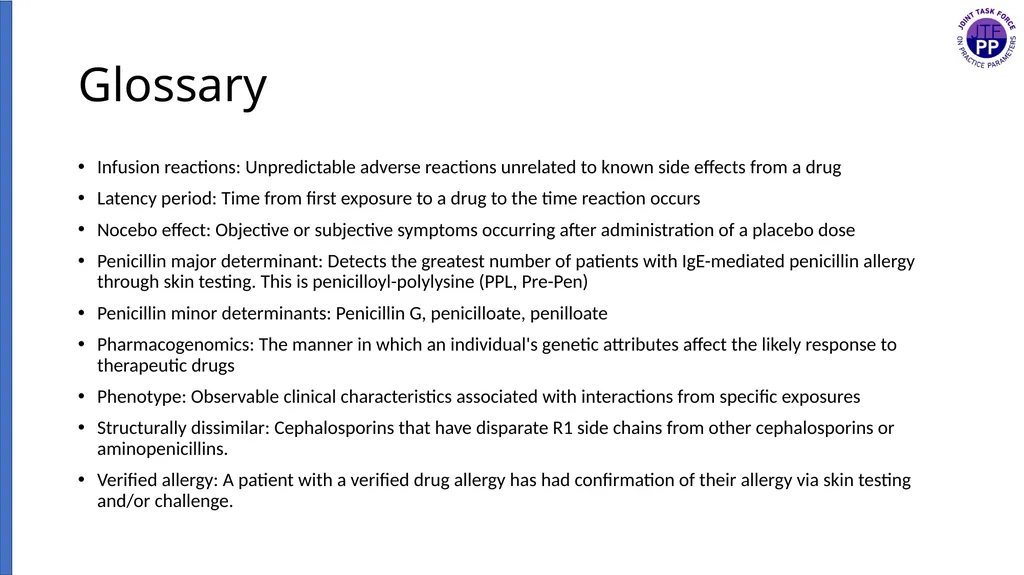
slide5. Glossary Infusion reactions: Unpredictable adverse reactions unrelated to known side effects from a drug
Latency period: Time from first exposure to a drug to the time reaction occurs
Nocebo effect: Objective or subjective symptoms occurring after administration of a placebo dose
Penicillin major determinant: Detects the greatest number of patients with IgE-mediated penicillin allergy through skin testing. This is penicilloyl-polylysine (PPL, Pre-Pen)
Penicillin minor determinants: Penicillin G, penicilloate, penilloate
Pharmacogenomics: The manner in which an individual's genetic attributes affect the likely response to therapeutic drugs
Phenotype: Observable clinical characteristics associated with interactions from specific exposures
Structurally dissimilar: Cephalosporins that have disparate R1 side chains from other cephalosporins or aminopenicillins.
Verified allergy: A patient with a verified drug allergy has had confirmation of their allergy via skin testing and/or challenge.<br>
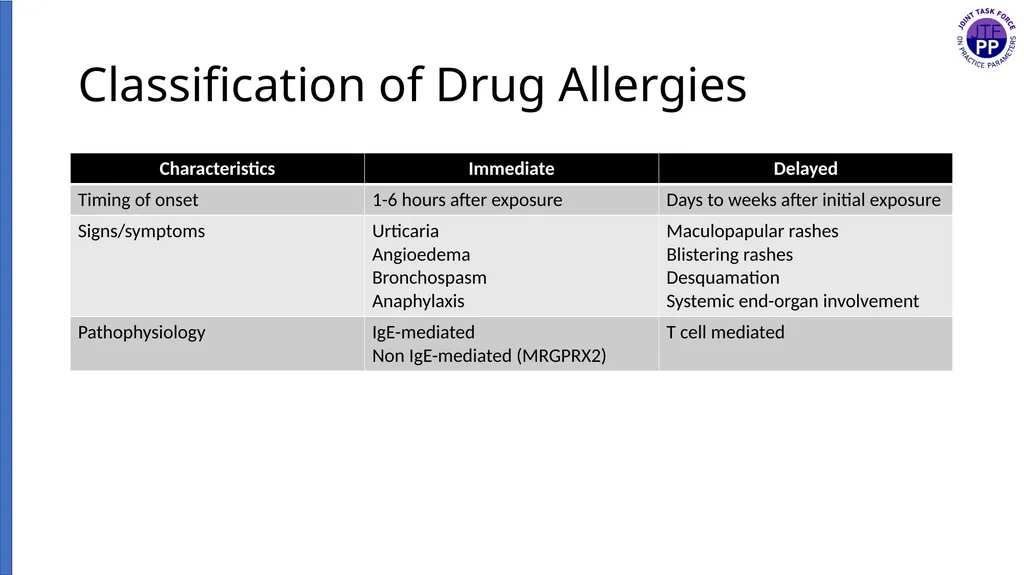
slide6. Classification of Drug Allergies<br>
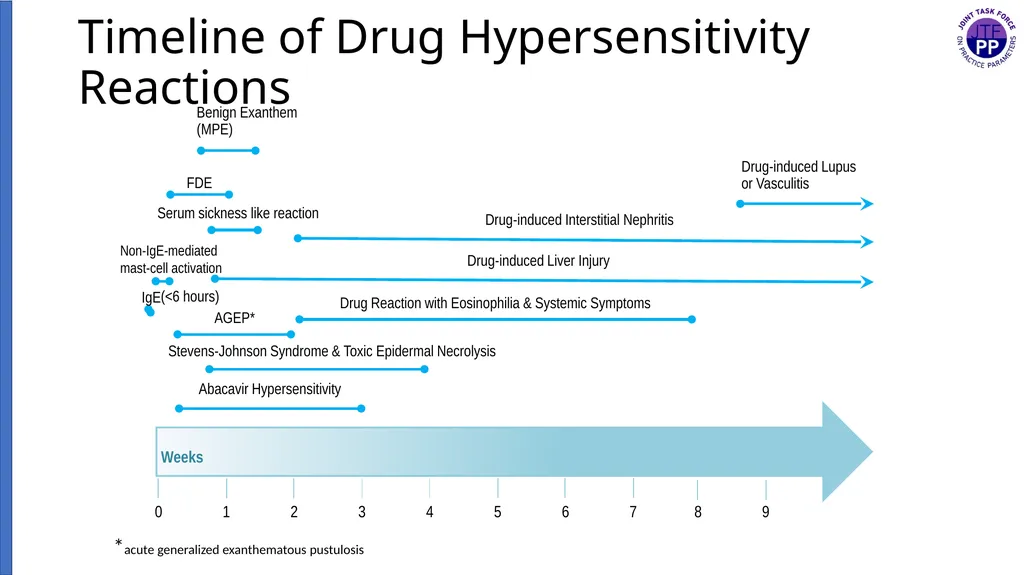
slide7. Timeline of Drug Hypersensitivity Reactions<br>
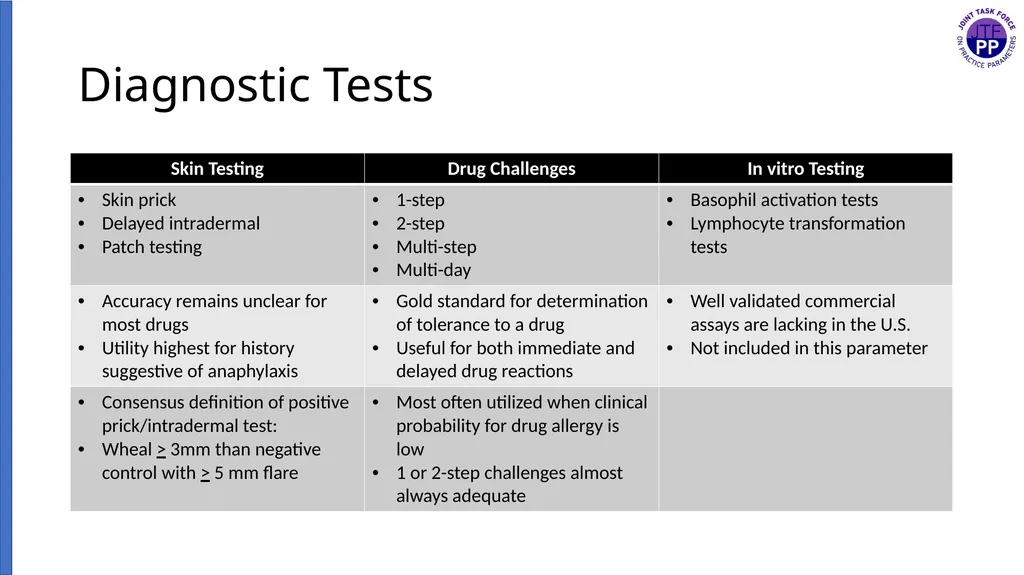
slide8. Diagnostic Tests<br>
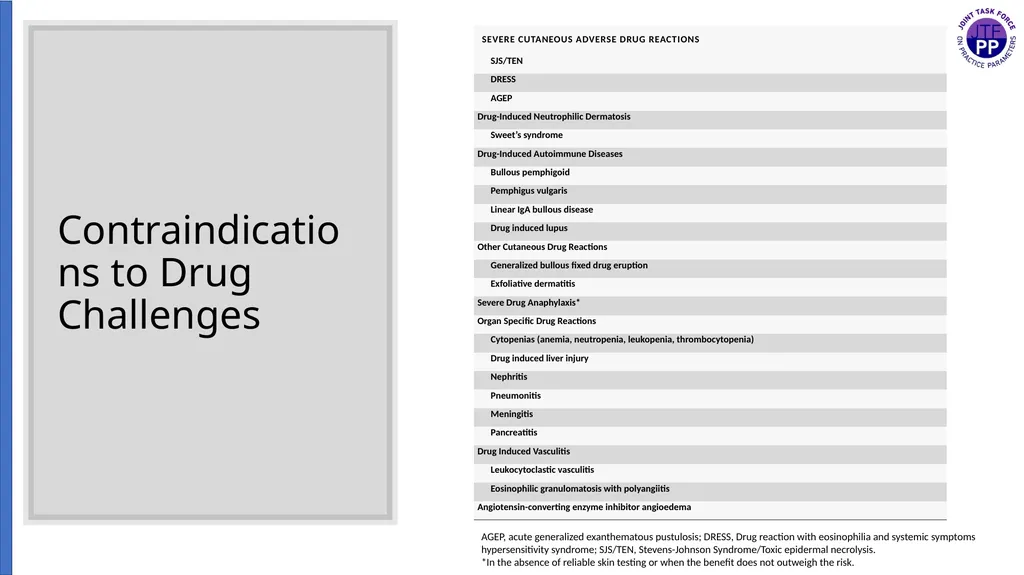
slide9. Contraindications to Drug Challenges AGEP, acute generalized exanthematous pustulosis; DRESS, Drug reaction with eosinophilia and systemic symptoms hypersensitivity syndrome; SJS/TEN, Stevens-Johnson Syndrome/Toxic epidermal necrolysis.
*In the absence of reliable skin testing or when the benefit does not outweigh the risk.<br>
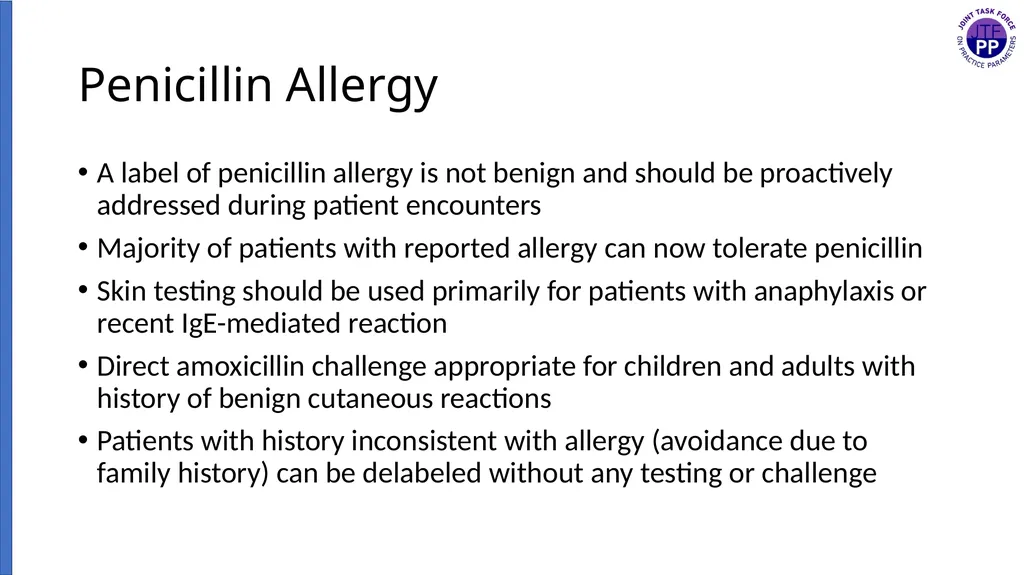
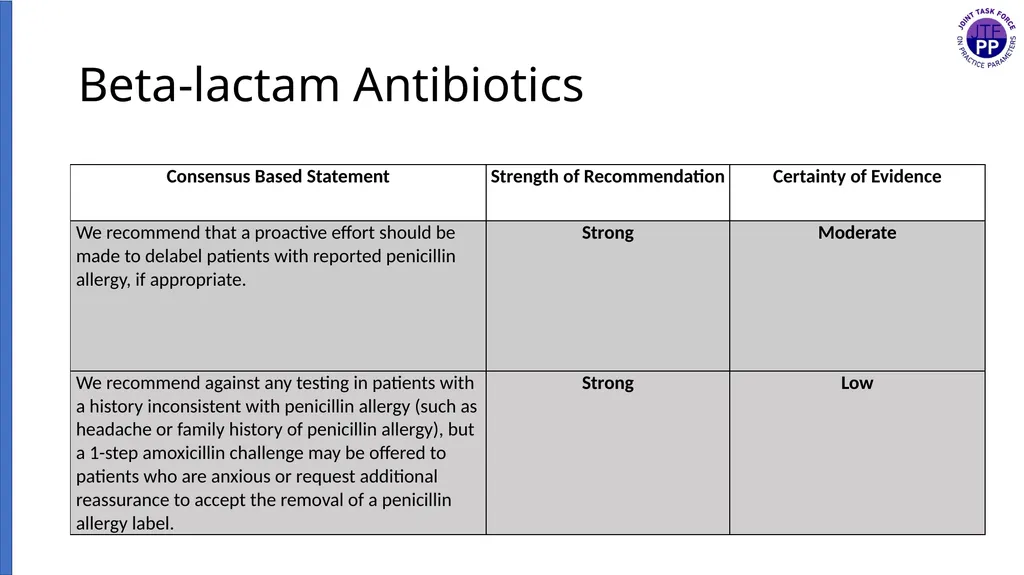
slide10. Penicillin Allergy A label of penicillin allergy is not benign and should be proactively addressed during patient encounters
Majority of patients with reported allergy can now tolerate penicillin
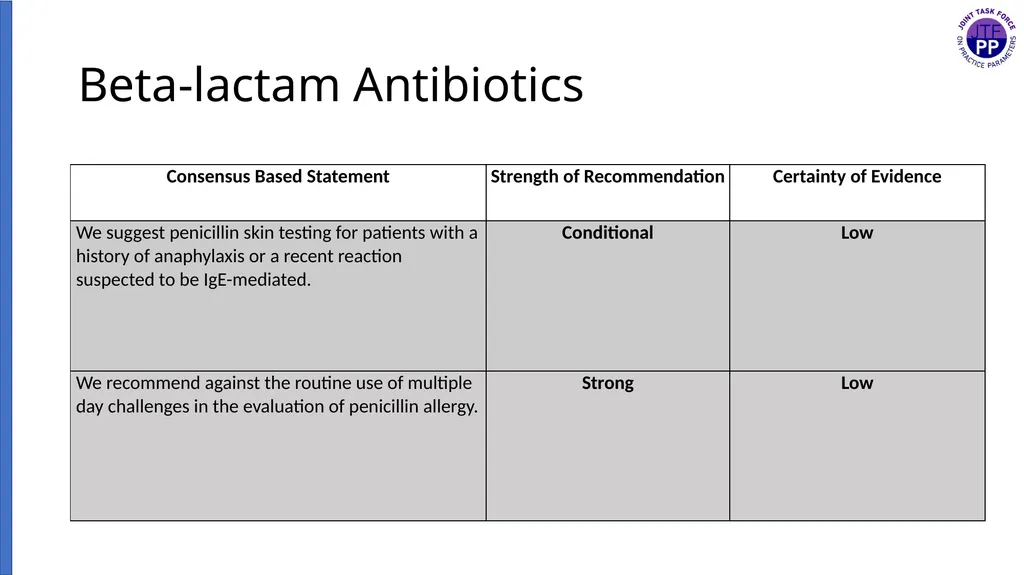
Skin testing should be used primarily for patients with anaphylaxis or recent IgE-mediated reaction
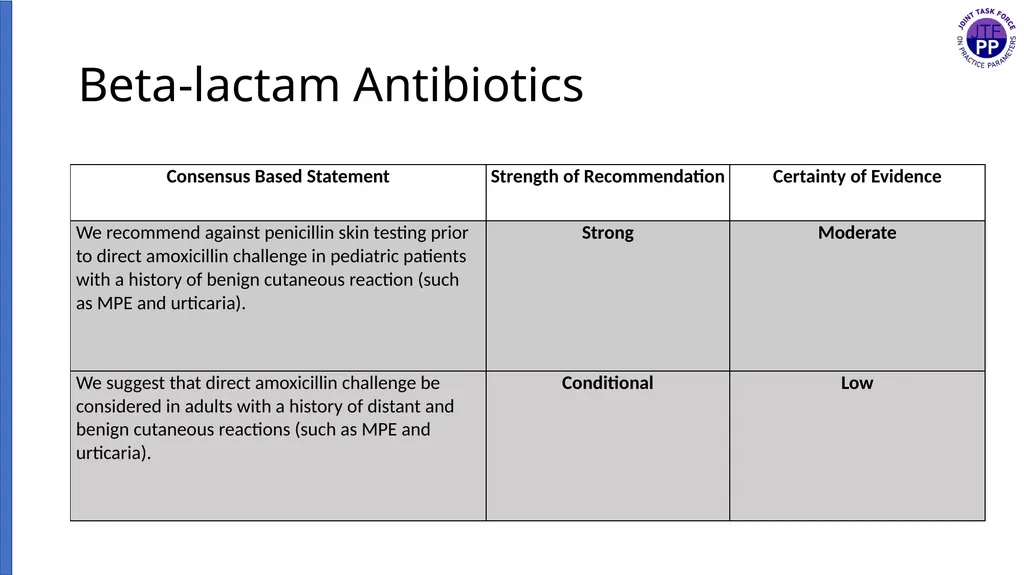
Direct amoxicillin challenge appropriate for children and adults with history of benign cutaneous reactions
Patients with history inconsistent with allergy (avoidance due to family history) can be delabeled without any testing or challenge<br>
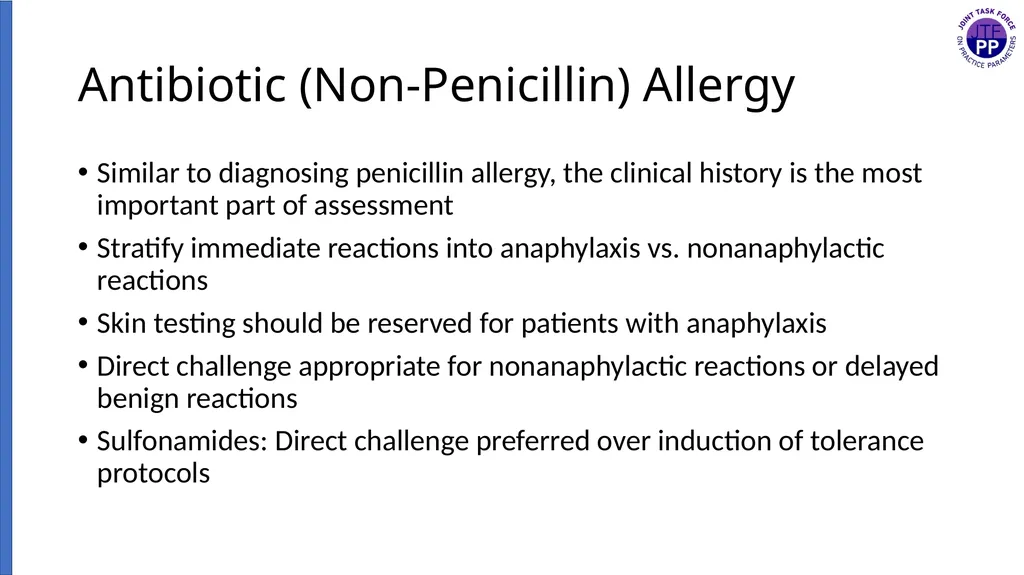
slide11. Antibiotic (Non-Penicillin) Allergy Similar to diagnosing penicillin allergy, the clinical history is the most important part of assessment
Stratify immediate reactions into anaphylaxis vs. nonanaphylactic reactions
Skin testing should be reserved for patients with anaphylaxis
Direct challenge appropriate for nonanaphylactic reactions or delayed benign reactions
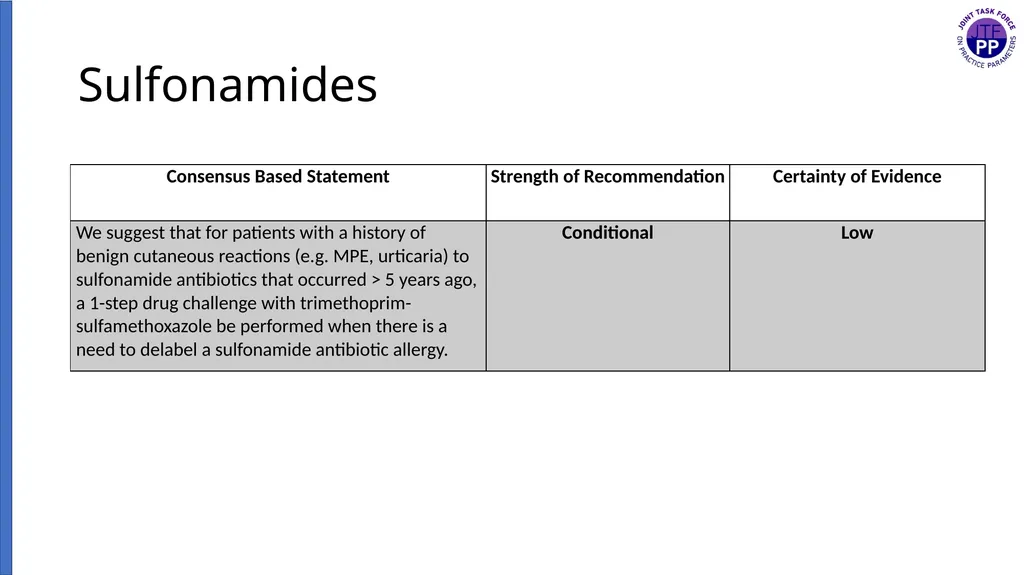
Sulfonamides: Direct challenge preferred over induction of tolerance protocols<br>
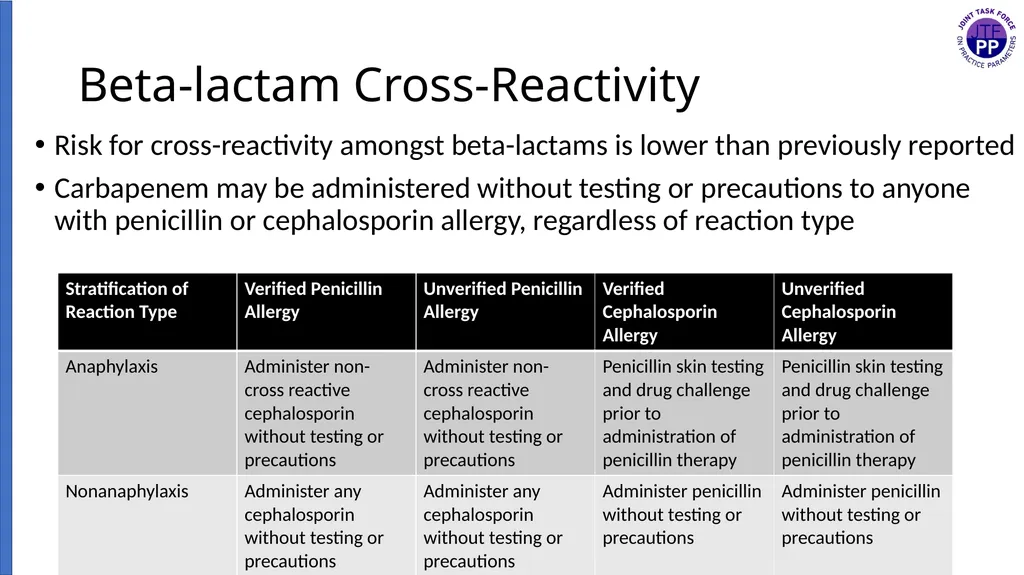
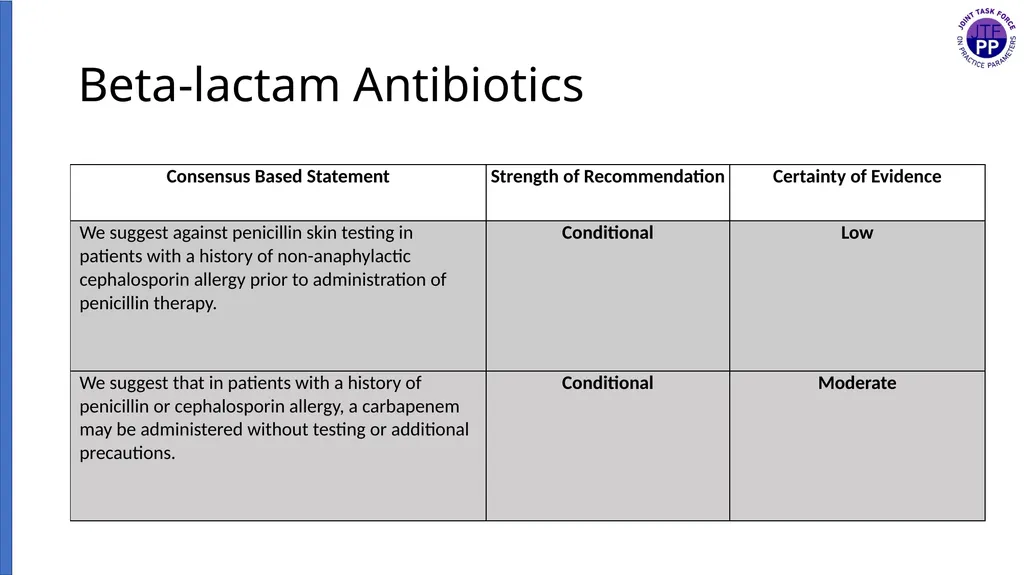
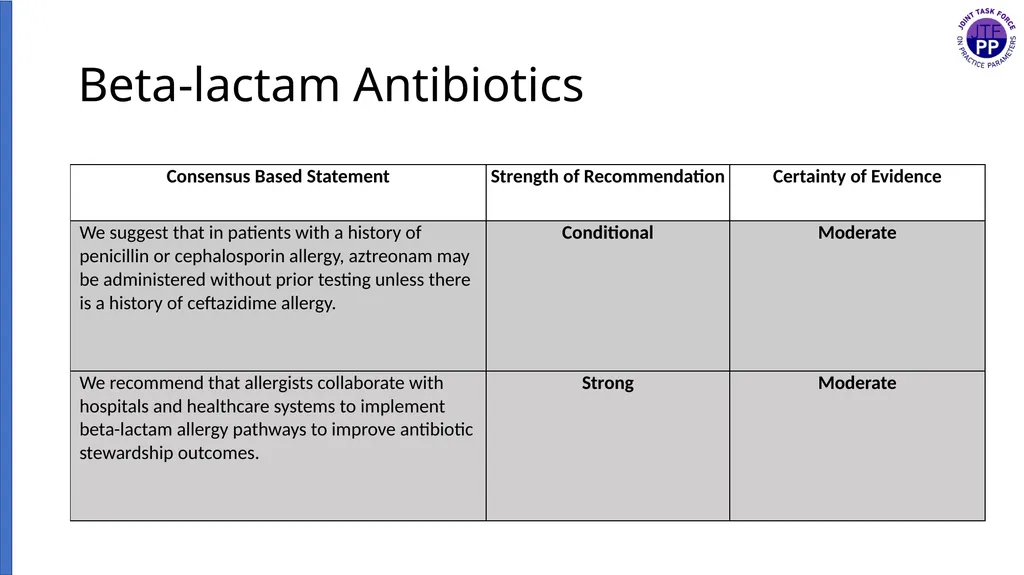
slide12. Beta-lactam Cross-Reactivity Risk for cross-reactivity amongst beta-lactams is lower than previously reported
Carbapenem may be administered without testing or precautions to anyone with penicillin or cephalosporin allergy, regardless of reaction type<br>
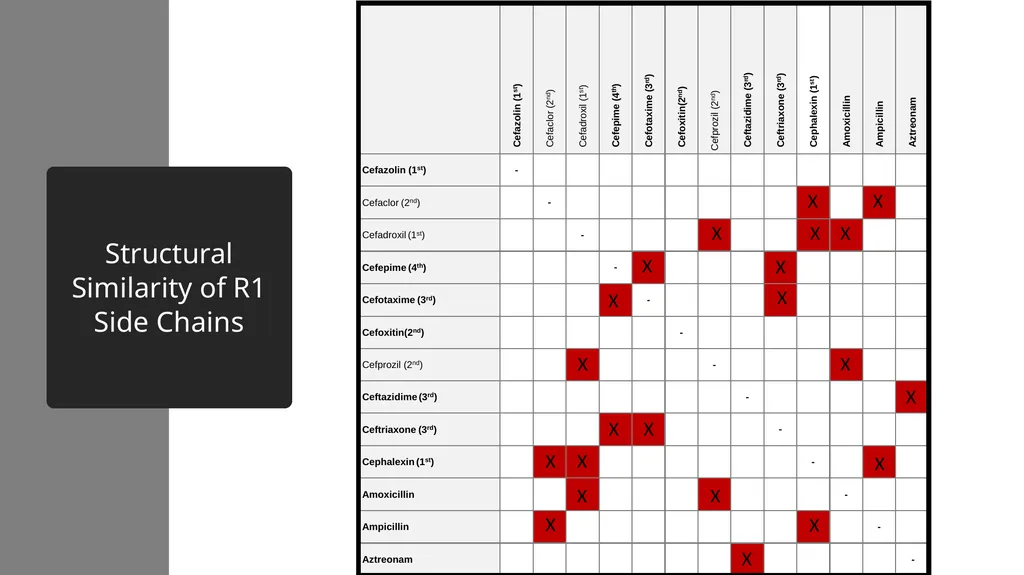
slide13. Structural Similarity of R1 Side Chains<br>
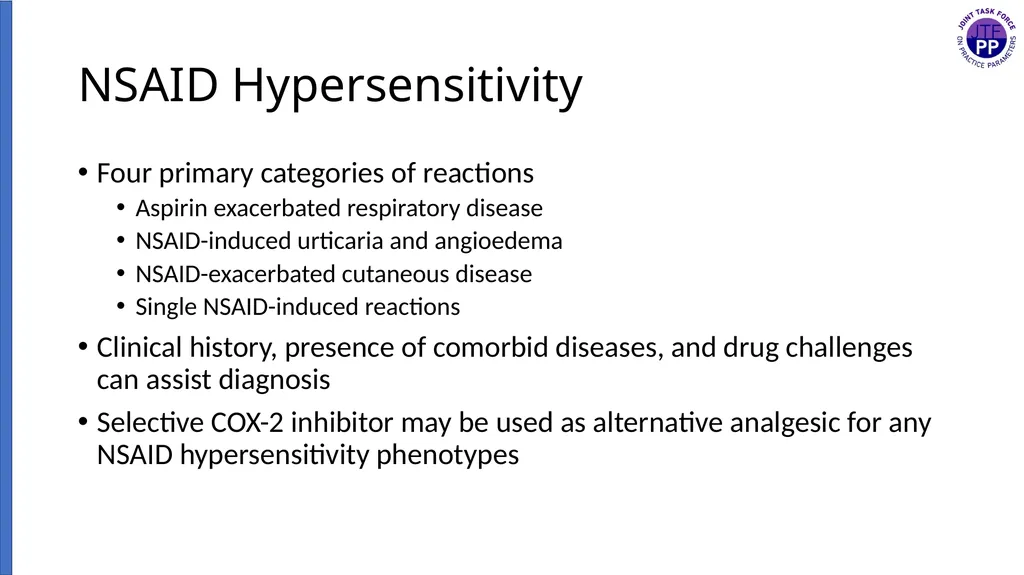
slide14. NSAID Hypersensitivity Four primary categories of reactions
Aspirin exacerbated respiratory disease
NSAID-induced urticaria and angioedema
NSAID-exacerbated cutaneous disease
Single NSAID-induced reactions
Clinical history, presence of comorbid diseases, and drug challenges can assist diagnosis
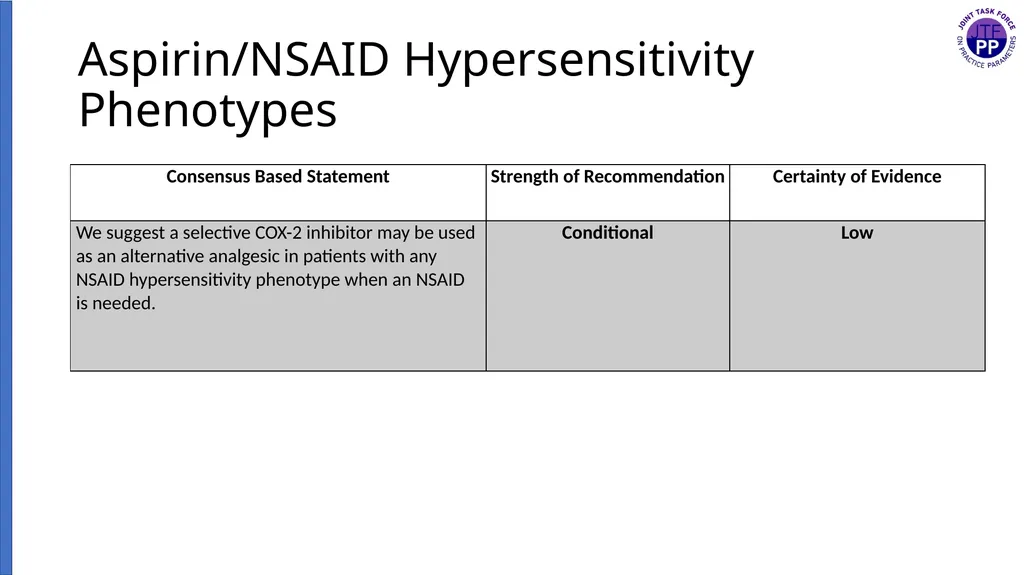
Selective COX-2 inhibitor may be used as alternative analgesic for any NSAID hypersensitivity phenotypes<br>
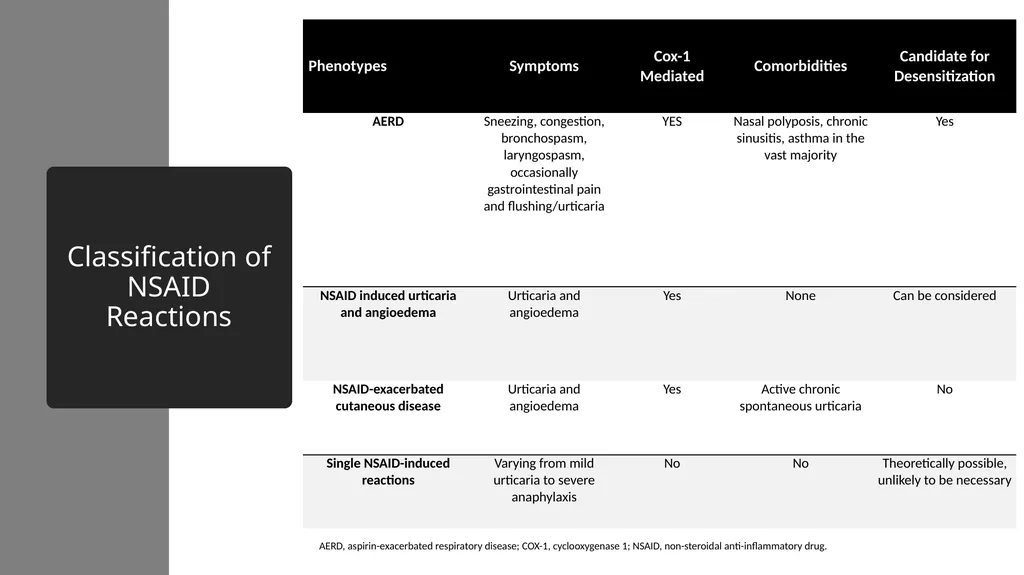
slide15. Classification of NSAID Reactions AERD, aspirin-exacerbated respiratory disease; COX-1, cyclooxygenase 1; NSAID, non-steroidal anti-inflammatory drug.<br>
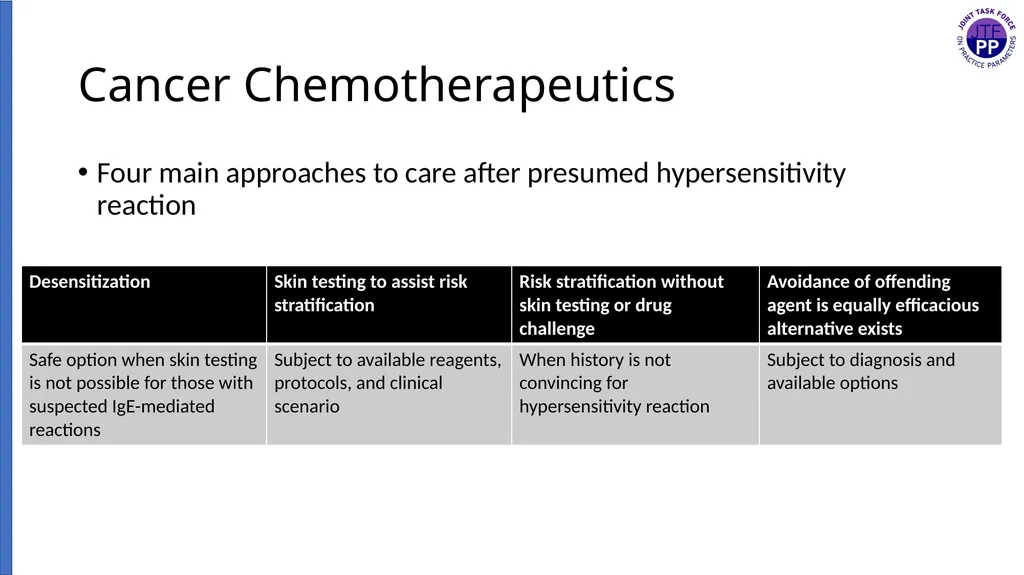
slide16. Cancer Chemotherapeutics Four main approaches to care after presumed hypersensitivity reaction<br>
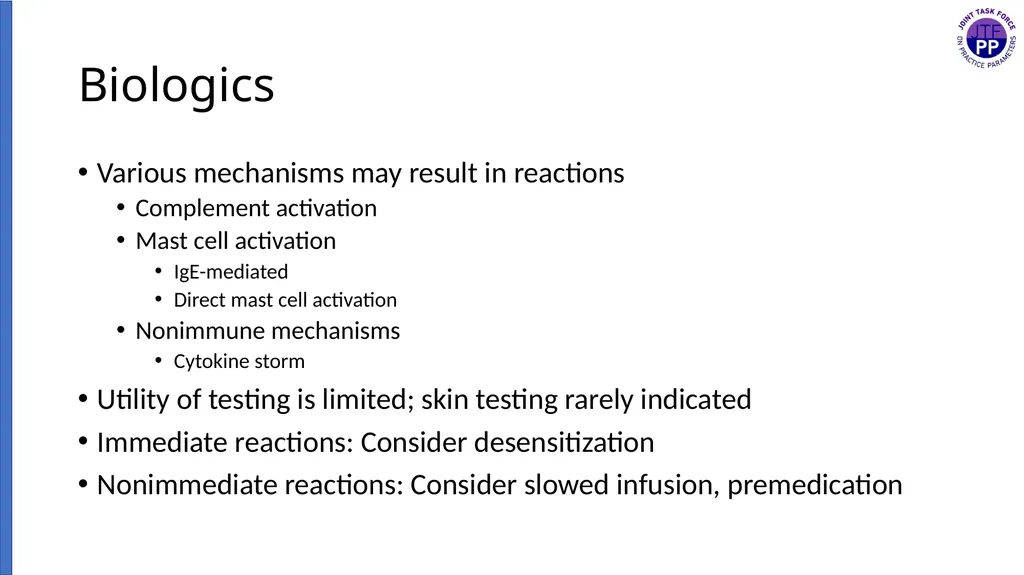
slide17. Biologics Various mechanisms may result in reactions
Complement activation
Mast cell activation
IgE-mediated
Direct mast cell activation
Nonimmune mechanisms
Cytokine storm
Utility of testing is limited; skin testing rarely indicated
Immediate reactions: Consider desensitization
Nonimmediate reactions: Consider slowed infusion, premedication<br>
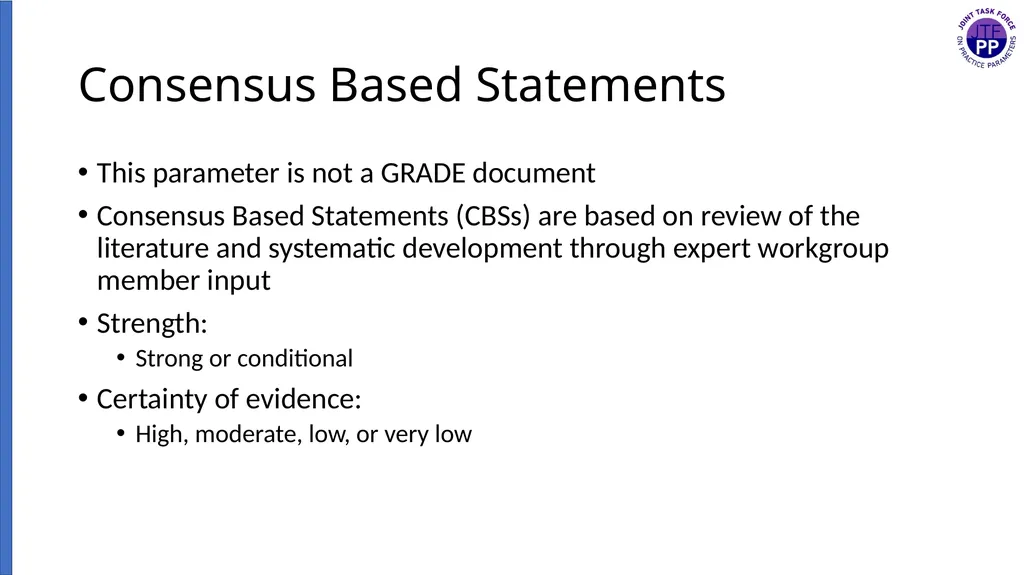
slide18. Consensus Based Statements This parameter is not a GRADE document
Consensus Based Statements (CBSs) are based on review of the literature and systematic development through expert workgroup member input
Strength:
Strong or conditional
Certainty of evidence:
High, moderate, low, or very low<br>
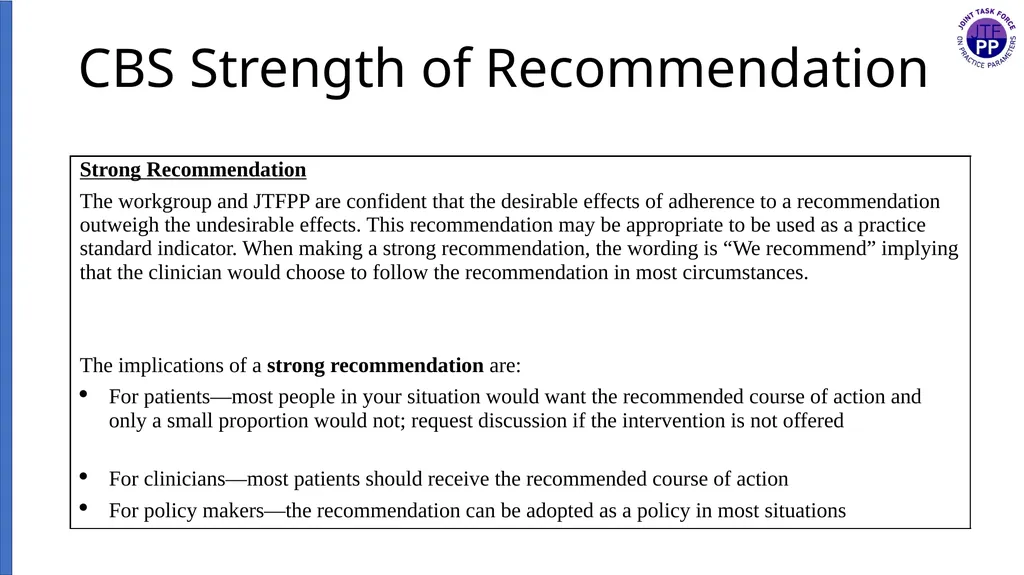
slide19. CBS Strength of Recommendation<br>
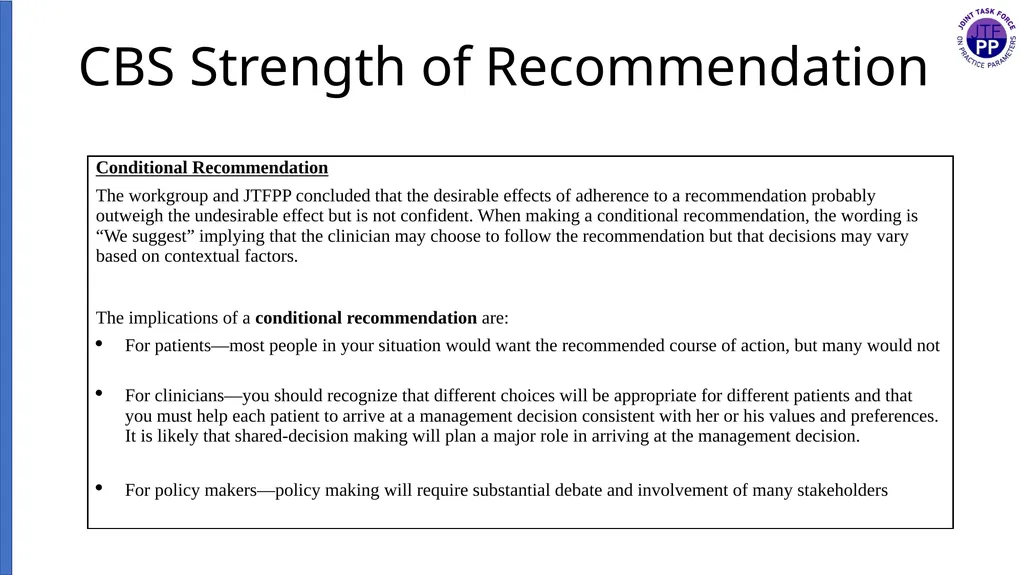
slide20. CBS Strength of Recommendation<br>
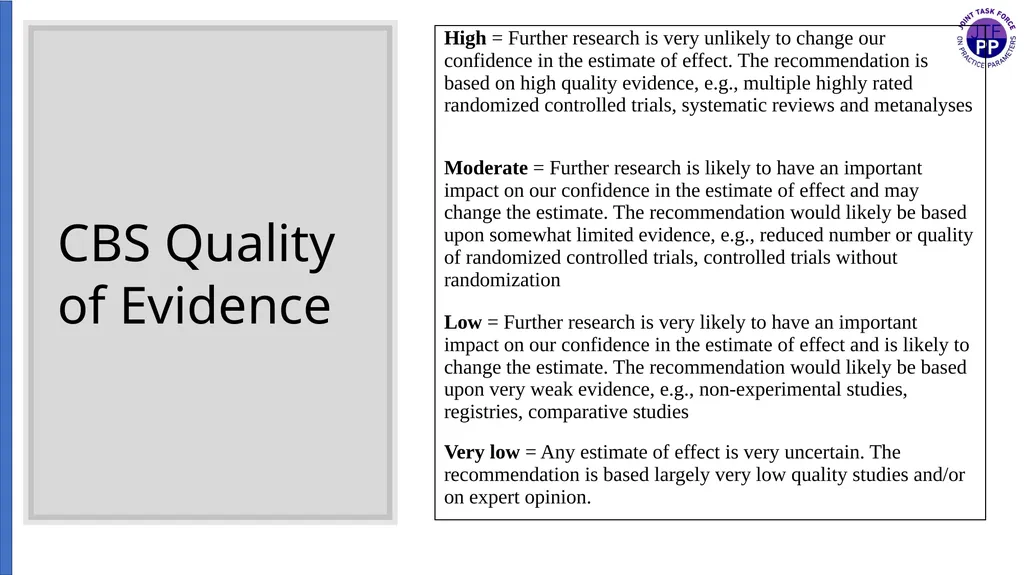
slide21. CBS Quality of Evidence<br>
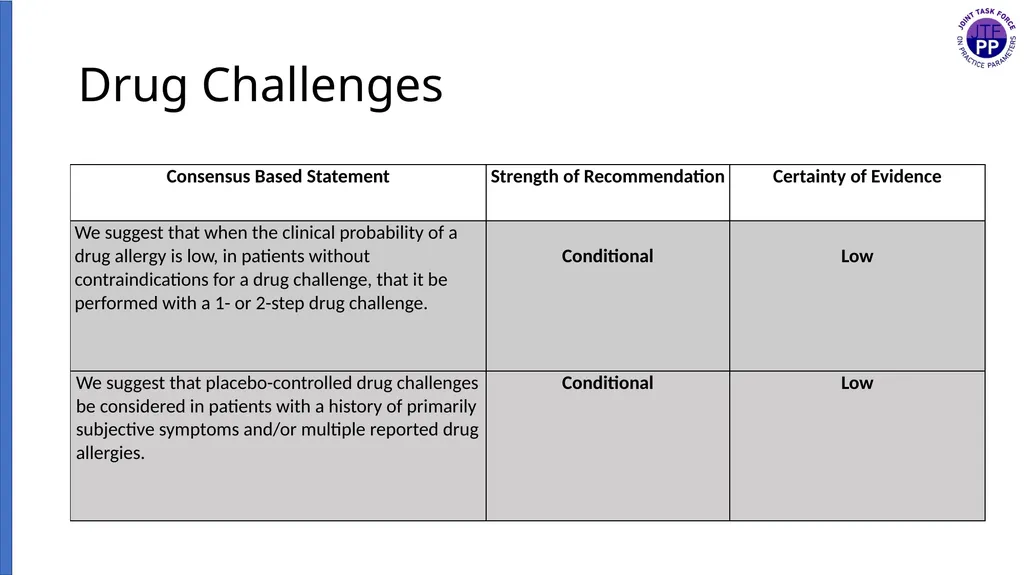
slide22. Drug Challenges<br>
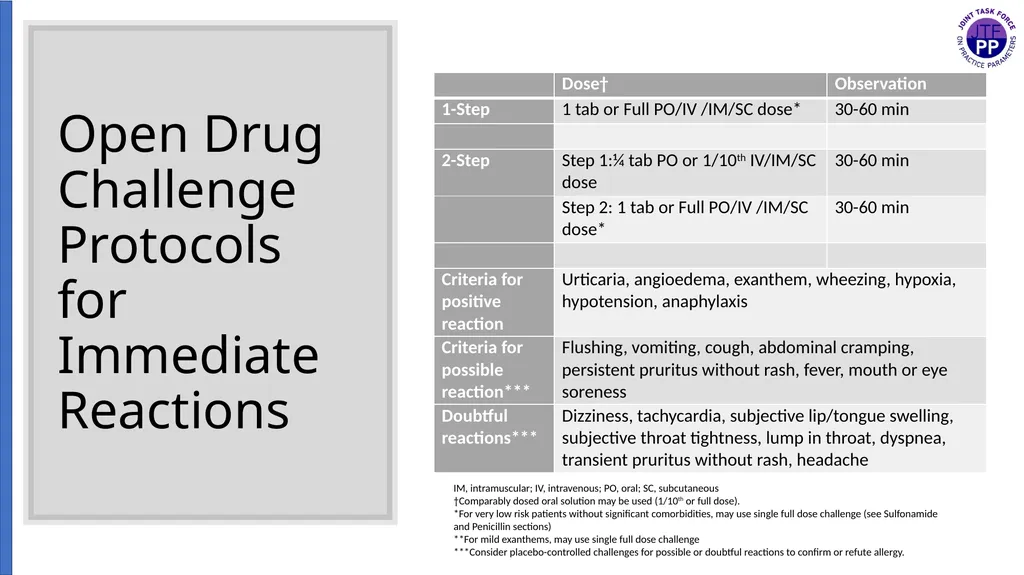
slide23. Open Drug Challenge Protocols for Immediate Reactions IM, intramuscular; IV, intravenous; PO, oral; SC, subcutaneous
†Comparably dosed oral solution may be used (1/10th or full dose).
*For very low risk patients without significant comorbidities, may use single full dose challenge (see Sulfonamide and Penicillin sections)
**For mild exanthems, may use single full dose challenge
***Consider placebo-controlled challenges for possible or doubtful reactions to confirm or refute allergy.<br>
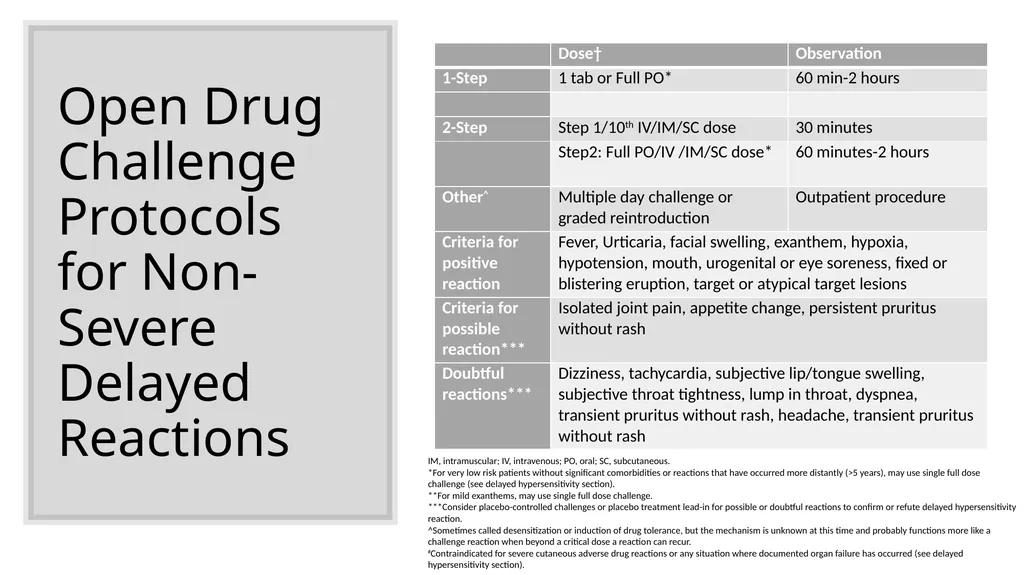
slide24. Open Drug Challenge Protocols for Non-Severe Delayed Reactions IM, intramuscular; IV, intravenous; PO, oral; SC, subcutaneous.
*For very low risk patients without significant comorbidities or reactions that have occurred more distantly (>5 years), may use single full dose challenge (see delayed hypersensitivity section).
**For mild exanthems, may use single full dose challenge.
***Consider placebo-controlled challenges or placebo treatment lead-in for possible or doubtful reactions to confirm or refute delayed hypersensitivity reaction.
^Sometimes called desensitization or induction of drug tolerance, but the mechanism is unknown at this time and probably functions more like a challenge reaction when beyond a critical dose a reaction can recur.
#Contraindicated for severe cutaneous adverse drug reactions or any situation where documented organ failure has occurred (see delayed hypersensitivity section).<br>
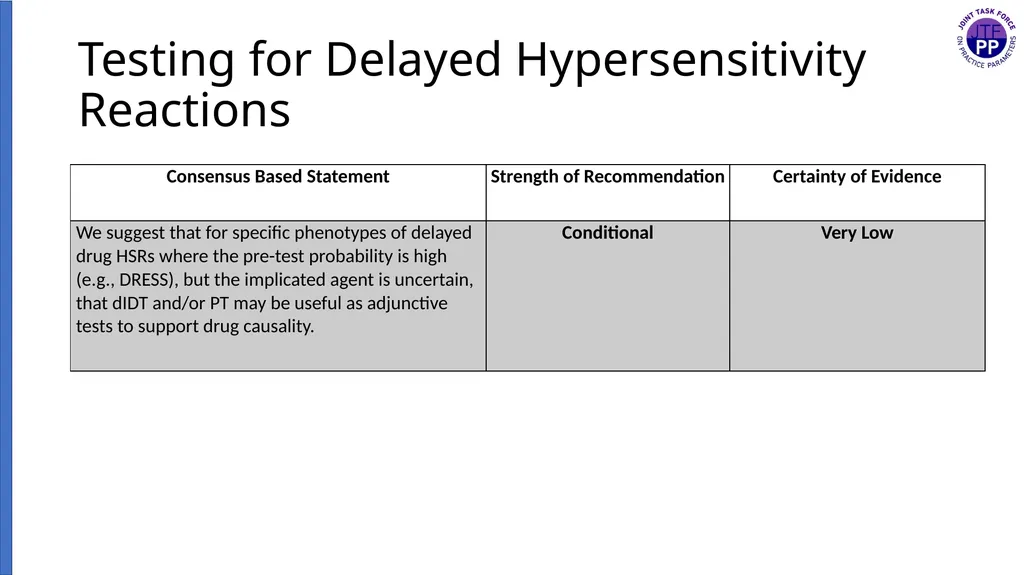
slide25. Testing for Delayed Hypersensitivity Reactions<br>
slide26. Beta-lactam Antibiotics<br>
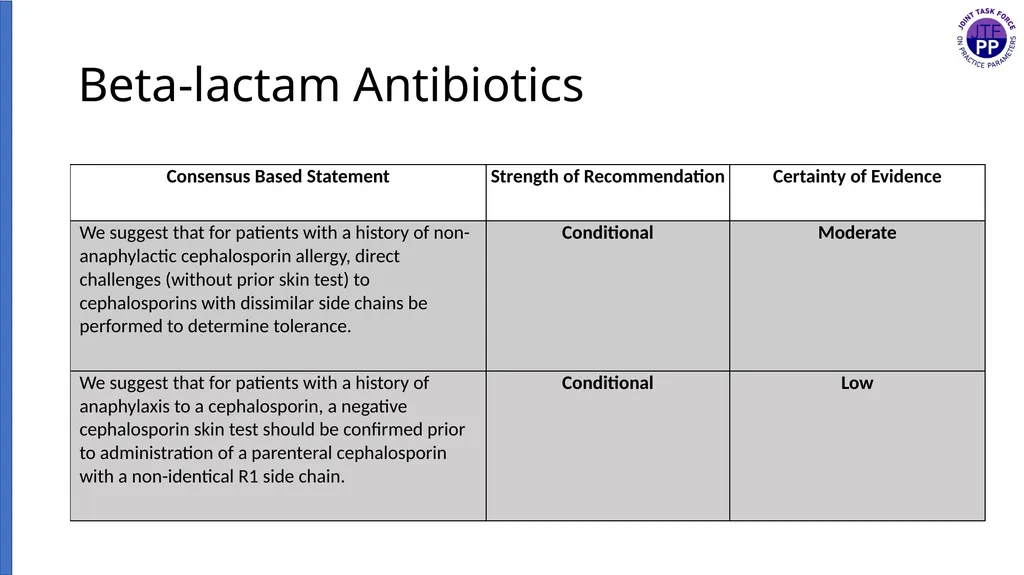
slide27. Beta-lactam Antibiotics<br>
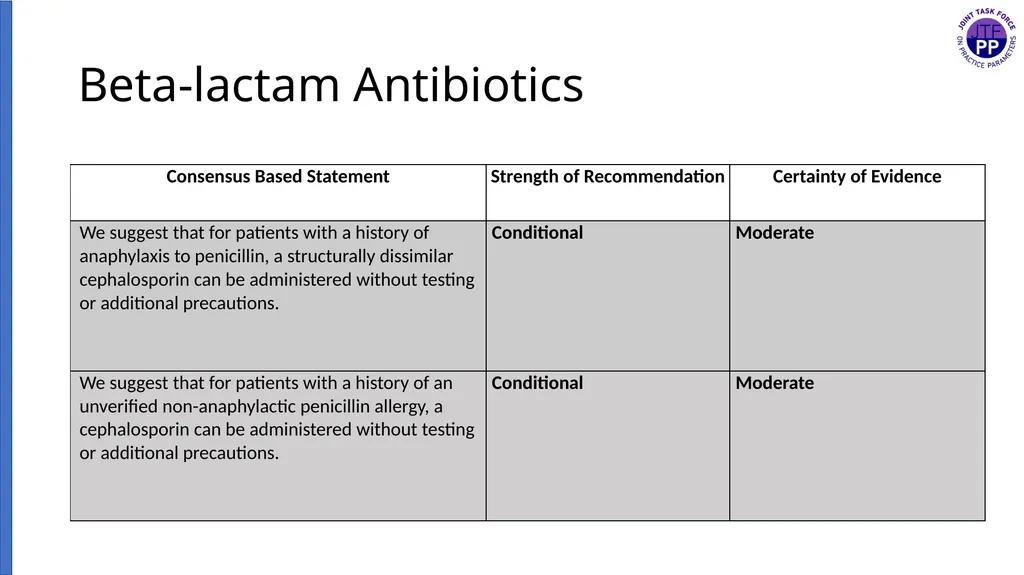
slide28. Beta-lactam Antibiotics<br>
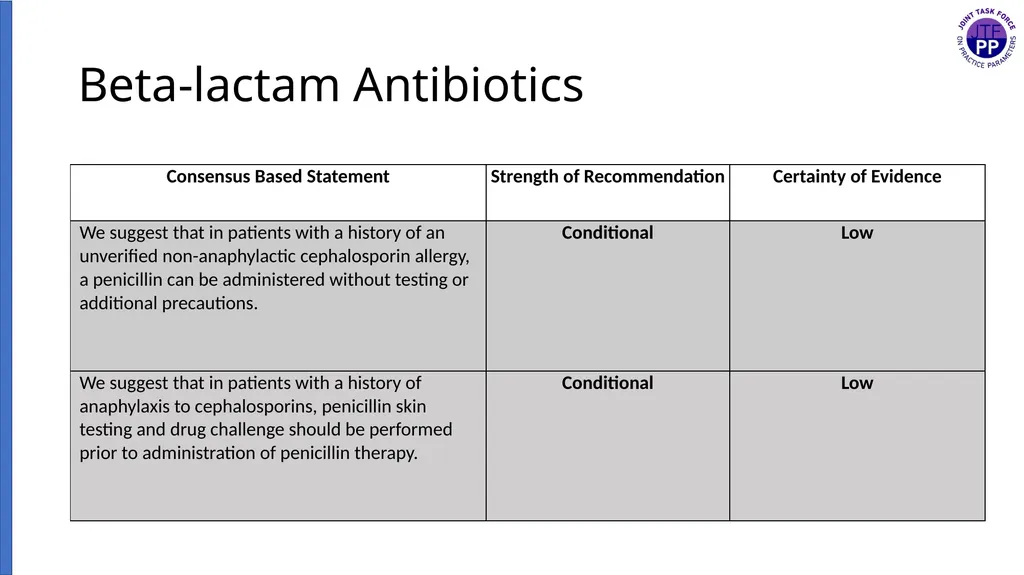
slide29. Beta-lactam Antibiotics<br>
slide30. Beta-lactam Antibiotics<br>
slide31. Beta-lactam Antibiotics<br>
slide32. Beta-lactam Antibiotics<br>
slide33. Beta-lactam Antibiotics<br>
slide34. Sulfonamides<br>
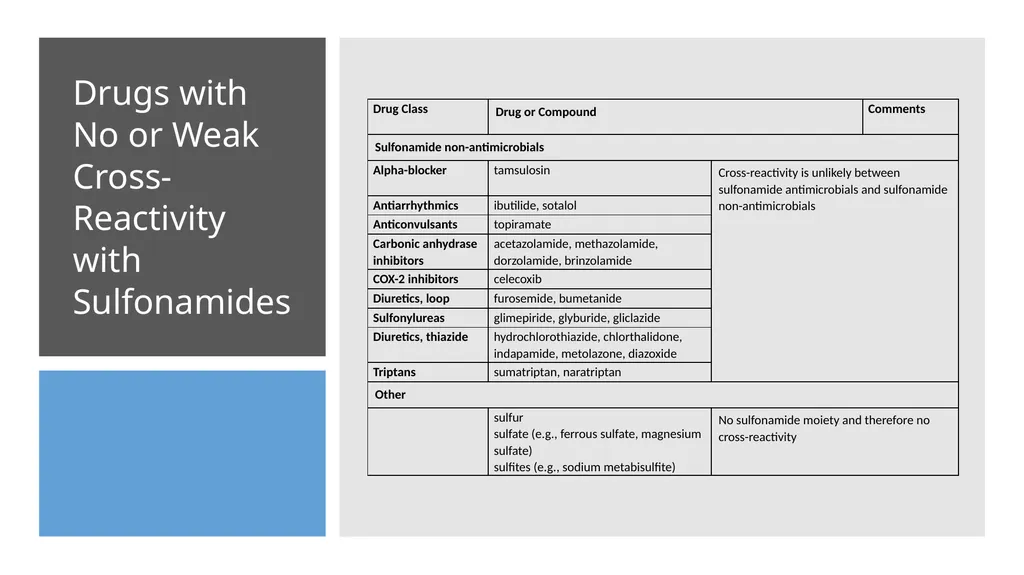
slide35. Drugs with No or Weak Cross-Reactivity with Sulfonamides<br>
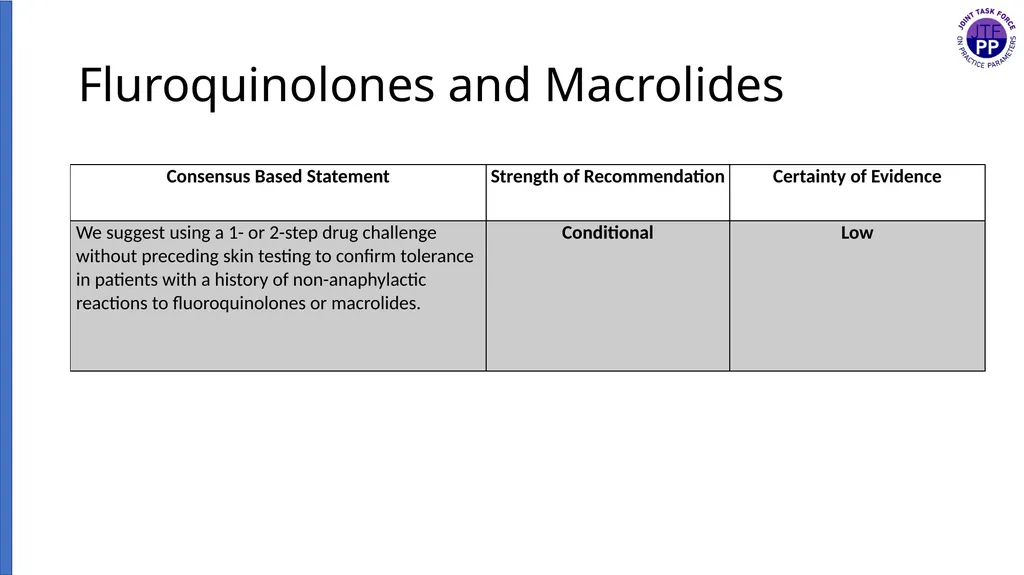
slide36. Fluroquinolones and Macrolides<br>
slide37. Aspirin/NSAID Hypersensitivity Phenotypes<br>
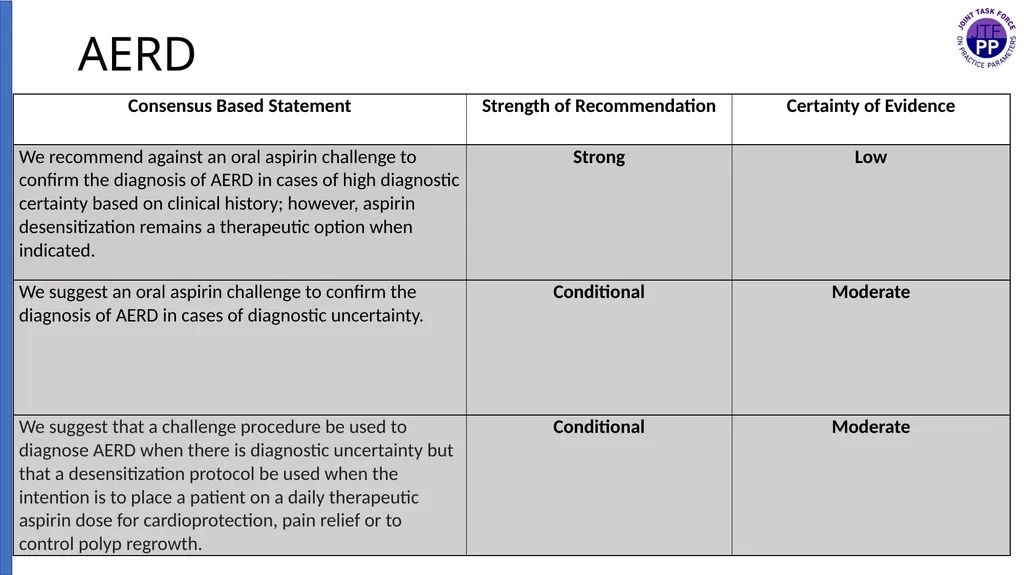
slide38. AERD<br>
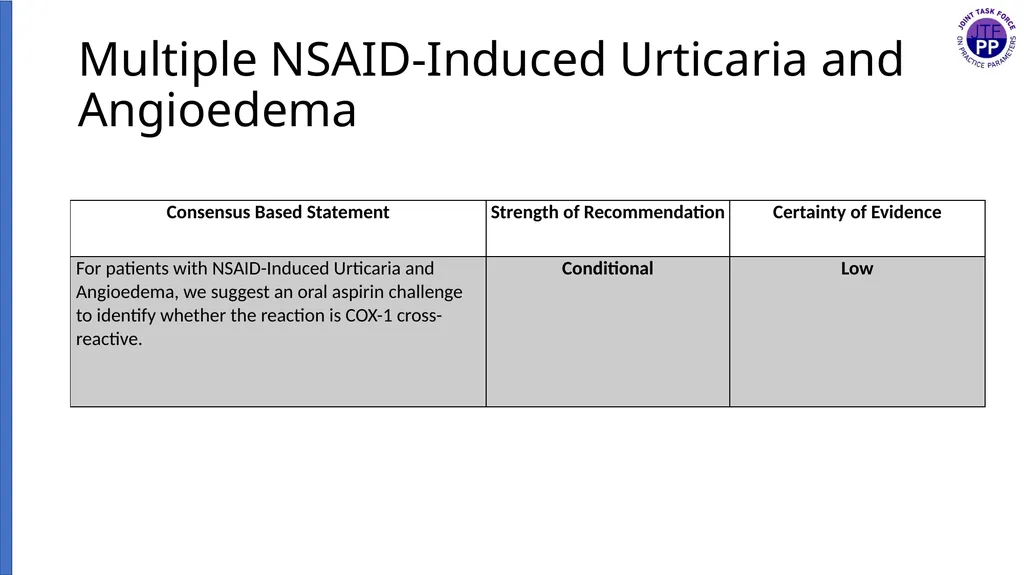
slide39. Multiple NSAID-Induced Urticaria and Angioedema<br>
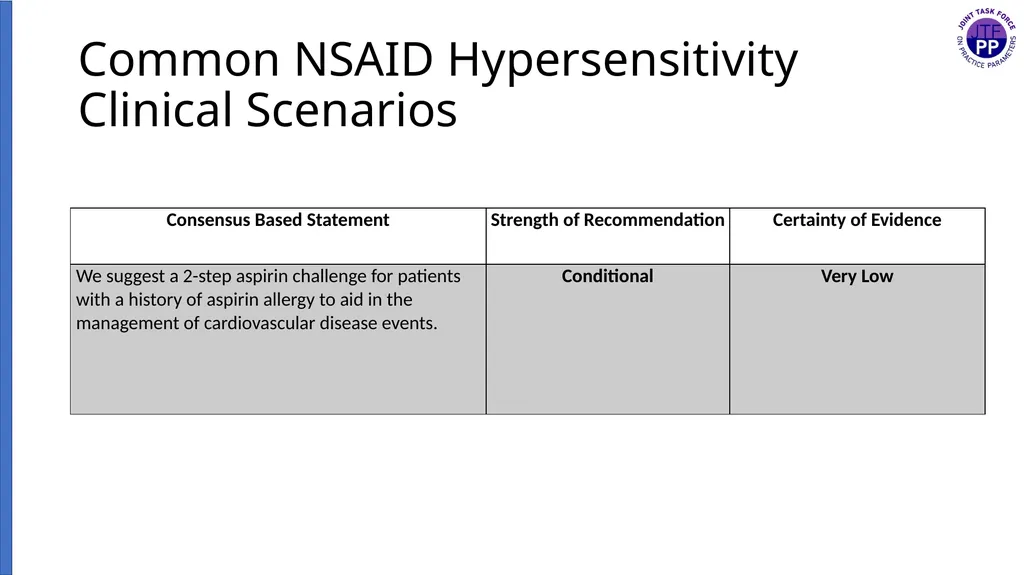
slide40. Common NSAID Hypersensitivity Clinical Scenarios<br>
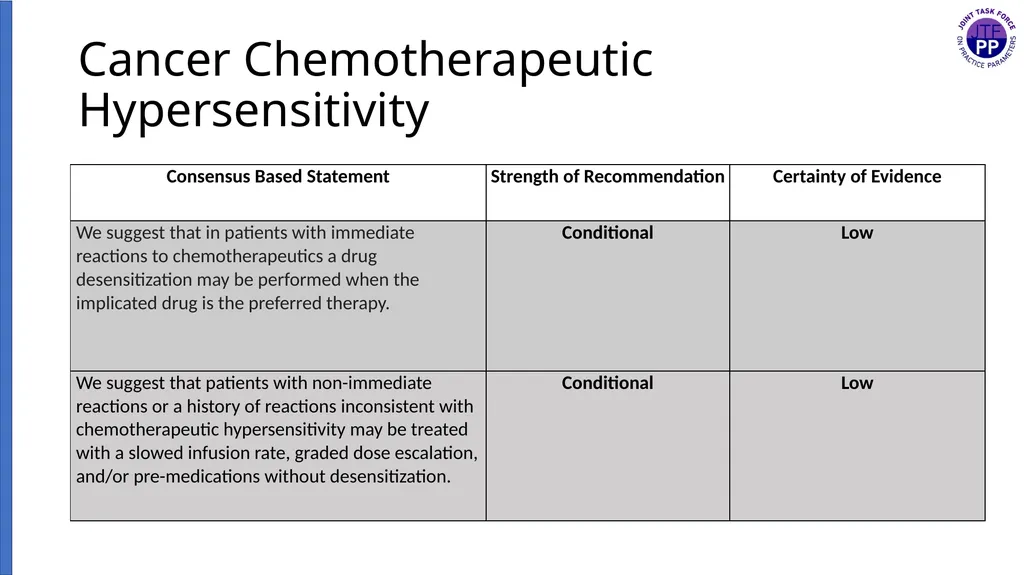
slide41. Cancer Chemotherapeutic Hypersensitivity<br>
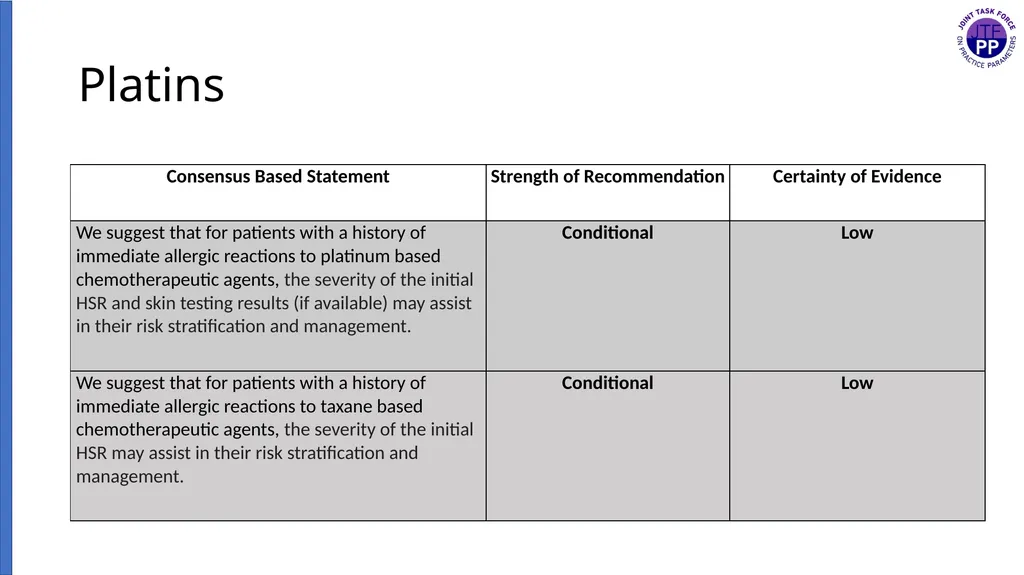
slide42. Platins<br>
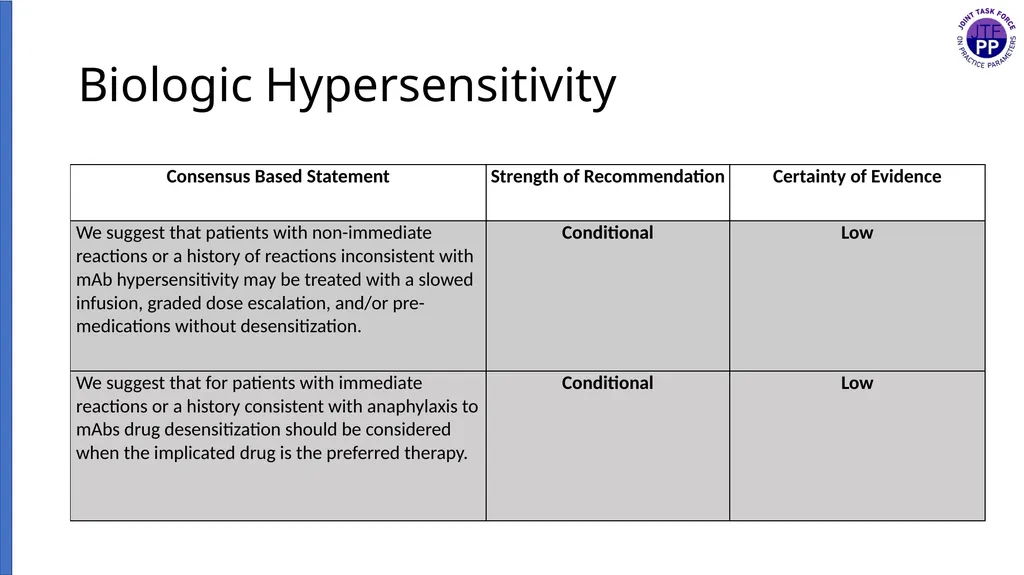
slide43. Biologic Hypersensitivity<br>
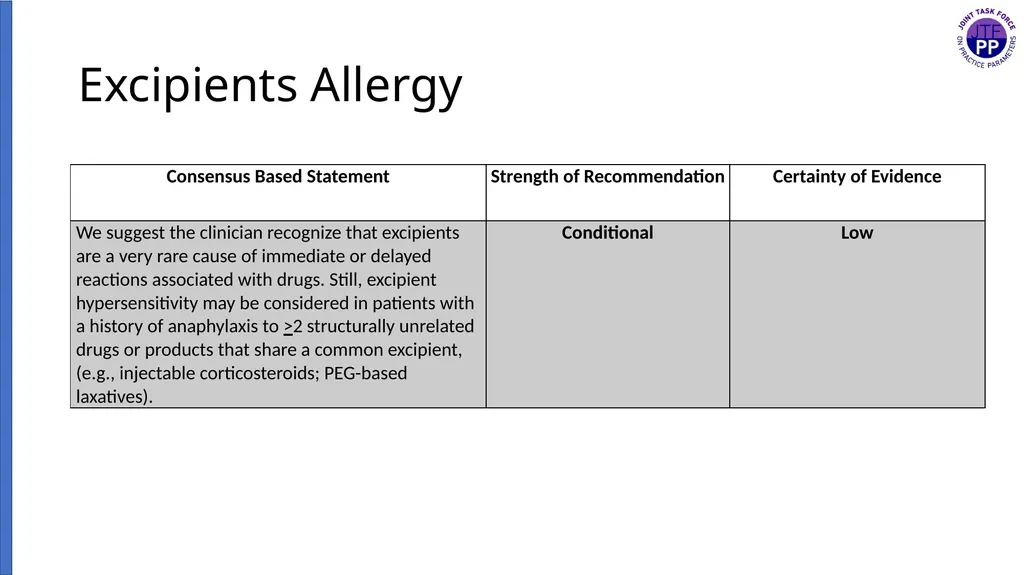
slide44. Excipients Allergy<br>
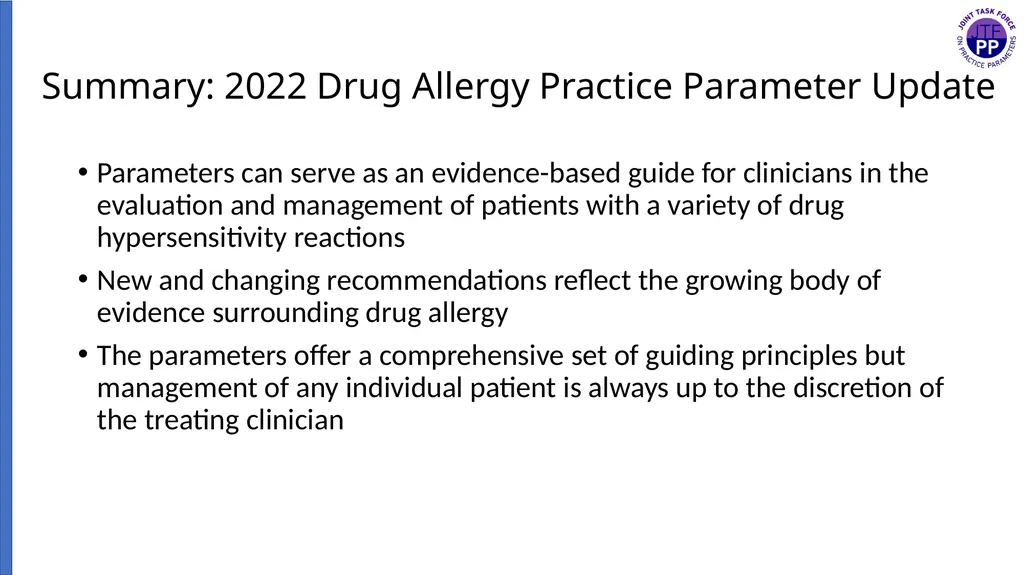
slide45. Summary: 2022 Drug Allergy Practice Parameter Update Parameters can serve as an evidence-based guide for clinicians in the evaluation and management of patients with a variety of drug hypersensitivity reactions
New and changing recommendations reflect the growing body of evidence surrounding drug allergy
The parameters offer a comprehensive set of guiding principles but management of any individual patient is always up to the discretion of the treating clinician<br>
Chief Editor(s): David A. Khan, MD, David B. Golden, MD, Marcus Shaker, MD, and David R. Stukus, MD
Workgroup Contributors: David A. Khan, MD, Aleena Banerji, MD, Kimberly G. Blumenthal, MD, Elizabeth J. Phillips, MD, Roland Solensky, MD, Andrew A. White, MD<br>
slide2. About This Slide Set These slides are not a comprehensive review of the Drug Allergy Practice Parameters
Summary of important updates as well as all consensus based statements included in the Parameters
The intent of this slide deck is to offer an overview of the Drug Allergy Practice Parameters and can be used by medical professionals as an adjunct to education surrounding the full publication
This slide deck is copyrighted and subject to all copyright laws. As such, any unauthorized use of any slides or photos is strictly prohibited.
The entire Parameter Update is available to download for free on the Practice Parameters website: www.allergyparameters.org<br>
slide3. Drug Allergy 2022: What is Different The 2022 update provides a focused update on new evidence pertaining to the diagnosis and management of various drug allergy reactions since the last published update in 2010
Major updates:
Clarification of clinical history to provide accurate phenotyping and diagnosis
Preferential utilization of drug challenges over skin testing for diagnosis
Emphasis on proactive approaches to delabel penicillin allergy
Prevent unnecessary avoidance of safe antibiotic alternatives when penicillin allergy is proven to be present
Updates for non-penicillin antibiotics, aspirin, chemotherapeutic agents, and biologics<br>
slide4. Glossary Delayed hypersensitivity reaction: Immunologic mediated reaction occurring at least 6 hours after dosing, with majority occurring 1-2 weeks after drug initiation
Delayed intradermal testing (dIDT): Intradermal injection of non-irritating drug concentration on the volar aspect of the forearm followed by evaluation for induration 24 hours after application
Desensitization: A form of induction of drug tolerance typically for IgE-mediated reactions through administration of multiple gradually increasing doses of a drug to allow for treatment. Ongoing consistent exposure to the drug is required to maintain desensitization
Direct challenge: Performing drug challenge without prior skin testing
Drug challenge: Procedure whereby drug is administered to determine tolerance. Preferred nomenclature compared with “drug provocation tests” or “test doses”, which imply intent to provoke a reaction
Drug challenge; 1-step: One treatment dose of the drug is administered, followed by observation for objective symptoms of reaction
Drug challenge; 2-step: 10% of the treatment dose of the drug is administered, followed 20-30 minutes later by 90% of the treatment dose if no symptoms occur
Drug challenge; multiple days: Treatment dose of the drug is administered daily at home for 5-10 days
Induction of drug tolerance: Administration of multiple gradually increasing doses of a drug to allow for treatment. Ongoing consistent exposure to the drug is required to maintain tolerance<br>
slide5. Glossary Infusion reactions: Unpredictable adverse reactions unrelated to known side effects from a drug
Latency period: Time from first exposure to a drug to the time reaction occurs
Nocebo effect: Objective or subjective symptoms occurring after administration of a placebo dose
Penicillin major determinant: Detects the greatest number of patients with IgE-mediated penicillin allergy through skin testing. This is penicilloyl-polylysine (PPL, Pre-Pen)
Penicillin minor determinants: Penicillin G, penicilloate, penilloate
Pharmacogenomics: The manner in which an individual's genetic attributes affect the likely response to therapeutic drugs
Phenotype: Observable clinical characteristics associated with interactions from specific exposures
Structurally dissimilar: Cephalosporins that have disparate R1 side chains from other cephalosporins or aminopenicillins.
Verified allergy: A patient with a verified drug allergy has had confirmation of their allergy via skin testing and/or challenge.<br>
slide6. Classification of Drug Allergies<br>
slide7. Timeline of Drug Hypersensitivity Reactions<br>
slide8. Diagnostic Tests<br>
slide9. Contraindications to Drug Challenges AGEP, acute generalized exanthematous pustulosis; DRESS, Drug reaction with eosinophilia and systemic symptoms hypersensitivity syndrome; SJS/TEN, Stevens-Johnson Syndrome/Toxic epidermal necrolysis.
*In the absence of reliable skin testing or when the benefit does not outweigh the risk.<br>
slide10. Penicillin Allergy A label of penicillin allergy is not benign and should be proactively addressed during patient encounters
Majority of patients with reported allergy can now tolerate penicillin
Skin testing should be used primarily for patients with anaphylaxis or recent IgE-mediated reaction
Direct amoxicillin challenge appropriate for children and adults with history of benign cutaneous reactions
Patients with history inconsistent with allergy (avoidance due to family history) can be delabeled without any testing or challenge<br>
slide11. Antibiotic (Non-Penicillin) Allergy Similar to diagnosing penicillin allergy, the clinical history is the most important part of assessment
Stratify immediate reactions into anaphylaxis vs. nonanaphylactic reactions
Skin testing should be reserved for patients with anaphylaxis
Direct challenge appropriate for nonanaphylactic reactions or delayed benign reactions
Sulfonamides: Direct challenge preferred over induction of tolerance protocols<br>
slide12. Beta-lactam Cross-Reactivity Risk for cross-reactivity amongst beta-lactams is lower than previously reported
Carbapenem may be administered without testing or precautions to anyone with penicillin or cephalosporin allergy, regardless of reaction type<br>
slide13. Structural Similarity of R1 Side Chains<br>
slide14. NSAID Hypersensitivity Four primary categories of reactions
Aspirin exacerbated respiratory disease
NSAID-induced urticaria and angioedema
NSAID-exacerbated cutaneous disease
Single NSAID-induced reactions
Clinical history, presence of comorbid diseases, and drug challenges can assist diagnosis
Selective COX-2 inhibitor may be used as alternative analgesic for any NSAID hypersensitivity phenotypes<br>
slide15. Classification of NSAID Reactions AERD, aspirin-exacerbated respiratory disease; COX-1, cyclooxygenase 1; NSAID, non-steroidal anti-inflammatory drug.<br>
slide16. Cancer Chemotherapeutics Four main approaches to care after presumed hypersensitivity reaction<br>
slide17. Biologics Various mechanisms may result in reactions
Complement activation
Mast cell activation
IgE-mediated
Direct mast cell activation
Nonimmune mechanisms
Cytokine storm
Utility of testing is limited; skin testing rarely indicated
Immediate reactions: Consider desensitization
Nonimmediate reactions: Consider slowed infusion, premedication<br>
slide18. Consensus Based Statements This parameter is not a GRADE document
Consensus Based Statements (CBSs) are based on review of the literature and systematic development through expert workgroup member input
Strength:
Strong or conditional
Certainty of evidence:
High, moderate, low, or very low<br>
slide19. CBS Strength of Recommendation<br>
slide20. CBS Strength of Recommendation<br>
slide21. CBS Quality of Evidence<br>
slide22. Drug Challenges<br>
slide23. Open Drug Challenge Protocols for Immediate Reactions IM, intramuscular; IV, intravenous; PO, oral; SC, subcutaneous
†Comparably dosed oral solution may be used (1/10th or full dose).
*For very low risk patients without significant comorbidities, may use single full dose challenge (see Sulfonamide and Penicillin sections)
**For mild exanthems, may use single full dose challenge
***Consider placebo-controlled challenges for possible or doubtful reactions to confirm or refute allergy.<br>
slide24. Open Drug Challenge Protocols for Non-Severe Delayed Reactions IM, intramuscular; IV, intravenous; PO, oral; SC, subcutaneous.
*For very low risk patients without significant comorbidities or reactions that have occurred more distantly (>5 years), may use single full dose challenge (see delayed hypersensitivity section).
**For mild exanthems, may use single full dose challenge.
***Consider placebo-controlled challenges or placebo treatment lead-in for possible or doubtful reactions to confirm or refute delayed hypersensitivity reaction.
^Sometimes called desensitization or induction of drug tolerance, but the mechanism is unknown at this time and probably functions more like a challenge reaction when beyond a critical dose a reaction can recur.
#Contraindicated for severe cutaneous adverse drug reactions or any situation where documented organ failure has occurred (see delayed hypersensitivity section).<br>
slide25. Testing for Delayed Hypersensitivity Reactions<br>
slide26. Beta-lactam Antibiotics<br>
slide27. Beta-lactam Antibiotics<br>
slide28. Beta-lactam Antibiotics<br>
slide29. Beta-lactam Antibiotics<br>
slide30. Beta-lactam Antibiotics<br>
slide31. Beta-lactam Antibiotics<br>
slide32. Beta-lactam Antibiotics<br>
slide33. Beta-lactam Antibiotics<br>
slide34. Sulfonamides<br>
slide35. Drugs with No or Weak Cross-Reactivity with Sulfonamides<br>
slide36. Fluroquinolones and Macrolides<br>
slide37. Aspirin/NSAID Hypersensitivity Phenotypes<br>
slide38. AERD<br>
slide39. Multiple NSAID-Induced Urticaria and Angioedema<br>
slide40. Common NSAID Hypersensitivity Clinical Scenarios<br>
slide41. Cancer Chemotherapeutic Hypersensitivity<br>
slide42. Platins<br>
slide43. Biologic Hypersensitivity<br>
slide44. Excipients Allergy<br>
slide45. Summary: 2022 Drug Allergy Practice Parameter Update Parameters can serve as an evidence-based guide for clinicians in the evaluation and management of patients with a variety of drug hypersensitivity reactions
New and changing recommendations reflect the growing body of evidence surrounding drug allergy
The parameters offer a comprehensive set of guiding principles but management of any individual patient is always up to the discretion of the treating clinician<br>