
Drug Distribution system in hospital By:
MS
Published · 26 slides · 0 views

1 / 1
Description
Drug Distribution system in hospital By: Kamaladevi Kshatriya Assistant Professor KLE College of Pharmacy, Hubli Introduction Towards development of new and improved drug distribution system, traditional methods of distributions are now
Related Topics
Share
Embed code
Download this presentation From Below
"Drug Distribution system in hospital By:" is the property of its rightful owner. Permission is granted to download and print the materials on this website for personal, non-commercial use only, and to display it on your personal computer provided you do not modify the materials and that you retain all copyright notices contained in the materials. By downloading content from our website, you accept the terms of this agreement.
Presentation Transcript
01
Drug Distribution system in hospital By: Kamaladevi Kshatriya
Assistant Professor
KLE College of Pharmacy, Hubli<br>
Assistant Professor
KLE College of Pharmacy, Hubli<br>
02
Introduction Towards development of new and improved drug distribution system, traditional methods of distributions are now recognised into new system. In hospital, the procedure of drug distribution may be categorised into two groups:
Ambulatory/ Outpatient Services
Inpatient Services<br>
Ambulatory/ Outpatient Services
Inpatient Services<br>
03
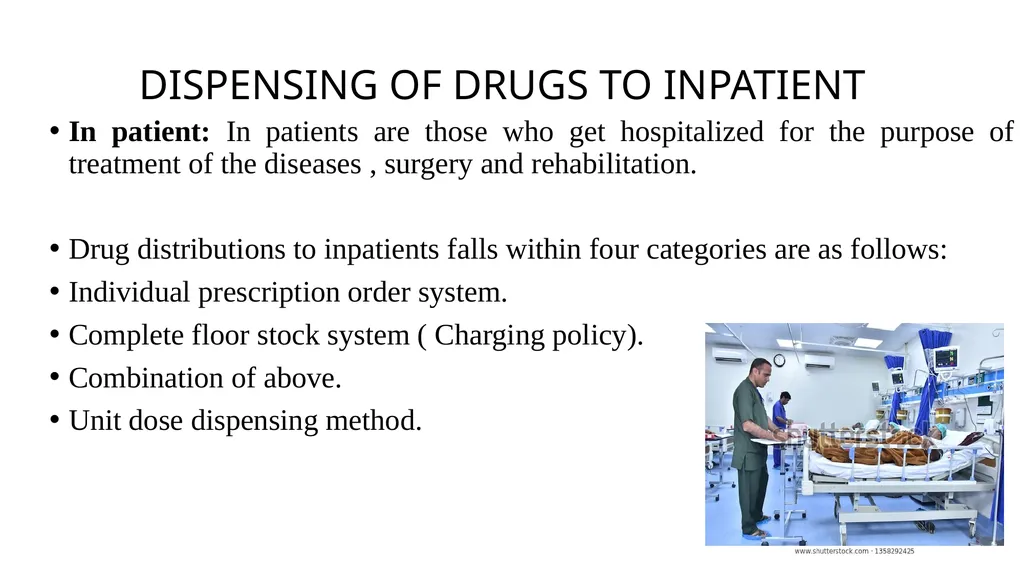
DISPENSING OF DRUGS TO INPATIENT In patient: In patients are those who get hospitalized for the purpose of treatment of the diseases , surgery and rehabilitation.
Drug distributions to inpatients falls within four categories are as follows:
Individual prescription order system.
Complete floor stock system ( Charging policy).
Combination of above.
Unit dose dispensing method.<br>
Drug distributions to inpatients falls within four categories are as follows:
Individual prescription order system.
Complete floor stock system ( Charging policy).
Combination of above.
Unit dose dispensing method.<br>
04
Individual Prescription Order System:
This system is generally used by the small or private hospital because of the less manpower requirement and the appeal for individualized service.
Advantage:
All medication order are directly reviewed by the pharmacist.
Easily interaction of pharmacist, doctor, nurse and patient in the medication matters.
Disadvantage:
Possible delay in obtaining the required medication and the increase in cost to the patient.
This system cannot be used in big hospitals.
Difficulty in Dispensing of drug in absence of pharmacist.<br>
05
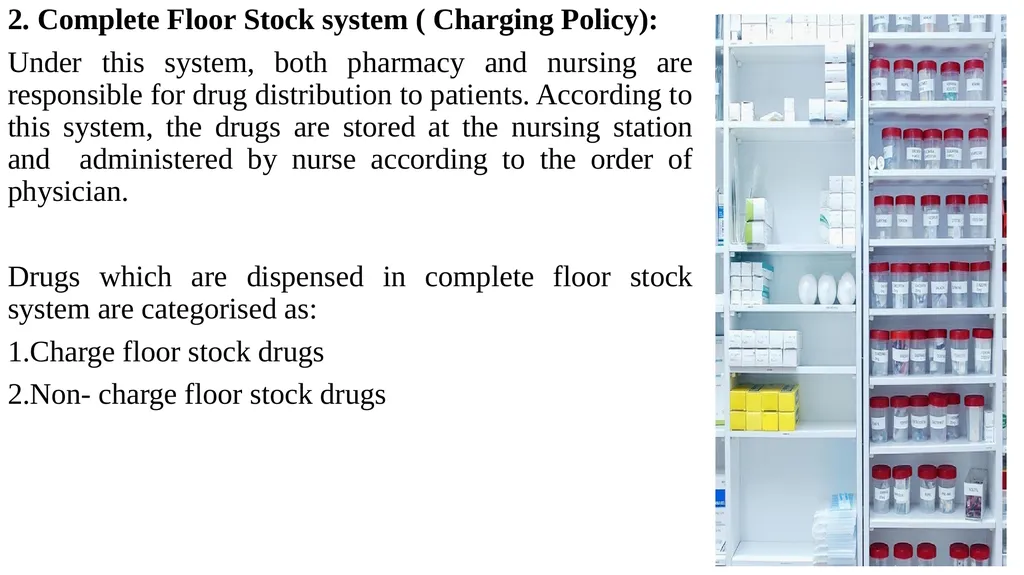
2. Complete Floor Stock system ( Charging Policy):
Under this system, both pharmacy and nursing are responsible for drug distribution to patients. According to this system, the drugs are stored at the nursing station and administered by nurse according to the order of physician.
Drugs which are dispensed in complete floor stock system are categorised as:
Charge floor stock drugs
Non- charge floor stock drugs<br>
06
a) Charge Floor Stock Drug:
Charge floor stock drugs are those where patient is charged for every single dose administered to him.
Selection of the drugs in various wards is decided by pharmacy and therapeutic committee. E.g. of drugs are antibiotics ,antihypertensive drug, anticoagulant, antiepileptic, antidepressant.
Method of dispensing charge Floor Stock Drugs:
Envelop Method: In this system, pharmacist fills a prelabelled envelops with needed drugs and gives it to nursing ward. The nurse after receiving the envelops, writes the name and room number of patients on the envelop and put it into her out basket and sent to pharmacy for costing and forward to billing section of accounting office.<br>
07
b) Non-Charge Floor stock Drugs:
Drugs are dispensed to all patients on floor on
non- Charged basis.
Method of Dispensing non- charge floor stock drugs:
Drug Basket Method: This method is adapted where nurses
verify the availability of medicines in all rooms as well as in the
refrigerator and accordingly prepare a master list of pharmacy .Nurses fill demand form for delivery of drug at the floor. When there is empty container , the nurses take it in the drug basket . ones the procedure is completed , the drug basket containing empty container and demand from for floor stock supplies sent to pharmacy.
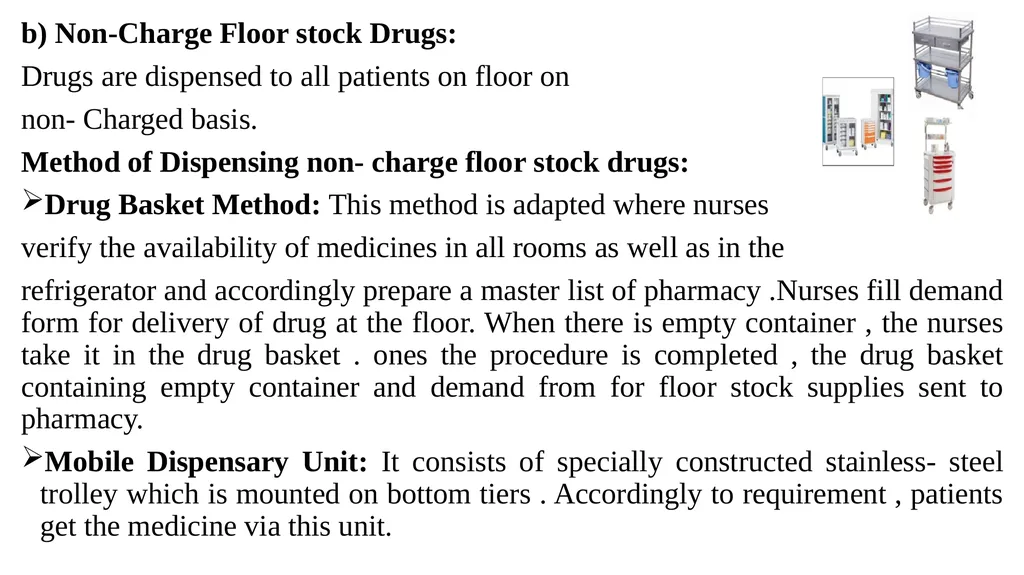
Mobile Dispensary Unit: It consists of specially constructed stainless- steel trolley which is mounted on bottom tiers . Accordingly to requirement , patients get the medicine via this unit.<br>
08
Advantage of complete floor stock system: Ready availability of the required drugs.
Minimize the return of drug to pharmacy.
Reduction in the number of pharmacy personnel required.
Disadvantage of Complete floor stock system:
Medications errors may increase.
Increased drug inventory on the porches.
Increased hazards associated with drug deterioration.
Lack of proper storage facilities on the ward may require capital outlay to provide them.<br>
09
c) Combination of Individual prescription order system and complete Floor stock system.
It is used in those hospitals , where patients have to pay for their hospitalization. In this system, their primary mean is to dispense the drugs according to individual prescription order system. Today most of the hospital uses this system. Some hospital modifies it to include the use of unit dose medications.
d)Unit Dose Dispensing:
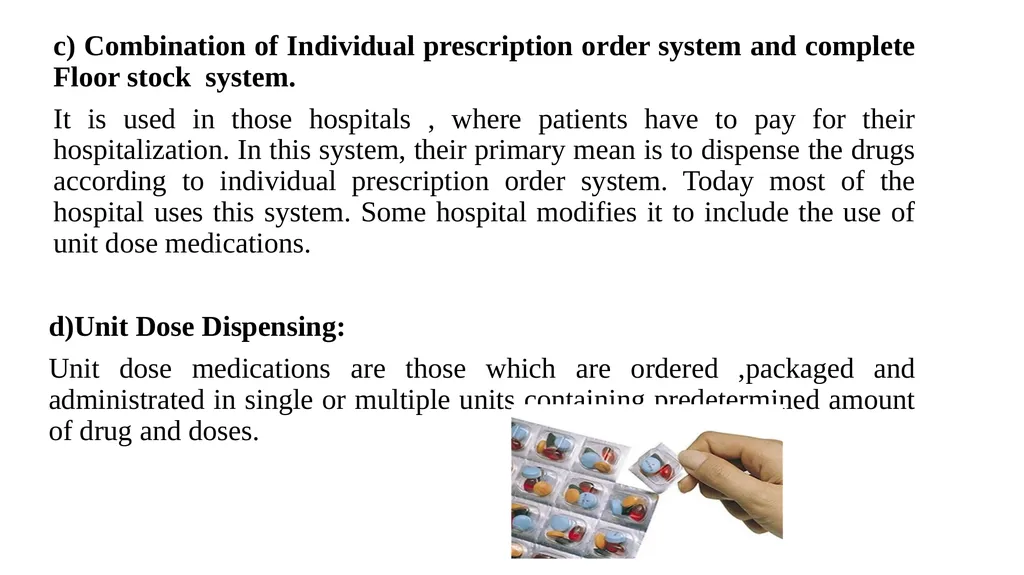
Unit dose medications are those which are ordered ,packaged and administrated in single or multiple units containing predetermined amount of drug and doses.<br>
10
Advantages of Unit dose system
Patients receive better health ,service and have to charge for those drug and doses which are administered to them.
Nurses get more time for patient care because all doses of medication are prepared by the pharmacist.
To reduce the medication errors pharmacist allow checking a copy of the physician original order.
Encourages more proficient utilizations of professional and non – professional personnel.
Reduces revenue losses.
Preserves space in nursing units by removing bulky floor stock.<br>
11
Dispensing procedure in Unit dose system:
This system could be followed by two ways:
Centralized Unit Dose Distribution system [CUDDS] and
De- centralized unit dose Distribution system[DCUDDS]
a)Centralized unit Dose system:
In this system, all the drugs are stored in central area of pharmacy and the drugs are dispensed to all inpatients in unit doses. To operate the delivery system effectively, various medication carts are used to transport unit doses to the patients and to forward a copy of the physician original medications order to the pharmacy for the direct explanation and filling.<br>
12
b) Decentralized Unit Dose system:
Unlike the centralized system , decentralized unit dose system function through small satellite pharmacies which are located on each floor of the hospital. In this system , the core pharmacy becomes a procurement , manufacturing ,storage and packaging centre which provides all medicine to all the satellites pharmacies. To delivery process of this system is accomplished by the use of medications carts. Such type of system can be used for a hospital with separate buildings.<br>
Unlike the centralized system , decentralized unit dose system function through small satellite pharmacies which are located on each floor of the hospital. In this system , the core pharmacy becomes a procurement , manufacturing ,storage and packaging centre which provides all medicine to all the satellites pharmacies. To delivery process of this system is accomplished by the use of medications carts. Such type of system can be used for a hospital with separate buildings.<br>
13
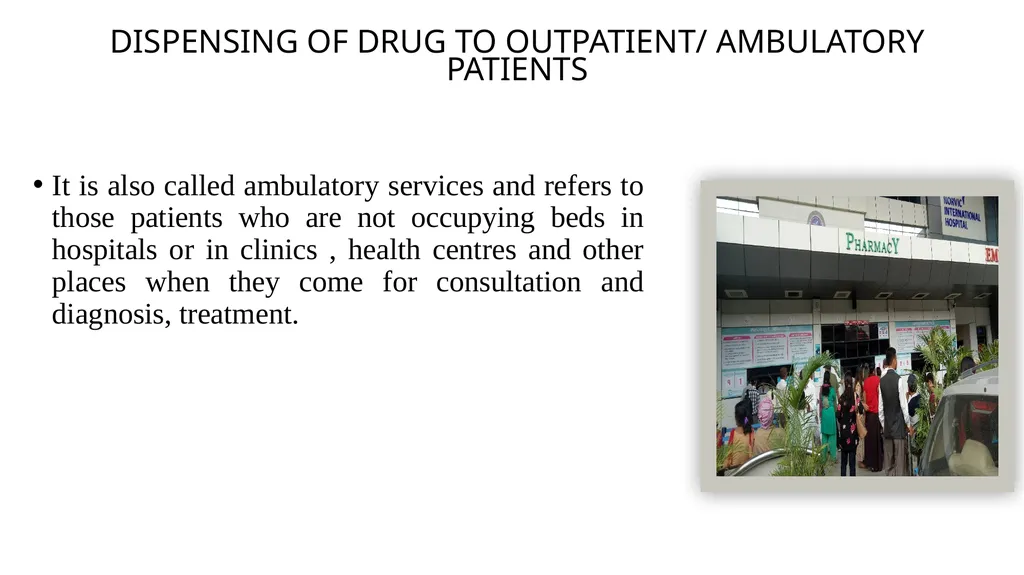
DISPENSING OF DRUG TO OUTPATIENT/ AMBULATORY PATIENTS It is also called ambulatory services and refers to those patients who are not occupying beds in hospitals or in clinics , health centres and other places when they come for consultation and diagnosis, treatment.<br>
14
Categories of Ambulatory Services:
Emergency Outpatients: For emergency outpatients, 24-hour services are given who require immediate care for survival.
Referred Outpatient: These patients are referred to the hospital for a specific purpose due to a lack of facilities available with private clinic practitioners or patients needing extra care.
Special outpatient: After the compilation of general check-ups the patients are asked to go for an accurate diagnosis by the clinical, pathological, or radiological examination. After receiving the test report of examination medicine is given to him.
General outpatient: These patients come for the general checkup and medicines are prescribed to them. They may either undertake minor surgery, superficial surgery, or dressing at the hospital.<br>
15
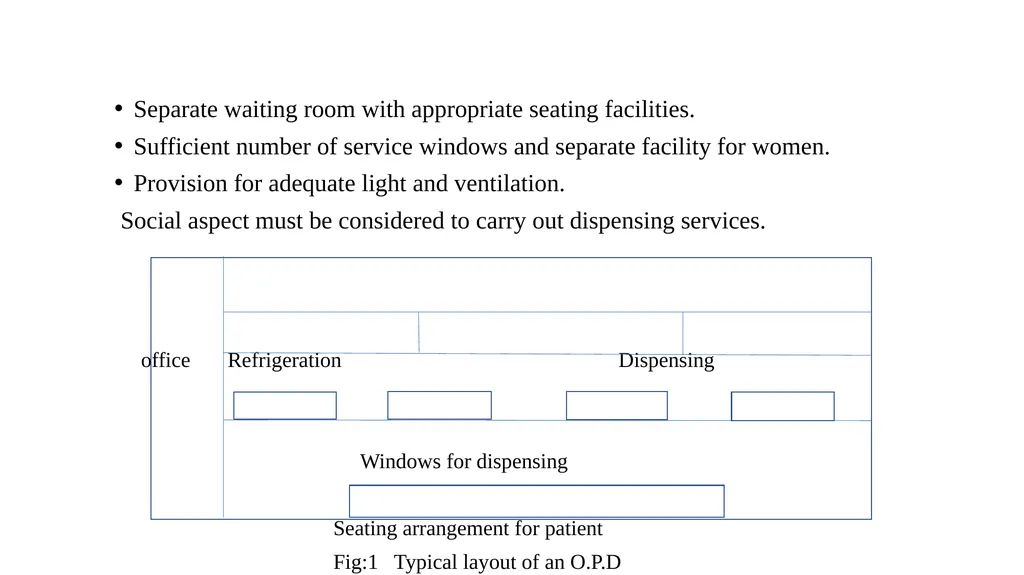
Separate waiting room with appropriate seating facilities.
Sufficient number of service windows and separate facility for women.
Provision for adequate light and ventilation.
Social aspect must be considered to carry out dispensing services.
office Refrigeration Dispensing
Windows for dispensing
Seating arrangement for patient
Fig:1 Typical layout of an O.P.D<br>
16
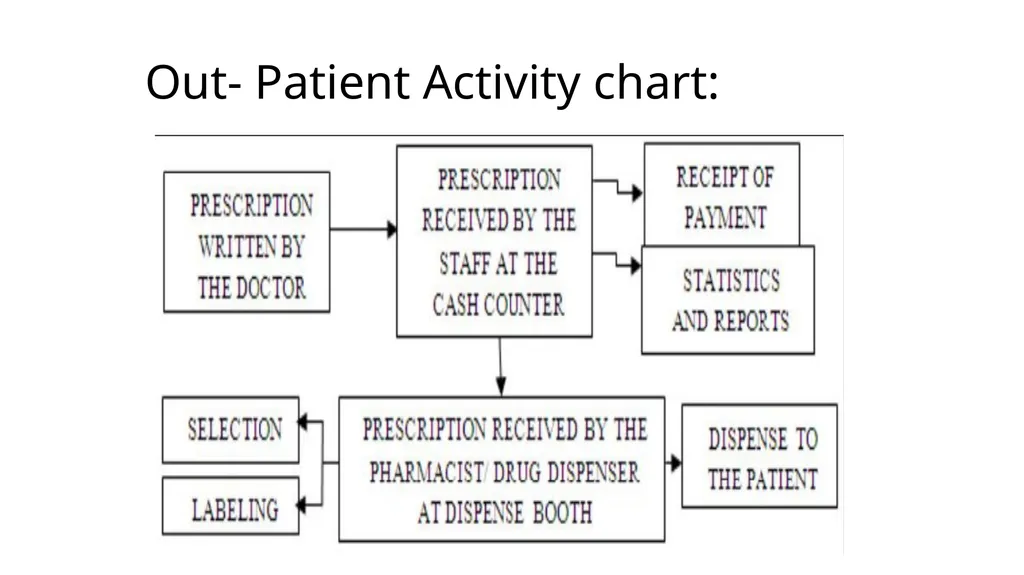
Routine Dispensing of Out- patient: Patients take written prescription by the physician, which is given to the pharmacist where it is dispensed.
Pharmacist guarantees that patient gets right medication.
Pharmacist gives instructions to patient about dispensed medicine.
Labelling of medicine.
Finally, Payment by medicine.<br>
Pharmacist guarantees that patient gets right medication.
Pharmacist gives instructions to patient about dispensed medicine.
Labelling of medicine.
Finally, Payment by medicine.<br>
17
Out- Patient Activity chart:<br>
18
SATELLITE PHARMACY SERVICES: Multi-speciality hospitals are generally design for the diagnosis and treatment of number of diseases so the concept of satellite pharmacy is adopted in such hospital which have multi-stored building in a single premises.
According to the hospital policies few days stock of medicine is stored in hospital. While main pharmacy supplies all medicine to satellites pharmacies.
Advantages:
Efficiently drugs can be distributed.
Time of drug distribution could be reduced.
Errors in drug distributions could be stop.
Disadvantage:
Effect on the financial statement of hospital.
Additional manpower is required.<br>
19
Dispensing of controlled drugs: Controlled substances is a drug or chemical which ownership, manufacture or use is the absolutely regulated by a respective government of country such as illegally used drugs or prescription medications.
These laws enforcement leads to prevention in the unauthorized use of such substances/drugs such as central analgesics (opioids), anaesthetic, steroids, etc
These controlled substances are listed following schedules.
SCHEDULE:
Schedule 1: The drugs under this schedule have high potential for abuse and have no accepted medical use in the treatment ( e.g. Marijuana , raw opium).
Schedule 2: e.g. benzodiazepine and painkiller, phenobarbitone codeine, steroids.
Schedule 3: e.g. benzodiazepine and painkiller, phenobarbitone, low strength codeine, steroids etc.<br>
20
Hospital control procedure: Following procedure and person/department is responsible for manufacture and record of control substances in hospital.
Pharmacist in chief
Head nurse
Administration head
POLICIES AND PROCEDURE FOR ORDERING OF CONTROLLED SUBSTANCES
Preparation of orders: Order of the control substances, should be made by using ink or incredible pencil, typing and duly sign by the respective doctor.
Doctors orders for administration of controlled drugs: order of control substances for ward stock must be on physician order sheet or patient chart.
Pro Re Nata orders ( PRN order): This type of order must be discouraged except under special circumstances.<br>
21
Verbal orders: In emergency cases, a doctor may give a verbal order to control substances and the nurses may write such an order sheet and later duly sign by the doctor within 24 hours. Ordering non-ward stock-controlled drugs from pharmacy: Ordering of the control substances for non-ward stock done by doctor sign and if more substances are again needed then doctor may sign again.
Ordering ward stock- controlled substances from pharmacy: Ordering of the control substances from pharmacy must be taken on the ward stock from which is completed by placing a checkmark on the opposite the name, and strength. This order from must be duly sign by the doctor.<br>
Ordering ward stock- controlled substances from pharmacy: Ordering of the control substances from pharmacy must be taken on the ward stock from which is completed by placing a checkmark on the opposite the name, and strength. This order from must be duly sign by the doctor.<br>
22
Prescribing of control Drugs in Out patient Department (OPD)
Dispensing of the controlled drugs for outpatient from pharmacy must be the made on the prescription only by clearly mentioning the strength and the quantity with duty sign of doctor. The information for such order includes:
Date.
Details of patients.
Patients hospital number.
Amount of drug ordered.
Strength.
Name of the prescriber and their signature.<br>
23
Dispensing of control drugs for house use when pharmacy is closed: When the patients are discharge from hospital or emergency ward at the time of closed of pharmacy. Occasionally such patients require drugs for use at home and such cases dispensing of drug can be done by only on prescription which must be signed by the staff who is a registered medical practioner and also authorized to prescribe control substances for this purpose.<br>
24
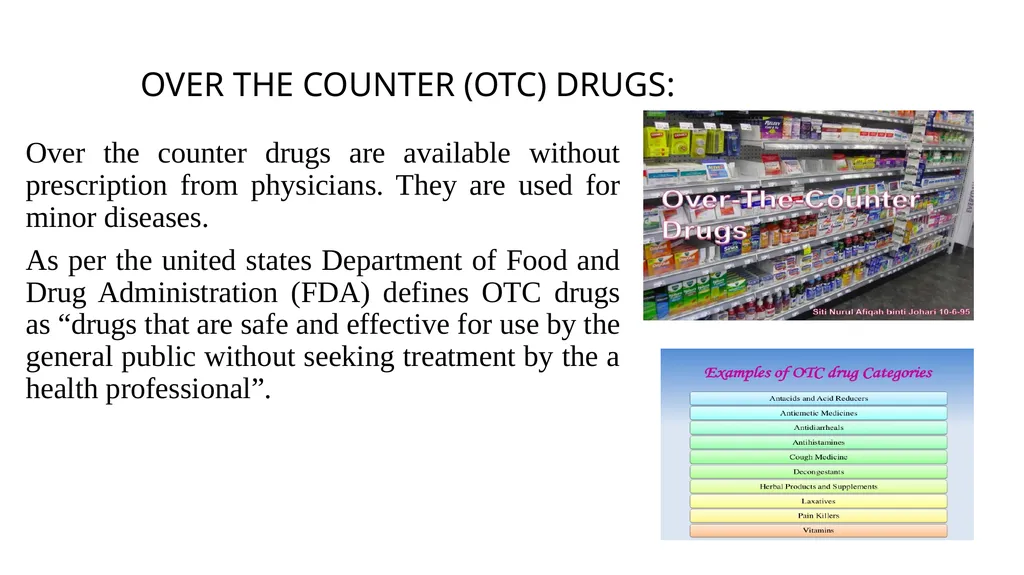
OVER THE COUNTER (OTC) DRUGS: Over the counter drugs are available without prescription from physicians. They are used for minor diseases.
As per the united states Department of Food and Drug Administration (FDA) defines OTC drugs as “drugs that are safe and effective for use by the general public without seeking treatment by the a health professional”.<br>
As per the united states Department of Food and Drug Administration (FDA) defines OTC drugs as “drugs that are safe and effective for use by the general public without seeking treatment by the a health professional”.<br>
25
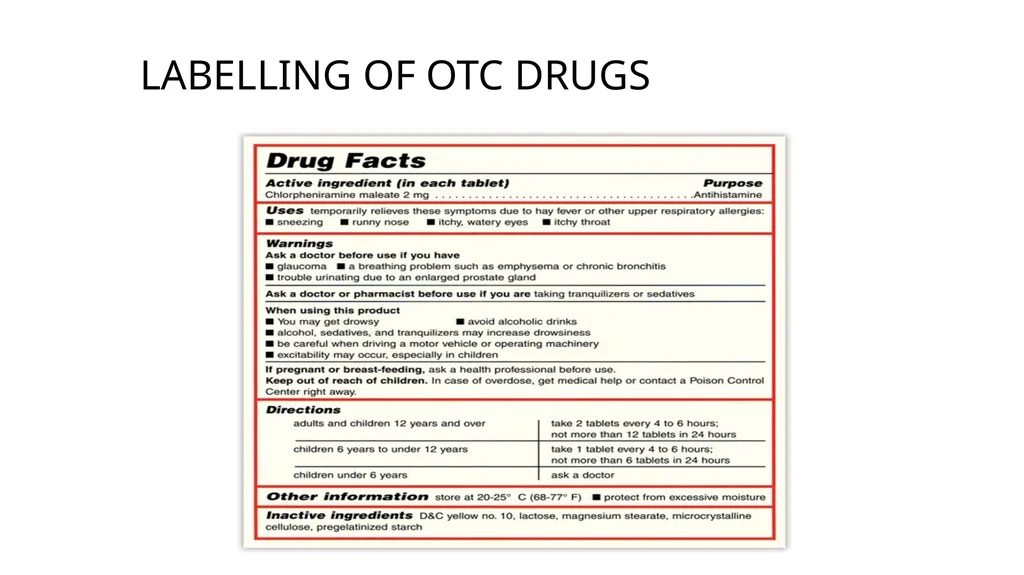
LABELLING OF OTC DRUGS<br>
26
REFERENCES: https://www.researchgate.net/publication/11043023_Drug_distribution_system_in_hospitals
https://www.ashp.org/-/media/assets/policy-guidelines/docs/technical-assistance-bulletins/technical-assistance-bulletins-hospital-drug-distribution-control.ashx
Dr.Sachin V.Tembhurne,Dr.Ashwini R . Madgulkar, A Text Book of Pharmacy Practice,First Edition,Published by Nirali Prakashan,Abhyudha Pragati,1312, Shivaji Nagar, Page no: 51-60<br>