DSD v COMMISSIONER OF POLICE FOR THE METROPOLIS

Published  . 0 views
↓ Download
DSD v COMMISSIONER OF POLICE FOR THE METROPOLIS
1 / 1
DSD v COMMISSIONER OF POLICE FOR THE METROPOLIS - slide 1 of 26 DSD v COMMISSIONER OF POLICE FOR THE METROPOLIS - slide 2 of 26 DSD v COMMISSIONER OF POLICE FOR THE METROPOLIS - slide 3 of 26 DSD v COMMISSIONER OF POLICE FOR THE METROPOLIS - slide 4 of 26 DSD v COMMISSIONER OF POLICE FOR THE METROPOLIS - slide 5 of 26 DSD v COMMISSIONER OF POLICE FOR THE METROPOLIS - slide 6 of 26 DSD v COMMISSIONER OF POLICE FOR THE METROPOLIS - slide 7 of 26 DSD v COMMISSIONER OF POLICE FOR THE METROPOLIS - slide 8 of 26 DSD v COMMISSIONER OF POLICE FOR THE METROPOLIS - slide 9 of 26 DSD v COMMISSIONER OF POLICE FOR THE METROPOLIS - slide 10 of 26 DSD v COMMISSIONER OF POLICE FOR THE METROPOLIS - slide 11 of 26 DSD v COMMISSIONER OF POLICE FOR THE METROPOLIS - slide 12 of 26 DSD v COMMISSIONER OF POLICE FOR THE METROPOLIS - slide 13 of 26 DSD v COMMISSIONER OF POLICE FOR THE METROPOLIS - slide 14 of 26 DSD v COMMISSIONER OF POLICE FOR THE METROPOLIS - slide 15 of 26 DSD v COMMISSIONER OF POLICE FOR THE METROPOLIS - slide 16 of 26 DSD v COMMISSIONER OF POLICE FOR THE METROPOLIS - slide 17 of 26 DSD v COMMISSIONER OF POLICE FOR THE METROPOLIS - slide 18 of 26 DSD v COMMISSIONER OF POLICE FOR THE METROPOLIS - slide 19 of 26 DSD v COMMISSIONER OF POLICE FOR THE METROPOLIS - slide 20 of 26 DSD v COMMISSIONER OF POLICE FOR THE METROPOLIS - slide 21 of 26 DSD v COMMISSIONER OF POLICE FOR THE METROPOLIS - slide 22 of 26 DSD v COMMISSIONER OF POLICE FOR THE METROPOLIS - slide 23 of 26 DSD v COMMISSIONER OF POLICE FOR THE METROPOLIS - slide 24 of 26 DSD v COMMISSIONER OF POLICE FOR THE METROPOLIS - slide 25 of 26 DSD v COMMISSIONER OF POLICE FOR THE METROPOLIS - slide 26 of 26
Description: DSD v COMMISSIONER OF POLICE FOR THE METROPOLIS Damages liability under the Human Rights Act: when can a victim of crime sue the police for failing to investigate? Ruth Brander, Doughty Street Chambers 6 key questions When does a duty to

Related Topics

Download Presentation

"DSD v COMMISSIONER OF POLICE FOR THE METROPOLIS" is the property of its rightful owner. Permission is granted to download and print the materials on this website for personal, non-commercial use only, and to display it on your personal computer provided you do not modify the materials and that you retain all copyright notices contained in the materials. By downloading content from our website, you accept the terms of this agreement.

Presentation Transcript

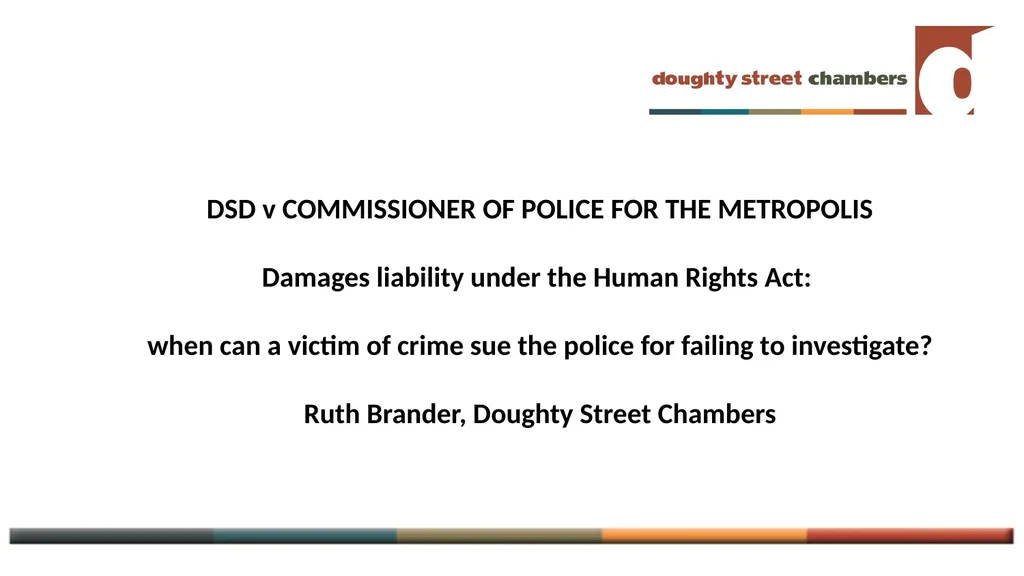
slide1. DSD v COMMISSIONER OF POLICE FOR THE METROPOLIS

Damages liability under the Human Rights Act:

when can a victim of crime sue the police for failing to investigate?

Ruth Brander, Doughty Street Chambers<br>
slide2. 6 key questions When does a duty to investigate arise? State complicity or is private crime enough?
What level of breach?
Who counts as a victim?
What is the relationship between HRA liability and the common law position?
Will damages be awarded?
What about investigative duties arising from other rights?<br>
slide3. DSD & NVB were victims of black cab rapist John Warboys
Warboys sexually assaulted over 105 women
DSD early victim – May 2003
NVB one of last victims – July 2007
Warboys finally arrested in Feb 2008
Convicted March 2009
Sentenced to indeterminate sentence min term 8 yrs<br>
slide4. DSD & NVB’s complaint Serious failings in police response to their allegations

Breach of duty to investigate – Article 3 and Article 8<br>
slide5. When does a duty to investigate arise? Police accepted duty to investigate where state complicit, but argued no duty for purely private crime – or, alternatively, that duty limited to putting in place structures to enable investigation to take place<br>
slide6. Is state complicity required? No. Positive obligation under A3 to protect those within jurisdiction from ill-treatment includes duty to take measures designed to ensure protection against ill-treatment administered by private persons.
Lord Kerr [59]-[62]<br>
slide7. Investigation of alleged breach important aspect of protection “In order to be an effective deterrent, laws which prohibit conduct constituting a breach of article 3 must be rigorously enforced and complaints of such conduct must be properly investigated. There is a clear line of Strasbourg authority for the duty properly to investigate reported offences and allegations of ill-treatment, which is summarised with approval in O’Keeffe v Ireland (2014) 59 EHRR 15, para 172”
Lord Kerr JSC, DSD [24]; Lord Mance (grudgingly) [150]<br>
slide8. What level of breach Systemic or operational?<br>
slide9. What level of breach (2) There does not have to be a structural deficiency - egregious errors in the investigation can amount to a breach. Lord Kerr JSC [30] & [58]; Lord Neuberger [85] & [92]-[99]

“given that it is rightly accepted on all sides that the authorities have an investigatory duty, it would be of little value unless it was a duty to investigate effectively” Lord Neuberger [92]<br>
slide10. What level of breach (3) “simple errors or isolated omissions will not give rise to a violation… only conspicuous or substantial errors in investigation would qualify… errors in investigation, to give rise to a breach of article 3, must be egregious and significant.” Lord Kerr JSC [29]

“conspicuous and substantial shortcomings in the conduct of the police and prosecutorial investigation… really serious operational failures” Lord Kerr JSC [53]

“… only obvious and significant shortcomings… will give rise to the possibility of a claim. There is no reason to suppose that courts will not be able to forestall challenges to police inquiries based on spurious or speculative claims.” Lord Kerr JSC [71]

“… only serious defects…” Lord Neuberger JSC [98]

“distinction to be drawn between simple errors or isolated omissions…and more serious failings” Lord Mance DPSC [151]<br>
slide11. What level of breach (4) Forensic difficulties in distinguishing between a systemic breach and an operational one – Lord Neuberger [95] & [96]

But c.f. Lord Hughes [135] – determining what constitutes a “serious and significant” failing is just as problematic

“It is evident from the way the court explains the assessment of the minimum level of severity that it is not going to be easy to predict where it falls in any individual case.” Lord Mance [151]<br>
slide12. What level of breach (5) Policy considerations will come into play:
In assessing what magnitude of failing will give rise to breach of A3 duty the courts will need to bear in mind “the difficulties involved in policing modern societies, the unpredictability of human conduct and the operational choices which must be made in terms of priorities and resources” and the need to interpret the duty “in a way which does not impose an impossible or disproportionate burden on the authorities”: Lord Neuberger JSC [92] citing Osman v UK [116]<br>
slide13. What level of breach (6) Correlation between the gravity of the underlying act and the nature and degree of scrutiny required – Lord Neuberger [98], citing Tunc v Turkey [176]; Beganovic v Croatia [78]<br>
slide14. Minimum standards for effective investigation Independent, impartial and subject to public scrutiny
Authorities must act with diligence and promptness / promptness & expedition
Authorities must take whatever reasonable steps they can to secure the evidence concerning the incident, including inter alia
a detailed statement from the alleged victim
eyewitness testimony
forensic evidence and, where appropriate
additional medical reports<br>
slide15. Minimum standards for effective investigation (2) Investigation should be capable in principle of leading to the establishment of the facts of the case and to the identification and punishment of those responsible.
Not an obligation of result, but one of means.
Any deficiency in the investigation which undermines its ability to establish the cause of injuries or the identity of the persons responsibl will risk falling foul of this standard.

Lord Kerr [38]-[43] citing Beganovic v Croatia; Vasilyev v Russia; Milanovic v Serbia; CAS v Romania; BV v Croatia; Lord Neuberger [90] citing Chernaya v Ukraine<br>
slide16. Nature of the failings in DSD Structural failings:
“The Metropolitan Police had a written policy for recognising and dealing with cases of drug induced rape but it was institutionally treated as mere form and there was no proper training in its application. The complaints made by the claimants were simply not accorded the kind of weight which they demanded because of generic failures to treat them with sufficient care and gravity. Moreover there was pressure internally to write off cases of the kind here encountered.”
Lord Hughes JSC [140]<br>
slide17. Nature of the failings in DSD (2) Operational failings:
Reception staff failed to record relevant names, addresses and vehicle registration details
Failure to interview promptly a key witness
Failure to collect CCTV evidence
Failure to link the numerous complaints made between 2003 and 2008
Failure to conduct searches of Worboys’ house.

Lord Kerr JSC [51]; Green J [2014] [285]-[313]; Laws LJ [72]-[78]<br>
slide18. Who counts as a victim? Two issues arise:
What level of criminal allegation will trigger the investigative duty?
Is it only the maker of the criminal complaint who is a victim, or, in the case of a serial offender, are individuals who would not have been attacked if there had been an effective investigation earlier also victims?<br>
slide19. What level of criminal allegation will trigger the investigative duty? Only addressed by Lord Hughes [128]:
Milanovic v Serbia: numerous cuts combined with feelings of fear and helplessness
BV v Croatia: injuries to the head and contusions to the body

“in English terms, somewhere on the scale of actual bodily harm… the great majority of violent and sexual offences will trigger the ancillary positive obligation”

c.f. MLIA v CC of Hampshire [2017] EWHC 292 (QB)<br>
slide20. Who counts as a victim? (2) Just the complainant – or other victims too?

Green J held CPM liable to NVB on 2 bases:

The prior systemic and operational failures of the MPS to investigate had caused her to be raped; and

For the period of time following the defective investigation into her case when the case had been wrongly closed and before it was reopened<br>
slide21. Lord Mance DPSC [141]
If there is an operational duty to investigate serious offences the commission of which there is no reason to attribute to state agents “then I do not see that it can or should be confined to the victim of the offence in question…if a third person suffers foreseeably as a result of a failure properly to investigate, that third person appears to me, potentially at least, to be a victim.”<br>
slide22. Relationship between liability under common law & HRA Lord Kerr JSC [66]-[72]
bases of liability are different
policy reasons which underlie absence of liability at common law do not apply to liability for breach of Convention rights – [69]-[72]

Hughes JSC [131]-[136] – endorses policy reasons from Hill v Chief Constable of West Yorkshire; Brooks v CPM; Van Colle; Smith v Chief Constable of Sussex; & Michael v CC of South Wales Police
(How does this fit with majority view in Robinson v Chief Constable of West Yorkshire?)<br>
slide23. Will damages be awarded? Police accepted public law duty to investigate (ex p Blackburn [1968] 2 QB 118) – but contended this is owed to public at large, does not give rise to damages liability to individual citizens - Kerr [8]; Hughes [130]

Damages are not automatic – Lord Kerr [63]

Purpose of compensation for breach of Convention right serves a different purpose from damages in civil action – Lord Brown, Van Colle [2009] AC 225 [138]<br>
slide24. Will damages be awarded? (2) The award of compensation for breach of A3 investigative duty “is geared principally to the upholding of standards concerning the discharge of the state’s duty to conduct proper investigations into criminal conduct which falls foul of article 3.” Lord Kerr JSC [65]<br>
slide25. Will damages be awarded? (3) Damages were awarded in this case notwithstanding damages already received from Warboys and Criminal Injuries Compensation Authority

Detailed damages judgment: Green J [2015] 1 WLR 1833<br>
slide26. Investigative obligations arising from other rights Article 2 – R (Litvinenko) v SSHD [2014] HRLR 6;
Menson v UK (2003) 37 EHRR CD220
Article 4 – OOO v CPM [2011] HRLR 29
Article 8 - DSD [2014] EWHC 436 (QB) [242];
Allen v CC of Hampshire [2013] EWCA 967 [56]&[57];
MLIA v CC of Hampshire [2017] EWHC 292 (QB);
c.f. R (Waxman) v CPS [2012] EWHC 133 (Admin);
KU v Finland (2009) 48 EHRR 52; MC v Bulgaria 40 EHRR 20; A v Croatia (Application no. 55164/08)
Lord Hughes JSC [129] – A1P1<br>